Satire Definition Is a technique employed by writers to expose and criticize foolishness and corruption of an individual or society by using humor, irony, hyperbole or ridicule. It intends to improve humanity by criticizing it. Simply put
"Satire Definition Is a technique employed by" is the property of its rightful owner. Permission is granted to
download and print the materials on this website for personal, non-commercial use only, and to display it
on your personal computer provided you do not modify the materials and that you retain all copyright
notices contained in the materials. By downloading content from our website, you accept the terms of this
agreement.
Presentation Transcript
01
Satire<br>
02
Definition Is a technique employed by writers to expose and criticize foolishness and corruption of an individual or society by using humor, irony, hyperbole or ridicule.
It intends to improve humanity by criticizing it.<br>
03
Simply put… It is a literary technique used to make fun of the vices of society…
…for the purpose of CHANGE.<br>
04
Horatian Satire Named for the Roman satirist, Horace, this playfully criticizes some social vice through gentle, mild, and light-hearted humor. It directs wit, exaggeration, and self-deprecating humor toward what it identifies as folly, rather than evil.
Horatian satire's sympathetic tone is common in modern society.
Examples of Horatian Satire: C.S. Lewis's "Screwtape Letters” Alexander Pope's "The Rape of the Lock"<br>
05
Juvenalian Satire Named after the Roman satirist Juvenal, this type of satire is more contemptuous and abrasive than the Horatian.
Juvenalian satire addresses social evil through scorn, outrage, and savage ridicule. This form is often pessimistic, characterized by irony, sarcasm and moral indignation, with less emphasis on humor.
Examples of Juvenalian: George Orwell's "Nineteen Eighty-Four" and "Animal Farm" Ray Bradbury's "Fahrenheit 451” Jonathan Swift's "A Modest Proposal”<br>
06
Elements of Satire (The speaker/writer uses one or more elements of satire in the text) Parody: an imitation of the style of a particular writer, artist, or genre with deliberate exaggeration for comic effect. (think Weird Al)
Ridicule: the subjection of someone or something to contemptuous and dismissive language or behavior.
Hyperbole: Exaggeration to make a point.
Irony: Expression of one’s meaning by using language that signifies the opposite, typically for humorous or emphatic effect.<br>
07
More on Irony Irony is the tension between what the audience expects to happen and what actually happens.
Dramatic irony —the audience knows something a character does not
Verbal irony —a character means the opposite of what he or she says
Situational irony —the outcome of the situation is opposite of what is expected<br>
08
More Elements of Satire Sarcasm: The use of irony to mock or convey contempt. Intent to hurt.
Understatement: the presentation of something as being smaller, worse, or less important than it actually is.
Caricature: description of a person using exaggeration of some characteristics and oversimplification of others.
Reversal: Presents the opposite of normal order.
Incongruity: Presents things that are absurd in relation to the surroundings.<br>
09
Forms of Satire Drama (Tartuffe – Moliere, The Importance of Being
Earnest – Oscar Wilde )
Journalism (The Onion)
Fiction (A Modest Proposal – Jonathan Swift, The Lowest Animal – Mark Twain)
Poetry (The Rape of the Locke – Alexander Pope)
Graphic Arts (editorial cartoons)
Television programs (Saturday Night Live, The
Colbert Report)
Music (With God on Our Side – Bob Dylan, Weird Al)<br>
10
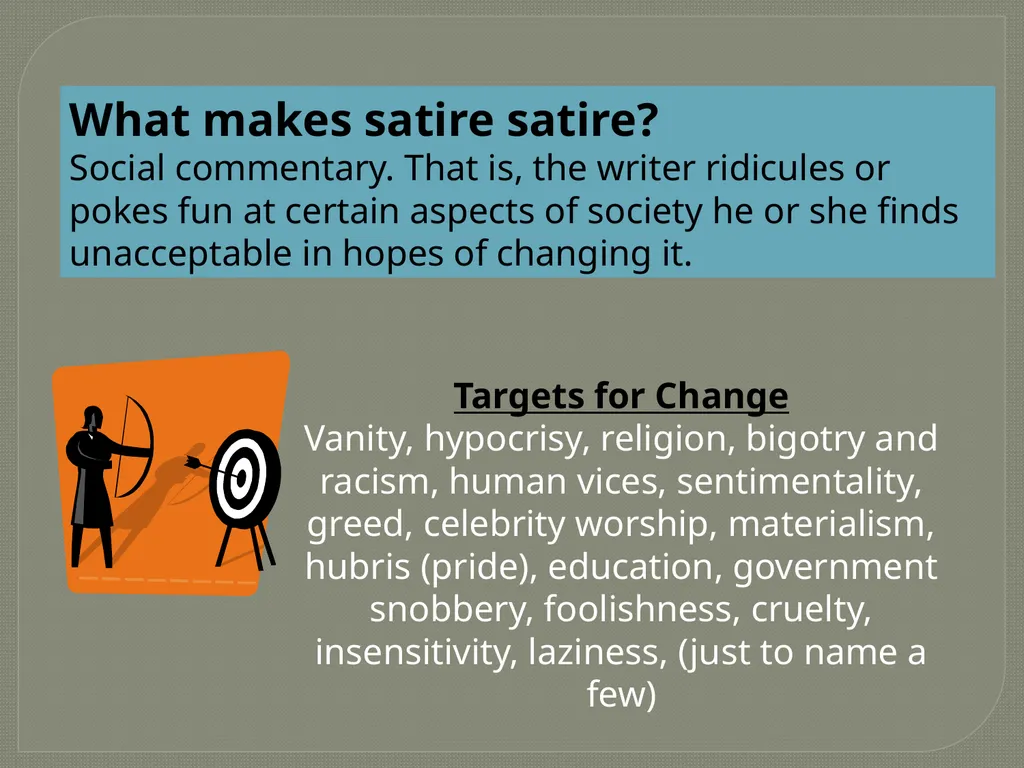
What makes satire satire?
Social commentary. That is, the writer ridicules or pokes fun at certain aspects of society he or she finds unacceptable in hopes of changing it. Targets for Change
Vanity, hypocrisy, religion, bigotry and racism, human vices, sentimentality, greed, celebrity worship, materialism, hubris (pride), education, government
snobbery, foolishness, cruelty, insensitivity, laziness, (just to name a few)<br>
11
Examples of Satire in Pop Culture Saturday Night Live’s Weekend Update
The Daily Show
Scary Movie
The Simpsons
Political cartoons
Family Guy
South Park<br>
12
Why Satire? Now that you know the elements of satire, what do you think makes satire effective?
Why do writers use satire instead of criticizing the person, group or institution directly?<br>
13
A Satirist (person who writes satire): Uses laughter as a weapon
Mixes criticism with humor…
…but does not stoop to insults or abusive language
Tries to get people to think critically about the issue being discussed
Tries to inspire people to improve or reform the situation<br>
14
Your Turn As you read satire, consider the following questions
What is the issue being targeted in the work?
How does the creator seem to feel about the issue?
What does s/he seem to think should change about the issue? A Modest Proposal Reference<br>