
Save the Black Sea – the challenge to understand
KL
Published · 5 slides · 0 views

1 / 1
Description
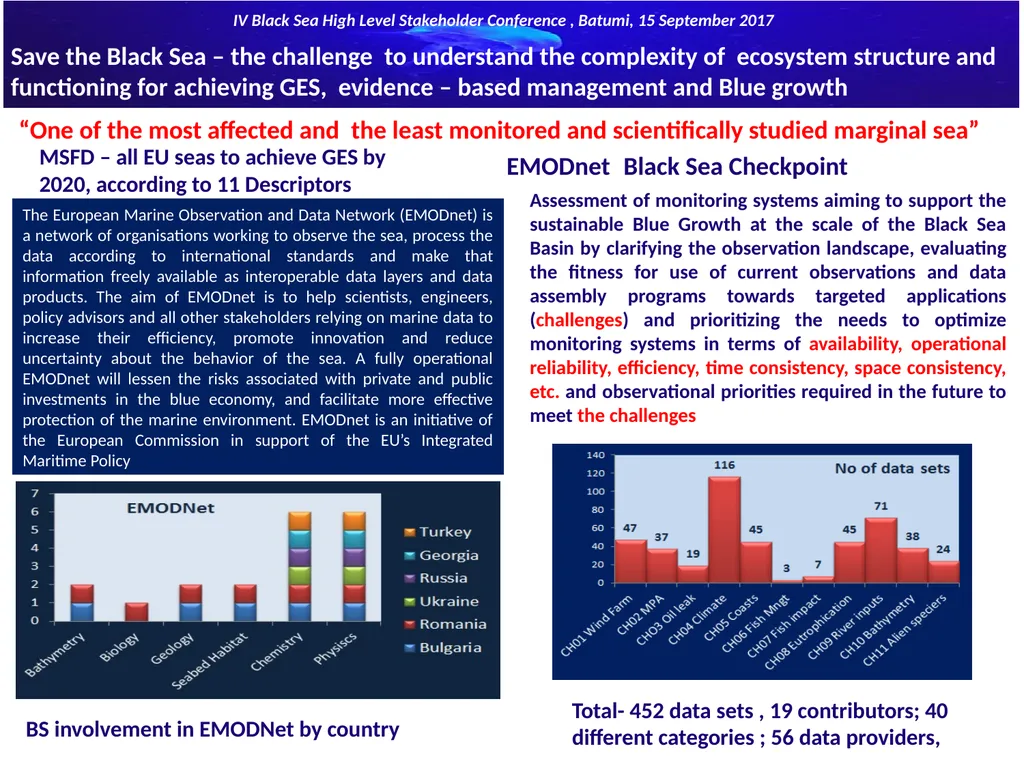
Save the Black Sea the challenge to understand the complexity of ecosystem structure and functioning for achieving GES, evidence based management and Blue growth Total- 452 data sets , 19 contributors; 40 different categories ; 56 data
Related Topics
Share
Embed code
Download this presentation From Below
"Save the Black Sea – the challenge to understand" is the property of its rightful owner. Permission is granted to download and print the materials on this website for personal, non-commercial use only, and to display it on your personal computer provided you do not modify the materials and that you retain all copyright notices contained in the materials. By downloading content from our website, you accept the terms of this agreement.
Presentation Transcript
01
Save the Black Sea – the challenge to understand the complexity of ecosystem structure and functioning for achieving GES, evidence – based management and Blue growth Total- 452 data sets , 19 contributors; 40 different categories ; 56 data providers, IV Black Sea High Level Stakeholder Conference , Batumi, 15 September 2017 “One of the most affected and the least monitored and scientifically studied marginal sea” The European Marine Observation and Data Network (EMODnet) is a network of organisations working to observe the sea, process the data according to international standards and make that information freely available as interoperable data layers and data products. The aim of EMODnet is to help scientists, engineers, policy advisors and all other stakeholders relying on marine data to increase their efficiency, promote innovation and reduce uncertainty about the behavior of the sea. A fully operational EMODnet will lessen the risks associated with private and public investments in the blue economy, and facilitate more effective protection of the marine environment. EMODnet is an initiative of the European Commission in support of the EU’s Integrated Maritime Policy MSFD – all EU seas to achieve GES by 2020, according to 11 Descriptors BS involvement in EMODNet by country<br>
02
Key findings of the “stress-test”
unique and timely evaluation of the state of BS marine data availability and level of preparedness for use and gaps
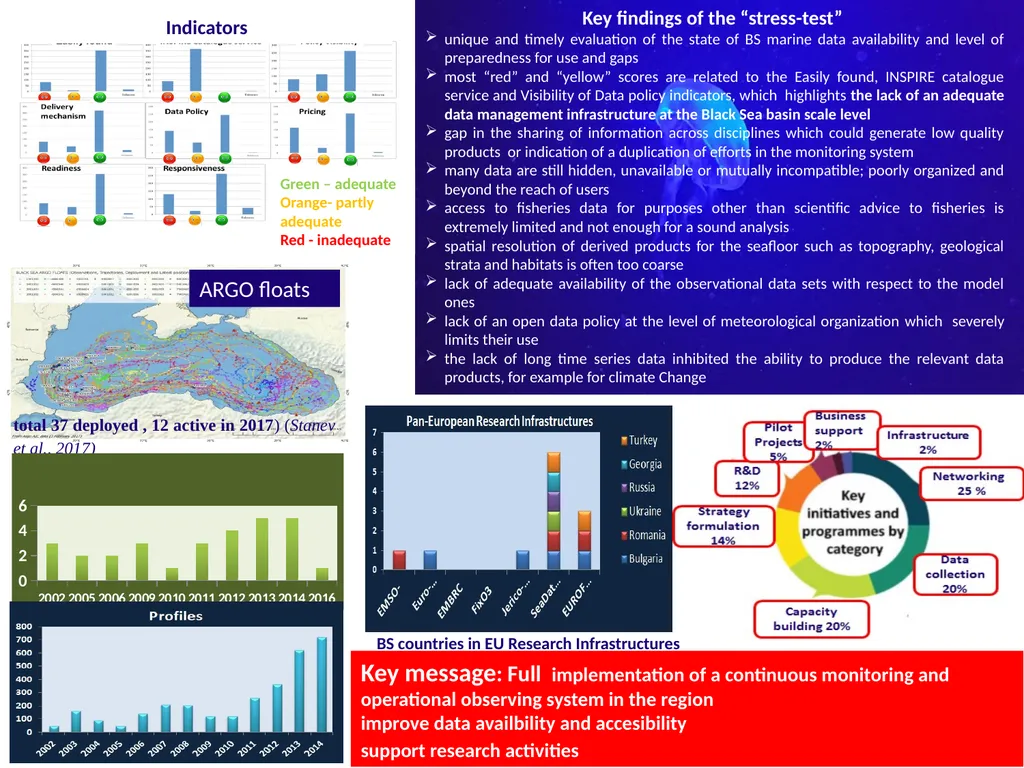
most “red” and “yellow” scores are related to the Easily found, INSPIRE catalogue service and Visibility of Data policy indicators, which highlights the lack of an adequate data management infrastructure at the Black Sea basin scale level
gap in the sharing of information across disciplines which could generate low quality products or indication of a duplication of efforts in the monitoring system
many data are still hidden, unavailable or mutually incompatible; poorly organized and beyond the reach of users
access to fisheries data for purposes other than scientific advice to fisheries is extremely limited and not enough for a sound analysis
spatial resolution of derived products for the seafloor such as topography, geological strata and habitats is often too coarse
lack of adequate availability of the observational data sets with respect to the model ones
lack of an open data policy at the level of meteorological organization which severely limits their use
the lack of long time series data inhibited the ability to produce the relevant data products, for example for climate Change ARGO floats BS countries in EU Research Infrastructures Key message: Full implementation of a continuous monitoring and operational observing system in the region
improve data availbility and accesibility
support research activities<br>
unique and timely evaluation of the state of BS marine data availability and level of preparedness for use and gaps
most “red” and “yellow” scores are related to the Easily found, INSPIRE catalogue service and Visibility of Data policy indicators, which highlights the lack of an adequate data management infrastructure at the Black Sea basin scale level
gap in the sharing of information across disciplines which could generate low quality products or indication of a duplication of efforts in the monitoring system
many data are still hidden, unavailable or mutually incompatible; poorly organized and beyond the reach of users
access to fisheries data for purposes other than scientific advice to fisheries is extremely limited and not enough for a sound analysis
spatial resolution of derived products for the seafloor such as topography, geological strata and habitats is often too coarse
lack of adequate availability of the observational data sets with respect to the model ones
lack of an open data policy at the level of meteorological organization which severely limits their use
the lack of long time series data inhibited the ability to produce the relevant data products, for example for climate Change ARGO floats BS countries in EU Research Infrastructures Key message: Full implementation of a continuous monitoring and operational observing system in the region
improve data availbility and accesibility
support research activities<br>
03
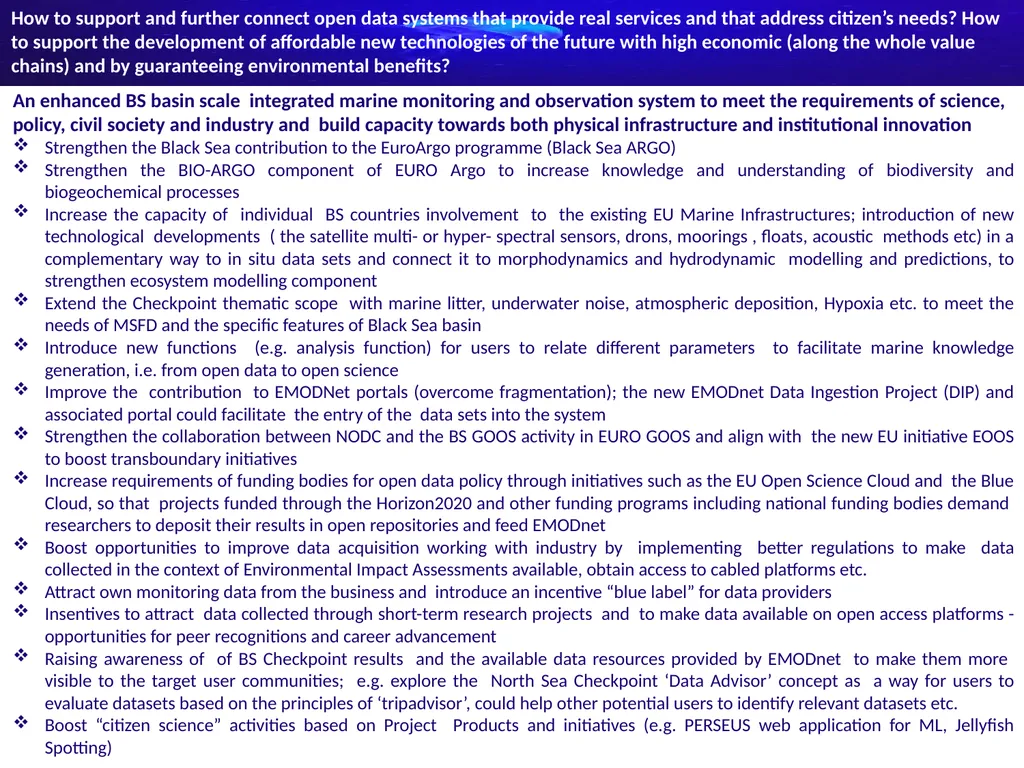
An enhanced BS basin scale integrated marine monitoring and observation system to meet the requirements of science, policy, civil society and industry and build capacity towards both physical infrastructure and institutional innovation
Strengthen the Black Sea contribution to the EuroArgo programme (Black Sea ARGO)
Strengthen the BIO-ARGO component of EURO Argo to increase knowledge and understanding of biodiversity and biogeochemical processes
Increase the capacity of individual BS countries involvement to the existing EU Marine Infrastructures; introduction of new technological developments ( the satellite multi- or hyper- spectral sensors, drons, moorings , floats, acoustic methods etc) in a complementary way to in situ data sets and connect it to morphodynamics and hydrodynamic modelling and predictions, to strengthen ecosystem modelling component
Extend the Checkpoint thematic scope with marine litter, underwater noise, atmospheric deposition, Hypoxia etc. to meet the needs of MSFD and the specific features of Black Sea basin
Introduce new functions (e.g. analysis function) for users to relate different parameters to facilitate marine knowledge generation, i.e. from open data to open science
Improve the contribution to EMODNet portals (overcome fragmentation); the new EMODnet Data Ingestion Project (DIP) and associated portal could facilitate the entry of the data sets into the system
Strengthen the collaboration between NODC and the BS GOOS activity in EURO GOOS and align with the new EU initiative EOOS to boost transboundary initiatives
Increase requirements of funding bodies for open data policy through initiatives such as the EU Open Science Cloud and the Blue Cloud, so that projects funded through the Horizon2020 and other funding programs including national funding bodies demand researchers to deposit their results in open repositories and feed EMODnet
Boost opportunities to improve data acquisition working with industry by implementing better regulations to make data collected in the context of Environmental Impact Assessments available, obtain access to cabled platforms etc.
Attract own monitoring data from the business and introduce an incentive “blue label” for data providers
Insentives to attract data collected through short-term research projects and to make data available on open access platforms - opportunities for peer recognitions and career advancement
Raising awareness of of BS Checkpoint results and the available data resources provided by EMODnet to make them more visible to the target user communities; e.g. explore the North Sea Checkpoint ‘Data Advisor’ concept as a way for users to evaluate datasets based on the principles of ‘tripadvisor’, could help other potential users to identify relevant datasets etc.
Boost “citizen science” activities based on Project Products and initiatives (e.g. PERSEUS web application for ML, Jellyfish Spotting) How to support and further connect open data systems that provide real services and that address citizen’s needs? How to support the development of affordable new technologies of the future with high economic (along the whole value chains) and by guaranteeing environmental benefits?<br>
Strengthen the Black Sea contribution to the EuroArgo programme (Black Sea ARGO)
Strengthen the BIO-ARGO component of EURO Argo to increase knowledge and understanding of biodiversity and biogeochemical processes
Increase the capacity of individual BS countries involvement to the existing EU Marine Infrastructures; introduction of new technological developments ( the satellite multi- or hyper- spectral sensors, drons, moorings , floats, acoustic methods etc) in a complementary way to in situ data sets and connect it to morphodynamics and hydrodynamic modelling and predictions, to strengthen ecosystem modelling component
Extend the Checkpoint thematic scope with marine litter, underwater noise, atmospheric deposition, Hypoxia etc. to meet the needs of MSFD and the specific features of Black Sea basin
Introduce new functions (e.g. analysis function) for users to relate different parameters to facilitate marine knowledge generation, i.e. from open data to open science
Improve the contribution to EMODNet portals (overcome fragmentation); the new EMODnet Data Ingestion Project (DIP) and associated portal could facilitate the entry of the data sets into the system
Strengthen the collaboration between NODC and the BS GOOS activity in EURO GOOS and align with the new EU initiative EOOS to boost transboundary initiatives
Increase requirements of funding bodies for open data policy through initiatives such as the EU Open Science Cloud and the Blue Cloud, so that projects funded through the Horizon2020 and other funding programs including national funding bodies demand researchers to deposit their results in open repositories and feed EMODnet
Boost opportunities to improve data acquisition working with industry by implementing better regulations to make data collected in the context of Environmental Impact Assessments available, obtain access to cabled platforms etc.
Attract own monitoring data from the business and introduce an incentive “blue label” for data providers
Insentives to attract data collected through short-term research projects and to make data available on open access platforms - opportunities for peer recognitions and career advancement
Raising awareness of of BS Checkpoint results and the available data resources provided by EMODnet to make them more visible to the target user communities; e.g. explore the North Sea Checkpoint ‘Data Advisor’ concept as a way for users to evaluate datasets based on the principles of ‘tripadvisor’, could help other potential users to identify relevant datasets etc.
Boost “citizen science” activities based on Project Products and initiatives (e.g. PERSEUS web application for ML, Jellyfish Spotting) How to support and further connect open data systems that provide real services and that address citizen’s needs? How to support the development of affordable new technologies of the future with high economic (along the whole value chains) and by guaranteeing environmental benefits?<br>
04
Capitalize on the SEA-ERA Project and upgrade the SRA into Research and Innovation Agenda for the Black Sea
Formulate dedicated “thematic expert groups” to formulate research priorities
Create a maritime innovation hub bringing together the research community, naval actors and industry stakeholders (Blue Economy Business and Science Forum initiative)
Development of cross-sectoral and cross border industrial value chains (smart specialization)
Consider Sector specific user challenges in the context of Blue Growth- EMODnet to organize dedicated basin scale workshops to bring together stakeholders of specific sectors
Promote exchange of knowledge, best practices and cooperation among different countries and networks to a harmonized, comprehensive assessment and monitoring activities, as a basis for implementation of MSFD ( initiated at the level of AG to the BS Comission)
Research to address gaps in knowledge of environment, maritime economy and human health by addressing the combined effect of short –term decadal-scale climate variation and anthropogenic pressures
Establish a portal and a flexible system, temporarily engaging experts in hubs to address emergency issues and ensure rapid advice from science to policy on risk assessment and possible scientific and technological solutions
Enhance the networks of research institutions to address current barriers to a common understanding and coherent assessment of GES in the BS basin based on harmonised indicators
Support to pilot phases of research on promising prospects (here the example of H production from H2S and Gas hydrate) and the needs of specific Blue Growth sectors (marine bio-discovery, bio-based innovative industries and services, producing for instance food ingredients, pharmaceuticals, cosmetics, chemicals, materials and energy)
New concepts and protocols to be developed by private companies and maritime operators to maximise the use
of infrastructure, ships and platforms for scientific, environmental, safety and security purposes
Dedicated thematic calls addressing innovation and research related to Blue growth for fund raising at all levels (EU Programs and regional initiatives- BS CBC, INTERREG – Blue-Med Sea, NSFunds, Operational Programs for Smart Growth (BG and RO), Academic bilateral cooperation, etc)<br>
Formulate dedicated “thematic expert groups” to formulate research priorities
Create a maritime innovation hub bringing together the research community, naval actors and industry stakeholders (Blue Economy Business and Science Forum initiative)
Development of cross-sectoral and cross border industrial value chains (smart specialization)
Consider Sector specific user challenges in the context of Blue Growth- EMODnet to organize dedicated basin scale workshops to bring together stakeholders of specific sectors
Promote exchange of knowledge, best practices and cooperation among different countries and networks to a harmonized, comprehensive assessment and monitoring activities, as a basis for implementation of MSFD ( initiated at the level of AG to the BS Comission)
Research to address gaps in knowledge of environment, maritime economy and human health by addressing the combined effect of short –term decadal-scale climate variation and anthropogenic pressures
Establish a portal and a flexible system, temporarily engaging experts in hubs to address emergency issues and ensure rapid advice from science to policy on risk assessment and possible scientific and technological solutions
Enhance the networks of research institutions to address current barriers to a common understanding and coherent assessment of GES in the BS basin based on harmonised indicators
Support to pilot phases of research on promising prospects (here the example of H production from H2S and Gas hydrate) and the needs of specific Blue Growth sectors (marine bio-discovery, bio-based innovative industries and services, producing for instance food ingredients, pharmaceuticals, cosmetics, chemicals, materials and energy)
New concepts and protocols to be developed by private companies and maritime operators to maximise the use
of infrastructure, ships and platforms for scientific, environmental, safety and security purposes
Dedicated thematic calls addressing innovation and research related to Blue growth for fund raising at all levels (EU Programs and regional initiatives- BS CBC, INTERREG – Blue-Med Sea, NSFunds, Operational Programs for Smart Growth (BG and RO), Academic bilateral cooperation, etc)<br>
05
How can brain circulation between research, education/training and business communities be promoted in the region? We need adequate data to improve knowledge and build wisdom to translate knowledge into evidence-based management and sustainable Blue growth
“In order to explore the full potential of open marine data and innovation, interoperability is the key: interoperability of technologies, interoperability of data and interoperability of people”
Need of a coherent Black Sea Program (BONUS like) to set a structured Black Sea basin research and innovation agenda and coordinate activities to maximise common assets for the entire region Actions to foster the development of innovative maritime knowledge and skills through a range of strategic actions to match demand and supply (Knowledge and Innovation Communities – KICs initiative):
Promote capacity building and advanced training on sustainable blue growth, and incentives for networking and exchanges between maritime institutes and academies at regional and national level
Develop new curricula and share capacities
Exchange know-how to educate and train seafarers and fishermen.
Improve student circulation
Establish maritime/blue economy training centres
Advanced Training School on Sustainable Blue Growth
Establish an international platform for exchanging scientific knowledge and technological know-how in the field of sustainable blue growth for the benefit of BS countries
Improving access to scientific information, virtual research environments and results on marine knowledge,
Explore web-based on-line domain for boosting ocean literacy
Marine biotechnology (blue biotechnology) uses resources from living organisms at sea either as a source or as a target of biotechnology applications. This vast field covers knowledge and tools from fields such as molecular biology, genomics, proteomics, metabolomics, cell biology and physiology or ecology to render applications to food (aquaculture), human health and wellbeing (anticancer drugs, pain killers, antibiotics, cosmetics, or nutraceuticals),conservation (habitat restoration or bioremediation of marine ecosystems) and new industrial products and processes (enzymes, biopolymers, biomaterials or algae biorefineries) – Need to build reasearch capacity in the BS region
Raise awareness of maritime professions and make them more attractive to young people, and to increase cooperation between maritime education institutes and industry, Mobilize the capacities of BS universities, high schools, The Black Sea University Network, EU training cources and Summer schools, ERASMUS Programm, COST action, the Commission's Blue Careers Initiative , International networking (BlueMed initiatives), the launched in 2017 dedicated assistance mechanism “Facility for blue economy development”<br>
“In order to explore the full potential of open marine data and innovation, interoperability is the key: interoperability of technologies, interoperability of data and interoperability of people”
Need of a coherent Black Sea Program (BONUS like) to set a structured Black Sea basin research and innovation agenda and coordinate activities to maximise common assets for the entire region Actions to foster the development of innovative maritime knowledge and skills through a range of strategic actions to match demand and supply (Knowledge and Innovation Communities – KICs initiative):
Promote capacity building and advanced training on sustainable blue growth, and incentives for networking and exchanges between maritime institutes and academies at regional and national level
Develop new curricula and share capacities
Exchange know-how to educate and train seafarers and fishermen.
Improve student circulation
Establish maritime/blue economy training centres
Advanced Training School on Sustainable Blue Growth
Establish an international platform for exchanging scientific knowledge and technological know-how in the field of sustainable blue growth for the benefit of BS countries
Improving access to scientific information, virtual research environments and results on marine knowledge,
Explore web-based on-line domain for boosting ocean literacy
Marine biotechnology (blue biotechnology) uses resources from living organisms at sea either as a source or as a target of biotechnology applications. This vast field covers knowledge and tools from fields such as molecular biology, genomics, proteomics, metabolomics, cell biology and physiology or ecology to render applications to food (aquaculture), human health and wellbeing (anticancer drugs, pain killers, antibiotics, cosmetics, or nutraceuticals),conservation (habitat restoration or bioremediation of marine ecosystems) and new industrial products and processes (enzymes, biopolymers, biomaterials or algae biorefineries) – Need to build reasearch capacity in the BS region
Raise awareness of maritime professions and make them more attractive to young people, and to increase cooperation between maritime education institutes and industry, Mobilize the capacities of BS universities, high schools, The Black Sea University Network, EU training cources and Summer schools, ERASMUS Programm, COST action, the Commission's Blue Careers Initiative , International networking (BlueMed initiatives), the launched in 2017 dedicated assistance mechanism “Facility for blue economy development”<br>