
SB 819: Abbreviated School Day Program Placement
CS
Published · 32 slides · 0 views
1 / 1




Description
SB 819: Abbreviated School Day Program Placement Train-the-Trainer Series Introduction and Overview Oregon Department of Education 1 These materials constitute the Oregon Department of Educations interpretation of various state laws and
Related Topics
Share
Embed code
Download this presentation From Below
"SB 819: Abbreviated School Day Program Placement" is the property of its rightful owner. Permission is granted to download and print the materials on this website for personal, non-commercial use only, and to display it on your personal computer provided you do not modify the materials and that you retain all copyright notices contained in the materials. By downloading content from our website, you accept the terms of this agreement.
Presentation Transcript
01
SB 819: Abbreviated School Day Program Placement Train-the-Trainer Series
Introduction and Overview Oregon Department of Education 1<br>
Introduction and Overview Oregon Department of Education 1<br>
02
These materials constitute the Oregon Department of Education’s interpretation of various state laws and are provided to support public education programs’ understanding of their obligations under these laws. The information in these materials is subject to change based on future legal and policy changes. These materials are intended for informational purposes only and do not constitute legal advice. Oregon Department of Education 2 Disclaimer<br>
03
Education equity is the equitable and anti-racist implementation of policy, practices, procedures, and legislation that translates into resource allocation, education rigor, and opportunities for historically and currently marginalized youth, students, and families including civil rights protected classes.
This means the restructuring and dismantling of systems and institutions that create the dichotomy of beneficiaries and the oppressed and marginalized. Oregon Department of Education 3 Our Equity Stance<br>
This means the restructuring and dismantling of systems and institutions that create the dichotomy of beneficiaries and the oppressed and marginalized. Oregon Department of Education 3 Our Equity Stance<br>
04
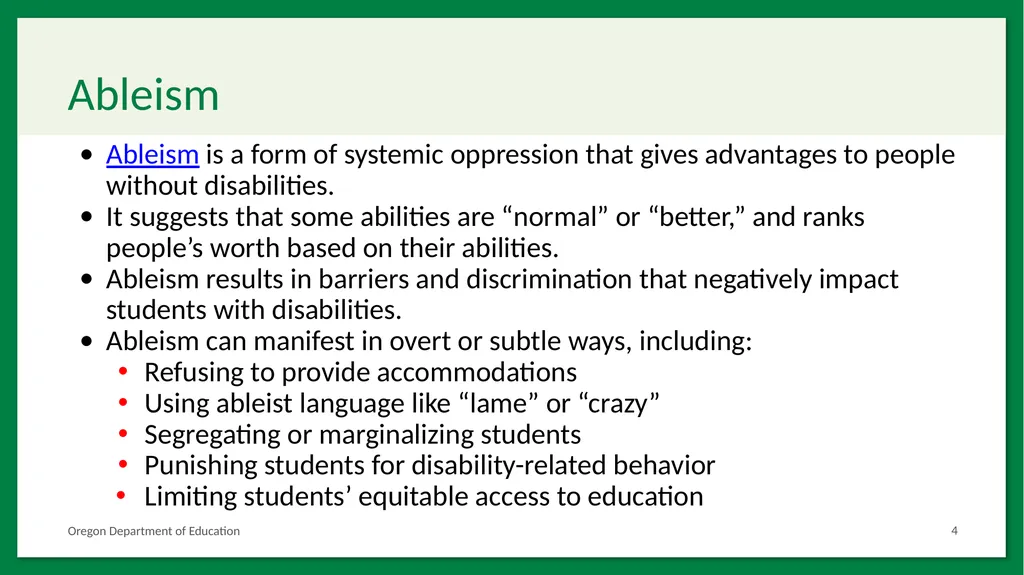
Ableism is a form of systemic oppression that gives advantages to people without disabilities.
It suggests that some abilities are “normal” or “better,” and ranks people’s worth based on their abilities.
Ableism results in barriers and discrimination that negatively impact students with disabilities.
Ableism can manifest in overt or subtle ways, including:
Refusing to provide accommodations
Using ableist language like “lame” or “crazy”
Segregating or marginalizing students
Punishing students for disability-related behavior
Limiting students’ equitable access to education Oregon Department of Education 4 Ableism<br>
It suggests that some abilities are “normal” or “better,” and ranks people’s worth based on their abilities.
Ableism results in barriers and discrimination that negatively impact students with disabilities.
Ableism can manifest in overt or subtle ways, including:
Refusing to provide accommodations
Using ableist language like “lame” or “crazy”
Segregating or marginalizing students
Punishing students for disability-related behavior
Limiting students’ equitable access to education Oregon Department of Education 4 Ableism<br>
05
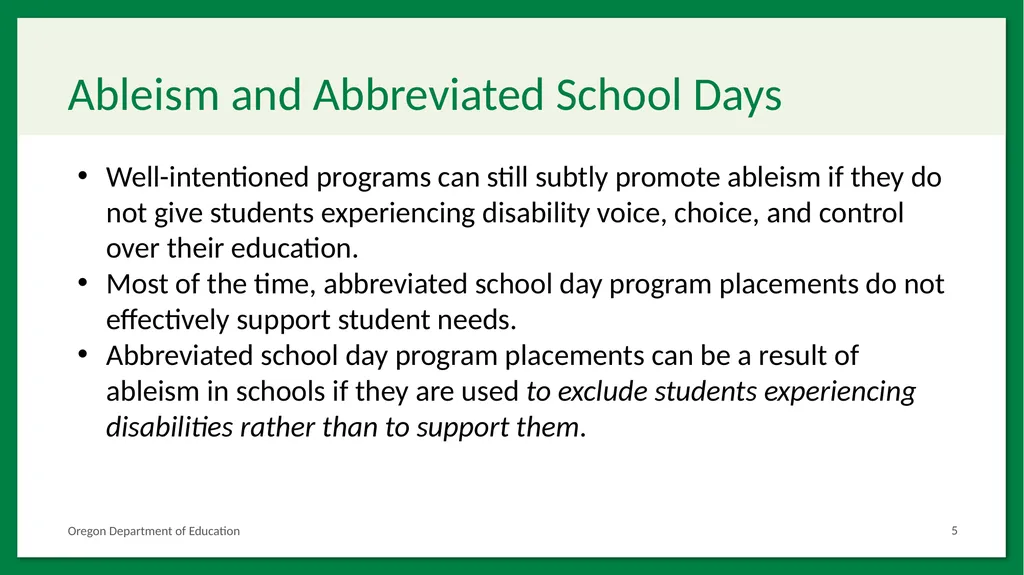
Well-intentioned programs can still subtly promote ableism if they do not give students experiencing disability voice, choice, and control over their education.
Most of the time, abbreviated school day program placements do not effectively support student needs.
Abbreviated school day program placements can be a result of ableism in schools if they are used to exclude students experiencing disabilities rather than to support them. Oregon Department of Education 5 Ableism and Abbreviated School Days<br>
Most of the time, abbreviated school day program placements do not effectively support student needs.
Abbreviated school day program placements can be a result of ableism in schools if they are used to exclude students experiencing disabilities rather than to support them. Oregon Department of Education 5 Ableism and Abbreviated School Days<br>
06
Implementation of SB 819 may require:
A change in the way we may think about the use of abbreviated school day programs, and
Current procedures used around shortened school day programs. Oregon Department of Education 6 Equitable Access to Instruction<br>
A change in the way we may think about the use of abbreviated school day programs, and
Current procedures used around shortened school day programs. Oregon Department of Education 6 Equitable Access to Instruction<br>
07
Oregon Department of Education 7 Abbreviated School Day Programs:
Equitable Access to Instruction<br>
08
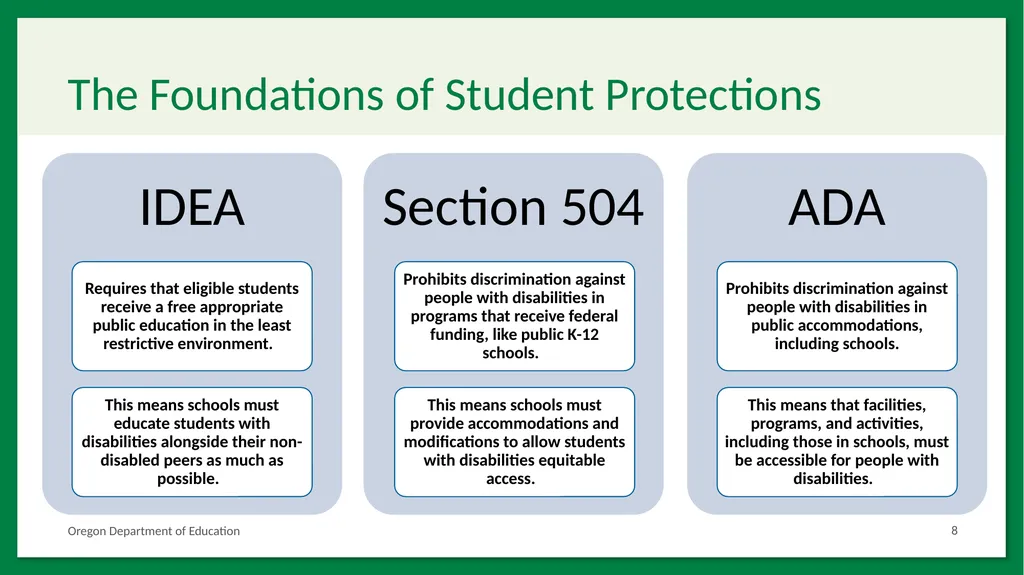
Oregon Department of Education 8 The Foundations of Student Protections<br>
09
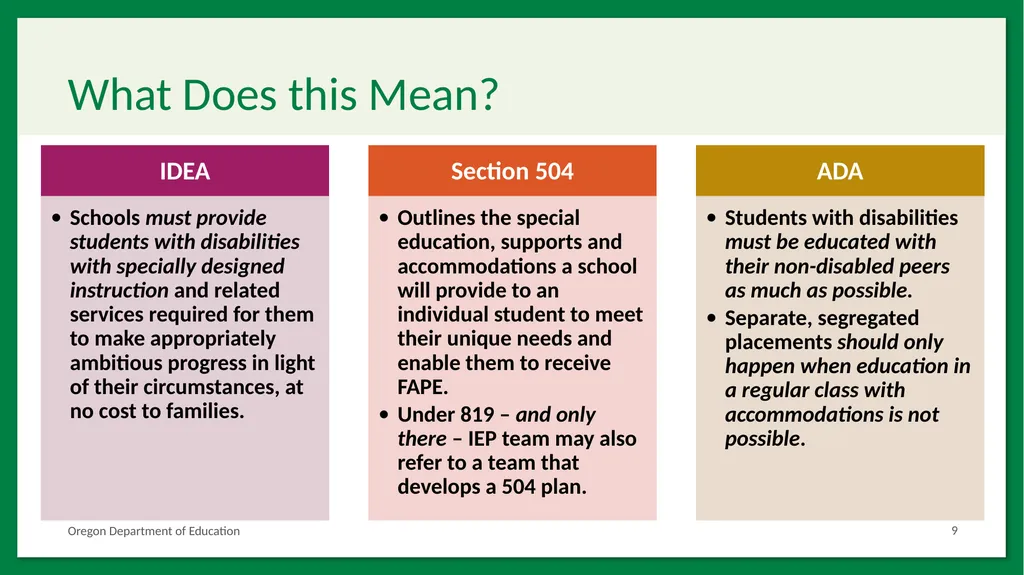
Oregon Department of Education 9 What Does this Mean?<br>
10
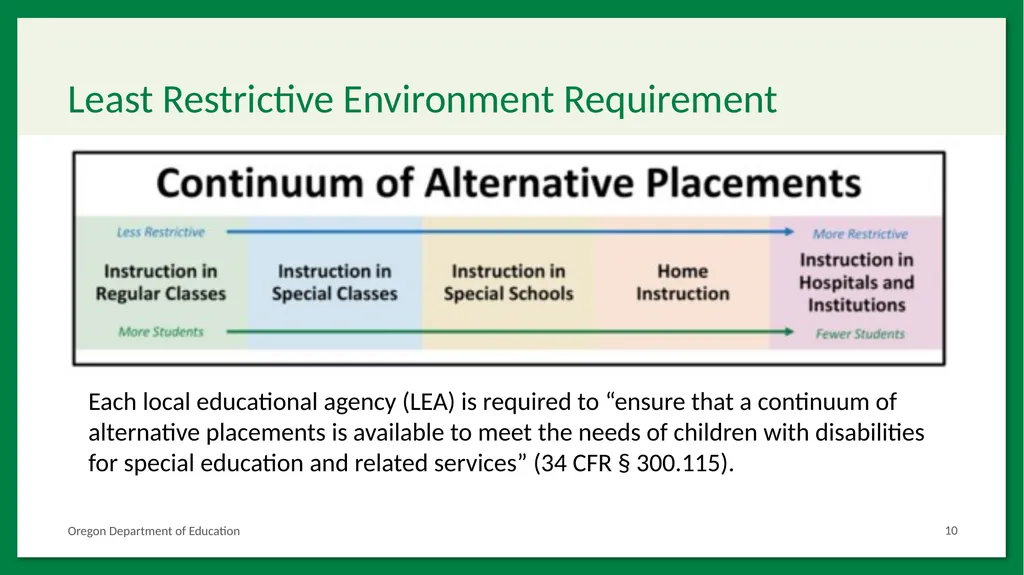
Oregon Department of Education 10 Least Restrictive Environment Requirement Each local educational agency (LEA) is required to “ensure that a continuum of alternative placements is available to meet the needs of children with disabilities for special education and related services” (34 CFR § 300.115).<br>
11
General Provision
“...afford [people with disabilities] equal opportunity to obtain the same result, to gain the same benefit, or to reach the same level of achievement in the most integrated setting appropriate to the person’s needs” (34 CFR § 104.4(b)(2))
Educational Setting
A district shall place a student with a disability “in the regular educational environment operated by the [district] unless it is demonstrated by the [district] that the education of the person in the regular environment with the use of supplementary aids and services cannot be achieved satisfactorily” (34 CFR § 104.34(a)) Oregon Department of Education 11 Specific to 504 Protections Regarding Student Placements<br>
“...afford [people with disabilities] equal opportunity to obtain the same result, to gain the same benefit, or to reach the same level of achievement in the most integrated setting appropriate to the person’s needs” (34 CFR § 104.4(b)(2))
Educational Setting
A district shall place a student with a disability “in the regular educational environment operated by the [district] unless it is demonstrated by the [district] that the education of the person in the regular environment with the use of supplementary aids and services cannot be achieved satisfactorily” (34 CFR § 104.34(a)) Oregon Department of Education 11 Specific to 504 Protections Regarding Student Placements<br>
12
Students with disabilities have a right to meaningful access to the same number of hours of instruction and educational services as the majority of students without disabilities who are in the same grade within the student’s resident school district.
Removal from school is neither a service nor support for students with disabilities.
Use of an abbreviated school day program for students with disabilities should be infrequent and, under most circumstances, should be used for a limited duration. Oregon Department of Education 12 To Think About and Discuss:<br>
Removal from school is neither a service nor support for students with disabilities.
Use of an abbreviated school day program for students with disabilities should be infrequent and, under most circumstances, should be used for a limited duration. Oregon Department of Education 12 To Think About and Discuss:<br>
13
Think About the Three Questions on the previous slide.
Where is our district’s thinking (general education and special education) with regard to these three statements?
Do we have work to do in these areas?
What could this work look like? Oregon Department of Education 13 Activity<br>
Where is our district’s thinking (general education and special education) with regard to these three statements?
Do we have work to do in these areas?
What could this work look like? Oregon Department of Education 13 Activity<br>
14
Key Changes to Abbreviated School Day Program with the Passage of SB 819 Oregon Department of Education 14<br>
15
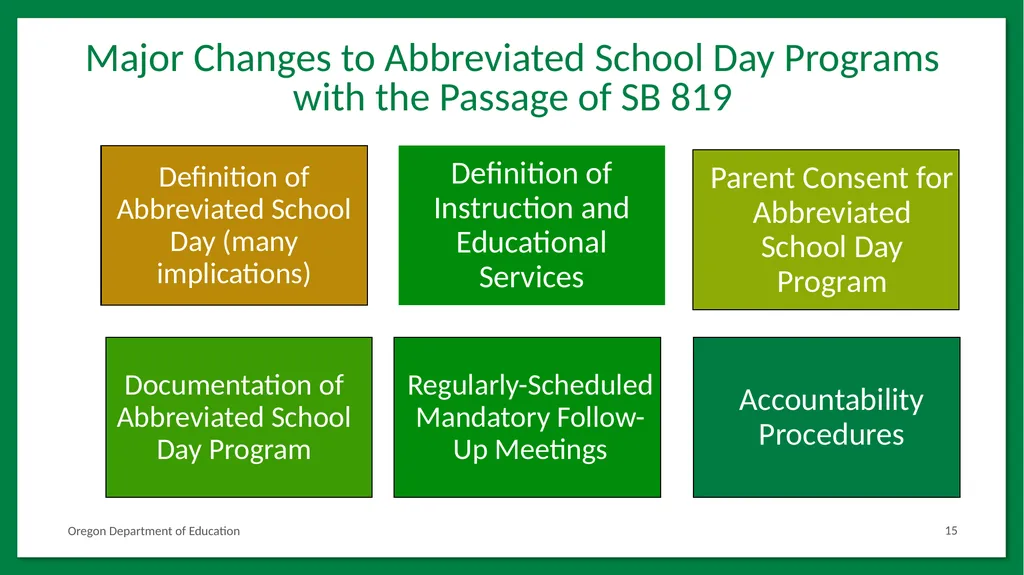
Oregon Department of Education 15 Major Changes to Abbreviated School Day Programs with the Passage of SB 819 Definition of Instruction and Educational Services<br>
16
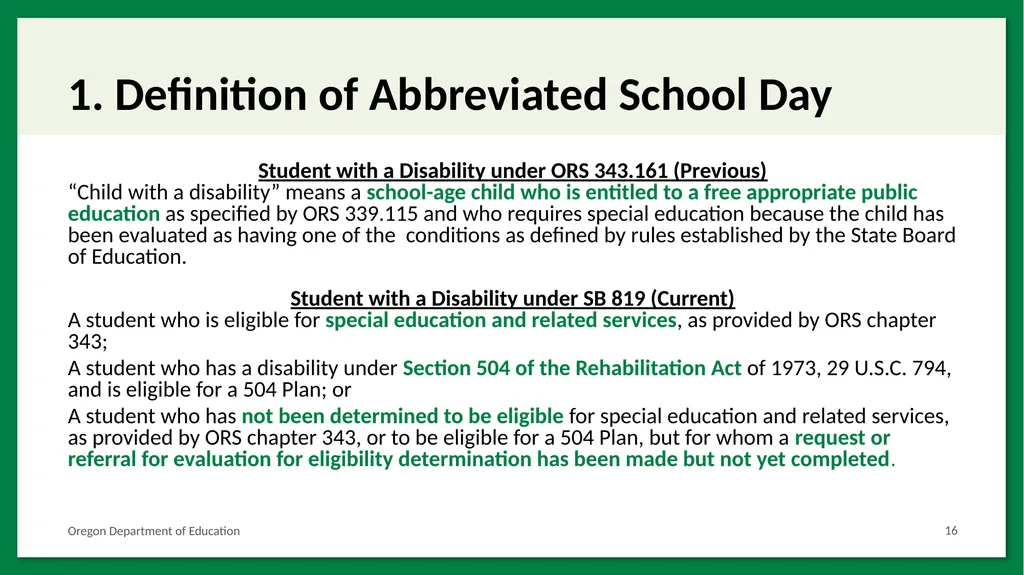
Student with a Disability under ORS 343.161 (Previous)
“Child with a disability” means a school-age child who is entitled to a free appropriate public education as specified by ORS 339.115 and who requires special education because the child has been evaluated as having one of the conditions as defined by rules established by the State Board of Education.
Student with a Disability under SB 819 (Current)
A student who is eligible for special education and related services, as provided by ORS chapter 343;
A student who has a disability under Section 504 of the Rehabilitation Act of 1973, 29 U.S.C. 794, and is eligible for a 504 Plan; or
A student who has not been determined to be eligible for special education and related services, as provided by ORS chapter 343, or to be eligible for a 504 Plan, but for whom a request or referral for evaluation for eligibility determination has been made but not yet completed. Oregon Department of Education 16 1. Definition of Abbreviated School Day<br>
“Child with a disability” means a school-age child who is entitled to a free appropriate public education as specified by ORS 339.115 and who requires special education because the child has been evaluated as having one of the conditions as defined by rules established by the State Board of Education.
Student with a Disability under SB 819 (Current)
A student who is eligible for special education and related services, as provided by ORS chapter 343;
A student who has a disability under Section 504 of the Rehabilitation Act of 1973, 29 U.S.C. 794, and is eligible for a 504 Plan; or
A student who has not been determined to be eligible for special education and related services, as provided by ORS chapter 343, or to be eligible for a 504 Plan, but for whom a request or referral for evaluation for eligibility determination has been made but not yet completed. Oregon Department of Education 16 1. Definition of Abbreviated School Day<br>
17
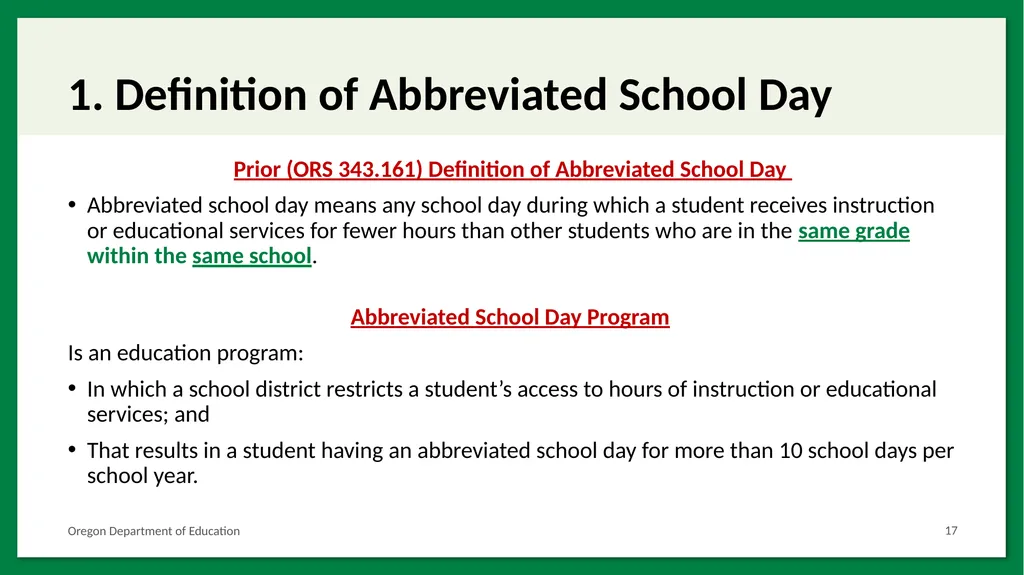
Prior (ORS 343.161) Definition of Abbreviated School Day
Abbreviated school day means any school day during which a student receives instruction or educational services for fewer hours than other students who are in the same grade within the same school.
Abbreviated School Day Program
Is an education program:
In which a school district restricts a student’s access to hours of instruction or educational services; and
That results in a student having an abbreviated school day for more than 10 school days per school year. Oregon Department of Education 17 1. Definition of Abbreviated School Day<br>
Abbreviated school day means any school day during which a student receives instruction or educational services for fewer hours than other students who are in the same grade within the same school.
Abbreviated School Day Program
Is an education program:
In which a school district restricts a student’s access to hours of instruction or educational services; and
That results in a student having an abbreviated school day for more than 10 school days per school year. Oregon Department of Education 17 1. Definition of Abbreviated School Day<br>
18
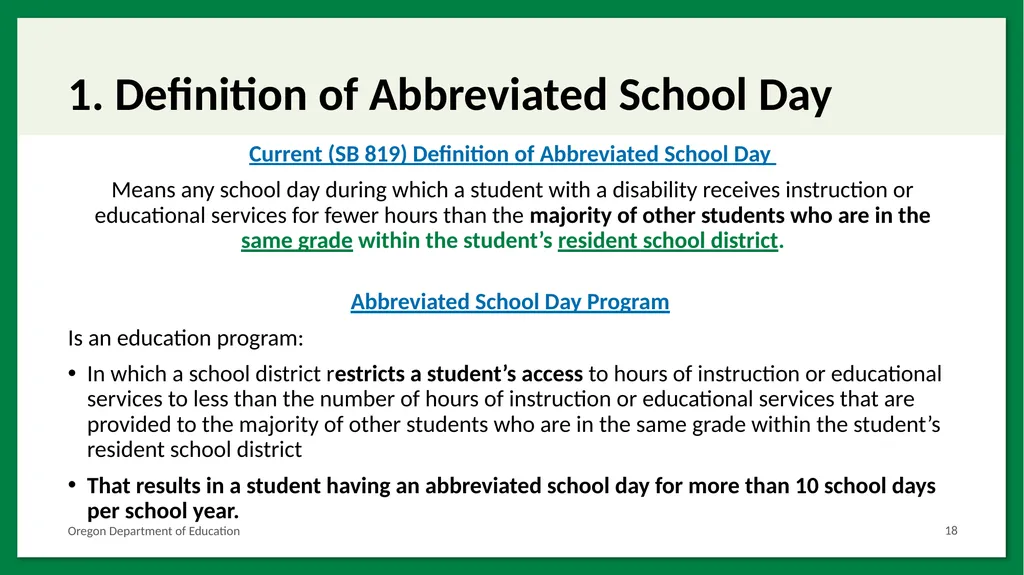
Current (SB 819) Definition of Abbreviated School Day
Means any school day during which a student with a disability receives instruction or educational services for fewer hours than the majority of other students who are in the same grade within the student’s resident school district.
Abbreviated School Day Program
Is an education program:
In which a school district restricts a student’s access to hours of instruction or educational services to less than the number of hours of instruction or educational services that are provided to the majority of other students who are in the same grade within the student’s resident school district
That results in a student having an abbreviated school day for more than 10 school days per school year. Oregon Department of Education 18 1. Definition of Abbreviated School Day<br>
Means any school day during which a student with a disability receives instruction or educational services for fewer hours than the majority of other students who are in the same grade within the student’s resident school district.
Abbreviated School Day Program
Is an education program:
In which a school district restricts a student’s access to hours of instruction or educational services to less than the number of hours of instruction or educational services that are provided to the majority of other students who are in the same grade within the student’s resident school district
That results in a student having an abbreviated school day for more than 10 school days per school year. Oregon Department of Education 18 1. Definition of Abbreviated School Day<br>
19
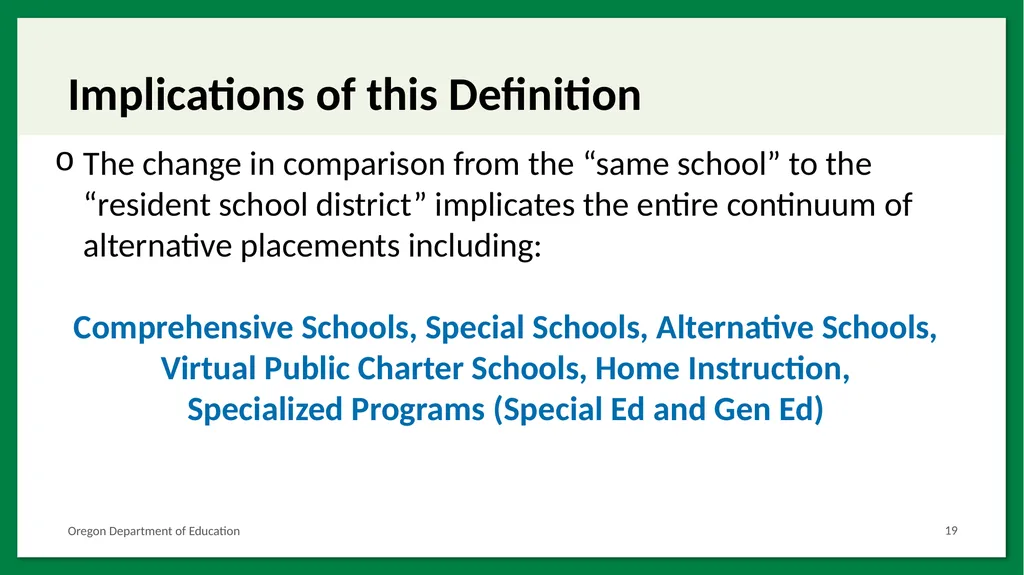
Oregon Department of Education 19 Implications of this Definition The change in comparison from the “same school” to the “resident school district” implicates the entire continuum of alternative placements including:
Comprehensive Schools, Special Schools, Alternative Schools, Virtual Public Charter Schools, Home Instruction,
Specialized Programs (Special Ed and Gen Ed)<br>
Comprehensive Schools, Special Schools, Alternative Schools, Virtual Public Charter Schools, Home Instruction,
Specialized Programs (Special Ed and Gen Ed)<br>
20
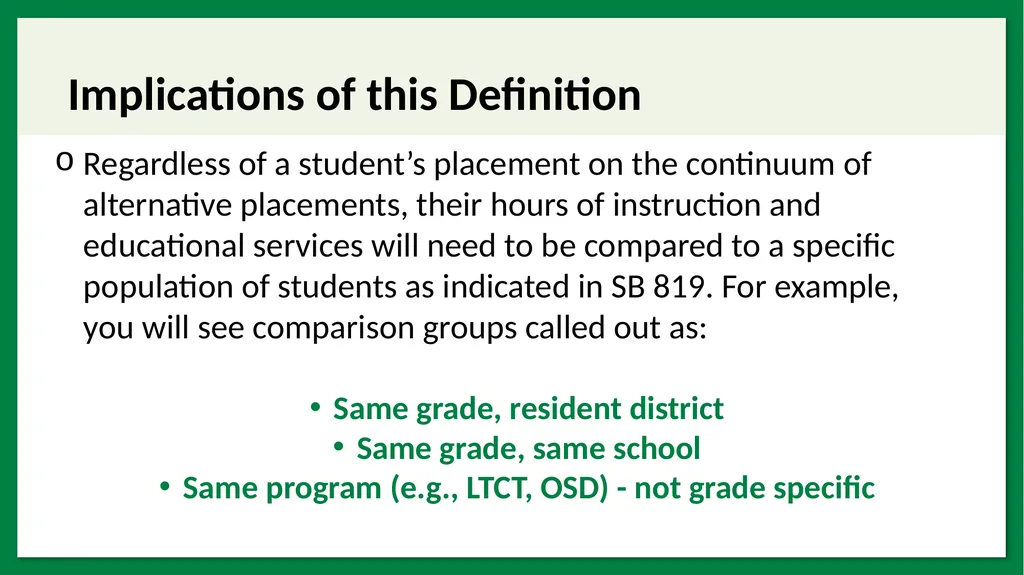
Oregon Department of Education 20 Implications of this Definition Regardless of a student’s placement on the continuum of alternative placements, their hours of instruction and educational services will need to be compared to a specific population of students as indicated in SB 819. For example, you will see comparison groups called out as:
Same grade, resident district
Same grade, same school
Same program (e.g., LTCT, OSD) - not grade specific<br>
Same grade, resident district
Same grade, same school
Same program (e.g., LTCT, OSD) - not grade specific<br>
21
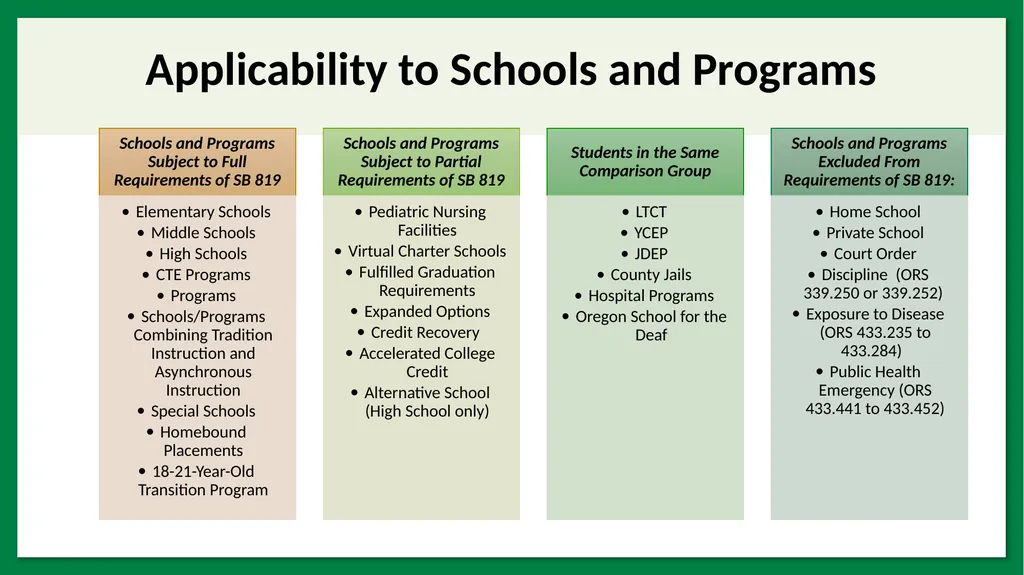
Applicability to Schools and Programs<br>
22
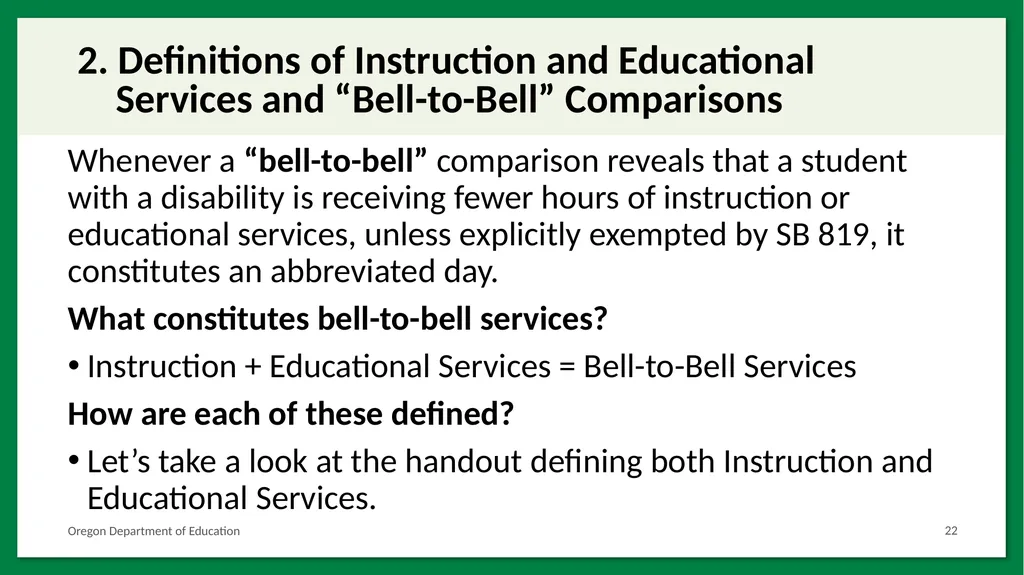
Whenever a “bell-to-bell” comparison reveals that a student with a disability is receiving fewer hours of instruction or educational services, unless explicitly exempted by SB 819, it constitutes an abbreviated day.
What constitutes bell-to-bell services?
Instruction + Educational Services = Bell-to-Bell Services
How are each of these defined?
Let’s take a look at the handout defining both Instruction and Educational Services. Oregon Department of Education 22 2. Definitions of Instruction and Educational Services and “Bell-to-Bell” Comparisons<br>
What constitutes bell-to-bell services?
Instruction + Educational Services = Bell-to-Bell Services
How are each of these defined?
Let’s take a look at the handout defining both Instruction and Educational Services. Oregon Department of Education 22 2. Definitions of Instruction and Educational Services and “Bell-to-Bell” Comparisons<br>
23
Let’s look at pages 12-13 of ODE’s Implementing SB 819 - Guidance for School Districts and Programs
Take a few minutes to read through the document
Does anything surprise you?
Do you have any concerns?
Do you see any information that may have implications for our district? Oregon Department of Education 23 2. Definitions of Instruction and Educational Services and “Bell-to-Bell” Comparisons<br>
Take a few minutes to read through the document
Does anything surprise you?
Do you have any concerns?
Do you see any information that may have implications for our district? Oregon Department of Education 23 2. Definitions of Instruction and Educational Services and “Bell-to-Bell” Comparisons<br>
24
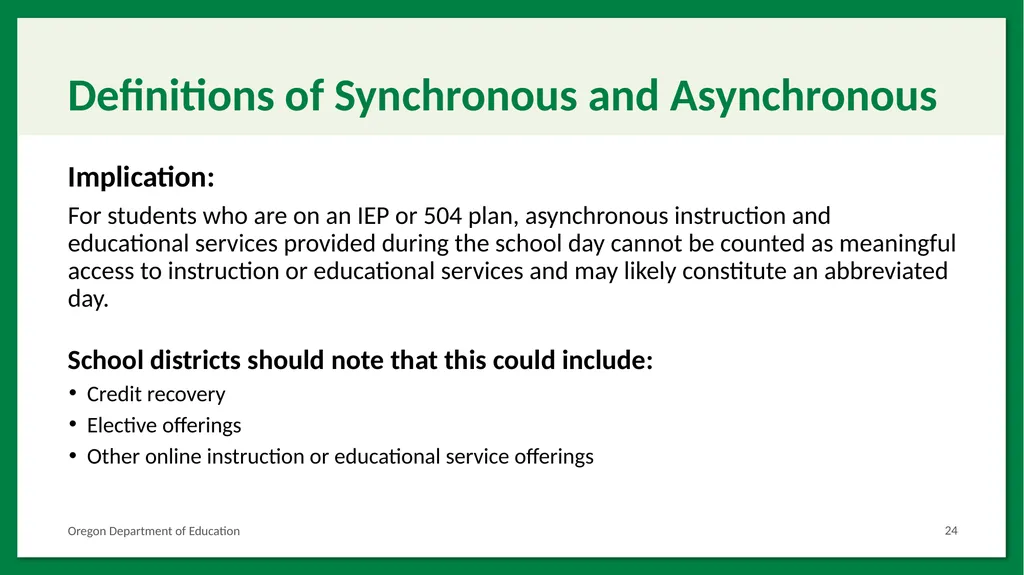
Implication:
For students who are on an IEP or 504 plan, asynchronous instruction and educational services provided during the school day cannot be counted as meaningful access to instruction or educational services and may likely constitute an abbreviated day.
School districts should note that this could include:
Credit recovery
Elective offerings
Other online instruction or educational service offerings Oregon Department of Education 24 Definitions of Synchronous and Asynchronous<br>
For students who are on an IEP or 504 plan, asynchronous instruction and educational services provided during the school day cannot be counted as meaningful access to instruction or educational services and may likely constitute an abbreviated day.
School districts should note that this could include:
Credit recovery
Elective offerings
Other online instruction or educational service offerings Oregon Department of Education 24 Definitions of Synchronous and Asynchronous<br>
25
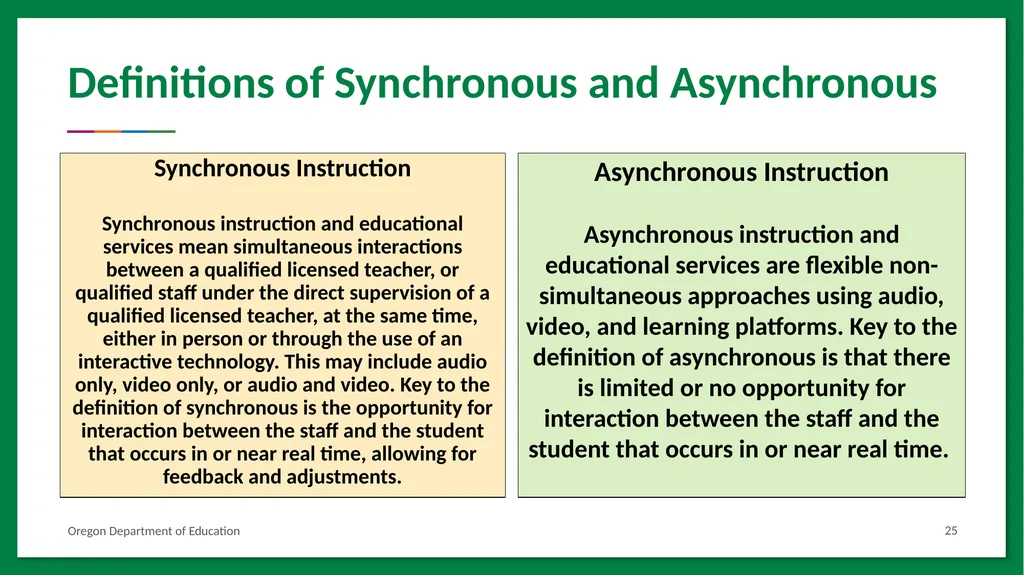
Synchronous Instruction
Synchronous instruction and educational services mean simultaneous interactions between a qualified licensed teacher, or qualified staff under the direct supervision of a qualified licensed teacher, at the same time, either in person or through the use of an interactive technology. This may include audio only, video only, or audio and video. Key to the definition of synchronous is the opportunity for interaction between the staff and the student that occurs in or near real time, allowing for feedback and adjustments. Asynchronous Instruction
Asynchronous instruction and educational services are flexible non-simultaneous approaches using audio, video, and learning platforms. Key to the definition of asynchronous is that there is limited or no opportunity for interaction between the staff and the student that occurs in or near real time. Oregon Department of Education 25 Definitions of Synchronous and Asynchronous<br>
Synchronous instruction and educational services mean simultaneous interactions between a qualified licensed teacher, or qualified staff under the direct supervision of a qualified licensed teacher, at the same time, either in person or through the use of an interactive technology. This may include audio only, video only, or audio and video. Key to the definition of synchronous is the opportunity for interaction between the staff and the student that occurs in or near real time, allowing for feedback and adjustments. Asynchronous Instruction
Asynchronous instruction and educational services are flexible non-simultaneous approaches using audio, video, and learning platforms. Key to the definition of asynchronous is that there is limited or no opportunity for interaction between the staff and the student that occurs in or near real time. Oregon Department of Education 25 Definitions of Synchronous and Asynchronous<br>
26
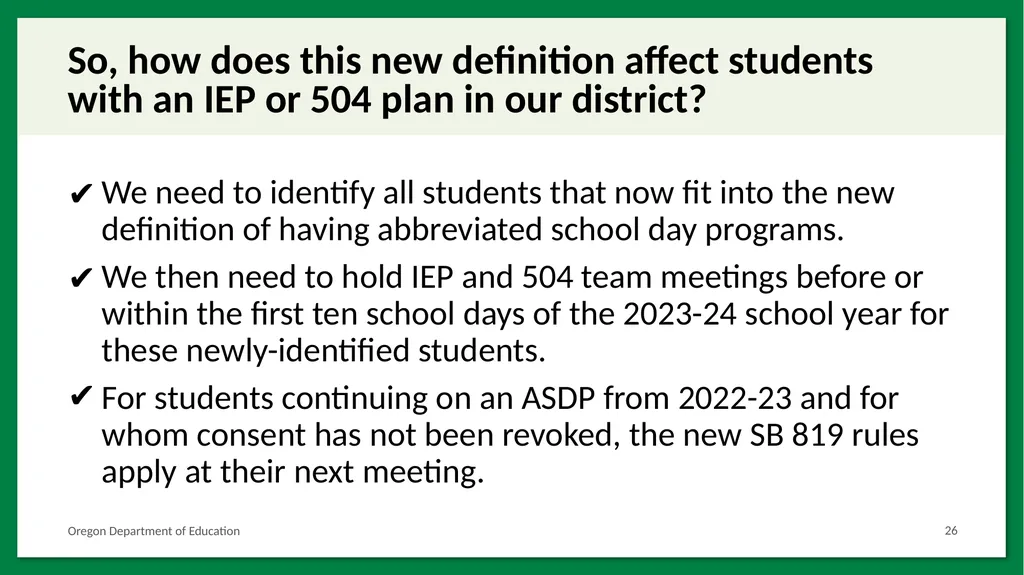
We need to identify all students that now fit into the new definition of having abbreviated school day programs.
We then need to hold IEP and 504 team meetings before or within the first ten school days of the 2023-24 school year for these newly-identified students.
For students continuing on an ASDP from 2022-23 and for whom consent has not been revoked, the new SB 819 rules apply at their next meeting. Oregon Department of Education 26 So, how does this new definition affect students with an IEP or 504 plan in our district?<br>
We then need to hold IEP and 504 team meetings before or within the first ten school days of the 2023-24 school year for these newly-identified students.
For students continuing on an ASDP from 2022-23 and for whom consent has not been revoked, the new SB 819 rules apply at their next meeting. Oregon Department of Education 26 So, how does this new definition affect students with an IEP or 504 plan in our district?<br>
27
Written consent for abbreviated school day placement from parents must be obtained.
School district cannot unilaterally place a student with a disability on an abbreviated school day program.
Parent or foster parent’s right, any any time, to withdraw consent for an abbreviated school day program placement or ask for meeting to discuss placement. Oregon Department of Education 27 3. Parent or Foster Parent Consent Required<br>
School district cannot unilaterally place a student with a disability on an abbreviated school day program.
Parent or foster parent’s right, any any time, to withdraw consent for an abbreviated school day program placement or ask for meeting to discuss placement. Oregon Department of Education 27 3. Parent or Foster Parent Consent Required<br>
28
Many new requirements and forms. For example:
Parent Notice of Required Information Prior to Initial Placement on ASDP
Information to Consider About Possible Initial Placement on an ASDP
Information to Consider About Possible Continued Placement on an ASDP
. . . and many more.
ODE also has a new data collection system to keep track of all students on abbreviated school day programs. Oregon Department of Education 28 4. Documentation of Abbreviated School Day Program<br>
Parent Notice of Required Information Prior to Initial Placement on ASDP
Information to Consider About Possible Initial Placement on an ASDP
Information to Consider About Possible Continued Placement on an ASDP
. . . and many more.
ODE also has a new data collection system to keep track of all students on abbreviated school day programs. Oregon Department of Education 28 4. Documentation of Abbreviated School Day Program<br>
29
SB 819 requires that the district hold a meeting of the student’s IEP/504 team to review the student’s abbreviated school day placement at specific intervals.
During the school year, a meeting must be held
(A) No fewer than 25 calendar days and no more than 35 calendar days after the initial placement on the abbreviated school day program.
(B) No less frequently than once every 30 calendar days, starting after the meeting described in subparagraph (A) of this paragraph, unless the parent or foster parent provides written consent to meet less frequently than once every 30 calendar days.
There are exceptions. Oregon Department of Education 29 5. Mandatory Regularly-Scheduled Follow-Up Meetings<br>
During the school year, a meeting must be held
(A) No fewer than 25 calendar days and no more than 35 calendar days after the initial placement on the abbreviated school day program.
(B) No less frequently than once every 30 calendar days, starting after the meeting described in subparagraph (A) of this paragraph, unless the parent or foster parent provides written consent to meet less frequently than once every 30 calendar days.
There are exceptions. Oregon Department of Education 29 5. Mandatory Regularly-Scheduled Follow-Up Meetings<br>
30
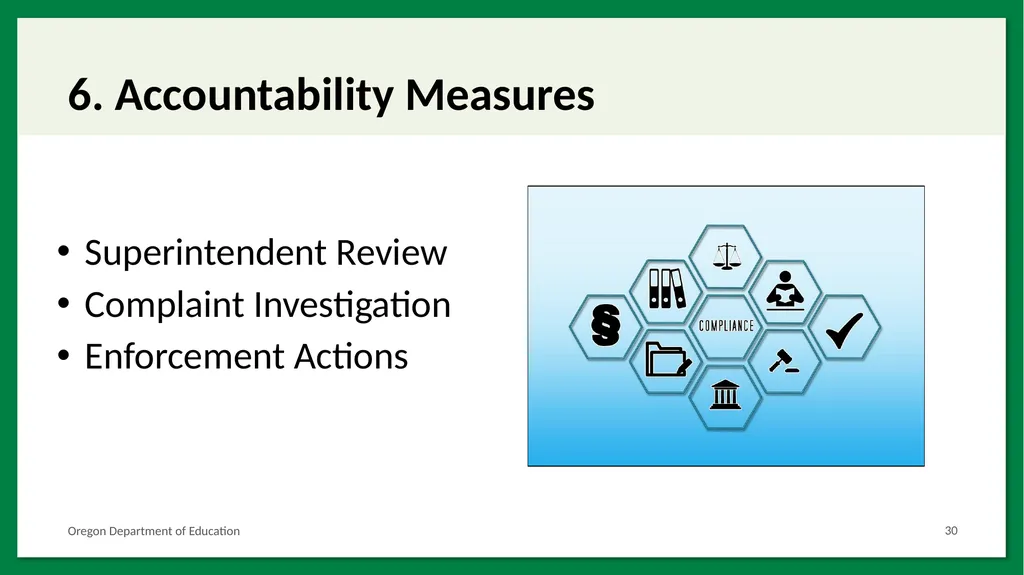
Superintendent Review
Complaint Investigation
Enforcement Actions Oregon Department of Education 30 6. Accountability Measures<br>
Complaint Investigation
Enforcement Actions Oregon Department of Education 30 6. Accountability Measures<br>
31
Oregon Department of Education 31 6. Accountability Measures How can our district ensure that adequate systems are set up to reduce the likelihood of investigation?
Do we have a preventative system within our district to help instructional personnel respond to student behavior with positive behavioral interventions and supports?
Have all of the staff members in our district including general education become familiar with the key components SB 819? If not, how can we help them become informed?
Do we have a system in place for timely superintendent reviews?<br>
Do we have a preventative system within our district to help instructional personnel respond to student behavior with positive behavioral interventions and supports?
Have all of the staff members in our district including general education become familiar with the key components SB 819? If not, how can we help them become informed?
Do we have a system in place for timely superintendent reviews?<br>
32
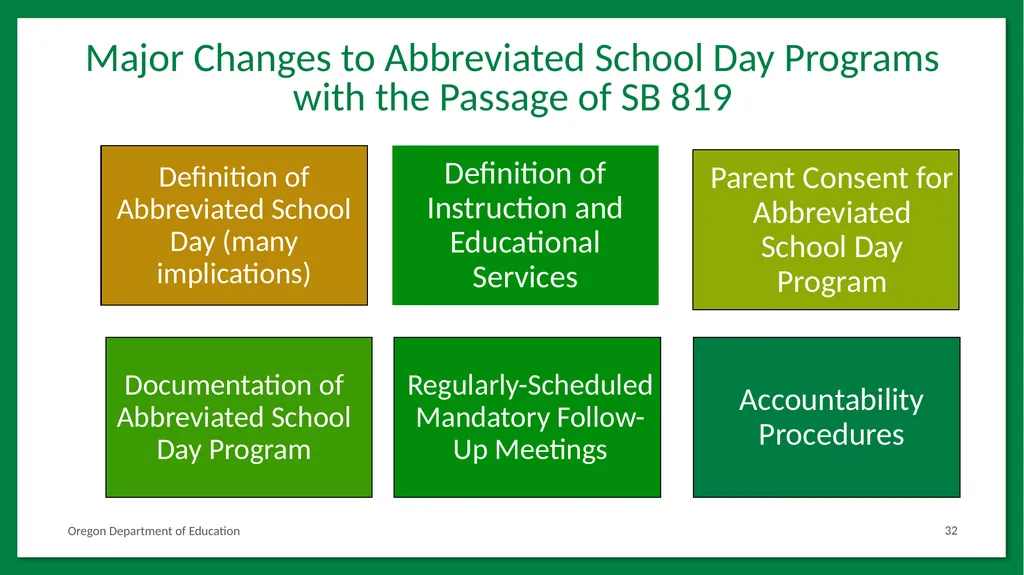
Oregon Department of Education 32 Major Changes to Abbreviated School Day Programs with the Passage of SB 819 Definition of Instruction and Educational Services<br>