SB 972 New Sidewalk Food Vending Law Background
Description: SB 972 New Sidewalk Food Vending Law Background Introduced by Senator Lena Gonzalez Intent (per Senator Lena Gonzalez official Fact Sheet): Senate Bill (SB) 972 will modernize the California Retail Food Code (CRFC) to include sidewalk food
Related Topics
Download Presentation
"SB 972 New Sidewalk Food Vending Law Background" is the property of its rightful owner. Permission is granted to download and print the materials on this website for personal, non-commercial use only, and to display it on your personal computer provided you do not modify the materials and that you retain all copyright notices contained in the materials. By downloading content from our website, you accept the terms of this agreement.
Presentation Transcript
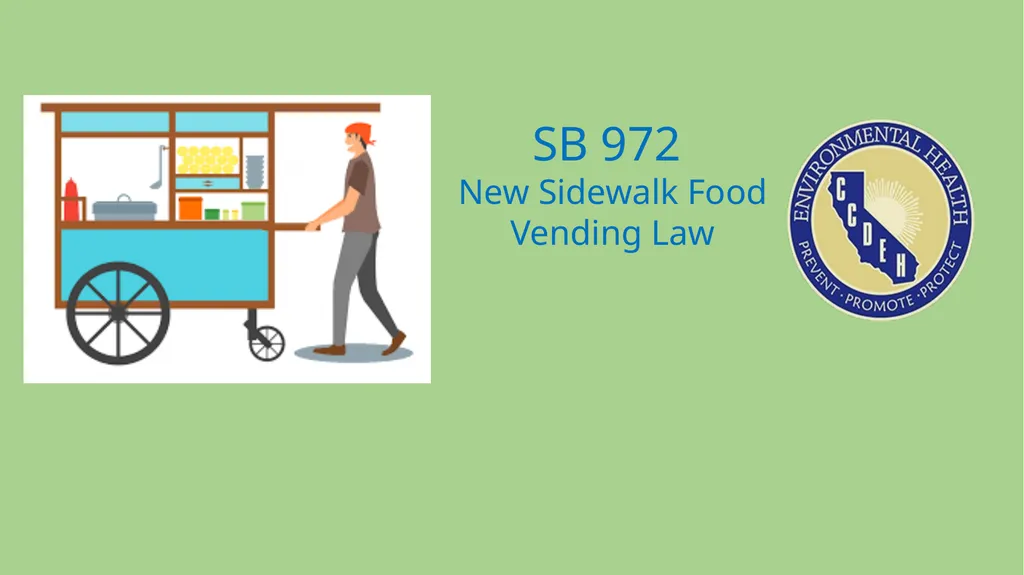
slide1. SB 972
New Sidewalk Food Vending Law<br>
slide2. Background Introduced by Senator Lena Gonzalez
Intent (per Senator Lena Gonzalez’ official Fact Sheet):
Senate Bill (SB) 972 will modernize the California Retail Food Code (CRFC) to include sidewalk food vendors and bring thousands of micro-entrepreneurs into a more equitable and well-regulated food economy while enhancing critical health and food safety regulation.
SB 972 modernizes the CRFC by reducing the barriers to obtain a local health permit, which will support food vendors, opening up economic opportunities for low income entrepreneurs and improving food safety and public health for consumers.<br>
slide3. SB 972 Summary California Retail Food Code
New Chapter 11.7 – Compact Mobile Food Operation 3 Limited Food Preparation Revised – Expands Food Operations
Reduced Structural Requirements
Structural Requirements<br>
slide4. What is a Compact Mobile Food Operation (CMFO)? A stand, showcase, rack, display that offers more than 25 sq ft of prepackaged non-potentially hazardous foods like prepackaged chips, nuts, bottled drinks and whole produce
A pushcart, pedal-driven cart, wagon, or other nonmotorized conveyance – may be approved for sale of prepackaged potentially hazardous foods or approved for limited food preparation 4<br>
slide5. No health permit is required when vending food from a person, stand, rack, or cart if selling 25 square feet or less of ONLY prepackaged, non-potentially hazardous food or whole produce.
>25 square feet = permit required No Permit Required Food must be from approved source
Food must be stored, handled, displayed so as to be protected from adulteration or contamination
Food must be stored/displayed at least 6 inches off the ground<br>
slide6. Prepackaged Food Prepackaged food is food that has been processed in a permitted food facility or food establishment and properly packaged and labeled to prevent any direct human contact with the food product and the consumer prior to consumption.<br>
slide7. Potentially Hazardous Food Potentially Hazardous Food (PHF) means a food that requires time or temperature control to limit pathogenic micro-organism growth or toxin formation. Examples include cooked meats, hot dogs, burritos, tamales, ice cream, cut melons. Non-Potentially Hazardous Food Non-Potentially Hazardous Food (Non-PHF) means food that does not require time or temperature control to prevent bacterial growth and is unlikely to cause food borne illness. Examples include chips, sodas, pretzels, cookies, popsicles.<br>
slide8. Limited Food Preparation - revised New: Dispensing and portioning of nonpotentially hazardous food (nonPHF) or dispensing and portioning for immediate service to a customer of food that has been held at the required temperatures.
New: Slicing and chopping of nonPHF food or produce that has been washed at an approved facility.
New: Hot and cold holding of food that has been prepared at an approved permanent food facility.
New: Reheating of food that has been prepared at an approved permanent food facility.
Heating, frying, baking, roasting, popping, shaving of ice, blending, steaming or boiling of hot dogs, or assembly of non-prepackaged food.
Slicing and chopping of food on a heated cooking surface during the cooking process.
Juicing or preparing beverages that are for immediate service, in response to an individual consumer order, that do not contain frozen milk products.<br>
slide9. Structural Requirements Reduced CMFO’s that do NOT handle raw meats, raw poultry or raw fish:
3-compartment warewashing sink is not required if spare utensils are provided
Must have a separate storage area for clean utensils and separate storage area for soiled utensils
Warm water is not required for hand wash sink; therefore, no water heater is required
Allows for the use of auxiliary conveyance units to support handwashing and warewashing requirements
Person responsible for the auxiliary conveyance unit(s) must obtain a health permit
The local enforcement agency may limit the number of CMFO’s that share one auxiliary conveyance unit Auxiliary Conveyance<br>
slide10. Structural Requirements Reduced All food equipment and utensils for a CMFO needs to be certified for sanitation by an ANSI-accredited certification program, or a certification program accredited by another accreditation body recognized by the enforcement agency as providing substantially similar food safety and operational standards. For all CMFOs:<br>
slide11. CMFO Conducting Limited Food Preparation Reduced<br>
slide12. Changes in Operational Requirements Requires only a food handler card (not a food manager certificate) even if handling
unpackaged potentially hazardous foods.
Requires that ALL potentially hazardous foods be discarded at the end of each operating day.
A CMFO with multiple employees is exempt from restroom requirements as long the food
operation may remain operable by a single individual<br>
slide14. New Commissary Options – Commercial Facilities Permitted Food Facilities Permitted Cottage Food Operations Class B Permitted Community Kitchens Require site evaluation
May be approved to support CMFO without submitting plans
May be required to obtain additional permit
CFO-Class B may support up to two carts<br>
slide15. Expansion of Cottage Food Operations Class B (CFO-B) A CFO-Class B can sell approved food items on up to two CMFO carts:
Sales are limited to approved products
Transactions do not count towards the annual gross sales
A CFO-Class B can support and store up to two CMFOs after an evaluation to ensure it can support the storage and operational needs<br>
slide16. Home Storage Requires site evaluation
Only for storage of up to two CMFOs
Approval is an endorsement not a permit
Subject to complaint investigations
Any food preparation and servicing of the CMFO MUST happen at a permitted facility<br>
slide17. Outreach to food vendors<br>
New Sidewalk Food Vending Law<br>
slide2. Background Introduced by Senator Lena Gonzalez
Intent (per Senator Lena Gonzalez’ official Fact Sheet):
Senate Bill (SB) 972 will modernize the California Retail Food Code (CRFC) to include sidewalk food vendors and bring thousands of micro-entrepreneurs into a more equitable and well-regulated food economy while enhancing critical health and food safety regulation.
SB 972 modernizes the CRFC by reducing the barriers to obtain a local health permit, which will support food vendors, opening up economic opportunities for low income entrepreneurs and improving food safety and public health for consumers.<br>
slide3. SB 972 Summary California Retail Food Code
New Chapter 11.7 – Compact Mobile Food Operation 3 Limited Food Preparation Revised – Expands Food Operations
Reduced Structural Requirements
Structural Requirements<br>
slide4. What is a Compact Mobile Food Operation (CMFO)? A stand, showcase, rack, display that offers more than 25 sq ft of prepackaged non-potentially hazardous foods like prepackaged chips, nuts, bottled drinks and whole produce
A pushcart, pedal-driven cart, wagon, or other nonmotorized conveyance – may be approved for sale of prepackaged potentially hazardous foods or approved for limited food preparation 4<br>
slide5. No health permit is required when vending food from a person, stand, rack, or cart if selling 25 square feet or less of ONLY prepackaged, non-potentially hazardous food or whole produce.
>25 square feet = permit required No Permit Required Food must be from approved source
Food must be stored, handled, displayed so as to be protected from adulteration or contamination
Food must be stored/displayed at least 6 inches off the ground<br>
slide6. Prepackaged Food Prepackaged food is food that has been processed in a permitted food facility or food establishment and properly packaged and labeled to prevent any direct human contact with the food product and the consumer prior to consumption.<br>
slide7. Potentially Hazardous Food Potentially Hazardous Food (PHF) means a food that requires time or temperature control to limit pathogenic micro-organism growth or toxin formation. Examples include cooked meats, hot dogs, burritos, tamales, ice cream, cut melons. Non-Potentially Hazardous Food Non-Potentially Hazardous Food (Non-PHF) means food that does not require time or temperature control to prevent bacterial growth and is unlikely to cause food borne illness. Examples include chips, sodas, pretzels, cookies, popsicles.<br>
slide8. Limited Food Preparation - revised New: Dispensing and portioning of nonpotentially hazardous food (nonPHF) or dispensing and portioning for immediate service to a customer of food that has been held at the required temperatures.
New: Slicing and chopping of nonPHF food or produce that has been washed at an approved facility.
New: Hot and cold holding of food that has been prepared at an approved permanent food facility.
New: Reheating of food that has been prepared at an approved permanent food facility.
Heating, frying, baking, roasting, popping, shaving of ice, blending, steaming or boiling of hot dogs, or assembly of non-prepackaged food.
Slicing and chopping of food on a heated cooking surface during the cooking process.
Juicing or preparing beverages that are for immediate service, in response to an individual consumer order, that do not contain frozen milk products.<br>
slide9. Structural Requirements Reduced CMFO’s that do NOT handle raw meats, raw poultry or raw fish:
3-compartment warewashing sink is not required if spare utensils are provided
Must have a separate storage area for clean utensils and separate storage area for soiled utensils
Warm water is not required for hand wash sink; therefore, no water heater is required
Allows for the use of auxiliary conveyance units to support handwashing and warewashing requirements
Person responsible for the auxiliary conveyance unit(s) must obtain a health permit
The local enforcement agency may limit the number of CMFO’s that share one auxiliary conveyance unit Auxiliary Conveyance<br>
slide10. Structural Requirements Reduced All food equipment and utensils for a CMFO needs to be certified for sanitation by an ANSI-accredited certification program, or a certification program accredited by another accreditation body recognized by the enforcement agency as providing substantially similar food safety and operational standards. For all CMFOs:<br>
slide11. CMFO Conducting Limited Food Preparation Reduced<br>
slide12. Changes in Operational Requirements Requires only a food handler card (not a food manager certificate) even if handling
unpackaged potentially hazardous foods.
Requires that ALL potentially hazardous foods be discarded at the end of each operating day.
A CMFO with multiple employees is exempt from restroom requirements as long the food
operation may remain operable by a single individual<br>
slide14. New Commissary Options – Commercial Facilities Permitted Food Facilities Permitted Cottage Food Operations Class B Permitted Community Kitchens Require site evaluation
May be approved to support CMFO without submitting plans
May be required to obtain additional permit
CFO-Class B may support up to two carts<br>
slide15. Expansion of Cottage Food Operations Class B (CFO-B) A CFO-Class B can sell approved food items on up to two CMFO carts:
Sales are limited to approved products
Transactions do not count towards the annual gross sales
A CFO-Class B can support and store up to two CMFOs after an evaluation to ensure it can support the storage and operational needs<br>
slide16. Home Storage Requires site evaluation
Only for storage of up to two CMFOs
Approval is an endorsement not a permit
Subject to complaint investigations
Any food preparation and servicing of the CMFO MUST happen at a permitted facility<br>
slide17. Outreach to food vendors<br>