
Scalability for Virtual Worlds By Nitin Gupta,
Description: Scalability for Virtual Worlds By Nitin Gupta, Alan Demers, Johannes Gehrke, Philipp Unterbrunner, Walker White at ICDE 2009 Presented By, Pratik Patre, Biplab Kar 1 Net-VEs Networked Virtual Environments A virtual environment shared by
Related Topics
Download Presentation
"Scalability for Virtual Worlds By Nitin Gupta," is the property of its rightful owner. Permission is granted to download and print the materials on this website for personal, non-commercial use only, and to display it on your personal computer provided you do not modify the materials and that you retain all copyright notices contained in the materials. By downloading content from our website, you accept the terms of this agreement.
Presentation Transcript
slide1. Scalability for Virtual Worlds By Nitin Gupta, Alan Demers, Johannes Gehrke, Philipp Unterbrunner, Walker White
at ICDE 2009
Presented By,
Pratik Patre, Biplab Kar 1<br>
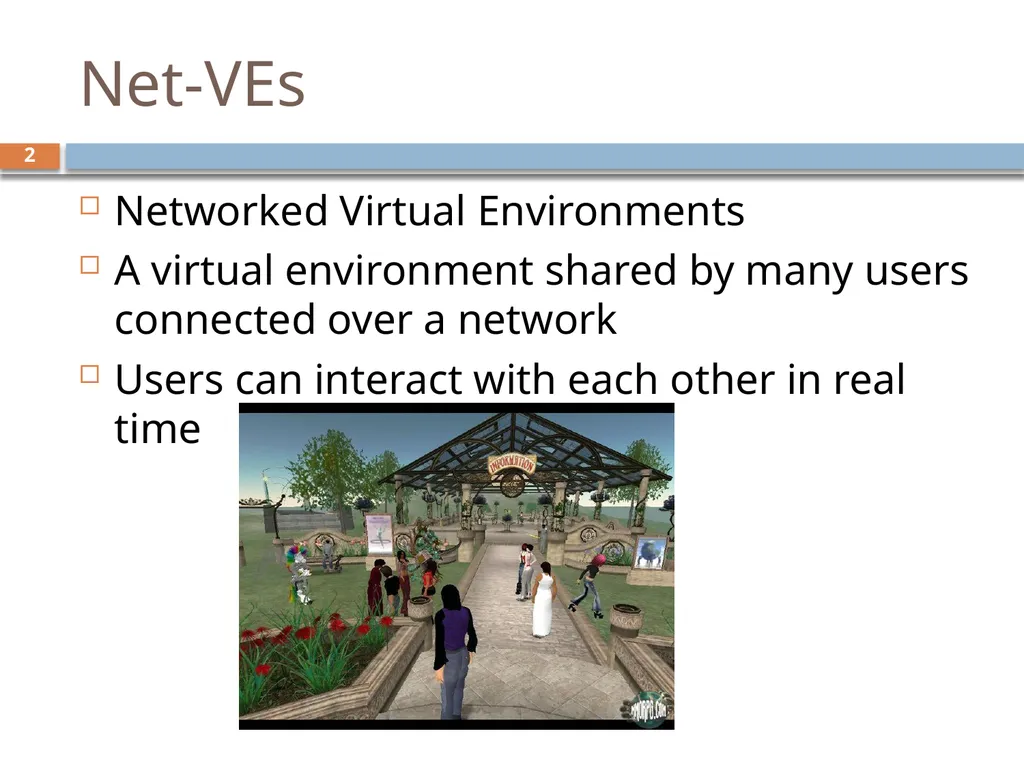
slide2. Net-VEs Networked Virtual Environments
A virtual environment shared by many users connected over a network
Users can interact with each other in real time 2<br>
slide3. Pushing the frontiers in Gaming Low quality to highly immersive visuals
Graphics Research Community
Simple button control to motion sensing control
Interaction Design Community
Single Player to Multiplayer over LAN
Networking Research Community
Massive Scalability over thousands of simultaneous users
Distributed Database Research Community 3<br>
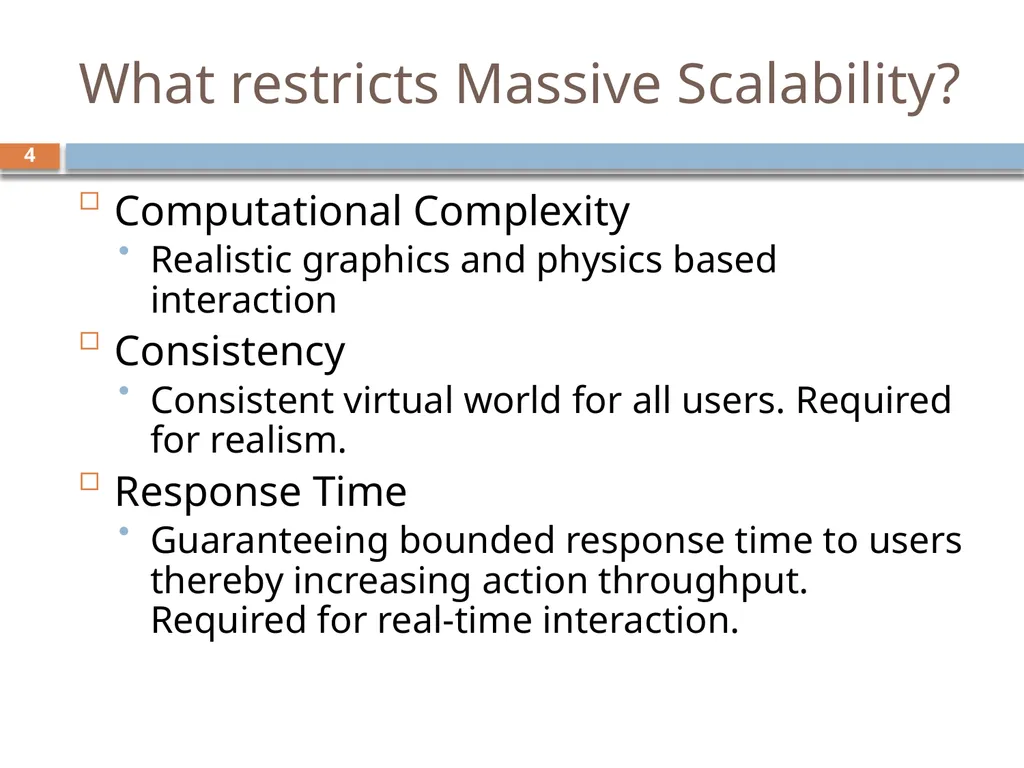
slide4. What restricts Massive Scalability? Computational Complexity
Realistic graphics and physics based interaction
Consistency
Consistent virtual world for all users. Required for realism.
Response Time
Guaranteeing bounded response time to users thereby increasing action throughput. Required for real-time interaction. 4<br>
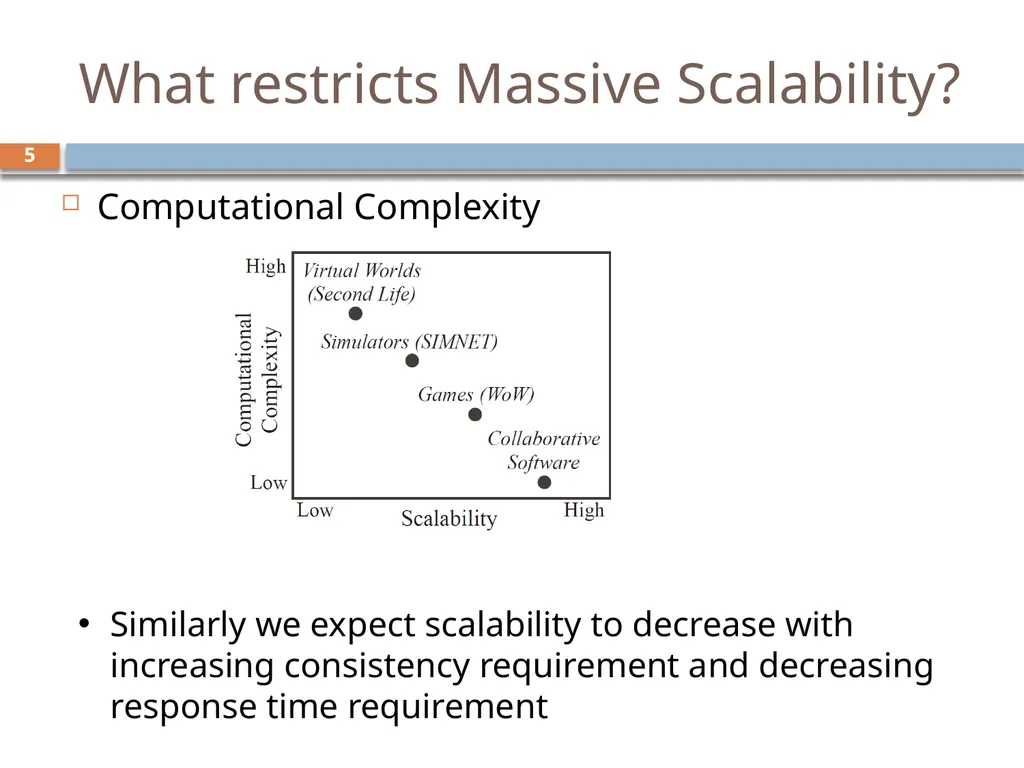
slide5. What restricts Massive Scalability? Computational Complexity Similarly we expect scalability to decrease with increasing consistency requirement and decreasing response time requirement 5<br>
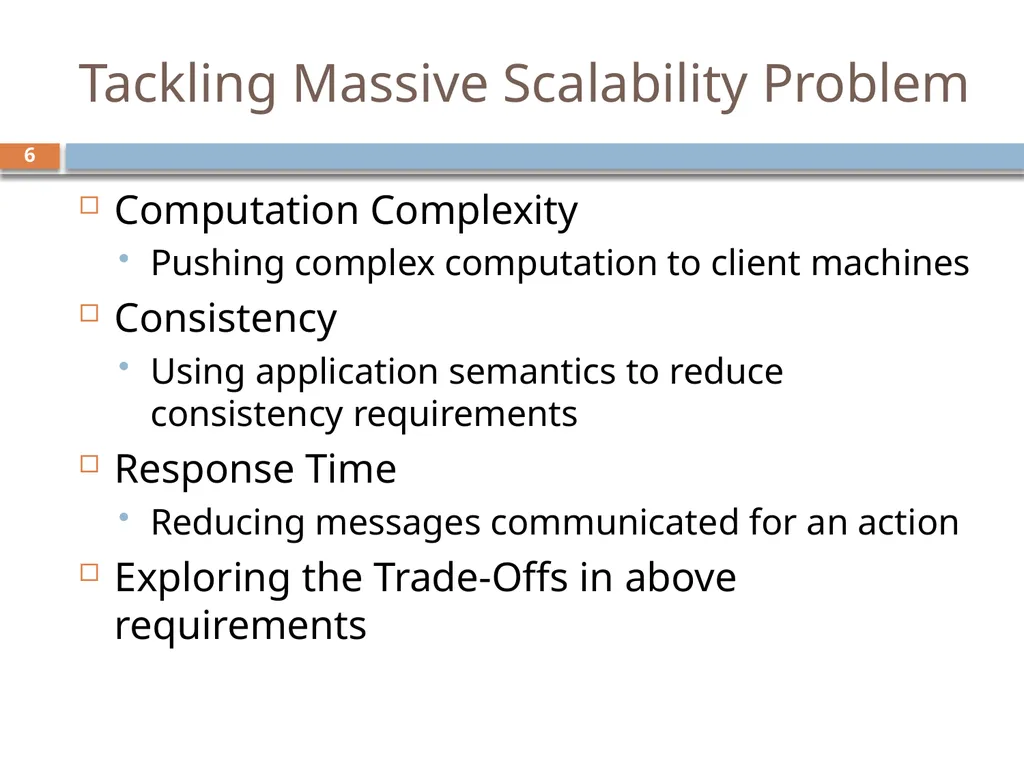
slide6. Tackling Massive Scalability Problem Computation Complexity
Pushing complex computation to client machines
Consistency
Using application semantics to reduce consistency requirements
Response Time
Reducing messages communicated for an action
Exploring the Trade-Offs in above requirements 6<br>
slide7. But Wait… First we investigate the current (as in 2008) approaches for improving scalability 7<br>
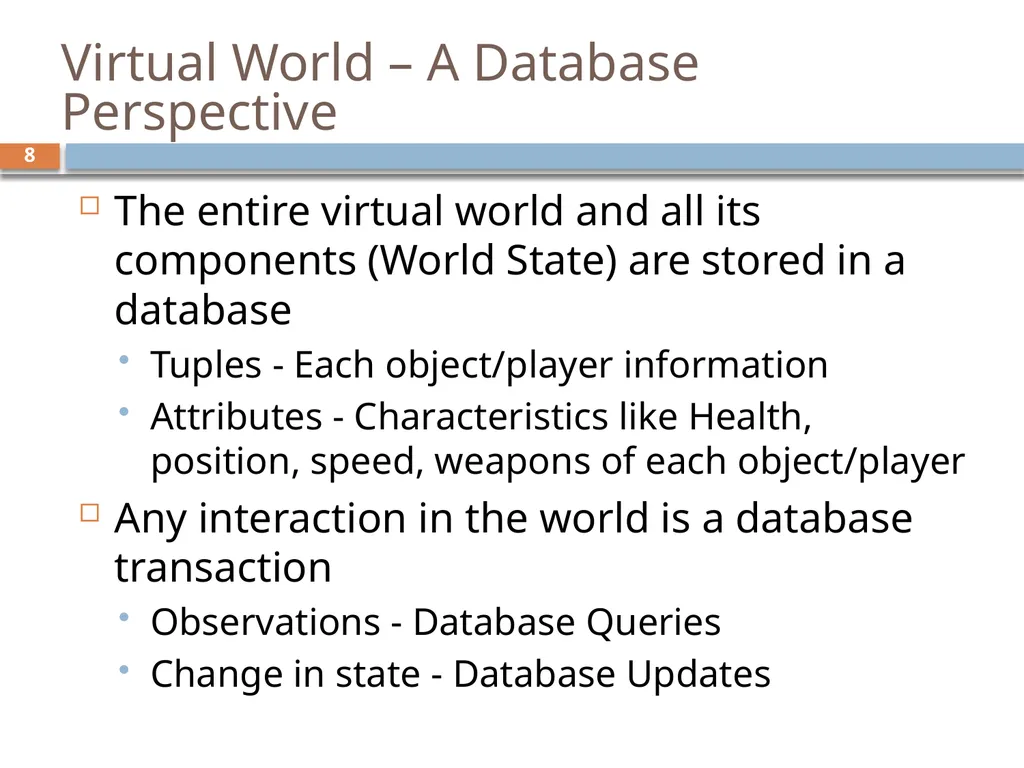
slide8. Virtual World – A Database Perspective The entire virtual world and all its components (World State) are stored in a database
Tuples - Each object/player information
Attributes - Characteristics like Health, position, speed, weapons of each object/player
Any interaction in the world is a database transaction
Observations - Database Queries
Change in state - Database Updates 8<br>
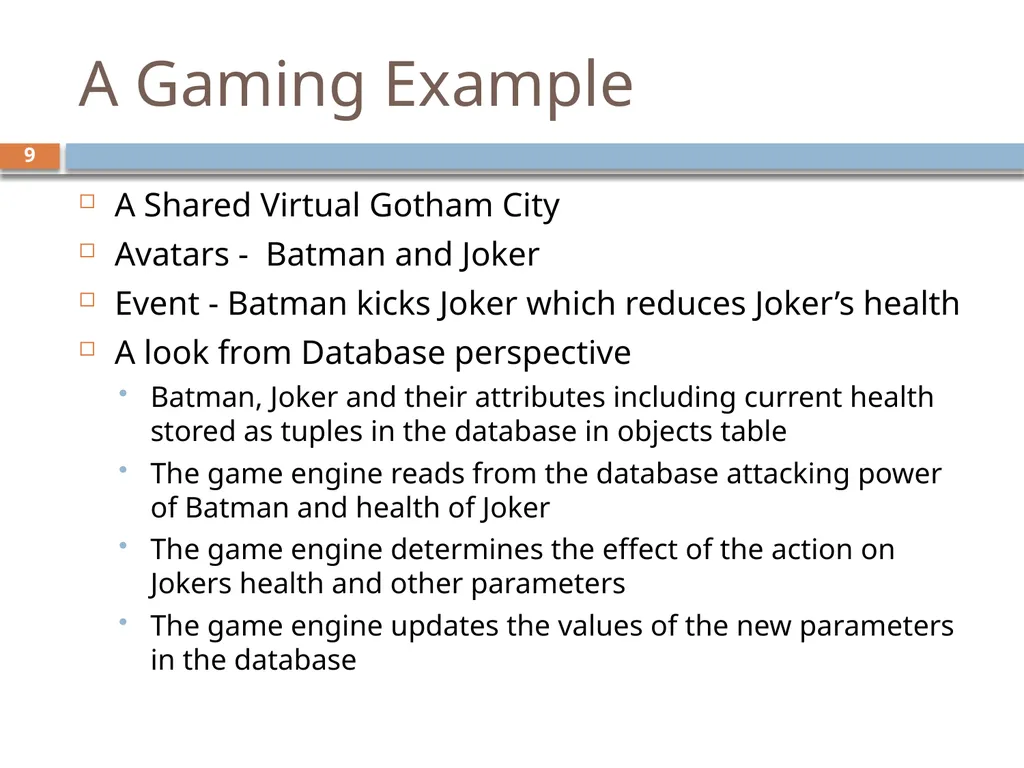
slide9. A Gaming Example A Shared Virtual Gotham City
Avatars - Batman and Joker
Event - Batman kicks Joker which reduces Joker’s health
A look from Database perspective
Batman, Joker and their attributes including current health stored as tuples in the database in objects table
The game engine reads from the database attacking power of Batman and health of Joker
The game engine determines the effect of the action on Jokers health and other parameters
The game engine updates the values of the new parameters in the database 9<br>
slide10. An example consistency issue Joker shoots at Robin while batman throws a batarang at Joker
What is the outcome? 10<br>
slide11. Net-VE Architectures Centralized VEs
All computations are done at a centralized server
World state updated only by server
The clients only read this world state and show it to the users 11<br>
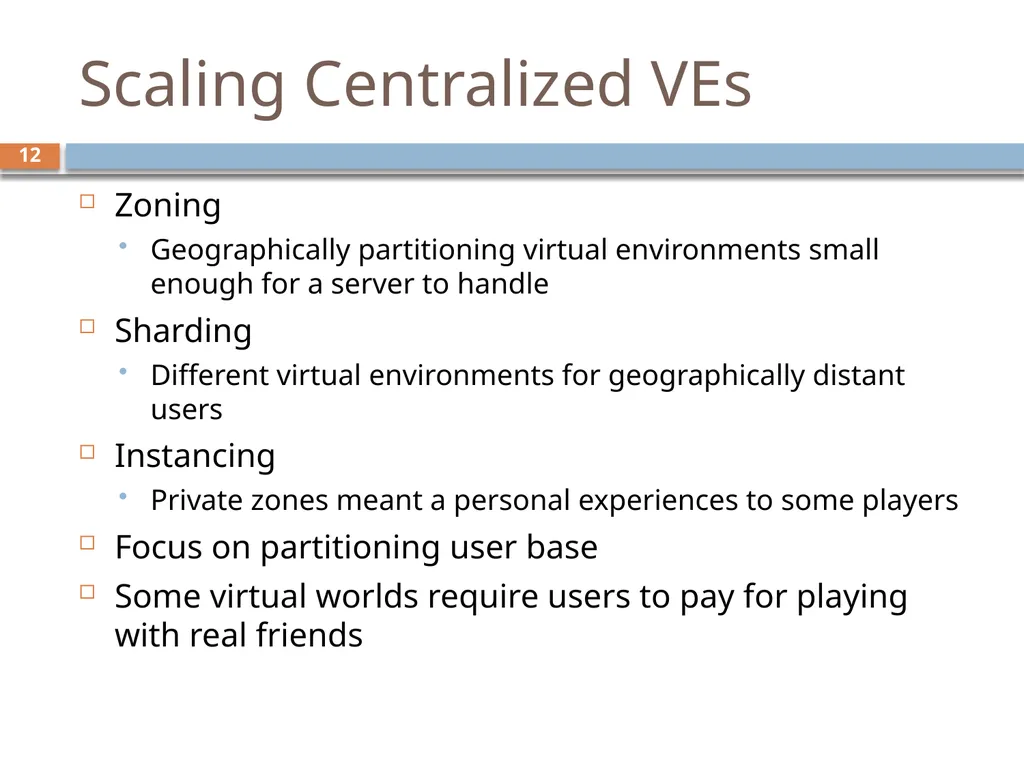
slide12. Scaling Centralized VEs Zoning
Geographically partitioning virtual environments small enough for a server to handle
Sharding
Different virtual environments for geographically distant users
Instancing
Private zones meant a personal experiences to some players
Focus on partitioning user base
Some virtual worlds require users to pay for playing with real friends 12<br>
slide13. Net-VE Architectures Distributed Net-VEs
Distribute computation to clients
Advantage – Reducing load on server and leveraging capabilities of client
Strongly consistent P2P architectures do not scale
Companies want to exert control and monetize the virtual environment discouraging completely distributed models 13<br>
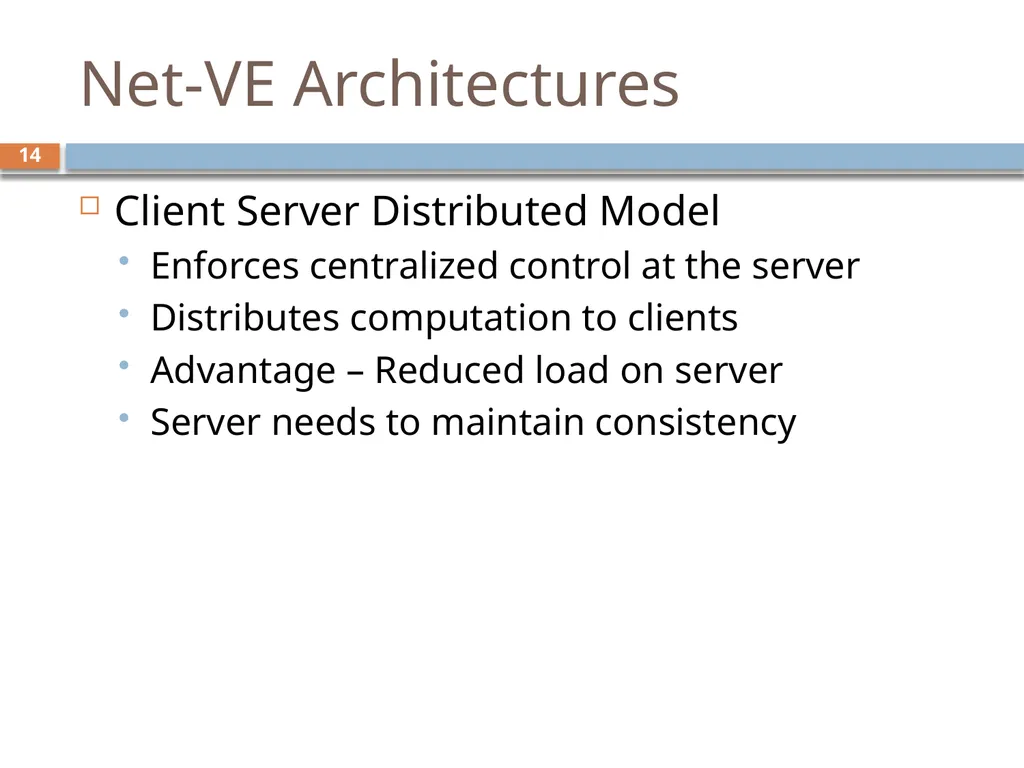
slide14. Net-VE Architectures Client Server Distributed Model
Enforces centralized control at the server
Distributes computation to clients
Advantage – Reduced load on server
Server needs to maintain consistency 14<br>
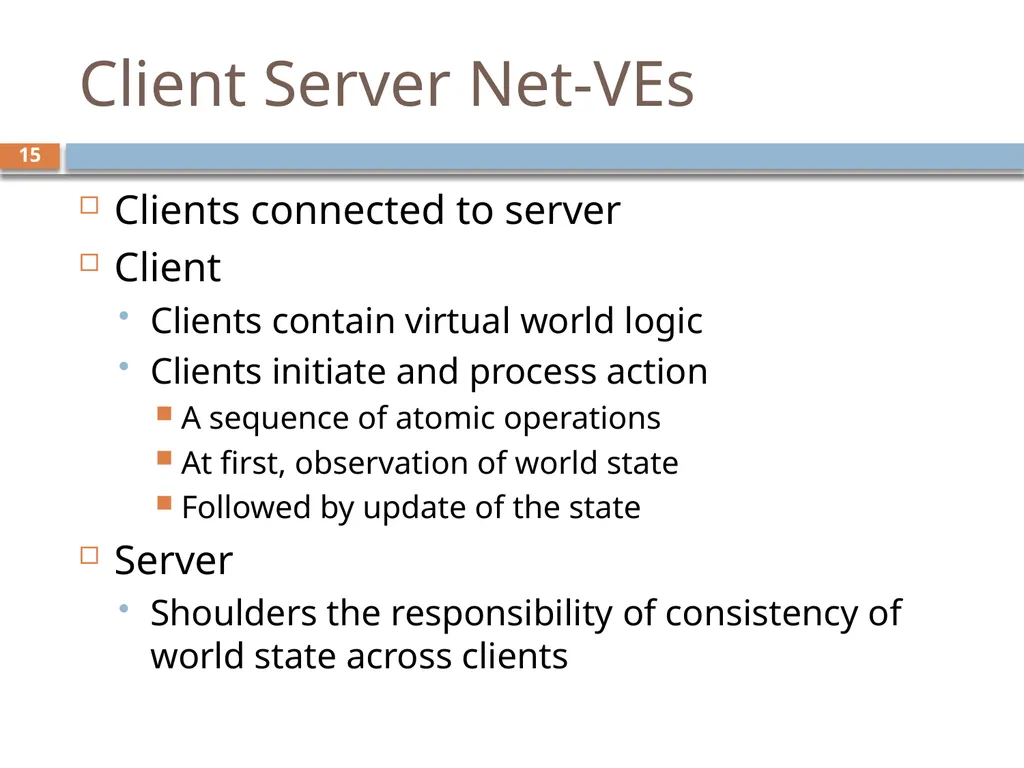
slide15. Client Server Net-VEs Clients connected to server
Client
Clients contain virtual world logic
Clients initiate and process action
A sequence of atomic operations
At first, observation of world state
Followed by update of the state
Server
Shoulders the responsibility of consistency of world state across clients 15<br>
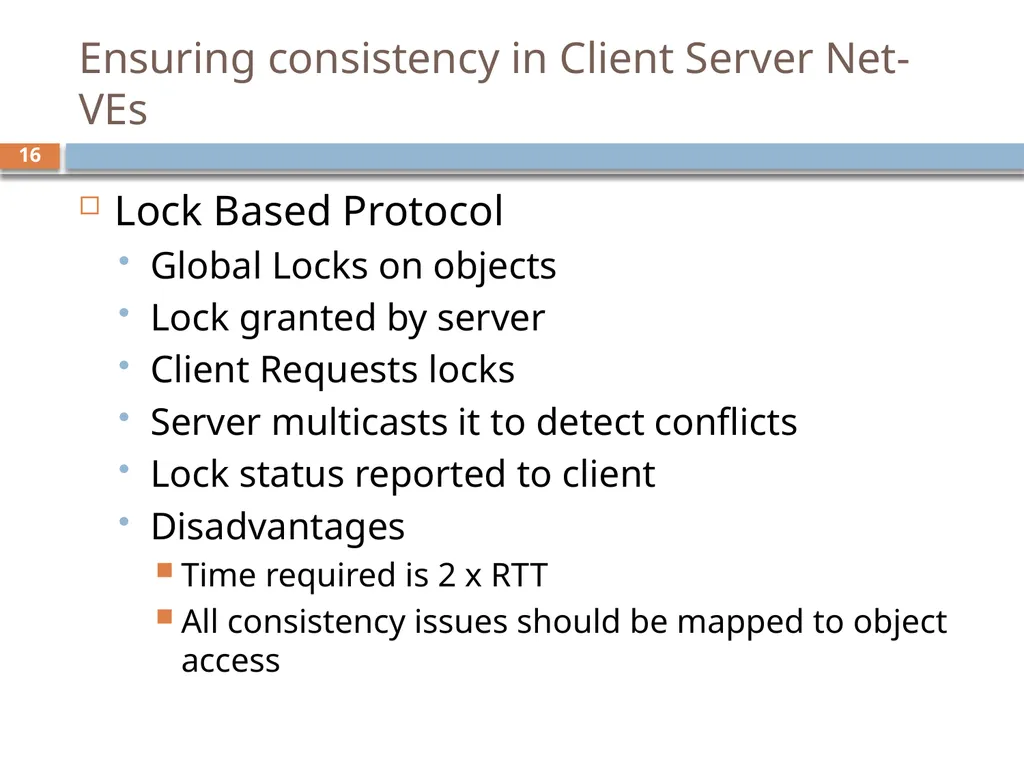
slide16. Ensuring consistency in Client Server Net-VEs Lock Based Protocol
Global Locks on objects
Lock granted by server
Client Requests locks
Server multicasts it to detect conflicts
Lock status reported to client
Disadvantages
Time required is 2 x RTT
All consistency issues should be mapped to object access 16<br>
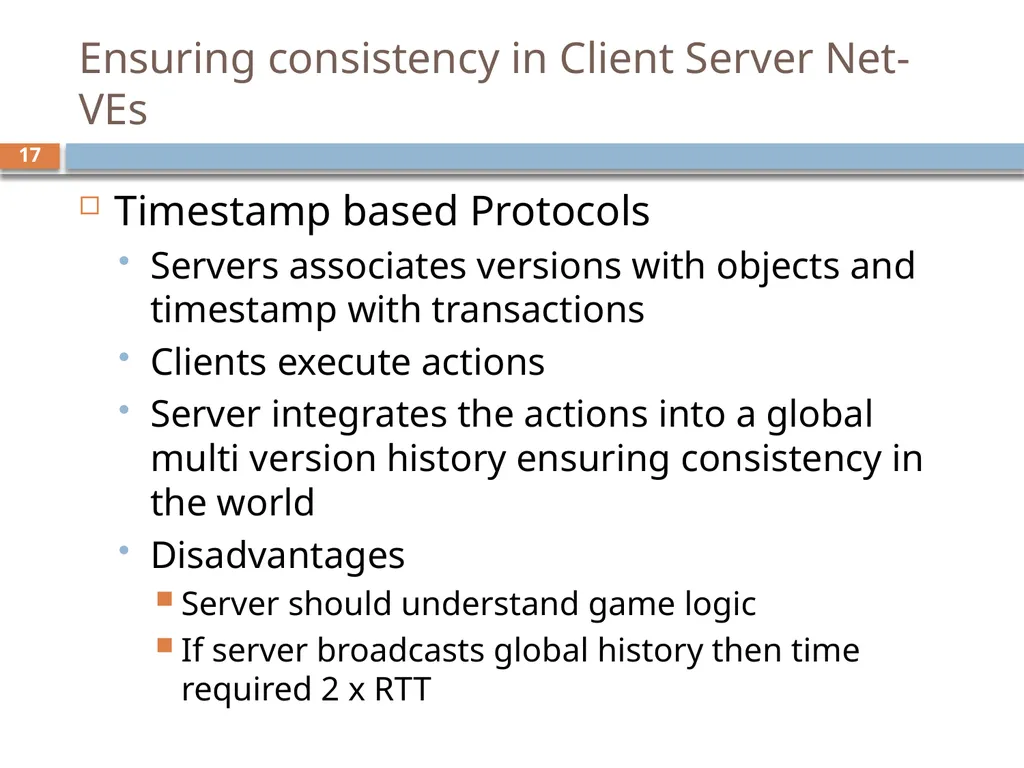
slide17. Ensuring consistency in Client Server Net-VEs Timestamp based Protocols
Servers associates versions with objects and timestamp with transactions
Clients execute actions
Server integrates the actions into a global multi version history ensuring consistency in the world
Disadvantages
Server should understand game logic
If server broadcasts global history then time required 2 x RTT 17<br>
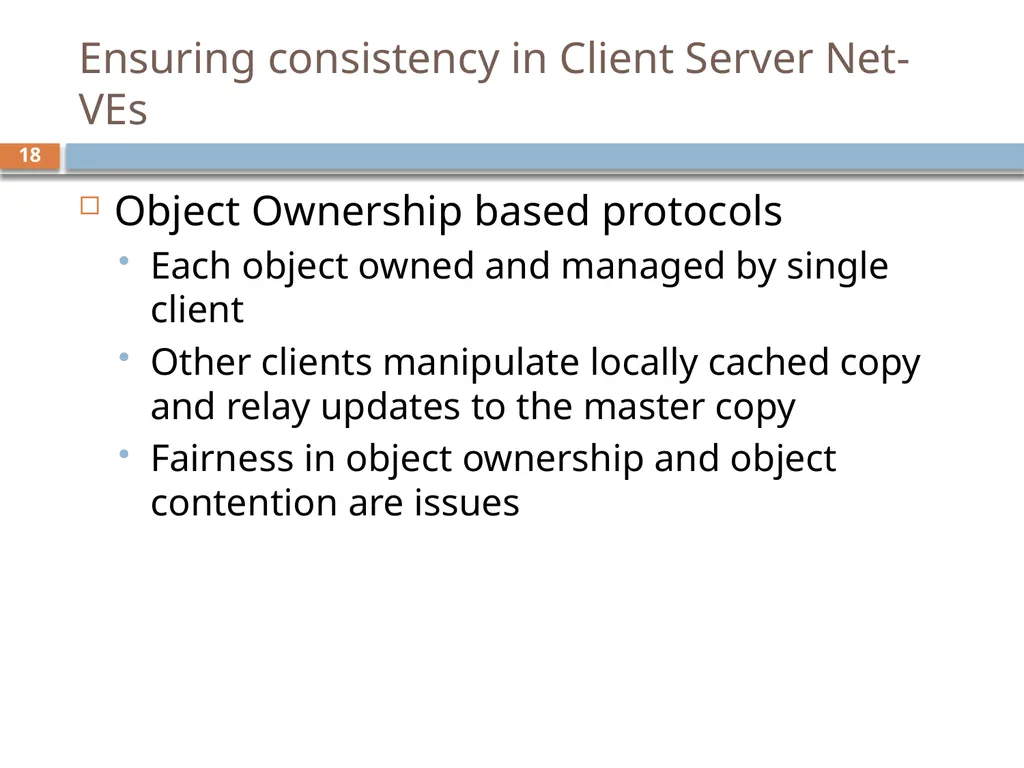
slide18. Ensuring consistency in Client Server Net-VEs Object Ownership based protocols
Each object owned and managed by single client
Other clients manipulate locally cached copy and relay updates to the master copy
Fairness in object ownership and object contention are issues 18<br>
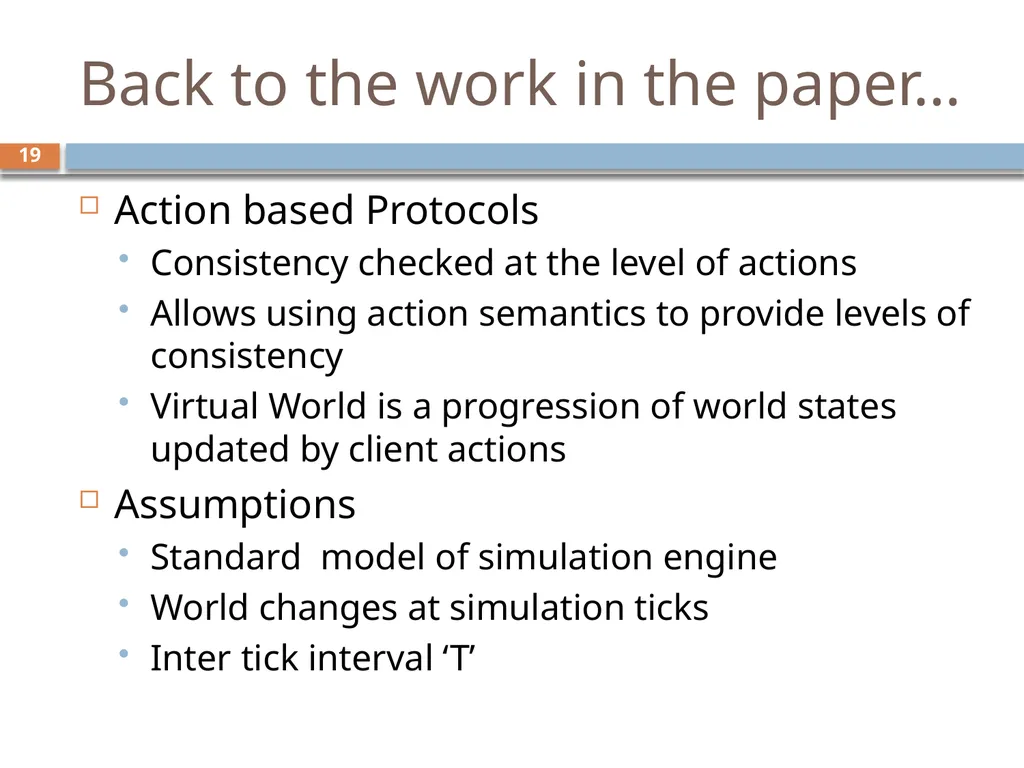
slide19. Back to the work in the paper… Action based Protocols
Consistency checked at the level of actions
Allows using action semantics to provide levels of consistency
Virtual World is a progression of world states updated by client actions
Assumptions
Standard model of simulation engine
World changes at simulation ticks
Inter tick interval ‘T’ 19<br>
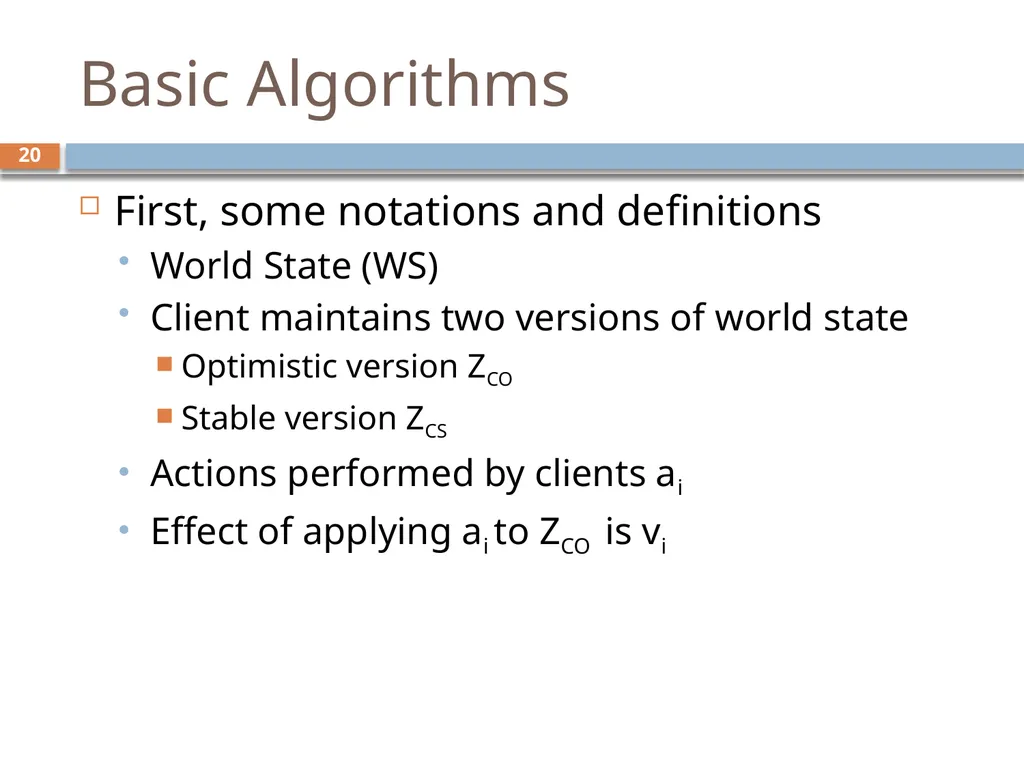
slide20. Basic Algorithms First, some notations and definitions
World State (WS)
Client maintains two versions of world state
Optimistic version ZCO
Stable version ZCS
Actions performed by clients ai
Effect of applying ai to ZCO is vi 20<br>
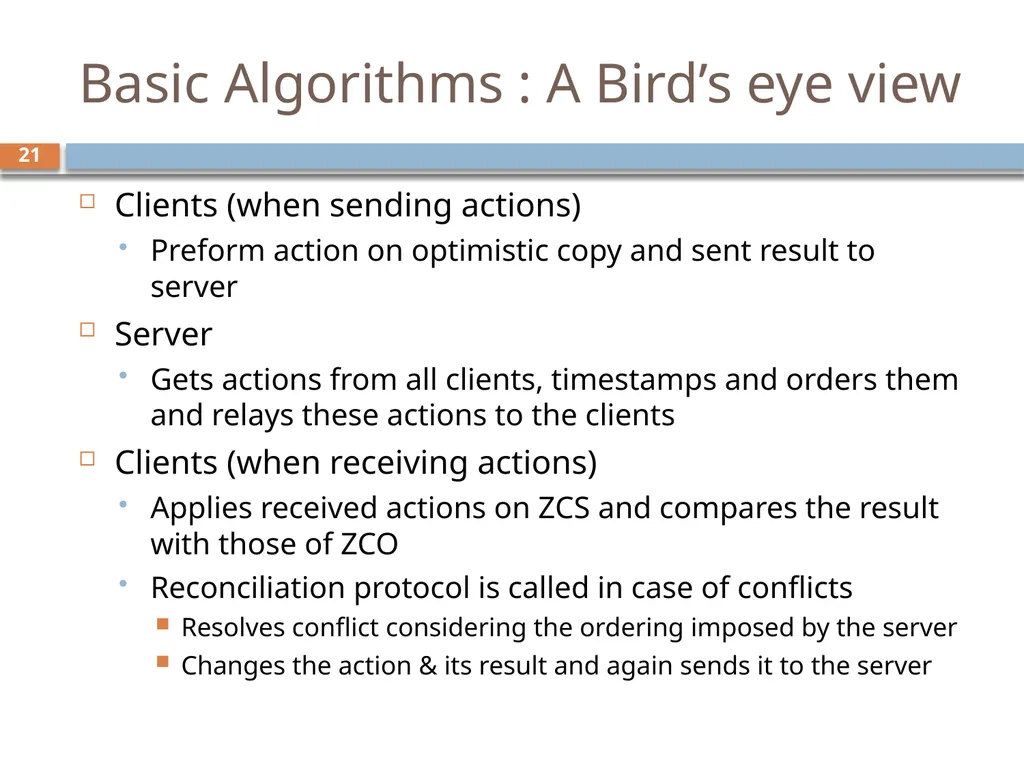
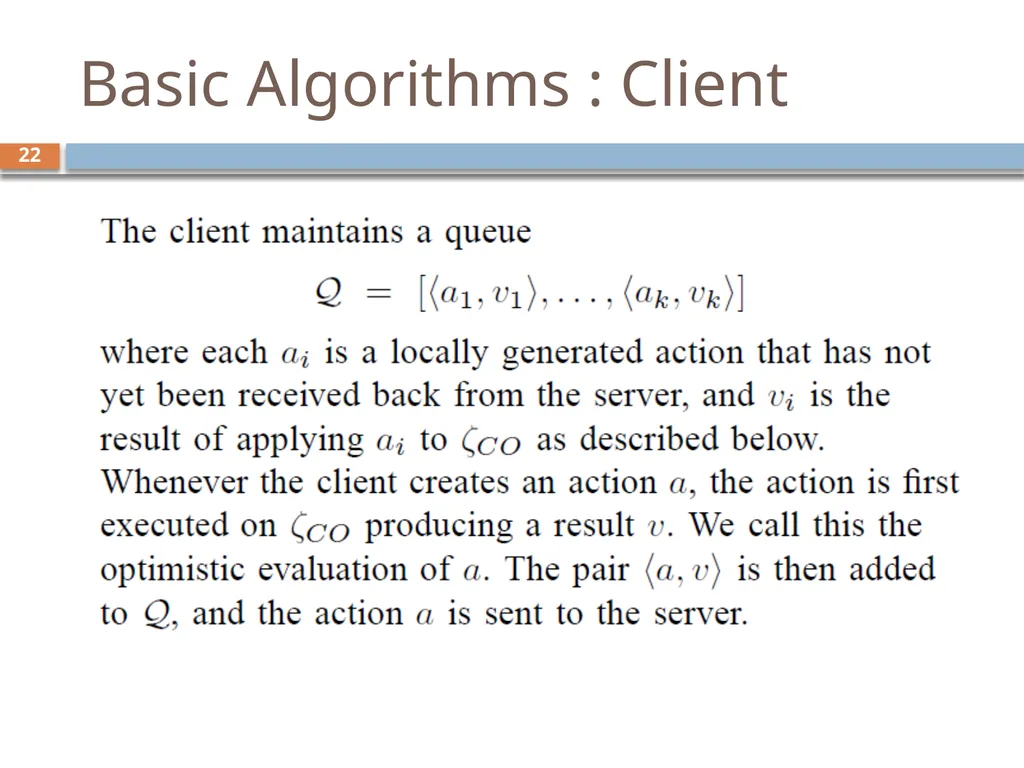
slide21. Basic Algorithms : A Bird’s eye view Clients (when sending actions)
Preform action on optimistic copy and sent result to server
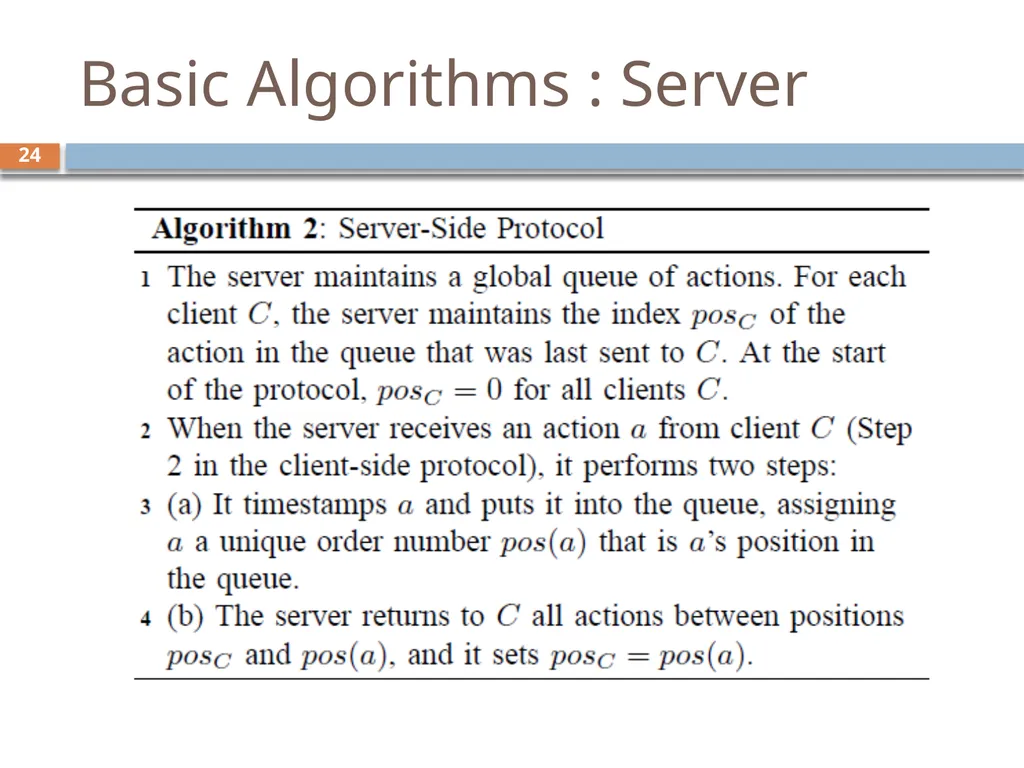
Server
Gets actions from all clients, timestamps and orders them and relays these actions to the clients
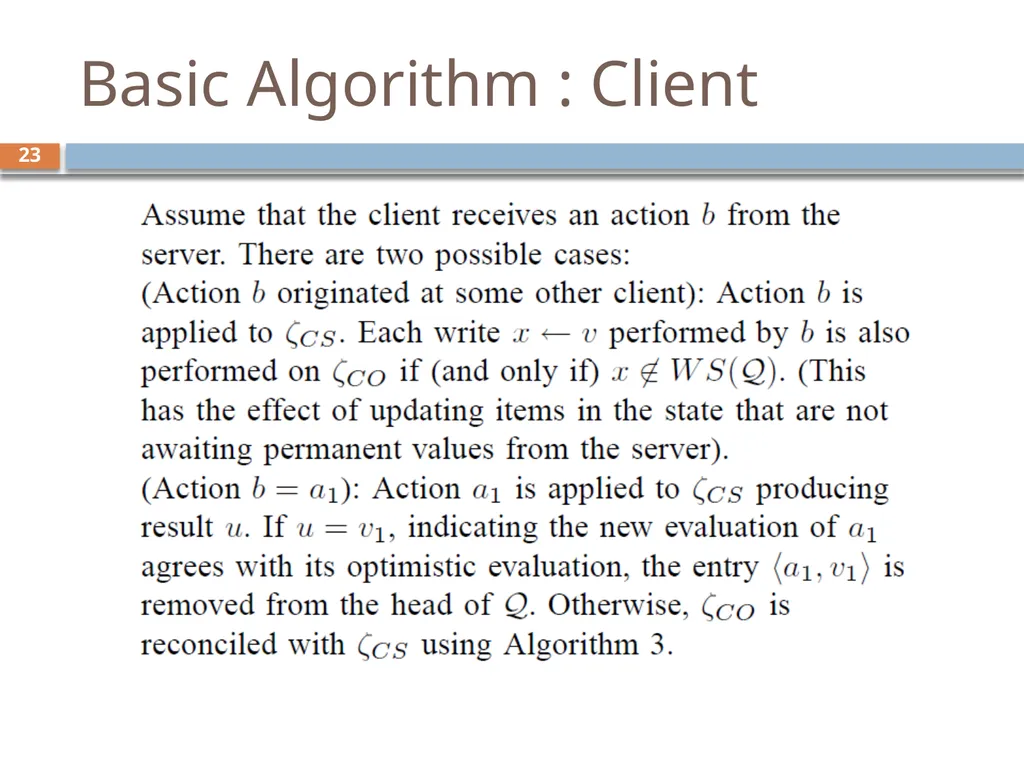
Clients (when receiving actions)
Applies received actions on ZCS and compares the result with those of ZCO
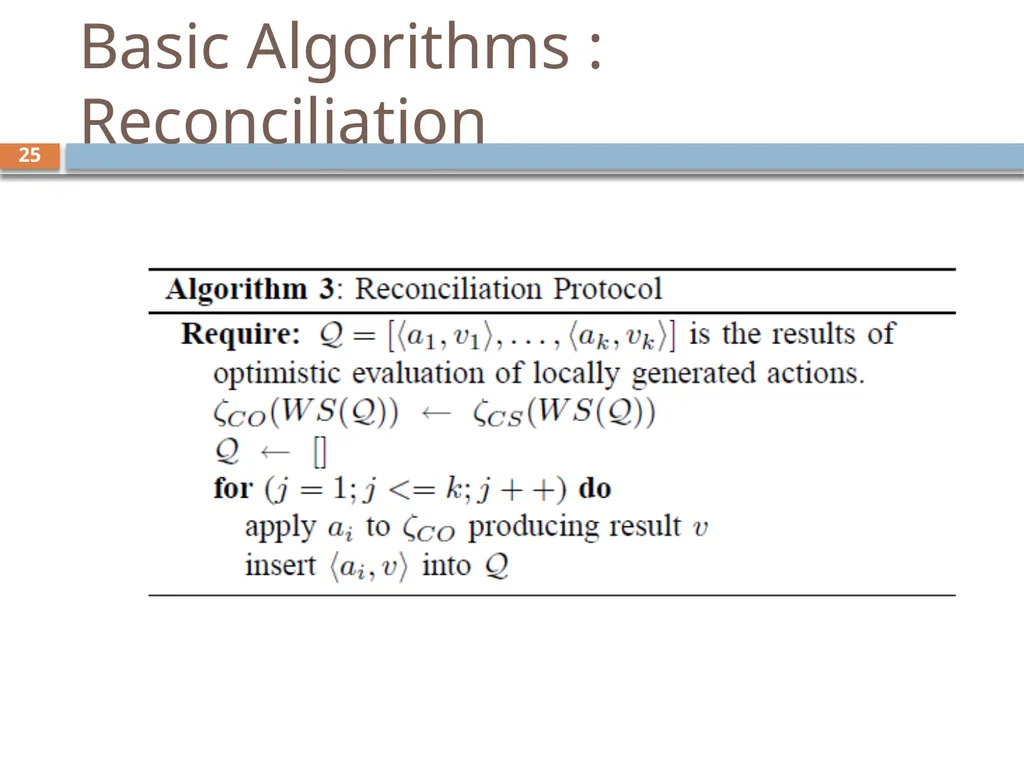
Reconciliation protocol is called in case of conflicts
Resolves conflict considering the ordering imposed by the server
Changes the action & its result and again sends it to the server 21<br>
slide22. Basic Algorithms : Client 22<br>
slide23. Basic Algorithm : Client 23<br>
slide24. Basic Algorithms : Server 24<br>
slide25. Basic Algorithms : Reconciliation 25<br>
slide26. Is the proposed solution enough? Response Time
Good Enough. RTT for most actions (More for conflicting actions)
Consistency
The server ensures consistency using timestamp ordering
Computational Load
Clients need to process actions of all the clients in the world
Incurs high computation load
Is it necessary? 26<br>
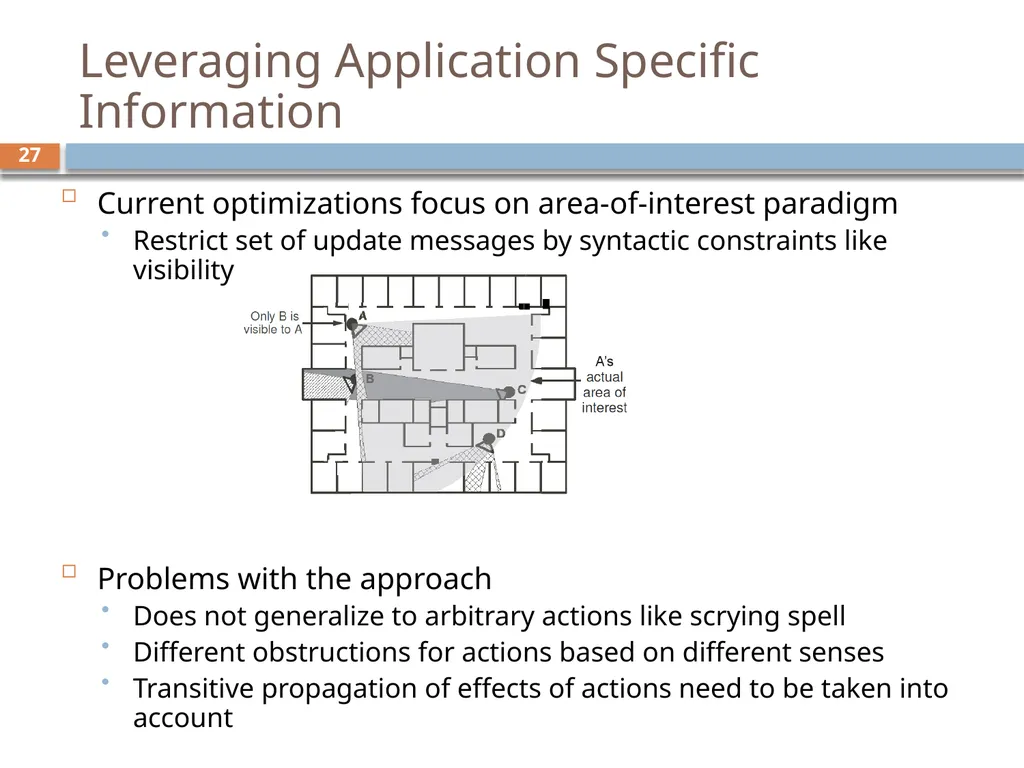
slide27. Leveraging Application Specific Information Current optimizations focus on area-of-interest paradigm
Restrict set of update messages by syntactic constraints like visibility
Problems with the approach
Does not generalize to arbitrary actions like scrying spell
Different obstructions for actions based on different senses
Transitive propagation of effects of actions need to be taken into account 27<br>
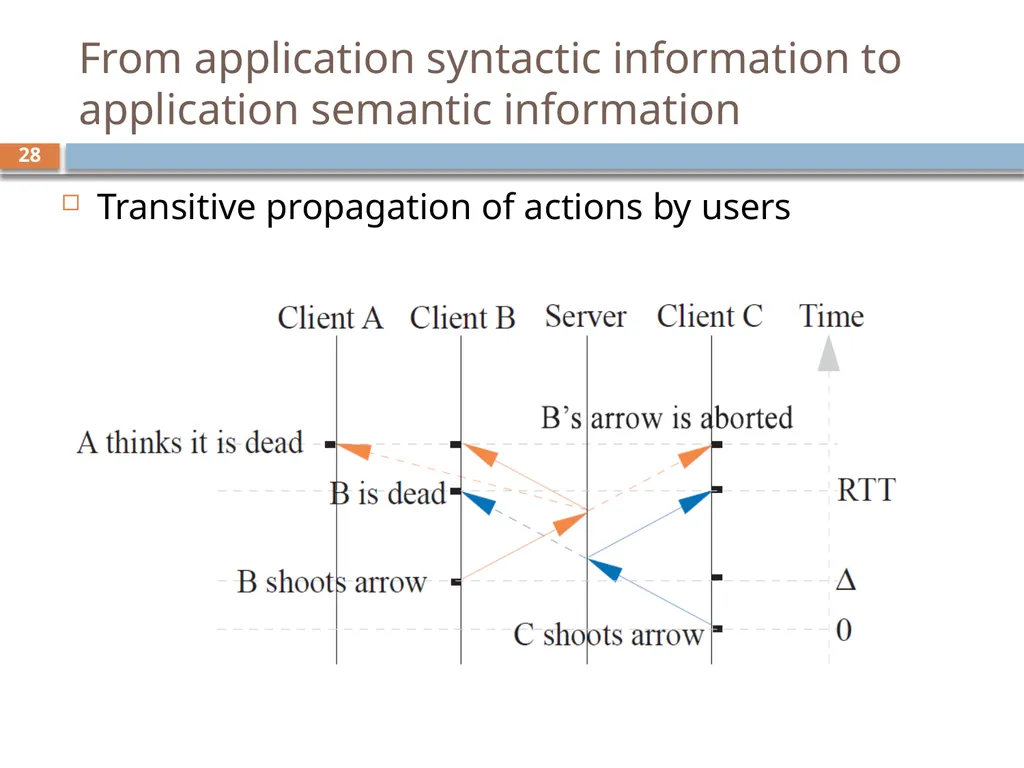
slide28. From application syntactic information to application semantic information Transitive propagation of actions by users 28<br>
slide29. Incomplete World Model 29 Clients maintain incomplete world state in their databases
World State variables which concern them are updated
Now server has the responsibility to maintain a complete world state
Also since we don’t want the server to evaluate game logic, the actions would still be evaluated by the clients
Their result and a completion message is sent to the server
The server then updates the authoritative state
Client sees an incomplete world while server sees a complete world<br>
slide30. Incomplete World Model : Client The client behaves similar as in the previous protocol
Now after application of each of its own action successfully, it sends a completion message to the server in both cases
If Zco and Zcs match
If not, then reconciled and new action added
Completion message indicates the successful application of an action 30<br>
slide31. Incomplete World Model : Server The server maintains
Authoritative state Zs
Global queue of ordered actions
And for each action in the queue, the clients it was sent
Time stamping of actions is similar as in previous protocol
For every action, it computes the set previous actions that must be sent to each client (See Next Slide)
Upon receipt of an completion message of an action from a client, the action is removed from the global queue
Only completed actions are applied to the authoritative state 31<br>
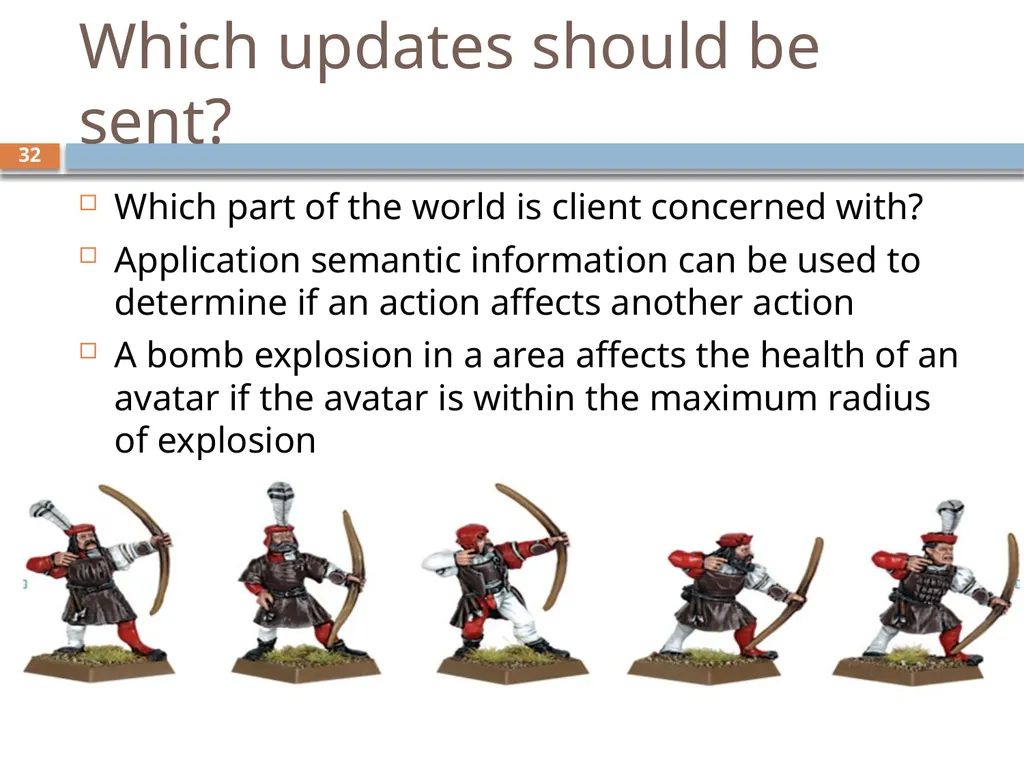
slide32. Which updates should be sent? Which part of the world is client concerned with?
Application semantic information can be used to determine if an action affects another action
A bomb explosion in a area affects the health of an avatar if the avatar is within the maximum radius of explosion 32<br>
slide33. Determining update set An action has
Read Set – The world state variables it reads
Write Set – The world state variables it updates
An action ai affects action aj if,
Read Set (ai) Write Set (aj) ≠ ø
Now compute which actions ak affect ai
Continue transitively for all actions in the ready queue of actions
The determination of actions would go on but terminates when
The action queue is finished since these actions have completed message sent
The values for the remaining read set are read from the authoritative database since it as all actions with completed actions have been applied to authoritative database 33<br>
slide34. Incomplete World Protocol : In Detail 34<br>
slide35. Incomplete World Protocol : In Detail 35<br>
slide36. Incomplete World Protocol : In Detail 36<br>
slide37. A Theorem In a distributed snapshot of the system, Zcs at all clients is consistent with Zs at the server
Observe that all clients and server apply the updates relevant to them in the same order 37<br>
slide38. Analysis of the Protocol Depends on the bound on the number of actions to be included in the update set which affects the computational complexity at the clients
Transitive closure
Determines which previously unsent actions can affect the evaluation of current action
First Bound Model
Considers the actions which might directly affect the current action using semantic constraints
Information Bound Model
Considers transitive dependence of the actions 38<br>
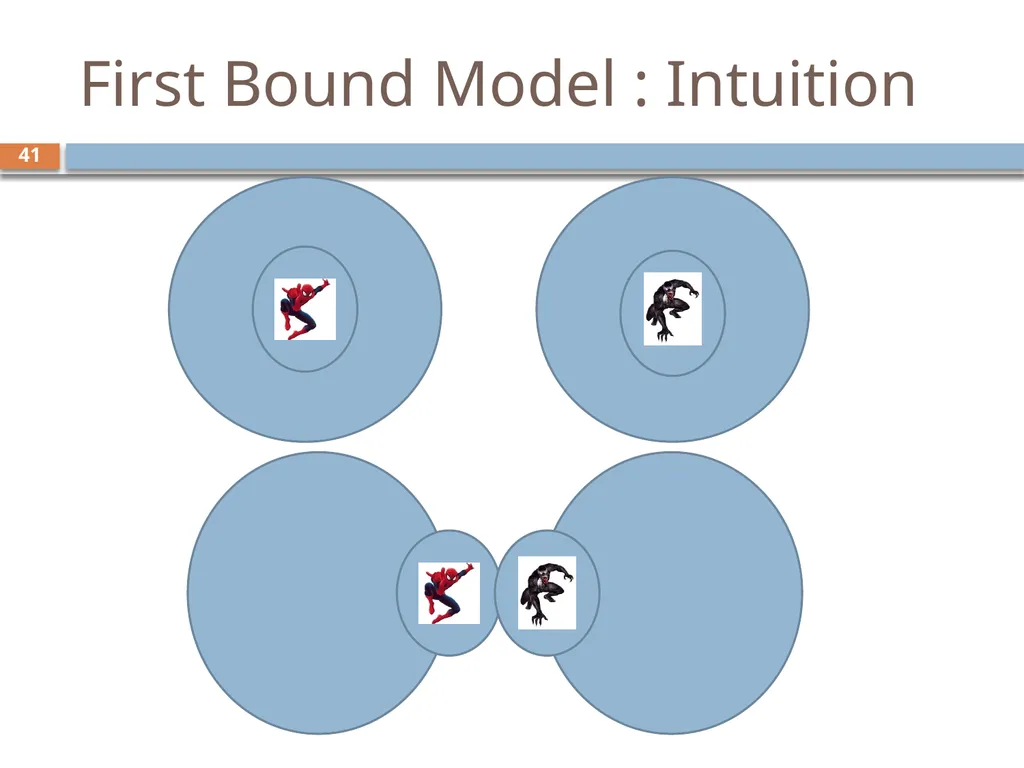
slide39. First Bound Model FBM determines the set of actions that are sent to a client
Finds bound on the number of actions that might directly affect the future actions of the client 39<br>
slide40. Which actions to consider? Use application semantics to bound actions
Spatial attributes can change at most by maximum velocity
A player can damage other player at most by the maximum attacking power 40<br>
slide41. First Bound Model : Intuition 41<br>
slide42. First Bound Model Computing Complexity
Time for server to receive response for an action from client is RTT + Y (initial processing)
Server needs to send all actions that it has seen in the previous (RTT + Y) / T ticks
Later as actions increase Y increases proportionally increasing the bound geometrically
A little change in the protocol
The server now proactively pushes action sets to clients at regular intervals of w RTT ( 0<w<1)
The server receives a response for any action from the client in time (1+w) RTT of sending the action to the client 42<br>
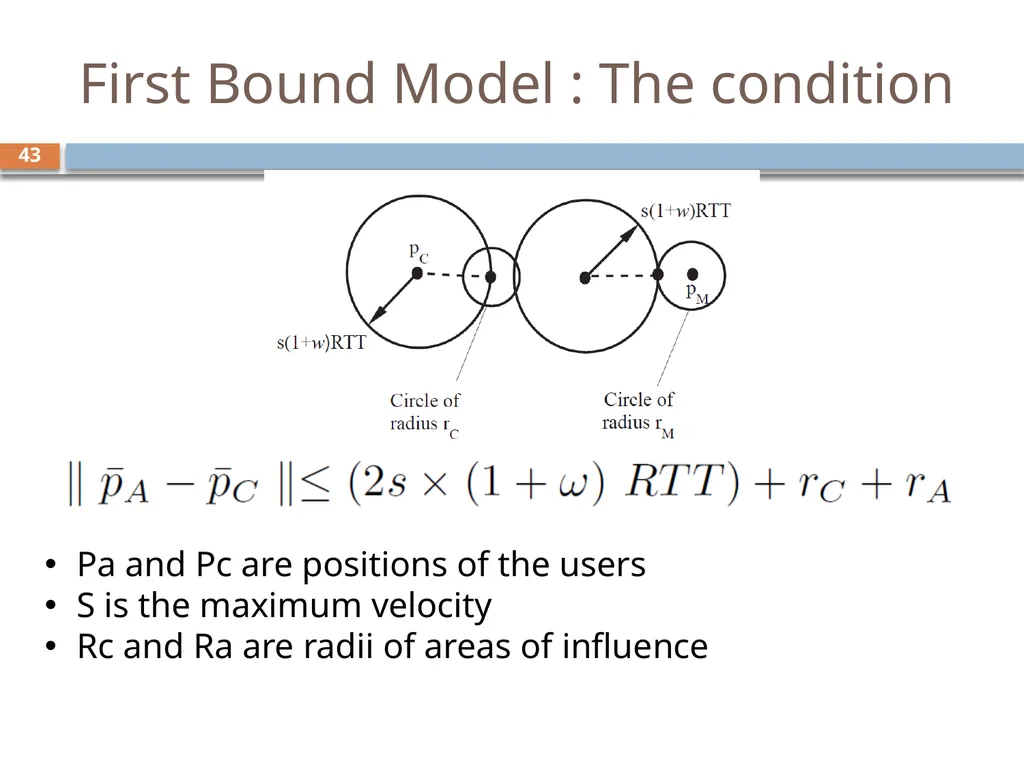
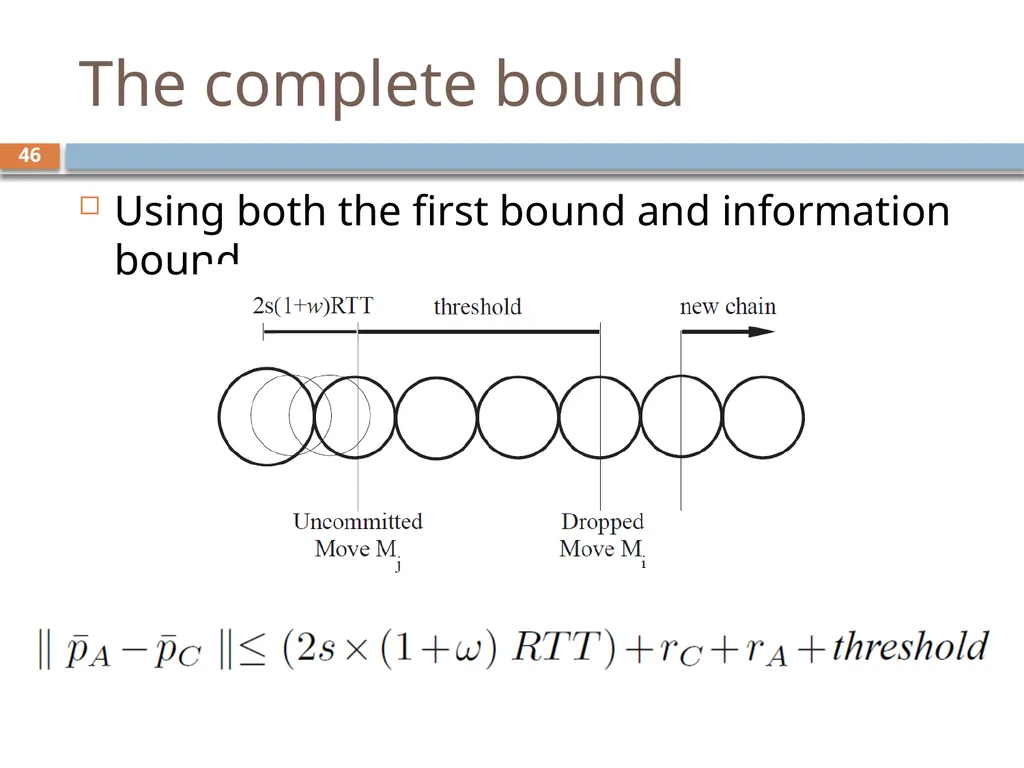
slide43. First Bound Model : The condition Pa and Pc are positions of the users
S is the maximum velocity
Rc and Ra are radii of areas of influence 43<br>
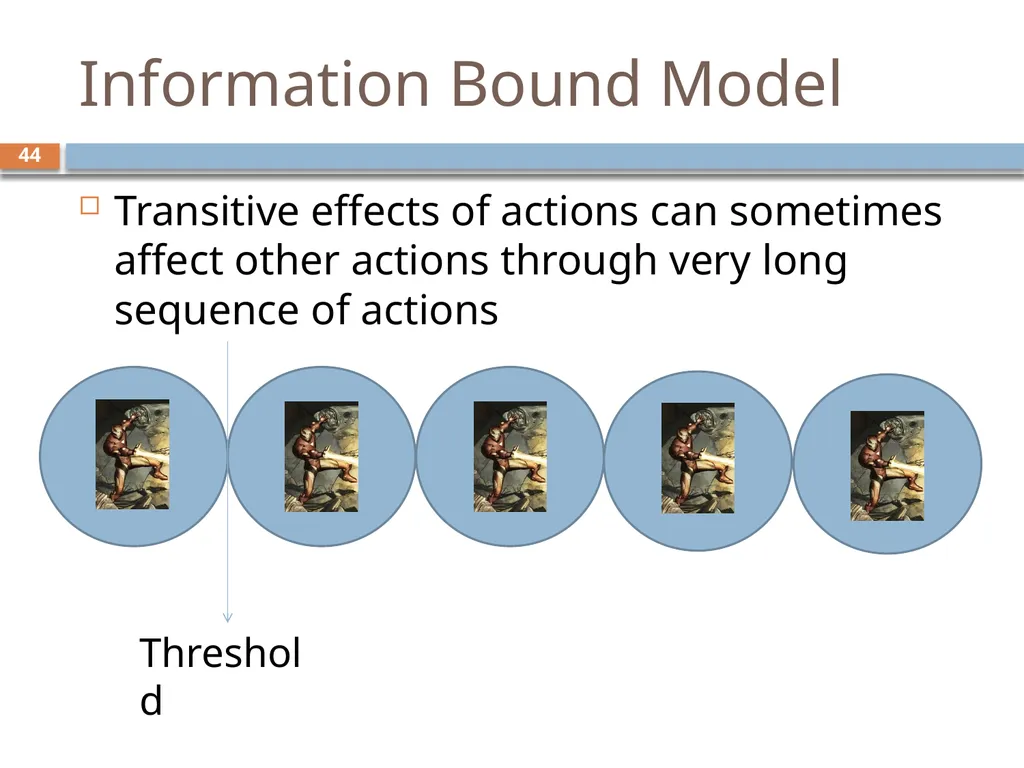
slide44. Information Bound Model Threshold Transitive effects of actions can sometimes affect other actions through very long sequence of actions 44<br>
slide45. Information Bound Model Transitive effects of actions can sometimes affect other actions through very long sequence of actions
Bound on the number of action to be considered for transitive effect
The bound is decided arbitrarily and actions are dropped and not considered
Raises some other issues like fairness but performance is good enough 45<br>
slide46. The complete bound Using both the first bound and information bound 46<br>
slide47. Other Optimizations Inconsequential Action Elimination
Some actions are inconsequential for other actions of objects
Small changes in a area are significant for an insect while they may be insignificant for a large transformer robot
Area Culling
Many actions do not have spherical area of influence like shooting of arrow
Modify action influence accordingly
An arrow shot by a player has a rectangular area of influence along with a velocity vector 47<br>
slide48. Experimental Evaluation Paper’s algorithm – SEVE (Scalable Engine for Virtual Environment)
The game - Manhattan People 48<br>
slide49. Experimental Evaluation 49<br>
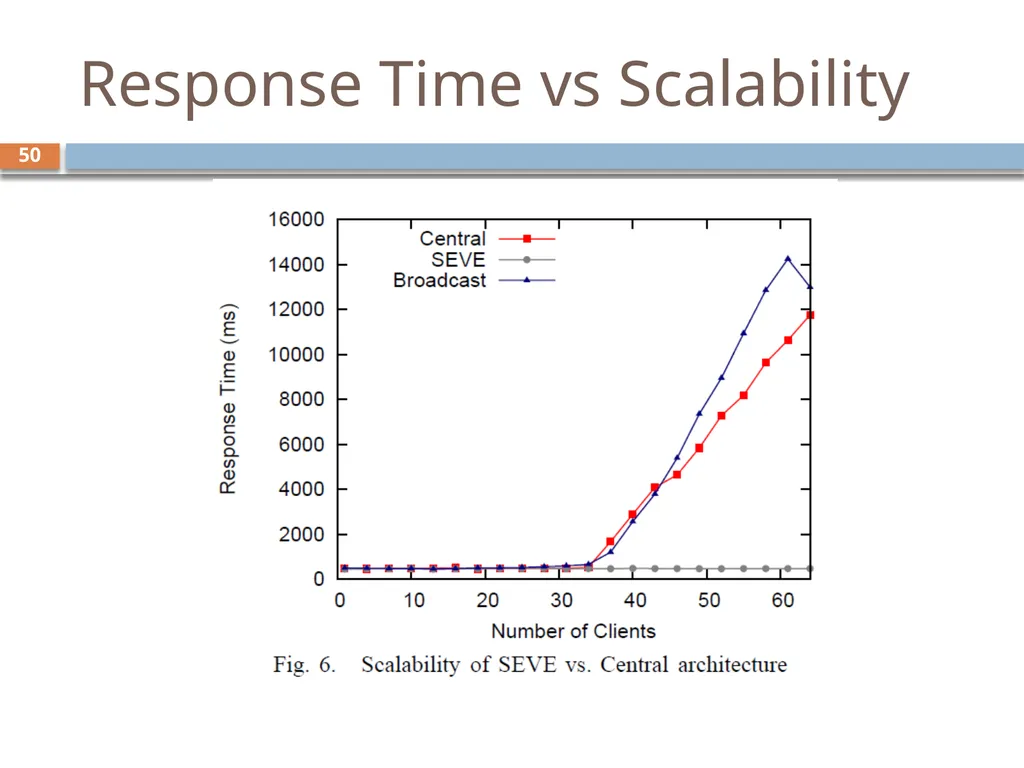
slide50. Response Time vs Scalability 50<br>
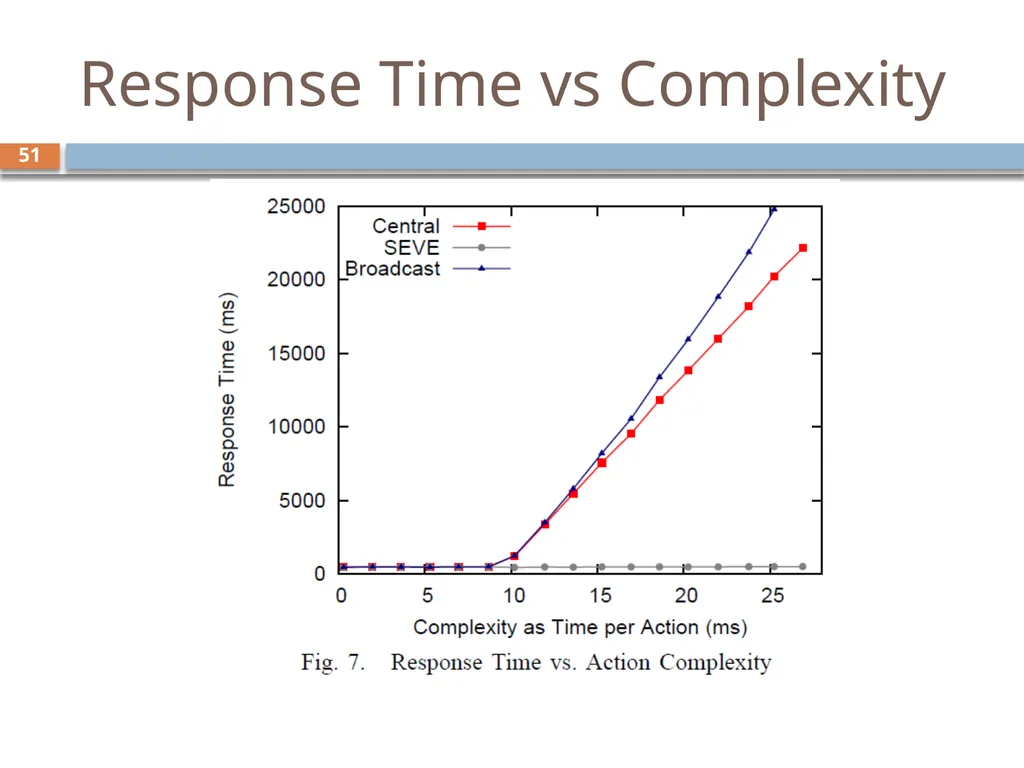
slide51. Response Time vs Complexity 51<br>
slide52. Response Time vs Density of Avatars 52<br>
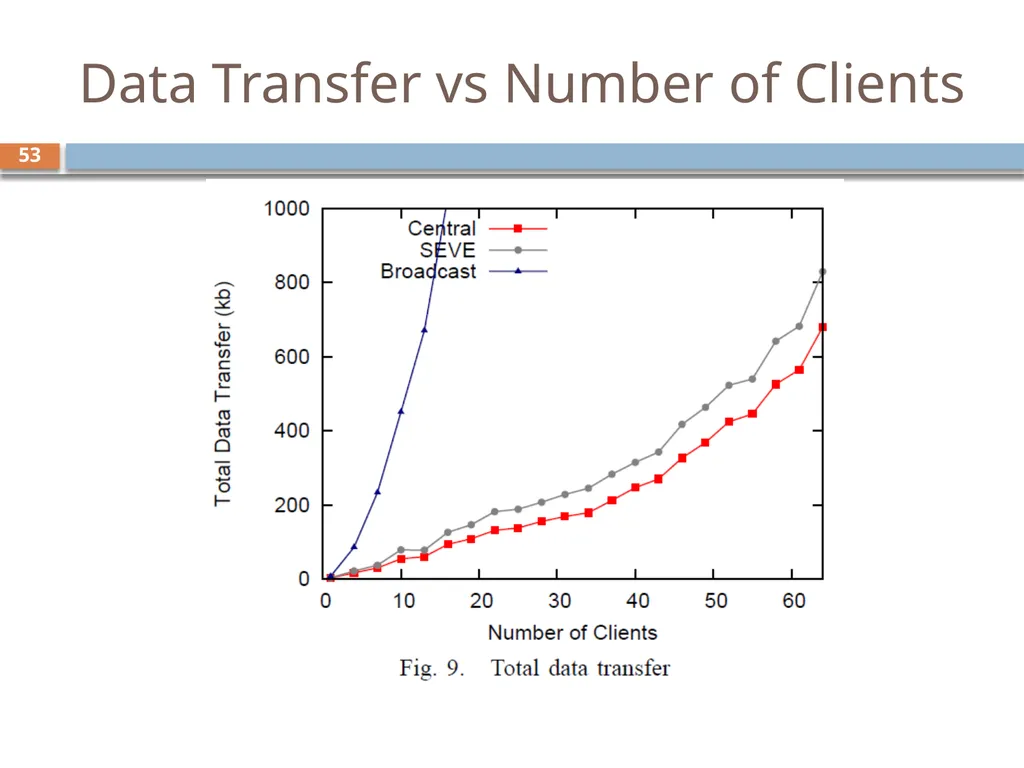
slide53. Data Transfer vs Number of Clients 53<br>
slide54. Response Time vs Number of Clients 54<br>
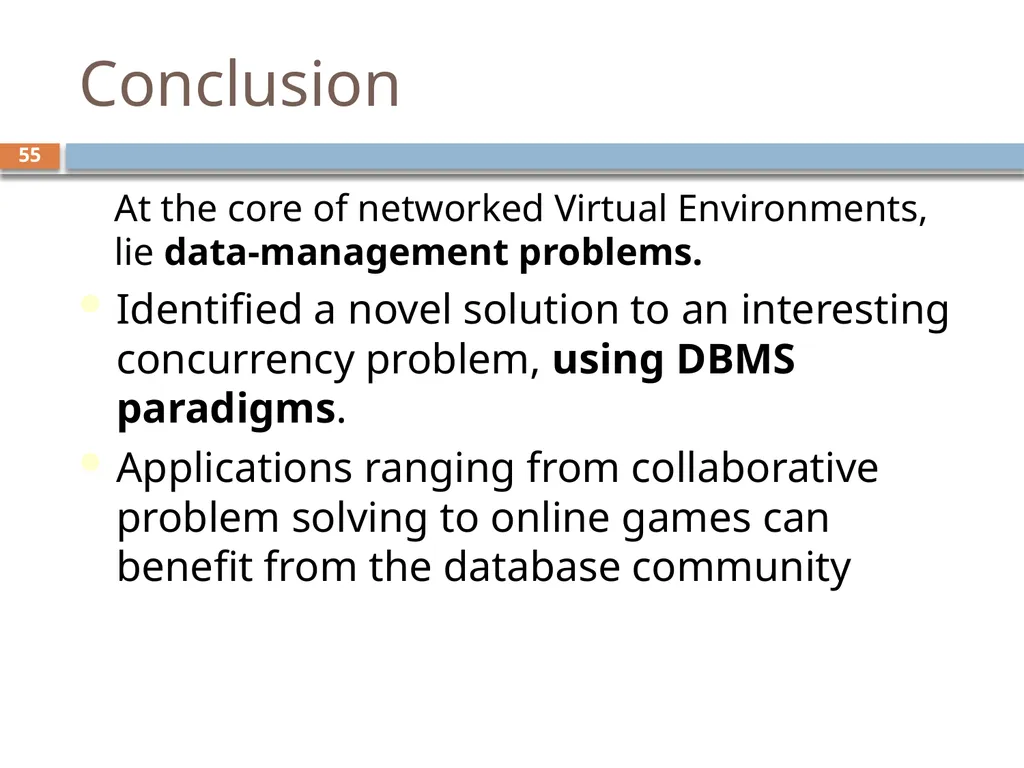
slide55. Conclusion At the core of networked Virtual Environments, lie data-management problems.
Identified a novel solution to an interesting concurrency problem, using DBMS paradigms.
Applications ranging from collaborative problem solving to online games can benefit from the database community 55<br>
slide56. References [1] Scalability for Virtual Worlds Nitin Gupta, Alan J. Demers, Johannes Gehrke, Philipp Unterbrunner, Walker M. White ICDE 2009
[2] SEMMO: A Scalable Engine for Massively Multiplayer Online Games (Demonstration Paper) Nitin Gupta, Alan Demers, and Johannes Gehrke, SIGMOD 2008
[3] Database Research Opportunities in Computer Games Walker White, Christoph Koch, Nitin Gupta, Johannes Gehrke, and Alan Demers, In SIGMOD Record, September 2007 56<br>
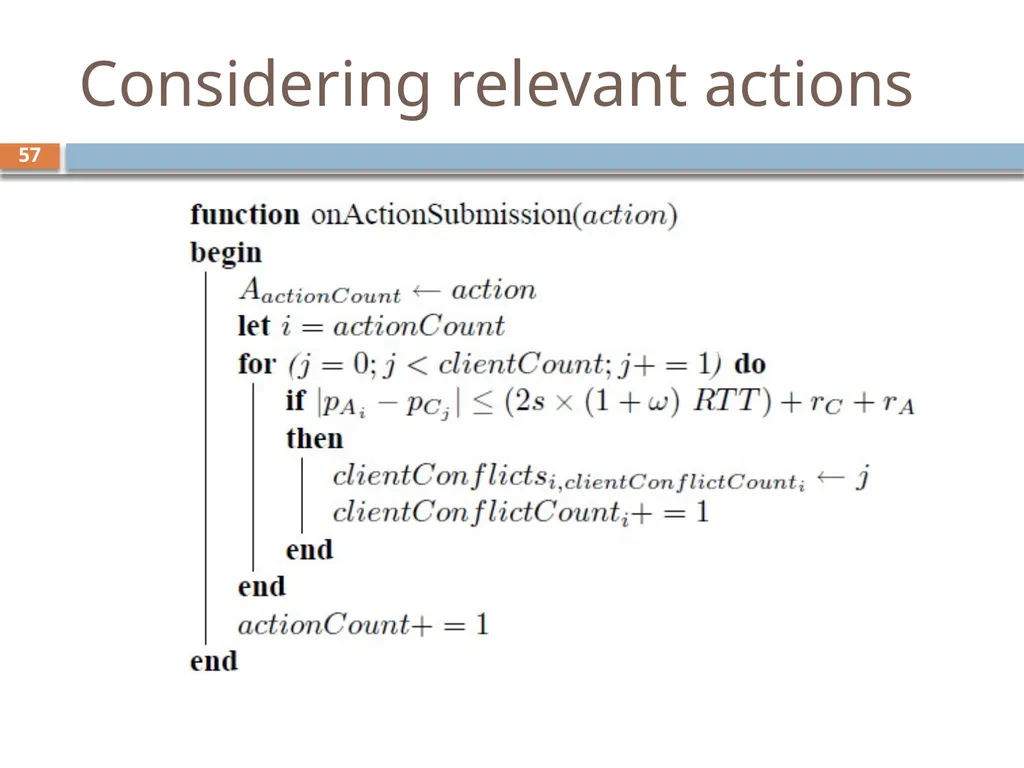
slide57. Considering relevant actions 57<br>
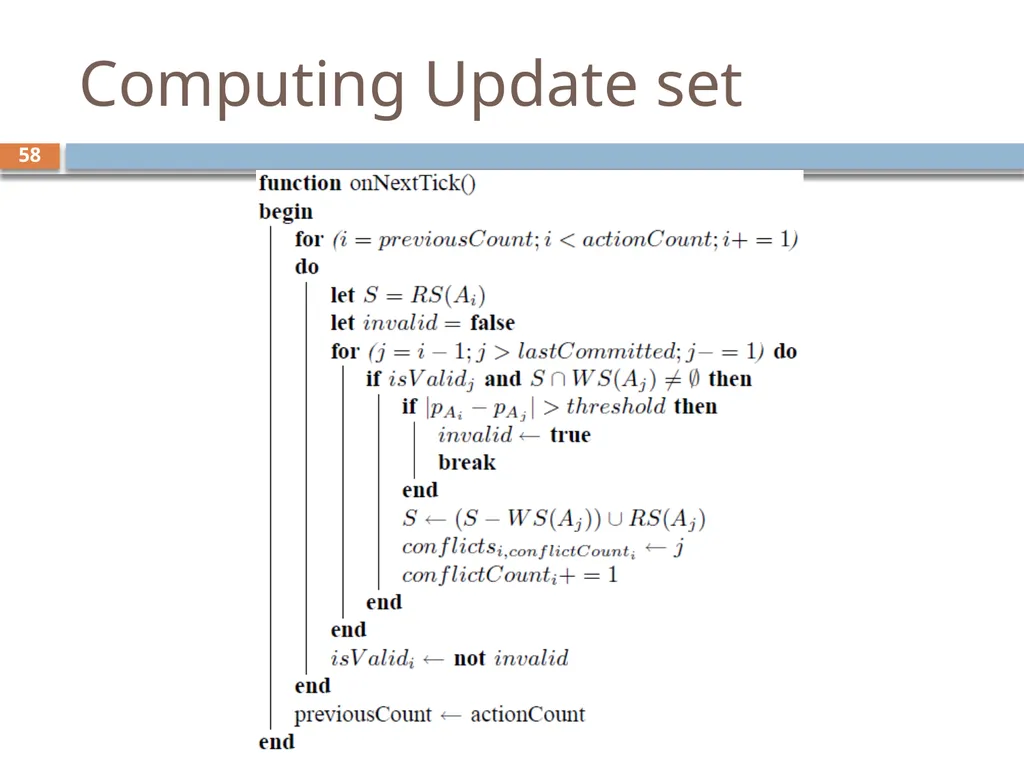
slide58. Computing Update set 58<br>
at ICDE 2009
Presented By,
Pratik Patre, Biplab Kar 1<br>
slide2. Net-VEs Networked Virtual Environments
A virtual environment shared by many users connected over a network
Users can interact with each other in real time 2<br>
slide3. Pushing the frontiers in Gaming Low quality to highly immersive visuals
Graphics Research Community
Simple button control to motion sensing control
Interaction Design Community
Single Player to Multiplayer over LAN
Networking Research Community
Massive Scalability over thousands of simultaneous users
Distributed Database Research Community 3<br>
slide4. What restricts Massive Scalability? Computational Complexity
Realistic graphics and physics based interaction
Consistency
Consistent virtual world for all users. Required for realism.
Response Time
Guaranteeing bounded response time to users thereby increasing action throughput. Required for real-time interaction. 4<br>
slide5. What restricts Massive Scalability? Computational Complexity Similarly we expect scalability to decrease with increasing consistency requirement and decreasing response time requirement 5<br>
slide6. Tackling Massive Scalability Problem Computation Complexity
Pushing complex computation to client machines
Consistency
Using application semantics to reduce consistency requirements
Response Time
Reducing messages communicated for an action
Exploring the Trade-Offs in above requirements 6<br>
slide7. But Wait… First we investigate the current (as in 2008) approaches for improving scalability 7<br>
slide8. Virtual World – A Database Perspective The entire virtual world and all its components (World State) are stored in a database
Tuples - Each object/player information
Attributes - Characteristics like Health, position, speed, weapons of each object/player
Any interaction in the world is a database transaction
Observations - Database Queries
Change in state - Database Updates 8<br>
slide9. A Gaming Example A Shared Virtual Gotham City
Avatars - Batman and Joker
Event - Batman kicks Joker which reduces Joker’s health
A look from Database perspective
Batman, Joker and their attributes including current health stored as tuples in the database in objects table
The game engine reads from the database attacking power of Batman and health of Joker
The game engine determines the effect of the action on Jokers health and other parameters
The game engine updates the values of the new parameters in the database 9<br>
slide10. An example consistency issue Joker shoots at Robin while batman throws a batarang at Joker
What is the outcome? 10<br>
slide11. Net-VE Architectures Centralized VEs
All computations are done at a centralized server
World state updated only by server
The clients only read this world state and show it to the users 11<br>
slide12. Scaling Centralized VEs Zoning
Geographically partitioning virtual environments small enough for a server to handle
Sharding
Different virtual environments for geographically distant users
Instancing
Private zones meant a personal experiences to some players
Focus on partitioning user base
Some virtual worlds require users to pay for playing with real friends 12<br>
slide13. Net-VE Architectures Distributed Net-VEs
Distribute computation to clients
Advantage – Reducing load on server and leveraging capabilities of client
Strongly consistent P2P architectures do not scale
Companies want to exert control and monetize the virtual environment discouraging completely distributed models 13<br>
slide14. Net-VE Architectures Client Server Distributed Model
Enforces centralized control at the server
Distributes computation to clients
Advantage – Reduced load on server
Server needs to maintain consistency 14<br>
slide15. Client Server Net-VEs Clients connected to server
Client
Clients contain virtual world logic
Clients initiate and process action
A sequence of atomic operations
At first, observation of world state
Followed by update of the state
Server
Shoulders the responsibility of consistency of world state across clients 15<br>
slide16. Ensuring consistency in Client Server Net-VEs Lock Based Protocol
Global Locks on objects
Lock granted by server
Client Requests locks
Server multicasts it to detect conflicts
Lock status reported to client
Disadvantages
Time required is 2 x RTT
All consistency issues should be mapped to object access 16<br>
slide17. Ensuring consistency in Client Server Net-VEs Timestamp based Protocols
Servers associates versions with objects and timestamp with transactions
Clients execute actions
Server integrates the actions into a global multi version history ensuring consistency in the world
Disadvantages
Server should understand game logic
If server broadcasts global history then time required 2 x RTT 17<br>
slide18. Ensuring consistency in Client Server Net-VEs Object Ownership based protocols
Each object owned and managed by single client
Other clients manipulate locally cached copy and relay updates to the master copy
Fairness in object ownership and object contention are issues 18<br>
slide19. Back to the work in the paper… Action based Protocols
Consistency checked at the level of actions
Allows using action semantics to provide levels of consistency
Virtual World is a progression of world states updated by client actions
Assumptions
Standard model of simulation engine
World changes at simulation ticks
Inter tick interval ‘T’ 19<br>
slide20. Basic Algorithms First, some notations and definitions
World State (WS)
Client maintains two versions of world state
Optimistic version ZCO
Stable version ZCS
Actions performed by clients ai
Effect of applying ai to ZCO is vi 20<br>
slide21. Basic Algorithms : A Bird’s eye view Clients (when sending actions)
Preform action on optimistic copy and sent result to server
Server
Gets actions from all clients, timestamps and orders them and relays these actions to the clients
Clients (when receiving actions)
Applies received actions on ZCS and compares the result with those of ZCO
Reconciliation protocol is called in case of conflicts
Resolves conflict considering the ordering imposed by the server
Changes the action & its result and again sends it to the server 21<br>
slide22. Basic Algorithms : Client 22<br>
slide23. Basic Algorithm : Client 23<br>
slide24. Basic Algorithms : Server 24<br>
slide25. Basic Algorithms : Reconciliation 25<br>
slide26. Is the proposed solution enough? Response Time
Good Enough. RTT for most actions (More for conflicting actions)
Consistency
The server ensures consistency using timestamp ordering
Computational Load
Clients need to process actions of all the clients in the world
Incurs high computation load
Is it necessary? 26<br>
slide27. Leveraging Application Specific Information Current optimizations focus on area-of-interest paradigm
Restrict set of update messages by syntactic constraints like visibility
Problems with the approach
Does not generalize to arbitrary actions like scrying spell
Different obstructions for actions based on different senses
Transitive propagation of effects of actions need to be taken into account 27<br>
slide28. From application syntactic information to application semantic information Transitive propagation of actions by users 28<br>
slide29. Incomplete World Model 29 Clients maintain incomplete world state in their databases
World State variables which concern them are updated
Now server has the responsibility to maintain a complete world state
Also since we don’t want the server to evaluate game logic, the actions would still be evaluated by the clients
Their result and a completion message is sent to the server
The server then updates the authoritative state
Client sees an incomplete world while server sees a complete world<br>
slide30. Incomplete World Model : Client The client behaves similar as in the previous protocol
Now after application of each of its own action successfully, it sends a completion message to the server in both cases
If Zco and Zcs match
If not, then reconciled and new action added
Completion message indicates the successful application of an action 30<br>
slide31. Incomplete World Model : Server The server maintains
Authoritative state Zs
Global queue of ordered actions
And for each action in the queue, the clients it was sent
Time stamping of actions is similar as in previous protocol
For every action, it computes the set previous actions that must be sent to each client (See Next Slide)
Upon receipt of an completion message of an action from a client, the action is removed from the global queue
Only completed actions are applied to the authoritative state 31<br>
slide32. Which updates should be sent? Which part of the world is client concerned with?
Application semantic information can be used to determine if an action affects another action
A bomb explosion in a area affects the health of an avatar if the avatar is within the maximum radius of explosion 32<br>
slide33. Determining update set An action has
Read Set – The world state variables it reads
Write Set – The world state variables it updates
An action ai affects action aj if,
Read Set (ai) Write Set (aj) ≠ ø
Now compute which actions ak affect ai
Continue transitively for all actions in the ready queue of actions
The determination of actions would go on but terminates when
The action queue is finished since these actions have completed message sent
The values for the remaining read set are read from the authoritative database since it as all actions with completed actions have been applied to authoritative database 33<br>
slide34. Incomplete World Protocol : In Detail 34<br>
slide35. Incomplete World Protocol : In Detail 35<br>
slide36. Incomplete World Protocol : In Detail 36<br>
slide37. A Theorem In a distributed snapshot of the system, Zcs at all clients is consistent with Zs at the server
Observe that all clients and server apply the updates relevant to them in the same order 37<br>
slide38. Analysis of the Protocol Depends on the bound on the number of actions to be included in the update set which affects the computational complexity at the clients
Transitive closure
Determines which previously unsent actions can affect the evaluation of current action
First Bound Model
Considers the actions which might directly affect the current action using semantic constraints
Information Bound Model
Considers transitive dependence of the actions 38<br>
slide39. First Bound Model FBM determines the set of actions that are sent to a client
Finds bound on the number of actions that might directly affect the future actions of the client 39<br>
slide40. Which actions to consider? Use application semantics to bound actions
Spatial attributes can change at most by maximum velocity
A player can damage other player at most by the maximum attacking power 40<br>
slide41. First Bound Model : Intuition 41<br>
slide42. First Bound Model Computing Complexity
Time for server to receive response for an action from client is RTT + Y (initial processing)
Server needs to send all actions that it has seen in the previous (RTT + Y) / T ticks
Later as actions increase Y increases proportionally increasing the bound geometrically
A little change in the protocol
The server now proactively pushes action sets to clients at regular intervals of w RTT ( 0<w<1)
The server receives a response for any action from the client in time (1+w) RTT of sending the action to the client 42<br>
slide43. First Bound Model : The condition Pa and Pc are positions of the users
S is the maximum velocity
Rc and Ra are radii of areas of influence 43<br>
slide44. Information Bound Model Threshold Transitive effects of actions can sometimes affect other actions through very long sequence of actions 44<br>
slide45. Information Bound Model Transitive effects of actions can sometimes affect other actions through very long sequence of actions
Bound on the number of action to be considered for transitive effect
The bound is decided arbitrarily and actions are dropped and not considered
Raises some other issues like fairness but performance is good enough 45<br>
slide46. The complete bound Using both the first bound and information bound 46<br>
slide47. Other Optimizations Inconsequential Action Elimination
Some actions are inconsequential for other actions of objects
Small changes in a area are significant for an insect while they may be insignificant for a large transformer robot
Area Culling
Many actions do not have spherical area of influence like shooting of arrow
Modify action influence accordingly
An arrow shot by a player has a rectangular area of influence along with a velocity vector 47<br>
slide48. Experimental Evaluation Paper’s algorithm – SEVE (Scalable Engine for Virtual Environment)
The game - Manhattan People 48<br>
slide49. Experimental Evaluation 49<br>
slide50. Response Time vs Scalability 50<br>
slide51. Response Time vs Complexity 51<br>
slide52. Response Time vs Density of Avatars 52<br>
slide53. Data Transfer vs Number of Clients 53<br>
slide54. Response Time vs Number of Clients 54<br>
slide55. Conclusion At the core of networked Virtual Environments, lie data-management problems.
Identified a novel solution to an interesting concurrency problem, using DBMS paradigms.
Applications ranging from collaborative problem solving to online games can benefit from the database community 55<br>
slide56. References [1] Scalability for Virtual Worlds Nitin Gupta, Alan J. Demers, Johannes Gehrke, Philipp Unterbrunner, Walker M. White ICDE 2009
[2] SEMMO: A Scalable Engine for Massively Multiplayer Online Games (Demonstration Paper) Nitin Gupta, Alan Demers, and Johannes Gehrke, SIGMOD 2008
[3] Database Research Opportunities in Computer Games Walker White, Christoph Koch, Nitin Gupta, Johannes Gehrke, and Alan Demers, In SIGMOD Record, September 2007 56<br>
slide57. Considering relevant actions 57<br>
slide58. Computing Update set 58<br>