
SCE questions – Cough Ranjeev Deerpalsing
LO
Published · 20 slides · 0 views

1 / 1

Description
SCE questions Cough Ranjeev Deerpalsing 4112020 Question 1 A 54 year old gentleman presents to the clinic with a troublesome cough for the past 10 weeks. He is a never smoker and is usually fairly fit and active. He describes the cough
Related Topics
Share
Embed code
Download this presentation From Below
"SCE questions – Cough Ranjeev Deerpalsing" is the property of its rightful owner. Permission is granted to download and print the materials on this website for personal, non-commercial use only, and to display it on your personal computer provided you do not modify the materials and that you retain all copyright notices contained in the materials. By downloading content from our website, you accept the terms of this agreement.
Presentation Transcript
01
SCE questions – Cough Ranjeev Deerpalsing
4/11/2020<br>
4/11/2020<br>
02
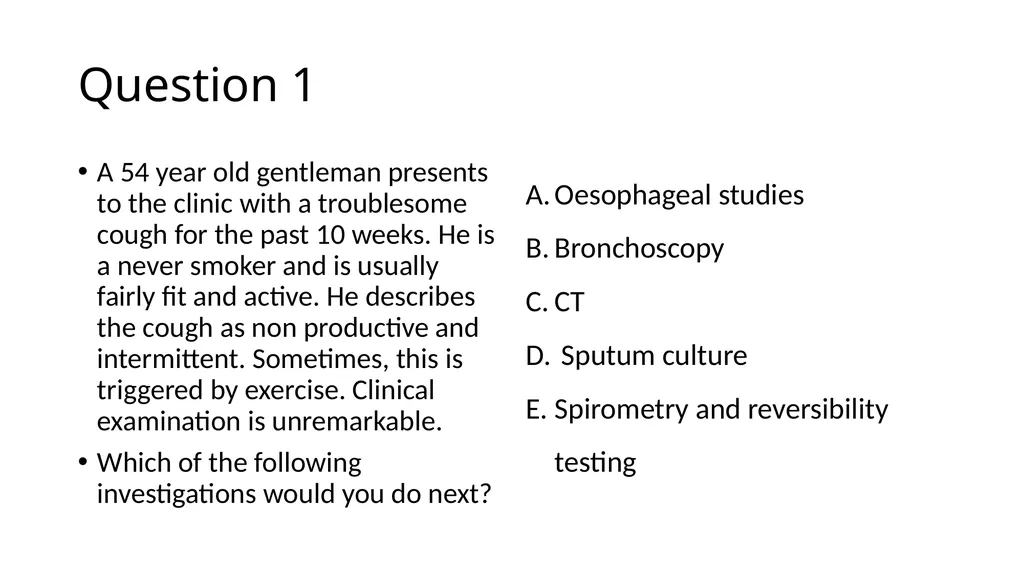
Question 1 A 54 year old gentleman presents to the clinic with a troublesome cough for the past 10 weeks. He is a never smoker and is usually fairly fit and active. He describes the cough as non productive and intermittent. Sometimes, this is triggered by exercise. Clinical examination is unremarkable.
Which of the following investigations would you do next? Oesophageal studies
Bronchoscopy
CT
Sputum culture
Spirometry and reversibility testing<br>
Which of the following investigations would you do next? Oesophageal studies
Bronchoscopy
CT
Sputum culture
Spirometry and reversibility testing<br>
03
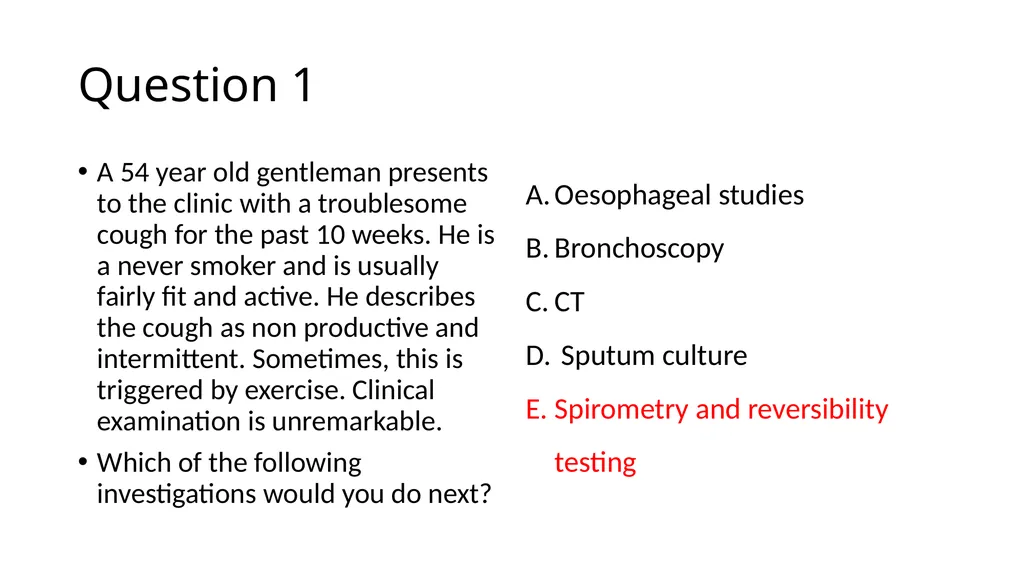
Question 1 A 54 year old gentleman presents to the clinic with a troublesome cough for the past 10 weeks. He is a never smoker and is usually fairly fit and active. He describes the cough as non productive and intermittent. Sometimes, this is triggered by exercise. Clinical examination is unremarkable.
Which of the following investigations would you do next? Oesophageal studies
Bronchoscopy
CT
Sputum culture
Spirometry and reversibility testing<br>
Which of the following investigations would you do next? Oesophageal studies
Bronchoscopy
CT
Sputum culture
Spirometry and reversibility testing<br>
04
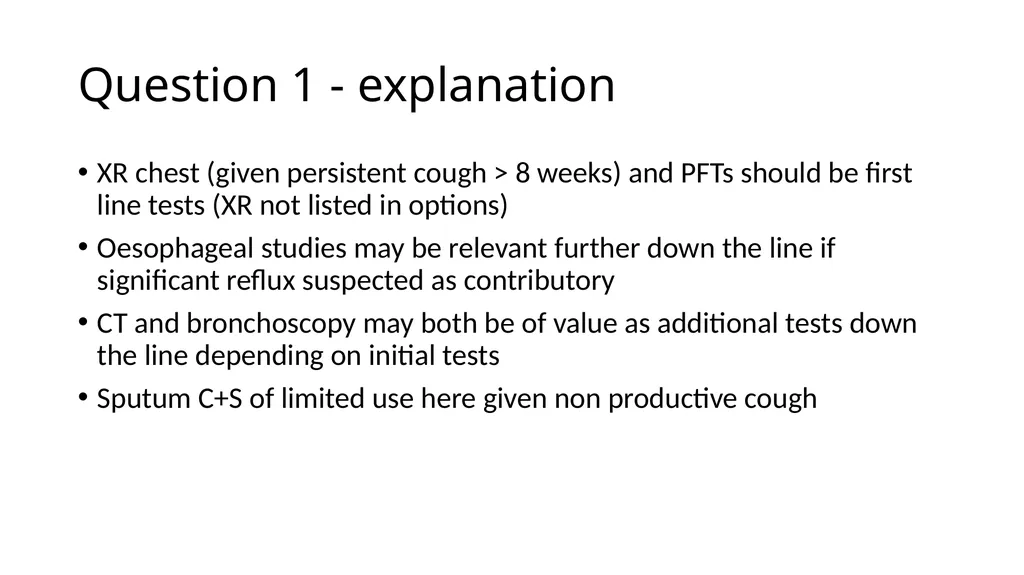
Question 1 - explanation XR chest (given persistent cough > 8 weeks) and PFTs should be first line tests (XR not listed in options)
Oesophageal studies may be relevant further down the line if significant reflux suspected as contributory
CT and bronchoscopy may both be of value as additional tests down the line depending on initial tests
Sputum C+S of limited use here given non productive cough<br>
Oesophageal studies may be relevant further down the line if significant reflux suspected as contributory
CT and bronchoscopy may both be of value as additional tests down the line depending on initial tests
Sputum C+S of limited use here given non productive cough<br>
05
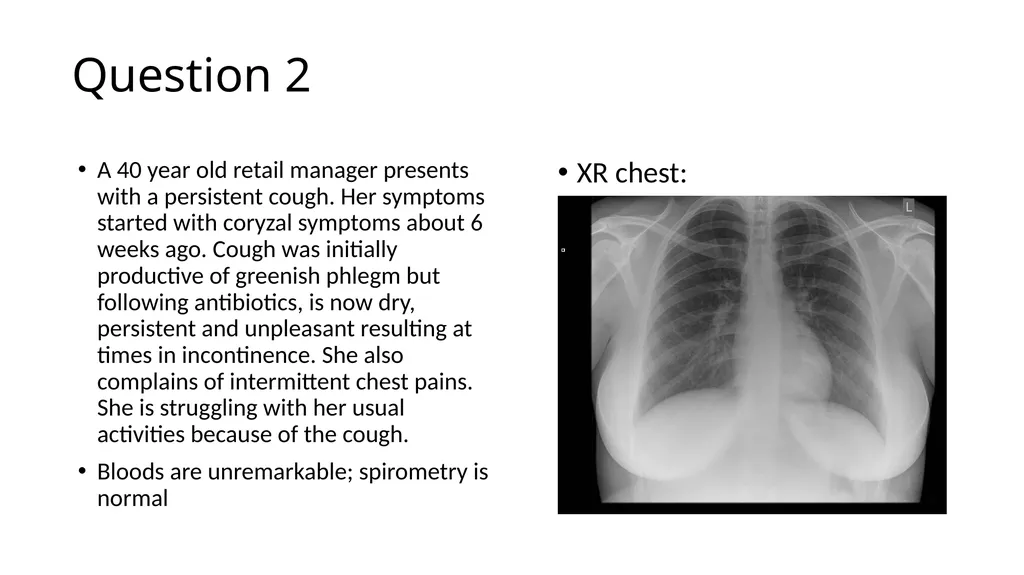
Question 2 A 40 year old retail manager presents with a persistent cough. Her symptoms started with coryzal symptoms about 6 weeks ago. Cough was initially productive of greenish phlegm but following antibiotics, is now dry, persistent and unpleasant resulting at times in incontinence. She also complains of intermittent chest pains. She is struggling with her usual activities because of the cough.
Bloods are unremarkable; spirometry is normal XR chest:<br>
Bloods are unremarkable; spirometry is normal XR chest:<br>
06
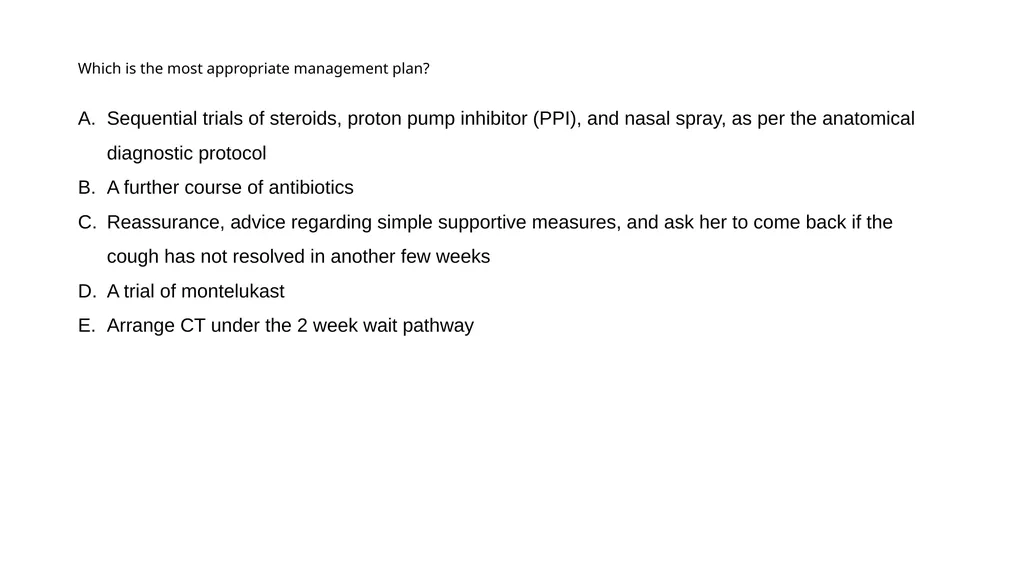
Which is the most appropriate management plan? Sequential trials of steroids, proton pump inhibitor (PPI), and nasal spray, as per the anatomical diagnostic protocol
A further course of antibiotics
Reassurance, advice regarding simple supportive measures, and ask her to come back if the cough has not resolved in another few weeks
A trial of montelukast
Arrange CT under the 2 week wait pathway<br>
A further course of antibiotics
Reassurance, advice regarding simple supportive measures, and ask her to come back if the cough has not resolved in another few weeks
A trial of montelukast
Arrange CT under the 2 week wait pathway<br>
07
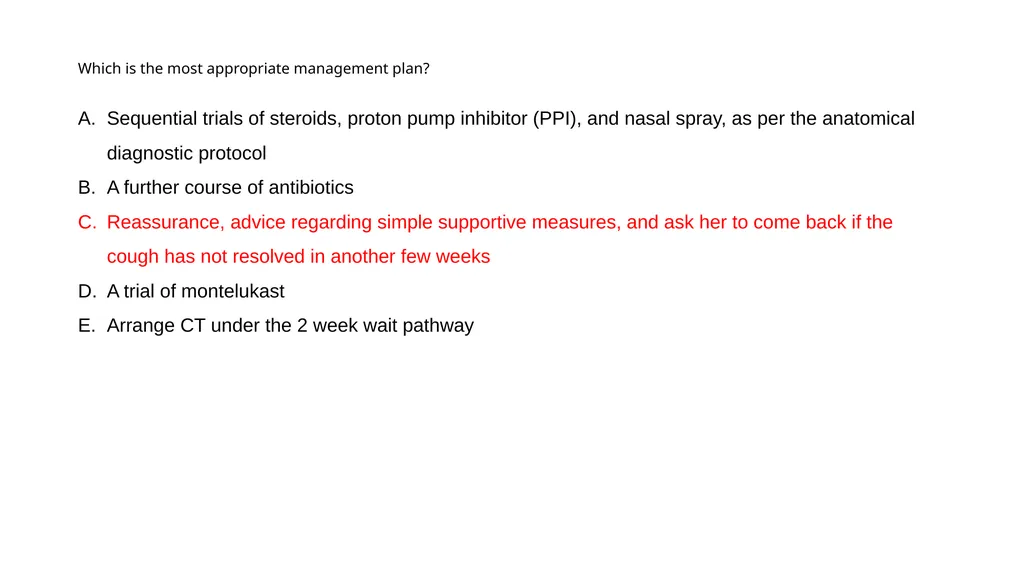
Which is the most appropriate management plan? Sequential trials of steroids, proton pump inhibitor (PPI), and nasal spray, as per the anatomical diagnostic protocol
A further course of antibiotics
Reassurance, advice regarding simple supportive measures, and ask her to come back if the cough has not resolved in another few weeks
A trial of montelukast
Arrange CT under the 2 week wait pathway<br>
A further course of antibiotics
Reassurance, advice regarding simple supportive measures, and ask her to come back if the cough has not resolved in another few weeks
A trial of montelukast
Arrange CT under the 2 week wait pathway<br>
08
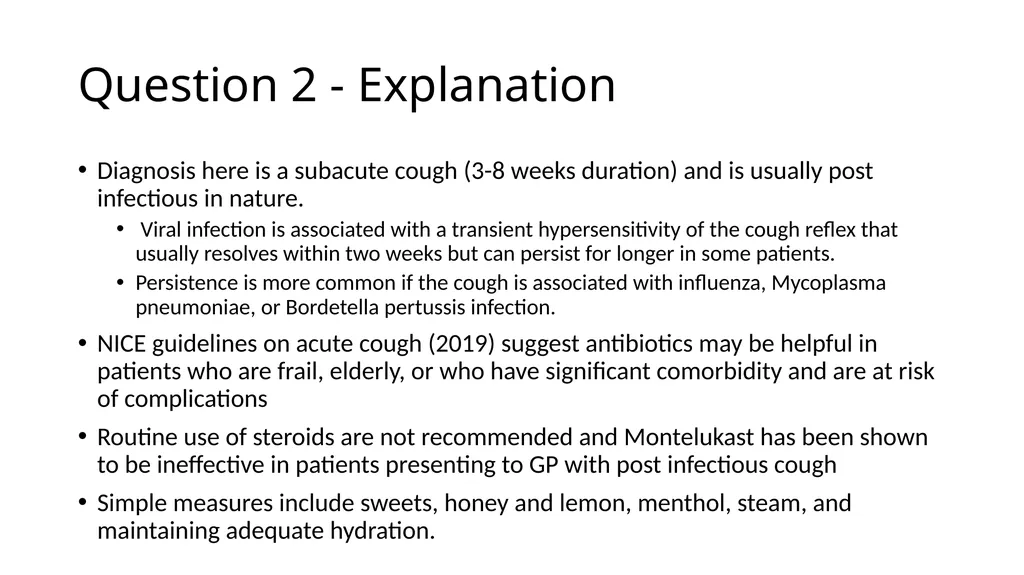
Question 2 - Explanation Diagnosis here is a subacute cough (3-8 weeks duration) and is usually post infectious in nature.
Viral infection is associated with a transient hypersensitivity of the cough reflex that usually resolves within two weeks but can persist for longer in some patients.
Persistence is more common if the cough is associated with influenza, Mycoplasma pneumoniae, or Bordetella pertussis infection.
NICE guidelines on acute cough (2019) suggest antibiotics may be helpful in patients who are frail, elderly, or who have significant comorbidity and are at risk of complications
Routine use of steroids are not recommended and Montelukast has been shown to be ineffective in patients presenting to GP with post infectious cough
Simple measures include sweets, honey and lemon, menthol, steam, and maintaining adequate hydration.<br>
Viral infection is associated with a transient hypersensitivity of the cough reflex that usually resolves within two weeks but can persist for longer in some patients.
Persistence is more common if the cough is associated with influenza, Mycoplasma pneumoniae, or Bordetella pertussis infection.
NICE guidelines on acute cough (2019) suggest antibiotics may be helpful in patients who are frail, elderly, or who have significant comorbidity and are at risk of complications
Routine use of steroids are not recommended and Montelukast has been shown to be ineffective in patients presenting to GP with post infectious cough
Simple measures include sweets, honey and lemon, menthol, steam, and maintaining adequate hydration.<br>
09
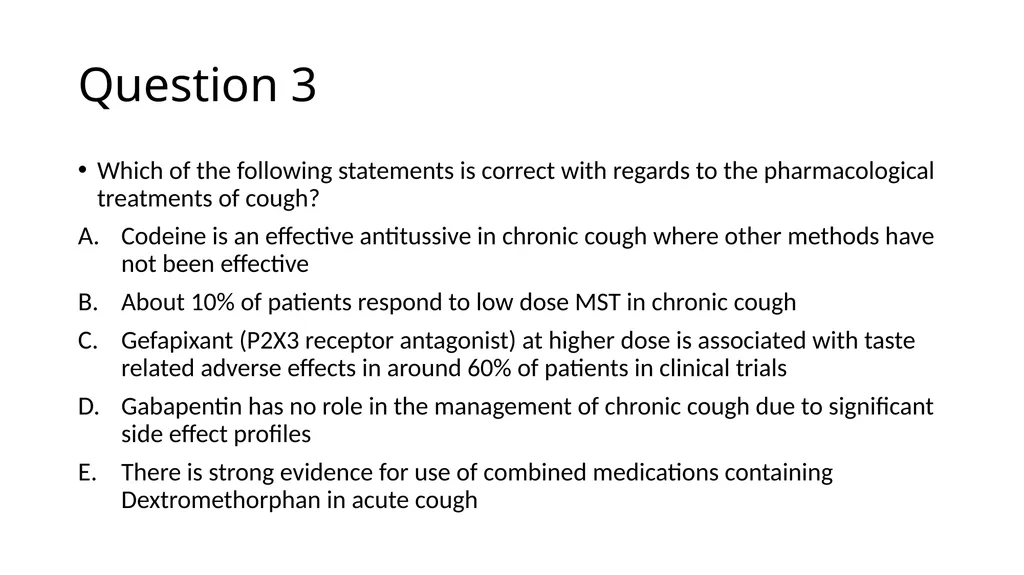
Question 3 Which of the following statements is correct with regards to the pharmacological treatments of cough?
Codeine is an effective antitussive in chronic cough where other methods have not been effective
About 10% of patients respond to low dose MST in chronic cough
Gefapixant (P2X3 receptor antagonist) at higher dose is associated with taste related adverse effects in around 60% of patients in clinical trials
Gabapentin has no role in the management of chronic cough due to significant side effect profiles
There is strong evidence for use of combined medications containing Dextromethorphan in acute cough<br>
Codeine is an effective antitussive in chronic cough where other methods have not been effective
About 10% of patients respond to low dose MST in chronic cough
Gefapixant (P2X3 receptor antagonist) at higher dose is associated with taste related adverse effects in around 60% of patients in clinical trials
Gabapentin has no role in the management of chronic cough due to significant side effect profiles
There is strong evidence for use of combined medications containing Dextromethorphan in acute cough<br>
10
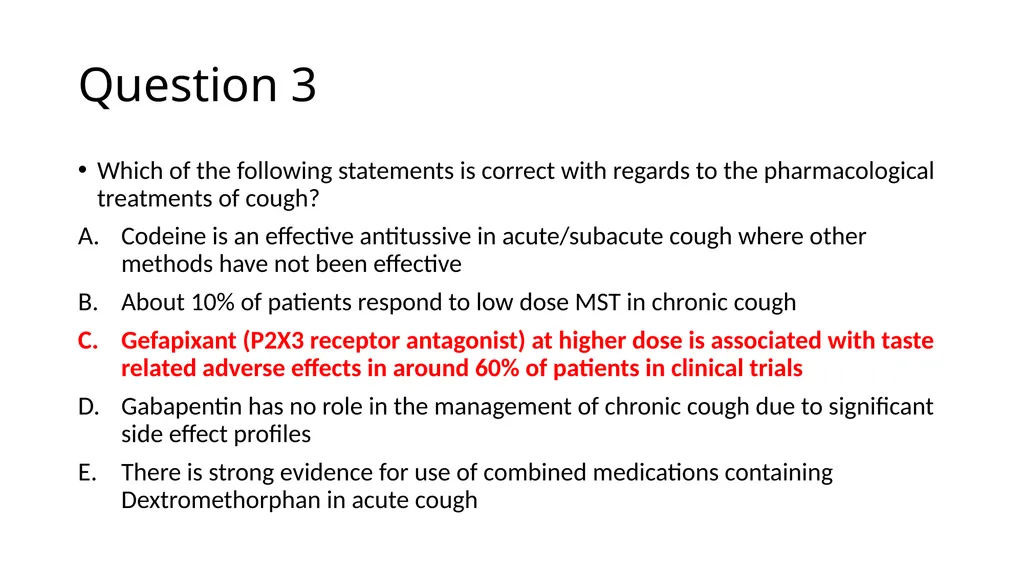
Question 3 Which of the following statements is correct with regards to the pharmacological treatments of cough?
Codeine is an effective antitussive in acute/subacute cough where other methods have not been effective
About 10% of patients respond to low dose MST in chronic cough
Gefapixant (P2X3 receptor antagonist) at higher dose is associated with taste related adverse effects in around 60% of patients in clinical trials
Gabapentin has no role in the management of chronic cough due to significant side effect profiles
There is strong evidence for use of combined medications containing Dextromethorphan in acute cough<br>
Codeine is an effective antitussive in acute/subacute cough where other methods have not been effective
About 10% of patients respond to low dose MST in chronic cough
Gefapixant (P2X3 receptor antagonist) at higher dose is associated with taste related adverse effects in around 60% of patients in clinical trials
Gabapentin has no role in the management of chronic cough due to significant side effect profiles
There is strong evidence for use of combined medications containing Dextromethorphan in acute cough<br>
11
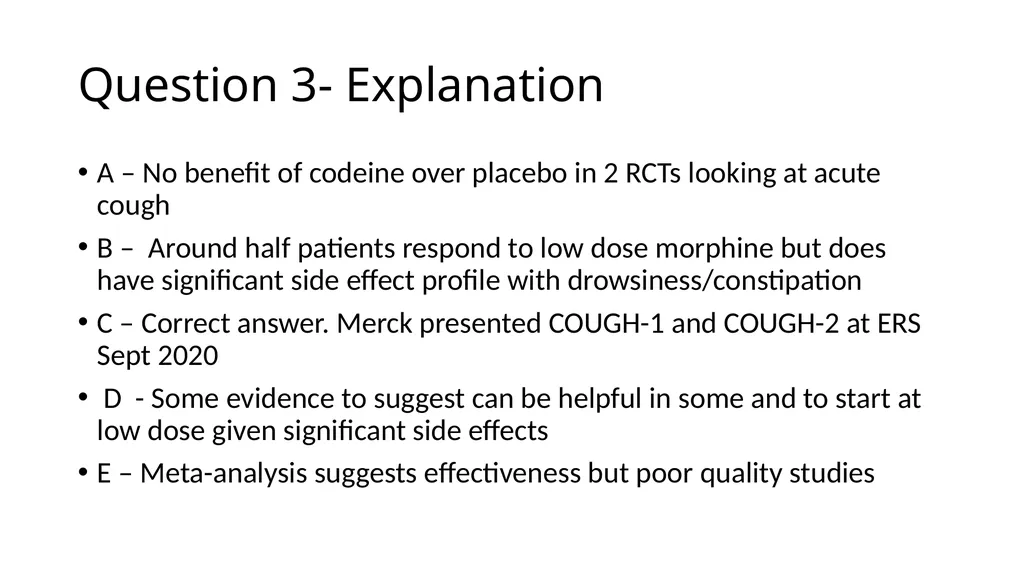
Question 3- Explanation A – No benefit of codeine over placebo in 2 RCTs looking at acute cough
B – Around half patients respond to low dose morphine but does have significant side effect profile with drowsiness/constipation
C – Correct answer. Merck presented COUGH-1 and COUGH-2 at ERS Sept 2020
D - Some evidence to suggest can be helpful in some and to start at low dose given significant side effects
E – Meta-analysis suggests effectiveness but poor quality studies<br>
B – Around half patients respond to low dose morphine but does have significant side effect profile with drowsiness/constipation
C – Correct answer. Merck presented COUGH-1 and COUGH-2 at ERS Sept 2020
D - Some evidence to suggest can be helpful in some and to start at low dose given significant side effects
E – Meta-analysis suggests effectiveness but poor quality studies<br>
12
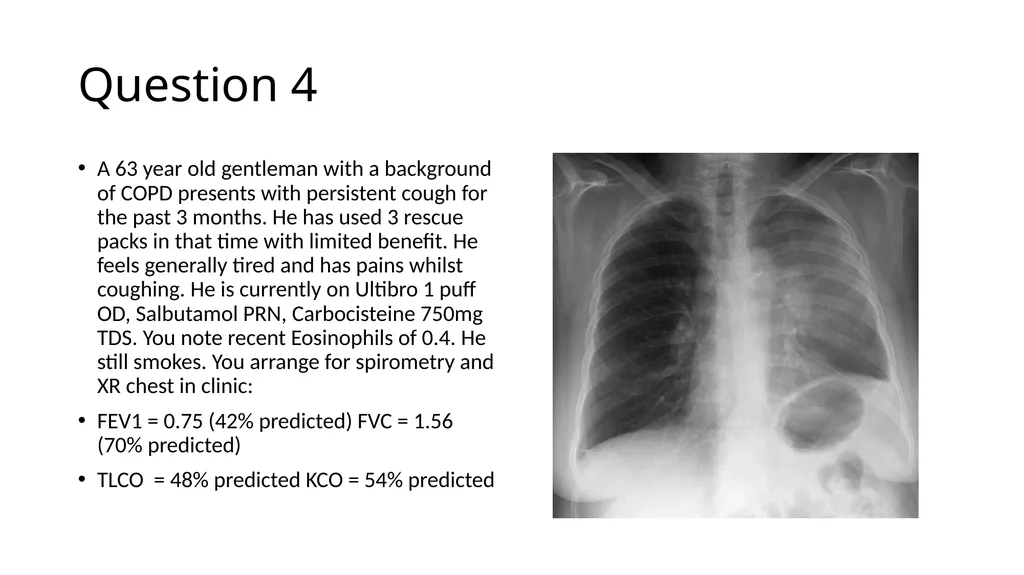
Question 4 A 63 year old gentleman with a background of COPD presents with persistent cough for the past 3 months. He has used 3 rescue packs in that time with limited benefit. He feels generally tired and has pains whilst coughing. He is currently on Ultibro 1 puff OD, Salbutamol PRN, Carbocisteine 750mg TDS. You note recent Eosinophils of 0.4. He still smokes. You arrange for spirometry and XR chest in clinic:
FEV1 = 0.75 (42% predicted) FVC = 1.56 (70% predicted)
TLCO = 48% predicted KCO = 54% predicted<br>
FEV1 = 0.75 (42% predicted) FVC = 1.56 (70% predicted)
TLCO = 48% predicted KCO = 54% predicted<br>
13
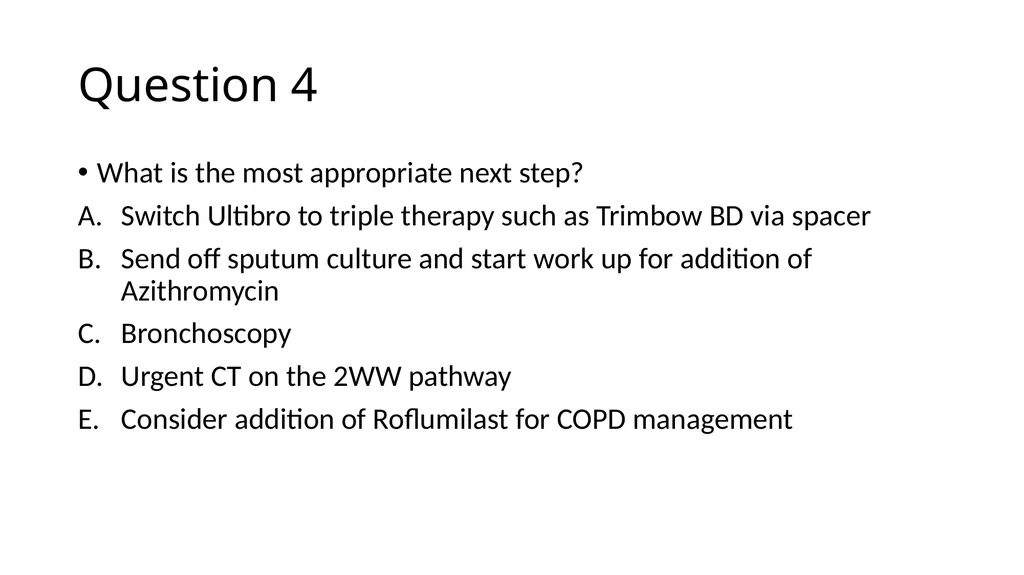
Question 4 What is the most appropriate next step?
Switch Ultibro to triple therapy such as Trimbow BD via spacer
Send off sputum culture and start work up for addition of Azithromycin
Bronchoscopy
Urgent CT on the 2WW pathway
Consider addition of Roflumilast for COPD management<br>
Switch Ultibro to triple therapy such as Trimbow BD via spacer
Send off sputum culture and start work up for addition of Azithromycin
Bronchoscopy
Urgent CT on the 2WW pathway
Consider addition of Roflumilast for COPD management<br>
14
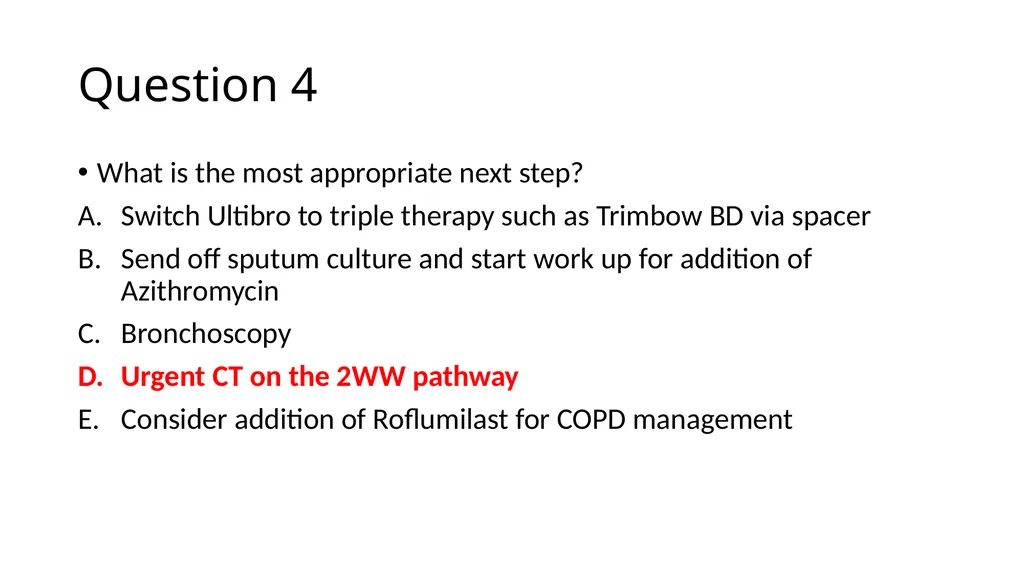
Question 4 What is the most appropriate next step?
Switch Ultibro to triple therapy such as Trimbow BD via spacer
Send off sputum culture and start work up for addition of Azithromycin
Bronchoscopy
Urgent CT on the 2WW pathway
Consider addition of Roflumilast for COPD management<br>
Switch Ultibro to triple therapy such as Trimbow BD via spacer
Send off sputum culture and start work up for addition of Azithromycin
Bronchoscopy
Urgent CT on the 2WW pathway
Consider addition of Roflumilast for COPD management<br>
15
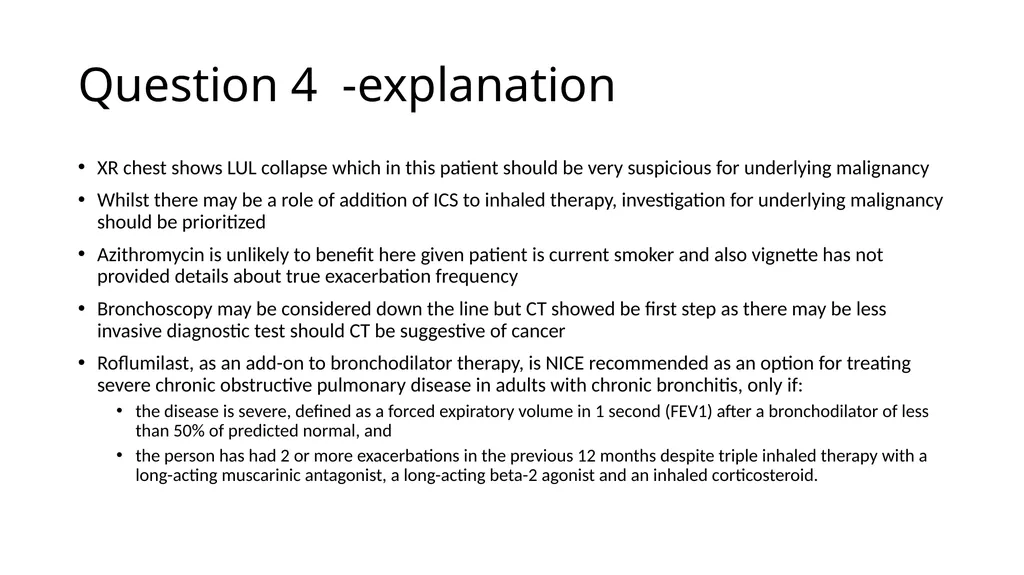
Question 4 -explanation XR chest shows LUL collapse which in this patient should be very suspicious for underlying malignancy
Whilst there may be a role of addition of ICS to inhaled therapy, investigation for underlying malignancy should be prioritized
Azithromycin is unlikely to benefit here given patient is current smoker and also vignette has not provided details about true exacerbation frequency
Bronchoscopy may be considered down the line but CT showed be first step as there may be less invasive diagnostic test should CT be suggestive of cancer
Roflumilast, as an add-on to bronchodilator therapy, is NICE recommended as an option for treating severe chronic obstructive pulmonary disease in adults with chronic bronchitis, only if:
the disease is severe, defined as a forced expiratory volume in 1 second (FEV1) after a bronchodilator of less than 50% of predicted normal, and
the person has had 2 or more exacerbations in the previous 12 months despite triple inhaled therapy with a long-acting muscarinic antagonist, a long-acting beta-2 agonist and an inhaled corticosteroid.<br>
Whilst there may be a role of addition of ICS to inhaled therapy, investigation for underlying malignancy should be prioritized
Azithromycin is unlikely to benefit here given patient is current smoker and also vignette has not provided details about true exacerbation frequency
Bronchoscopy may be considered down the line but CT showed be first step as there may be less invasive diagnostic test should CT be suggestive of cancer
Roflumilast, as an add-on to bronchodilator therapy, is NICE recommended as an option for treating severe chronic obstructive pulmonary disease in adults with chronic bronchitis, only if:
the disease is severe, defined as a forced expiratory volume in 1 second (FEV1) after a bronchodilator of less than 50% of predicted normal, and
the person has had 2 or more exacerbations in the previous 12 months despite triple inhaled therapy with a long-acting muscarinic antagonist, a long-acting beta-2 agonist and an inhaled corticosteroid.<br>
16
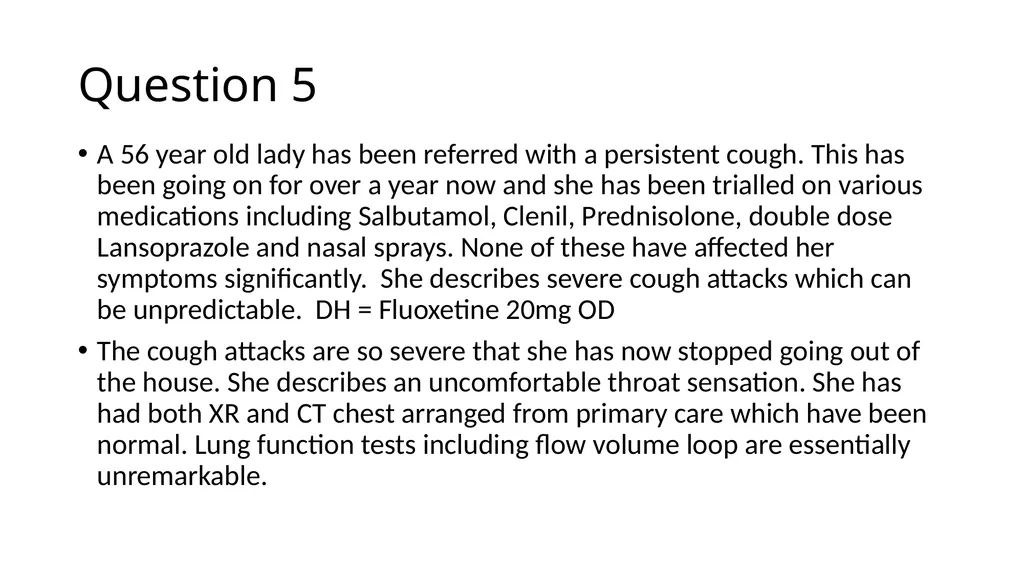
Question 5 A 56 year old lady has been referred with a persistent cough. This has been going on for over a year now and she has been trialled on various medications including Salbutamol, Clenil, Prednisolone, double dose Lansoprazole and nasal sprays. None of these have affected her symptoms significantly. She describes severe cough attacks which can be unpredictable. DH = Fluoxetine 20mg OD
The cough attacks are so severe that she has now stopped going out of the house. She describes an uncomfortable throat sensation. She has had both XR and CT chest arranged from primary care which have been normal. Lung function tests including flow volume loop are essentially unremarkable.<br>
The cough attacks are so severe that she has now stopped going out of the house. She describes an uncomfortable throat sensation. She has had both XR and CT chest arranged from primary care which have been normal. Lung function tests including flow volume loop are essentially unremarkable.<br>
17
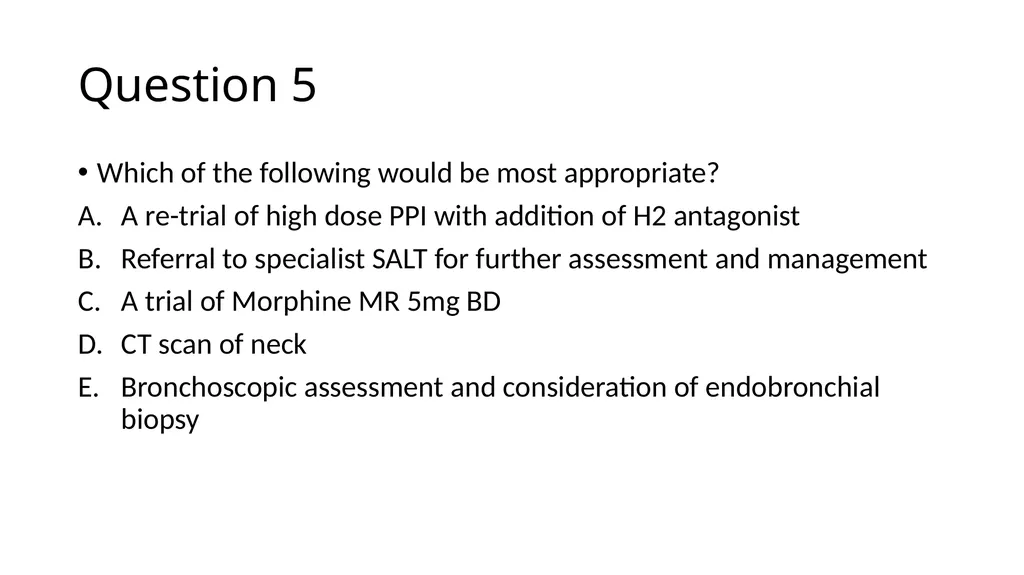
Question 5 Which of the following would be most appropriate?
A re-trial of high dose PPI with addition of H2 antagonist
Referral to specialist SALT for further assessment and management
A trial of Morphine MR 5mg BD
CT scan of neck
Bronchoscopic assessment and consideration of endobronchial biopsy<br>
A re-trial of high dose PPI with addition of H2 antagonist
Referral to specialist SALT for further assessment and management
A trial of Morphine MR 5mg BD
CT scan of neck
Bronchoscopic assessment and consideration of endobronchial biopsy<br>
18
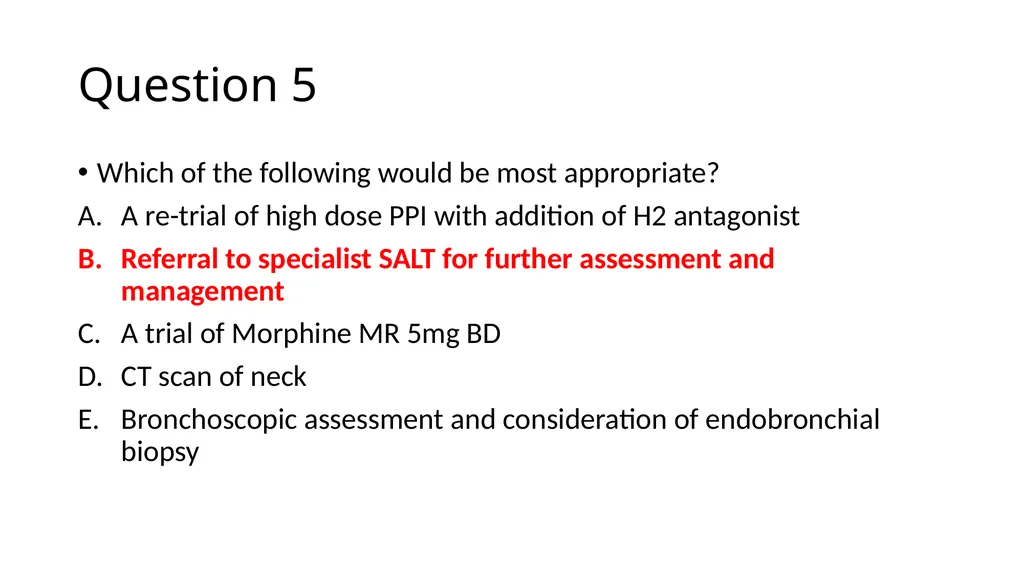
Question 5 Which of the following would be most appropriate?
A re-trial of high dose PPI with addition of H2 antagonist
Referral to specialist SALT for further assessment and management
A trial of Morphine MR 5mg BD
CT scan of neck
Bronchoscopic assessment and consideration of endobronchial biopsy<br>
A re-trial of high dose PPI with addition of H2 antagonist
Referral to specialist SALT for further assessment and management
A trial of Morphine MR 5mg BD
CT scan of neck
Bronchoscopic assessment and consideration of endobronchial biopsy<br>
19
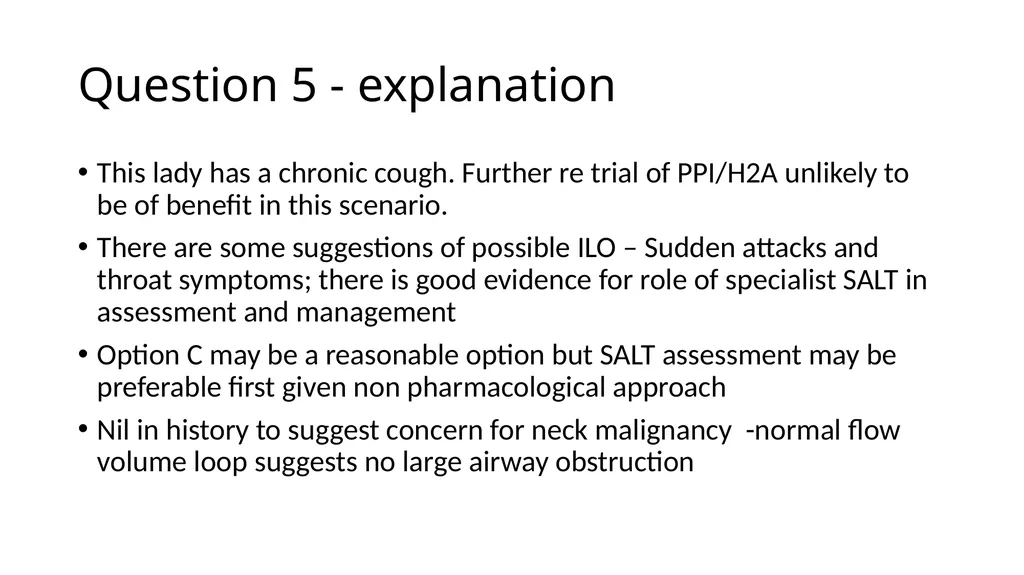
Question 5 - explanation This lady has a chronic cough. Further re trial of PPI/H2A unlikely to be of benefit in this scenario.
There are some suggestions of possible ILO – Sudden attacks and throat symptoms; there is good evidence for role of specialist SALT in assessment and management
Option C may be a reasonable option but SALT assessment may be preferable first given non pharmacological approach
Nil in history to suggest concern for neck malignancy -normal flow volume loop suggests no large airway obstruction<br>
There are some suggestions of possible ILO – Sudden attacks and throat symptoms; there is good evidence for role of specialist SALT in assessment and management
Option C may be a reasonable option but SALT assessment may be preferable first given non pharmacological approach
Nil in history to suggest concern for neck malignancy -normal flow volume loop suggests no large airway obstruction<br>
20
Thanks<br>