"SCFD EMS CIRCULATORY EMERGENCIES Updated 03/2017" is the property of its rightful owner. Permission is granted to
download and print the materials on this website for personal, non-commercial use only, and to display it
on your personal computer provided you do not modify the materials and that you retain all copyright
notices contained in the materials. By downloading content from our website, you accept the terms of this
agreement.
Presentation Transcript
01
SCFD EMS CIRCULATORY EMERGENCIES Updated 03/2017 by J. GOODREAU<br>
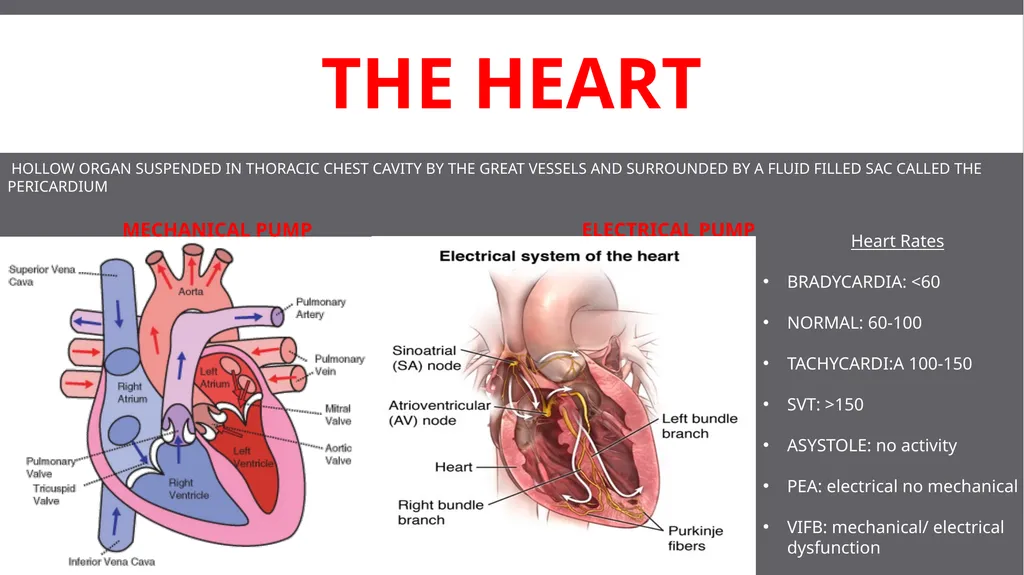
VIFB: mechanical/ electrical dysfunction HOLLOW ORGAN SUSPENDED IN THORACIC CHEST CAVITY BY THE GREAT VESSELS AND SURROUNDED BY A FLUID FILLED SAC CALLED THE PERICARDIUM
MECHANICAL PUMP ELECTRICAL PUMP<br>
04
Blood and perfusion Complex thick red fluid made with:
Plasma - sticky yellow fluid that carries blood cells
Nutrients and waste
Compounds needed for clotting
Red Blood Cells carry oxygen
White blood cells – body’s immune system
Platelets – initial formation of clots
Adequate perfusion means that:
Oxygen and nutrients are provided to each cell of body
Capillary perfusion of tissues
The process of transfer of oxygen and nutrients are brought to every cell
Carbon dioxide and waste is removed BLOOD PRESSURE:
THE FORCE OF THE BLOOD ON THE WALLS OF THE ARTERIES
Contraction phase is call systole
Relaxation phase is called diastole
HYPERTENSION >160 SYSTOLIC
HYPOTENSION <90 SYSTOLIC<br>
05
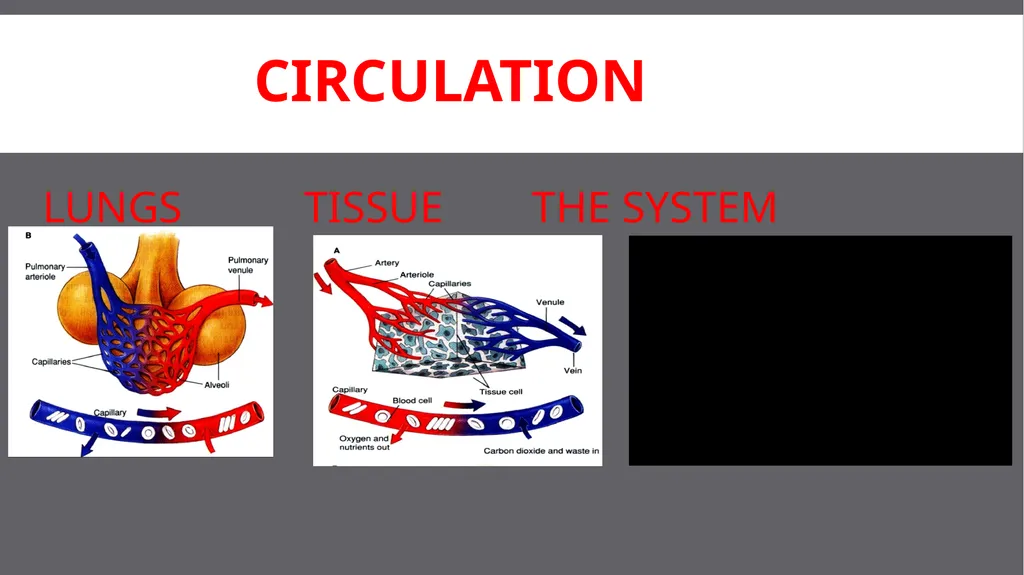
circulation LUNGS TISSUE THE SYSTEM<br>
06
Acute myocardial infarct PAIN IN THE CHEST CAUSED BY CEASED BLOOD FLOW TO AN AREA OF THE HEART
PAIN USUALY 20 MINUTES OR GREATER, MAY BE ACUTE ONSET OR GRDUAL INCREASE
PLAQUE NARROWS ARTIERS, LIMITS/ STOPS BLOOD SUPPLY. ISCHEMIA = PAIN= DEATH
PAIN MAY BE RELEIVED BY ASA, MORPHINE AND OXYGEN
MAY CAUSE HEART TO FAIL: CHF ~CARDIOGENIC SHOCK ~ CARDIAC ARREST
SIGNS/ SYMPTOMS
CHEST PAIN ~ CENTER (SUBSTERNAL) OR LEFT SIDED. MAY RADIAITE TO ARM(S),
JAW, NECK, BACK
FEELS LIKE GAS/ INDIGESTION IN EPIGASTRIC AREA
SOB, N/V, DIZZINESS, COOL/CLAMMY SKIN, ANXIETY, NEAR SYNCOPE
PAIN WONT CHANGE WITH MOVEMENT/ INSPIRATION OR PALPATION
FEMALES (ESPECIALY ELDERLY) MAY PRESENT WITH ATYPICAL SIGNS
~ I.E. COUGH/ SORE ARM/ ABD PAIN, SWEATING<br>
07
Chest pain protocol C-10 PRIORITIES: ABCs Degree of distress? Shock? Obtain Sample History and Collect Medications.
Chest Pain Suspicious of Cardiac Origin
(Substernal pain, discomfort or tightness radiating to jaw, left shoulder or arm, nausea, diaphoresis, dyspnea, anxiety.)
Baseline Vitals: BP, RR, PR, room air spo2%, skin signs, lung sounds
Administer 02 ~ adjust to maintain spo2 >94%
Assist pt taking prescribed nitro medication (don’t administered if BP <110 systolic, expired or pt has taken Viagra)
Pt may take up to three total doses prior to ALS arrival
Treat shock as indicated: keep warm, shock position with legs elevated (modified with head up if crackles in lungs are present), reassess vitals
Assist ALS with 12-lead set-up and spike IV bag as needed<br>
08
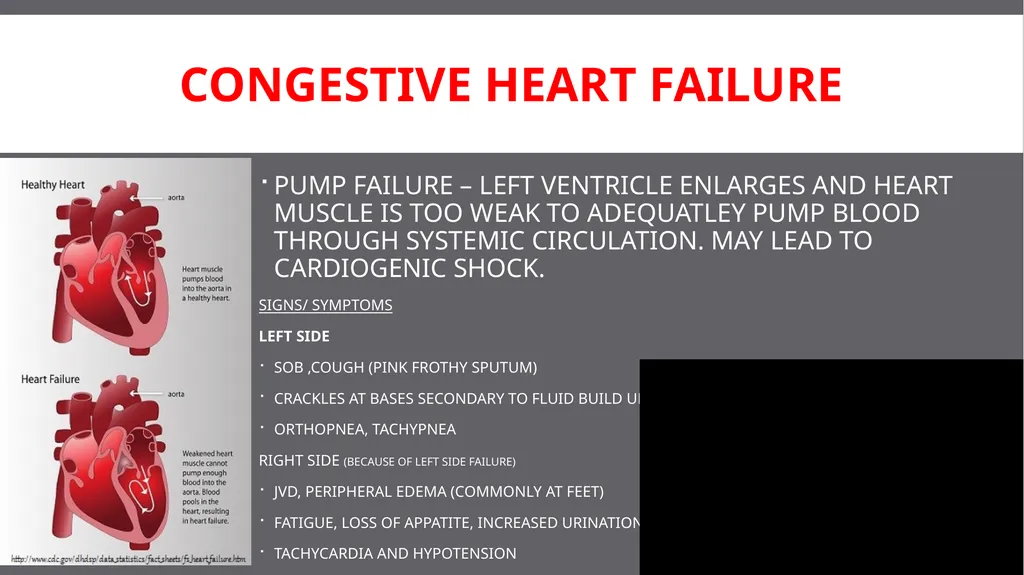
CONGESTIVE HEART FAILURE PUMP FAILURE – LEFT VENTRICLE ENLARGES AND HEART MUSCLE IS TOO WEAK TO ADEQUATLEY PUMP BLOOD THROUGH SYSTEMIC CIRCULATION. MAY LEAD TO CARDIOGENIC SHOCK.
SIGNS/ SYMPTOMS
LEFT SIDE
SOB ,COUGH (PINK FROTHY SPUTUM)
CRACKLES AT BASES SECONDARY TO FLUID BUILD UP
ORTHOPNEA, TACHYPNEA
RIGHT SIDE (BECAUSE OF LEFT SIDE FAILURE)
JVD, PERIPHERAL EDEMA (COMMONLY AT FEET)
FATIGUE, LOSS OF APPATITE, INCREASED URINATION
TACHYCARDIA AND HYPOTENSION<br>
09
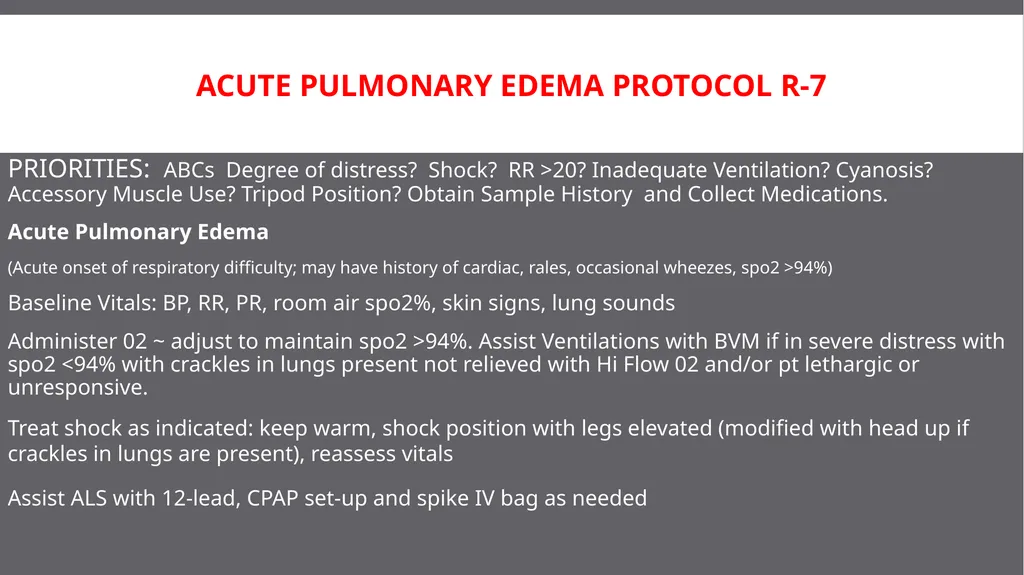
Acute Pulmonary Edema protocol r-7 PRIORITIES: ABCs Degree of distress? Shock? RR >20? Inadequate Ventilation? Cyanosis? Accessory Muscle Use? Tripod Position? Obtain Sample History and Collect Medications.
Acute Pulmonary Edema
(Acute onset of respiratory difficulty; may have history of cardiac, rales, occasional wheezes, spo2 >94%)
Baseline Vitals: BP, RR, PR, room air spo2%, skin signs, lung sounds
Administer 02 ~ adjust to maintain spo2 >94%. Assist Ventilations with BVM if in severe distress with spo2 <94% with crackles in lungs present not relieved with Hi Flow 02 and/or pt lethargic or unresponsive.
Treat shock as indicated: keep warm, shock position with legs elevated (modified with head up if crackles in lungs are present), reassess vitals
Assist ALS with 12-lead, CPAP set-up and spike IV bag as needed<br>
10
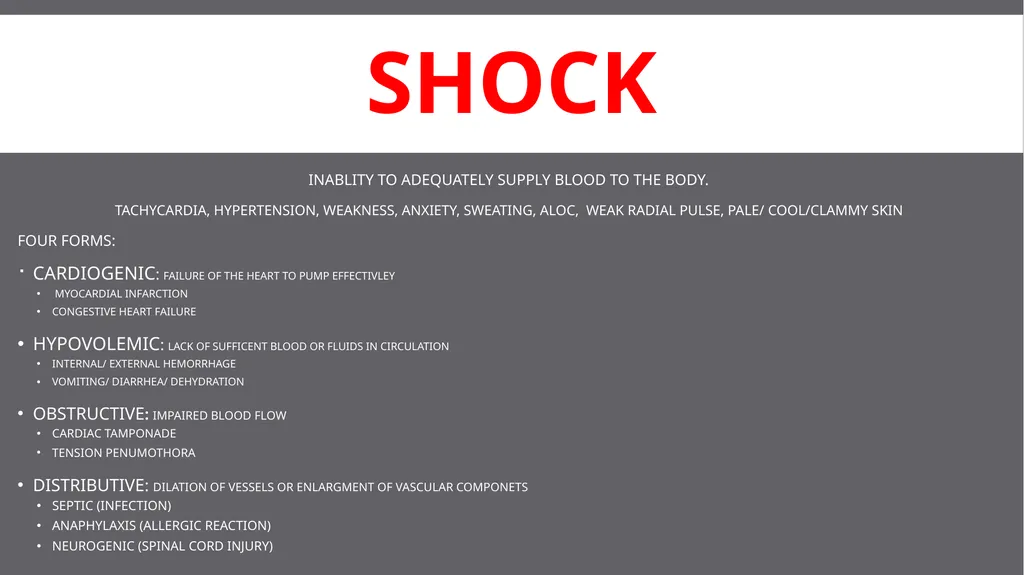
SHOCK INABLITY TO ADEQUATELY SUPPLY BLOOD TO THE BODY.
TACHYCARDIA, HYPERTENSION, WEAKNESS, ANXIETY, SWEATING, ALOC, WEAK RADIAL PULSE, PALE/ COOL/CLAMMY SKIN
FOUR FORMS:
CARDIOGENIC: FAILURE OF THE HEART TO PUMP EFFECTIVLEY
MYOCARDIAL INFARCTION
CONGESTIVE HEART FAILURE
HYPOVOLEMIC: LACK OF SUFFICENT BLOOD OR FLUIDS IN CIRCULATION
INTERNAL/ EXTERNAL HEMORRHAGE
VOMITING/ DIARRHEA/ DEHYDRATION
OBSTRUCTIVE: IMPAIRED BLOOD FLOW
CARDIAC TAMPONADE
TENSION PENUMOTHORA
DISTRIBUTIVE: DILATION OF VESSELS OR ENLARGMENT OF VASCULAR COMPONETS
SEPTIC (INFECTION)
ANAPHYLAXIS (ALLERGIC REACTION)
NEUROGENIC (SPINAL CORD INJURY)<br>
11
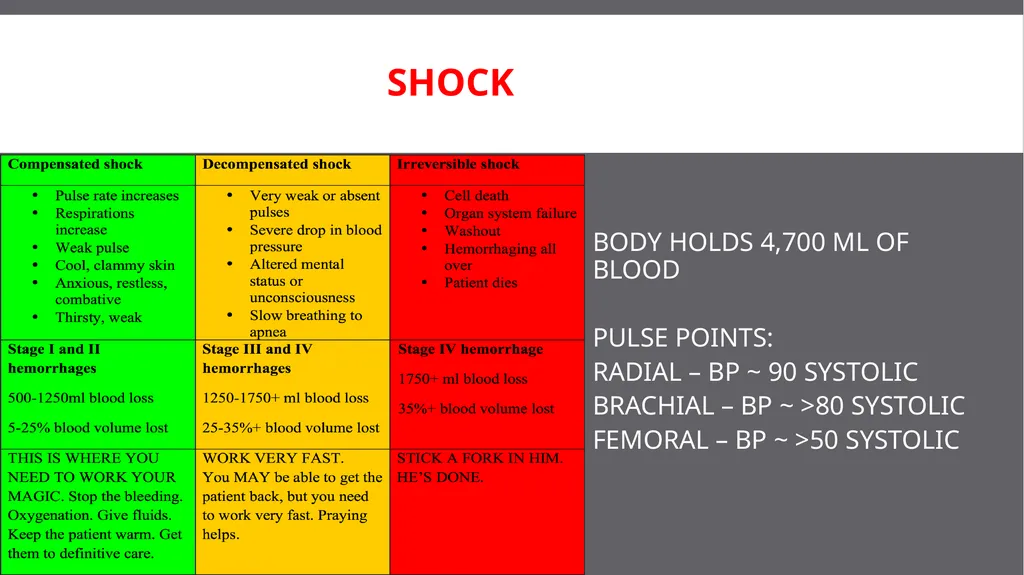
shock BODY HOLDS 4,700 ML OF BLOOD
PULSE POINTS:
RADIAL – BP ~ 90 SYSTOLIC
BRACHIAL – BP ~ >80 SYSTOLIC
FEMORAL – BP ~ >50 SYSTOLIC<br>
12
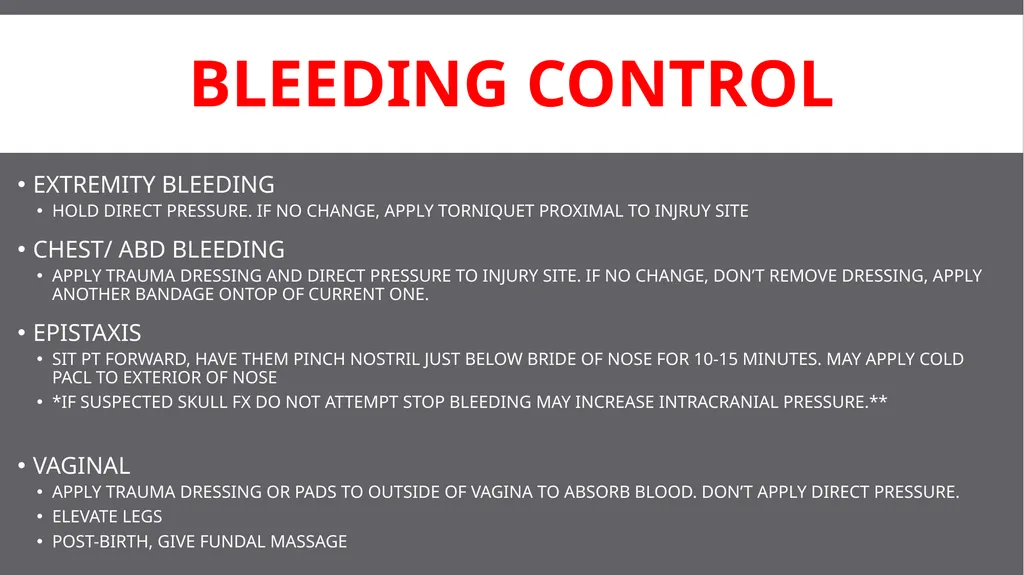
Bleeding Control EXTREMITY BLEEDING
HOLD DIRECT PRESSURE. IF NO CHANGE, APPLY TORNIQUET PROXIMAL TO INJRUY SITE
CHEST/ ABD BLEEDING
APPLY TRAUMA DRESSING AND DIRECT PRESSURE TO INJURY SITE. IF NO CHANGE, DON’T REMOVE DRESSING, APPLY ANOTHER BANDAGE ONTOP OF CURRENT ONE.
EPISTAXIS
SIT PT FORWARD, HAVE THEM PINCH NOSTRIL JUST BELOW BRIDE OF NOSE FOR 10-15 MINUTES. MAY APPLY COLD PACL TO EXTERIOR OF NOSE
*IF SUSPECTED SKULL FX DO NOT ATTEMPT STOP BLEEDING MAY INCREASE INTRACRANIAL PRESSURE.**
VAGINAL
APPLY TRAUMA DRESSING OR PADS TO OUTSIDE OF VAGINA TO ABSORB BLOOD. DON’T APPLY DIRECT PRESSURE.
ELEVATE LEGS
POST-BIRTH, GIVE FUNDAL MASSAGE<br>
13
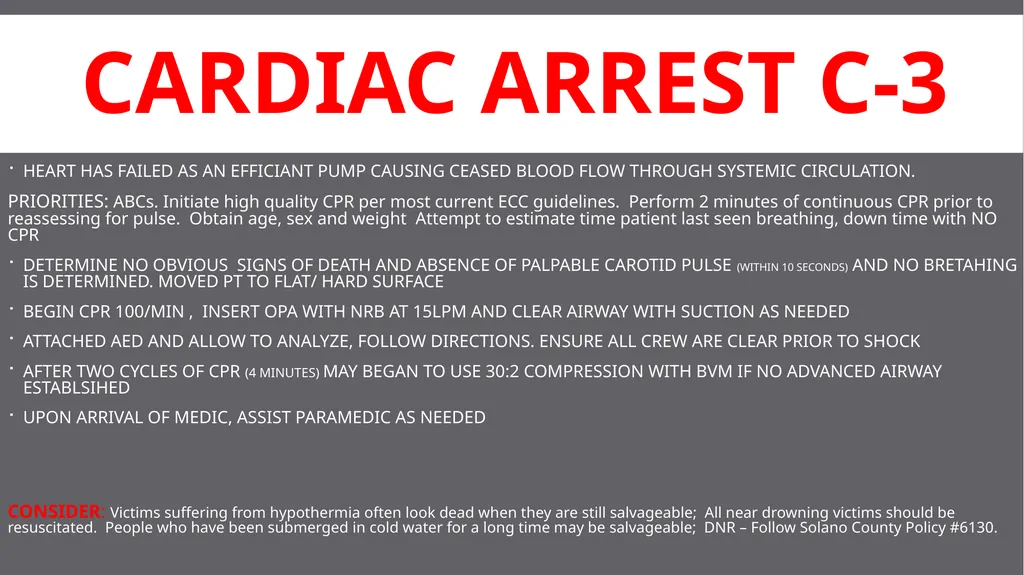
CARDIAC ARREST C-3 HEART HAS FAILED AS AN EFFICIANT PUMP CAUSING CEASED BLOOD FLOW THROUGH SYSTEMIC CIRCULATION.
PRIORITIES: ABCs. Initiate high quality CPR per most current ECC guidelines. Perform 2 minutes of continuous CPR prior to reassessing for pulse. Obtain age, sex and weight Attempt to estimate time patient last seen breathing, down time with NO CPR
DETERMINE NO OBVIOUS SIGNS OF DEATH AND ABSENCE OF PALPABLE CAROTID PULSE (WITHIN 10 SECONDS) AND NO BRETAHING IS DETERMINED. MOVED PT TO FLAT/ HARD SURFACE
BEGIN CPR 100/MIN , INSERT OPA WITH NRB AT 15LPM AND CLEAR AIRWAY WITH SUCTION AS NEEDED
ATTACHED AED AND ALLOW TO ANALYZE, FOLLOW DIRECTIONS. ENSURE ALL CREW ARE CLEAR PRIOR TO SHOCK
AFTER TWO CYCLES OF CPR (4 MINUTES) MAY BEGAN TO USE 30:2 COMPRESSION WITH BVM IF NO ADVANCED AIRWAY ESTABLSIHED
UPON ARRIVAL OF MEDIC, ASSIST PARAMEDIC AS NEEDED
CONSIDER: Victims suffering from hypothermia often look dead when they are still salvageable; All near drowning victims should be resuscitated. People who have been submerged in cold water for a long time may be salvageable; DNR – Follow Solano County Policy #6130.<br>