
“Schedule III Division-ii ( Amendments fy:



Description: Schedule III Division-ii ( Amendments fy: 2021-22) TOPIC OF THE DAY On 24th March 2020, the MCA notified amendments to Schedule III to the Companies Act, 2013. The notification states that the Central Government hereby makes the
Related Topics
Download Presentation
"“Schedule III Division-ii ( Amendments fy:" is the property of its rightful owner. Permission is granted to download and print the materials on this website for personal, non-commercial use only, and to display it on your personal computer provided you do not modify the materials and that you retain all copyright notices contained in the materials. By downloading content from our website, you accept the terms of this agreement.
Presentation Transcript
slide2. “Schedule III Division-ii
( Amendments fy: 2021-22)” TOPIC OF THE DAY<br>
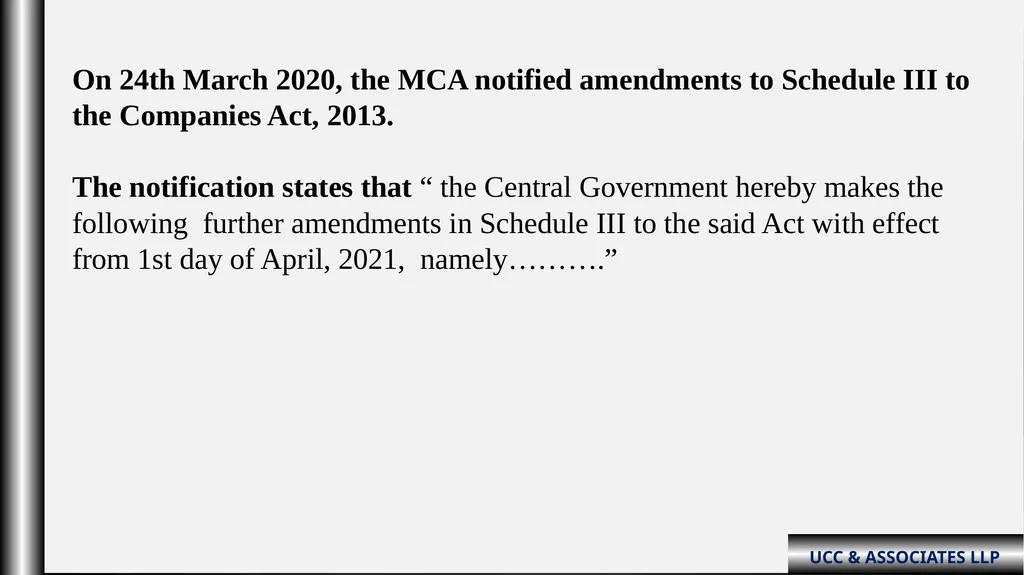
slide3. On 24th March 2020, the MCA notified amendments to Schedule III to the Companies Act, 2013.
The notification states that “ the Central Government hereby makes the following further amendments in Schedule III to the said Act with effect from 1st day of April, 2021, namely……….”<br>
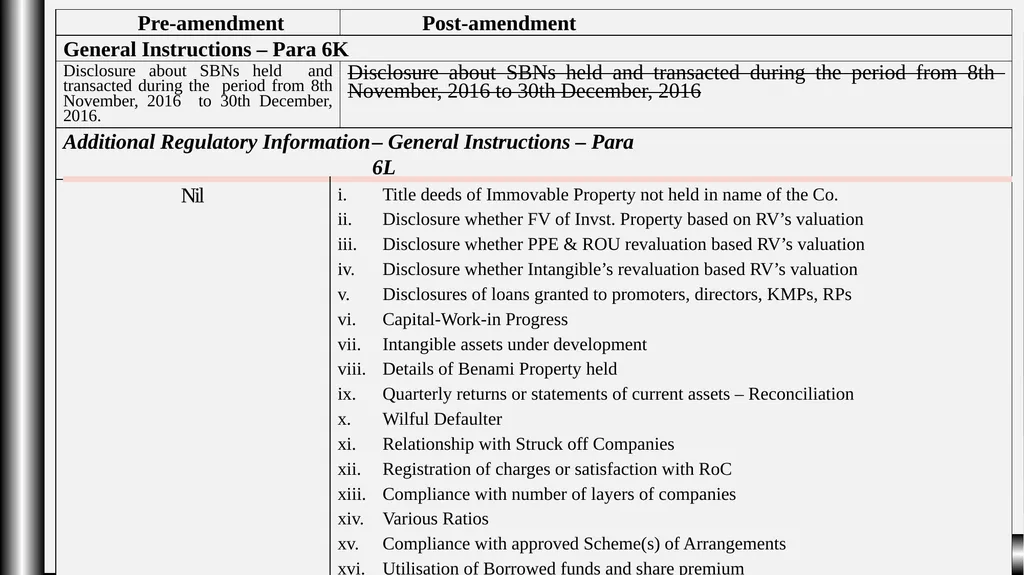
slide4. Amendments in Division II –
General Instructions for Preparation of Balance Sheet and Statement of Profit & Loss<br>
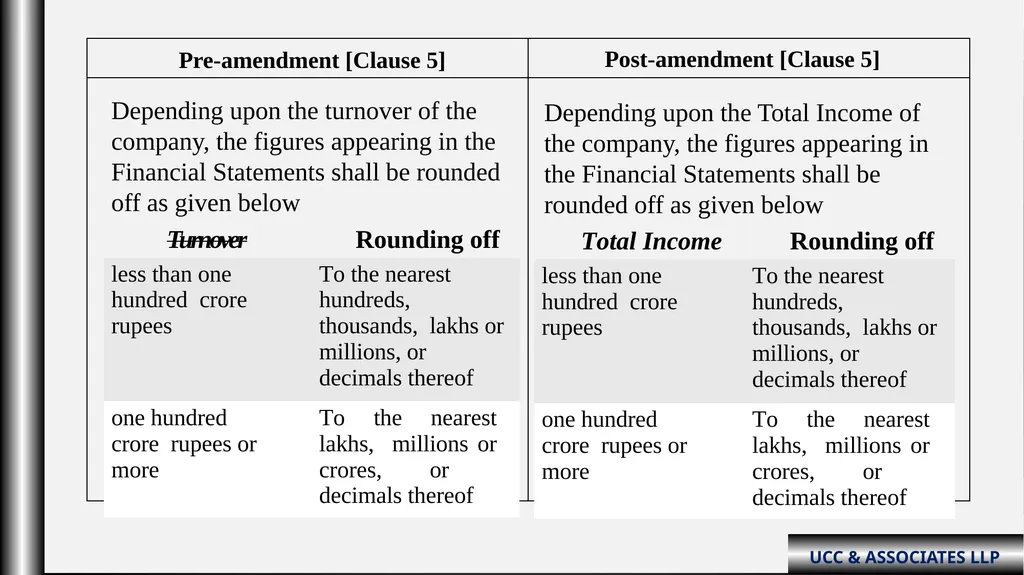
slide5. Pre-amendment [Clause 5] Post-amendment [Clause 5] Depending upon the turnover of the company, the figures appearing in the Financial Statements shall be rounded off as given below Depending upon the Total Income of the company, the figures appearing in the Financial Statements shall be rounded off as given below<br>
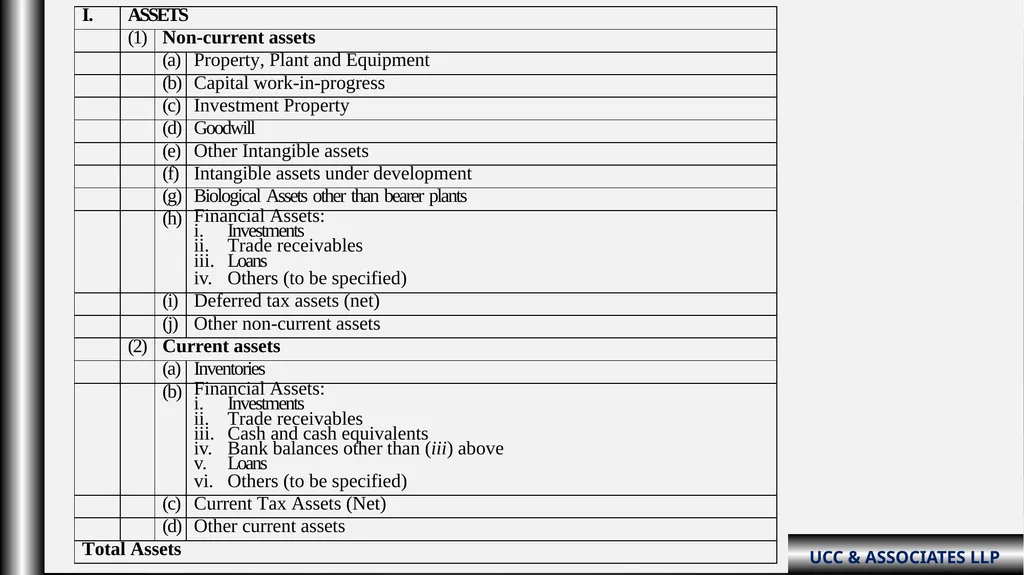
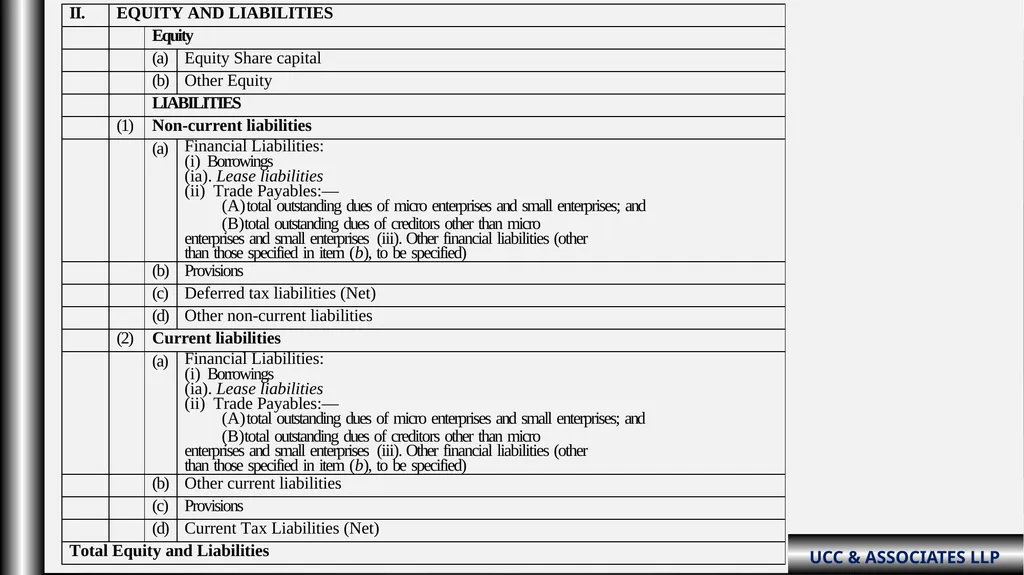
slide6. Amendments in Division II
– Balance Sheet<br>
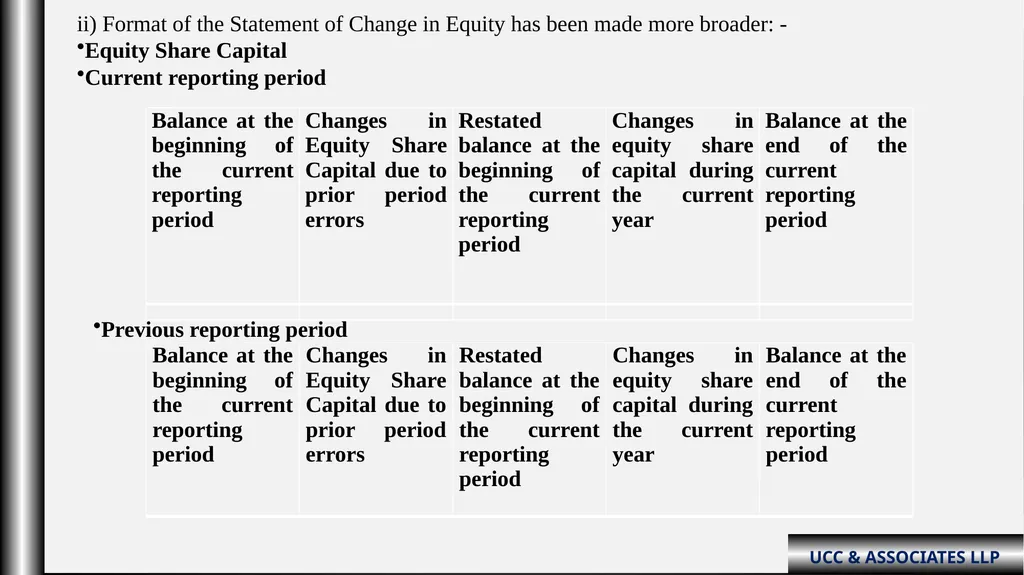
slide9. ii) Format of the Statement of Change in Equity has been made more broader: -
Equity Share Capital
Current reporting period Previous reporting period<br>
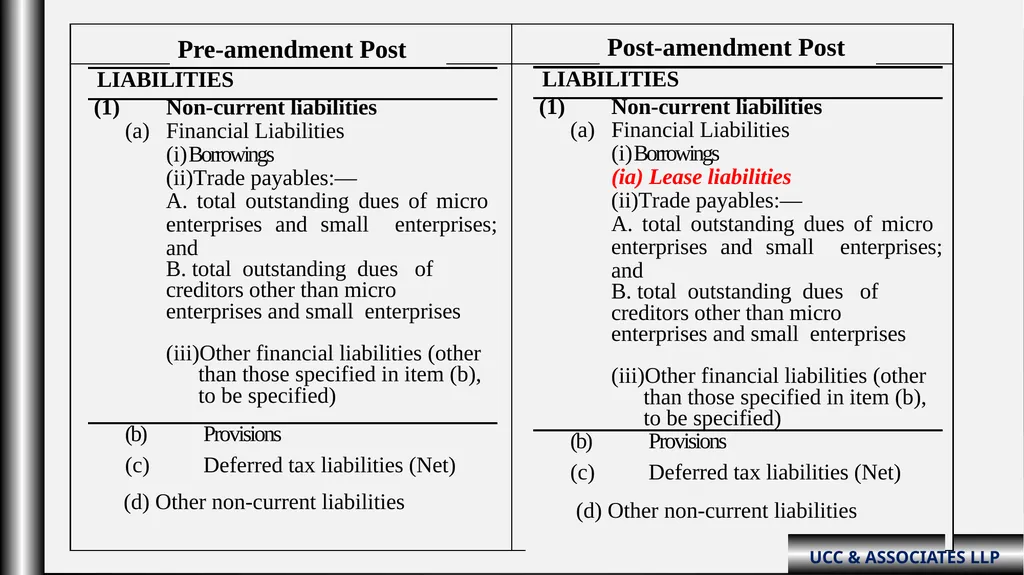
slide10. Pre-amendment Post Post-amendment Post (d) Other non-current liabilities (d) Other non-current liabilities<br>
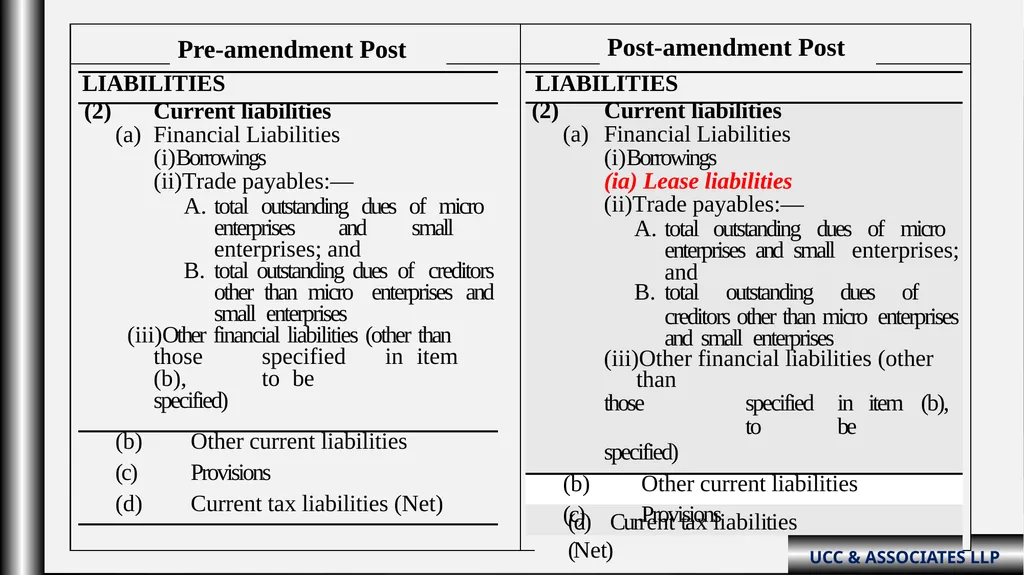
slide11. Pre-amendment Post Post-amendment Post (d) Current tax liabilities (Net)<br>
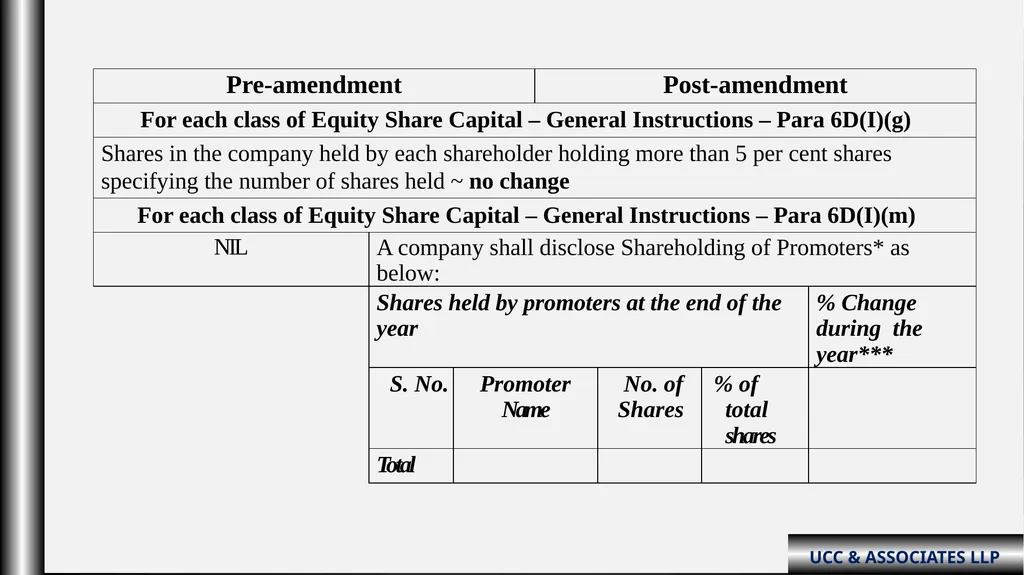
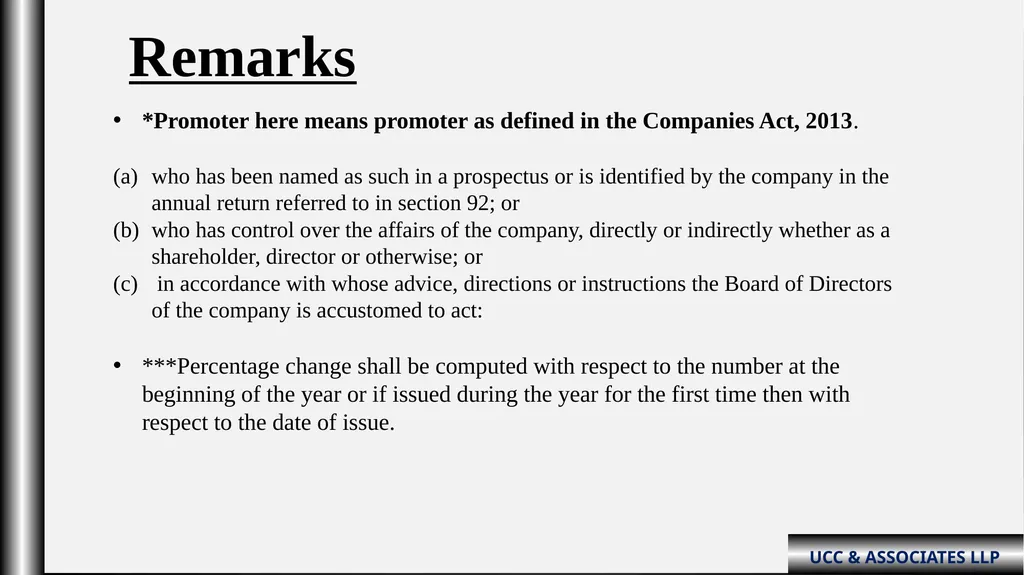
slide13. Remarks *Promoter here means promoter as defined in the Companies Act, 2013.
who has been named as such in a prospectus or is identified by the company in the annual return referred to in section 92; or
who has control over the affairs of the company, directly or indirectly whether as a shareholder, director or otherwise; or
in accordance with whose advice, directions or instructions the Board of Directors of the company is accustomed to act:
***Percentage change shall be computed with respect to the number at the beginning of the year or if issued during the year for the first time then with respect to the date of issue.<br>
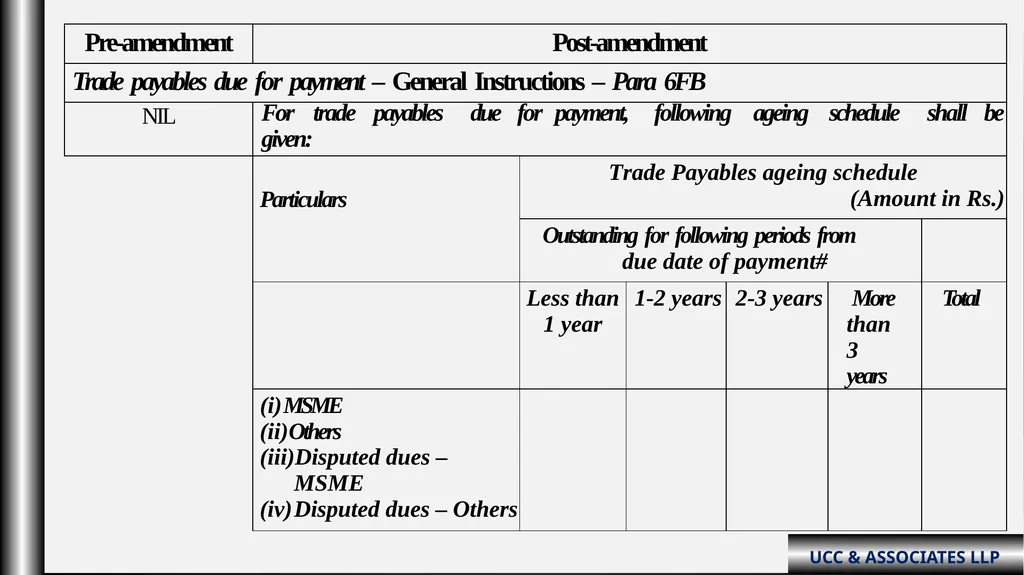
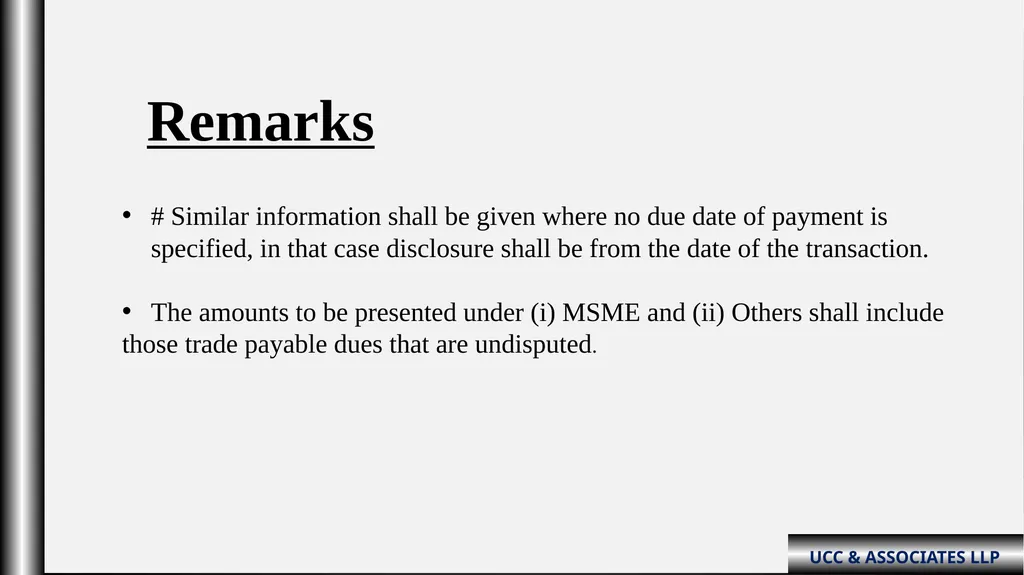
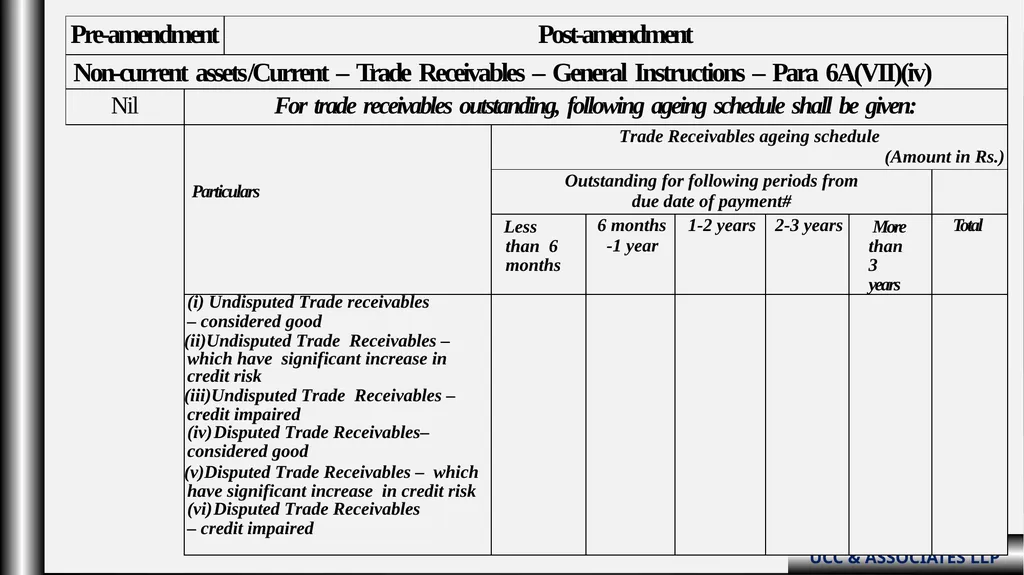
slide17. Remarks # Similar information shall be given where no due date of payment is specified, in that case disclosure shall be from the date of the transaction.
The amounts to be presented under (i) MSME and (ii) Others shall include
those trade payable dues that are undisputed.<br>
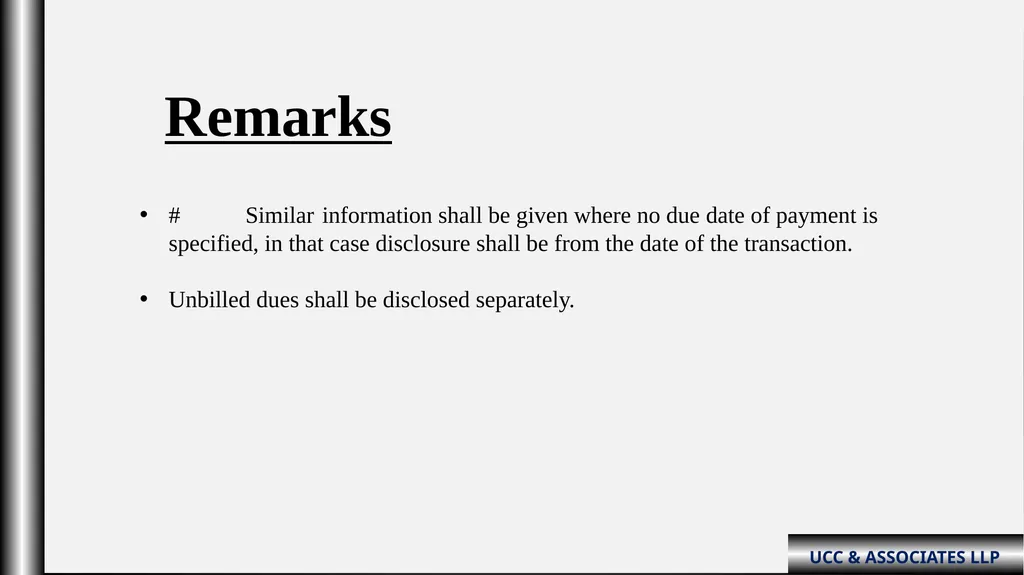
slide22. Remarks # Similar information shall be given where no due date of payment is specified, in that case disclosure shall be from the date of the transaction.
Unbilled dues shall be disclosed separately.<br>
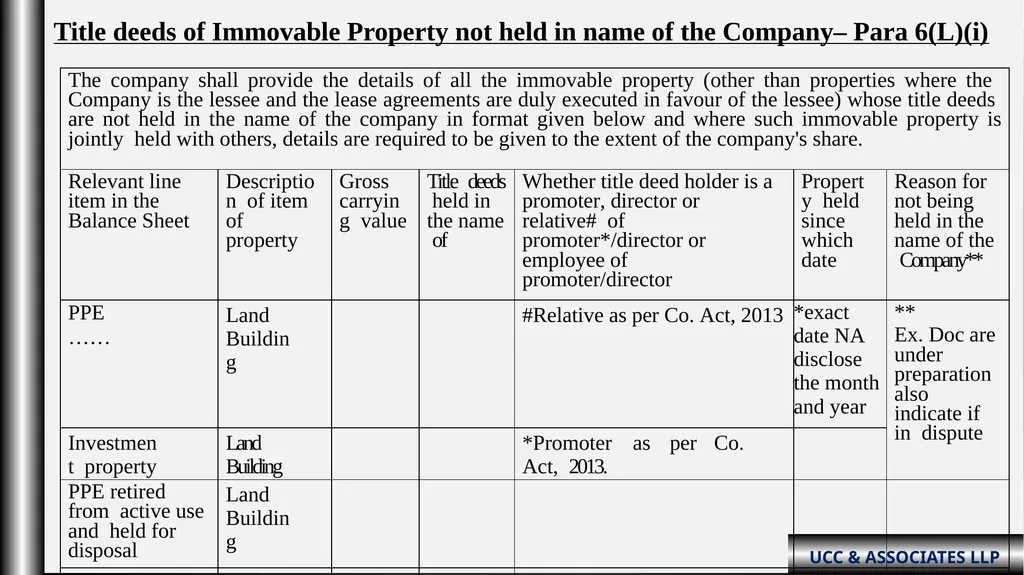
slide26. Title deeds of Immovable Property not held in name of the Company– Para 6(L)(i)<br>
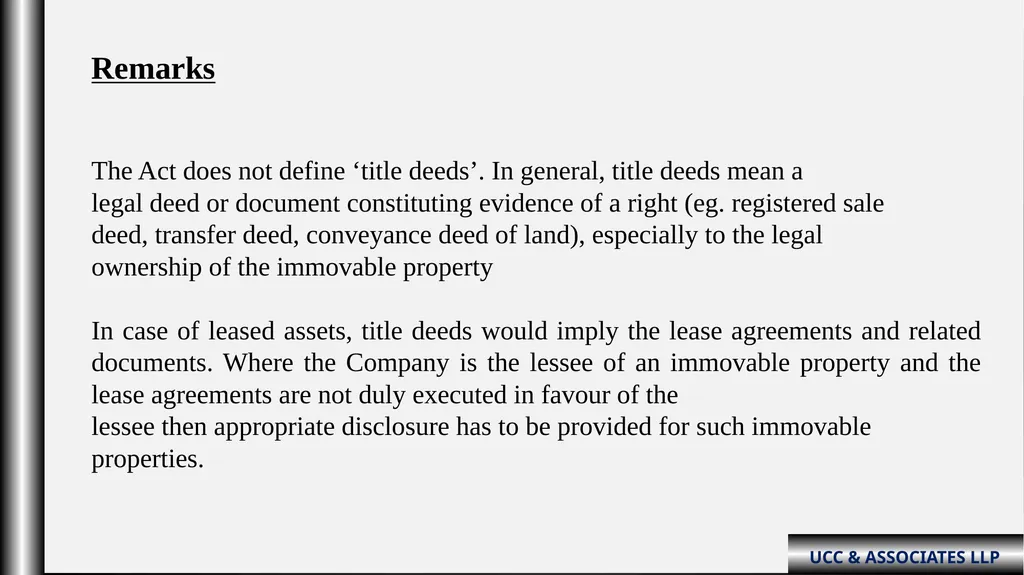
slide27. Remarks The Act does not define ‘title deeds’. In general, title deeds mean a
legal deed or document constituting evidence of a right (eg. registered sale
deed, transfer deed, conveyance deed of land), especially to the legal
ownership of the immovable property
In case of leased assets, title deeds would imply the lease agreements and related documents. Where the Company is the lessee of an immovable property and the lease agreements are not duly executed in favour of the
lessee then appropriate disclosure has to be provided for such immovable
properties.<br>
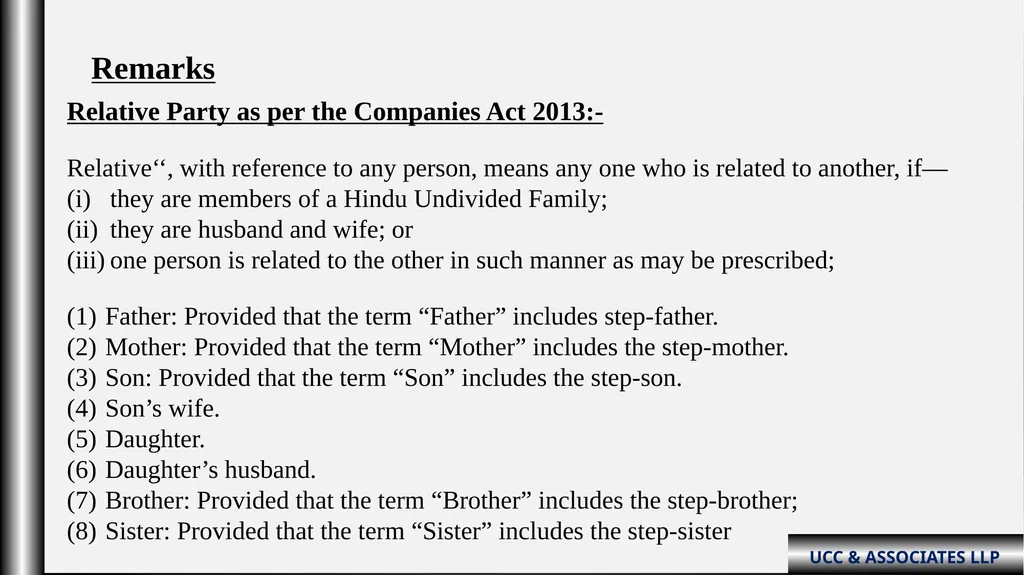
slide28. Remarks Relative Party as per the Companies Act 2013:-
Relative‘‘, with reference to any person, means any one who is related to another, if—
they are members of a Hindu Undivided Family;
they are husband and wife; or
one person is related to the other in such manner as may be prescribed;
Father: Provided that the term “Father” includes step-father.
Mother: Provided that the term “Mother” includes the step-mother.
Son: Provided that the term “Son” includes the step-son.
Son’s wife.
Daughter.
Daughter’s husband.
Brother: Provided that the term “Brother” includes the step-brother;
Sister: Provided that the term “Sister” includes the step-sister<br>
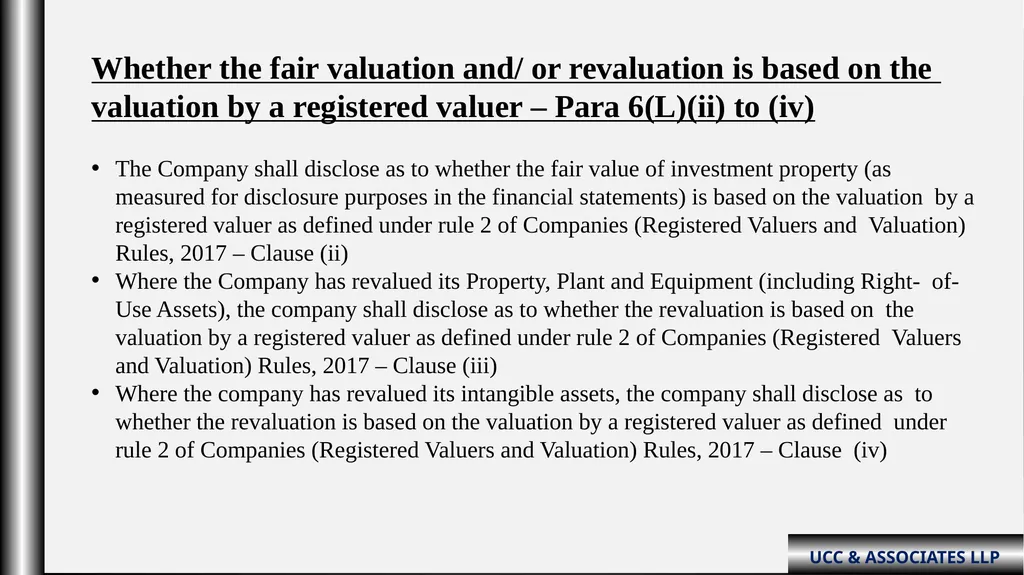
slide29. Whether the fair valuation and/ or revaluation is based on the valuation by a registered valuer – Para 6(L)(ii) to (iv) The Company shall disclose as to whether the fair value of investment property (as measured for disclosure purposes in the financial statements) is based on the valuation by a registered valuer as defined under rule 2 of Companies (Registered Valuers and Valuation) Rules, 2017 – Clause (ii)
Where the Company has revalued its Property, Plant and Equipment (including Right- of-Use Assets), the company shall disclose as to whether the revaluation is based on the valuation by a registered valuer as defined under rule 2 of Companies (Registered Valuers and Valuation) Rules, 2017 – Clause (iii)
Where the company has revalued its intangible assets, the company shall disclose as to whether the revaluation is based on the valuation by a registered valuer as defined under rule 2 of Companies (Registered Valuers and Valuation) Rules, 2017 – Clause (iv)<br>
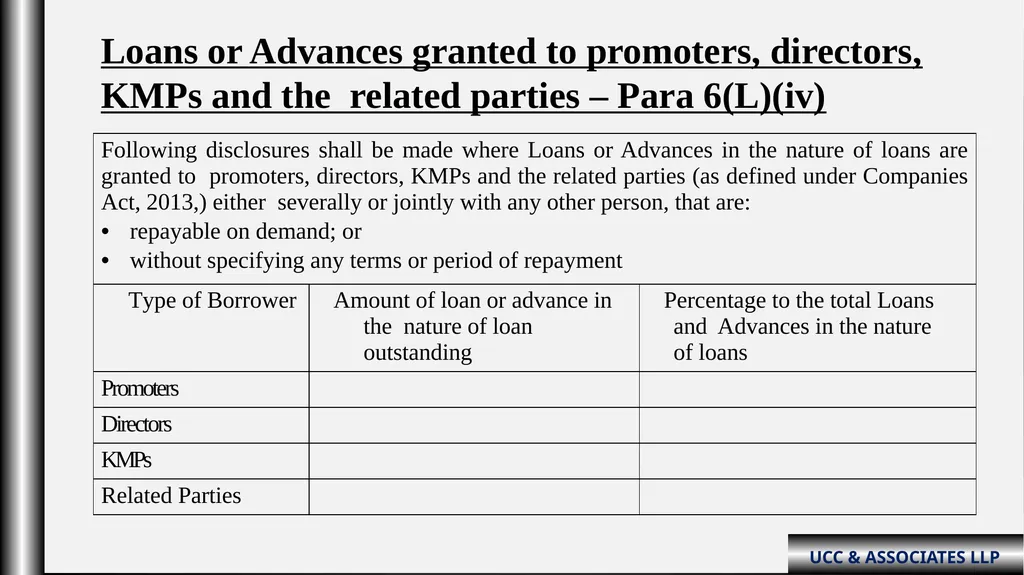
slide30. Loans or Advances granted to promoters, directors, KMPs and the related parties – Para 6(L)(iv)<br>
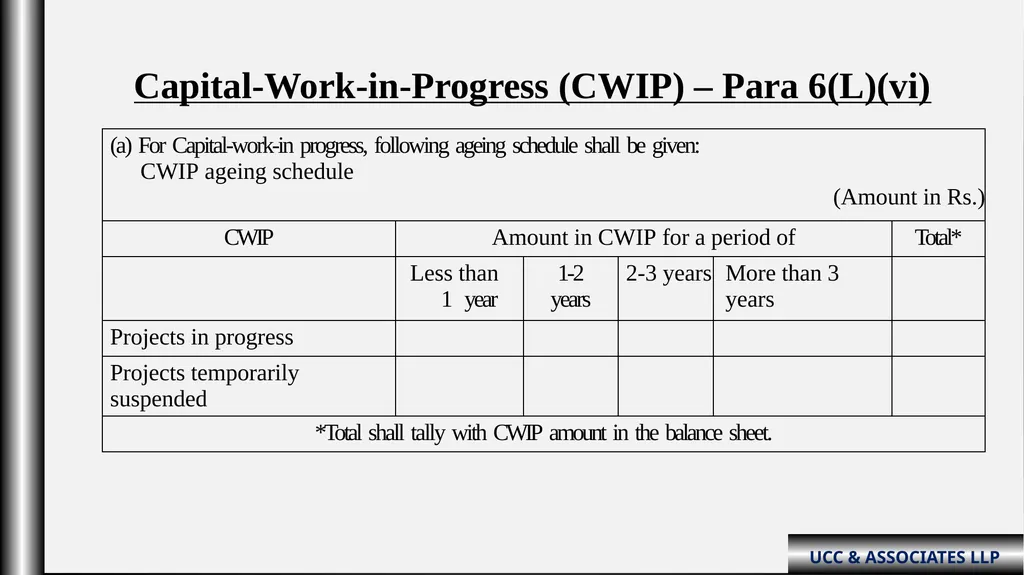
slide31. Capital-Work-in-Progress (CWIP) – Para 6(L)(vi)<br>
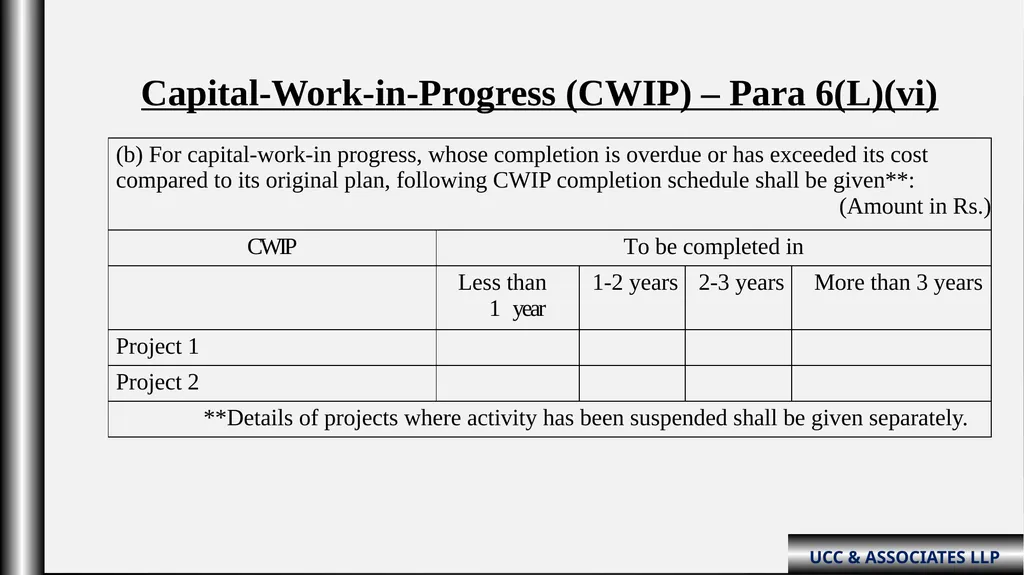
slide32. Capital-Work-in-Progress (CWIP) – Para 6(L)(vi)<br>
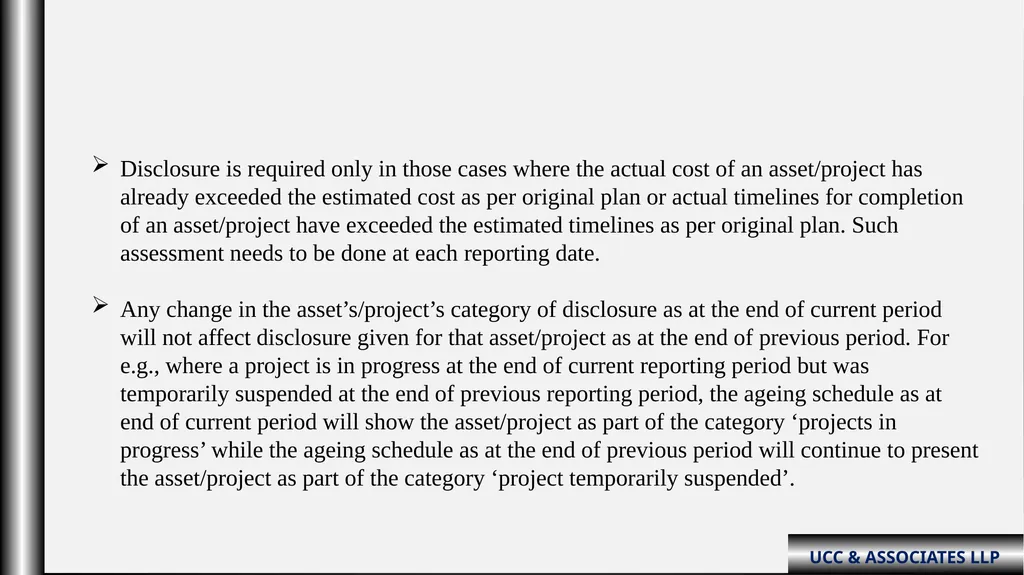
slide33. Disclosure is required only in those cases where the actual cost of an asset/project has already exceeded the estimated cost as per original plan or actual timelines for completion of an asset/project have exceeded the estimated timelines as per original plan. Such assessment needs to be done at each reporting date.
Any change in the asset’s/project’s category of disclosure as at the end of current period will not affect disclosure given for that asset/project as at the end of previous period. For e.g., where a project is in progress at the end of current reporting period but was temporarily suspended at the end of previous reporting period, the ageing schedule as at end of current period will show the asset/project as part of the category ‘projects in progress’ while the ageing schedule as at the end of previous period will continue to present the asset/project as part of the category ‘project temporarily suspended’.<br>
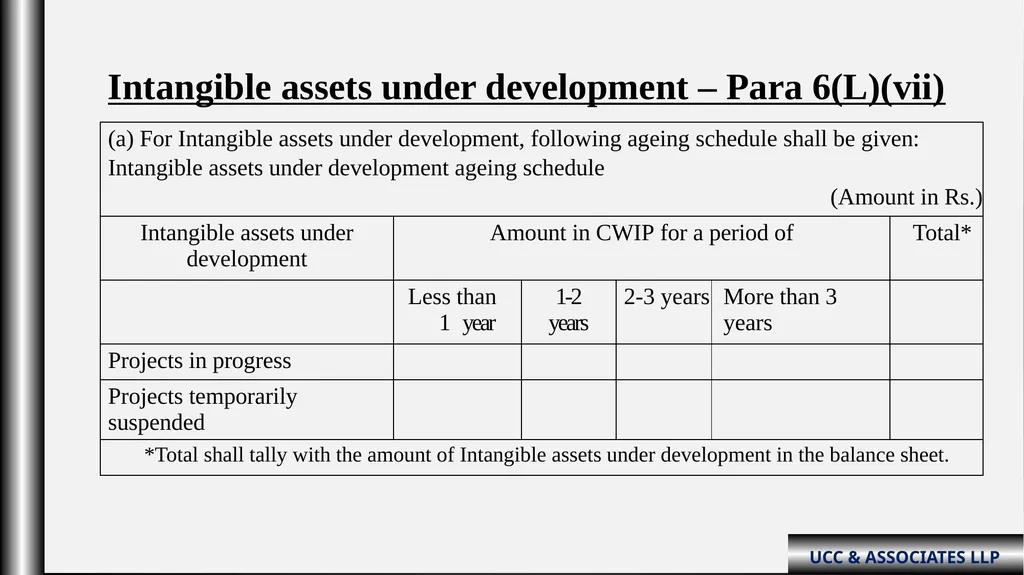
slide34. Intangible assets under development – Para 6(L)(vii)<br>
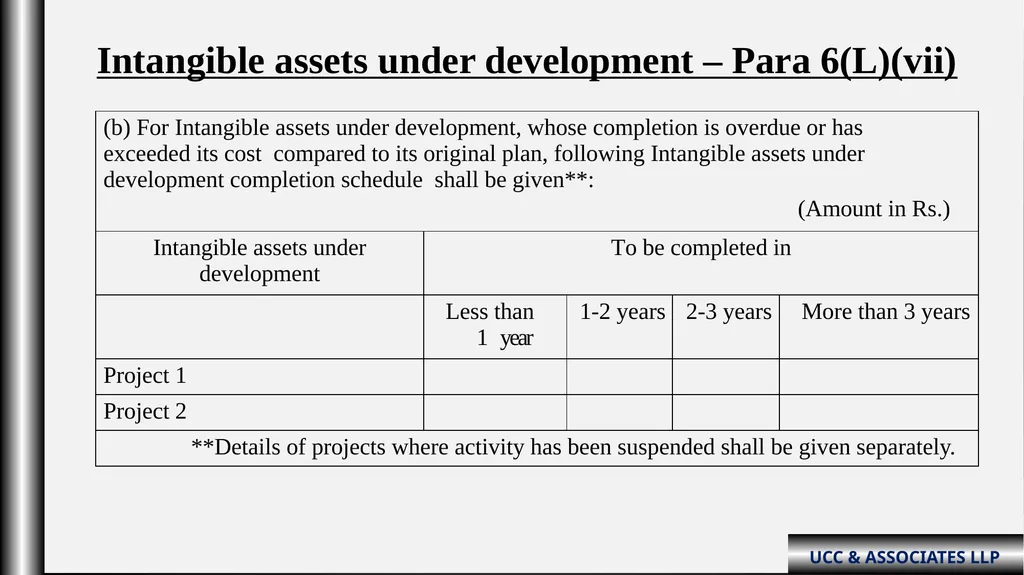
slide35. Intangible assets under development – Para 6(L)(vii)<br>
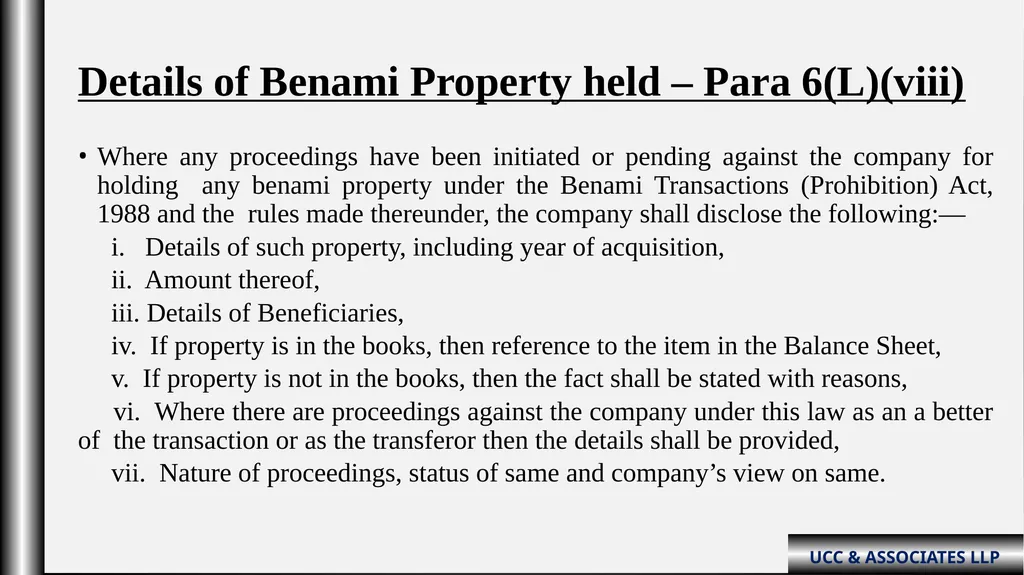
slide36. Details of Benami Property held – Para 6(L)(viii) Where any proceedings have been initiated or pending against the company for holding any benami property under the Benami Transactions (Prohibition) Act, 1988 and the rules made thereunder, the company shall disclose the following:—
i. Details of such property, including year of acquisition,
ii. Amount thereof,
iii. Details of Beneficiaries,
iv. If property is in the books, then reference to the item in the Balance Sheet,
v. If property is not in the books, then the fact shall be stated with reasons,
vi. Where there are proceedings against the company under this law as an a better of the transaction or as the transferor then the details shall be provided,
vii. Nature of proceedings, status of same and company’s view on same.<br>
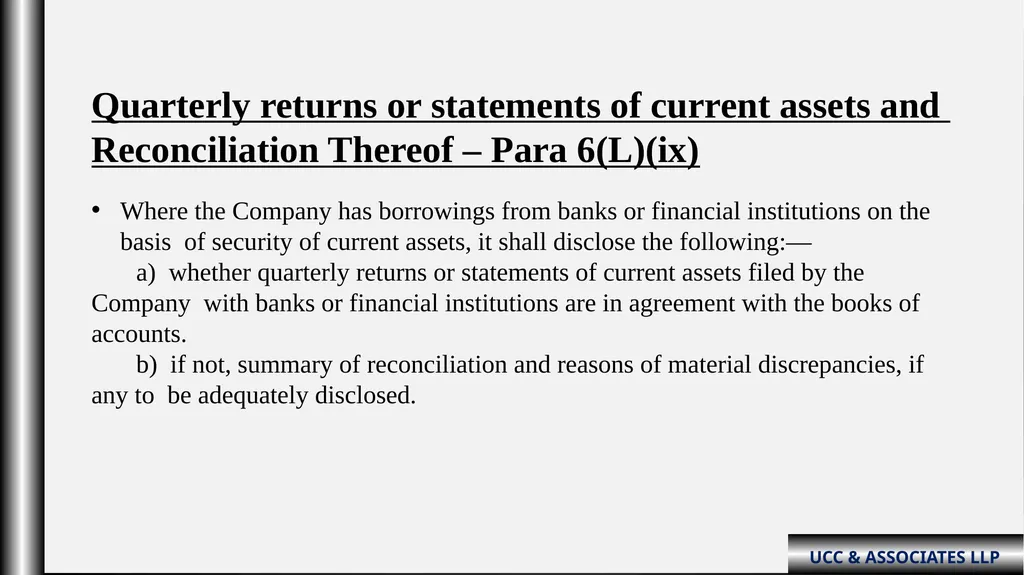
slide37. Quarterly returns or statements of current assets and Reconciliation Thereof – Para 6(L)(ix) Where the Company has borrowings from banks or financial institutions on the basis of security of current assets, it shall disclose the following:—
a) whether quarterly returns or statements of current assets filed by the Company with banks or financial institutions are in agreement with the books of accounts.
b) if not, summary of reconciliation and reasons of material discrepancies, if any to be adequately disclosed.<br>
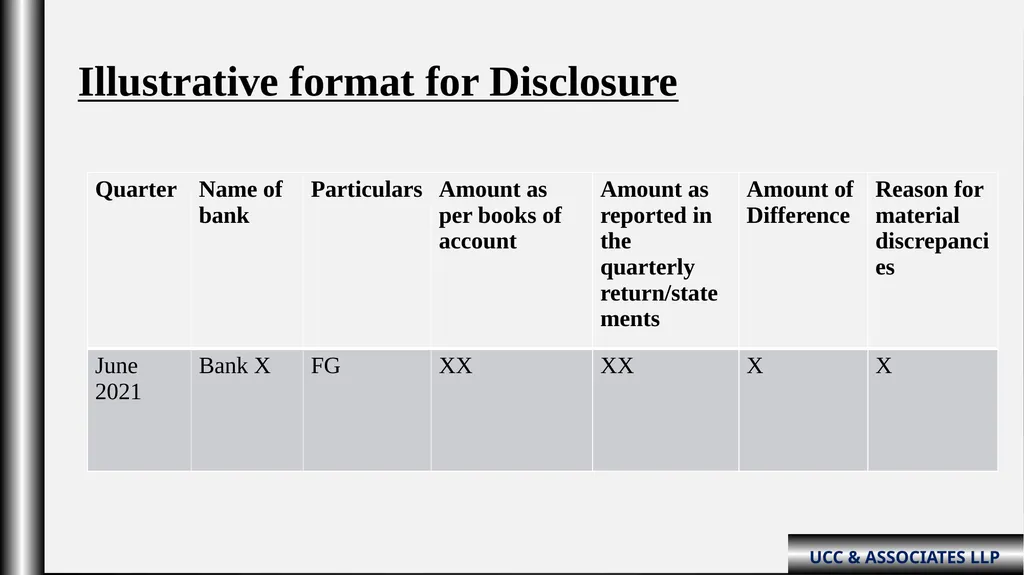
slide38. Illustrative format for Disclosure<br>
slide39. Wilful Defaulter – Para 6(L)(x) Where a company is a declared wilful defaulter by any bank or financial Institution or other lender, following details shall be given:
a) Date of declaration as wilful defaulter,
b) Details of defaults (amount and nature of defaults),
* “wilful defaulter” here means a person or an issuer who or which is categorized as a wilful defaulter by any bank or financial institution (as defined under the Act) or consortium thereof, in accordance with the guidelines on wilful defaulters issued by the Reserve Bank of India.<br>
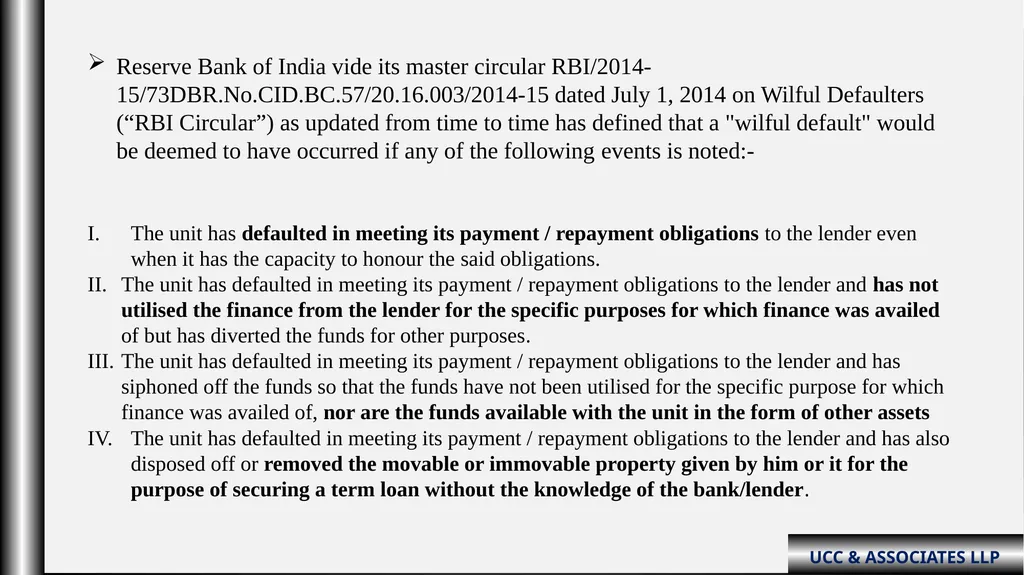
slide40. Reserve Bank of India vide its master circular RBI/2014- 15/73DBR.No.CID.BC.57/20.16.003/2014-15 dated July 1, 2014 on Wilful Defaulters (“RBI Circular”) as updated from time to time has defined that a "wilful default" would be deemed to have occurred if any of the following events is noted:-
The unit has defaulted in meeting its payment / repayment obligations to the lender even when it has the capacity to honour the said obligations.
The unit has defaulted in meeting its payment / repayment obligations to the lender and has not utilised the finance from the lender for the specific purposes for which finance was availed of but has diverted the funds for other purposes.
The unit has defaulted in meeting its payment / repayment obligations to the lender and has siphoned off the funds so that the funds have not been utilised for the specific purpose for which finance was availed of, nor are the funds available with the unit in the form of other assets
The unit has defaulted in meeting its payment / repayment obligations to the lender and has also disposed off or removed the movable or immovable property given by him or it for the purpose of securing a term loan without the knowledge of the bank/lender.<br>
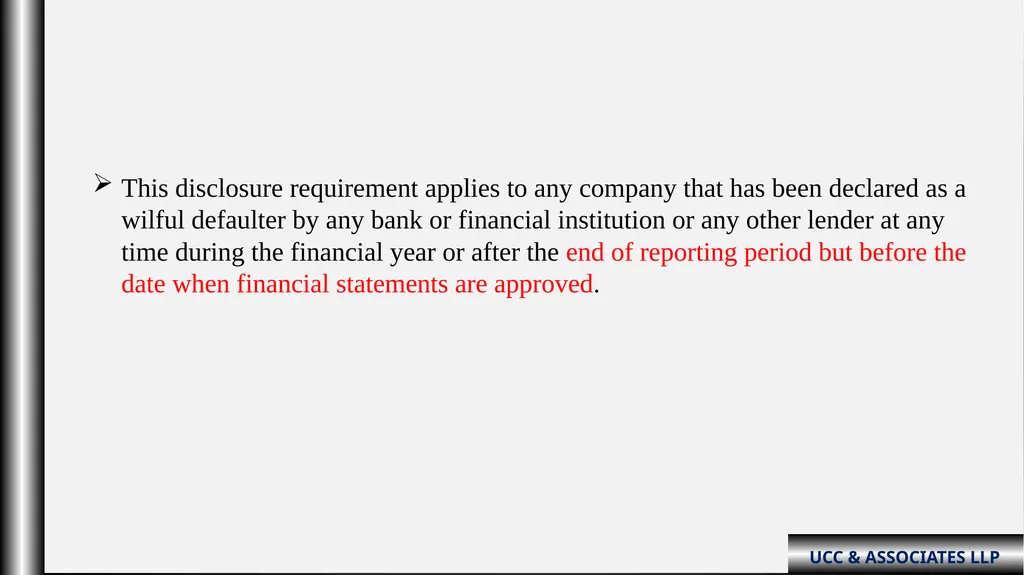
slide41. This disclosure requirement applies to any company that has been declared as a wilful defaulter by any bank or financial institution or any other lender at any time during the financial year or after the end of reporting period but before the date when financial statements are approved.<br>
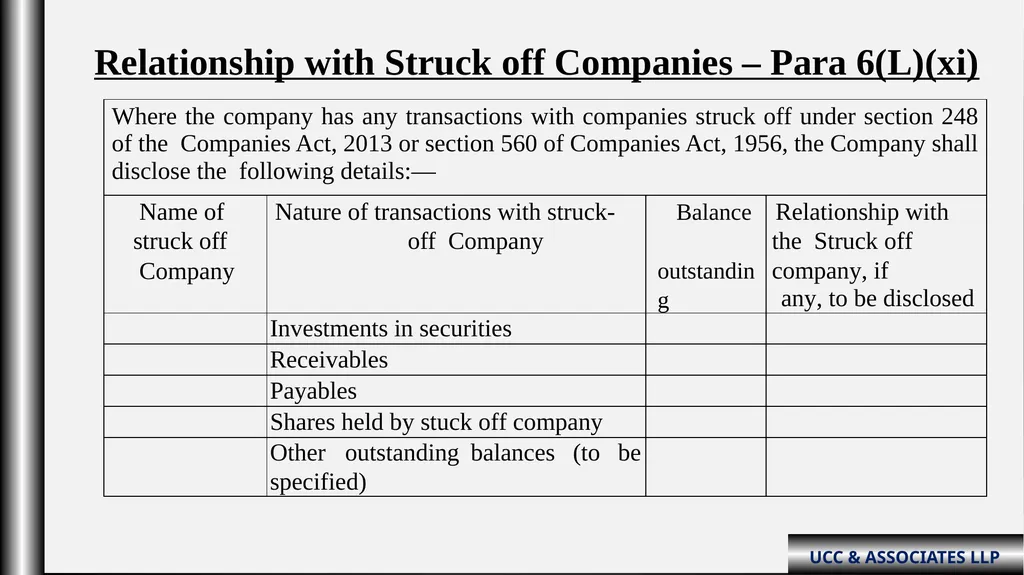
slide42. Relationship with Struck off Companies – Para 6(L)(xi)<br>
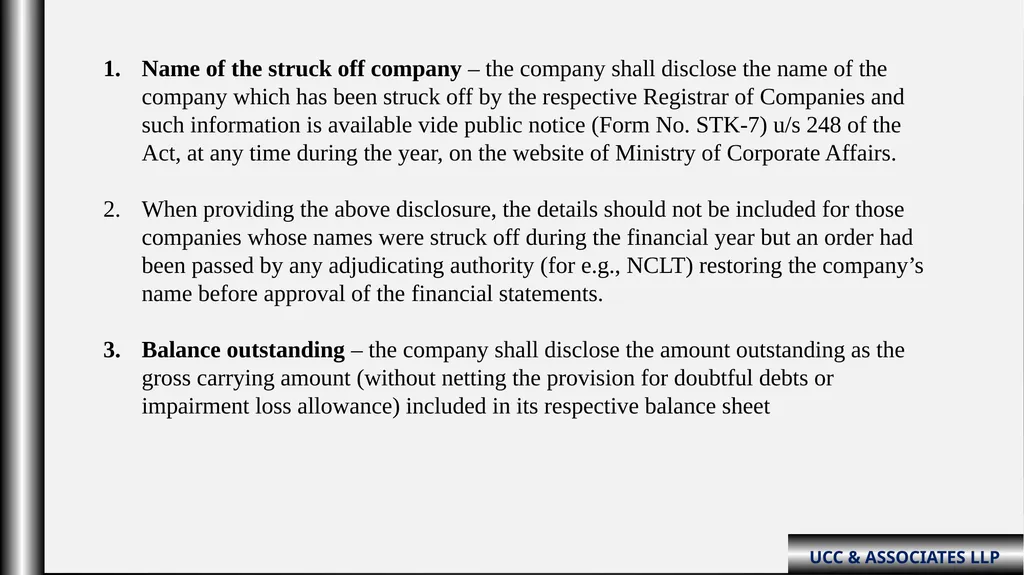
slide43. Name of the struck off company – the company shall disclose the name of the company which has been struck off by the respective Registrar of Companies and such information is available vide public notice (Form No. STK-7) u/s 248 of the Act, at any time during the year, on the website of Ministry of Corporate Affairs.
When providing the above disclosure, the details should not be included for those companies whose names were struck off during the financial year but an order had been passed by any adjudicating authority (for e.g., NCLT) restoring the company’s name before approval of the financial statements.
Balance outstanding – the company shall disclose the amount outstanding as the gross carrying amount (without netting the provision for doubtful debts or impairment loss allowance) included in its respective balance sheet<br>
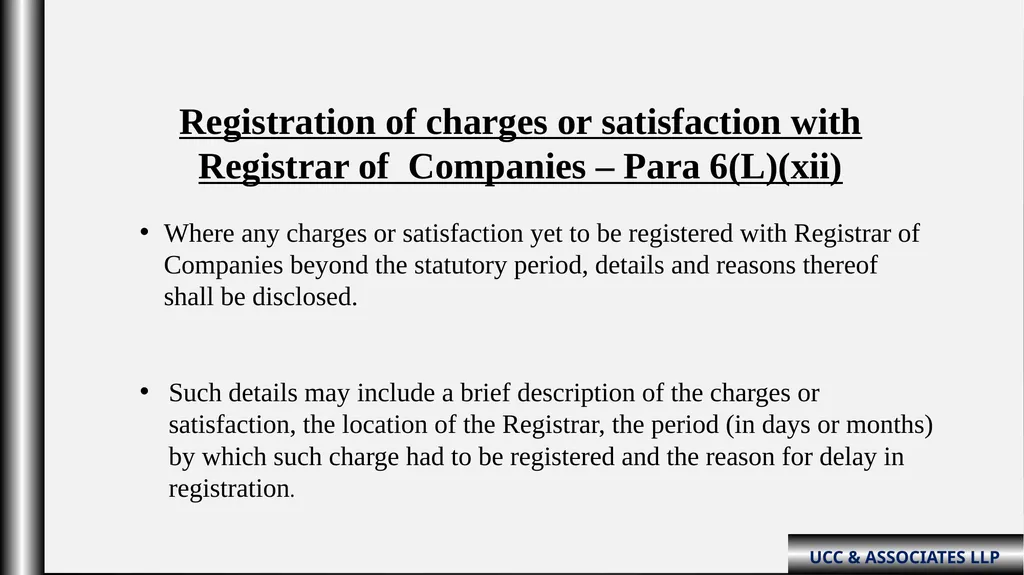
slide44. Registration of charges or satisfaction with Registrar of Companies – Para 6(L)(xii) Where any charges or satisfaction yet to be registered with Registrar of Companies beyond the statutory period, details and reasons thereof shall be disclosed.
Such details may include a brief description of the charges or satisfaction, the location of the Registrar, the period (in days or months) by which such charge had to be registered and the reason for delay in registration.<br>
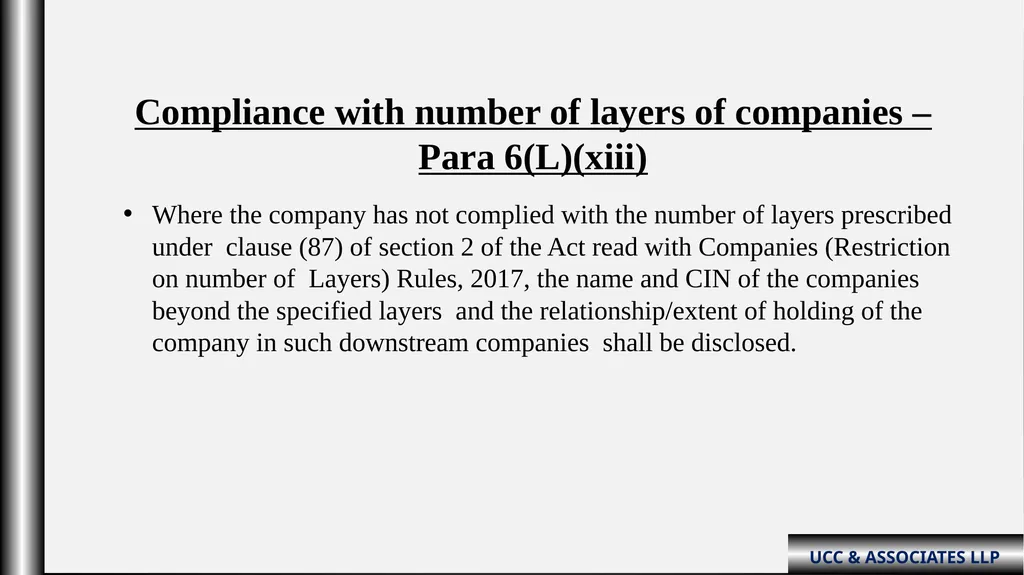
slide45. Compliance with number of layers of companies –
Para 6(L)(xiii) Where the company has not complied with the number of layers prescribed under clause (87) of section 2 of the Act read with Companies (Restriction on number of Layers) Rules, 2017, the name and CIN of the companies beyond the specified layers and the relationship/extent of holding of the company in such downstream companies shall be disclosed.<br>
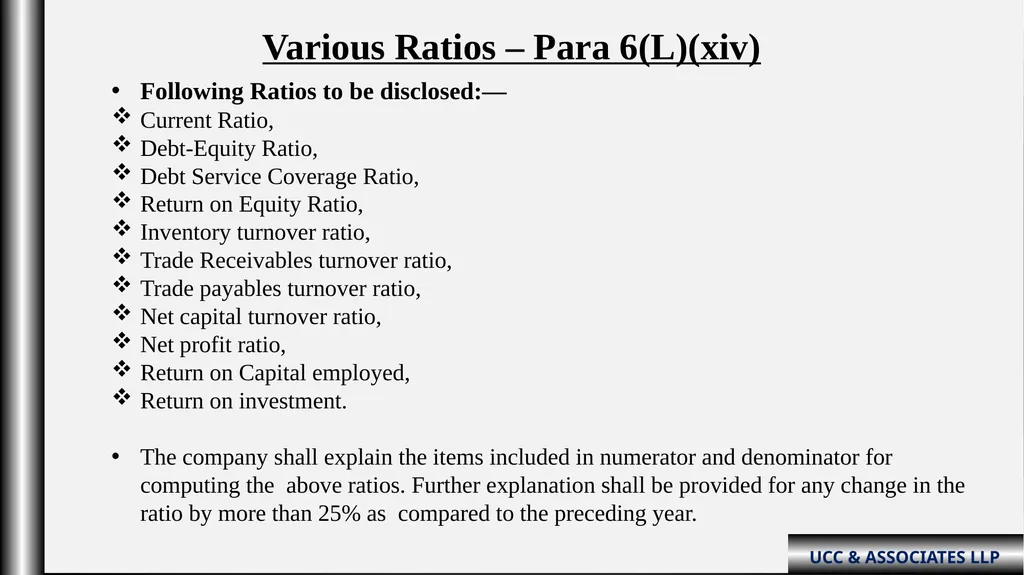
slide46. Various Ratios – Para 6(L)(xiv) Following Ratios to be disclosed:—
Current Ratio,
Debt-Equity Ratio,
Debt Service Coverage Ratio,
Return on Equity Ratio,
Inventory turnover ratio,
Trade Receivables turnover ratio,
Trade payables turnover ratio,
Net capital turnover ratio,
Net profit ratio,
Return on Capital employed,
Return on investment.
The company shall explain the items included in numerator and denominator for computing the above ratios. Further explanation shall be provided for any change in the ratio by more than 25% as compared to the preceding year.<br>
slide47. Compliance with approved Scheme(s) of Arrangements –Para 6(L)(xv) Where any Scheme of Arrangements has been approved by the Competent Authority in terms of sections 230 to 237 of the Companies Act, 2013, the Company shall disclose that the effect of such Scheme of Arrangements have been accounted for in the books of account of the Company ‘in accordance with the Scheme’ and ‘in accordance with accounting standards’ and deviation in this regard shall be explained<br>
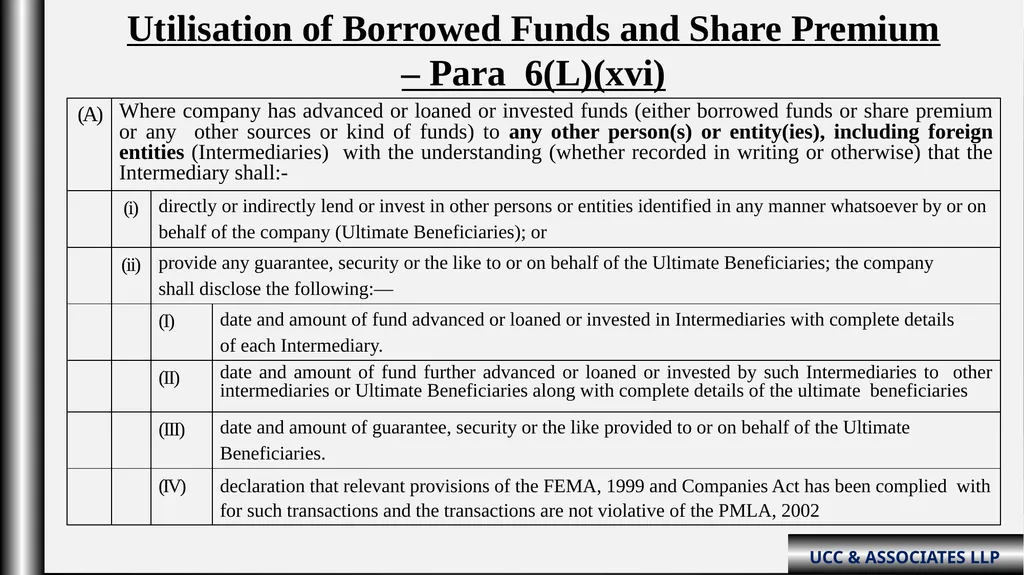
slide48. Utilisation of Borrowed Funds and Share Premium – Para 6(L)(xvi)<br>
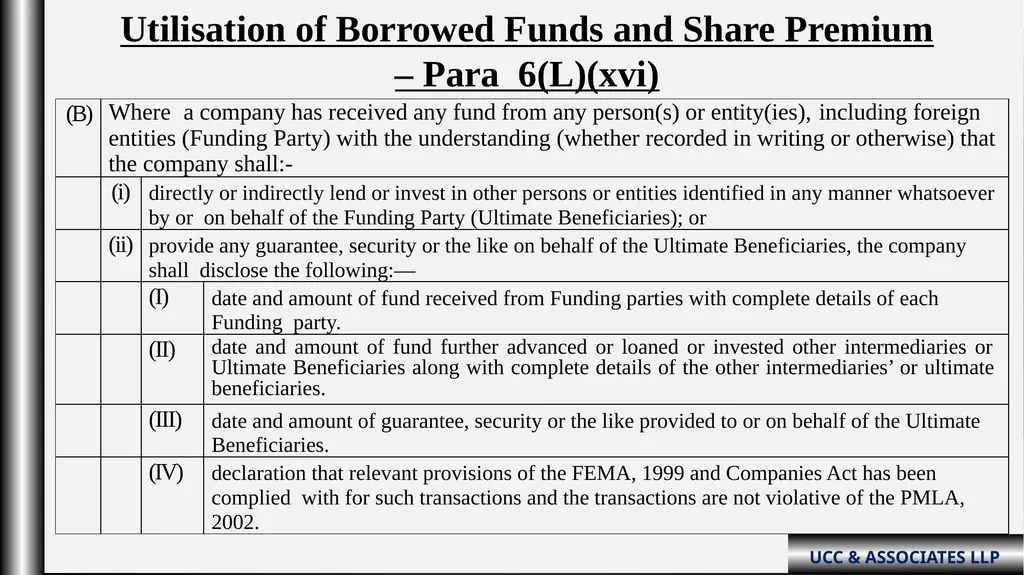
slide49. Utilisation of Borrowed Funds and Share Premium – Para 6(L)(xvi)<br>
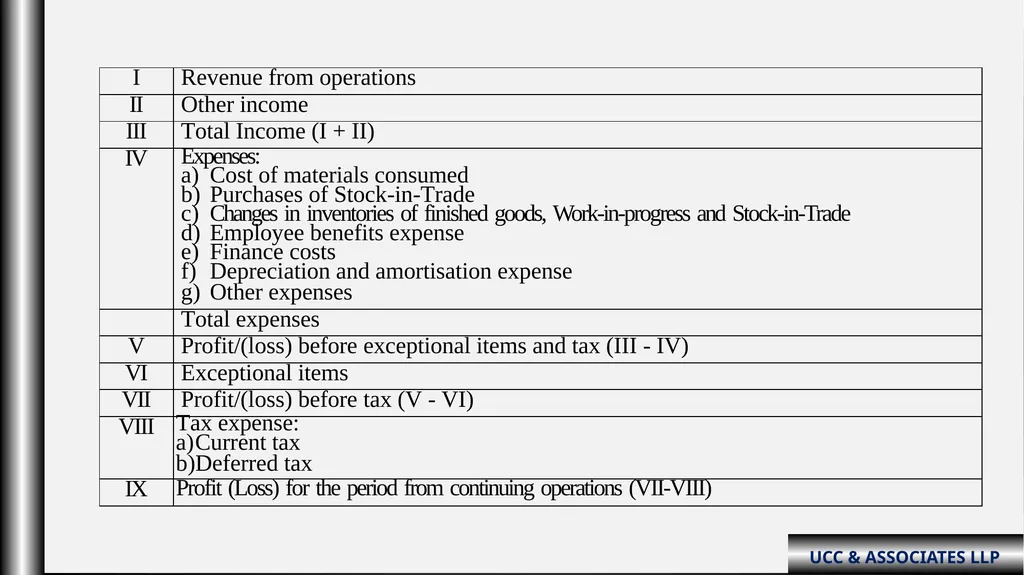
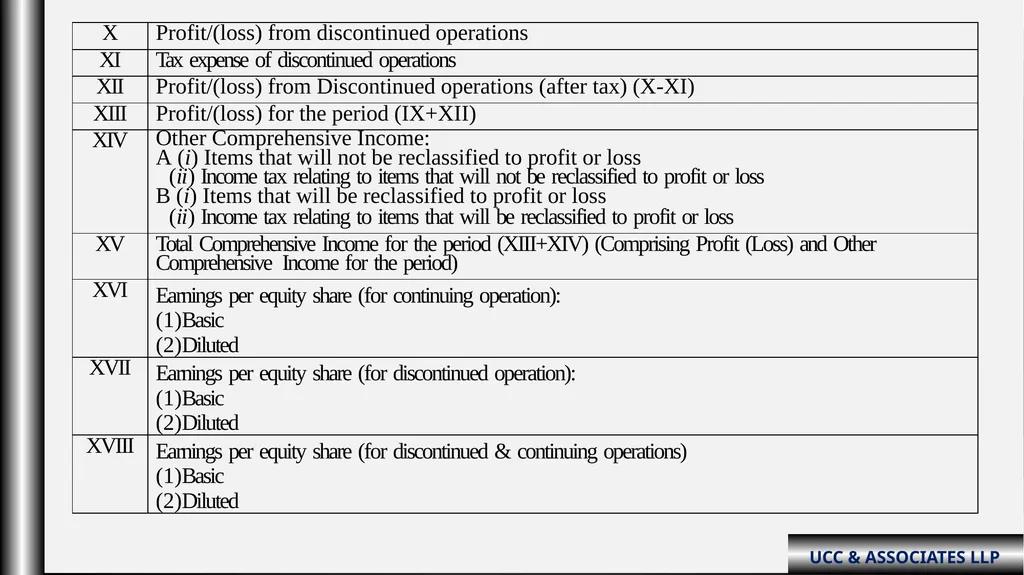
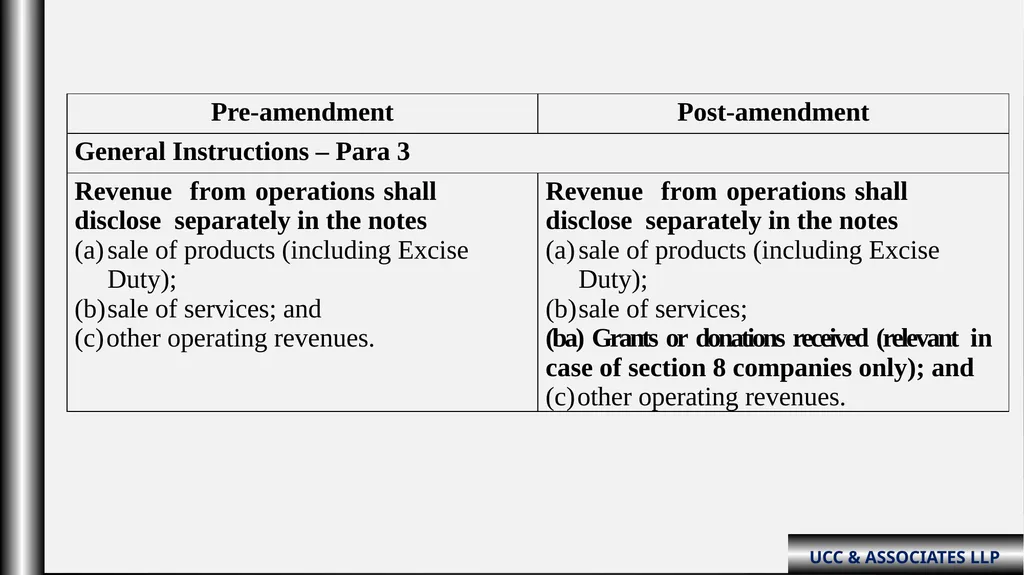
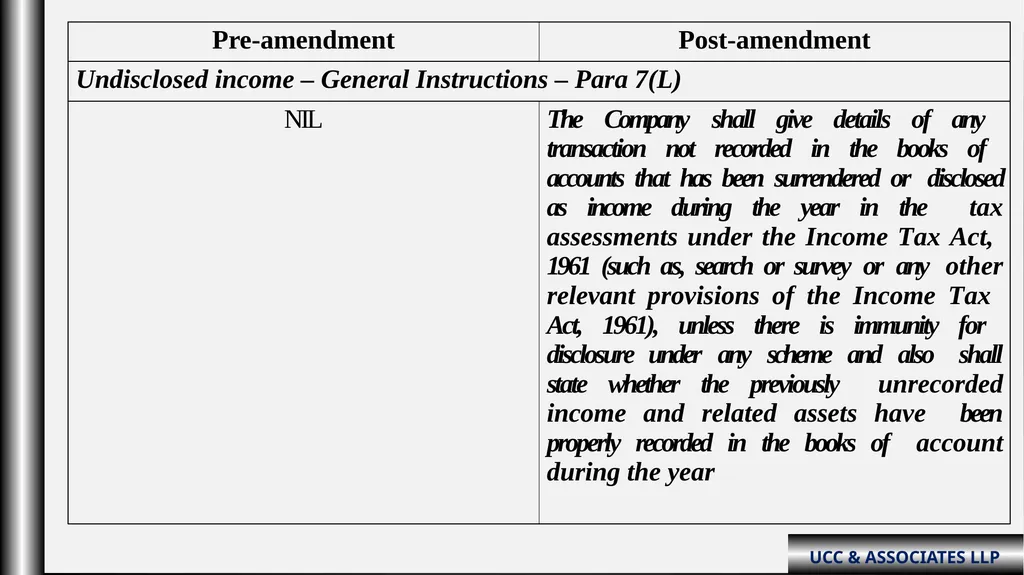
slide50. Amendments in Division II
– Statement of Profit and
Loss<br>
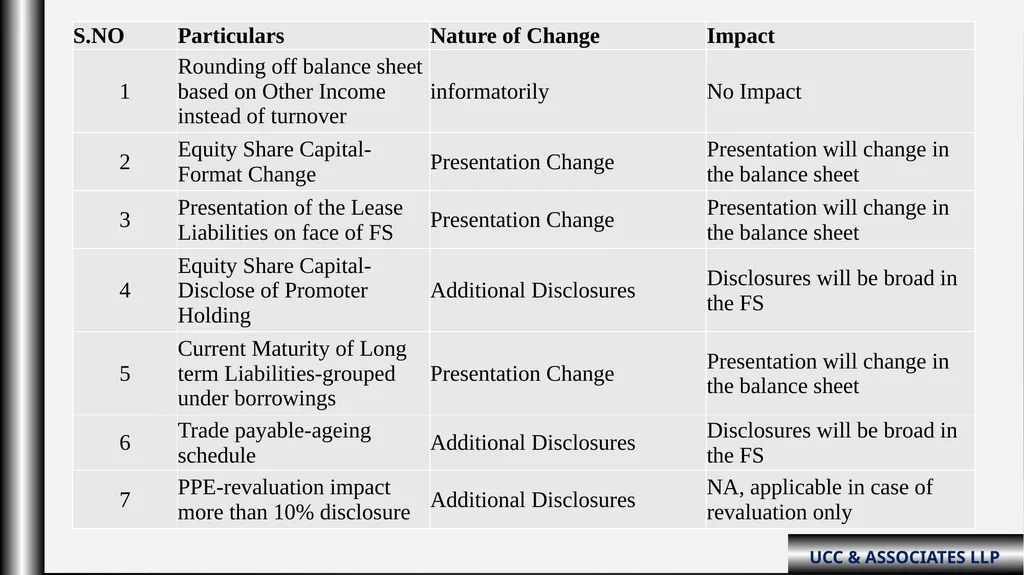
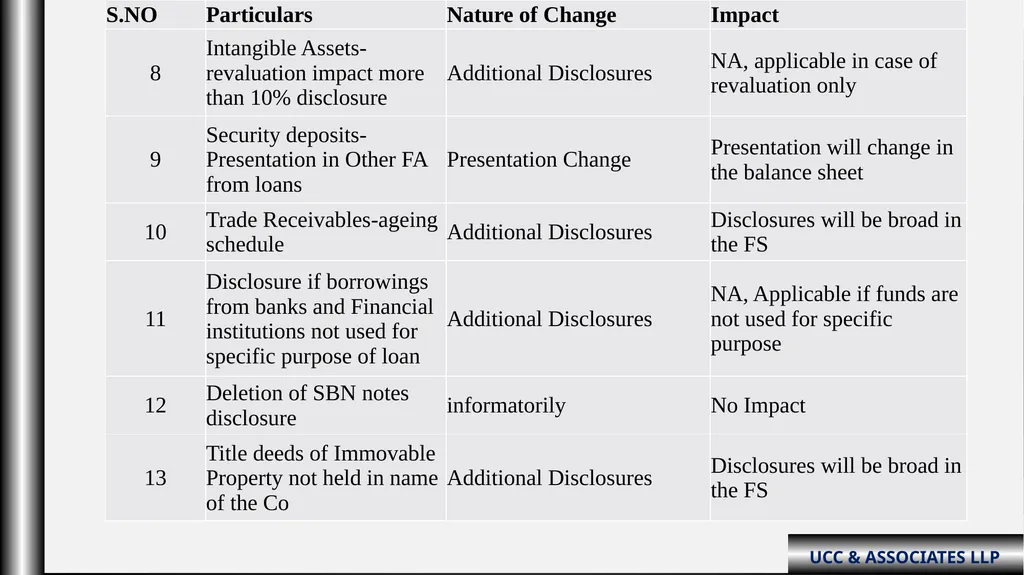
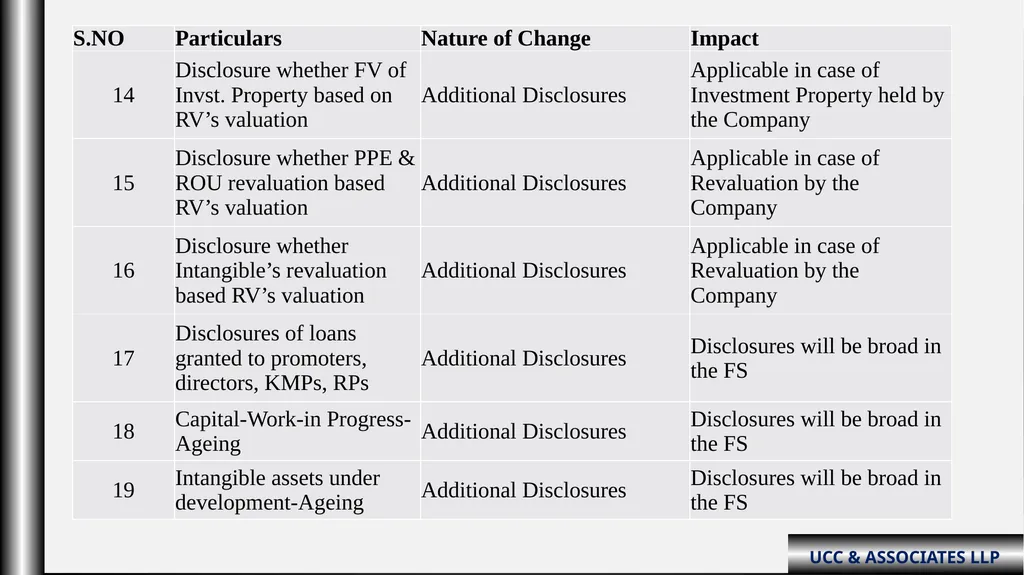
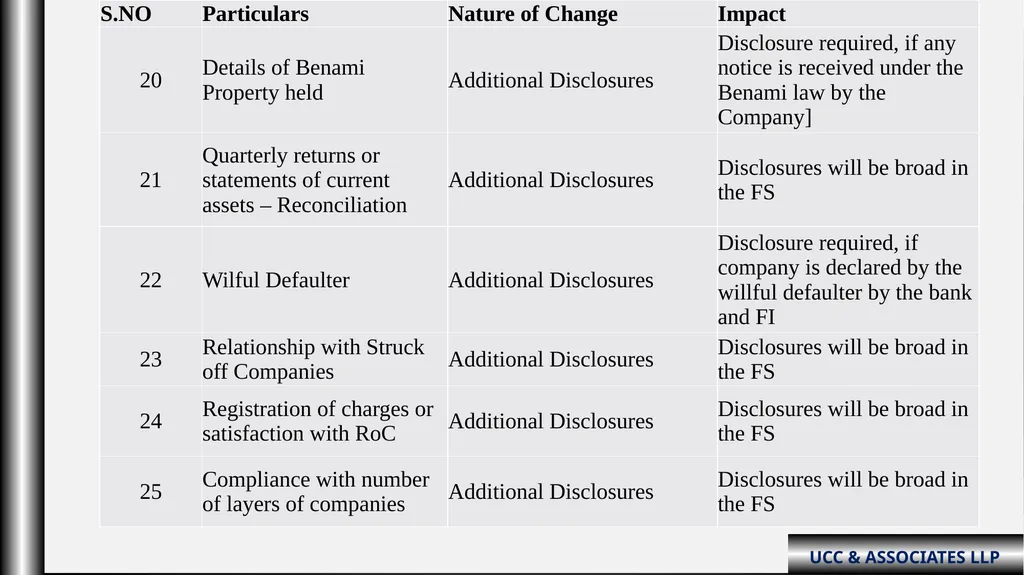
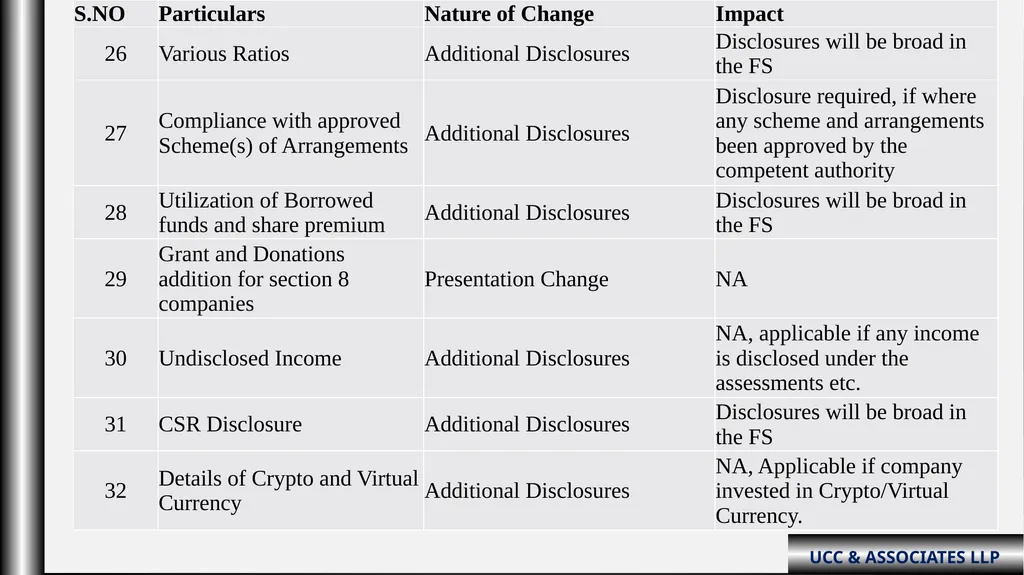
slide57. SUMMARY OF CHANGES<br>
slide63. QUESTIONS
&
ANSWERS<br>
slide64. THANK YOU… Address 1315 Ansal Tower, 38 Nehru Place, New Delhi - 110019 Contact No. +91 9810044684 Email Id info@uccglobal.in<br>
( Amendments fy: 2021-22)” TOPIC OF THE DAY<br>
slide3. On 24th March 2020, the MCA notified amendments to Schedule III to the Companies Act, 2013.
The notification states that “ the Central Government hereby makes the following further amendments in Schedule III to the said Act with effect from 1st day of April, 2021, namely……….”<br>
slide4. Amendments in Division II –
General Instructions for Preparation of Balance Sheet and Statement of Profit & Loss<br>
slide5. Pre-amendment [Clause 5] Post-amendment [Clause 5] Depending upon the turnover of the company, the figures appearing in the Financial Statements shall be rounded off as given below Depending upon the Total Income of the company, the figures appearing in the Financial Statements shall be rounded off as given below<br>
slide6. Amendments in Division II
– Balance Sheet<br>
slide9. ii) Format of the Statement of Change in Equity has been made more broader: -
Equity Share Capital
Current reporting period Previous reporting period<br>
slide10. Pre-amendment Post Post-amendment Post (d) Other non-current liabilities (d) Other non-current liabilities<br>
slide11. Pre-amendment Post Post-amendment Post (d) Current tax liabilities (Net)<br>
slide13. Remarks *Promoter here means promoter as defined in the Companies Act, 2013.
who has been named as such in a prospectus or is identified by the company in the annual return referred to in section 92; or
who has control over the affairs of the company, directly or indirectly whether as a shareholder, director or otherwise; or
in accordance with whose advice, directions or instructions the Board of Directors of the company is accustomed to act:
***Percentage change shall be computed with respect to the number at the beginning of the year or if issued during the year for the first time then with respect to the date of issue.<br>
slide17. Remarks # Similar information shall be given where no due date of payment is specified, in that case disclosure shall be from the date of the transaction.
The amounts to be presented under (i) MSME and (ii) Others shall include
those trade payable dues that are undisputed.<br>
slide22. Remarks # Similar information shall be given where no due date of payment is specified, in that case disclosure shall be from the date of the transaction.
Unbilled dues shall be disclosed separately.<br>
slide26. Title deeds of Immovable Property not held in name of the Company– Para 6(L)(i)<br>
slide27. Remarks The Act does not define ‘title deeds’. In general, title deeds mean a
legal deed or document constituting evidence of a right (eg. registered sale
deed, transfer deed, conveyance deed of land), especially to the legal
ownership of the immovable property
In case of leased assets, title deeds would imply the lease agreements and related documents. Where the Company is the lessee of an immovable property and the lease agreements are not duly executed in favour of the
lessee then appropriate disclosure has to be provided for such immovable
properties.<br>
slide28. Remarks Relative Party as per the Companies Act 2013:-
Relative‘‘, with reference to any person, means any one who is related to another, if—
they are members of a Hindu Undivided Family;
they are husband and wife; or
one person is related to the other in such manner as may be prescribed;
Father: Provided that the term “Father” includes step-father.
Mother: Provided that the term “Mother” includes the step-mother.
Son: Provided that the term “Son” includes the step-son.
Son’s wife.
Daughter.
Daughter’s husband.
Brother: Provided that the term “Brother” includes the step-brother;
Sister: Provided that the term “Sister” includes the step-sister<br>
slide29. Whether the fair valuation and/ or revaluation is based on the valuation by a registered valuer – Para 6(L)(ii) to (iv) The Company shall disclose as to whether the fair value of investment property (as measured for disclosure purposes in the financial statements) is based on the valuation by a registered valuer as defined under rule 2 of Companies (Registered Valuers and Valuation) Rules, 2017 – Clause (ii)
Where the Company has revalued its Property, Plant and Equipment (including Right- of-Use Assets), the company shall disclose as to whether the revaluation is based on the valuation by a registered valuer as defined under rule 2 of Companies (Registered Valuers and Valuation) Rules, 2017 – Clause (iii)
Where the company has revalued its intangible assets, the company shall disclose as to whether the revaluation is based on the valuation by a registered valuer as defined under rule 2 of Companies (Registered Valuers and Valuation) Rules, 2017 – Clause (iv)<br>
slide30. Loans or Advances granted to promoters, directors, KMPs and the related parties – Para 6(L)(iv)<br>
slide31. Capital-Work-in-Progress (CWIP) – Para 6(L)(vi)<br>
slide32. Capital-Work-in-Progress (CWIP) – Para 6(L)(vi)<br>
slide33. Disclosure is required only in those cases where the actual cost of an asset/project has already exceeded the estimated cost as per original plan or actual timelines for completion of an asset/project have exceeded the estimated timelines as per original plan. Such assessment needs to be done at each reporting date.
Any change in the asset’s/project’s category of disclosure as at the end of current period will not affect disclosure given for that asset/project as at the end of previous period. For e.g., where a project is in progress at the end of current reporting period but was temporarily suspended at the end of previous reporting period, the ageing schedule as at end of current period will show the asset/project as part of the category ‘projects in progress’ while the ageing schedule as at the end of previous period will continue to present the asset/project as part of the category ‘project temporarily suspended’.<br>
slide34. Intangible assets under development – Para 6(L)(vii)<br>
slide35. Intangible assets under development – Para 6(L)(vii)<br>
slide36. Details of Benami Property held – Para 6(L)(viii) Where any proceedings have been initiated or pending against the company for holding any benami property under the Benami Transactions (Prohibition) Act, 1988 and the rules made thereunder, the company shall disclose the following:—
i. Details of such property, including year of acquisition,
ii. Amount thereof,
iii. Details of Beneficiaries,
iv. If property is in the books, then reference to the item in the Balance Sheet,
v. If property is not in the books, then the fact shall be stated with reasons,
vi. Where there are proceedings against the company under this law as an a better of the transaction or as the transferor then the details shall be provided,
vii. Nature of proceedings, status of same and company’s view on same.<br>
slide37. Quarterly returns or statements of current assets and Reconciliation Thereof – Para 6(L)(ix) Where the Company has borrowings from banks or financial institutions on the basis of security of current assets, it shall disclose the following:—
a) whether quarterly returns or statements of current assets filed by the Company with banks or financial institutions are in agreement with the books of accounts.
b) if not, summary of reconciliation and reasons of material discrepancies, if any to be adequately disclosed.<br>
slide38. Illustrative format for Disclosure<br>
slide39. Wilful Defaulter – Para 6(L)(x) Where a company is a declared wilful defaulter by any bank or financial Institution or other lender, following details shall be given:
a) Date of declaration as wilful defaulter,
b) Details of defaults (amount and nature of defaults),
* “wilful defaulter” here means a person or an issuer who or which is categorized as a wilful defaulter by any bank or financial institution (as defined under the Act) or consortium thereof, in accordance with the guidelines on wilful defaulters issued by the Reserve Bank of India.<br>
slide40. Reserve Bank of India vide its master circular RBI/2014- 15/73DBR.No.CID.BC.57/20.16.003/2014-15 dated July 1, 2014 on Wilful Defaulters (“RBI Circular”) as updated from time to time has defined that a "wilful default" would be deemed to have occurred if any of the following events is noted:-
The unit has defaulted in meeting its payment / repayment obligations to the lender even when it has the capacity to honour the said obligations.
The unit has defaulted in meeting its payment / repayment obligations to the lender and has not utilised the finance from the lender for the specific purposes for which finance was availed of but has diverted the funds for other purposes.
The unit has defaulted in meeting its payment / repayment obligations to the lender and has siphoned off the funds so that the funds have not been utilised for the specific purpose for which finance was availed of, nor are the funds available with the unit in the form of other assets
The unit has defaulted in meeting its payment / repayment obligations to the lender and has also disposed off or removed the movable or immovable property given by him or it for the purpose of securing a term loan without the knowledge of the bank/lender.<br>
slide41. This disclosure requirement applies to any company that has been declared as a wilful defaulter by any bank or financial institution or any other lender at any time during the financial year or after the end of reporting period but before the date when financial statements are approved.<br>
slide42. Relationship with Struck off Companies – Para 6(L)(xi)<br>
slide43. Name of the struck off company – the company shall disclose the name of the company which has been struck off by the respective Registrar of Companies and such information is available vide public notice (Form No. STK-7) u/s 248 of the Act, at any time during the year, on the website of Ministry of Corporate Affairs.
When providing the above disclosure, the details should not be included for those companies whose names were struck off during the financial year but an order had been passed by any adjudicating authority (for e.g., NCLT) restoring the company’s name before approval of the financial statements.
Balance outstanding – the company shall disclose the amount outstanding as the gross carrying amount (without netting the provision for doubtful debts or impairment loss allowance) included in its respective balance sheet<br>
slide44. Registration of charges or satisfaction with Registrar of Companies – Para 6(L)(xii) Where any charges or satisfaction yet to be registered with Registrar of Companies beyond the statutory period, details and reasons thereof shall be disclosed.
Such details may include a brief description of the charges or satisfaction, the location of the Registrar, the period (in days or months) by which such charge had to be registered and the reason for delay in registration.<br>
slide45. Compliance with number of layers of companies –
Para 6(L)(xiii) Where the company has not complied with the number of layers prescribed under clause (87) of section 2 of the Act read with Companies (Restriction on number of Layers) Rules, 2017, the name and CIN of the companies beyond the specified layers and the relationship/extent of holding of the company in such downstream companies shall be disclosed.<br>
slide46. Various Ratios – Para 6(L)(xiv) Following Ratios to be disclosed:—
Current Ratio,
Debt-Equity Ratio,
Debt Service Coverage Ratio,
Return on Equity Ratio,
Inventory turnover ratio,
Trade Receivables turnover ratio,
Trade payables turnover ratio,
Net capital turnover ratio,
Net profit ratio,
Return on Capital employed,
Return on investment.
The company shall explain the items included in numerator and denominator for computing the above ratios. Further explanation shall be provided for any change in the ratio by more than 25% as compared to the preceding year.<br>
slide47. Compliance with approved Scheme(s) of Arrangements –Para 6(L)(xv) Where any Scheme of Arrangements has been approved by the Competent Authority in terms of sections 230 to 237 of the Companies Act, 2013, the Company shall disclose that the effect of such Scheme of Arrangements have been accounted for in the books of account of the Company ‘in accordance with the Scheme’ and ‘in accordance with accounting standards’ and deviation in this regard shall be explained<br>
slide48. Utilisation of Borrowed Funds and Share Premium – Para 6(L)(xvi)<br>
slide49. Utilisation of Borrowed Funds and Share Premium – Para 6(L)(xvi)<br>
slide50. Amendments in Division II
– Statement of Profit and
Loss<br>
slide57. SUMMARY OF CHANGES<br>
slide63. QUESTIONS
&
ANSWERS<br>
slide64. THANK YOU… Address 1315 Ansal Tower, 38 Nehru Place, New Delhi - 110019 Contact No. +91 9810044684 Email Id info@uccglobal.in<br>