
Schizophrenia Spectrum and Other Psychotic
JO
Published · 27 slides · 0 views

1 / 1

Description
Schizophrenia Spectrum and Other Psychotic Disorders Schizophrenia Schizophreniform disorder Brief (acute) psychotic disorder Delusional disorder Schizoaffective disorder Symptoms of Schizophrenia Positive: Abnormal Behaviors
Related Topics
Share
Embed code
Download this presentation From Below
"Schizophrenia Spectrum and Other Psychotic" is the property of its rightful owner. Permission is granted to download and print the materials on this website for personal, non-commercial use only, and to display it on your personal computer provided you do not modify the materials and that you retain all copyright notices contained in the materials. By downloading content from our website, you accept the terms of this agreement.
Presentation Transcript
01
Schizophrenia Spectrum and Other
Psychotic Disorders<br>
02
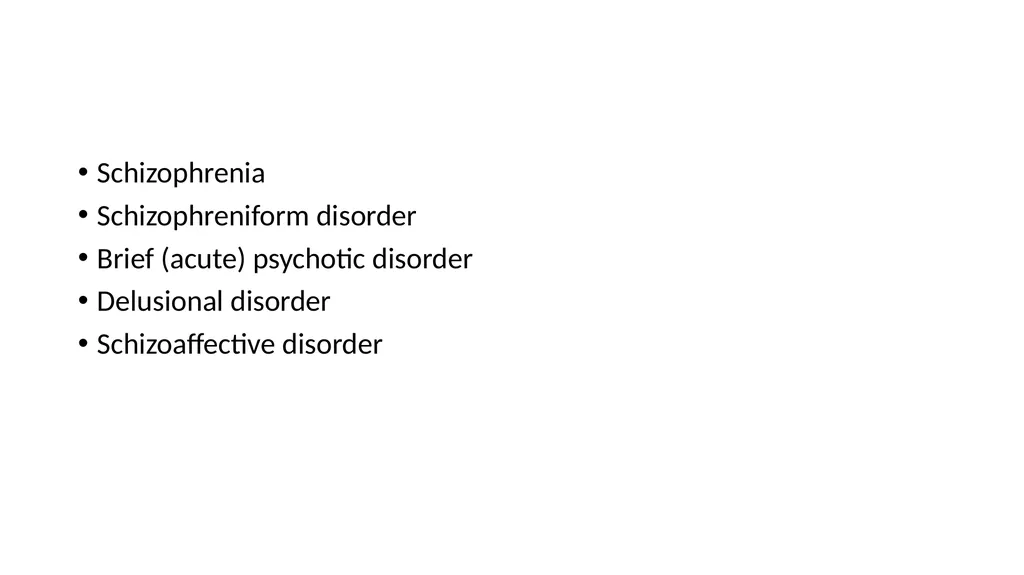
Schizophrenia
Schizophreniform disorder
Brief (acute) psychotic disorder
Delusional disorder
Schizoaffective disorder<br>
Schizophreniform disorder
Brief (acute) psychotic disorder
Delusional disorder
Schizoaffective disorder<br>
03
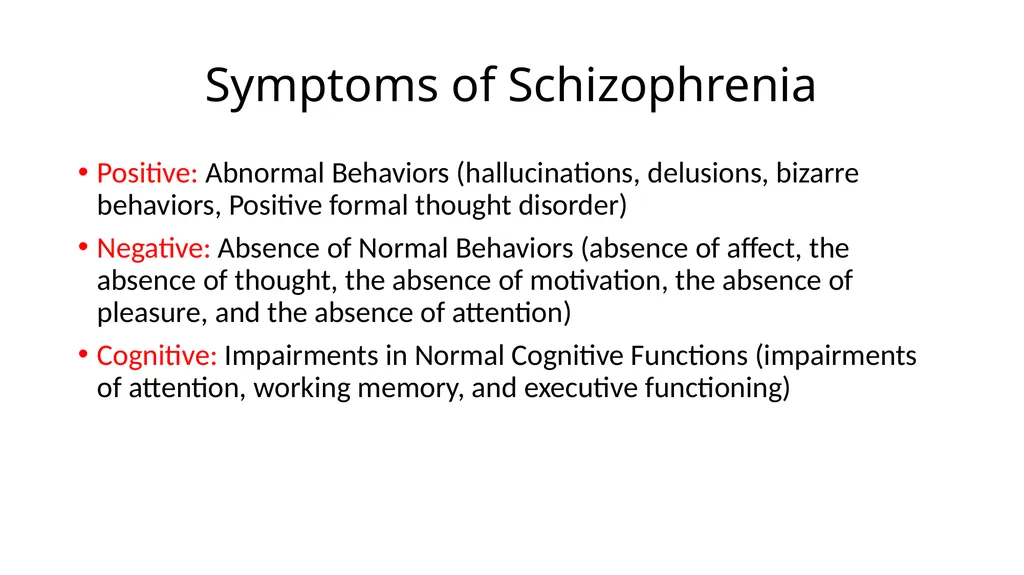
Symptoms of Schizophrenia Positive: Abnormal Behaviors (hallucinations, delusions, bizarre behaviors, Positive formal thought disorder)
Negative: Absence of Normal Behaviors (absence of affect, the absence of thought, the absence of motivation, the absence of pleasure, and the absence of attention)
Cognitive: Impairments in Normal Cognitive Functions (impairments of attention, working memory, and executive functioning)<br>
Negative: Absence of Normal Behaviors (absence of affect, the absence of thought, the absence of motivation, the absence of pleasure, and the absence of attention)
Cognitive: Impairments in Normal Cognitive Functions (impairments of attention, working memory, and executive functioning)<br>
04
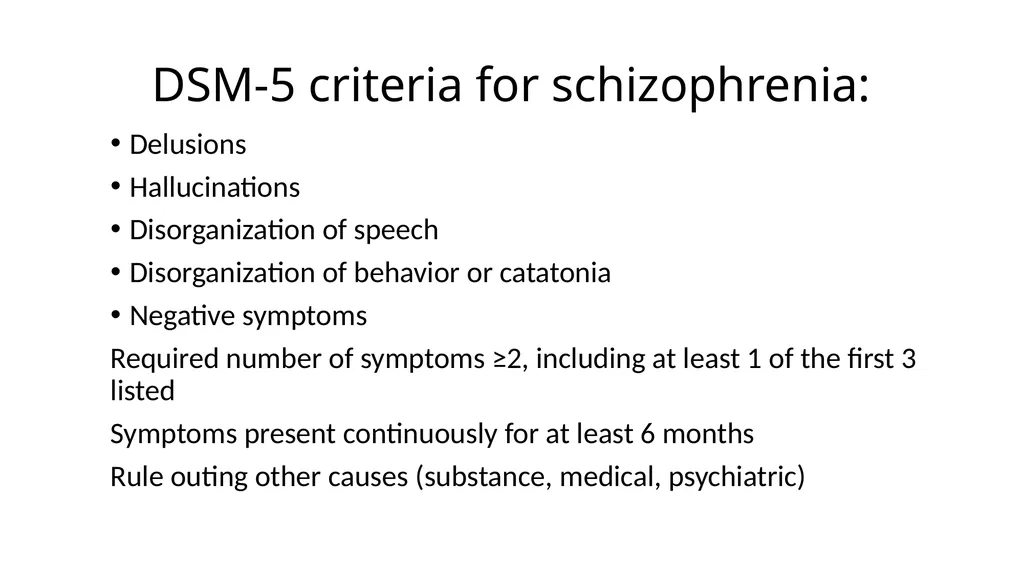
DSM-5 criteria for schizophrenia: Delusions
Hallucinations
Disorganization of speech
Disorganization of behavior or catatonia
Negative symptoms
Required number of symptoms ≥2, including at least 1 of the first 3 listed
Symptoms present continuously for at least 6 months
Rule outing other causes (substance, medical, psychiatric)<br>
Hallucinations
Disorganization of speech
Disorganization of behavior or catatonia
Negative symptoms
Required number of symptoms ≥2, including at least 1 of the first 3 listed
Symptoms present continuously for at least 6 months
Rule outing other causes (substance, medical, psychiatric)<br>
05
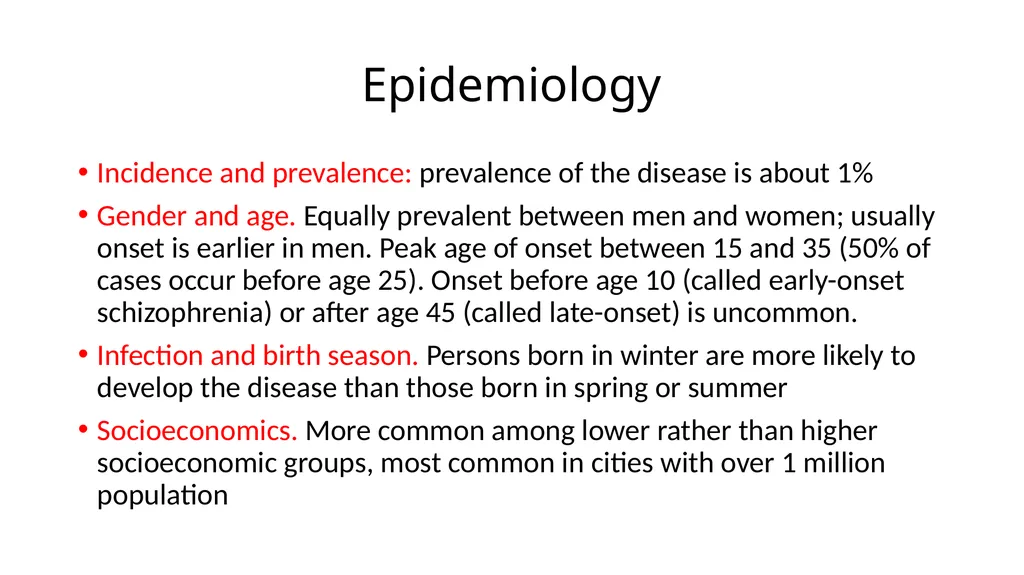
Epidemiology Incidence and prevalence: prevalence of the disease is about 1%
Gender and age. Equally prevalent between men and women; usually onset is earlier in men. Peak age of onset between 15 and 35 (50% of cases occur before age 25). Onset before age 10 (called early-onset schizophrenia) or after age 45 (called late-onset) is uncommon.
Infection and birth season. Persons born in winter are more likely to develop the disease than those born in spring or summer
Socioeconomics. More common among lower rather than higher socioeconomic groups, most common in cities with over 1 million population<br>
Gender and age. Equally prevalent between men and women; usually onset is earlier in men. Peak age of onset between 15 and 35 (50% of cases occur before age 25). Onset before age 10 (called early-onset schizophrenia) or after age 45 (called late-onset) is uncommon.
Infection and birth season. Persons born in winter are more likely to develop the disease than those born in spring or summer
Socioeconomics. More common among lower rather than higher socioeconomic groups, most common in cities with over 1 million population<br>
06
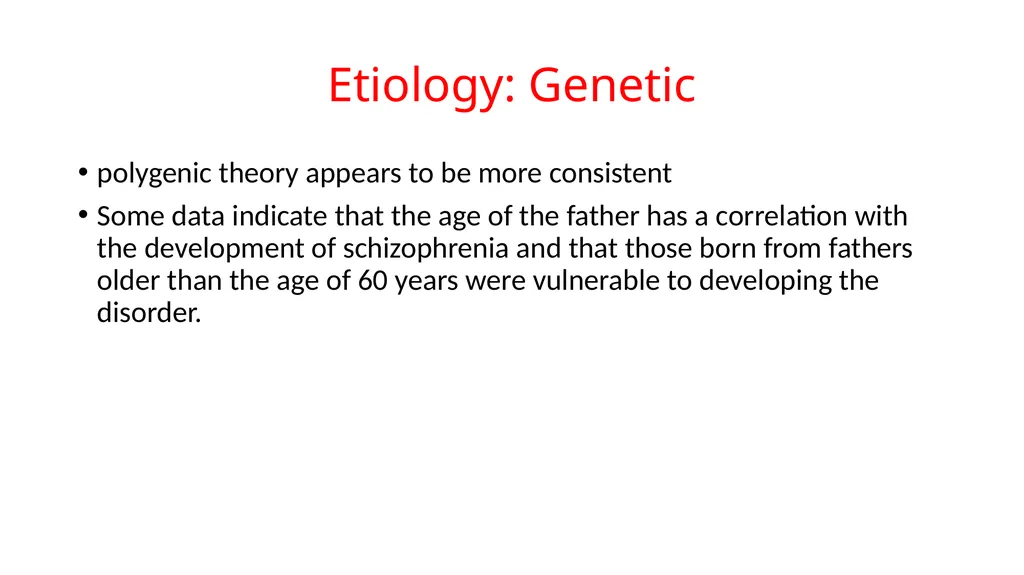
Etiology: Genetic polygenic theory appears to be more consistent
Some data indicate that the age of the father has a correlation with the development of schizophrenia and that those born from fathers older than the age of 60 years were vulnerable to developing the disorder.<br>
Some data indicate that the age of the father has a correlation with the development of schizophrenia and that those born from fathers older than the age of 60 years were vulnerable to developing the disorder.<br>
07
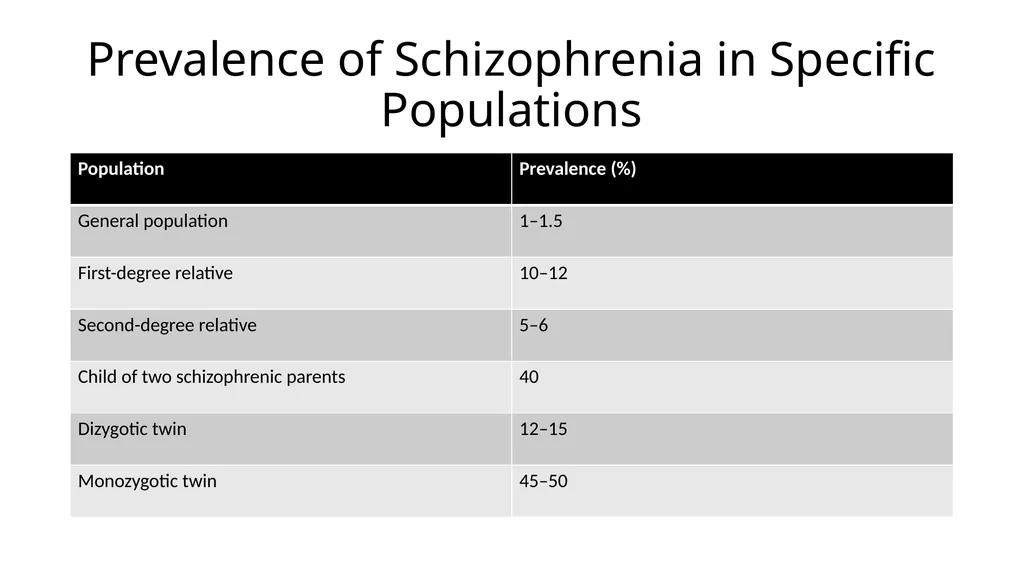
Prevalence of Schizophrenia in Specific Populations<br>
08
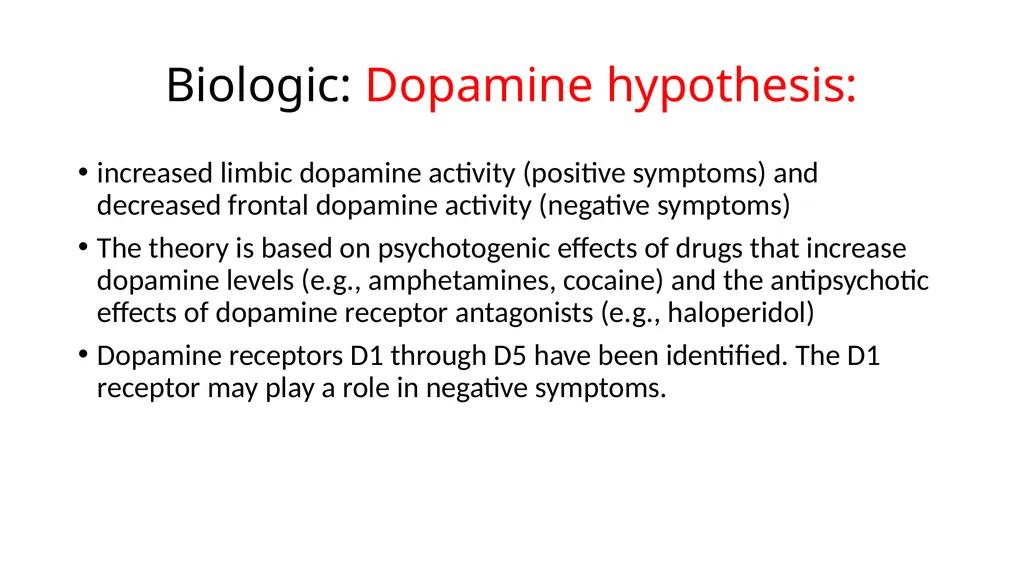
Biologic: Dopamine hypothesis: increased limbic dopamine activity (positive symptoms) and decreased frontal dopamine activity (negative symptoms)
The theory is based on psychotogenic effects of drugs that increase dopamine levels (e.g., amphetamines, cocaine) and the antipsychotic effects of dopamine receptor antagonists (e.g., haloperidol)
Dopamine receptors D1 through D5 have been identified. The D1 receptor may play a role in negative symptoms.<br>
The theory is based on psychotogenic effects of drugs that increase dopamine levels (e.g., amphetamines, cocaine) and the antipsychotic effects of dopamine receptor antagonists (e.g., haloperidol)
Dopamine receptors D1 through D5 have been identified. The D1 receptor may play a role in negative symptoms.<br>
09
Norepinephrine hypothesis: Increased norepinephrine levels in schizophrenia lead to increased sensitization to sensory input.
γ-Aminobutyric acid (GABA) hypothesis: Decreased GABA activity results in increased dopamine activity.
Serotonin hypothesis: antagonism at the serotonin 5-HT2 receptor has been emphasized as important in reducing psychotic symptoms
Glutamate hypothesis: psychotogenic effects of the NMDA antagonists phencyclidine and ketamine (Ketalar), in addition to the observed therapeutic effects (in research settings) of the NMDA agonists glycine and D-cycloserine.<br>
γ-Aminobutyric acid (GABA) hypothesis: Decreased GABA activity results in increased dopamine activity.
Serotonin hypothesis: antagonism at the serotonin 5-HT2 receptor has been emphasized as important in reducing psychotic symptoms
Glutamate hypothesis: psychotogenic effects of the NMDA antagonists phencyclidine and ketamine (Ketalar), in addition to the observed therapeutic effects (in research settings) of the NMDA agonists glycine and D-cycloserine.<br>
10
Neurodevelopmental theories: This is evidence for abnormal neuronal migration during the second trimester of fetal development. Abnormal neuronal functioning may lead to the emergence of symptoms during adolescence.<br>
11
Psychosocial and environmental Family factors. Patients whose families have high levels of expressed emotion (EE) have higher relapse rate than those whose families have low EE levels. EE has been defined as any overly involved, intrusive behavior, be it hostile and critical or controlling and infantilizing
Other psychodynamic issues. psychological and environmental stresses
Infectious theory. Evidence for a slow virus etiology includes neuropathologic changes consistent with past infections: gliosis, glial scarring, and antiviral antibodies in the serum and cerebrospinal fluid (CSF) of some schizophrenia patients. Increased frequency of perinatal complications and seasonality of birth data<br>
Other psychodynamic issues. psychological and environmental stresses
Infectious theory. Evidence for a slow virus etiology includes neuropathologic changes consistent with past infections: gliosis, glial scarring, and antiviral antibodies in the serum and cerebrospinal fluid (CSF) of some schizophrenia patients. Increased frequency of perinatal complications and seasonality of birth data<br>
12
Subtypes Paranoid
Disorganized (formerly called hebephrenia)
Catatonic
Undifferentiated type
Residual type
Simple deteriorative schizophrenia (simple schizophrenia)<br>
Disorganized (formerly called hebephrenia)
Catatonic
Undifferentiated type
Residual type
Simple deteriorative schizophrenia (simple schizophrenia)<br>
13
Laboratory and Psychological Tests EEG. Most schizophrenic patients have normal EEG findings
Evoked potential studies. Initial hypersensitivity to sensory stimulation, with later compensatory blunting of information processing at higher cortical levels
Immunologic studies. In some patients, atypical lymphocytes and decreased numbers of natural killer cells.
Endocrinologic studies. In some patients, decreased levels of luteinizing hormone and follicle-stimulating hormone; diminished release of prolactin and growth hormone
Neuropsychological testing. Thematic apperception test and Rorschach test usually reveal bizarre responses<br>
Evoked potential studies. Initial hypersensitivity to sensory stimulation, with later compensatory blunting of information processing at higher cortical levels
Immunologic studies. In some patients, atypical lymphocytes and decreased numbers of natural killer cells.
Endocrinologic studies. In some patients, decreased levels of luteinizing hormone and follicle-stimulating hormone; diminished release of prolactin and growth hormone
Neuropsychological testing. Thematic apperception test and Rorschach test usually reveal bizarre responses<br>
14
Neuropathology No consistent structural defects; changes noted include decreased number of neurons, increased gliosis, and disorganization of neuronal architecture. There is degeneration in the limbic system, especially the amygdala, hippocampus, and the cingulate cortex. The basal ganglia, including the substantia nigra and dorsolateral prefrontal cortex are also involved. Abnormal functioning in basal ganglia and cerebellum may account for movement disorders in schizophrenic patients.<br>
15
Brain imaging Computed tomography (CT). Cortical atrophy in 10% to 35% of patients; enlargement of the lateral and third ventricle in 10% to 50% of patients; atrophy of the cerebellar vermis and decreased radiodensity of brain parenchyma.
Magnetic resonance imaging (MRI). Ventricles in MZ twins with schizophrenia are larger than those of unaffected siblings. Reduced volume of hippocampus, amygdala, and parahippocampal gyrus
Magnetic resonance spectroscopy. Decreased metabolism of the dorsolateral prefrontal cortex
Positron emission tomography (PET). In some patients, decreased frontal and parietal lobe metabolism, relatively high rate of posterior metabolism, and abnormal laterality<br>
Magnetic resonance imaging (MRI). Ventricles in MZ twins with schizophrenia are larger than those of unaffected siblings. Reduced volume of hippocampus, amygdala, and parahippocampal gyrus
Magnetic resonance spectroscopy. Decreased metabolism of the dorsolateral prefrontal cortex
Positron emission tomography (PET). In some patients, decreased frontal and parietal lobe metabolism, relatively high rate of posterior metabolism, and abnormal laterality<br>
16
Physical findings Minor (soft) neurologic findings occur in 50% to 100% of patients: increased prevalence of primitive reflexes (e.g., grasp reflex), abnormal stereognosis and two-point discrimination, and dysdiadochokinesia (impairment in ability to perform rapidly alternating movements). Paroxysmal saccadic eye movements (inability to follow object through space with smooth eye movements) occur in 50% to 80% of schizophrenic patients and in 40% to 45% of first-degree relatives of schizophrenic patients (compared with an 8% to 10% prevalence in nonschizophrenic persons)<br>
17
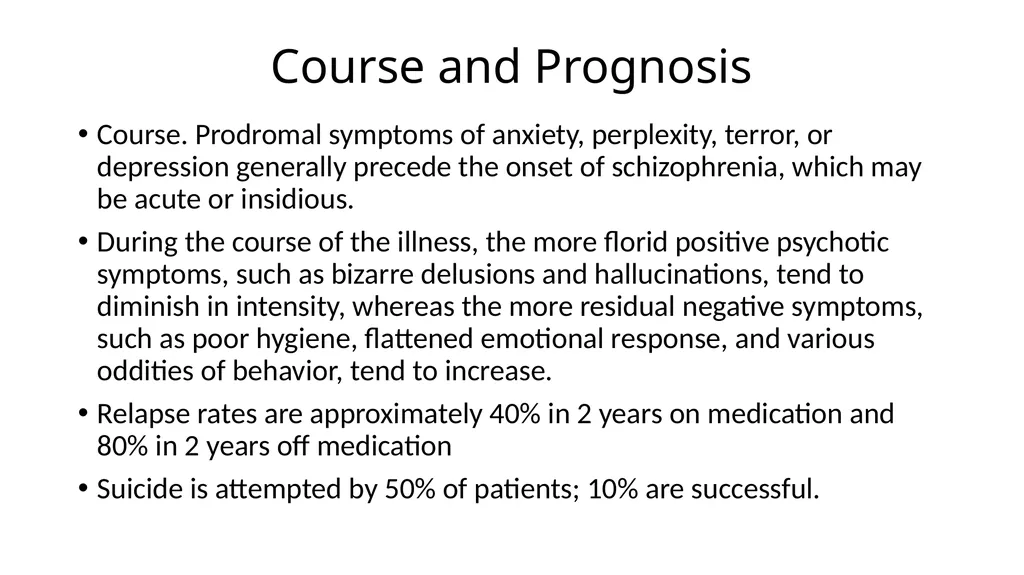
Course and Prognosis Course. Prodromal symptoms of anxiety, perplexity, terror, or depression generally precede the onset of schizophrenia, which may be acute or insidious.
During the course of the illness, the more florid positive psychotic symptoms, such as bizarre delusions and hallucinations, tend to diminish in intensity, whereas the more residual negative symptoms, such as poor hygiene, flattened emotional response, and various oddities of behavior, tend to increase.
Relapse rates are approximately 40% in 2 years on medication and 80% in 2 years off medication
Suicide is attempted by 50% of patients; 10% are successful.<br>
During the course of the illness, the more florid positive psychotic symptoms, such as bizarre delusions and hallucinations, tend to diminish in intensity, whereas the more residual negative symptoms, such as poor hygiene, flattened emotional response, and various oddities of behavior, tend to increase.
Relapse rates are approximately 40% in 2 years on medication and 80% in 2 years off medication
Suicide is attempted by 50% of patients; 10% are successful.<br>
18
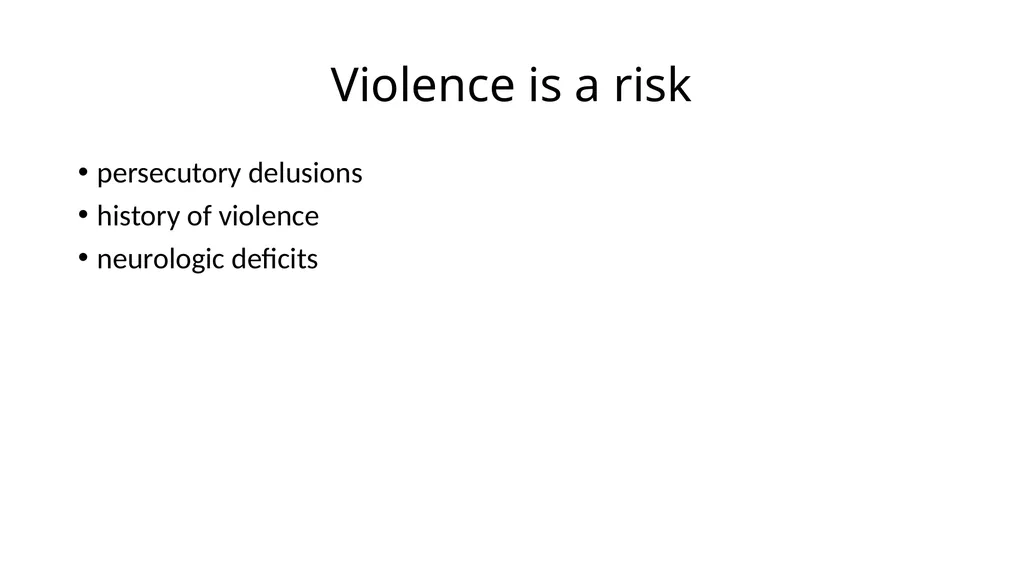
Violence is a risk persecutory delusions
history of violence
neurologic deficits<br>
history of violence
neurologic deficits<br>
19
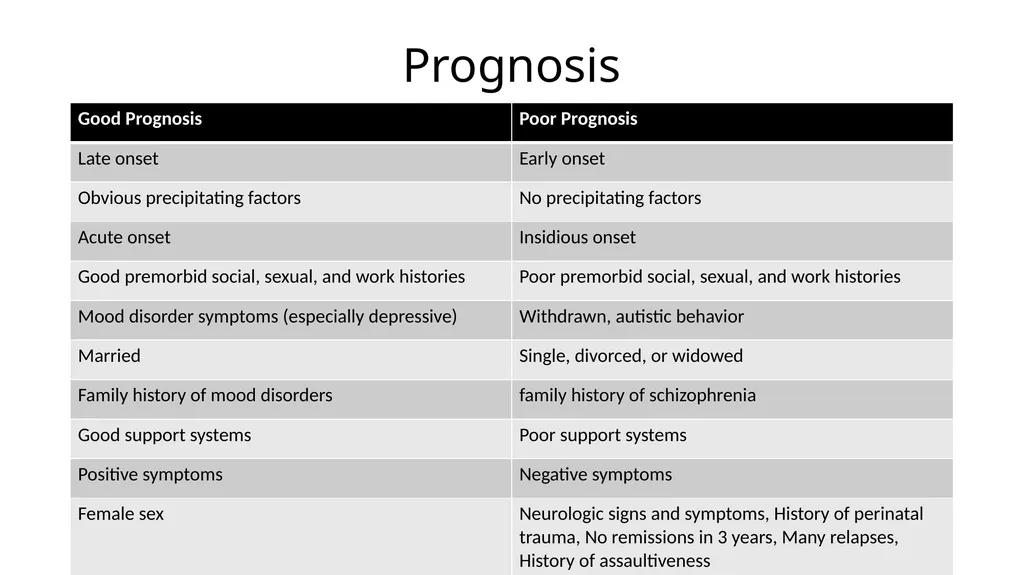
Prognosis<br>
20
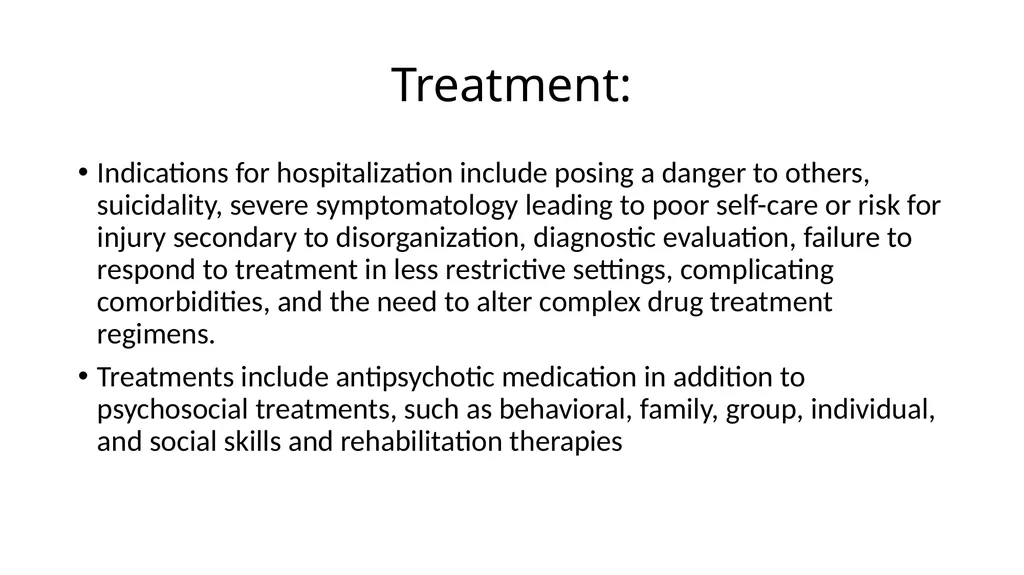
Treatment: Indications for hospitalization include posing a danger to others, suicidality, severe symptomatology leading to poor self-care or risk for injury secondary to disorganization, diagnostic evaluation, failure to respond to treatment in less restrictive settings, complicating comorbidities, and the need to alter complex drug treatment regimens.
Treatments include antipsychotic medication in addition to psychosocial treatments, such as behavioral, family, group, individual, and social skills and rehabilitation therapies<br>
Treatments include antipsychotic medication in addition to psychosocial treatments, such as behavioral, family, group, individual, and social skills and rehabilitation therapies<br>
21
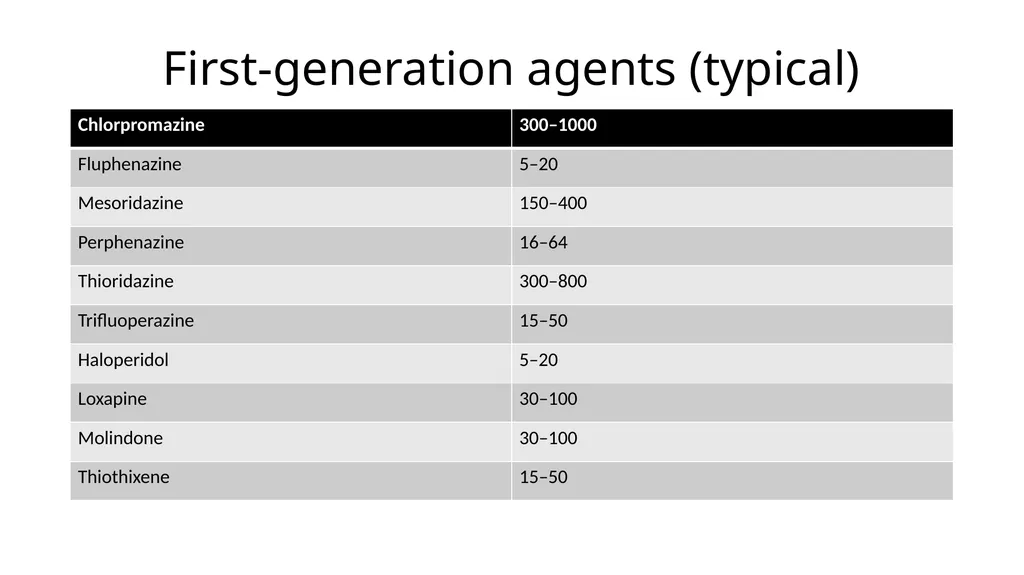
First-generation agents (typical)<br>
22
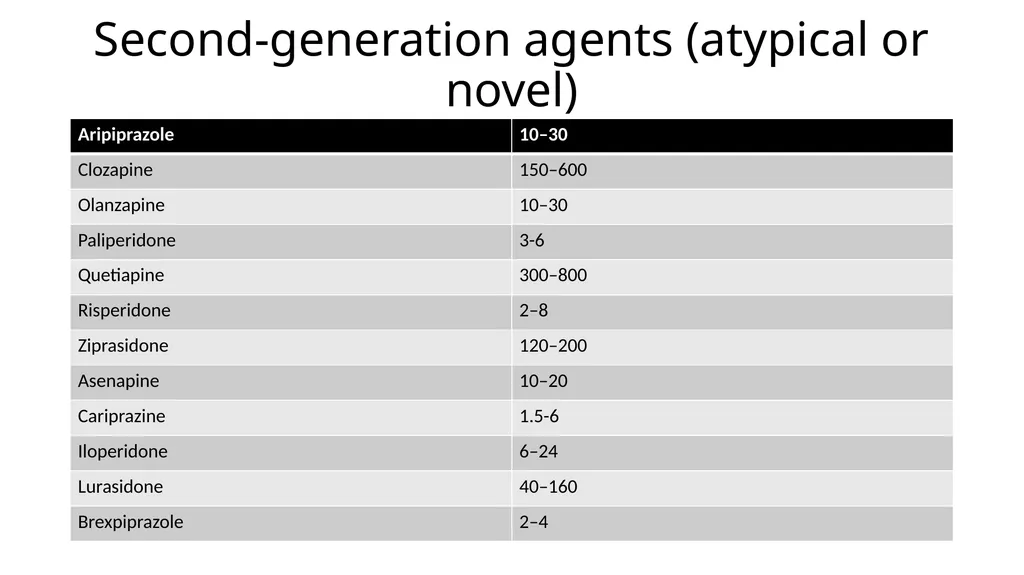
Second-generation agents (atypical or novel)<br>
23
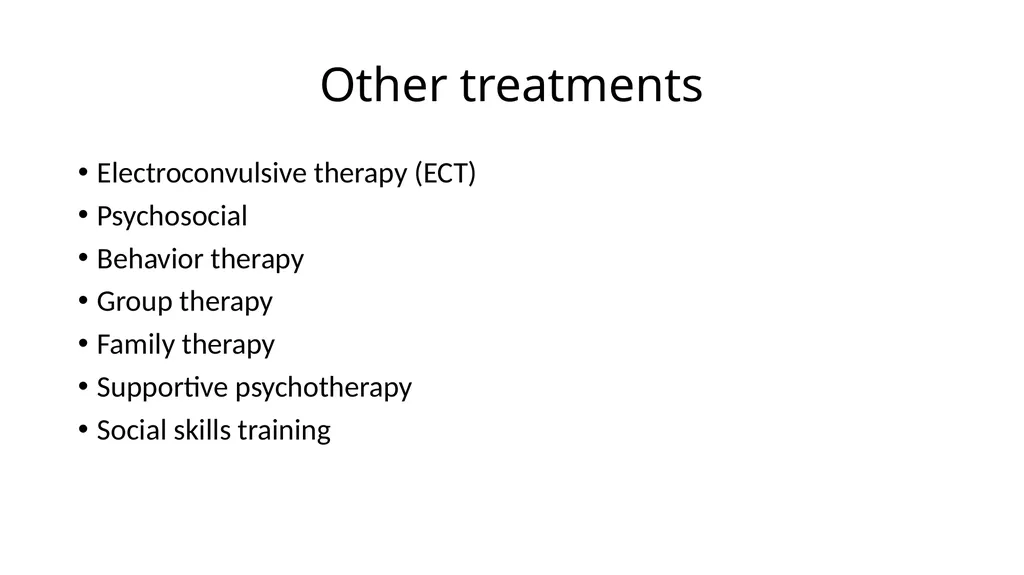
Other treatments Electroconvulsive therapy (ECT)
Psychosocial
Behavior therapy
Group therapy
Family therapy
Supportive psychotherapy
Social skills training<br>
Psychosocial
Behavior therapy
Group therapy
Family therapy
Supportive psychotherapy
Social skills training<br>
24
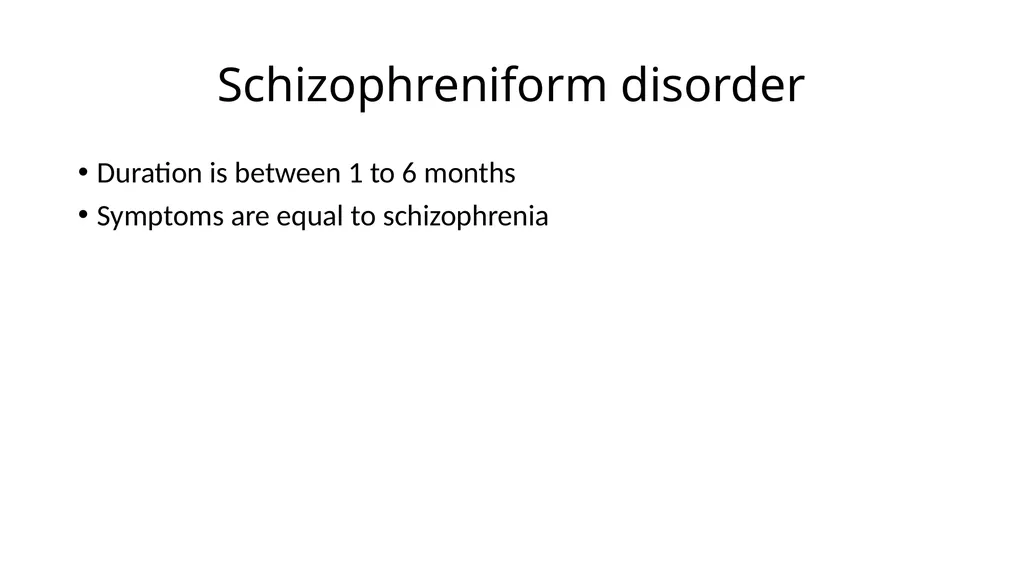
Schizophreniform disorder Duration is between 1 to 6 months
Symptoms are equal to schizophrenia<br>
Symptoms are equal to schizophrenia<br>
25
Brief (acute) psychotic disorder Duration is less than 1 month<br>
26
Delusional disorder These patients has only one delusion and are almost normal in other areas of life that are unrelated to the delusion<br>
27
Schizoaffective disorder Symptoms are a combination of schizophrenia and bipolar disorder
Patient has delusions for two weeks without mood symptoms<br>
Patient has delusions for two weeks without mood symptoms<br>