Scholarly Publishing in China: Overview and Opportunities Dr. Lifang Xu Publishing Science Department, School of Information Management, Wuhan University, China Boone Library School (1929) Mary Elizabeth Wood (August 22, 1861 May 1, 1931)
"Scholarly Publishing in China: Overview and" is the property of its rightful owner. Permission is granted to
download and print the materials on this website for personal, non-commercial use only, and to display it
on your personal computer provided you do not modify the materials and that you retain all copyright
notices contained in the materials. By downloading content from our website, you accept the terms of this
agreement.
Presentation Transcript
01
Scholarly Publishing in China: Overview and Opportunities Dr. Lifang Xu
Publishing Science Department, School of Information Management, Wuhan University, China<br>
02
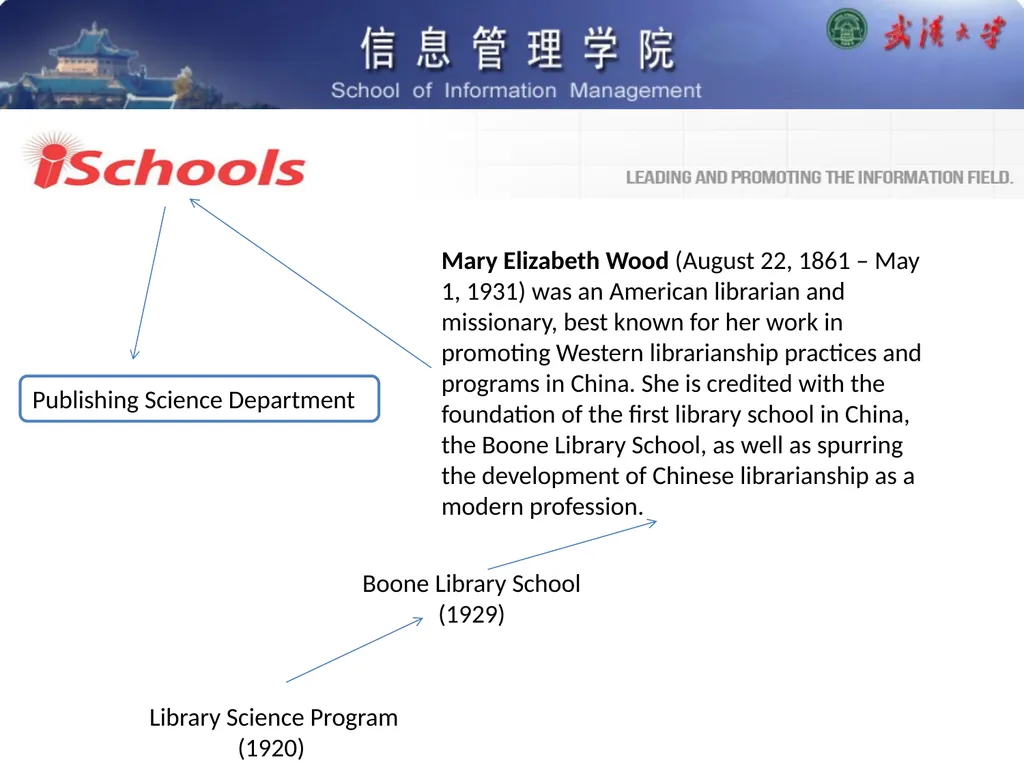
Boone Library School
(1929) Mary Elizabeth Wood (August 22, 1861 – May 1, 1931) was an American librarian and missionary, best known for her work in promoting Western librarianship practices and programs in China. She is credited with the foundation of the first library school in China, the Boone Library School, as well as spurring the development of Chinese librarianship as a modern profession. Library Science Program
(1920) Publishing Science Department<br>
03
R&D as a Background<br>
04
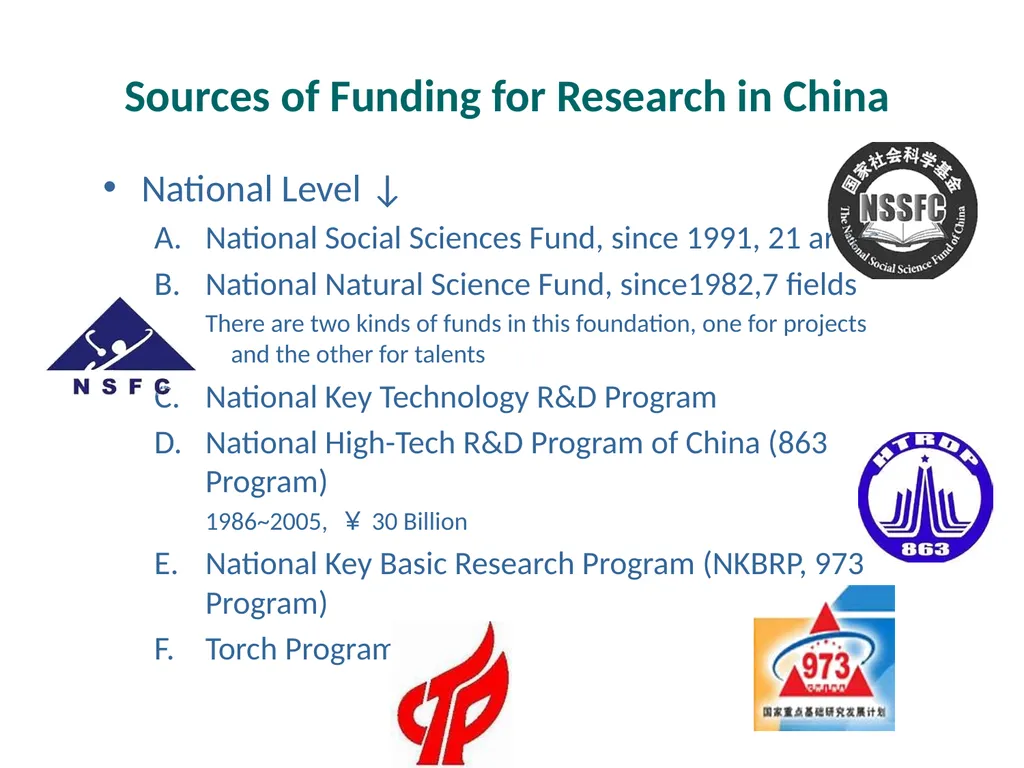
Sources of Funding for Research in China National Level ↓
National Social Sciences Fund, since 1991, 21 areas
National Natural Science Fund, since1982,7 fields
There are two kinds of funds in this foundation, one for projects and the other for talents
National Key Technology R&D Program
National High-Tech R&D Program of China (863 Program)
1986~2005, ¥30 Billion
National Key Basic Research Program (NKBRP, 973 Program)
Torch Program<br>
05
Ministerial Level ↓
Project of Chinese Ministry of Education
Project of Ministry of Agriculture
Project of Ministry of Health
……
Local Level ↓
Provincial projects
Municipal projects
University projects
……
Horizontal projects →
Enterprise projects
International coordination projects
……<br>
06
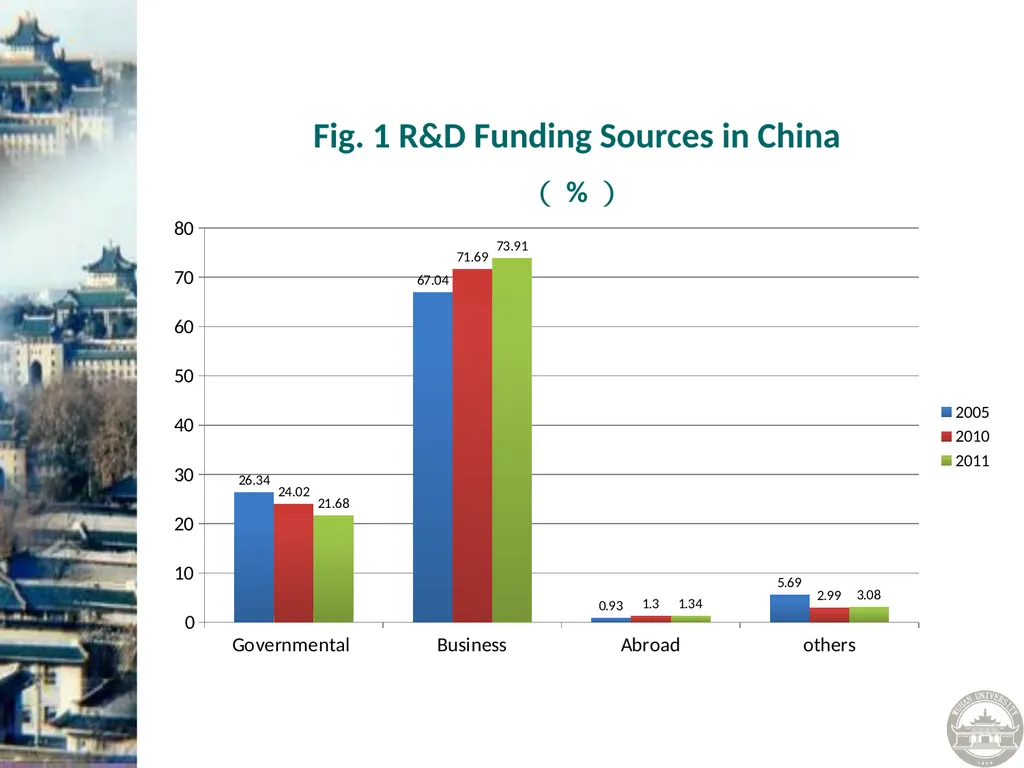
Fig. 1 R&D Funding Sources in China (%)<br>
07
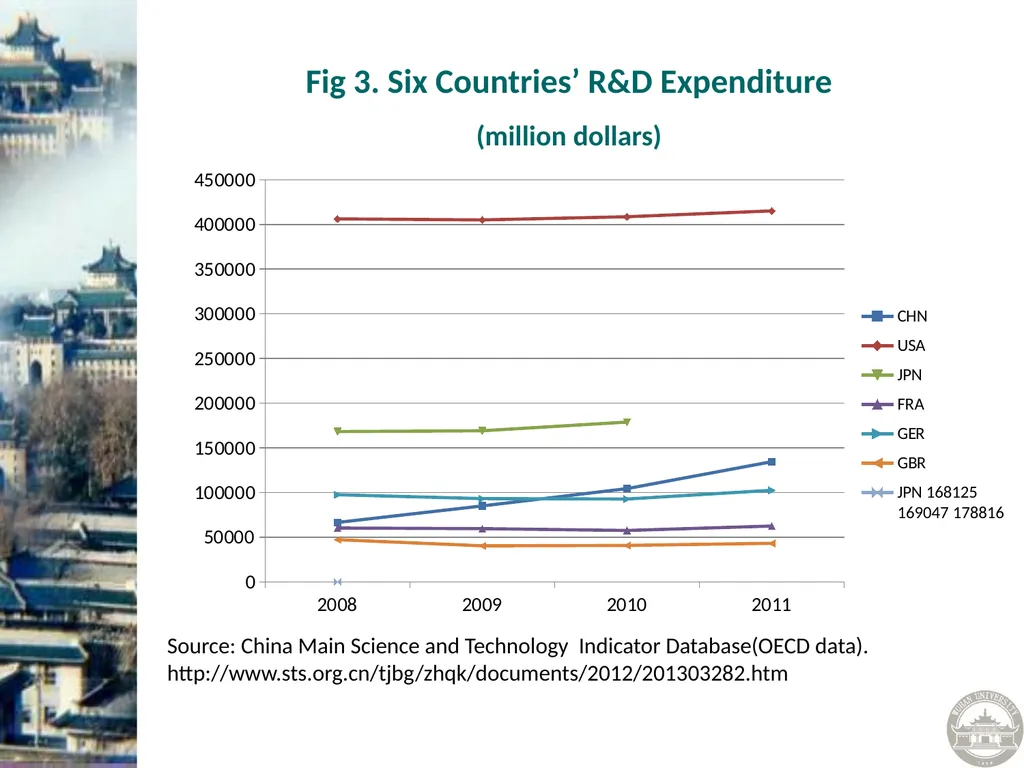
Fig 3. Six Countries’ R&D Expenditure (million dollars) Source: China Main Science and Technology Indicator Database(OECD data). http://www.sts.org.cn/tjbg/zhqk/documents/2012/201303282.htm<br>
08
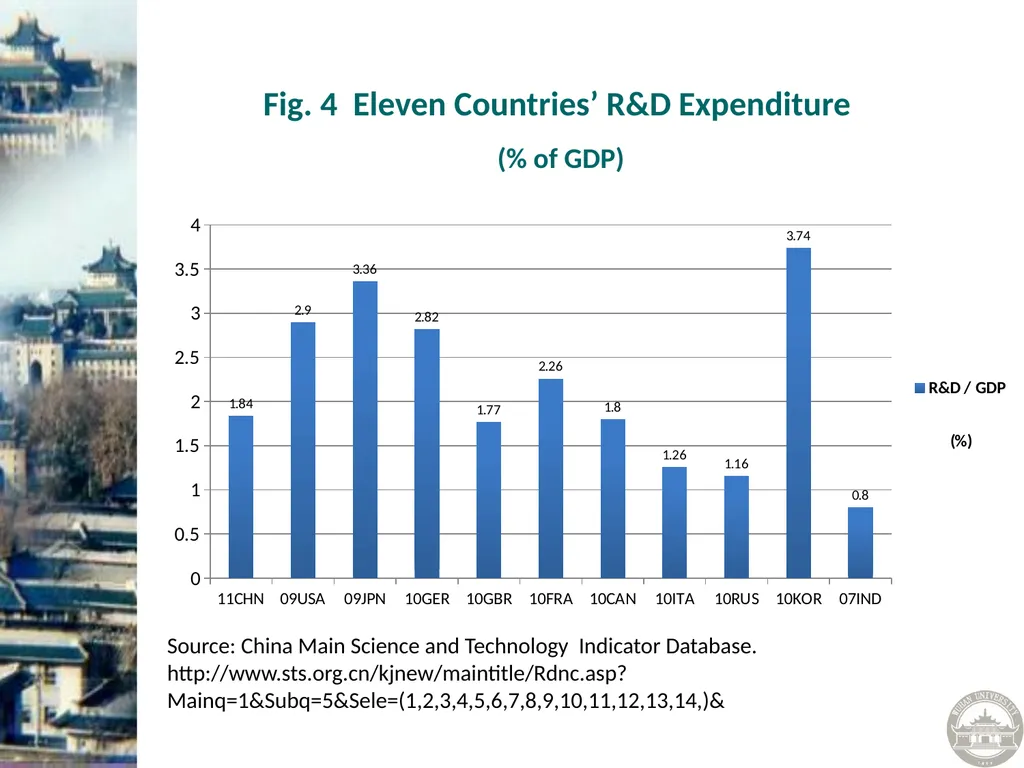
Fig. 4 Eleven Countries’ R&D Expenditure (% of GDP) Source: China Main Science and Technology Indicator Database. http://www.sts.org.cn/kjnew/maintitle/Rdnc.asp?Mainq=1&Subq=5&Sele=(1,2,3,4,5,6,7,8,9,10,11,12,13,14,)&<br>
09
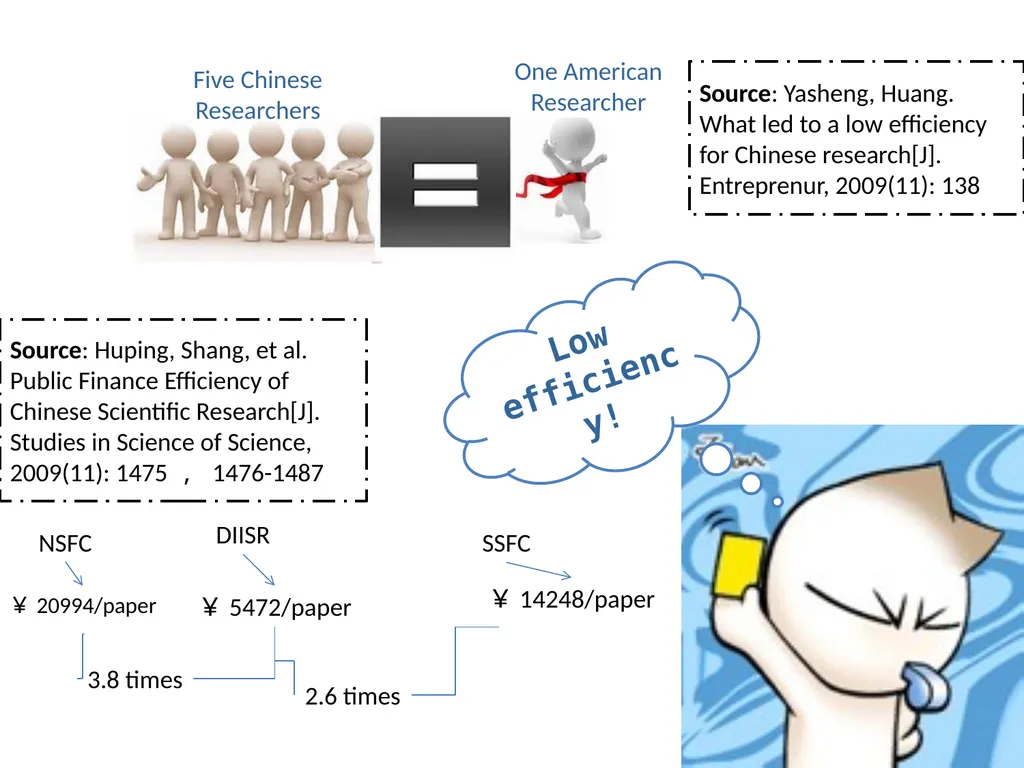
Low efficiency! Source: Yasheng, Huang. What led to a low efficiency for Chinese research[J]. Entreprenur, 2009(11): 138 Source: Huping, Shang, et al. Public Finance Efficiency of Chinese Scientific Research[J]. Studies in Science of Science, 2009(11): 1475, 1476-1487<br>
10
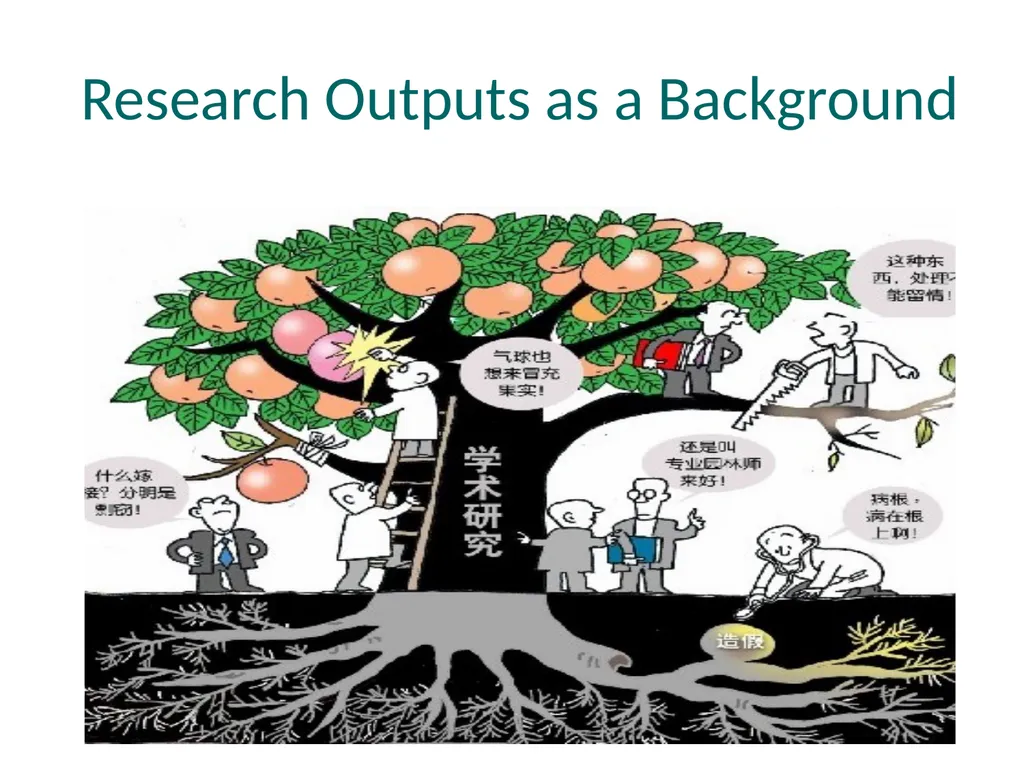
Research Outputs as a Background<br>
11
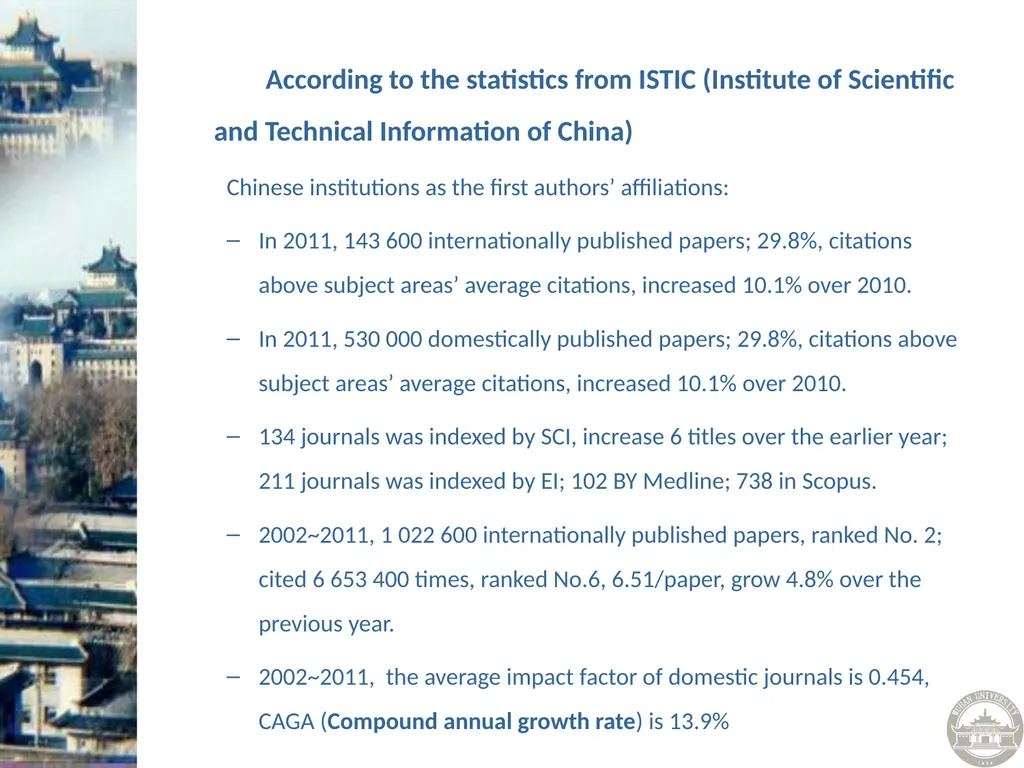
According to the statistics from ISTIC (Institute of Scientific and Technical Information of China)
Chinese institutions as the first authors’ affiliations:
In 2011, 143 600 internationally published papers; 29.8%, citations above subject areas’ average citations, increased 10.1% over 2010.
In 2011, 530 000 domestically published papers; 29.8%, citations above subject areas’ average citations, increased 10.1% over 2010.
134 journals was indexed by SCI, increase 6 titles over the earlier year; 211 journals was indexed by EI; 102 BY Medline; 738 in Scopus.
2002~2011, 1 022 600 internationally published papers, ranked No. 2; cited 6 653 400 times, ranked No.6, 6.51/paper, grow 4.8% over the previous year.
2002~2011, the average impact factor of domestic journals is 0.454, CAGA (Compound annual growth rate) is 13.9%<br>
12
Chinese Scholarly Publishing Overview: some features Chinese STM journal publishers are usually very small. There are no such thing like “800-pound gorilla” in the arena. 10,000 titles of books/ year
300 STM Journals<br>
13
Chinese publishing houses paid more attention to books/monographs.
Societies/ associations, universities/ colleges, government agencies, non-for-profit, esp. before 2012
From the economic perspective, Chinese STM Journal publishing is insignificant. Another three features<br>
14
Very low STM journal prices in China
Few publishers could control the market and raise the subscription fees.
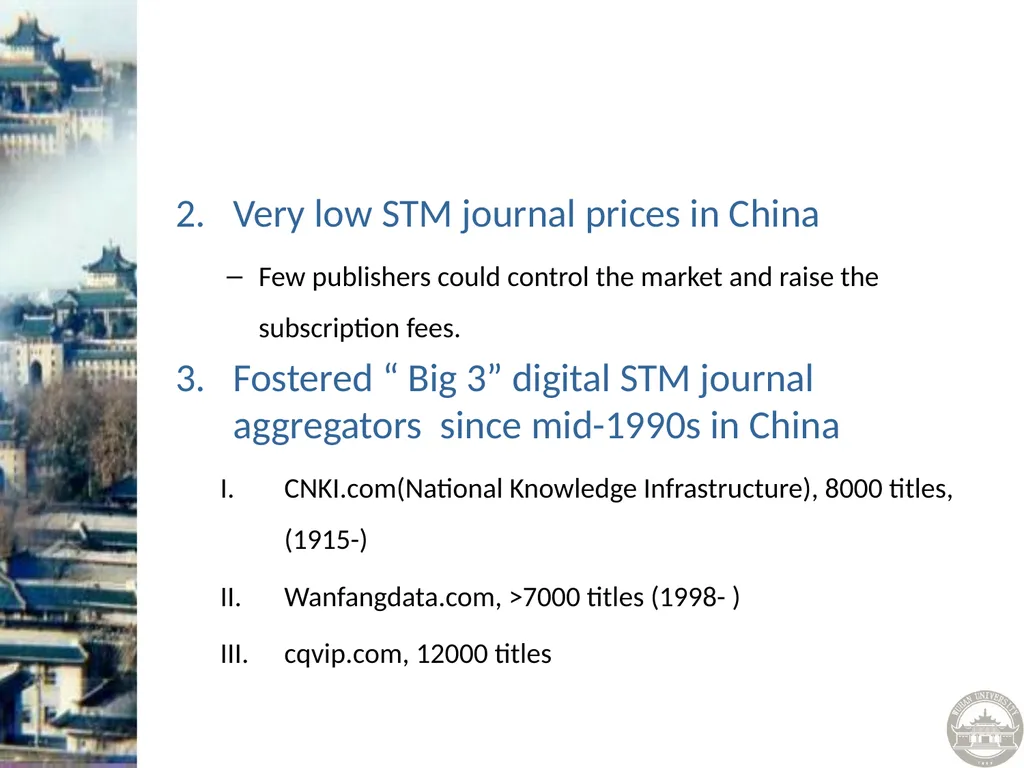
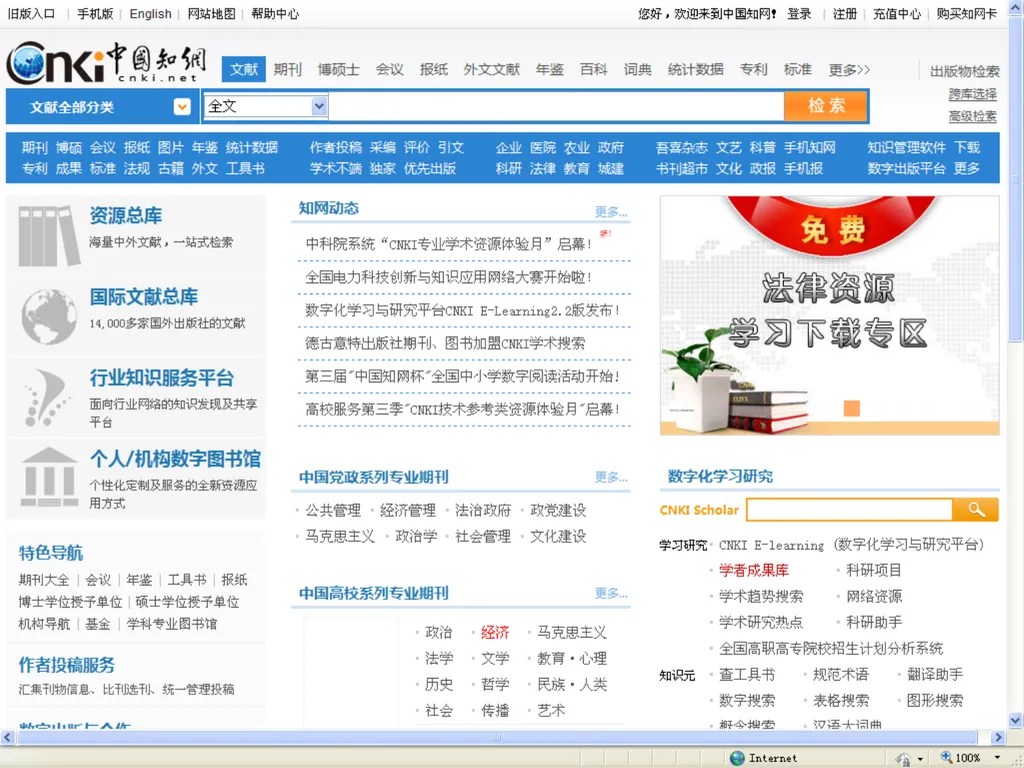
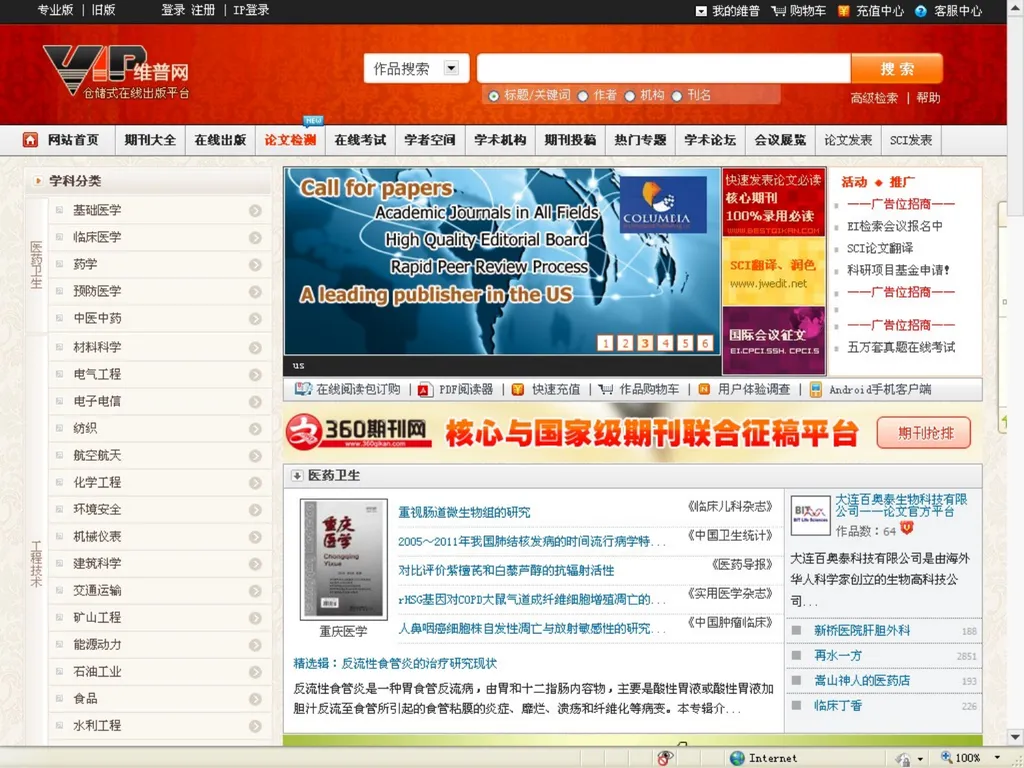
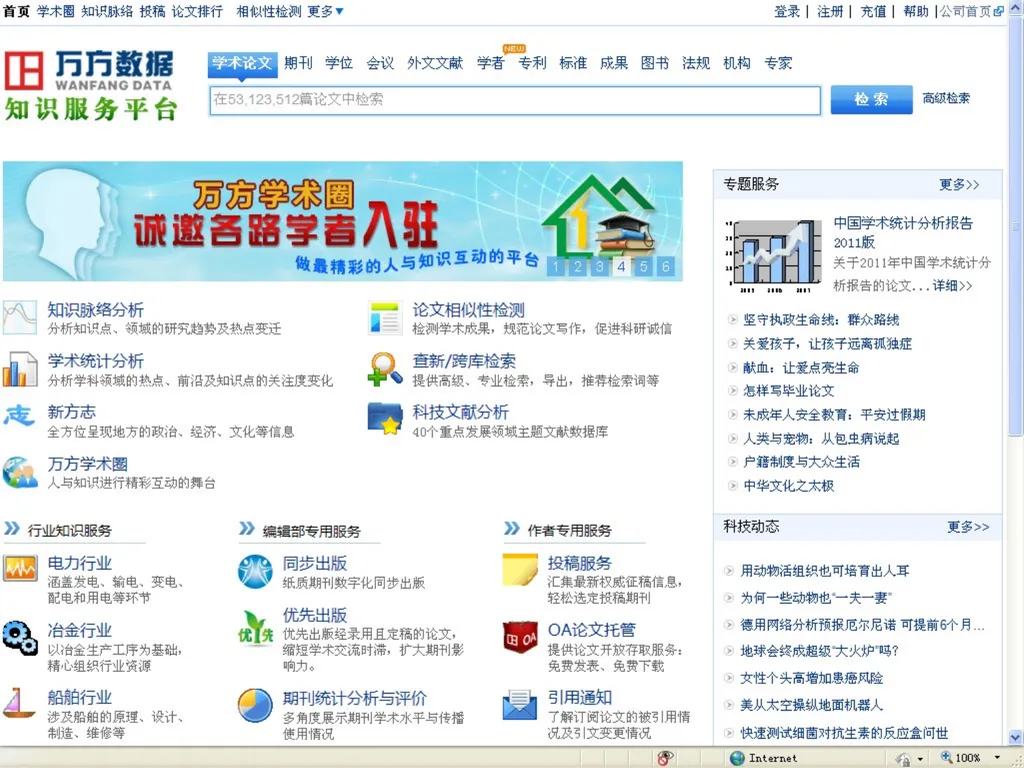
Fostered “ Big 3” digital STM journal aggregators since mid-1990s in China
CNKI.com(National Knowledge Infrastructure), 8000 titles, (1915-)
Wanfangdata.com, >7000 titles (1998- )
cqvip.com, 12000 titles<br>
15
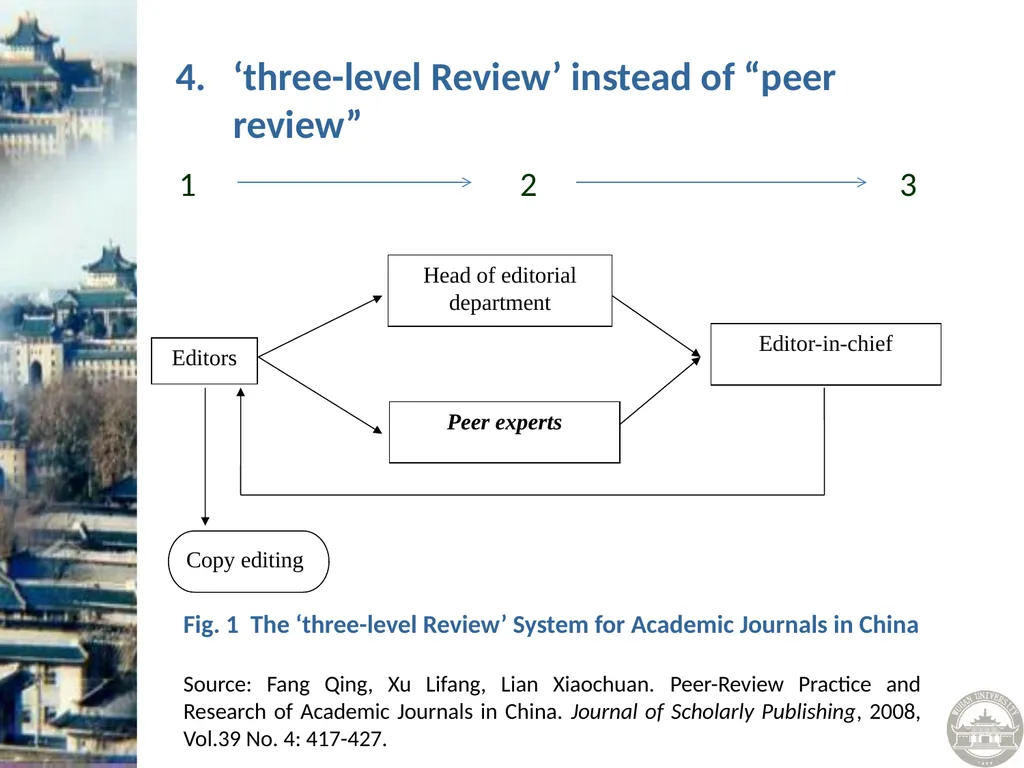
1 2 3 Fig. 1 The ‘three-level Review’ System for Academic Journals in China
Source: Fang Qing, Xu Lifang, Lian Xiaochuan. Peer-Review Practice and Research of Academic Journals in China. Journal of Scholarly Publishing, 2008, Vol.39 No. 4: 417-427. ‘three-level Review’ instead of “peer review”<br>
16
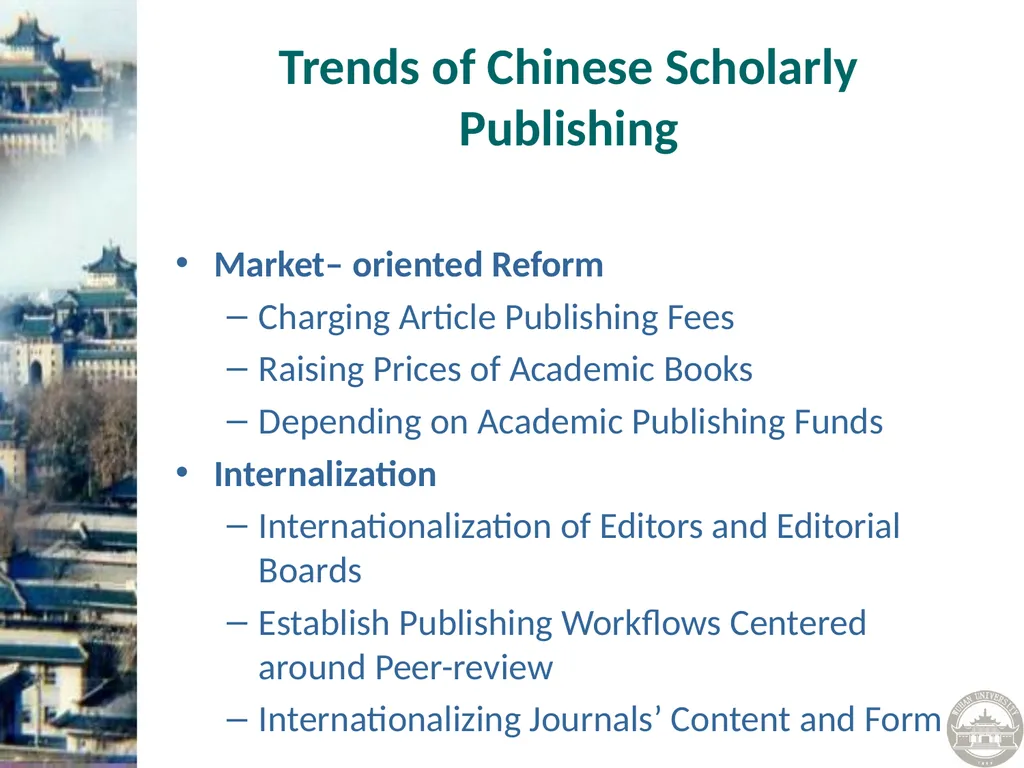
Trends of Chinese Scholarly Publishing Market– oriented Reform
Charging Article Publishing Fees
Raising Prices of Academic Books
Depending on Academic Publishing Funds
Internalization
Internationalization of Editors and Editorial Boards
Establish Publishing Workflows Centered around Peer-review
Internationalizing Journals’ Content and Form<br>