School Finance Basics Presented for the Alaska Association of School Boards by Amy Lujan, Executive Director Alaska Association of School Business Officials (ALASBO) December 7, 2018 About ALASBO Our mission: To promote the highest
"School Finance Basics Presented for the Alaska" is the property of its rightful owner. Permission is granted to
download and print the materials on this website for personal, non-commercial use only, and to display it
on your personal computer provided you do not modify the materials and that you retain all copyright
notices contained in the materials. By downloading content from our website, you accept the terms of this
agreement.
Presentation Transcript
01
School Finance Basics Presented for the Alaska Association of School Boards by
Amy Lujan, Executive Director
Alaska Association of School Business Officials (ALASBO)
December 7, 2018<br>
02
About ALASBO Our mission: To promote the highest standards in school business practices
180 members from K-12 business offices
46th Annual Conference held December 1-5, 2018 in Anchorage
Training and networking all year
Affiliate of ASBO International and associate of the AK Council of School Administrators (ACSA)
www.alasbo.org<br>
03
About Amy Lujan Twenty-three+ years in school business
Six years as business manager of Kuspuk School District, an REAA in western Alaska
One year with North Slope Borough SD
Seven years as business manager of Nome Public Schools, a municipal district
10 years as ALASBO Exec Director - alasbo@gci.net<br>
04
Presentation Outline Critical school finance functions
Interaction with your district business office
State funding basics
Other funding sources
Expenditures
Budgeting basics
Audit
Questions?<br>
05
Critical School Finance/Business Office Functions Policy Manual Section 3000 - Business & Non-Instructional Operations
Budgeting
Income (revenue)
Expenditures (purchasing, including contracts)
Management of assets (inventory, audits)
Policy Manual Section 4000 - Personnel
Compensation and benefits (payroll!)<br>
06
Additional Business Office Functions Policy Manual Section 3000 - Business & Non-Instructional Operations
Maintenance, risk management, pupil transportation, food service
Policy Manual Section 4000 - Personnel
Recruiting, conditions of employment, negotiations
Policy Manual Section 5000 - Students
Student records
Policy Manual Section 7000 - New Construction
Planning, funding<br>
07
Interaction with your District Business Office Review the organizational chart, as it relates to your policy manual
Request additional info through Superintendent
Request and review procedures manuals, negotiated agreements, chart of accounts
Note: Chart of Accounts revised in 2018 through collaboration between ALASBO and DEED; approved by State Board
Request additional sessions to review critical documents
Monthly financial reports
Budgets
Audit reports<br>
08
State Funding Basics It’s complicated! $$/student too simplistic
Variations in district and school types
Eligibility for Impact Aid federal funding
Politics
Last formula re-write in 2000; tweaks since
Joint Legislative Education Funding Task Force - implemented FY09-FY12
APA Funding Program Review - July 2015<br>
09
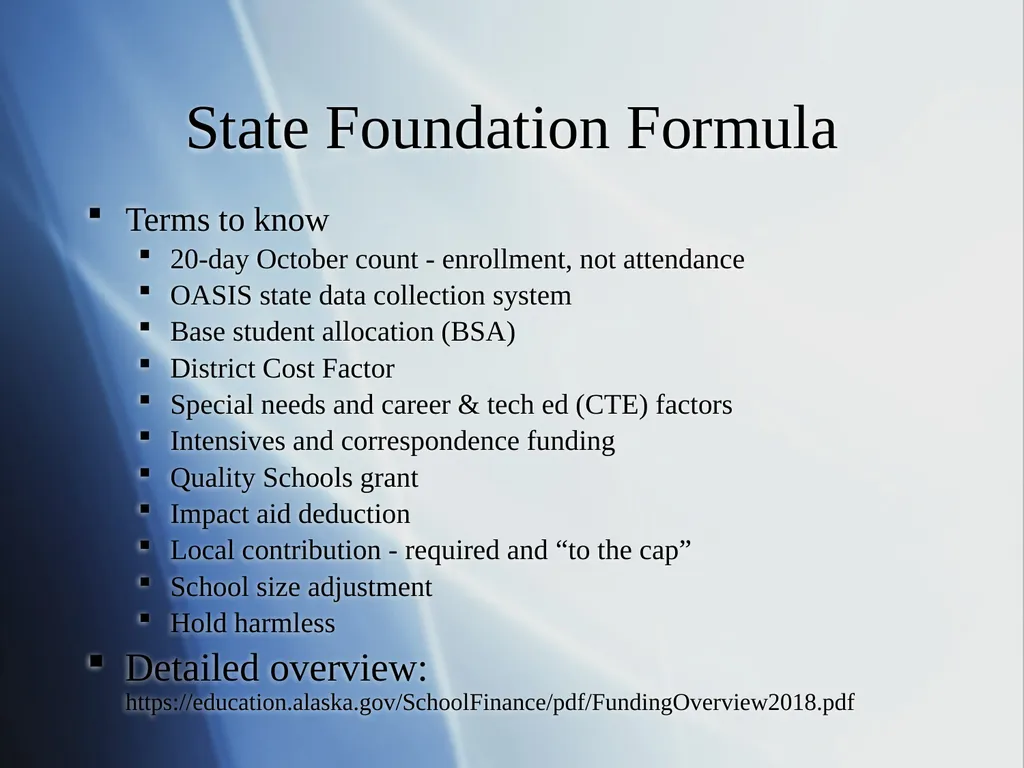
State Foundation Formula Terms to know
20-day October count - enrollment, not attendance
OASIS state data collection system
Base student allocation (BSA)
District Cost Factor
Special needs and career & tech ed (CTE) factors
Intensives and correspondence funding
Quality Schools grant
Impact aid deduction
Local contribution - required and “to the cap”
School size adjustment
Hold harmless
Detailed overview: https://education.alaska.gov/SchoolFinance/pdf/FundingOverview2018.pdf<br>
10
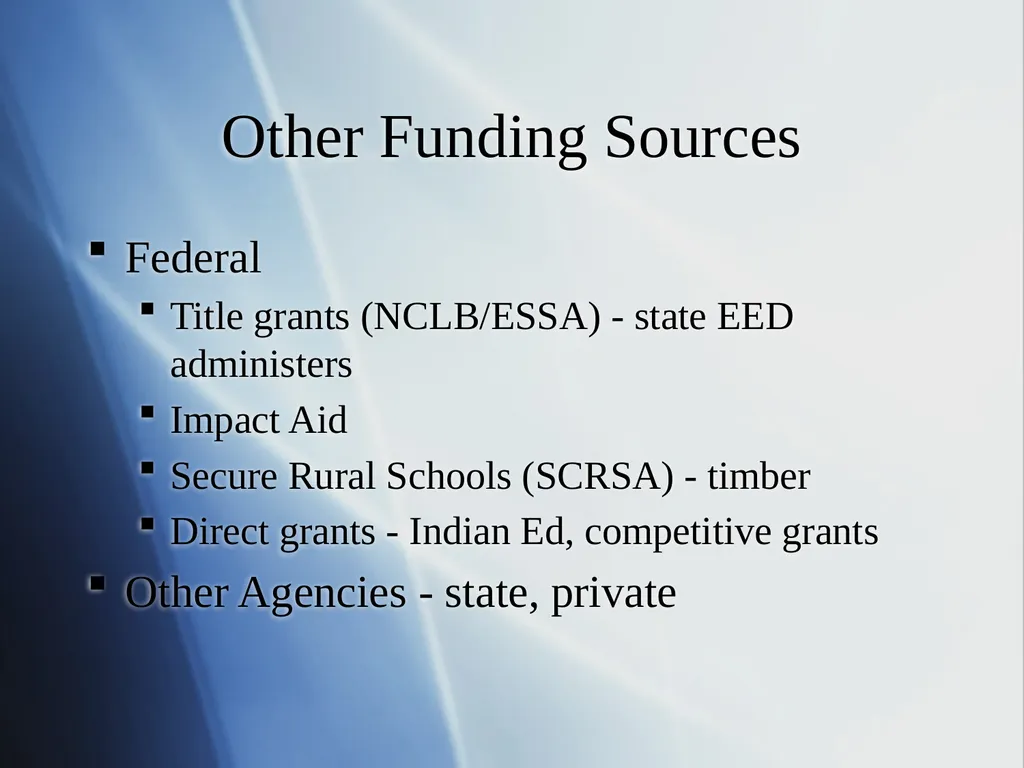
Other Funding Sources Federal
Title grants (NCLB/ESSA) - state EED administers
Impact Aid
Secure Rural Schools (SCRSA) - timber
Direct grants - Indian Ed, competitive grants
Other Agencies - state, private<br>
11
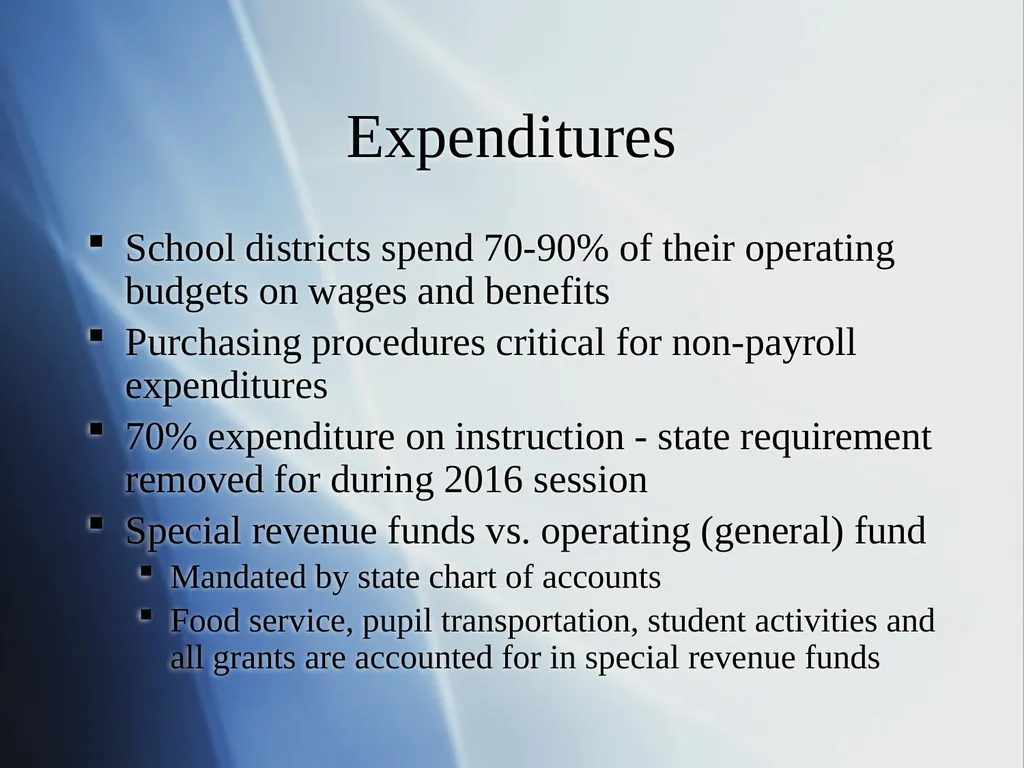
Expenditures School districts spend 70-90% of their operating budgets on wages and benefits
Purchasing procedures critical for non-payroll expenditures
70% expenditure on instruction - state requirement removed for during 2016 session
Special revenue funds vs. operating (general) fund
Mandated by state chart of accounts
Food service, pupil transportation, student activities and all grants are accounted for in special revenue funds<br>
12
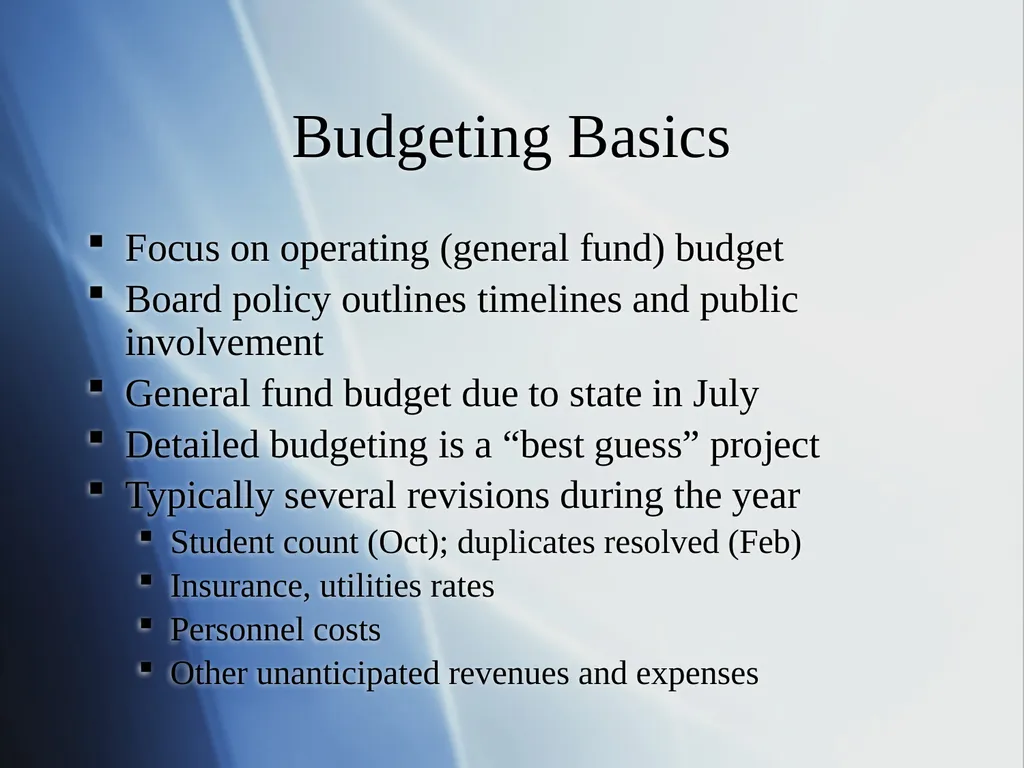
Budgeting Basics Focus on operating (general fund) budget
Board policy outlines timelines and public involvement
General fund budget due to state in July
Detailed budgeting is a “best guess” project
Typically several revisions during the year
Student count (Oct); duplicates resolved (Feb)
Insurance, utilities rates
Personnel costs
Other unanticipated revenues and expenses<br>
13
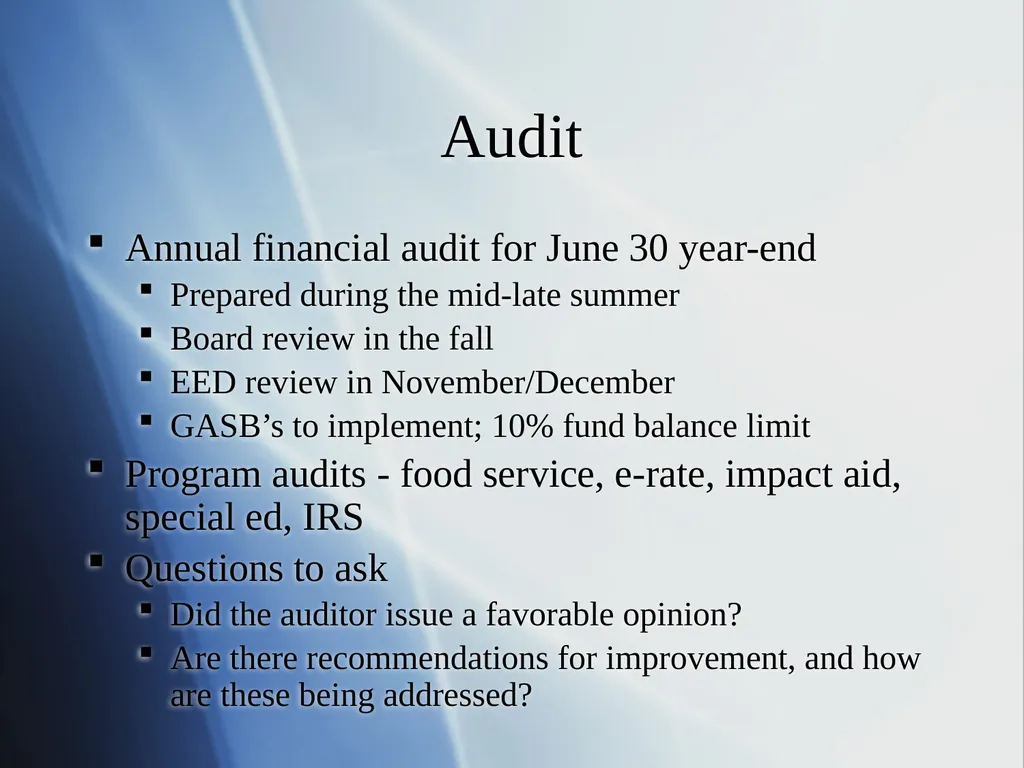
Audit Annual financial audit for June 30 year-end
Prepared during the mid-late summer
Board review in the fall
EED review in November/December
GASB’s to implement; 10% fund balance limit
Program audits - food service, e-rate, impact aid, special ed, IRS
Questions to ask
Did the auditor issue a favorable opinion?
Are there recommendations for improvement, and how are these being addressed?<br>