
School Finance Bruce Marchand, Ed.D. Presentation
FD
Published · 90 slides · 0 views

1 / 1








Description
School Finance Bruce Marchand, Ed.D. Presentation Topics How charter school funding is different than traditional ISDs; Funding sources in charter school systems; How attendance drives budget dollars; Determine why the TX school finance
Related Topics
Share
Embed code
Download this presentation From Below
"School Finance Bruce Marchand, Ed.D. Presentation" is the property of its rightful owner. Permission is granted to download and print the materials on this website for personal, non-commercial use only, and to display it on your personal computer provided you do not modify the materials and that you retain all copyright notices contained in the materials. By downloading content from our website, you accept the terms of this agreement.
Presentation Transcript
01
School Finance Bruce Marchand, Ed.D.<br>
02
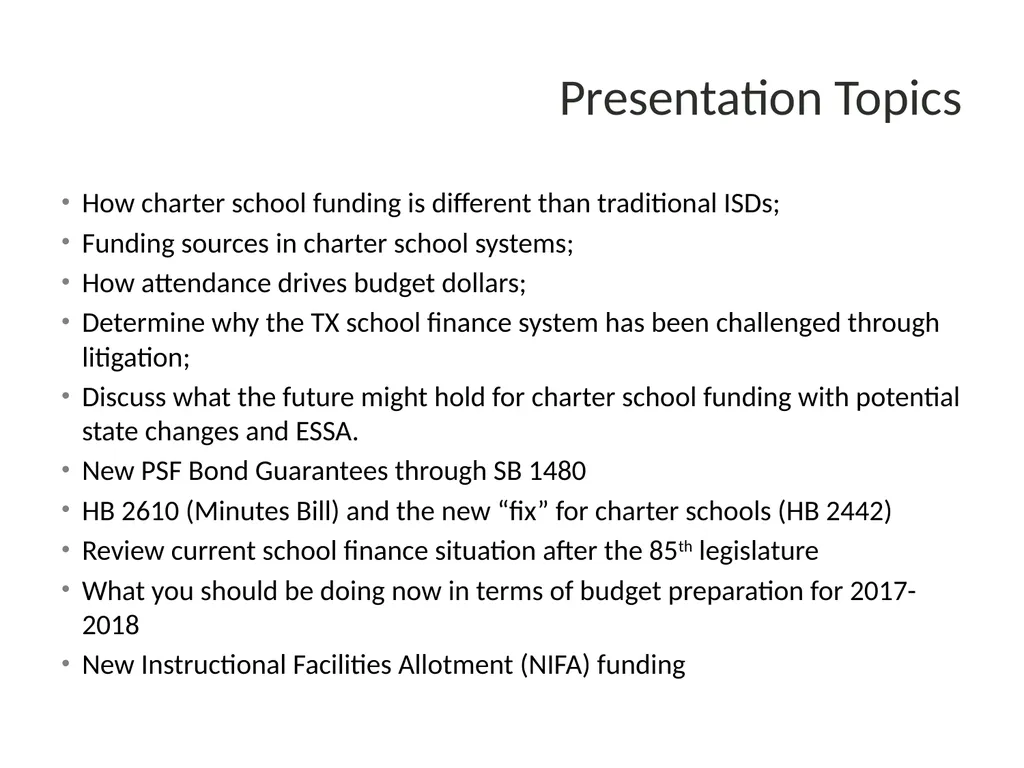
Presentation Topics How charter school funding is different than traditional ISDs;
Funding sources in charter school systems;
How attendance drives budget dollars;
Determine why the TX school finance system has been challenged through litigation;
Discuss what the future might hold for charter school funding with potential state changes and ESSA.
New PSF Bond Guarantees through SB 1480
HB 2610 (Minutes Bill) and the new “fix” for charter schools (HB 2442)
Review current school finance situation after the 85th legislature
What you should be doing now in terms of budget preparation for 2017-2018
New Instructional Facilities Allotment (NIFA) funding<br>
Funding sources in charter school systems;
How attendance drives budget dollars;
Determine why the TX school finance system has been challenged through litigation;
Discuss what the future might hold for charter school funding with potential state changes and ESSA.
New PSF Bond Guarantees through SB 1480
HB 2610 (Minutes Bill) and the new “fix” for charter schools (HB 2442)
Review current school finance situation after the 85th legislature
What you should be doing now in terms of budget preparation for 2017-2018
New Instructional Facilities Allotment (NIFA) funding<br>
03
List the funding sources used in your system’s budget<br>
04
Which funding sources did you list?
State Foundation School Program
Federal Entitlements
Grants
Private Foundations and Gifts<br>
State Foundation School Program
Federal Entitlements
Grants
Private Foundations and Gifts<br>
05
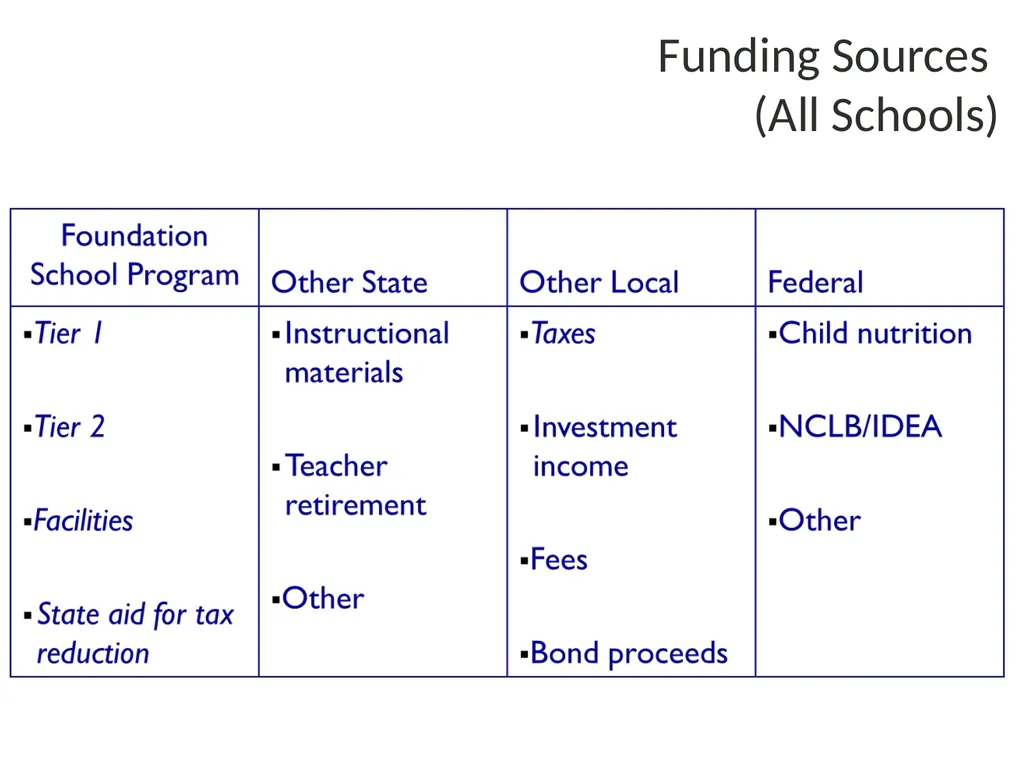
Funding Sources
(All Schools)<br>
06
Funding Sources
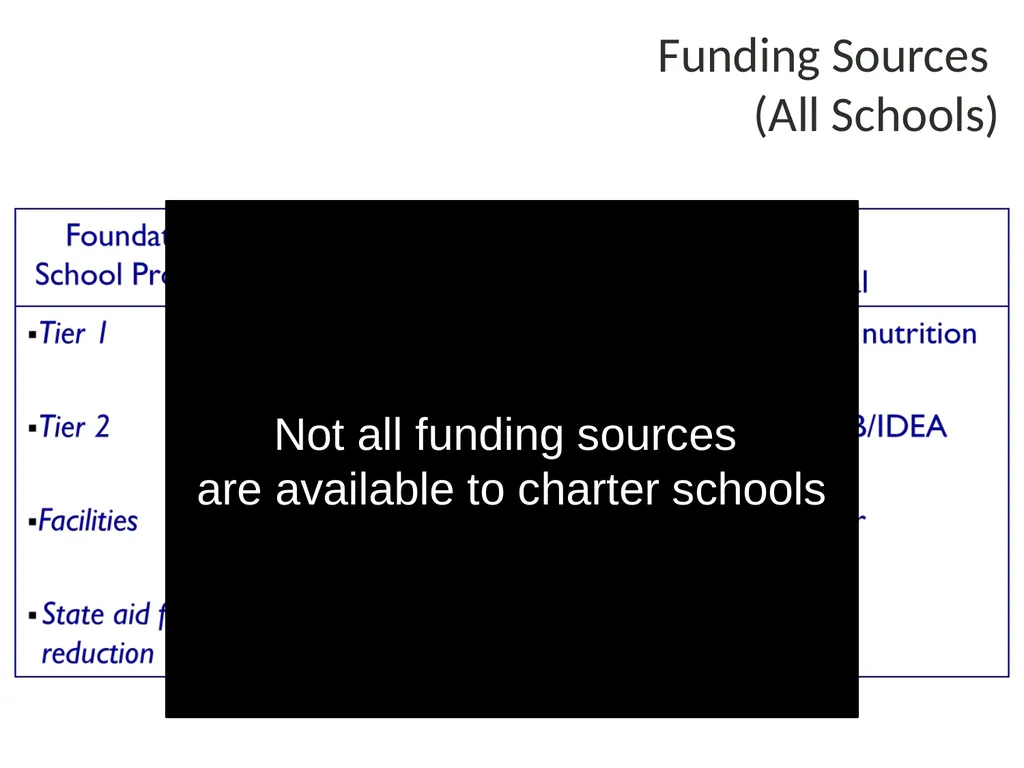
(All Schools) Not all funding sources
are available to charter schools<br>
are available to charter schools<br>
07
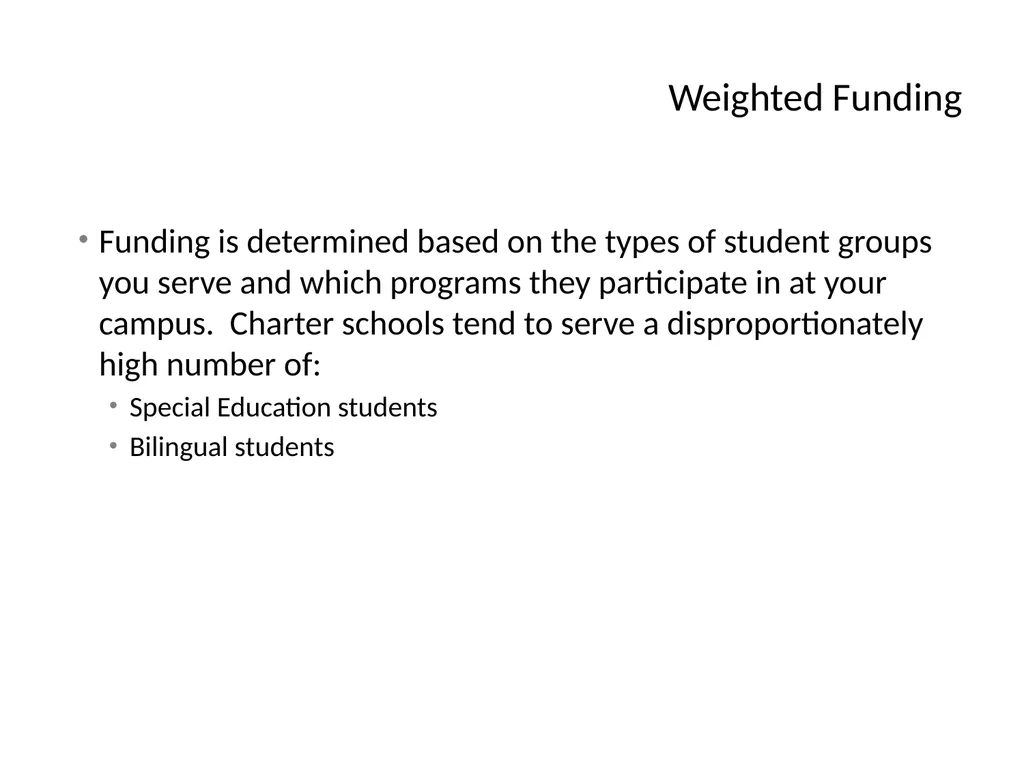
Weighted Funding Funding is determined based on the types of student groups you serve and which programs they participate in at your campus. Charter schools tend to serve a disproportionately high number of:
Special Education students
Bilingual students<br>
Special Education students
Bilingual students<br>
08
Weighted Funding Foundation School Program funding provides a base amount of funding for each student and an additional weight (percentage of the base amount) depending on the program(s) the student participates in.<br>
09
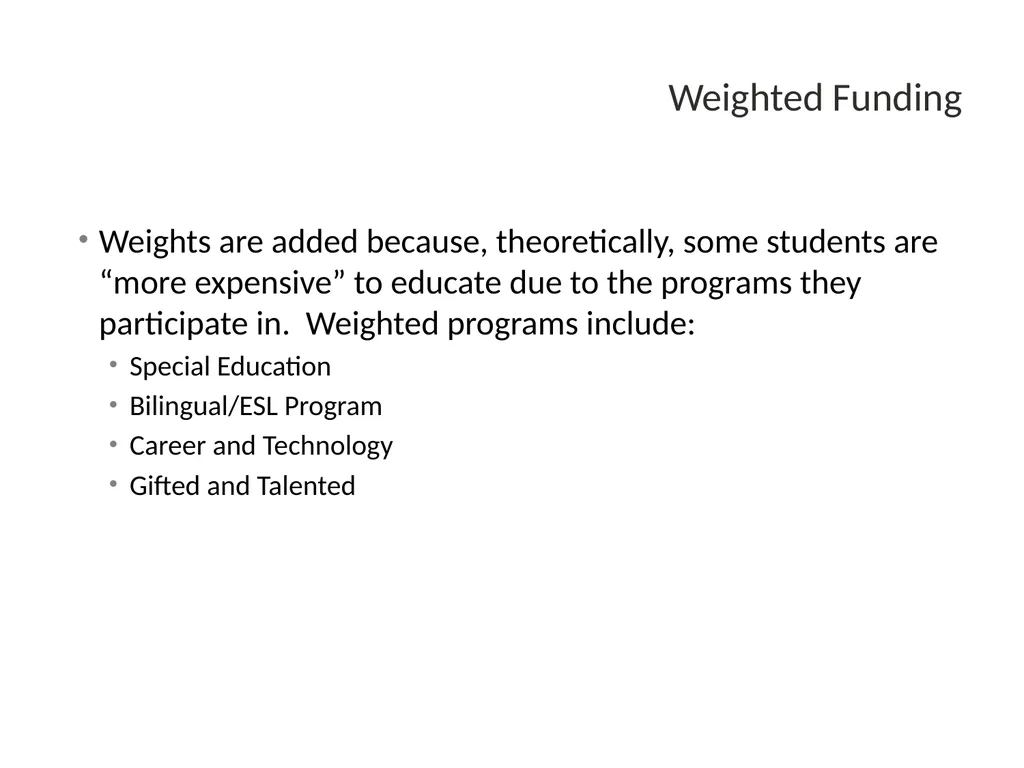
Weighted Funding Weights are added because, theoretically, some students are “more expensive” to educate due to the programs they participate in. Weighted programs include:
Special Education
Bilingual/ESL Program
Career and Technology
Gifted and Talented<br>
Special Education
Bilingual/ESL Program
Career and Technology
Gifted and Talented<br>
10
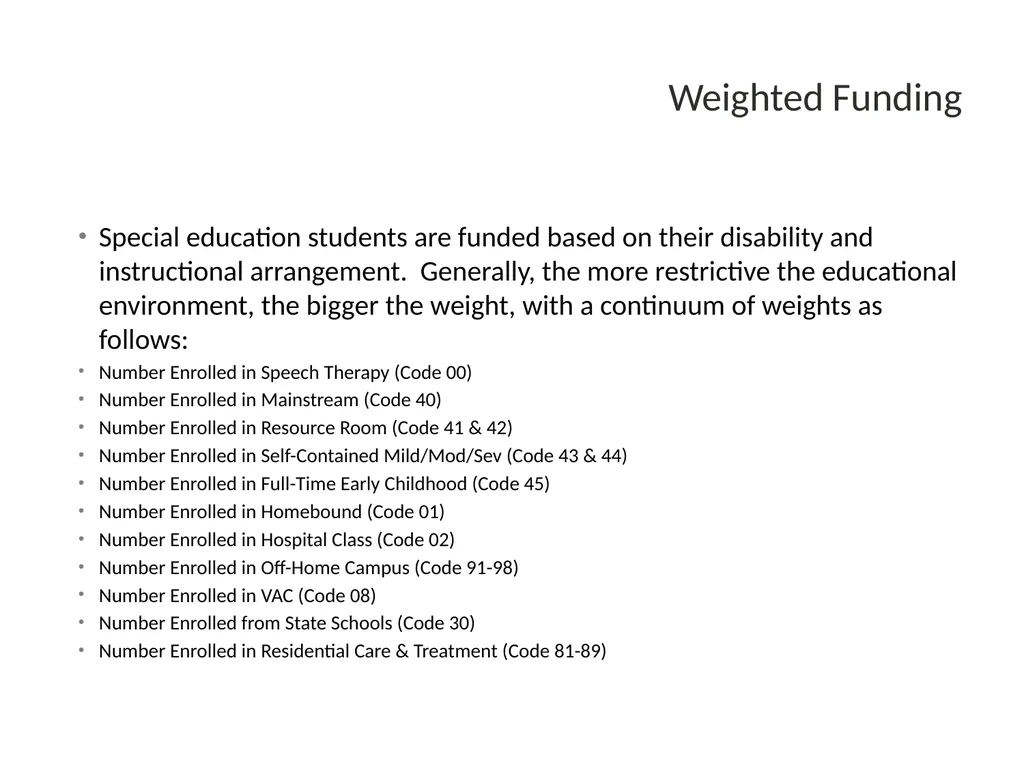
Weighted Funding Special education students are funded based on their disability and instructional arrangement. Generally, the more restrictive the educational environment, the bigger the weight, with a continuum of weights as follows:
Number Enrolled in Speech Therapy (Code 00)
Number Enrolled in Mainstream (Code 40)
Number Enrolled in Resource Room (Code 41 & 42)
Number Enrolled in Self-Contained Mild/Mod/Sev (Code 43 & 44)
Number Enrolled in Full-Time Early Childhood (Code 45)
Number Enrolled in Homebound (Code 01)
Number Enrolled in Hospital Class (Code 02)
Number Enrolled in Off-Home Campus (Code 91-98)
Number Enrolled in VAC (Code 08)
Number Enrolled from State Schools (Code 30)
Number Enrolled in Residential Care & Treatment (Code 81-89)<br>
Number Enrolled in Speech Therapy (Code 00)
Number Enrolled in Mainstream (Code 40)
Number Enrolled in Resource Room (Code 41 & 42)
Number Enrolled in Self-Contained Mild/Mod/Sev (Code 43 & 44)
Number Enrolled in Full-Time Early Childhood (Code 45)
Number Enrolled in Homebound (Code 01)
Number Enrolled in Hospital Class (Code 02)
Number Enrolled in Off-Home Campus (Code 91-98)
Number Enrolled in VAC (Code 08)
Number Enrolled from State Schools (Code 30)
Number Enrolled in Residential Care & Treatment (Code 81-89)<br>
11
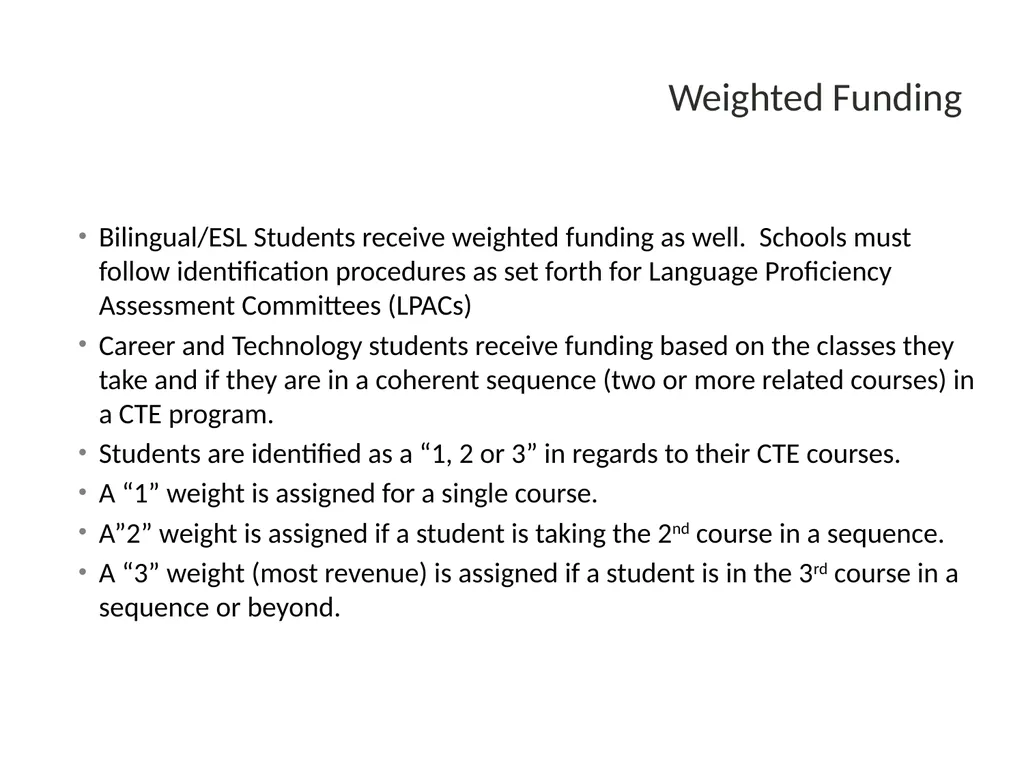
Weighted Funding Bilingual/ESL Students receive weighted funding as well. Schools must follow identification procedures as set forth for Language Proficiency Assessment Committees (LPACs)
Career and Technology students receive funding based on the classes they take and if they are in a coherent sequence (two or more related courses) in a CTE program.
Students are identified as a “1, 2 or 3” in regards to their CTE courses.
A “1” weight is assigned for a single course.
A”2” weight is assigned if a student is taking the 2nd course in a sequence.
A “3” weight (most revenue) is assigned if a student is in the 3rd course in a sequence or beyond.<br>
Career and Technology students receive funding based on the classes they take and if they are in a coherent sequence (two or more related courses) in a CTE program.
Students are identified as a “1, 2 or 3” in regards to their CTE courses.
A “1” weight is assigned for a single course.
A”2” weight is assigned if a student is taking the 2nd course in a sequence.
A “3” weight (most revenue) is assigned if a student is in the 3rd course in a sequence or beyond.<br>
12
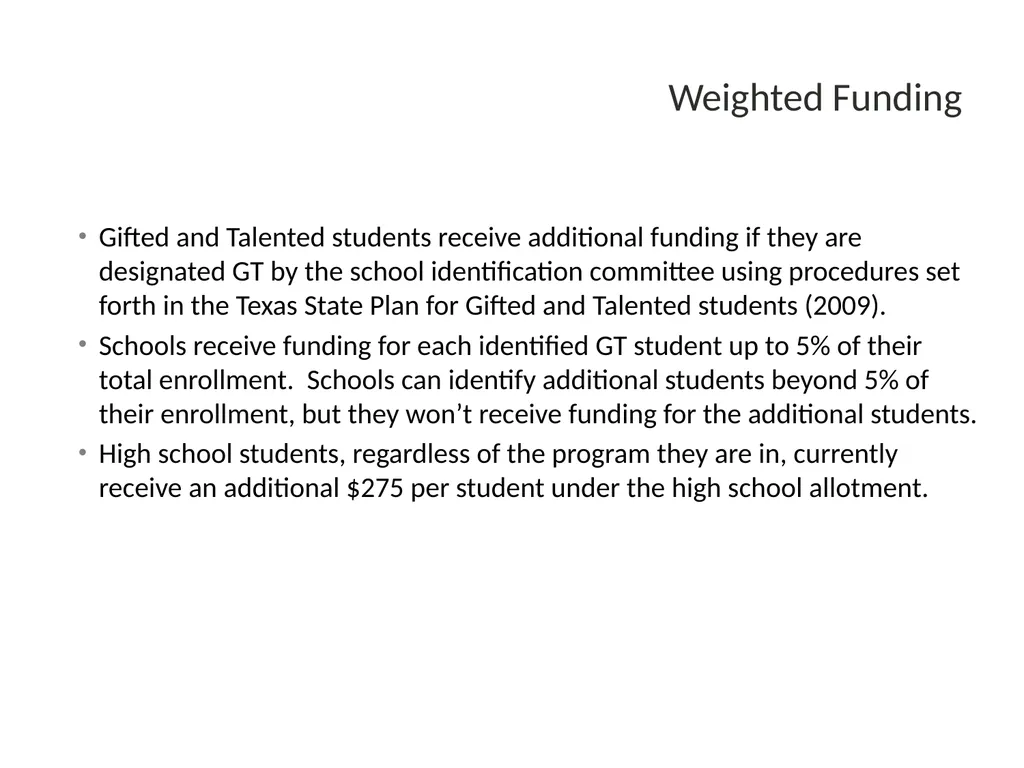
Weighted Funding Gifted and Talented students receive additional funding if they are designated GT by the school identification committee using procedures set forth in the Texas State Plan for Gifted and Talented students (2009).
Schools receive funding for each identified GT student up to 5% of their total enrollment. Schools can identify additional students beyond 5% of their enrollment, but they won’t receive funding for the additional students.
High school students, regardless of the program they are in, currently receive an additional $275 per student under the high school allotment.<br>
Schools receive funding for each identified GT student up to 5% of their total enrollment. Schools can identify additional students beyond 5% of their enrollment, but they won’t receive funding for the additional students.
High school students, regardless of the program they are in, currently receive an additional $275 per student under the high school allotment.<br>
13
Group Activity:
A look at weighted funding<br>
A look at weighted funding<br>
14
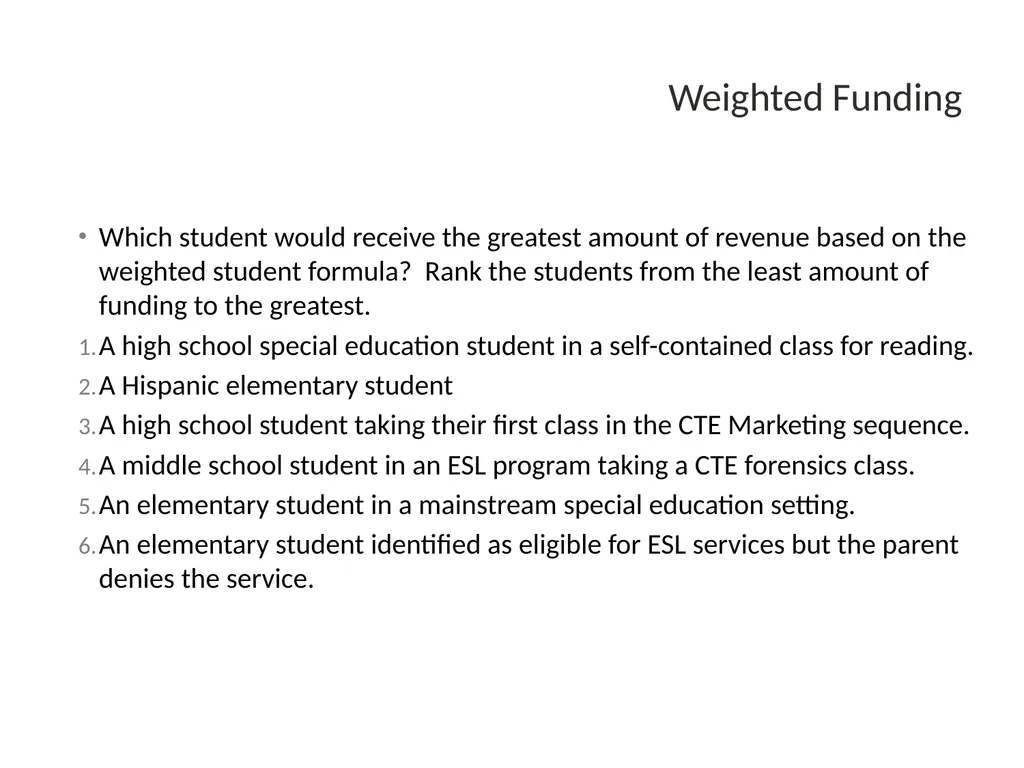
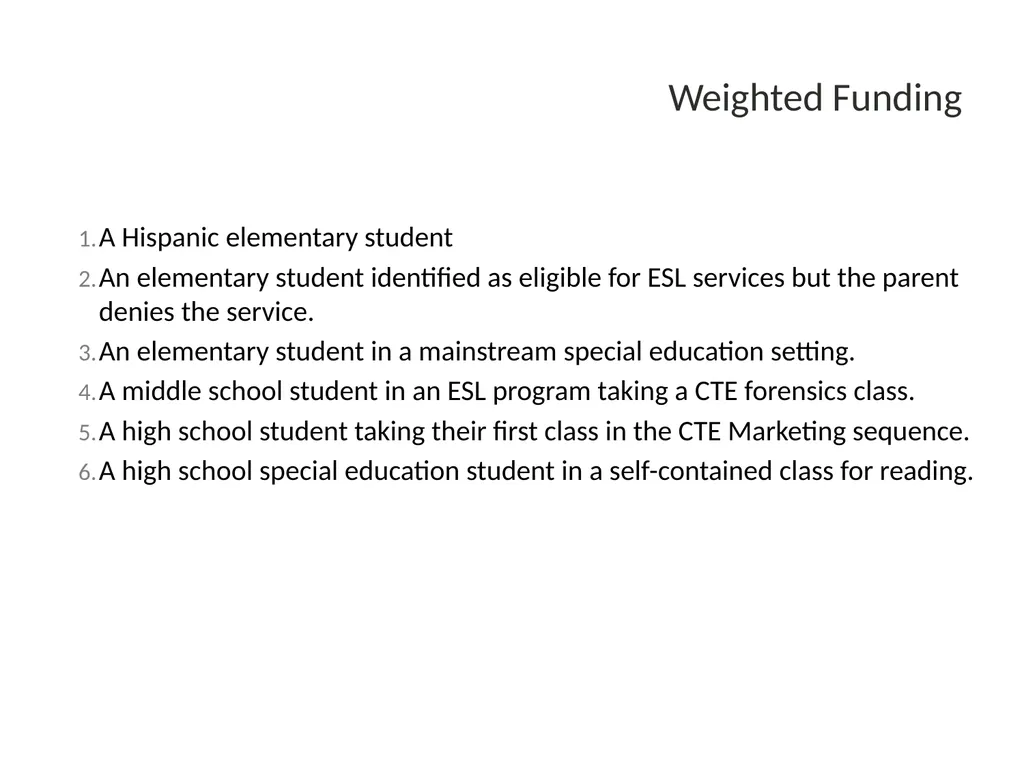
Weighted Funding Which student would receive the greatest amount of revenue based on the weighted student formula? Rank the students from the least amount of funding to the greatest.
A high school special education student in a self-contained class for reading.
A Hispanic elementary student
A high school student taking their first class in the CTE Marketing sequence.
A middle school student in an ESL program taking a CTE forensics class.
An elementary student in a mainstream special education setting.
An elementary student identified as eligible for ESL services but the parent denies the service.<br>
A high school special education student in a self-contained class for reading.
A Hispanic elementary student
A high school student taking their first class in the CTE Marketing sequence.
A middle school student in an ESL program taking a CTE forensics class.
An elementary student in a mainstream special education setting.
An elementary student identified as eligible for ESL services but the parent denies the service.<br>
15
Weighted Funding A Hispanic elementary student
An elementary student identified as eligible for ESL services but the parent denies the service.
An elementary student in a mainstream special education setting.
A middle school student in an ESL program taking a CTE forensics class.
A high school student taking their first class in the CTE Marketing sequence.
A high school special education student in a self-contained class for reading.<br>
An elementary student identified as eligible for ESL services but the parent denies the service.
An elementary student in a mainstream special education setting.
A middle school student in an ESL program taking a CTE forensics class.
A high school student taking their first class in the CTE Marketing sequence.
A high school special education student in a self-contained class for reading.<br>
16
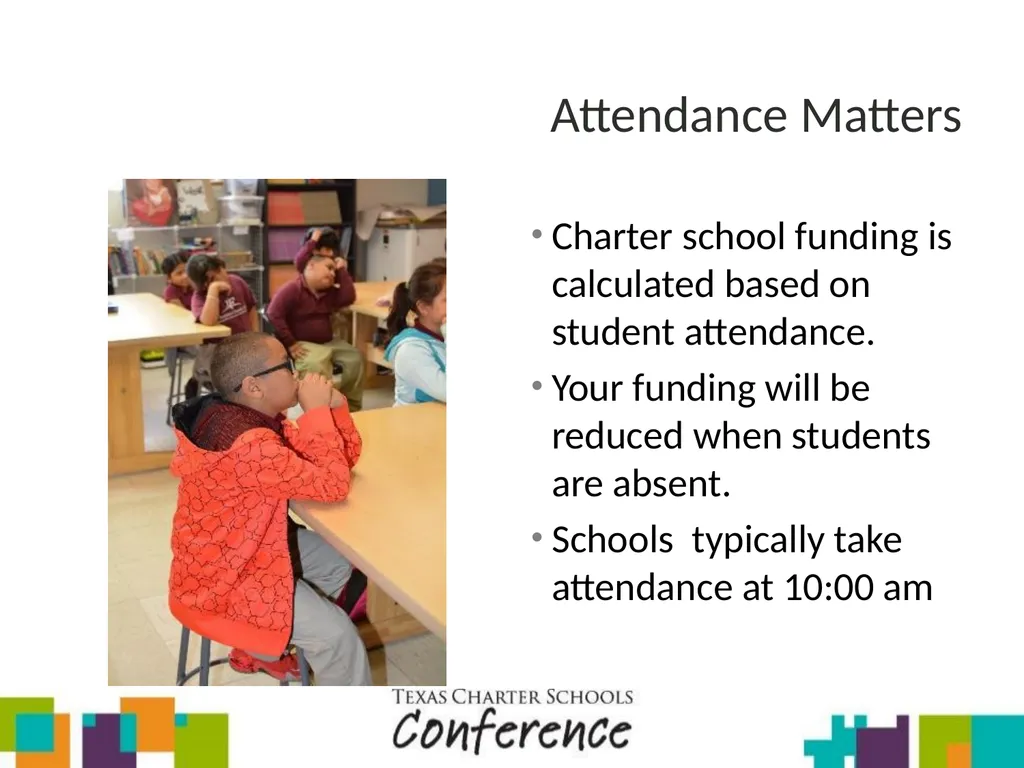
Attendance Matters Charter school funding is calculated based on student attendance.
Your funding will be reduced when students are absent.
Schools typically take attendance at 10:00 am<br>
Your funding will be reduced when students are absent.
Schools typically take attendance at 10:00 am<br>
17
Coding Matters The Public Education Information System (PEIMS) encompasses all data requested and received by TEA about public education, including student performance, personnel, financial, and organizational information.<br>
18
Data Collected in PEIMS Organizational
Budget
Actual financial
Staff
Student demographic Program participation
Leaver
Attendance
Course completion
Discipline<br>
Budget
Actual financial
Staff
Student demographic Program participation
Leaver
Attendance
Course completion
Discipline<br>
19
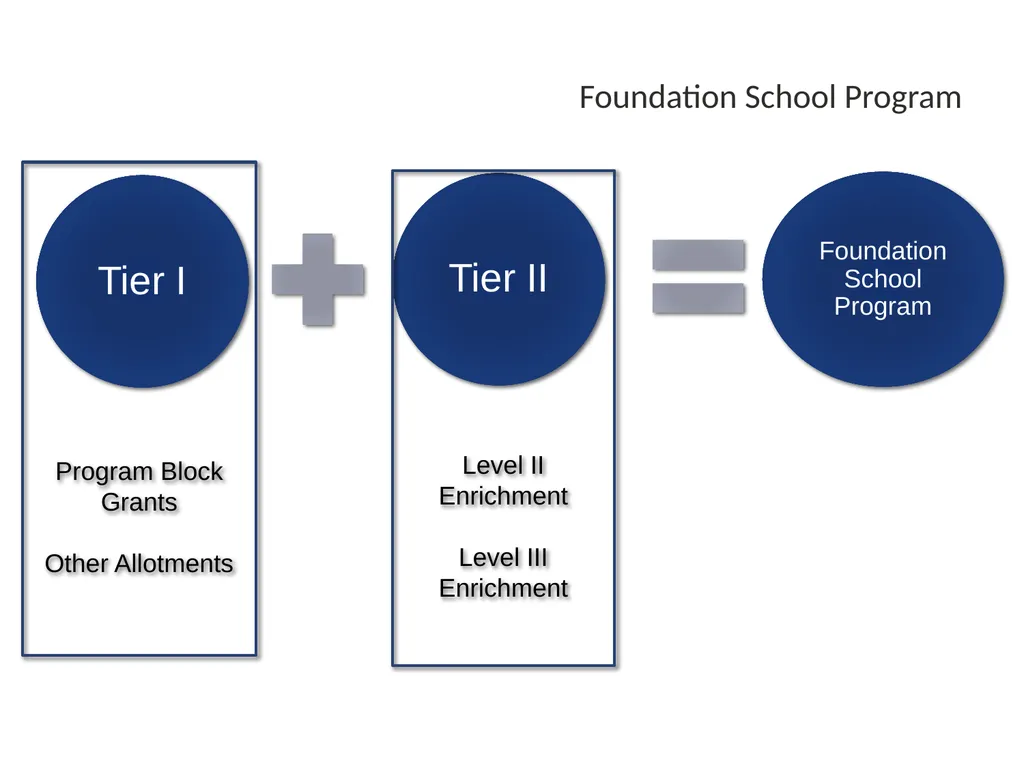
Foundation School Program Program Block Grants
Other Allotments Level II Enrichment
Level III Enrichment<br>
Other Allotments Level II Enrichment
Level III Enrichment<br>
20
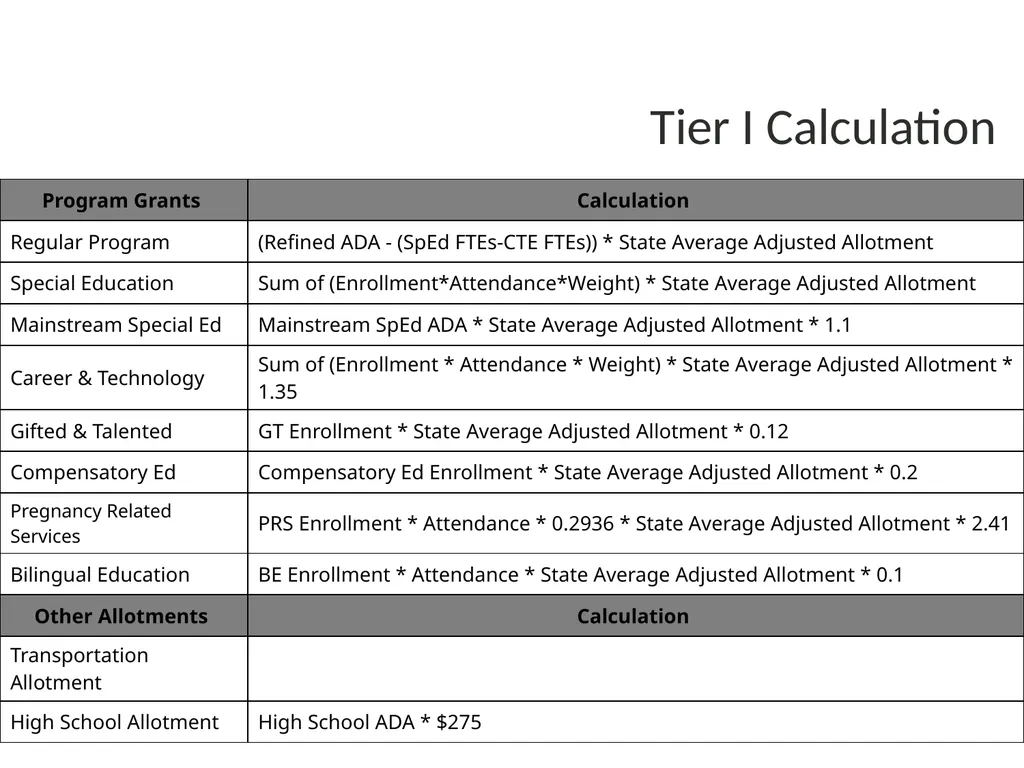
Tier I Calculation<br>
21
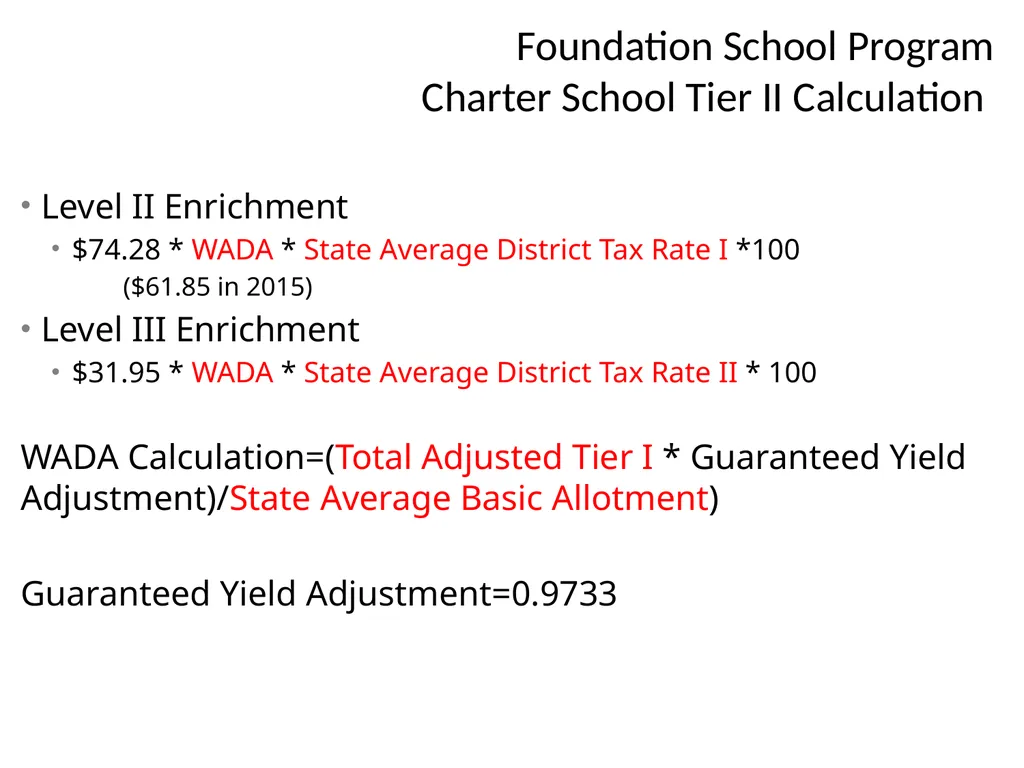
Level II Enrichment
$74.28 * WADA * State Average District Tax Rate I *100
($61.85 in 2015)
Level III Enrichment
$31.95 * WADA * State Average District Tax Rate II * 100
WADA Calculation=(Total Adjusted Tier I * Guaranteed Yield Adjustment)/State Average Basic Allotment)
Guaranteed Yield Adjustment=0.9733 Foundation School Program Charter School Tier II Calculation<br>
$74.28 * WADA * State Average District Tax Rate I *100
($61.85 in 2015)
Level III Enrichment
$31.95 * WADA * State Average District Tax Rate II * 100
WADA Calculation=(Total Adjusted Tier I * Guaranteed Yield Adjustment)/State Average Basic Allotment)
Guaranteed Yield Adjustment=0.9733 Foundation School Program Charter School Tier II Calculation<br>
22
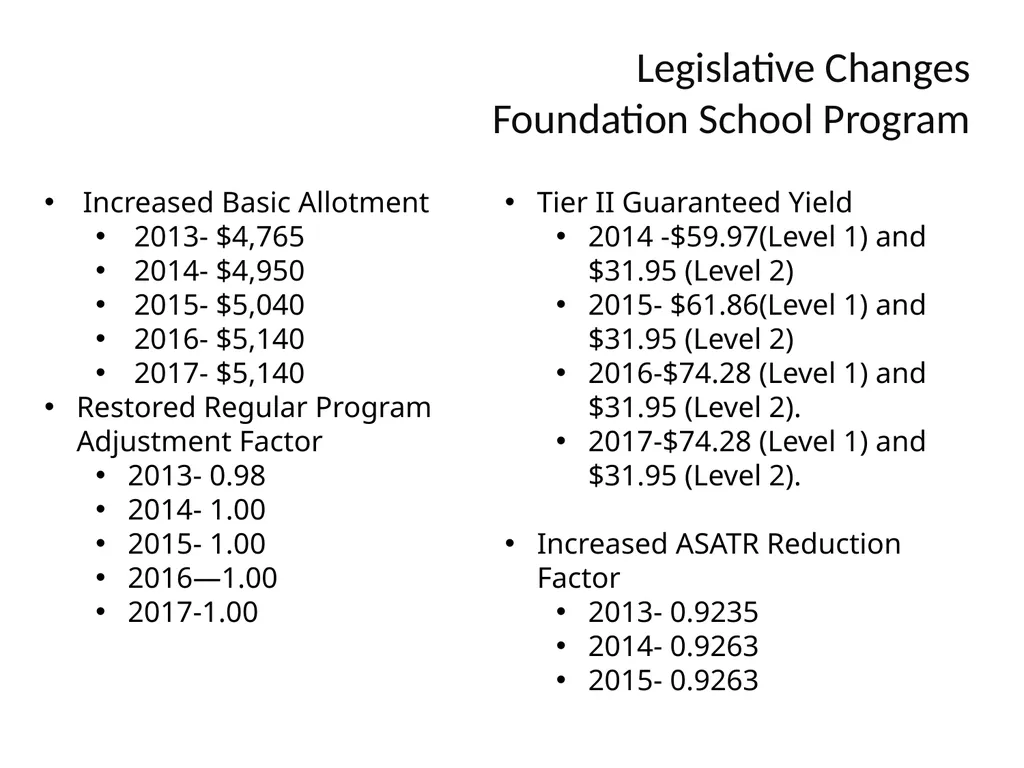
Legislative Changes
Foundation School Program Increased Basic Allotment
2013- $4,765
2014- $4,950
2015- $5,040
2016- $5,140
2017- $5,140
Restored Regular Program Adjustment Factor
2013- 0.98
2014- 1.00
2015- 1.00
2016—1.00
2017-1.00 Tier II Guaranteed Yield
2014 -$59.97(Level 1) and $31.95 (Level 2)
2015- $61.86(Level 1) and $31.95 (Level 2)
2016-$74.28 (Level 1) and $31.95 (Level 2).
2017-$74.28 (Level 1) and $31.95 (Level 2).
Increased ASATR Reduction Factor
2013- 0.9235
2014- 0.9263
2015- 0.9263<br>
Foundation School Program Increased Basic Allotment
2013- $4,765
2014- $4,950
2015- $5,040
2016- $5,140
2017- $5,140
Restored Regular Program Adjustment Factor
2013- 0.98
2014- 1.00
2015- 1.00
2016—1.00
2017-1.00 Tier II Guaranteed Yield
2014 -$59.97(Level 1) and $31.95 (Level 2)
2015- $61.86(Level 1) and $31.95 (Level 2)
2016-$74.28 (Level 1) and $31.95 (Level 2).
2017-$74.28 (Level 1) and $31.95 (Level 2).
Increased ASATR Reduction Factor
2013- 0.9235
2014- 0.9263
2015- 0.9263<br>
23
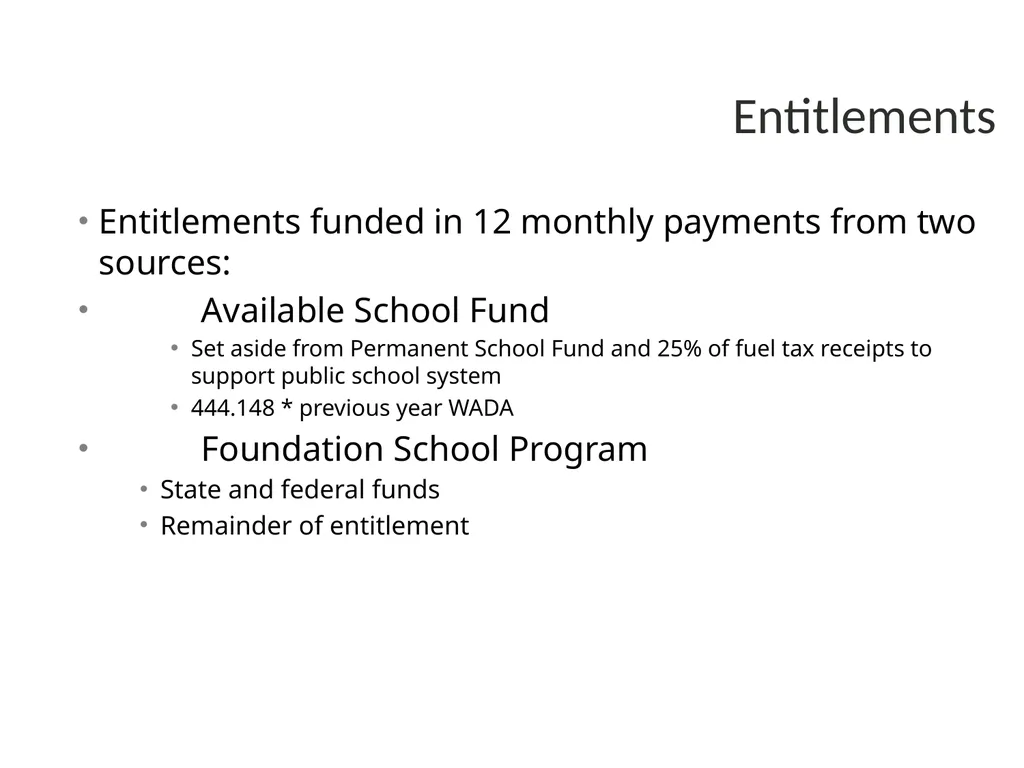
Entitlements Entitlements funded in 12 monthly payments from two sources:
Available School Fund
Set aside from Permanent School Fund and 25% of fuel tax receipts to support public school system
444.148 * previous year WADA
Foundation School Program
State and federal funds
Remainder of entitlement<br>
Available School Fund
Set aside from Permanent School Fund and 25% of fuel tax receipts to support public school system
444.148 * previous year WADA
Foundation School Program
State and federal funds
Remainder of entitlement<br>
24
Group Activity:
What federal funds can you use?<br>
What federal funds can you use?<br>
25
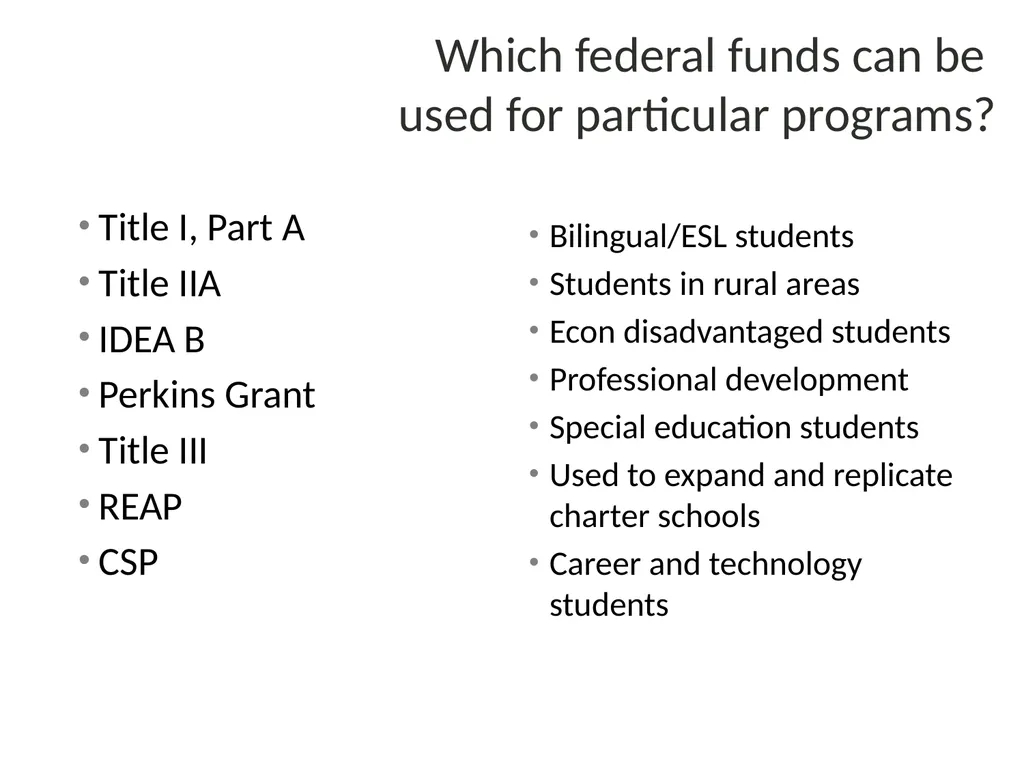
Which federal funds can be
used for particular programs? Title I, Part A
Title IIA
IDEA B
Perkins Grant
Title III
REAP
CSP
Bilingual/ESL students
Students in rural areas
Econ disadvantaged students
Professional development
Special education students
Used to expand and replicate charter schools
Career and technology students<br>
Title IIA
IDEA B
Perkins Grant
Title III
REAP
CSP
Bilingual/ESL students
Students in rural areas
Econ disadvantaged students
Professional development
Special education students
Used to expand and replicate charter schools
Career and technology students<br>
26
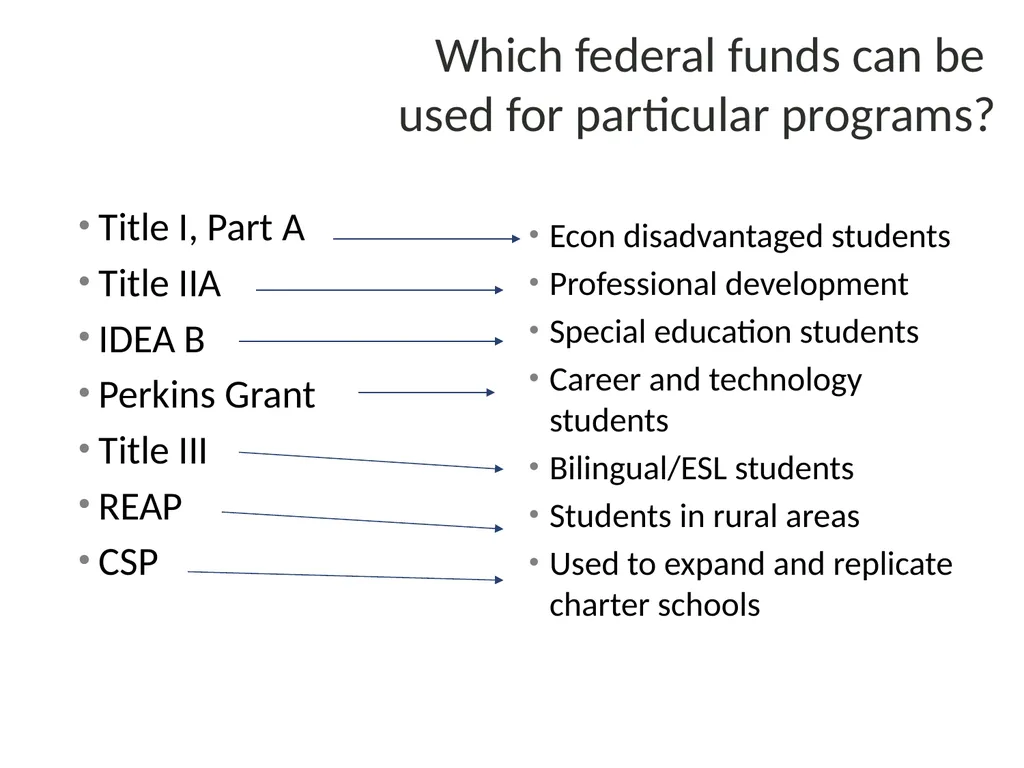
Which federal funds can be
used for particular programs? Title I, Part A
Title IIA
IDEA B
Perkins Grant
Title III
REAP
CSP
Econ disadvantaged students
Professional development
Special education students
Career and technology students
Bilingual/ESL students
Students in rural areas
Used to expand and replicate charter schools<br>
Title IIA
IDEA B
Perkins Grant
Title III
REAP
CSP
Econ disadvantaged students
Professional development
Special education students
Career and technology students
Bilingual/ESL students
Students in rural areas
Used to expand and replicate charter schools<br>
27
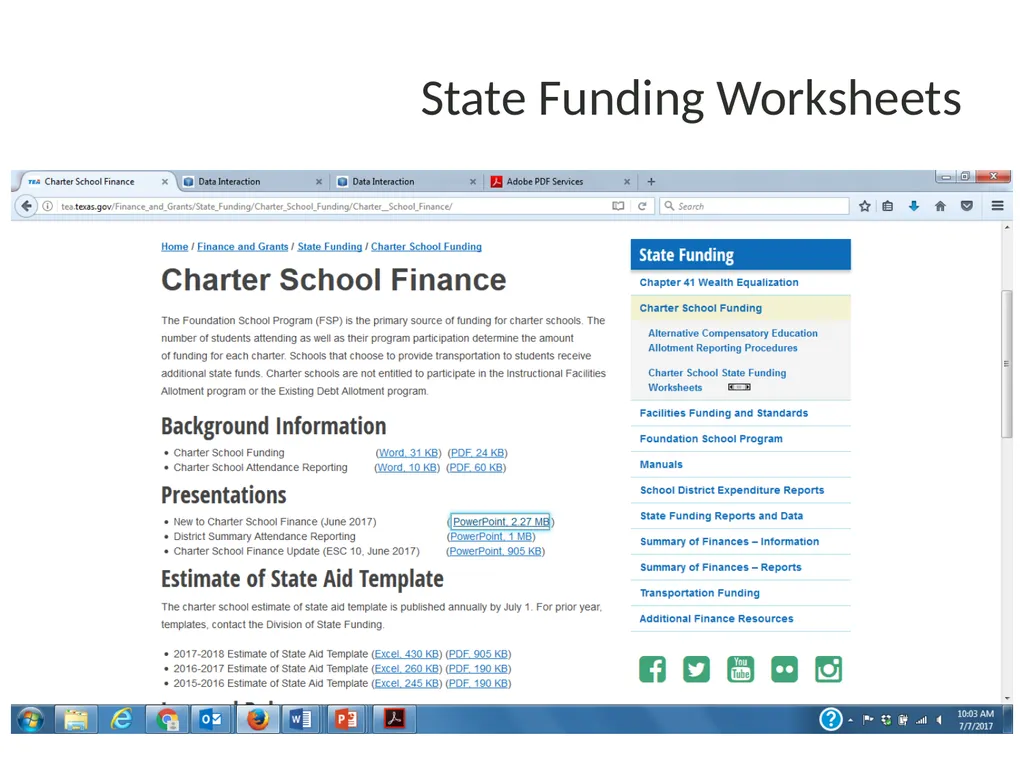
State Funding Worksheets<br>
28
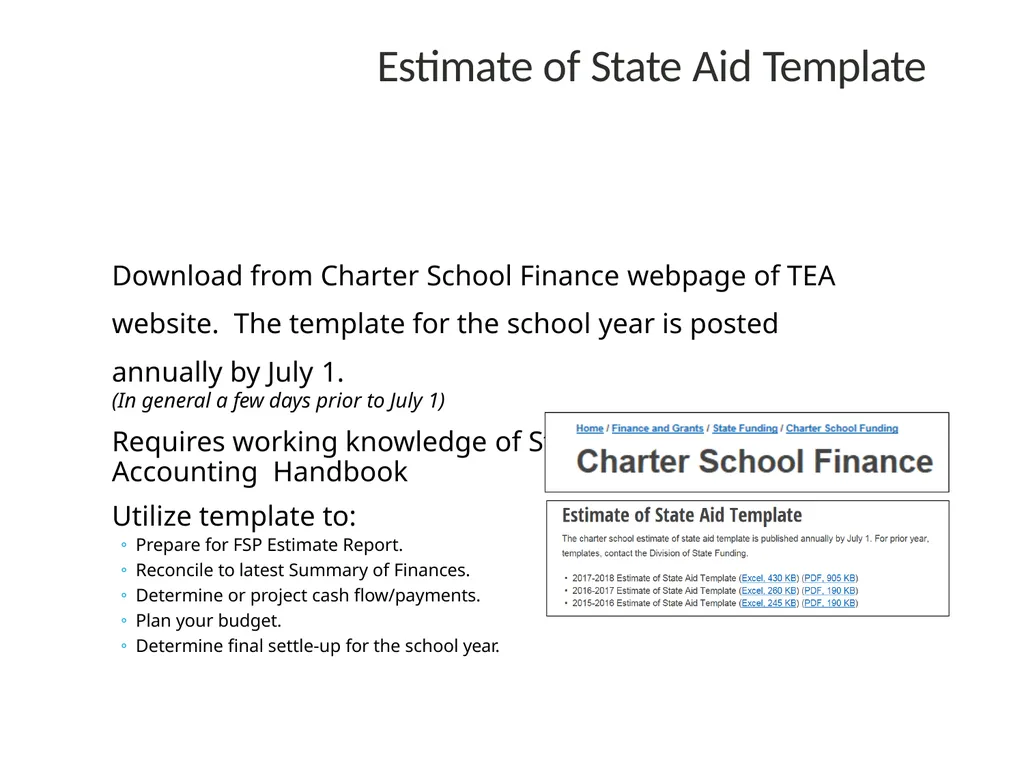
Estimate of State Aid Template Download from Charter School Finance webpage of TEA website. The template for the school year is posted annually by July 1.
(In general a few days prior to July 1)
Requires working knowledge of Student Attendance Accounting Handbook
Utilize template to:
Prepare for FSP Estimate Report.
Reconcile to latest Summary of Finances.
Determine or project cash flow/payments.
Plan your budget.
Determine final settle-up for the school year. 29<br>
(In general a few days prior to July 1)
Requires working knowledge of Student Attendance Accounting Handbook
Utilize template to:
Prepare for FSP Estimate Report.
Reconcile to latest Summary of Finances.
Determine or project cash flow/payments.
Plan your budget.
Determine final settle-up for the school year. 29<br>
29
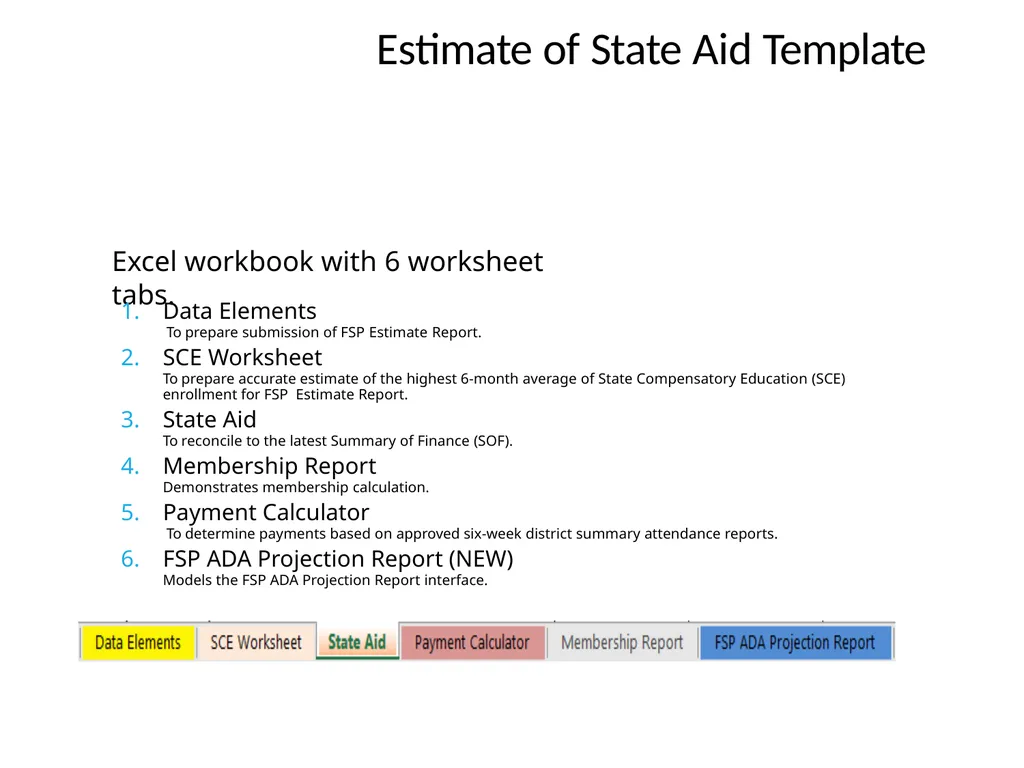
Estimate of State Aid Template Excel workbook with 6 worksheet tabs. Data Elements
To prepare submission of FSP Estimate Report.
SCE Worksheet
To prepare accurate estimate of the highest 6-month average of State Compensatory Education (SCE) enrollment for FSP Estimate Report.
State Aid
To reconcile to the latest Summary of Finance (SOF).
Membership Report
Demonstrates membership calculation.
Payment Calculator
To determine payments based on approved six-week district summary attendance reports.
FSP ADA Projection Report (NEW)
Models the FSP ADA Projection Report interface. 30<br>
To prepare submission of FSP Estimate Report.
SCE Worksheet
To prepare accurate estimate of the highest 6-month average of State Compensatory Education (SCE) enrollment for FSP Estimate Report.
State Aid
To reconcile to the latest Summary of Finance (SOF).
Membership Report
Demonstrates membership calculation.
Payment Calculator
To determine payments based on approved six-week district summary attendance reports.
FSP ADA Projection Report (NEW)
Models the FSP ADA Projection Report interface. 30<br>
30
Estimate of State Aid Template 31 Data Elements
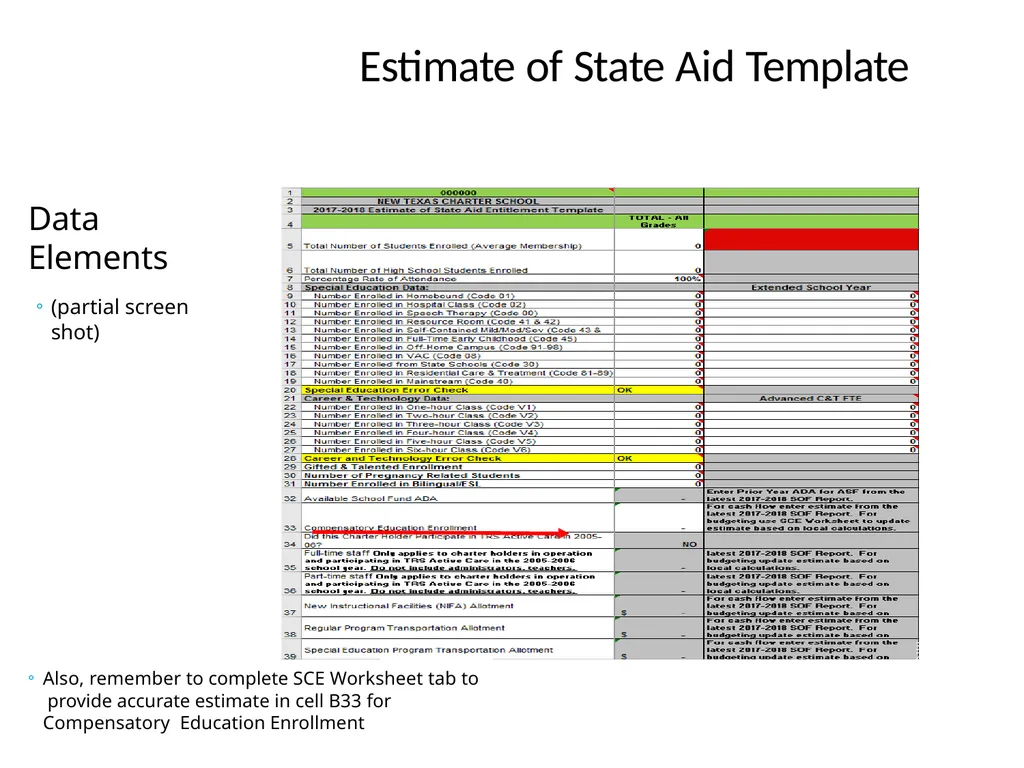
For use in entering new enrollment estimates for 1st six-week only in preparation for FSP Estimate Report.
To load prior year in column C of State Aid tab, enter charter school’s 6-digit county district number.
Note: For new charter schools, no prior year data.
Your updates in the Data Elements tab feeds into column D of the State Aid tab.
Data entry validation warnings for exceeded maximum approved enrollment cap.
Any charter reporting data in the FSP Estimate Data Report should complete Estimate of State Aid Template before submitting to TEA.
In general, the Data elements tab is used one-time only. However, you may return for the purpose of determining per-student funding estimate information.<br>
For use in entering new enrollment estimates for 1st six-week only in preparation for FSP Estimate Report.
To load prior year in column C of State Aid tab, enter charter school’s 6-digit county district number.
Note: For new charter schools, no prior year data.
Your updates in the Data Elements tab feeds into column D of the State Aid tab.
Data entry validation warnings for exceeded maximum approved enrollment cap.
Any charter reporting data in the FSP Estimate Data Report should complete Estimate of State Aid Template before submitting to TEA.
In general, the Data elements tab is used one-time only. However, you may return for the purpose of determining per-student funding estimate information.<br>
31
Estimate of State Aid Template Data Elements
(partial screen shot) Also, remember to complete SCE Worksheet tab to provide accurate estimate in cell B33 for Compensatory Education Enrollment 32<br>
(partial screen shot) Also, remember to complete SCE Worksheet tab to provide accurate estimate in cell B33 for Compensatory Education Enrollment 32<br>
32
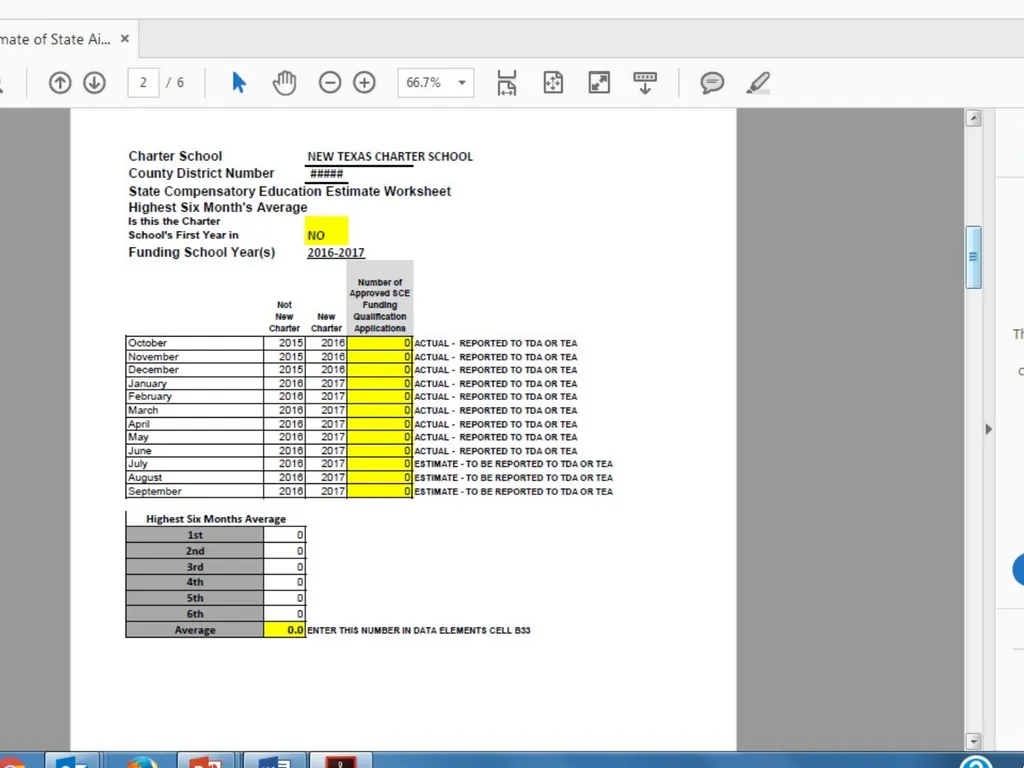
Estimate of State Aid Template 33 SCE Worksheet
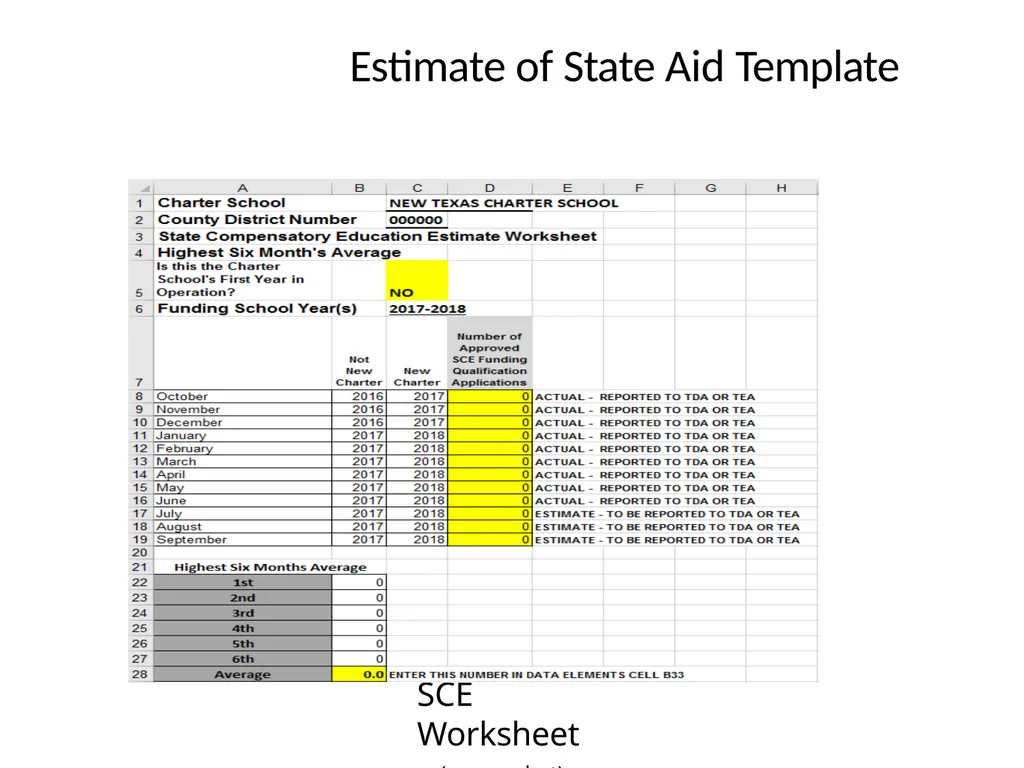
Assists charter schools in arriving at accurate estimate of the highest 6-month average of State Compensatory Education (SCE) enrollment.
Enter YES or NO to this question: Is this the Charter School's First Year in Operation?
If NO – enter October 2016 through September 2017 actual and estimate SCE data.
If YES – enter an estimate of October 2017 through September 2018 SCE data.
Complete SCE worksheet before entering SCE high six-month average in the Data Elements tab in cell B33 or State Aid tab.
Utilizing this worksheet is beneficial because it should minimize adjustments to the State Compensatory Education allotment. Failure to do so may result in over/under reporting for majority of school year (September – March).<br>
Assists charter schools in arriving at accurate estimate of the highest 6-month average of State Compensatory Education (SCE) enrollment.
Enter YES or NO to this question: Is this the Charter School's First Year in Operation?
If NO – enter October 2016 through September 2017 actual and estimate SCE data.
If YES – enter an estimate of October 2017 through September 2018 SCE data.
Complete SCE worksheet before entering SCE high six-month average in the Data Elements tab in cell B33 or State Aid tab.
Utilizing this worksheet is beneficial because it should minimize adjustments to the State Compensatory Education allotment. Failure to do so may result in over/under reporting for majority of school year (September – March).<br>
33
Estimate of State Aid Template SCE Worksheet
(screen shot) 10<br>
(screen shot) 10<br>
34
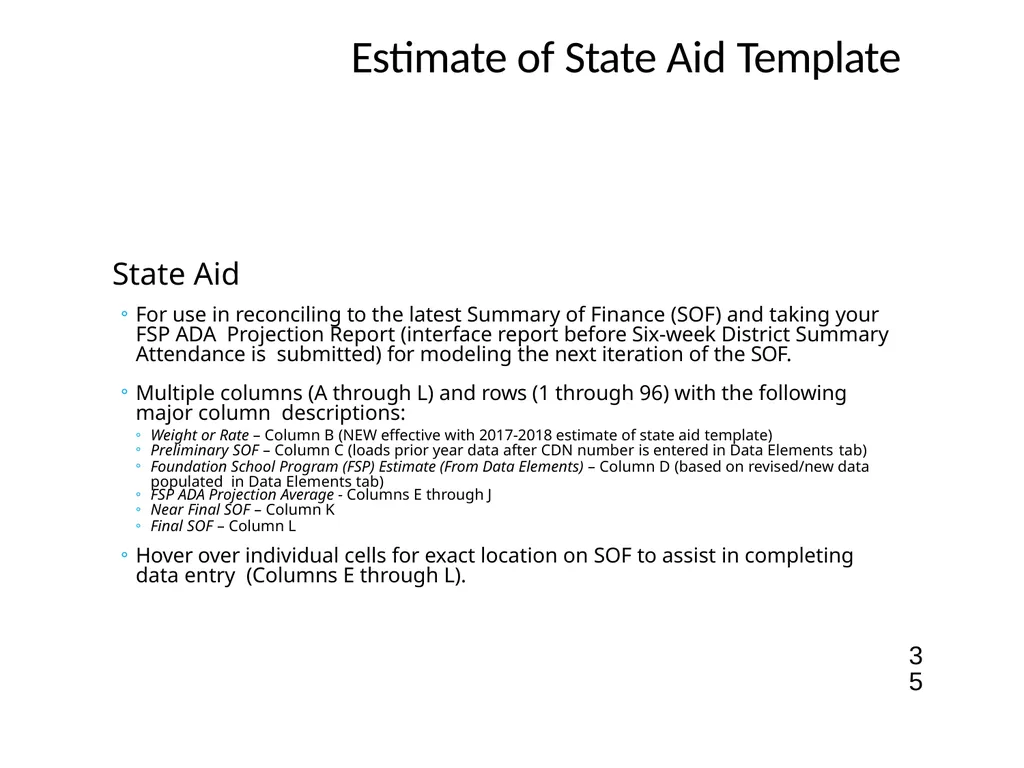
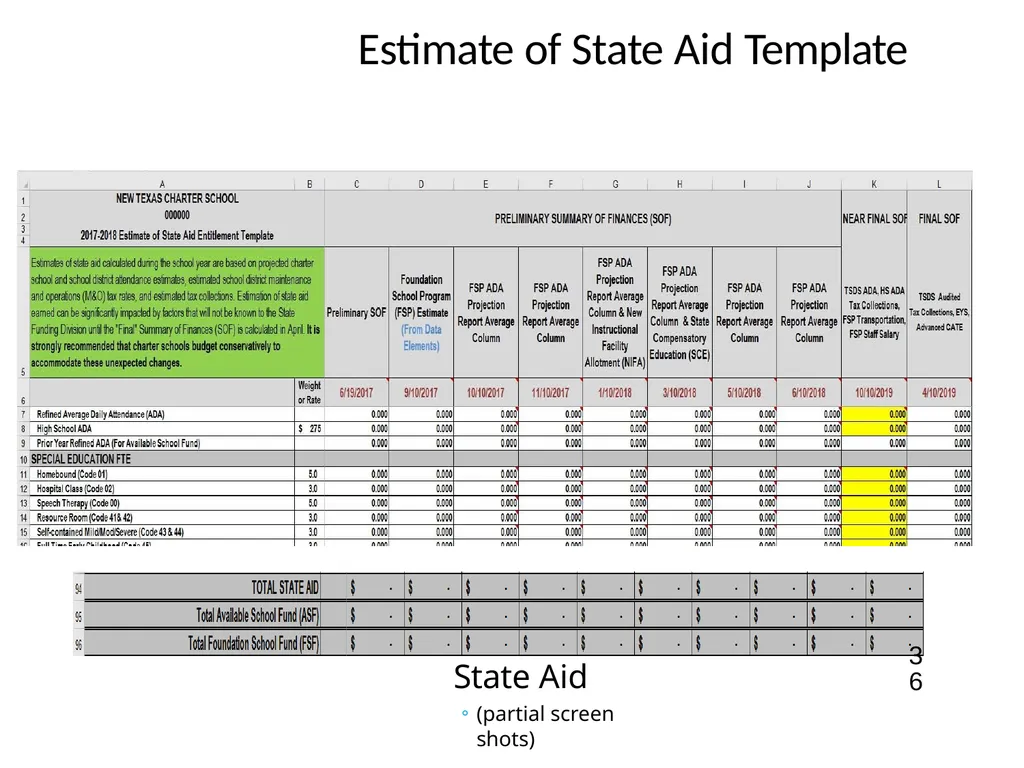
Estimate of State Aid Template 35 State Aid
For use in reconciling to the latest Summary of Finance (SOF) and taking your FSP ADA Projection Report (interface report before Six-week District Summary Attendance is submitted) for modeling the next iteration of the SOF.
Multiple columns (A through L) and rows (1 through 96) with the following major column descriptions:
Weight or Rate – Column B (NEW effective with 2017-2018 estimate of state aid template)
Preliminary SOF – Column C (loads prior year data after CDN number is entered in Data Elements tab)
Foundation School Program (FSP) Estimate (From Data Elements) – Column D (based on revised/new data populated in Data Elements tab)
FSP ADA Projection Average - Columns E through J
Near Final SOF – Column K
Final SOF – Column L
Hover over individual cells for exact location on SOF to assist in completing data entry (Columns E through L).<br>
For use in reconciling to the latest Summary of Finance (SOF) and taking your FSP ADA Projection Report (interface report before Six-week District Summary Attendance is submitted) for modeling the next iteration of the SOF.
Multiple columns (A through L) and rows (1 through 96) with the following major column descriptions:
Weight or Rate – Column B (NEW effective with 2017-2018 estimate of state aid template)
Preliminary SOF – Column C (loads prior year data after CDN number is entered in Data Elements tab)
Foundation School Program (FSP) Estimate (From Data Elements) – Column D (based on revised/new data populated in Data Elements tab)
FSP ADA Projection Average - Columns E through J
Near Final SOF – Column K
Final SOF – Column L
Hover over individual cells for exact location on SOF to assist in completing data entry (Columns E through L).<br>
35
Estimate of State Aid Template State Aid
(partial screen shots) 36<br>
(partial screen shots) 36<br>
36
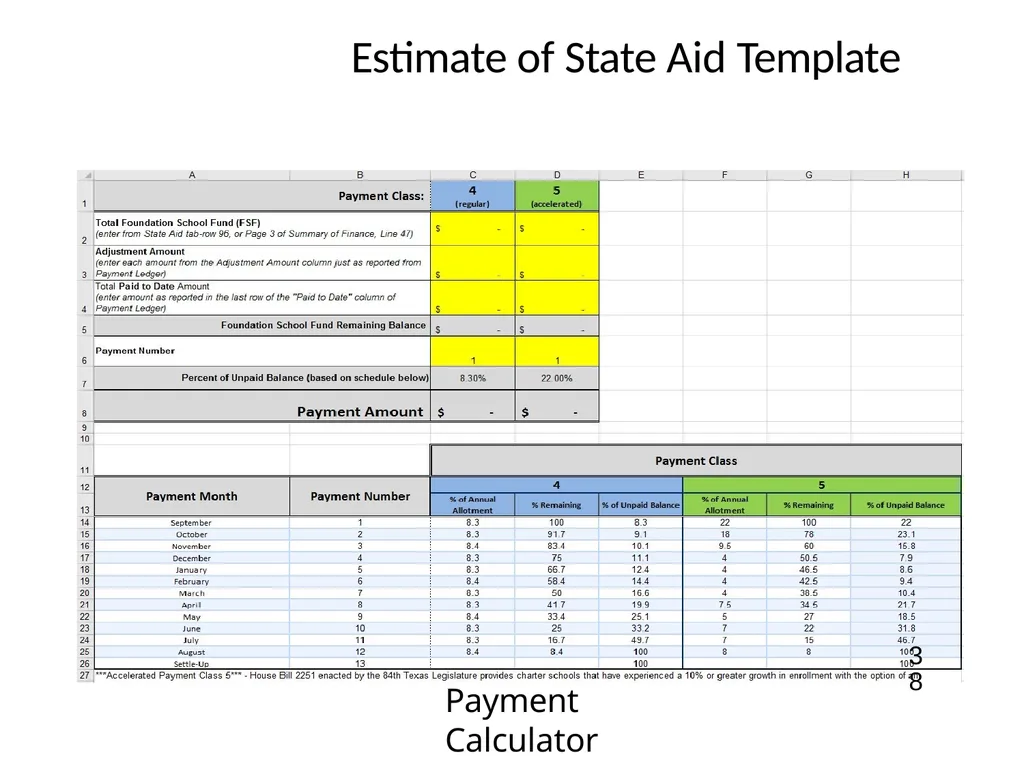
Estimate of State Aid Template 37 Payment Calculator
Assists charter school determine cash flow and next payment based on approved six-week district summary attendance reports.
Enter data in the field according to your Payment Class which is either Payment Class 4 (Regular) or Payment Class 5 (Accelerated).
Obtain your Payment Ledger Report and your most recent SOF or Estimate of State Aid template updated with FSP ADA projection data to complete.
Allows charter school to also determine Final settle-up payments or adjustment.<br>
Assists charter school determine cash flow and next payment based on approved six-week district summary attendance reports.
Enter data in the field according to your Payment Class which is either Payment Class 4 (Regular) or Payment Class 5 (Accelerated).
Obtain your Payment Ledger Report and your most recent SOF or Estimate of State Aid template updated with FSP ADA projection data to complete.
Allows charter school to also determine Final settle-up payments or adjustment.<br>
37
Estimate of State Aid Template Payment Calculator
(screen shot) 38<br>
(screen shot) 38<br>
38
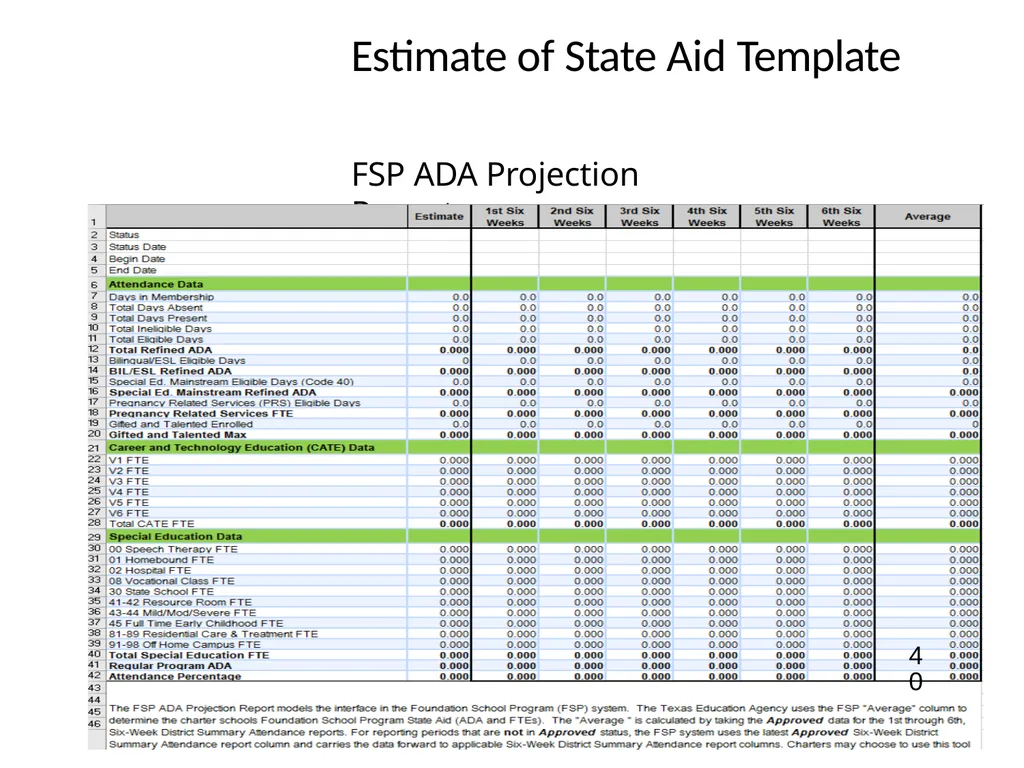
Estimate of State Aid Template 39 FSP ADA Projection Report
Models the ADA Projection Report found in the FSP system which calculates the annualized average of Six-Week District Summary Attendance Reports values.
In the FPS system, TEA calculates the annualized average using:
Approved Six-Week District Summary Attendance Reports, and
Projected Six-Week District Summary Attendance Reports for the remaining six-week district reporting periods based on the last “Approved” report.
Therefore, this tool was created for the charter school to factor trends that are not known by TEA to assist with budgeting purposes.<br>
Models the ADA Projection Report found in the FSP system which calculates the annualized average of Six-Week District Summary Attendance Reports values.
In the FPS system, TEA calculates the annualized average using:
Approved Six-Week District Summary Attendance Reports, and
Projected Six-Week District Summary Attendance Reports for the remaining six-week district reporting periods based on the last “Approved” report.
Therefore, this tool was created for the charter school to factor trends that are not known by TEA to assist with budgeting purposes.<br>
39
Estimate of State Aid Template FSP ADA Projection Report
(screen shot) 40<br>
(screen shot) 40<br>
40
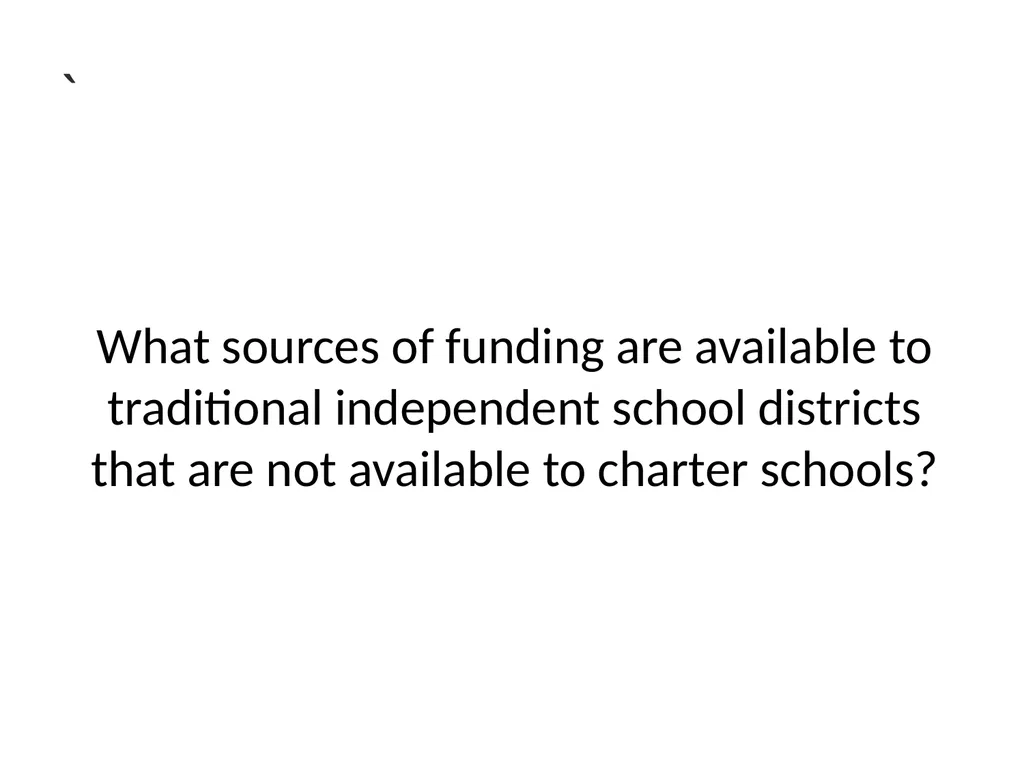
` What sources of funding are available to traditional independent school districts that are not available to charter schools?<br>
41
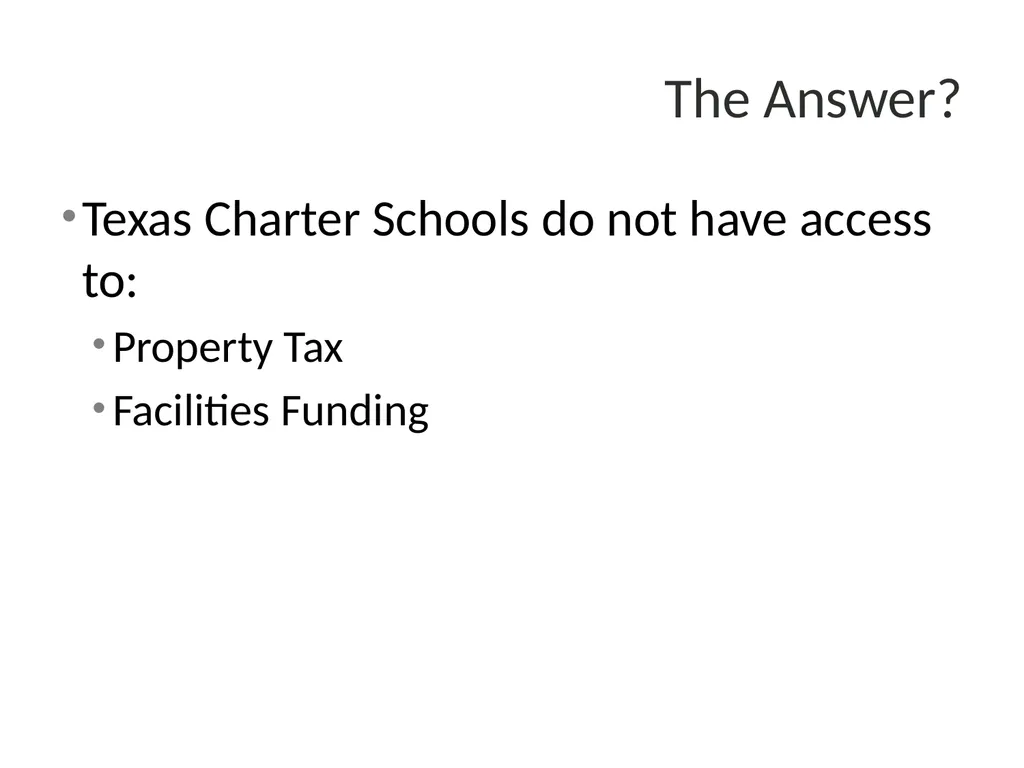
The Answer? Texas Charter Schools do not have access to:
Property Tax
Facilities Funding<br>
Property Tax
Facilities Funding<br>
42
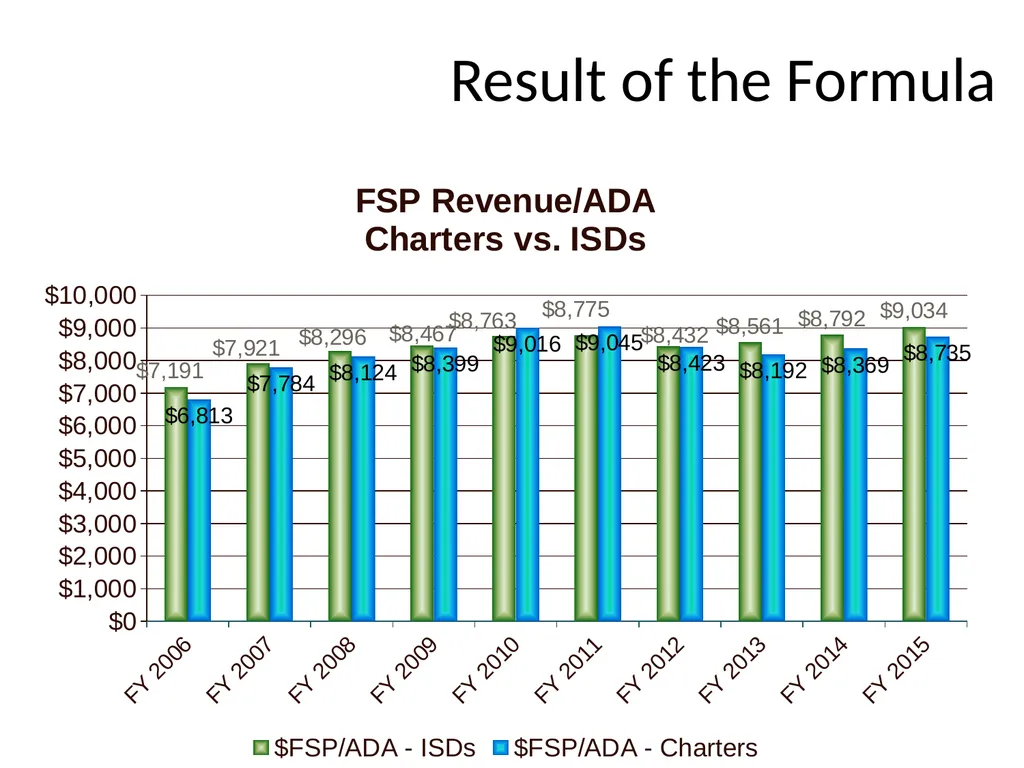
Result of the Formula<br>
43
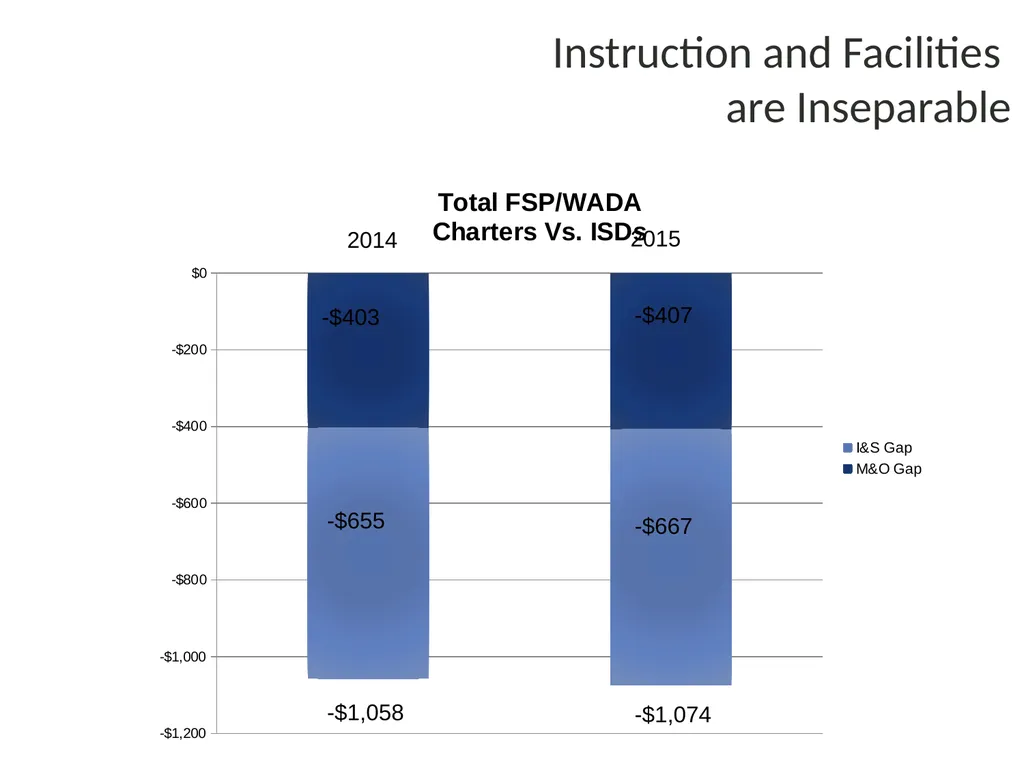
Instruction and Facilities
are Inseparable -$1,074 2014 2015 -$403 -$655 -$407 -$667 -$1,058<br>
44
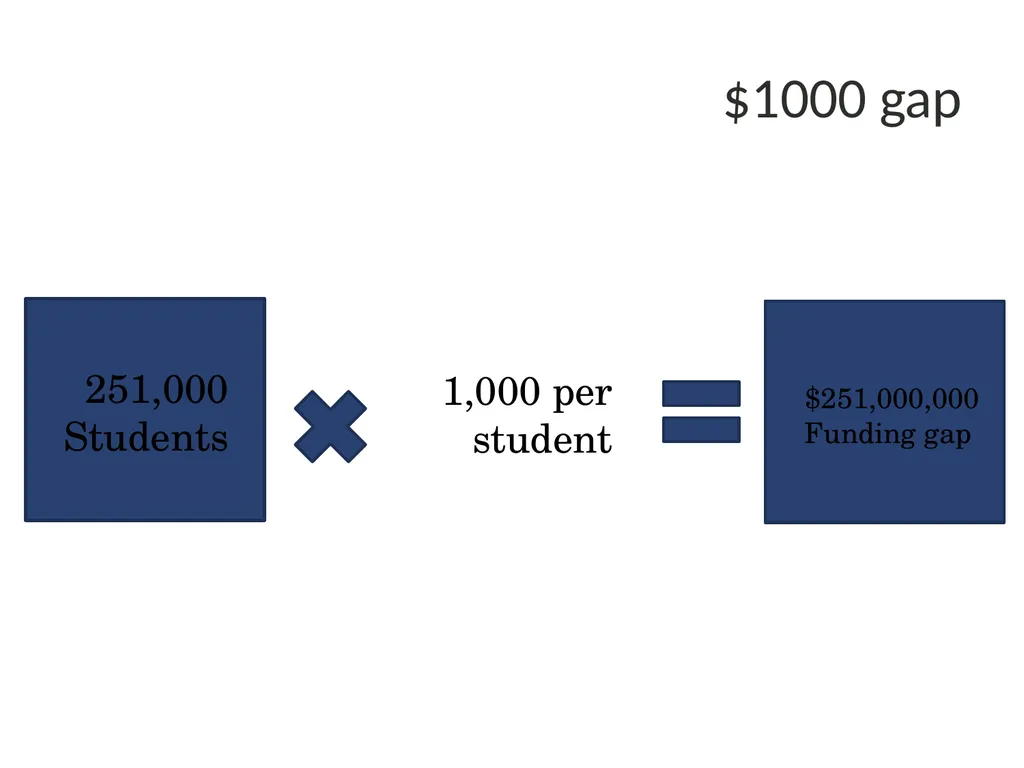
$1000 gap 251,000 Students 1,000 per
student $251,000,000
Funding gap<br>
student $251,000,000
Funding gap<br>
45
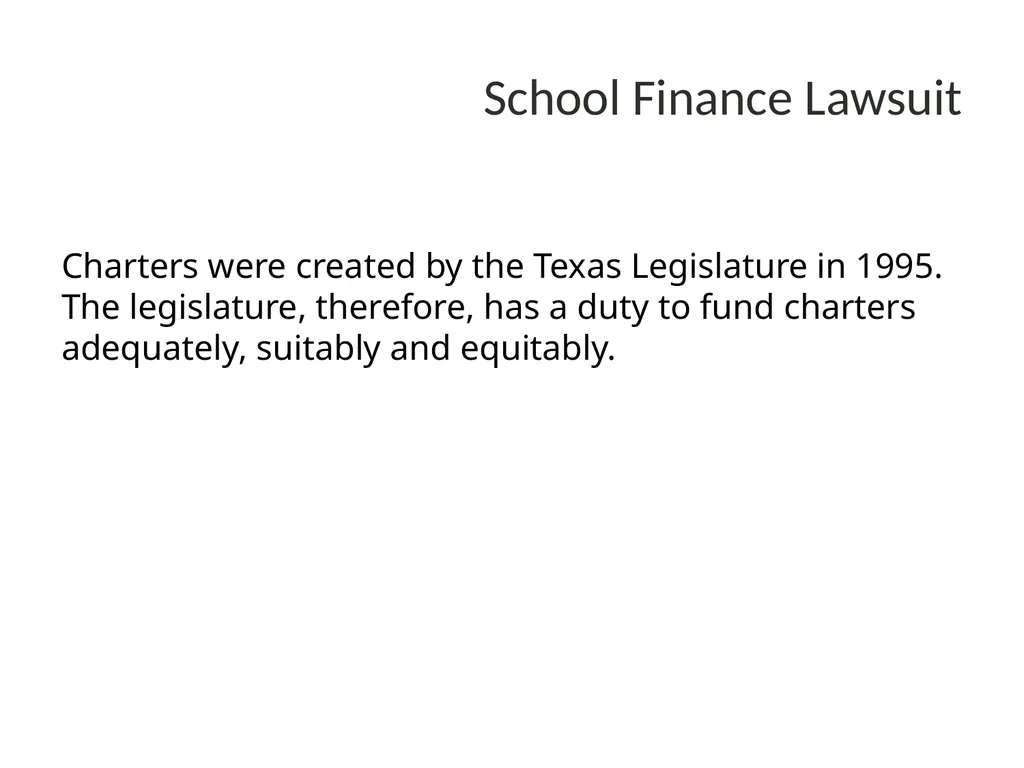
School Finance Lawsuit Charters were created by the Texas Legislature in 1995. The legislature, therefore, has a duty to fund charters adequately, suitably and equitably.<br>
46
Funding Gap Causes Charter school funding is not specifically adjusted for the individual characteristics of each charter school.
Charter schools do not receive facilities funding.<br>
Charter schools do not receive facilities funding.<br>
47
Property Taxes Open enrollment charter schools can’t levy an Interest and Sinking (I&S) tax rate.
Open Enrollment Charter Schools aren’t able to capture revenue from property taxes (like traditional ISDs do) because we serve students from a larger geographic boundary.
For example, A+ Charter School resides in Dallas ISD, but serves students from students multiple school districts.<br>
Open Enrollment Charter Schools aren’t able to capture revenue from property taxes (like traditional ISDs do) because we serve students from a larger geographic boundary.
For example, A+ Charter School resides in Dallas ISD, but serves students from students multiple school districts.<br>
48
Historical Info In prior years, charter schools have not had access to the Permanent School Fund. Access to the PSF guarantees bond issues and allows borrowing at lower interest rates.
For example, When Harmony Public Schools financed bank bonds to construct campuses, the added cost was between $50 and $60 million.
-Source, Texas Tribune<br>
For example, When Harmony Public Schools financed bank bonds to construct campuses, the added cost was between $50 and $60 million.
-Source, Texas Tribune<br>
49
PSF Access Granted In 2011, Senate Bill 1 was enacted by the Legislature and authorized the use of the PSF to guarantee revenue bonds for charter schools.
Capacity based upon Statewide Charter enrollment (Adjusted Annually)
Charter Capacity is currently $858,000,0000
Qualifications:
3-Years of Operation
No “Strikes”
Investment Grade Rating (BBB- or higher)<br>
Capacity based upon Statewide Charter enrollment (Adjusted Annually)
Charter Capacity is currently $858,000,0000
Qualifications:
3-Years of Operation
No “Strikes”
Investment Grade Rating (BBB- or higher)<br>
50
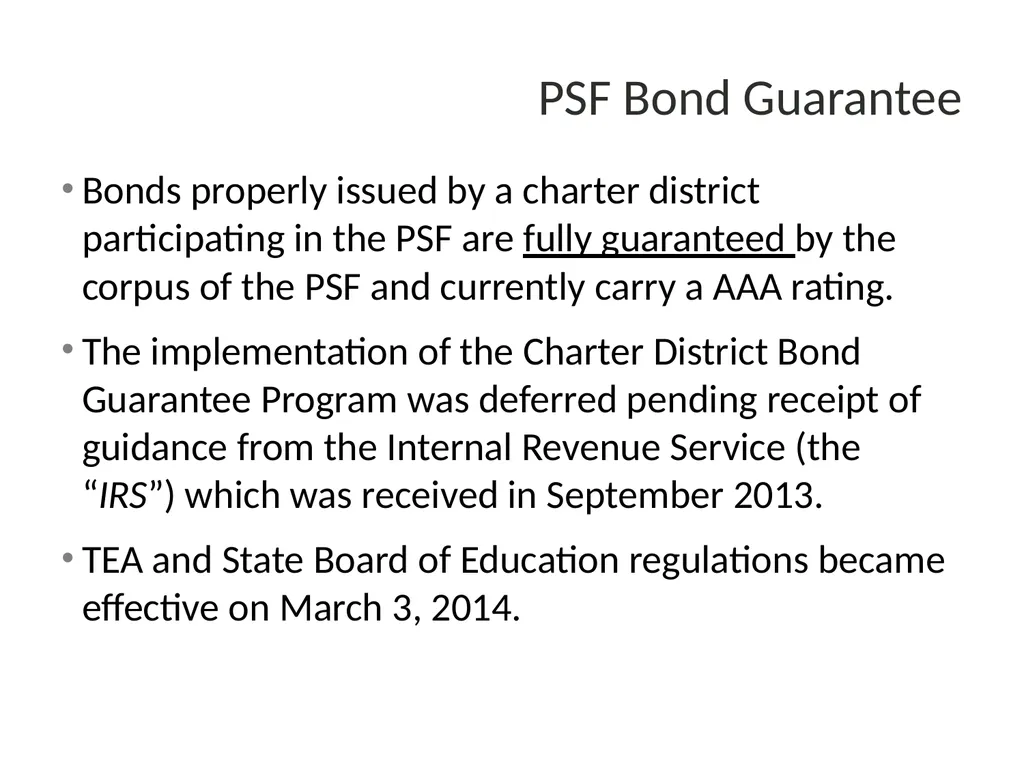
PSF Bond Guarantee Bonds properly issued by a charter district participating in the PSF are fully guaranteed by the corpus of the PSF and currently carry a AAA rating.
The implementation of the Charter District Bond Guarantee Program was deferred pending receipt of guidance from the Internal Revenue Service (the “IRS”) which was received in September 2013.
TEA and State Board of Education regulations became effective on March 3, 2014.<br>
The implementation of the Charter District Bond Guarantee Program was deferred pending receipt of guidance from the Internal Revenue Service (the “IRS”) which was received in September 2013.
TEA and State Board of Education regulations became effective on March 3, 2014.<br>
51
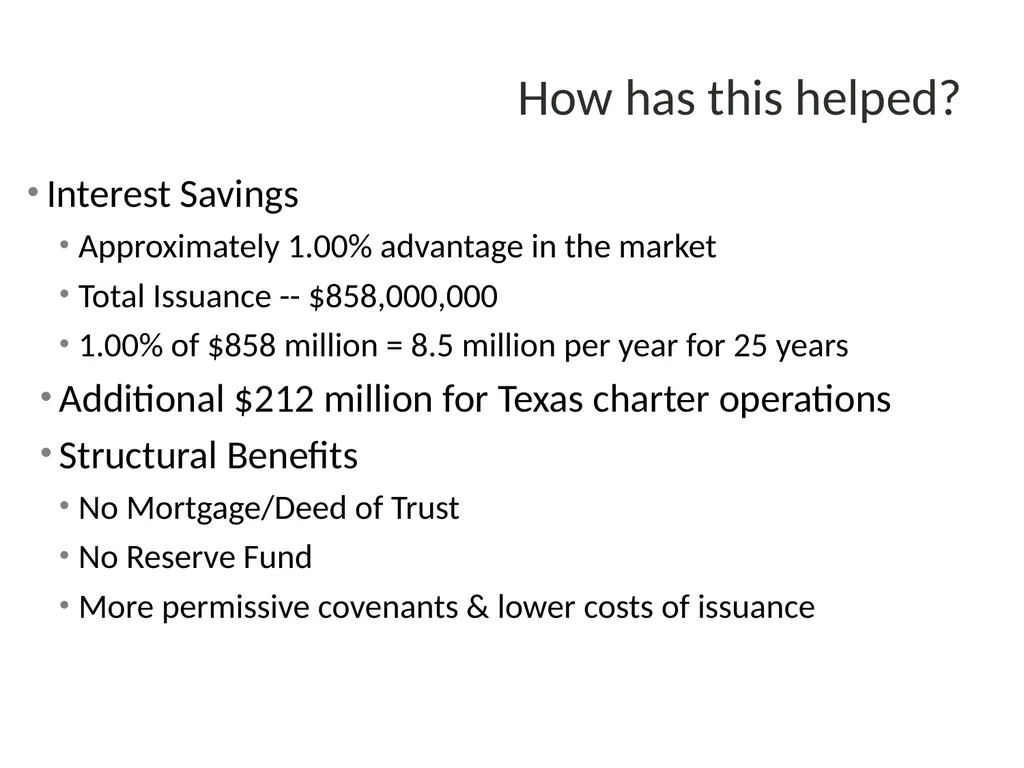
How has this helped? Interest Savings
Approximately 1.00% advantage in the market
Total Issuance -- $858,000,000
1.00% of $858 million = 8.5 million per year for 25 years
Additional $212 million for Texas charter operations
Structural Benefits
No Mortgage/Deed of Trust
No Reserve Fund
More permissive covenants & lower costs of issuance<br>
Approximately 1.00% advantage in the market
Total Issuance -- $858,000,000
1.00% of $858 million = 8.5 million per year for 25 years
Additional $212 million for Texas charter operations
Structural Benefits
No Mortgage/Deed of Trust
No Reserve Fund
More permissive covenants & lower costs of issuance<br>
52
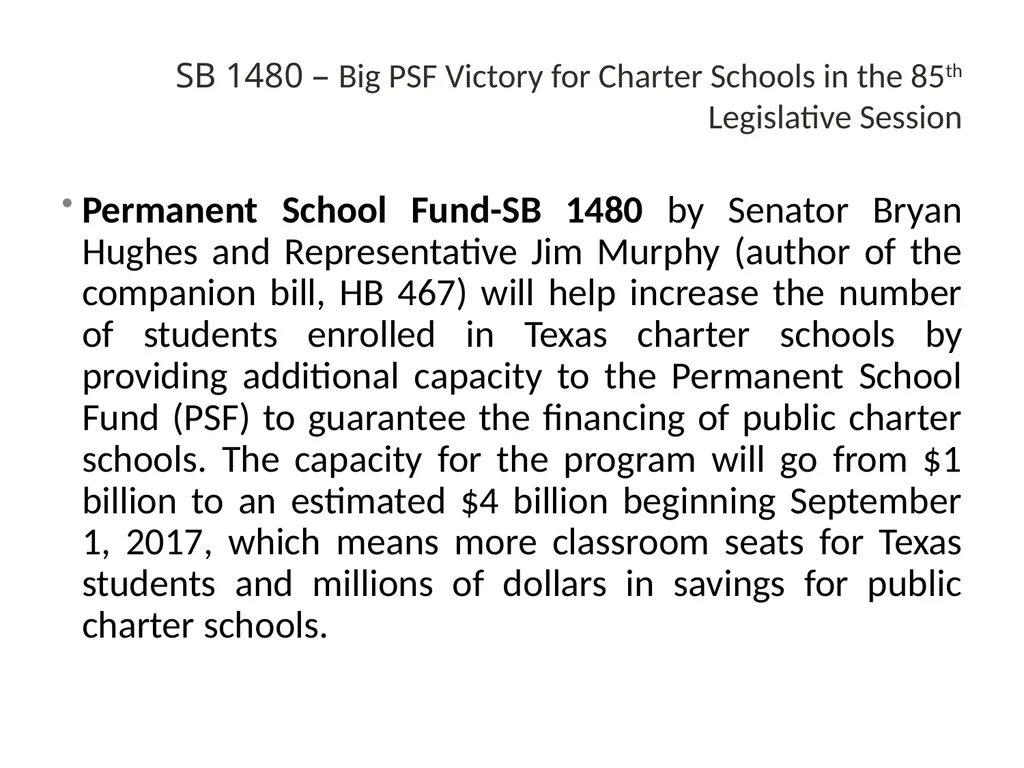
SB 1480 – Big PSF Victory for Charter Schools in the 85th Legislative Session Permanent School Fund-SB 1480 by Senator Bryan Hughes and Representative Jim Murphy (author of the companion bill, HB 467) will help increase the number of students enrolled in Texas charter schools by providing additional capacity to the Permanent School Fund (PSF) to guarantee the financing of public charter schools. The capacity for the program will go from $1 billion to an estimated $4 billion beginning September 1, 2017, which means more classroom seats for Texas students and millions of dollars in savings for public charter schools.<br>
53
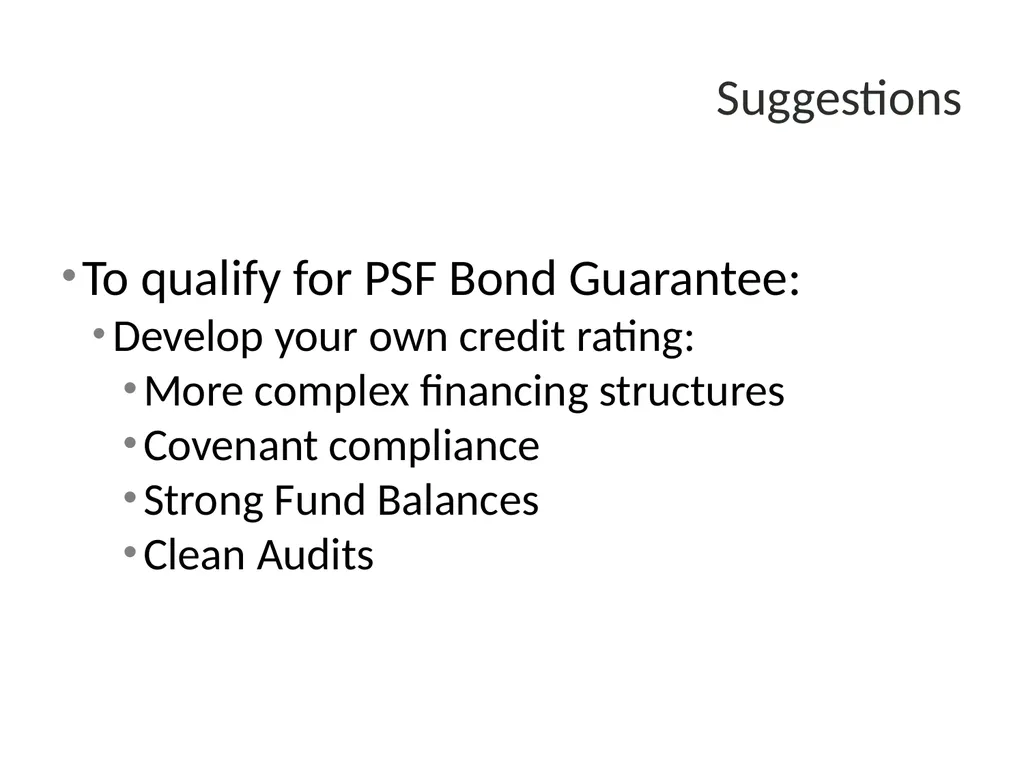
Suggestions To qualify for PSF Bond Guarantee:
Develop your own credit rating:
More complex financing structures
Covenant compliance
Strong Fund Balances
Clean Audits<br>
Develop your own credit rating:
More complex financing structures
Covenant compliance
Strong Fund Balances
Clean Audits<br>
54
HB 2610 Tex. Educ. Code §25.081 now requires 75,600 minutes of instruction (including intermissions and recesses) instead of 180 days of instruction
Day of Instruction = 420 minutes
Originally, TEA said that charter schools were not subject to the requirement but that state funding will be reduced in proportion to the number of minutes which a charter school’s calendar falls below 75,600 minutes. As a temporary fix, for the last two years TEA let charters submit an instructional time waiver.<br>
Day of Instruction = 420 minutes
Originally, TEA said that charter schools were not subject to the requirement but that state funding will be reduced in proportion to the number of minutes which a charter school’s calendar falls below 75,600 minutes. As a temporary fix, for the last two years TEA let charters submit an instructional time waiver.<br>
55
Minutes of Instruction Attendance-taking procedures have not changed. 2-hour rule/4-hour rule remains for coding for half-day/full-day attendance (excludes intermissions and recess).
Schools must maintain local documentation, showing instructional days and start and end times beginning with 2015-2016 school year
ADA will continue to be calculated at six-week intervals/days taught.<br>
Schools must maintain local documentation, showing instructional days and start and end times beginning with 2015-2016 school year
ADA will continue to be calculated at six-week intervals/days taught.<br>
56
HB 2442 Fixes the Waiver Requirement
for Charter Schools the Minutes Minutes of Instructional Time-HB 2442 by Representative Ken King and Senator Larry Taylor (author of SB 1660) will protect the funding of about 110 public charter school campuses that enroll nearly 21,000 students. During the previous 84th Legislative Session, HB 2610 passed with the unintended consequence of reducing the funding for public charter schools with unique programs, often serving our most vulnerable student populations. With the passage of HB 2442, the funding of these schools is safeguarded<br>
57
HB 2442 Fixes the Waiver Requirement
for Charter Schools the Minutes Three automatic waivers are granted under HB 2442:
1. Charter schools operating before January 1, 2015, will receive full funding if they report 180 days of attendance and comply with the four-hour instruction rule (240 minutes). The charter school must continue to meet the instructional requirements in its contract for charter.<br>
1. Charter schools operating before January 1, 2015, will receive full funding if they report 180 days of attendance and comply with the four-hour instruction rule (240 minutes). The charter school must continue to meet the instructional requirements in its contract for charter.<br>
58
HB 2442 Fixes the Waiver Requirement
for Charter Schools the Minutes 2. A dropout recovery campus, a day treatment facility, a residential treatment facility, a psychiatric hospital, a school program offered at a correctional facility, an alternative education program (AEP), a disciplinary alternative education program (DAEP), and a school operating under Texas Education Code (TEC), §29.259, will receive the allotted funding as long as they comply with the four-hour instruction rule (240 minutes).<br>
59
HB 2442 Fixes the Waiver Requirement
for Charter Schools the Minutes Prekindergarten programs will receive the allotted funding as long as they comply with the two-hour instruction rule (120 minutes).
Waivers are automatically granted for the three exceptions. School districts and charter schools do not need to apply for these automatic waivers<br>
Waivers are automatically granted for the three exceptions. School districts and charter schools do not need to apply for these automatic waivers<br>
60
Other Waivers Available Through TEA Waiver applications available for the 2017–2018 school year include the following: early release (six days total), staff development (five days total), and the seven-hour school day as defined in TEC, §25.082(a). The 2017–2018 waiver application will open July 10, 2017.
To apply for a waiver of TEC, §25.082(a), districts would select the “Other Waiver” type then complete and submit the application.
Districts and charter schools must continue to follow the rules in the student attendance accounting handbook (SAAH)<br>
To apply for a waiver of TEC, §25.082(a), districts would select the “Other Waiver” type then complete and submit the application.
Districts and charter schools must continue to follow the rules in the student attendance accounting handbook (SAAH)<br>
61
School Funding – the 85th Legislative Session TCSA’s top legislative priority, facilities funding (SB 457/HB 2337), was not achieved, but went further in the legislative process and had more support than in any prior session with SB 457 passing out of the Senate, not once but twice.<br>
62
School Funding – the 85th Legislative Session SB 457, filed by Senator Donna Campbell (R-New Braunfels), and HB 2337 filed by Representatives Harold Dutton (D-Houston), Ron Simmons (R-Carrollton), Eddie Lucio, III (D-Brownsville), Jodie Laubenberg (R-Parker), and Dwayne Bohac (R-Houston), represented a bipartisan coalition from various geographic areas of Texas, a first in the history of the charter school movement in Texas. Separately, Representative Jason Villalba filed HB 1269, taking another approach to facilities funding.<br>
63
School Funding – the 85th Legislative Session HB 21 by Representative Dan Huberty, the House’s major school finance bill was amended to include charter school facilities funding towards the end of the legislative session. While the House and Senate considered HB 21 until the final hours of the session, ultimately, they were unable to come to consensus on this bill.<br>
64
School Funding – the 85th Legislative Session So as things currently stand, there are no changes to the funding structures and per-pupil allocations from the 84th Legislative Session. Schools should plan to budget using the same per-pupil revenue amounts for 2017-2018 budgets that they used to build their 2016-2017 budgets.<br>
65
Budgeting – What you should be doing now? FSP Estimate Report (Opens July 1 – due August 1)
District Approver must be familiar with Student Attendance Accounting
It is recommended that District Approver complete the 2017-2018 Estimate of State Aid Worksheet prior to completing the FSP Estimate
The Estimate of State Aid Worksheet includes a worksheet specifically designed for estimating State Compensatory Education (SCE) enrollment.<br>
District Approver must be familiar with Student Attendance Accounting
It is recommended that District Approver complete the 2017-2018 Estimate of State Aid Worksheet prior to completing the FSP Estimate
The Estimate of State Aid Worksheet includes a worksheet specifically designed for estimating State Compensatory Education (SCE) enrollment.<br>
66
New Instructional Facility (NIFA) Allotment –
Understanding the Basics NIFA is a reimbursement program for start-up costs, such as outfitting classrooms with furniture and equipment, for new campuses for isds and charter schools.
The NIFA program provides up to $1,000 per student in average daily attendance (ADA) in an eligible new campus in the first year of operation and up to $1,000 per each additional ADA in the second year of operation to help with any start-up costs associated with opening a new campus.
The program provides for a statewide total of $23.75 million in the 2017-2018 school year, and the amount provided per student depends upon the total amount of requests made<br>
The NIFA program provides up to $1,000 per student in average daily attendance (ADA) in an eligible new campus in the first year of operation and up to $1,000 per each additional ADA in the second year of operation to help with any start-up costs associated with opening a new campus.
The program provides for a statewide total of $23.75 million in the 2017-2018 school year, and the amount provided per student depends upon the total amount of requests made<br>
67
Funding Amounts For an initial (first-year) or one-year application, a school district is entitled to an allotment of up to $1,000 per ADA earned by students in attendance on an eligible new campus. For a follow-up (second-year) application, a school district is entitled to an allotment of up to $1,000 for each additional ADA earned by students on the eligible campus.
Special One Year Applications are available for facilities that were occupied for the first time in 2016-2017 but did not receive NIFA funds because of the district’s failure to apply for funding before opening the campus. Any such eligible campus will receive funds for one year of operation only.<br>
Special One Year Applications are available for facilities that were occupied for the first time in 2016-2017 but did not receive NIFA funds because of the district’s failure to apply for funding before opening the campus. Any such eligible campus will receive funds for one year of operation only.<br>
68
Funding Amounts Last year, TEA had the same appropriated amount ($23.75 million) but only $18 million in allocations were distributed based on all approved applications at last year’s rate of $250 per ADA.
This year, the appropriation is the same, but the payment has increased to up to $1000 per ADA. In addition, the definition of a qualifying facility has broadened. So this likely means that schools won’t receive the $1000 per ADA but instead a reduced amount, all dependent on demand. If the amount per ADA is reduced, it will be done proportionally so that all approved facilities receive the same amount per ADA.<br>
This year, the appropriation is the same, but the payment has increased to up to $1000 per ADA. In addition, the definition of a qualifying facility has broadened. So this likely means that schools won’t receive the $1000 per ADA but instead a reduced amount, all dependent on demand. If the amount per ADA is reduced, it will be done proportionally so that all approved facilities receive the same amount per ADA.<br>
69
New Instructional Facility (NIFA) Allotment –
Understanding the Basics There are three types of applications:
Initial (first-year) applications must be submitted during the summer before the expected opening of the new building.
Follow-up (second-year) applications must be submitted during the summer after the first year of occupation.
Special One-Year applications are available for facilities that were occupied for the first time in 2016-2017 but did not receive NIFA funds because of the district’s failure to apply for funding before opening the campus. Any such eligible campus will receive funds for one year of operation only.<br>
Initial (first-year) applications must be submitted during the summer before the expected opening of the new building.
Follow-up (second-year) applications must be submitted during the summer after the first year of occupation.
Special One-Year applications are available for facilities that were occupied for the first time in 2016-2017 but did not receive NIFA funds because of the district’s failure to apply for funding before opening the campus. Any such eligible campus will receive funds for one year of operation only.<br>
70
New Instructional Facility (NIFA) Allotment –
Understanding the Basics In order to access funding under the NIFA program, your district or charter school must submit an online application. Applications must be entered, saved, and sent through the TEASE online system. Applications must be submitted electronically by July 17, 2017. Neither late applications nor paper applications will be accepted.<br>
71
What Types of Facilities Qualify for NIFA Funding? The facility for which funds are requested must be used for teaching the curriculum required by the TEC, Chapter 28 and must be one of the following:
A newly constructed facility This is a facility that was not occupied before the 2017-18 school year. To qualify for initial funding, the campus must be occupied for the first time during the 2017-18 school year.
A repurposed instructional facility This would be a building that was not previously a school facility but has been modified for that purpose (such as retail space)
A leased facility operating for the first time as an instructional facility with a minimum lease term of not less than 10 years<br>
A newly constructed facility This is a facility that was not occupied before the 2017-18 school year. To qualify for initial funding, the campus must be occupied for the first time during the 2017-18 school year.
A repurposed instructional facility This would be a building that was not previously a school facility but has been modified for that purpose (such as retail space)
A leased facility operating for the first time as an instructional facility with a minimum lease term of not less than 10 years<br>
72
What Types of Facilities Qualify for NIFA Funding? Additional requirements for qualification:
The new facility must have its own campus ID number as designated by the Texas Education Agency. The facility cannot be a new, repurposed, or leased facility that shares a campus number with another existing facility.<br>
The new facility must have its own campus ID number as designated by the Texas Education Agency. The facility cannot be a new, repurposed, or leased facility that shares a campus number with another existing facility.<br>
73
What Types of Facilities Qualify for NIFA Funding? Additional requirements for qualification:
2. The new facility must have its own principal or be eligible to receive an accountability rating through standard analysis as described in the most current Accountability Manual. Here are several scenarios to consider:
XYZ Charter School builds a new PreK-2 building. Would it qualify for NIFA funds?
YES – if the school has its own campus number and shares an accountability rating with a grade 3+ campus or stands alone but has its own principal.
Can the same principal be in charge of multiple buildings and a facility qualify?
YES – as long as the new facility has its own campus number and receives an accountability rating.<br>
2. The new facility must have its own principal or be eligible to receive an accountability rating through standard analysis as described in the most current Accountability Manual. Here are several scenarios to consider:
XYZ Charter School builds a new PreK-2 building. Would it qualify for NIFA funds?
YES – if the school has its own campus number and shares an accountability rating with a grade 3+ campus or stands alone but has its own principal.
Can the same principal be in charge of multiple buildings and a facility qualify?
YES – as long as the new facility has its own campus number and receives an accountability rating.<br>
74
What Types of Facilities Qualify for NIFA Funding? Additional requirements for qualification:
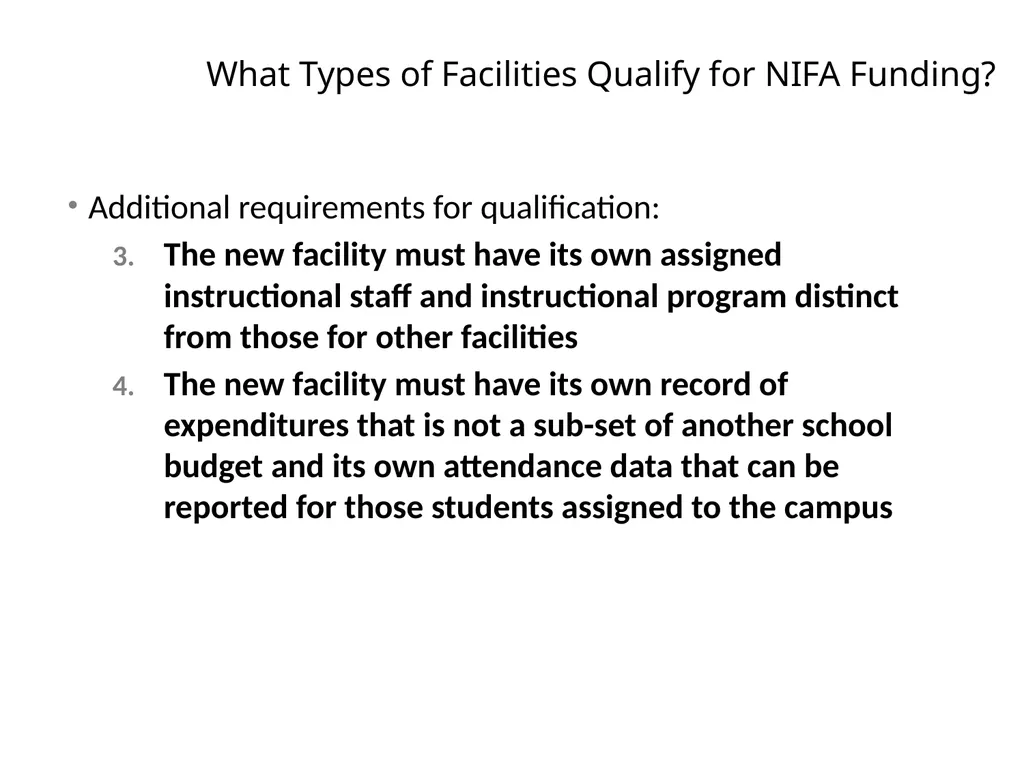
The new facility must have its own assigned instructional staff and instructional program distinct from those for other facilities
The new facility must have its own record of expenditures that is not a sub-set of another school budget and its own attendance data that can be reported for those students assigned to the campus<br>
The new facility must have its own assigned instructional staff and instructional program distinct from those for other facilities
The new facility must have its own record of expenditures that is not a sub-set of another school budget and its own attendance data that can be reported for those students assigned to the campus<br>
75
What Types of Facilities Qualify for NIFA Funding? Additional requirements for qualification:
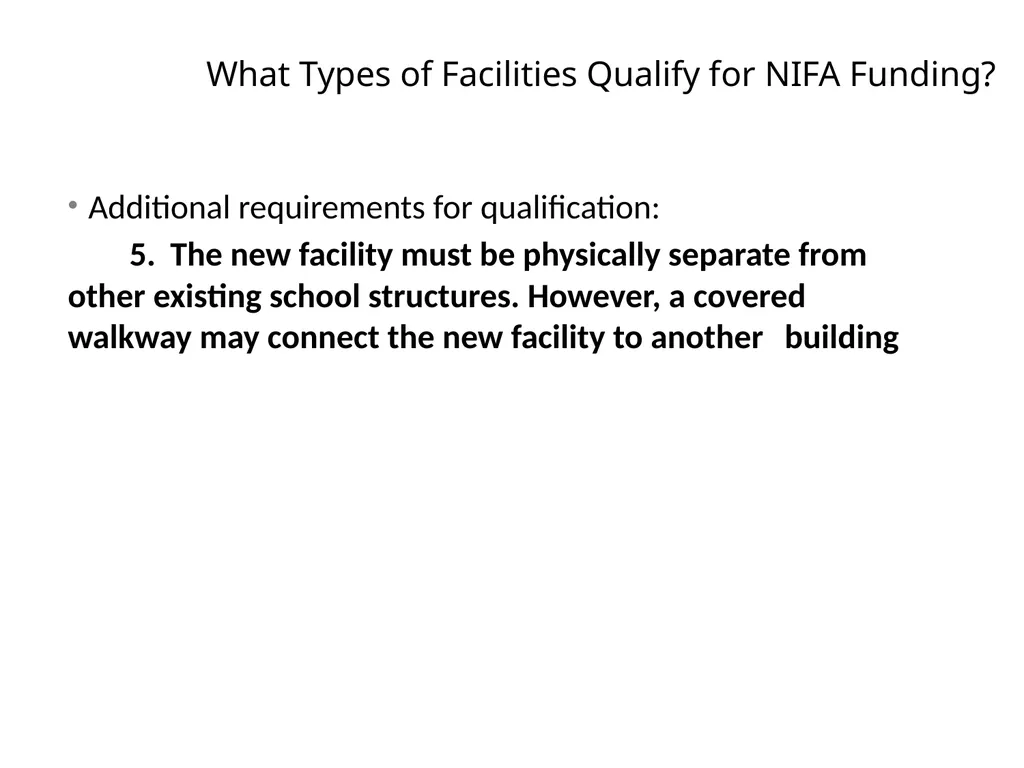
5. The new facility must be physically separate from other existing school structures. However, a covered walkway may connect the new facility to another building<br>
5. The new facility must be physically separate from other existing school structures. However, a covered walkway may connect the new facility to another building<br>
76
What Facilities are Prohibited
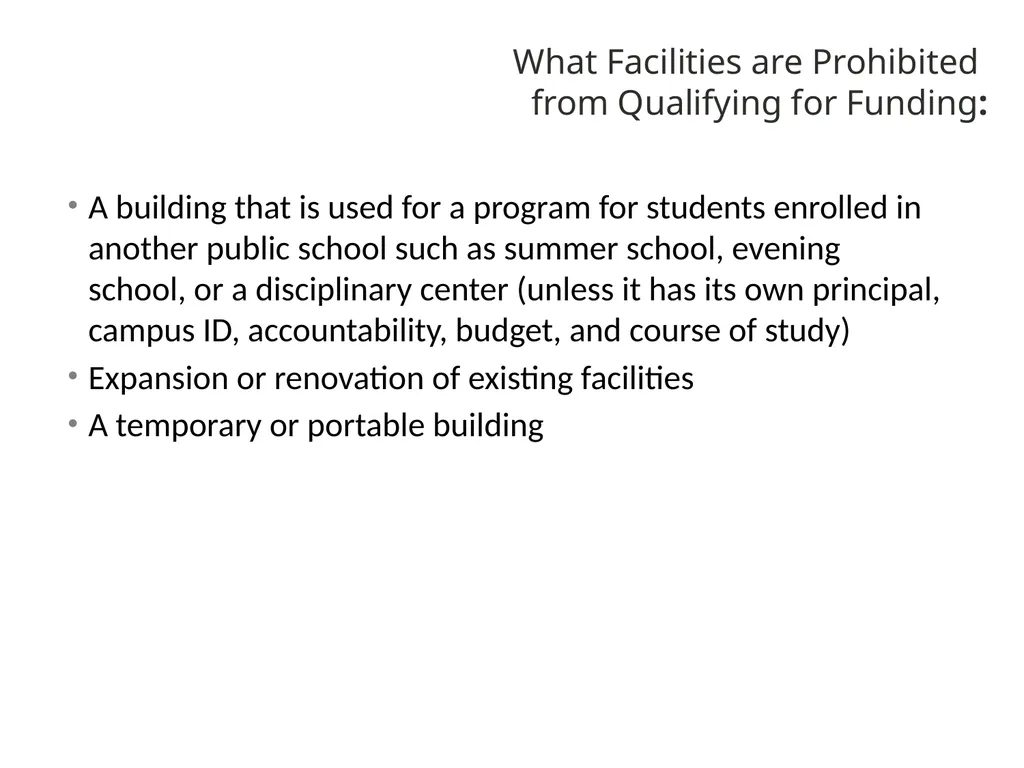
from Qualifying for Funding: A building that is used for a program for students enrolled in another public school such as summer school, evening school, or a disciplinary center (unless it has its own principal, campus ID, accountability, budget, and course of study)
Expansion or renovation of existing facilities
A temporary or portable building<br>
Expansion or renovation of existing facilities
A temporary or portable building<br>
77
What Documents will I need to
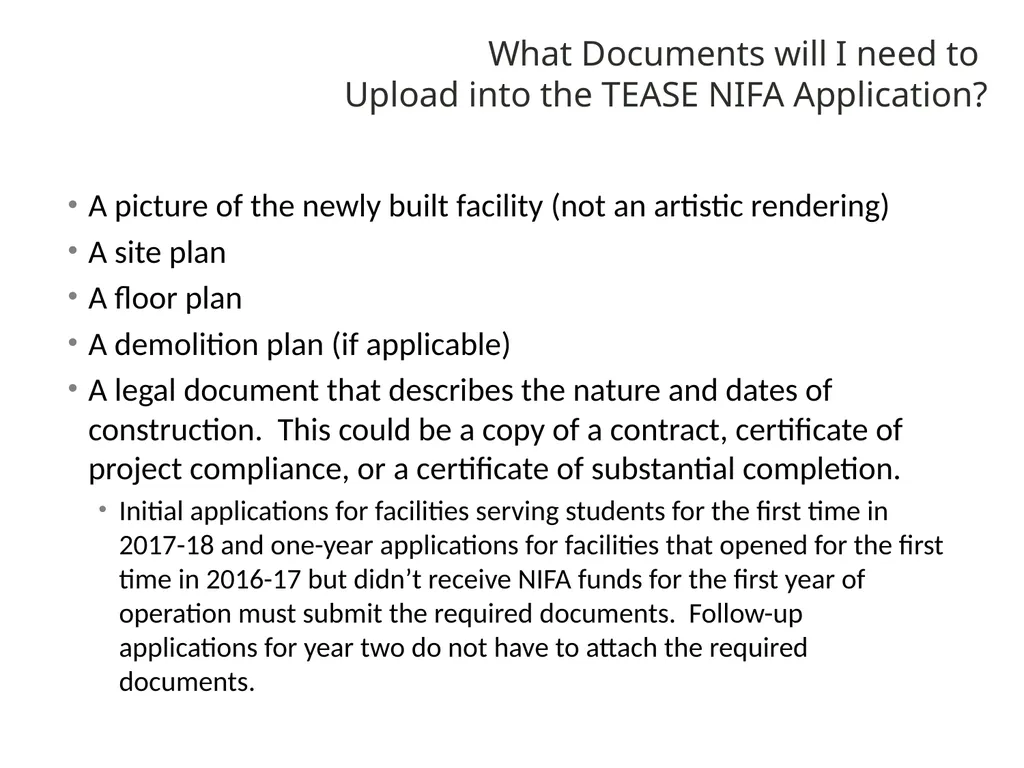
Upload into the TEASE NIFA Application? A picture of the newly built facility (not an artistic rendering)
A site plan
A floor plan
A demolition plan (if applicable)
A legal document that describes the nature and dates of construction. This could be a copy of a contract, certificate of project compliance, or a certificate of substantial completion.
Initial applications for facilities serving students for the first time in 2017-18 and one-year applications for facilities that opened for the first time in 2016-17 but didn’t receive NIFA funds for the first year of operation must submit the required documents. Follow-up applications for year two do not have to attach the required documents.<br>
A site plan
A floor plan
A demolition plan (if applicable)
A legal document that describes the nature and dates of construction. This could be a copy of a contract, certificate of project compliance, or a certificate of substantial completion.
Initial applications for facilities serving students for the first time in 2017-18 and one-year applications for facilities that opened for the first time in 2016-17 but didn’t receive NIFA funds for the first year of operation must submit the required documents. Follow-up applications for year two do not have to attach the required documents.<br>
78
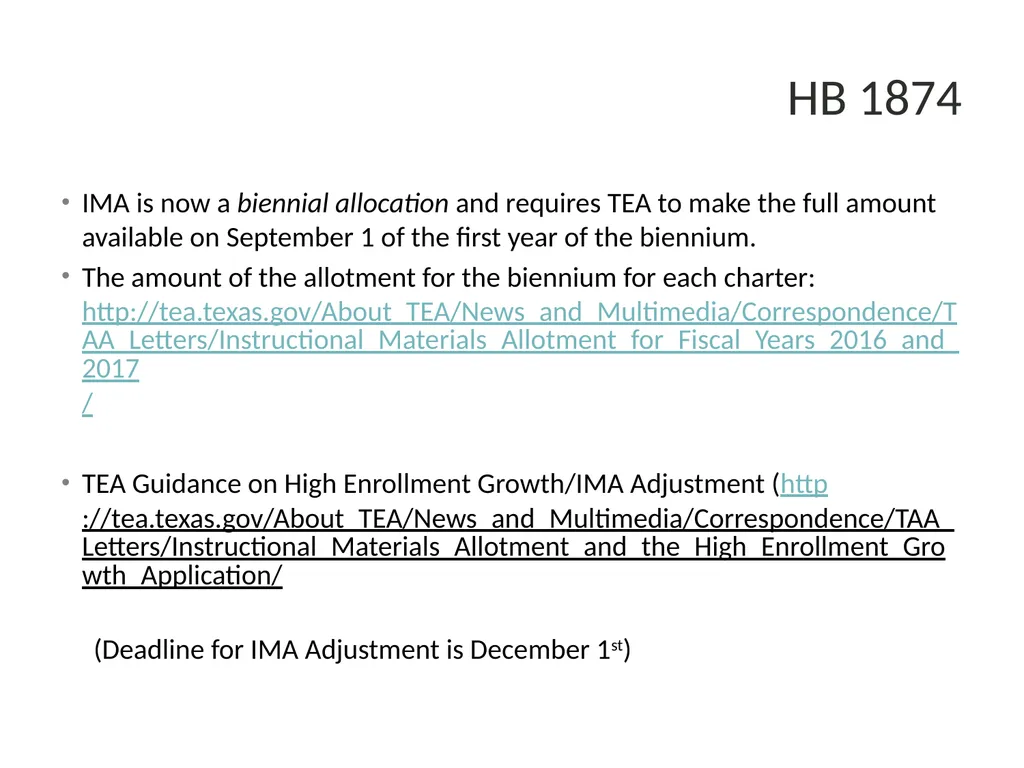
HB 1874 IMA is now a biennial allocation and requires TEA to make the full amount available on September 1 of the first year of the biennium.
The amount of the allotment for the biennium for each charter: http://tea.texas.gov/About_TEA/News_and_Multimedia/Correspondence/TAA_Letters/Instructional_Materials_Allotment_for_Fiscal_Years_2016_and_2017/
TEA Guidance on High Enrollment Growth/IMA Adjustment (http://tea.texas.gov/About_TEA/News_and_Multimedia/Correspondence/TAA_Letters/Instructional_Materials_Allotment_and_the_High_Enrollment_Growth_Application/
(Deadline for IMA Adjustment is December 1st)<br>
The amount of the allotment for the biennium for each charter: http://tea.texas.gov/About_TEA/News_and_Multimedia/Correspondence/TAA_Letters/Instructional_Materials_Allotment_for_Fiscal_Years_2016_and_2017/
TEA Guidance on High Enrollment Growth/IMA Adjustment (http://tea.texas.gov/About_TEA/News_and_Multimedia/Correspondence/TAA_Letters/Instructional_Materials_Allotment_and_the_High_Enrollment_Growth_Application/
(Deadline for IMA Adjustment is December 1st)<br>
79
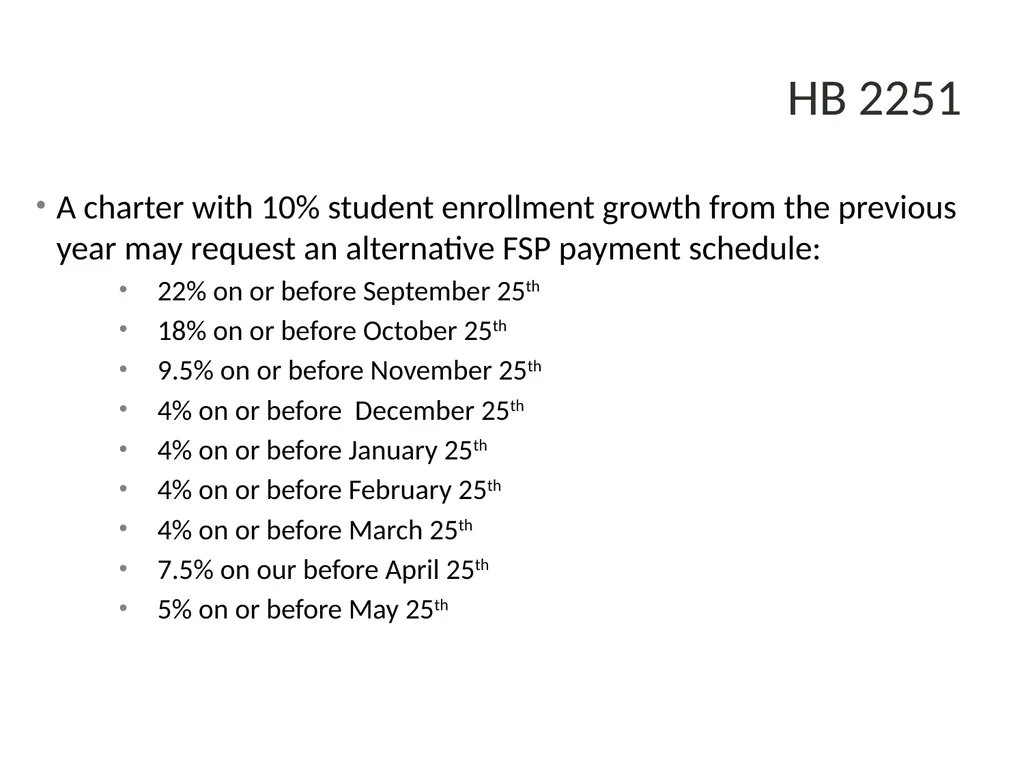
HB 2251 A charter with 10% student enrollment growth from the previous year may request an alternative FSP payment schedule:
22% on or before September 25th
18% on or before October 25th
9.5% on or before November 25th
4% on or before December 25th
4% on or before January 25th
4% on or before February 25th
4% on or before March 25th
7.5% on our before April 25th
5% on or before May 25th<br>
22% on or before September 25th
18% on or before October 25th
9.5% on or before November 25th
4% on or before December 25th
4% on or before January 25th
4% on or before February 25th
4% on or before March 25th
7.5% on our before April 25th
5% on or before May 25th<br>
80
Goal: 1 million
students by 2025<br>
81
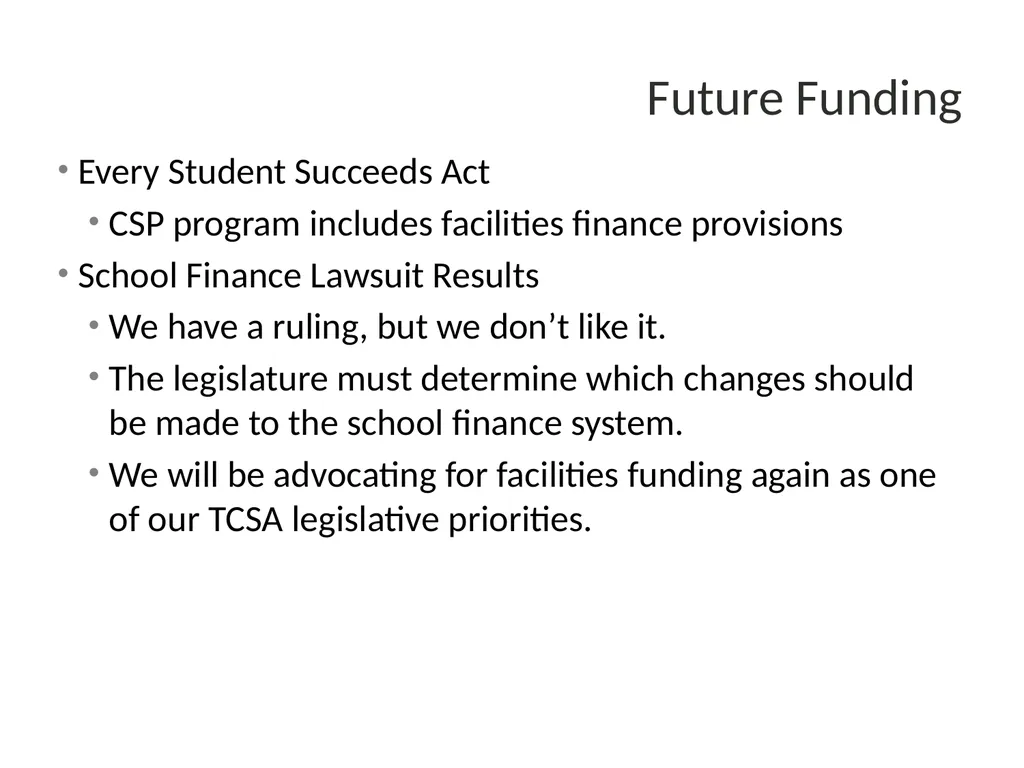
Future Funding Every Student Succeeds Act
CSP program includes facilities finance provisions
School Finance Lawsuit Results
We have a ruling, but we don’t like it.
The legislature must determine which changes should be made to the school finance system.
We will be advocating for facilities funding again as one of our TCSA legislative priorities.<br>
CSP program includes facilities finance provisions
School Finance Lawsuit Results
We have a ruling, but we don’t like it.
The legislature must determine which changes should be made to the school finance system.
We will be advocating for facilities funding again as one of our TCSA legislative priorities.<br>
82
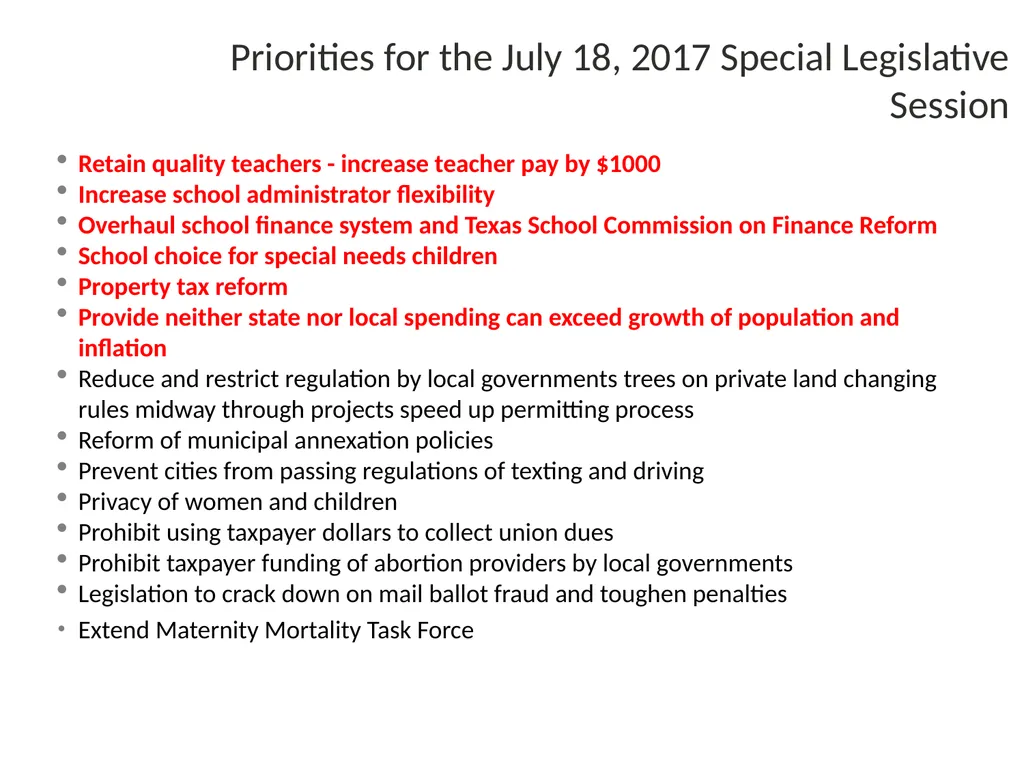
Priorities for the July 18, 2017 Special Legislative Session Retain quality teachers - increase teacher pay by $1000
Increase school administrator flexibility
Overhaul school finance system and Texas School Commission on Finance Reform
School choice for special needs children
Property tax reform
Provide neither state nor local spending can exceed growth of population and inflation
Reduce and restrict regulation by local governments trees on private land changing rules midway through projects speed up permitting process
Reform of municipal annexation policies
Prevent cities from passing regulations of texting and driving
Privacy of women and children
Prohibit using taxpayer dollars to collect union dues
Prohibit taxpayer funding of abortion providers by local governments
Legislation to crack down on mail ballot fraud and toughen penalties
Extend Maternity Mortality Task Force<br>
Increase school administrator flexibility
Overhaul school finance system and Texas School Commission on Finance Reform
School choice for special needs children
Property tax reform
Provide neither state nor local spending can exceed growth of population and inflation
Reduce and restrict regulation by local governments trees on private land changing rules midway through projects speed up permitting process
Reform of municipal annexation policies
Prevent cities from passing regulations of texting and driving
Privacy of women and children
Prohibit using taxpayer dollars to collect union dues
Prohibit taxpayer funding of abortion providers by local governments
Legislation to crack down on mail ballot fraud and toughen penalties
Extend Maternity Mortality Task Force<br>
83
What does the Public See? Foundation School Program Report
Access current year FSP reports here: https://wfspcprdap1b16.tea.state.tx.us/Fsp/Reports/ReportSelection.aspx
Texas Academic Performance Reporting Data
Revenue and Expenditure Data
Access your TAPR here: http://ritter.tea.state.tx.us/perfreport/tapr/2014/srch.html?srch=D
Charter FIRST<br>
Access current year FSP reports here: https://wfspcprdap1b16.tea.state.tx.us/Fsp/Reports/ReportSelection.aspx
Texas Academic Performance Reporting Data
Revenue and Expenditure Data
Access your TAPR here: http://ritter.tea.state.tx.us/perfreport/tapr/2014/srch.html?srch=D
Charter FIRST<br>
84
Bruce Marchand, Ed.D.
Director of Charter School Growth and Development
512.584.8272 x 320
bmarchand@txcharterschools.org<br>
Director of Charter School Growth and Development
512.584.8272 x 320
bmarchand@txcharterschools.org<br>