
School Finance Training Slide 1 --- No Recommended
KL
Published · 31 slides · 0 views

1 / 1
Description
School Finance Training Slide 1 --- No Recommended Changes Slide 2 Taxing Authority 53F-8-201. Annual Certification of Tax Rate Prior to June 22 of each year, each local school board shall certify to the county legislative body the proposed
Related Topics
Share
Embed code
Download this presentation From Below
"School Finance Training Slide 1 --- No Recommended" is the property of its rightful owner. Permission is granted to download and print the materials on this website for personal, non-commercial use only, and to display it on your personal computer provided you do not modify the materials and that you retain all copyright notices contained in the materials. By downloading content from our website, you accept the terms of this agreement.
Presentation Transcript
01
School Finance Training Slide 1 --- No Recommended Changes<br>
02
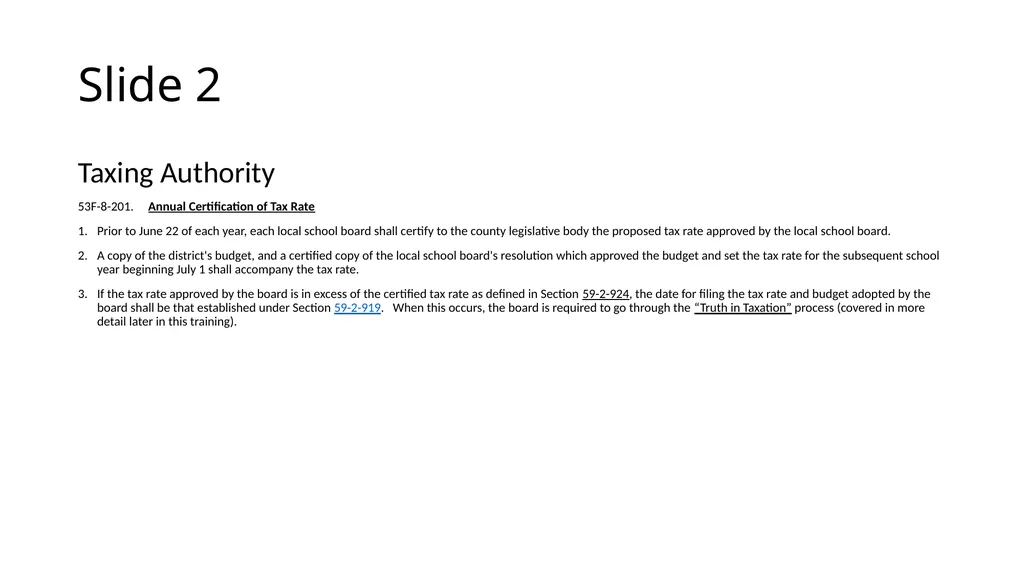
Slide 2 Taxing Authority
53F-8-201. Annual Certification of Tax Rate
Prior to June 22 of each year, each local school board shall certify to the county legislative body the proposed tax rate approved by the local school board.
A copy of the district's budget, and a certified copy of the local school board's resolution which approved the budget and set the tax rate for the subsequent school year beginning July 1 shall accompany the tax rate.
If the tax rate approved by the board is in excess of the certified tax rate as defined in Section 59-2-924, the date for filing the tax rate and budget adopted by the board shall be that established under Section 59-2-919. When this occurs, the board is required to go through the “Truth in Taxation” process (covered in more detail later in this training).<br>
53F-8-201. Annual Certification of Tax Rate
Prior to June 22 of each year, each local school board shall certify to the county legislative body the proposed tax rate approved by the local school board.
A copy of the district's budget, and a certified copy of the local school board's resolution which approved the budget and set the tax rate for the subsequent school year beginning July 1 shall accompany the tax rate.
If the tax rate approved by the board is in excess of the certified tax rate as defined in Section 59-2-924, the date for filing the tax rate and budget adopted by the board shall be that established under Section 59-2-919. When this occurs, the board is required to go through the “Truth in Taxation” process (covered in more detail later in this training).<br>
03
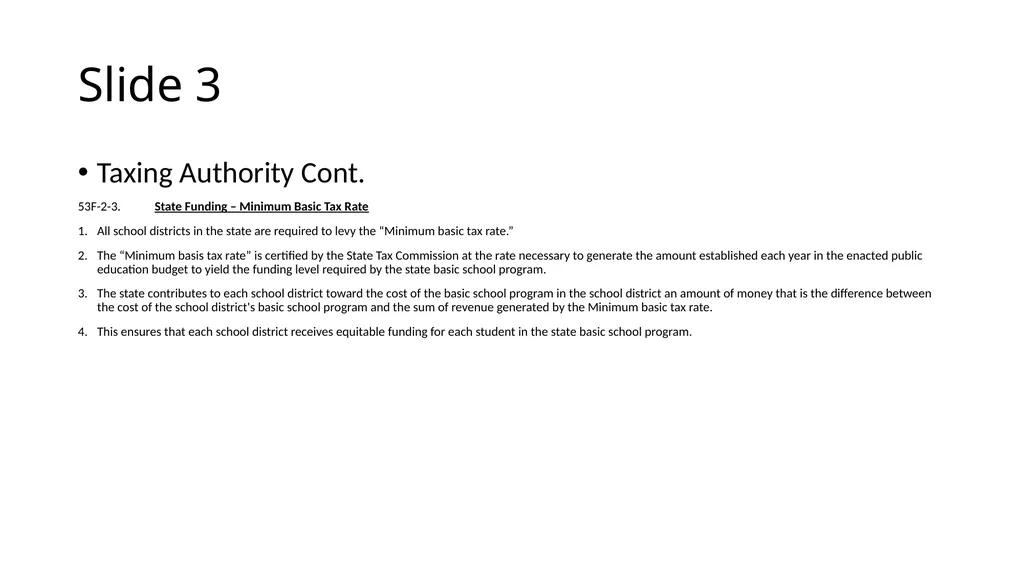
Slide 3 Taxing Authority Cont.
53F-2-3. State Funding – Minimum Basic Tax Rate
All school districts in the state are required to levy the “Minimum basic tax rate.”
The “Minimum basis tax rate” is certified by the State Tax Commission at the rate necessary to generate the amount established each year in the enacted public education budget to yield the funding level required by the state basic school program.
The state contributes to each school district toward the cost of the basic school program in the school district an amount of money that is the difference between the cost of the school district's basic school program and the sum of revenue generated by the Minimum basic tax rate.
This ensures that each school district receives equitable funding for each student in the state basic school program.<br>
53F-2-3. State Funding – Minimum Basic Tax Rate
All school districts in the state are required to levy the “Minimum basic tax rate.”
The “Minimum basis tax rate” is certified by the State Tax Commission at the rate necessary to generate the amount established each year in the enacted public education budget to yield the funding level required by the state basic school program.
The state contributes to each school district toward the cost of the basic school program in the school district an amount of money that is the difference between the cost of the school district's basic school program and the sum of revenue generated by the Minimum basic tax rate.
This ensures that each school district receives equitable funding for each student in the state basic school program.<br>
04
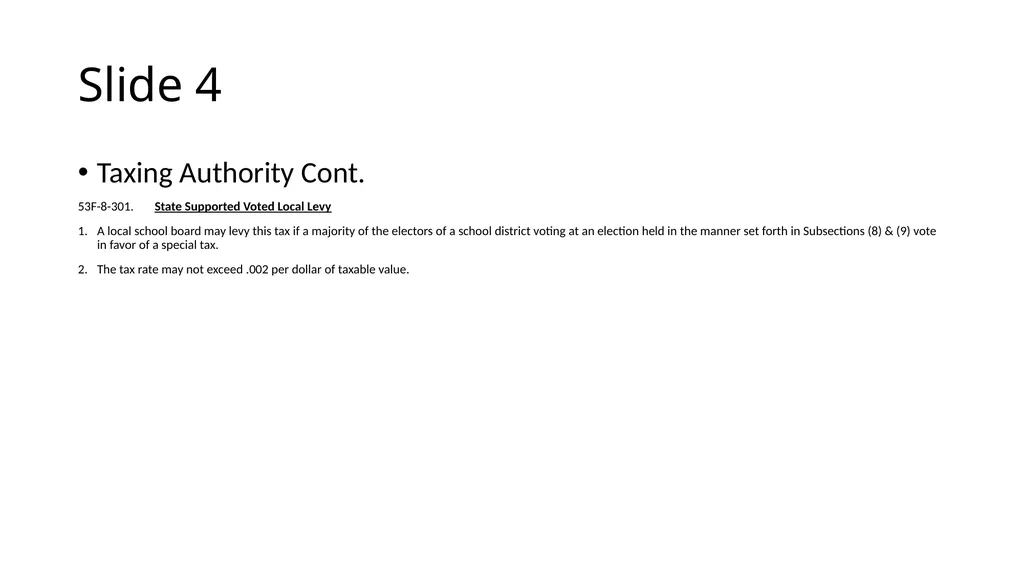
Slide 4 Taxing Authority Cont.
53F-8-301. State Supported Voted Local Levy
A local school board may levy this tax if a majority of the electors of a school district voting at an election held in the manner set forth in Subsections (8) & (9) vote in favor of a special tax.
The tax rate may not exceed .002 per dollar of taxable value.<br>
53F-8-301. State Supported Voted Local Levy
A local school board may levy this tax if a majority of the electors of a school district voting at an election held in the manner set forth in Subsections (8) & (9) vote in favor of a special tax.
The tax rate may not exceed .002 per dollar of taxable value.<br>
05
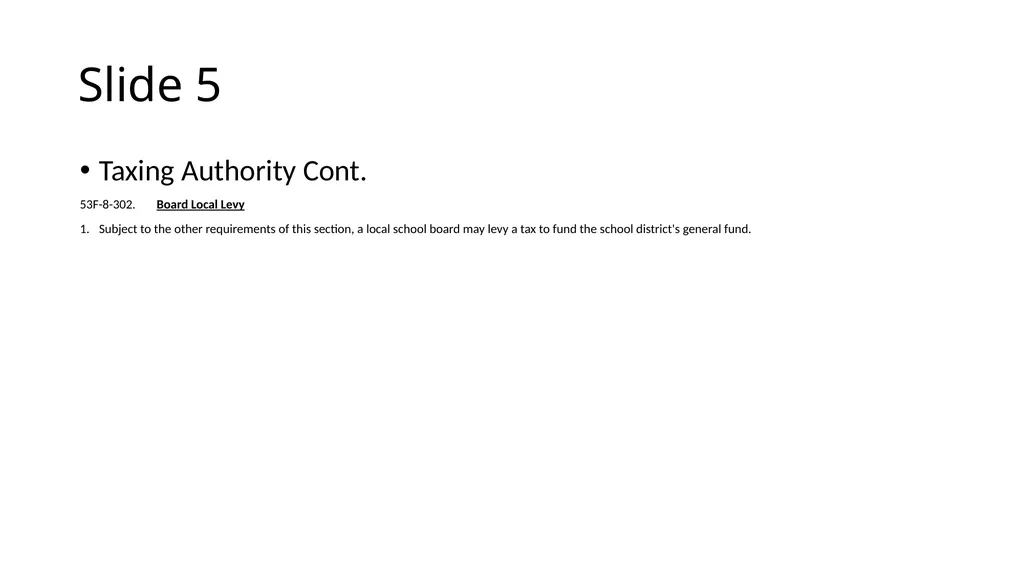
Slide 5 Taxing Authority Cont.
53F-8-302. Board Local Levy
Subject to the other requirements of this section, a local school board may levy a tax to fund the school district's general fund.<br>
53F-8-302. Board Local Levy
Subject to the other requirements of this section, a local school board may levy a tax to fund the school district's general fund.<br>
06
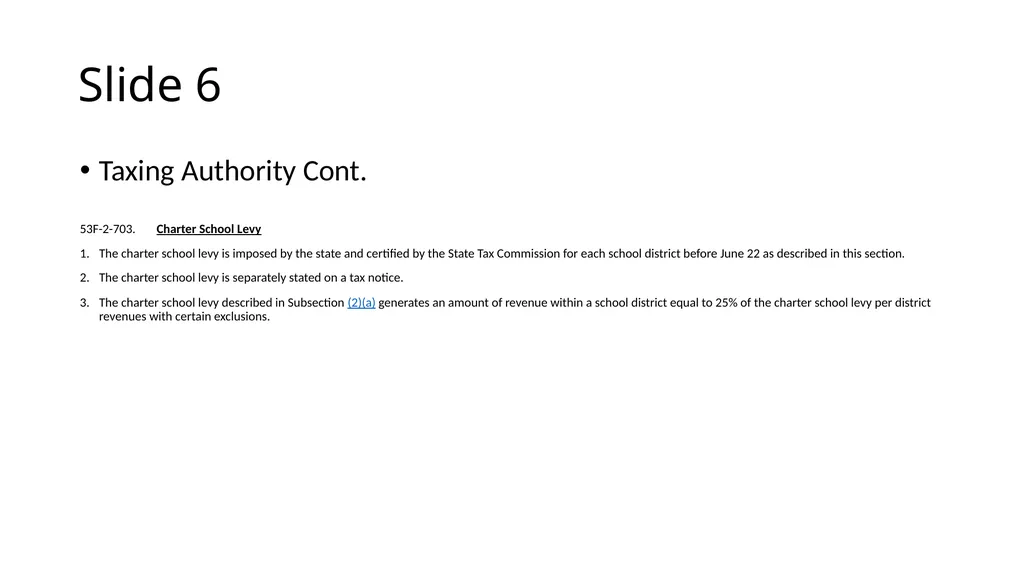
Slide 6 Taxing Authority Cont.
53F-2-703. Charter School Levy
The charter school levy is imposed by the state and certified by the State Tax Commission for each school district before June 22 as described in this section.
The charter school levy is separately stated on a tax notice.
The charter school levy described in Subsection (2)(a) generates an amount of revenue within a school district equal to 25% of the charter school levy per district revenues with certain exclusions.<br>
53F-2-703. Charter School Levy
The charter school levy is imposed by the state and certified by the State Tax Commission for each school district before June 22 as described in this section.
The charter school levy is separately stated on a tax notice.
The charter school levy described in Subsection (2)(a) generates an amount of revenue within a school district equal to 25% of the charter school levy per district revenues with certain exclusions.<br>
07
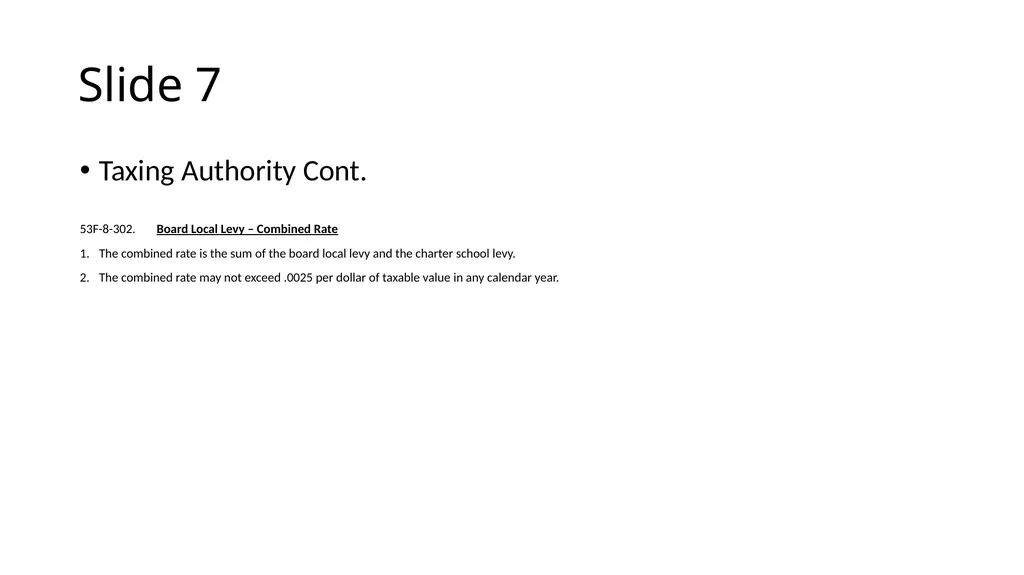
Slide 7 Taxing Authority Cont.
53F-8-302. Board Local Levy – Combined Rate
The combined rate is the sum of the board local levy and the charter school levy.
The combined rate may not exceed .0025 per dollar of taxable value in any calendar year.<br>
53F-8-302. Board Local Levy – Combined Rate
The combined rate is the sum of the board local levy and the charter school levy.
The combined rate may not exceed .0025 per dollar of taxable value in any calendar year.<br>
08
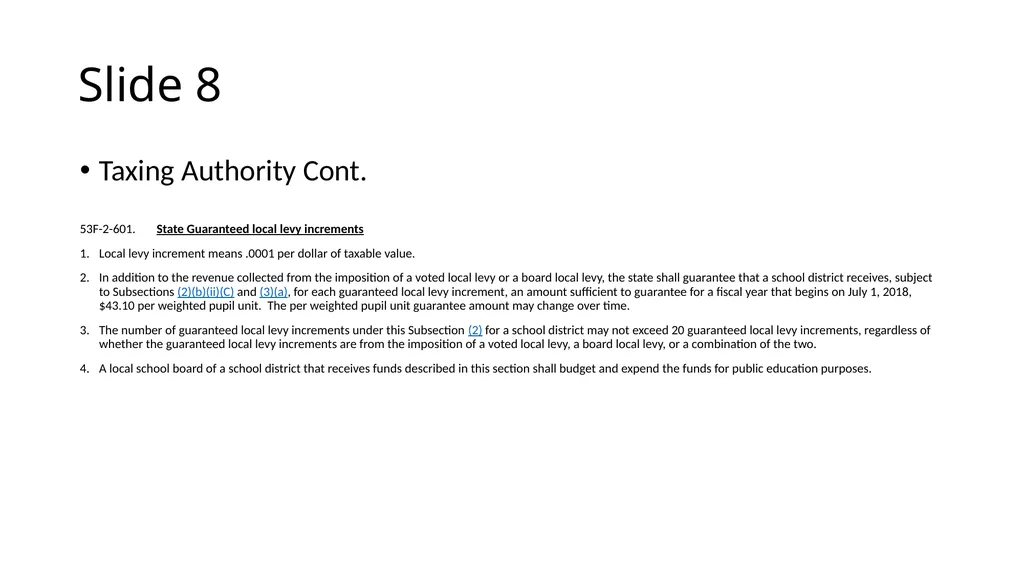
Slide 8 Taxing Authority Cont.
53F-2-601. State Guaranteed local levy increments
Local levy increment means .0001 per dollar of taxable value.
In addition to the revenue collected from the imposition of a voted local levy or a board local levy, the state shall guarantee that a school district receives, subject to Subsections (2)(b)(ii)(C) and (3)(a), for each guaranteed local levy increment, an amount sufficient to guarantee for a fiscal year that begins on July 1, 2018, $43.10 per weighted pupil unit. The per weighted pupil unit guarantee amount may change over time.
The number of guaranteed local levy increments under this Subsection (2) for a school district may not exceed 20 guaranteed local levy increments, regardless of whether the guaranteed local levy increments are from the imposition of a voted local levy, a board local levy, or a combination of the two.
A local school board of a school district that receives funds described in this section shall budget and expend the funds for public education purposes.<br>
53F-2-601. State Guaranteed local levy increments
Local levy increment means .0001 per dollar of taxable value.
In addition to the revenue collected from the imposition of a voted local levy or a board local levy, the state shall guarantee that a school district receives, subject to Subsections (2)(b)(ii)(C) and (3)(a), for each guaranteed local levy increment, an amount sufficient to guarantee for a fiscal year that begins on July 1, 2018, $43.10 per weighted pupil unit. The per weighted pupil unit guarantee amount may change over time.
The number of guaranteed local levy increments under this Subsection (2) for a school district may not exceed 20 guaranteed local levy increments, regardless of whether the guaranteed local levy increments are from the imposition of a voted local levy, a board local levy, or a combination of the two.
A local school board of a school district that receives funds described in this section shall budget and expend the funds for public education purposes.<br>
09
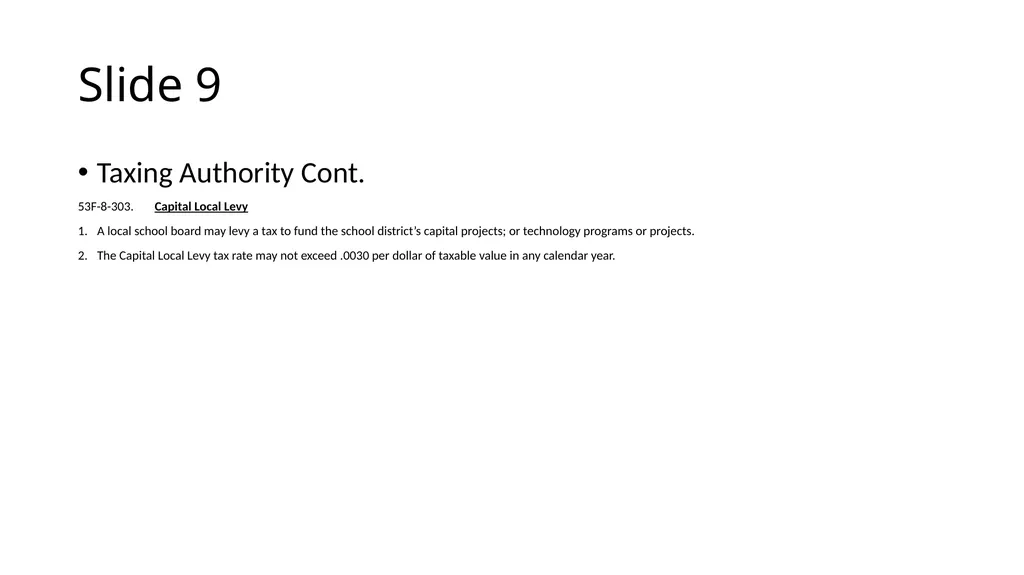
Slide 9 Taxing Authority Cont.
53F-8-303. Capital Local Levy
A local school board may levy a tax to fund the school district’s capital projects; or technology programs or projects.
The Capital Local Levy tax rate may not exceed .0030 per dollar of taxable value in any calendar year.<br>
53F-8-303. Capital Local Levy
A local school board may levy a tax to fund the school district’s capital projects; or technology programs or projects.
The Capital Local Levy tax rate may not exceed .0030 per dollar of taxable value in any calendar year.<br>
10
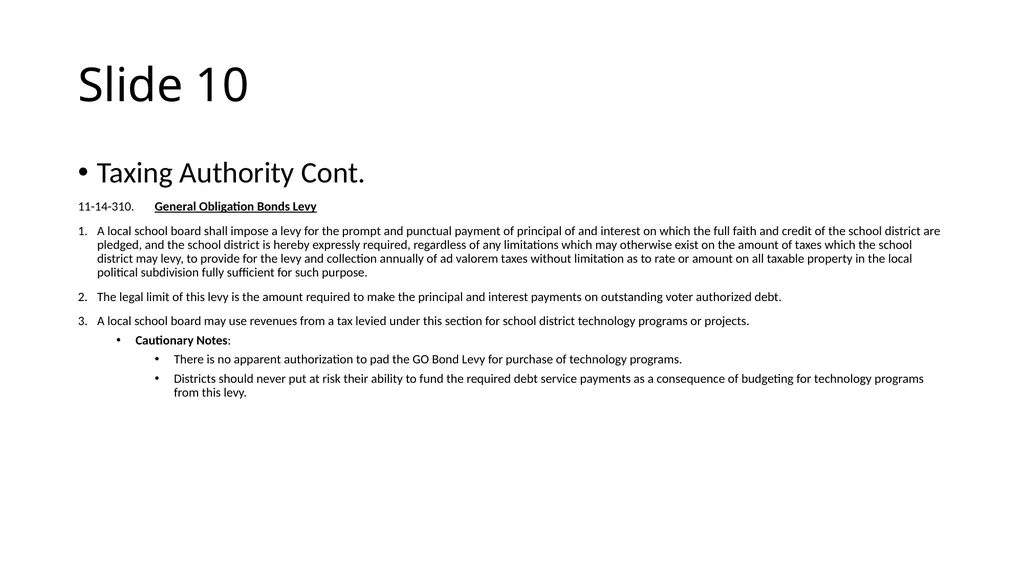
Slide 10 Taxing Authority Cont.
11-14-310. General Obligation Bonds Levy
A local school board shall impose a levy for the prompt and punctual payment of principal of and interest on which the full faith and credit of the school district are pledged, and the school district is hereby expressly required, regardless of any limitations which may otherwise exist on the amount of taxes which the school district may levy, to provide for the levy and collection annually of ad valorem taxes without limitation as to rate or amount on all taxable property in the local political subdivision fully sufficient for such purpose.
The legal limit of this levy is the amount required to make the principal and interest payments on outstanding voter authorized debt.
A local school board may use revenues from a tax levied under this section for school district technology programs or projects.
Cautionary Notes:
There is no apparent authorization to pad the GO Bond Levy for purchase of technology programs.
Districts should never put at risk their ability to fund the required debt service payments as a consequence of budgeting for technology programs from this levy.<br>
11-14-310. General Obligation Bonds Levy
A local school board shall impose a levy for the prompt and punctual payment of principal of and interest on which the full faith and credit of the school district are pledged, and the school district is hereby expressly required, regardless of any limitations which may otherwise exist on the amount of taxes which the school district may levy, to provide for the levy and collection annually of ad valorem taxes without limitation as to rate or amount on all taxable property in the local political subdivision fully sufficient for such purpose.
The legal limit of this levy is the amount required to make the principal and interest payments on outstanding voter authorized debt.
A local school board may use revenues from a tax levied under this section for school district technology programs or projects.
Cautionary Notes:
There is no apparent authorization to pad the GO Bond Levy for purchase of technology programs.
Districts should never put at risk their ability to fund the required debt service payments as a consequence of budgeting for technology programs from this levy.<br>
11
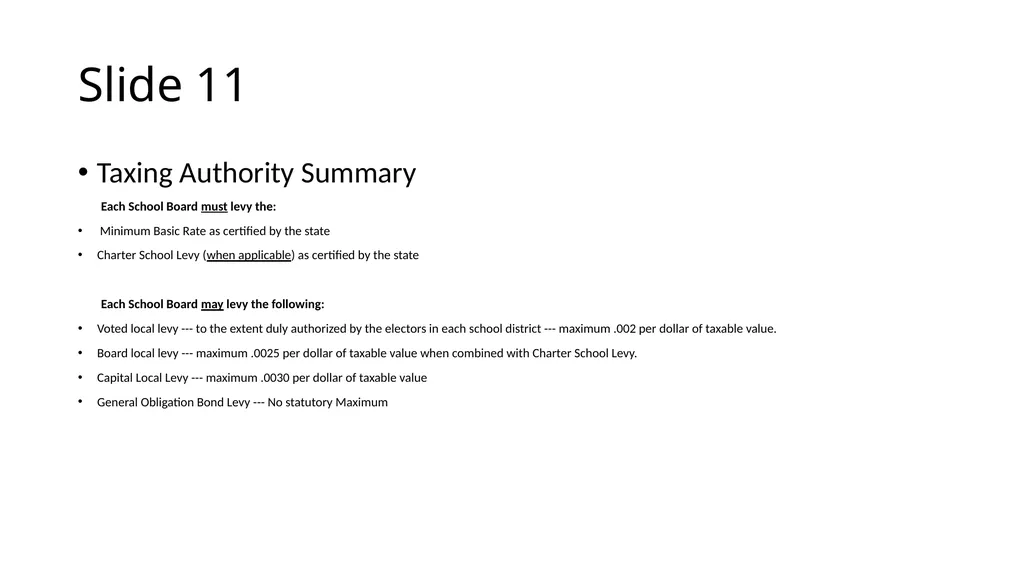
Slide 11 Taxing Authority Summary
Each School Board must levy the:
Minimum Basic Rate as certified by the state
Charter School Levy (when applicable) as certified by the state
Each School Board may levy the following:
Voted local levy --- to the extent duly authorized by the electors in each school district --- maximum .002 per dollar of taxable value.
Board local levy --- maximum .0025 per dollar of taxable value when combined with Charter School Levy.
Capital Local Levy --- maximum .0030 per dollar of taxable value
General Obligation Bond Levy --- No statutory Maximum<br>
Each School Board must levy the:
Minimum Basic Rate as certified by the state
Charter School Levy (when applicable) as certified by the state
Each School Board may levy the following:
Voted local levy --- to the extent duly authorized by the electors in each school district --- maximum .002 per dollar of taxable value.
Board local levy --- maximum .0025 per dollar of taxable value when combined with Charter School Levy.
Capital Local Levy --- maximum .0030 per dollar of taxable value
General Obligation Bond Levy --- No statutory Maximum<br>
12
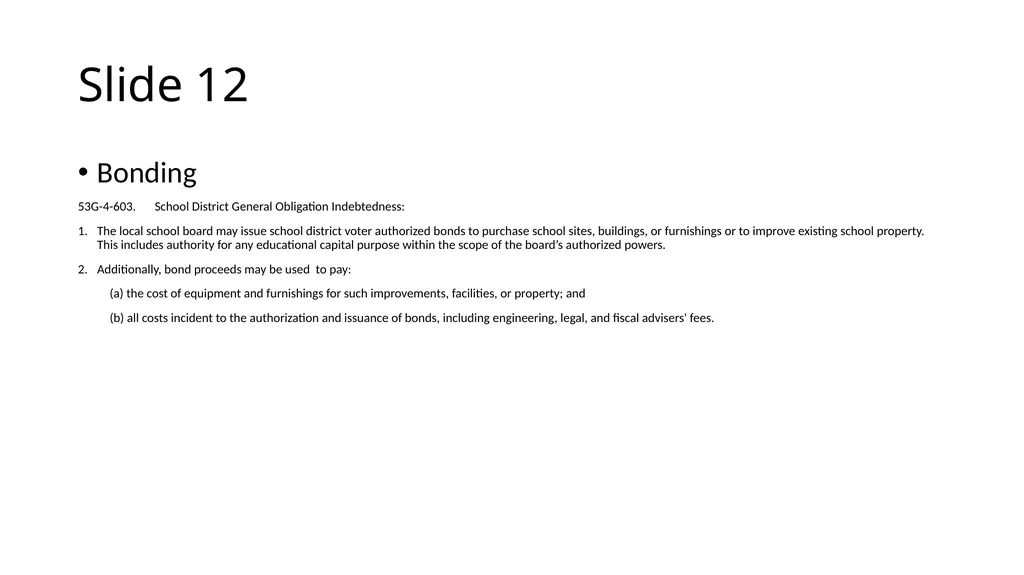
Slide 12 Bonding
53G-4-603. School District General Obligation Indebtedness:
The local school board may issue school district voter authorized bonds to purchase school sites, buildings, or furnishings or to improve existing school property. This includes authority for any educational capital purpose within the scope of the board’s authorized powers.
Additionally, bond proceeds may be used to pay:
(a) the cost of equipment and furnishings for such improvements, facilities, or property; and
(b) all costs incident to the authorization and issuance of bonds, including engineering, legal, and fiscal advisers' fees.<br>
53G-4-603. School District General Obligation Indebtedness:
The local school board may issue school district voter authorized bonds to purchase school sites, buildings, or furnishings or to improve existing school property. This includes authority for any educational capital purpose within the scope of the board’s authorized powers.
Additionally, bond proceeds may be used to pay:
(a) the cost of equipment and furnishings for such improvements, facilities, or property; and
(b) all costs incident to the authorization and issuance of bonds, including engineering, legal, and fiscal advisers' fees.<br>
13
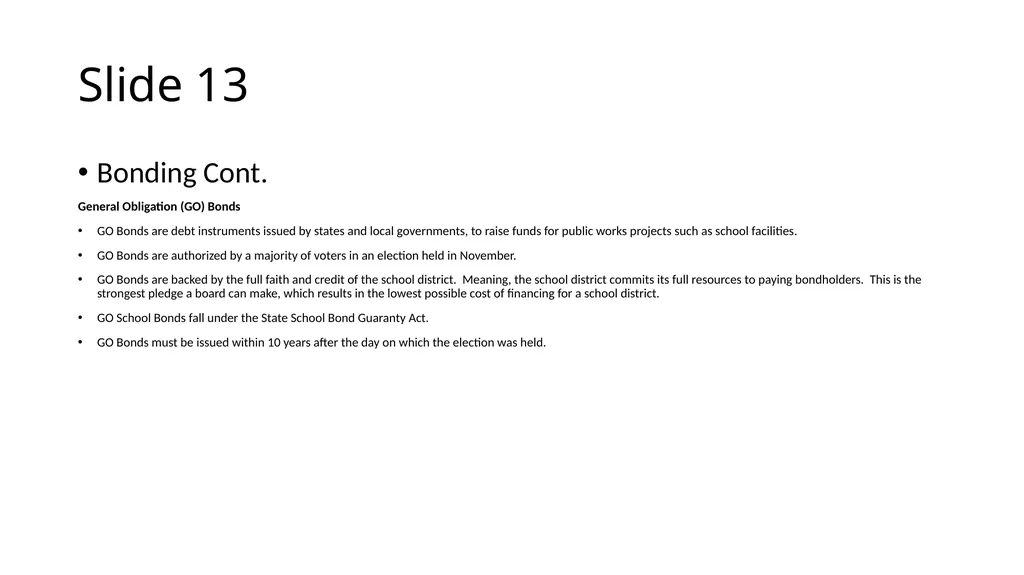
Slide 13 Bonding Cont.
General Obligation (GO) Bonds
GO Bonds are debt instruments issued by states and local governments, to raise funds for public works projects such as school facilities.
GO Bonds are authorized by a majority of voters in an election held in November.
GO Bonds are backed by the full faith and credit of the school district. Meaning, the school district commits its full resources to paying bondholders. This is the strongest pledge a board can make, which results in the lowest possible cost of financing for a school district.
GO School Bonds fall under the State School Bond Guaranty Act.
GO Bonds must be issued within 10 years after the day on which the election was held.<br>
General Obligation (GO) Bonds
GO Bonds are debt instruments issued by states and local governments, to raise funds for public works projects such as school facilities.
GO Bonds are authorized by a majority of voters in an election held in November.
GO Bonds are backed by the full faith and credit of the school district. Meaning, the school district commits its full resources to paying bondholders. This is the strongest pledge a board can make, which results in the lowest possible cost of financing for a school district.
GO School Bonds fall under the State School Bond Guaranty Act.
GO Bonds must be issued within 10 years after the day on which the election was held.<br>
14
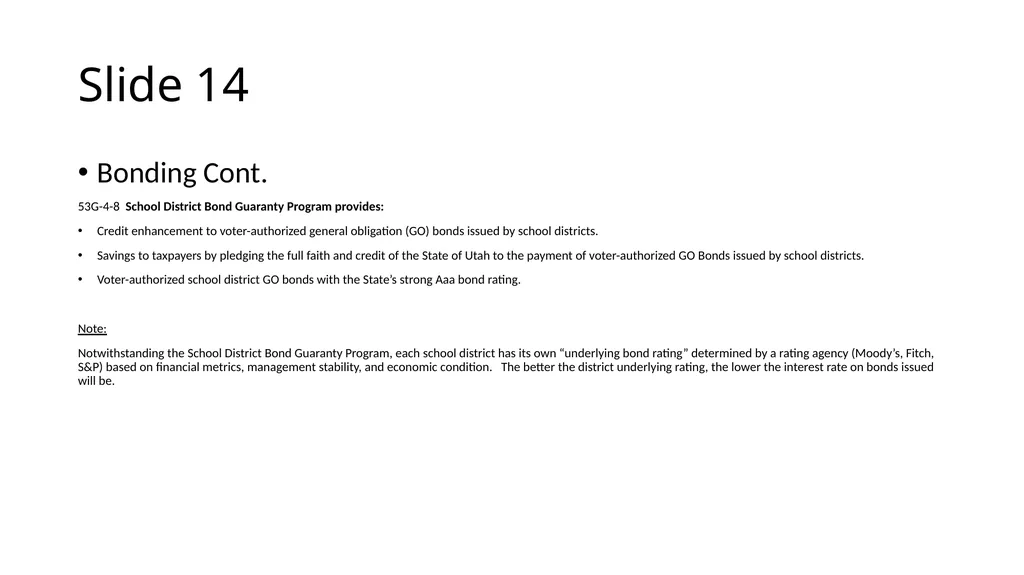
Slide 14 Bonding Cont.
53G-4-8 School District Bond Guaranty Program provides:
Credit enhancement to voter-authorized general obligation (GO) bonds issued by school districts.
Savings to taxpayers by pledging the full faith and credit of the State of Utah to the payment of voter-authorized GO Bonds issued by school districts.
Voter-authorized school district GO bonds with the State’s strong Aaa bond rating.
Note:
Notwithstanding the School District Bond Guaranty Program, each school district has its own “underlying bond rating” determined by a rating agency (Moody’s, Fitch, S&P) based on financial metrics, management stability, and economic condition. The better the district underlying rating, the lower the interest rate on bonds issued will be.<br>
53G-4-8 School District Bond Guaranty Program provides:
Credit enhancement to voter-authorized general obligation (GO) bonds issued by school districts.
Savings to taxpayers by pledging the full faith and credit of the State of Utah to the payment of voter-authorized GO Bonds issued by school districts.
Voter-authorized school district GO bonds with the State’s strong Aaa bond rating.
Note:
Notwithstanding the School District Bond Guaranty Program, each school district has its own “underlying bond rating” determined by a rating agency (Moody’s, Fitch, S&P) based on financial metrics, management stability, and economic condition. The better the district underlying rating, the lower the interest rate on bonds issued will be.<br>
15
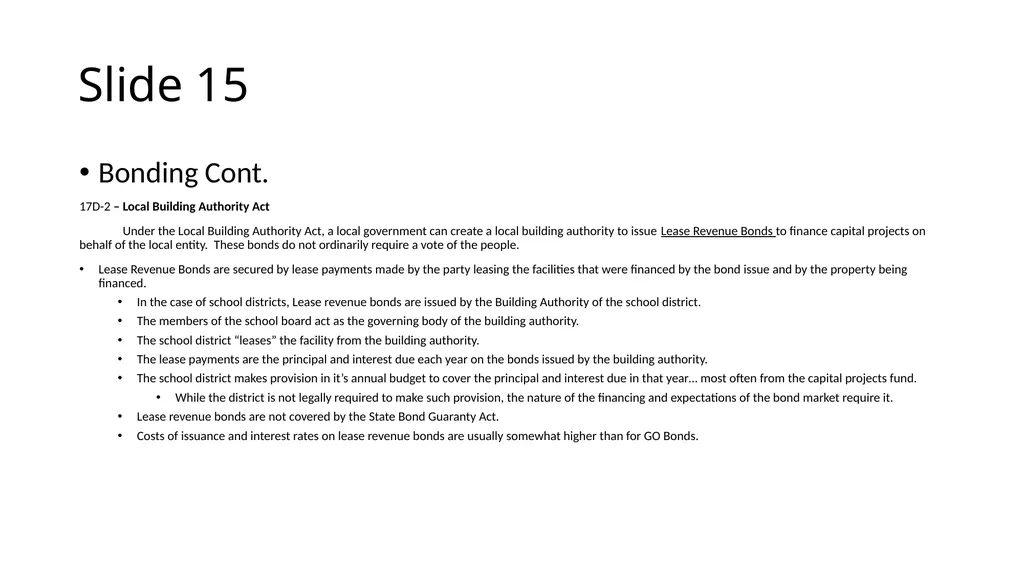
Slide 15 Bonding Cont.
17D-2 – Local Building Authority Act
Under the Local Building Authority Act, a local government can create a local building authority to issue Lease Revenue Bonds to finance capital projects on behalf of the local entity. These bonds do not ordinarily require a vote of the people.
Lease Revenue Bonds are secured by lease payments made by the party leasing the facilities that were financed by the bond issue and by the property being financed.
In the case of school districts, Lease revenue bonds are issued by the Building Authority of the school district.
The members of the school board act as the governing body of the building authority.
The school district “leases” the facility from the building authority.
The lease payments are the principal and interest due each year on the bonds issued by the building authority.
The school district makes provision in it’s annual budget to cover the principal and interest due in that year… most often from the capital projects fund.
While the district is not legally required to make such provision, the nature of the financing and expectations of the bond market require it.
Lease revenue bonds are not covered by the State Bond Guaranty Act.
Costs of issuance and interest rates on lease revenue bonds are usually somewhat higher than for GO Bonds.<br>
17D-2 – Local Building Authority Act
Under the Local Building Authority Act, a local government can create a local building authority to issue Lease Revenue Bonds to finance capital projects on behalf of the local entity. These bonds do not ordinarily require a vote of the people.
Lease Revenue Bonds are secured by lease payments made by the party leasing the facilities that were financed by the bond issue and by the property being financed.
In the case of school districts, Lease revenue bonds are issued by the Building Authority of the school district.
The members of the school board act as the governing body of the building authority.
The school district “leases” the facility from the building authority.
The lease payments are the principal and interest due each year on the bonds issued by the building authority.
The school district makes provision in it’s annual budget to cover the principal and interest due in that year… most often from the capital projects fund.
While the district is not legally required to make such provision, the nature of the financing and expectations of the bond market require it.
Lease revenue bonds are not covered by the State Bond Guaranty Act.
Costs of issuance and interest rates on lease revenue bonds are usually somewhat higher than for GO Bonds.<br>
16
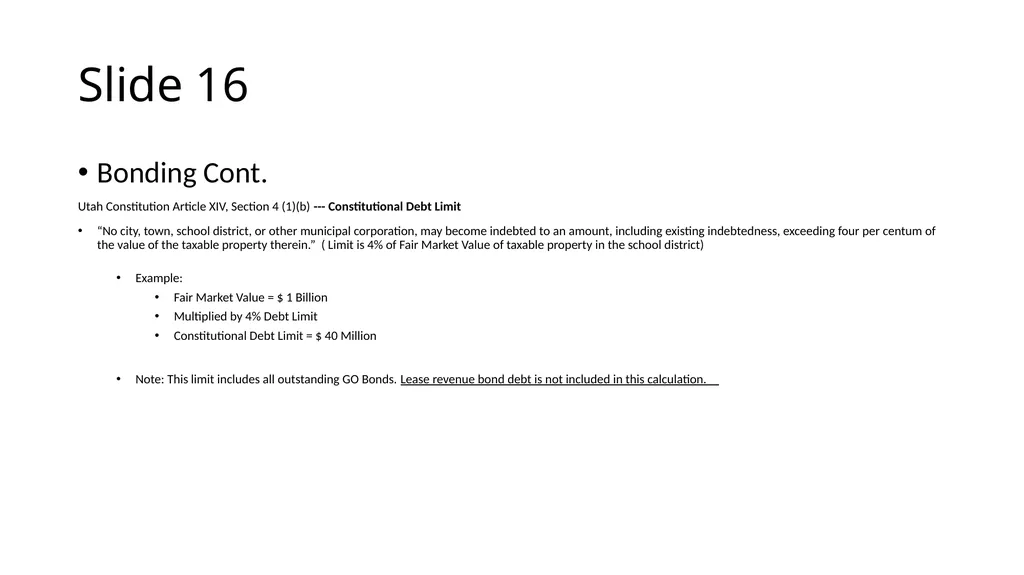
Slide 16 Bonding Cont.
Utah Constitution Article XIV, Section 4 (1)(b) --- Constitutional Debt Limit
“No city, town, school district, or other municipal corporation, may become indebted to an amount, including existing indebtedness, exceeding four per centum of the value of the taxable property therein.” ( Limit is 4% of Fair Market Value of taxable property in the school district)
Example:
Fair Market Value = $ 1 Billion
Multiplied by 4% Debt Limit
Constitutional Debt Limit = $ 40 Million
Note: This limit includes all outstanding GO Bonds. Lease revenue bond debt is not included in this calculation.<br>
Utah Constitution Article XIV, Section 4 (1)(b) --- Constitutional Debt Limit
“No city, town, school district, or other municipal corporation, may become indebted to an amount, including existing indebtedness, exceeding four per centum of the value of the taxable property therein.” ( Limit is 4% of Fair Market Value of taxable property in the school district)
Example:
Fair Market Value = $ 1 Billion
Multiplied by 4% Debt Limit
Constitutional Debt Limit = $ 40 Million
Note: This limit includes all outstanding GO Bonds. Lease revenue bond debt is not included in this calculation.<br>
17
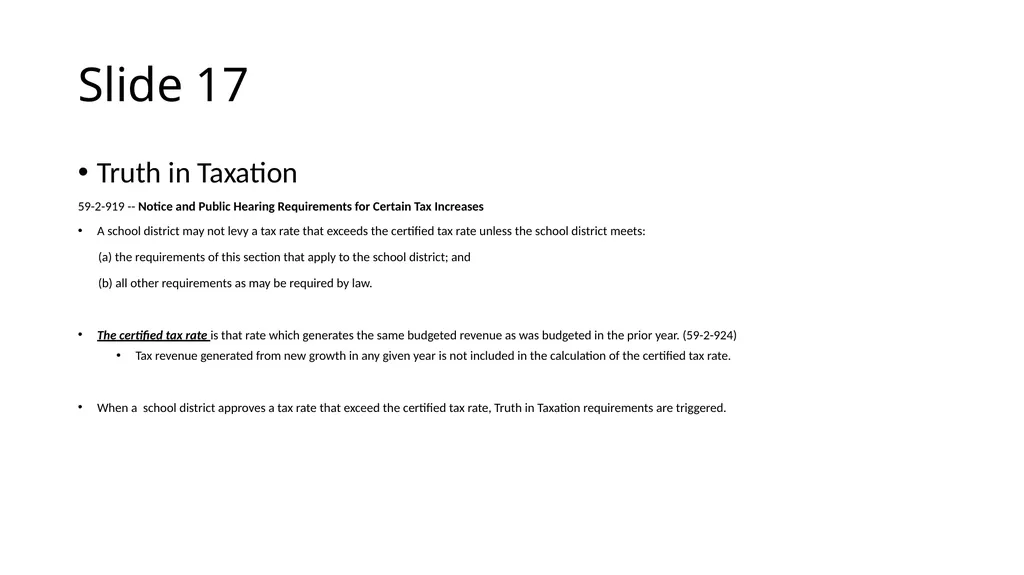
Slide 17 Truth in Taxation
59-2-919 -- Notice and Public Hearing Requirements for Certain Tax Increases
A school district may not levy a tax rate that exceeds the certified tax rate unless the school district meets:
(a) the requirements of this section that apply to the school district; and
(b) all other requirements as may be required by law.
The certified tax rate is that rate which generates the same budgeted revenue as was budgeted in the prior year. (59-2-924)
Tax revenue generated from new growth in any given year is not included in the calculation of the certified tax rate.
When a school district approves a tax rate that exceed the certified tax rate, Truth in Taxation requirements are triggered.<br>
59-2-919 -- Notice and Public Hearing Requirements for Certain Tax Increases
A school district may not levy a tax rate that exceeds the certified tax rate unless the school district meets:
(a) the requirements of this section that apply to the school district; and
(b) all other requirements as may be required by law.
The certified tax rate is that rate which generates the same budgeted revenue as was budgeted in the prior year. (59-2-924)
Tax revenue generated from new growth in any given year is not included in the calculation of the certified tax rate.
When a school district approves a tax rate that exceed the certified tax rate, Truth in Taxation requirements are triggered.<br>
18
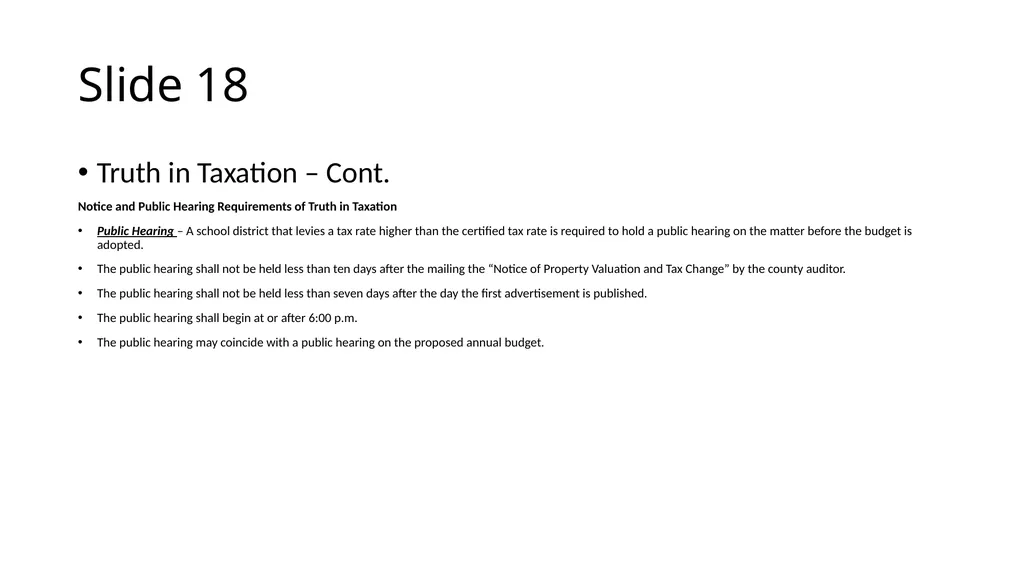
Slide 18 Truth in Taxation – Cont.
Notice and Public Hearing Requirements of Truth in Taxation
Public Hearing – A school district that levies a tax rate higher than the certified tax rate is required to hold a public hearing on the matter before the budget is adopted.
The public hearing shall not be held less than ten days after the mailing the “Notice of Property Valuation and Tax Change” by the county auditor.
The public hearing shall not be held less than seven days after the day the first advertisement is published.
The public hearing shall begin at or after 6:00 p.m.
The public hearing may coincide with a public hearing on the proposed annual budget.<br>
Notice and Public Hearing Requirements of Truth in Taxation
Public Hearing – A school district that levies a tax rate higher than the certified tax rate is required to hold a public hearing on the matter before the budget is adopted.
The public hearing shall not be held less than ten days after the mailing the “Notice of Property Valuation and Tax Change” by the county auditor.
The public hearing shall not be held less than seven days after the day the first advertisement is published.
The public hearing shall begin at or after 6:00 p.m.
The public hearing may coincide with a public hearing on the proposed annual budget.<br>
19
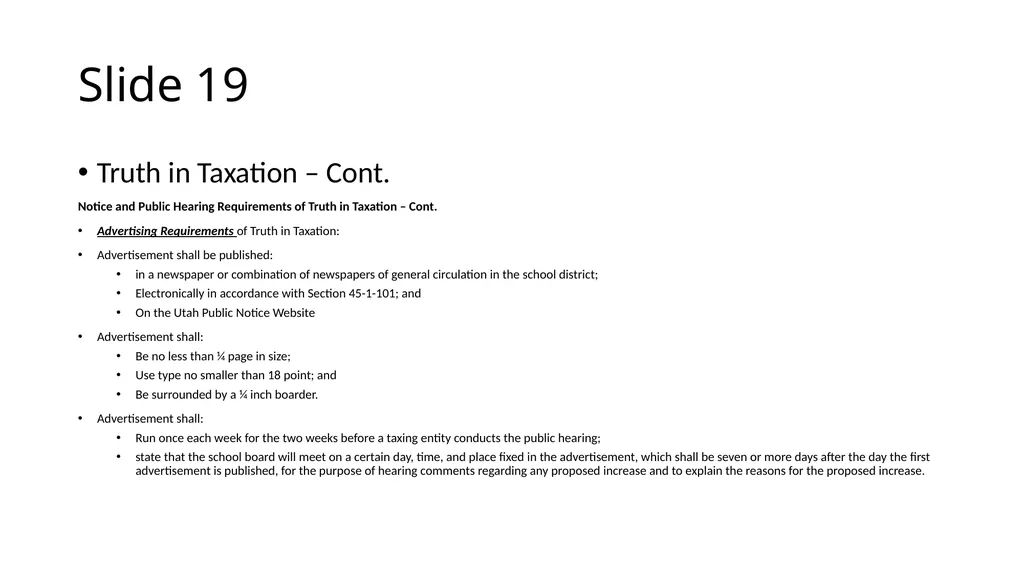
Slide 19 Truth in Taxation – Cont.
Notice and Public Hearing Requirements of Truth in Taxation – Cont.
Advertising Requirements of Truth in Taxation:
Advertisement shall be published:
in a newspaper or combination of newspapers of general circulation in the school district;
Electronically in accordance with Section 45-1-101; and
On the Utah Public Notice Website
Advertisement shall:
Be no less than ¼ page in size;
Use type no smaller than 18 point; and
Be surrounded by a ¼ inch boarder.
Advertisement shall:
Run once each week for the two weeks before a taxing entity conducts the public hearing;
state that the school board will meet on a certain day, time, and place fixed in the advertisement, which shall be seven or more days after the day the first advertisement is published, for the purpose of hearing comments regarding any proposed increase and to explain the reasons for the proposed increase.<br>
Notice and Public Hearing Requirements of Truth in Taxation – Cont.
Advertising Requirements of Truth in Taxation:
Advertisement shall be published:
in a newspaper or combination of newspapers of general circulation in the school district;
Electronically in accordance with Section 45-1-101; and
On the Utah Public Notice Website
Advertisement shall:
Be no less than ¼ page in size;
Use type no smaller than 18 point; and
Be surrounded by a ¼ inch boarder.
Advertisement shall:
Run once each week for the two weeks before a taxing entity conducts the public hearing;
state that the school board will meet on a certain day, time, and place fixed in the advertisement, which shall be seven or more days after the day the first advertisement is published, for the purpose of hearing comments regarding any proposed increase and to explain the reasons for the proposed increase.<br>
20
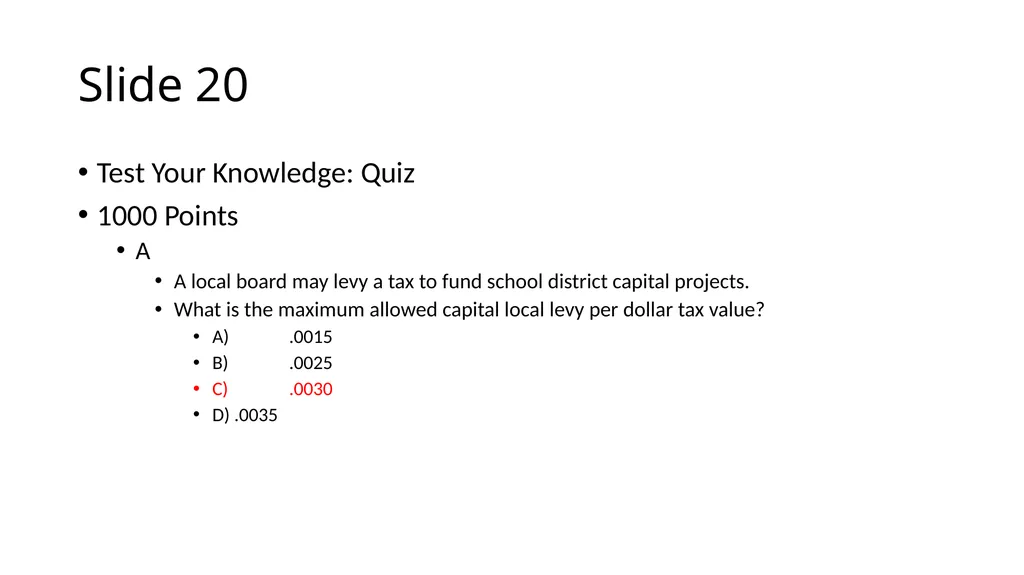
Slide 20 Test Your Knowledge: Quiz
1000 Points
A
A local board may levy a tax to fund school district capital projects.
What is the maximum allowed capital local levy per dollar tax value?
A) .0015
B) .0025
C) .0030
D) .0035<br>
1000 Points
A
A local board may levy a tax to fund school district capital projects.
What is the maximum allowed capital local levy per dollar tax value?
A) .0015
B) .0025
C) .0030
D) .0035<br>
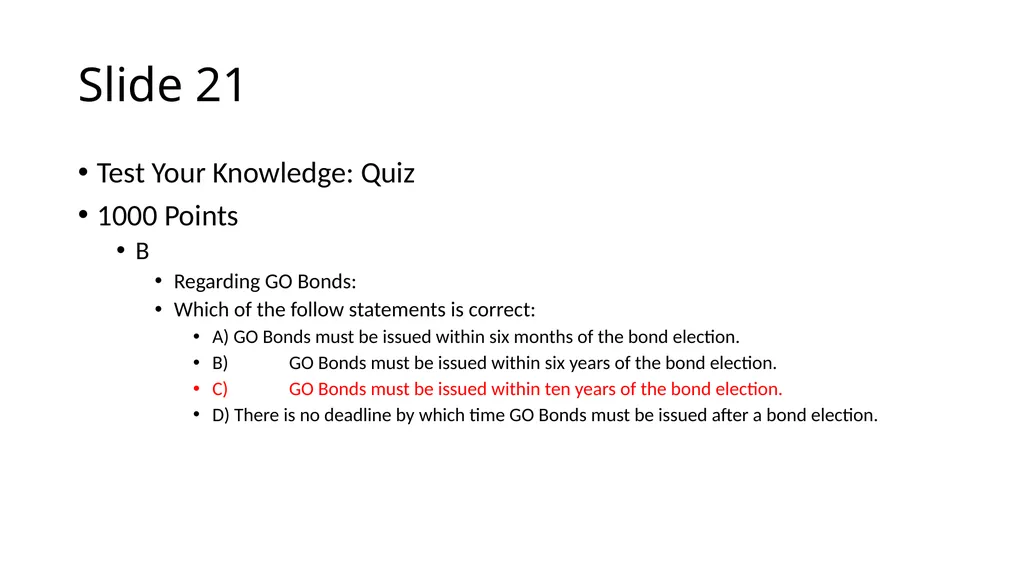
21
Slide 21 Test Your Knowledge: Quiz
1000 Points
B
Regarding GO Bonds:
Which of the follow statements is correct:
A) GO Bonds must be issued within six months of the bond election.
B) GO Bonds must be issued within six years of the bond election.
C) GO Bonds must be issued within ten years of the bond election.
D) There is no deadline by which time GO Bonds must be issued after a bond election.<br>
1000 Points
B
Regarding GO Bonds:
Which of the follow statements is correct:
A) GO Bonds must be issued within six months of the bond election.
B) GO Bonds must be issued within six years of the bond election.
C) GO Bonds must be issued within ten years of the bond election.
D) There is no deadline by which time GO Bonds must be issued after a bond election.<br>
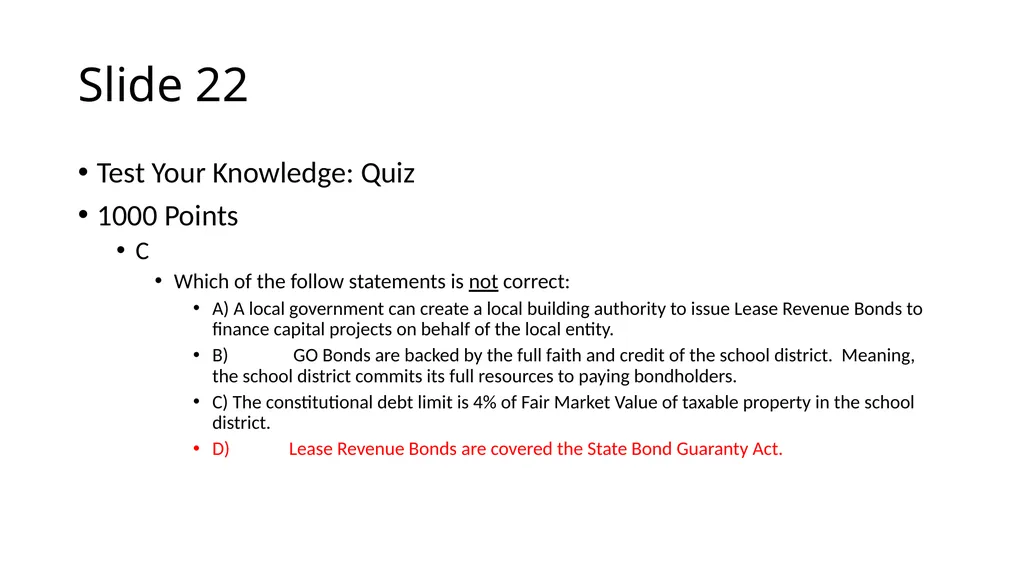
22
Slide 22 Test Your Knowledge: Quiz
1000 Points
C
Which of the follow statements is not correct:
A) A local government can create a local building authority to issue Lease Revenue Bonds to finance capital projects on behalf of the local entity.
B) GO Bonds are backed by the full faith and credit of the school district. Meaning, the school district commits its full resources to paying bondholders.
C) The constitutional debt limit is 4% of Fair Market Value of taxable property in the school district.
D) Lease Revenue Bonds are covered the State Bond Guaranty Act.<br>
1000 Points
C
Which of the follow statements is not correct:
A) A local government can create a local building authority to issue Lease Revenue Bonds to finance capital projects on behalf of the local entity.
B) GO Bonds are backed by the full faith and credit of the school district. Meaning, the school district commits its full resources to paying bondholders.
C) The constitutional debt limit is 4% of Fair Market Value of taxable property in the school district.
D) Lease Revenue Bonds are covered the State Bond Guaranty Act.<br>
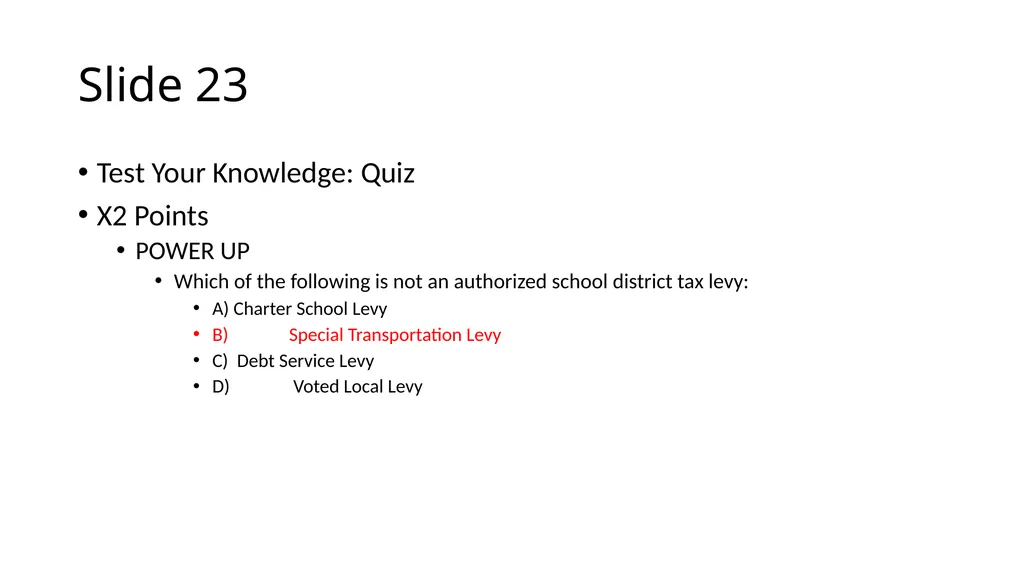
23
Slide 23 Test Your Knowledge: Quiz
X2 Points
POWER UP
Which of the following is not an authorized school district tax levy:
A) Charter School Levy
B) Special Transportation Levy
C) Debt Service Levy
D) Voted Local Levy<br>
X2 Points
POWER UP
Which of the following is not an authorized school district tax levy:
A) Charter School Levy
B) Special Transportation Levy
C) Debt Service Levy
D) Voted Local Levy<br>
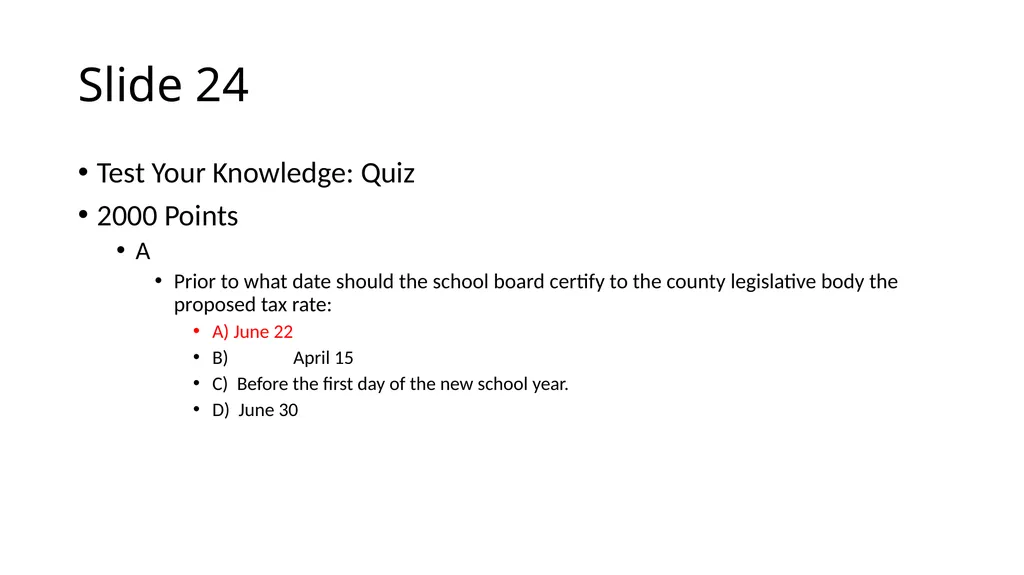
24
Slide 24 Test Your Knowledge: Quiz
2000 Points
A
Prior to what date should the school board certify to the county legislative body the proposed tax rate:
A) June 22
B) April 15
C) Before the first day of the new school year.
D) June 30<br>
2000 Points
A
Prior to what date should the school board certify to the county legislative body the proposed tax rate:
A) June 22
B) April 15
C) Before the first day of the new school year.
D) June 30<br>
25
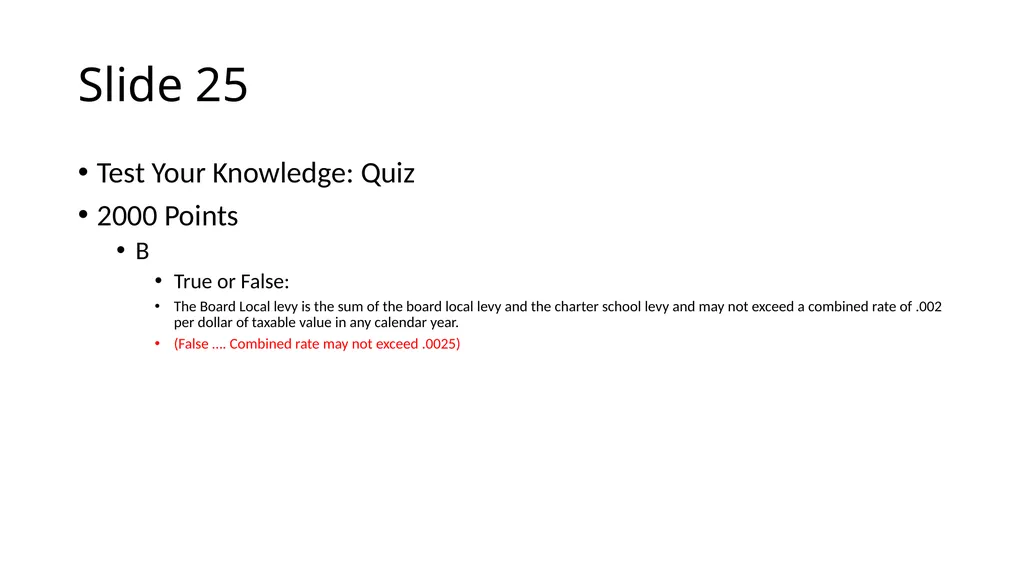
Slide 25 Test Your Knowledge: Quiz
2000 Points
B
True or False:
The Board Local levy is the sum of the board local levy and the charter school levy and may not exceed a combined rate of .002 per dollar of taxable value in any calendar year.
(False …. Combined rate may not exceed .0025)<br>
2000 Points
B
True or False:
The Board Local levy is the sum of the board local levy and the charter school levy and may not exceed a combined rate of .002 per dollar of taxable value in any calendar year.
(False …. Combined rate may not exceed .0025)<br>
26
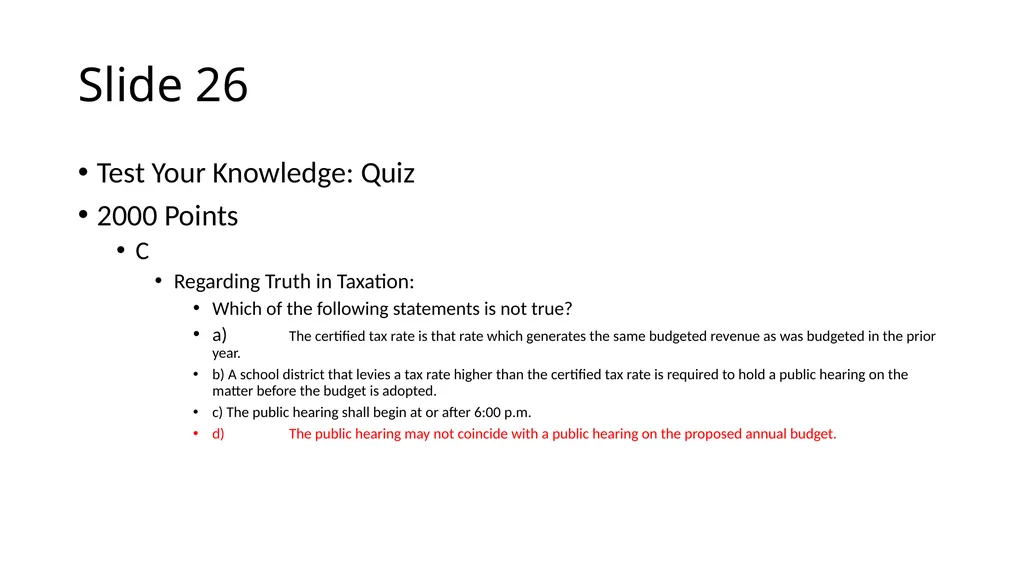
Slide 26 Test Your Knowledge: Quiz
2000 Points
C
Regarding Truth in Taxation:
Which of the following statements is not true?
a) The certified tax rate is that rate which generates the same budgeted revenue as was budgeted in the prior year.
b) A school district that levies a tax rate higher than the certified tax rate is required to hold a public hearing on the matter before the budget is adopted.
c) The public hearing shall begin at or after 6:00 p.m.
d) The public hearing may not coincide with a public hearing on the proposed annual budget.<br>
2000 Points
C
Regarding Truth in Taxation:
Which of the following statements is not true?
a) The certified tax rate is that rate which generates the same budgeted revenue as was budgeted in the prior year.
b) A school district that levies a tax rate higher than the certified tax rate is required to hold a public hearing on the matter before the budget is adopted.
c) The public hearing shall begin at or after 6:00 p.m.
d) The public hearing may not coincide with a public hearing on the proposed annual budget.<br>
27
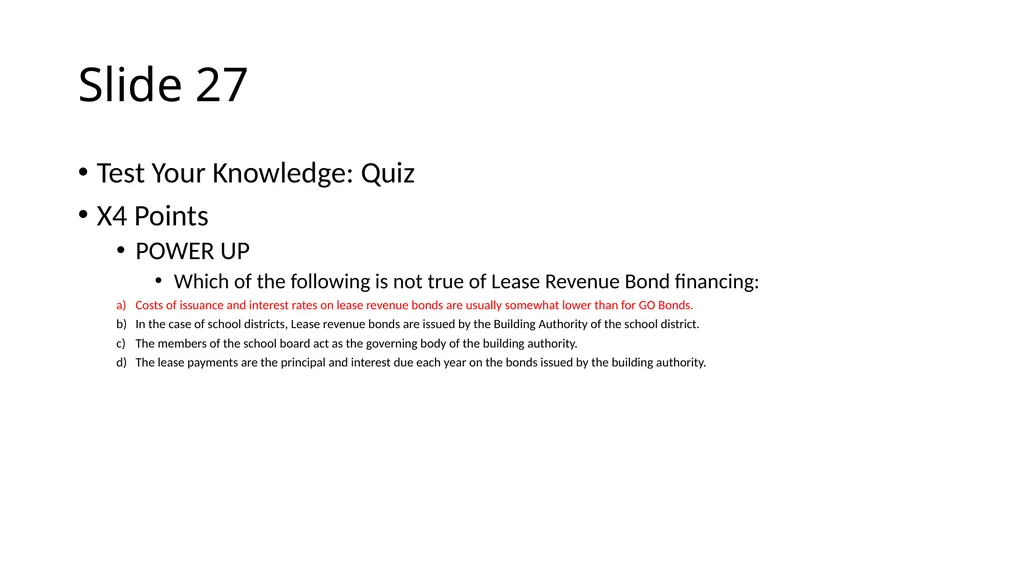
Slide 27 Test Your Knowledge: Quiz
X4 Points
POWER UP
Which of the following is not true of Lease Revenue Bond financing:
Costs of issuance and interest rates on lease revenue bonds are usually somewhat lower than for GO Bonds.
In the case of school districts, Lease revenue bonds are issued by the Building Authority of the school district.
The members of the school board act as the governing body of the building authority.
The lease payments are the principal and interest due each year on the bonds issued by the building authority.<br>
X4 Points
POWER UP
Which of the following is not true of Lease Revenue Bond financing:
Costs of issuance and interest rates on lease revenue bonds are usually somewhat lower than for GO Bonds.
In the case of school districts, Lease revenue bonds are issued by the Building Authority of the school district.
The members of the school board act as the governing body of the building authority.
The lease payments are the principal and interest due each year on the bonds issued by the building authority.<br>
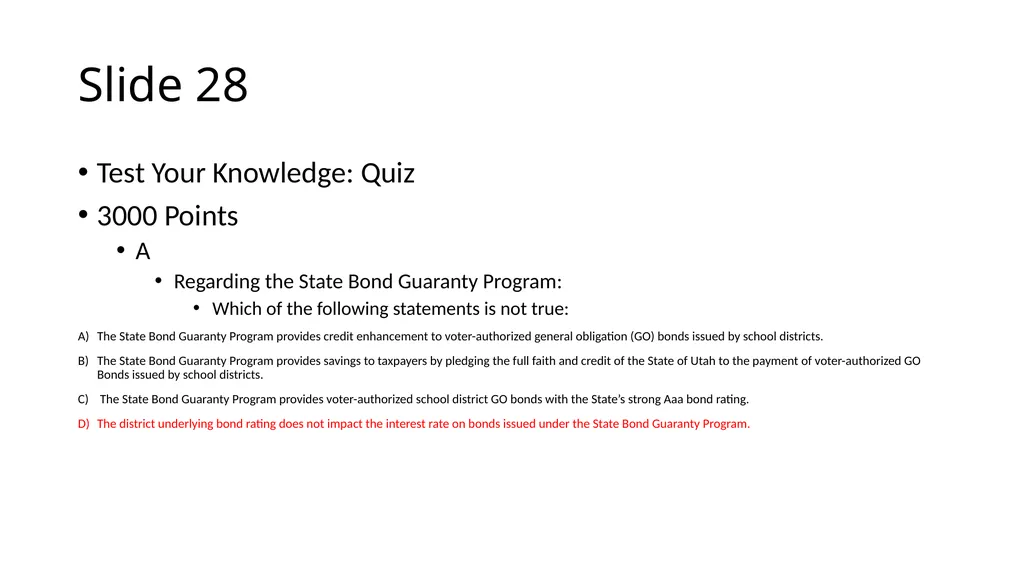
28
Slide 28 Test Your Knowledge: Quiz
3000 Points
A
Regarding the State Bond Guaranty Program:
Which of the following statements is not true:
The State Bond Guaranty Program provides credit enhancement to voter-authorized general obligation (GO) bonds issued by school districts.
The State Bond Guaranty Program provides savings to taxpayers by pledging the full faith and credit of the State of Utah to the payment of voter-authorized GO Bonds issued by school districts.
The State Bond Guaranty Program provides voter-authorized school district GO bonds with the State’s strong Aaa bond rating.
The district underlying bond rating does not impact the interest rate on bonds issued under the State Bond Guaranty Program.<br>
3000 Points
A
Regarding the State Bond Guaranty Program:
Which of the following statements is not true:
The State Bond Guaranty Program provides credit enhancement to voter-authorized general obligation (GO) bonds issued by school districts.
The State Bond Guaranty Program provides savings to taxpayers by pledging the full faith and credit of the State of Utah to the payment of voter-authorized GO Bonds issued by school districts.
The State Bond Guaranty Program provides voter-authorized school district GO bonds with the State’s strong Aaa bond rating.
The district underlying bond rating does not impact the interest rate on bonds issued under the State Bond Guaranty Program.<br>
29
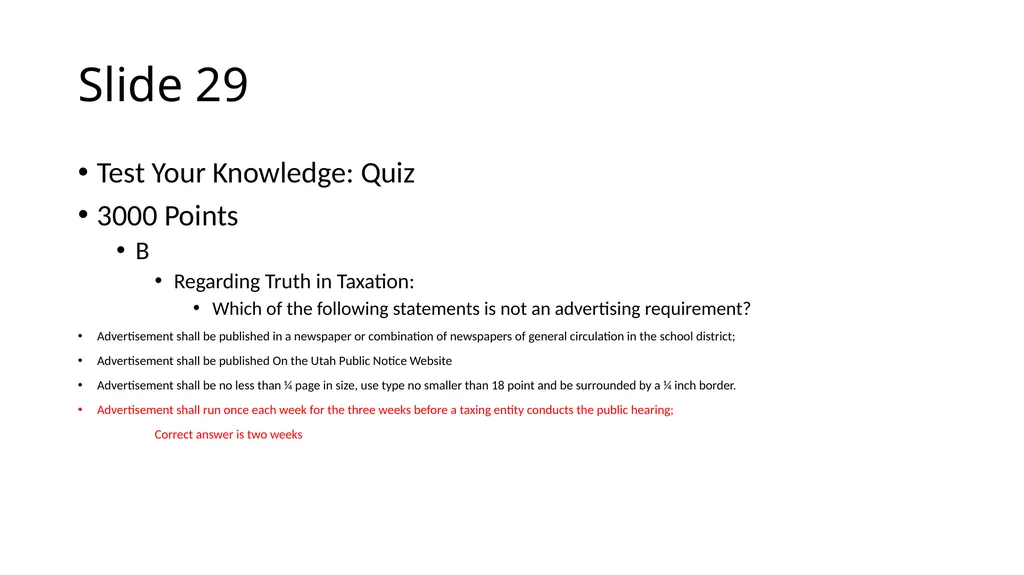
Slide 29 Test Your Knowledge: Quiz
3000 Points
B
Regarding Truth in Taxation:
Which of the following statements is not an advertising requirement?
Advertisement shall be published in a newspaper or combination of newspapers of general circulation in the school district;
Advertisement shall be published On the Utah Public Notice Website
Advertisement shall be no less than ¼ page in size, use type no smaller than 18 point and be surrounded by a ¼ inch border.
Advertisement shall run once each week for the three weeks before a taxing entity conducts the public hearing;
Correct answer is two weeks<br>
3000 Points
B
Regarding Truth in Taxation:
Which of the following statements is not an advertising requirement?
Advertisement shall be published in a newspaper or combination of newspapers of general circulation in the school district;
Advertisement shall be published On the Utah Public Notice Website
Advertisement shall be no less than ¼ page in size, use type no smaller than 18 point and be surrounded by a ¼ inch border.
Advertisement shall run once each week for the three weeks before a taxing entity conducts the public hearing;
Correct answer is two weeks<br>
30
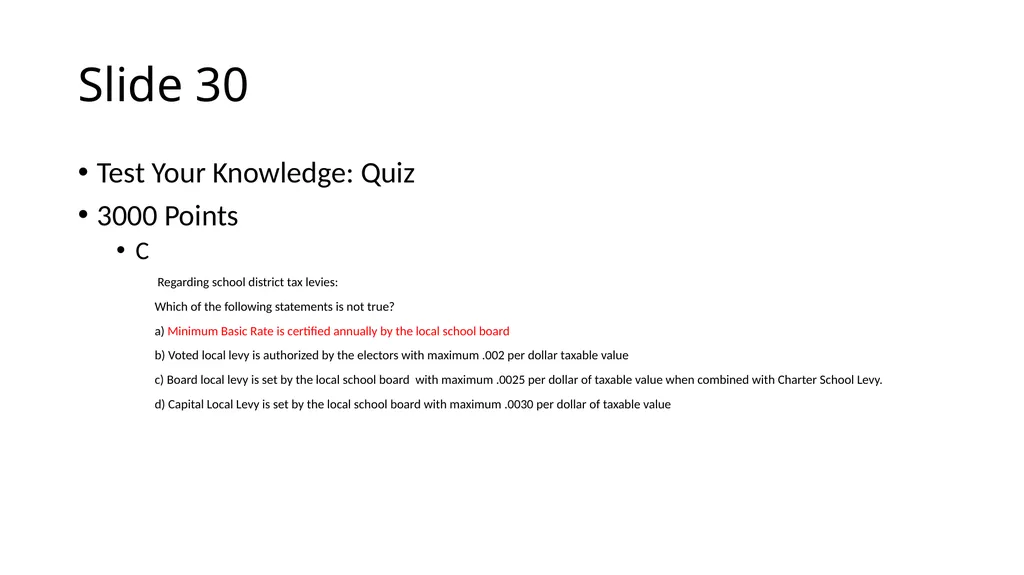
Slide 30 Test Your Knowledge: Quiz
3000 Points
C
Regarding school district tax levies:
Which of the following statements is not true?
a) Minimum Basic Rate is certified annually by the local school board
b) Voted local levy is authorized by the electors with maximum .002 per dollar taxable value
c) Board local levy is set by the local school board with maximum .0025 per dollar of taxable value when combined with Charter School Levy.
d) Capital Local Levy is set by the local school board with maximum .0030 per dollar of taxable value<br>
3000 Points
C
Regarding school district tax levies:
Which of the following statements is not true?
a) Minimum Basic Rate is certified annually by the local school board
b) Voted local levy is authorized by the electors with maximum .002 per dollar taxable value
c) Board local levy is set by the local school board with maximum .0025 per dollar of taxable value when combined with Charter School Levy.
d) Capital Local Levy is set by the local school board with maximum .0030 per dollar of taxable value<br>
31
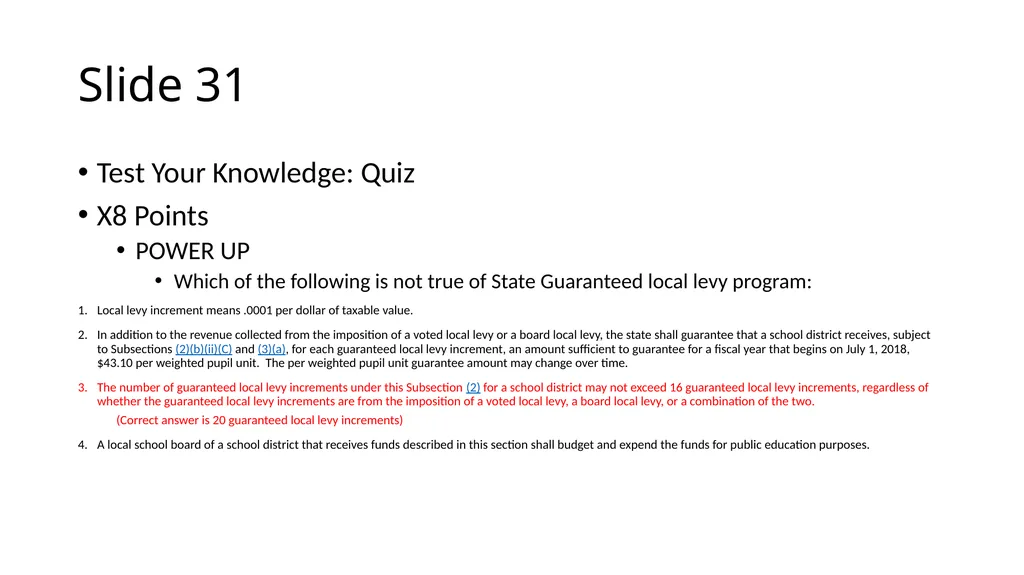
Slide 31 Test Your Knowledge: Quiz
X8 Points
POWER UP
Which of the following is not true of State Guaranteed local levy program:
Local levy increment means .0001 per dollar of taxable value.
In addition to the revenue collected from the imposition of a voted local levy or a board local levy, the state shall guarantee that a school district receives, subject to Subsections (2)(b)(ii)(C) and (3)(a), for each guaranteed local levy increment, an amount sufficient to guarantee for a fiscal year that begins on July 1, 2018, $43.10 per weighted pupil unit. The per weighted pupil unit guarantee amount may change over time.
The number of guaranteed local levy increments under this Subsection (2) for a school district may not exceed 16 guaranteed local levy increments, regardless of whether the guaranteed local levy increments are from the imposition of a voted local levy, a board local levy, or a combination of the two.
(Correct answer is 20 guaranteed local levy increments)
A local school board of a school district that receives funds described in this section shall budget and expend the funds for public education purposes.<br>
X8 Points
POWER UP
Which of the following is not true of State Guaranteed local levy program:
Local levy increment means .0001 per dollar of taxable value.
In addition to the revenue collected from the imposition of a voted local levy or a board local levy, the state shall guarantee that a school district receives, subject to Subsections (2)(b)(ii)(C) and (3)(a), for each guaranteed local levy increment, an amount sufficient to guarantee for a fiscal year that begins on July 1, 2018, $43.10 per weighted pupil unit. The per weighted pupil unit guarantee amount may change over time.
The number of guaranteed local levy increments under this Subsection (2) for a school district may not exceed 16 guaranteed local levy increments, regardless of whether the guaranteed local levy increments are from the imposition of a voted local levy, a board local levy, or a combination of the two.
(Correct answer is 20 guaranteed local levy increments)
A local school board of a school district that receives funds described in this section shall budget and expend the funds for public education purposes.<br>