Science: Ways of Knowing Computational Freakonomics Chapter 1 Coursenotes Guzdial Poll Whats your favorite ice cream? Vanilla Chunky Monkey Cherry Garcia Extreme Moose Tracks What was wrong with that poll? Can I make a claim about what ice
"Science: Ways of Knowing Computational" is the property of its rightful owner. Permission is granted to
download and print the materials on this website for personal, non-commercial use only, and to display it
on your personal computer provided you do not modify the materials and that you retain all copyright
notices contained in the materials. By downloading content from our website, you accept the terms of this
agreement.
Presentation Transcript
01
Science: Ways of Knowing Computational Freakonomics
Chapter 1 Coursenotes
Guzdial<br>
What was wrong with that poll? Can I make a claim about what ice cream that GT undergraduate students like?<br>
04
How do we decide to believe something? Tenacity
Authority
Reason
Common Sense<br>
05
The incumbent usually wins elections. Which forms of reasoning are people using?
Tenacity
Authority
Reason
Common Sense<br>
06
General methods of science Dispassionately observe by means of our sense,
Using reason to compare various theoretical conceptualizations based on experience.
Real scientists don’t really use the “Scientific Method.” (Nancy Nerssessian)
They build models
Good science is replicable and falsifiable.<br>
07
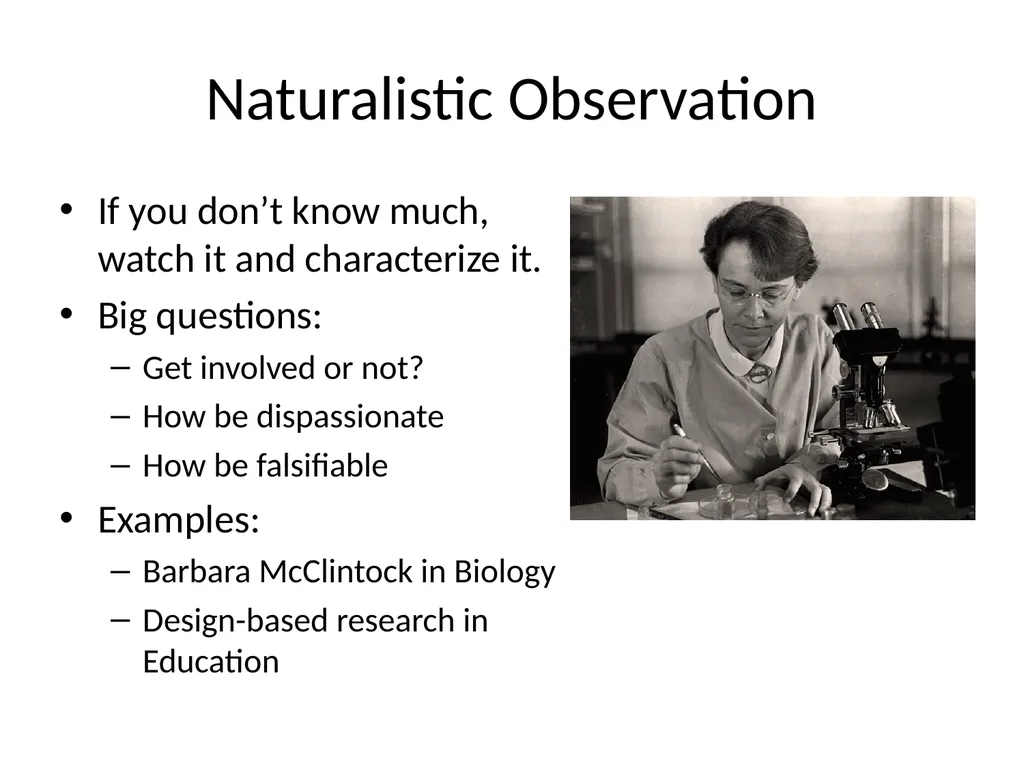
Naturalistic Observation If you don’t know much, watch it and characterize it.
Big questions:
Get involved or not?
How be dispassionate
How be falsifiable
Examples:
Barbara McClintock in Biology
Design-based research in Education<br>
08
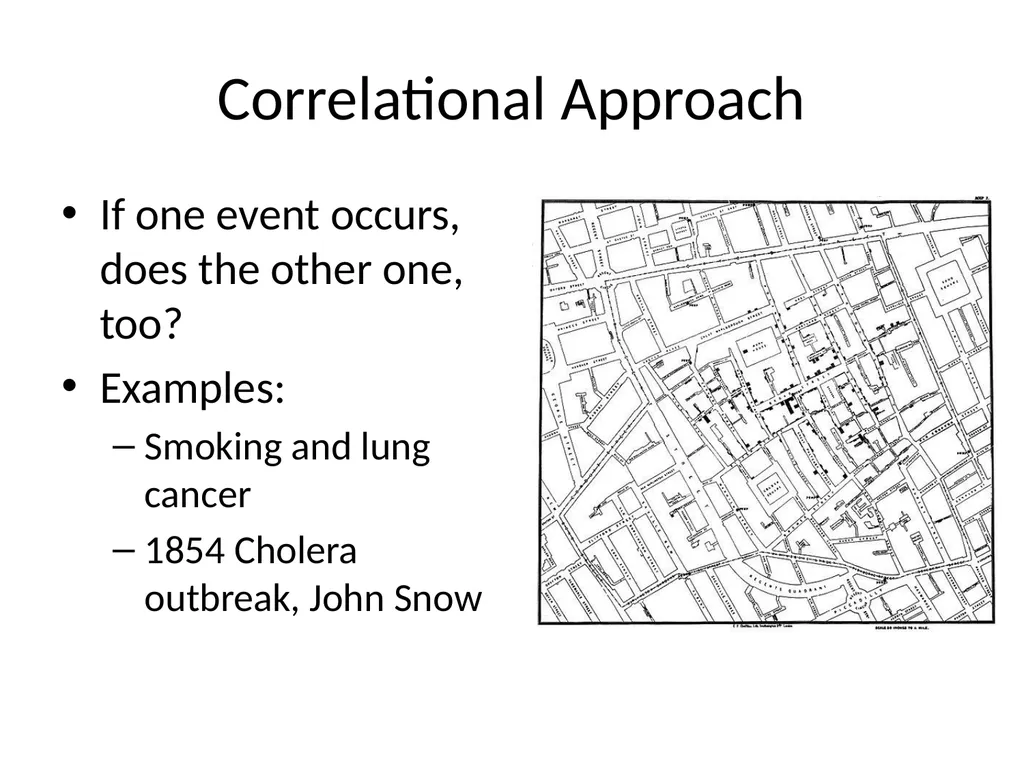
Correlational Approach If one event occurs, does the other one, too?
Examples:
Smoking and lung cancer
1854 Cholera outbreak, John Snow<br>
09
Problems of correlational approach What if multiple variables?
South African President Thabo Mbeki's embrace of AIDS-denialist claims: The resulting governmental refusal to provide effective anti-HIV treatment in South Africa has been blamed for hundreds of thousands of premature AIDS-related deaths in South Africa.
What if non-linear?<br>
10
Internal validity Do we believe it?
Ecological validity
In vitro vs. In vivo<br>
11
Experiment: Relaxation techniques Gymnastics team wants to improve their mental game.
Teach relaxation techniques.
If scores go up after the relaxation techniques, did it work?<br>
12
Experimental Method Treatment/experimental group vs. Comparison/control group
Operational definitions: What are you going to measure?
Beware the Hawthorne Effect.
Taxicab drivers, rear lights, front end vs. back end experiments
Ann Brown and “feeling special”<br>
13
Time series design Within-subjects design
Pre and post testing
Between-subjects design
Compare two different groups
Time series design: Within-subjects design
That’s what our gymnastics experiment is
Interrupted time series design: Multiple tests before or after
Check multiple meets before and multiple after.
Was the change “lasting”?
Variance?<br>
14
Multiple time series design Do before/after, but between different subjects or populations.
Does having a bottle deposit impact litter?
You could before/after, but maybe that state is special?
Compare two states at the same times.
New York (with deposit): 260 items of litter -> 145.
New Jersey (no deposit): 221 -> 214
Alternative explanations? Assumptions?<br>
15
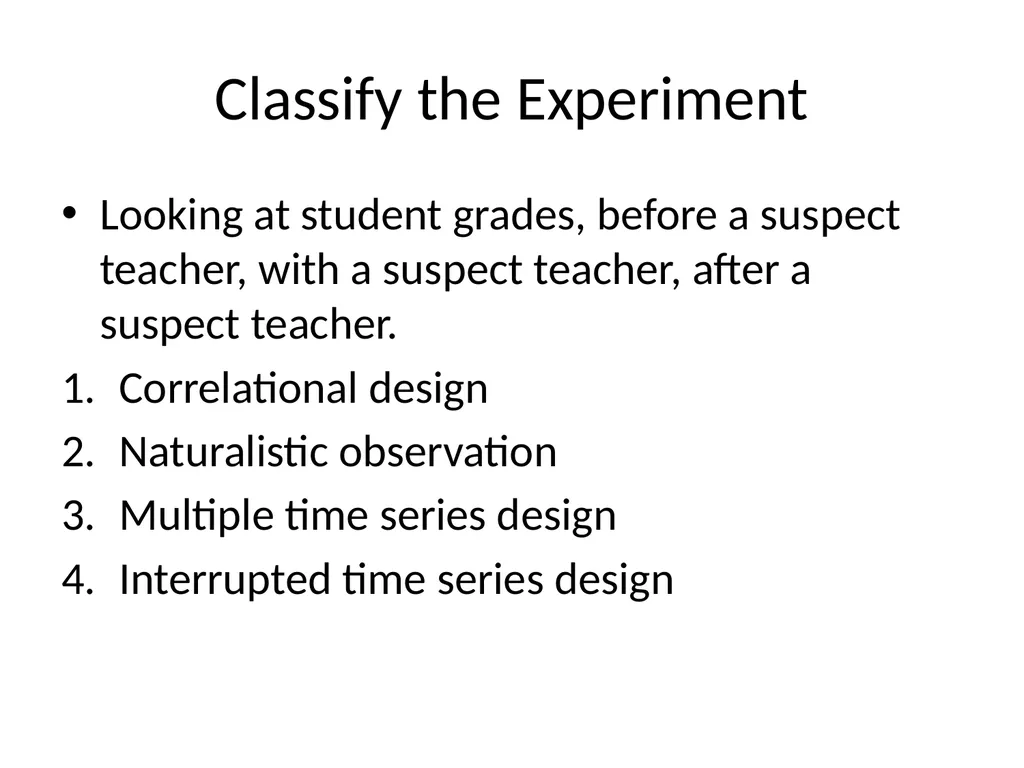
Classify the Experiment Looking at student grades, before a suspect teacher, with a suspect teacher, after a suspect teacher.
Correlational design
Naturalistic observation
Multiple time series design
Interrupted time series design<br>
16
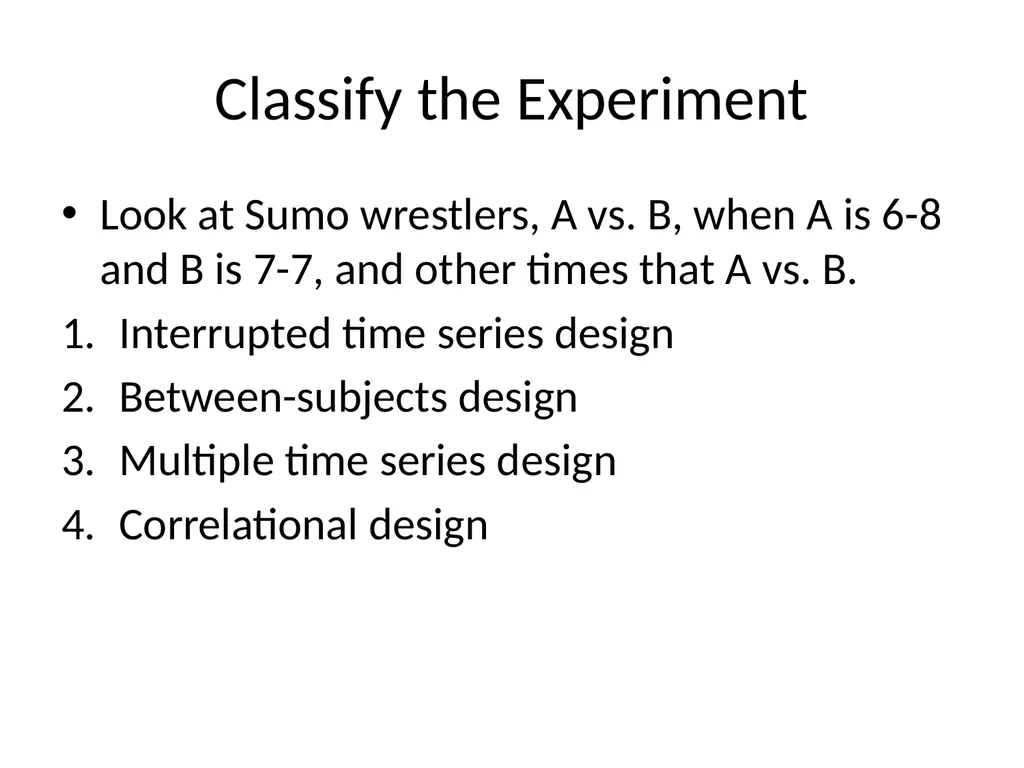
Classify the Experiment Look at Sumo wrestlers, A vs. B, when A is 6-8 and B is 7-7, and other times that A vs. B.
Interrupted time series design
Between-subjects design
Multiple time series design
Correlational design<br>
17
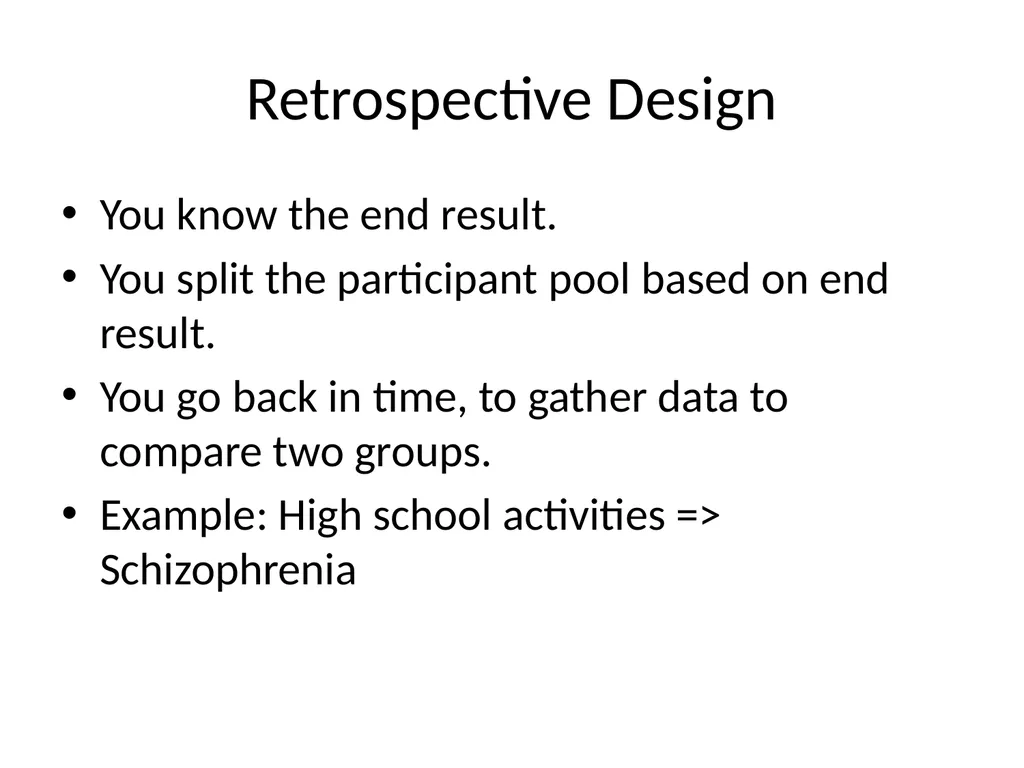
Retrospective Design You know the end result.
You split the participant pool based on end result.
You go back in time, to gather data to compare two groups.
Example: High school activities => Schizophrenia<br>
18
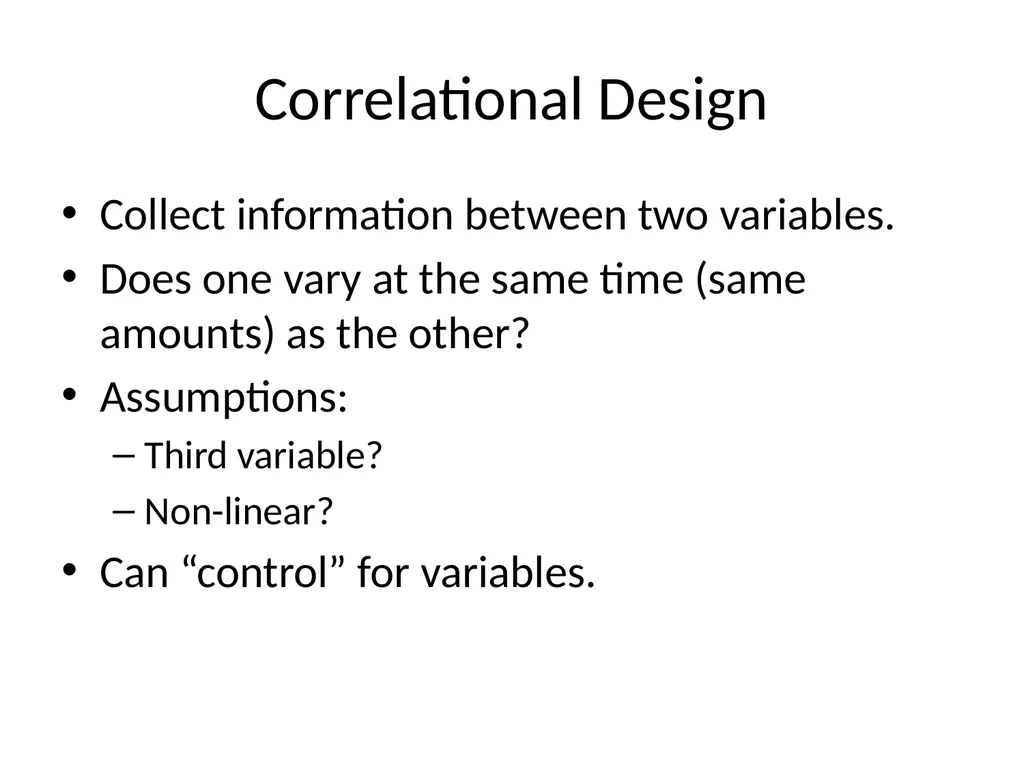
Correlational Design Collect information between two variables.
Does one vary at the same time (same amounts) as the other?
Assumptions:
Third variable?
Non-linear?
Can “control” for variables.<br>
19
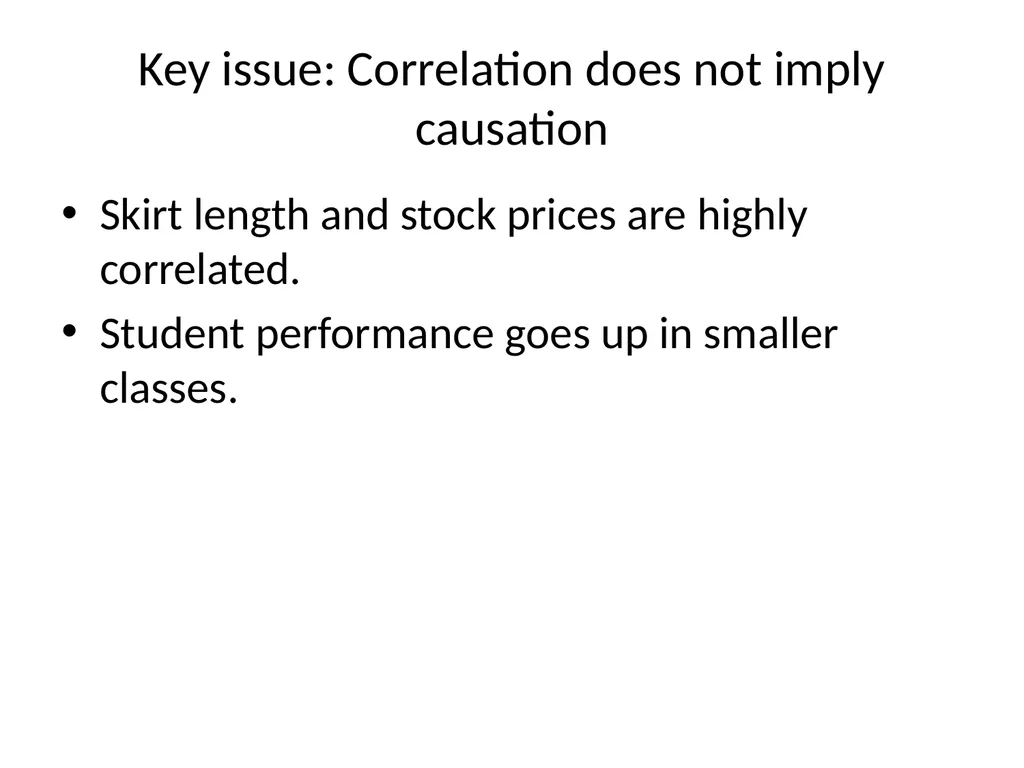
Key issue: Correlation does not imply causation Skirt length and stock prices are highly correlated.
Student performance goes up in smaller classes.<br>
20
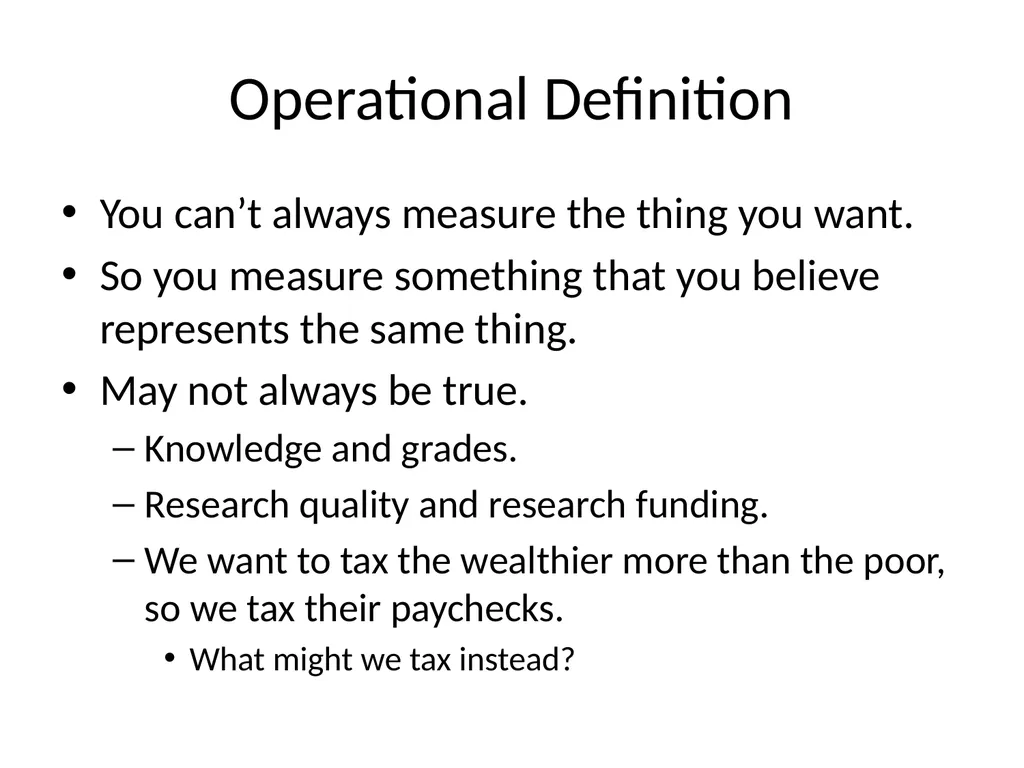
Operational Definition You can’t always measure the thing you want.
So you measure something that you believe represents the same thing.
May not always be true.
Knowledge and grades.
Research quality and research funding.
We want to tax the wealthier more than the poor, so we tax their paychecks.
What might we tax instead?<br>
21
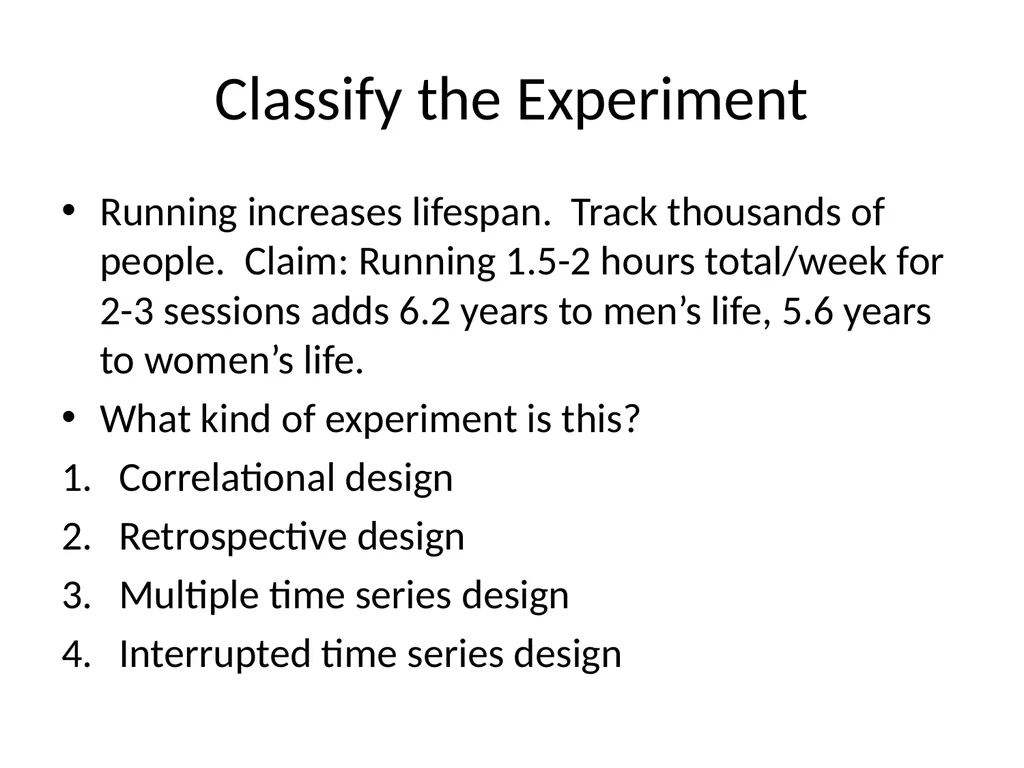
Classify the Experiment Running increases lifespan. Track thousands of people. Claim: Running 1.5-2 hours total/week for 2-3 sessions adds 6.2 years to men’s life, 5.6 years to women’s life.
What kind of experiment is this?
Correlational design
Retrospective design
Multiple time series design
Interrupted time series design<br>
22
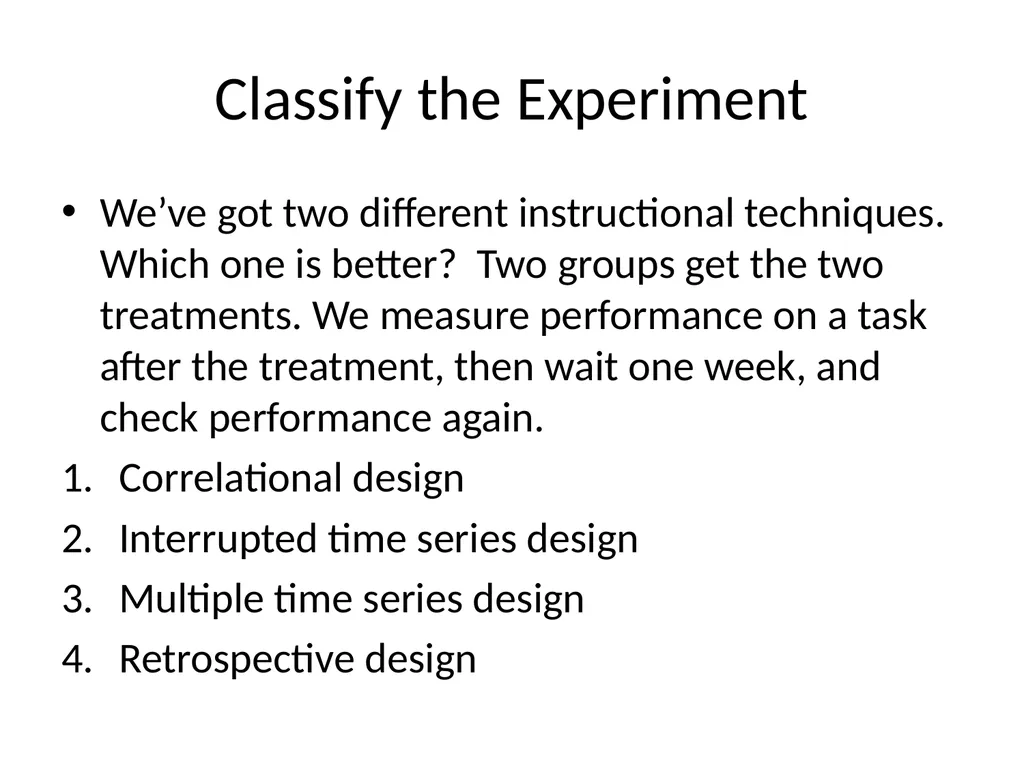
Classify the Experiment We’ve got two different instructional techniques. Which one is better? Two groups get the two treatments. We measure performance on a task after the treatment, then wait one week, and check performance again.
Correlational design
Interrupted time series design
Multiple time series design
Retrospective design<br>
23
Give me advice! GaComputes: $3.5M investment over 5 years, starting in 2006.
One goal: Increase number and diversity of students taking Advanced Placement CS.
How would you know if it worked? What kind of experiment would you run?<br>