Scientific Abstracts Dr. Gail P. Taylor Associate
Description: Scientific Abstracts Dr. Gail P. Taylor Associate Director of STEM Initiatives Asst. PD MBRS-RISE Research Training Programs University of Texas at San Antonio Rev 92019 Acknowledgements - Abstracts Online How-To Presentation from SACNAS
Related Topics
Download Presentation
"Scientific Abstracts Dr. Gail P. Taylor Associate" is the property of its rightful owner. Permission is granted to download and print the materials on this website for personal, non-commercial use only, and to display it on your personal computer provided you do not modify the materials and that you retain all copyright notices contained in the materials. By downloading content from our website, you accept the terms of this agreement.
Presentation Transcript
slide1. Scientific Abstracts Dr. Gail P. Taylor
Associate Director of STEM Initiatives
Asst. PD MBRS-RISE
Research Training Programs
University of Texas at San Antonio
Rev 9/2019<br>
slide2. Acknowledgements - Abstracts Online How-To Presentation from SACNAS
http://www.vimeo.com/3968357
How to construct a Nature summary paragraph
http://www.nature.com/nature/authors/gta/Letter_bold_para.doc
Sir Conferences – Abstract Preparation and how to write a good abstract:
http://www.sirmeeting.org/index.cfm?do=cnt.page&pg=1135<br>
slide3. The Scientific Abstract<br>
slide4. Student Conference Submission/Instruction Pages SACNAS
https://www.sacnas.org/conference/research-presentations
ABRCMS
https://abrcms.org/index.php/present-at-abrcms/submit-an-abstract
Most conferences put out a Call for Abstracts or Abstract Submission Google
2024 OUR Showcase: https://utsa.az1.qualtrics.com/jfe/form/SV_6YkAZROlHCsHMQm<br>
slide5. abstract<br>
slide6. What is an Abstract? Summary report of research study
Single paragraph manuscript
Several types
In papers
Included in grant proposals
Conferences
Conferences
Determines format/style/length
Approval required for Presentation
Published in books/proceedings or electronically
THESE ARE A PUBLICATION FOR YOUR CV!!!!
Draws people to your work
Some fields have mini-papers<br>
slide7. General Abstract Format Introduction:
Start Broad and get specific
End with Purpose/Hypothesis
Methods
Make this very superficial
Results
Include some data
Discussion/Implications
Funding Source (if not included elsewhere on submission site)<br>
slide8. Abstract Process for Conferences CREATE
Examine “call for abstracts” or “Presentations” rules
With research mentor (you may have to press on explicit hypothesis
Write abstract (multiple drafts with mentor)
Make sure to include grant / number
SUBMIT
Double check rules
Final mentor approval
Choose Oral Presentation or Poster (might not have choice)
CONFERENCE RESPONSE:
Accepted or not
Oral or Poster (you usually choose Oral, and drop to poster)
REGISTER FOR CONFERENCE
CREATE PRESENTATION
GO TO CONFERENCE / GIVE PRESENTATION<br>
slide9. General Rules... Broadens out
arallels Intro Concise as possible
Body length determined
~300 Words (250 for SACNAS and Showcase)
~2500 Characters (Spaces or not???)
Title length may be determined
Formatting specified
Font used and its size
Title capitalization
Single spaced
Third Person Active Tense allowed now (We found..)
Usually no references or figures (check with PI)
Engineers or other computational fields may include these
Usually no references ABRCMS Call for Abstracts 2019<br>
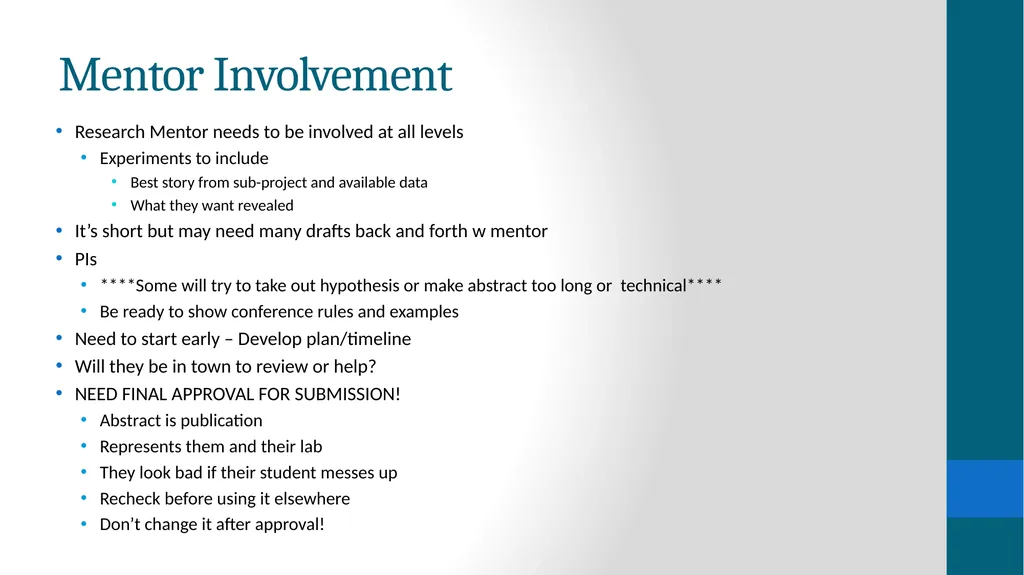
slide10. Mentor Involvement Research Mentor needs to be involved at all levels
Experiments to include
Best story from sub-project and available data
What they want revealed
It’s short but may need many drafts back and forth w mentor
PIs
****Some will try to take out hypothesis or make abstract too long or technical****
Be ready to show conference rules and examples
Need to start early – Develop plan/timeline
Will they be in town to review or help?
NEED FINAL APPROVAL FOR SUBMISSION!
Abstract is publication
Represents them and their lab
They look bad if their student messes up
Recheck before using it elsewhere
Don’t change it after approval!<br>
slide11. Authorship Always has more than YOU!
Generally:
You (first)
PI (generally Last)
Others who contributed significantly to project
In order of extent of contribution
Nearer to first author better<br>
slide12. Advice on Writing Short but time-consuming
Information-dense, but simply formatted
Follow Conference Rules!
Write “long” and pare down if needed
Analyze one sentence at a time
Each sentence has purpose
Each sentence is clear and straightforward – plain English
Split up long sentences (usually only two lines…)
Combine very short sentences
Each sentence logically follows another
Include transition words in sentences
Similarly, in addition, concurrently, as a result, further, etc.
Remember active 3rd person (we) voice, or passive when needed
Make sure to provide “take Home” message
There is not good writing, only good rewriting<br>
slide13. Tense in Scientific Writing PRESENT TENSE–
Previously published information accepted as fact
Usually In Intro
FGF-2 expression is found in the nailbed
Spatial resolution of MR microscopy can reach 3 microns.
In Conclusions with Implications of your findings
Our findings suggest/we conclude
PAST TENSE
We Hypothesized
Methods and Results/Actions
What we did, saw, and found
Rats were anesthetized with isoflurane.
All animals exhibited significantly diminished learning Duke University Medical Centerhttp://wwwcivm.mc.duke.edu/civmResources/iplHelp/writing.tips/tenses.html<br>
slide14. Abstract Title Length and text style may be determined by conference
Is your shortest summary of your work
Will also be used for your poster
Helps people to choose and find article
Needs to be concise, specific and active:
Omits “A study of,” “Investigations of,” etc
Spell out most acronyms
Put species studied
Mention variables/treatment
Put limiting information
Avoid “cute”
May or may not give results (Mentor’s choice)
Topic – Effects of phenobarbital on learning
Conclusive – Phenobarbital diminishes learning…
Ex: Effect of Owner Education Level on Number of Cats per Household
Ex: FGF-2 Induces Regeneration of the Chick Limb Bud<br>
slide15. Abstract - Introduction Rationale for Study - Motivation
Generally max 3 sentences
Engages readers – Interesting (consider type of conference)
No refs (check w mentor)
General information to specific.
Big problem (Medical condition/Improve world)
Findings leading directly to your research (not summary of field)
You will flow into the problem (next slide)<br>
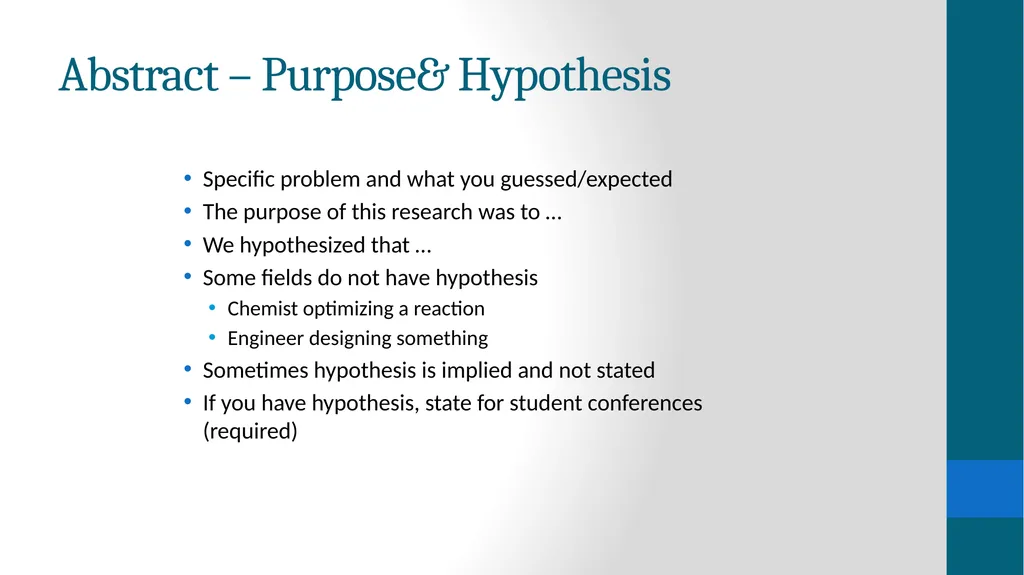
slide16. Abstract – Purpose& Hypothesis Specific problem and what you guessed/expected
The purpose of this research was to …
We hypothesized that …
Some fields do not have hypothesis
Chemist optimizing a reaction
Engineer designing something
Sometimes hypothesis is implied and not stated
If you have hypothesis, state for student conferences (required)<br>
slide17. Abstract – Methods/Approach How did you solve your problem?
Two sentences (or less) are needed for short abstract
What experiments did you run using what method(s)?
What variables?
Often worked into text. Using XXX we did this and found X. Then we used XXX to find XXX.
Give general idea
No vendor info needed<br>
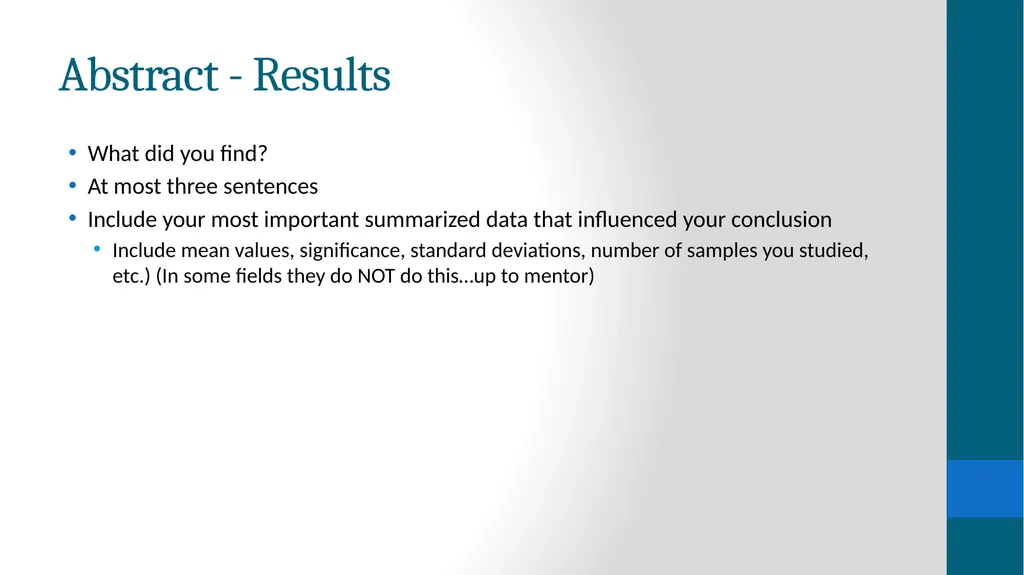
slide18. Abstract - Results What did you find?
At most three sentences
Include your most important summarized data that influenced your conclusion
Include mean values, significance, standard deviations, number of samples you studied, etc.) (In some fields they do NOT do this…up to mentor)<br>
slide19. Abstract - Discussion ~Three sentences
Conclusions
What does your work mean?
What is the big point/Take Home Message!!
(How did hypothesis turn out?)
Future Directions<br>
slide20. Acknowledgements of Funding At end, MAY place recognition of funding source:
NIGMS MBRS-RISE GM060655
NIGMS MARC-U*STAR GM007717
Work Study Research Training Program
Your mentor’s grant
CIMAXXXXX<br>
slide21. Submit! With final permission from your PI…submit!
Can also submit a travel award (they pay for you to go!)
Await a Response…
May get an Oral (if requested)
Otherwise, will probably be a Poster<br>
slide22. Acceptance! Dear SACNAS Colleague,It is with great pleasure we inform you that your abstract "OPTICAL PROPERTIES OF WHOLE HUMAN BLOOD IN THE NEAR IR REGION" has been accepted for poster presentation at the 2009 SACNAS National Conference - October 15-18, 2009 in Dallas, Texas.If you must cancel your presentation at any time, please contact me immediately, michael@sacnas.org; TollFree 877-722-6271 x333.As the Conference approaches, please look for more emails from SACNAS regarding guidelines for presentations, exact time/date/location of your presentation, as well as information on the many opportunities present at this year's Conference in Dallas.Kind Regards,xxxx<br>
Associate Director of STEM Initiatives
Asst. PD MBRS-RISE
Research Training Programs
University of Texas at San Antonio
Rev 9/2019<br>
slide2. Acknowledgements - Abstracts Online How-To Presentation from SACNAS
http://www.vimeo.com/3968357
How to construct a Nature summary paragraph
http://www.nature.com/nature/authors/gta/Letter_bold_para.doc
Sir Conferences – Abstract Preparation and how to write a good abstract:
http://www.sirmeeting.org/index.cfm?do=cnt.page&pg=1135<br>
slide3. The Scientific Abstract<br>
slide4. Student Conference Submission/Instruction Pages SACNAS
https://www.sacnas.org/conference/research-presentations
ABRCMS
https://abrcms.org/index.php/present-at-abrcms/submit-an-abstract
Most conferences put out a Call for Abstracts or Abstract Submission Google
2024 OUR Showcase: https://utsa.az1.qualtrics.com/jfe/form/SV_6YkAZROlHCsHMQm<br>
slide5. abstract<br>
slide6. What is an Abstract? Summary report of research study
Single paragraph manuscript
Several types
In papers
Included in grant proposals
Conferences
Conferences
Determines format/style/length
Approval required for Presentation
Published in books/proceedings or electronically
THESE ARE A PUBLICATION FOR YOUR CV!!!!
Draws people to your work
Some fields have mini-papers<br>
slide7. General Abstract Format Introduction:
Start Broad and get specific
End with Purpose/Hypothesis
Methods
Make this very superficial
Results
Include some data
Discussion/Implications
Funding Source (if not included elsewhere on submission site)<br>
slide8. Abstract Process for Conferences CREATE
Examine “call for abstracts” or “Presentations” rules
With research mentor (you may have to press on explicit hypothesis
Write abstract (multiple drafts with mentor)
Make sure to include grant / number
SUBMIT
Double check rules
Final mentor approval
Choose Oral Presentation or Poster (might not have choice)
CONFERENCE RESPONSE:
Accepted or not
Oral or Poster (you usually choose Oral, and drop to poster)
REGISTER FOR CONFERENCE
CREATE PRESENTATION
GO TO CONFERENCE / GIVE PRESENTATION<br>
slide9. General Rules... Broadens out
arallels Intro Concise as possible
Body length determined
~300 Words (250 for SACNAS and Showcase)
~2500 Characters (Spaces or not???)
Title length may be determined
Formatting specified
Font used and its size
Title capitalization
Single spaced
Third Person Active Tense allowed now (We found..)
Usually no references or figures (check with PI)
Engineers or other computational fields may include these
Usually no references ABRCMS Call for Abstracts 2019<br>
slide10. Mentor Involvement Research Mentor needs to be involved at all levels
Experiments to include
Best story from sub-project and available data
What they want revealed
It’s short but may need many drafts back and forth w mentor
PIs
****Some will try to take out hypothesis or make abstract too long or technical****
Be ready to show conference rules and examples
Need to start early – Develop plan/timeline
Will they be in town to review or help?
NEED FINAL APPROVAL FOR SUBMISSION!
Abstract is publication
Represents them and their lab
They look bad if their student messes up
Recheck before using it elsewhere
Don’t change it after approval!<br>
slide11. Authorship Always has more than YOU!
Generally:
You (first)
PI (generally Last)
Others who contributed significantly to project
In order of extent of contribution
Nearer to first author better<br>
slide12. Advice on Writing Short but time-consuming
Information-dense, but simply formatted
Follow Conference Rules!
Write “long” and pare down if needed
Analyze one sentence at a time
Each sentence has purpose
Each sentence is clear and straightforward – plain English
Split up long sentences (usually only two lines…)
Combine very short sentences
Each sentence logically follows another
Include transition words in sentences
Similarly, in addition, concurrently, as a result, further, etc.
Remember active 3rd person (we) voice, or passive when needed
Make sure to provide “take Home” message
There is not good writing, only good rewriting<br>
slide13. Tense in Scientific Writing PRESENT TENSE–
Previously published information accepted as fact
Usually In Intro
FGF-2 expression is found in the nailbed
Spatial resolution of MR microscopy can reach 3 microns.
In Conclusions with Implications of your findings
Our findings suggest/we conclude
PAST TENSE
We Hypothesized
Methods and Results/Actions
What we did, saw, and found
Rats were anesthetized with isoflurane.
All animals exhibited significantly diminished learning Duke University Medical Centerhttp://wwwcivm.mc.duke.edu/civmResources/iplHelp/writing.tips/tenses.html<br>
slide14. Abstract Title Length and text style may be determined by conference
Is your shortest summary of your work
Will also be used for your poster
Helps people to choose and find article
Needs to be concise, specific and active:
Omits “A study of,” “Investigations of,” etc
Spell out most acronyms
Put species studied
Mention variables/treatment
Put limiting information
Avoid “cute”
May or may not give results (Mentor’s choice)
Topic – Effects of phenobarbital on learning
Conclusive – Phenobarbital diminishes learning…
Ex: Effect of Owner Education Level on Number of Cats per Household
Ex: FGF-2 Induces Regeneration of the Chick Limb Bud<br>
slide15. Abstract - Introduction Rationale for Study - Motivation
Generally max 3 sentences
Engages readers – Interesting (consider type of conference)
No refs (check w mentor)
General information to specific.
Big problem (Medical condition/Improve world)
Findings leading directly to your research (not summary of field)
You will flow into the problem (next slide)<br>
slide16. Abstract – Purpose& Hypothesis Specific problem and what you guessed/expected
The purpose of this research was to …
We hypothesized that …
Some fields do not have hypothesis
Chemist optimizing a reaction
Engineer designing something
Sometimes hypothesis is implied and not stated
If you have hypothesis, state for student conferences (required)<br>
slide17. Abstract – Methods/Approach How did you solve your problem?
Two sentences (or less) are needed for short abstract
What experiments did you run using what method(s)?
What variables?
Often worked into text. Using XXX we did this and found X. Then we used XXX to find XXX.
Give general idea
No vendor info needed<br>
slide18. Abstract - Results What did you find?
At most three sentences
Include your most important summarized data that influenced your conclusion
Include mean values, significance, standard deviations, number of samples you studied, etc.) (In some fields they do NOT do this…up to mentor)<br>
slide19. Abstract - Discussion ~Three sentences
Conclusions
What does your work mean?
What is the big point/Take Home Message!!
(How did hypothesis turn out?)
Future Directions<br>
slide20. Acknowledgements of Funding At end, MAY place recognition of funding source:
NIGMS MBRS-RISE GM060655
NIGMS MARC-U*STAR GM007717
Work Study Research Training Program
Your mentor’s grant
CIMAXXXXX<br>
slide21. Submit! With final permission from your PI…submit!
Can also submit a travel award (they pay for you to go!)
Await a Response…
May get an Oral (if requested)
Otherwise, will probably be a Poster<br>
slide22. Acceptance! Dear SACNAS Colleague,It is with great pleasure we inform you that your abstract "OPTICAL PROPERTIES OF WHOLE HUMAN BLOOD IN THE NEAR IR REGION" has been accepted for poster presentation at the 2009 SACNAS National Conference - October 15-18, 2009 in Dallas, Texas.If you must cancel your presentation at any time, please contact me immediately, michael@sacnas.org; TollFree 877-722-6271 x333.As the Conference approaches, please look for more emails from SACNAS regarding guidelines for presentations, exact time/date/location of your presentation, as well as information on the many opportunities present at this year's Conference in Dallas.Kind Regards,xxxx<br>