SCREENING ORIENTATION OF ASHAs FOR NON COMMUNICABLE DISEASES AT PULWAMA DISTRICT, JK 4th NATIONAL SUMMIT ON GOOD REPLICABLE PRACTICES AND INNOVATIONS Presented by: Dr. Jitender Mehta MBBS (GMC Jammu) MHA (AIIMS, ND) National Health
"SCREENING & ORIENTATION OF ASHAs FOR NON" is the property of its rightful owner. Permission is granted to
download and print the materials on this website for personal, non-commercial use only, and to display it
on your personal computer provided you do not modify the materials and that you retain all copyright
notices contained in the materials. By downloading content from our website, you accept the terms of this
agreement.
Presentation Transcript
01
SCREENING & ORIENTATION
OF ASHAs
FOR NON COMMUNICABLE DISEASES AT PULWAMA DISTRICT, J&K 4th NATIONAL SUMMIT ON GOOD &REPLICABLE PRACTICES AND INNOVATIONS Presented by:
Dr. Jitender Mehta
MBBS (GMC Jammu)
MHA (AIIMS, ND)
National Health Mission, J&K<br>
02
PLAN OF PRESENTATION RATIONALE FOR INTERVENTION
INTERVENTIONS UNDERTAKEN-
SCREENING OF ASHAs
RESULTS
INTERPRETATIONS
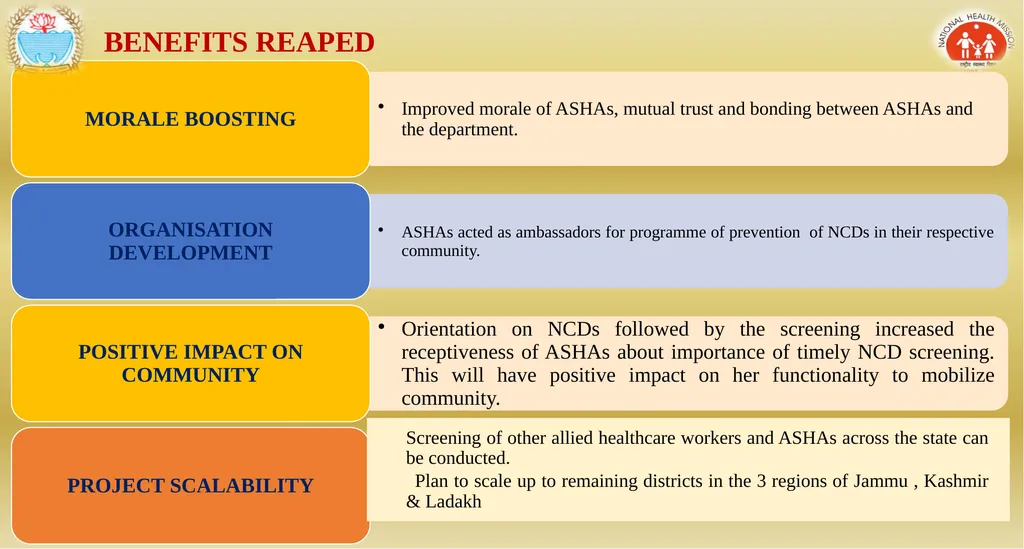
BENEFITS REAPED<br>
03
RATIONALE FOR INTERVENTION INCREASING BURDEN OF NON COMMUNICABLE DISEASES :- Non-communicable diseases (NCDs) are the leading cause of death in the world, responsible for 63% deaths worldwide; 5.87 million deaths i.e., 60 % of all deaths in India. Strong multi-sectoral governance mechanisms are needed to implement SDG target 3.4 on NCDs, i.e. By 2030, reduce by one third premature mortality from non-communicable diseases through prevention and treatment, through whole-of-government and whole-of-society approaches.
ASHA being a vital frontline worker, the healthcare of the community to a large extent, in present HCO (Health Care Operations) systems, depends to a large extent on ASHAs and CP programme who are the important contributors to the present whole-of-government and whole-of-society approaches.
The ASHA programme looks after 1.25 crore population in 22 districts including 117 blocks of the J&K state. ASHAs perform >35 ongoing activities on monthly basis for keeping the populations healthy. There is add-on every year to these activities with a recent special focus on NCDs.<br>
04
RATIONALE FOR INTERVENTION..... National Health Mission, J&K decided to assess the Health status of ASHAs and decided to screen them for Non-communicable diseases i.e. Diabetes, Hypertension, Thyroid, Dyslipidemias, PCOD and Obesity.
Aims -
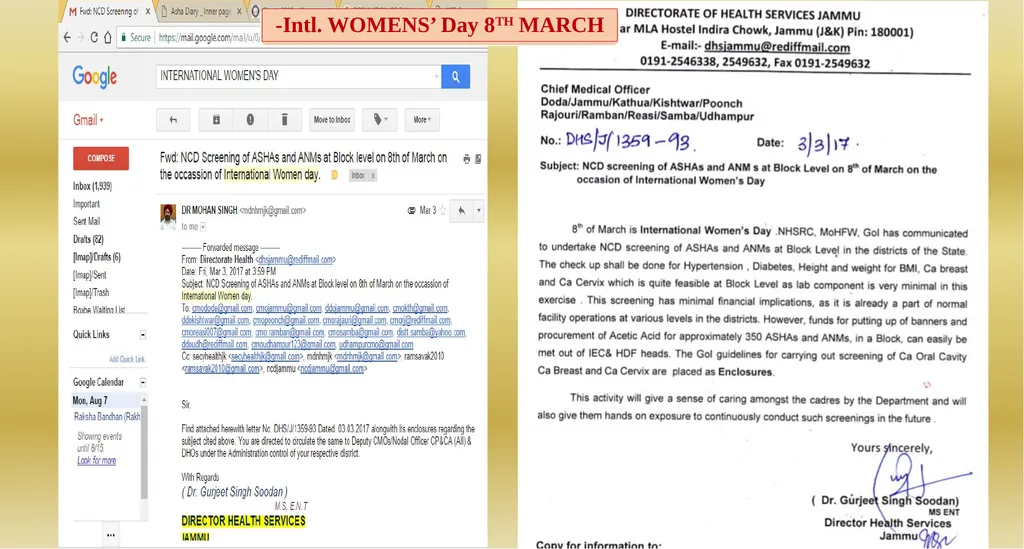
To perform the check-up of ASHAs, who have the most pivotal role in the operational components of ‘4 A Platform’ , at their door steps, by reputed faculty of AIIMS & SKIIMS. This was envisaged to instil the sense of caring in these cadres by the Health Department and NHM.
The day-long exercise of testing and check-up of these cadres would impart them with hands-on practical training and concept of NCDs. This was envisaged to be important preparatory exercise for the subsequent roll out of Population based NCD screening and their management through these cadres.
This was expected to provide the Health Department an insight into the status of NCDs in a representative sample of the population of a particular geographic location. This is further envisaged to be rolled out in all 22 districts of the state so that distribution of NCDs in different geographic areas of the state can be studied.<br>
05
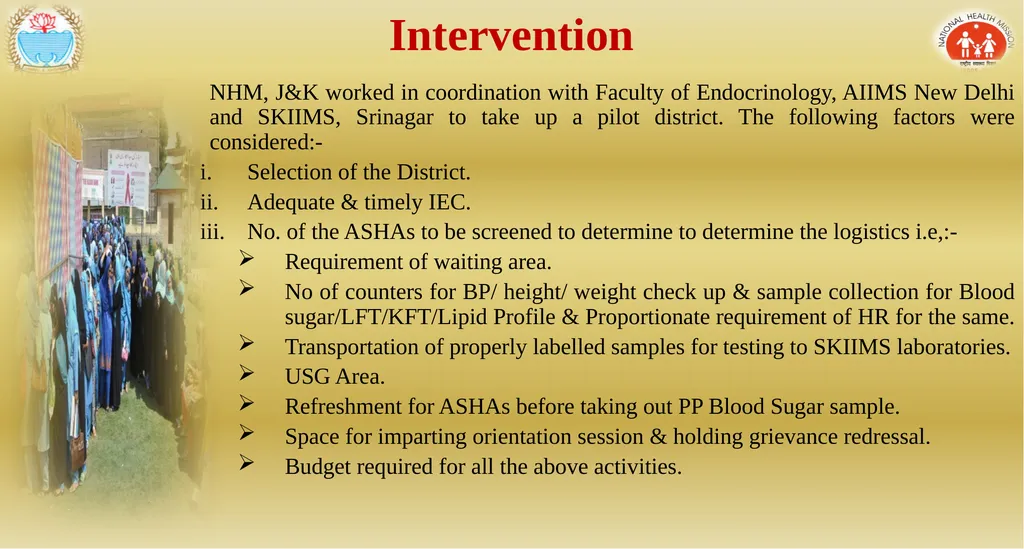
Intervention NHM, J&K worked in coordination with Faculty of Endocrinology, AIIMS New Delhi and SKIIMS, Srinagar to take up a pilot district. The following factors were considered:-
Selection of the District.
Adequate & timely IEC.
No. of the ASHAs to be screened to determine to determine the logistics i.e,:-
Requirement of waiting area.
No of counters for BP/ height/ weight check up & sample collection for Blood sugar/LFT/KFT/Lipid Profile & Proportionate requirement of HR for the same.
Transportation of properly labelled samples for testing to SKIIMS laboratories.
USG Area.
Refreshment for ASHAs before taking out PP Blood Sugar sample.
Space for imparting orientation session & holding grievance redressal.
Budget required for all the above activities.<br>
06
Intervention HR & BUDGET FOR SCREENING:-
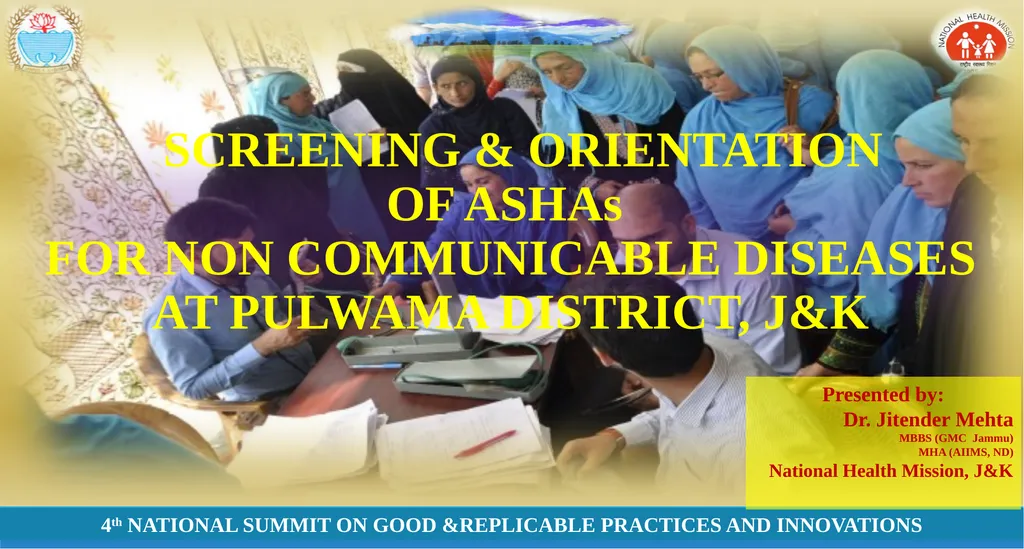
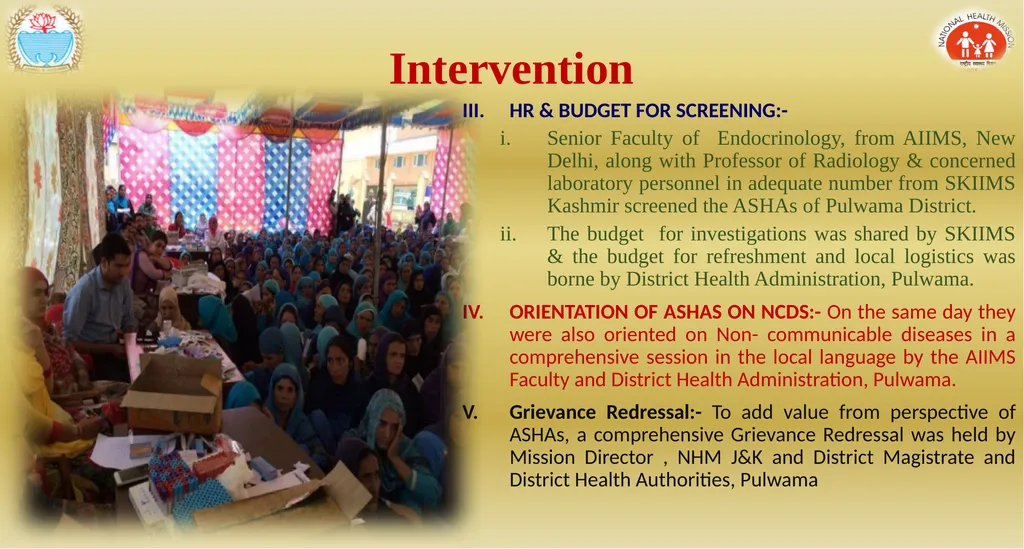
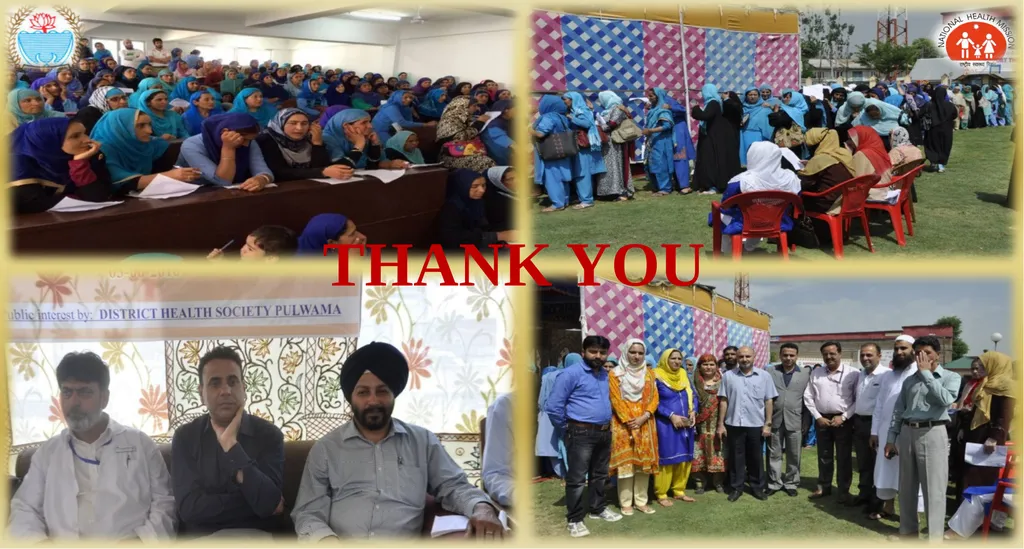
Senior Faculty of Endocrinology, from AIIMS, New Delhi, along with Professor of Radiology & concerned laboratory personnel in adequate number from SKIIMS Kashmir screened the ASHAs of Pulwama District.
The budget for investigations was shared by SKIIMS & the budget for refreshment and local logistics was borne by District Health Administration, Pulwama.
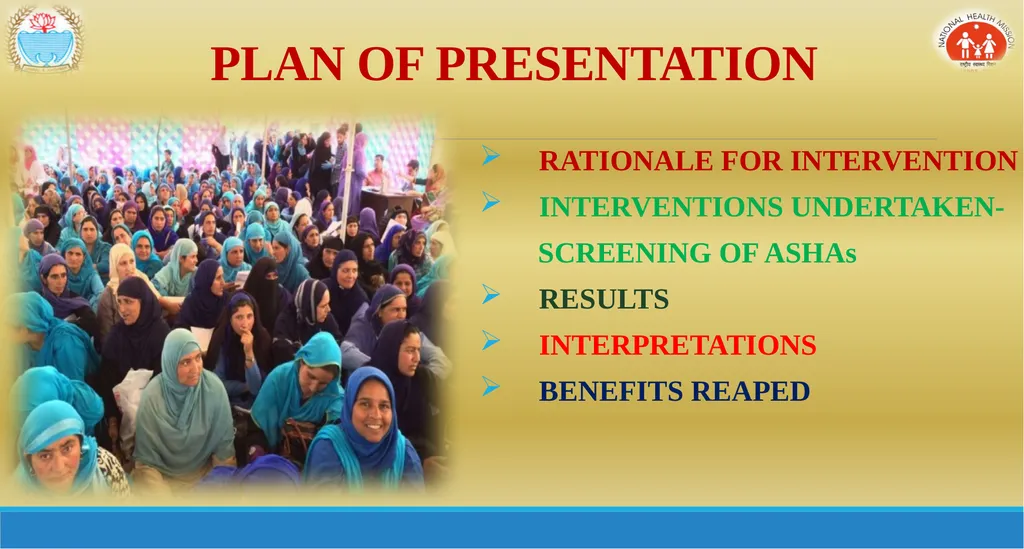
ORIENTATION OF ASHAS ON NCDS:- On the same day they were also oriented on Non- communicable diseases in a comprehensive session in the local language by the AIIMS Faculty and District Health Administration, Pulwama.
Grievance Redressal:- To add value from perspective of ASHAs, a comprehensive Grievance Redressal was held by Mission Director , NHM J&K and District Magistrate and District Health Authorities, Pulwama<br>
07
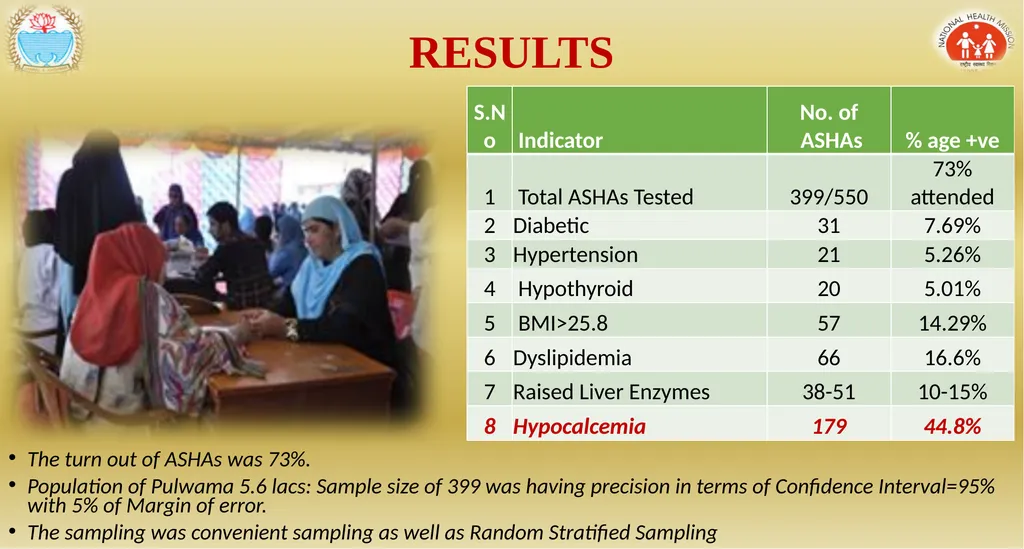
RESULTS The turn out of ASHAs was 73%.
Population of Pulwama 5.6 lacs: Sample size of 399 was having precision in terms of Confidence Interval=95% with 5% of Margin of error.
The sampling was convenient sampling as well as Random Stratified Sampling<br>
08
INTERPRETATIONS Age :-The mean age of the ASHAs was 35.62 years (ranging 21-55years).
BMI (Body Mass Index):-Mean BMI of the evaluated ASHA workers was 25.95±4.78 kg/m2. Out of these 14.28% of the ASHA workers were obese with mean BMI 33.962.
BP (Blood Pressure):-Blood pressure (BP) was measured up to 1mm using a standard mercury BP apparatus, after examining the BP, 5.26% of the ASHAs were hypertensive with the mean BP of 156/100 mm of Hg. The mean value of systolic and diastolic blood pressure for rest of the ASHAs was 117.15±15.38 mm of Hg and 77.55±10.66 mm of Hg, respectively.
Glucose:-The mean value of blood glucose level amongst the participating ASHA workers was 94.90±20.41 mg/dl. 7.89 % of the ASHAs were diabetic with mean Glucose 157±15.66.
Lipidemia:-Dyslipidemia was noted in 16.58% with a mean value of blood serum cholesterol level as 148.14±55.17 ng/dl amongst the participating workers.
Liver Enzyme:-Amongst the various liver enzymes, Alkaline Phosphatase (15.13%) and Aspartate Serum Amino Transpherase (10.18) showed higher levels as compared to other enzymes.
Calcium:-Hypocalcaemia (44.89%) was one of the important observations amongst these workers. The mean serum calcium levels amongst the participating ASHAs was 7.77±1.78 mg/dl.<br>