Screening Patients for Substance Use in Your
Description: Screening Patients for Substance Use in Your Practice Setting Learning Objectives By the end of this session, participants will Understand the rationale for universal screening. Identify potential health impact of substance misuse and
Related Topics
Download Presentation
"Screening Patients for Substance Use in Your" is the property of its rightful owner. Permission is granted to download and print the materials on this website for personal, non-commercial use only, and to display it on your personal computer provided you do not modify the materials and that you retain all copyright notices contained in the materials. By downloading content from our website, you accept the terms of this agreement.
Presentation Transcript
slide1. Screening Patients for SubstanceUse in Your Practice Setting<br>
slide2. Learning Objectives By the end of this session, participants will—
Understand the rationale for universal screening.
Identify potential health impact of substance misuse and abuse.
Identify substance use risk limits.
Identify how screening is conducted in a practice setting, including prescreening and screening.
Practice how to use two screening tools.
Understand how screening is used in brief intervention.<br>
slide3. Rationale for Universal Screening Drinking and drug use are common.
Drinking and drug use can increase the risk for health problems, safety risks, and a host of other issues.
Drinking and drug use often go undetected.
People are more open to change than you might expect.<br>
slide4. Why Screen Universally? Detect current health problems related to at-risk alcohol and substance use at an early stage—before they result in more serious disease or other health problems.
Detect alcohol and substance use patterns that can increase future injury or illness risks.
Intervene and educate about at-risk alcohol and other substance use.
Research has shown that approximately 90 percent of substance use disorders go untreated. (NSDUH, 2007).<br>
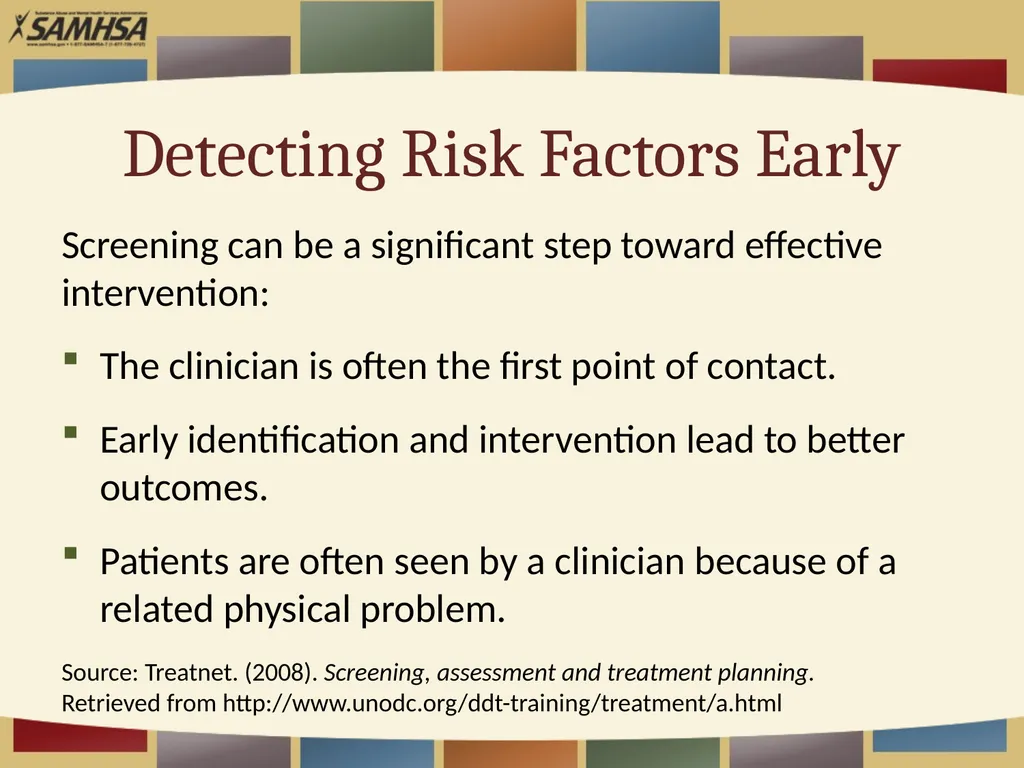
slide5. Detecting Risk Factors Early Screening can be a significant step toward effective intervention:
The clinician is often the first point of contact.
Early identification and intervention lead to better outcomes.
Patients are often seen by a clinician because of a related physical problem.
Source: Treatnet. (2008). Screening, assessment and treatment planning. Retrieved from http://www.unodc.org/ddt-training/treatment/a.html<br>
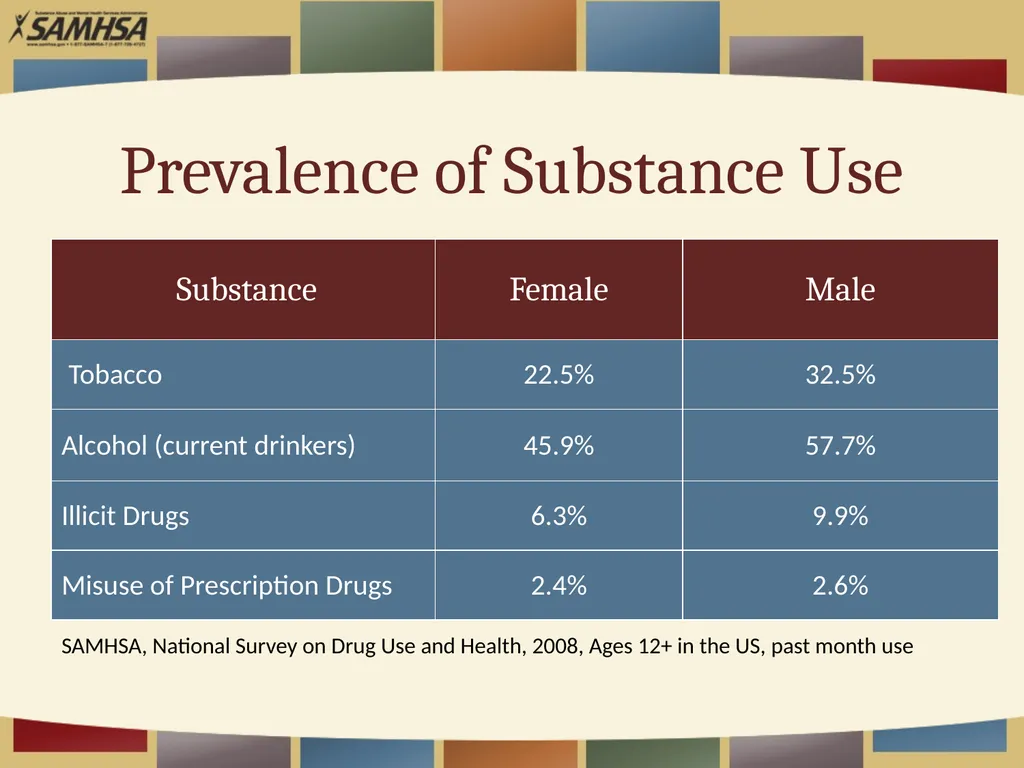
slide6. Prevalence of Substance Use SAMHSA, National Survey on Drug Use and Health, 2008, Ages 12+ in the US, past month use<br>
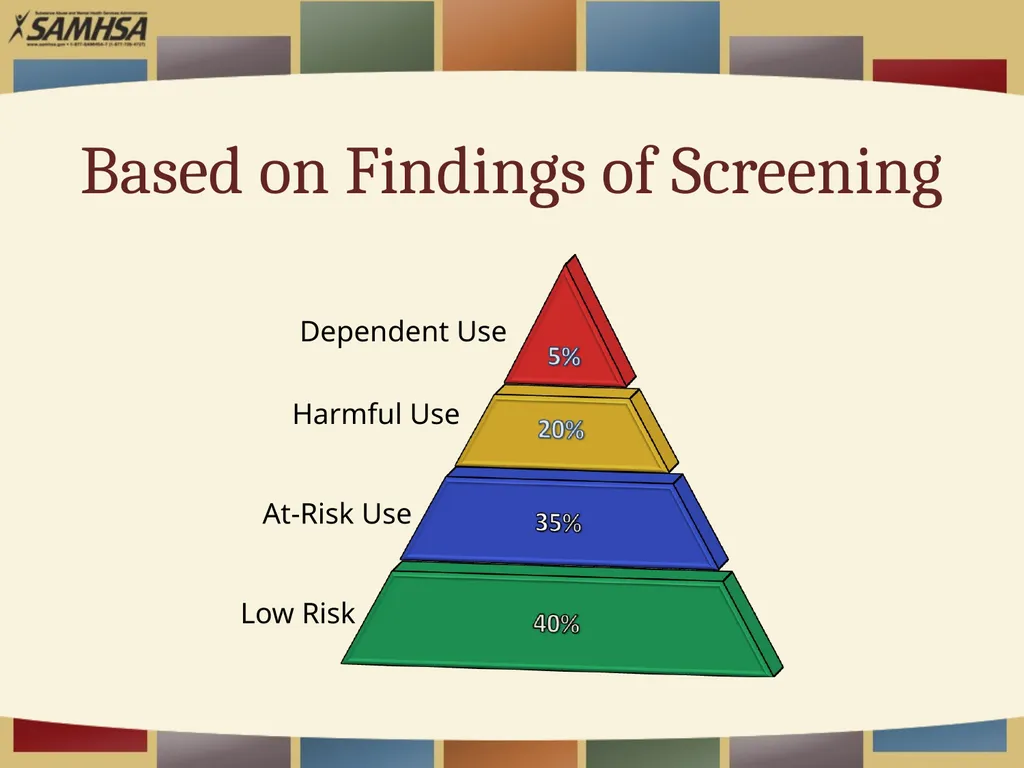
slide7. Based on Findings of Screening<br>
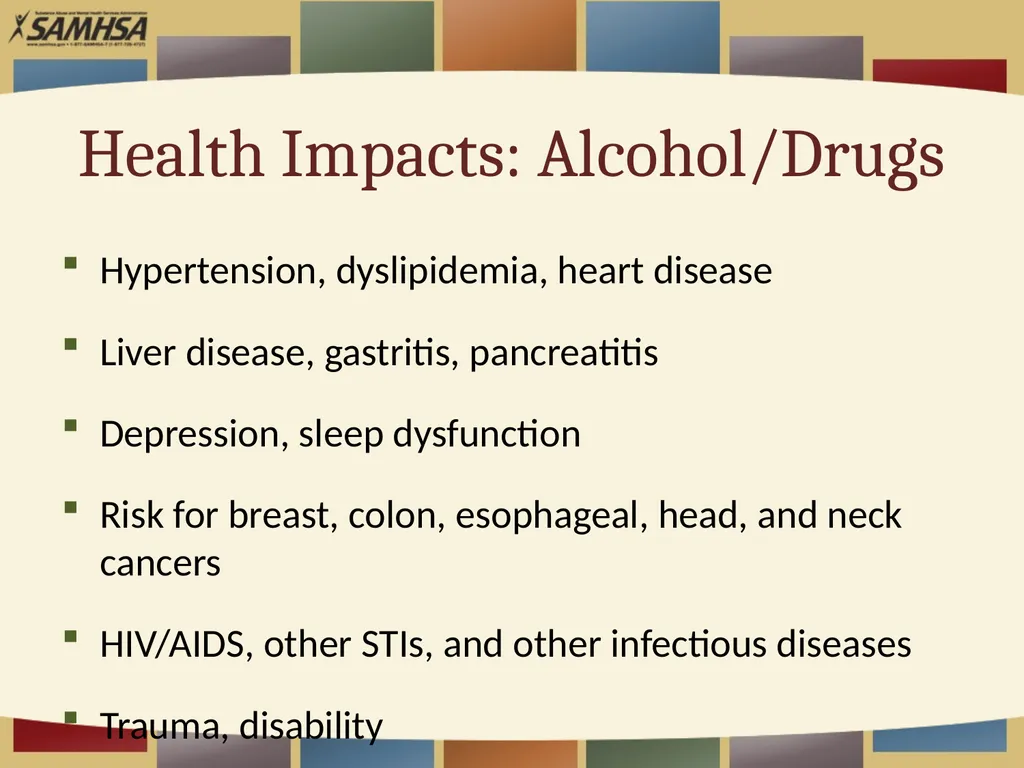
slide8. Health Impacts: Alcohol/Drugs Hypertension, dyslipidemia, heart disease
Liver disease, gastritis, pancreatitis
Depression, sleep dysfunction
Risk for breast, colon, esophageal, head, and neck cancers
HIV/AIDS, other STIs, and other infectious diseases
Trauma, disability<br>
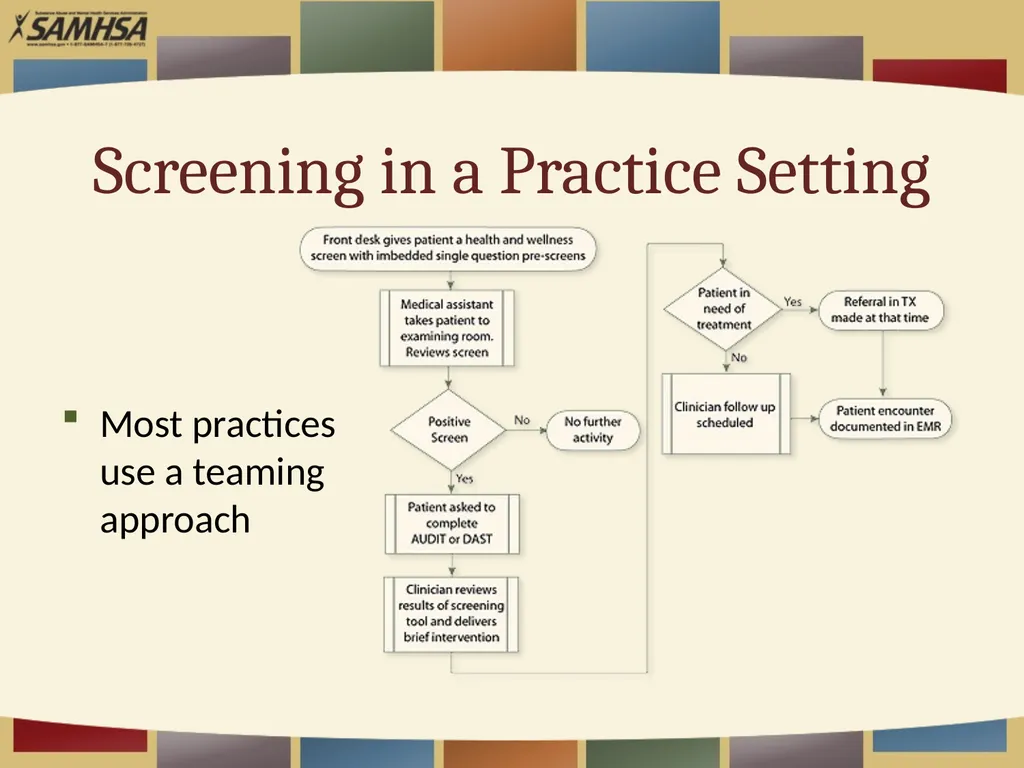
slide9. Screening in a Practice Setting Most practices use a teaming approach<br>
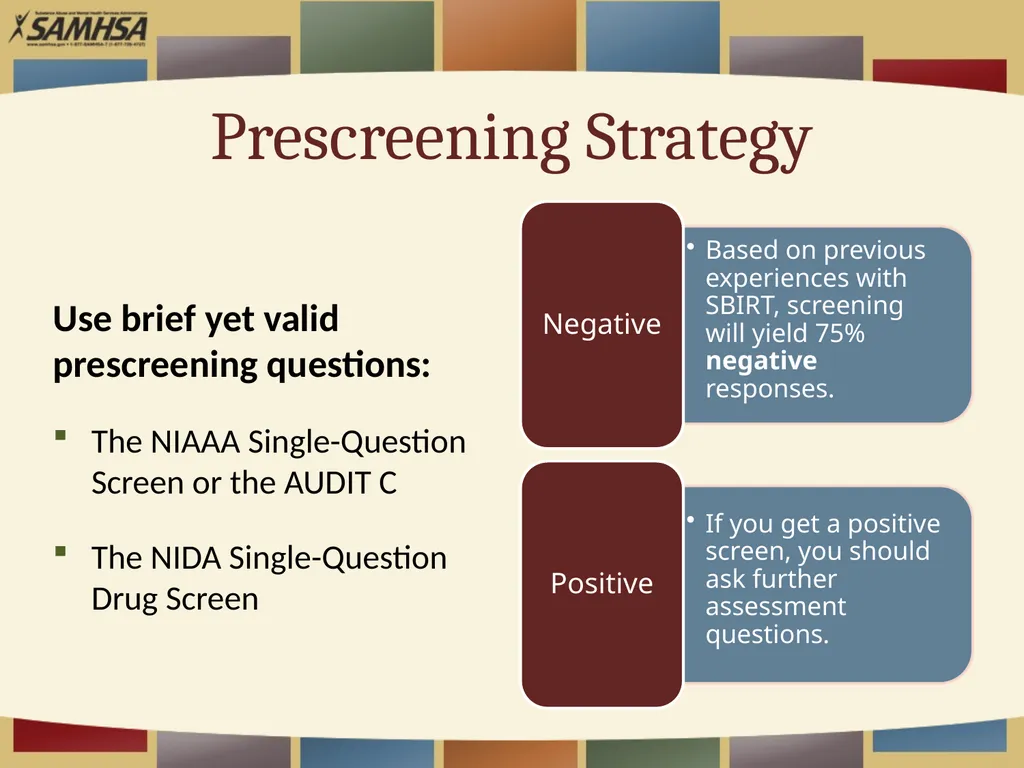
slide10. Prescreening Strategy Use brief yet valid prescreening questions:
The NIAAA Single-Question Screen or the AUDIT C
The NIDA Single-Question Drug Screen<br>
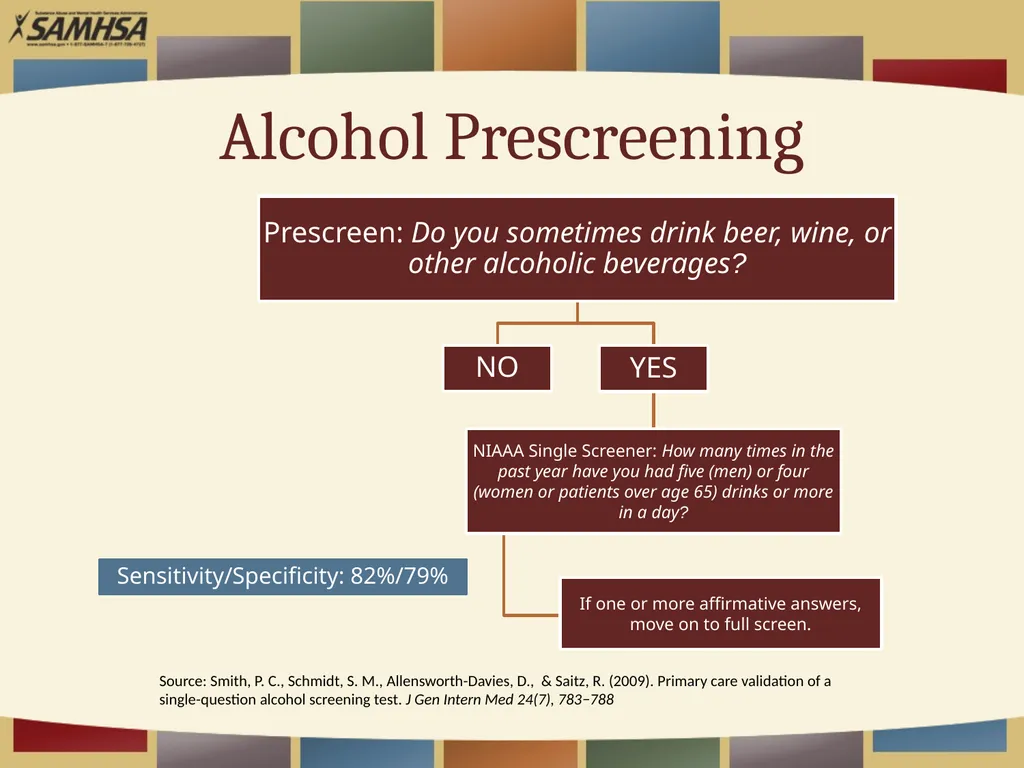
slide11. Source: Smith, P. C., Schmidt, S. M., Allensworth-Davies, D., & Saitz, R. (2009). Primary care validation of a single-question alcohol screening test. J Gen Intern Med 24(7), 783−788 Alcohol Prescreening<br>
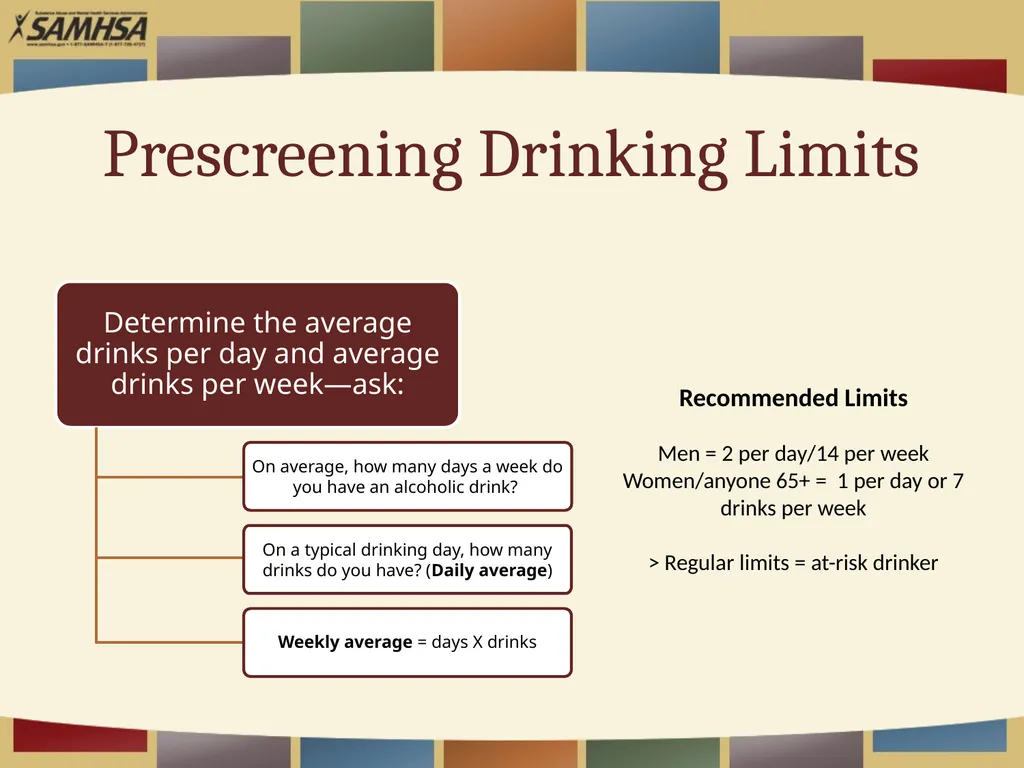
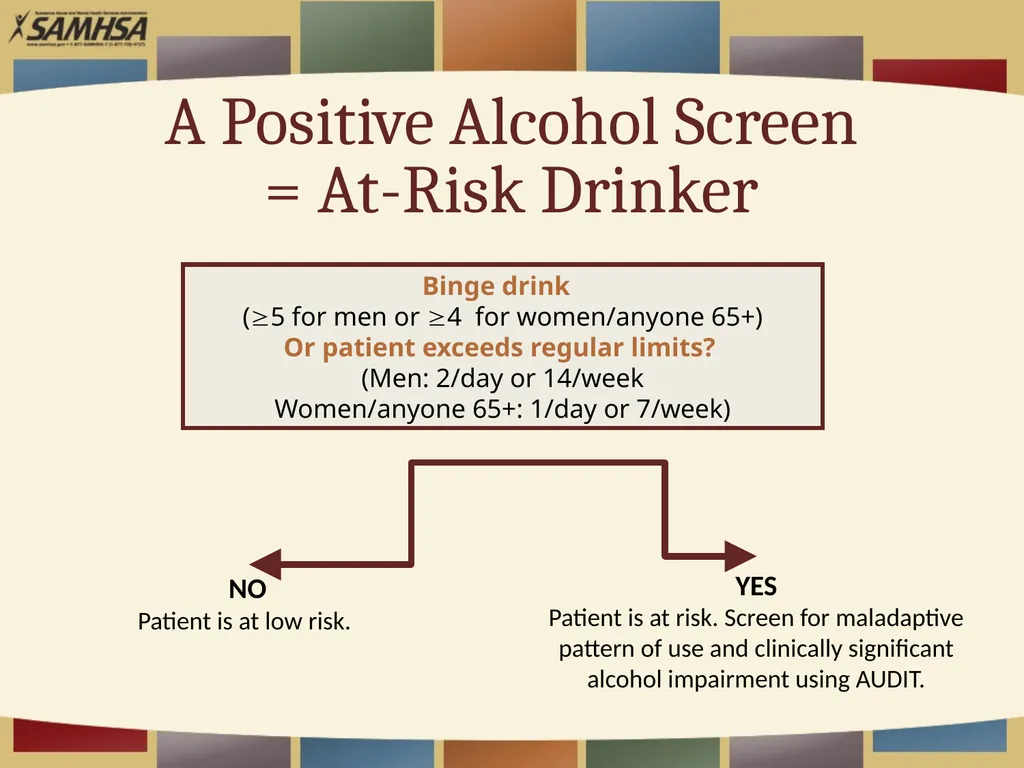
slide12. Recommended Limits
Men = 2 per day/14 per week
Women/anyone 65+ = 1 per day or 7 drinks per week
> Regular limits = at-risk drinker Prescreening Drinking Limits<br>
slide13. A Positive Alcohol Screen= At-Risk Drinker<br>
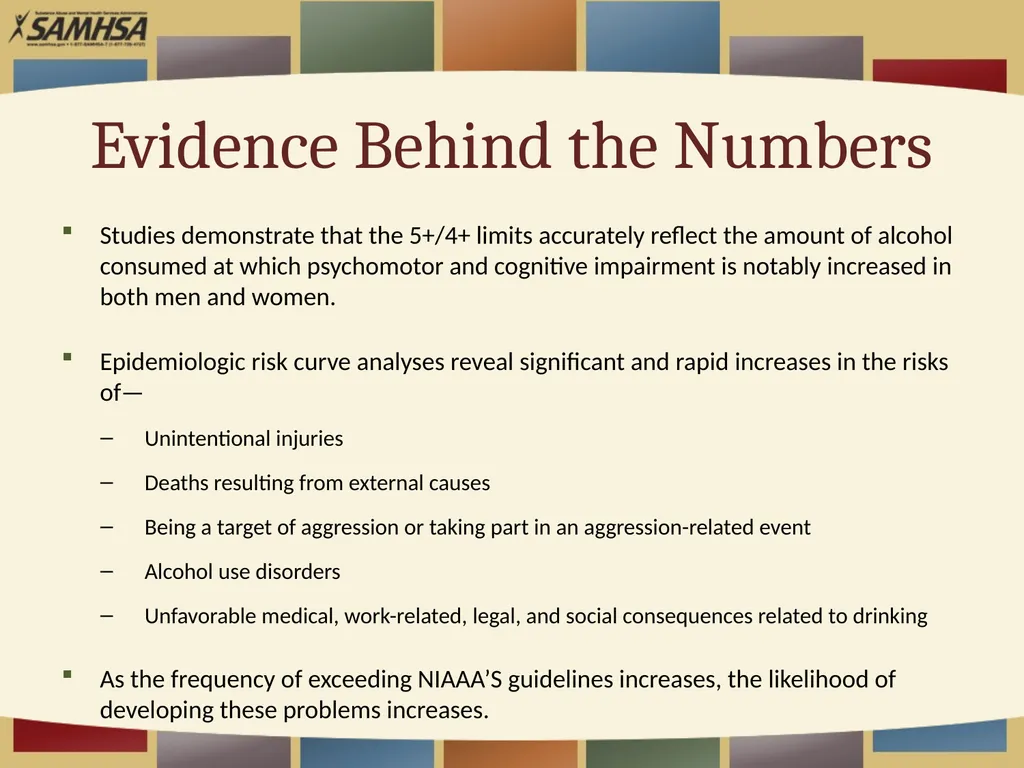
slide14. Evidence Behind the Numbers Studies demonstrate that the 5+/4+ limits accurately reflect the amount of alcohol consumed at which psychomotor and cognitive impairment is notably increased in both men and women.
Epidemiologic risk curve analyses reveal significant and rapid increases in the risks of—
Unintentional injuries
Deaths resulting from external causes
Being a target of aggression or taking part in an aggression-related event
Alcohol use disorders
Unfavorable medical, work-related, legal, and social consequences related to drinking
As the frequency of exceeding NIAAA’S guidelines increases, the likelihood of developing these problems increases.<br>
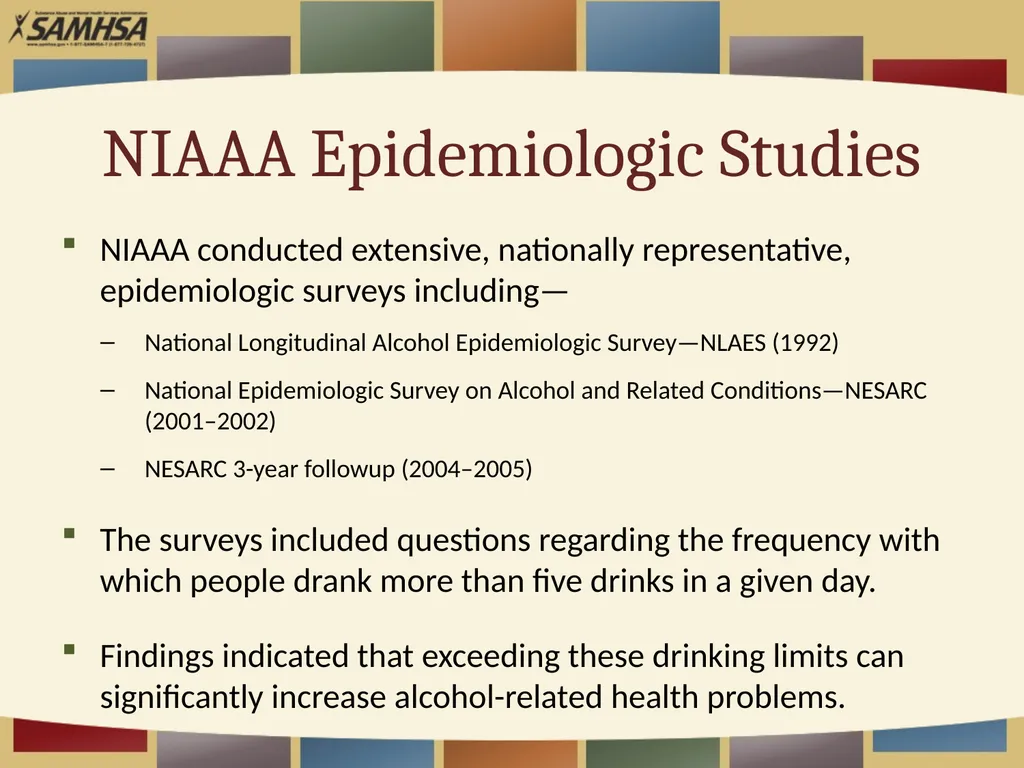
slide15. NIAAA Epidemiologic Studies NIAAA conducted extensive, nationally representative, epidemiologic surveys including—
National Longitudinal Alcohol Epidemiologic Survey—NLAES (1992)
National Epidemiologic Survey on Alcohol and Related Conditions—NESARC (2001–2002)
NESARC 3-year followup (2004–2005)
The surveys included questions regarding the frequency with which people drank more than five drinks in a given day.
Findings indicated that exceeding these drinking limits can significantly increase alcohol-related health problems.<br>
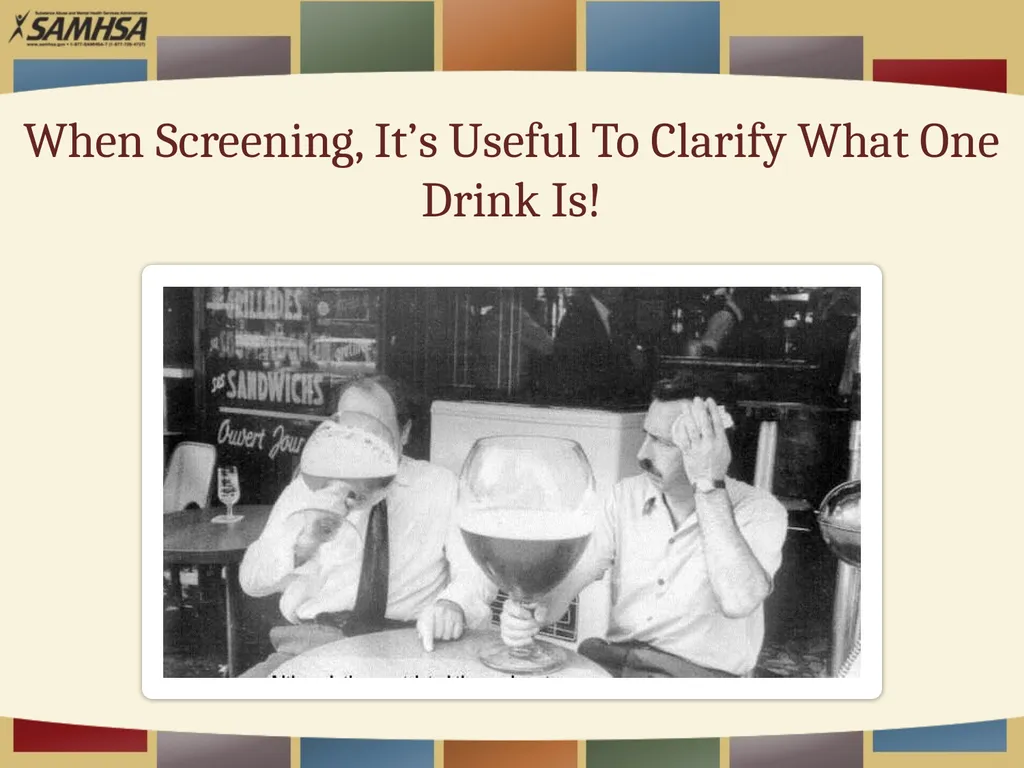
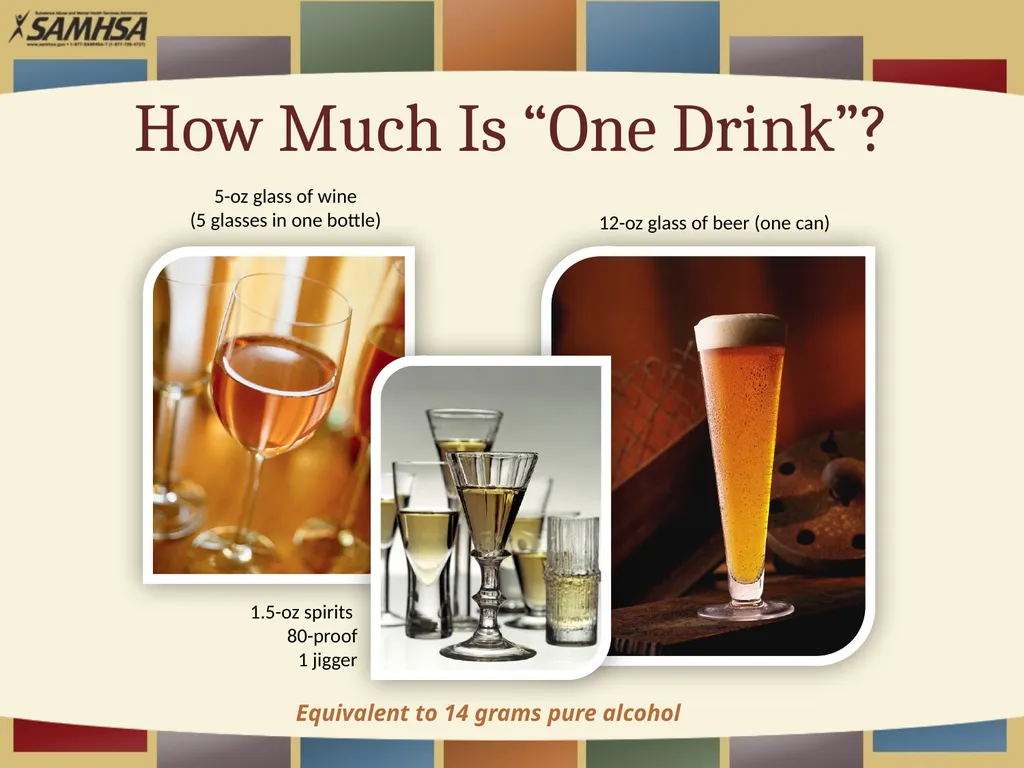
slide16. When Screening, It’s Useful To Clarify What One Drink Is!<br>
slide17. How Much Is “One Drink”? 12-oz glass of beer (one can) 5-oz glass of wine
(5 glasses in one bottle) 1.5-oz spirits
80-proof
1 jigger Equivalent to 14 grams pure alcohol<br>
slide18. AUDITAlcohol Use Disorders Identification Test What is it?
Ten questions, self-administered or through an interview; addresses recent alcohol use, alcohol dependence symptoms, and alcohol-related problems
Developed by World Health Organization (WHO)<br>
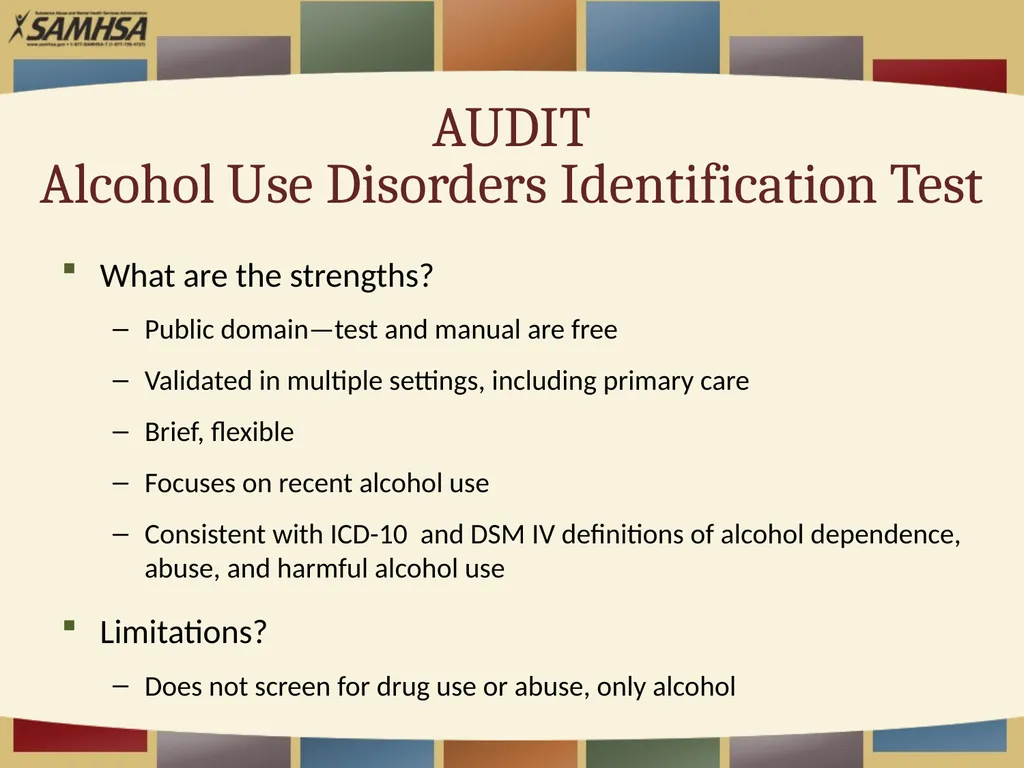
slide19. AUDITAlcohol Use Disorders Identification Test What are the strengths?
Public domain—test and manual are free
Validated in multiple settings, including primary care
Brief, flexible
Focuses on recent alcohol use
Consistent with ICD-10 and DSM IV definitions of alcohol dependence, abuse, and harmful alcohol use
Limitations?
Does not screen for drug use or abuse, only alcohol<br>
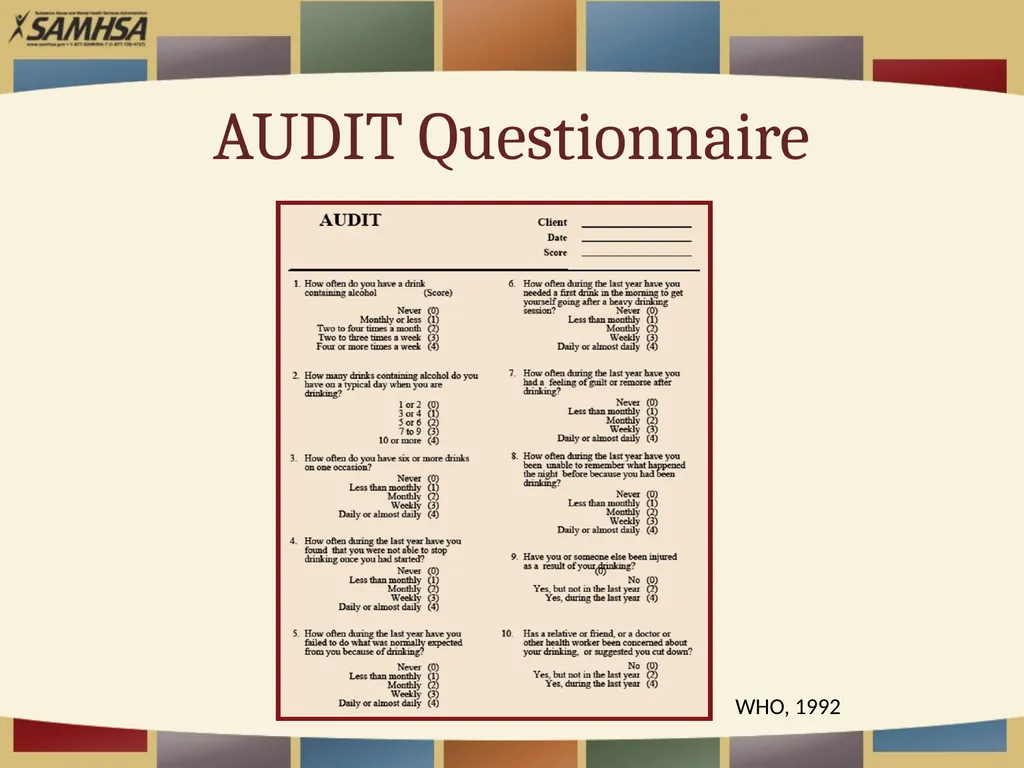
slide20. AUDIT Questionnaire WHO, 1992<br>
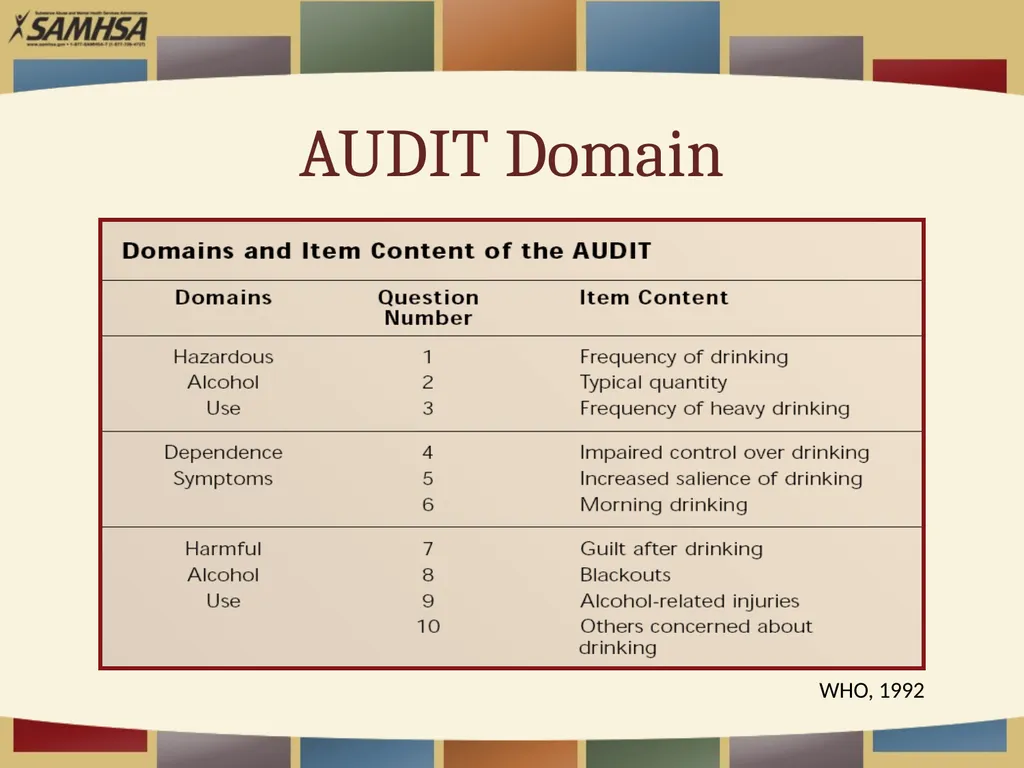
slide21. AUDIT Domain WHO, 1992<br>
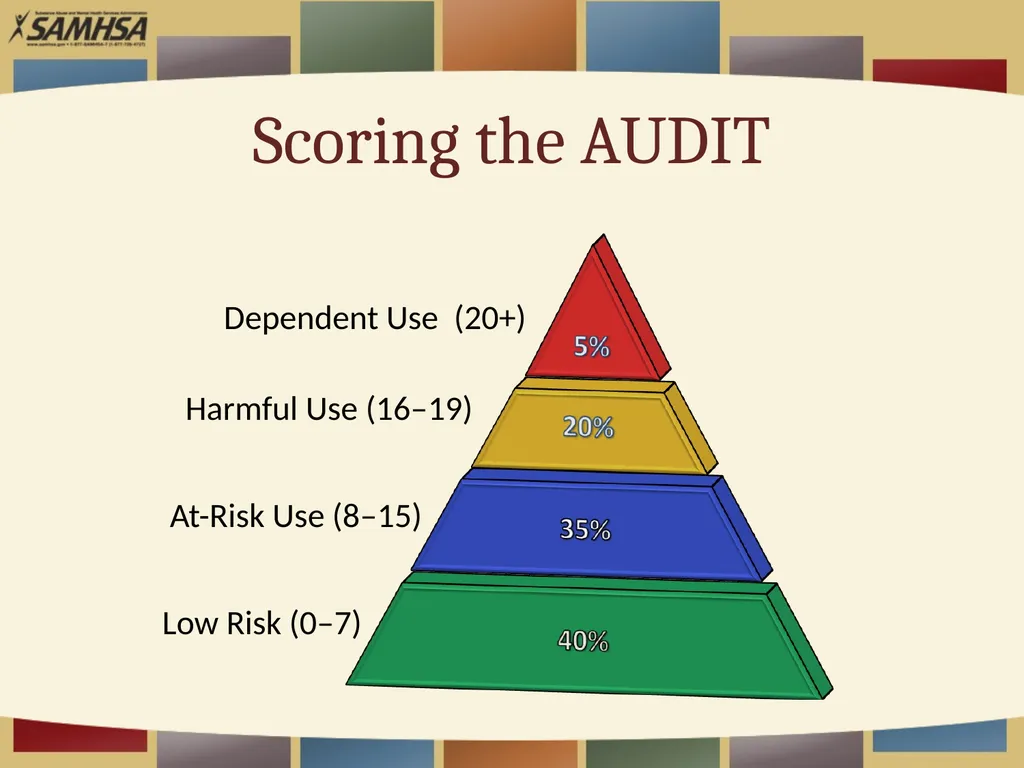
slide22. Scoring the AUDIT Dependent Use (20+)
Harmful Use (16‒19)
At-Risk Use (8‒15)
Low Risk (0‒7)<br>
slide23. Practice Session Screening Using the AUDIT<br>
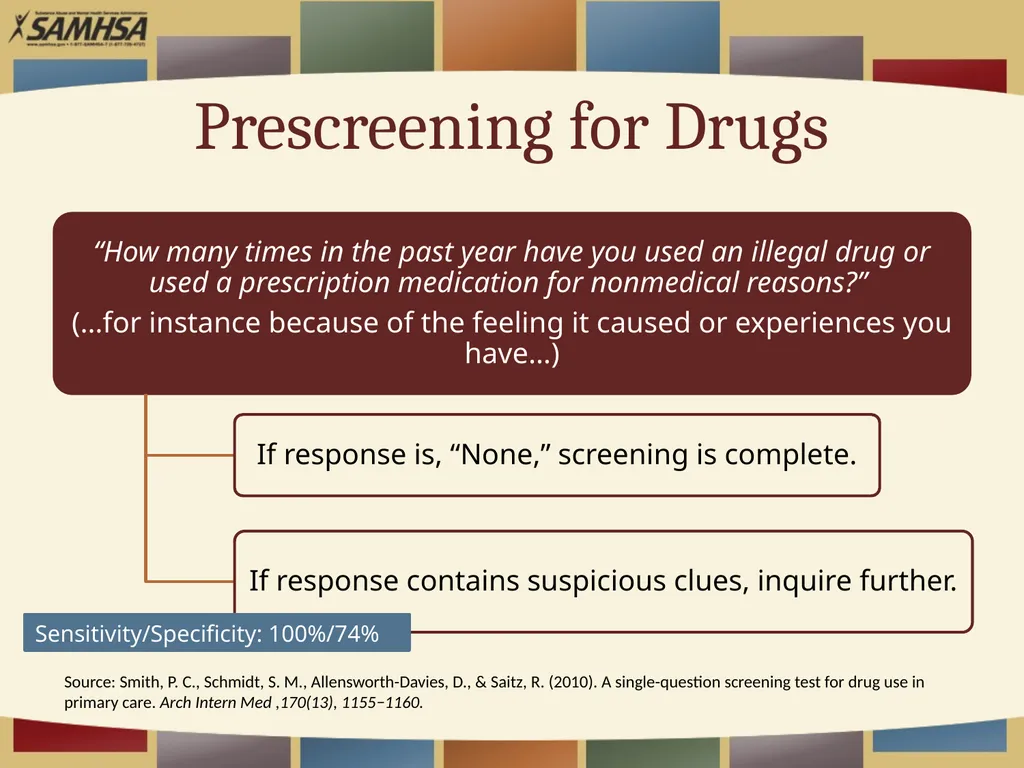
slide24. Prescreening for Drugs “How many times in the past year have you used an illegal drug or used a prescription medication for nonmedical reasons?”
(…for instance because of the feeling it caused or experiences you have…) If response is, “None,” screening is complete. If response contains suspicious clues, inquire further. Sensitivity/Specificity: 100%/74% Source: Smith, P. C., Schmidt, S. M., Allensworth-Davies, D., & Saitz, R. (2010). A single-question screening test for drug use in primary care. Arch Intern Med ,170(13), 1155−1160.<br>
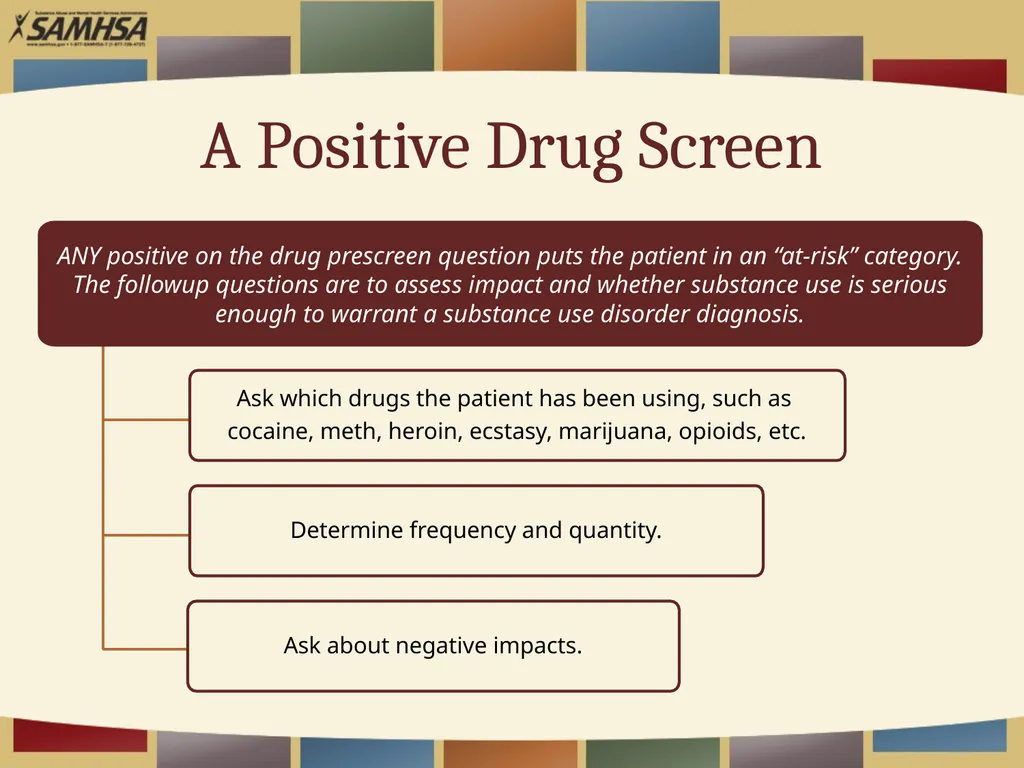
slide25. A Positive Drug Screen<br>
slide26. Prescription Drug Misuse Although many people take medications that are not prescribed to them, we are primarily concerned with—
Opioids (oxycodone, hydrocodone, fentanyl, methadone)
Benzodiazepines (clonazepam, alprazolam, diazepam)
Stimulants (amphetamine, dextroamphetamine, methylphenidate
Sleep aids (zolpidem, zaleplon, eszopicione)
Other assorted (clonidine, carisoprodol)<br>
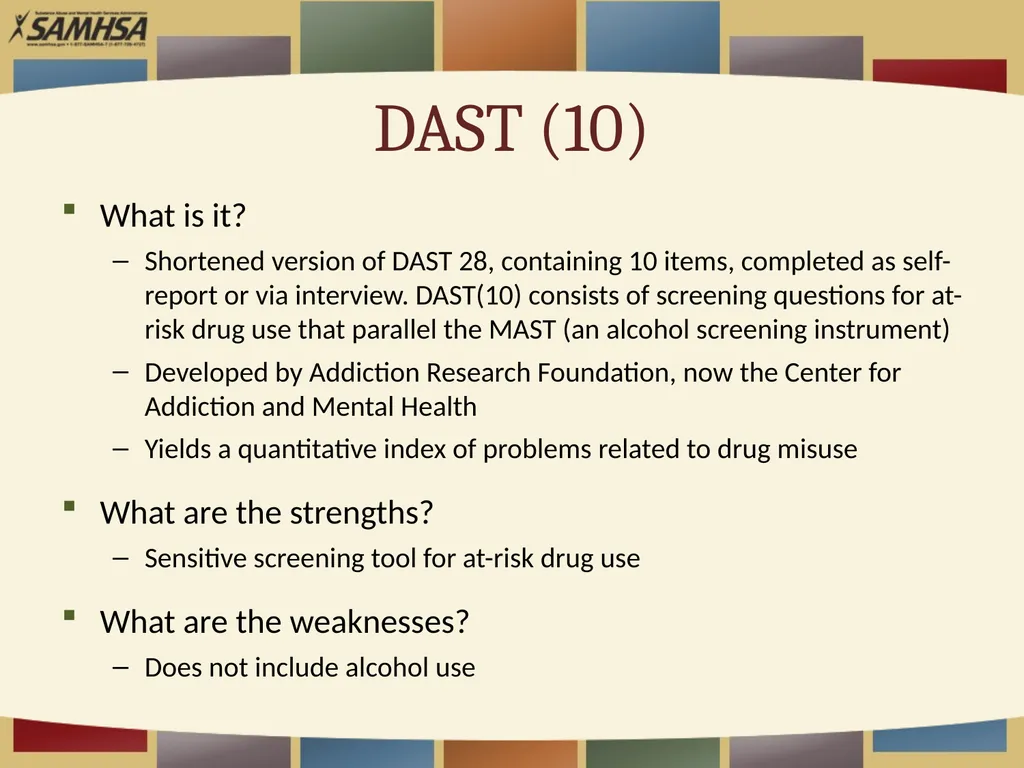
slide27. DAST (10) What is it?
Shortened version of DAST 28, containing 10 items, completed as self-report or via interview. DAST(10) consists of screening questions for at-risk drug use that parallel the MAST (an alcohol screening instrument)
Developed by Addiction Research Foundation, now the Center for Addiction and Mental Health
Yields a quantitative index of problems related to drug misuse
What are the strengths?
Sensitive screening tool for at-risk drug use
What are the weaknesses?
Does not include alcohol use<br>
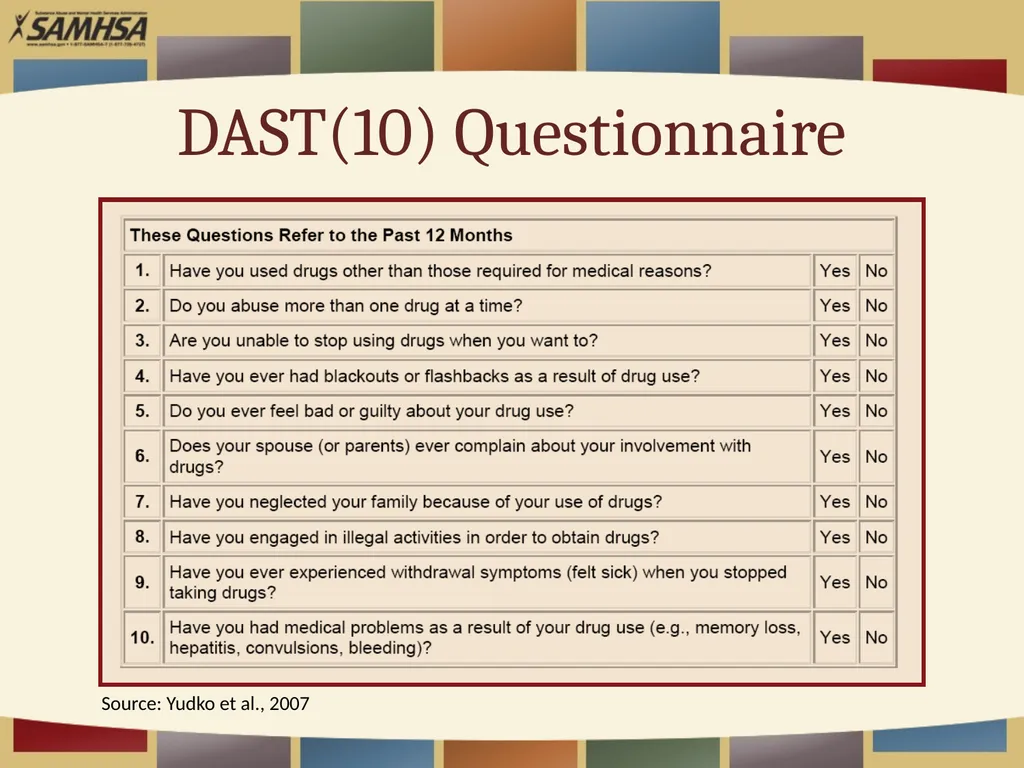
slide28. DAST(10) Questionnaire Source: Yudko et al., 2007<br>
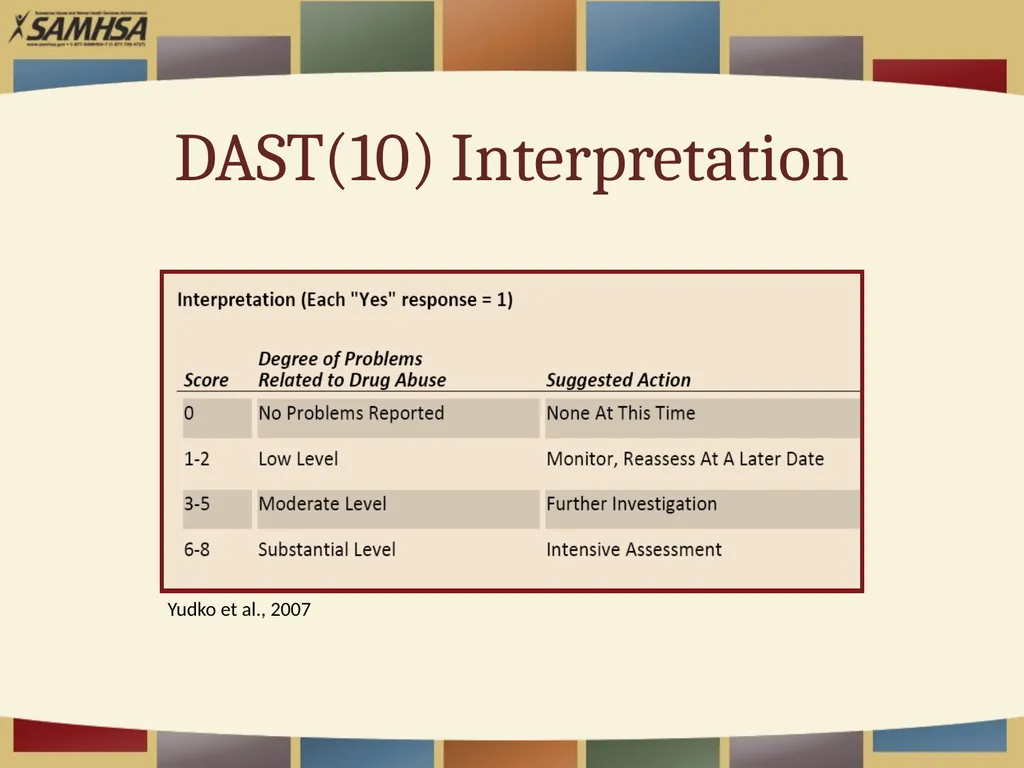
slide29. DAST(10) Interpretation Yudko et al., 2007<br>
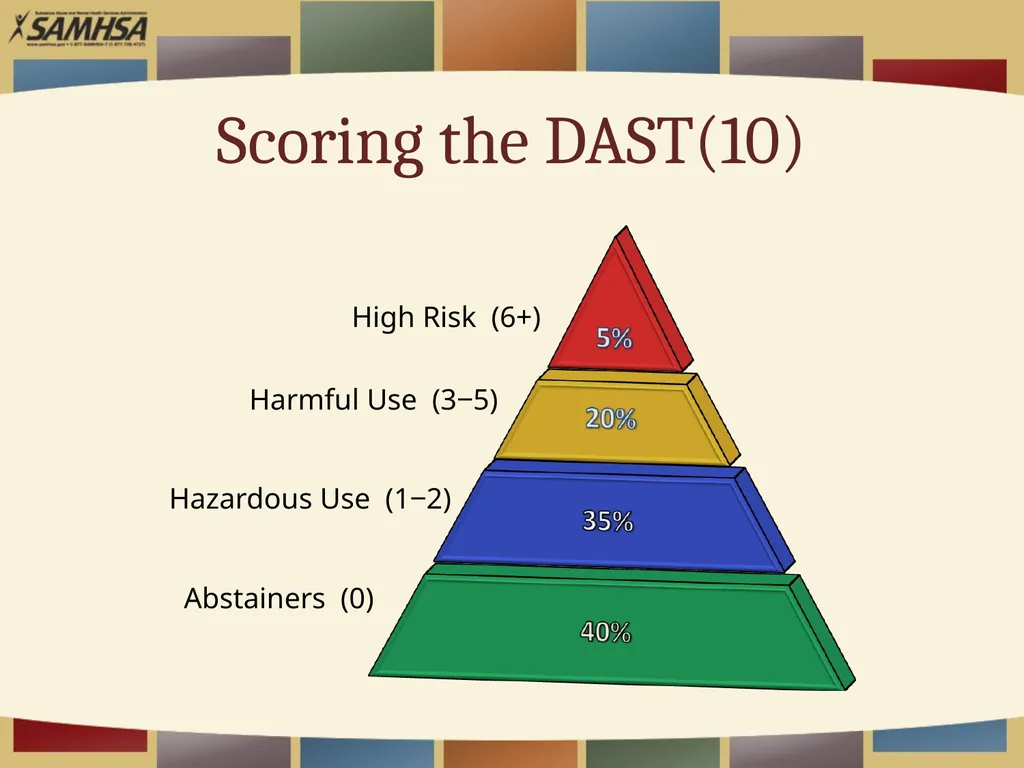
slide30. Scoring the DAST(10) High Risk (6+)
Harmful Use (3‒5)
Hazardous Use (1‒2)
Abstainers (0)<br>
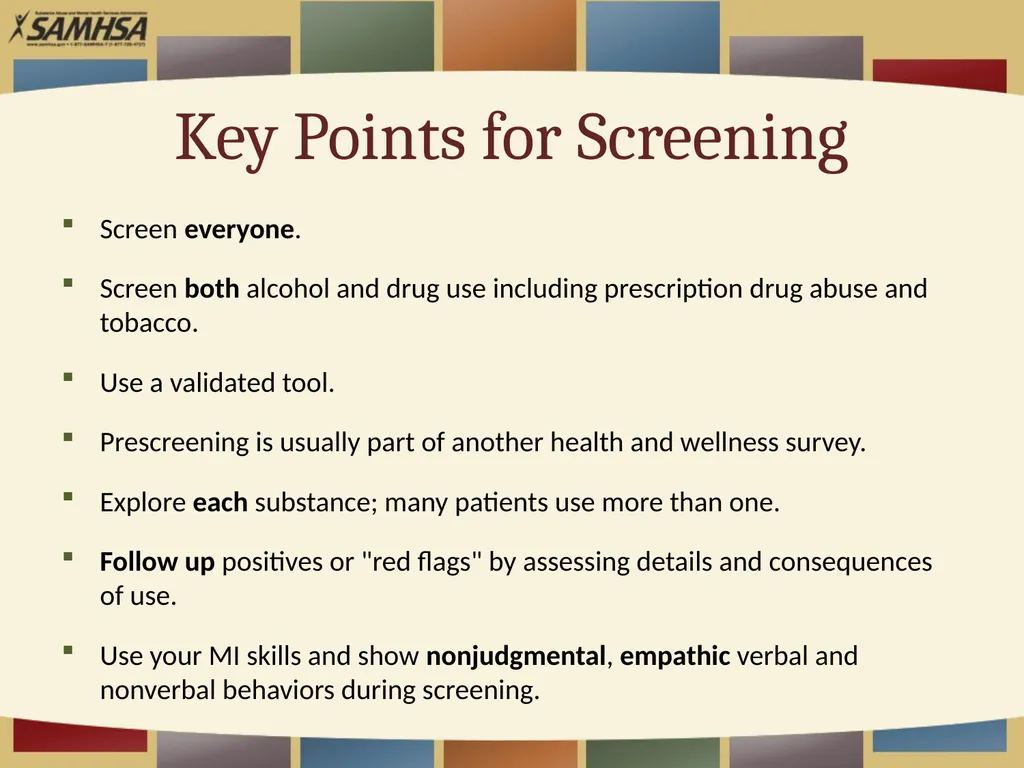
slide31. Key Points for Screening Screen everyone.
Screen both alcohol and drug use including prescription drug abuse and tobacco.
Use a validated tool.
Prescreening is usually part of another health and wellness survey.
Explore each substance; many patients use more than one.
Follow up positives or "red flags" by assessing details and consequences of use.
Use your MI skills and show nonjudgmental, empathic verbal and nonverbal behaviors during screening.<br>
slide32. Screening: Summary Screening is the first step of the SBIRT process and determines the severity and risk level of the patient’s substance use.
The result of a screen allows the provider to determine if a brief intervention or referral to treatment is a necessary next step for the patient.<br>
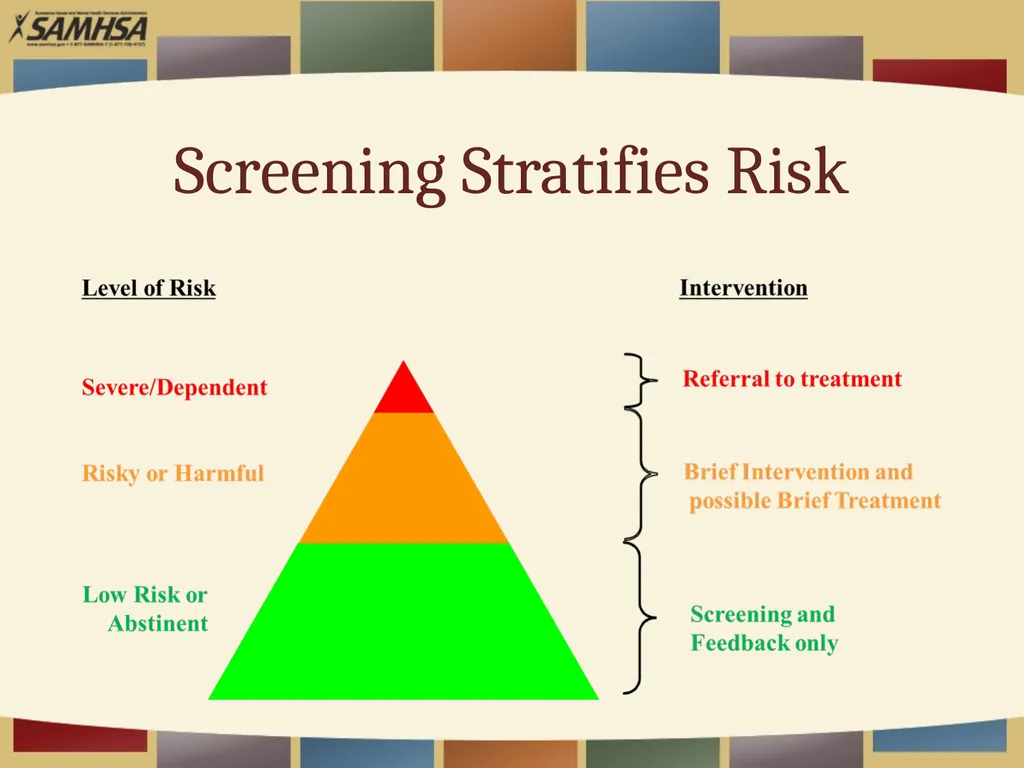
slide33. Screening Stratifies Risk<br>
slide34. Based on Findings of Screening The clinician has valid, patient self-reported information that is used in brief intervention.
Often the process of screening sets in motion patient reflection on their substance use behavior.<br>

slide35. Question?<br>
slide2. Learning Objectives By the end of this session, participants will—
Understand the rationale for universal screening.
Identify potential health impact of substance misuse and abuse.
Identify substance use risk limits.
Identify how screening is conducted in a practice setting, including prescreening and screening.
Practice how to use two screening tools.
Understand how screening is used in brief intervention.<br>
slide3. Rationale for Universal Screening Drinking and drug use are common.
Drinking and drug use can increase the risk for health problems, safety risks, and a host of other issues.
Drinking and drug use often go undetected.
People are more open to change than you might expect.<br>
slide4. Why Screen Universally? Detect current health problems related to at-risk alcohol and substance use at an early stage—before they result in more serious disease or other health problems.
Detect alcohol and substance use patterns that can increase future injury or illness risks.
Intervene and educate about at-risk alcohol and other substance use.
Research has shown that approximately 90 percent of substance use disorders go untreated. (NSDUH, 2007).<br>
slide5. Detecting Risk Factors Early Screening can be a significant step toward effective intervention:
The clinician is often the first point of contact.
Early identification and intervention lead to better outcomes.
Patients are often seen by a clinician because of a related physical problem.
Source: Treatnet. (2008). Screening, assessment and treatment planning. Retrieved from http://www.unodc.org/ddt-training/treatment/a.html<br>
slide6. Prevalence of Substance Use SAMHSA, National Survey on Drug Use and Health, 2008, Ages 12+ in the US, past month use<br>
slide7. Based on Findings of Screening<br>
slide8. Health Impacts: Alcohol/Drugs Hypertension, dyslipidemia, heart disease
Liver disease, gastritis, pancreatitis
Depression, sleep dysfunction
Risk for breast, colon, esophageal, head, and neck cancers
HIV/AIDS, other STIs, and other infectious diseases
Trauma, disability<br>
slide9. Screening in a Practice Setting Most practices use a teaming approach<br>
slide10. Prescreening Strategy Use brief yet valid prescreening questions:
The NIAAA Single-Question Screen or the AUDIT C
The NIDA Single-Question Drug Screen<br>
slide11. Source: Smith, P. C., Schmidt, S. M., Allensworth-Davies, D., & Saitz, R. (2009). Primary care validation of a single-question alcohol screening test. J Gen Intern Med 24(7), 783−788 Alcohol Prescreening<br>
slide12. Recommended Limits
Men = 2 per day/14 per week
Women/anyone 65+ = 1 per day or 7 drinks per week
> Regular limits = at-risk drinker Prescreening Drinking Limits<br>
slide13. A Positive Alcohol Screen= At-Risk Drinker<br>
slide14. Evidence Behind the Numbers Studies demonstrate that the 5+/4+ limits accurately reflect the amount of alcohol consumed at which psychomotor and cognitive impairment is notably increased in both men and women.
Epidemiologic risk curve analyses reveal significant and rapid increases in the risks of—
Unintentional injuries
Deaths resulting from external causes
Being a target of aggression or taking part in an aggression-related event
Alcohol use disorders
Unfavorable medical, work-related, legal, and social consequences related to drinking
As the frequency of exceeding NIAAA’S guidelines increases, the likelihood of developing these problems increases.<br>
slide15. NIAAA Epidemiologic Studies NIAAA conducted extensive, nationally representative, epidemiologic surveys including—
National Longitudinal Alcohol Epidemiologic Survey—NLAES (1992)
National Epidemiologic Survey on Alcohol and Related Conditions—NESARC (2001–2002)
NESARC 3-year followup (2004–2005)
The surveys included questions regarding the frequency with which people drank more than five drinks in a given day.
Findings indicated that exceeding these drinking limits can significantly increase alcohol-related health problems.<br>
slide16. When Screening, It’s Useful To Clarify What One Drink Is!<br>
slide17. How Much Is “One Drink”? 12-oz glass of beer (one can) 5-oz glass of wine
(5 glasses in one bottle) 1.5-oz spirits
80-proof
1 jigger Equivalent to 14 grams pure alcohol<br>
slide18. AUDITAlcohol Use Disorders Identification Test What is it?
Ten questions, self-administered or through an interview; addresses recent alcohol use, alcohol dependence symptoms, and alcohol-related problems
Developed by World Health Organization (WHO)<br>
slide19. AUDITAlcohol Use Disorders Identification Test What are the strengths?
Public domain—test and manual are free
Validated in multiple settings, including primary care
Brief, flexible
Focuses on recent alcohol use
Consistent with ICD-10 and DSM IV definitions of alcohol dependence, abuse, and harmful alcohol use
Limitations?
Does not screen for drug use or abuse, only alcohol<br>
slide20. AUDIT Questionnaire WHO, 1992<br>
slide21. AUDIT Domain WHO, 1992<br>
slide22. Scoring the AUDIT Dependent Use (20+)
Harmful Use (16‒19)
At-Risk Use (8‒15)
Low Risk (0‒7)<br>
slide23. Practice Session Screening Using the AUDIT<br>
slide24. Prescreening for Drugs “How many times in the past year have you used an illegal drug or used a prescription medication for nonmedical reasons?”
(…for instance because of the feeling it caused or experiences you have…) If response is, “None,” screening is complete. If response contains suspicious clues, inquire further. Sensitivity/Specificity: 100%/74% Source: Smith, P. C., Schmidt, S. M., Allensworth-Davies, D., & Saitz, R. (2010). A single-question screening test for drug use in primary care. Arch Intern Med ,170(13), 1155−1160.<br>
slide25. A Positive Drug Screen<br>
slide26. Prescription Drug Misuse Although many people take medications that are not prescribed to them, we are primarily concerned with—
Opioids (oxycodone, hydrocodone, fentanyl, methadone)
Benzodiazepines (clonazepam, alprazolam, diazepam)
Stimulants (amphetamine, dextroamphetamine, methylphenidate
Sleep aids (zolpidem, zaleplon, eszopicione)
Other assorted (clonidine, carisoprodol)<br>
slide27. DAST (10) What is it?
Shortened version of DAST 28, containing 10 items, completed as self-report or via interview. DAST(10) consists of screening questions for at-risk drug use that parallel the MAST (an alcohol screening instrument)
Developed by Addiction Research Foundation, now the Center for Addiction and Mental Health
Yields a quantitative index of problems related to drug misuse
What are the strengths?
Sensitive screening tool for at-risk drug use
What are the weaknesses?
Does not include alcohol use<br>
slide28. DAST(10) Questionnaire Source: Yudko et al., 2007<br>
slide29. DAST(10) Interpretation Yudko et al., 2007<br>
slide30. Scoring the DAST(10) High Risk (6+)
Harmful Use (3‒5)
Hazardous Use (1‒2)
Abstainers (0)<br>
slide31. Key Points for Screening Screen everyone.
Screen both alcohol and drug use including prescription drug abuse and tobacco.
Use a validated tool.
Prescreening is usually part of another health and wellness survey.
Explore each substance; many patients use more than one.
Follow up positives or "red flags" by assessing details and consequences of use.
Use your MI skills and show nonjudgmental, empathic verbal and nonverbal behaviors during screening.<br>
slide32. Screening: Summary Screening is the first step of the SBIRT process and determines the severity and risk level of the patient’s substance use.
The result of a screen allows the provider to determine if a brief intervention or referral to treatment is a necessary next step for the patient.<br>
slide33. Screening Stratifies Risk<br>
slide34. Based on Findings of Screening The clinician has valid, patient self-reported information that is used in brief intervention.
Often the process of screening sets in motion patient reflection on their substance use behavior.<br>
slide35. Question?<br>