
SDG 8 – Where do we stand? Status and deviations



Description: SDG 8 Where do we stand? Status and deviations Sukti Dasgupta, Chief ILO Employment, Labour Markets and Youth Branch Date: Monday 01 October 2019 Advancing social justice, promoting decent work 1 Introduction SDG 8: Promote
Related Topics
Download Presentation
"SDG 8 – Where do we stand? Status and deviations" is the property of its rightful owner. Permission is granted to download and print the materials on this website for personal, non-commercial use only, and to display it on your personal computer provided you do not modify the materials and that you retain all copyright notices contained in the materials. By downloading content from our website, you accept the terms of this agreement.
Presentation Transcript
slide1. SDG 8 – Where do we stand? Status and deviations
Sukti Dasgupta, Chief
ILO Employment, Labour Markets and Youth Branch Date: Monday / 01 / October / 2019 Advancing social justice, promoting decent work 1<br>
slide2. Introduction SDG 8: ”Promote sustained, inclusive and sustainable economic growth, full and productive employment and decent work for all”.
Some progress made. However the severe economic and employment impacts of COVID-19 pandemic have seriously disrupted gains achieved. Date: Monday / 01 / October / 2019 Advancing social justice, promoting decent work 2<br>
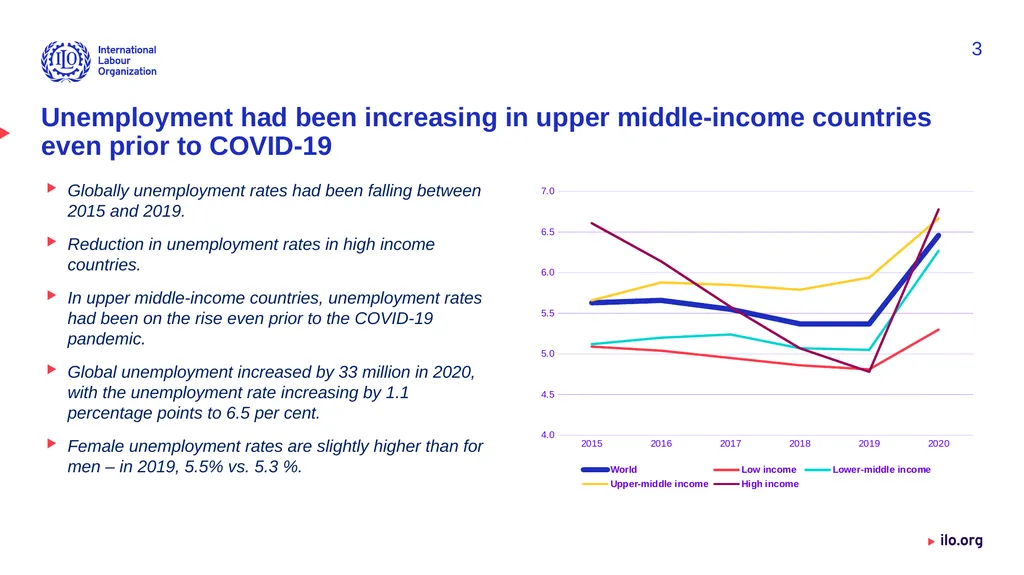
slide3. Unemployment had been increasing in upper middle-income countries even prior to COVID-19 Globally unemployment rates had been falling between 2015 and 2019.
Reduction in unemployment rates in high income countries.
In upper middle-income countries, unemployment rates had been on the rise even prior to the COVID-19 pandemic.
Global unemployment increased by 33 million in 2020, with the unemployment rate increasing by 1.1 percentage points to 6.5 per cent.
Female unemployment rates are slightly higher than for men – in 2019, 5.5% vs. 5.3 %. Date: Monday / 01 / October / 2019 3<br>
slide4. Informal employment remains a concern Prior to the pandemic, the informal employment share was 60.2 per cent of global employment. Regional variations. 89 percent for LDCs.
About 2 billion people worked in the informal economy.
Particularly worrisome in least developed countries, where the share of informal employment in total employment was 88.7 per cent (2019).
Severely affected by current crisis. Date: Monday / 01 / October / 2019 Advancing social justice, promoting decent work 4<br>
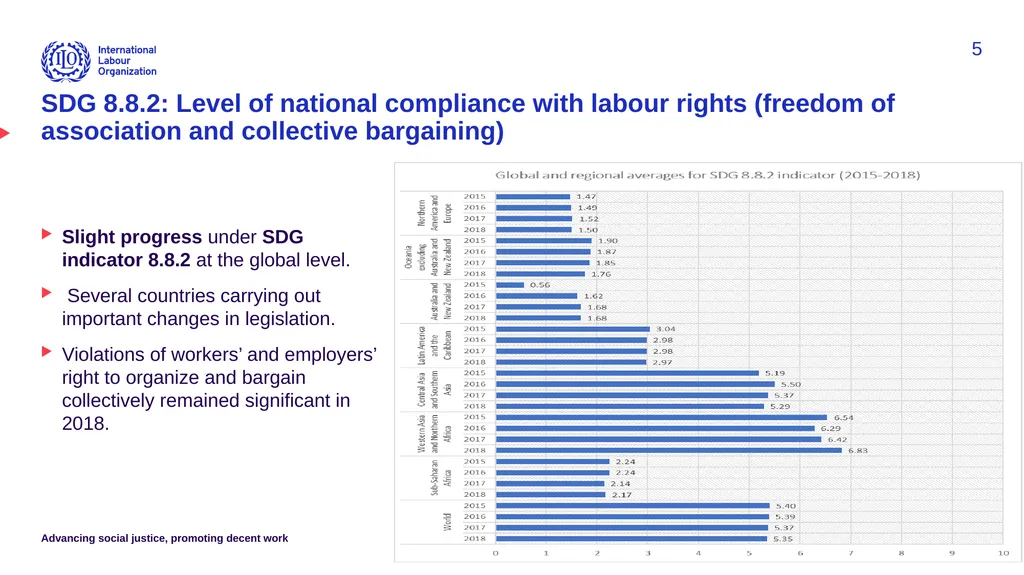
slide5. SDG 8.8.2: Level of national compliance with labour rights (freedom of association and collective bargaining) Slight progress under SDG indicator 8.8.2 at the global level.
Several countries carrying out important changes in legislation.
Violations of workers’ and employers’ right to organize and bargain collectively remained significant in 2018. Date: Monday / 01 / October / 2019 Advancing social justice, promoting decent work 5<br>
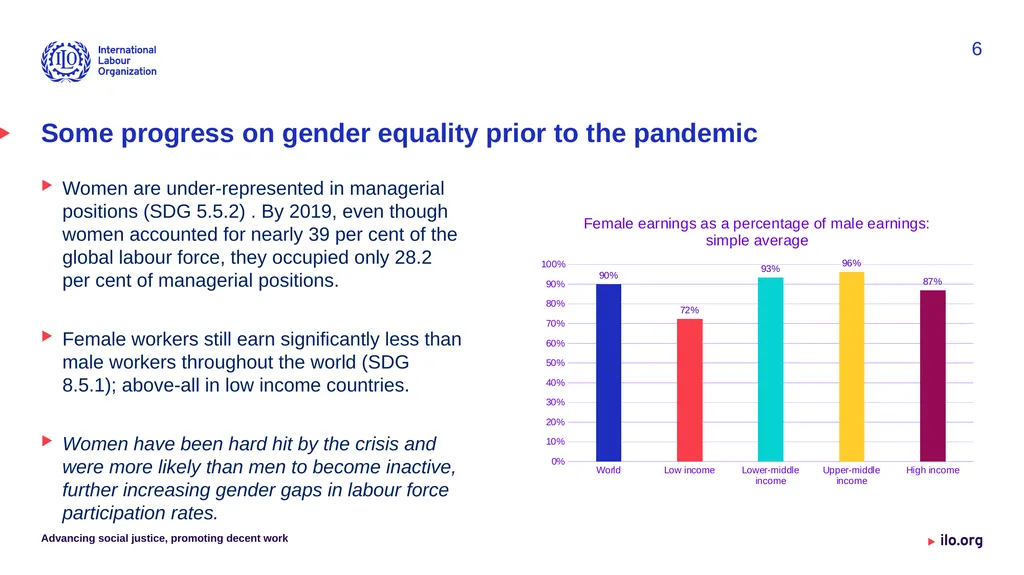
slide6. Some progress on gender equality prior to the pandemic Women are under-represented in managerial positions (SDG 5.5.2) . By 2019, even though women accounted for nearly 39 per cent of the global labour force, they occupied only 28.2 per cent of managerial positions.
Female workers still earn significantly less than male workers throughout the world (SDG 8.5.1); above-all in low income countries.
Women have been hard hit by the crisis and were more likely than men to become inactive, further increasing gender gaps in labour force participation rates. Date: Monday / 01 / October / 2019 Advancing social justice, promoting decent work 6<br>
slide7. Youth- NEET rates had been increasing in some regions, even prior to the COVID-19 pandemic (SDG 8.6.1) Globally, the share of young NEET had remained stable between 2015 and 2019.
This reflected falls in Europe and the Americas, on the one hand;
And an increase in Africa and most markedly Arab States on the other.
Young females are more than twice as likely as men to be NEET - in 2019 were 31.1% for young women and 14% for young men. In lower middle-income countries almost ¾ of NEETs are female.
NEET rate likely to rise due to Covid 19. Date: Monday / 01 / October / 2019 7<br>
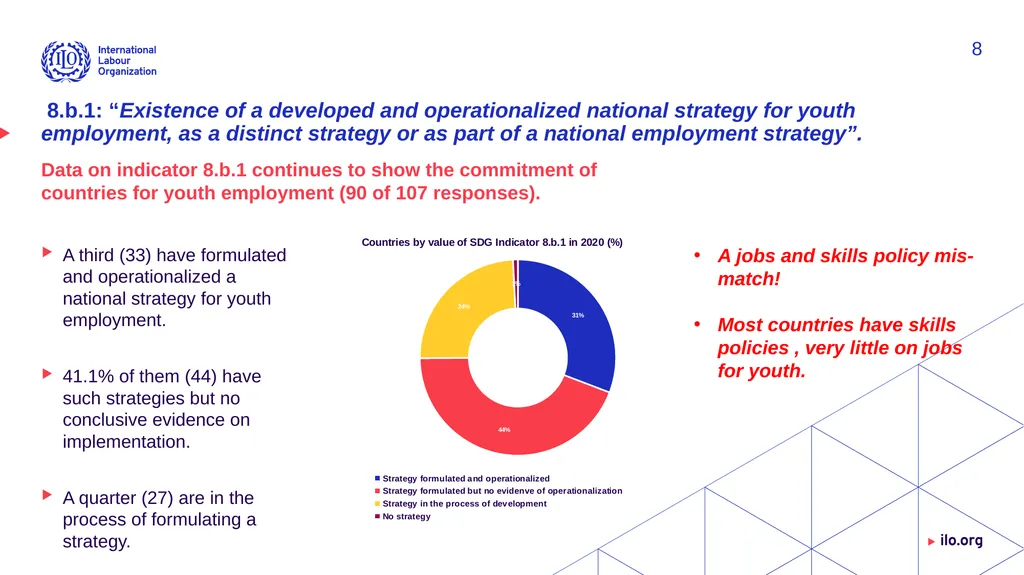
slide8. 8.b.1: “Existence of a developed and operationalized national strategy for youth employment, as a distinct strategy or as part of a national employment strategy”. Data on indicator 8.b.1 continues to show the commitment of countries for youth employment (90 of 107 responses). Date: Monday / 01 / October / 2019 8 A third (33) have formulated and operationalized a national strategy for youth employment.
41.1% of them (44) have such strategies but no conclusive evidence on implementation.
A quarter (27) are in the process of formulating a strategy. A jobs and skills policy mis-match!
Most countries have skills policies , very little on jobs for youth.<br>
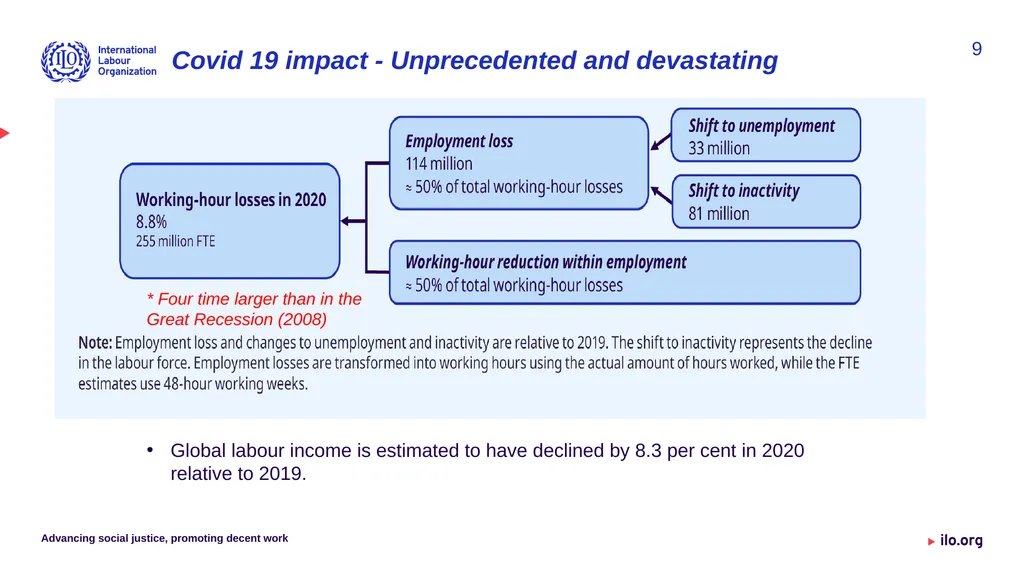
slide9. Date: Monday / 01 / October / 2019 Advancing social justice, promoting decent work 9 Covid 19 impact - Unprecedented and devastating * Four time larger than in the Great Recession (2008) Global labour income is estimated to have declined by 8.3 per cent in 2020 relative to 2019.<br>
slide10. The COVID-19 crisis has dealt a serious blow to achieving SDG 8 Date: Monday / 01 / October / 2019 10 Severe job loss leading to growth in unemployment and inactivity, and loss of labour income.
The impact has been more severe for women, youth, and vulnerable groups.
Labour market inequality has increased.
The regional picture is quite varied: advanced countries are ‘recovering’, but developing countries – including many upper middle-income countries, still in crisis.
Impact on SDG 8 likely to affect other SDG indicators, especially SDG 1 (poverty), 2 (hunger) 5 (gender), 10 (inequality).<br>
slide11. Thank you. Date: Monday / 01 / October / 2019 Advancing social justice, promoting decent work 11<br>
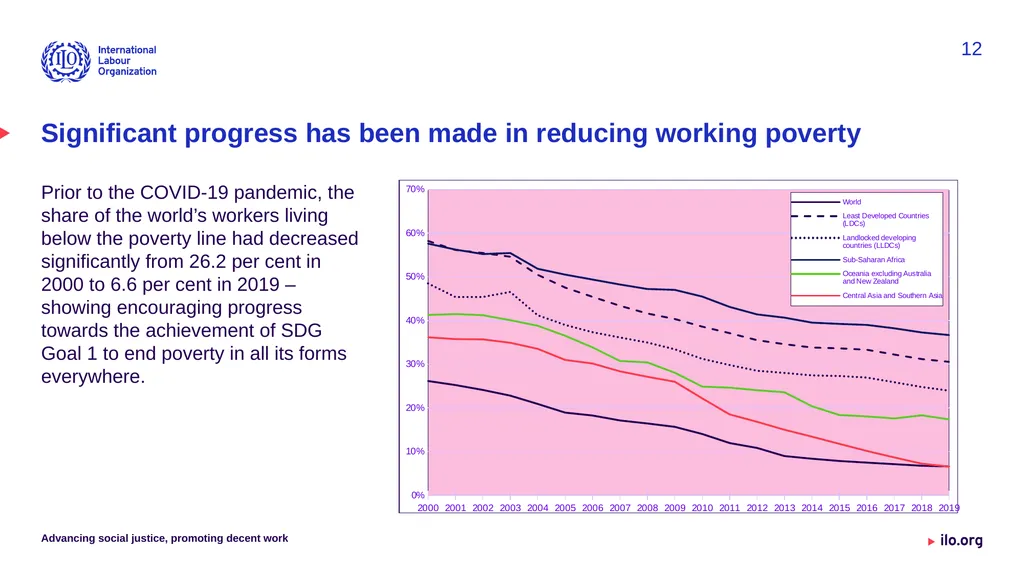
slide12. Significant progress has been made in reducing working poverty Prior to the COVID-19 pandemic, the share of the world’s workers living below the poverty line had decreased significantly from 26.2 per cent in 2000 to 6.6 per cent in 2019 – showing encouraging progress towards the achievement of SDG Goal 1 to end poverty in all its forms everywhere. Date: Monday / 01 / October / 2019 Advancing social justice, promoting decent work 12<br>
Sukti Dasgupta, Chief
ILO Employment, Labour Markets and Youth Branch Date: Monday / 01 / October / 2019 Advancing social justice, promoting decent work 1<br>
slide2. Introduction SDG 8: ”Promote sustained, inclusive and sustainable economic growth, full and productive employment and decent work for all”.
Some progress made. However the severe economic and employment impacts of COVID-19 pandemic have seriously disrupted gains achieved. Date: Monday / 01 / October / 2019 Advancing social justice, promoting decent work 2<br>
slide3. Unemployment had been increasing in upper middle-income countries even prior to COVID-19 Globally unemployment rates had been falling between 2015 and 2019.
Reduction in unemployment rates in high income countries.
In upper middle-income countries, unemployment rates had been on the rise even prior to the COVID-19 pandemic.
Global unemployment increased by 33 million in 2020, with the unemployment rate increasing by 1.1 percentage points to 6.5 per cent.
Female unemployment rates are slightly higher than for men – in 2019, 5.5% vs. 5.3 %. Date: Monday / 01 / October / 2019 3<br>
slide4. Informal employment remains a concern Prior to the pandemic, the informal employment share was 60.2 per cent of global employment. Regional variations. 89 percent for LDCs.
About 2 billion people worked in the informal economy.
Particularly worrisome in least developed countries, where the share of informal employment in total employment was 88.7 per cent (2019).
Severely affected by current crisis. Date: Monday / 01 / October / 2019 Advancing social justice, promoting decent work 4<br>
slide5. SDG 8.8.2: Level of national compliance with labour rights (freedom of association and collective bargaining) Slight progress under SDG indicator 8.8.2 at the global level.
Several countries carrying out important changes in legislation.
Violations of workers’ and employers’ right to organize and bargain collectively remained significant in 2018. Date: Monday / 01 / October / 2019 Advancing social justice, promoting decent work 5<br>
slide6. Some progress on gender equality prior to the pandemic Women are under-represented in managerial positions (SDG 5.5.2) . By 2019, even though women accounted for nearly 39 per cent of the global labour force, they occupied only 28.2 per cent of managerial positions.
Female workers still earn significantly less than male workers throughout the world (SDG 8.5.1); above-all in low income countries.
Women have been hard hit by the crisis and were more likely than men to become inactive, further increasing gender gaps in labour force participation rates. Date: Monday / 01 / October / 2019 Advancing social justice, promoting decent work 6<br>
slide7. Youth- NEET rates had been increasing in some regions, even prior to the COVID-19 pandemic (SDG 8.6.1) Globally, the share of young NEET had remained stable between 2015 and 2019.
This reflected falls in Europe and the Americas, on the one hand;
And an increase in Africa and most markedly Arab States on the other.
Young females are more than twice as likely as men to be NEET - in 2019 were 31.1% for young women and 14% for young men. In lower middle-income countries almost ¾ of NEETs are female.
NEET rate likely to rise due to Covid 19. Date: Monday / 01 / October / 2019 7<br>
slide8. 8.b.1: “Existence of a developed and operationalized national strategy for youth employment, as a distinct strategy or as part of a national employment strategy”. Data on indicator 8.b.1 continues to show the commitment of countries for youth employment (90 of 107 responses). Date: Monday / 01 / October / 2019 8 A third (33) have formulated and operationalized a national strategy for youth employment.
41.1% of them (44) have such strategies but no conclusive evidence on implementation.
A quarter (27) are in the process of formulating a strategy. A jobs and skills policy mis-match!
Most countries have skills policies , very little on jobs for youth.<br>
slide9. Date: Monday / 01 / October / 2019 Advancing social justice, promoting decent work 9 Covid 19 impact - Unprecedented and devastating * Four time larger than in the Great Recession (2008) Global labour income is estimated to have declined by 8.3 per cent in 2020 relative to 2019.<br>
slide10. The COVID-19 crisis has dealt a serious blow to achieving SDG 8 Date: Monday / 01 / October / 2019 10 Severe job loss leading to growth in unemployment and inactivity, and loss of labour income.
The impact has been more severe for women, youth, and vulnerable groups.
Labour market inequality has increased.
The regional picture is quite varied: advanced countries are ‘recovering’, but developing countries – including many upper middle-income countries, still in crisis.
Impact on SDG 8 likely to affect other SDG indicators, especially SDG 1 (poverty), 2 (hunger) 5 (gender), 10 (inequality).<br>
slide11. Thank you. Date: Monday / 01 / October / 2019 Advancing social justice, promoting decent work 11<br>
slide12. Significant progress has been made in reducing working poverty Prior to the COVID-19 pandemic, the share of the world’s workers living below the poverty line had decreased significantly from 26.2 per cent in 2000 to 6.6 per cent in 2019 – showing encouraging progress towards the achievement of SDG Goal 1 to end poverty in all its forms everywhere. Date: Monday / 01 / October / 2019 Advancing social justice, promoting decent work 12<br>