
SDM: Case Report SKN Caribecafé Location: Colombia
PC
Published · 10 slides · 0 views

1 / 1

Description
SDM: Case Report SKN Caribecafé Location: Colombia Commodity: Coffee Services: Extension, financial, certification and compliance, information services, market access Service Delivery Model assessment: short version August 2019 What are
Related Topics
Share
Embed code
Download this presentation From Below
"SDM: Case Report SKN Caribecafé Location: Colombia" is the property of its rightful owner. Permission is granted to download and print the materials on this website for personal, non-commercial use only, and to display it on your personal computer provided you do not modify the materials and that you retain all copyright notices contained in the materials. By downloading content from our website, you accept the terms of this agreement.
Presentation Transcript
01
SDM: Case Report SKN Caribecafé Location: Colombia
Commodity: Coffee
Services: Extension, financial, certification and compliance, information services, market access Service Delivery Model assessment: short version
August 2019<br>
Commodity: Coffee
Services: Extension, financial, certification and compliance, information services, market access Service Delivery Model assessment: short version
August 2019<br>
02
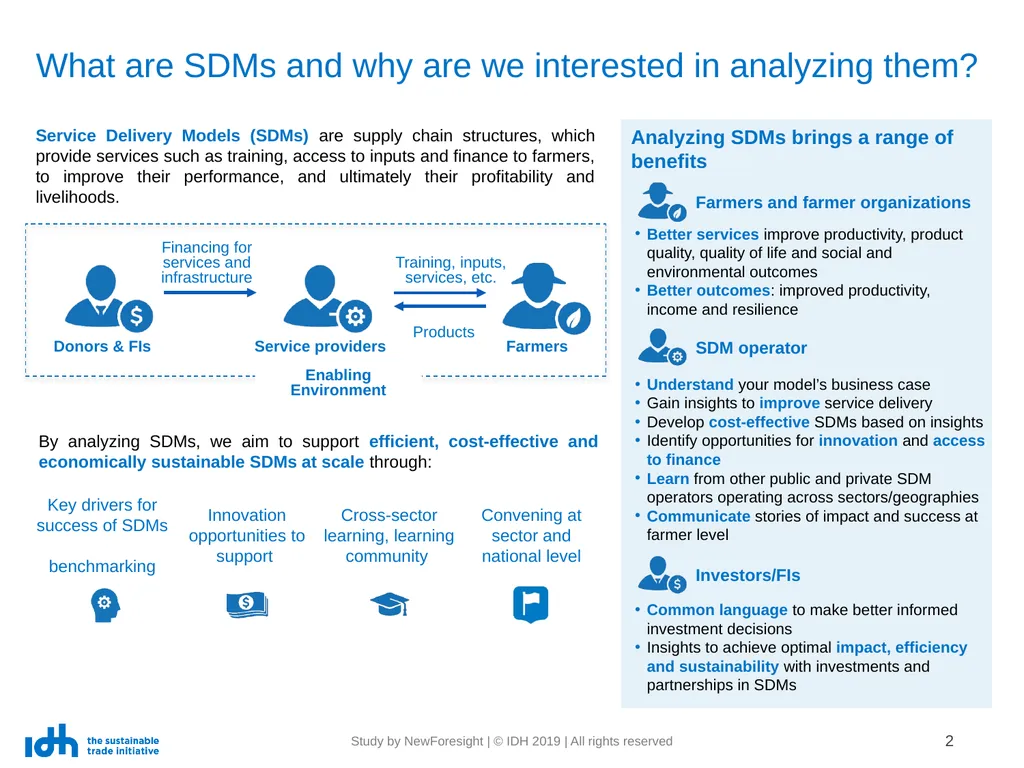
What are SDMs and why are we interested in analyzing them? 2 Service Delivery Models (SDMs) are supply chain structures, which provide services such as training, access to inputs and finance to farmers, to improve their performance, and ultimately their profitability and livelihoods. By analyzing SDMs, we aim to support efficient, cost-effective and economically sustainable SDMs at scale through: Analyzing SDMs brings a range of benefits Farmers and farmer organizations SDM operator Investors/FIs Better services improve productivity, product quality, quality of life and social and environmental outcomes
Better outcomes: improved productivity, income and resilience
Understand your model’s business case
Gain insights to improve service delivery
Develop cost-effective SDMs based on insights
Identify opportunities for innovation and access to finance
Learn from other public and private SDM operators operating across sectors/geographies
Communicate stories of impact and success at farmer level
Common language to make better informed investment decisions
Insights to achieve optimal impact, efficiency and sustainability with investments and partnerships in SDMs<br>
Better outcomes: improved productivity, income and resilience
Understand your model’s business case
Gain insights to improve service delivery
Develop cost-effective SDMs based on insights
Identify opportunities for innovation and access to finance
Learn from other public and private SDM operators operating across sectors/geographies
Communicate stories of impact and success at farmer level
Common language to make better informed investment decisions
Insights to achieve optimal impact, efficiency and sustainability with investments and partnerships in SDMs<br>
03
The SKN Caribecafé SDM and objectives 3 General SDM information:
Location: Colombia
Timing in analysis scope: 2017-2025
Scale (start of analysis): 3,704 farmers
Scale (end of analysis): 10,350 farmers
Funding: Service provider, Nespresso, Neumann Gruppe, USAID, Rabobank, ABN AMRO, IDH
SDM Archetype*: Global SKN was founded in 1945 in Tolima by Lord Schaefer, Klausmann and Neumann.
Caribecafé started in 1956 in Medellin by Lord John Kalf and Gunter Lemberg.
In 1997 the companies were merged to form SKN Caribecafé. The Nuemann Kaffee Gruppe became the majority shareholder. The direct access to farmers and high-quality Arabica beans were the rational for the acquisition.
In 2007 SKN Caribecafé started a partnership with Nespresso to source AAA quality coffee, that buys directly from farmers through their 10 buying stations. SDM objectives: * For more info on SDM archetypes, see the IDH Smallholder Engagement Report SDM rationale: Good Agricultural Practices (GAP) Improved farmer livelihoods Access to finances Increased access to markets<br>
Location: Colombia
Timing in analysis scope: 2017-2025
Scale (start of analysis): 3,704 farmers
Scale (end of analysis): 10,350 farmers
Funding: Service provider, Nespresso, Neumann Gruppe, USAID, Rabobank, ABN AMRO, IDH
SDM Archetype*: Global SKN was founded in 1945 in Tolima by Lord Schaefer, Klausmann and Neumann.
Caribecafé started in 1956 in Medellin by Lord John Kalf and Gunter Lemberg.
In 1997 the companies were merged to form SKN Caribecafé. The Nuemann Kaffee Gruppe became the majority shareholder. The direct access to farmers and high-quality Arabica beans were the rational for the acquisition.
In 2007 SKN Caribecafé started a partnership with Nespresso to source AAA quality coffee, that buys directly from farmers through their 10 buying stations. SDM objectives: * For more info on SDM archetypes, see the IDH Smallholder Engagement Report SDM rationale: Good Agricultural Practices (GAP) Improved farmer livelihoods Access to finances Increased access to markets<br>
04
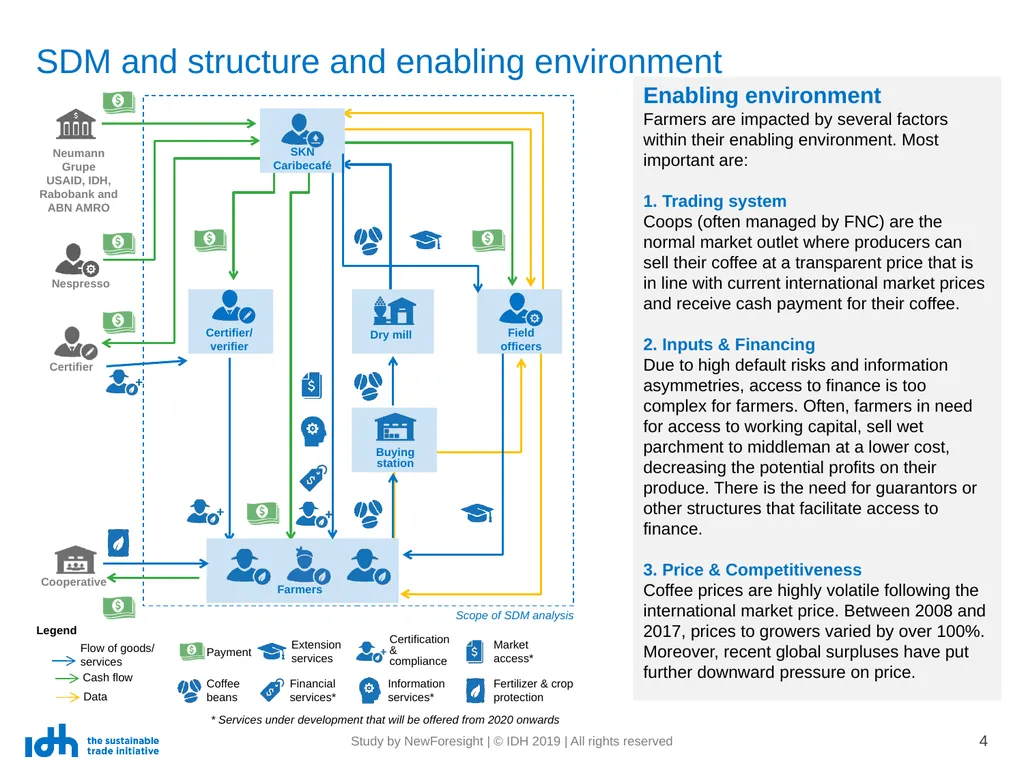
SDM and structure and enabling environment 4 Enabling environment
Farmers are impacted by several factors within their enabling environment. Most important are:
1. Trading system
Coops (often managed by FNC) are the normal market outlet where producers can sell their coffee at a transparent price that is in line with current international market prices and receive cash payment for their coffee.
2. Inputs & Financing
Due to high default risks and information asymmetries, access to finance is too complex for farmers. Often, farmers in need for access to working capital, sell wet parchment to middleman at a lower cost, decreasing the potential profits on their produce. There is the need for guarantors or other structures that facilitate access to finance.
3. Price & Competitiveness
Coffee prices are highly volatile following the international market price. Between 2008 and 2017, prices to growers varied by over 100%. Moreover, recent global surpluses have put further downward pressure on price. Farmers Certifier/ verifier Field officers Dry mill * Services under development that will be offered from 2020 onwards Extension services Financial services* Payment Coffee beans Information services* Certification & compliance Fertilizer & crop protection Market access* Scope of SDM analysis<br>
Farmers are impacted by several factors within their enabling environment. Most important are:
1. Trading system
Coops (often managed by FNC) are the normal market outlet where producers can sell their coffee at a transparent price that is in line with current international market prices and receive cash payment for their coffee.
2. Inputs & Financing
Due to high default risks and information asymmetries, access to finance is too complex for farmers. Often, farmers in need for access to working capital, sell wet parchment to middleman at a lower cost, decreasing the potential profits on their produce. There is the need for guarantors or other structures that facilitate access to finance.
3. Price & Competitiveness
Coffee prices are highly volatile following the international market price. Between 2008 and 2017, prices to growers varied by over 100%. Moreover, recent global surpluses have put further downward pressure on price. Farmers Certifier/ verifier Field officers Dry mill * Services under development that will be offered from 2020 onwards Extension services Financial services* Payment Coffee beans Information services* Certification & compliance Fertilizer & crop protection Market access* Scope of SDM analysis<br>
05
Extension services
Field officers provide farmers with agronomic advice, information on pricing, as well as coffee management practices.
Field officer visit each farmer at least once per year.
SKN monitors farmers closely, in order to provide them with the adequate support to resolve problems.
Nespresso contributes to finance the cost of capacity building, so farmers are able to improve the quality. Financial services*
Digital payments that facilitate access to other financial services.
Short-term finance for working capital, such as input purchase or investment in labor.
Long-term financing for assets such as machinery, or for farmer groups to establish their own wet mills.
(under development) Nanocredits via mobile banking, to avoid the challenges of access to cash Services delivered and farmer segmentation 5 Market access*
SKN will provide access to a global network of customers that demand top quality Colombian coffee.
Farmers will be able to sell their specialty coffee at competitive prices, positioning SKN as a premium buyer. Information services*
Provision of Field Buzz mobile app and a card to farmers, in order to digitalize all transactions, and to manage their farms.
This decreases human error in the transactions, ensure traceability for buyers and to keep track record. Certification and compliance
Offered through the extension services.
Farmers are supported to comply with diverse schemes, such as Nespresso’s AAA scheme, Starbucks Coffee Practices or Rainforest Alliance.
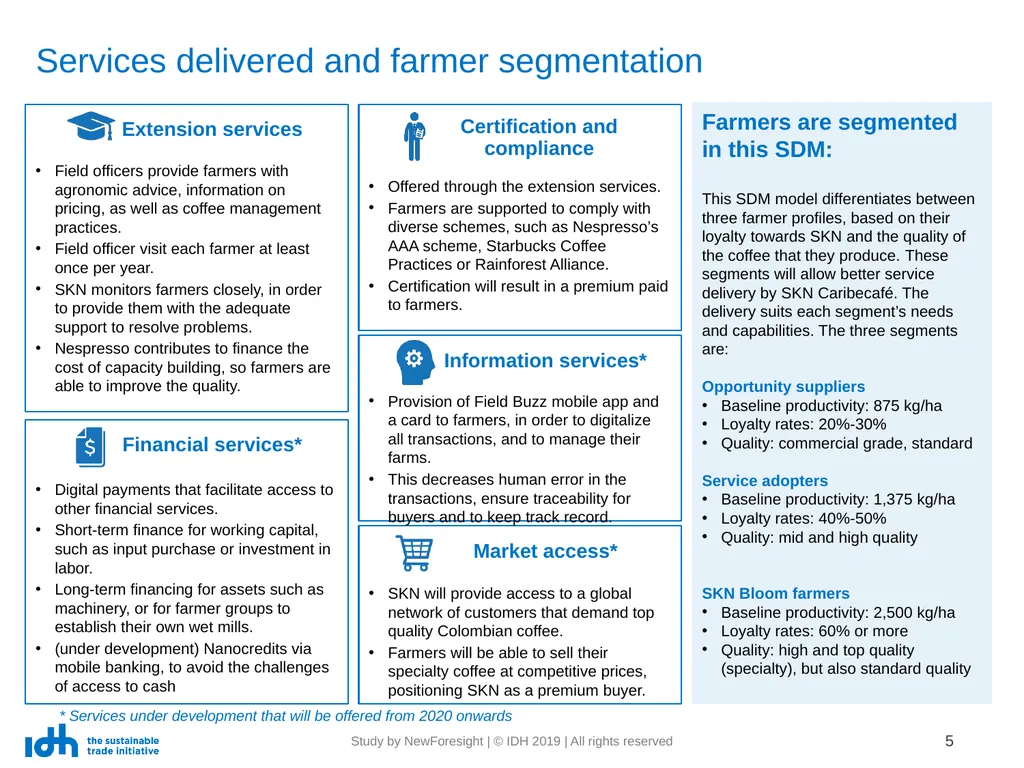
Certification will result in a premium paid to farmers. Farmers are segmented in this SDM:
This SDM model differentiates between three farmer profiles, based on their loyalty towards SKN and the quality of the coffee that they produce. These segments will allow better service delivery by SKN Caribecafé. The delivery suits each segment’s needs and capabilities. The three segments are:
Opportunity suppliers
Baseline productivity: 875 kg/ha
Loyalty rates: 20%-30%
Quality: commercial grade, standard
Service adopters
Baseline productivity: 1,375 kg/ha
Loyalty rates: 40%-50%
Quality: mid and high quality
SKN Bloom farmers
Baseline productivity: 2,500 kg/ha
Loyalty rates: 60% or more
Quality: high and top quality (specialty), but also standard quality * Services under development that will be offered from 2020 onwards<br>
Field officers provide farmers with agronomic advice, information on pricing, as well as coffee management practices.
Field officer visit each farmer at least once per year.
SKN monitors farmers closely, in order to provide them with the adequate support to resolve problems.
Nespresso contributes to finance the cost of capacity building, so farmers are able to improve the quality. Financial services*
Digital payments that facilitate access to other financial services.
Short-term finance for working capital, such as input purchase or investment in labor.
Long-term financing for assets such as machinery, or for farmer groups to establish their own wet mills.
(under development) Nanocredits via mobile banking, to avoid the challenges of access to cash Services delivered and farmer segmentation 5 Market access*
SKN will provide access to a global network of customers that demand top quality Colombian coffee.
Farmers will be able to sell their specialty coffee at competitive prices, positioning SKN as a premium buyer. Information services*
Provision of Field Buzz mobile app and a card to farmers, in order to digitalize all transactions, and to manage their farms.
This decreases human error in the transactions, ensure traceability for buyers and to keep track record. Certification and compliance
Offered through the extension services.
Farmers are supported to comply with diverse schemes, such as Nespresso’s AAA scheme, Starbucks Coffee Practices or Rainforest Alliance.
Certification will result in a premium paid to farmers. Farmers are segmented in this SDM:
This SDM model differentiates between three farmer profiles, based on their loyalty towards SKN and the quality of the coffee that they produce. These segments will allow better service delivery by SKN Caribecafé. The delivery suits each segment’s needs and capabilities. The three segments are:
Opportunity suppliers
Baseline productivity: 875 kg/ha
Loyalty rates: 20%-30%
Quality: commercial grade, standard
Service adopters
Baseline productivity: 1,375 kg/ha
Loyalty rates: 40%-50%
Quality: mid and high quality
SKN Bloom farmers
Baseline productivity: 2,500 kg/ha
Loyalty rates: 60% or more
Quality: high and top quality (specialty), but also standard quality * Services under development that will be offered from 2020 onwards<br>
06
Service adopters Overall SDM impact: Farmer P&L Economic sustainability at farm level
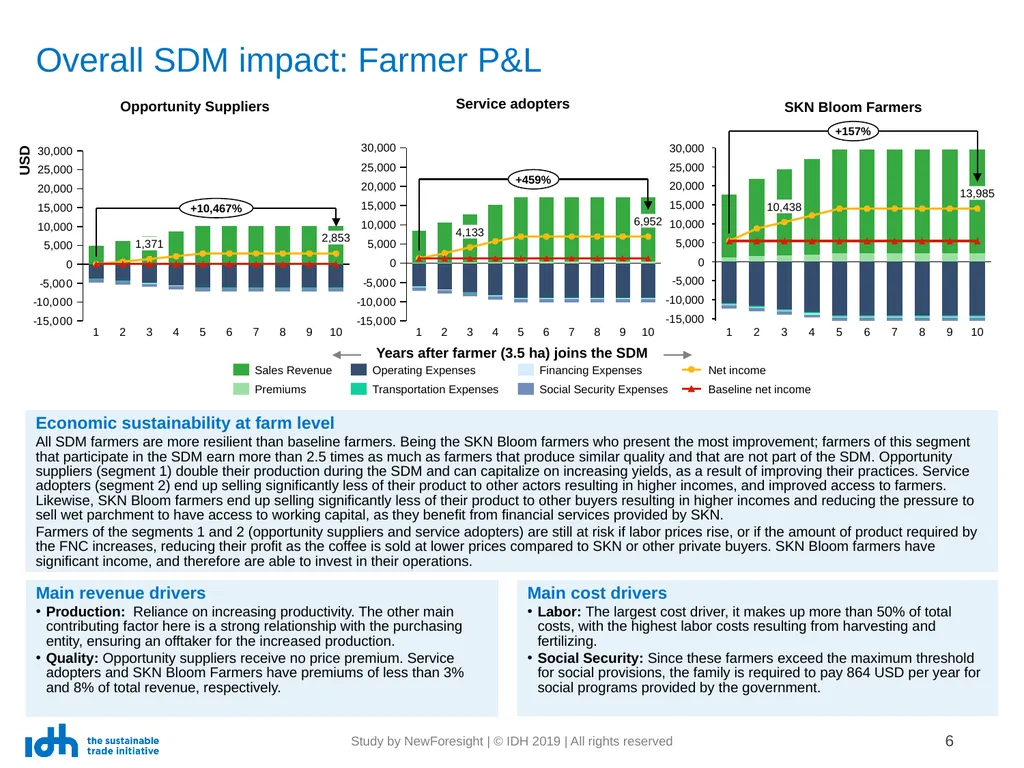
All SDM farmers are more resilient than baseline farmers. Being the SKN Bloom farmers who present the most improvement; farmers of this segment that participate in the SDM earn more than 2.5 times as much as farmers that produce similar quality and that are not part of the SDM. Opportunity suppliers (segment 1) double their production during the SDM and can capitalize on increasing yields, as a result of improving their practices. Service adopters (segment 2) end up selling significantly less of their product to other actors resulting in higher incomes, and improved access to farmers. Likewise, SKN Bloom farmers end up selling significantly less of their product to other buyers resulting in higher incomes and reducing the pressure to sell wet parchment to have access to working capital, as they benefit from financial services provided by SKN.
Farmers of the segments 1 and 2 (opportunity suppliers and service adopters) are still at risk if labor prices rise, or if the amount of product required by the FNC increases, reducing their profit as the coffee is sold at lower prices compared to SKN or other private buyers. SKN Bloom farmers have significant income, and therefore are able to invest in their operations. Main revenue drivers
Production: Reliance on increasing productivity. The other main contributing factor here is a strong relationship with the purchasing entity, ensuring an offtaker for the increased production.
Quality: Opportunity suppliers receive no price premium. Service adopters and SKN Bloom Farmers have premiums of less than 3% and 8% of total revenue, respectively. Main cost drivers
Labor: The largest cost driver, it makes up more than 50% of total costs, with the highest labor costs resulting from harvesting and fertilizing.
Social Security: Since these farmers exceed the maximum threshold for social provisions, the family is required to pay 864 USD per year for social programs provided by the government. 6 USD 6 9 4 6,952 1 2 5 4,133 7 3 8 10 +459% Net income Sales Revenue Operating Expenses Premiums Transportation Expenses Financing Expenses Social Security Expenses Baseline net income SKN Bloom Farmers -5,000 -15,000 -10,000 0 30,000 5,000 10,000 15,000 25,000 20,000 10 4 8 7 9 1 2 10,438 3 5 6 13,985 +157% Years after farmer (3.5 ha) joins the SDM Opportunity Suppliers 1,371 1 7 10 5 6 2 3 4 8 9 2,853 +10,467%<br>
All SDM farmers are more resilient than baseline farmers. Being the SKN Bloom farmers who present the most improvement; farmers of this segment that participate in the SDM earn more than 2.5 times as much as farmers that produce similar quality and that are not part of the SDM. Opportunity suppliers (segment 1) double their production during the SDM and can capitalize on increasing yields, as a result of improving their practices. Service adopters (segment 2) end up selling significantly less of their product to other actors resulting in higher incomes, and improved access to farmers. Likewise, SKN Bloom farmers end up selling significantly less of their product to other buyers resulting in higher incomes and reducing the pressure to sell wet parchment to have access to working capital, as they benefit from financial services provided by SKN.
Farmers of the segments 1 and 2 (opportunity suppliers and service adopters) are still at risk if labor prices rise, or if the amount of product required by the FNC increases, reducing their profit as the coffee is sold at lower prices compared to SKN or other private buyers. SKN Bloom farmers have significant income, and therefore are able to invest in their operations. Main revenue drivers
Production: Reliance on increasing productivity. The other main contributing factor here is a strong relationship with the purchasing entity, ensuring an offtaker for the increased production.
Quality: Opportunity suppliers receive no price premium. Service adopters and SKN Bloom Farmers have premiums of less than 3% and 8% of total revenue, respectively. Main cost drivers
Labor: The largest cost driver, it makes up more than 50% of total costs, with the highest labor costs resulting from harvesting and fertilizing.
Social Security: Since these farmers exceed the maximum threshold for social provisions, the family is required to pay 864 USD per year for social programs provided by the government. 6 USD 6 9 4 6,952 1 2 5 4,133 7 3 8 10 +459% Net income Sales Revenue Operating Expenses Premiums Transportation Expenses Financing Expenses Social Security Expenses Baseline net income SKN Bloom Farmers -5,000 -15,000 -10,000 0 30,000 5,000 10,000 15,000 25,000 20,000 10 4 8 7 9 1 2 10,438 3 5 6 13,985 +157% Years after farmer (3.5 ha) joins the SDM Opportunity Suppliers 1,371 1 7 10 5 6 2 3 4 8 9 2,853 +10,467%<br>
07
7 Specific service impact: sensitivity analyses Market volatility impact
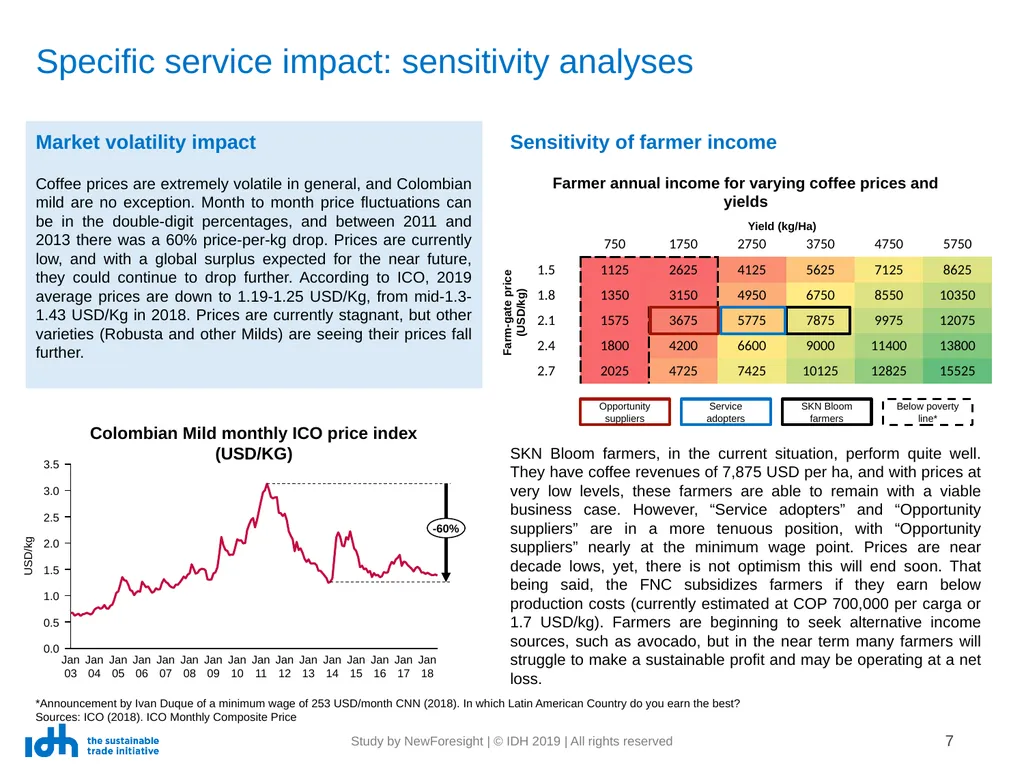
Coffee prices are extremely volatile in general, and Colombian mild are no exception. Month to month price fluctuations can be in the double-digit percentages, and between 2011 and 2013 there was a 60% price-per-kg drop. Prices are currently low, and with a global surplus expected for the near future, they could continue to drop further. According to ICO, 2019 average prices are down to 1.19-1.25 USD/Kg, from mid-1.3-1.43 USD/Kg in 2018. Prices are currently stagnant, but other varieties (Robusta and other Milds) are seeing their prices fall further. SKN Bloom farmers, in the current situation, perform quite well. They have coffee revenues of 7,875 USD per ha, and with prices at very low levels, these farmers are able to remain with a viable business case. However, “Service adopters” and “Opportunity suppliers” are in a more tenuous position, with “Opportunity suppliers” nearly at the minimum wage point. Prices are near decade lows, yet, there is not optimism this will end soon. That being said, the FNC subsidizes farmers if they earn below production costs (currently estimated at COP 700,000 per carga or 1.7 USD/kg). Farmers are beginning to seek alternative income sources, such as avocado, but in the near term many farmers will struggle to make a sustainable profit and may be operating at a net loss. 3.0 1.5 2.5 0.0 0.5 3.5 2.0 1.0 Jan 06 USD/kg Jan 12 Jan 03 Jan 04 Jan 05 Jan 07 Jan 08 Jan 09 Jan 10 Jan 11 Jan 16 Jan 13 Jan 14 Jan 15 Jan 17 Jan 18 -60% Colombian Mild monthly ICO price index (USD/KG) Sensitivity of farmer income Farmer annual income for varying coffee prices and yields SKN Bloom farmers Below poverty line* Service adopters Opportunity suppliers Farm-gate price (USD/kg) Yield (kg/Ha) *Announcement by Ivan Duque of a minimum wage of 253 USD/month CNN (2018). In which Latin American Country do you earn the best?
Sources: ICO (2018). ICO Monthly Composite Price<br>
Coffee prices are extremely volatile in general, and Colombian mild are no exception. Month to month price fluctuations can be in the double-digit percentages, and between 2011 and 2013 there was a 60% price-per-kg drop. Prices are currently low, and with a global surplus expected for the near future, they could continue to drop further. According to ICO, 2019 average prices are down to 1.19-1.25 USD/Kg, from mid-1.3-1.43 USD/Kg in 2018. Prices are currently stagnant, but other varieties (Robusta and other Milds) are seeing their prices fall further. SKN Bloom farmers, in the current situation, perform quite well. They have coffee revenues of 7,875 USD per ha, and with prices at very low levels, these farmers are able to remain with a viable business case. However, “Service adopters” and “Opportunity suppliers” are in a more tenuous position, with “Opportunity suppliers” nearly at the minimum wage point. Prices are near decade lows, yet, there is not optimism this will end soon. That being said, the FNC subsidizes farmers if they earn below production costs (currently estimated at COP 700,000 per carga or 1.7 USD/kg). Farmers are beginning to seek alternative income sources, such as avocado, but in the near term many farmers will struggle to make a sustainable profit and may be operating at a net loss. 3.0 1.5 2.5 0.0 0.5 3.5 2.0 1.0 Jan 06 USD/kg Jan 12 Jan 03 Jan 04 Jan 05 Jan 07 Jan 08 Jan 09 Jan 10 Jan 11 Jan 16 Jan 13 Jan 14 Jan 15 Jan 17 Jan 18 -60% Colombian Mild monthly ICO price index (USD/KG) Sensitivity of farmer income Farmer annual income for varying coffee prices and yields SKN Bloom farmers Below poverty line* Service adopters Opportunity suppliers Farm-gate price (USD/kg) Yield (kg/Ha) *Announcement by Ivan Duque of a minimum wage of 253 USD/month CNN (2018). In which Latin American Country do you earn the best?
Sources: ICO (2018). ICO Monthly Composite Price<br>
08
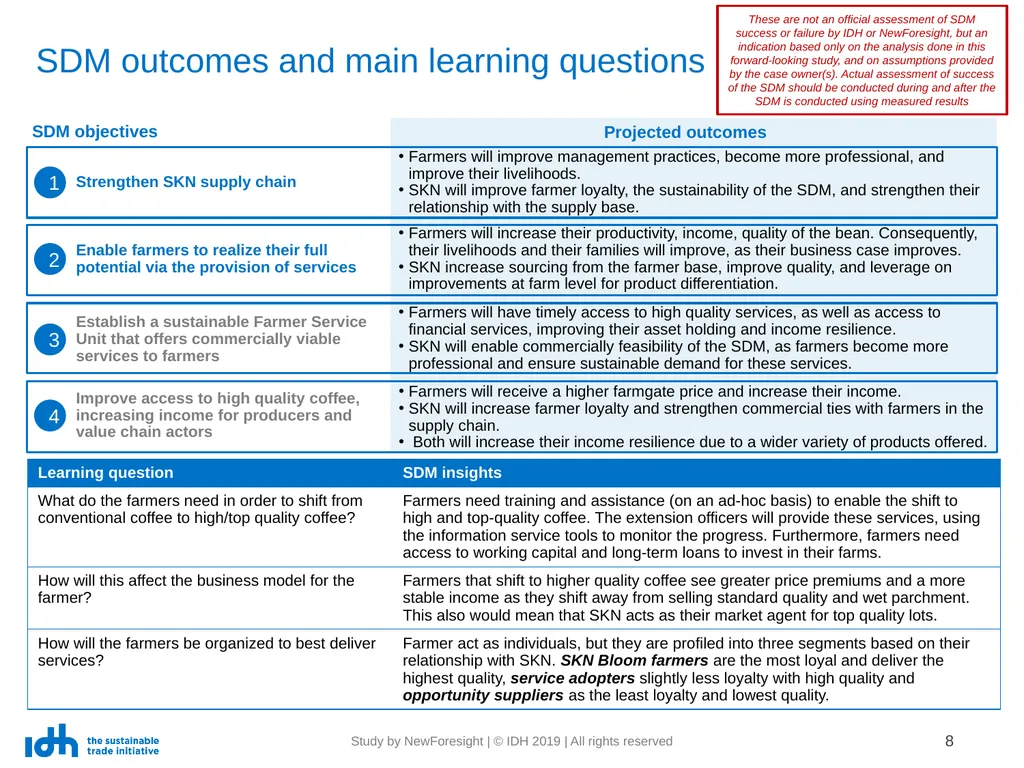
8 SDM outcomes and main learning questions 1 2 3 4 SDM objectives Projected outcomes Strengthen SKN supply chain Farmers will improve management practices, become more professional, and improve their livelihoods.
SKN will improve farmer loyalty, the sustainability of the SDM, and strengthen their relationship with the supply base. Enable farmers to realize their full potential via the provision of services Farmers will increase their productivity, income, quality of the bean. Consequently, their livelihoods and their families will improve, as their business case improves.
SKN increase sourcing from the farmer base, improve quality, and leverage on improvements at farm level for product differentiation. Establish a sustainable Farmer Service Unit that offers commercially viable services to farmers Farmers will have timely access to high quality services, as well as access to financial services, improving their asset holding and income resilience.
SKN will enable commercially feasibility of the SDM, as farmers become more professional and ensure sustainable demand for these services. Improve access to high quality coffee, increasing income for producers and value chain actors Farmers will receive a higher farmgate price and increase their income.
SKN will increase farmer loyalty and strengthen commercial ties with farmers in the supply chain.
Both will increase their income resilience due to a wider variety of products offered. These are not an official assessment of SDM success or failure by IDH or NewForesight, but an indication based only on the analysis done in this forward-looking study, and on assumptions provided by the case owner(s). Actual assessment of success of the SDM should be conducted during and after the SDM is conducted using measured results<br>
SKN will improve farmer loyalty, the sustainability of the SDM, and strengthen their relationship with the supply base. Enable farmers to realize their full potential via the provision of services Farmers will increase their productivity, income, quality of the bean. Consequently, their livelihoods and their families will improve, as their business case improves.
SKN increase sourcing from the farmer base, improve quality, and leverage on improvements at farm level for product differentiation. Establish a sustainable Farmer Service Unit that offers commercially viable services to farmers Farmers will have timely access to high quality services, as well as access to financial services, improving their asset holding and income resilience.
SKN will enable commercially feasibility of the SDM, as farmers become more professional and ensure sustainable demand for these services. Improve access to high quality coffee, increasing income for producers and value chain actors Farmers will receive a higher farmgate price and increase their income.
SKN will increase farmer loyalty and strengthen commercial ties with farmers in the supply chain.
Both will increase their income resilience due to a wider variety of products offered. These are not an official assessment of SDM success or failure by IDH or NewForesight, but an indication based only on the analysis done in this forward-looking study, and on assumptions provided by the case owner(s). Actual assessment of success of the SDM should be conducted during and after the SDM is conducted using measured results<br>
09
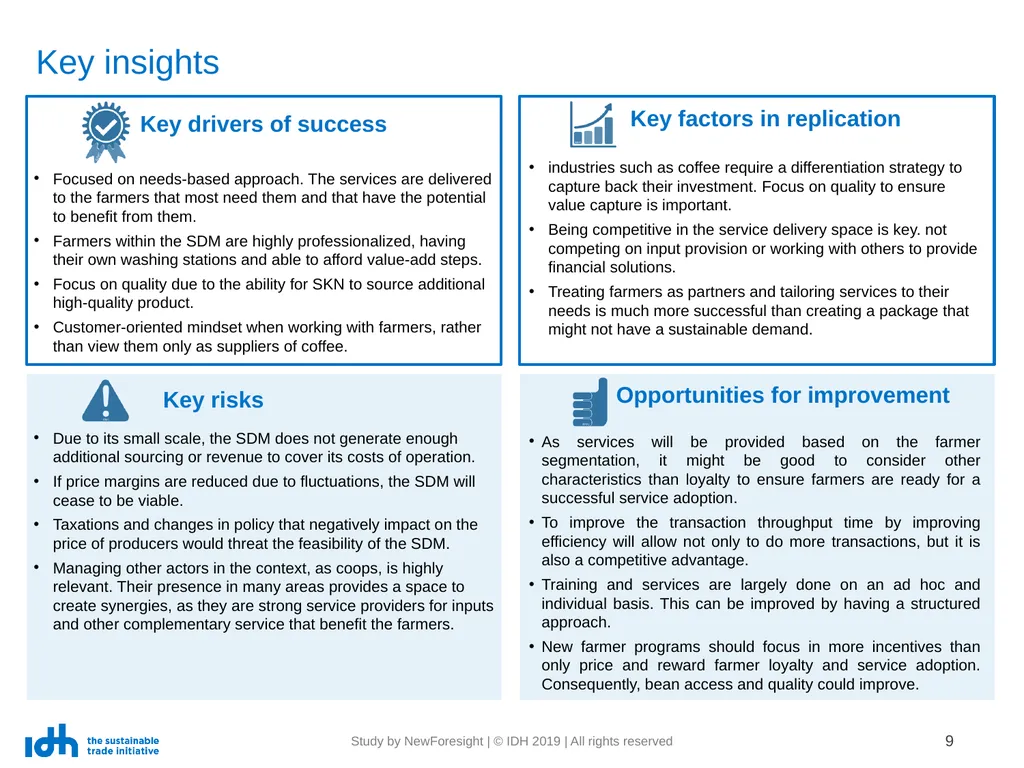
Key insights 9 Focused on needs-based approach. The services are delivered to the farmers that most need them and that have the potential to benefit from them.
Farmers within the SDM are highly professionalized, having their own washing stations and able to afford value-add steps.
Focus on quality due to the ability for SKN to source additional high-quality product.
Customer-oriented mindset when working with farmers, rather than view them only as suppliers of coffee. Due to its small scale, the SDM does not generate enough additional sourcing or revenue to cover its costs of operation.
If price margins are reduced due to fluctuations, the SDM will cease to be viable.
Taxations and changes in policy that negatively impact on the price of producers would threat the feasibility of the SDM.
Managing other actors in the context, as coops, is highly relevant. Their presence in many areas provides a space to create synergies, as they are strong service providers for inputs and other complementary service that benefit the farmers. industries such as coffee require a differentiation strategy to capture back their investment. Focus on quality to ensure value capture is important.
Being competitive in the service delivery space is key. not competing on input provision or working with others to provide financial solutions.
Treating farmers as partners and tailoring services to their needs is much more successful than creating a package that might not have a sustainable demand. Key drivers of success Key risks Key factors in replication As services will be provided based on the farmer segmentation, it might be good to consider other characteristics than loyalty to ensure farmers are ready for a successful service adoption.
To improve the transaction throughput time by improving efficiency will allow not only to do more transactions, but it is also a competitive advantage.
Training and services are largely done on an ad hoc and individual basis. This can be improved by having a structured approach.
New farmer programs should focus in more incentives than only price and reward farmer loyalty and service adoption. Consequently, bean access and quality could improve. Opportunities for improvement<br>
Farmers within the SDM are highly professionalized, having their own washing stations and able to afford value-add steps.
Focus on quality due to the ability for SKN to source additional high-quality product.
Customer-oriented mindset when working with farmers, rather than view them only as suppliers of coffee. Due to its small scale, the SDM does not generate enough additional sourcing or revenue to cover its costs of operation.
If price margins are reduced due to fluctuations, the SDM will cease to be viable.
Taxations and changes in policy that negatively impact on the price of producers would threat the feasibility of the SDM.
Managing other actors in the context, as coops, is highly relevant. Their presence in many areas provides a space to create synergies, as they are strong service providers for inputs and other complementary service that benefit the farmers. industries such as coffee require a differentiation strategy to capture back their investment. Focus on quality to ensure value capture is important.
Being competitive in the service delivery space is key. not competing on input provision or working with others to provide financial solutions.
Treating farmers as partners and tailoring services to their needs is much more successful than creating a package that might not have a sustainable demand. Key drivers of success Key risks Key factors in replication As services will be provided based on the farmer segmentation, it might be good to consider other characteristics than loyalty to ensure farmers are ready for a successful service adoption.
To improve the transaction throughput time by improving efficiency will allow not only to do more transactions, but it is also a competitive advantage.
Training and services are largely done on an ad hoc and individual basis. This can be improved by having a structured approach.
New farmer programs should focus in more incentives than only price and reward farmer loyalty and service adoption. Consequently, bean access and quality could improve. Opportunities for improvement<br>
10
Silvana Paniagua
Senior Consultant Ashlee Tuttleman
Coffee Program Manager 10 For more information and insights on SDM’s, see the IDH Smallholder Engagement Report<br>
Senior Consultant Ashlee Tuttleman
Coffee Program Manager 10 For more information and insights on SDM’s, see the IDH Smallholder Engagement Report<br>