
Sea Containers Task Force Update IPPC Secretariat
Description: Sea Containers Task Force Update IPPC Secretariat Risks Associated with Movement of Sea Containers and their Cargoes Sea containers (Cargo Transport Units (CTUs))and their cargoes potential pest pathway High level of risk - once
Related Topics
Download Presentation
"Sea Containers Task Force Update IPPC Secretariat" is the property of its rightful owner. Permission is granted to download and print the materials on this website for personal, non-commercial use only, and to display it on your personal computer provided you do not modify the materials and that you retain all copyright notices contained in the materials. By downloading content from our website, you accept the terms of this agreement.
Presentation Transcript
slide1. Sea Containers Task Force Update IPPC Secretariat<br>
slide2. Risks Associated with Movement of Sea Containers and their Cargoes Sea containers (Cargo Transport Units (CTUs))and their cargoes – potential pest pathway
High level of risk - once introduced, pests are very difficult and expensive to control or eradicate
Involvement of different stakeholders in the supply chain for cooperation
Joint actions are needed<br>
slide3. Factors to be Understood The movement of sea containers
Where sea containers can be checked for cleanliness and cleaned if necessary
Joint actions are needed<br>
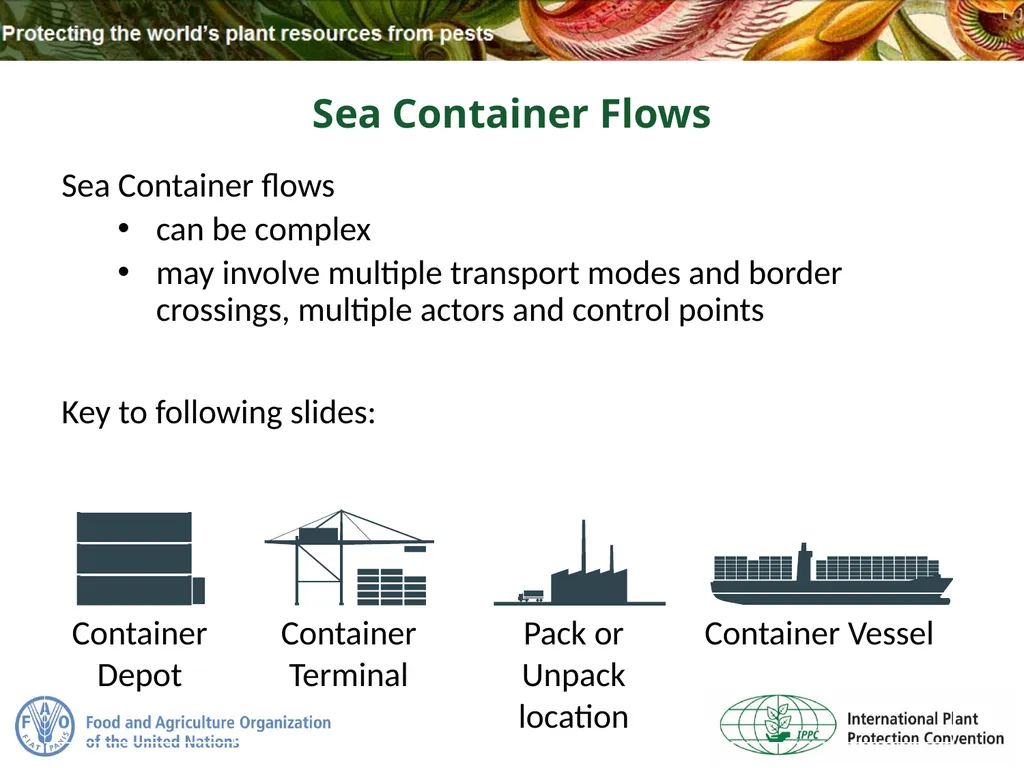
slide4. Sea Container Flows Sea Container flows
can be complex
may involve multiple transport modes and border crossings, multiple actors and control points
Key to following slides:<br>
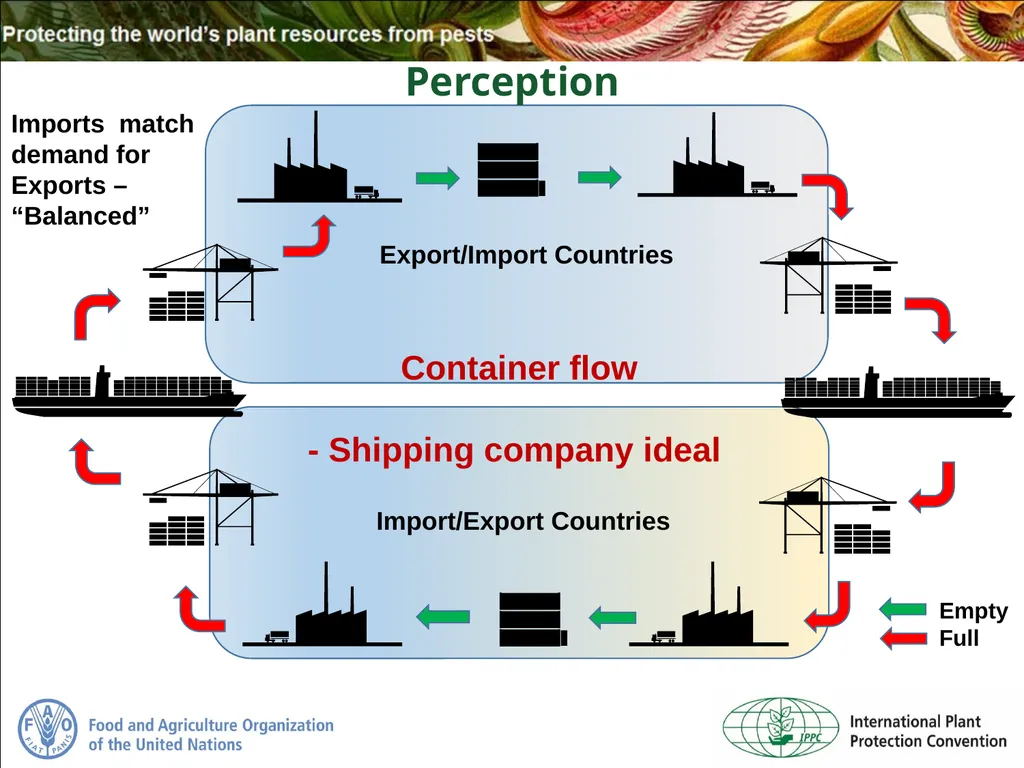
slide5. Empty
Full Container flow
- Shipping company ideal Export/Import Countries Import/Export Countries Imports match demand for Exports – “Balanced” Perception<br>
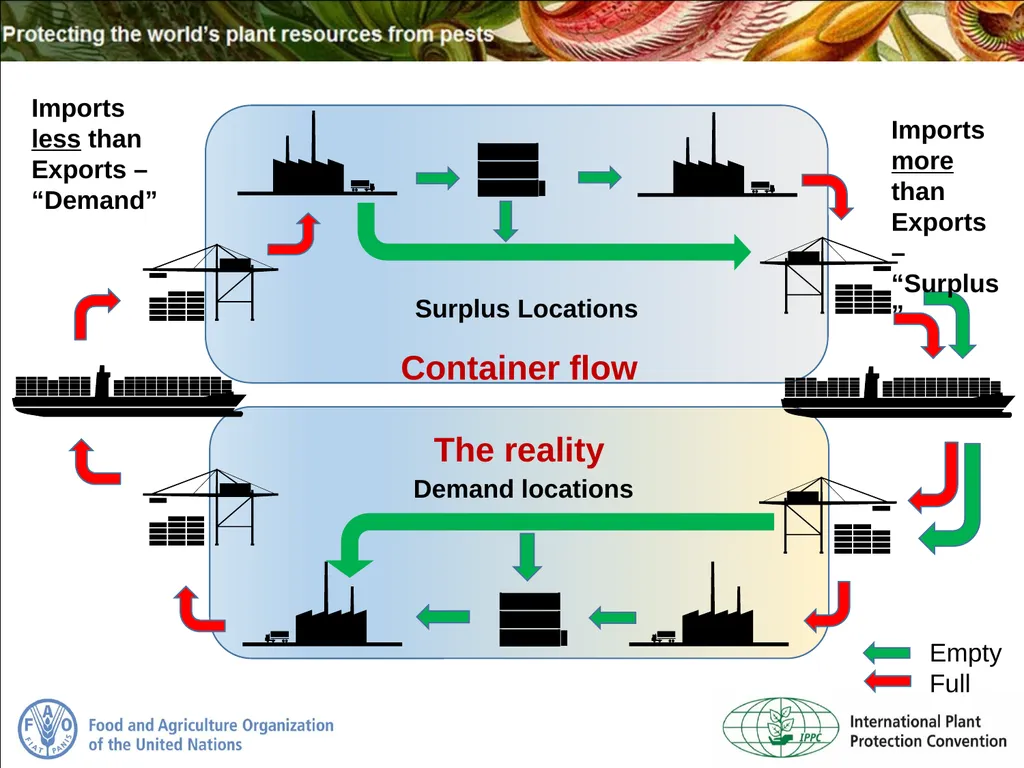
slide6. Container flow
The reality Surplus Locations Demand locations Imports less than Exports – “Demand” Imports more than Exports – “Surplus”<br>
slide7. Summary
Container flows are complex, involve multiple transport modes, border crossings, actors and control points
Empty containers despatched from a repair (or container) depot under the control of a shipping company should be clean. However not all containers pass through a repair (or container) depot
Pack points are the most likely points for contamination BUT Shipping companies have no control over these
The CTU code is directed at the shipper and packer (pack points) Sea Container Flows<br>
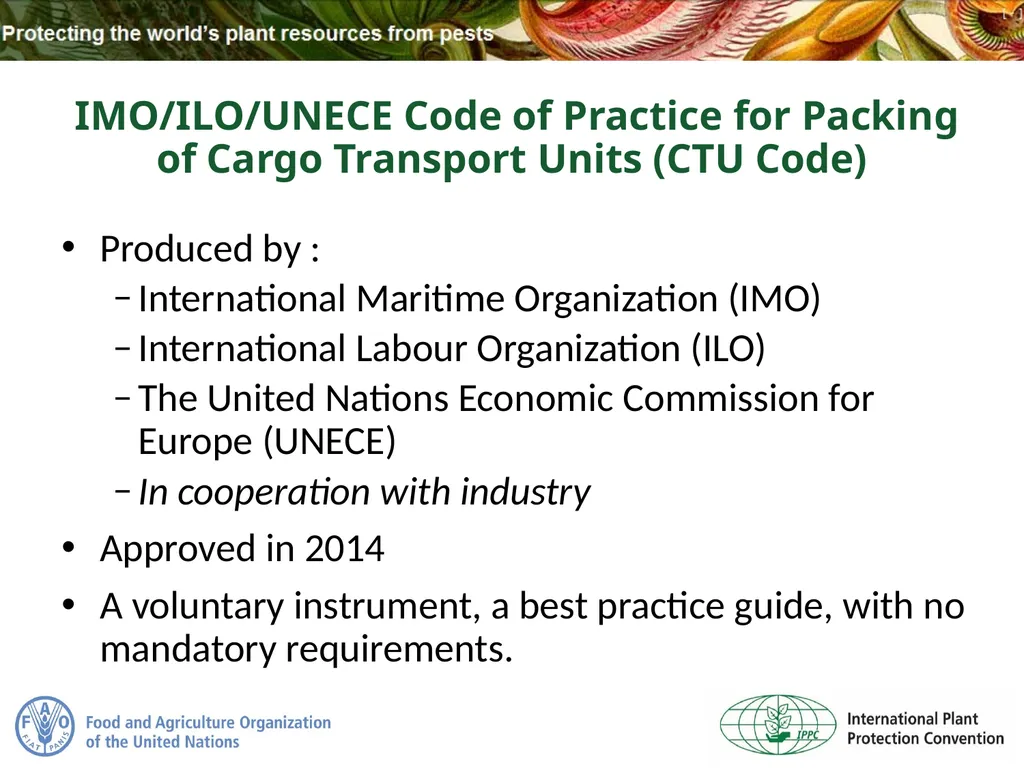
slide8. IMO/ILO/UNECE Code of Practice for Packing of Cargo Transport Units (CTU Code) Produced by :
International Maritime Organization (IMO)
International Labour Organization (ILO)
The United Nations Economic Commission for Europe (UNECE)
In cooperation with industry
Approved in 2014
A voluntary instrument, a best practice guide, with no mandatory requirements.<br>
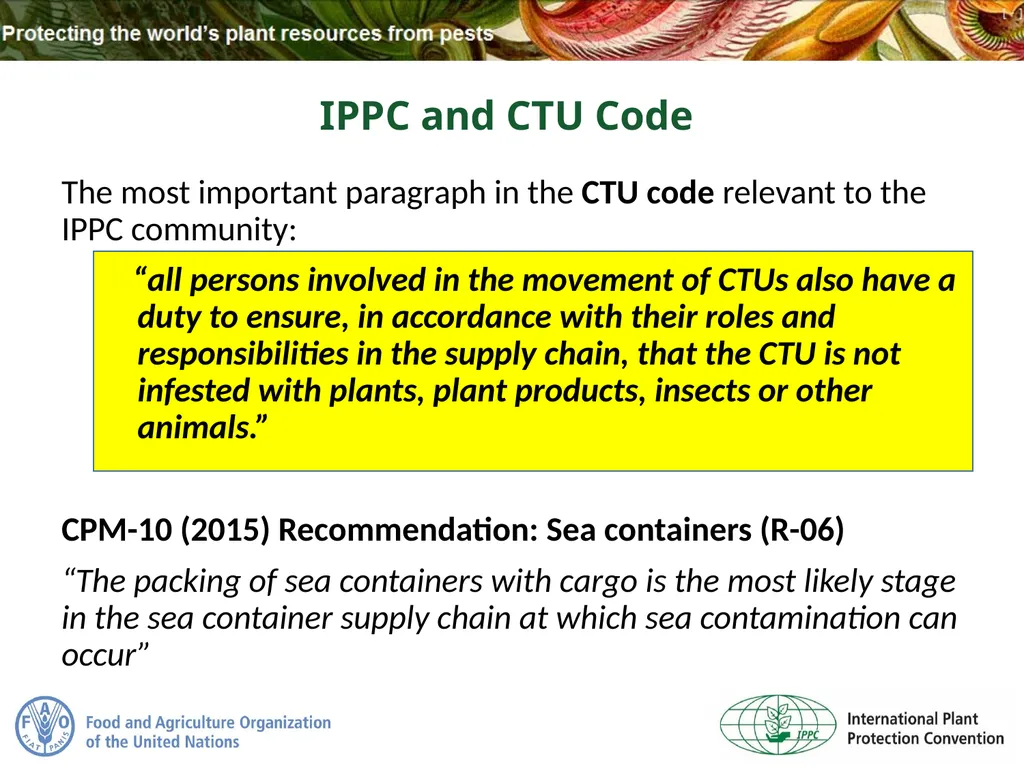
slide9. IPPC and CTU Code The most important paragraph in the CTU code relevant to the IPPC community:
“all persons involved in the movement of CTUs also have a duty to ensure, in accordance with their roles and responsibilities in the supply chain, that the CTU is not infested with plants, plant products, insects or other animals.”
CPM-10 (2015) Recommendation: Sea containers (R-06)
“The packing of sea containers with cargo is the most likely stage in the sea container supply chain at which sea contamination can occur”<br>
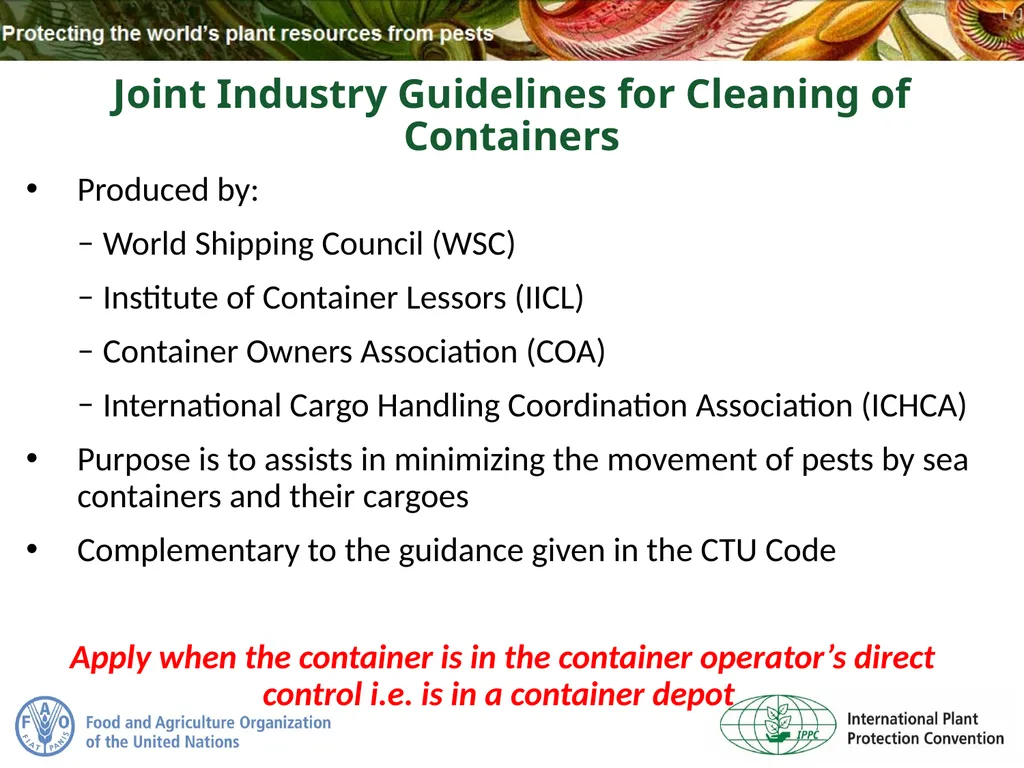
slide10. Joint Industry Guidelines for Cleaning of Containers Produced by:
World Shipping Council (WSC)
Institute of Container Lessors (IICL)
Container Owners Association (COA)
International Cargo Handling Coordination Association (ICHCA)
Purpose is to assists in minimizing the movement of pests by sea containers and their cargoes
Complementary to the guidance given in the CTU Code
Apply when the container is in the container operator’s direct control i.e. is in a container depot<br>
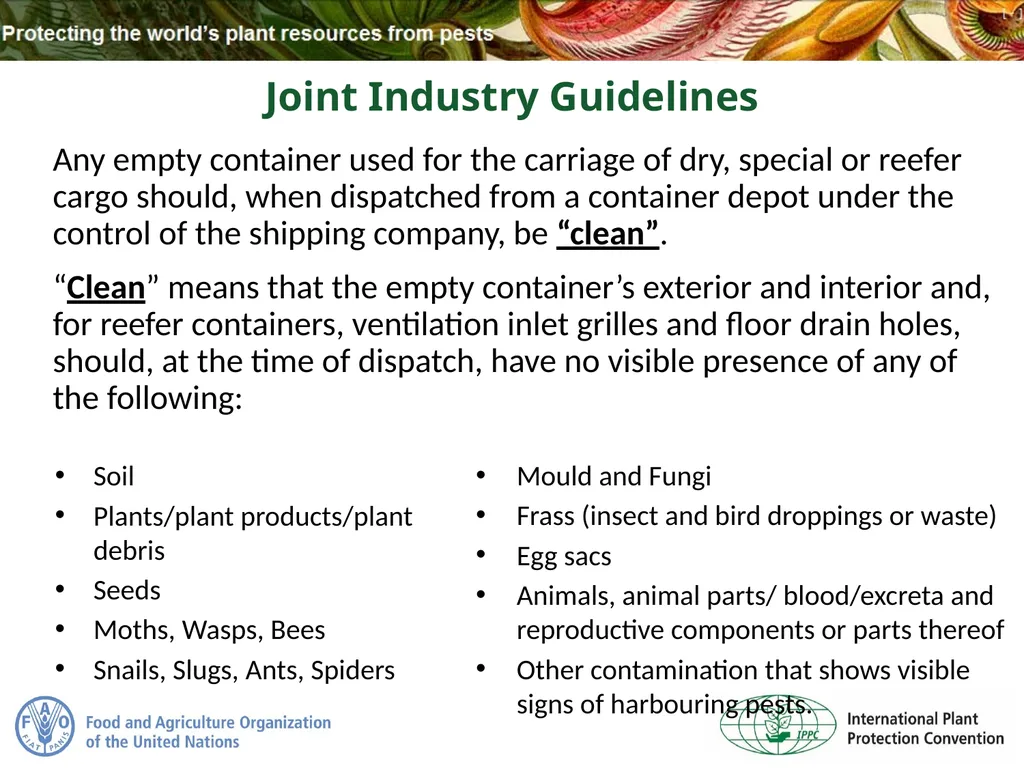
slide11. Joint Industry Guidelines Any empty container used for the carriage of dry, special or reefer cargo should, when dispatched from a container depot under the control of the shipping company, be “clean”.
“Clean” means that the empty container’s exterior and interior and, for reefer containers, ventilation inlet grilles and floor drain holes, should, at the time of dispatch, have no visible presence of any of the following: Soil
Plants/plant products/plant debris
Seeds
Moths, Wasps, Bees
Snails, Slugs, Ants, Spiders Mould and Fungi
Frass (insect and bird droppings or waste)
Egg sacs
Animals, animal parts/ blood/excreta and reproductive components or parts thereof
Other contamination that shows visible signs of harbouring pests.<br>
slide12. Joint Industry Guidelines cont’d Contain recommendations on cleaning methods for various types of visible pest contamination.
In cases of doubt, local National Plant Protection Office or Quarantine Office should be contacted.
Do not replace local regulatory pest contamination measures and requirements.
Do not replace individual container operators’ cleaning guidelines.
Are additional to industry guidelines regarding non-pest contamination of containers.<br>
slide13. Sea Containers Task Force (SCTF) The SCTF is an IC Sub-group
The SCTF purpose is to supervise and direct the implementation of the Sea Containers Complementary Action Plan endorsed by CPM 12, overseen by the IC
The SCTF will operate for a temporary period, at the latest until CPM-16 in 2021<br>
slide14. SCTF Key Tasks Measuring the impact of the CTU Code by:
The development of a joint IPPC/IMO/Industry protocol for the collection of data related to contamination of sea containers
Monitoring the uptake and implementation of the CTU Code
Verifying the efficacy of the CTU Code in ensuring the arrival of clean sea container<br>
slide15. SCTF Key Tasks cont’d. 2. Increasing awareness of pest risks of sea containers through:
Publication of the data of the (previous) Sea Container EWG
Requesting countries that have data on contamination to make it publicly available
Calling for and publication of pest risk management guidance material for sea containers
Encouraging NPPOs to inform industry on the risks and possible international actions to manage pest risks associated with sea containers<br>
slide16. SCTF Key Tasks cont’d. Providing information on pest risks of sea containers and their management
Coordinating with contracting parties, regional plant protection organizations (RPPOs), industry and other international organizations
Establishing a mechanism for contracting parties to report to Commission on Phytosanitary Measures (CPM) on their progress and achievements
Providing advice on how the Cargo Transport Unit (CTU) Code or any other instrument could be updated.<br>
slide17. SCTF ongoing actions Monitoring uptake and efficacy of the CTU Code
Sea container cleanliness surveys performed by NPPOs
Industry monitoring of contaminated containers
Engage industry at various forums
Industry cleaning guidelines revision (e.g. Institute of International Container Lessors (IICL))
Questionnaire to determine regulatory basis for NPPO container monitoring<br>
slide18. SCTF ongoing actions Communication/Increasing Awareness
Guidelines on sea container surveys for NPPOs
Encourage best practice sharing
Use of social media
Factsheets<br>
slide19. SCTF ongoing actions Communication/Increasing Awareness (continued)
Donor agency support pilot for developing countries where there is no legal basis for the NPPO to determine what liaison is required with various entities e.g. customs etc.
Encourage national compliance with IPPC framework and CTU Code guidelines.<br>
slide20. IPPC Secretariat
Food and Agriculture Organization of the United Nations
Viale delle Terme di Caracalla, 00153 Rome, Italy
Tel.: +39-0657054812 Email: IPPC@fao.org
Websites:
www.fao.org
www.ippc.int Contacts<br>
slide2. Risks Associated with Movement of Sea Containers and their Cargoes Sea containers (Cargo Transport Units (CTUs))and their cargoes – potential pest pathway
High level of risk - once introduced, pests are very difficult and expensive to control or eradicate
Involvement of different stakeholders in the supply chain for cooperation
Joint actions are needed<br>
slide3. Factors to be Understood The movement of sea containers
Where sea containers can be checked for cleanliness and cleaned if necessary
Joint actions are needed<br>
slide4. Sea Container Flows Sea Container flows
can be complex
may involve multiple transport modes and border crossings, multiple actors and control points
Key to following slides:<br>
slide5. Empty
Full Container flow
- Shipping company ideal Export/Import Countries Import/Export Countries Imports match demand for Exports – “Balanced” Perception<br>
slide6. Container flow
The reality Surplus Locations Demand locations Imports less than Exports – “Demand” Imports more than Exports – “Surplus”<br>
slide7. Summary
Container flows are complex, involve multiple transport modes, border crossings, actors and control points
Empty containers despatched from a repair (or container) depot under the control of a shipping company should be clean. However not all containers pass through a repair (or container) depot
Pack points are the most likely points for contamination BUT Shipping companies have no control over these
The CTU code is directed at the shipper and packer (pack points) Sea Container Flows<br>
slide8. IMO/ILO/UNECE Code of Practice for Packing of Cargo Transport Units (CTU Code) Produced by :
International Maritime Organization (IMO)
International Labour Organization (ILO)
The United Nations Economic Commission for Europe (UNECE)
In cooperation with industry
Approved in 2014
A voluntary instrument, a best practice guide, with no mandatory requirements.<br>
slide9. IPPC and CTU Code The most important paragraph in the CTU code relevant to the IPPC community:
“all persons involved in the movement of CTUs also have a duty to ensure, in accordance with their roles and responsibilities in the supply chain, that the CTU is not infested with plants, plant products, insects or other animals.”
CPM-10 (2015) Recommendation: Sea containers (R-06)
“The packing of sea containers with cargo is the most likely stage in the sea container supply chain at which sea contamination can occur”<br>
slide10. Joint Industry Guidelines for Cleaning of Containers Produced by:
World Shipping Council (WSC)
Institute of Container Lessors (IICL)
Container Owners Association (COA)
International Cargo Handling Coordination Association (ICHCA)
Purpose is to assists in minimizing the movement of pests by sea containers and their cargoes
Complementary to the guidance given in the CTU Code
Apply when the container is in the container operator’s direct control i.e. is in a container depot<br>
slide11. Joint Industry Guidelines Any empty container used for the carriage of dry, special or reefer cargo should, when dispatched from a container depot under the control of the shipping company, be “clean”.
“Clean” means that the empty container’s exterior and interior and, for reefer containers, ventilation inlet grilles and floor drain holes, should, at the time of dispatch, have no visible presence of any of the following: Soil
Plants/plant products/plant debris
Seeds
Moths, Wasps, Bees
Snails, Slugs, Ants, Spiders Mould and Fungi
Frass (insect and bird droppings or waste)
Egg sacs
Animals, animal parts/ blood/excreta and reproductive components or parts thereof
Other contamination that shows visible signs of harbouring pests.<br>
slide12. Joint Industry Guidelines cont’d Contain recommendations on cleaning methods for various types of visible pest contamination.
In cases of doubt, local National Plant Protection Office or Quarantine Office should be contacted.
Do not replace local regulatory pest contamination measures and requirements.
Do not replace individual container operators’ cleaning guidelines.
Are additional to industry guidelines regarding non-pest contamination of containers.<br>
slide13. Sea Containers Task Force (SCTF) The SCTF is an IC Sub-group
The SCTF purpose is to supervise and direct the implementation of the Sea Containers Complementary Action Plan endorsed by CPM 12, overseen by the IC
The SCTF will operate for a temporary period, at the latest until CPM-16 in 2021<br>
slide14. SCTF Key Tasks Measuring the impact of the CTU Code by:
The development of a joint IPPC/IMO/Industry protocol for the collection of data related to contamination of sea containers
Monitoring the uptake and implementation of the CTU Code
Verifying the efficacy of the CTU Code in ensuring the arrival of clean sea container<br>
slide15. SCTF Key Tasks cont’d. 2. Increasing awareness of pest risks of sea containers through:
Publication of the data of the (previous) Sea Container EWG
Requesting countries that have data on contamination to make it publicly available
Calling for and publication of pest risk management guidance material for sea containers
Encouraging NPPOs to inform industry on the risks and possible international actions to manage pest risks associated with sea containers<br>
slide16. SCTF Key Tasks cont’d. Providing information on pest risks of sea containers and their management
Coordinating with contracting parties, regional plant protection organizations (RPPOs), industry and other international organizations
Establishing a mechanism for contracting parties to report to Commission on Phytosanitary Measures (CPM) on their progress and achievements
Providing advice on how the Cargo Transport Unit (CTU) Code or any other instrument could be updated.<br>
slide17. SCTF ongoing actions Monitoring uptake and efficacy of the CTU Code
Sea container cleanliness surveys performed by NPPOs
Industry monitoring of contaminated containers
Engage industry at various forums
Industry cleaning guidelines revision (e.g. Institute of International Container Lessors (IICL))
Questionnaire to determine regulatory basis for NPPO container monitoring<br>
slide18. SCTF ongoing actions Communication/Increasing Awareness
Guidelines on sea container surveys for NPPOs
Encourage best practice sharing
Use of social media
Factsheets<br>
slide19. SCTF ongoing actions Communication/Increasing Awareness (continued)
Donor agency support pilot for developing countries where there is no legal basis for the NPPO to determine what liaison is required with various entities e.g. customs etc.
Encourage national compliance with IPPC framework and CTU Code guidelines.<br>
slide20. IPPC Secretariat
Food and Agriculture Organization of the United Nations
Viale delle Terme di Caracalla, 00153 Rome, Italy
Tel.: +39-0657054812 Email: IPPC@fao.org
Websites:
www.fao.org
www.ippc.int Contacts<br>