"‹#› Searching for More Efficient Dynamic Programs" is the property of its rightful owner. Permission is granted to
download and print the materials on this website for personal, non-commercial use only, and to display it
on your personal computer provided you do not modify the materials and that you retain all copyright
notices contained in the materials. By downloading content from our website, you accept the terms of this
agreement.
Presentation Transcript
01
‹#› Searching for More Efficient Dynamic Programs Tim Vieira, Ryan Cotterell, Jason Eisner<br>
02
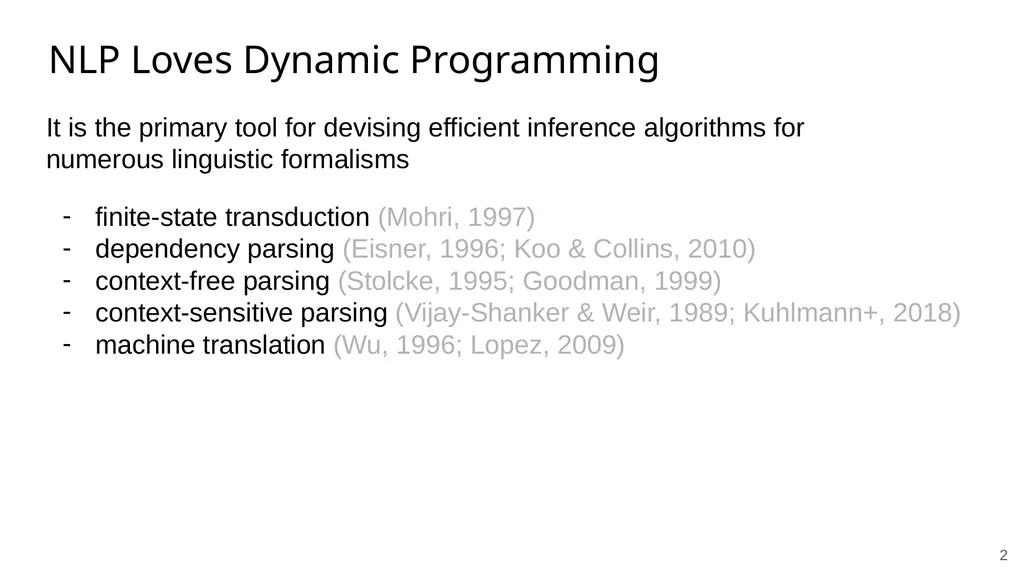
‹#› finite-state transduction (Mohri, 1997)
dependency parsing (Eisner, 1996; Koo & Collins, 2010)
context-free parsing (Stolcke, 1995; Goodman, 1999)
context-sensitive parsing (Vijay-Shanker & Weir, 1989; Kuhlmann+, 2018)
machine translation (Wu, 1996; Lopez, 2009) NLP Loves Dynamic Programming It is the primary tool for devising efficient inference algorithms for numerous linguistic formalisms<br>
03
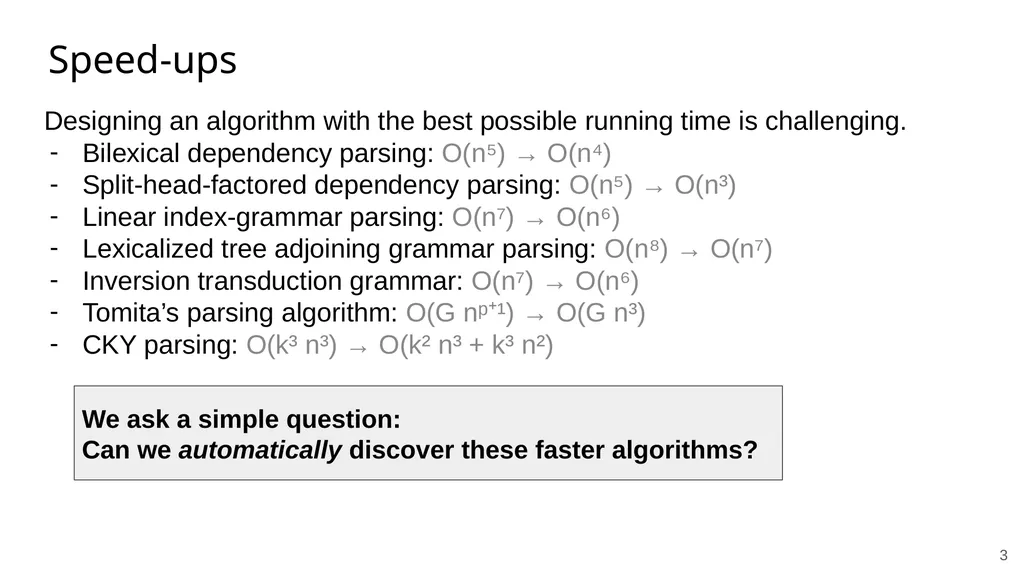
‹#› Designing an algorithm with the best possible running time is challenging.
Bilexical dependency parsing: O(n⁵) → O(n⁴)
Split-head-factored dependency parsing: O(n⁵) → O(n³)
Linear index-grammar parsing: O(n⁷) → O(n⁶)
Lexicalized tree adjoining grammar parsing: O(n⁸) → O(n⁷)
Inversion transduction grammar: O(n⁷) → O(n⁶)
Tomita’s parsing algorithm: O(G nᵖ⁺¹) → O(G n³)
CKY parsing: O(k³ n³) → O(k² n³ + k³ n²) Speed-ups We ask a simple question:
Can we automatically discover these faster algorithms?<br>
04
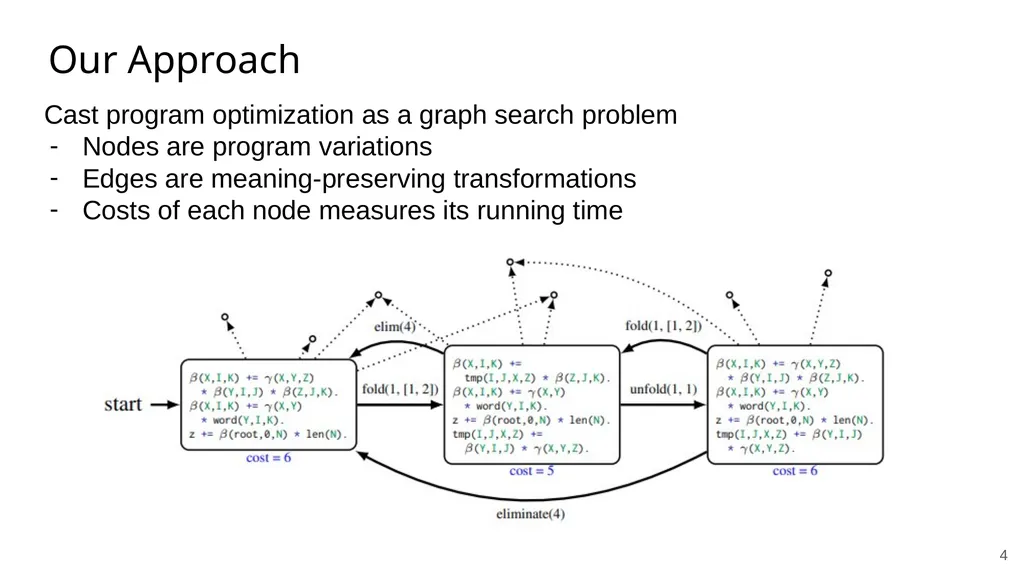
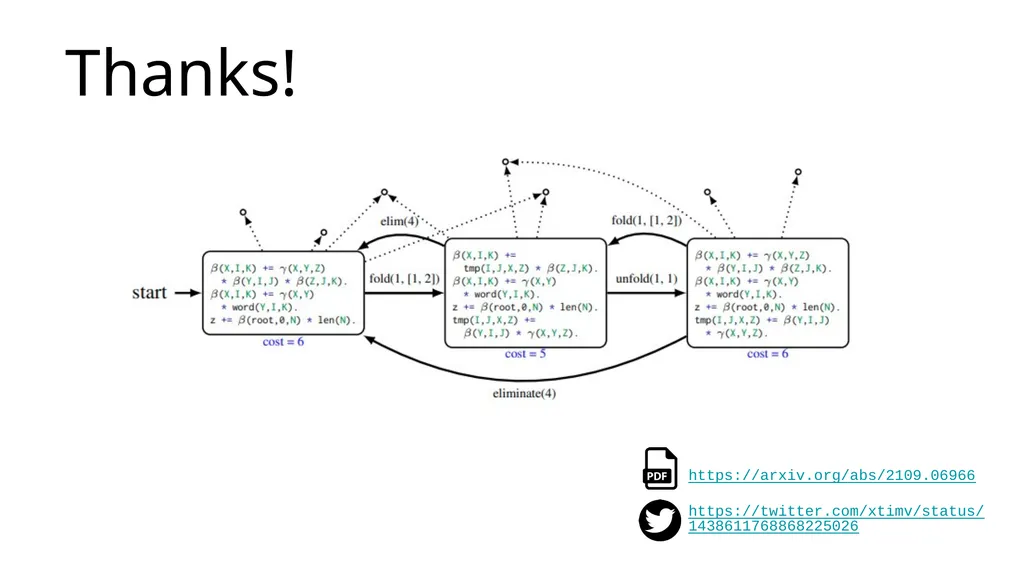
Cast program optimization as a graph search problem
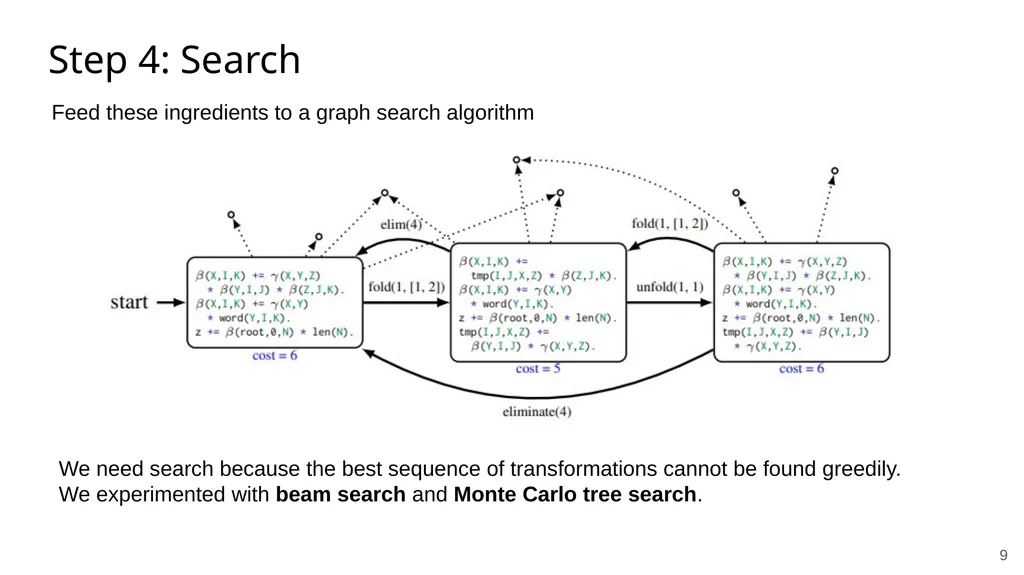
Nodes are program variations
Edges are meaning-preserving transformations
Costs of each node measures its running time ‹#› Our Approach<br>
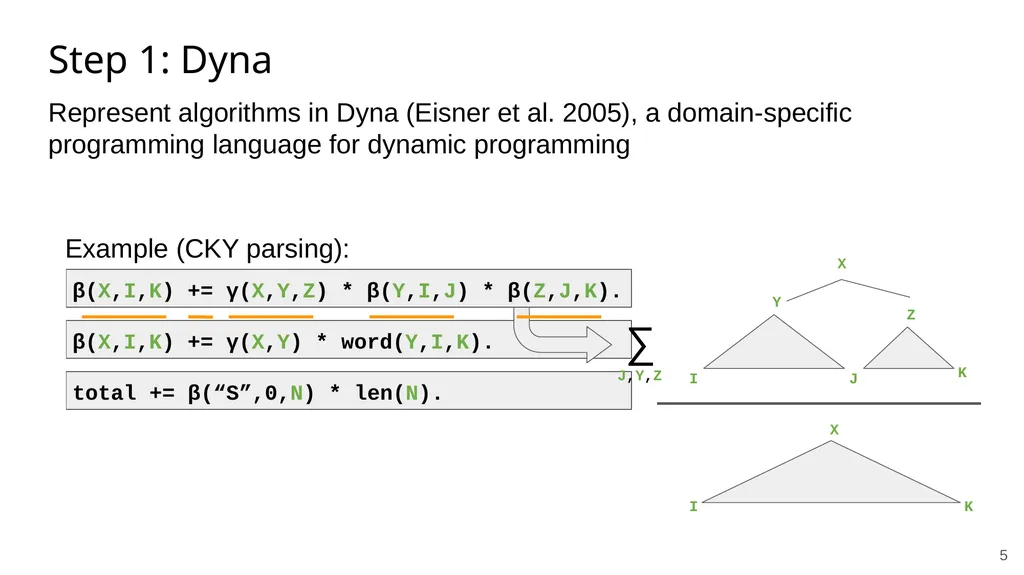
05
Represent algorithms in Dyna (Eisner et al. 2005), a domain-specific programming language for dynamic programming ‹#› Step 1: Dyna<br>
06
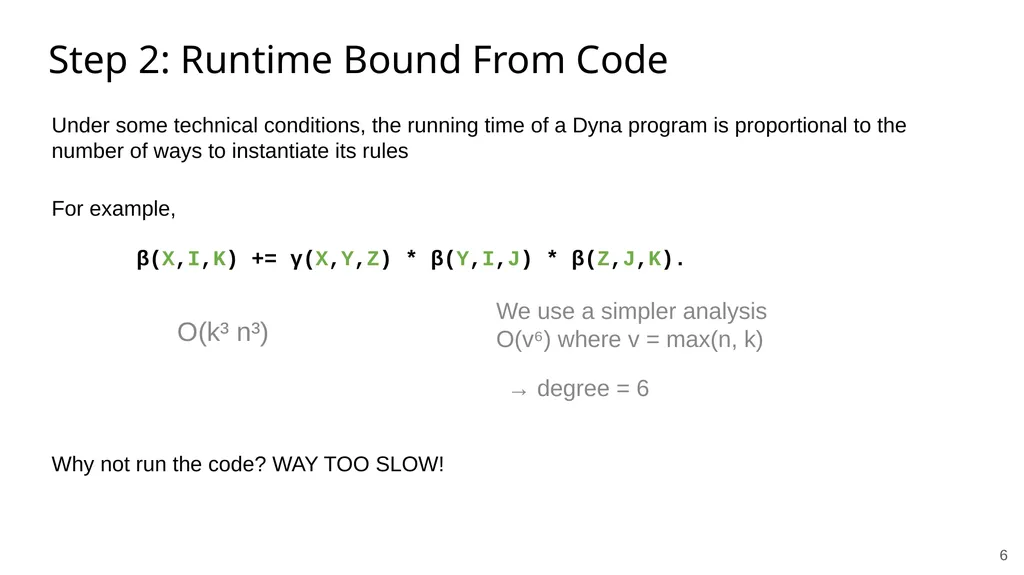
We use a simpler analysis
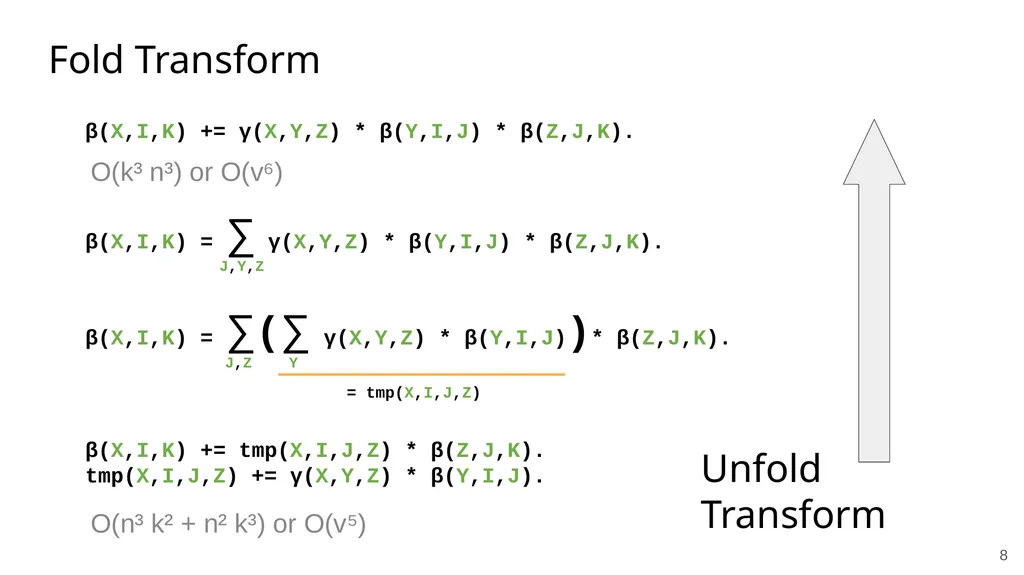
O(v⁶) where v = max(n, k) ‹#› Step 2: Runtime Bound From Code β(X,I,K) += γ(X,Y,Z) * β(Y,I,J) * β(Z,J,K). Under some technical conditions, the running time of a Dyna program is proportional to the number of ways to instantiate its rules For example, O(k³ n³) → degree = 6 Why not run the code? WAY TOO SLOW!<br>
07
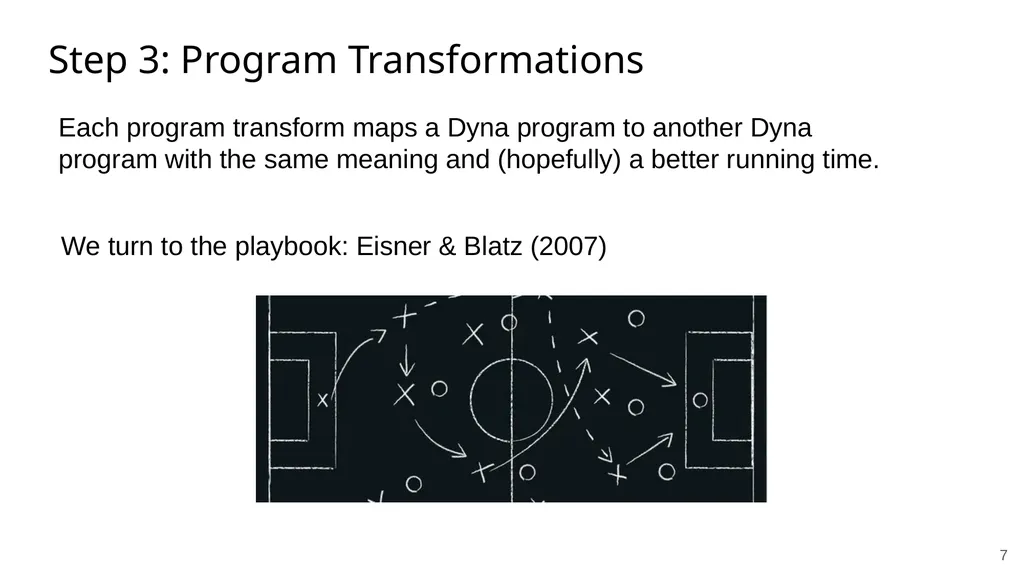
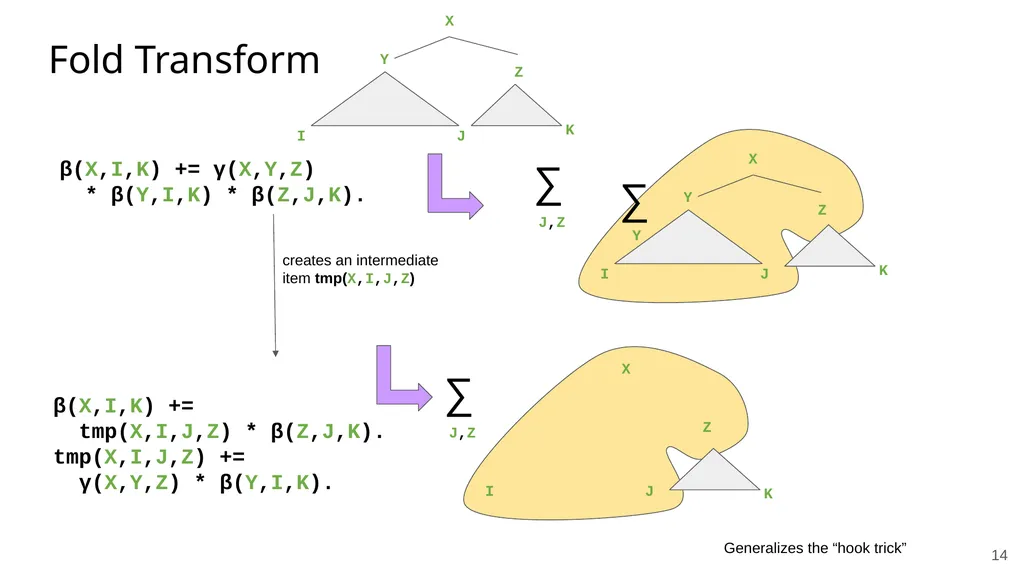
Each program transform maps a Dyna program to another Dyna program with the same meaning and (hopefully) a better running time. ‹#› Step 3: Program Transformations We turn to the playbook: Eisner & Blatz (2007)<br>
‹#› Step 4: Search Feed these ingredients to a graph search algorithm We need search because the best sequence of transformations cannot be found greedily.
We experimented with beam search and Monte Carlo tree search.<br>
10
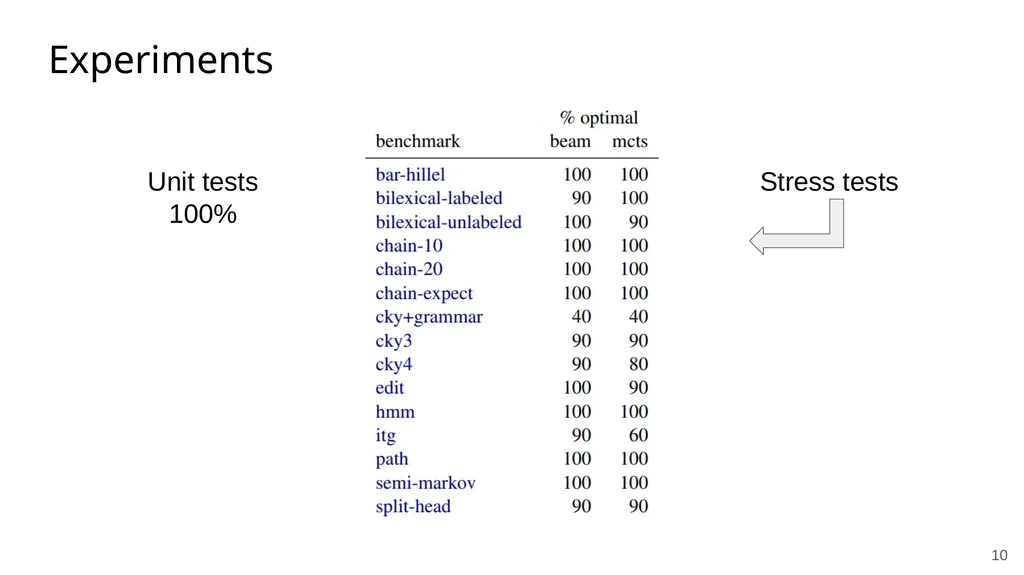
‹#› Experiments Unit tests
100%<br>
11
‹#› Summary Representing algorithms in a unified language allows us systematize the process of speeding them up.
We showed how to optimize dynamic programs with graph search on a program transformation graph.
We found that measuring running time efficiently was essential in order to explore enough of the search graph.<br>