
Seasons What do your students think causes the




Description: Seasons What do your students think causes the seasons? Images at http:nix.ksc.nasa.govinfo Created by the Lunar and Planetary Institute For Educational Use Only LPI is not responsible for the ways in which this powerpoint may be used or
Related Topics
Download Presentation
"Seasons What do your students think causes the" is the property of its rightful owner. Permission is granted to download and print the materials on this website for personal, non-commercial use only, and to display it on your personal computer provided you do not modify the materials and that you retain all copyright notices contained in the materials. By downloading content from our website, you accept the terms of this agreement.
Presentation Transcript
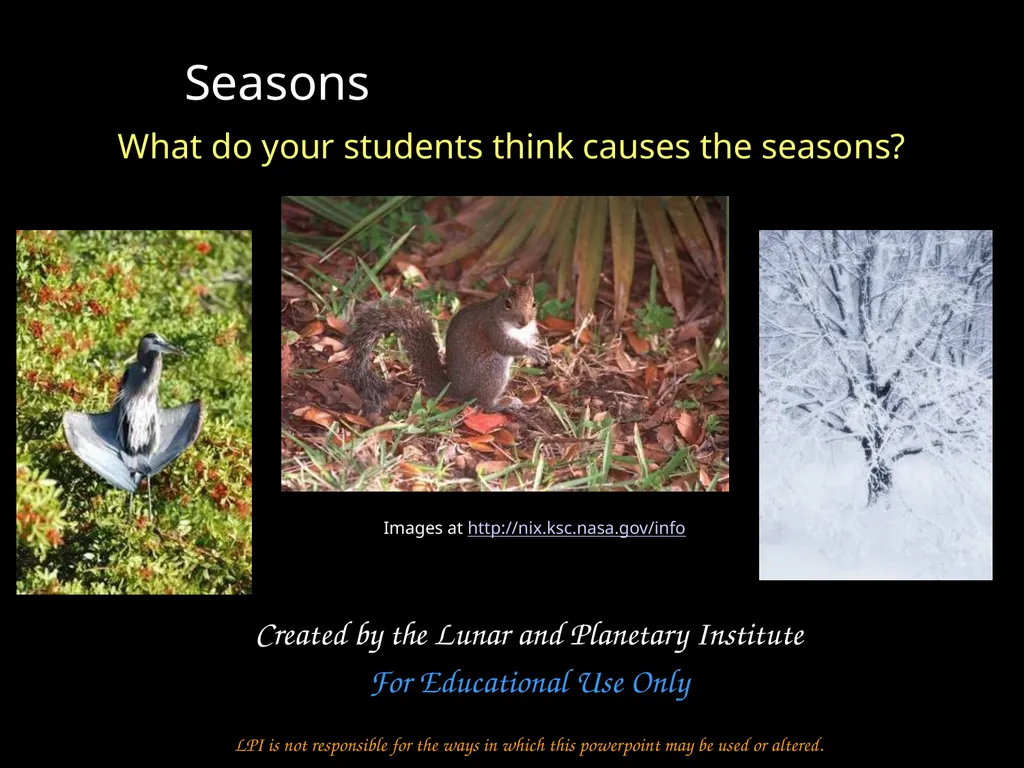
slide1. Seasons What do your students think causes the seasons? Images at http://nix.ksc.nasa.gov/info Created by the Lunar and Planetary Institute
For Educational Use Only
LPI is not responsible for the ways in which this powerpoint may be used or altered.<br>
slide2. Let’s start with a couple “probes” Snowball!<br>
slide3. Let’s Look at Some Data! Temperatures around the World<br>
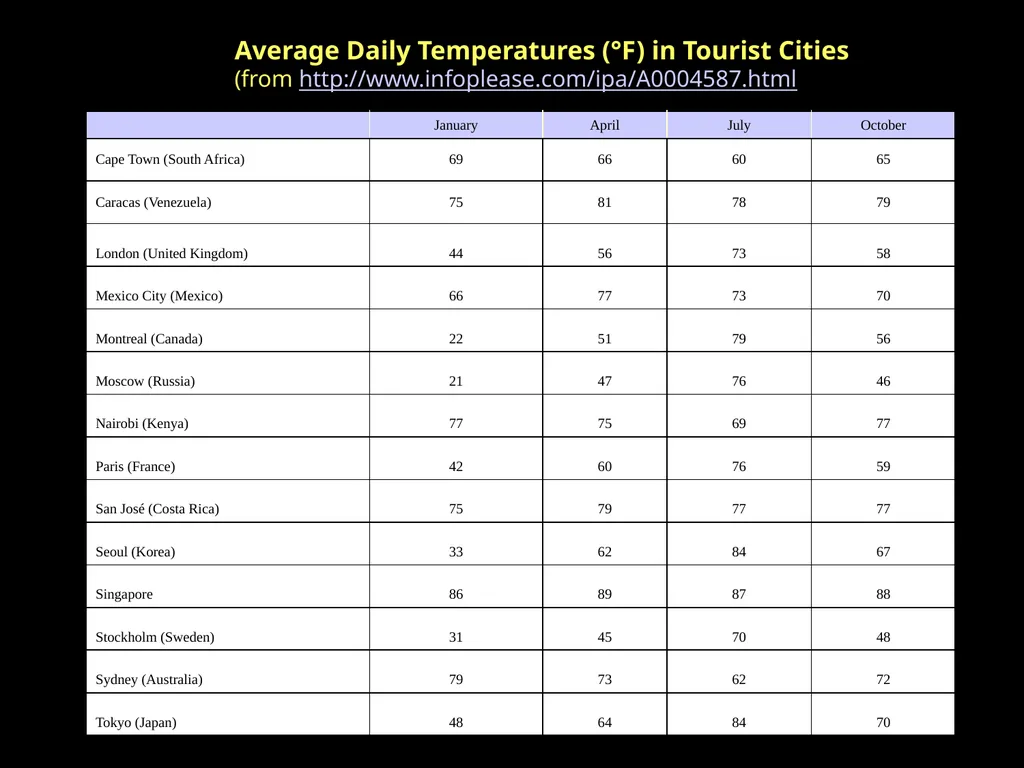
slide4. Average Daily Temperatures (°F) in Tourist Cities
(from http://www.infoplease.com/ipa/A0004587.html ))<br>
slide5. Let’s Start with some Observations Using free downloaded computer program, Stellarium: http://www.stellarium.org/
Stellarium is planetarium software that shows exactly what you see when you look up at the stars. It's easy to use, and free.
Let’s look at sunrise & sunset, and Sun’s height in the sky.<br>
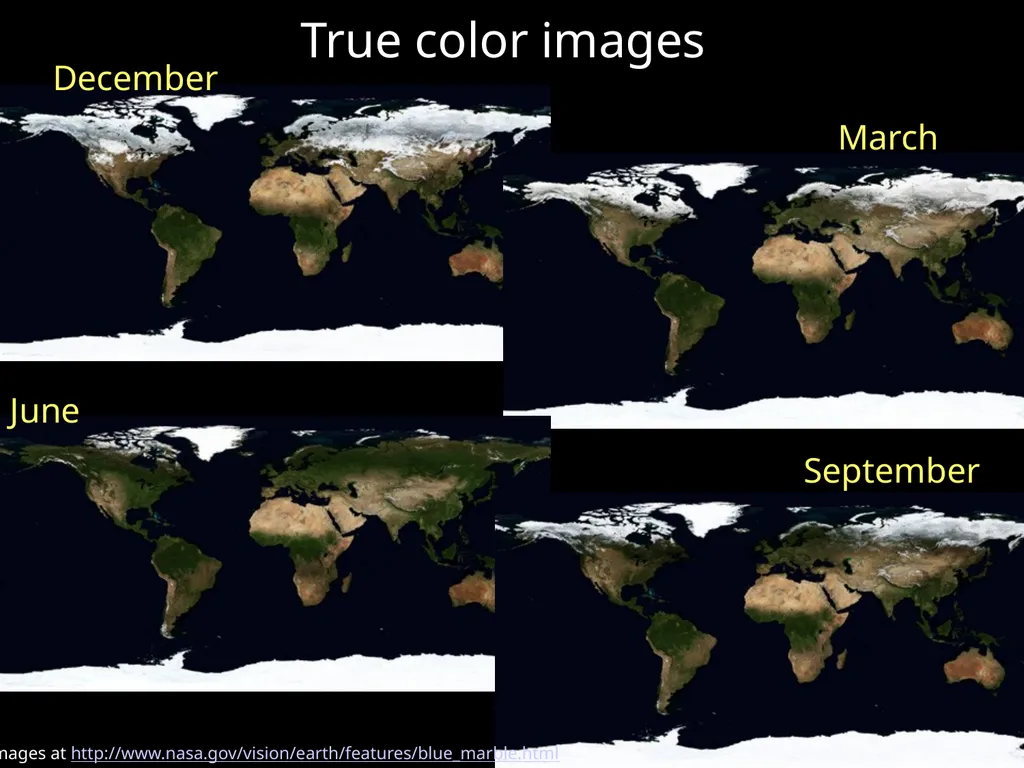
slide6. True color images June December March September Images at http://www.nasa.gov/vision/earth/features/blue_marble.html<br>
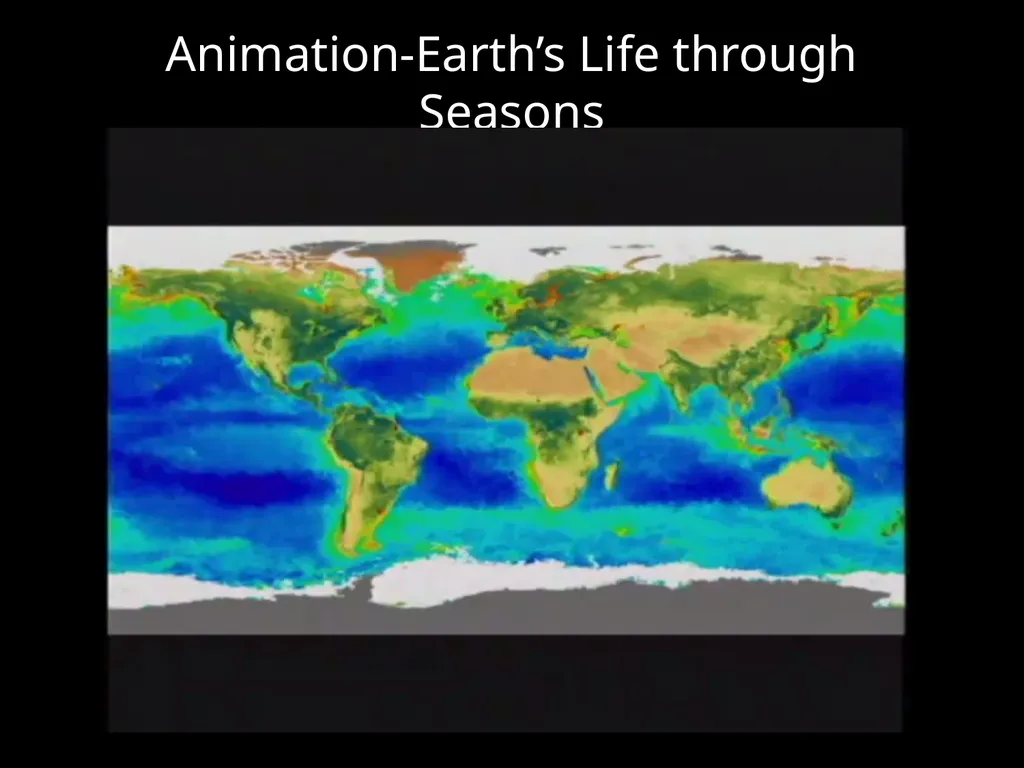
slide7. Animation-Earth’s Life through Seasons<br>
slide8. Modeling the Seasons Time to grab a styrofoam ball and a light!<br>
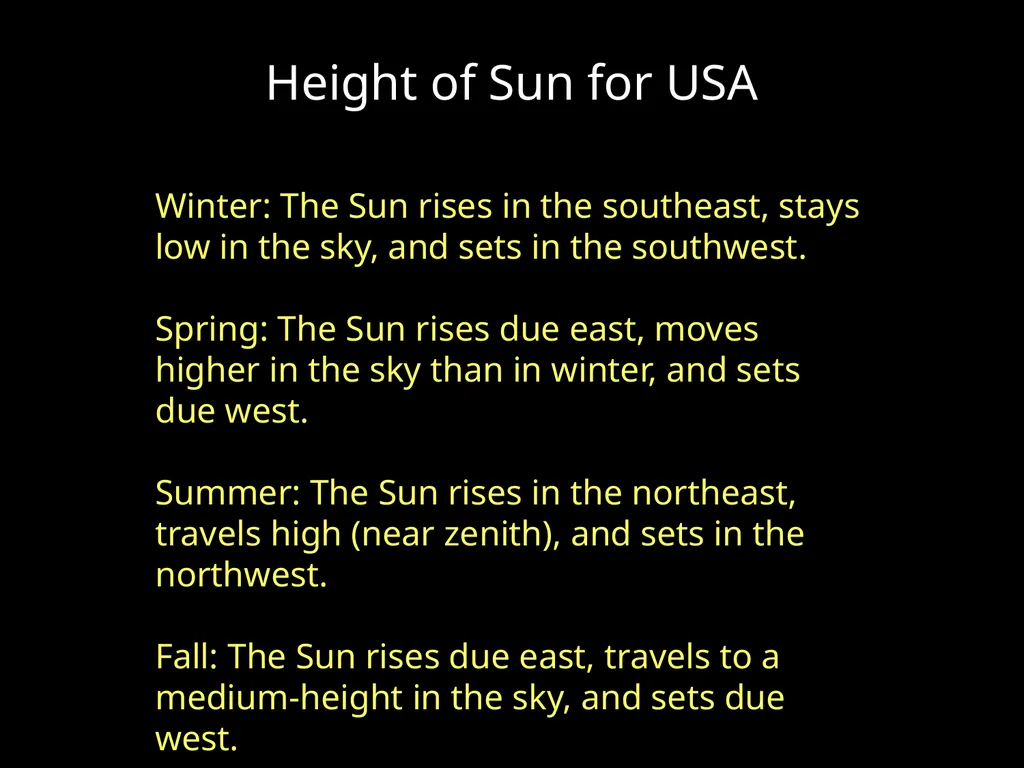
slide9. Height of Sun for USA Winter: The Sun rises in the southeast, stays low in the sky, and sets in the southwest.
Spring: The Sun rises due east, moves higher in the sky than in winter, and sets due west.
Summer: The Sun rises in the northeast, travels high (near zenith), and sets in the northwest.
Fall: The Sun rises due east, travels to a medium-height in the sky, and sets due west.<br>
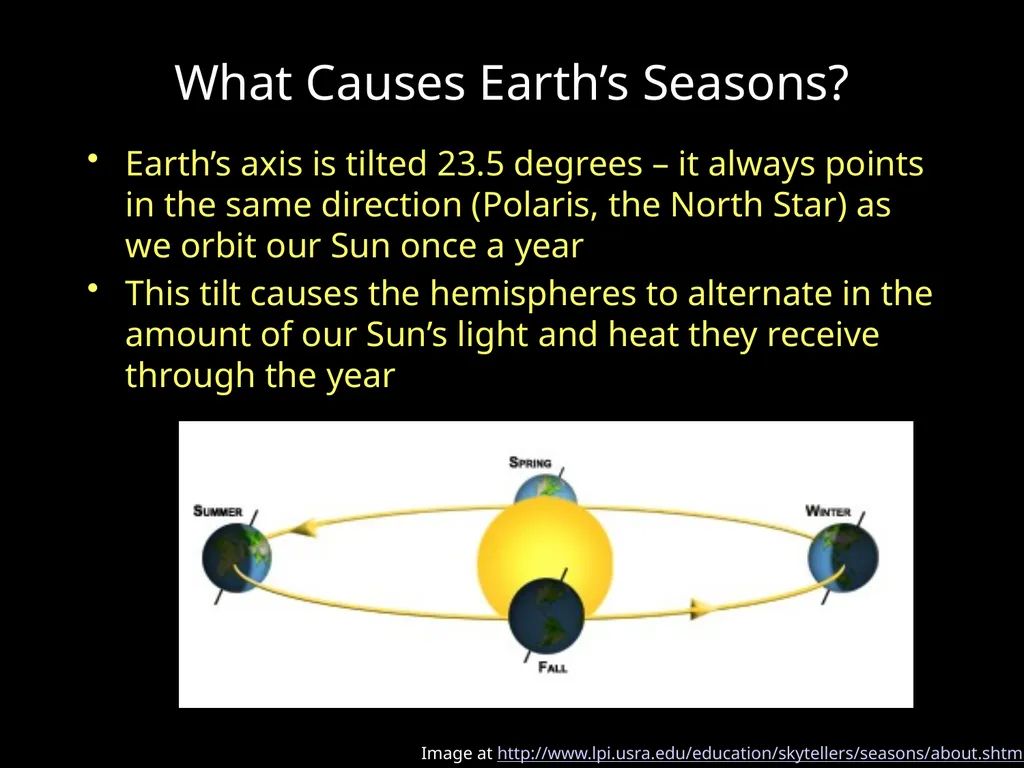
slide10. What Causes Earth’s Seasons? Earth’s axis is tilted 23.5 degrees – it always points in the same direction (Polaris, the North Star) as we orbit our Sun once a year
This tilt causes the hemispheres to alternate in the amount of our Sun’s light and heat they receive through the year Image at http://www.lpi.usra.edu/education/skytellers/seasons/about.shtml<br>
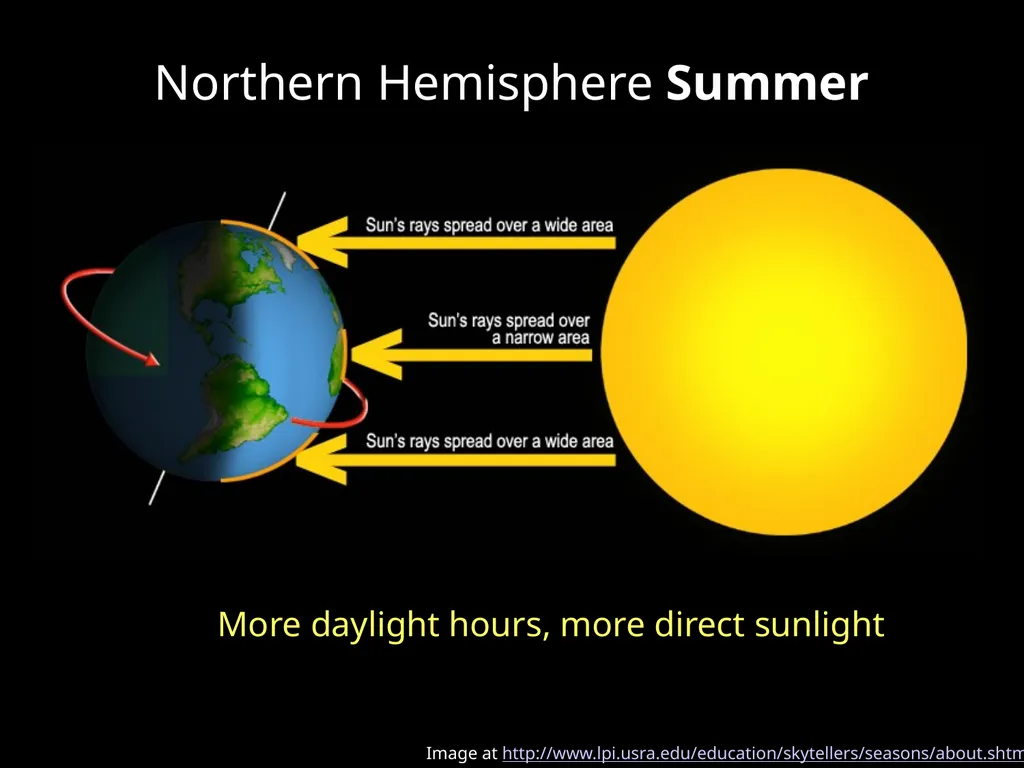
slide11. More daylight hours, more direct sunlight Northern Hemisphere Summer Image at http://www.lpi.usra.edu/education/skytellers/seasons/about.shtml<br>
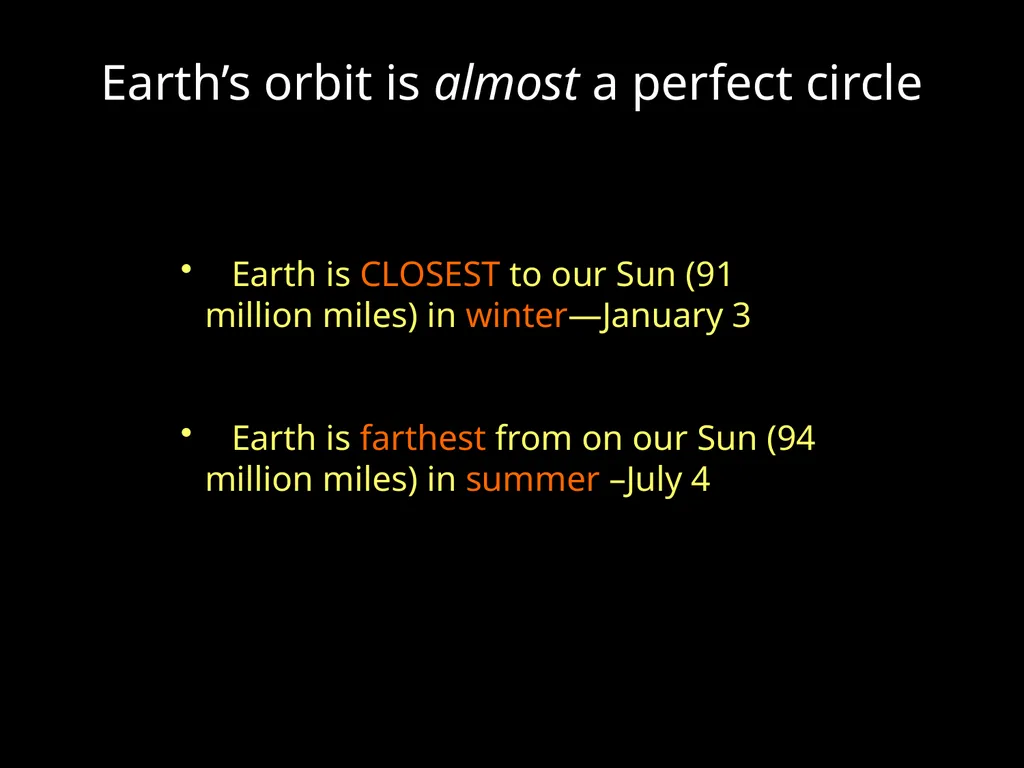
slide12. Earth’s orbit is almost a perfect circle Earth is CLOSEST to our Sun (91 million miles) in winter—January 3
Earth is farthest from on our Sun (94 million miles) in summer –July 4<br>
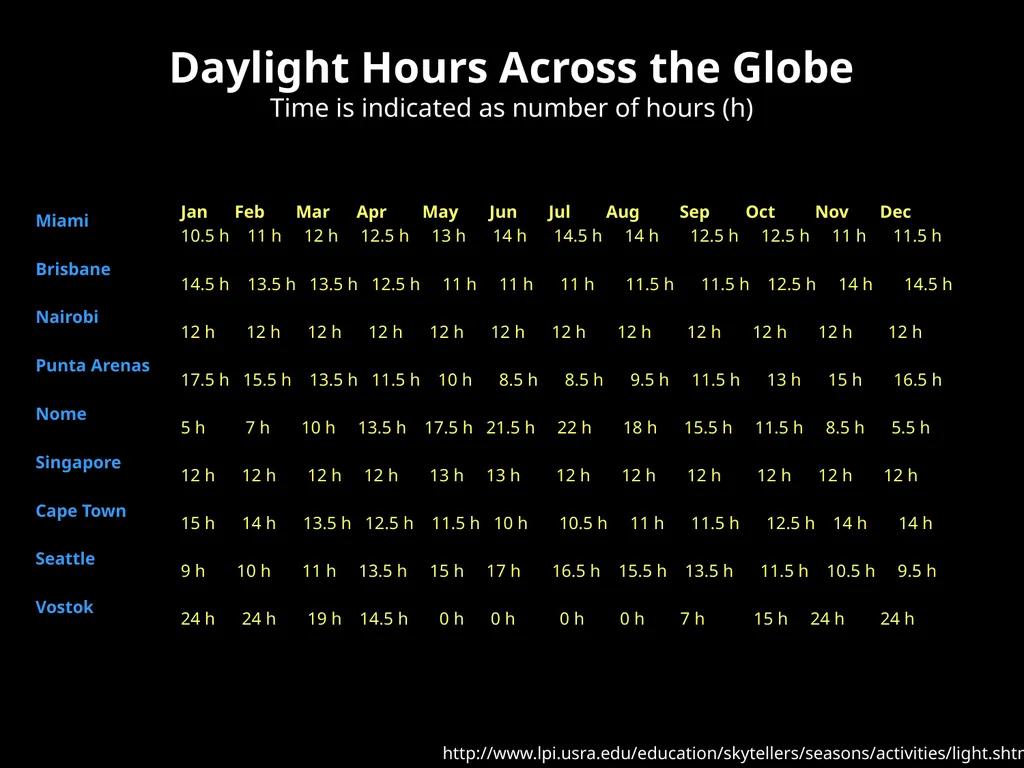
slide13. Daylight Hours Across the Globe Time is indicated as number of hours (h) Jan Feb Mar Apr May Jun Jul Aug Sep Oct Nov Dec
10.5 h 11 h 12 h 12.5 h 13 h 14 h 14.5 h 14 h 12.5 h 12.5 h 11 h 11.5 h
14.5 h 13.5 h 13.5 h 12.5 h 11 h 11 h 11 h 11.5 h 11.5 h 12.5 h 14 h 14.5 h
12 h 12 h 12 h 12 h 12 h 12 h 12 h 12 h 12 h 12 h 12 h 12 h
17.5 h 15.5 h 13.5 h 11.5 h 10 h 8.5 h 8.5 h 9.5 h 11.5 h 13 h 15 h 16.5 h
5 h 7 h 10 h 13.5 h 17.5 h 21.5 h 22 h 18 h 15.5 h 11.5 h 8.5 h 5.5 h
12 h 12 h 12 h 12 h 13 h 13 h 12 h 12 h 12 h 12 h 12 h 12 h
15 h 14 h 13.5 h 12.5 h 11.5 h 10 h 10.5 h 11 h 11.5 h 12.5 h 14 h 14 h
9 h 10 h 11 h 13.5 h 15 h 17 h 16.5 h 15.5 h 13.5 h 11.5 h 10.5 h 9.5 h
24 h 24 h 19 h 14.5 h 0 h 0 h 0 h 0 h 7 h 15 h 24 h 24 h Miami
Brisbane
Nairobi
Punta Arenas
Nome
Singapore
Cape Town
Seattle
Vostok http://www.lpi.usra.edu/education/skytellers/seasons/activities/light.shtml<br>
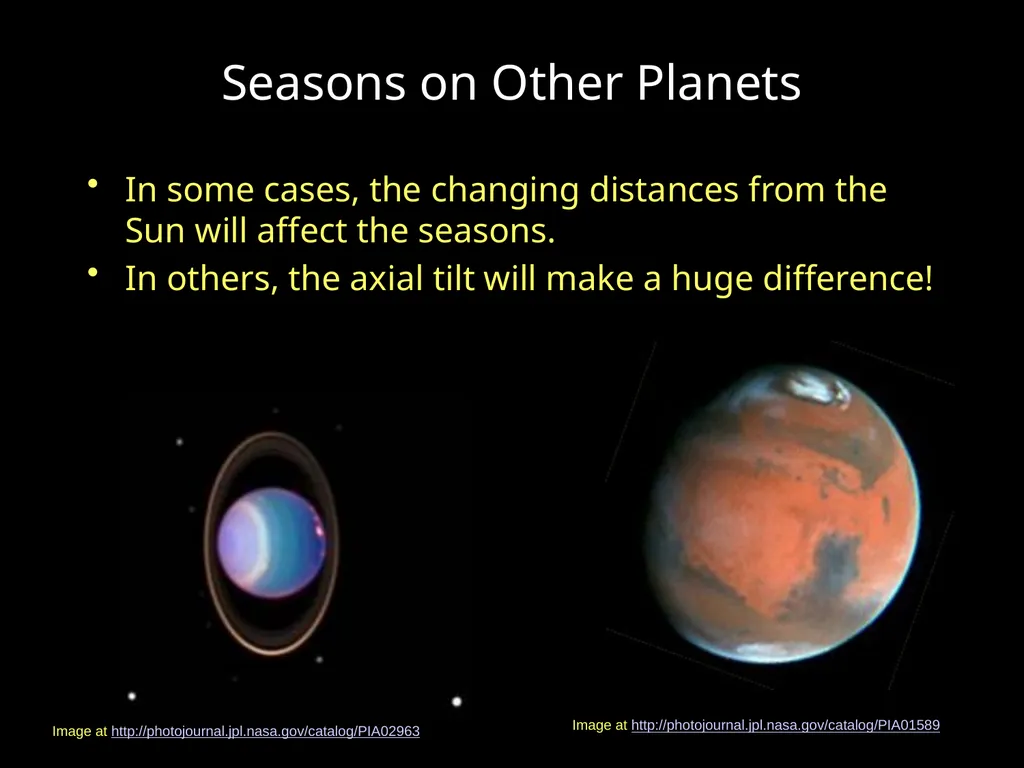
slide14. Seasons on Other Planets In some cases, the changing distances from the Sun will affect the seasons.
In others, the axial tilt will make a huge difference! Image at http://photojournal.jpl.nasa.gov/catalog/PIA01589 Image at http://photojournal.jpl.nasa.gov/catalog/PIA02963<br>
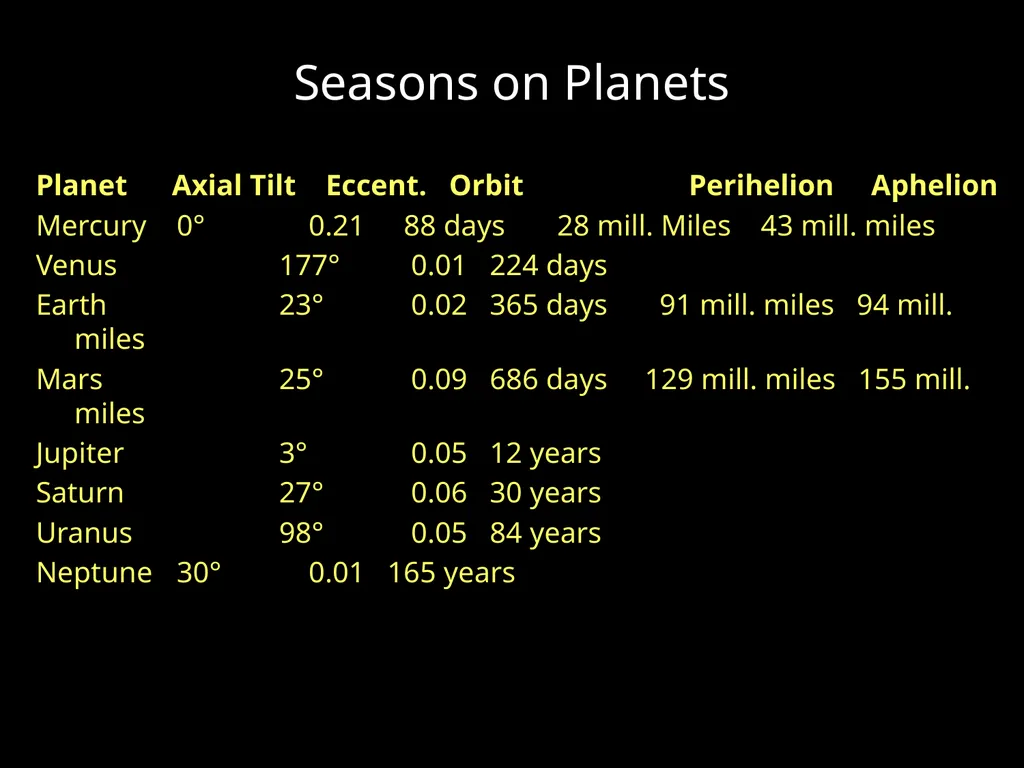
slide15. Seasons on Planets Planet Axial Tilt Eccent. Orbit Perihelion Aphelion
Mercury 0° 0.21 88 days 28 mill. Miles 43 mill. miles
Venus 177° 0.01 224 days
Earth 23° 0.02 365 days 91 mill. miles 94 mill. miles
Mars 25° 0.09 686 days 129 mill. miles 155 mill. miles
Jupiter 3° 0.05 12 years
Saturn 27° 0.06 30 years
Uranus 98° 0.05 84 years
Neptune 30° 0.01 165 years<br>
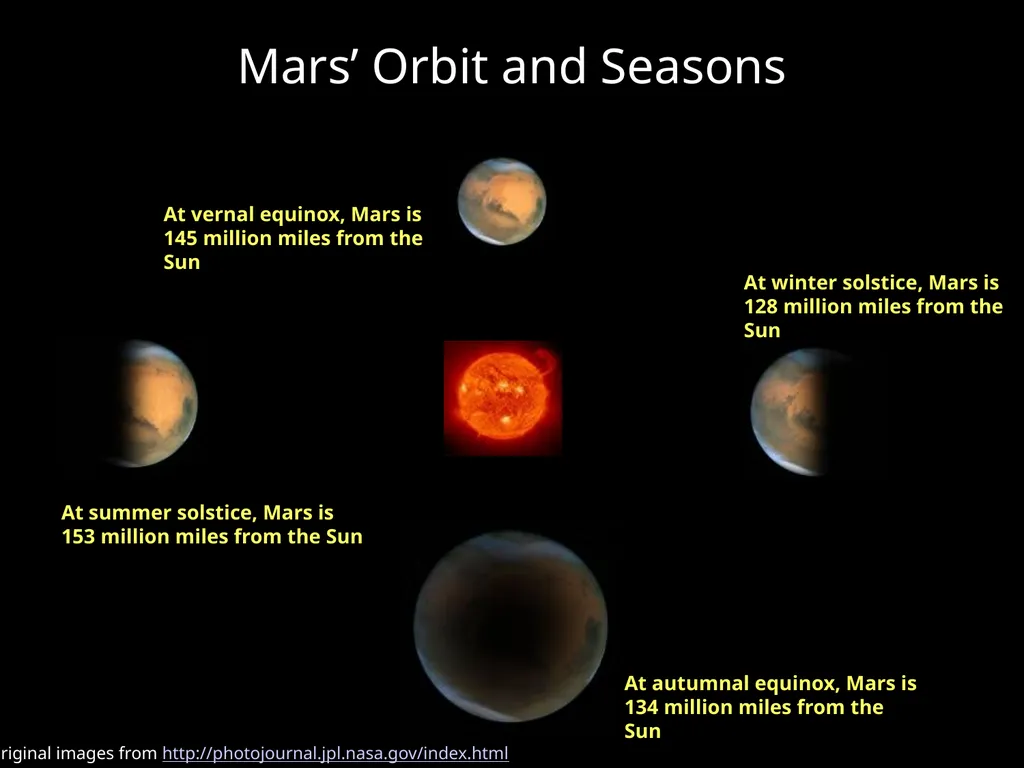
slide16. Mars’ Orbit and Seasons At summer solstice, Mars is 153 million miles from the Sun At autumnal equinox, Mars is 134 million miles from the Sun At winter solstice, Mars is 128 million miles from the Sun At vernal equinox, Mars is 145 million miles from the Sun Original images from http://photojournal.jpl.nasa.gov/index.html<br>
slide17. Northerners have cold days in January because
the Earth is farthest from the Sun in January.
the sunlight takes a longer route to get to the Earth in January.
the Sun is lower in the sky in January.
El Nino is always strongest in January. An Assessment Best procedures: read quietly to yourself (so you don’t give any subconscious clues)
As the instructor, we read it too, for timing, then ask if anyone needs more time
If not, it’s time to vote simultaneously—use your fingers, right in front of your chest so others don’t see (anonymous)<br>
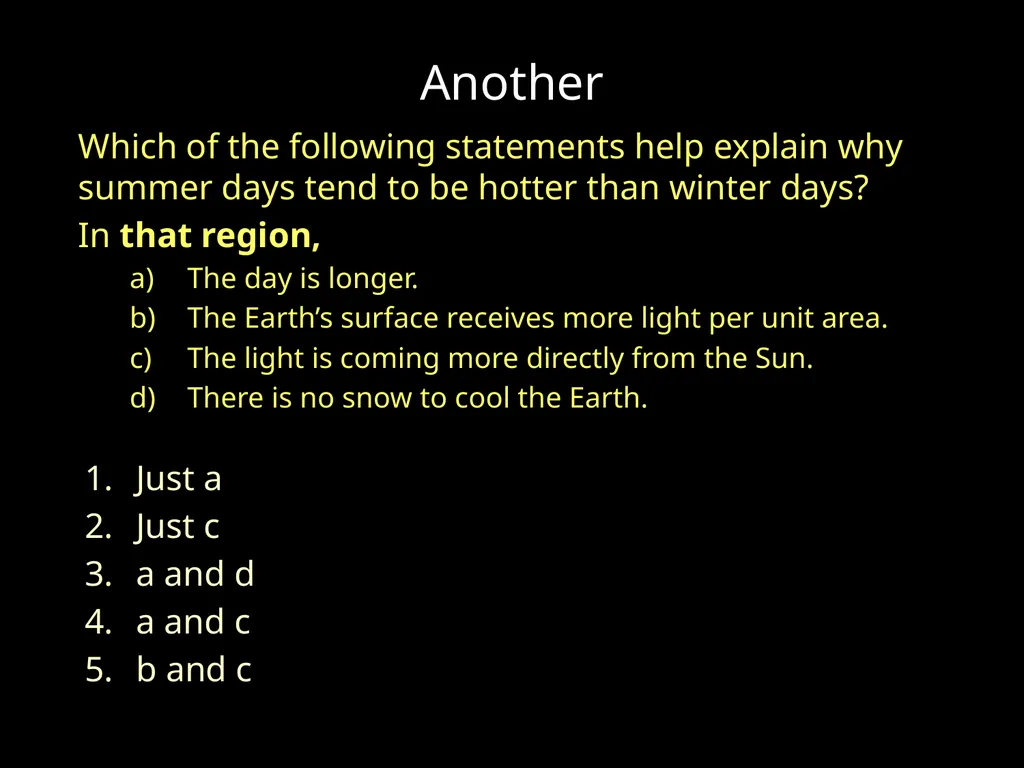
slide18. Another Which of the following statements help explain why summer days tend to be hotter than winter days?
In that region,
The day is longer.
The Earth’s surface receives more light per unit area.
The light is coming more directly from the Sun.
There is no snow to cool the Earth.
Just a
Just c
a and d
a and c
b and c<br>
slide19. What would the days and seasons be like in Houston if the Earth still rotated at the same speed, but the Earth’s axis were tilted nearly 50 degrees on its side instead of 23 degrees?
Both days and seasons would be half a year long.
The days would be the same length, but the seasons would be half a year long.
There would be no seasons, but days would be 6 months long.
The days and seasons would be the same lengths as ours, but the seasons would have more extreme temperature changes.<br>
For Educational Use Only
LPI is not responsible for the ways in which this powerpoint may be used or altered.<br>
slide2. Let’s start with a couple “probes” Snowball!<br>
slide3. Let’s Look at Some Data! Temperatures around the World<br>
slide4. Average Daily Temperatures (°F) in Tourist Cities
(from http://www.infoplease.com/ipa/A0004587.html ))<br>
slide5. Let’s Start with some Observations Using free downloaded computer program, Stellarium: http://www.stellarium.org/
Stellarium is planetarium software that shows exactly what you see when you look up at the stars. It's easy to use, and free.
Let’s look at sunrise & sunset, and Sun’s height in the sky.<br>
slide6. True color images June December March September Images at http://www.nasa.gov/vision/earth/features/blue_marble.html<br>
slide7. Animation-Earth’s Life through Seasons<br>
slide8. Modeling the Seasons Time to grab a styrofoam ball and a light!<br>
slide9. Height of Sun for USA Winter: The Sun rises in the southeast, stays low in the sky, and sets in the southwest.
Spring: The Sun rises due east, moves higher in the sky than in winter, and sets due west.
Summer: The Sun rises in the northeast, travels high (near zenith), and sets in the northwest.
Fall: The Sun rises due east, travels to a medium-height in the sky, and sets due west.<br>
slide10. What Causes Earth’s Seasons? Earth’s axis is tilted 23.5 degrees – it always points in the same direction (Polaris, the North Star) as we orbit our Sun once a year
This tilt causes the hemispheres to alternate in the amount of our Sun’s light and heat they receive through the year Image at http://www.lpi.usra.edu/education/skytellers/seasons/about.shtml<br>
slide11. More daylight hours, more direct sunlight Northern Hemisphere Summer Image at http://www.lpi.usra.edu/education/skytellers/seasons/about.shtml<br>
slide12. Earth’s orbit is almost a perfect circle Earth is CLOSEST to our Sun (91 million miles) in winter—January 3
Earth is farthest from on our Sun (94 million miles) in summer –July 4<br>
slide13. Daylight Hours Across the Globe Time is indicated as number of hours (h) Jan Feb Mar Apr May Jun Jul Aug Sep Oct Nov Dec
10.5 h 11 h 12 h 12.5 h 13 h 14 h 14.5 h 14 h 12.5 h 12.5 h 11 h 11.5 h
14.5 h 13.5 h 13.5 h 12.5 h 11 h 11 h 11 h 11.5 h 11.5 h 12.5 h 14 h 14.5 h
12 h 12 h 12 h 12 h 12 h 12 h 12 h 12 h 12 h 12 h 12 h 12 h
17.5 h 15.5 h 13.5 h 11.5 h 10 h 8.5 h 8.5 h 9.5 h 11.5 h 13 h 15 h 16.5 h
5 h 7 h 10 h 13.5 h 17.5 h 21.5 h 22 h 18 h 15.5 h 11.5 h 8.5 h 5.5 h
12 h 12 h 12 h 12 h 13 h 13 h 12 h 12 h 12 h 12 h 12 h 12 h
15 h 14 h 13.5 h 12.5 h 11.5 h 10 h 10.5 h 11 h 11.5 h 12.5 h 14 h 14 h
9 h 10 h 11 h 13.5 h 15 h 17 h 16.5 h 15.5 h 13.5 h 11.5 h 10.5 h 9.5 h
24 h 24 h 19 h 14.5 h 0 h 0 h 0 h 0 h 7 h 15 h 24 h 24 h Miami
Brisbane
Nairobi
Punta Arenas
Nome
Singapore
Cape Town
Seattle
Vostok http://www.lpi.usra.edu/education/skytellers/seasons/activities/light.shtml<br>
slide14. Seasons on Other Planets In some cases, the changing distances from the Sun will affect the seasons.
In others, the axial tilt will make a huge difference! Image at http://photojournal.jpl.nasa.gov/catalog/PIA01589 Image at http://photojournal.jpl.nasa.gov/catalog/PIA02963<br>
slide15. Seasons on Planets Planet Axial Tilt Eccent. Orbit Perihelion Aphelion
Mercury 0° 0.21 88 days 28 mill. Miles 43 mill. miles
Venus 177° 0.01 224 days
Earth 23° 0.02 365 days 91 mill. miles 94 mill. miles
Mars 25° 0.09 686 days 129 mill. miles 155 mill. miles
Jupiter 3° 0.05 12 years
Saturn 27° 0.06 30 years
Uranus 98° 0.05 84 years
Neptune 30° 0.01 165 years<br>
slide16. Mars’ Orbit and Seasons At summer solstice, Mars is 153 million miles from the Sun At autumnal equinox, Mars is 134 million miles from the Sun At winter solstice, Mars is 128 million miles from the Sun At vernal equinox, Mars is 145 million miles from the Sun Original images from http://photojournal.jpl.nasa.gov/index.html<br>
slide17. Northerners have cold days in January because
the Earth is farthest from the Sun in January.
the sunlight takes a longer route to get to the Earth in January.
the Sun is lower in the sky in January.
El Nino is always strongest in January. An Assessment Best procedures: read quietly to yourself (so you don’t give any subconscious clues)
As the instructor, we read it too, for timing, then ask if anyone needs more time
If not, it’s time to vote simultaneously—use your fingers, right in front of your chest so others don’t see (anonymous)<br>
slide18. Another Which of the following statements help explain why summer days tend to be hotter than winter days?
In that region,
The day is longer.
The Earth’s surface receives more light per unit area.
The light is coming more directly from the Sun.
There is no snow to cool the Earth.
Just a
Just c
a and d
a and c
b and c<br>
slide19. What would the days and seasons be like in Houston if the Earth still rotated at the same speed, but the Earth’s axis were tilted nearly 50 degrees on its side instead of 23 degrees?
Both days and seasons would be half a year long.
The days would be the same length, but the seasons would be half a year long.
There would be no seasons, but days would be 6 months long.
The days and seasons would be the same lengths as ours, but the seasons would have more extreme temperature changes.<br>