
Second-Line ART After Treatment Failure or for
CP
Published · 25 slides · 0 views

1 / 1

Description
Second-Line ART After Treatment Failure or for Regimen Simplification www.hivguidelines.org FEBRUARY 2026 NYSDOH AIDS Institute Clinical Guidelines Program Goals of This Guideline Increase clinicians ability to recognize ART failure
Related Topics
Share
Embed code
Download this presentation From Below
"Second-Line ART After Treatment Failure or for" is the property of its rightful owner. Permission is granted to download and print the materials on this website for personal, non-commercial use only, and to display it on your personal computer provided you do not modify the materials and that you retain all copyright notices contained in the materials. By downloading content from our website, you accept the terms of this agreement.
Presentation Transcript
01
Second-Line ART After Treatment Failure or for Regimen Simplification
www.hivguidelines.org FEBRUARY 2026 NYSDOH AIDS Institute Clinical Guidelines Program<br>
www.hivguidelines.org FEBRUARY 2026 NYSDOH AIDS Institute Clinical Guidelines Program<br>
02
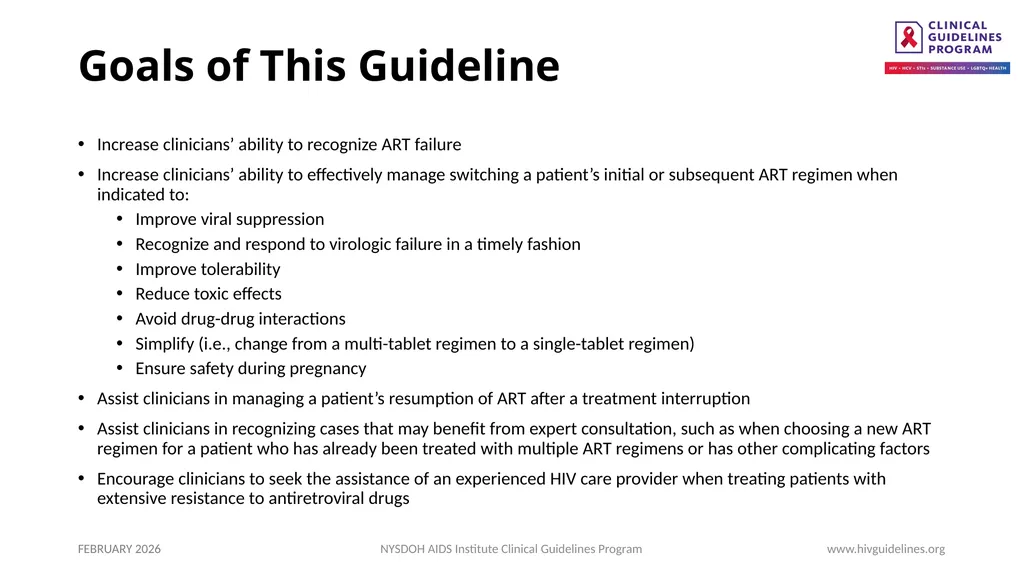
Goals of This Guideline Increase clinicians’ ability to recognize ART failure
Increase clinicians’ ability to effectively manage switching a patient’s initial or subsequent ART regimen when indicated to:
Improve viral suppression
Recognize and respond to virologic failure in a timely fashion
Improve tolerability
Reduce toxic effects
Avoid drug-drug interactions
Simplify (i.e., change from a multi-tablet regimen to a single-tablet regimen)
Ensure safety during pregnancy
Assist clinicians in managing a patient’s resumption of ART after a treatment interruption
Assist clinicians in recognizing cases that may benefit from expert consultation, such as when choosing a new ART regimen for a patient who has already been treated with multiple ART regimens or has other complicating factors
Encourage clinicians to seek the assistance of an experienced HIV care provider when treating patients with extensive resistance to antiretroviral drugs NYSDOH AIDS Institute Clinical Guidelines Program www.hivguidelines.org FEBRUARY 2026<br>
Increase clinicians’ ability to effectively manage switching a patient’s initial or subsequent ART regimen when indicated to:
Improve viral suppression
Recognize and respond to virologic failure in a timely fashion
Improve tolerability
Reduce toxic effects
Avoid drug-drug interactions
Simplify (i.e., change from a multi-tablet regimen to a single-tablet regimen)
Ensure safety during pregnancy
Assist clinicians in managing a patient’s resumption of ART after a treatment interruption
Assist clinicians in recognizing cases that may benefit from expert consultation, such as when choosing a new ART regimen for a patient who has already been treated with multiple ART regimens or has other complicating factors
Encourage clinicians to seek the assistance of an experienced HIV care provider when treating patients with extensive resistance to antiretroviral drugs NYSDOH AIDS Institute Clinical Guidelines Program www.hivguidelines.org FEBRUARY 2026<br>
03
Recommendations:
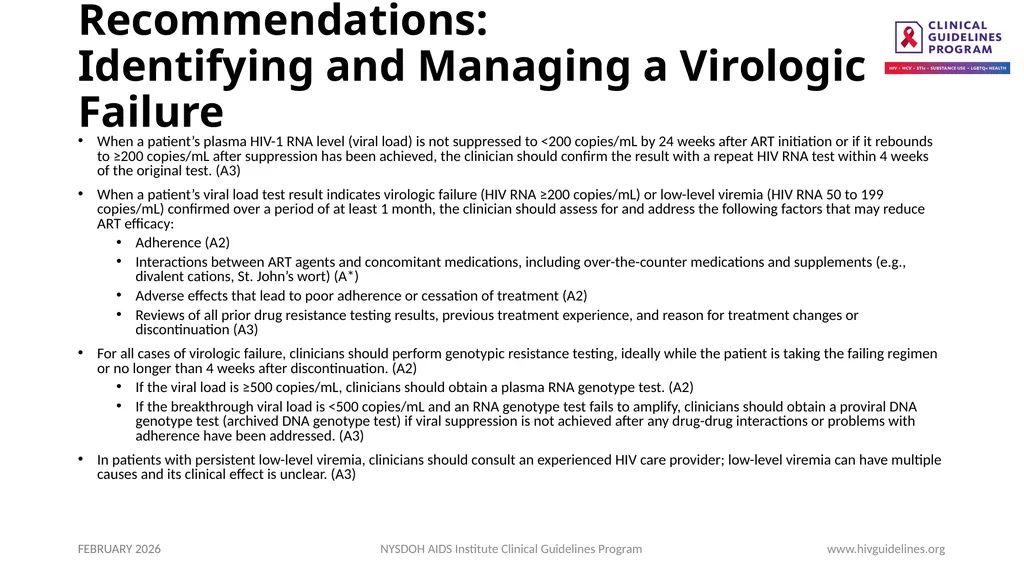
Identifying and Managing a Virologic Failure When a patient’s plasma HIV-1 RNA level (viral load) is not suppressed to <200 copies/mL by 24 weeks after ART initiation or if it rebounds to ≥200 copies/mL after suppression has been achieved, the clinician should confirm the result with a repeat HIV RNA test within 4 weeks of the original test. (A3)
When a patient’s viral load test result indicates virologic failure (HIV RNA ≥200 copies/mL) or low-level viremia (HIV RNA 50 to 199 copies/mL) confirmed over a period of at least 1 month, the clinician should assess for and address the following factors that may reduce ART efficacy:
Adherence (A2)
Interactions between ART agents and concomitant medications, including over-the-counter medications and supplements (e.g., divalent cations, St. John’s wort) (A*)
Adverse effects that lead to poor adherence or cessation of treatment (A2)
Reviews of all prior drug resistance testing results, previous treatment experience, and reason for treatment changes or discontinuation (A3)
For all cases of virologic failure, clinicians should perform genotypic resistance testing, ideally while the patient is taking the failing regimen or no longer than 4 weeks after discontinuation. (A2)
If the viral load is ≥500 copies/mL, clinicians should obtain a plasma RNA genotype test. (A2)
If the breakthrough viral load is <500 copies/mL and an RNA genotype test fails to amplify, clinicians should obtain a proviral DNA genotype test (archived DNA genotype test) if viral suppression is not achieved after any drug-drug interactions or problems with adherence have been addressed. (A3)
In patients with persistent low-level viremia, clinicians should consult an experienced HIV care provider; low-level viremia can have multiple causes and its clinical effect is unclear. (A3) NYSDOH AIDS Institute Clinical Guidelines Program www.hivguidelines.org FEBRUARY 2026<br>
When a patient’s viral load test result indicates virologic failure (HIV RNA ≥200 copies/mL) or low-level viremia (HIV RNA 50 to 199 copies/mL) confirmed over a period of at least 1 month, the clinician should assess for and address the following factors that may reduce ART efficacy:
Adherence (A2)
Interactions between ART agents and concomitant medications, including over-the-counter medications and supplements (e.g., divalent cations, St. John’s wort) (A*)
Adverse effects that lead to poor adherence or cessation of treatment (A2)
Reviews of all prior drug resistance testing results, previous treatment experience, and reason for treatment changes or discontinuation (A3)
For all cases of virologic failure, clinicians should perform genotypic resistance testing, ideally while the patient is taking the failing regimen or no longer than 4 weeks after discontinuation. (A2)
If the viral load is ≥500 copies/mL, clinicians should obtain a plasma RNA genotype test. (A2)
If the breakthrough viral load is <500 copies/mL and an RNA genotype test fails to amplify, clinicians should obtain a proviral DNA genotype test (archived DNA genotype test) if viral suppression is not achieved after any drug-drug interactions or problems with adherence have been addressed. (A3)
In patients with persistent low-level viremia, clinicians should consult an experienced HIV care provider; low-level viremia can have multiple causes and its clinical effect is unclear. (A3) NYSDOH AIDS Institute Clinical Guidelines Program www.hivguidelines.org FEBRUARY 2026<br>
04
Key Points:
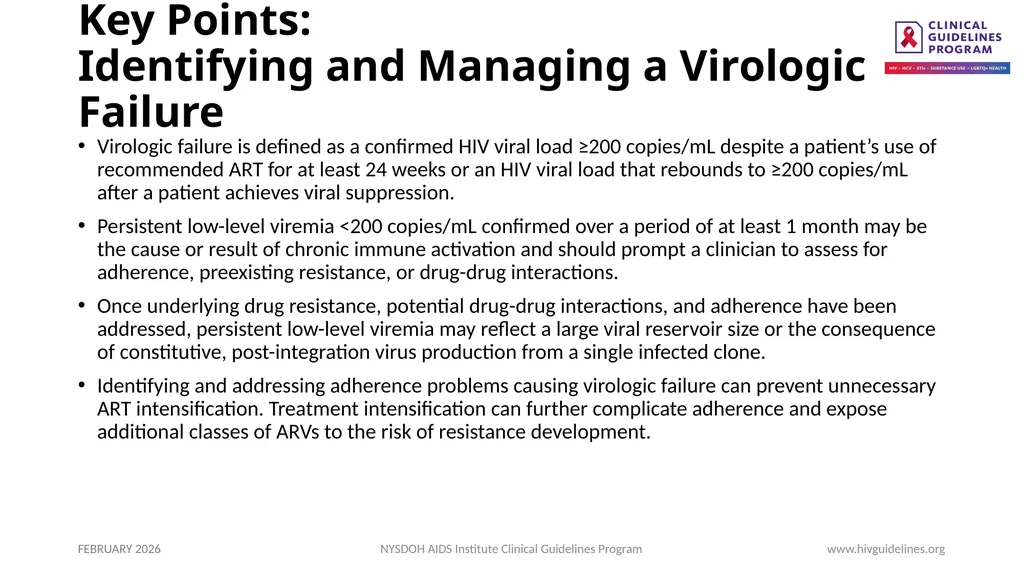
Identifying and Managing a Virologic Failure Virologic failure is defined as a confirmed HIV viral load ≥200 copies/mL despite a patient’s use of recommended ART for at least 24 weeks or an HIV viral load that rebounds to ≥200 copies/mL after a patient achieves viral suppression.
Persistent low-level viremia <200 copies/mL confirmed over a period of at least 1 month may be the cause or result of chronic immune activation and should prompt a clinician to assess for adherence, preexisting resistance, or drug-drug interactions.
Once underlying drug resistance, potential drug-drug interactions, and adherence have been addressed, persistent low-level viremia may reflect a large viral reservoir size or the consequence of constitutive, post-integration virus production from a single infected clone.
Identifying and addressing adherence problems causing virologic failure can prevent unnecessary ART intensification. Treatment intensification can further complicate adherence and expose additional classes of ARVs to the risk of resistance development. NYSDOH AIDS Institute Clinical Guidelines Program www.hivguidelines.org FEBRUARY 2026<br>
Persistent low-level viremia <200 copies/mL confirmed over a period of at least 1 month may be the cause or result of chronic immune activation and should prompt a clinician to assess for adherence, preexisting resistance, or drug-drug interactions.
Once underlying drug resistance, potential drug-drug interactions, and adherence have been addressed, persistent low-level viremia may reflect a large viral reservoir size or the consequence of constitutive, post-integration virus production from a single infected clone.
Identifying and addressing adherence problems causing virologic failure can prevent unnecessary ART intensification. Treatment intensification can further complicate adherence and expose additional classes of ARVs to the risk of resistance development. NYSDOH AIDS Institute Clinical Guidelines Program www.hivguidelines.org FEBRUARY 2026<br>
05
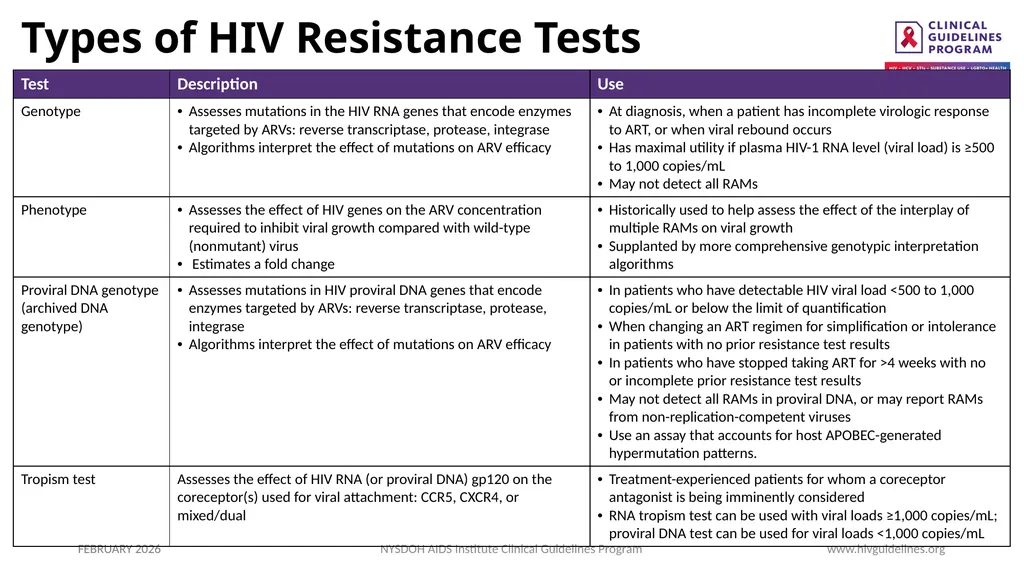
Types of HIV Resistance Tests NYSDOH AIDS Institute Clinical Guidelines Program www.hivguidelines.org FEBRUARY 2026<br>
06
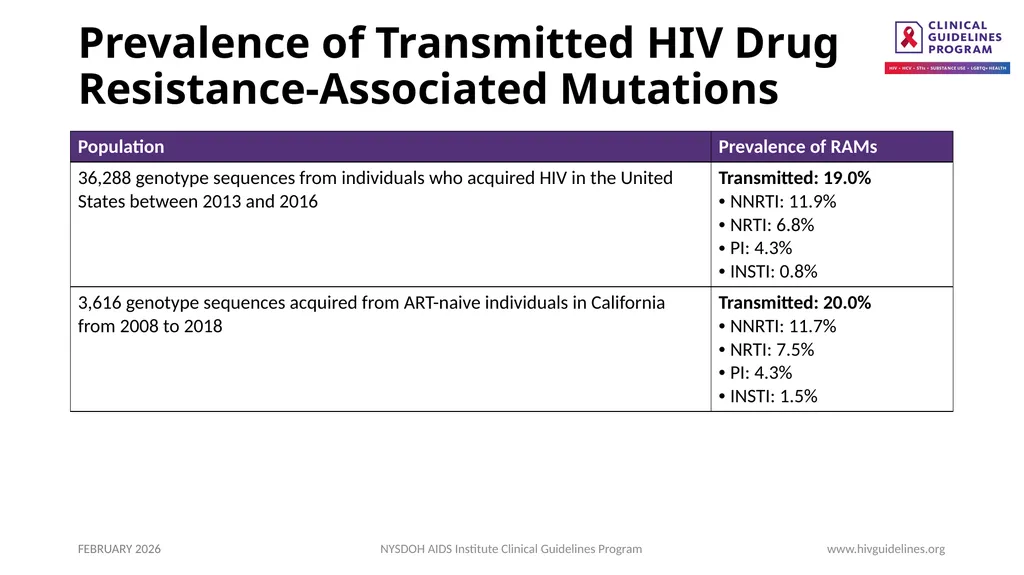
Prevalence of Transmitted HIV Drug Resistance-Associated Mutations NYSDOH AIDS Institute Clinical Guidelines Program www.hivguidelines.org FEBRUARY 2026<br>
07
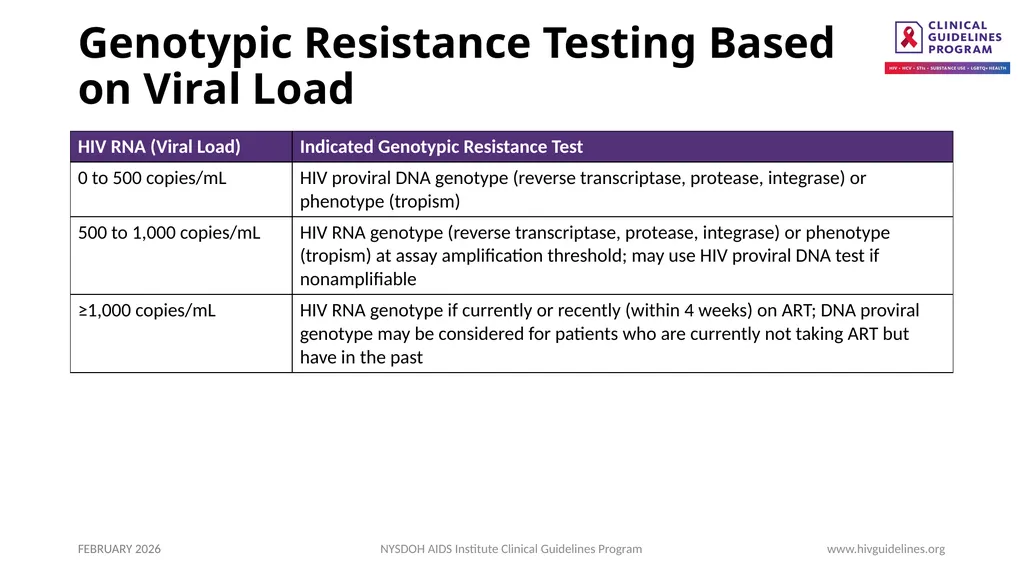
Genotypic Resistance Testing Based on Viral Load NYSDOH AIDS Institute Clinical Guidelines Program www.hivguidelines.org FEBRUARY 2026<br>
08
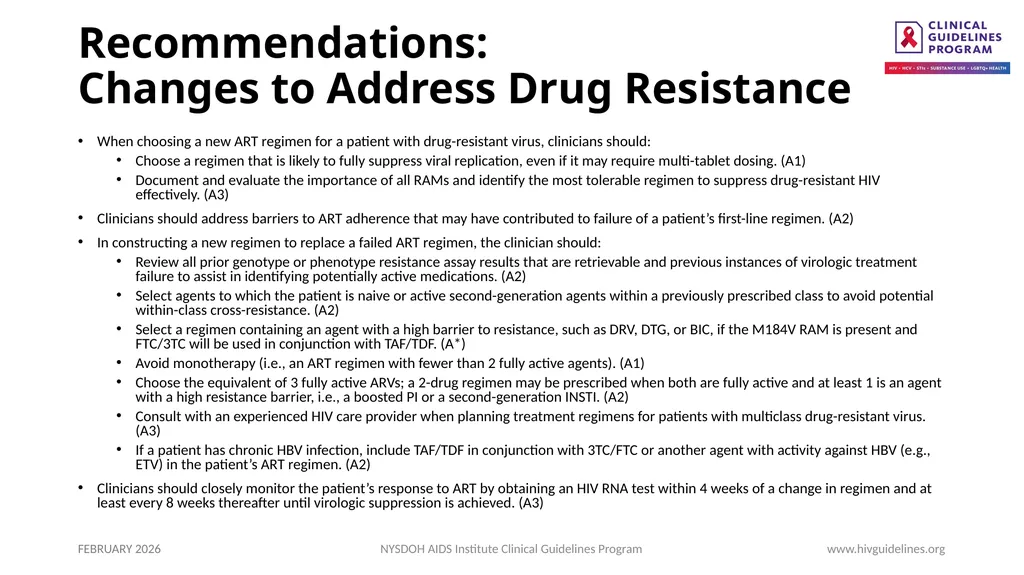
Recommendations:
Changes to Address Drug Resistance When choosing a new ART regimen for a patient with drug-resistant virus, clinicians should:
Choose a regimen that is likely to fully suppress viral replication, even if it may require multi-tablet dosing. (A1)
Document and evaluate the importance of all RAMs and identify the most tolerable regimen to suppress drug-resistant HIV effectively. (A3)
Clinicians should address barriers to ART adherence that may have contributed to failure of a patient’s first-line regimen. (A2)
In constructing a new regimen to replace a failed ART regimen, the clinician should:
Review all prior genotype or phenotype resistance assay results that are retrievable and previous instances of virologic treatment failure to assist in identifying potentially active medications. (A2)
Select agents to which the patient is naive or active second-generation agents within a previously prescribed class to avoid potential within-class cross-resistance. (A2)
Select a regimen containing an agent with a high barrier to resistance, such as DRV, DTG, or BIC, if the M184V RAM is present and FTC/3TC will be used in conjunction with TAF/TDF. (A*)
Avoid monotherapy (i.e., an ART regimen with fewer than 2 fully active agents). (A1)
Choose the equivalent of 3 fully active ARVs; a 2-drug regimen may be prescribed when both are fully active and at least 1 is an agent with a high resistance barrier, i.e., a boosted PI or a second-generation INSTI. (A2)
Consult with an experienced HIV care provider when planning treatment regimens for patients with multiclass drug-resistant virus. (A3)
If a patient has chronic HBV infection, include TAF/TDF in conjunction with 3TC/FTC or another agent with activity against HBV (e.g., ETV) in the patient’s ART regimen. (A2)
Clinicians should closely monitor the patient’s response to ART by obtaining an HIV RNA test within 4 weeks of a change in regimen and at least every 8 weeks thereafter until virologic suppression is achieved. (A3) NYSDOH AIDS Institute Clinical Guidelines Program www.hivguidelines.org FEBRUARY 2026<br>
Choose a regimen that is likely to fully suppress viral replication, even if it may require multi-tablet dosing. (A1)
Document and evaluate the importance of all RAMs and identify the most tolerable regimen to suppress drug-resistant HIV effectively. (A3)
Clinicians should address barriers to ART adherence that may have contributed to failure of a patient’s first-line regimen. (A2)
In constructing a new regimen to replace a failed ART regimen, the clinician should:
Review all prior genotype or phenotype resistance assay results that are retrievable and previous instances of virologic treatment failure to assist in identifying potentially active medications. (A2)
Select agents to which the patient is naive or active second-generation agents within a previously prescribed class to avoid potential within-class cross-resistance. (A2)
Select a regimen containing an agent with a high barrier to resistance, such as DRV, DTG, or BIC, if the M184V RAM is present and FTC/3TC will be used in conjunction with TAF/TDF. (A*)
Avoid monotherapy (i.e., an ART regimen with fewer than 2 fully active agents). (A1)
Choose the equivalent of 3 fully active ARVs; a 2-drug regimen may be prescribed when both are fully active and at least 1 is an agent with a high resistance barrier, i.e., a boosted PI or a second-generation INSTI. (A2)
Consult with an experienced HIV care provider when planning treatment regimens for patients with multiclass drug-resistant virus. (A3)
If a patient has chronic HBV infection, include TAF/TDF in conjunction with 3TC/FTC or another agent with activity against HBV (e.g., ETV) in the patient’s ART regimen. (A2)
Clinicians should closely monitor the patient’s response to ART by obtaining an HIV RNA test within 4 weeks of a change in regimen and at least every 8 weeks thereafter until virologic suppression is achieved. (A3) NYSDOH AIDS Institute Clinical Guidelines Program www.hivguidelines.org FEBRUARY 2026<br>
09
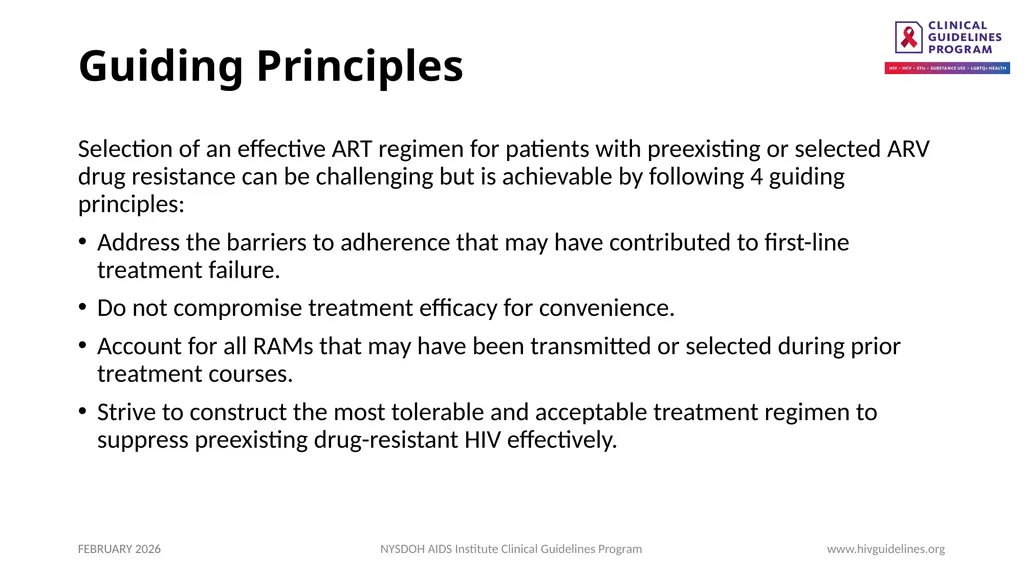
Guiding Principles Selection of an effective ART regimen for patients with preexisting or selected ARV drug resistance can be challenging but is achievable by following 4 guiding principles:
Address the barriers to adherence that may have contributed to first-line treatment failure.
Do not compromise treatment efficacy for convenience.
Account for all RAMs that may have been transmitted or selected during prior treatment courses.
Strive to construct the most tolerable and acceptable treatment regimen to suppress preexisting drug-resistant HIV effectively. NYSDOH AIDS Institute Clinical Guidelines Program www.hivguidelines.org FEBRUARY 2026<br>
Address the barriers to adherence that may have contributed to first-line treatment failure.
Do not compromise treatment efficacy for convenience.
Account for all RAMs that may have been transmitted or selected during prior treatment courses.
Strive to construct the most tolerable and acceptable treatment regimen to suppress preexisting drug-resistant HIV effectively. NYSDOH AIDS Institute Clinical Guidelines Program www.hivguidelines.org FEBRUARY 2026<br>
10
Key Point:
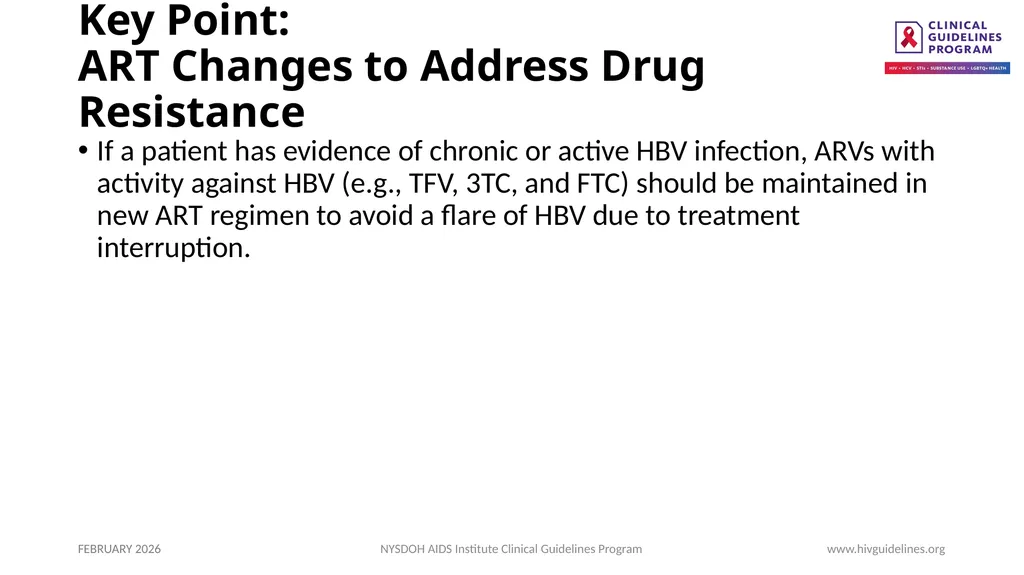
ART Changes to Address Drug Resistance If a patient has evidence of chronic or active HBV infection, ARVs with activity against HBV (e.g., TFV, 3TC, and FTC) should be maintained in new ART regimen to avoid a flare of HBV due to treatment interruption. NYSDOH AIDS Institute Clinical Guidelines Program www.hivguidelines.org FEBRUARY 2026<br>
11
Antiretroviral Medications by Level of Genetic Barrier to Resistance [a] NYSDOH AIDS Institute Clinical Guidelines Program www.hivguidelines.org FEBRUARY 2026<br>
12
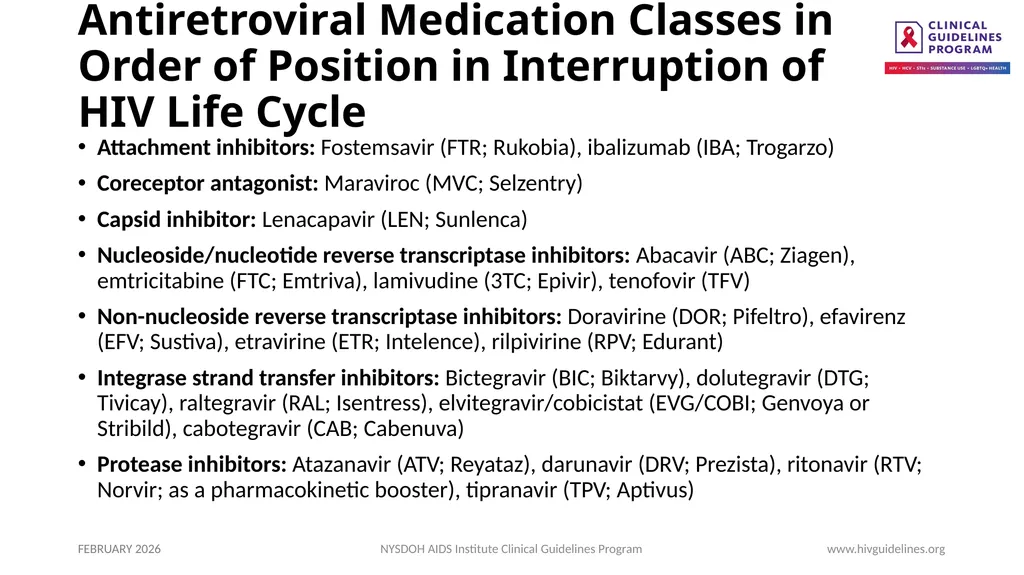
Antiretroviral Medication Classes in Order of Position in Interruption of HIV Life Cycle Attachment inhibitors: Fostemsavir (FTR; Rukobia), ibalizumab (IBA; Trogarzo)
Coreceptor antagonist: Maraviroc (MVC; Selzentry)
Capsid inhibitor: Lenacapavir (LEN; Sunlenca)
Nucleoside/nucleotide reverse transcriptase inhibitors: Abacavir (ABC; Ziagen), emtricitabine (FTC; Emtriva), lamivudine (3TC; Epivir), tenofovir (TFV)
Non-nucleoside reverse transcriptase inhibitors: Doravirine (DOR; Pifeltro), efavirenz (EFV; Sustiva), etravirine (ETR; Intelence), rilpivirine (RPV; Edurant)
Integrase strand transfer inhibitors: Bictegravir (BIC; Biktarvy), dolutegravir (DTG; Tivicay), raltegravir (RAL; Isentress), elvitegravir/cobicistat (EVG/COBI; Genvoya or Stribild), cabotegravir (CAB; Cabenuva)
Protease inhibitors: Atazanavir (ATV; Reyataz), darunavir (DRV; Prezista), ritonavir (RTV; Norvir; as a pharmacokinetic booster), tipranavir (TPV; Aptivus) NYSDOH AIDS Institute Clinical Guidelines Program www.hivguidelines.org FEBRUARY 2026<br>
Coreceptor antagonist: Maraviroc (MVC; Selzentry)
Capsid inhibitor: Lenacapavir (LEN; Sunlenca)
Nucleoside/nucleotide reverse transcriptase inhibitors: Abacavir (ABC; Ziagen), emtricitabine (FTC; Emtriva), lamivudine (3TC; Epivir), tenofovir (TFV)
Non-nucleoside reverse transcriptase inhibitors: Doravirine (DOR; Pifeltro), efavirenz (EFV; Sustiva), etravirine (ETR; Intelence), rilpivirine (RPV; Edurant)
Integrase strand transfer inhibitors: Bictegravir (BIC; Biktarvy), dolutegravir (DTG; Tivicay), raltegravir (RAL; Isentress), elvitegravir/cobicistat (EVG/COBI; Genvoya or Stribild), cabotegravir (CAB; Cabenuva)
Protease inhibitors: Atazanavir (ATV; Reyataz), darunavir (DRV; Prezista), ritonavir (RTV; Norvir; as a pharmacokinetic booster), tipranavir (TPV; Aptivus) NYSDOH AIDS Institute Clinical Guidelines Program www.hivguidelines.org FEBRUARY 2026<br>
13
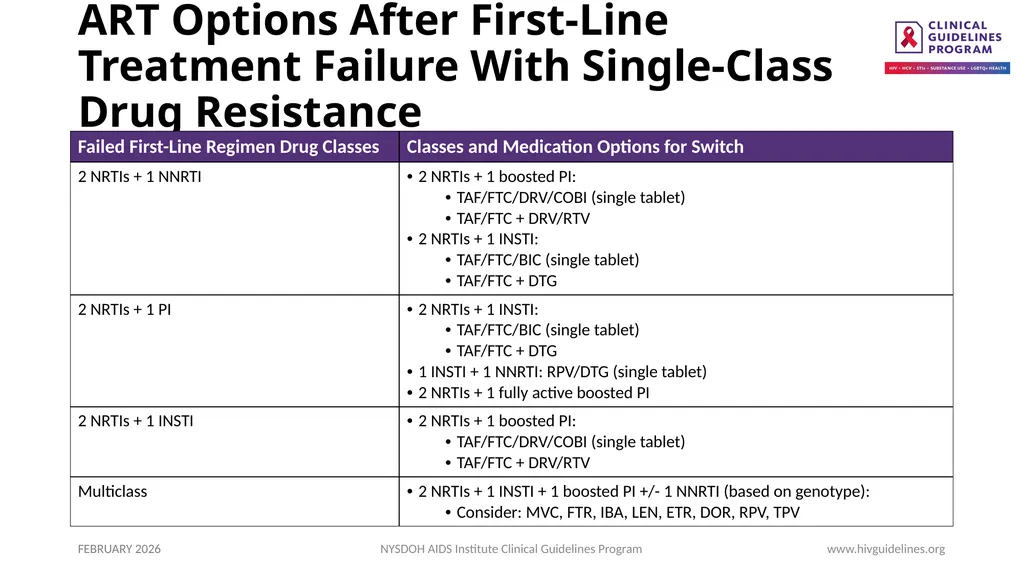
ART Options After First-Line Treatment Failure With Single-Class Drug Resistance NYSDOH AIDS Institute Clinical Guidelines Program www.hivguidelines.org FEBRUARY 2026<br>
14
Recommendations:
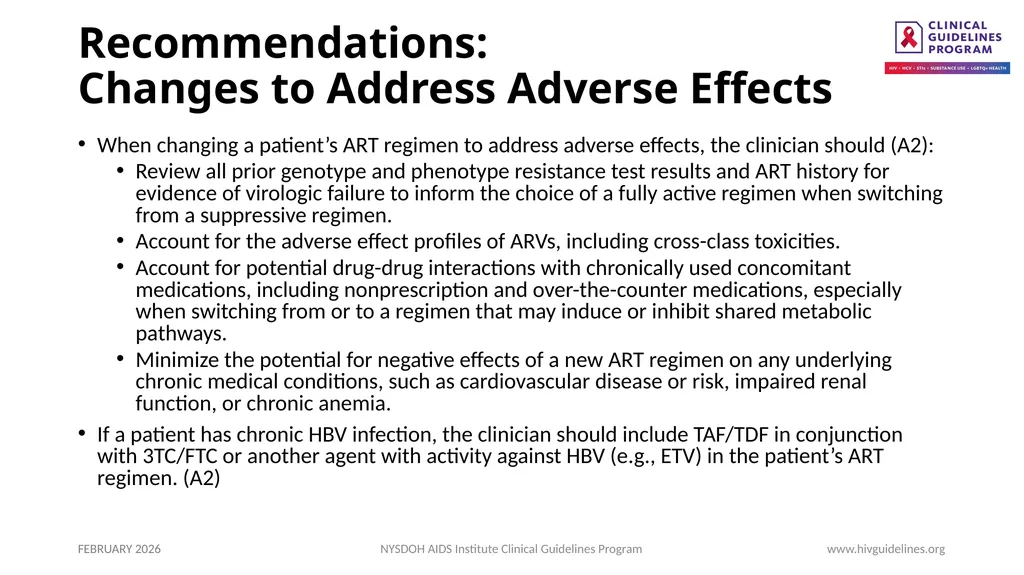
Changes to Address Adverse Effects When changing a patient’s ART regimen to address adverse effects, the clinician should (A2):
Review all prior genotype and phenotype resistance test results and ART history for evidence of virologic failure to inform the choice of a fully active regimen when switching from a suppressive regimen.
Account for the adverse effect profiles of ARVs, including cross-class toxicities.
Account for potential drug-drug interactions with chronically used concomitant medications, including nonprescription and over-the-counter medications, especially when switching from or to a regimen that may induce or inhibit shared metabolic pathways.
Minimize the potential for negative effects of a new ART regimen on any underlying chronic medical conditions, such as cardiovascular disease or risk, impaired renal function, or chronic anemia.
If a patient has chronic HBV infection, the clinician should include TAF/TDF in conjunction with 3TC/FTC or another agent with activity against HBV (e.g., ETV) in the patient’s ART regimen. (A2) NYSDOH AIDS Institute Clinical Guidelines Program www.hivguidelines.org FEBRUARY 2026<br>
Review all prior genotype and phenotype resistance test results and ART history for evidence of virologic failure to inform the choice of a fully active regimen when switching from a suppressive regimen.
Account for the adverse effect profiles of ARVs, including cross-class toxicities.
Account for potential drug-drug interactions with chronically used concomitant medications, including nonprescription and over-the-counter medications, especially when switching from or to a regimen that may induce or inhibit shared metabolic pathways.
Minimize the potential for negative effects of a new ART regimen on any underlying chronic medical conditions, such as cardiovascular disease or risk, impaired renal function, or chronic anemia.
If a patient has chronic HBV infection, the clinician should include TAF/TDF in conjunction with 3TC/FTC or another agent with activity against HBV (e.g., ETV) in the patient’s ART regimen. (A2) NYSDOH AIDS Institute Clinical Guidelines Program www.hivguidelines.org FEBRUARY 2026<br>
15
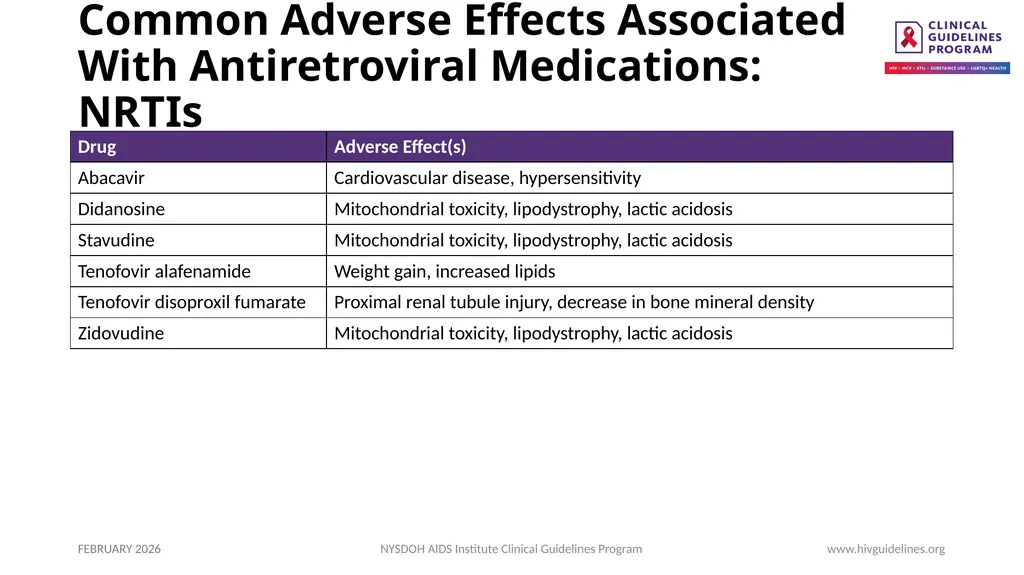
Common Adverse Effects Associated With Antiretroviral Medications: NRTIs NYSDOH AIDS Institute Clinical Guidelines Program www.hivguidelines.org FEBRUARY 2026<br>
16
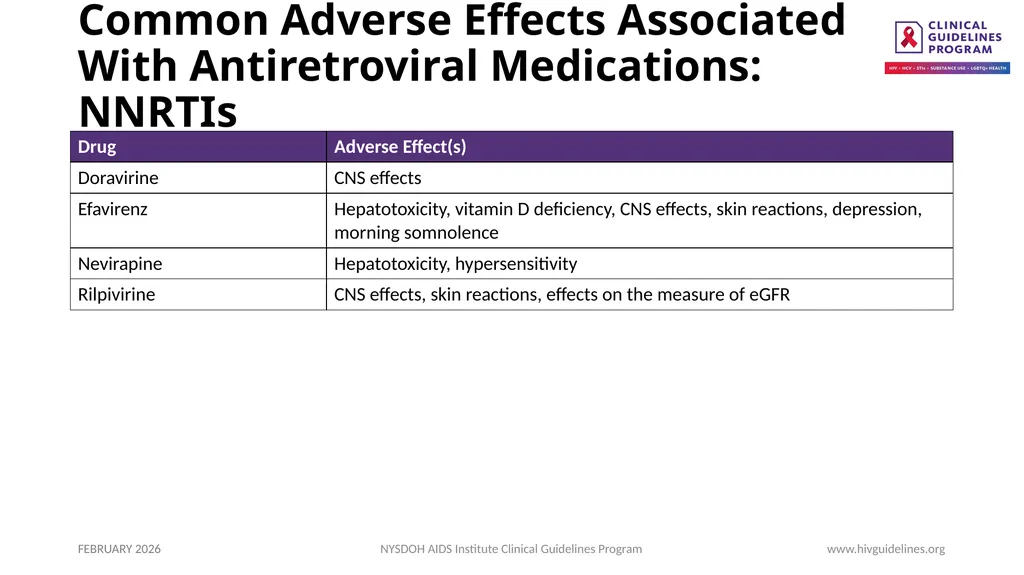
Common Adverse Effects Associated With Antiretroviral Medications: NNRTIs NYSDOH AIDS Institute Clinical Guidelines Program www.hivguidelines.org FEBRUARY 2026<br>
17
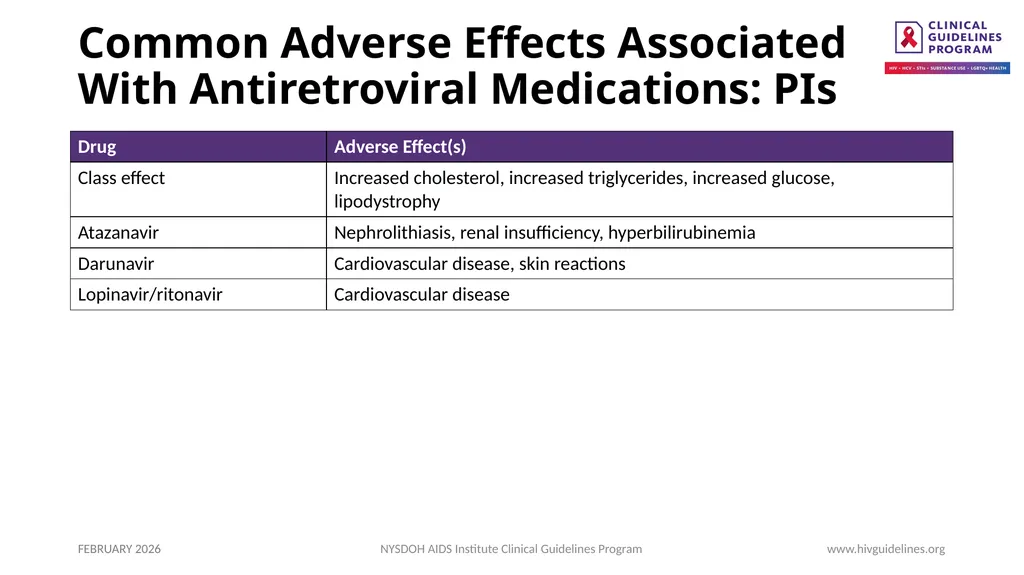
Common Adverse Effects Associated With Antiretroviral Medications: PIs NYSDOH AIDS Institute Clinical Guidelines Program www.hivguidelines.org FEBRUARY 2026<br>
18
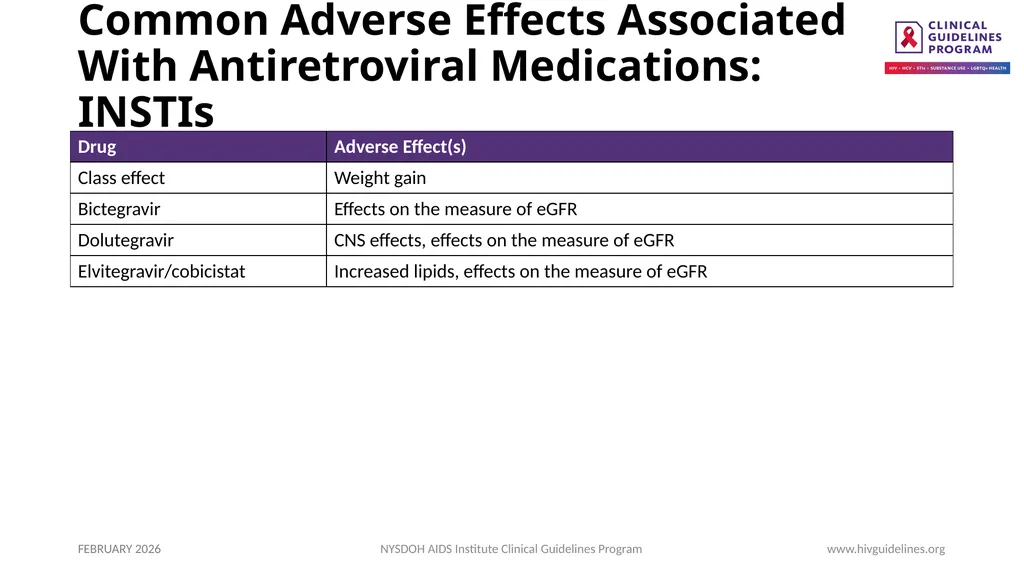
Common Adverse Effects Associated With Antiretroviral Medications: INSTIs NYSDOH AIDS Institute Clinical Guidelines Program www.hivguidelines.org FEBRUARY 2026<br>
19
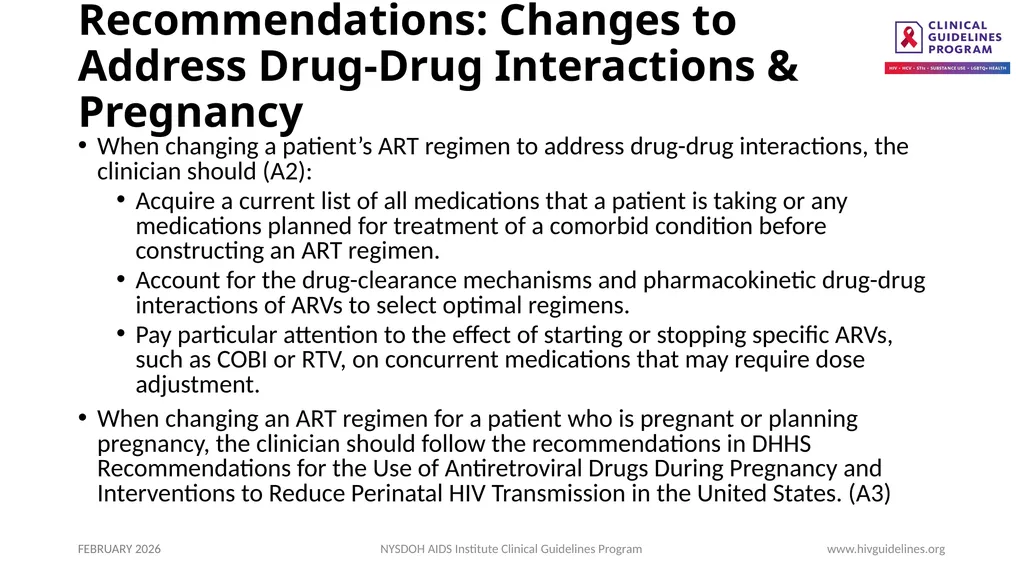
Recommendations: Changes to Address Drug-Drug Interactions & Pregnancy When changing a patient’s ART regimen to address drug-drug interactions, the clinician should (A2):
Acquire a current list of all medications that a patient is taking or any medications planned for treatment of a comorbid condition before constructing an ART regimen.
Account for the drug-clearance mechanisms and pharmacokinetic drug-drug interactions of ARVs to select optimal regimens.
Pay particular attention to the effect of starting or stopping specific ARVs, such as COBI or RTV, on concurrent medications that may require dose adjustment.
When changing an ART regimen for a patient who is pregnant or planning pregnancy, the clinician should follow the recommendations in DHHS Recommendations for the Use of Antiretroviral Drugs During Pregnancy and Interventions to Reduce Perinatal HIV Transmission in the United States. (A3) NYSDOH AIDS Institute Clinical Guidelines Program www.hivguidelines.org FEBRUARY 2026<br>
Acquire a current list of all medications that a patient is taking or any medications planned for treatment of a comorbid condition before constructing an ART regimen.
Account for the drug-clearance mechanisms and pharmacokinetic drug-drug interactions of ARVs to select optimal regimens.
Pay particular attention to the effect of starting or stopping specific ARVs, such as COBI or RTV, on concurrent medications that may require dose adjustment.
When changing an ART regimen for a patient who is pregnant or planning pregnancy, the clinician should follow the recommendations in DHHS Recommendations for the Use of Antiretroviral Drugs During Pregnancy and Interventions to Reduce Perinatal HIV Transmission in the United States. (A3) NYSDOH AIDS Institute Clinical Guidelines Program www.hivguidelines.org FEBRUARY 2026<br>
20
Key Point:
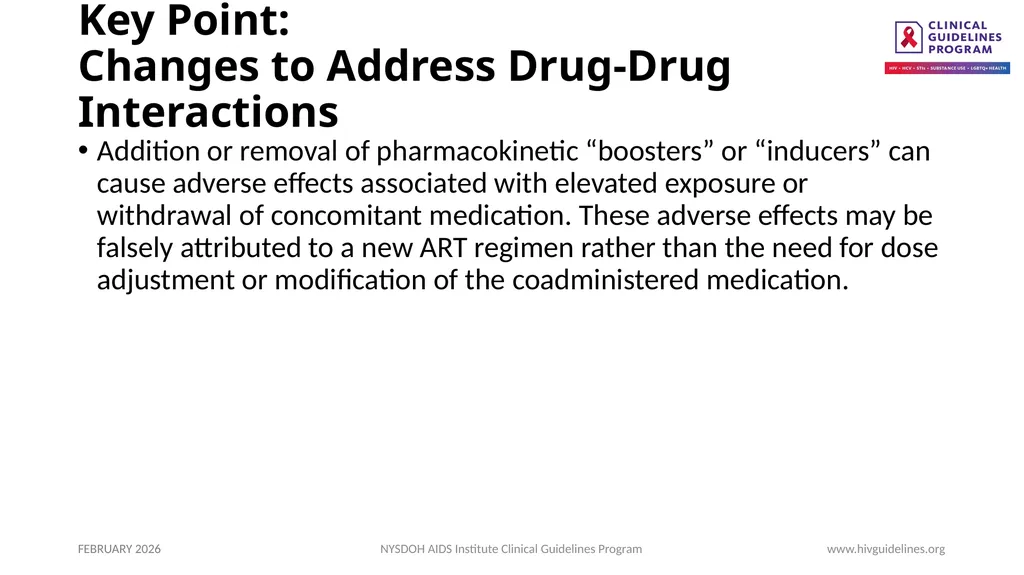
Changes to Address Drug-Drug Interactions Addition or removal of pharmacokinetic “boosters” or “inducers” can cause adverse effects associated with elevated exposure or withdrawal of concomitant medication. These adverse effects may be falsely attributed to a new ART regimen rather than the need for dose adjustment or modification of the coadministered medication. NYSDOH AIDS Institute Clinical Guidelines Program www.hivguidelines.org FEBRUARY 2026<br>
21
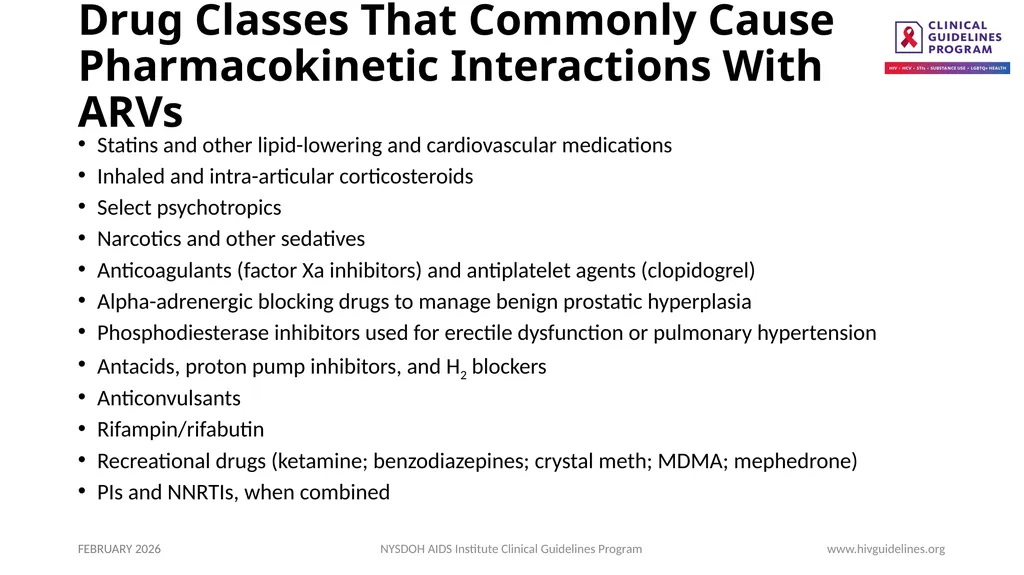
Drug Classes That Commonly Cause Pharmacokinetic Interactions With ARVs Statins and other lipid-lowering and cardiovascular medications
Inhaled and intra-articular corticosteroids
Select psychotropics
Narcotics and other sedatives
Anticoagulants (factor Xa inhibitors) and antiplatelet agents (clopidogrel)
Alpha-adrenergic blocking drugs to manage benign prostatic hyperplasia
Phosphodiesterase inhibitors used for erectile dysfunction or pulmonary hypertension
Antacids, proton pump inhibitors, and H2 blockers
Anticonvulsants
Rifampin/rifabutin
Recreational drugs (ketamine; benzodiazepines; crystal meth; MDMA; mephedrone)
PIs and NNRTIs, when combined NYSDOH AIDS Institute Clinical Guidelines Program www.hivguidelines.org FEBRUARY 2026<br>
Inhaled and intra-articular corticosteroids
Select psychotropics
Narcotics and other sedatives
Anticoagulants (factor Xa inhibitors) and antiplatelet agents (clopidogrel)
Alpha-adrenergic blocking drugs to manage benign prostatic hyperplasia
Phosphodiesterase inhibitors used for erectile dysfunction or pulmonary hypertension
Antacids, proton pump inhibitors, and H2 blockers
Anticonvulsants
Rifampin/rifabutin
Recreational drugs (ketamine; benzodiazepines; crystal meth; MDMA; mephedrone)
PIs and NNRTIs, when combined NYSDOH AIDS Institute Clinical Guidelines Program www.hivguidelines.org FEBRUARY 2026<br>
22
Recommendations:
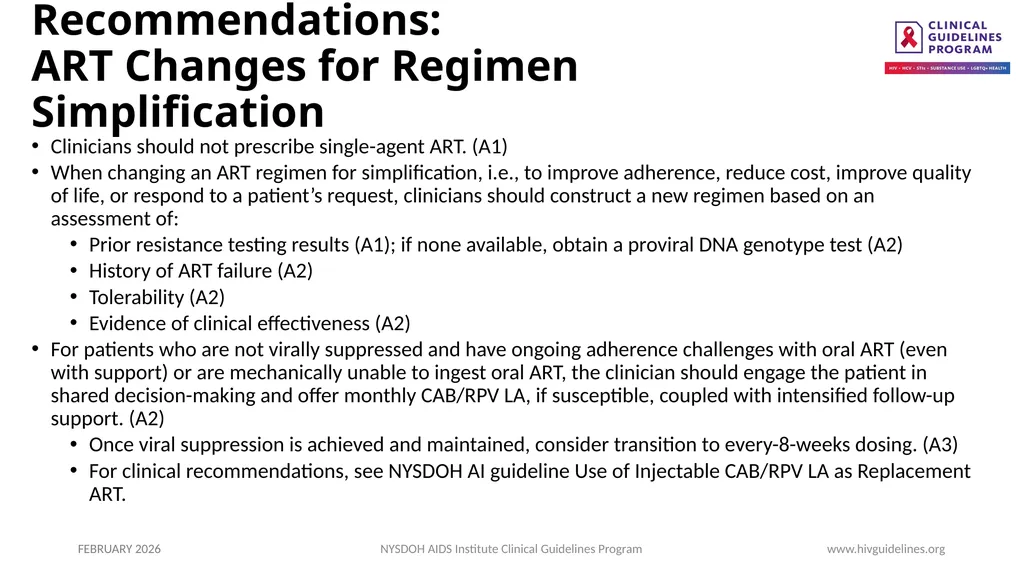
ART Changes for Regimen Simplification Clinicians should not prescribe single-agent ART. (A1)
When changing an ART regimen for simplification, i.e., to improve adherence, reduce cost, improve quality of life, or respond to a patient’s request, clinicians should construct a new regimen based on an assessment of:
Prior resistance testing results (A1); if none available, obtain a proviral DNA genotype test (A2)
History of ART failure (A2)
Tolerability (A2)
Evidence of clinical effectiveness (A2)
For patients who are not virally suppressed and have ongoing adherence challenges with oral ART (even with support) or are mechanically unable to ingest oral ART, the clinician should engage the patient in shared decision-making and offer monthly CAB/RPV LA, if susceptible, coupled with intensified follow-up support. (A2)
Once viral suppression is achieved and maintained, consider transition to every-8-weeks dosing. (A3)
For clinical recommendations, see NYSDOH AI guideline Use of Injectable CAB/RPV LA as Replacement ART. NYSDOH AIDS Institute Clinical Guidelines Program www.hivguidelines.org FEBRUARY 2026<br>
When changing an ART regimen for simplification, i.e., to improve adherence, reduce cost, improve quality of life, or respond to a patient’s request, clinicians should construct a new regimen based on an assessment of:
Prior resistance testing results (A1); if none available, obtain a proviral DNA genotype test (A2)
History of ART failure (A2)
Tolerability (A2)
Evidence of clinical effectiveness (A2)
For patients who are not virally suppressed and have ongoing adherence challenges with oral ART (even with support) or are mechanically unable to ingest oral ART, the clinician should engage the patient in shared decision-making and offer monthly CAB/RPV LA, if susceptible, coupled with intensified follow-up support. (A2)
Once viral suppression is achieved and maintained, consider transition to every-8-weeks dosing. (A3)
For clinical recommendations, see NYSDOH AI guideline Use of Injectable CAB/RPV LA as Replacement ART. NYSDOH AIDS Institute Clinical Guidelines Program www.hivguidelines.org FEBRUARY 2026<br>
23
Recommendations:
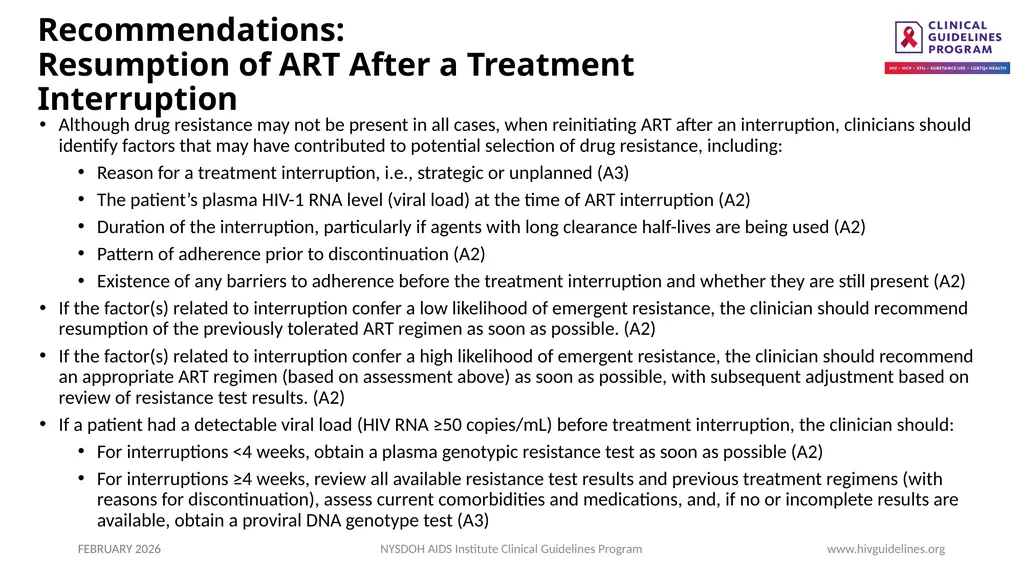
Resumption of ART After a Treatment Interruption Although drug resistance may not be present in all cases, when reinitiating ART after an interruption, clinicians should identify factors that may have contributed to potential selection of drug resistance, including:
Reason for a treatment interruption, i.e., strategic or unplanned (A3)
The patient’s plasma HIV-1 RNA level (viral load) at the time of ART interruption (A2)
Duration of the interruption, particularly if agents with long clearance half-lives are being used (A2)
Pattern of adherence prior to discontinuation (A2)
Existence of any barriers to adherence before the treatment interruption and whether they are still present (A2)
If the factor(s) related to interruption confer a low likelihood of emergent resistance, the clinician should recommend resumption of the previously tolerated ART regimen as soon as possible. (A2)
If the factor(s) related to interruption confer a high likelihood of emergent resistance, the clinician should recommend an appropriate ART regimen (based on assessment above) as soon as possible, with subsequent adjustment based on review of resistance test results. (A2)
If a patient had a detectable viral load (HIV RNA ≥50 copies/mL) before treatment interruption, the clinician should:
For interruptions <4 weeks, obtain a plasma genotypic resistance test as soon as possible (A2)
For interruptions ≥4 weeks, review all available resistance test results and previous treatment regimens (with reasons for discontinuation), assess current comorbidities and medications, and, if no or incomplete results are available, obtain a proviral DNA genotype test (A3) NYSDOH AIDS Institute Clinical Guidelines Program www.hivguidelines.org FEBRUARY 2026<br>
Reason for a treatment interruption, i.e., strategic or unplanned (A3)
The patient’s plasma HIV-1 RNA level (viral load) at the time of ART interruption (A2)
Duration of the interruption, particularly if agents with long clearance half-lives are being used (A2)
Pattern of adherence prior to discontinuation (A2)
Existence of any barriers to adherence before the treatment interruption and whether they are still present (A2)
If the factor(s) related to interruption confer a low likelihood of emergent resistance, the clinician should recommend resumption of the previously tolerated ART regimen as soon as possible. (A2)
If the factor(s) related to interruption confer a high likelihood of emergent resistance, the clinician should recommend an appropriate ART regimen (based on assessment above) as soon as possible, with subsequent adjustment based on review of resistance test results. (A2)
If a patient had a detectable viral load (HIV RNA ≥50 copies/mL) before treatment interruption, the clinician should:
For interruptions <4 weeks, obtain a plasma genotypic resistance test as soon as possible (A2)
For interruptions ≥4 weeks, review all available resistance test results and previous treatment regimens (with reasons for discontinuation), assess current comorbidities and medications, and, if no or incomplete results are available, obtain a proviral DNA genotype test (A3) NYSDOH AIDS Institute Clinical Guidelines Program www.hivguidelines.org FEBRUARY 2026<br>
24
NYSDOH AIDS Institute Clinical Guidelines Program www.hivguidelines.org Need Help?<br>
25
NYSDOH AIDS Institute Clinical Guidelines Program www.hivguidelines.org Access the Guideline www.hivguidelines.org > Second-Line ART After Treatment Failure or for Regimen Simplification
Also available: Printable pocket guide and PDF Podcast: Viremic—Cases in HIV
Find all episodes at viremic.org<br>
Also available: Printable pocket guide and PDF Podcast: Viremic—Cases in HIV
Find all episodes at viremic.org<br>