
Section 1: Cost Management Overview What are costs

Description: Section 1: Cost Management Overview What are costs and why is managing costs important? Armys overall objectives Change enablers to support Cost Management The process of Cost Management and how it differs from Budget Management Section 2:
Related Topics
Download Presentation
"Section 1: Cost Management Overview What are costs" is the property of its rightful owner. Permission is granted to download and print the materials on this website for personal, non-commercial use only, and to display it on your personal computer provided you do not modify the materials and that you retain all copyright notices contained in the materials. By downloading content from our website, you accept the terms of this agreement.
Presentation Transcript
slide1. Section 1: Cost Management Overview
What are costs and why is managing costs important?
Army’s overall objectives
Change enablers to support Cost Management
The process of Cost Management and how it differs from Budget Management
Section 2: Cost Model Components
Defining the various cost objects (which replace APCs/JONOs) within a Cost Model, e.g. organizations, products, services, jobs, etc.
Understanding decision points of where to capture information
Section 3: Cost Flow Methods
The difference between cost capturing, allocations, and assignment
Section 4: Cost Model Build
Reflecting organizational structures
Replacing APC/JONO’s CM 101 Training 1<br>
slide2. Section 2 Objective & Agenda Section 2: Cost Model Components
Understanding of the master data available to define the cost model Lesson 1: Cost Elements
Lesson 2: Cost Terms
Lesson 3: Cost Centers
Lesson 4: Activity Types
Lesson 5: Payroll & Labor Tracking
Lesson 6: WBS Elements
Lesson 7: Orders
Lesson 8: Business Processes
Lesson 9: Statistical Key Figures 2<br>
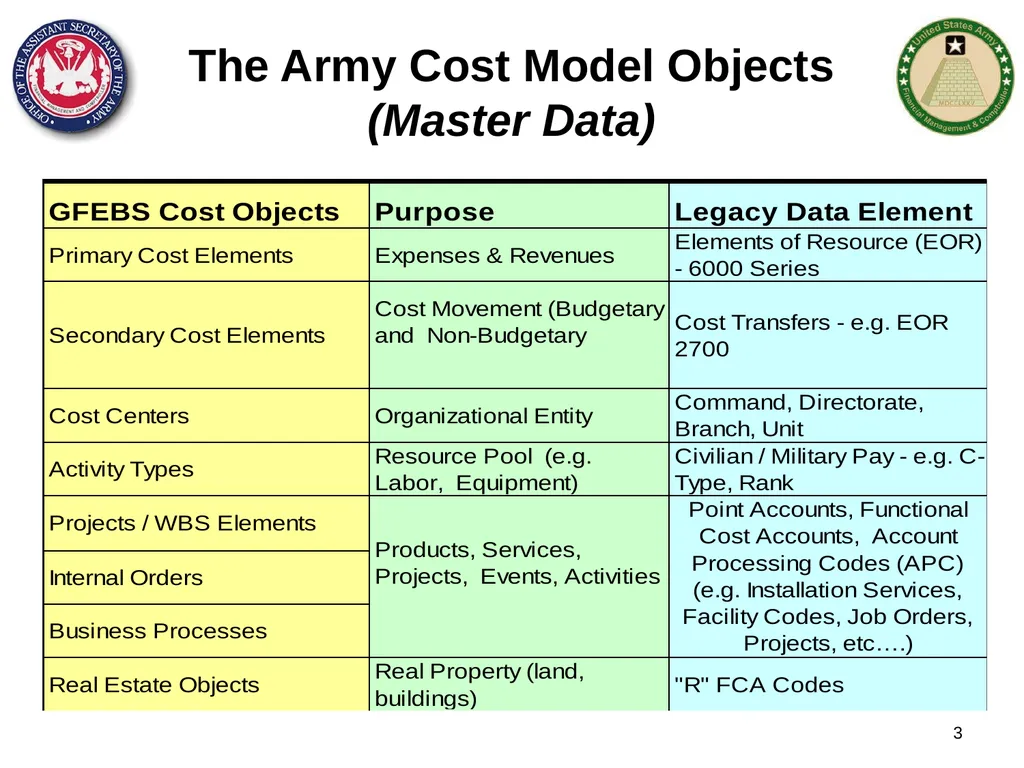
slide3. The Army Cost Model Objects (Master Data)<br>
slide4. Lesson 1: Cost Elements Objective(s):
To understand what the Cost Element cost object represents, key definition criteria (guiding principles), uses, and how defined for the Cost Model<br>
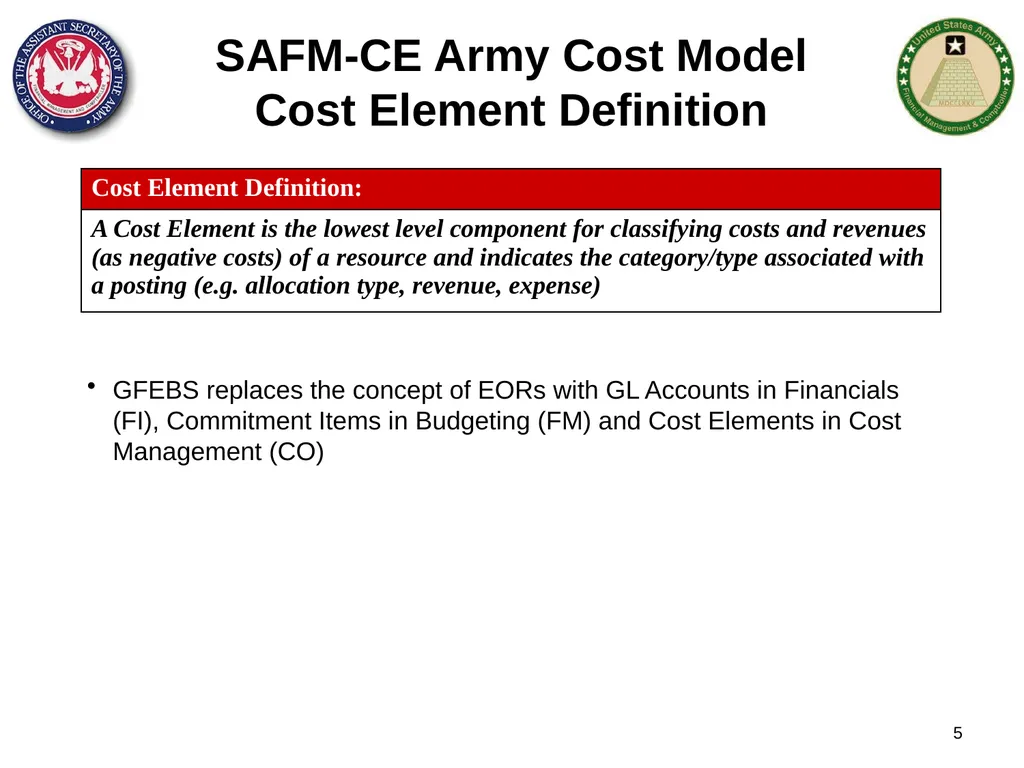
slide5. SAFM-CE Army Cost Model
Cost Element Definition GFEBS replaces the concept of EORs with GL Accounts in Financials (FI), Commitment Items in Budgeting (FM) and Cost Elements in Cost Management (CO)<br>
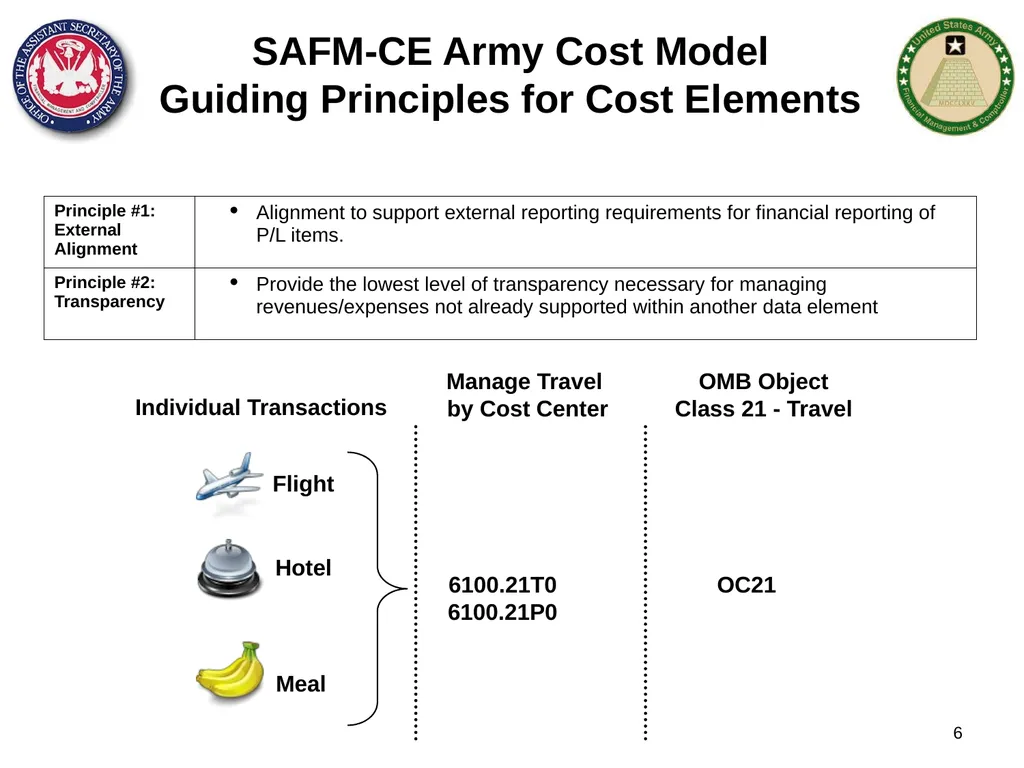
slide6. SAFM-CE Army Cost Model
Guiding Principles for Cost Elements Flight Hotel Meal Individual Transactions<br>
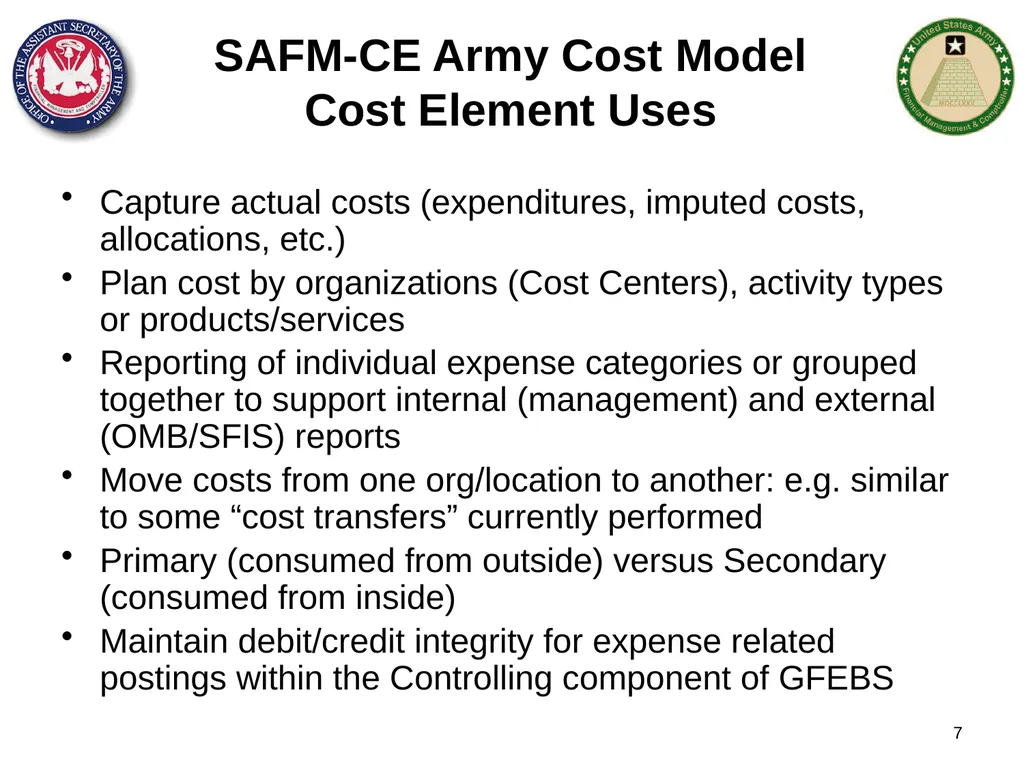
slide7. SAFM-CE Army Cost Model
Cost Element Uses Capture actual costs (expenditures, imputed costs, allocations, etc.)
Plan cost by organizations (Cost Centers), activity types or products/services
Reporting of individual expense categories or grouped together to support internal (management) and external (OMB/SFIS) reports
Move costs from one org/location to another: e.g. similar to some “cost transfers” currently performed
Primary (consumed from outside) versus Secondary (consumed from inside)
Maintain debit/credit integrity for expense related postings within the Controlling component of GFEBS<br>
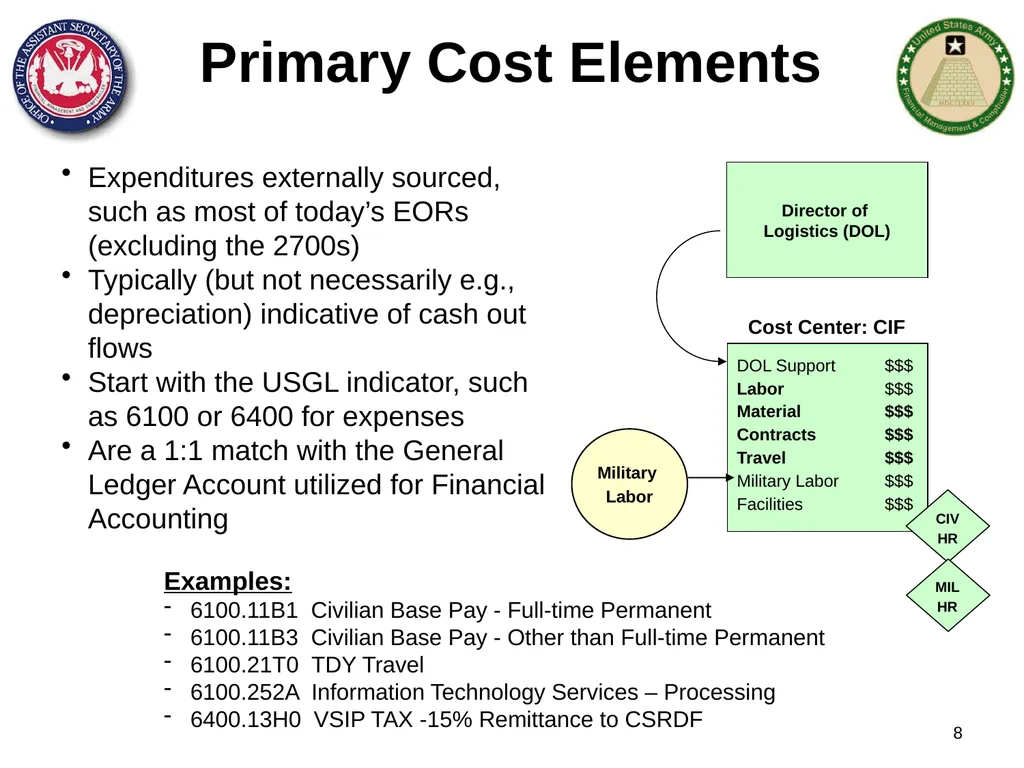
slide8. Expenditures externally sourced, such as most of today’s EORs (excluding the 2700s)
Typically (but not necessarily e.g., depreciation) indicative of cash out flows
Start with the USGL indicator, such as 6100 or 6400 for expenses
Are a 1:1 match with the General Ledger Account utilized for Financial Accounting Primary Cost Elements Examples:
6100.11B1 Civilian Base Pay - Full-time Permanent
6100.11B3 Civilian Base Pay - Other than Full-time Permanent
6100.21T0 TDY Travel
6100.252A Information Technology Services – Processing
6400.13H0 VSIP TAX -15% Remittance to CSRDF<br>
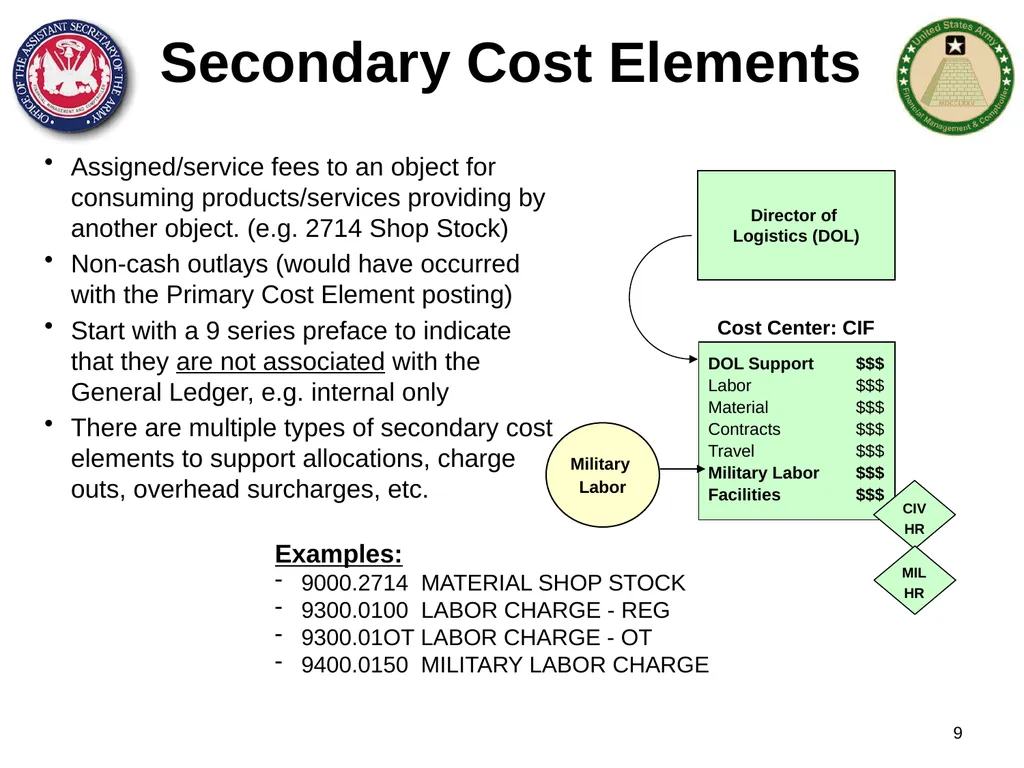
slide9. Assigned/service fees to an object for consuming products/services providing by another object. (e.g. 2714 Shop Stock)
Non-cash outlays (would have occurred with the Primary Cost Element posting)
Start with a 9 series preface to indicate that they are not associated with the General Ledger, e.g. internal only
There are multiple types of secondary cost elements to support allocations, charge outs, overhead surcharges, etc. Secondary Cost Elements Examples:
9000.2714 MATERIAL SHOP STOCK
9300.0100 LABOR CHARGE - REG
9300.01OT LABOR CHARGE - OT
9400.0150 MILITARY LABOR CHARGE<br>
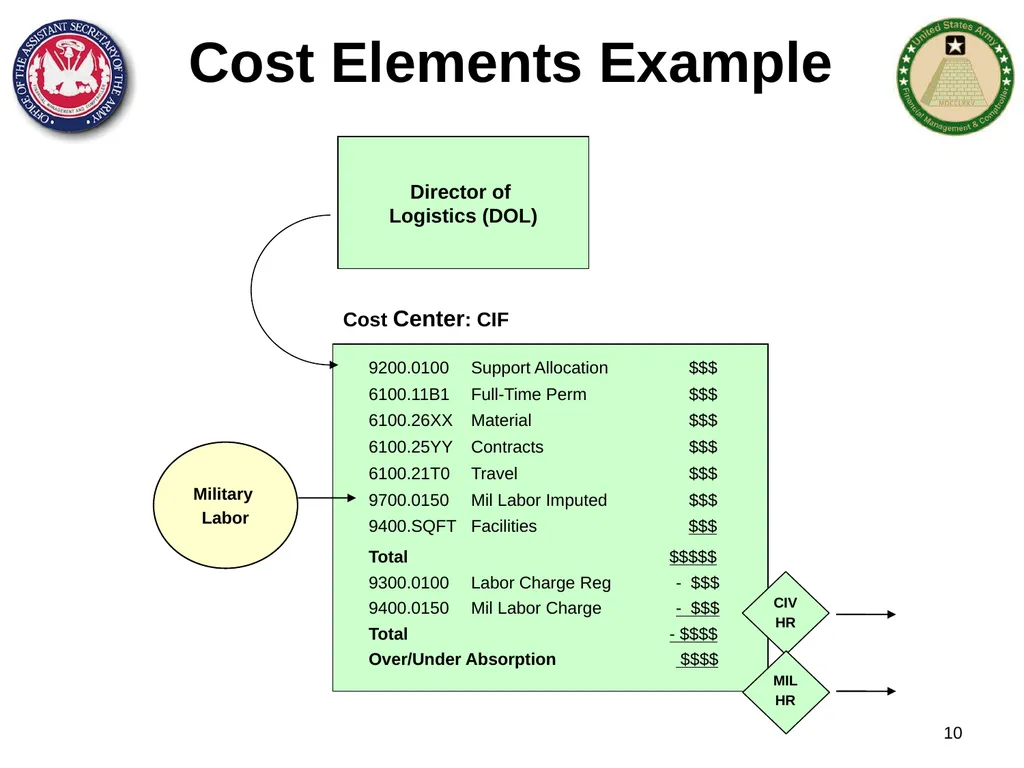
slide10. Cost Elements Example Cost Center: CIF Military
Labor Director of
Logistics (DOL) Total $$$$$ Total - $$$$ Over/Under Absorption $$$$<br>
slide11. SAFM-CE Army Cost Model
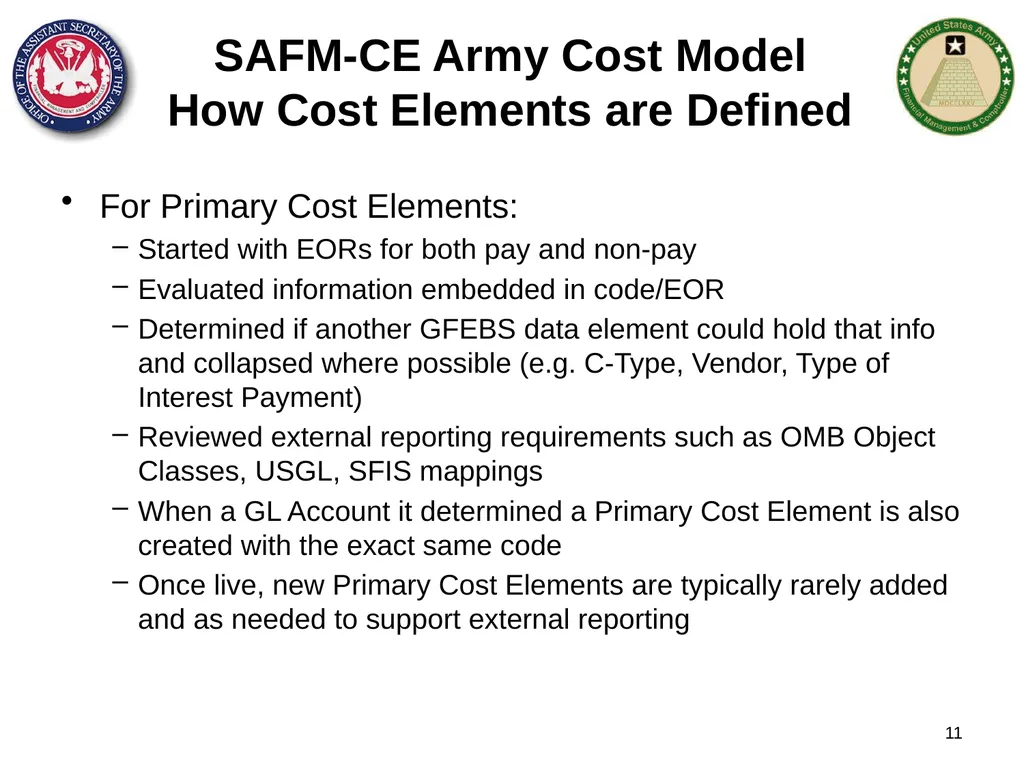
How Cost Elements are Defined For Primary Cost Elements:
Started with EORs for both pay and non-pay
Evaluated information embedded in code/EOR
Determined if another GFEBS data element could hold that info and collapsed where possible (e.g. C-Type, Vendor, Type of Interest Payment)
Reviewed external reporting requirements such as OMB Object Classes, USGL, SFIS mappings
When a GL Account it determined a Primary Cost Element is also created with the exact same code
Once live, new Primary Cost Elements are typically rarely added and as needed to support external reporting<br>
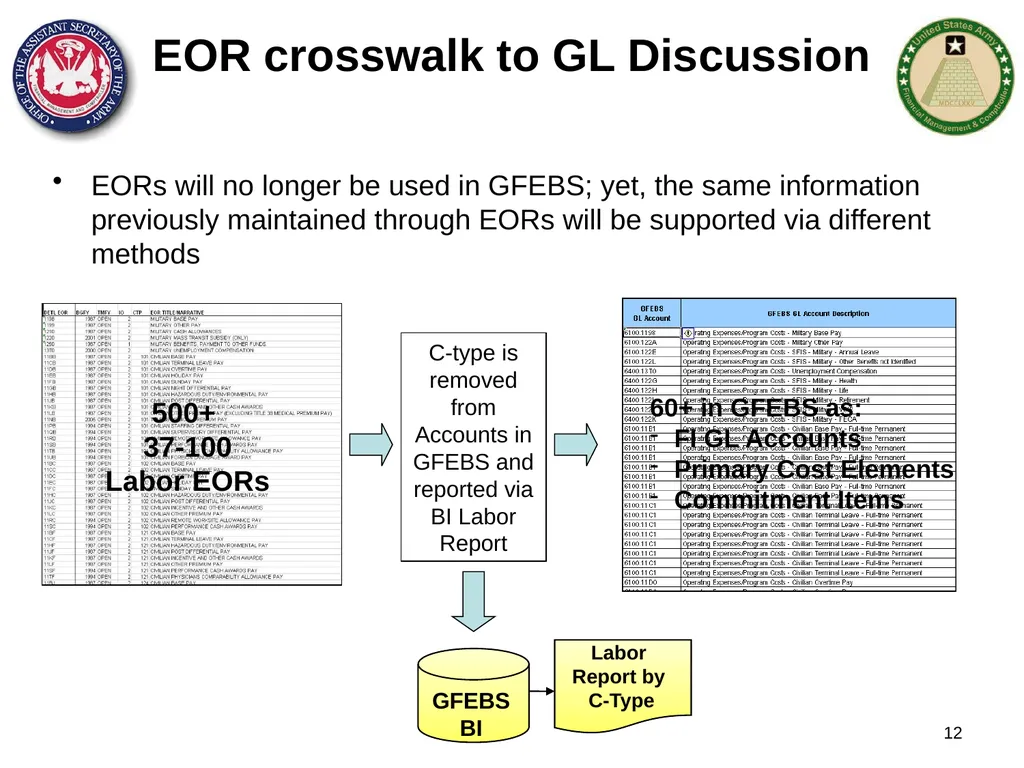
slide12. EOR crosswalk to GL Discussion EORs will no longer be used in GFEBS; yet, the same information previously maintained through EORs will be supported via different methods 60+ in GFEBS as:
FI GL Accounts
Primary Cost Elements
Commitment Items C-type is removed from Accounts in GFEBS and reported via BI Labor Report GFEBS BI Labor
Report by
C-Type<br>
slide13. SAFM-CE Army Cost Model
How Cost Elements are Defined For Secondary Cost Elements:
Determined types of cost allocations/ assignments to be supported (assumed all possible in GFEBS)
Determine internal management reporting detail needs, continues to expand with maturity
Identified impacts for budget/non-budget relevant in funds management
Secondary Cost Elements are constantly being added as assignments/allocations are updated/changed in order to provide transparency for management reporting<br>
slide14. Cost Element Groups Cost Elements can be grouped together to support
Reporting: e.g. all labor related primary cost elements into a group called Payroll Labor
Reconciliation: e.g. the primary cost element used to procure shop stock with the secondary cost element used to allocate shop stock to manage the under/over absorption
Allocations: e.g. allocating a combination of cost elements to multiple receivers
Hierarchies: e.g. by creating cost element groups within cost element groups a hierarchy is generated which can be utilized to meet OMB Object Class and SFIS reporting requirements<br>
slide15. Lesson 1: Wrap-Up A Cost Element is the lowest level component for classifying costs and revenues (as negative costs) and indicates the category/type associated with a posting (e.g. allocation type, revenue, expense)
There are two types of Cost Elements: Primary and Secondary
Primary Cost Elements represent those obtained from the external market, the initial posting
Secondary Cost Elements represent costs incurred from within the Army
EORs and the EOR information will be supported via GFEBS through GL Accounts, Commitment Items, and Primary Cost Elements
Cost Elements can be grouped together to support internal and external reporting including to generate hierarchies such as OMB Object Class<br>
slide16. Lesson 2: Cost Terms Objective(s):
Understand the key terms involved with Cost Management<br>
slide17. Cost Terms There is a language to Cost Management, however there are many dialects!
There is an inconsistency of cost terms in the market driven by outgrowth from manufacturing to the introduction of service costing
Cost terms additionally differ based on costing philosophy (e.g. standard costing, activity-based costing, theory of constraints, etc.)
Army has determined the Cost Terms to be propagated to provide a level set language for understanding Cost information<br>
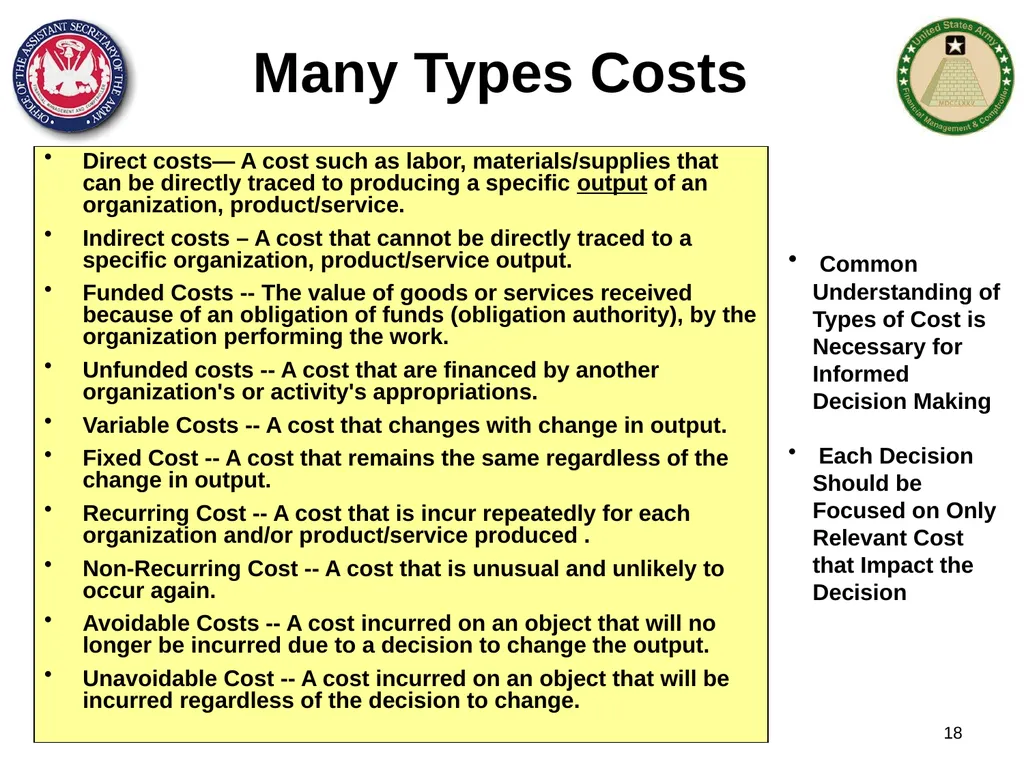
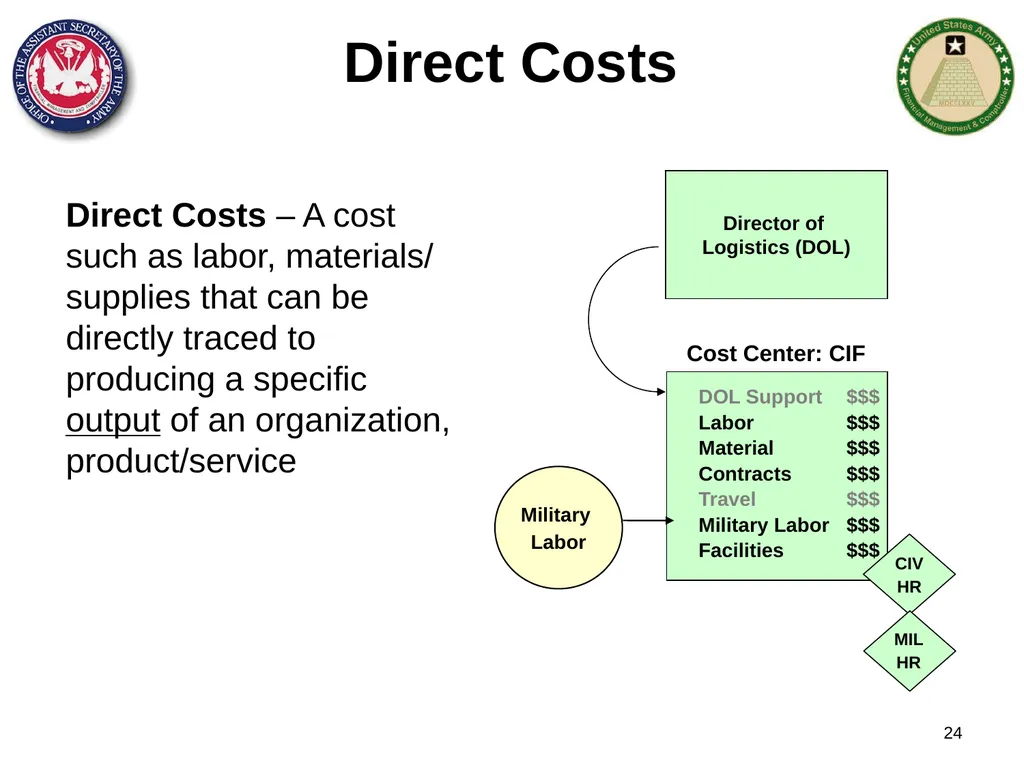
slide18. Many Types Costs Direct costs— A cost such as labor, materials/supplies that can be directly traced to producing a specific output of an organization, product/service.
Indirect costs – A cost that cannot be directly traced to a specific organization, product/service output.
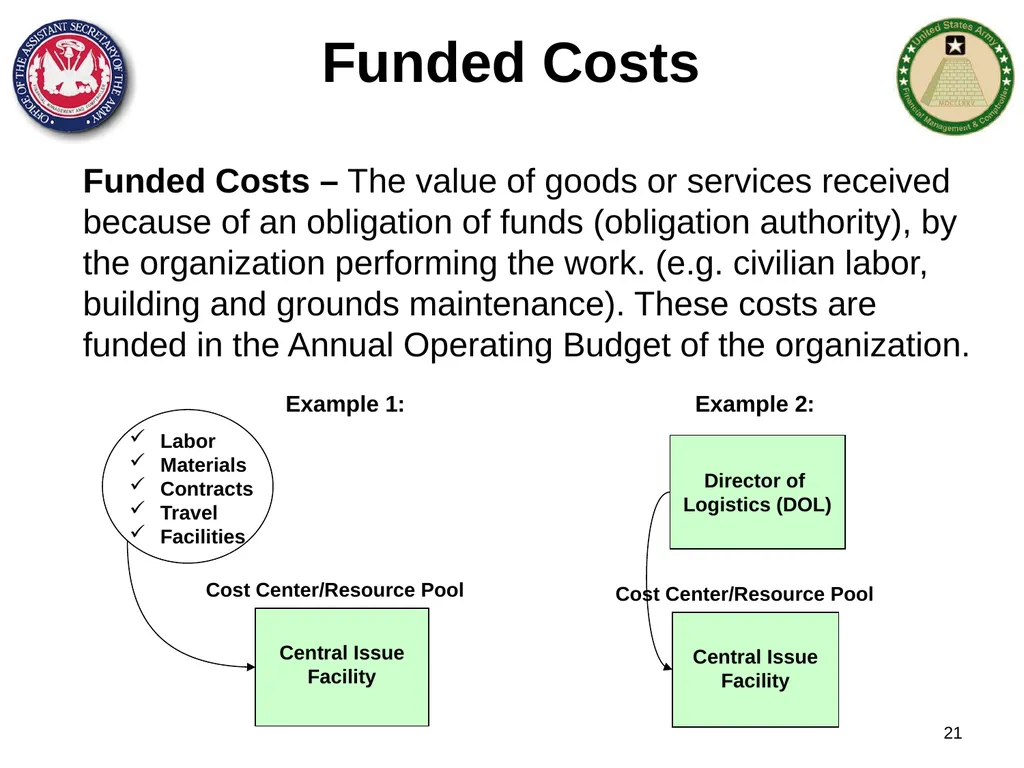
Funded Costs -- The value of goods or services received because of an obligation of funds (obligation authority), by the organization performing the work.
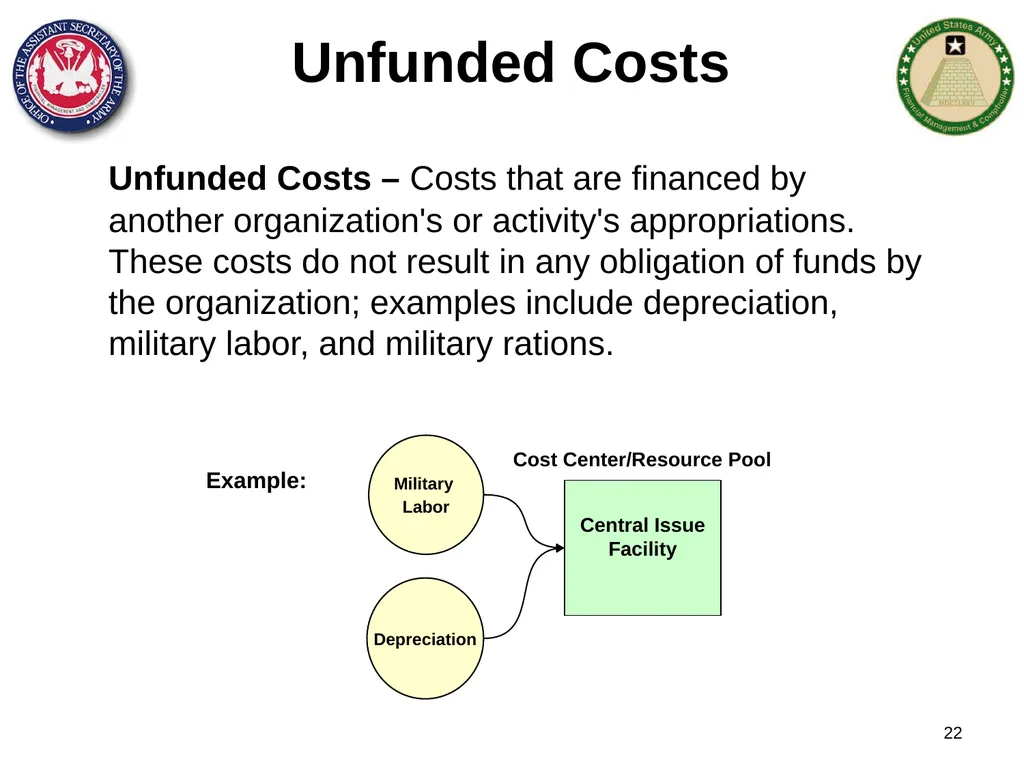
Unfunded costs -- A cost that are financed by another organization's or activity's appropriations.
Variable Costs -- A cost that changes with change in output.
Fixed Cost -- A cost that remains the same regardless of the change in output.
Recurring Cost -- A cost that is incur repeatedly for each organization and/or product/service produced .
Non-Recurring Cost -- A cost that is unusual and unlikely to occur again.
Avoidable Costs -- A cost incurred on an object that will no longer be incurred due to a decision to change the output.
Unavoidable Cost -- A cost incurred on an object that will be incurred regardless of the decision to change. Common Understanding of Types of Cost is Necessary for Informed Decision Making
Each Decision Should be Focused on Only Relevant Cost that Impact the Decision<br>
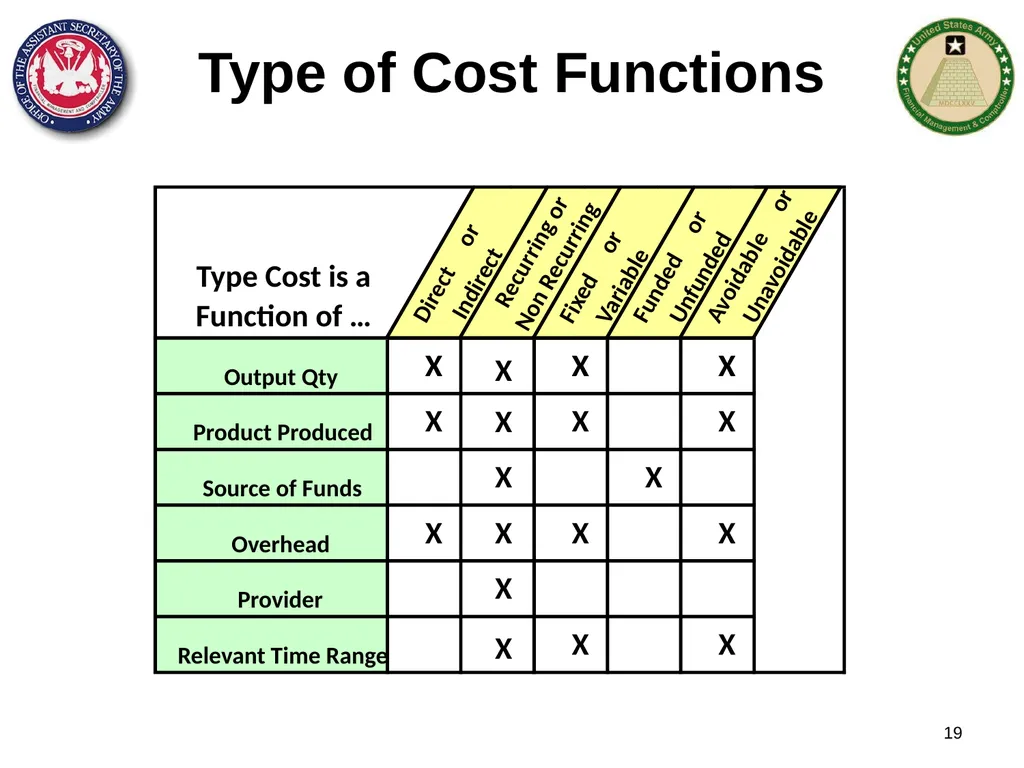
slide19. Type of Cost Functions X X X<br>
slide20. Funded vs Unfunded The terms Funded and Unfunded define the relationship of the appropriation dollars consumed to the organization utilizing those funds.
Classification of the dollars input (utilized) in relationship to the organization responsible for the output<br>
slide21. Funded Costs – The value of goods or services received because of an obligation of funds (obligation authority), by the organization performing the work. (e.g. civilian labor, building and grounds maintenance). These costs are funded in the Annual Operating Budget of the organization. Funded Costs<br>
slide22. Unfunded Costs – Costs that are financed by another organization's or activity's appropriations. These costs do not result in any obligation of funds by the organization; examples include depreciation, military labor, and military rations. Unfunded Costs Example:<br>
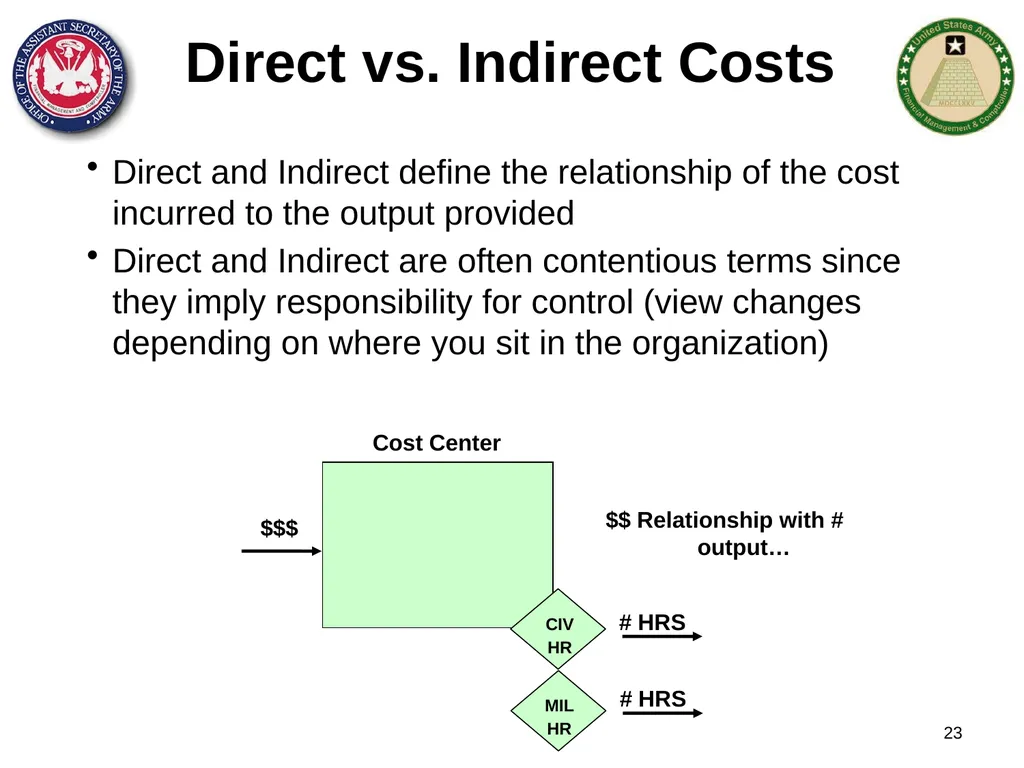
slide23. Direct vs. Indirect Costs Direct and Indirect define the relationship of the cost incurred to the output provided
Direct and Indirect are often contentious terms since they imply responsibility for control (view changes depending on where you sit in the organization) Cost Center $$$ $$ Relationship with # output… # HRS # HRS<br>
slide24. Direct Costs – A cost such as labor, materials/ supplies that can be directly traced to producing a specific output of an organization, product/service Direct Costs Cost Center: CIF Military
Labor Director of
Logistics (DOL) Material $$$ Labor $$$ DOL Support $$$ Contracts $$$ Travel $$$ Military Labor $$$ Facilities $$$<br>
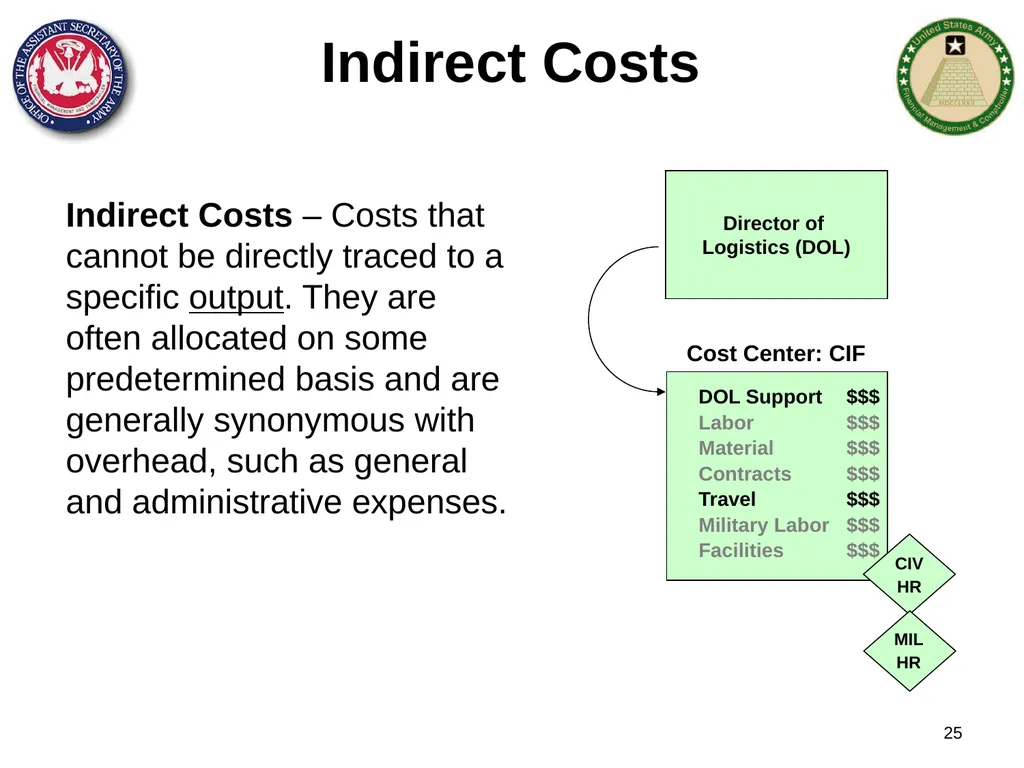
slide25. Indirect Costs – Costs that cannot be directly traced to a specific output. They are often allocated on some predetermined basis and are generally synonymous with overhead, such as general and administrative expenses. Indirect Costs Cost Center: CIF Director of
Logistics (DOL) Material $$$ Labor $$$ DOL Support $$$ Contracts $$$ Travel $$$ Military Labor $$$ Facilities $$$<br>
slide26. Recurring vs Non Recurring The terms Recurring and Non-Recurring define regularity of the occurrence of the expense
Recurring Costs are those that incur repeatedly for each organization and/or product/service produced (e.g. payroll, materials)
Non-Recurring Costs are those that are unusual and unlikely to occur again (e.g. Hurricane, GFEBS deployment)<br>
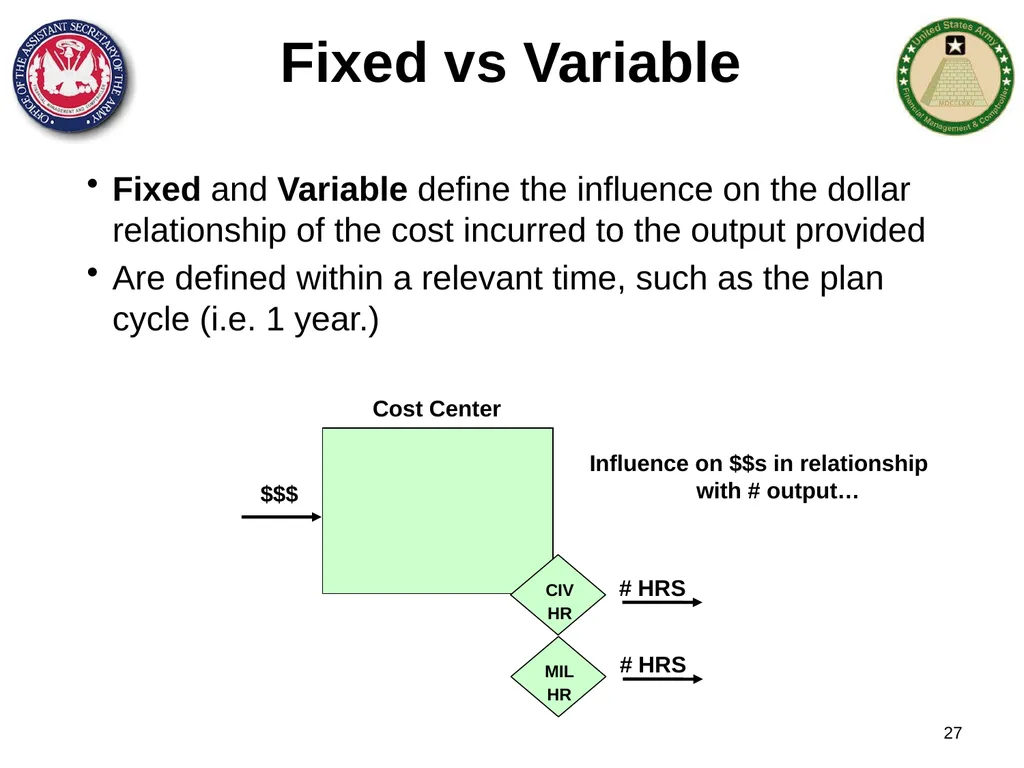
slide27. Fixed vs Variable Fixed and Variable define the influence on the dollar relationship of the cost incurred to the output provided
Are defined within a relevant time, such as the plan cycle (i.e. 1 year.) Cost Center $$$ Influence on $$s in relationship with # output… # HRS # HRS<br>
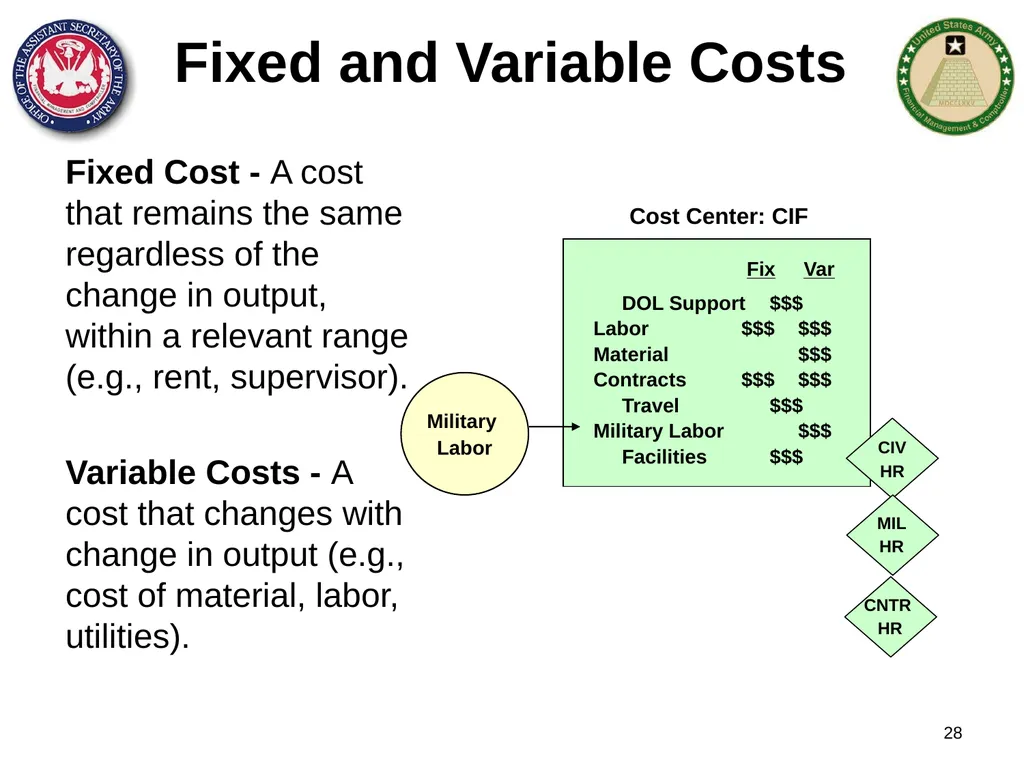
slide28. Fixed Cost - A cost that remains the same regardless of the change in output, within a relevant range (e.g., rent, supervisor).
Variable Costs - A cost that changes with change in output (e.g., cost of material, labor, utilities). Fixed and Variable Costs Cost Center: CIF Military
Labor Material $$$ Labor $$$ $$$ Contracts $$$ $$$ Travel $$$ Fix Var<br>
slide29. The Prices Video<br>
slide30. Avoidable Costs - A cost incurred on an object that will no longer be incurred due to a decision to change the output, such as contract labor to operate the test range
Unavoidable Cost - A cost incurred on an object that will be incurred regardless of the decision to change output, such as depreciation on equipment Decision Specific Cost Concepts<br>
slide31. Lesson 2: Wrap-Up Cost Management has a language of its own and terms have a different meaning then when used for other purposes
Common understanding of types of cost is necessary for informed and decision making
Types are usually in pairs and can only be one or the other (e.g. Funded or Unfunded)
Each cost can have multiple types considered (e.g. Funded, Direct, Unavoidable)
Each decision should be focused on only relevant cost that impact the decision<br>
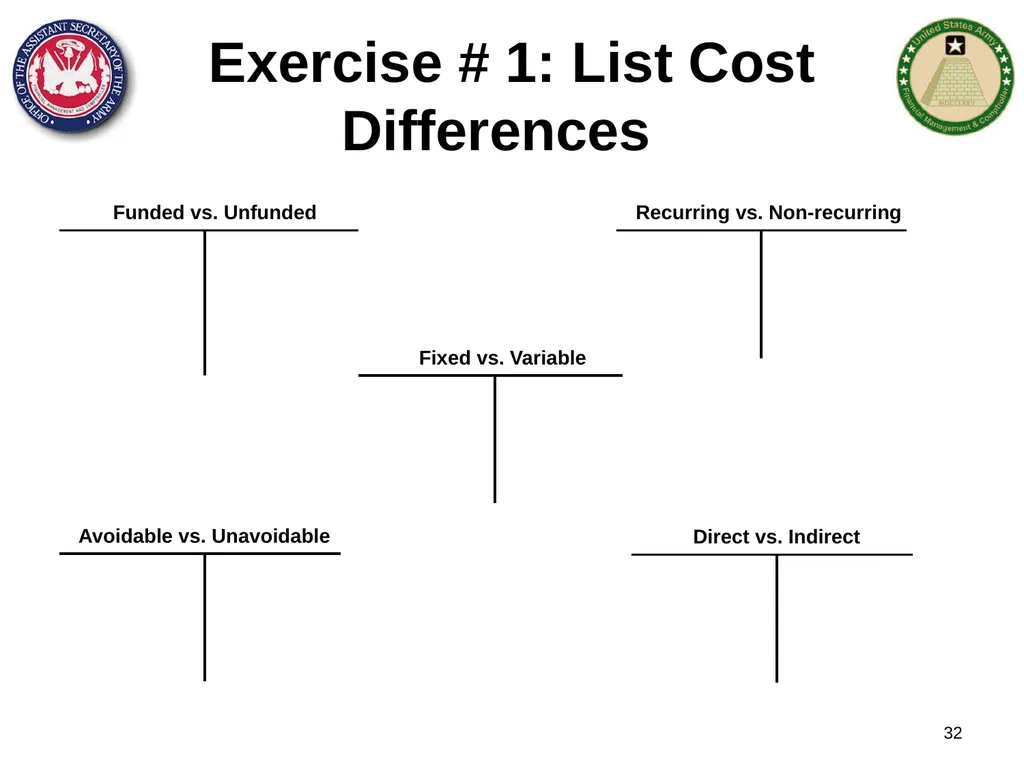
slide32. Exercise # 1: List Cost Differences<br>
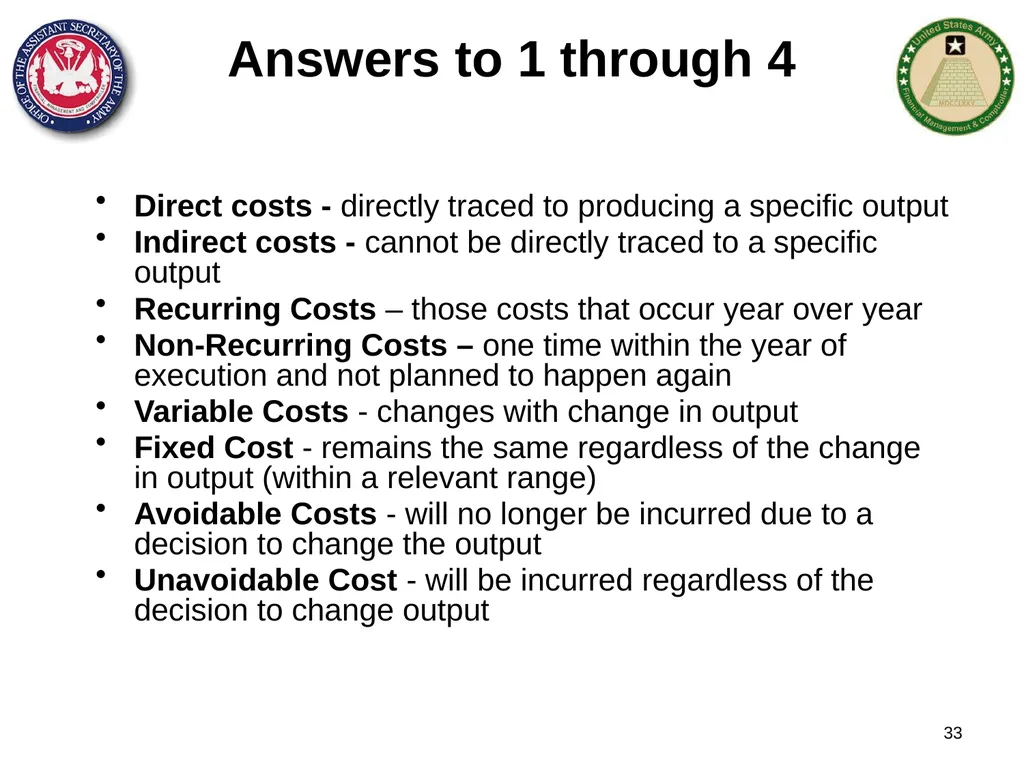
slide33. Answers to 1 through 4 Direct costs - directly traced to producing a specific output
Indirect costs - cannot be directly traced to a specific output
Recurring Costs – those costs that occur year over year
Non-Recurring Costs – one time within the year of execution and not planned to happen again
Variable Costs - changes with change in output
Fixed Cost - remains the same regardless of the change in output (within a relevant range)
Avoidable Costs - will no longer be incurred due to a decision to change the output
Unavoidable Cost - will be incurred regardless of the decision to change output<br>
slide34. Question #5: Provide Examples of When Labor is? Direct
Indirect
Funded
Unfunded
Recurring
Non-Recurring
Variable
Fixed
Avoidable
Unavoidable Answer: Discussion<br>
slide35. Lesson 3: Cost Centers Objective(s):
To understand what the Cost Center cost object represents, key definition criteria (guiding principles), uses, and how defined for the Cost Model<br>
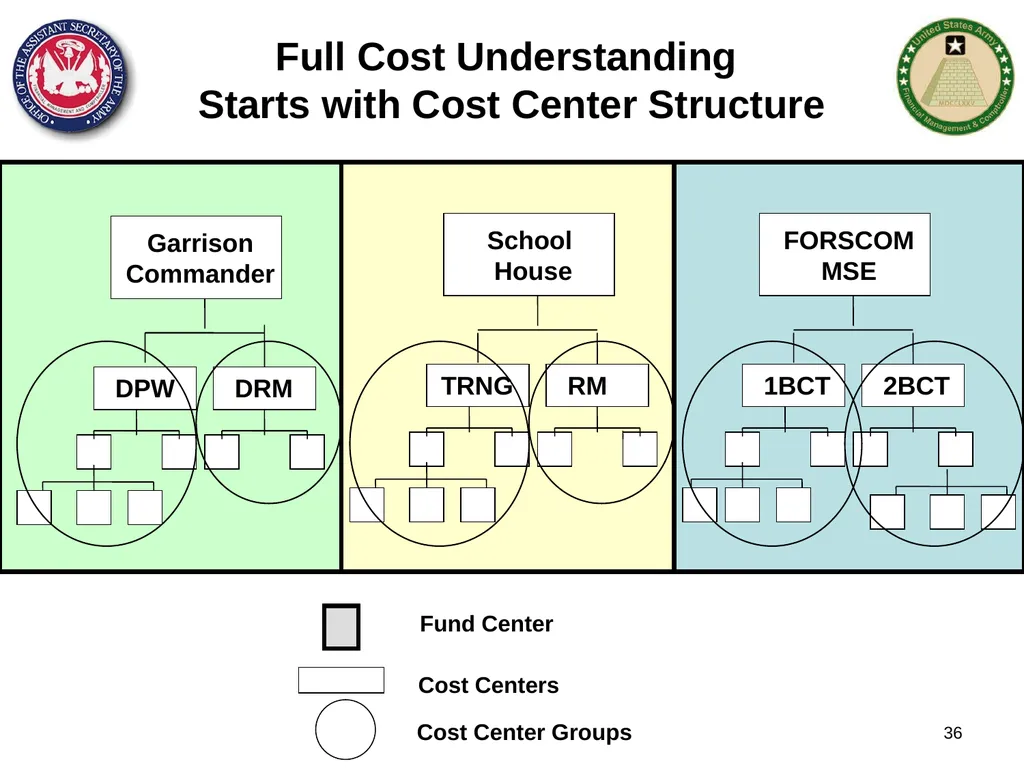
slide36. Cost Center Groups Full Cost Understanding Starts with Cost Center Structure 1BCT FORSCOM
MSE 2BCT DPW Garrison Commander DRM TRNG School
House RM Fund Center<br>
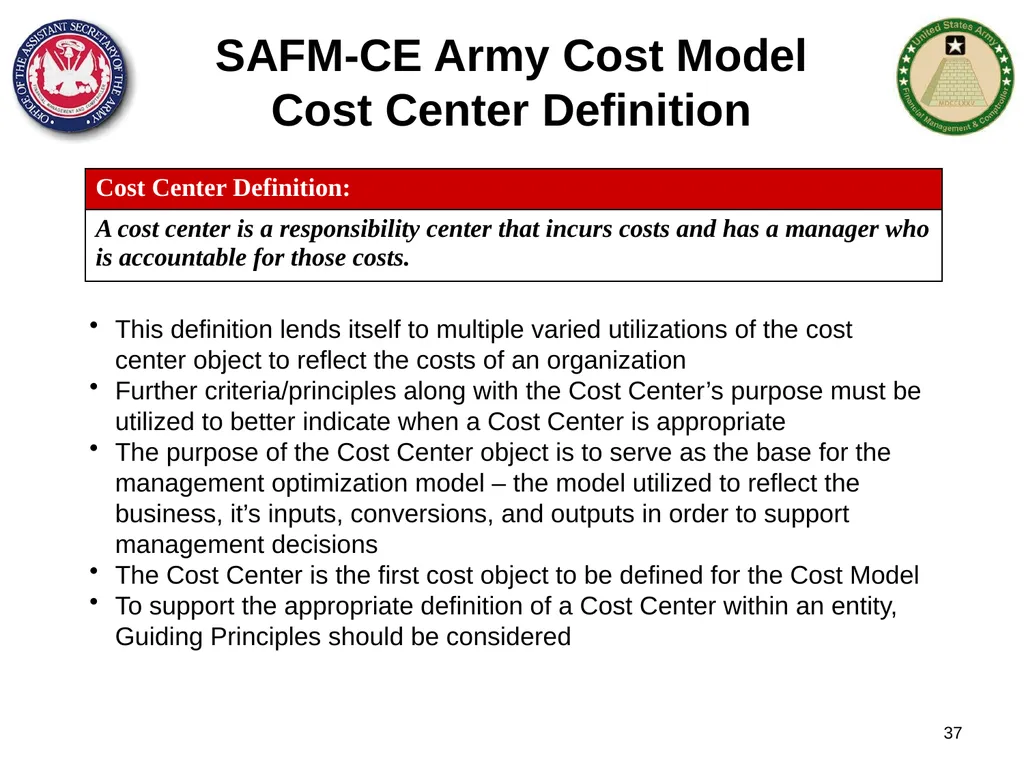
slide37. SAFM-CE Army Cost Model
Cost Center Definition This definition lends itself to multiple varied utilizations of the cost center object to reflect the costs of an organization
Further criteria/principles along with the Cost Center’s purpose must be utilized to better indicate when a Cost Center is appropriate
The purpose of the Cost Center object is to serve as the base for the management optimization model – the model utilized to reflect the business, it’s inputs, conversions, and outputs in order to support management decisions
The Cost Center is the first cost object to be defined for the Cost Model
To support the appropriate definition of a Cost Center within an entity, Guiding Principles should be considered<br>
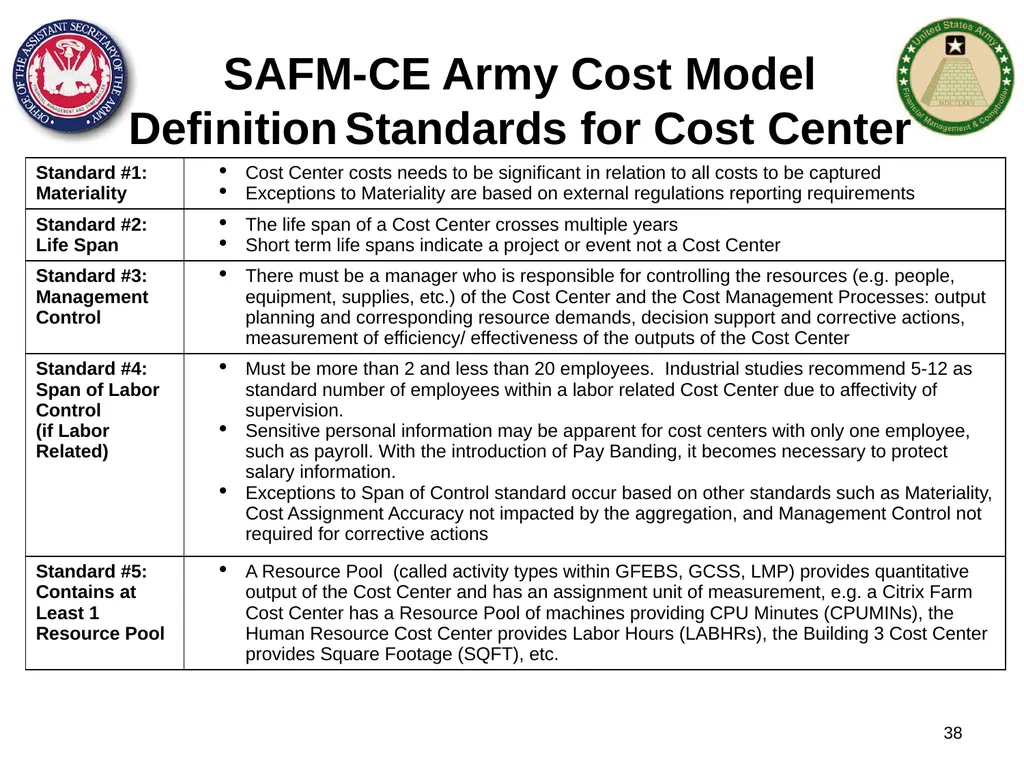
slide38. SAFM-CE Army Cost Model
Definition Standards for Cost Center<br>
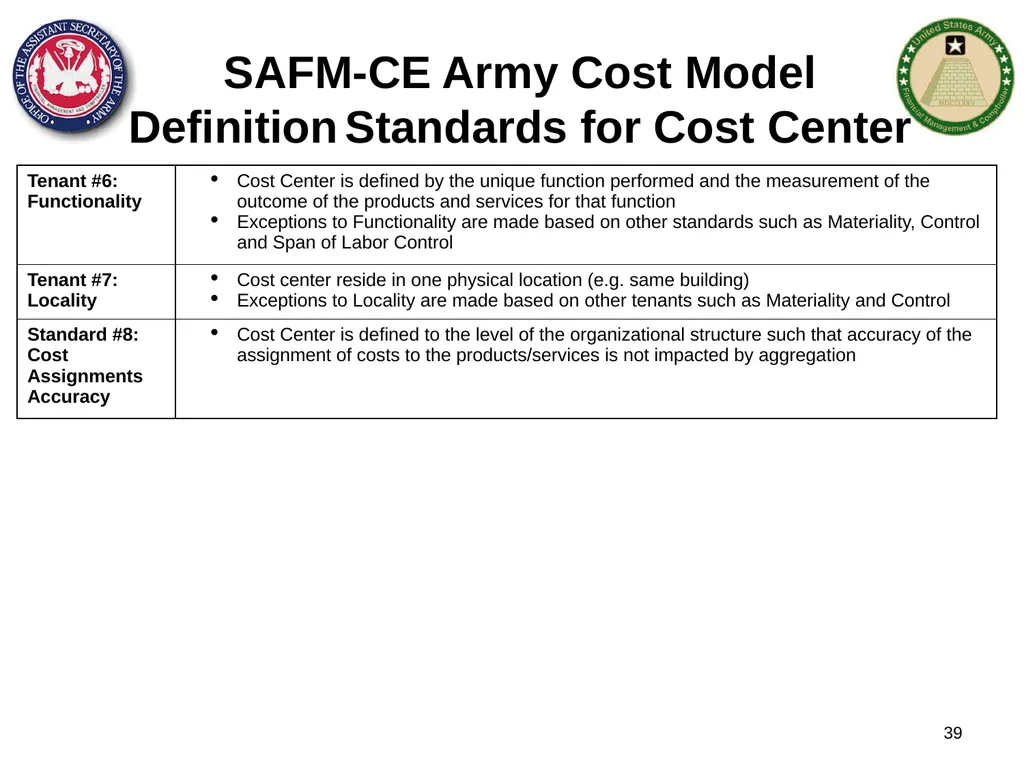
slide39. SAFM-CE Army Cost Model
Definition Standards for Cost Center<br>
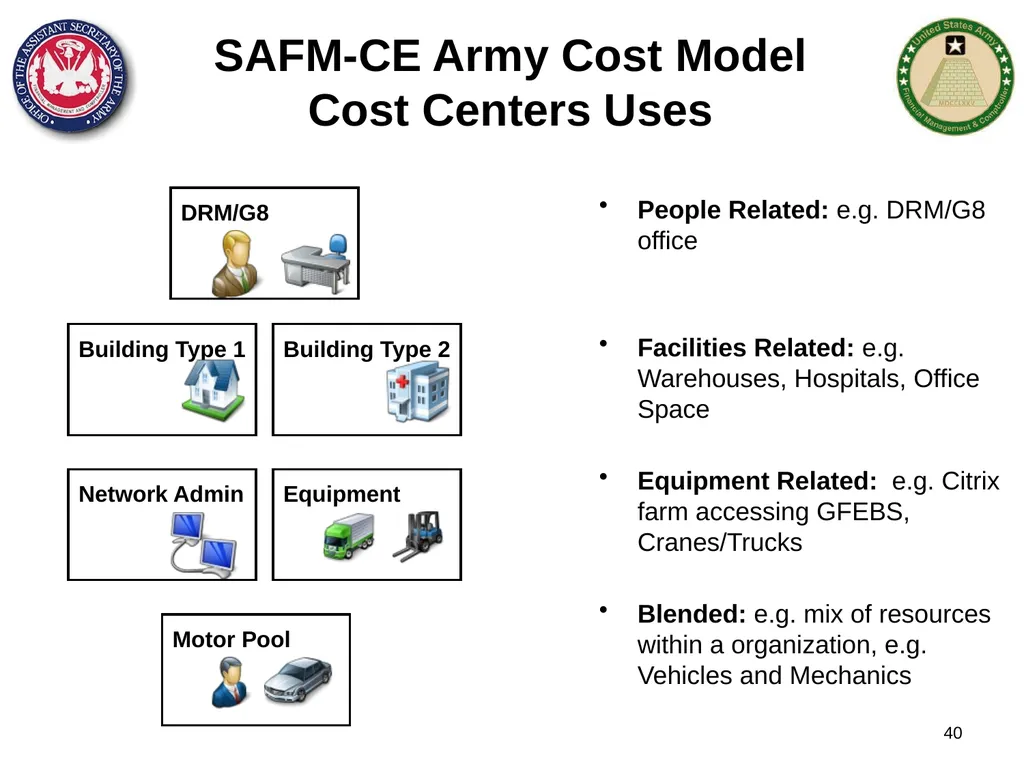
slide40. SAFM-CE Army Cost Model
Cost Centers Uses People Related: e.g. DRM/G8 office
Facilities Related: e.g. Warehouses, Hospitals, Office Space
Equipment Related: e.g. Citrix farm accessing GFEBS, Cranes/Trucks
Blended: e.g. mix of resources within a organization, e.g. Vehicles and Mechanics DRM/G8 Building Type 1 Network Admin Building Type 2 Equipment Motor Pool<br>
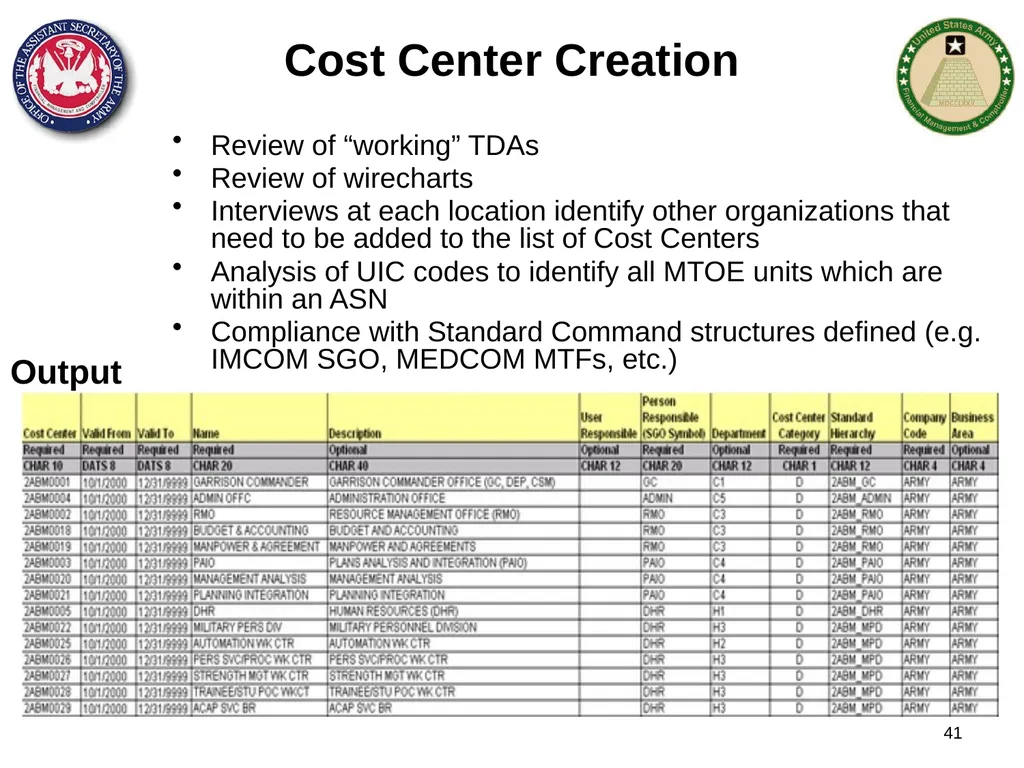
slide41. Cost Center Creation Review of “working” TDAs
Review of wirecharts
Interviews at each location identify other organizations that need to be added to the list of Cost Centers
Analysis of UIC codes to identify all MTOE units which are within an ASN
Compliance with Standard Command structures defined (e.g. IMCOM SGO, MEDCOM MTFs, etc.) Output<br>
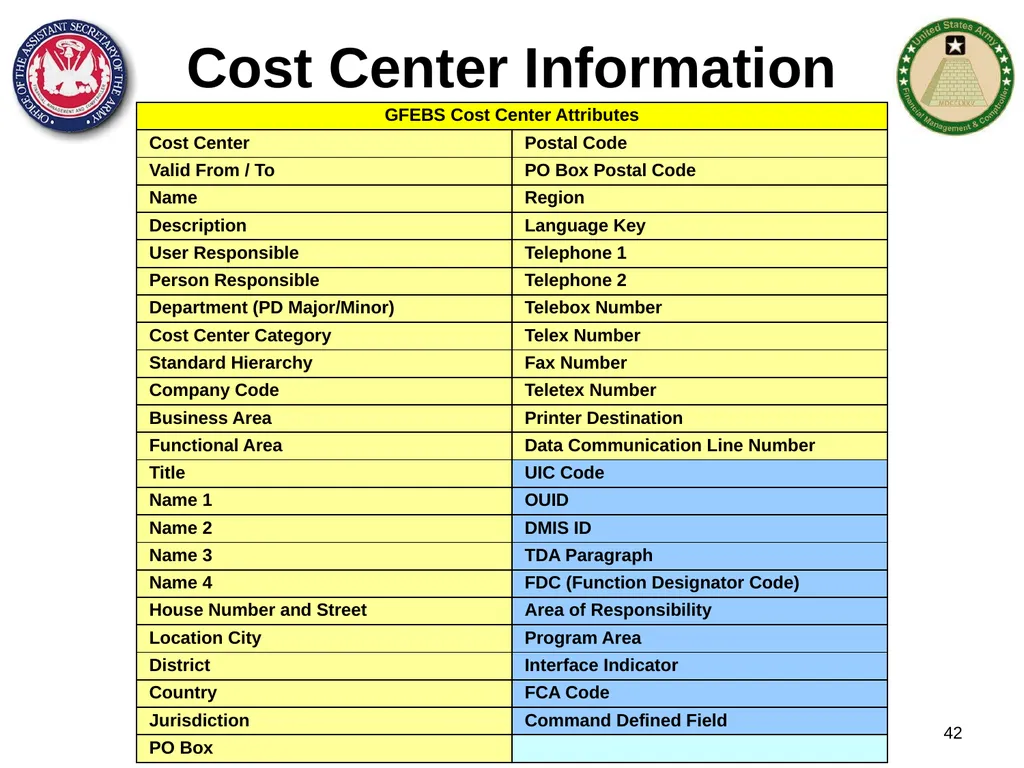
slide42. Cost Center Information<br>
slide43. SAFM-CE Army Cost Model
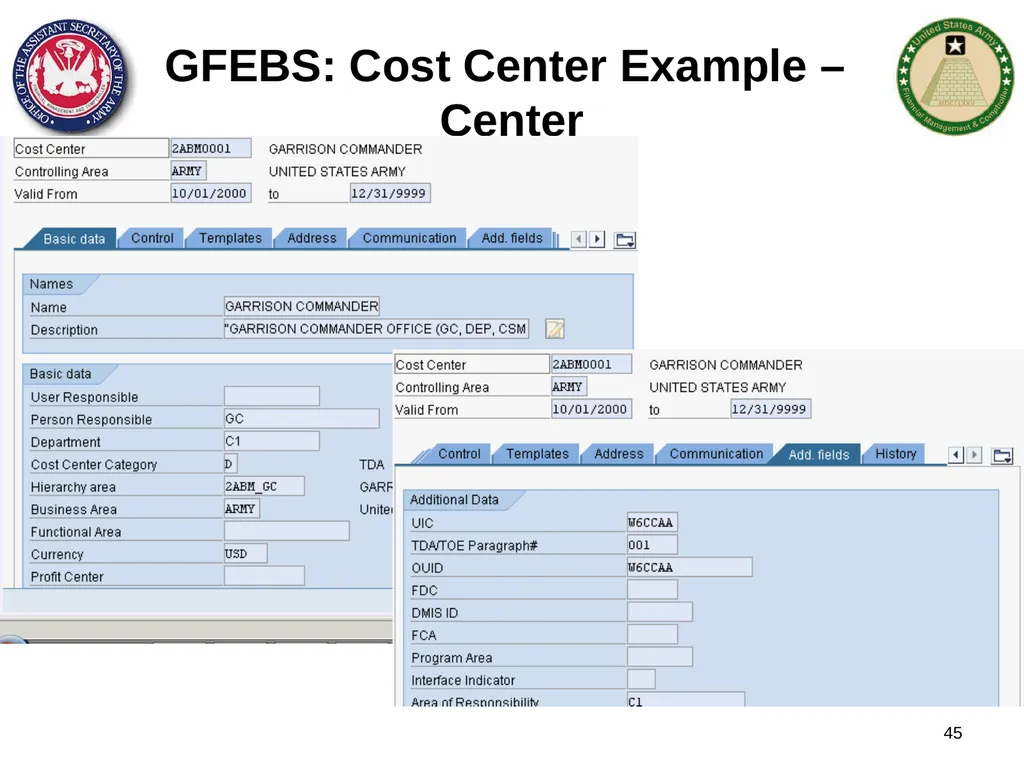
Cost Center Hierarchy In addition to defining the Cost Centers and the attribute information for each individual Cost Center, the Cost Centers need to be identified on a standard hierarchy
There is a single standard hierarchy which every Cost Center will reside on to ensure that all costs can be reported from a single hierarchy
Alternative hierarchies can be defined as needed to meet management objectives
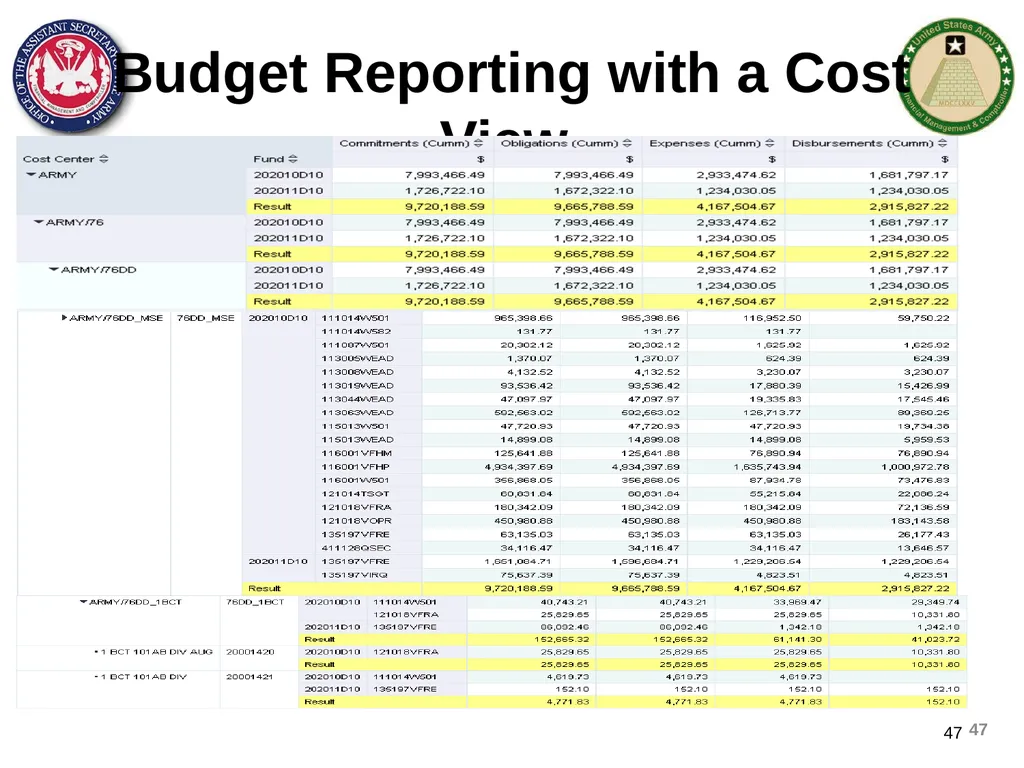
The Cost Center Hierarchy is utilized to support Informal Budget Distribution and Budget Execution Status of Available Fund report aggregation<br>
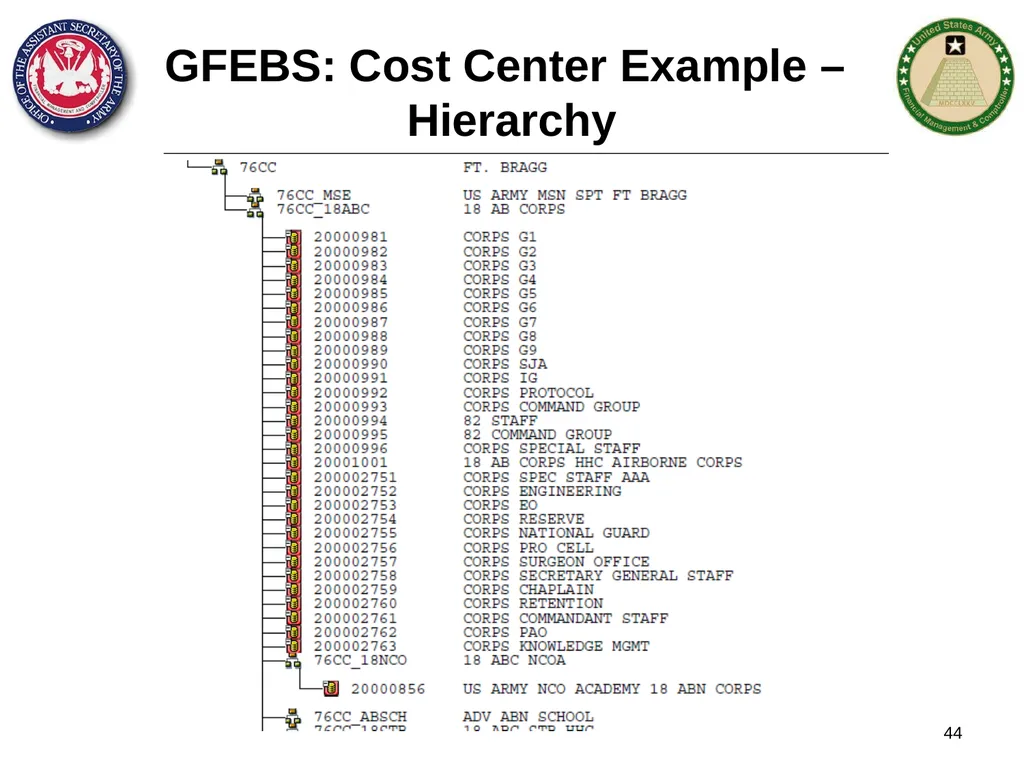
slide44. GFEBS: Cost Center Example – Hierarchy<br>
slide45. GFEBS: Cost Center Example – Center<br>
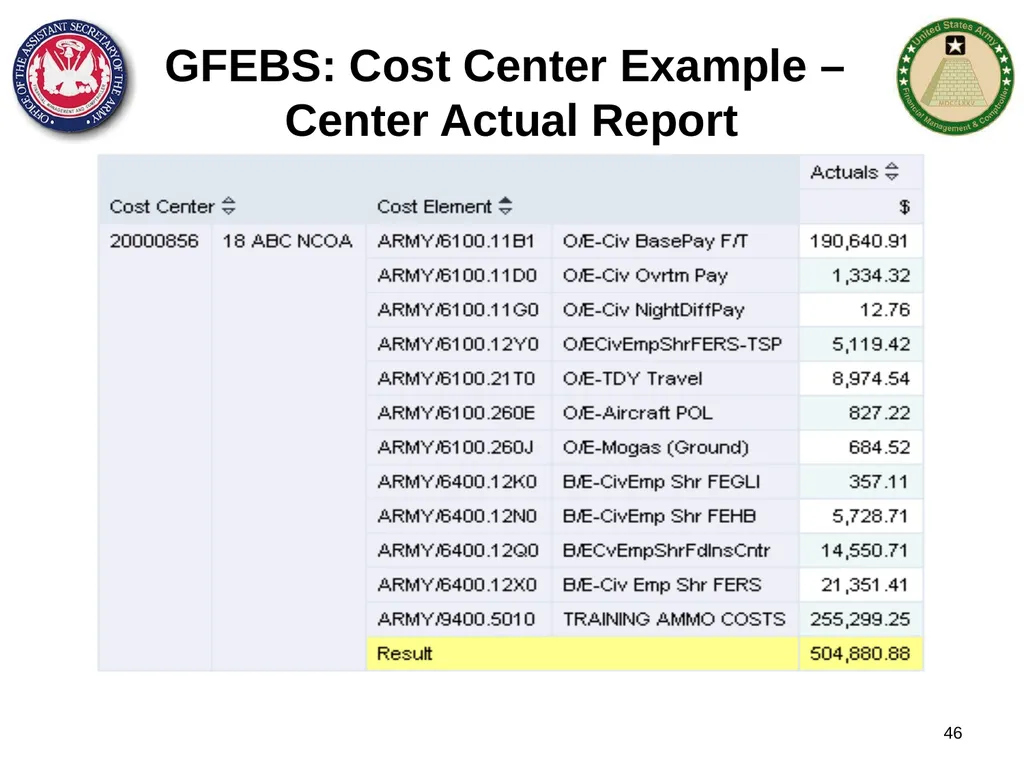
slide46. GFEBS: Cost Center Example – Center Actual Report<br>
slide47. Budget Reporting with a Cost View 47<br>
slide48. Lesson 3: Wrap-Up A cost center is a responsibility center that incurs costs and has a manager who is accountable for those costs
Costs of the cost center are material in nature (worth capturing vs. the cost of capturing)
A cost center has a long life span of more than 1 year (typically years) and has a manager responsible for the resources consumed and the outputs produced by the cost center
Every cost center resides on the standard hierarchy
Alternative cost center hierarchies can exist as well
CC Hierarchy is utilized to support Informal Budgets and Status of Available Funds Reporting<br>
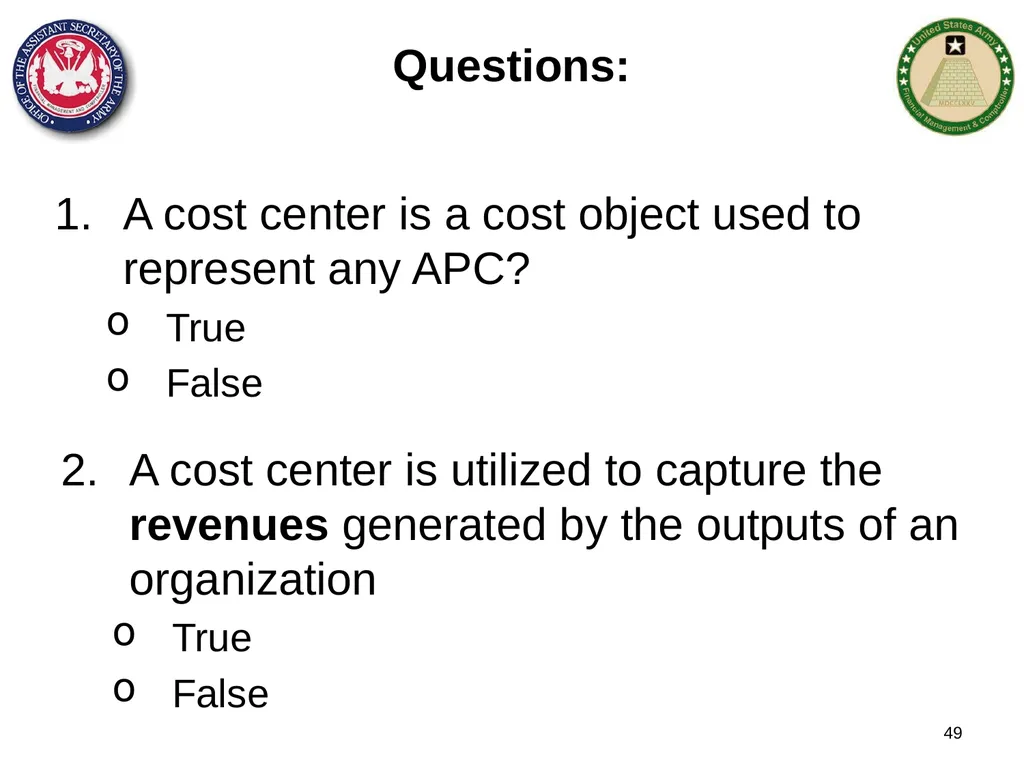
slide49. Questions: A cost center is a cost object used to represent any APC?
True
False A cost center is utilized to capture the revenues generated by the outputs of an organization
True
False<br>
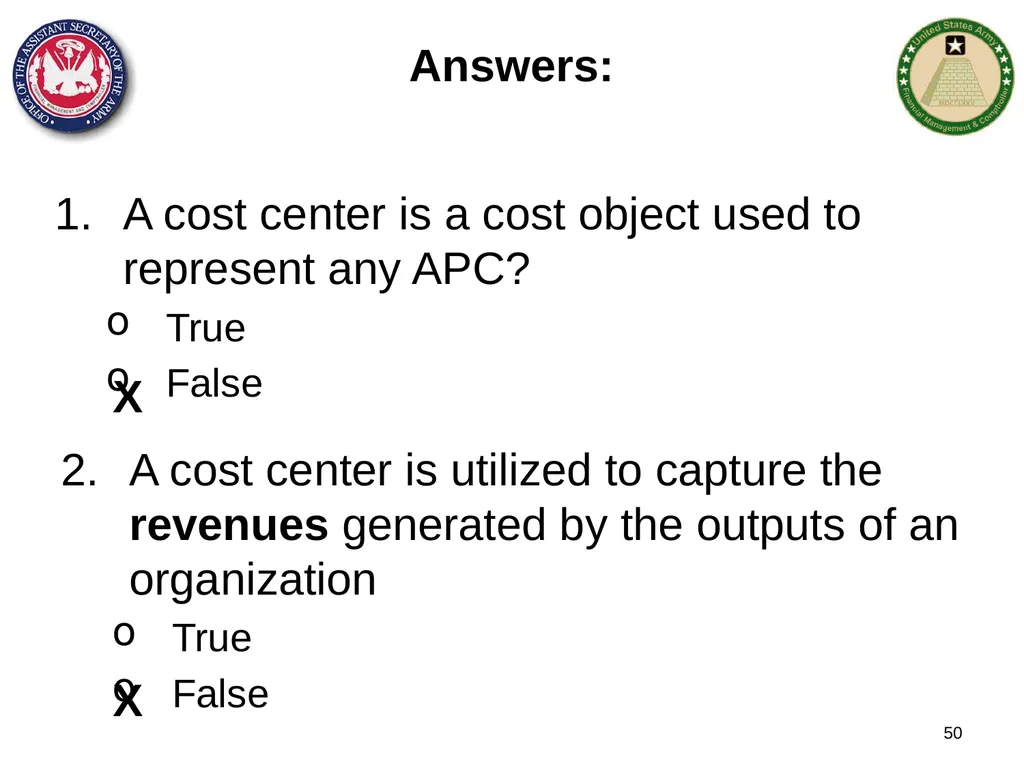
slide50. Answers: A cost center is a cost object used to represent any APC?
True
False A cost center is utilized to capture the revenues generated by the outputs of an organization
True
False X X<br>
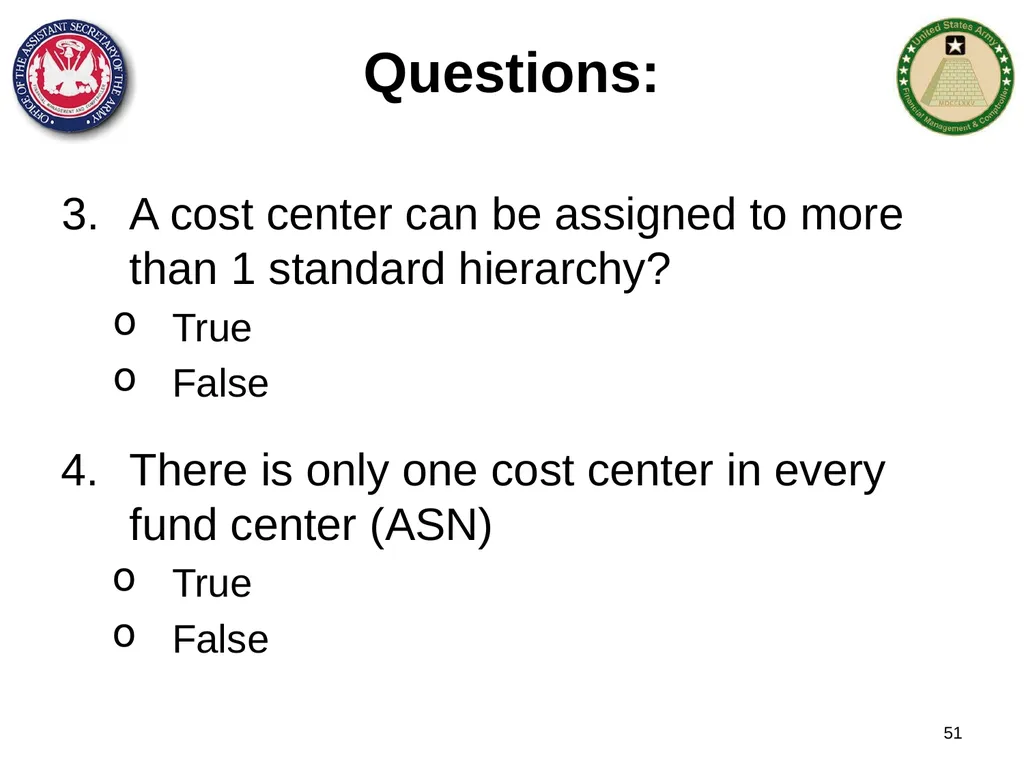
slide51. Questions: A cost center can be assigned to more than 1 standard hierarchy?
True
False There is only one cost center in every fund center (ASN)
True
False<br>
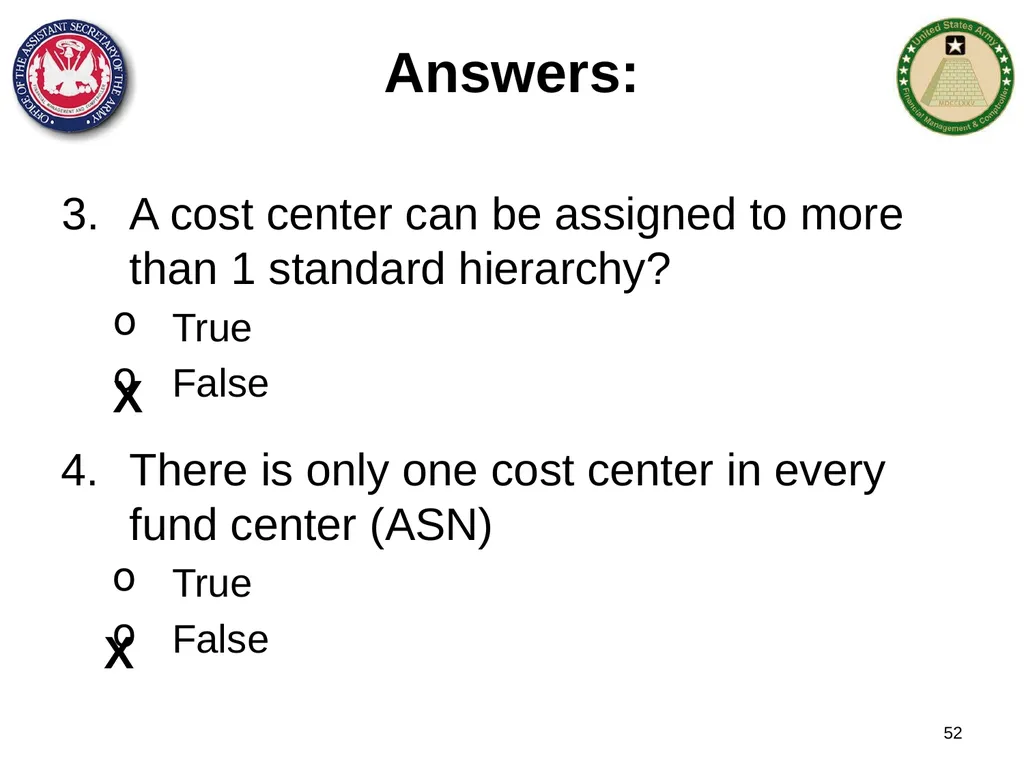
slide52. Answers: A cost center can be assigned to more than 1 standard hierarchy?
True
False There is only one cost center in every fund center (ASN)
True
False X X<br>
slide53. Lesson 4: Activity Types Objective(s):
To understand what the Activity Type cost object represents, key definition criteria (guiding principles), uses, and how defined for the Cost Model<br>
slide54. SAFM-CE Army Cost Model
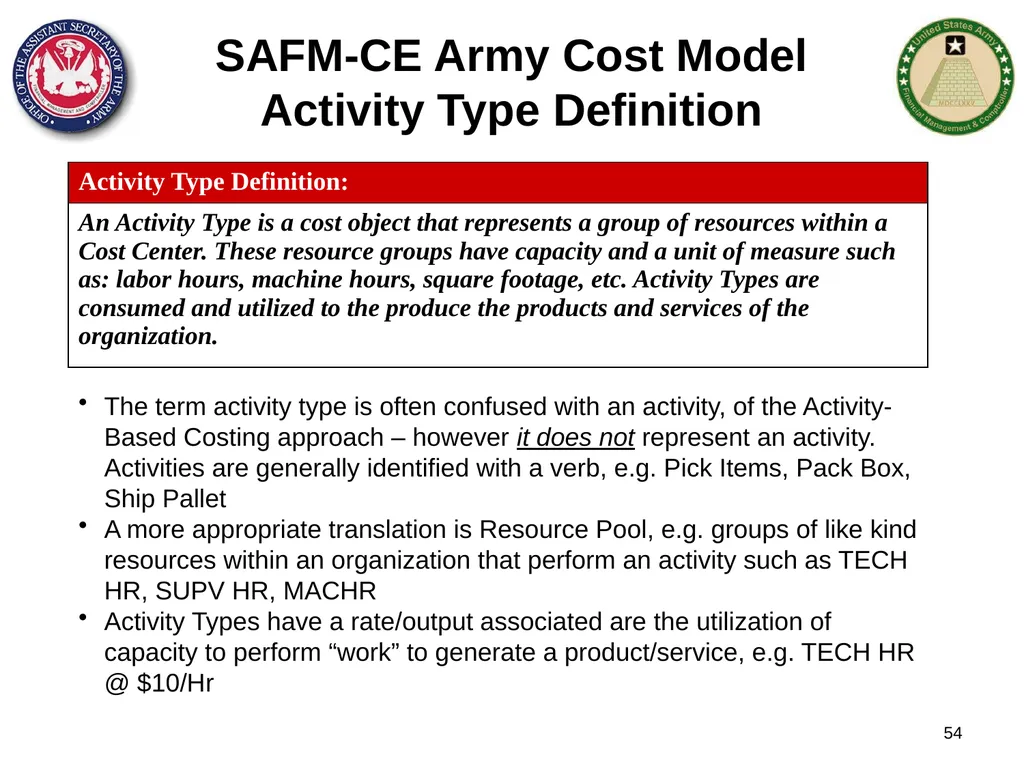
Activity Type Definition The term activity type is often confused with an activity, of the Activity-Based Costing approach – however it does not represent an activity. Activities are generally identified with a verb, e.g. Pick Items, Pack Box, Ship Pallet
A more appropriate translation is Resource Pool, e.g. groups of like kind resources within an organization that perform an activity such as TECH HR, SUPV HR, MACHR
Activity Types have a rate/output associated are the utilization of capacity to perform “work” to generate a product/service, e.g. TECH HR @ $10/Hr<br>
slide55. SAFM-CE Army Cost Model
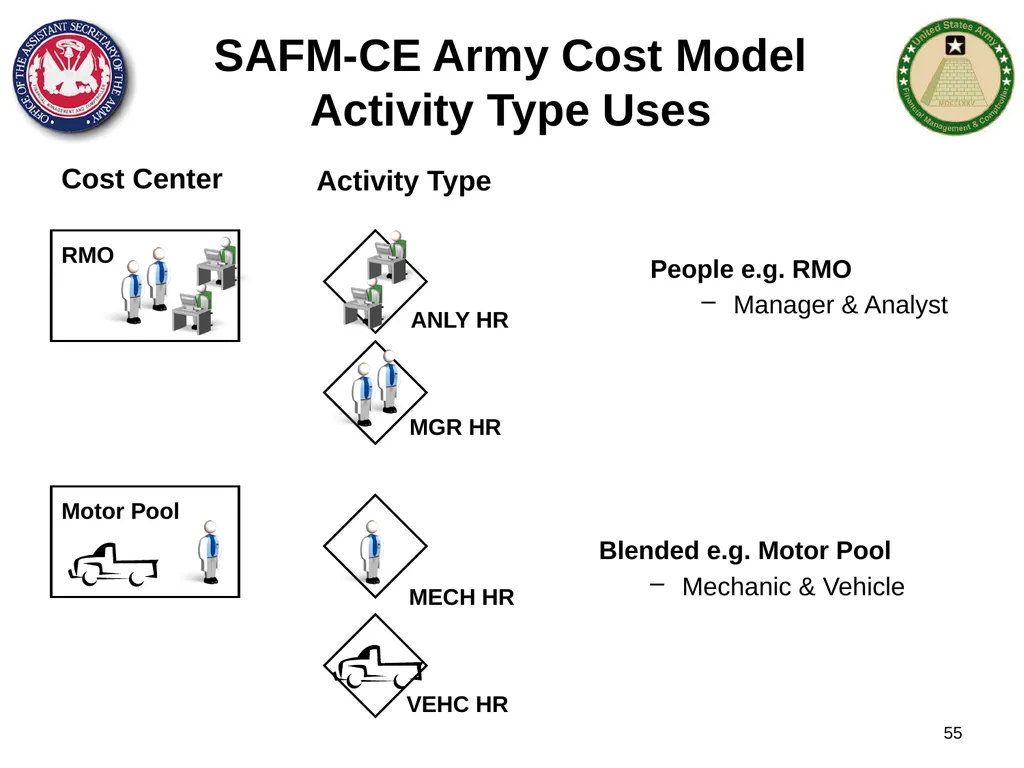
Activity Type Uses People e.g. RMO
Manager & Analyst RMO Motor Pool Blended e.g. Motor Pool
Mechanic & Vehicle Cost Center Activity Type<br>
slide56. SAFM-CE Army Cost Model
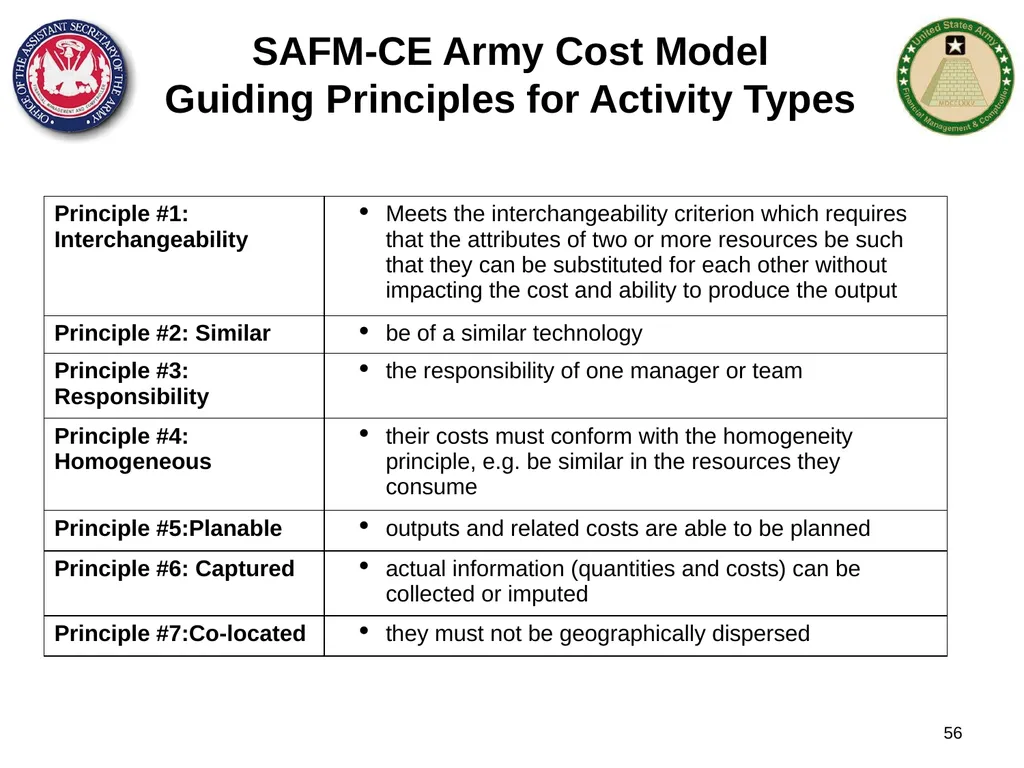
Guiding Principles for Activity Types<br>
slide57. SAFM-CE Army Cost Model
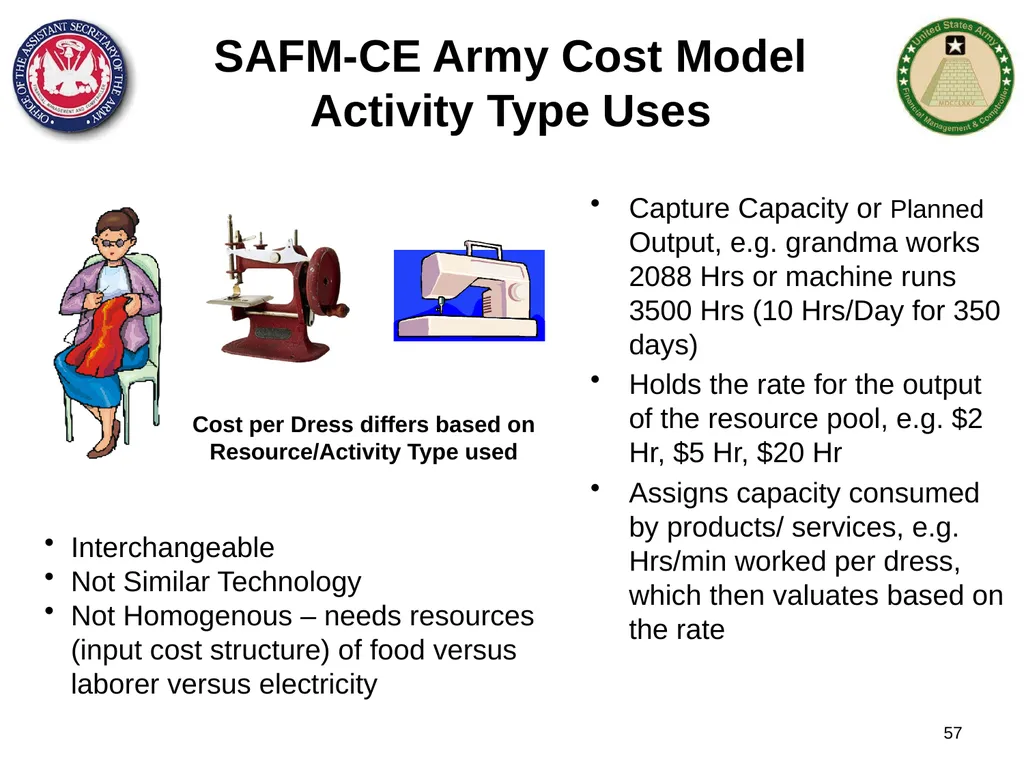
Activity Type Uses Capture Capacity or Planned Output, e.g. grandma works 2088 Hrs or machine runs 3500 Hrs (10 Hrs/Day for 350 days)
Holds the rate for the output of the resource pool, e.g. $2 Hr, $5 Hr, $20 Hr
Assigns capacity consumed by products/ services, e.g. Hrs/min worked per dress, which then valuates based on the rate Cost per Dress differs based on Resource/Activity Type used Interchangeable
Not Similar Technology
Not Homogenous – needs resources (input cost structure) of food versus laborer versus electricity<br>
slide58. Activity Types facilitate capacity management and there are various types of capacity (e.g. Productive, Non-Productive, Idle/Excess, etc.)
Activity Types provide the capacity information required to optimize the conversion of inputs to generate the most outputs – meeting the “Efficiently” portion of the Cost Management definition
Activity Types are defined as master data, however they exist only in conjunction with a Cost Center
Activity Type = MACHR is assigned to Cost Center 1 and Cost Center 2 resulting in CC1/MACHR and CC2/MACHR each of which holds their own rate, their planned output, captures actuals, etc. Capacity Management<br>
slide59. SAFM-CE Army Cost Model
How Activity Types are Defined The project and production related areas are familiar with the concepts of labor and equipment rates and often have std. rates for charging level of effort for like kind resources to work on an order, e.g. IFS
Maintenance shop rates are reviewed and then grouped/expanded upon into like kind resources
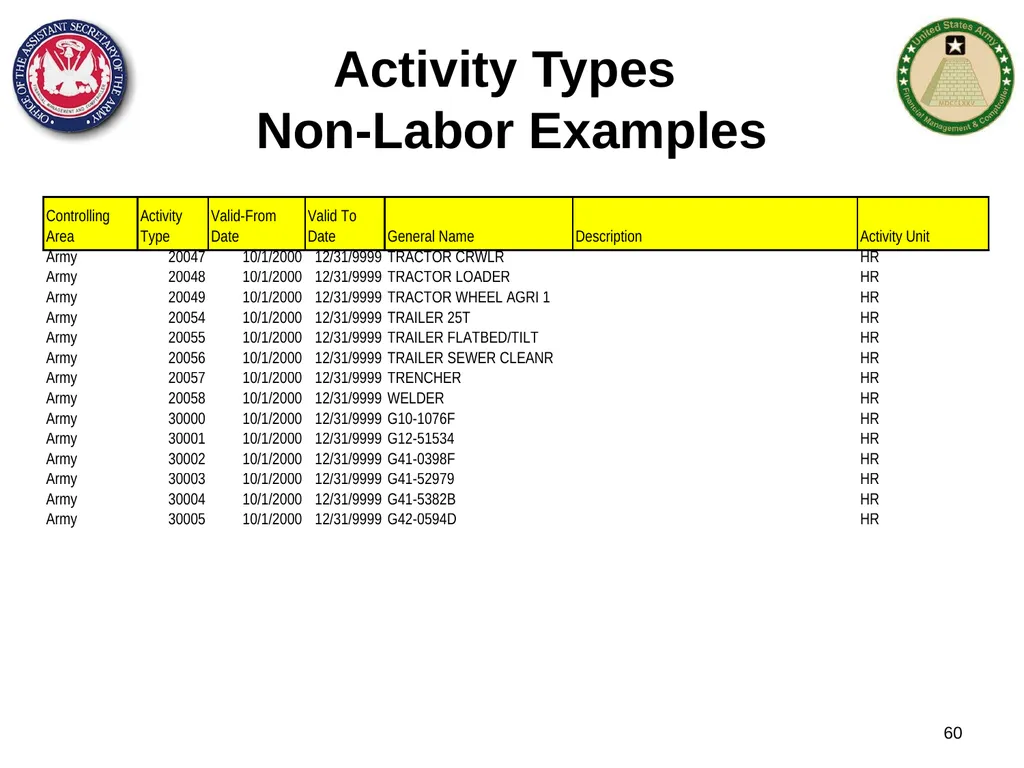
Equipment Activity Types are defined based on a review and grouping of equipment, e.g. Dump Truck 6T
Vehicle Activity Types are defined based on GSA classification into groupings<br>
slide60. Activity Types Non-Labor Examples<br>
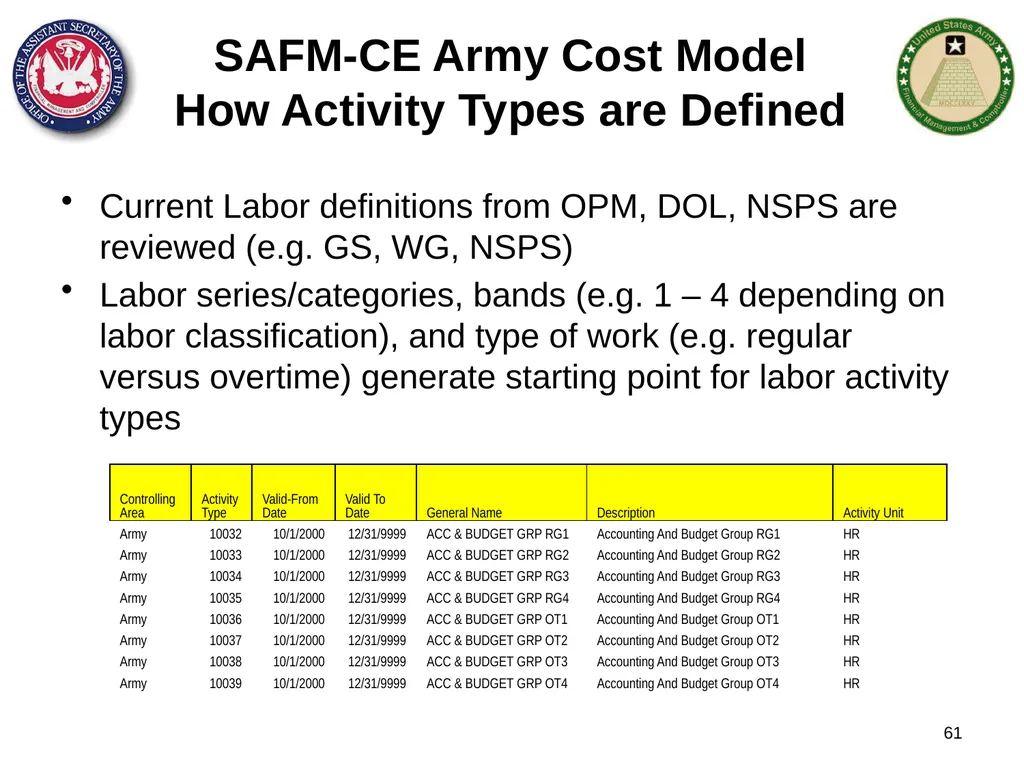
slide61. SAFM-CE Army Cost Model
How Activity Types are Defined Current Labor definitions from OPM, DOL, NSPS are reviewed (e.g. GS, WG, NSPS)
Labor series/categories, bands (e.g. 1 – 4 depending on labor classification), and type of work (e.g. regular versus overtime) generate starting point for labor activity types<br>
slide62. Faces to Spaces to
Activity Types The Cost Center and Activity Type will be updated on the DCPS accounting information as the default Cost Center/Activity Type for an employee
To determine the Activity Type for each person an exercise of mapping people (Faces) to cost centers (Spaces) occurred, and then an Activity Type is assigned
The Activity Type is associated with the ATAAPS entry for time tracking or via the work order confirmation process (confirmations associate labor and non-labor activity types to the work order supported<br>
slide63. Lesson 4: Wrap-Up An Activity Type is a cost object that represents a group of resources within a Cost Center. These resource groups have capacity and a unit of measure such as: labor hours, machine hours, square footage, etc. Activity Types are consumed and utilized to the produce the products and services of the organization.
There are several guiding principles for the definition of an Activity Type which should be considered
The Activity Type is the cost object which supports capacity management
Each person will be assigned their default activity type based on NSPS, WG, GS, cost center assigned, etc.<br>
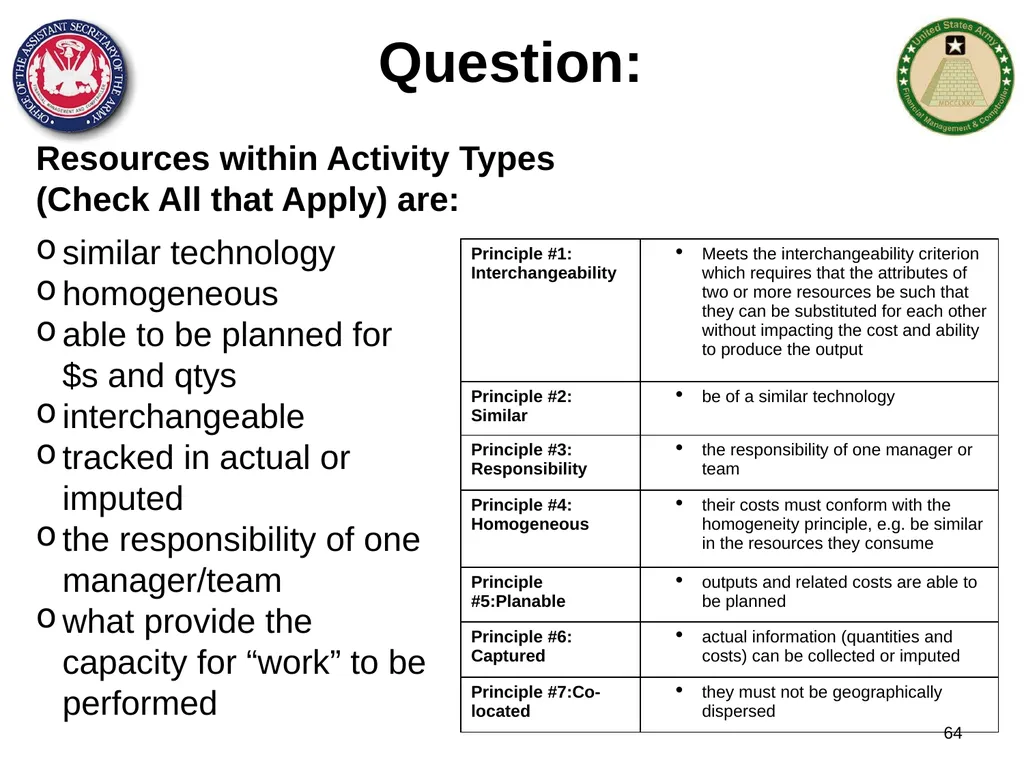
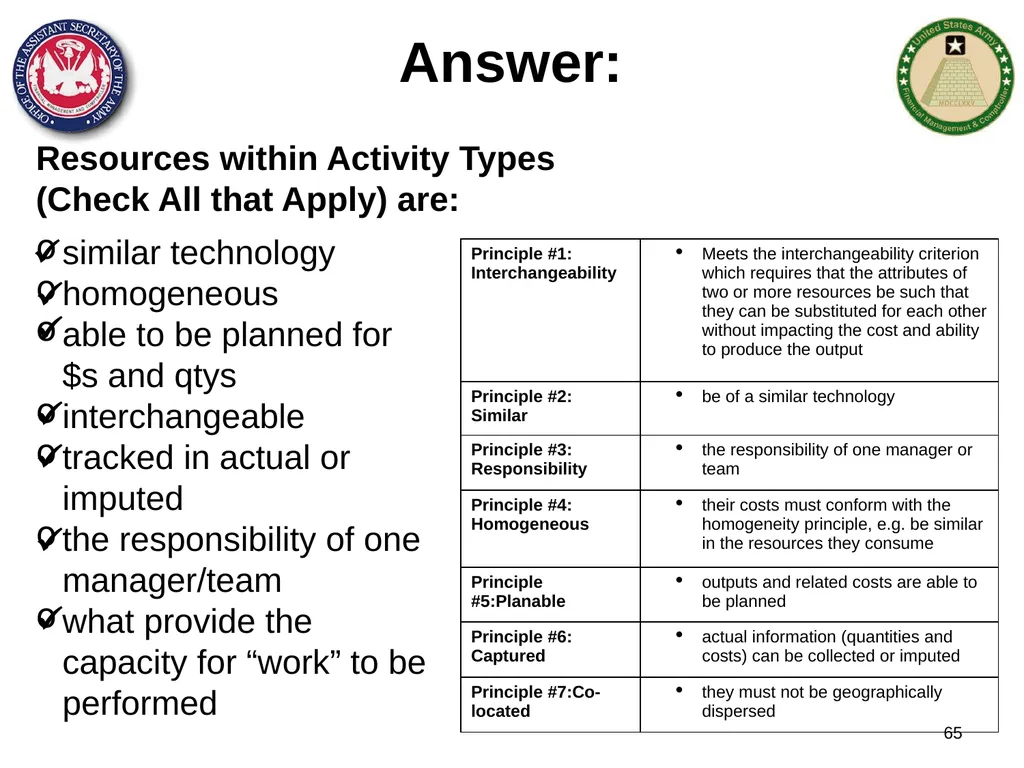
slide64. Question: Resources within Activity Types
(Check All that Apply) are: similar technology
homogeneous
able to be planned for $s and qtys
interchangeable
tracked in actual or imputed
the responsibility of one manager/team
what provide the capacity for “work” to be performed<br>
slide65. Answer: Resources within Activity Types
(Check All that Apply) are: similar technology
homogeneous
able to be planned for $s and qtys
interchangeable
tracked in actual or imputed
the responsibility of one manager/team
what provide the capacity for “work” to be performed <br>
slide66. Lesson 5: Capture Payroll/Labor Costs Objective(s):
To understand how payroll and labor costs can be captured, maintenance required, and what information can be reported/analyzed<br>
slide67. Payroll vs. Labor Process Payroll Process - the tracking of time for attendance purposes and corresponding payment to employees as well as accruing for work performed but not yet paid
Labor Process - the tracking of time for recordation to a specific cost of outputs (services, customers, course, etc.)<br>
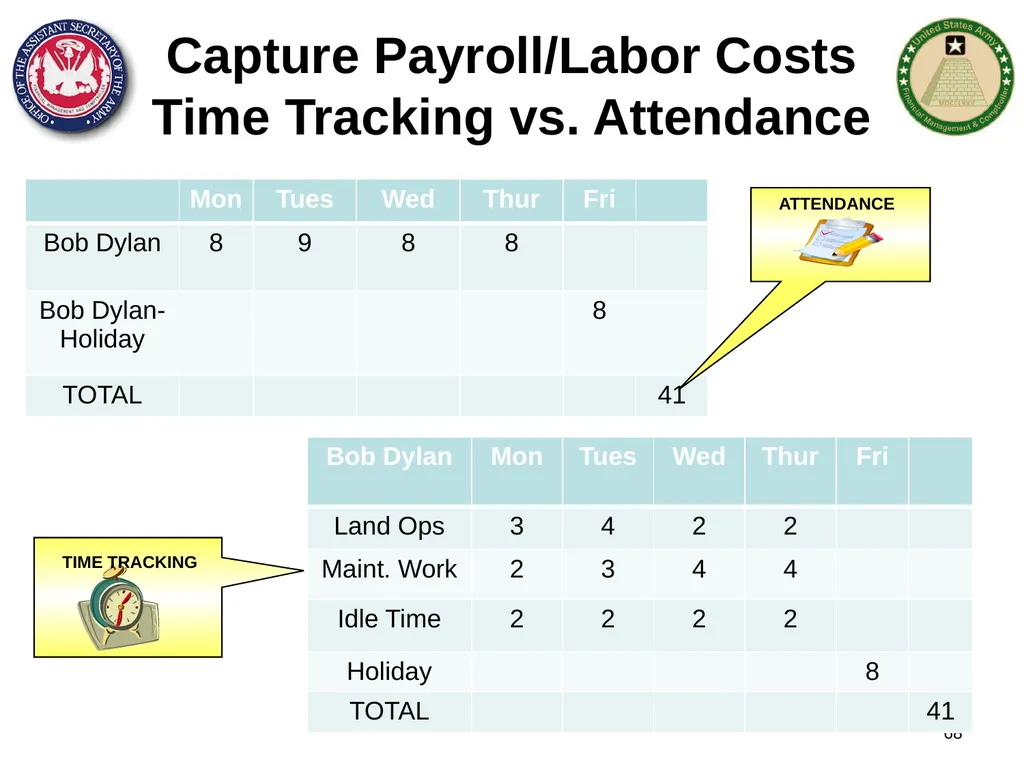
slide68. Capture Payroll/Labor Costs Time Tracking vs. Attendance<br>
slide69. Capture Civilian Payroll Costs Overview DCPS remains the operational system for calculating and disbursing Civilian payroll
Reports gross disbursements from ARMY
Utilizes Primary Cost Elements
Accruals for work earned but not paid is also a part of the GFEBS payroll process
DCPS line of account changes with GFEBS
No more APCs/JONOs therefore a cost object had to be utilized
DCPS doesn’t support all the GFEBS cost objects
People are management within Cost Centers
Within GFEBS ALL Payroll costs post to a Cost Center and then most be associated with the products/services/customers<br>
slide70. Capture Civilian Payroll Costs Ongoing DCPS Employee LOA
When people shift organizations they need to update the Cost Center in the record
On the Employee LOA an Activity Type is assigned as well
Identifies type of resource pool - e.g. Budget/Accounting
Is utilized to charge out for organizations doing Labor Tracking<br>
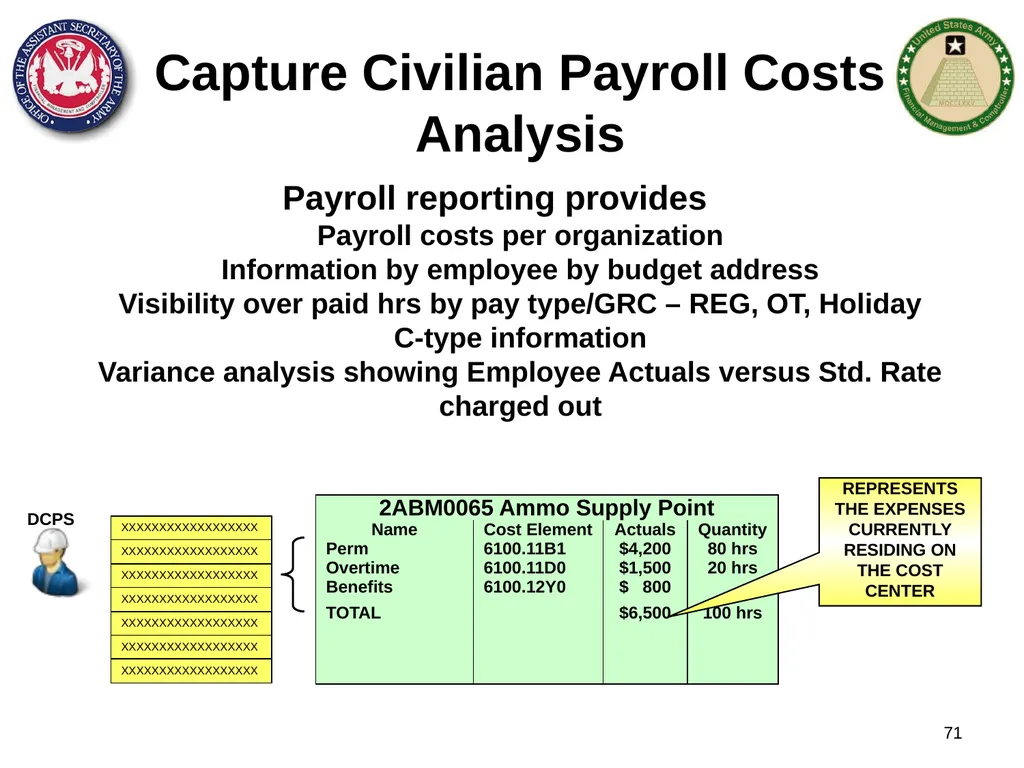
slide71. Capture Civilian Payroll Costs Analysis Payroll reporting provides
Payroll costs per organization
Information by employee by budget address
Visibility over paid hrs by pay type/GRC – REG, OT, Holiday
C-type information
Variance analysis showing Employee Actuals versus Std. Rate charged out REPRESENTS THE EXPENSES CURRENTLY RESIDING ON THE COST CENTER<br>
slide72. No Army wide approach for time tracking currently
Army’s need for Time Tracking
Labor accounts for nearly 70% of Army AFP
Visibility into what tasks are being performed by who and to which output
Ability to determine what Products/Services are worked on
Visibility into non-productive time
Need to bill reimbursable customers for services rendered
Work is tracked by cost center to receiving Cost Object
Quantity of hours worked are charged out by standard rates
Rates are established to represent groups of similar work
Military labor costs will be imputed based on composite rates by rank Capture Labor Costs Overview<br>
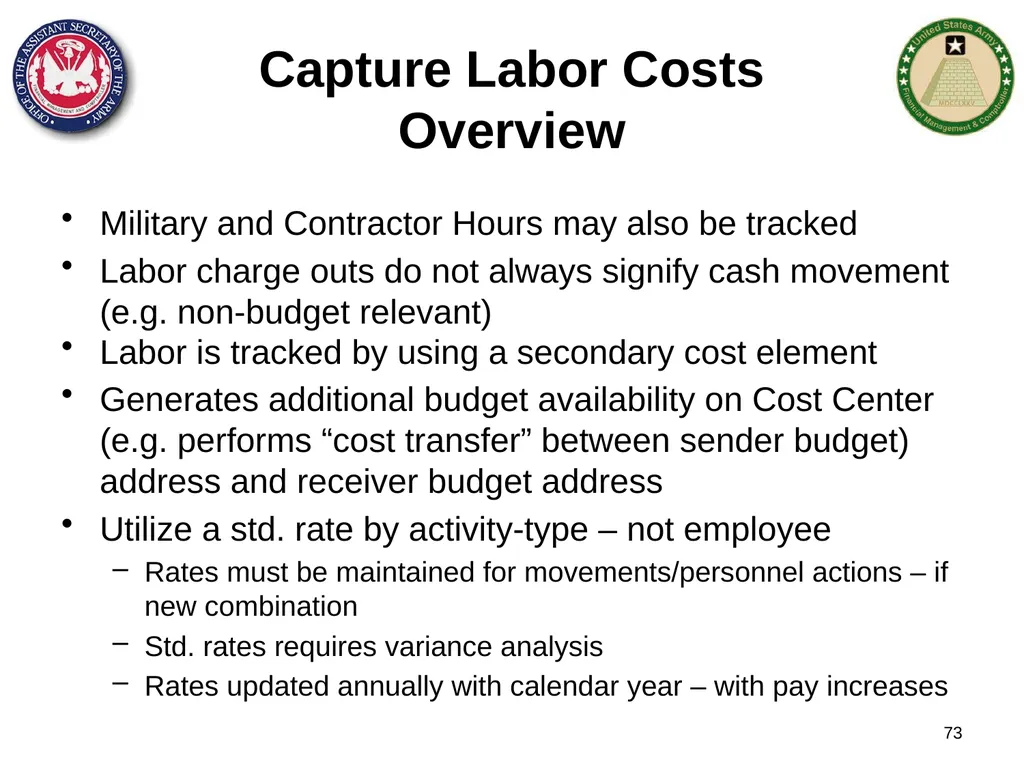
slide73. Capture Labor Costs Overview Military and Contractor Hours may also be tracked
Labor charge outs do not always signify cash movement (e.g. non-budget relevant)
Labor is tracked by using a secondary cost element
Generates additional budget availability on Cost Center (e.g. performs “cost transfer” between sender budget) address and receiver budget address
Utilize a std. rate by activity-type – not employee
Rates must be maintained for movements/personnel actions – if new combination
Std. rates requires variance analysis
Rates updated annually with calendar year – with pay increases<br>
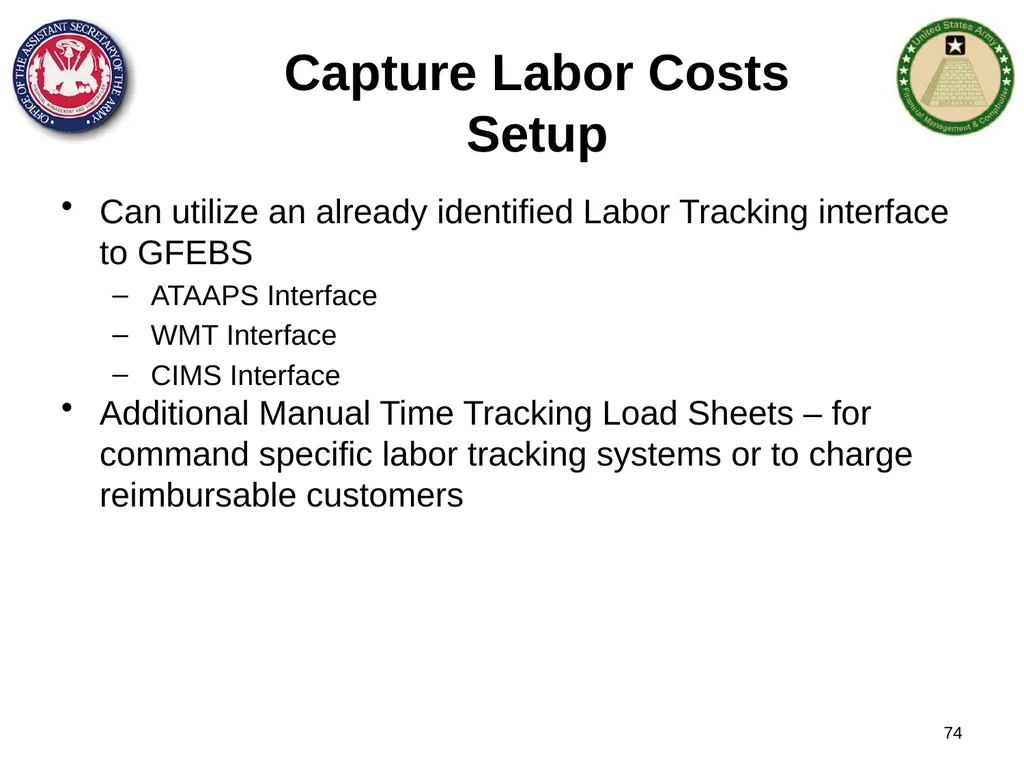
slide74. Capture Labor Costs Setup Can utilize an already identified Labor Tracking interface to GFEBS
ATAAPS Interface
WMT Interface
CIMS Interface
Additional Manual Time Tracking Load Sheets – for command specific labor tracking systems or to charge reimbursable customers<br>
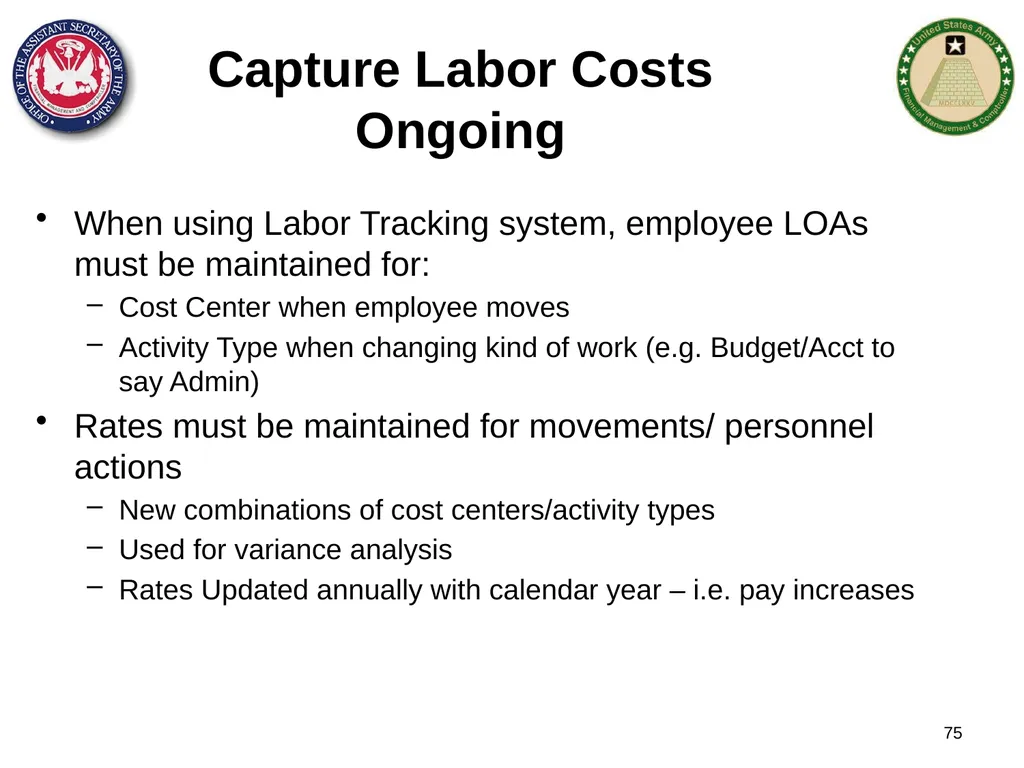
slide75. Capture Labor Costs Ongoing When using Labor Tracking system, employee LOAs must be maintained for:
Cost Center when employee moves
Activity Type when changing kind of work (e.g. Budget/Acct to say Admin)
Rates must be maintained for movements/ personnel actions
New combinations of cost centers/activity types
Used for variance analysis
Rates Updated annually with calendar year – i.e. pay increases<br>
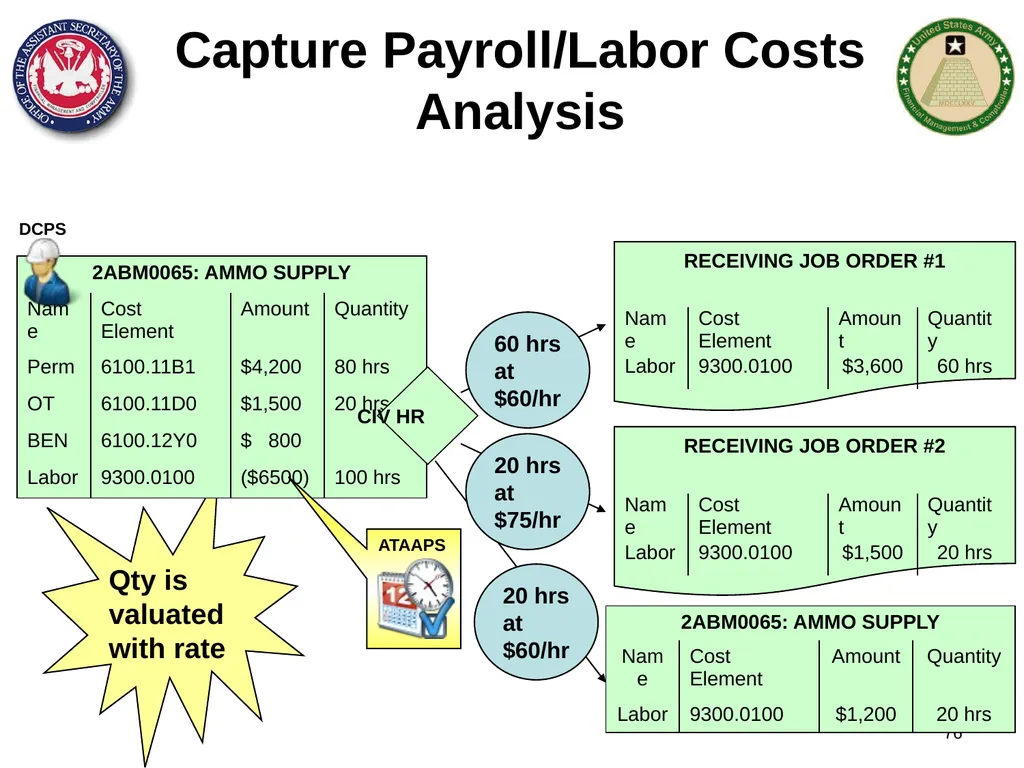
slide76. Capture Payroll/Labor Costs Analysis 60 hrs
at
$60/hr 20 hrs
at
$75/hr Qty is valuated
with rate 20 hrs
at
$60/hr<br>
slide77. Lesson 5: Wrap Up Payroll process is the reporting of attendance with the corresponding disbursement to the employees
Capturing payroll costs through DCPS requires modification to DCPS LOA’s. Updated information will be part of “Faces to Spaces” deployment exercise.
Payroll process includes the accruals, but not the earmarking of funds to ensure availability for future payroll
Labor-tracking is the capture of hours worked on specific tasks. Attendance is the recording of presence only.
Labor charge outs are used to charge hours out based on a std. rate. This rate corresponds to a Cost Center/Activity Type combination and updated annually (calendar year)<br>
slide78. Lesson 5: Quiz All employees are assigned to a __________ during the “Faces to Spaces” exercise.
__________ are used to charge out labor allocations in order to assign quantity and a dollar amount to specific tasks. Also leveraged in variance analysis to ensure that the correct amounts are being allocated.
__________ is responsible for updating the employee’s DCPS LOA information prior to an installation using GFEBS.
Time Tracking is the tracking of whether or not an employee came to work
True
False
Explain how the employee’s LOA should look in both the payroll and Time Tracking Source System<br>
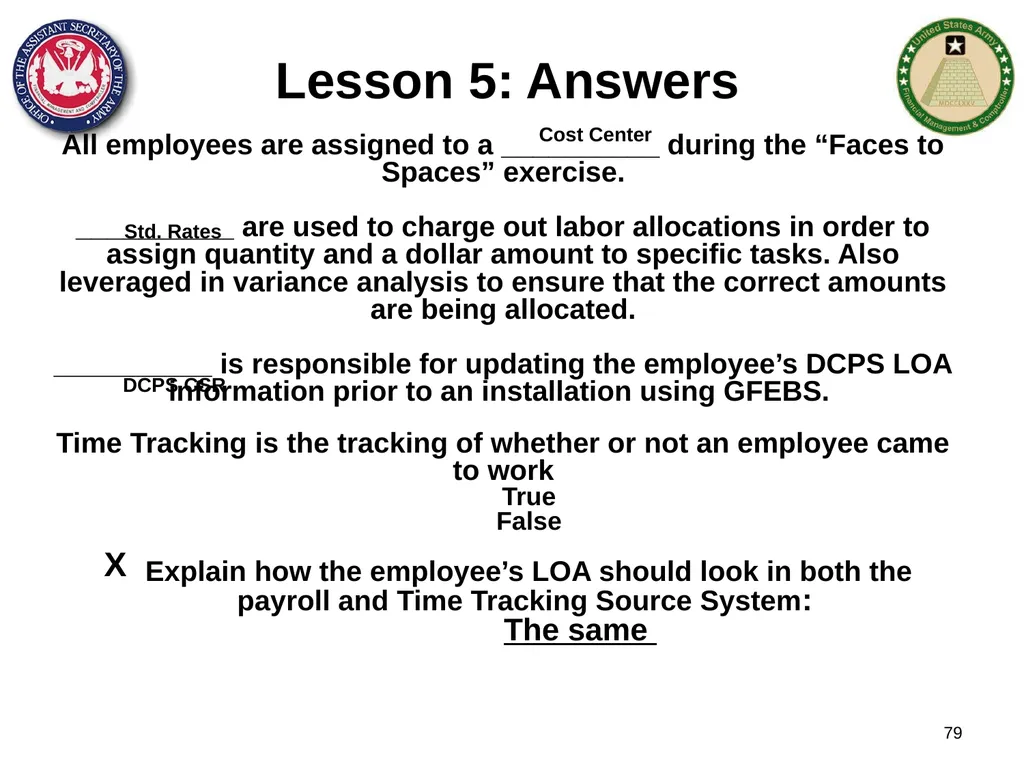
slide79. Lesson 5: Answers All employees are assigned to a __________ during the “Faces to Spaces” exercise.
__________ are used to charge out labor allocations in order to assign quantity and a dollar amount to specific tasks. Also leveraged in variance analysis to ensure that the correct amounts are being allocated.
__________ is responsible for updating the employee’s DCPS LOA information prior to an installation using GFEBS.
Time Tracking is the tracking of whether or not an employee came to work
True
False
Explain how the employee’s LOA should look in both the payroll and Time Tracking Source System:
The same X Cost Center Std. Rates DCPS CSR<br>
slide80. Exercise #2 For your organization:
Cost Centers
Activity Types
What are the kinds of products/services performed which time tracking can be captured
What are some primary and secondary cost elements that would be posted to the orgs<br>
slide81. Lesson 6: WBS Elements Objective(s):
To understand what the Project WBS Element cost object represents, uses, and how defined for the Cost Model<br>
slide82. SAFM-CE Army Cost Model
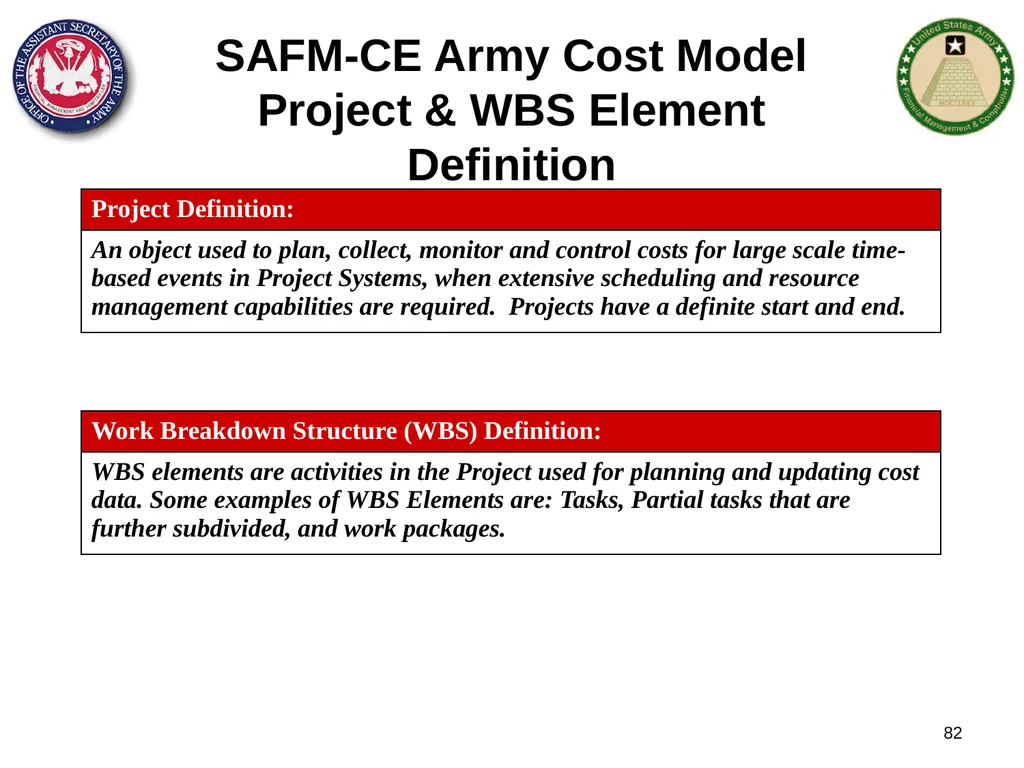
Project & WBS Element Definition<br>
slide83. SAFM-CE Army Cost Model
WBS Element Uses Projects and WBS Elements are master data elements of the Project System (PS) will be utilized to support project oriented areas such as environmental, maintenance, R&D, RDT&E, etc
PS will be utilized to replace the IFS functionality and will utilize Projects/ WBS Elements as cost objects for tracking the costs associated with repairs and SSPs
MEDCOM uses WBS Elements to represent all non-organizational costs that need to be recorded
Needed to support interface with DMLSS and cost reporting in EAS IV.<br>
slide84. SAFM-CE Army Cost Model
WBS Element Uses Even though WBS Elements are master data for the PS module of GFEBS they are cost objects for the Cost Model and fully integrated within the Controlling module
WBS Elements are utilized to represent reimbursing work (e.g. MIPRS, Direct Charge)
The receiver of the MIPR is responsible for creating the WBS Element<br>
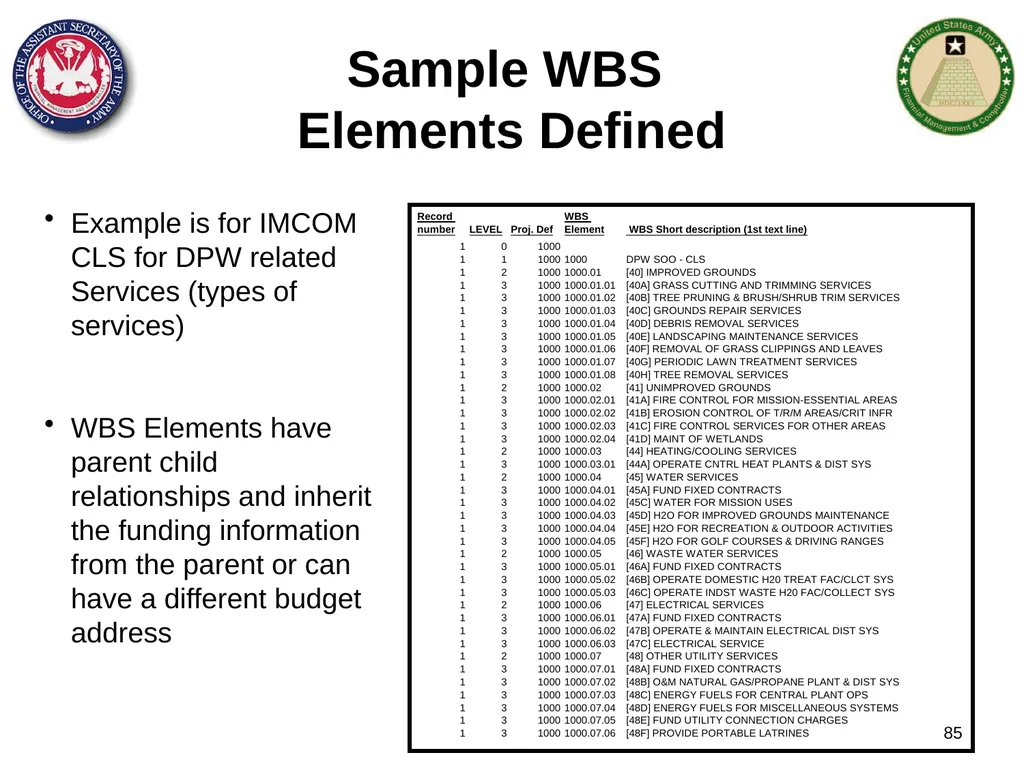
slide85. Sample WBS Elements Defined Example is for IMCOM CLS for DPW related Services (types of services)
WBS Elements have parent child relationships and inherit the funding information from the parent or can have a different budget address<br>
slide86. Lesson 6: Wrap-Up Work Breakdown Structure (WBS) Element is a cost object defined and maintained within a Project residing in the Project Systems (PS) module
WBS Elements are cost objects and therefore fully integrated within the Controlling module for use within the Cost Model
WBS Elements will be utilize to support Maintenance functionality which is integrated with Plant Maintenance orders
WBS Elements are utilized for Reimbursables<br>
slide87. Lesson 6: Quiz A WBS Element is (check all that apply)?
master data of the controlling module
a component of a Project System
utilized to support Maintenance activities
Provides project accounting
support reimbursables<br>
slide88. Lesson 6: Answers A WBS Element is:
a component of a Project System
utilized to support Maintenance activities
used to provided project accounting
used to support reimbursables
A WBS Element is not - master data of the controlling module <br>
slide89. Lesson 7: Orders Objective(s):
To understand what the Order cost object represents, key definition criteria (guiding principles), uses, and how defined for the Cost Model<br>
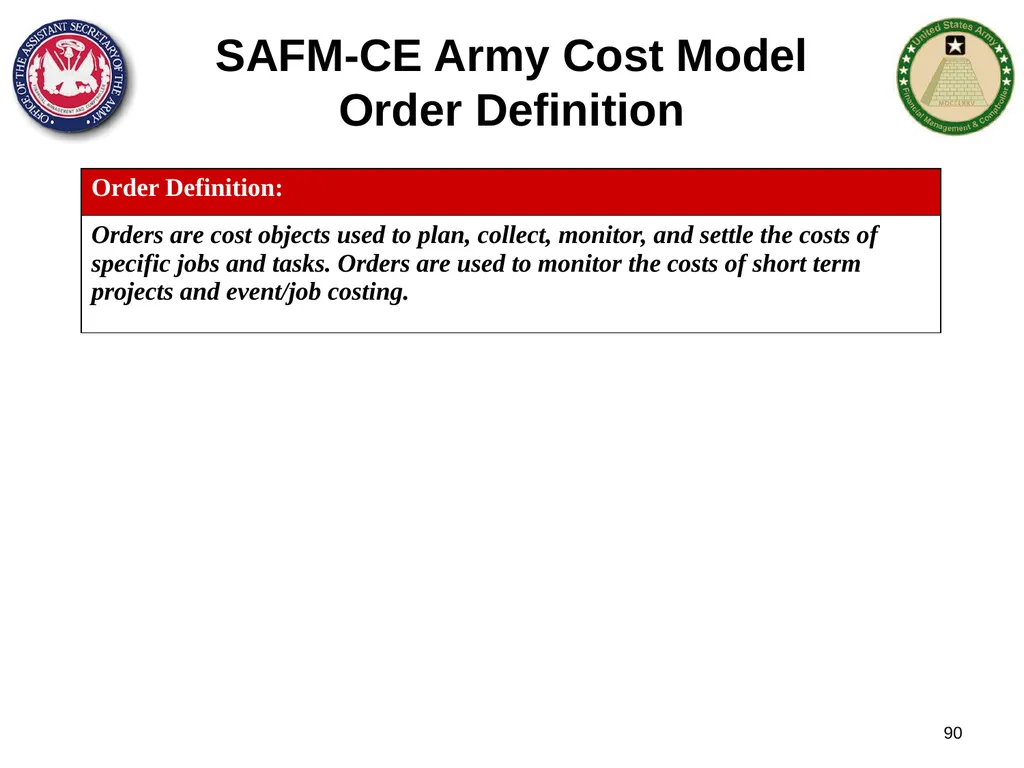
slide90. SAFM-CE Army Cost Model
Order Definition<br>
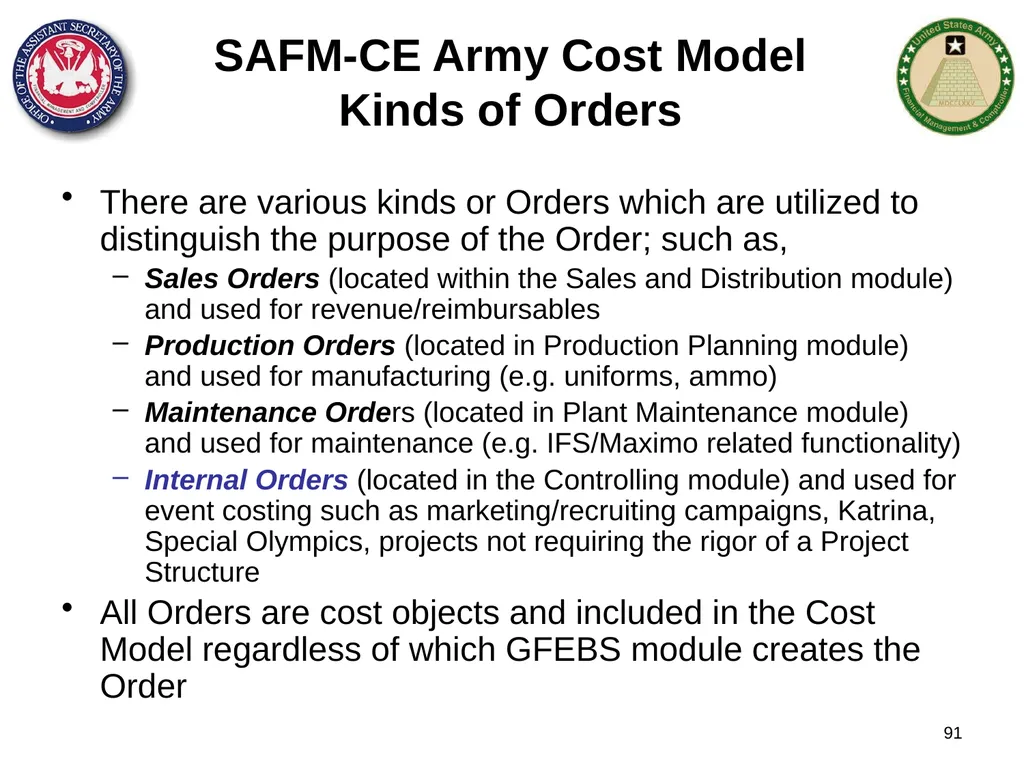
slide91. SAFM-CE Army Cost Model
Kinds of Orders There are various kinds or Orders which are utilized to distinguish the purpose of the Order; such as,
Sales Orders (located within the Sales and Distribution module) and used for revenue/reimbursables
Production Orders (located in Production Planning module) and used for manufacturing (e.g. uniforms, ammo)
Maintenance Orders (located in Plant Maintenance module) and used for maintenance (e.g. IFS/Maximo related functionality)
Internal Orders (located in the Controlling module) and used for event costing such as marketing/recruiting campaigns, Katrina, Special Olympics, projects not requiring the rigor of a Project Structure
All Orders are cost objects and included in the Cost Model regardless of which GFEBS module creates the Order<br>
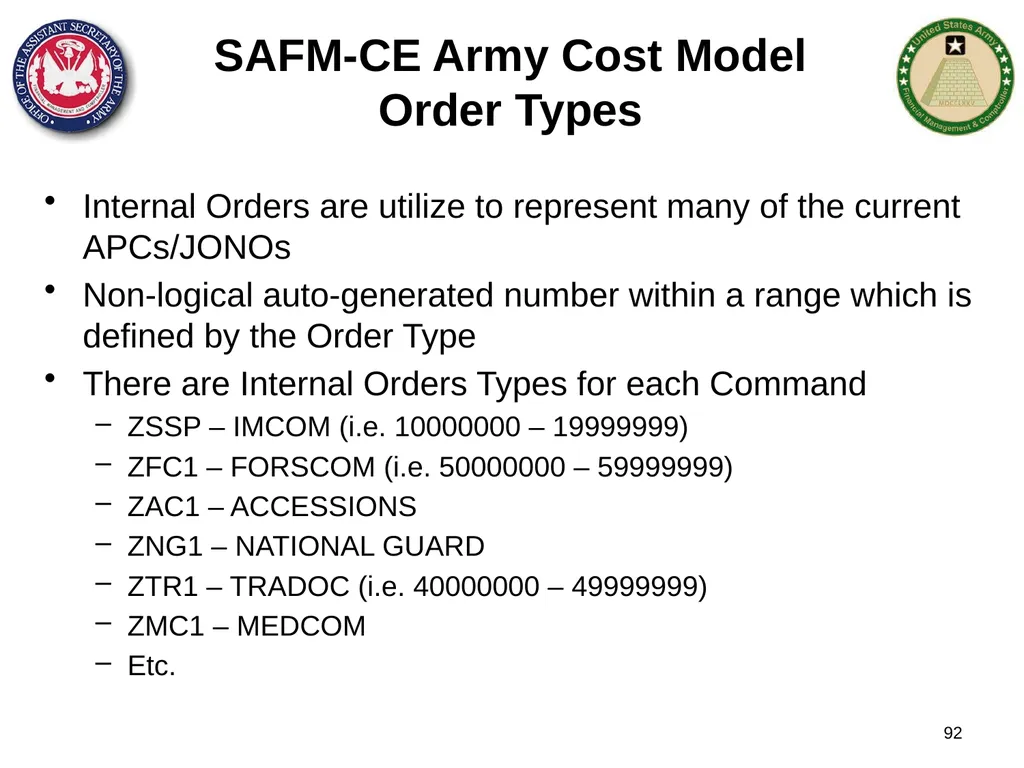
slide92. SAFM-CE Army Cost Model
Order Types Internal Orders are utilize to represent many of the current APCs/JONOs
Non-logical auto-generated number within a range which is defined by the Order Type
There are Internal Orders Types for each Command
ZSSP – IMCOM (i.e. 10000000 – 19999999)
ZFC1 – FORSCOM (i.e. 50000000 – 59999999)
ZAC1 – ACCESSIONS
ZNG1 – NATIONAL GUARD
ZTR1 – TRADOC (i.e. 40000000 – 49999999)
ZMC1 – MEDCOM
Etc.<br>
slide93. SAFM-CE Army Cost Model
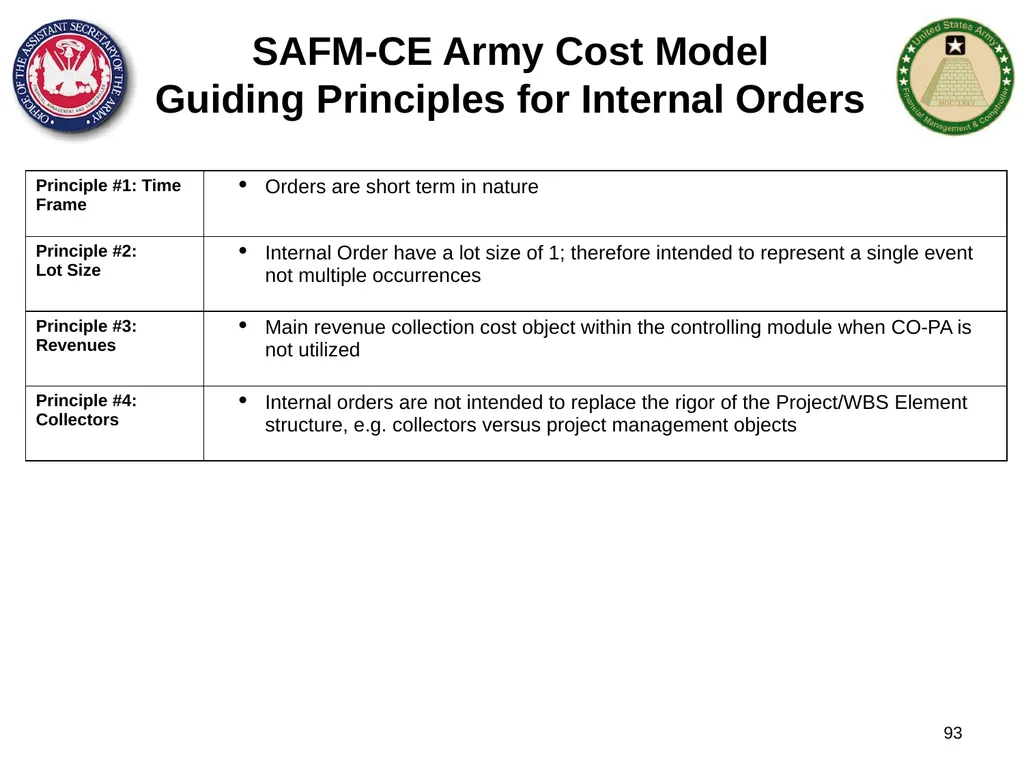
Guiding Principles for Internal Orders<br>
slide94. SAFM-CE Army Cost Model
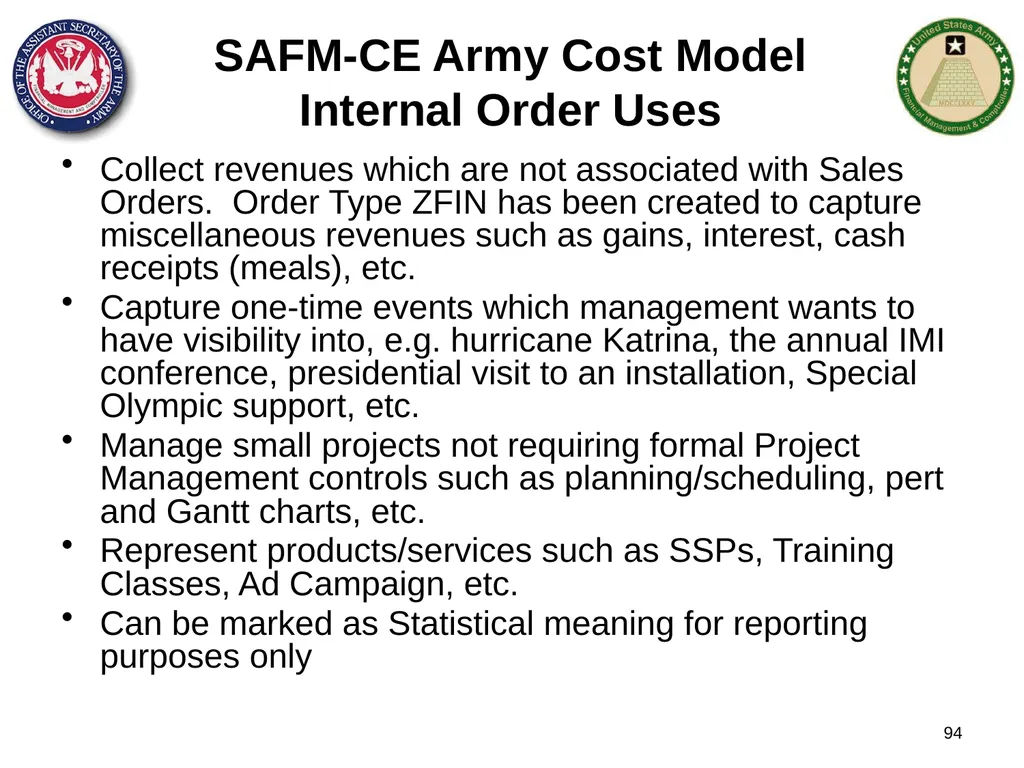
Internal Order Uses Collect revenues which are not associated with Sales Orders. Order Type ZFIN has been created to capture miscellaneous revenues such as gains, interest, cash receipts (meals), etc.
Capture one-time events which management wants to have visibility into, e.g. hurricane Katrina, the annual IMI conference, presidential visit to an installation, Special Olympic support, etc.
Manage small projects not requiring formal Project Management controls such as planning/scheduling, pert and Gantt charts, etc.
Represent products/services such as SSPs, Training Classes, Ad Campaign, etc.
Can be marked as Statistical meaning for reporting purposes only<br>
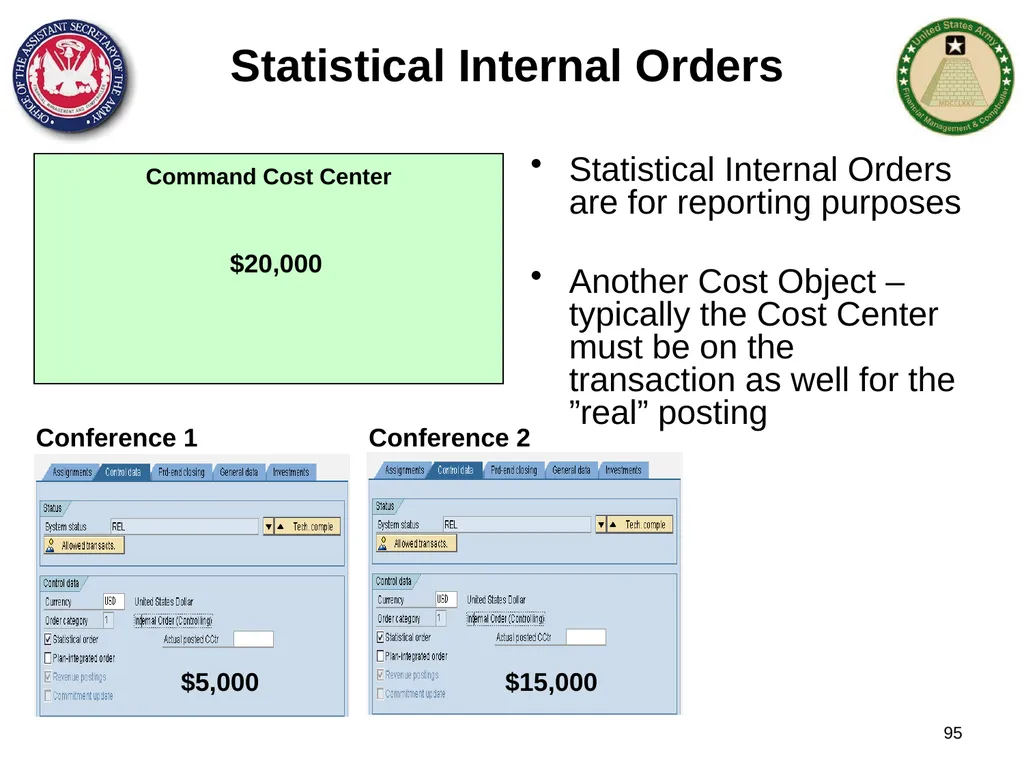
slide95. Statistical Internal Orders Statistical Internal Orders are for reporting purposes
Another Cost Object – typically the Cost Center must be on the transaction as well for the ”real” posting Command Cost Center Conference 1 Conference 2 $5,000 $15,000 $20,000<br>
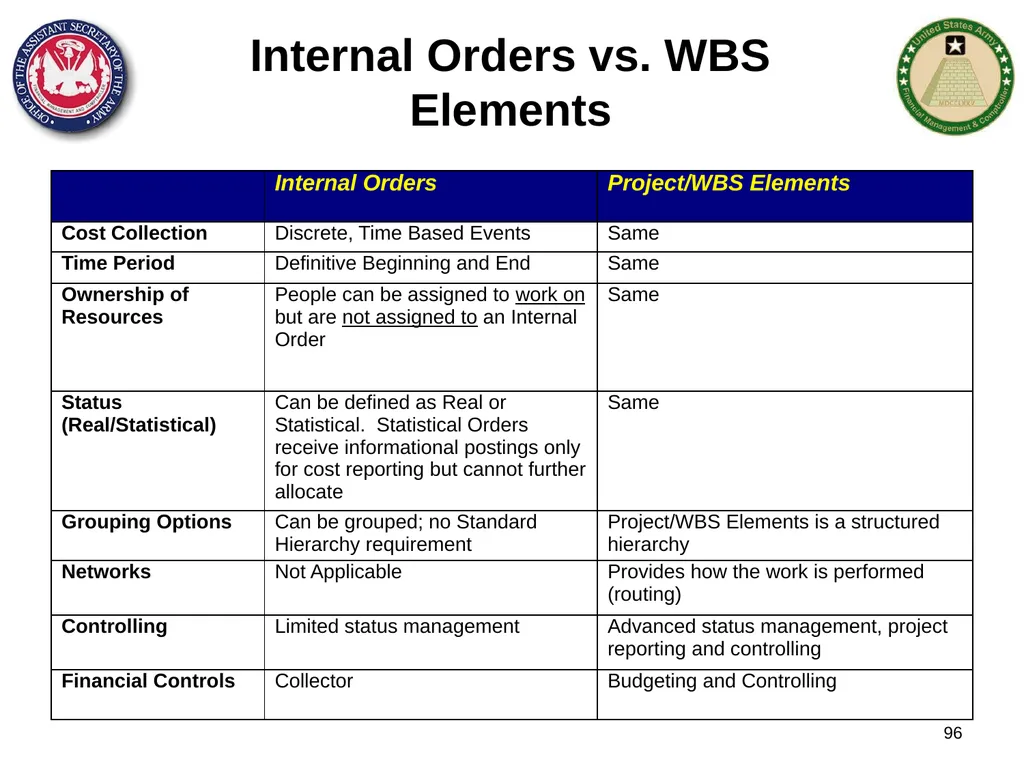
slide96. Internal Orders vs. WBS Elements<br>
slide97. Example of Internal Order Use: Capturing Kinds of Travel Costs DTS is the operational system utilized by the Army to support the travel process.
To associate travel processed and completed to the financial system, a DTS Line of Accounting is created within DTS.
To support multiple requirements an updated DTS LOA (10X20) and process is utilized by organizations deployed to GFEBS
FMR Compliance for Funds Availability Check
BTA SFIS Compliance for 4 digit year identifier
Multiple Cost Objects versus a single APC.<br>
slide98. Capture Travel Costs Setup Need to first determine where the travel cost needs to be recorded: Organization? Event? Project? Customer?
Customer: directly to WBS Element representing that reimbursement
Event: (e.g. GFEBS Training) then to the order representing that event
Organization: then to a Cost Center
Need to identify if further transparency required (e.g. emergency leave, TDY in transit)<br>
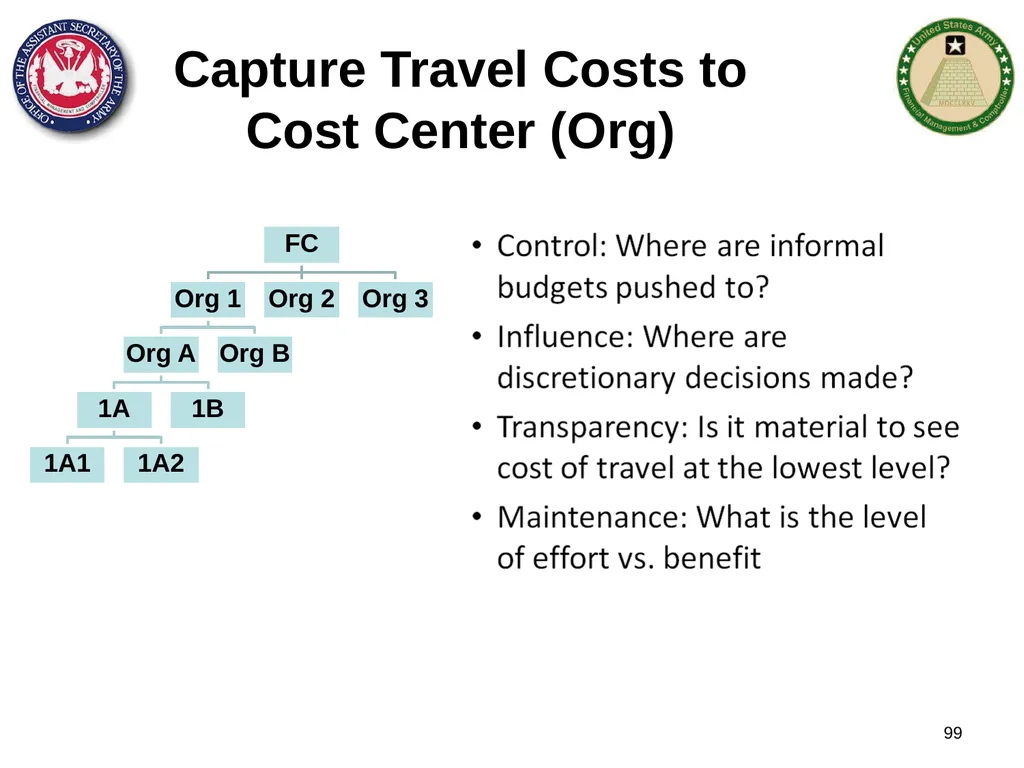
slide99. Capture Travel Costs to Cost Center (Org)<br>
slide100. Capture Travel Costs Internal Order DTS LOA’s can capture costs directly to orders being used to reflect events (conferences, products, SSP’s, FCA codes, etc)
If “kind” of travel is needed then IO’s can reflect that level therefore multiple cost objects can by on DTS LOA (e.g. Emergency Travel, TDY, etc)
Can consume multiple budget addresses on same order which requires multiple DTS LOAs with the same internal order number<br>
slide101. Lesson 7: Wrap-Up Orders are cost objects used to plan, collect, monitor, and settle the costs of specific jobs and tasks. Orders are used to monitor the costs of short term projects and event/job costing.
There are multiple order types which are used for various focused purposes; e.g. Sales Orders, Maintenance Orders, Internal Orders, etc.
Internal Order Type ZSSP will include all non-DPW CLS-SSPs
Internal Orders provided a sub-view of the costs within a Cost Center or a cross Cost Center view<br>
slide102. Questions An Internal Order is interchangeable with Cost Center?
True
False Like a Cost Center, Internal Orders can capture costs only?
True
False Internal Orders can be identified as statistical (informational only) or real (capture and transfer costs)?
True
False S2L7_p<br>
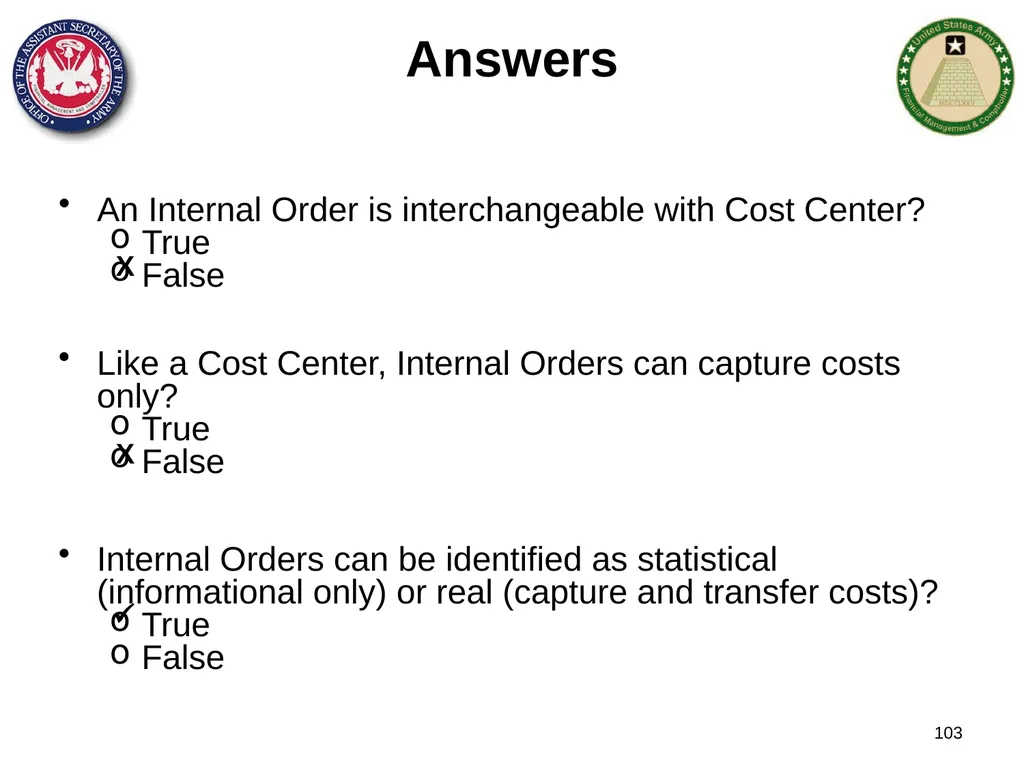
slide103. Answers An Internal Order is interchangeable with Cost Center?
True
False Like a Cost Center, Internal Orders can capture costs only?
True
False Internal Orders can be identified as statistical (informational only) or real (capture and transfer costs)?
True
False X X<br>
slide104. Lesson 8: Business Process Objective(s):
To understand what the Business Process cost object represents, key definition criteria (guiding principles), uses, and how defined for the Cost Model<br>
slide105. Lesson 8: Business Process Objective(s):
To understand what the Business Process cost object represents, key definition criteria (guiding principles), uses, and how defined for the Cost Model<br>
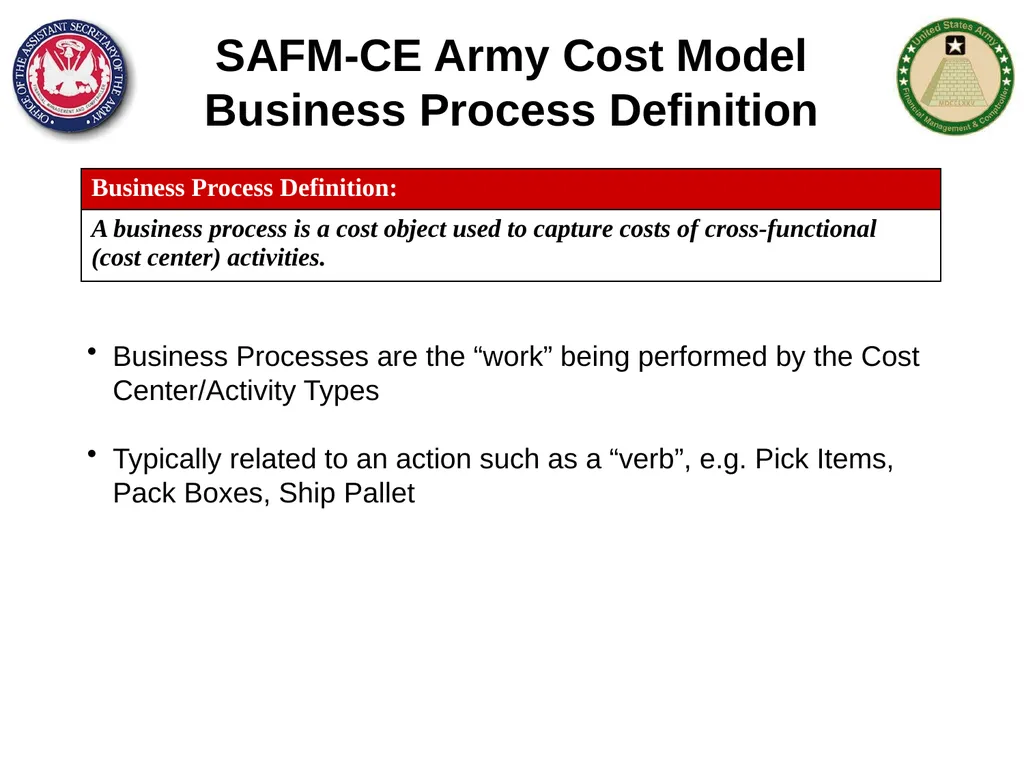
slide106. SAFM-CE Army Cost Model
Business Process Definition Business Processes are the “work” being performed by the Cost Center/Activity Types
Typically related to an action such as a “verb”, e.g. Pick Items, Pack Boxes, Ship Pallet<br>
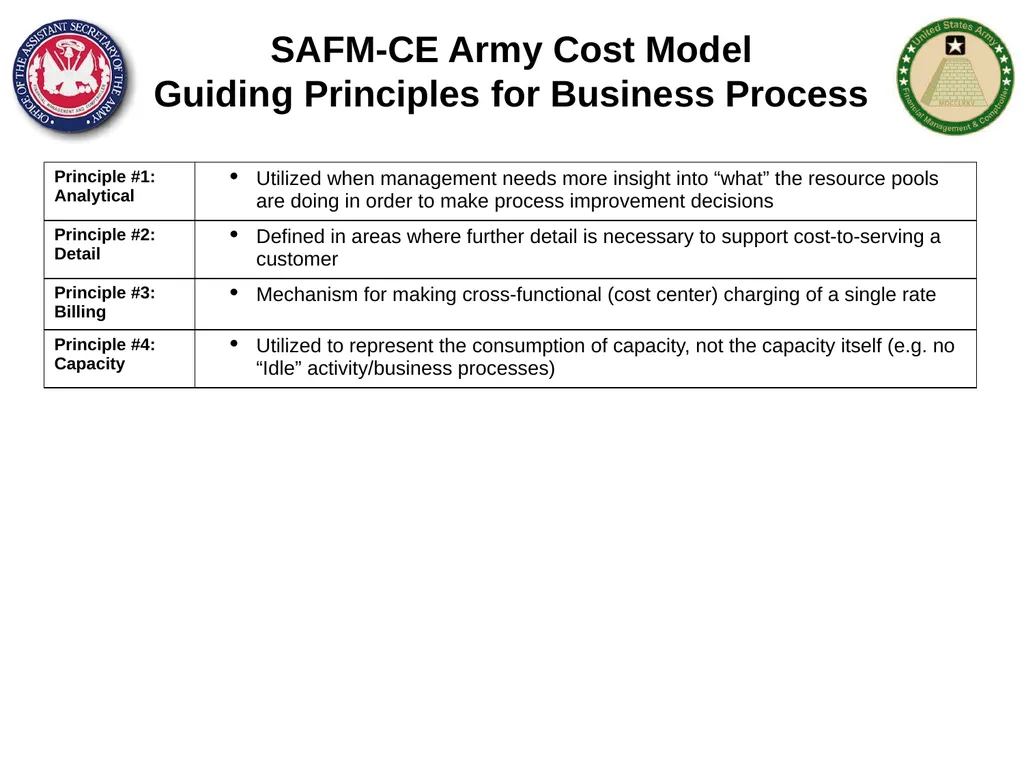
slide107. SAFM-CE Army Cost Model
Guiding Principles for Business Process<br>
slide108. SAFM-CE Army Cost Model
Business Process Uses Used to support activity-based costing initiatives
For utilization of a single consolidated rate of a similar activity performed across several cost centers
Represent repetitive services that are not Order based (e.g. Process Help Desk Ticket)<br>
slide109. SAFM-CE Army Cost Model
How Business Processes are defined Utilized to associate the goods for free to the consumers
Assignments/Allocation using Business Processes will be defined in conjunction with the DASA-CE Cost Team<br>
slide110. SAFM-CE Army Cost Model
Business Processes Std. Hierarchy There is a Business Process Std. Hierarchy to which all business processes must be assigned when created.
The currently defined Business Process Hierarchy groups processes into Services, this will be augmented as other commands are included into the Cost Model
Additionally, alternative hierarchies can be generated as needed
Groups of processes can also be generated to support ad-hoc reporting or cost allocations<br>
slide111. Lesson 8: Wrap-Up A business process is a cost object used to capture costs of cross-functional (cost center) activities
Reflect the utilization of capacity of a resource pool (activity type)
Can have a rate associated supporting a $/per occurrence of the process being charged to the receiver
Must be assigned to the Business Process Std. Hierarchy but can also be assigned to alternative groups for reporting<br>
slide112. Questions A Business Process is interchangeable with an Activity Type
True
False<br>
slide113. Answer A Business Process is interchangeable with an Activity Type
True
False X<br>
slide114. Lesson 9: Statistical Key Figures Objective(s):
To understand what the Statistical Key Figure represents, uses, and how defined for the Cost Model<br>
slide115. SAFM-CE Army Cost Model
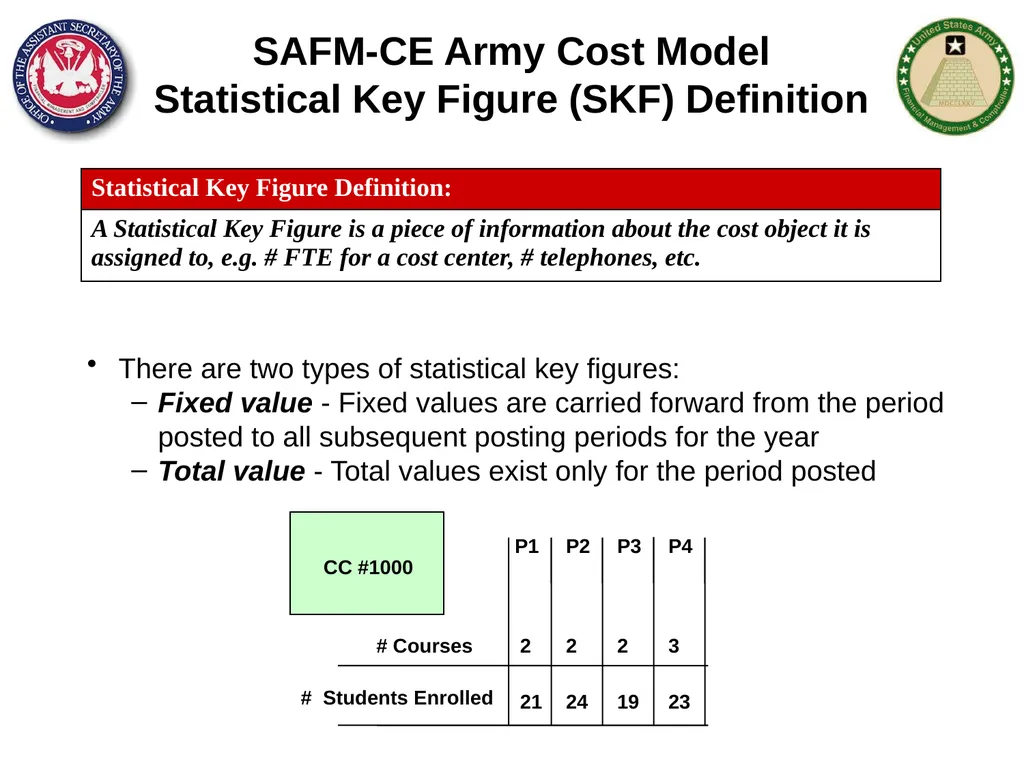
Statistical Key Figure (SKF) Definition There are two types of statistical key figures:
Fixed value - Fixed values are carried forward from the period posted to all subsequent posting periods for the year
Total value - Total values exist only for the period posted<br>
slide116. SAFM-CE Army Cost Model
Statistical Key Figure Uses As a basis (cost driver) for cost assignments, e.g. # telephones to allocate out the phone bill
To measure performance, e.g. # surveys SKF can be planned for the year and then actuals captured to report progress
To calculate a unit cost rate in unit cost report. This report is designed specifically for the Army and allows for some or all of the costs on the cost object selected to be divided by the SKF on that cost object to calculate a Unit Cost rate of the SKF, e.g. $/meal<br>
slide117. SAFM-CE Army Cost Model
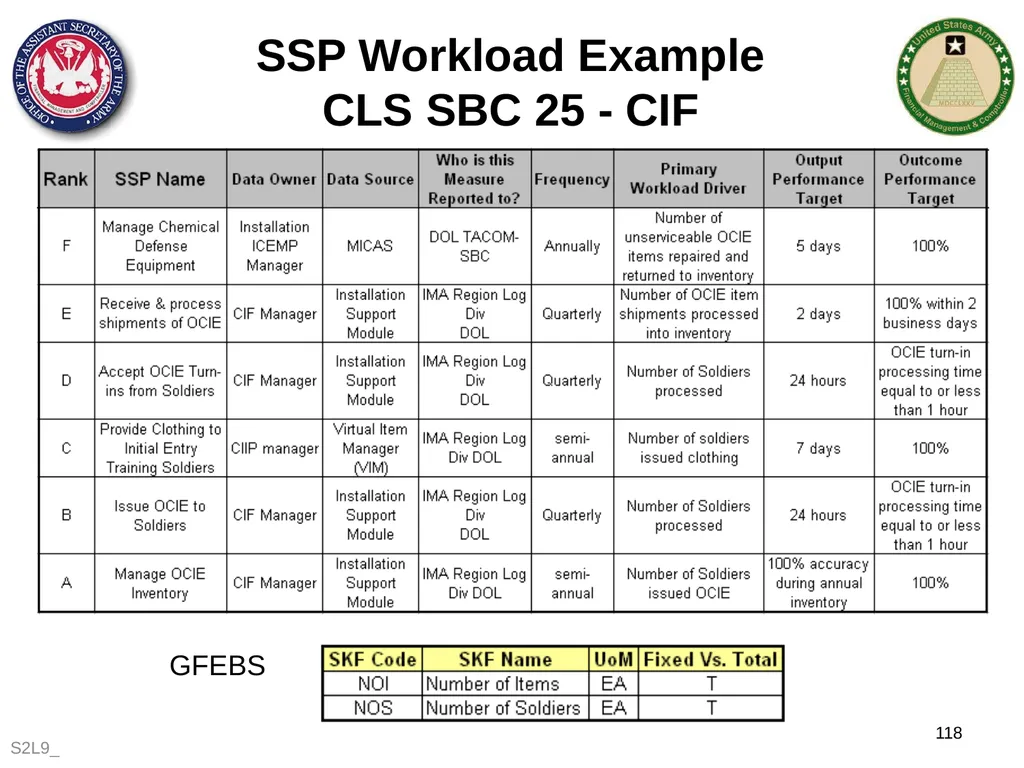
How SKFs are defined Identify the workload measures of the organizations
Review off-line reports that merge financial information with outputs produced
SKFs have to be associated with a cost object and the information must then be captured and maintained (directly or via some system feed)<br>
slide118. SSP Workload Example
CLS SBC 25 - CIF GFEBS S2L9_<br>
slide119. Lesson 9: Wrap-Up A Statistical Key Figure is a piece of information about the cost object it is assigned to, e.g. # FTE for a cost center, # telephones, etc.
There are two types of SKFs; Fixed which pre-populates the same data for each period until changed and Total which represents the total value of that SKF for that period only
Utilized as cost drivers/basis for cost allocations and performance reporting
Must be assigned to a cost object<br>
slide120. Questions There is a limited number of SKFs that can be assigned to a Cost Object?
True
False _______ statistical key figure varies each period.
_______ statistical key figure is static from the period of entry through to the end of the year.<br>
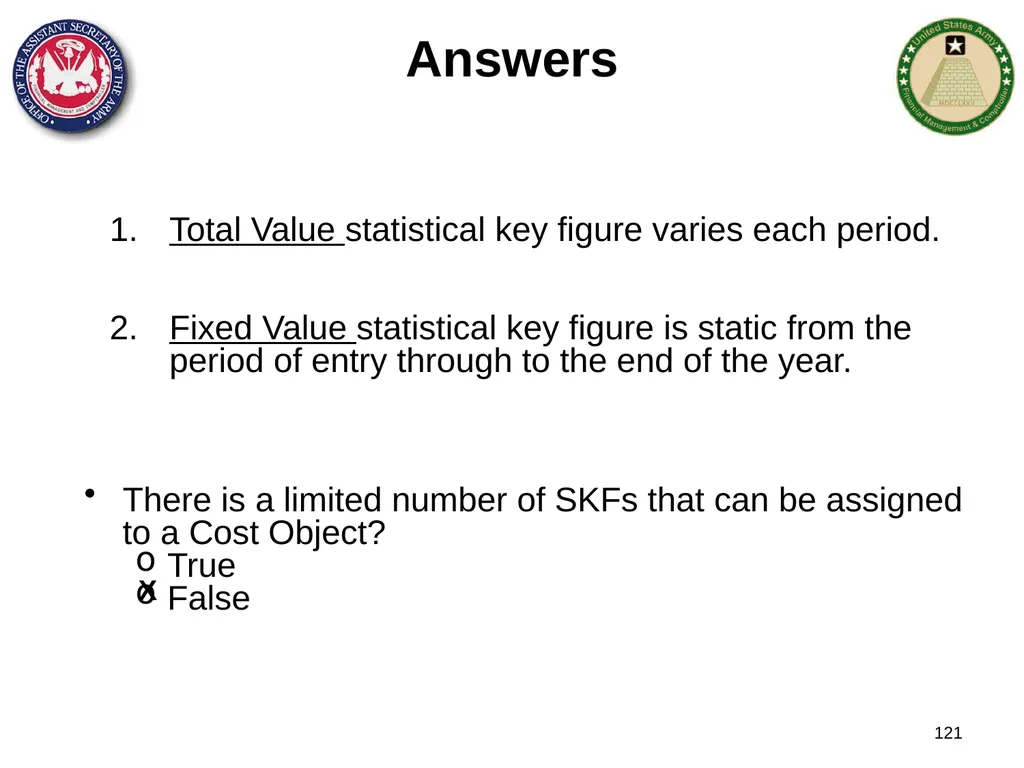
slide121. Answers There is a limited number of SKFs that can be assigned to a Cost Object?
True
False Total Value statistical key figure varies each period.
2. Fixed Value statistical key figure is static from the period of entry through to the end of the year. X<br>
slide122. Exercise #3 For your organization:
Identify what object for your products/services – Project/WBS Element or Internal Orders
What Statistical Key Figures (SKF) could be tracked?<br>
What are costs and why is managing costs important?
Army’s overall objectives
Change enablers to support Cost Management
The process of Cost Management and how it differs from Budget Management
Section 2: Cost Model Components
Defining the various cost objects (which replace APCs/JONOs) within a Cost Model, e.g. organizations, products, services, jobs, etc.
Understanding decision points of where to capture information
Section 3: Cost Flow Methods
The difference between cost capturing, allocations, and assignment
Section 4: Cost Model Build
Reflecting organizational structures
Replacing APC/JONO’s CM 101 Training 1<br>
slide2. Section 2 Objective & Agenda Section 2: Cost Model Components
Understanding of the master data available to define the cost model Lesson 1: Cost Elements
Lesson 2: Cost Terms
Lesson 3: Cost Centers
Lesson 4: Activity Types
Lesson 5: Payroll & Labor Tracking
Lesson 6: WBS Elements
Lesson 7: Orders
Lesson 8: Business Processes
Lesson 9: Statistical Key Figures 2<br>
slide3. The Army Cost Model Objects (Master Data)<br>
slide4. Lesson 1: Cost Elements Objective(s):
To understand what the Cost Element cost object represents, key definition criteria (guiding principles), uses, and how defined for the Cost Model<br>
slide5. SAFM-CE Army Cost Model
Cost Element Definition GFEBS replaces the concept of EORs with GL Accounts in Financials (FI), Commitment Items in Budgeting (FM) and Cost Elements in Cost Management (CO)<br>
slide6. SAFM-CE Army Cost Model
Guiding Principles for Cost Elements Flight Hotel Meal Individual Transactions<br>
slide7. SAFM-CE Army Cost Model
Cost Element Uses Capture actual costs (expenditures, imputed costs, allocations, etc.)
Plan cost by organizations (Cost Centers), activity types or products/services
Reporting of individual expense categories or grouped together to support internal (management) and external (OMB/SFIS) reports
Move costs from one org/location to another: e.g. similar to some “cost transfers” currently performed
Primary (consumed from outside) versus Secondary (consumed from inside)
Maintain debit/credit integrity for expense related postings within the Controlling component of GFEBS<br>
slide8. Expenditures externally sourced, such as most of today’s EORs (excluding the 2700s)
Typically (but not necessarily e.g., depreciation) indicative of cash out flows
Start with the USGL indicator, such as 6100 or 6400 for expenses
Are a 1:1 match with the General Ledger Account utilized for Financial Accounting Primary Cost Elements Examples:
6100.11B1 Civilian Base Pay - Full-time Permanent
6100.11B3 Civilian Base Pay - Other than Full-time Permanent
6100.21T0 TDY Travel
6100.252A Information Technology Services – Processing
6400.13H0 VSIP TAX -15% Remittance to CSRDF<br>
slide9. Assigned/service fees to an object for consuming products/services providing by another object. (e.g. 2714 Shop Stock)
Non-cash outlays (would have occurred with the Primary Cost Element posting)
Start with a 9 series preface to indicate that they are not associated with the General Ledger, e.g. internal only
There are multiple types of secondary cost elements to support allocations, charge outs, overhead surcharges, etc. Secondary Cost Elements Examples:
9000.2714 MATERIAL SHOP STOCK
9300.0100 LABOR CHARGE - REG
9300.01OT LABOR CHARGE - OT
9400.0150 MILITARY LABOR CHARGE<br>
slide10. Cost Elements Example Cost Center: CIF Military
Labor Director of
Logistics (DOL) Total $$$$$ Total - $$$$ Over/Under Absorption $$$$<br>
slide11. SAFM-CE Army Cost Model
How Cost Elements are Defined For Primary Cost Elements:
Started with EORs for both pay and non-pay
Evaluated information embedded in code/EOR
Determined if another GFEBS data element could hold that info and collapsed where possible (e.g. C-Type, Vendor, Type of Interest Payment)
Reviewed external reporting requirements such as OMB Object Classes, USGL, SFIS mappings
When a GL Account it determined a Primary Cost Element is also created with the exact same code
Once live, new Primary Cost Elements are typically rarely added and as needed to support external reporting<br>
slide12. EOR crosswalk to GL Discussion EORs will no longer be used in GFEBS; yet, the same information previously maintained through EORs will be supported via different methods 60+ in GFEBS as:
FI GL Accounts
Primary Cost Elements
Commitment Items C-type is removed from Accounts in GFEBS and reported via BI Labor Report GFEBS BI Labor
Report by
C-Type<br>
slide13. SAFM-CE Army Cost Model
How Cost Elements are Defined For Secondary Cost Elements:
Determined types of cost allocations/ assignments to be supported (assumed all possible in GFEBS)
Determine internal management reporting detail needs, continues to expand with maturity
Identified impacts for budget/non-budget relevant in funds management
Secondary Cost Elements are constantly being added as assignments/allocations are updated/changed in order to provide transparency for management reporting<br>
slide14. Cost Element Groups Cost Elements can be grouped together to support
Reporting: e.g. all labor related primary cost elements into a group called Payroll Labor
Reconciliation: e.g. the primary cost element used to procure shop stock with the secondary cost element used to allocate shop stock to manage the under/over absorption
Allocations: e.g. allocating a combination of cost elements to multiple receivers
Hierarchies: e.g. by creating cost element groups within cost element groups a hierarchy is generated which can be utilized to meet OMB Object Class and SFIS reporting requirements<br>
slide15. Lesson 1: Wrap-Up A Cost Element is the lowest level component for classifying costs and revenues (as negative costs) and indicates the category/type associated with a posting (e.g. allocation type, revenue, expense)
There are two types of Cost Elements: Primary and Secondary
Primary Cost Elements represent those obtained from the external market, the initial posting
Secondary Cost Elements represent costs incurred from within the Army
EORs and the EOR information will be supported via GFEBS through GL Accounts, Commitment Items, and Primary Cost Elements
Cost Elements can be grouped together to support internal and external reporting including to generate hierarchies such as OMB Object Class<br>
slide16. Lesson 2: Cost Terms Objective(s):
Understand the key terms involved with Cost Management<br>
slide17. Cost Terms There is a language to Cost Management, however there are many dialects!
There is an inconsistency of cost terms in the market driven by outgrowth from manufacturing to the introduction of service costing
Cost terms additionally differ based on costing philosophy (e.g. standard costing, activity-based costing, theory of constraints, etc.)
Army has determined the Cost Terms to be propagated to provide a level set language for understanding Cost information<br>
slide18. Many Types Costs Direct costs— A cost such as labor, materials/supplies that can be directly traced to producing a specific output of an organization, product/service.
Indirect costs – A cost that cannot be directly traced to a specific organization, product/service output.
Funded Costs -- The value of goods or services received because of an obligation of funds (obligation authority), by the organization performing the work.
Unfunded costs -- A cost that are financed by another organization's or activity's appropriations.
Variable Costs -- A cost that changes with change in output.
Fixed Cost -- A cost that remains the same regardless of the change in output.
Recurring Cost -- A cost that is incur repeatedly for each organization and/or product/service produced .
Non-Recurring Cost -- A cost that is unusual and unlikely to occur again.
Avoidable Costs -- A cost incurred on an object that will no longer be incurred due to a decision to change the output.
Unavoidable Cost -- A cost incurred on an object that will be incurred regardless of the decision to change. Common Understanding of Types of Cost is Necessary for Informed Decision Making
Each Decision Should be Focused on Only Relevant Cost that Impact the Decision<br>
slide19. Type of Cost Functions X X X<br>
slide20. Funded vs Unfunded The terms Funded and Unfunded define the relationship of the appropriation dollars consumed to the organization utilizing those funds.
Classification of the dollars input (utilized) in relationship to the organization responsible for the output<br>
slide21. Funded Costs – The value of goods or services received because of an obligation of funds (obligation authority), by the organization performing the work. (e.g. civilian labor, building and grounds maintenance). These costs are funded in the Annual Operating Budget of the organization. Funded Costs<br>
slide22. Unfunded Costs – Costs that are financed by another organization's or activity's appropriations. These costs do not result in any obligation of funds by the organization; examples include depreciation, military labor, and military rations. Unfunded Costs Example:<br>
slide23. Direct vs. Indirect Costs Direct and Indirect define the relationship of the cost incurred to the output provided
Direct and Indirect are often contentious terms since they imply responsibility for control (view changes depending on where you sit in the organization) Cost Center $$$ $$ Relationship with # output… # HRS # HRS<br>
slide24. Direct Costs – A cost such as labor, materials/ supplies that can be directly traced to producing a specific output of an organization, product/service Direct Costs Cost Center: CIF Military
Labor Director of
Logistics (DOL) Material $$$ Labor $$$ DOL Support $$$ Contracts $$$ Travel $$$ Military Labor $$$ Facilities $$$<br>
slide25. Indirect Costs – Costs that cannot be directly traced to a specific output. They are often allocated on some predetermined basis and are generally synonymous with overhead, such as general and administrative expenses. Indirect Costs Cost Center: CIF Director of
Logistics (DOL) Material $$$ Labor $$$ DOL Support $$$ Contracts $$$ Travel $$$ Military Labor $$$ Facilities $$$<br>
slide26. Recurring vs Non Recurring The terms Recurring and Non-Recurring define regularity of the occurrence of the expense
Recurring Costs are those that incur repeatedly for each organization and/or product/service produced (e.g. payroll, materials)
Non-Recurring Costs are those that are unusual and unlikely to occur again (e.g. Hurricane, GFEBS deployment)<br>
slide27. Fixed vs Variable Fixed and Variable define the influence on the dollar relationship of the cost incurred to the output provided
Are defined within a relevant time, such as the plan cycle (i.e. 1 year.) Cost Center $$$ Influence on $$s in relationship with # output… # HRS # HRS<br>
slide28. Fixed Cost - A cost that remains the same regardless of the change in output, within a relevant range (e.g., rent, supervisor).
Variable Costs - A cost that changes with change in output (e.g., cost of material, labor, utilities). Fixed and Variable Costs Cost Center: CIF Military
Labor Material $$$ Labor $$$ $$$ Contracts $$$ $$$ Travel $$$ Fix Var<br>
slide29. The Prices Video<br>
slide30. Avoidable Costs - A cost incurred on an object that will no longer be incurred due to a decision to change the output, such as contract labor to operate the test range
Unavoidable Cost - A cost incurred on an object that will be incurred regardless of the decision to change output, such as depreciation on equipment Decision Specific Cost Concepts<br>
slide31. Lesson 2: Wrap-Up Cost Management has a language of its own and terms have a different meaning then when used for other purposes
Common understanding of types of cost is necessary for informed and decision making
Types are usually in pairs and can only be one or the other (e.g. Funded or Unfunded)
Each cost can have multiple types considered (e.g. Funded, Direct, Unavoidable)
Each decision should be focused on only relevant cost that impact the decision<br>
slide32. Exercise # 1: List Cost Differences<br>
slide33. Answers to 1 through 4 Direct costs - directly traced to producing a specific output
Indirect costs - cannot be directly traced to a specific output
Recurring Costs – those costs that occur year over year
Non-Recurring Costs – one time within the year of execution and not planned to happen again
Variable Costs - changes with change in output
Fixed Cost - remains the same regardless of the change in output (within a relevant range)
Avoidable Costs - will no longer be incurred due to a decision to change the output
Unavoidable Cost - will be incurred regardless of the decision to change output<br>
slide34. Question #5: Provide Examples of When Labor is? Direct
Indirect
Funded
Unfunded
Recurring
Non-Recurring
Variable
Fixed
Avoidable
Unavoidable Answer: Discussion<br>
slide35. Lesson 3: Cost Centers Objective(s):
To understand what the Cost Center cost object represents, key definition criteria (guiding principles), uses, and how defined for the Cost Model<br>
slide36. Cost Center Groups Full Cost Understanding Starts with Cost Center Structure 1BCT FORSCOM
MSE 2BCT DPW Garrison Commander DRM TRNG School
House RM Fund Center<br>
slide37. SAFM-CE Army Cost Model
Cost Center Definition This definition lends itself to multiple varied utilizations of the cost center object to reflect the costs of an organization
Further criteria/principles along with the Cost Center’s purpose must be utilized to better indicate when a Cost Center is appropriate
The purpose of the Cost Center object is to serve as the base for the management optimization model – the model utilized to reflect the business, it’s inputs, conversions, and outputs in order to support management decisions
The Cost Center is the first cost object to be defined for the Cost Model
To support the appropriate definition of a Cost Center within an entity, Guiding Principles should be considered<br>
slide38. SAFM-CE Army Cost Model
Definition Standards for Cost Center<br>
slide39. SAFM-CE Army Cost Model
Definition Standards for Cost Center<br>
slide40. SAFM-CE Army Cost Model
Cost Centers Uses People Related: e.g. DRM/G8 office
Facilities Related: e.g. Warehouses, Hospitals, Office Space
Equipment Related: e.g. Citrix farm accessing GFEBS, Cranes/Trucks
Blended: e.g. mix of resources within a organization, e.g. Vehicles and Mechanics DRM/G8 Building Type 1 Network Admin Building Type 2 Equipment Motor Pool<br>
slide41. Cost Center Creation Review of “working” TDAs
Review of wirecharts
Interviews at each location identify other organizations that need to be added to the list of Cost Centers
Analysis of UIC codes to identify all MTOE units which are within an ASN
Compliance with Standard Command structures defined (e.g. IMCOM SGO, MEDCOM MTFs, etc.) Output<br>
slide42. Cost Center Information<br>
slide43. SAFM-CE Army Cost Model
Cost Center Hierarchy In addition to defining the Cost Centers and the attribute information for each individual Cost Center, the Cost Centers need to be identified on a standard hierarchy
There is a single standard hierarchy which every Cost Center will reside on to ensure that all costs can be reported from a single hierarchy
Alternative hierarchies can be defined as needed to meet management objectives
The Cost Center Hierarchy is utilized to support Informal Budget Distribution and Budget Execution Status of Available Fund report aggregation<br>
slide44. GFEBS: Cost Center Example – Hierarchy<br>
slide45. GFEBS: Cost Center Example – Center<br>
slide46. GFEBS: Cost Center Example – Center Actual Report<br>
slide47. Budget Reporting with a Cost View 47<br>
slide48. Lesson 3: Wrap-Up A cost center is a responsibility center that incurs costs and has a manager who is accountable for those costs
Costs of the cost center are material in nature (worth capturing vs. the cost of capturing)
A cost center has a long life span of more than 1 year (typically years) and has a manager responsible for the resources consumed and the outputs produced by the cost center
Every cost center resides on the standard hierarchy
Alternative cost center hierarchies can exist as well
CC Hierarchy is utilized to support Informal Budgets and Status of Available Funds Reporting<br>
slide49. Questions: A cost center is a cost object used to represent any APC?
True
False A cost center is utilized to capture the revenues generated by the outputs of an organization
True
False<br>
slide50. Answers: A cost center is a cost object used to represent any APC?
True
False A cost center is utilized to capture the revenues generated by the outputs of an organization
True
False X X<br>
slide51. Questions: A cost center can be assigned to more than 1 standard hierarchy?
True
False There is only one cost center in every fund center (ASN)
True
False<br>
slide52. Answers: A cost center can be assigned to more than 1 standard hierarchy?
True
False There is only one cost center in every fund center (ASN)
True
False X X<br>
slide53. Lesson 4: Activity Types Objective(s):
To understand what the Activity Type cost object represents, key definition criteria (guiding principles), uses, and how defined for the Cost Model<br>
slide54. SAFM-CE Army Cost Model
Activity Type Definition The term activity type is often confused with an activity, of the Activity-Based Costing approach – however it does not represent an activity. Activities are generally identified with a verb, e.g. Pick Items, Pack Box, Ship Pallet
A more appropriate translation is Resource Pool, e.g. groups of like kind resources within an organization that perform an activity such as TECH HR, SUPV HR, MACHR
Activity Types have a rate/output associated are the utilization of capacity to perform “work” to generate a product/service, e.g. TECH HR @ $10/Hr<br>
slide55. SAFM-CE Army Cost Model
Activity Type Uses People e.g. RMO
Manager & Analyst RMO Motor Pool Blended e.g. Motor Pool
Mechanic & Vehicle Cost Center Activity Type<br>
slide56. SAFM-CE Army Cost Model
Guiding Principles for Activity Types<br>
slide57. SAFM-CE Army Cost Model
Activity Type Uses Capture Capacity or Planned Output, e.g. grandma works 2088 Hrs or machine runs 3500 Hrs (10 Hrs/Day for 350 days)
Holds the rate for the output of the resource pool, e.g. $2 Hr, $5 Hr, $20 Hr
Assigns capacity consumed by products/ services, e.g. Hrs/min worked per dress, which then valuates based on the rate Cost per Dress differs based on Resource/Activity Type used Interchangeable
Not Similar Technology
Not Homogenous – needs resources (input cost structure) of food versus laborer versus electricity<br>
slide58. Activity Types facilitate capacity management and there are various types of capacity (e.g. Productive, Non-Productive, Idle/Excess, etc.)
Activity Types provide the capacity information required to optimize the conversion of inputs to generate the most outputs – meeting the “Efficiently” portion of the Cost Management definition
Activity Types are defined as master data, however they exist only in conjunction with a Cost Center
Activity Type = MACHR is assigned to Cost Center 1 and Cost Center 2 resulting in CC1/MACHR and CC2/MACHR each of which holds their own rate, their planned output, captures actuals, etc. Capacity Management<br>
slide59. SAFM-CE Army Cost Model
How Activity Types are Defined The project and production related areas are familiar with the concepts of labor and equipment rates and often have std. rates for charging level of effort for like kind resources to work on an order, e.g. IFS
Maintenance shop rates are reviewed and then grouped/expanded upon into like kind resources
Equipment Activity Types are defined based on a review and grouping of equipment, e.g. Dump Truck 6T
Vehicle Activity Types are defined based on GSA classification into groupings<br>
slide60. Activity Types Non-Labor Examples<br>
slide61. SAFM-CE Army Cost Model
How Activity Types are Defined Current Labor definitions from OPM, DOL, NSPS are reviewed (e.g. GS, WG, NSPS)
Labor series/categories, bands (e.g. 1 – 4 depending on labor classification), and type of work (e.g. regular versus overtime) generate starting point for labor activity types<br>
slide62. Faces to Spaces to
Activity Types The Cost Center and Activity Type will be updated on the DCPS accounting information as the default Cost Center/Activity Type for an employee
To determine the Activity Type for each person an exercise of mapping people (Faces) to cost centers (Spaces) occurred, and then an Activity Type is assigned
The Activity Type is associated with the ATAAPS entry for time tracking or via the work order confirmation process (confirmations associate labor and non-labor activity types to the work order supported<br>
slide63. Lesson 4: Wrap-Up An Activity Type is a cost object that represents a group of resources within a Cost Center. These resource groups have capacity and a unit of measure such as: labor hours, machine hours, square footage, etc. Activity Types are consumed and utilized to the produce the products and services of the organization.
There are several guiding principles for the definition of an Activity Type which should be considered
The Activity Type is the cost object which supports capacity management
Each person will be assigned their default activity type based on NSPS, WG, GS, cost center assigned, etc.<br>
slide64. Question: Resources within Activity Types
(Check All that Apply) are: similar technology
homogeneous
able to be planned for $s and qtys
interchangeable
tracked in actual or imputed
the responsibility of one manager/team
what provide the capacity for “work” to be performed<br>
slide65. Answer: Resources within Activity Types
(Check All that Apply) are: similar technology
homogeneous
able to be planned for $s and qtys
interchangeable
tracked in actual or imputed
the responsibility of one manager/team
what provide the capacity for “work” to be performed <br>
slide66. Lesson 5: Capture Payroll/Labor Costs Objective(s):
To understand how payroll and labor costs can be captured, maintenance required, and what information can be reported/analyzed<br>
slide67. Payroll vs. Labor Process Payroll Process - the tracking of time for attendance purposes and corresponding payment to employees as well as accruing for work performed but not yet paid
Labor Process - the tracking of time for recordation to a specific cost of outputs (services, customers, course, etc.)<br>
slide68. Capture Payroll/Labor Costs Time Tracking vs. Attendance<br>
slide69. Capture Civilian Payroll Costs Overview DCPS remains the operational system for calculating and disbursing Civilian payroll
Reports gross disbursements from ARMY
Utilizes Primary Cost Elements
Accruals for work earned but not paid is also a part of the GFEBS payroll process
DCPS line of account changes with GFEBS
No more APCs/JONOs therefore a cost object had to be utilized
DCPS doesn’t support all the GFEBS cost objects
People are management within Cost Centers
Within GFEBS ALL Payroll costs post to a Cost Center and then most be associated with the products/services/customers<br>
slide70. Capture Civilian Payroll Costs Ongoing DCPS Employee LOA
When people shift organizations they need to update the Cost Center in the record
On the Employee LOA an Activity Type is assigned as well
Identifies type of resource pool - e.g. Budget/Accounting
Is utilized to charge out for organizations doing Labor Tracking<br>
slide71. Capture Civilian Payroll Costs Analysis Payroll reporting provides
Payroll costs per organization
Information by employee by budget address
Visibility over paid hrs by pay type/GRC – REG, OT, Holiday
C-type information
Variance analysis showing Employee Actuals versus Std. Rate charged out REPRESENTS THE EXPENSES CURRENTLY RESIDING ON THE COST CENTER<br>
slide72. No Army wide approach for time tracking currently
Army’s need for Time Tracking
Labor accounts for nearly 70% of Army AFP
Visibility into what tasks are being performed by who and to which output
Ability to determine what Products/Services are worked on
Visibility into non-productive time
Need to bill reimbursable customers for services rendered
Work is tracked by cost center to receiving Cost Object
Quantity of hours worked are charged out by standard rates
Rates are established to represent groups of similar work
Military labor costs will be imputed based on composite rates by rank Capture Labor Costs Overview<br>
slide73. Capture Labor Costs Overview Military and Contractor Hours may also be tracked
Labor charge outs do not always signify cash movement (e.g. non-budget relevant)
Labor is tracked by using a secondary cost element
Generates additional budget availability on Cost Center (e.g. performs “cost transfer” between sender budget) address and receiver budget address
Utilize a std. rate by activity-type – not employee
Rates must be maintained for movements/personnel actions – if new combination
Std. rates requires variance analysis
Rates updated annually with calendar year – with pay increases<br>
slide74. Capture Labor Costs Setup Can utilize an already identified Labor Tracking interface to GFEBS
ATAAPS Interface
WMT Interface
CIMS Interface
Additional Manual Time Tracking Load Sheets – for command specific labor tracking systems or to charge reimbursable customers<br>
slide75. Capture Labor Costs Ongoing When using Labor Tracking system, employee LOAs must be maintained for:
Cost Center when employee moves
Activity Type when changing kind of work (e.g. Budget/Acct to say Admin)
Rates must be maintained for movements/ personnel actions
New combinations of cost centers/activity types
Used for variance analysis
Rates Updated annually with calendar year – i.e. pay increases<br>
slide76. Capture Payroll/Labor Costs Analysis 60 hrs
at
$60/hr 20 hrs
at
$75/hr Qty is valuated
with rate 20 hrs
at
$60/hr<br>
slide77. Lesson 5: Wrap Up Payroll process is the reporting of attendance with the corresponding disbursement to the employees
Capturing payroll costs through DCPS requires modification to DCPS LOA’s. Updated information will be part of “Faces to Spaces” deployment exercise.
Payroll process includes the accruals, but not the earmarking of funds to ensure availability for future payroll
Labor-tracking is the capture of hours worked on specific tasks. Attendance is the recording of presence only.
Labor charge outs are used to charge hours out based on a std. rate. This rate corresponds to a Cost Center/Activity Type combination and updated annually (calendar year)<br>
slide78. Lesson 5: Quiz All employees are assigned to a __________ during the “Faces to Spaces” exercise.
__________ are used to charge out labor allocations in order to assign quantity and a dollar amount to specific tasks. Also leveraged in variance analysis to ensure that the correct amounts are being allocated.
__________ is responsible for updating the employee’s DCPS LOA information prior to an installation using GFEBS.
Time Tracking is the tracking of whether or not an employee came to work
True
False
Explain how the employee’s LOA should look in both the payroll and Time Tracking Source System<br>
slide79. Lesson 5: Answers All employees are assigned to a __________ during the “Faces to Spaces” exercise.
__________ are used to charge out labor allocations in order to assign quantity and a dollar amount to specific tasks. Also leveraged in variance analysis to ensure that the correct amounts are being allocated.
__________ is responsible for updating the employee’s DCPS LOA information prior to an installation using GFEBS.
Time Tracking is the tracking of whether or not an employee came to work
True
False
Explain how the employee’s LOA should look in both the payroll and Time Tracking Source System:
The same X Cost Center Std. Rates DCPS CSR<br>
slide80. Exercise #2 For your organization:
Cost Centers
Activity Types
What are the kinds of products/services performed which time tracking can be captured
What are some primary and secondary cost elements that would be posted to the orgs<br>
slide81. Lesson 6: WBS Elements Objective(s):
To understand what the Project WBS Element cost object represents, uses, and how defined for the Cost Model<br>
slide82. SAFM-CE Army Cost Model
Project & WBS Element Definition<br>
slide83. SAFM-CE Army Cost Model
WBS Element Uses Projects and WBS Elements are master data elements of the Project System (PS) will be utilized to support project oriented areas such as environmental, maintenance, R&D, RDT&E, etc
PS will be utilized to replace the IFS functionality and will utilize Projects/ WBS Elements as cost objects for tracking the costs associated with repairs and SSPs
MEDCOM uses WBS Elements to represent all non-organizational costs that need to be recorded
Needed to support interface with DMLSS and cost reporting in EAS IV.<br>
slide84. SAFM-CE Army Cost Model
WBS Element Uses Even though WBS Elements are master data for the PS module of GFEBS they are cost objects for the Cost Model and fully integrated within the Controlling module
WBS Elements are utilized to represent reimbursing work (e.g. MIPRS, Direct Charge)
The receiver of the MIPR is responsible for creating the WBS Element<br>
slide85. Sample WBS Elements Defined Example is for IMCOM CLS for DPW related Services (types of services)
WBS Elements have parent child relationships and inherit the funding information from the parent or can have a different budget address<br>
slide86. Lesson 6: Wrap-Up Work Breakdown Structure (WBS) Element is a cost object defined and maintained within a Project residing in the Project Systems (PS) module
WBS Elements are cost objects and therefore fully integrated within the Controlling module for use within the Cost Model
WBS Elements will be utilize to support Maintenance functionality which is integrated with Plant Maintenance orders
WBS Elements are utilized for Reimbursables<br>
slide87. Lesson 6: Quiz A WBS Element is (check all that apply)?
master data of the controlling module
a component of a Project System
utilized to support Maintenance activities
Provides project accounting
support reimbursables<br>
slide88. Lesson 6: Answers A WBS Element is:
a component of a Project System
utilized to support Maintenance activities
used to provided project accounting
used to support reimbursables
A WBS Element is not - master data of the controlling module <br>
slide89. Lesson 7: Orders Objective(s):
To understand what the Order cost object represents, key definition criteria (guiding principles), uses, and how defined for the Cost Model<br>
slide90. SAFM-CE Army Cost Model
Order Definition<br>
slide91. SAFM-CE Army Cost Model
Kinds of Orders There are various kinds or Orders which are utilized to distinguish the purpose of the Order; such as,
Sales Orders (located within the Sales and Distribution module) and used for revenue/reimbursables
Production Orders (located in Production Planning module) and used for manufacturing (e.g. uniforms, ammo)
Maintenance Orders (located in Plant Maintenance module) and used for maintenance (e.g. IFS/Maximo related functionality)
Internal Orders (located in the Controlling module) and used for event costing such as marketing/recruiting campaigns, Katrina, Special Olympics, projects not requiring the rigor of a Project Structure
All Orders are cost objects and included in the Cost Model regardless of which GFEBS module creates the Order<br>
slide92. SAFM-CE Army Cost Model
Order Types Internal Orders are utilize to represent many of the current APCs/JONOs
Non-logical auto-generated number within a range which is defined by the Order Type
There are Internal Orders Types for each Command
ZSSP – IMCOM (i.e. 10000000 – 19999999)
ZFC1 – FORSCOM (i.e. 50000000 – 59999999)
ZAC1 – ACCESSIONS
ZNG1 – NATIONAL GUARD
ZTR1 – TRADOC (i.e. 40000000 – 49999999)
ZMC1 – MEDCOM
Etc.<br>
slide93. SAFM-CE Army Cost Model
Guiding Principles for Internal Orders<br>
slide94. SAFM-CE Army Cost Model
Internal Order Uses Collect revenues which are not associated with Sales Orders. Order Type ZFIN has been created to capture miscellaneous revenues such as gains, interest, cash receipts (meals), etc.
Capture one-time events which management wants to have visibility into, e.g. hurricane Katrina, the annual IMI conference, presidential visit to an installation, Special Olympic support, etc.
Manage small projects not requiring formal Project Management controls such as planning/scheduling, pert and Gantt charts, etc.
Represent products/services such as SSPs, Training Classes, Ad Campaign, etc.
Can be marked as Statistical meaning for reporting purposes only<br>
slide95. Statistical Internal Orders Statistical Internal Orders are for reporting purposes
Another Cost Object – typically the Cost Center must be on the transaction as well for the ”real” posting Command Cost Center Conference 1 Conference 2 $5,000 $15,000 $20,000<br>
slide96. Internal Orders vs. WBS Elements<br>
slide97. Example of Internal Order Use: Capturing Kinds of Travel Costs DTS is the operational system utilized by the Army to support the travel process.
To associate travel processed and completed to the financial system, a DTS Line of Accounting is created within DTS.
To support multiple requirements an updated DTS LOA (10X20) and process is utilized by organizations deployed to GFEBS
FMR Compliance for Funds Availability Check
BTA SFIS Compliance for 4 digit year identifier
Multiple Cost Objects versus a single APC.<br>
slide98. Capture Travel Costs Setup Need to first determine where the travel cost needs to be recorded: Organization? Event? Project? Customer?
Customer: directly to WBS Element representing that reimbursement
Event: (e.g. GFEBS Training) then to the order representing that event
Organization: then to a Cost Center
Need to identify if further transparency required (e.g. emergency leave, TDY in transit)<br>
slide99. Capture Travel Costs to Cost Center (Org)<br>
slide100. Capture Travel Costs Internal Order DTS LOA’s can capture costs directly to orders being used to reflect events (conferences, products, SSP’s, FCA codes, etc)
If “kind” of travel is needed then IO’s can reflect that level therefore multiple cost objects can by on DTS LOA (e.g. Emergency Travel, TDY, etc)
Can consume multiple budget addresses on same order which requires multiple DTS LOAs with the same internal order number<br>
slide101. Lesson 7: Wrap-Up Orders are cost objects used to plan, collect, monitor, and settle the costs of specific jobs and tasks. Orders are used to monitor the costs of short term projects and event/job costing.
There are multiple order types which are used for various focused purposes; e.g. Sales Orders, Maintenance Orders, Internal Orders, etc.
Internal Order Type ZSSP will include all non-DPW CLS-SSPs
Internal Orders provided a sub-view of the costs within a Cost Center or a cross Cost Center view<br>
slide102. Questions An Internal Order is interchangeable with Cost Center?
True
False Like a Cost Center, Internal Orders can capture costs only?
True
False Internal Orders can be identified as statistical (informational only) or real (capture and transfer costs)?
True
False S2L7_p<br>
slide103. Answers An Internal Order is interchangeable with Cost Center?
True
False Like a Cost Center, Internal Orders can capture costs only?
True
False Internal Orders can be identified as statistical (informational only) or real (capture and transfer costs)?
True
False X X<br>
slide104. Lesson 8: Business Process Objective(s):
To understand what the Business Process cost object represents, key definition criteria (guiding principles), uses, and how defined for the Cost Model<br>
slide105. Lesson 8: Business Process Objective(s):
To understand what the Business Process cost object represents, key definition criteria (guiding principles), uses, and how defined for the Cost Model<br>
slide106. SAFM-CE Army Cost Model
Business Process Definition Business Processes are the “work” being performed by the Cost Center/Activity Types
Typically related to an action such as a “verb”, e.g. Pick Items, Pack Boxes, Ship Pallet<br>
slide107. SAFM-CE Army Cost Model
Guiding Principles for Business Process<br>
slide108. SAFM-CE Army Cost Model
Business Process Uses Used to support activity-based costing initiatives
For utilization of a single consolidated rate of a similar activity performed across several cost centers
Represent repetitive services that are not Order based (e.g. Process Help Desk Ticket)<br>
slide109. SAFM-CE Army Cost Model
How Business Processes are defined Utilized to associate the goods for free to the consumers
Assignments/Allocation using Business Processes will be defined in conjunction with the DASA-CE Cost Team<br>
slide110. SAFM-CE Army Cost Model
Business Processes Std. Hierarchy There is a Business Process Std. Hierarchy to which all business processes must be assigned when created.
The currently defined Business Process Hierarchy groups processes into Services, this will be augmented as other commands are included into the Cost Model
Additionally, alternative hierarchies can be generated as needed
Groups of processes can also be generated to support ad-hoc reporting or cost allocations<br>
slide111. Lesson 8: Wrap-Up A business process is a cost object used to capture costs of cross-functional (cost center) activities
Reflect the utilization of capacity of a resource pool (activity type)
Can have a rate associated supporting a $/per occurrence of the process being charged to the receiver
Must be assigned to the Business Process Std. Hierarchy but can also be assigned to alternative groups for reporting<br>
slide112. Questions A Business Process is interchangeable with an Activity Type
True
False<br>
slide113. Answer A Business Process is interchangeable with an Activity Type
True
False X<br>
slide114. Lesson 9: Statistical Key Figures Objective(s):
To understand what the Statistical Key Figure represents, uses, and how defined for the Cost Model<br>
slide115. SAFM-CE Army Cost Model
Statistical Key Figure (SKF) Definition There are two types of statistical key figures:
Fixed value - Fixed values are carried forward from the period posted to all subsequent posting periods for the year
Total value - Total values exist only for the period posted<br>
slide116. SAFM-CE Army Cost Model
Statistical Key Figure Uses As a basis (cost driver) for cost assignments, e.g. # telephones to allocate out the phone bill
To measure performance, e.g. # surveys SKF can be planned for the year and then actuals captured to report progress
To calculate a unit cost rate in unit cost report. This report is designed specifically for the Army and allows for some or all of the costs on the cost object selected to be divided by the SKF on that cost object to calculate a Unit Cost rate of the SKF, e.g. $/meal<br>
slide117. SAFM-CE Army Cost Model
How SKFs are defined Identify the workload measures of the organizations
Review off-line reports that merge financial information with outputs produced
SKFs have to be associated with a cost object and the information must then be captured and maintained (directly or via some system feed)<br>
slide118. SSP Workload Example
CLS SBC 25 - CIF GFEBS S2L9_<br>
slide119. Lesson 9: Wrap-Up A Statistical Key Figure is a piece of information about the cost object it is assigned to, e.g. # FTE for a cost center, # telephones, etc.
There are two types of SKFs; Fixed which pre-populates the same data for each period until changed and Total which represents the total value of that SKF for that period only
Utilized as cost drivers/basis for cost allocations and performance reporting
Must be assigned to a cost object<br>
slide120. Questions There is a limited number of SKFs that can be assigned to a Cost Object?
True
False _______ statistical key figure varies each period.
_______ statistical key figure is static from the period of entry through to the end of the year.<br>
slide121. Answers There is a limited number of SKFs that can be assigned to a Cost Object?
True
False Total Value statistical key figure varies each period.
2. Fixed Value statistical key figure is static from the period of entry through to the end of the year. X<br>
slide122. Exercise #3 For your organization:
Identify what object for your products/services – Project/WBS Element or Internal Orders
What Statistical Key Figures (SKF) could be tracked?<br>