Section 1: Learning Check Question 1 Please put into Slide Show Mode to begin interactive Quiz (Slide Show From Beginning) Instructions Click on responses to select answer. Use navigation arrows to advance to next question Correct Answer!
"Section 1: Learning Check Question 1 Please put" is the property of its rightful owner. Permission is granted to
download and print the materials on this website for personal, non-commercial use only, and to display it
on your personal computer provided you do not modify the materials and that you retain all copyright
notices contained in the materials. By downloading content from our website, you accept the terms of this
agreement.
Presentation Transcript
01
Section 1: Learning Check Question 1 Please put into Slide Show Mode to begin interactive Quiz
(Slide Show From Beginning) Instructions
Click on responses to select answer.
Use navigation arrows to advance to next question<br>
02
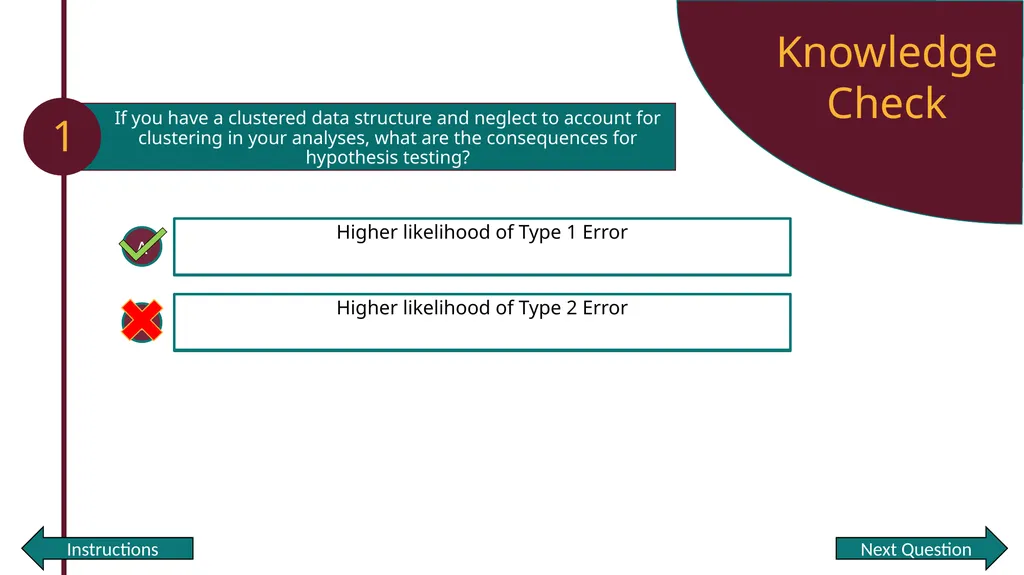
Correct Answer! The dependencies in clustered data reduce the effective sample size, which causes inflated standard errors and t-values, and thus a higher likelihood of Type 1 Error. Incorrect, Please try again! The standard errors are inflated, not deflated, by failing to account for clustering Higher likelihood of Type 2 Error Higher likelihood of Type 1 Error If you have a clustered data structure and neglect to account for clustering in your analyses, what are the consequences for hypothesis testing? 1 A B Knowledge Check Instructions Next Question<br>
03
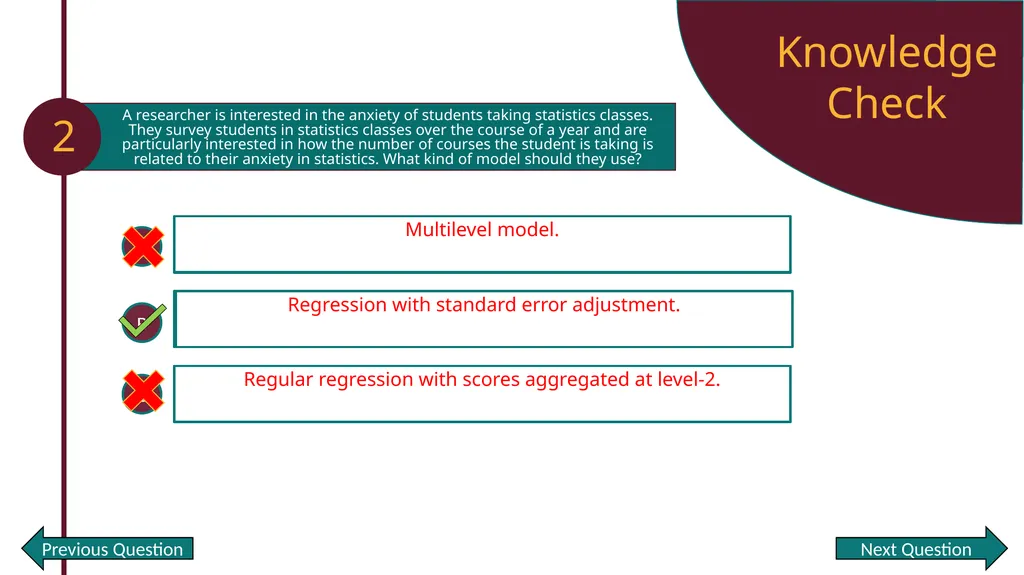
Incorrect, please try again! Would be appropriate with only level-2 predictors. Regular regression with scores aggregated at level-2. Correct Answer! Clustered data but predictor only at level-1. Incorrect, please try again! This would be appropriate when using predictors at both level-1 and level-2. Multilevel model. Regression with standard error adjustment. A researcher is interested in the anxiety of students taking statistics classes. They survey students in statistics classes over the course of a year and are particularly interested in how the number of courses the student is taking is related to their anxiety in statistics. What kind of model should they use? 2 A B C Knowledge Check Previous Question Next Question<br>
04
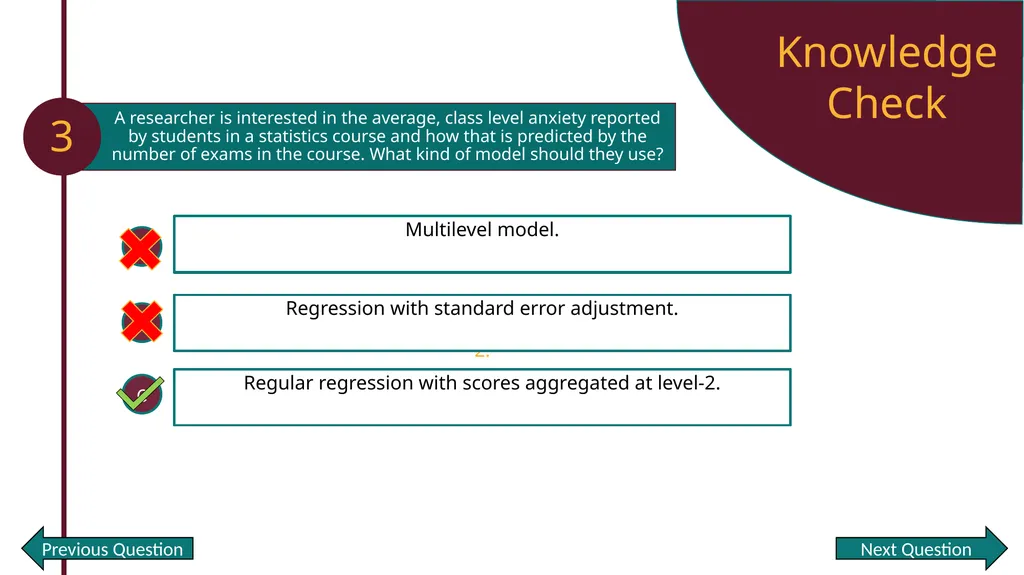
Incorrect, please try again! Would be appropriate for clustered data with predictor only at level-1. In this case predictor is at level-2. Regression with standard error adjustment. Correct! They’re only using the level-2 predictor. Incorrect, please try again! This would be appropriate when using predictors at both level-1 and level-2. Multilevel model. Regular regression with scores aggregated at level-2. A researcher is interested in the average, class level anxiety reported by students in a statistics course and how that is predicted by the number of exams in the course. What kind of model should they use? 3 A B C Knowledge Check Previous Question Next Question Regression with standard error adjustment. Multilevel model.<br>
05
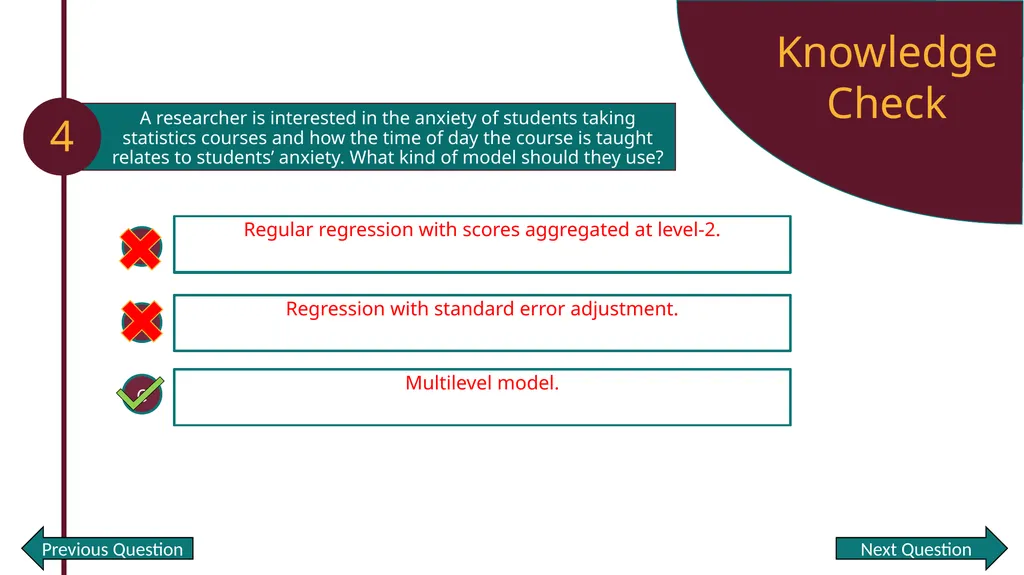
Incorrect, please try again! Would be appropriate for clustered data with predictor only at level-1. In this case predictors are at both levels. Regression with standard error adjustment. Correct! Clustered data structure using predictors at both level-1 and level-2. Incorrect, please try again! Not appropriate because there are level-1 and level-2 predictors in the model. Regular regression with scores aggregated at level-2. Multilevel model. A researcher is interested in the anxiety of students taking statistics courses and how the time of day the course is taught relates to students’ anxiety. What kind of model should they use? 4 A B C Knowledge Check Previous Question Next Question<br>
06
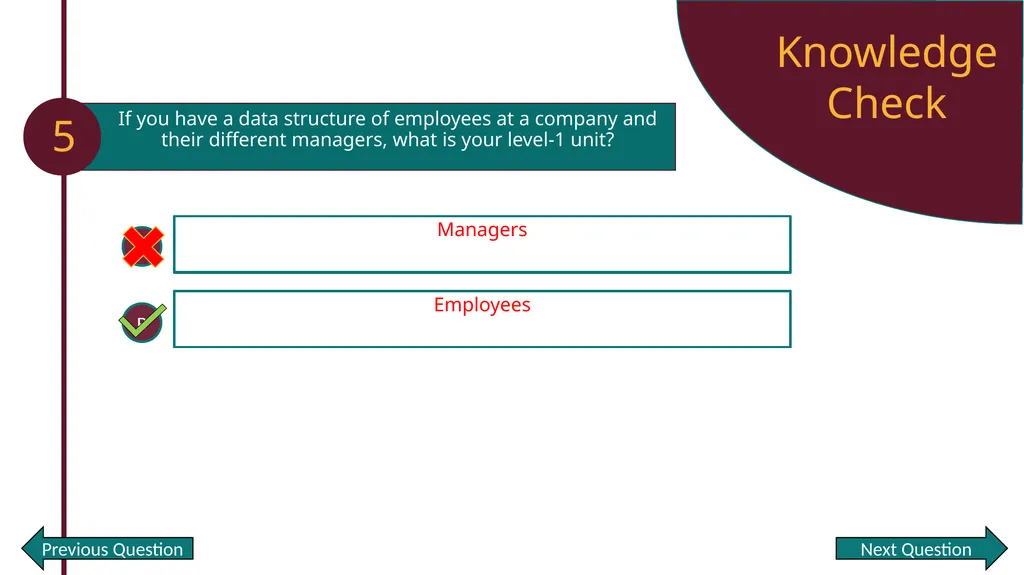
Correct! Employees are clustered within managers. Incorrect, please try again! Managers are the clustering variable, and things about them (e.g., their management style, their experience level) can introduce dependencies in the employees’ answers to questions about, for example, job satisfaction. Managers Employees If you have a data structure of employees at a company and their different managers, what is your level-1 unit? 5 A B Knowledge Check Previous Question Next Question<br>
07
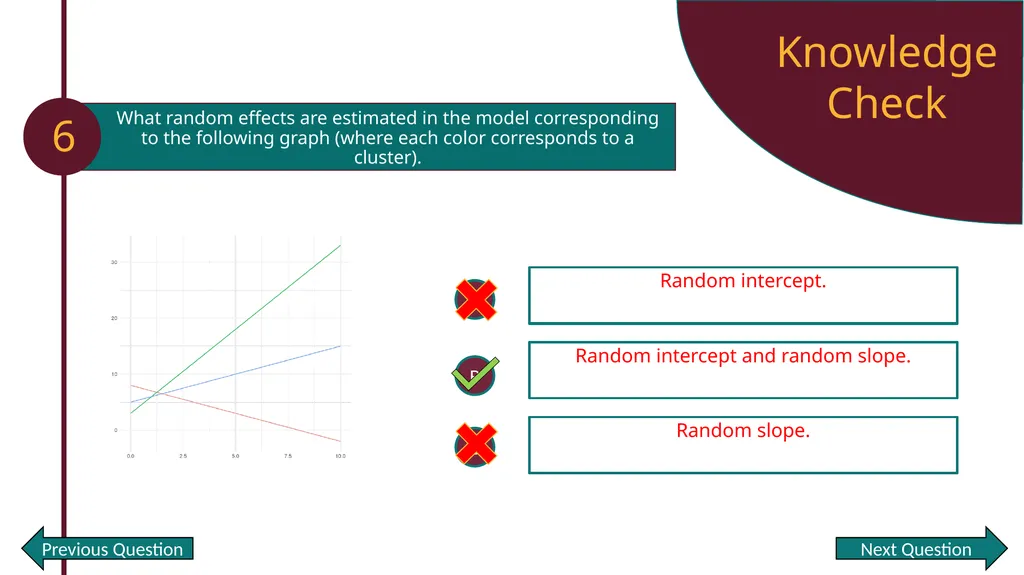
Incorrect, please try again! The slope does vary, but so does the intercept. Random slope. Correct! There is variance in the slope and intercept. Incorrect, please try again! The intercept does vary, but so does the slope. Random intercept. Random intercept and random slope. What random effects are estimated in the model corresponding to the following graph (where each color corresponds to a cluster). 6 A B C Knowledge Check Previous Question Next Question<br>
08
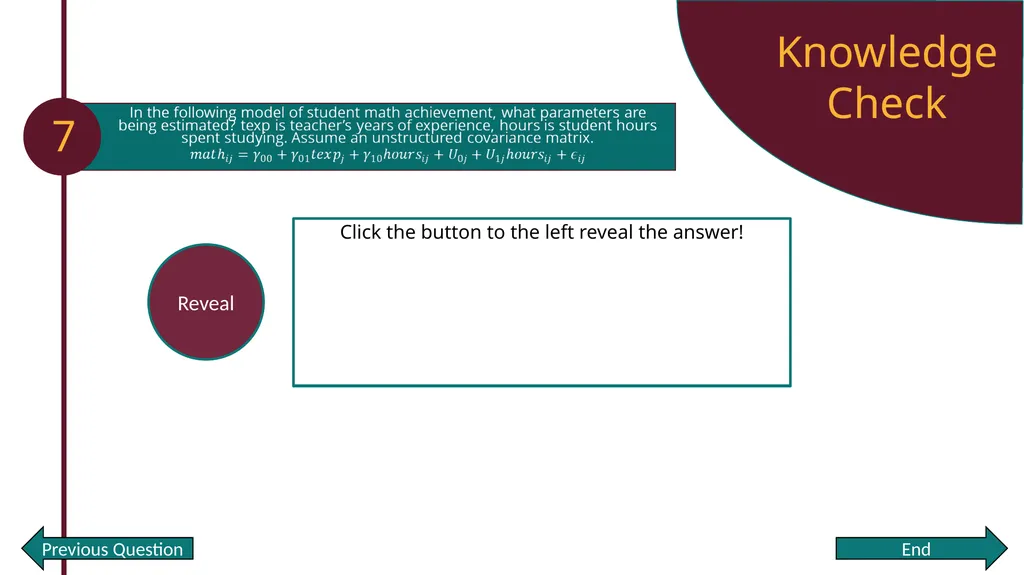
Click the button to the left reveal the answer! 7 Reveal Knowledge Check Previous Question End<br>
09
You have reached the end of this learning check Please click anywhere to exit! Previous Question<br>