
Section 188 Equal Opportunity & Accessibility for
TA
Published · 53 slides · 0 views
1 / 1
Description
Section 188 Equal Opportunity Accessibility for People with Disabilities in American Job Centers Presented by: The Workforce Investment Council of Washington, DC In collaboration with the LEAD Center April 26, 2018 1 Presenter 1 2 Lauren
Related Topics
Share
Embed code
Download this presentation From Below
"Section 188 Equal Opportunity & Accessibility for" is the property of its rightful owner. Permission is granted to download and print the materials on this website for personal, non-commercial use only, and to display it on your personal computer provided you do not modify the materials and that you retain all copyright notices contained in the materials. By downloading content from our website, you accept the terms of this agreement.
Presentation Transcript
01
Section 188
Equal Opportunity & Accessibility for People with Disabilities in American Job Centers Presented by:
The Workforce Investment Council of Washington, DC
In collaboration with the LEAD Center
April 26, 2018 1<br>
The Workforce Investment Council of Washington, DC
In collaboration with the LEAD Center
April 26, 2018 1<br>
02
Presenter #1 2 Lauren Scott
WIOA Program Manager
Workforce Investment Council
Government of the District of Columbia
Office of the Deputy Mayor for GEO,
Washington, DC
lauren.scott@dc.gov<br>
WIOA Program Manager
Workforce Investment Council
Government of the District of Columbia
Office of the Deputy Mayor for GEO,
Washington, DC
lauren.scott@dc.gov<br>
03
DC Workforce investment council 3 The District of Columbia Workforce Investment Council develops comprehensive strategies, policies, and partnerships to deliver accessible and effective education, training, and support services in response to the workforce needs of DC residents and employers.<br>
04
Presenter #2 4 Jamie Robinson, MA
LEAD Center
Technical Assistance
National Disability Institute
Washington, DC
Jrobinson@ndi-inc.org<br>
LEAD Center
Technical Assistance
National Disability Institute
Washington, DC
Jrobinson@ndi-inc.org<br>
05
Presenter #3 5 Rebecca Salon, Ph.D.
LEAD Center Project Director
National Disability Institute
1667 K Street, NW
Washington, DC
rsalon@ndi-inc.org<br>
LEAD Center Project Director
National Disability Institute
1667 K Street, NW
Washington, DC
rsalon@ndi-inc.org<br>
06
The National Center on Leadership for the Employment and Economic Advancement of People with Disabilities (LEAD) is a collaborative of disability, workforce and economic empowerment organizations led by National Disability Institute with funding from the U.S. Department of Labor’s Office of Disability Employment Policy, Grant No. #OD-23863-12-75-4-11.
This document does not necessarily reflect the views or policies of the U.S. Department of Labor’s Office of Disability Employment Policy, nor does the mention of trade names, commercial products, or organizations imply endorsement by the U.S. Government. 6<br>
This document does not necessarily reflect the views or policies of the U.S. Department of Labor’s Office of Disability Employment Policy, nor does the mention of trade names, commercial products, or organizations imply endorsement by the U.S. Government. 6<br>
07
LEAD Center Mission To advance sustainable individual and systems level change that results in improved, competitive integrated employment and economic self-sufficiency outcomes for individuals across the spectrum of disability.
www.leadcenter.org 7<br>
www.leadcenter.org 7<br>
08
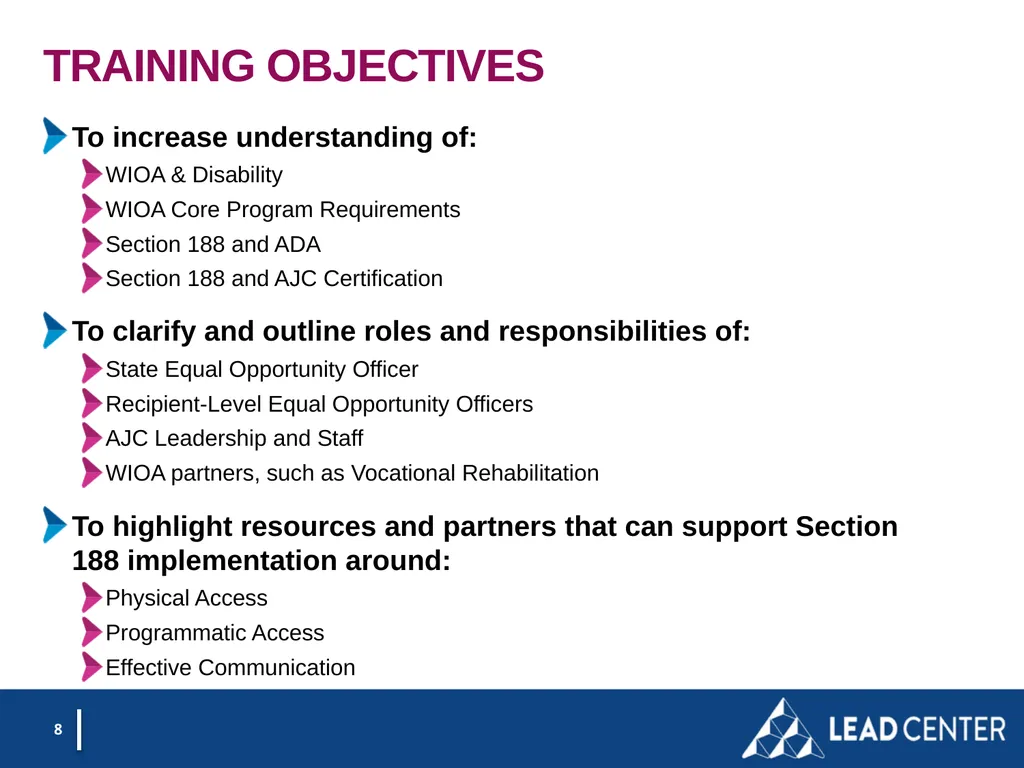
Training objectives 8 To increase understanding of:
WIOA & Disability
WIOA Core Program Requirements
Section 188 and ADA
Section 188 and AJC Certification
To clarify and outline roles and responsibilities of:
State Equal Opportunity Officer
Recipient-Level Equal Opportunity Officers
AJC Leadership and Staff
WIOA partners, such as Vocational Rehabilitation
To highlight resources and partners that can support Section 188 implementation around:
Physical Access
Programmatic Access
Effective Communication<br>
WIOA & Disability
WIOA Core Program Requirements
Section 188 and ADA
Section 188 and AJC Certification
To clarify and outline roles and responsibilities of:
State Equal Opportunity Officer
Recipient-Level Equal Opportunity Officers
AJC Leadership and Staff
WIOA partners, such as Vocational Rehabilitation
To highlight resources and partners that can support Section 188 implementation around:
Physical Access
Programmatic Access
Effective Communication<br>
09
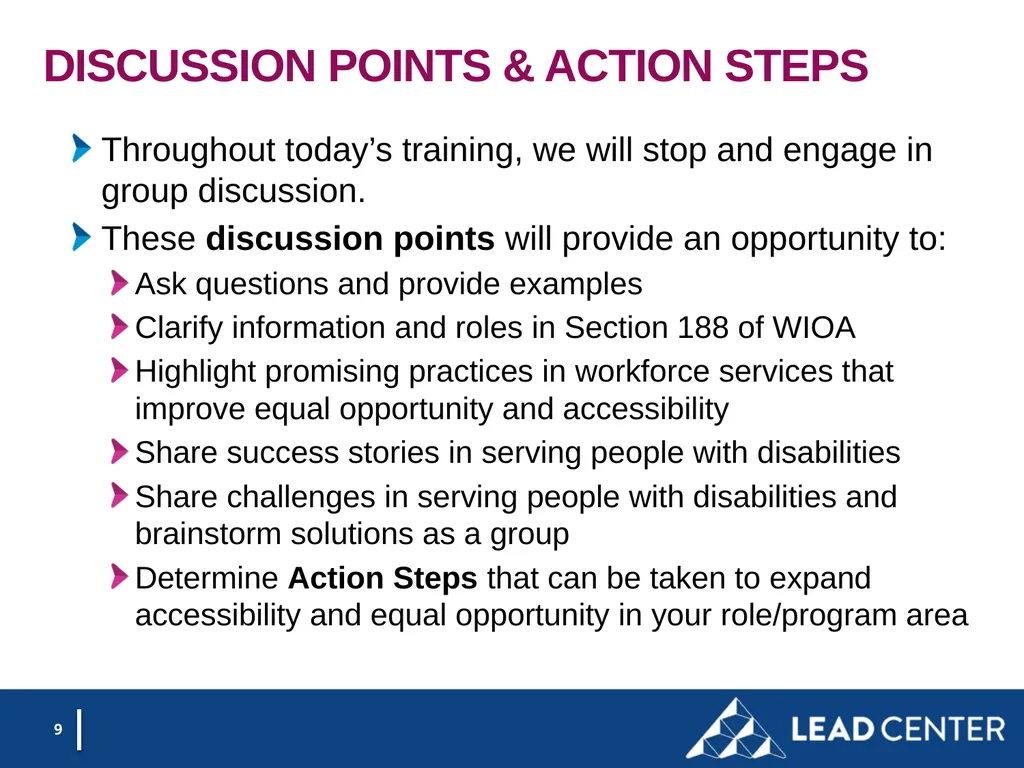
Discussion points & Action steps 9 Throughout today’s training, we will stop and engage in group discussion.
These discussion points will provide an opportunity to:
Ask questions and provide examples
Clarify information and roles in Section 188 of WIOA
Highlight promising practices in workforce services that improve equal opportunity and accessibility
Share success stories in serving people with disabilities
Share challenges in serving people with disabilities and brainstorm solutions as a group
Determine Action Steps that can be taken to expand accessibility and equal opportunity in your role/program area<br>
These discussion points will provide an opportunity to:
Ask questions and provide examples
Clarify information and roles in Section 188 of WIOA
Highlight promising practices in workforce services that improve equal opportunity and accessibility
Share success stories in serving people with disabilities
Share challenges in serving people with disabilities and brainstorm solutions as a group
Determine Action Steps that can be taken to expand accessibility and equal opportunity in your role/program area<br>
10
10 KEY FEATURES OF WIOA<br>
11
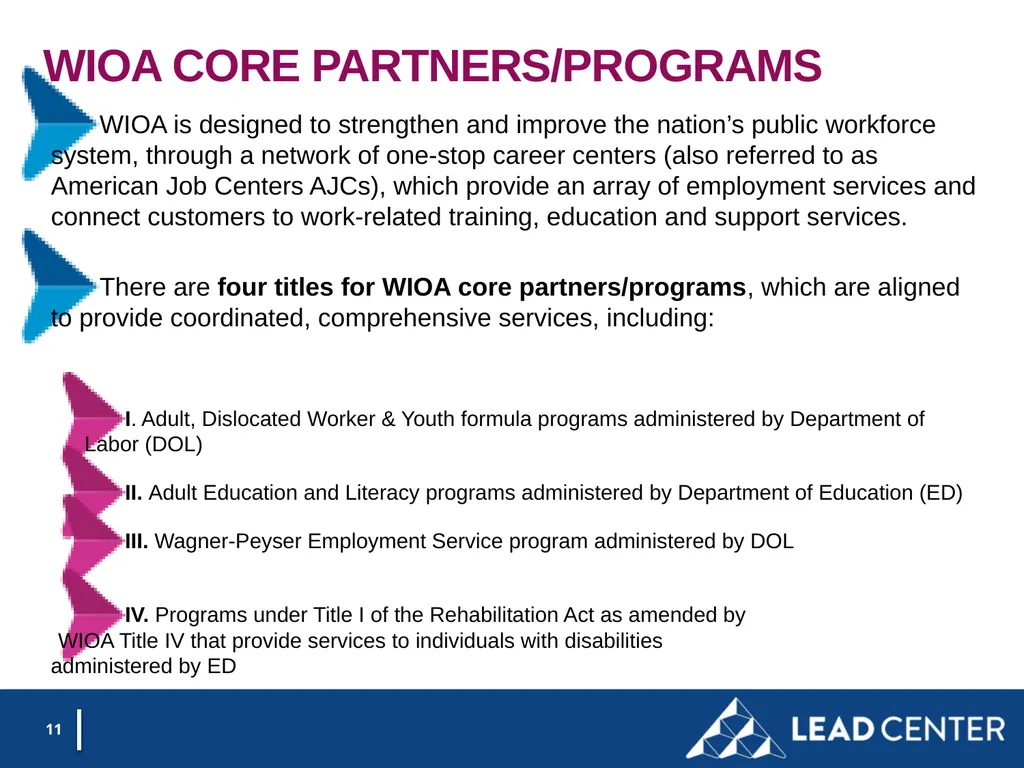
WIOA Core partners/programs 11 WIOA is designed to strengthen and improve the nation’s public workforce system, through a network of one-stop career centers (also referred to as American Job Centers AJCs), which provide an array of employment services and connect customers to work-related training, education and support services.
There are four titles for WIOA core partners/programs, which are aligned to provide coordinated, comprehensive services, including:
I. Adult, Dislocated Worker & Youth formula programs administered by Department of Labor (DOL)
II. Adult Education and Literacy programs administered by Department of Education (ED)
III. Wagner-Peyser Employment Service program administered by DOL
IV. Programs under Title I of the Rehabilitation Act as amended by
WIOA Title IV that provide services to individuals with disabilities
administered by ED<br>
There are four titles for WIOA core partners/programs, which are aligned to provide coordinated, comprehensive services, including:
I. Adult, Dislocated Worker & Youth formula programs administered by Department of Labor (DOL)
II. Adult Education and Literacy programs administered by Department of Education (ED)
III. Wagner-Peyser Employment Service program administered by DOL
IV. Programs under Title I of the Rehabilitation Act as amended by
WIOA Title IV that provide services to individuals with disabilities
administered by ED<br>
12
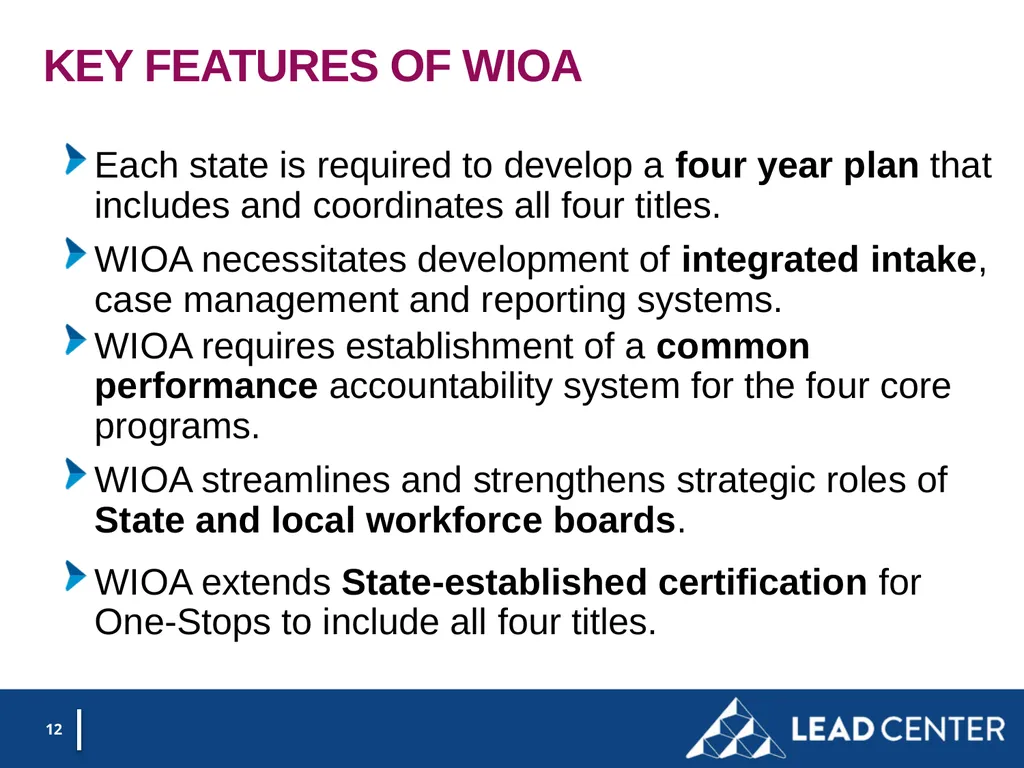
Key features of wioA 12 Each state is required to develop a four year plan that includes and coordinates all four titles.
WIOA necessitates development of integrated intake, case management and reporting systems.
WIOA requires establishment of a common performance accountability system for the four core programs.
WIOA streamlines and strengthens strategic roles of State and local workforce boards.
WIOA extends State-established certification for One-Stops to include all four titles.<br>
WIOA necessitates development of integrated intake, case management and reporting systems.
WIOA requires establishment of a common performance accountability system for the four core programs.
WIOA streamlines and strengthens strategic roles of State and local workforce boards.
WIOA extends State-established certification for One-Stops to include all four titles.<br>
13
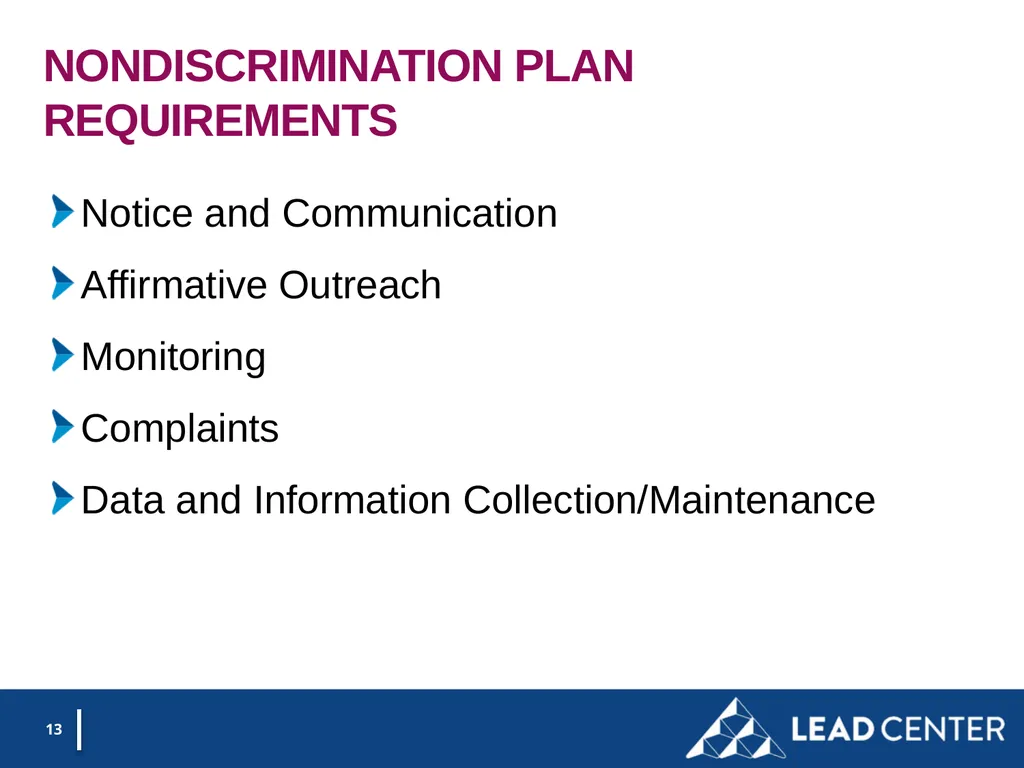
Nondiscrimination Plan Requirements 13 Notice and Communication
Affirmative Outreach
Monitoring
Complaints
Data and Information Collection/Maintenance<br>
Affirmative Outreach
Monitoring
Complaints
Data and Information Collection/Maintenance<br>
14
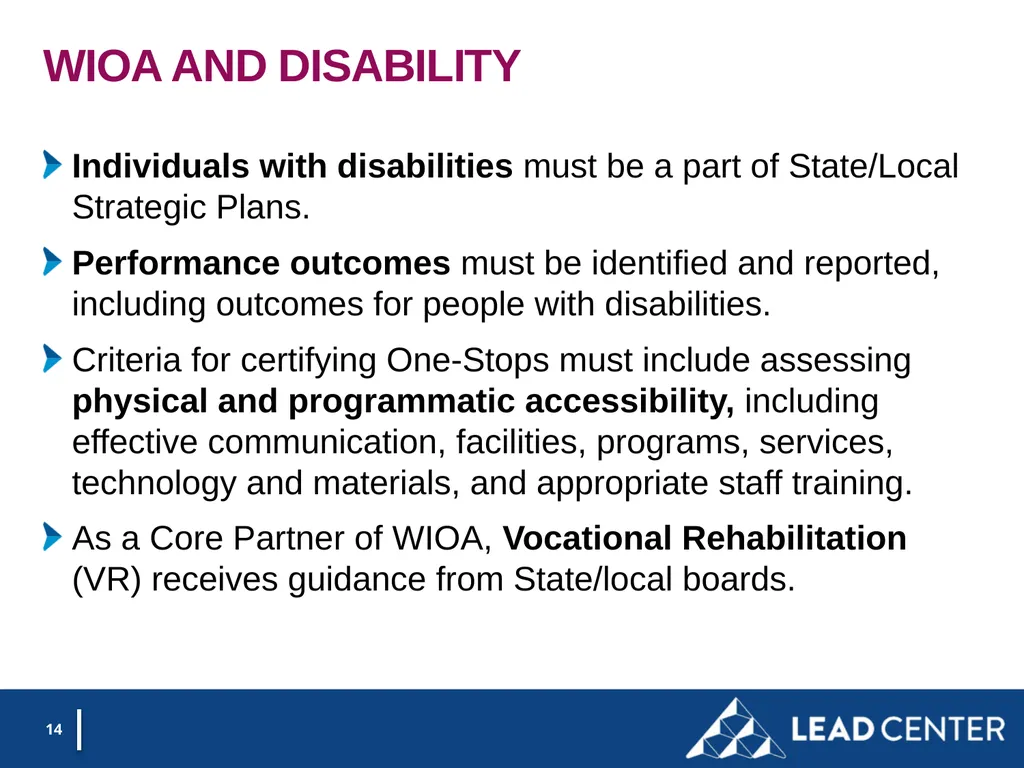
WIOA and disability 14 Individuals with disabilities must be a part of State/Local Strategic Plans.
Performance outcomes must be identified and reported, including outcomes for people with disabilities.
Criteria for certifying One-Stops must include assessing physical and programmatic accessibility, including effective communication, facilities, programs, services, technology and materials, and appropriate staff training.
As a Core Partner of WIOA, Vocational Rehabilitation (VR) receives guidance from State/local boards.<br>
Performance outcomes must be identified and reported, including outcomes for people with disabilities.
Criteria for certifying One-Stops must include assessing physical and programmatic accessibility, including effective communication, facilities, programs, services, technology and materials, and appropriate staff training.
As a Core Partner of WIOA, Vocational Rehabilitation (VR) receives guidance from State/local boards.<br>
15
15 SECTION 188<br>
16
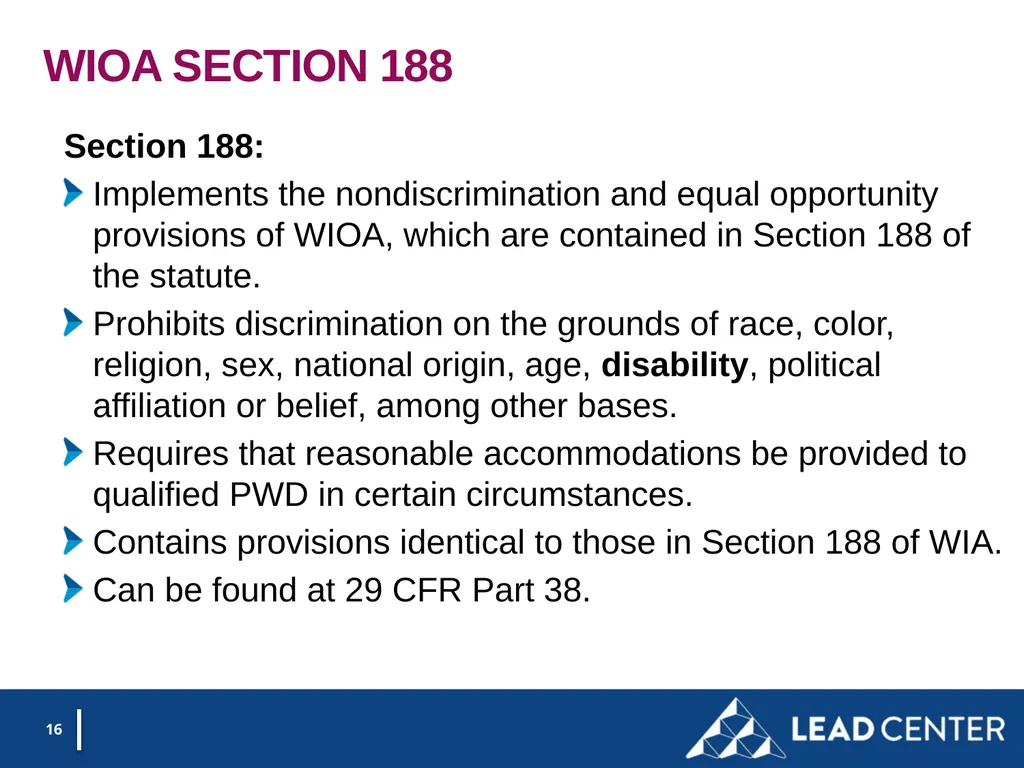
WIOA Section 188 16 Section 188:
Implements the nondiscrimination and equal opportunity provisions of WIOA, which are contained in Section 188 of the statute.
Prohibits discrimination on the grounds of race, color, religion, sex, national origin, age, disability, political affiliation or belief, among other bases.
Requires that reasonable accommodations be provided to qualified PWD in certain circumstances.
Contains provisions identical to those in Section 188 of WIA.
Can be found at 29 CFR Part 38.<br>
Implements the nondiscrimination and equal opportunity provisions of WIOA, which are contained in Section 188 of the statute.
Prohibits discrimination on the grounds of race, color, religion, sex, national origin, age, disability, political affiliation or belief, among other bases.
Requires that reasonable accommodations be provided to qualified PWD in certain circumstances.
Contains provisions identical to those in Section 188 of WIA.
Can be found at 29 CFR Part 38.<br>
17
Who does Section 188 apply to?
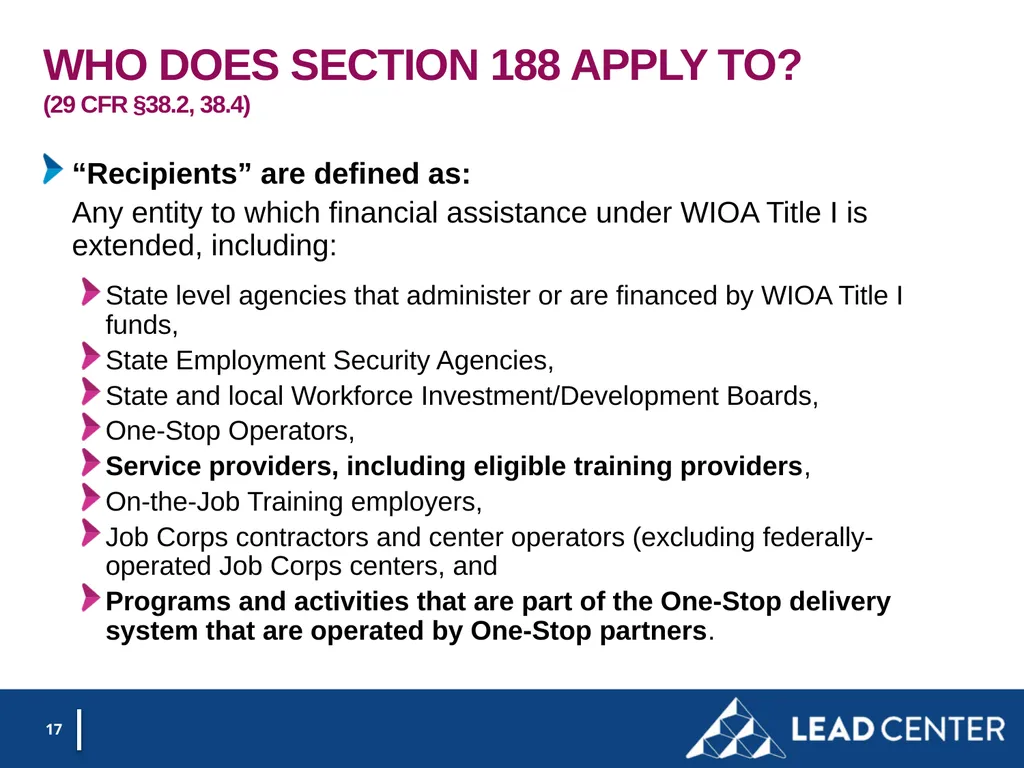
(29 CFR §38.2, 38.4) 17 “Recipients” are defined as:
Any entity to which financial assistance under WIOA Title I is extended, including:
State level agencies that administer or are financed by WIOA Title I funds,
State Employment Security Agencies,
State and local Workforce Investment/Development Boards,
One-Stop Operators,
Service providers, including eligible training providers,
On-the-Job Training employers,
Job Corps contractors and center operators (excluding federally-operated Job Corps centers, and
Programs and activities that are part of the One-Stop delivery system that are operated by One-Stop partners.<br>
Any entity to which financial assistance under WIOA Title I is extended, including:
State level agencies that administer or are financed by WIOA Title I funds,
State Employment Security Agencies,
State and local Workforce Investment/Development Boards,
One-Stop Operators,
Service providers, including eligible training providers,
On-the-Job Training employers,
Job Corps contractors and center operators (excluding federally-operated Job Corps centers, and
Programs and activities that are part of the One-Stop delivery system that are operated by One-Stop partners.<br>
18
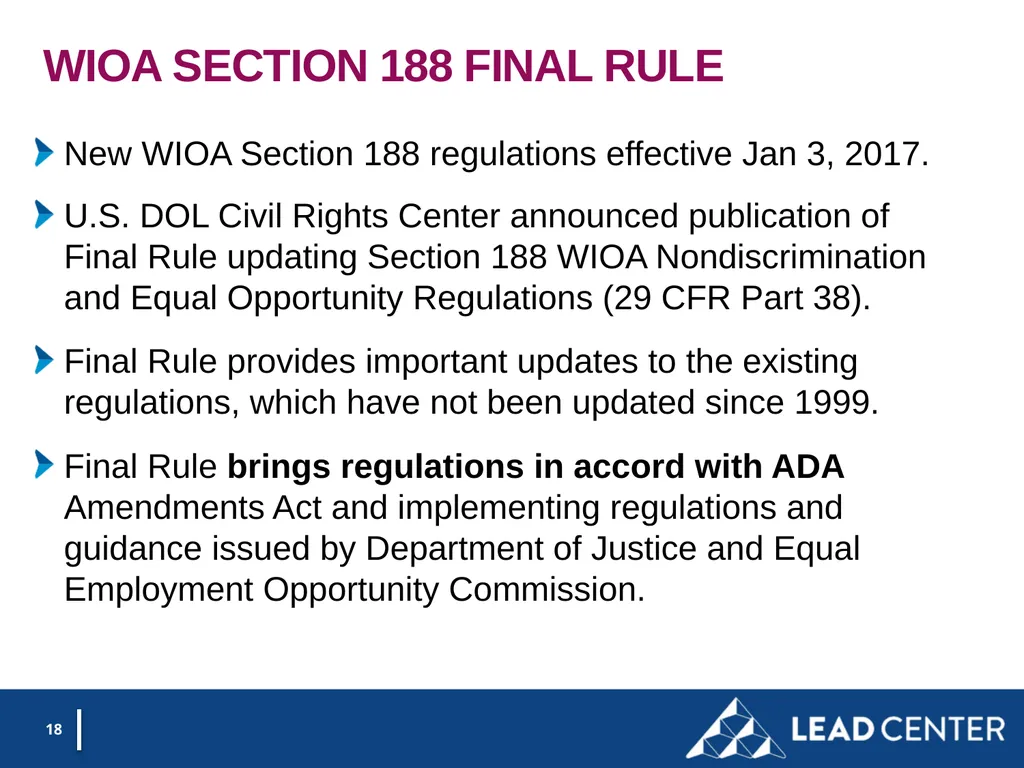
WIOA Section 188 FINAL RULE 18 New WIOA Section 188 regulations effective Jan 3, 2017.
U.S. DOL Civil Rights Center announced publication of Final Rule updating Section 188 WIOA Nondiscrimination and Equal Opportunity Regulations (29 CFR Part 38).
Final Rule provides important updates to the existing regulations, which have not been updated since 1999.
Final Rule brings regulations in accord with ADA Amendments Act and implementing regulations and guidance issued by Department of Justice and Equal Employment Opportunity Commission.<br>
U.S. DOL Civil Rights Center announced publication of Final Rule updating Section 188 WIOA Nondiscrimination and Equal Opportunity Regulations (29 CFR Part 38).
Final Rule provides important updates to the existing regulations, which have not been updated since 1999.
Final Rule brings regulations in accord with ADA Amendments Act and implementing regulations and guidance issued by Department of Justice and Equal Employment Opportunity Commission.<br>
19
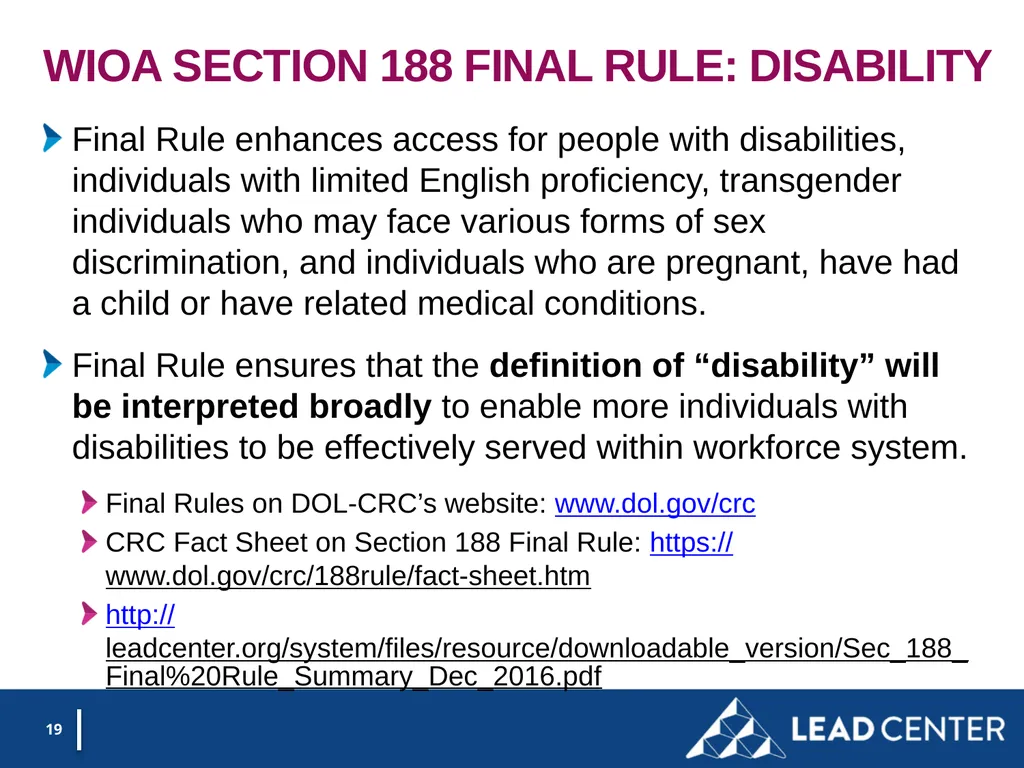
WIOA Section 188 FINAL RULE: DIsability 19 Final Rule enhances access for people with disabilities, individuals with limited English proficiency, transgender individuals who may face various forms of sex discrimination, and individuals who are pregnant, have had a child or have related medical conditions.
Final Rule ensures that the definition of “disability” will be interpreted broadly to enable more individuals with disabilities to be effectively served within workforce system.
Final Rules on DOL-CRC’s website: www.dol.gov/crc
CRC Fact Sheet on Section 188 Final Rule: https://www.dol.gov/crc/188rule/fact-sheet.htm
http://leadcenter.org/system/files/resource/downloadable_version/Sec_188_Final%20Rule_Summary_Dec_2016.pdf<br>
Final Rule ensures that the definition of “disability” will be interpreted broadly to enable more individuals with disabilities to be effectively served within workforce system.
Final Rules on DOL-CRC’s website: www.dol.gov/crc
CRC Fact Sheet on Section 188 Final Rule: https://www.dol.gov/crc/188rule/fact-sheet.htm
http://leadcenter.org/system/files/resource/downloadable_version/Sec_188_Final%20Rule_Summary_Dec_2016.pdf<br>
20
Definition of disability 20 Disability means, with respect to an individual:
A physical or mental impairment that substantially limits one or more major life activities of such individual;
A record of such an impairment; or
Being regarded as having such an impairment.
“Substantially limits” is not meant to be a demanding standard.
This is the same definition of disability as the ADA.
ADA Amendments Act of 2008 P.L. 110-325 Section 3<br>
A physical or mental impairment that substantially limits one or more major life activities of such individual;
A record of such an impairment; or
Being regarded as having such an impairment.
“Substantially limits” is not meant to be a demanding standard.
This is the same definition of disability as the ADA.
ADA Amendments Act of 2008 P.L. 110-325 Section 3<br>
21
Definition of qualified individual with a disability 21 With respect to employment, an individual who satisfies the requisite skill, experience, education, and other job-related requirements of the employment position, and who, with or without reasonable accommodation, can perform the essential functions of such position.
With respect to aid, benefits, services, or training, an individual who -- with or without auxiliary aids and services, reasonable accommodations, and/or reasonable modifications in policies, practices, and procedures -- meets the essential eligibility requirements for such aid/benefit/service/training.<br>
With respect to aid, benefits, services, or training, an individual who -- with or without auxiliary aids and services, reasonable accommodations, and/or reasonable modifications in policies, practices, and procedures -- meets the essential eligibility requirements for such aid/benefit/service/training.<br>
22
Reasonable accommodations 22 With regard to any aid/benefit/service/training, and employment, workforce partners must provide reasonable accommodations to qualified individuals with disabilities unless it would cause undue hardship.
Reasonable accommodation means:
Modifications or adjustments to an application/registration process that enables a qualified applicant/registrant with a disability to be considered for the aid/benefits/services/ training/employment they desire; or
Modification or adjustments that enable a qualified individual with a disability to perform the essential functions of a job, or to receive aid/benefits/services/training equal to that provided to qualified individuals without disabilities.<br>
Reasonable accommodation means:
Modifications or adjustments to an application/registration process that enables a qualified applicant/registrant with a disability to be considered for the aid/benefits/services/ training/employment they desire; or
Modification or adjustments that enable a qualified individual with a disability to perform the essential functions of a job, or to receive aid/benefits/services/training equal to that provided to qualified individuals without disabilities.<br>
23
Disability discrimination 23 Discrimination prohibited based on disability:
Denying a qualified individual with a disability the opportunity to participate in or benefit from the aid/benefit/service/training.
Providing a qualified individual with a disability with any aid/benefit/service/training that is not equal to what is offered to others or that is not as effective.
Requiring a qualified individual with a disability to participate in separate or different programs or activities instead of mainstream programs/activities.
Not administering programs and activities in the most integrated setting appropriate to the needs of qualified individuals with disabilities.
Not providing meaningful opportunities for seeking employment and work in competitive integrated settings.<br>
Denying a qualified individual with a disability the opportunity to participate in or benefit from the aid/benefit/service/training.
Providing a qualified individual with a disability with any aid/benefit/service/training that is not equal to what is offered to others or that is not as effective.
Requiring a qualified individual with a disability to participate in separate or different programs or activities instead of mainstream programs/activities.
Not administering programs and activities in the most integrated setting appropriate to the needs of qualified individuals with disabilities.
Not providing meaningful opportunities for seeking employment and work in competitive integrated settings.<br>
24
Discussion point & action steps 24 What is your role in Section 188? Is it at a policy level, practice level or both?
State Equal Opportunity Officer
Recipient-Level Equal Opportunity Officers
AJC Leadership and Staff
WIOA partners, such as Vocational Rehabilitation, Adult Education, Career Pathways partners
How do you recognize when someone is disclosing a disability?
How do you respond to an accommodation request?(JAN Handout)
Can you think of an example of disability discrimination? How could this be prevented?<br>
State Equal Opportunity Officer
Recipient-Level Equal Opportunity Officers
AJC Leadership and Staff
WIOA partners, such as Vocational Rehabilitation, Adult Education, Career Pathways partners
How do you recognize when someone is disclosing a disability?
How do you respond to an accommodation request?(JAN Handout)
Can you think of an example of disability discrimination? How could this be prevented?<br>
25
25 SECTION 188 &
AJC CERTIFICATION<br>
AJC CERTIFICATION<br>
26
Section 188 is the framework for ajc certification 26 Under WIOA, all four titles/programs are responsible for aspects of:
Delivering AJC services
Providing AJC maintenance
AJC Certification
TEGL 16-16
Section 188 is the required framework for this process and divides program accessibility into three areas of compliance:
Physical access
Programmatic access
Effective Communication<br>
Delivering AJC services
Providing AJC maintenance
AJC Certification
TEGL 16-16
Section 188 is the required framework for this process and divides program accessibility into three areas of compliance:
Physical access
Programmatic access
Effective Communication<br>
27
Physical access 27 ADA Accessibility Guidelines (ADAAG) contains scoping and technical requirements for accessibility to buildings and facilities by individuals with disabilities under ADA of 1990.
Requirements are to be applied during design, construction, and alteration of buildings and facilities covered by Titles II and III of the ADA issued by Federal agencies, including Department of Justice and Department of Transportation.
Common trusted resources for supporting physical access:
DC Center for Independent Living (CILs)
Regional ADA Centers – Mid-Atlantic ADA Center
Mayor’s Offices/Departments on Disabilities (e.g., DDS)<br>
Requirements are to be applied during design, construction, and alteration of buildings and facilities covered by Titles II and III of the ADA issued by Federal agencies, including Department of Justice and Department of Transportation.
Common trusted resources for supporting physical access:
DC Center for Independent Living (CILs)
Regional ADA Centers – Mid-Atlantic ADA Center
Mayor’s Offices/Departments on Disabilities (e.g., DDS)<br>
28
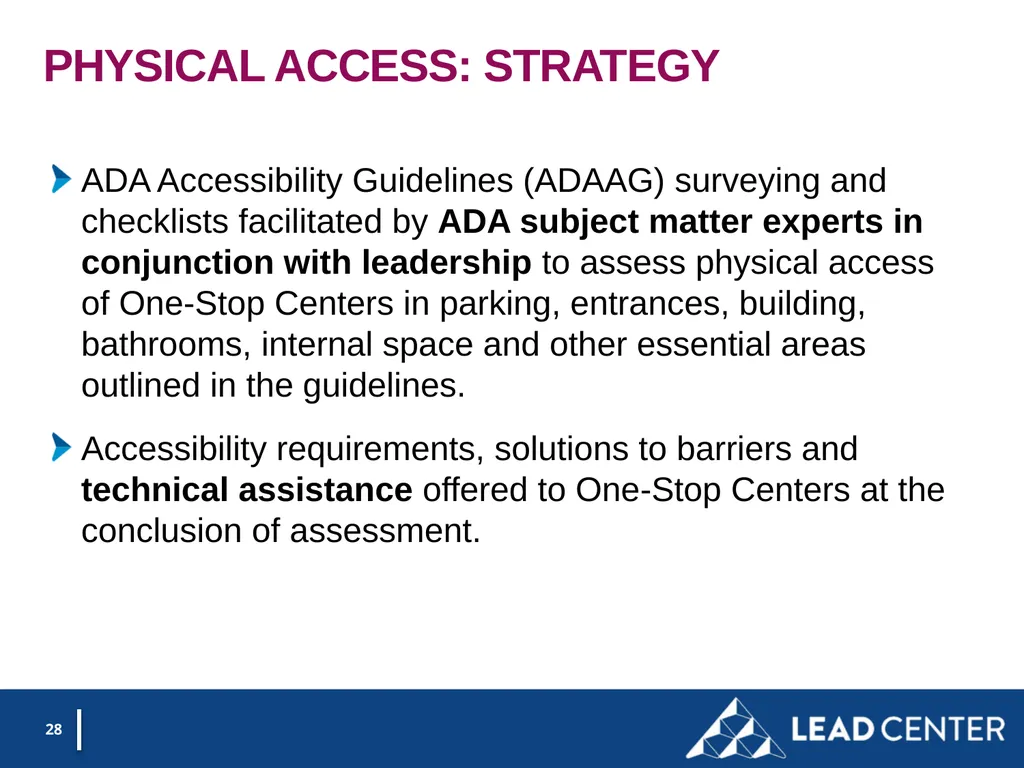
Physical access: strategy 28 ADA Accessibility Guidelines (ADAAG) surveying and checklists facilitated by ADA subject matter experts in conjunction with leadership to assess physical access of One-Stop Centers in parking, entrances, building, bathrooms, internal space and other essential areas outlined in the guidelines.
Accessibility requirements, solutions to barriers and technical assistance offered to One-Stop Centers at the conclusion of assessment.<br>
Accessibility requirements, solutions to barriers and technical assistance offered to One-Stop Centers at the conclusion of assessment.<br>
29
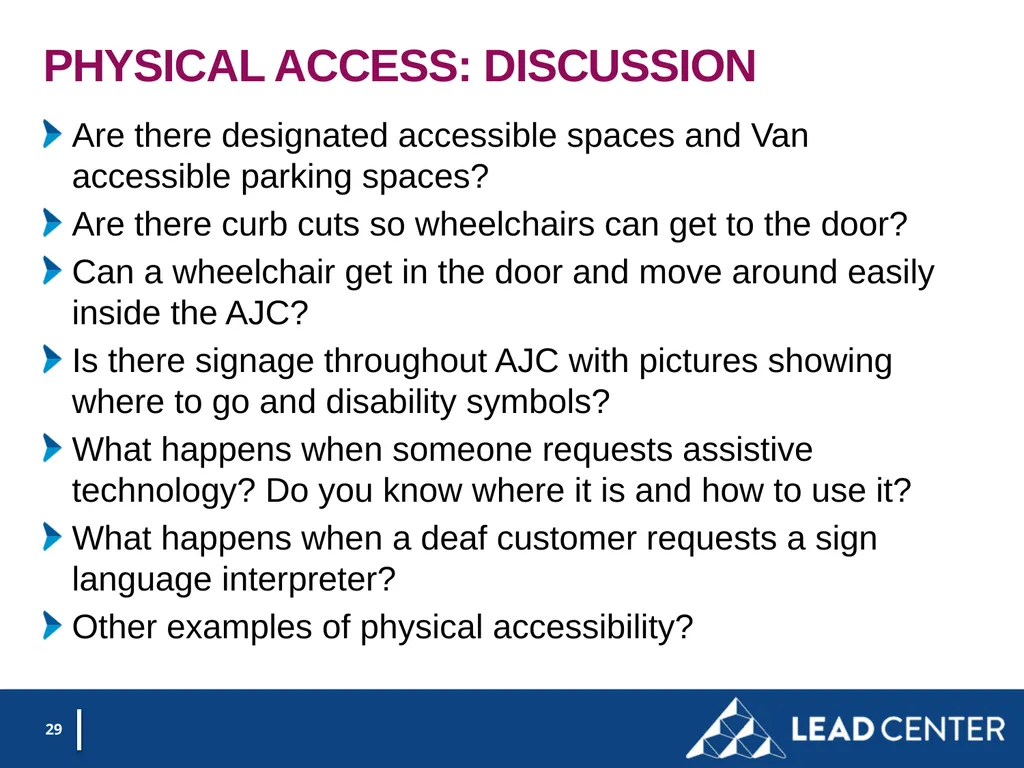
Physical access: discussion 29 Are there designated accessible spaces and Van accessible parking spaces?
Are there curb cuts so wheelchairs can get to the door?
Can a wheelchair get in the door and move around easily inside the AJC?
Is there signage throughout AJC with pictures showing where to go and disability symbols?
What happens when someone requests assistive technology? Do you know where it is and how to use it?
What happens when a deaf customer requests a sign language interpreter?
Other examples of physical accessibility?<br>
Are there curb cuts so wheelchairs can get to the door?
Can a wheelchair get in the door and move around easily inside the AJC?
Is there signage throughout AJC with pictures showing where to go and disability symbols?
What happens when someone requests assistive technology? Do you know where it is and how to use it?
What happens when a deaf customer requests a sign language interpreter?
Other examples of physical accessibility?<br>
30
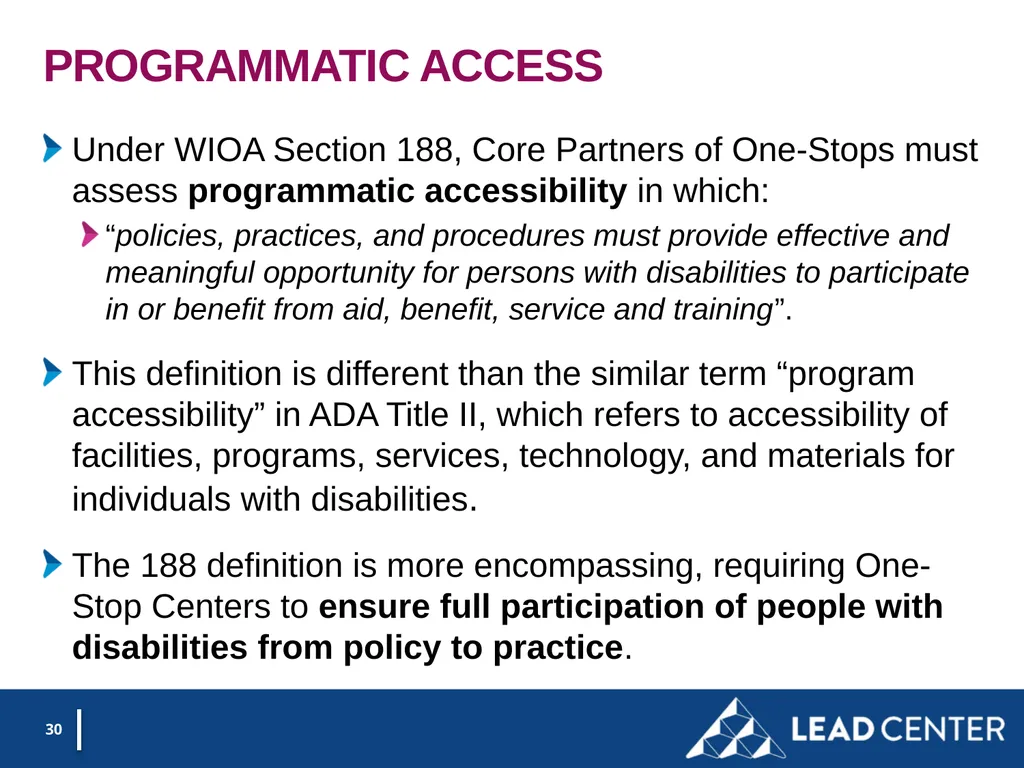
PROGRAMMATIC ACCESS 30 Under WIOA Section 188, Core Partners of One-Stops must assess programmatic accessibility in which:
“policies, practices, and procedures must provide effective and meaningful opportunity for persons with disabilities to participate in or benefit from aid, benefit, service and training”.
This definition is different than the similar term “program accessibility” in ADA Title II, which refers to accessibility of facilities, programs, services, technology, and materials for individuals with disabilities.
The 188 definition is more encompassing, requiring One-Stop Centers to ensure full participation of people with disabilities from policy to practice.<br>
“policies, practices, and procedures must provide effective and meaningful opportunity for persons with disabilities to participate in or benefit from aid, benefit, service and training”.
This definition is different than the similar term “program accessibility” in ADA Title II, which refers to accessibility of facilities, programs, services, technology, and materials for individuals with disabilities.
The 188 definition is more encompassing, requiring One-Stop Centers to ensure full participation of people with disabilities from policy to practice.<br>
31
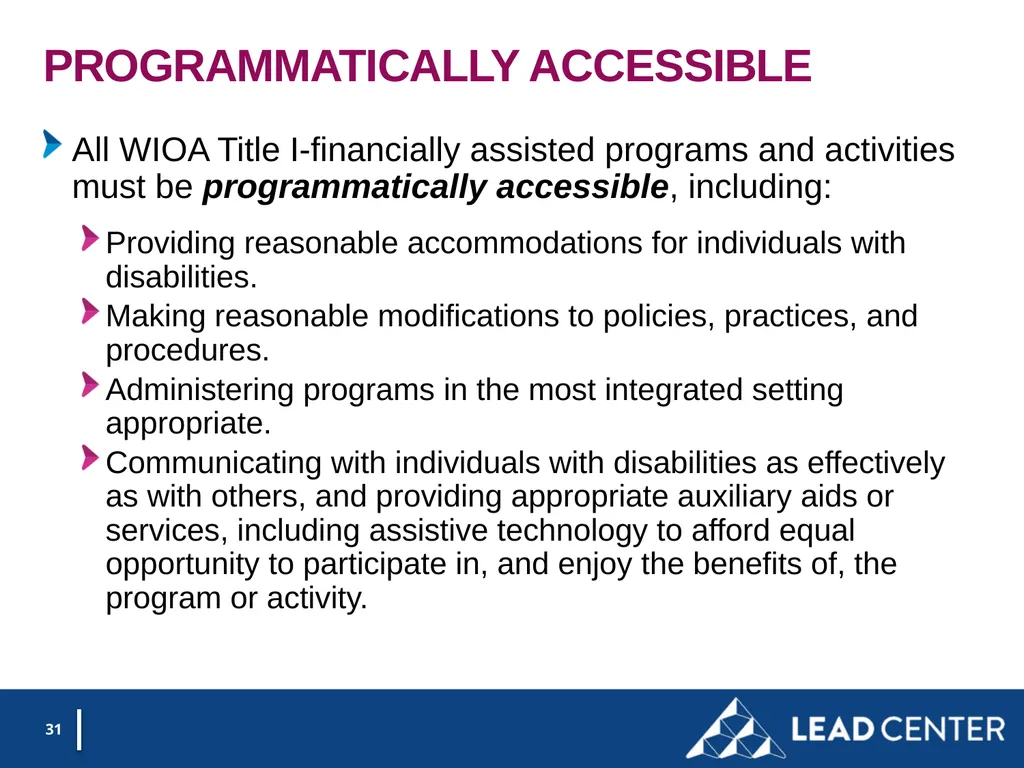
Programmatically accessible 31 All WIOA Title I-financially assisted programs and activities must be programmatically accessible, including:
Providing reasonable accommodations for individuals with disabilities.
Making reasonable modifications to policies, practices, and procedures.
Administering programs in the most integrated setting appropriate.
Communicating with individuals with disabilities as effectively as with others, and providing appropriate auxiliary aids or services, including assistive technology to afford equal opportunity to participate in, and enjoy the benefits of, the program or activity.<br>
Providing reasonable accommodations for individuals with disabilities.
Making reasonable modifications to policies, practices, and procedures.
Administering programs in the most integrated setting appropriate.
Communicating with individuals with disabilities as effectively as with others, and providing appropriate auxiliary aids or services, including assistive technology to afford equal opportunity to participate in, and enjoy the benefits of, the program or activity.<br>
32
Programmatic access = outcomes 32 “…to afford individuals with disabilities an equal opportunity to participate in, and enjoy the benefits of, the program or activity.”
‘Benefits’ = Outcomes of program or activity.
The overarching goal of equal access is that all individuals benefit equally from the full spectrum of services available in the One-Stop Center and ultimately have an equal opportunity to access the employment and training outcomes associated with all the services provided there.<br>
‘Benefits’ = Outcomes of program or activity.
The overarching goal of equal access is that all individuals benefit equally from the full spectrum of services available in the One-Stop Center and ultimately have an equal opportunity to access the employment and training outcomes associated with all the services provided there.<br>
33
Programmatic access: discussion 33 Steps are taken by AJC to improve operational collaboration (e.g., establish partnerships/linkages) with entities that have experience working with individuals with disabilities in areas of:
Common data intake and sharing
Customer outreach
Service delivery and coordination
Cost sharing
Performance measures and outcome data collection
Integrated Resource Teams (IRT) are used to coordinate services and leverage funding to meet employment needs of job seekers who need multiple service providers/resources
Cross systems training to increase disability awareness<br>
Common data intake and sharing
Customer outreach
Service delivery and coordination
Cost sharing
Performance measures and outcome data collection
Integrated Resource Teams (IRT) are used to coordinate services and leverage funding to meet employment needs of job seekers who need multiple service providers/resources
Cross systems training to increase disability awareness<br>
34
Effective Communication 34 Effective Communication means that whatever is written or spoken must be as clear and understandable to all individuals, including those who are Deaf/Hard-of-Hearing (HoH) or have other disabilities.
It is required, except when it would fundamentally alter the nature of the service or program or would result in an undue financial and administrative burden.
Under WIOA Section 188, it is considered highly difficult to prove undue burden especially when ensuring effective communication access (e.g., AJCs paying for sign language interpreters).<br>
It is required, except when it would fundamentally alter the nature of the service or program or would result in an undue financial and administrative burden.
Under WIOA Section 188, it is considered highly difficult to prove undue burden especially when ensuring effective communication access (e.g., AJCs paying for sign language interpreters).<br>
35
Effective Communication: strategy 35 Workforce leadership coordinates with Deaf/Hard-of-Hearing (HoH) and other disability partners to:
Review/survey policies and procedures for ensuring communication access.
Review/survey assistive technology available and staff knowledge and use of the technology.
Survey One-Stop Center staff on experiences with customers with diverse communication needs.
Survey Deaf/HoH partners on experiences of constituents using workforce system.
Identify training needs to state-level on effective communication with customers across spectrum of disability.<br>
Review/survey policies and procedures for ensuring communication access.
Review/survey assistive technology available and staff knowledge and use of the technology.
Survey One-Stop Center staff on experiences with customers with diverse communication needs.
Survey Deaf/HoH partners on experiences of constituents using workforce system.
Identify training needs to state-level on effective communication with customers across spectrum of disability.<br>
36
Effective Communication: discussion 36 Review reasonable accommodation policies and procedures, including staff knowledge and experiences on implementing reasonable accommodations.
Examples of surveying staff experience with Deaf/HoH customers:
Do you have knowledge of which situations are appropriate for writing notes/emailing/texting with customers vs. when to hire interpreters?
Do you know the procedures for securing qualified sign language interpreters for Deaf/HoH customers?
Do you understand how to use Video Relay calls with Deaf/HoH?
Do you use video remote interpreting (VRI) as an option?
Are videos used in AJC captioned?<br>
Examples of surveying staff experience with Deaf/HoH customers:
Do you have knowledge of which situations are appropriate for writing notes/emailing/texting with customers vs. when to hire interpreters?
Do you know the procedures for securing qualified sign language interpreters for Deaf/HoH customers?
Do you understand how to use Video Relay calls with Deaf/HoH?
Do you use video remote interpreting (VRI) as an option?
Are videos used in AJC captioned?<br>
37
Discussion point & action steps 37 What are your experiences around these 3 areas of accessibility?
Physical accessibility
Programmatic accessibility
Communication access
What kinds of supports do you need in each of any of these access areas?
What action steps may help your region take to help expand accessibility in these areas?
Does your region have a cross partner committee?
Is Section 188 used as framework?
Are decisions impacting policy to practice?<br>
Physical accessibility
Programmatic accessibility
Communication access
What kinds of supports do you need in each of any of these access areas?
What action steps may help your region take to help expand accessibility in these areas?
Does your region have a cross partner committee?
Is Section 188 used as framework?
Are decisions impacting policy to practice?<br>
38
38 RESOURCES & PARTNERS THAT CAN SUPPORT SECTION 188 IMPLEMENTATION<br>
39
Resources to support equal opportunity 39 LEAD Center Brief: Section 188 of the Workforce Innovation and Opportunity Act (Nondiscrimination and Equal Opportunity): Summary Review of the DOL Final Rule, from a Disability Perspective
3-part webinar series:
Part 1:WIOA from a Disability Perspective & Section 188: A Powerful Foundation for Access (archived)
Part 2: State Workforce Systems that are Making Equal Opportunity a Priority: Missouri, Virginia, California (archived)
Part 3: Achieving 188 Compliance & AJC Certification: Key Strategies & Actions from Policy to Procedure (April 30)<br>
3-part webinar series:
Part 1:WIOA from a Disability Perspective & Section 188: A Powerful Foundation for Access (archived)
Part 2: State Workforce Systems that are Making Equal Opportunity a Priority: Missouri, Virginia, California (archived)
Part 3: Achieving 188 Compliance & AJC Certification: Key Strategies & Actions from Policy to Procedure (April 30)<br>
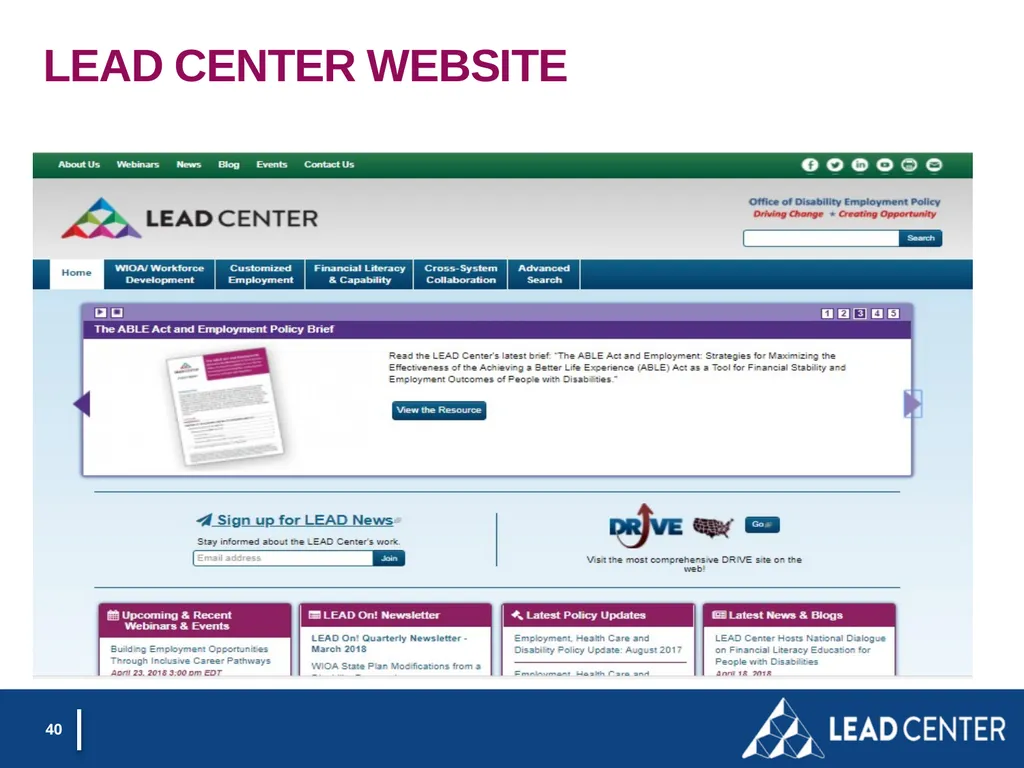
40
LEAD Center website 40<br>
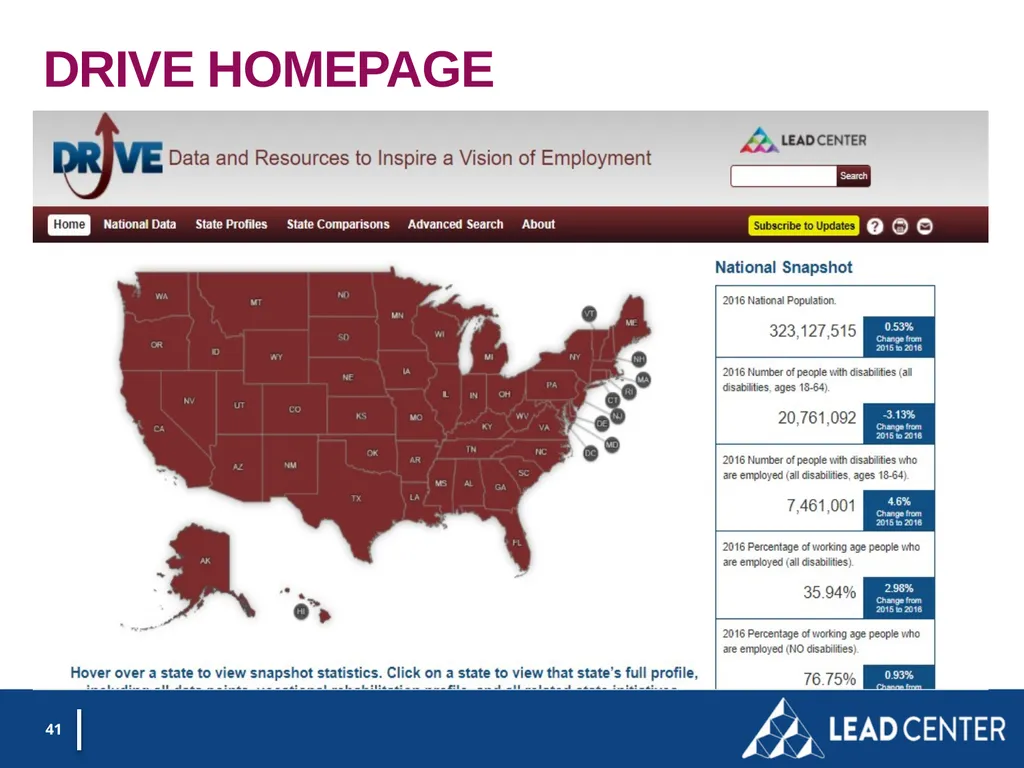
41
Drive homepage 41<br>
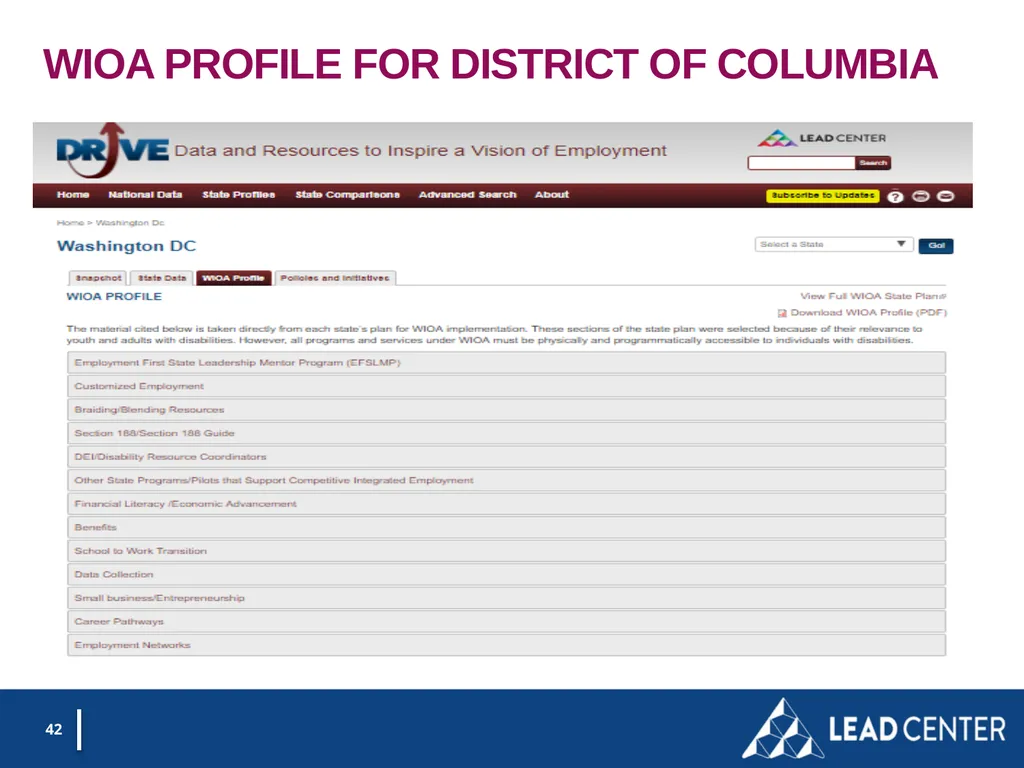
42
WIOA Profile for district of columbia 42<br>
43
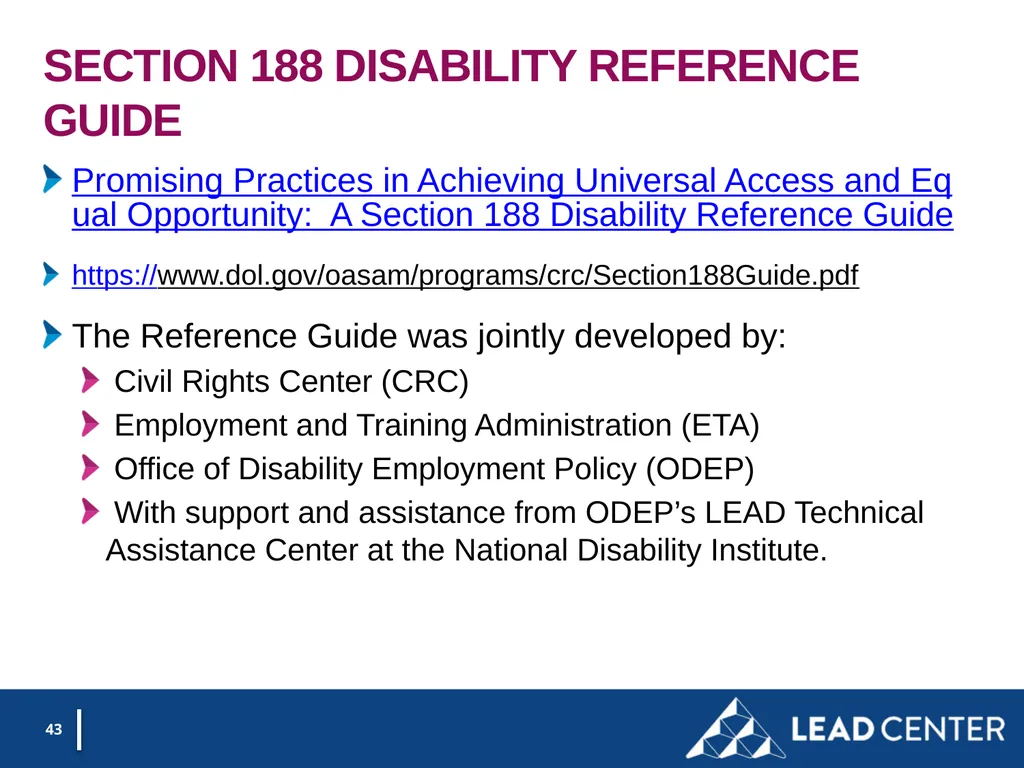
Section 188 Disability Reference Guide 43 Promising Practices in Achieving Universal Access and Equal Opportunity: A Section 188 Disability Reference Guide
https://www.dol.gov/oasam/programs/crc/Section188Guide.pdf
The Reference Guide was jointly developed by:
Civil Rights Center (CRC)
Employment and Training Administration (ETA)
Office of Disability Employment Policy (ODEP)
With support and assistance from ODEP’s LEAD Technical Assistance Center at the National Disability Institute.<br>
https://www.dol.gov/oasam/programs/crc/Section188Guide.pdf
The Reference Guide was jointly developed by:
Civil Rights Center (CRC)
Employment and Training Administration (ETA)
Office of Disability Employment Policy (ODEP)
With support and assistance from ODEP’s LEAD Technical Assistance Center at the National Disability Institute.<br>
44
Section 188 Guide correlates with federal requirements 44 The promising practices in the Guide correlate with the nondiscrimination (equal opportunity) and universal access requirements of Section 188 as previously defined in the Workforce Investment Act (WIA):
Reference Guide does not create new legal requirements or change current legal requirements;
Promising practices do not preclude states and recipients from devising alternative approaches;
Adoption of promising practices will not guarantee compliance.<br>
Reference Guide does not create new legal requirements or change current legal requirements;
Promising practices do not preclude states and recipients from devising alternative approaches;
Adoption of promising practices will not guarantee compliance.<br>
45
188 Guide SECTION ONE: universal access best practices 45 Partnerships with Diverse Disability Groups
Resource Mapping and Coordination
Disability Knowledge of Staff
Training Opportunities around Disability
National/State/Local Disability Resources/Supports<br>
Resource Mapping and Coordination
Disability Knowledge of Staff
Training Opportunities around Disability
National/State/Local Disability Resources/Supports<br>
46
188 Guide SECTION TWO: equal opportunity best practices 46 Provide Reasonable Modifications of Policies, Practices, and Procedures
Ensure Legal Practices around Asking, Telling, Using, and Storing of Disability-Related Information
Representation of People with Disabilities in All AJC Services and Programs
Referrals of People with Disabilities to Separate Programs are Not Automatic<br>
Ensure Legal Practices around Asking, Telling, Using, and Storing of Disability-Related Information
Representation of People with Disabilities in All AJC Services and Programs
Referrals of People with Disabilities to Separate Programs are Not Automatic<br>
47
Customized employment promising practices 47 Guided Group Discovery Curriculum Materials (including a Facilitator Manual and PowerPoint, and a Participant Workbook with its Blueprint for Employment), an approach designed to lay the foundation for competitive integrated employment as a Universal Design that can benefit all job seekers.
Guided Group Discovery: Paving the Way to Employment Webinar, in which LEAD Center shares materials used to implement Guided Group Discovery through cross-system partnerships.
The Essential Elements of Customized Employment for Universal Application Manual, a guide for the universal application of elements of Customized Employment across service delivery and training providers approaches.
Self-Guided Discovery Facilitator's Guide: Helping People Discover Their Own Path to Employment, an approach that applies Customized Employment strategies effective for anyone<br>
Guided Group Discovery: Paving the Way to Employment Webinar, in which LEAD Center shares materials used to implement Guided Group Discovery through cross-system partnerships.
The Essential Elements of Customized Employment for Universal Application Manual, a guide for the universal application of elements of Customized Employment across service delivery and training providers approaches.
Self-Guided Discovery Facilitator's Guide: Helping People Discover Their Own Path to Employment, an approach that applies Customized Employment strategies effective for anyone<br>
48
48 STATE STRATEGIES
FOR IMPLEMENTING
SECTION 188<br>
FOR IMPLEMENTING
SECTION 188<br>
49
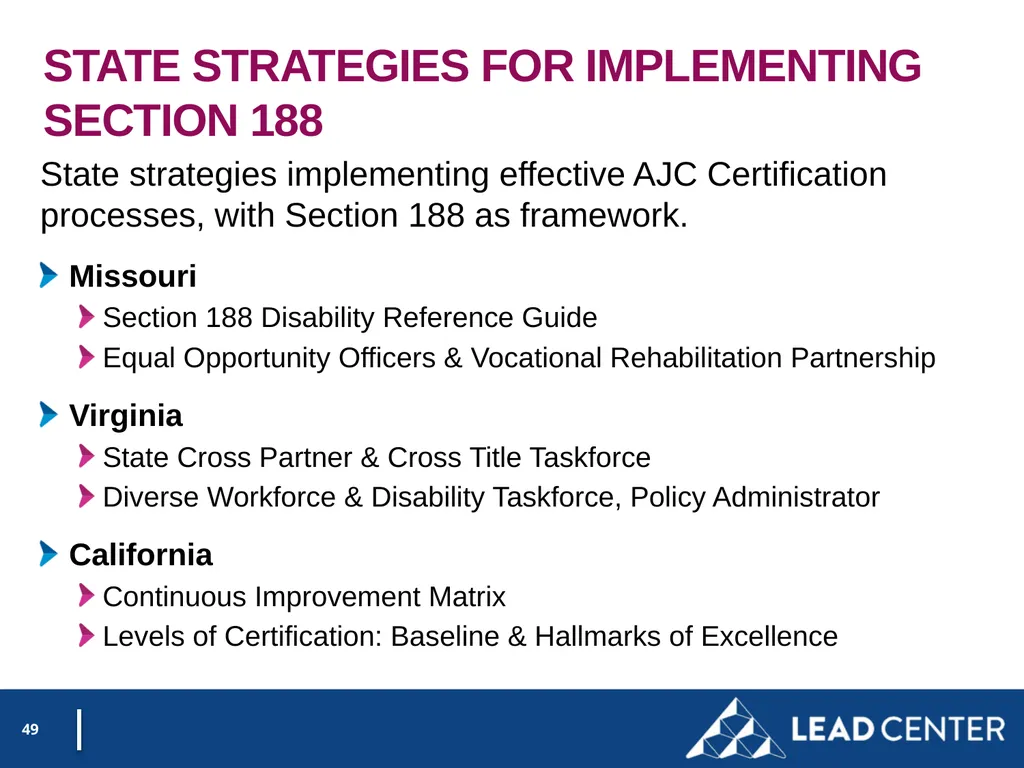
State Strategies for implementing section 188 49 State strategies implementing effective AJC Certification processes, with Section 188 as framework.
Missouri
Section 188 Disability Reference Guide
Equal Opportunity Officers & Vocational Rehabilitation Partnership
Virginia
State Cross Partner & Cross Title Taskforce
Diverse Workforce & Disability Taskforce, Policy Administrator
California
Continuous Improvement Matrix
Levels of Certification: Baseline & Hallmarks of Excellence<br>
Missouri
Section 188 Disability Reference Guide
Equal Opportunity Officers & Vocational Rehabilitation Partnership
Virginia
State Cross Partner & Cross Title Taskforce
Diverse Workforce & Disability Taskforce, Policy Administrator
California
Continuous Improvement Matrix
Levels of Certification: Baseline & Hallmarks of Excellence<br>
50
Connect with the LEAD Center 50 Website: www.leadcenter.org
DRIVE Website: http://drivedisabilityemployment.org/
Sign up for LEAD Center News: http://eepurl.com/sQiHr
Follow the LEAD Center on…
Facebook: www.facebook.com/LEADCtr
Twitter: @LEADCtr
LinkedIn: linkedin.com/groups/LEAD-Center-4828089
YouTube: https://www.youtube.com/user/LEADCtr
Contact us:
Rebecca Salon, Project Director, rsalon@ndi-inc.org
Elizabeth Jennings, Asst. Project Director, ejennings@ndi-inc.org
Aramide Awosika, Project Coordinator, aawosika@ndi-inc.org<br>
DRIVE Website: http://drivedisabilityemployment.org/
Sign up for LEAD Center News: http://eepurl.com/sQiHr
Follow the LEAD Center on…
Facebook: www.facebook.com/LEADCtr
Twitter: @LEADCtr
LinkedIn: linkedin.com/groups/LEAD-Center-4828089
YouTube: https://www.youtube.com/user/LEADCtr
Contact us:
Rebecca Salon, Project Director, rsalon@ndi-inc.org
Elizabeth Jennings, Asst. Project Director, ejennings@ndi-inc.org
Aramide Awosika, Project Coordinator, aawosika@ndi-inc.org<br>
51
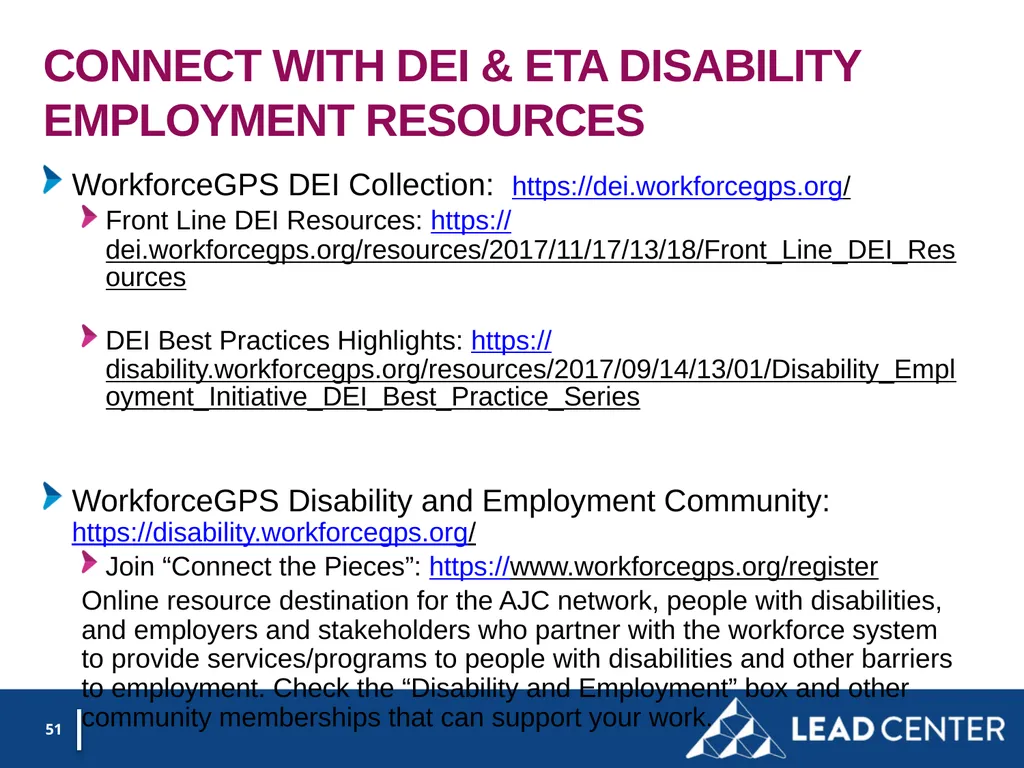
Connect with DEI & eta Disability employment resources 51 WorkforceGPS DEI Collection: https://dei.workforcegps.org/
Front Line DEI Resources: https://dei.workforcegps.org/resources/2017/11/17/13/18/Front_Line_DEI_Resources
DEI Best Practices Highlights: https://disability.workforcegps.org/resources/2017/09/14/13/01/Disability_Employment_Initiative_DEI_Best_Practice_Series
WorkforceGPS Disability and Employment Community: https://disability.workforcegps.org/
Join “Connect the Pieces”: https://www.workforcegps.org/register
Online resource destination for the AJC network, people with disabilities, and employers and stakeholders who partner with the workforce system to provide services/programs to people with disabilities and other barriers to employment. Check the “Disability and Employment” box and other community memberships that can support your work.<br>
Front Line DEI Resources: https://dei.workforcegps.org/resources/2017/11/17/13/18/Front_Line_DEI_Resources
DEI Best Practices Highlights: https://disability.workforcegps.org/resources/2017/09/14/13/01/Disability_Employment_Initiative_DEI_Best_Practice_Series
WorkforceGPS Disability and Employment Community: https://disability.workforcegps.org/
Join “Connect the Pieces”: https://www.workforcegps.org/register
Online resource destination for the AJC network, people with disabilities, and employers and stakeholders who partner with the workforce system to provide services/programs to people with disabilities and other barriers to employment. Check the “Disability and Employment” box and other community memberships that can support your work.<br>
52
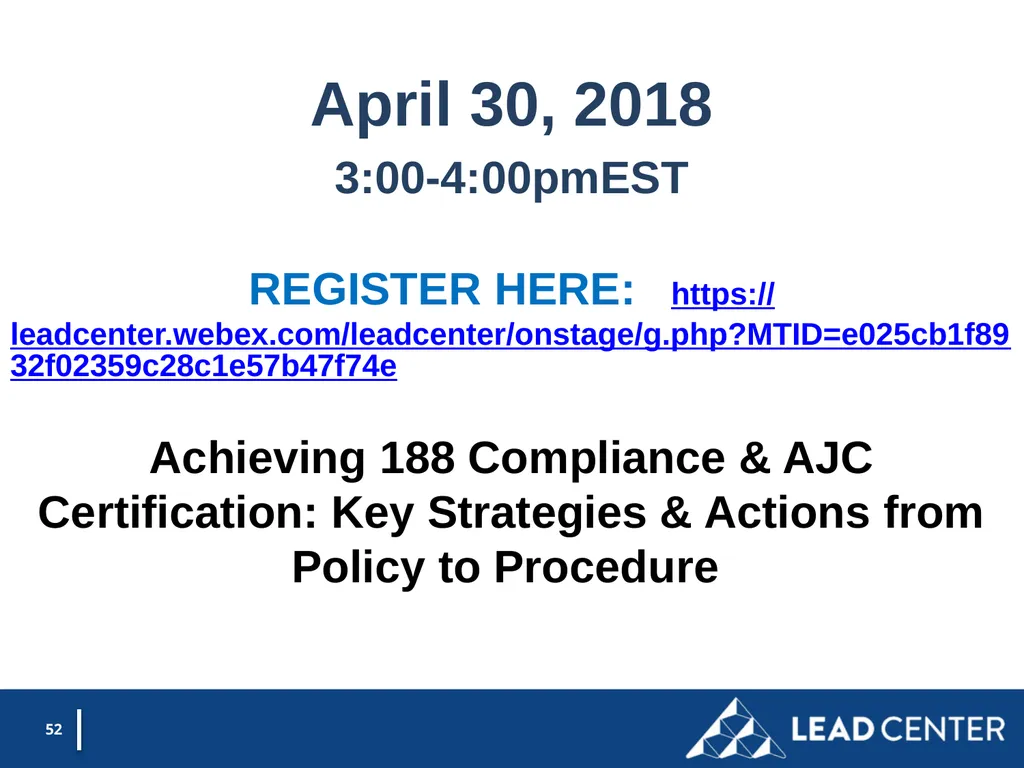
52 April 30, 2018
3:00-4:00pmEST
REGISTER HERE: https://leadcenter.webex.com/leadcenter/onstage/g.php?MTID=e025cb1f8932f02359c28c1e57b47f74e
Achieving 188 Compliance & AJC Certification: Key Strategies & Actions from Policy to Procedure<br>
3:00-4:00pmEST
REGISTER HERE: https://leadcenter.webex.com/leadcenter/onstage/g.php?MTID=e025cb1f8932f02359c28c1e57b47f74e
Achieving 188 Compliance & AJC Certification: Key Strategies & Actions from Policy to Procedure<br>
53
53 NEXT STEPS FOR
THE DISTRICT OF COLUMBIA<br>
THE DISTRICT OF COLUMBIA<br>