04
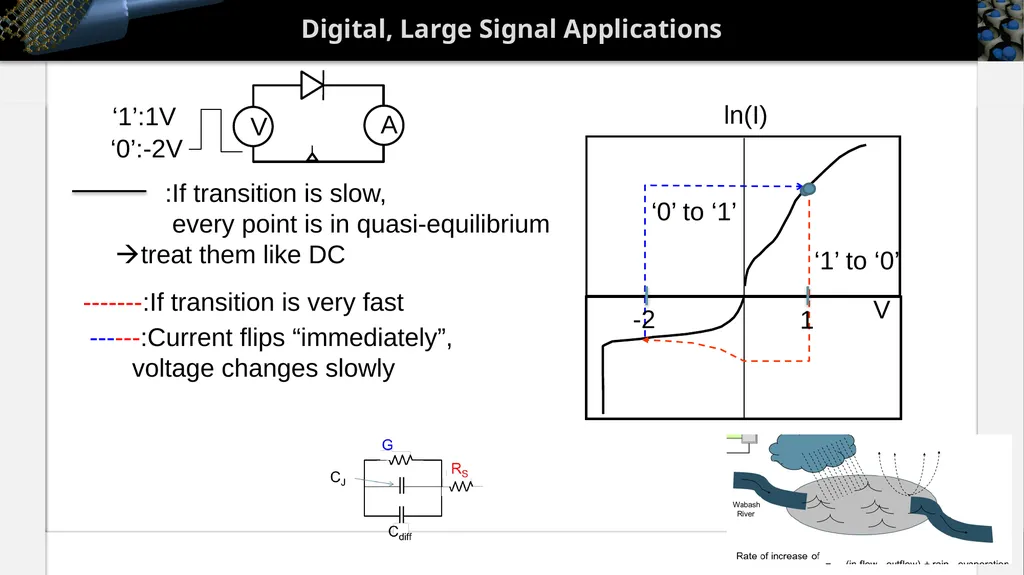
Digital, Large Signal Applications 4 V ln(I) ‘1’ to ‘0’ ‘0’ to ‘1’ 1 -2 -------:If transition is very fast A V ‘1’:1V ‘0’:-2V ------:Current flips “immediately”, � voltage changes slowly<br>
05
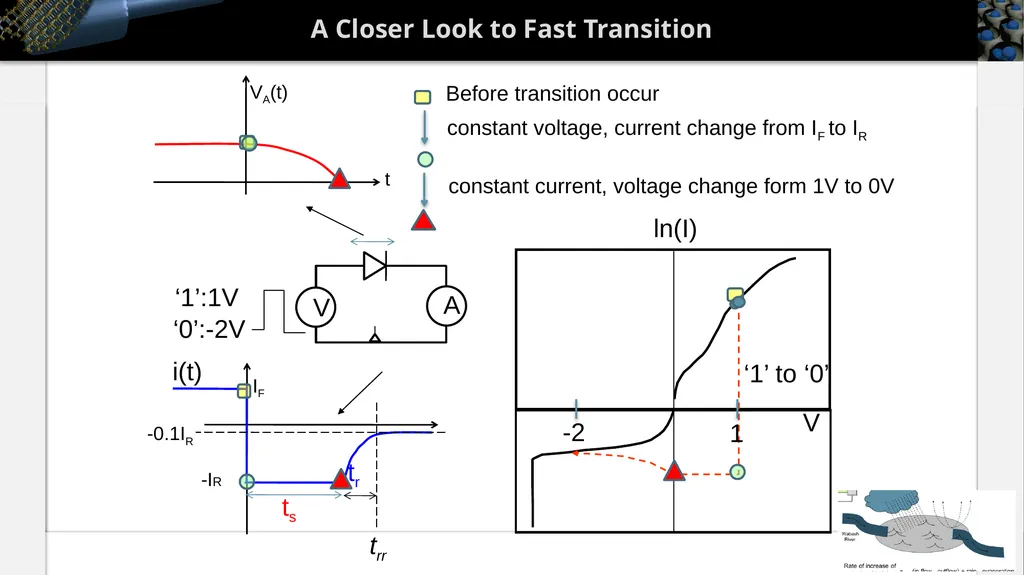
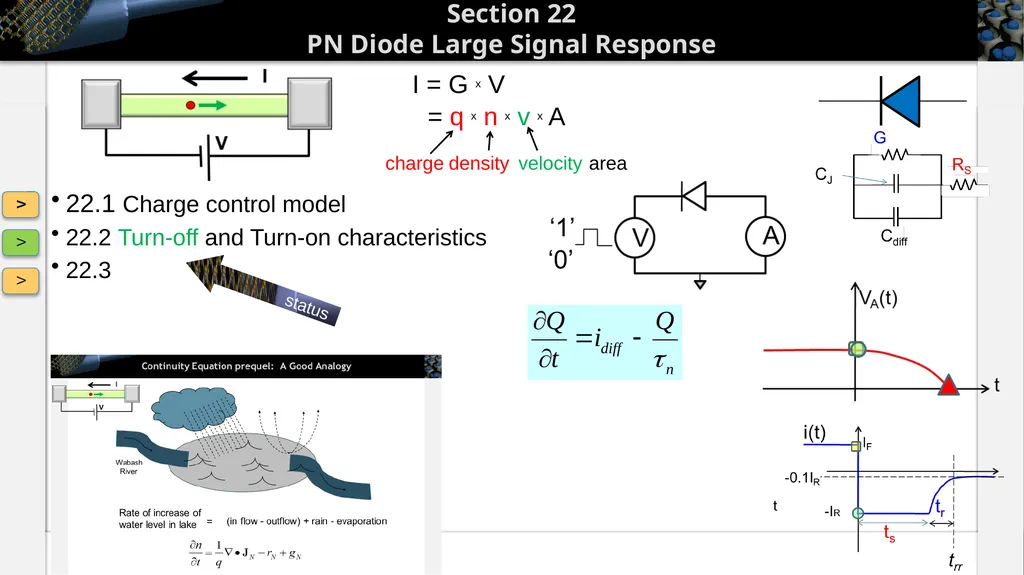
A Closer Look to Fast Transition V ln(I) ‘1’ to ‘0’ A V ‘1’:1V ‘0’:-2V -0.1IR -IR IF ts trr tr i(t) t VA(t) 1 -2<br>
06
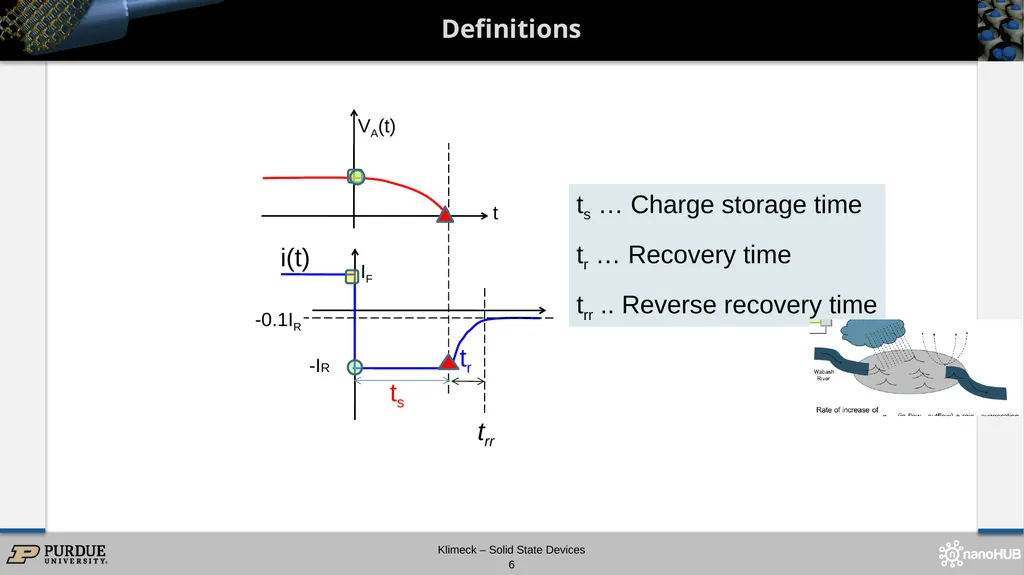
Definitions ts … Charge storage time
tr … Recovery time
trr .. Reverse recovery time -0.1IR -IR IF ts trr tr i(t) t VA(t)<br>
07
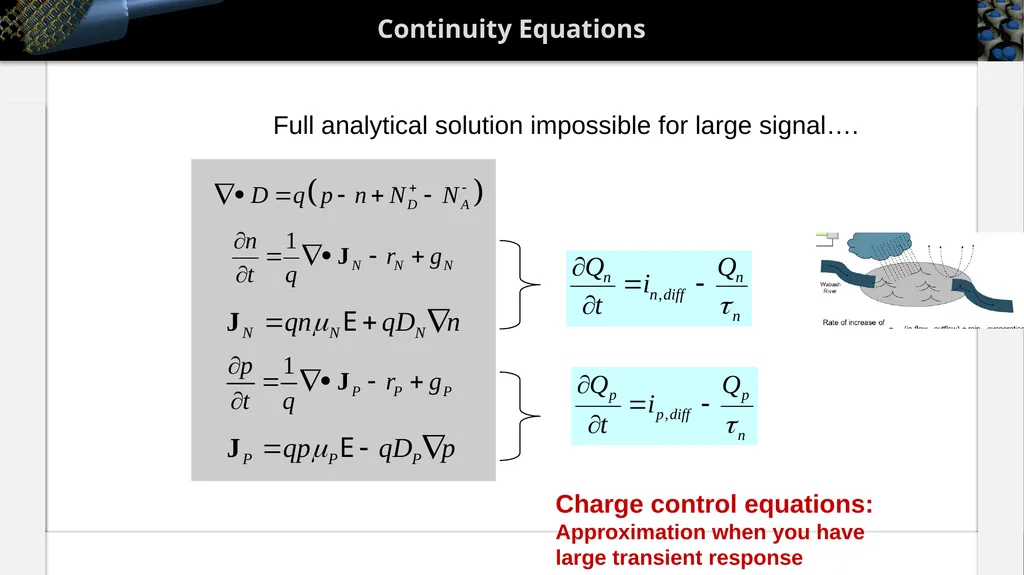
Continuity Equations Full analytical solution impossible for large signal…. Charge control equations:
Approximation when you have
large transient response<br>
08
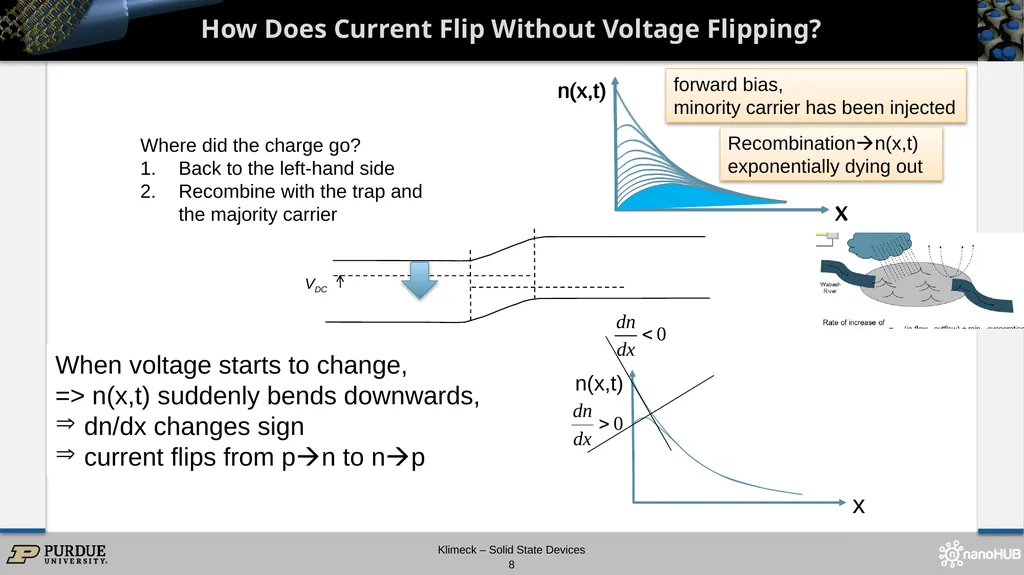
forward bias,
minority carrier has been injected How Does Current Flip Without Voltage Flipping? n(x,t) x Recombinationn(x,t) exponentially dying out Where did the charge go?
Back to the left-hand side
Recombine with the trap and the majority carrier When voltage starts to change,�=> n(x,t) suddenly bends downwards,
dn/dx changes sign
current flips from pn to np<br>
09
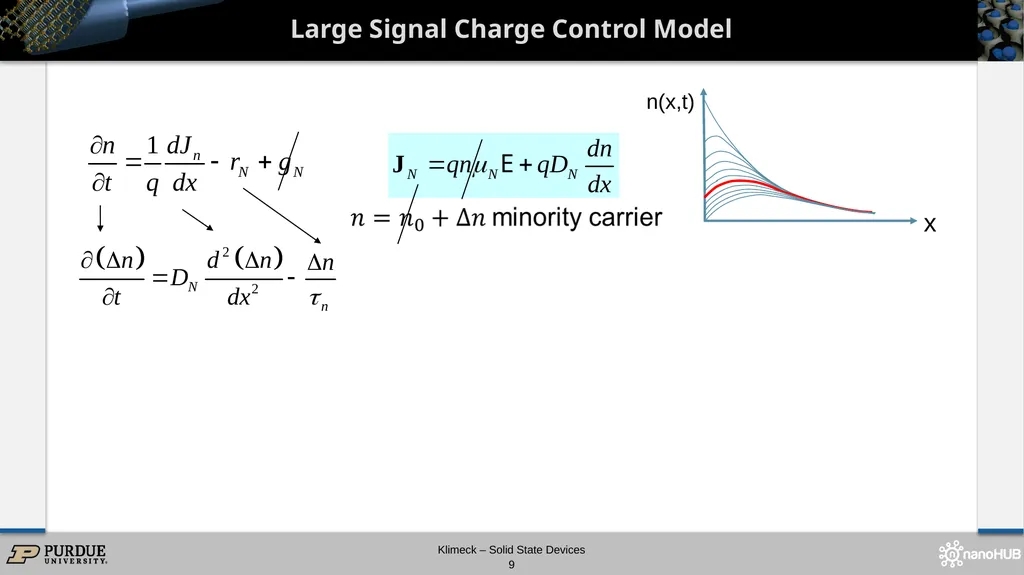
Large Signal Charge Control Model 9<br>
10
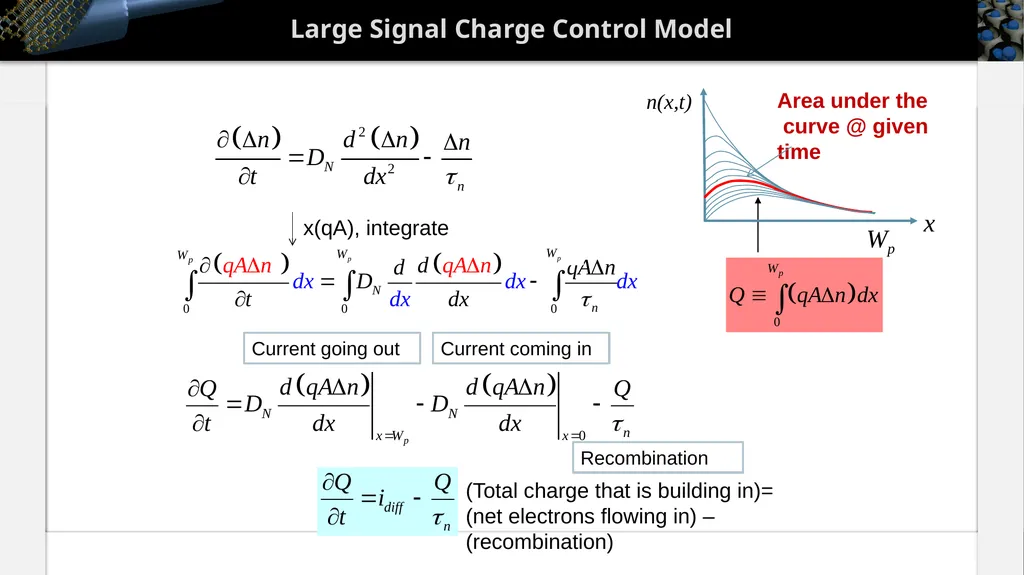
Large Signal Charge Control Model Area under the
curve @ given time Current going out Current coming in Recombination (Total charge that is building in)=
(net electrons flowing in) – (recombination) Wp<br>
11
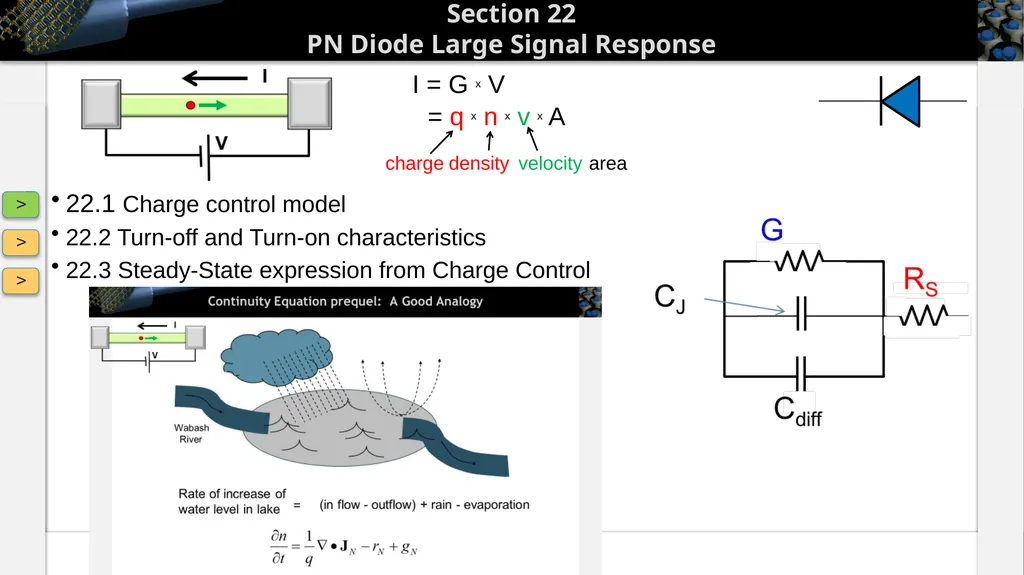
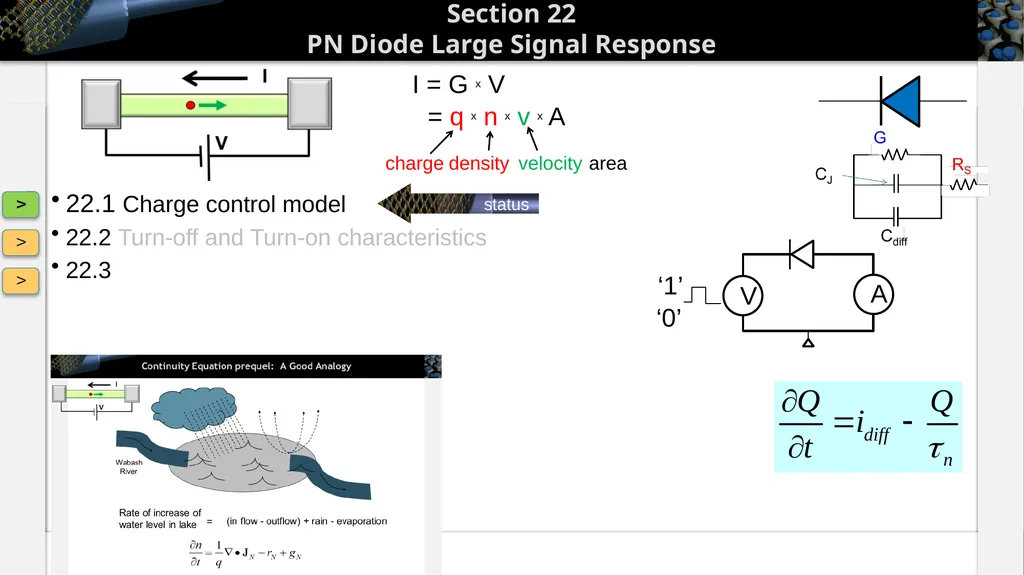
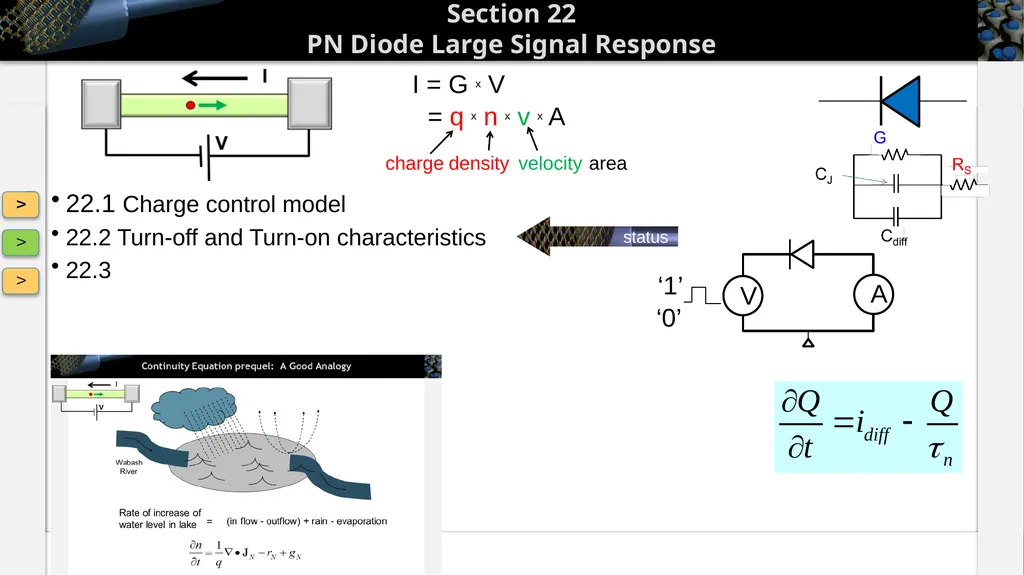
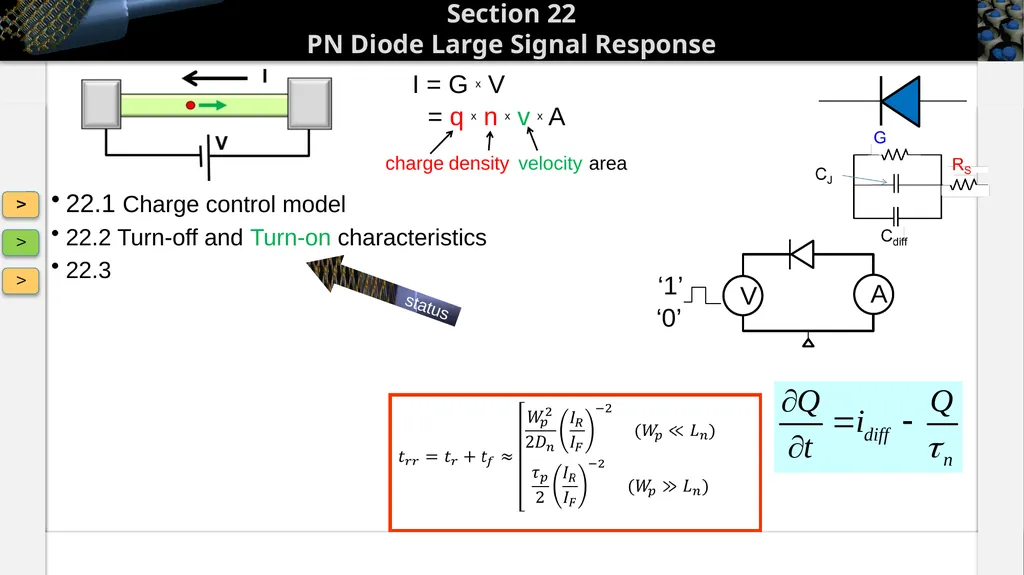
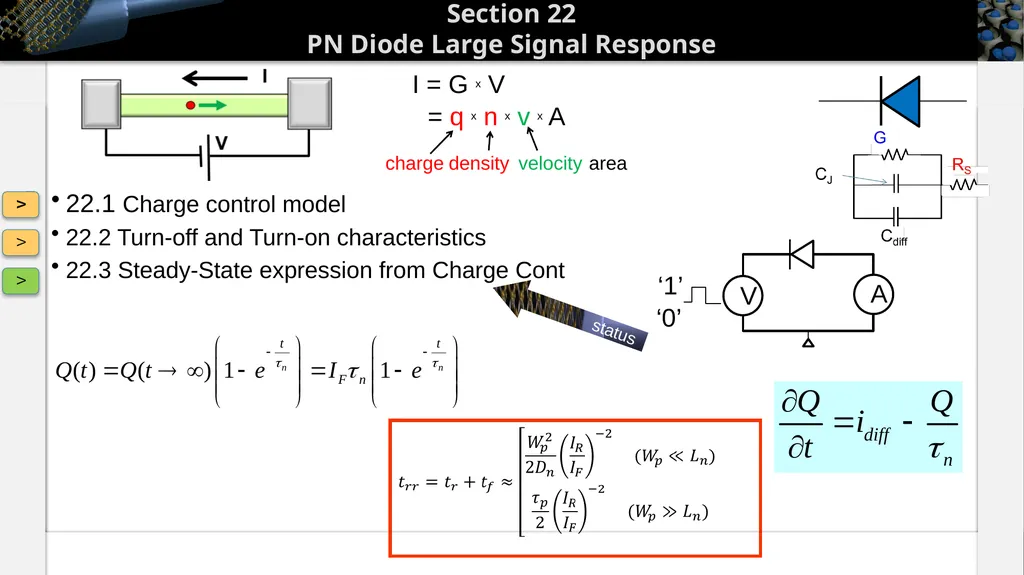
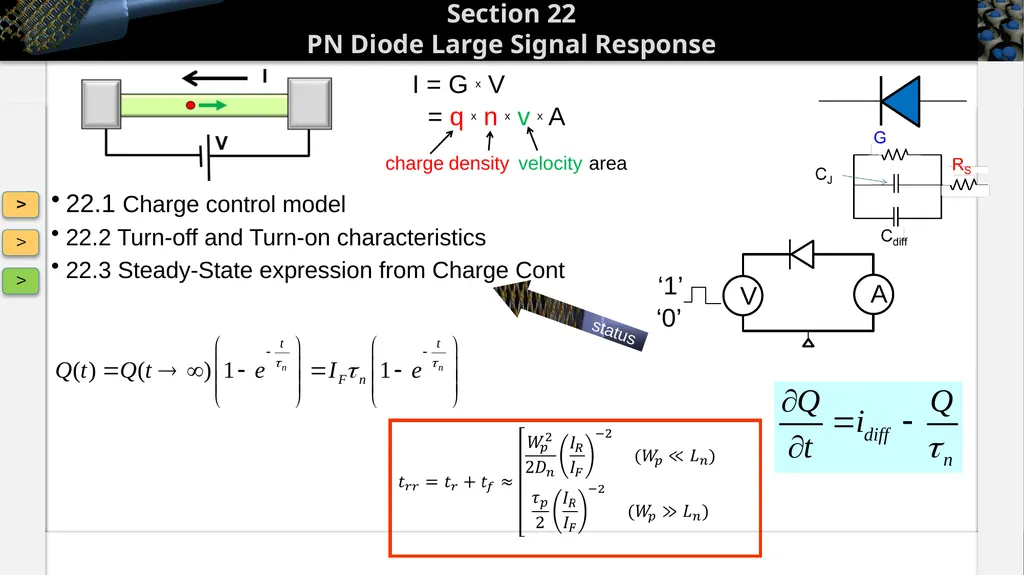
I = G x V Section 22�PN Diode Large Signal Response 22.1 Charge control model
22.2 Turn-off and Turn-on characteristics
22.3 Steady-State expression from Charge Control V V V A V ‘1’ ‘0’ status<br>
12
I = G x V Section 22�PN Diode Large Signal Response 22.1 Charge control model
22.2 Turn-off and Turn-on characteristics
22.3 Steady-State expression from Charge Control V V V A V ‘1’ ‘0’ status<br>
13
Section 22�PN Diode Large Signal Response Solid State Devices 22.2 Turn-off and Turn-on characteristics<br>
14
I = G x V Section 22�PN Diode Large Signal Response 22.1 Charge control model
22.2 Turn-off and Turn-on characteristics
22.3 Steady-State expression from Charge Control V V V status<br>
15
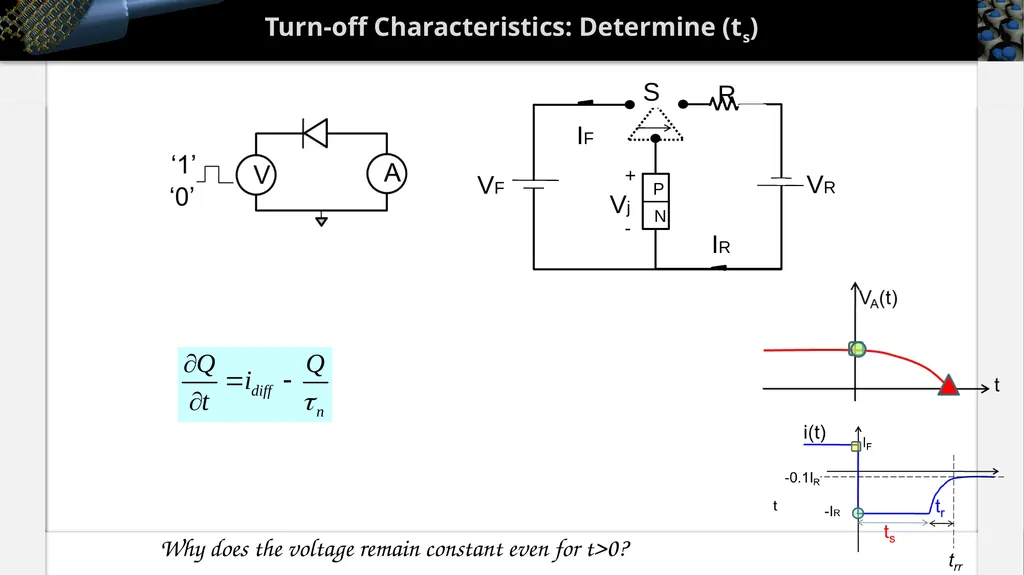
Turn-off Characteristics: Determine (ts) P N S R VR VF IF IR Vj + - Why does the voltage remain constant even for t>0?<br>
16
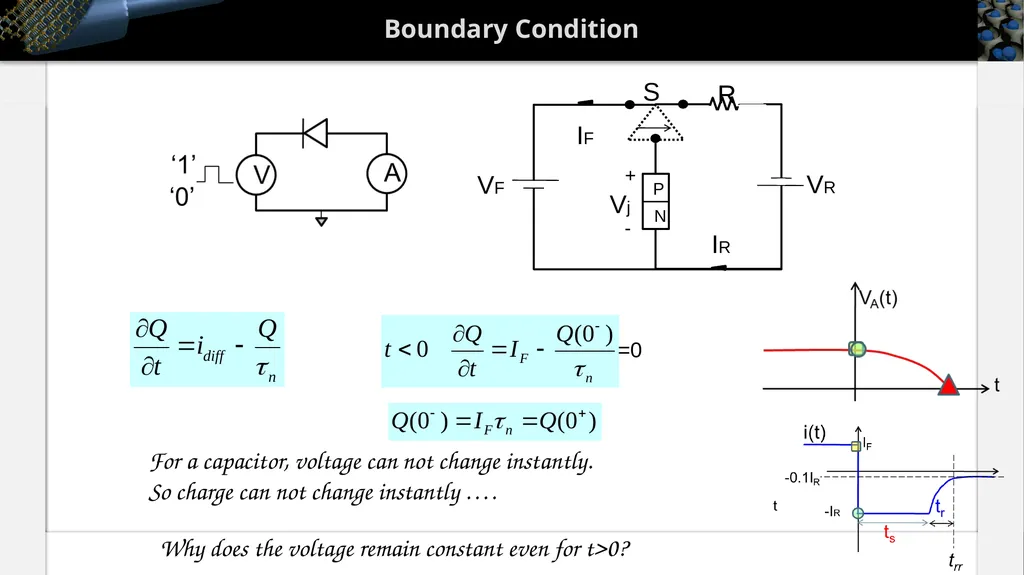
Boundary Condition For a capacitor, voltage can not change instantly.
So charge can not change instantly …. R =0 P N S R VR VF IF IR Vj + - Why does the voltage remain constant even for t>0?<br>
17
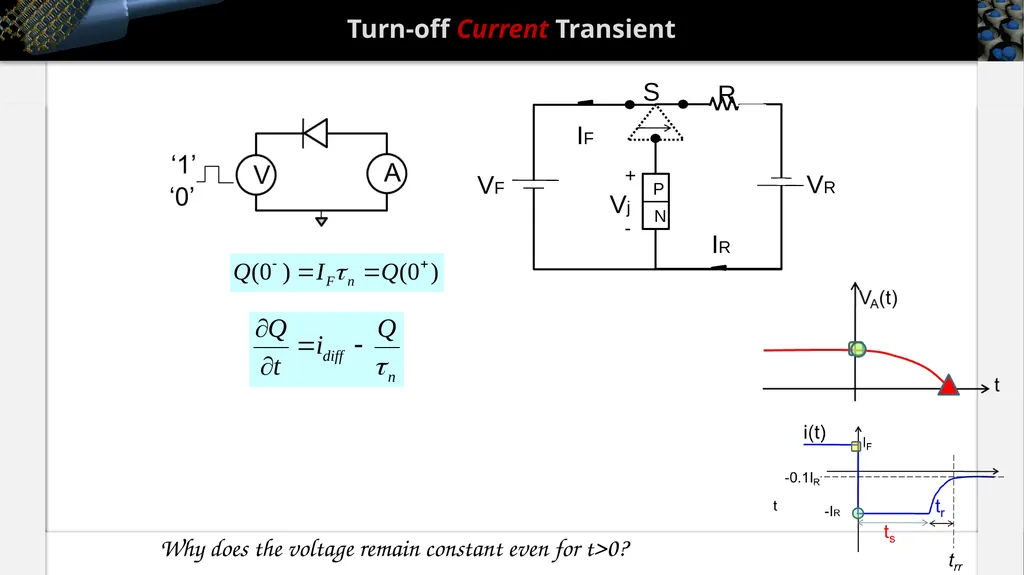
Turn-off Current Transient 17 P N S R VR VF IF IR Vj + - Why does the voltage remain constant even for t>0?<br>
18
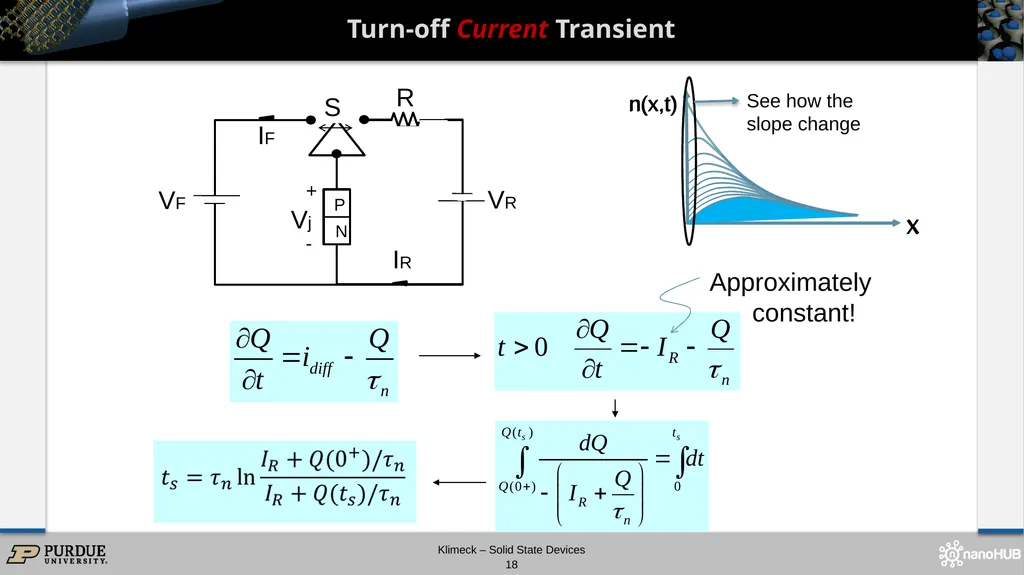
Turn-off Current Transient P N S R VR VF IF IR Vj + - n(x,t) x Approximately
constant!<br>
19
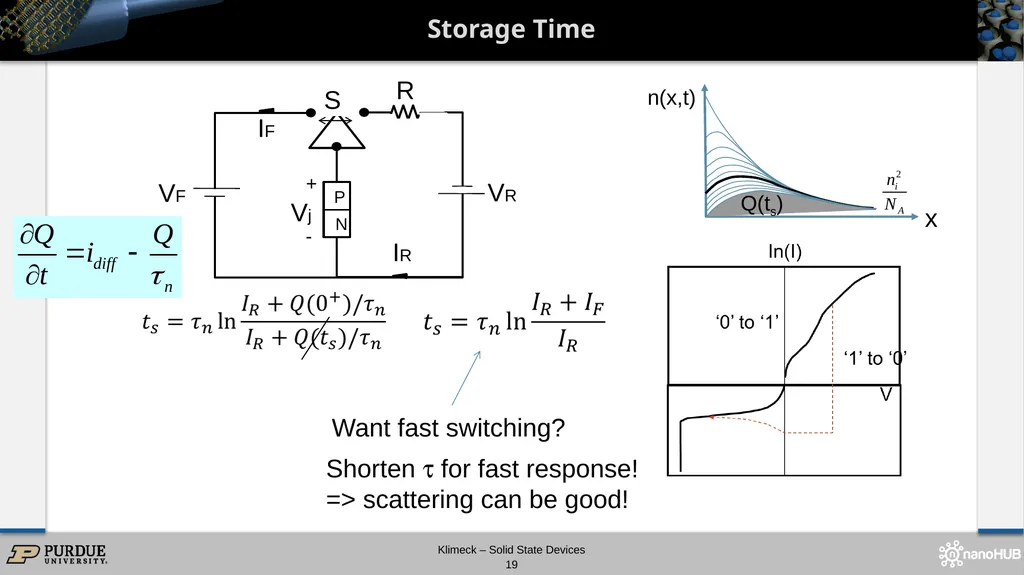
Storage Time P N S R VR VF IF IR Vj + - Want fast switching? Q(ts) Shorten t for fast response!�=> scattering can be good!<br>
20
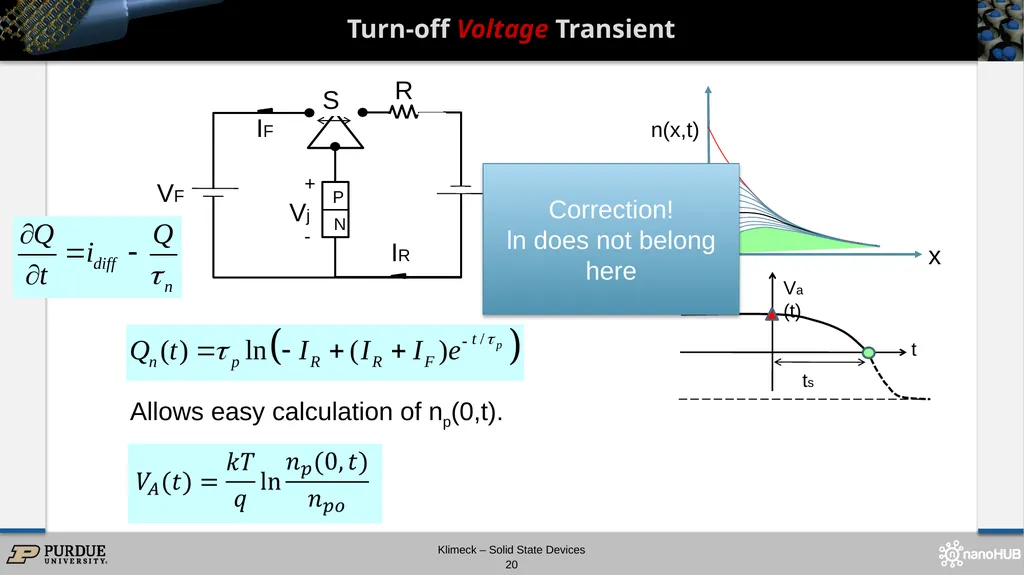
Turn-off Voltage Transient Allows easy calculation of np(0,t). t Va (t) ts P N S R VR VF IF IR Vj + - Correction!
ln does not belong here<br>
21
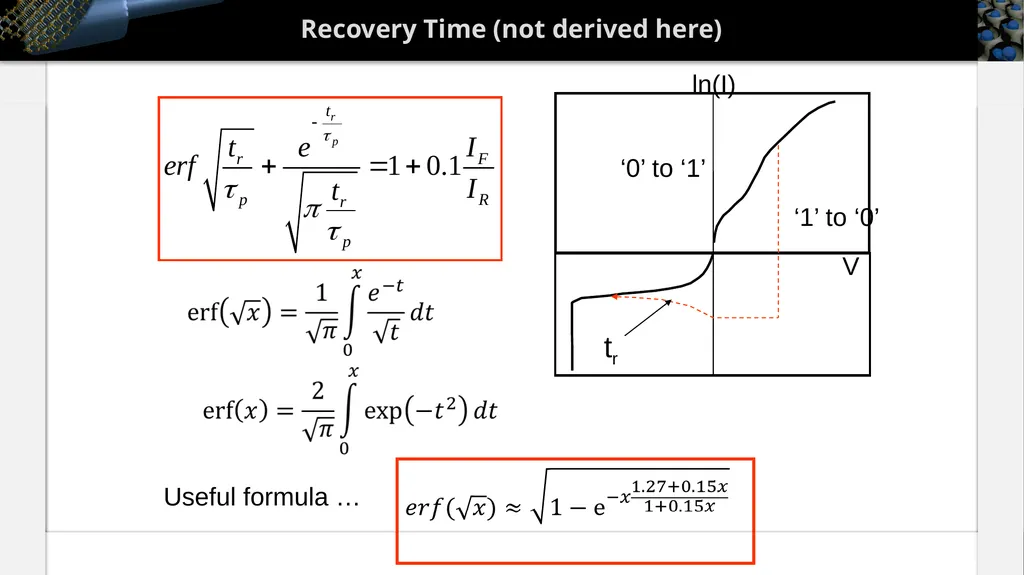
Recovery Time (not derived here) V ln(I) ‘1’ to ‘0’ ‘0’ to ‘1’ tr Useful formula …<br>
22
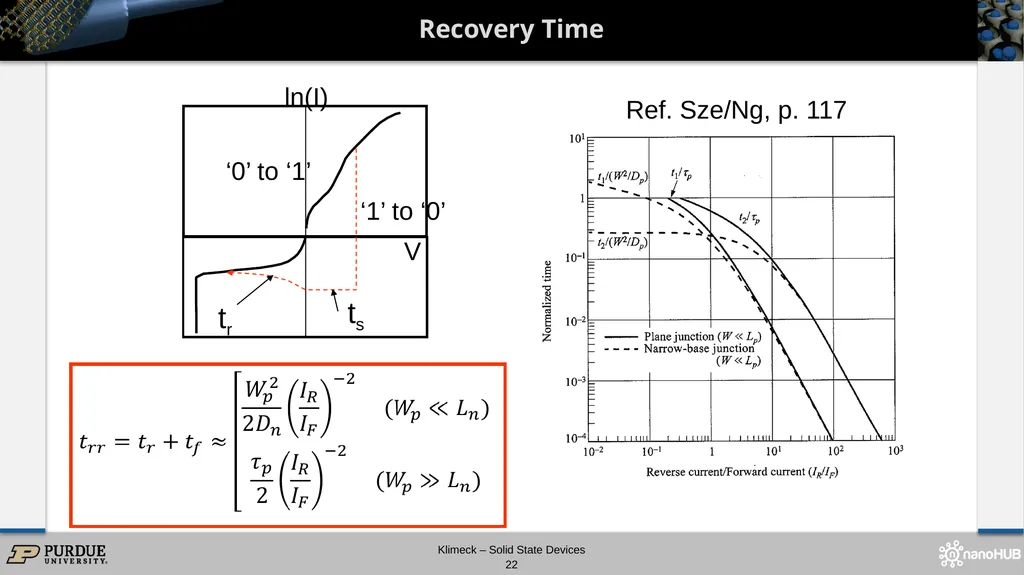
Recovery Time V ln(I) ‘1’ to ‘0’ ‘0’ to ‘1’ tr Ref. Sze/Ng, p. 117 ts<br>
23
I = G x V Section 22�PN Diode Large Signal Response 22.1 Charge control model
22.2 Turn-off and Turn-on characteristics
22.3 Steady-State expression from Charge Control V V V A V ‘1’ ‘0’ status<br>
24
I = G x V Section 22�PN Diode Large Signal Response 22.1 Charge control model
22.2 Turn-off and Turn-on characteristics
22.3 Steady-State expression from Charge Control V V V A V ‘1’ ‘0’ status<br>
25
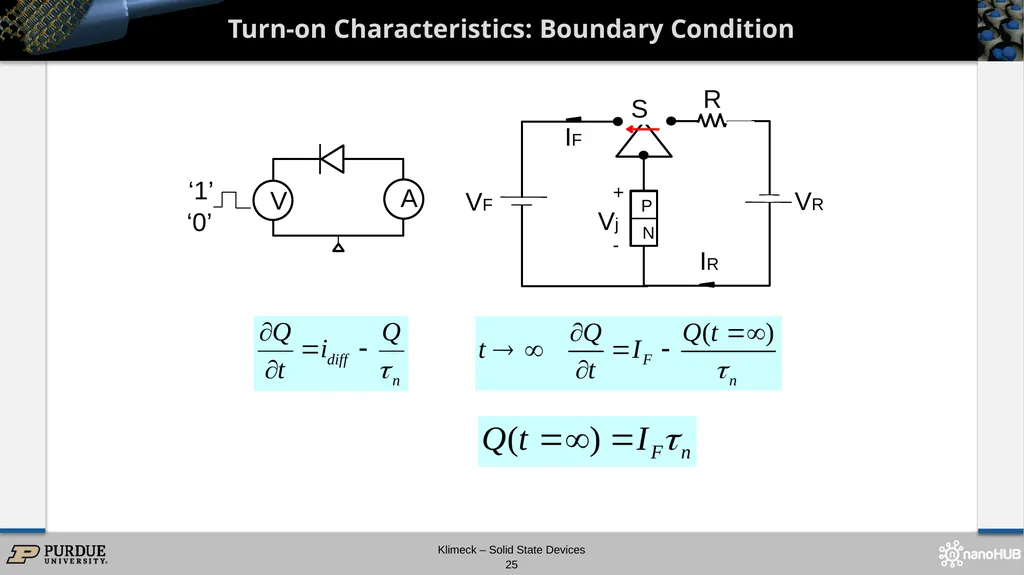
Turn-on Characteristics: Boundary Condition A V ‘1’ ‘0’ P N S R VR VF IF IR Vj + -<br>
26
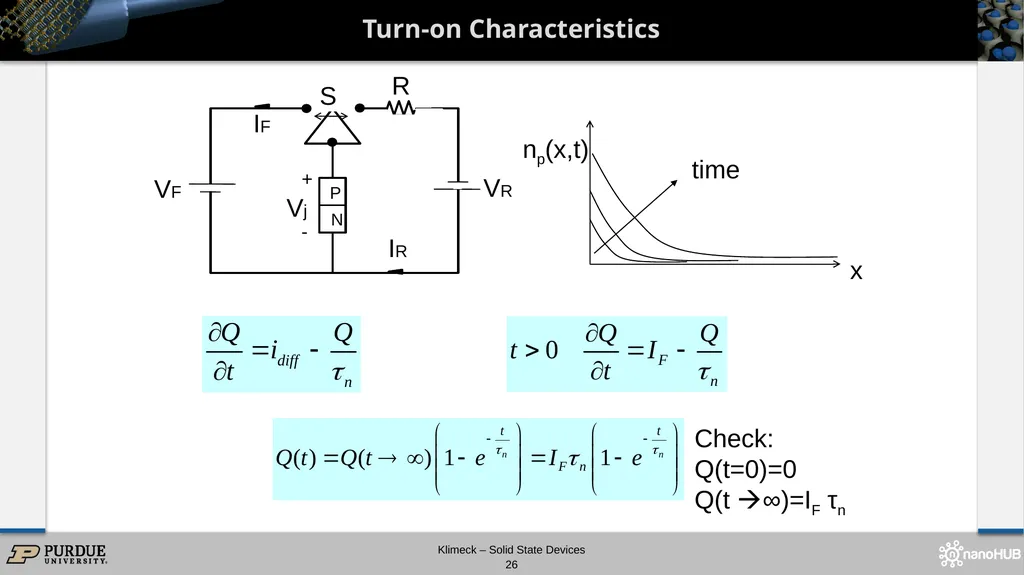
Turn-on Characteristics np(x,t) time x P N S R VR VF IF IR Vj + - Check:
Q(t=0)=0
Q(t ∞)=IF τn<br>
27
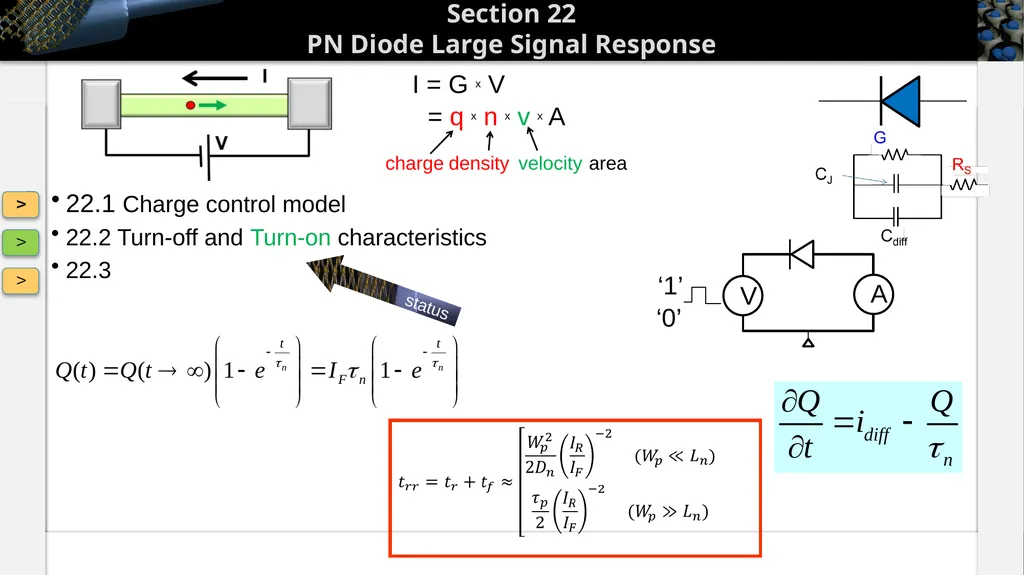
I = G x V Section 22�PN Diode Large Signal Response 22.1 Charge control model
22.2 Turn-off and Turn-on characteristics
22.3 Steady-State expression from Charge Control V V V A V ‘1’ ‘0’ status<br>
28
I = G x V Section 22�PN Diode Large Signal Response 22.1 Charge control model
22.2 Turn-off and Turn-on characteristics
22.3 Steady-State expression from Charge Control V V V A V ‘1’ ‘0’ status<br>
29
Section 22�PN Diode Large Signal Response Solid State Devices 22.3 Steady-State expression from Charge Control<br>
30
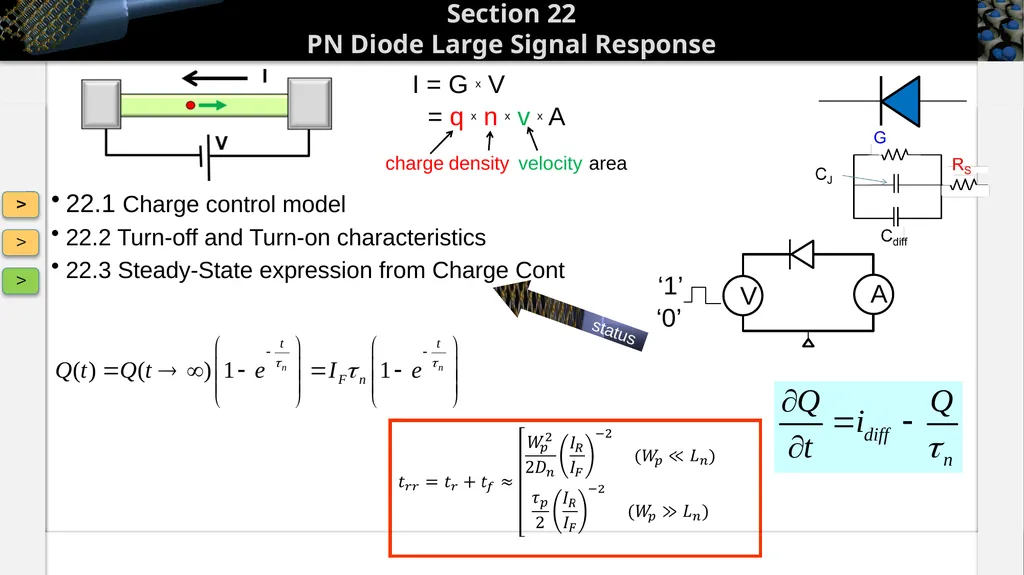
I = G x V Section 22�PN Diode Large Signal Response 22.1 Charge control model
22.2 Turn-off and Turn-on characteristics
22.3 Steady-State expression from Charge Control V V V A V ‘1’ ‘0’ status<br>
31
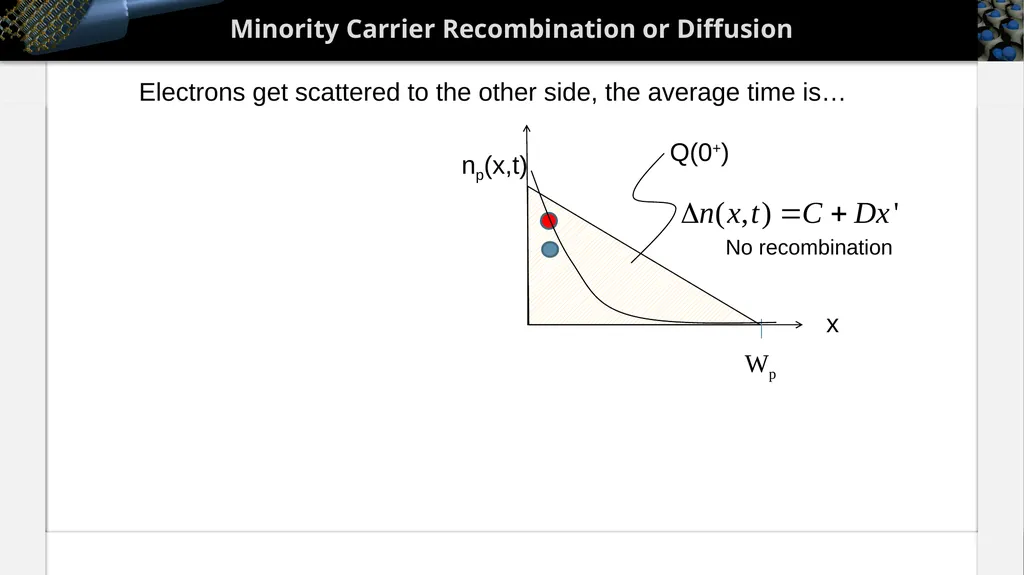
Minority Carrier Recombination or Diffusion np(x,t) x Q(0+) Wp Electrons get scattered to the other side, the average time is… recombination No recombination<br>
32
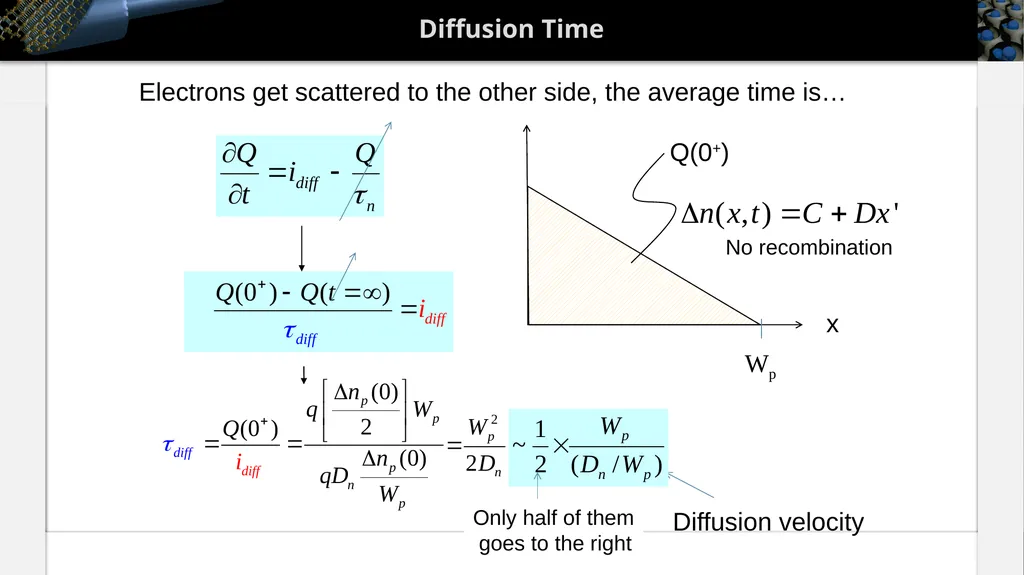
Diffusion Time Diffusion velocity Electrons get scattered to the other side, the average time is… Only half of them
goes to the right x Q(0+) Wp recombination No recombination<br>
33
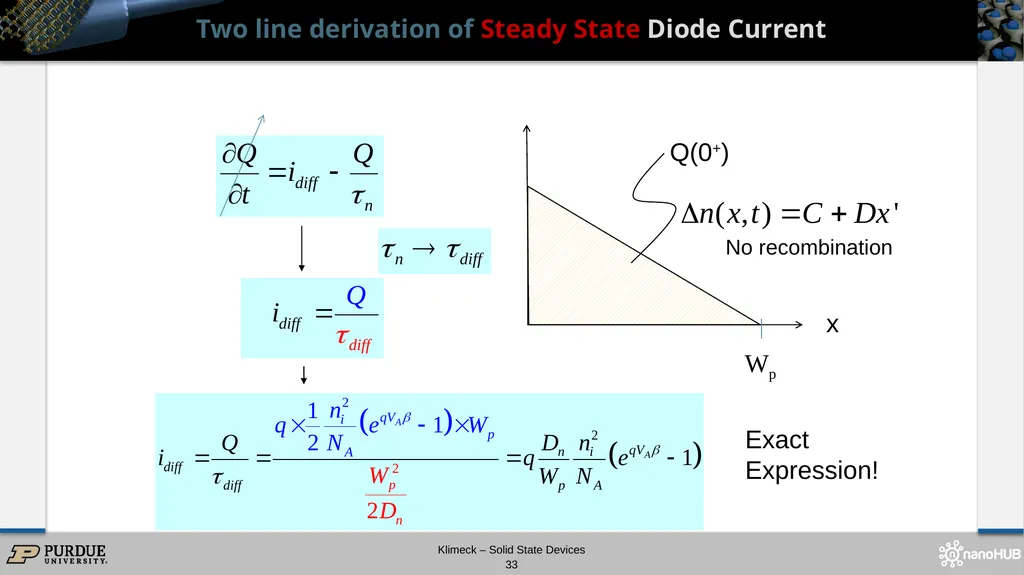
Two line derivation of Steady State Diode Current Exact
Expression! x Q(0+) Wp recombination No recombination<br>
34
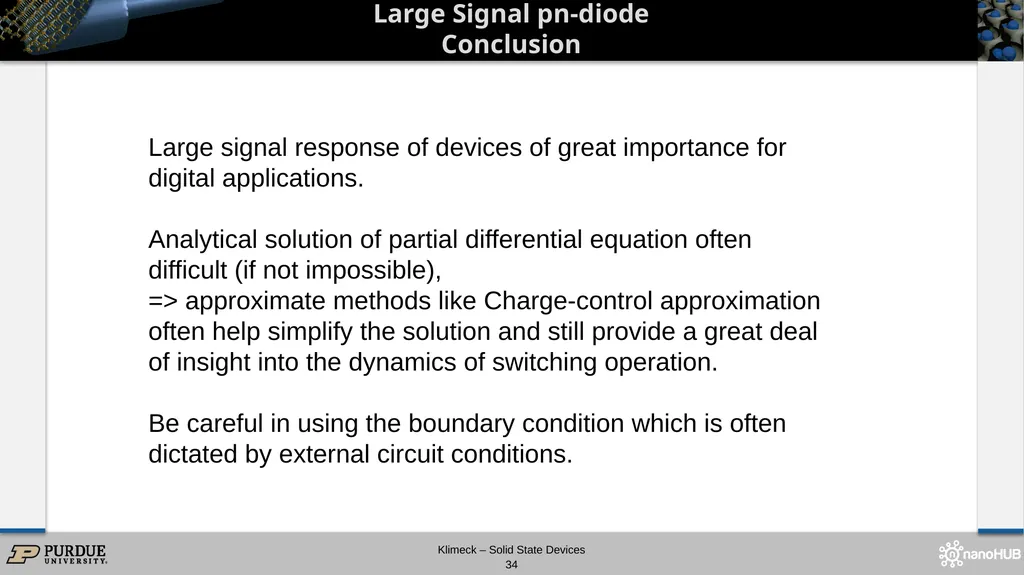
Large Signal pn-diode�Conclusion Large signal response of devices of great importance for digital applications.
Analytical solution of partial differential equation often difficult (if not impossible), �=> approximate methods like Charge-control approximation often help simplify the solution and still provide a great deal of insight into the dynamics of switching operation.
Be careful in using the boundary condition which is often dictated by external circuit conditions.<br>
35
I = G x V Section 22�PN Diode Large Signal Response 22.1 Charge control model
22.2 Turn-off and Turn-on characteristics
22.3 Steady-State expression from Charge Control V V V A V ‘1’ ‘0’ status<br>