
Section 5.7 Exponential and Logarithmic Functions
OM
Published · 55 slides · 0 views
1 / 1


Description
Section 5.7 Exponential and Logarithmic Functions Definition: Exponential Function An exponential function is a function of the form where b 0, b 1, a is the initial value, and x is a real number. Helpful HintSlide 1 The base number b
Related Topics
Share
Embed code
Download this presentation From Below
"Section 5.7 Exponential and Logarithmic Functions" is the property of its rightful owner. Permission is granted to download and print the materials on this website for personal, non-commercial use only, and to display it on your personal computer provided you do not modify the materials and that you retain all copyright notices contained in the materials. By downloading content from our website, you accept the terms of this agreement.
Presentation Transcript
01
Section 5.7 Exponential and Logarithmic Functions<br>
02
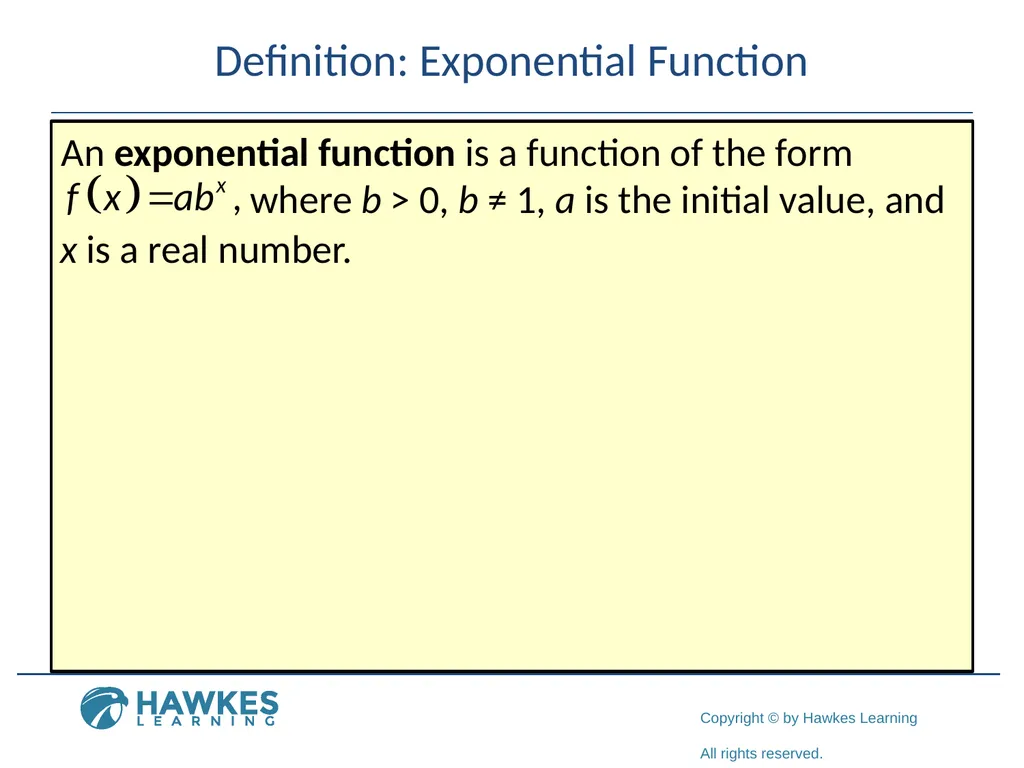
Definition: Exponential Function An exponential function is a function of the form where b > 0, b ≠ 1, a is the initial value, and x is a real number.<br>
03
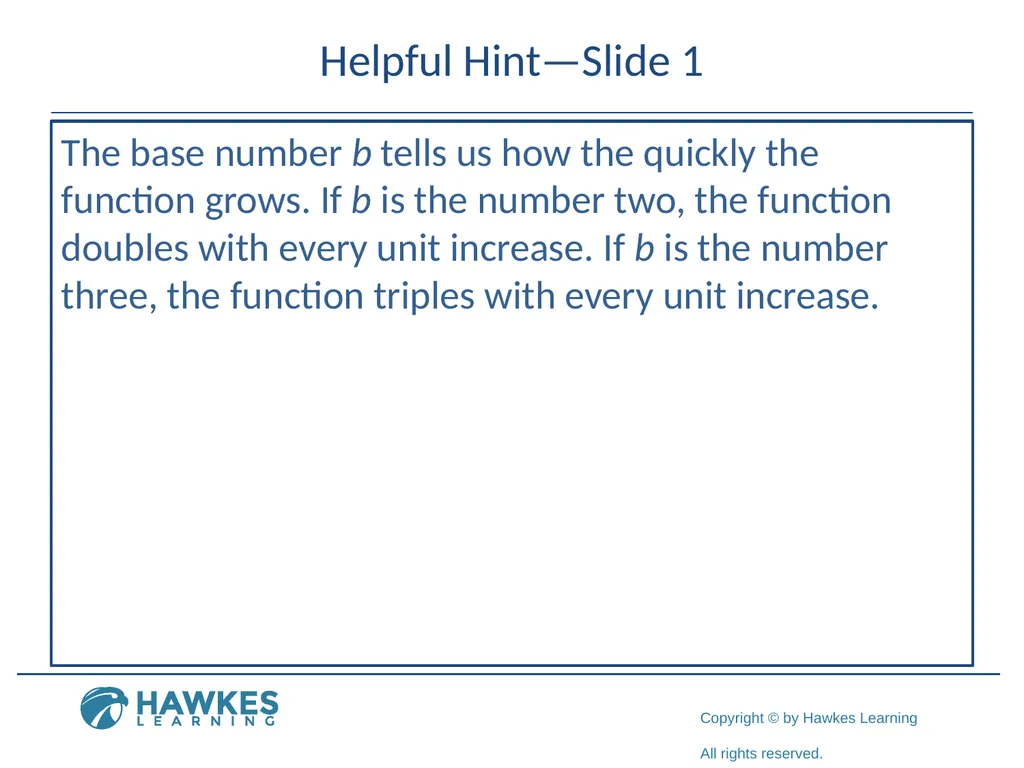
Helpful Hint—Slide 1 The base number b tells us how the quickly the function grows. If b is the number two, the function doubles with every unit increase. If b is the number three, the function triples with every unit increase.<br>
04
Fun Fact—Slide 1 Albert Bartlett was a physics professor that became quite famous after delivering a lecture in 1969 titled Arithmetic, Population, and Energy: Sustainability 101. The lecture was a mathematical demonstration of the capacity of Earth's population based on the energy needs and available resources. He delivered the lecture over 1700 times over the next 36 years!<br>
05
Example 1: Using an Exponential
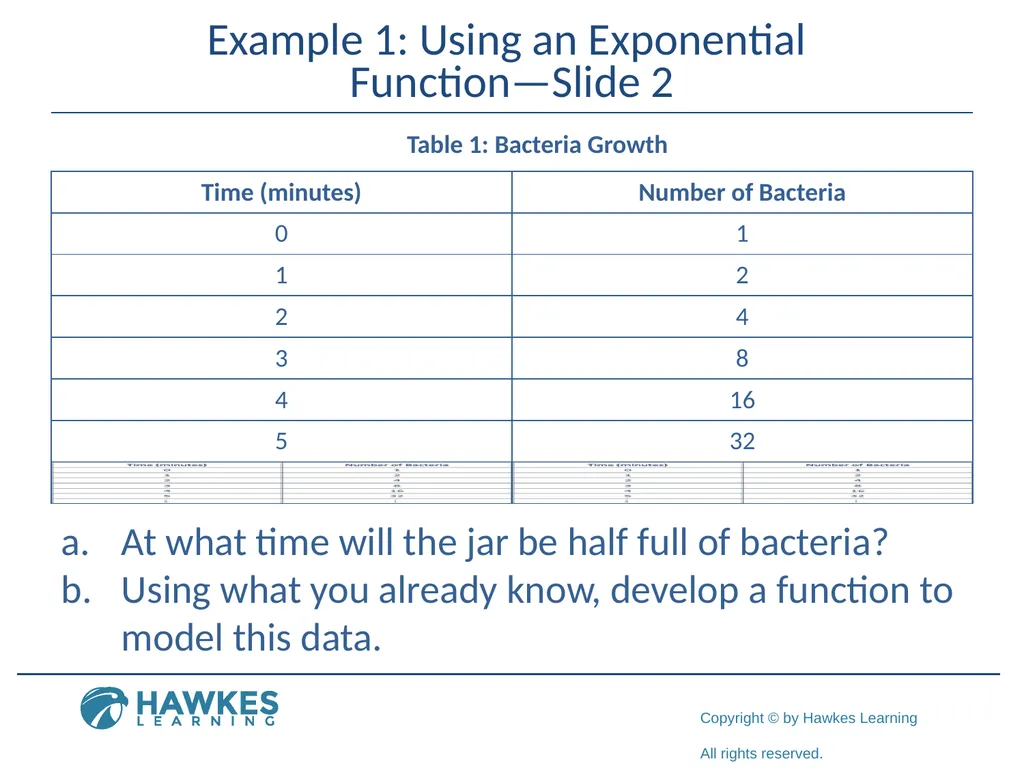
Function—Slide 1 A certain type of bacteria reproduces in such a way that every minute, the number of bacteria doubles. At 8:00 a.m., or time t = 0, a single bacterium is placed in a jar. At 8:01 a.m., there are two bacteria in the jar, and at 8:02 a.m., there are four bacteria. Assume the bacteria continues to reproduce in this manner, with no loss in the number of bacteria, and that the jar is full of bacteria at 8:30 a.m. Table 1 displays the pattern of growth in the bacteria. Note that time t = 0 represents the starting time of 8:00 a.m.<br>
06
Example 1: Using an Exponential
Function—Slide 2 Table 1: Bacteria Growth a. At what time will the jar be half full of bacteria?
b. Using what you already know, develop a function to model this data.<br>
b. Using what you already know, develop a function to model this data.<br>
07
Example 1: Using an Exponential
Function—Slide 3 Solution
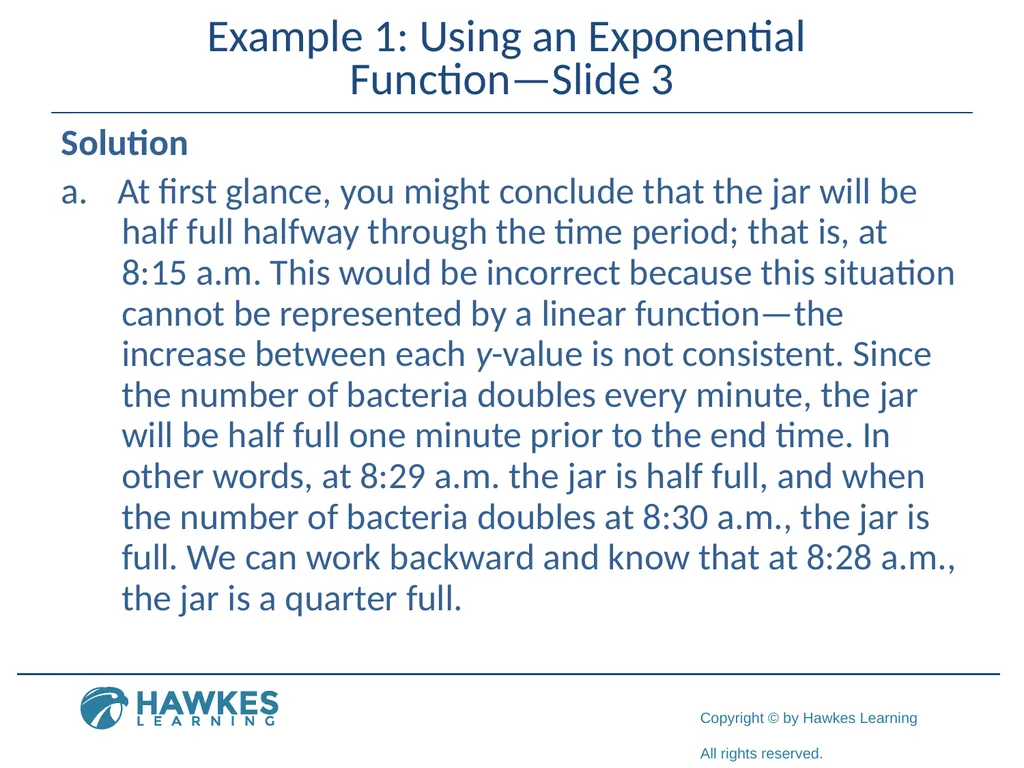
a. At first glance, you might conclude that the jar will be half full halfway through the time period; that is, at 8:15 a.m. This would be incorrect because this situation cannot be represented by a linear function—the increase between each y-value is not consistent. Since the number of bacteria doubles every minute, the jar will be half full one minute prior to the end time. In other words, at 8:29 a.m. the jar is half full, and when the number of bacteria doubles at 8:30 a.m., the jar is full. We can work backward and know that at 8:28 a.m., the jar is a quarter full.<br>
a. At first glance, you might conclude that the jar will be half full halfway through the time period; that is, at 8:15 a.m. This would be incorrect because this situation cannot be represented by a linear function—the increase between each y-value is not consistent. Since the number of bacteria doubles every minute, the jar will be half full one minute prior to the end time. In other words, at 8:29 a.m. the jar is half full, and when the number of bacteria doubles at 8:30 a.m., the jar is full. We can work backward and know that at 8:28 a.m., the jar is a quarter full.<br>
08
Example 1: Using an Exponential
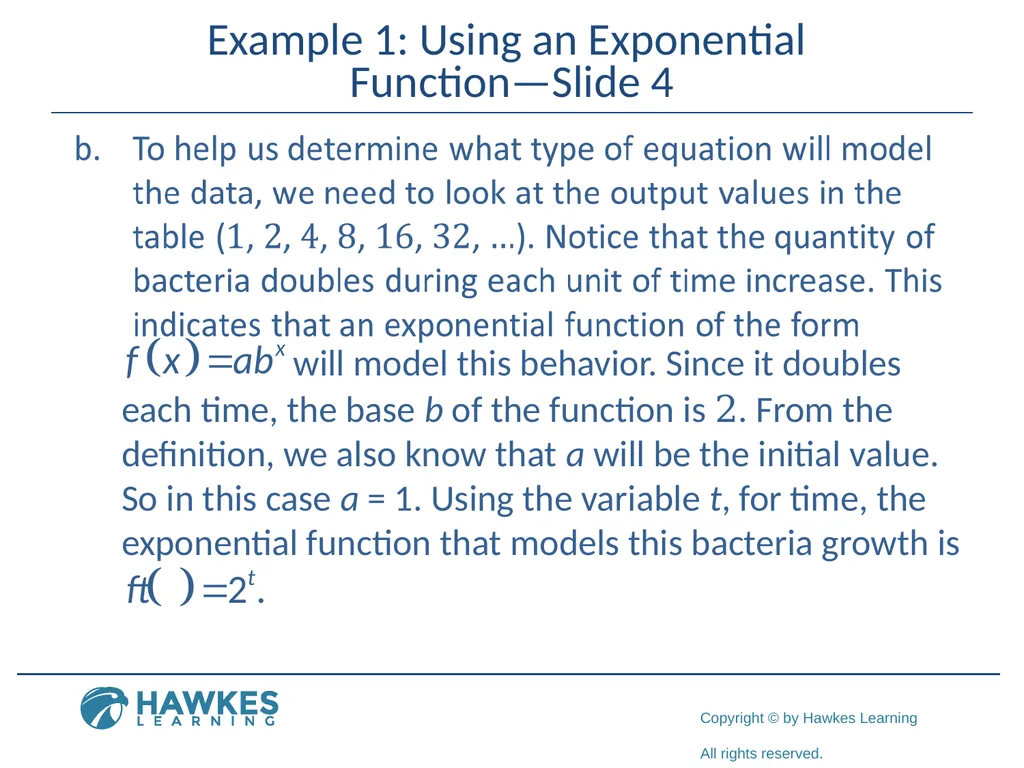
Function—Slide 4 will model this behavior. Since it doubles each time, the base b of the function is 2. From the definition, we also know that a will be the initial value. So in this case a = 1. Using the variable t, for time, the exponential function that models this bacteria growth is<br>
09
Example 1: Using an Exponential
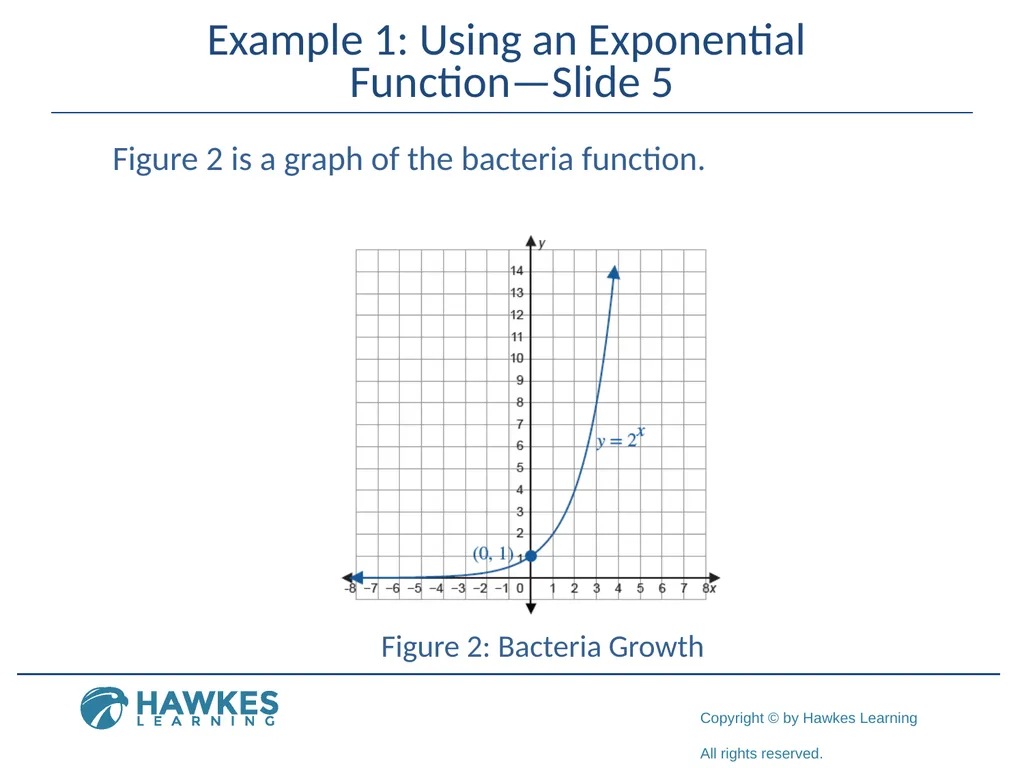
Function—Slide 5 Figure 2 is a graph of the bacteria function. Figure 2: Bacteria Growth<br>
10
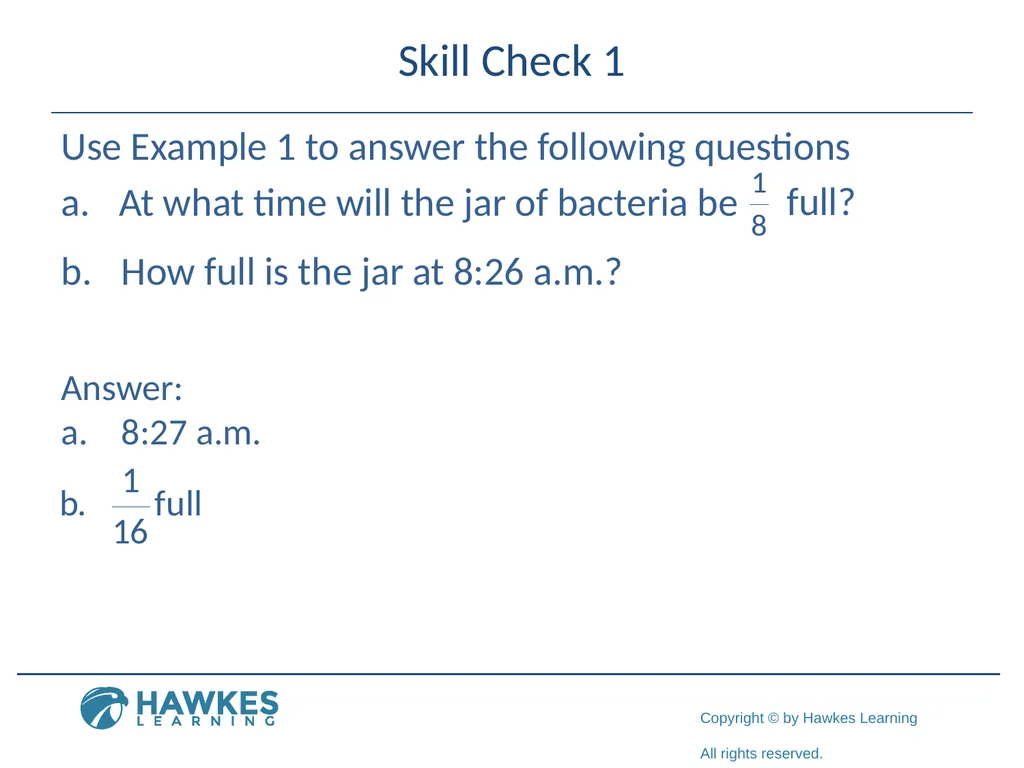
Skill Check 1 Use Example 1 to answer the following questions
At what time will the jar of bacteria be full? b. How full is the jar at 8:26 a.m.? Answer:
a. 8:27 a.m.<br>
At what time will the jar of bacteria be full? b. How full is the jar at 8:26 a.m.? Answer:
a. 8:27 a.m.<br>
11
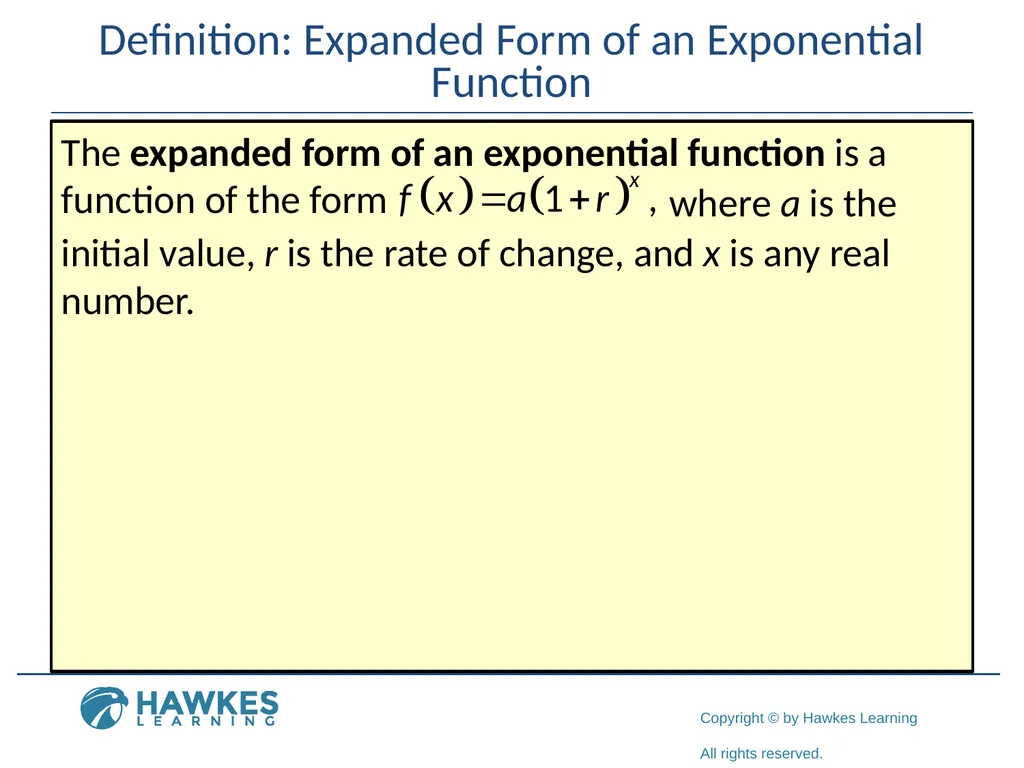
Definition: Expanded Form of an Exponential Function The expanded form of an exponential function is a function of the form where a is the initial value, r is the rate of change, and x is any real number.<br>
12
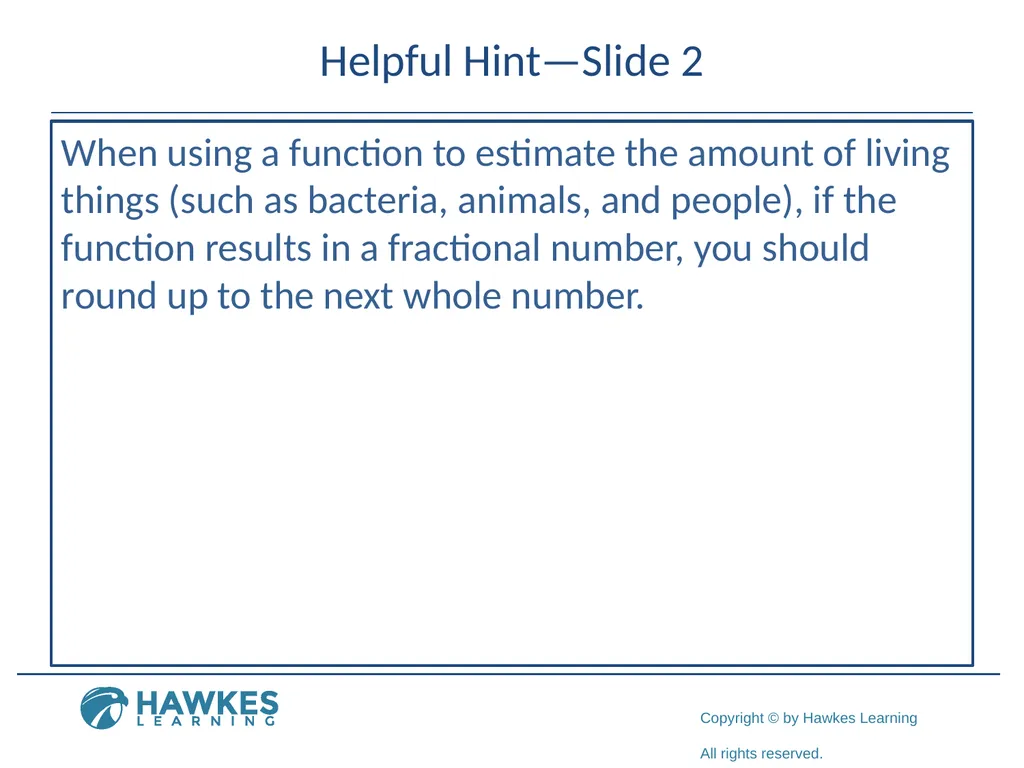
Helpful Hint—Slide 2 When using a function to estimate the amount of living things (such as bacteria, animals, and people), if the function results in a fractional number, you should round up to the next whole number.<br>
13
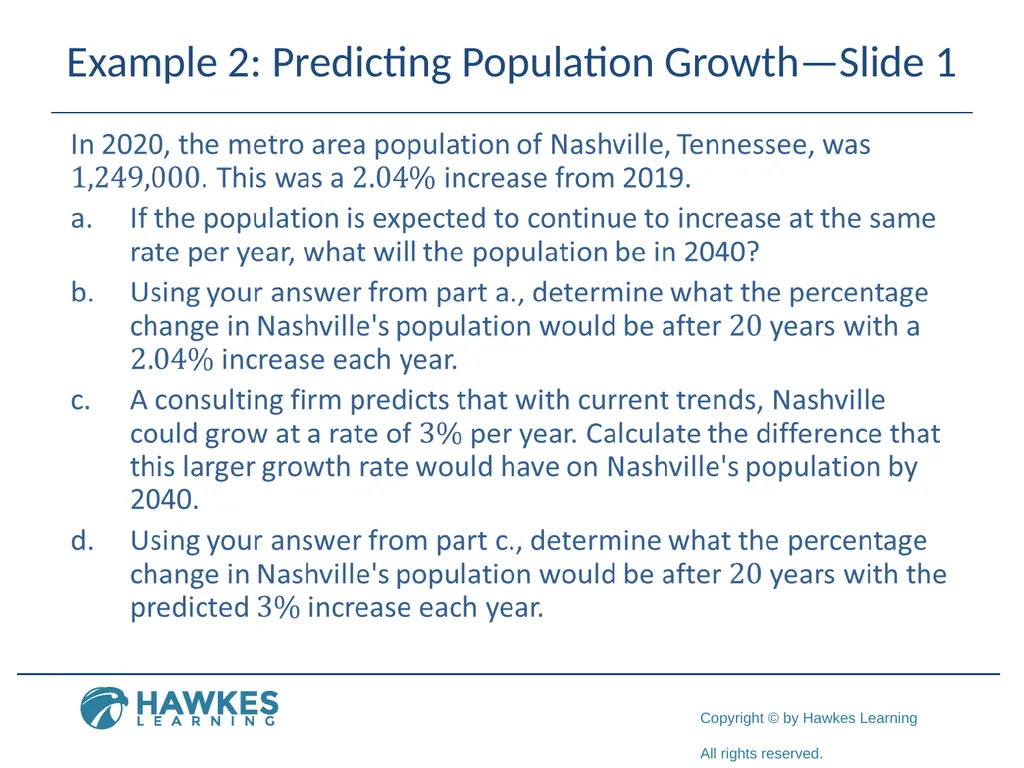
Example 2: Predicting Population Growth—Slide 1<br>
14
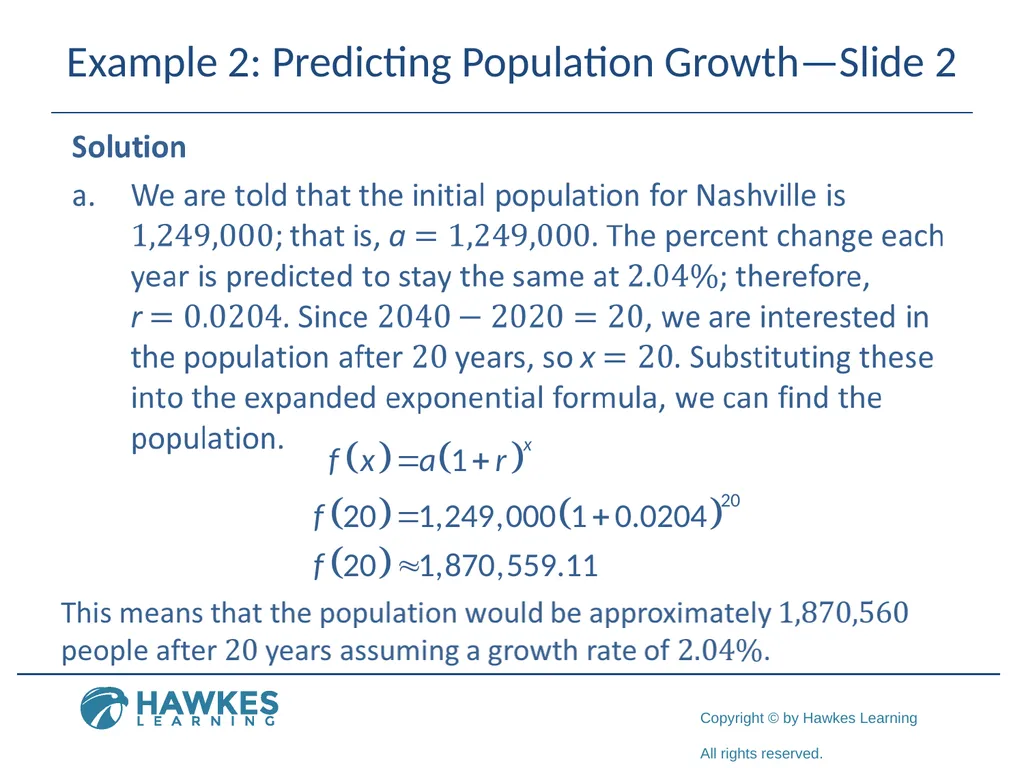
Example 2: Predicting Population Growth—Slide 2<br>
15
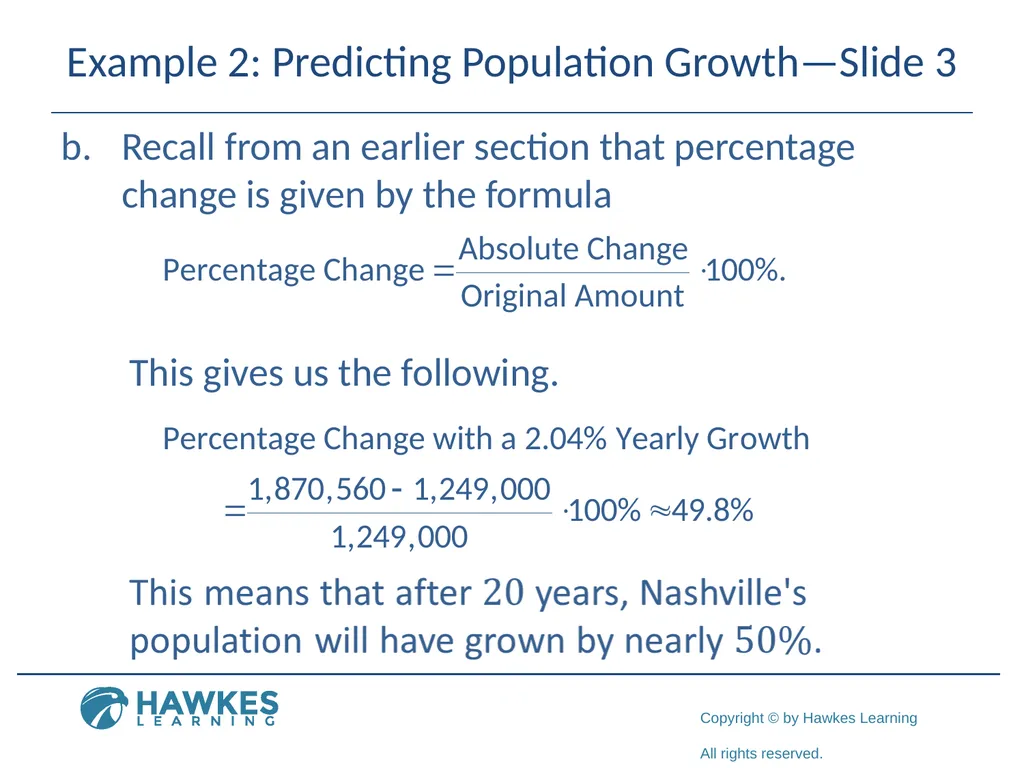
Example 2: Predicting Population Growth—Slide 3 b. Recall from an earlier section that percentage change is given by the formula
This gives us the following.<br>
This gives us the following.<br>
16
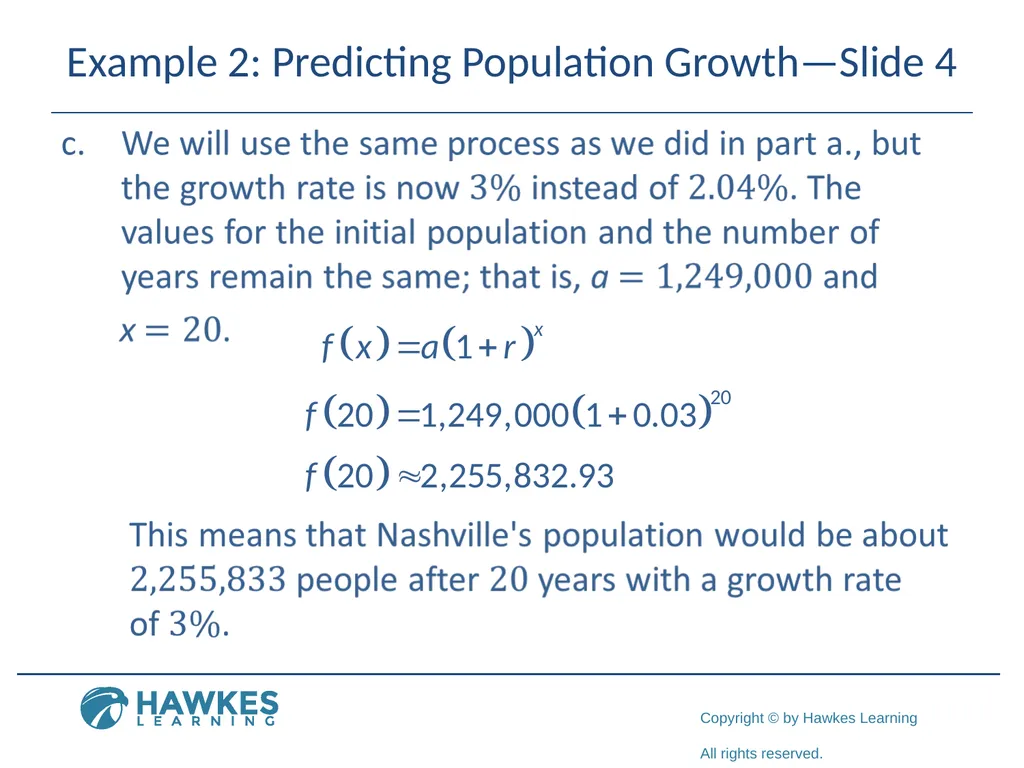
Example 2: Predicting Population Growth—Slide 4<br>
17
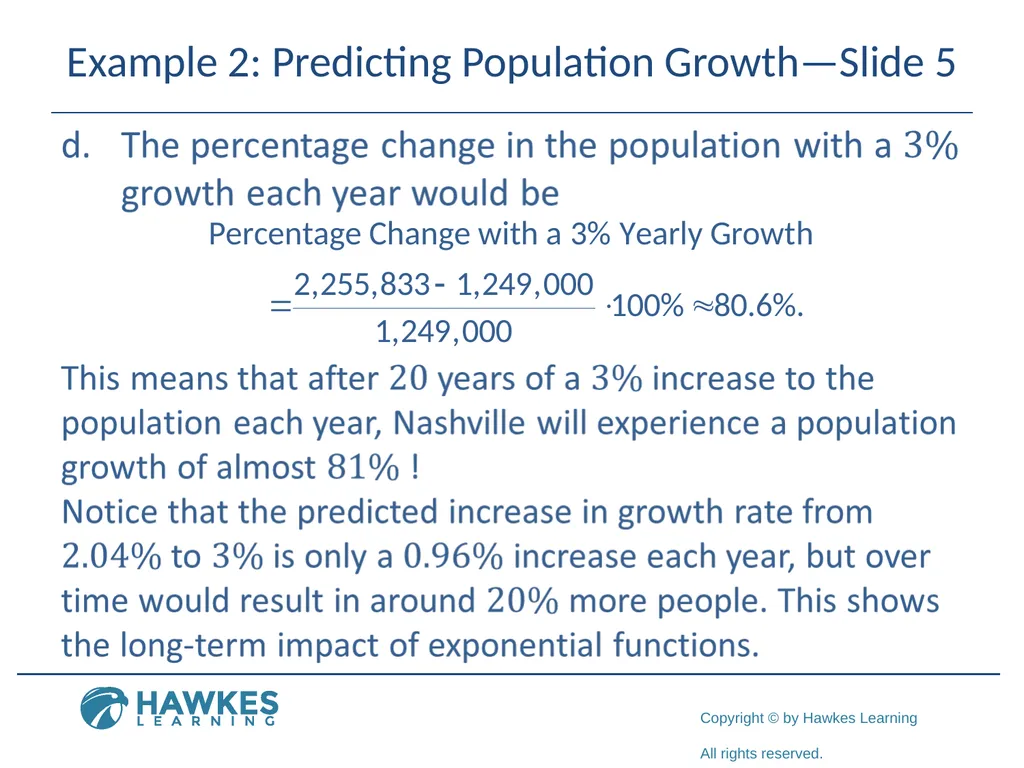
Example 2: Predicting Population Growth—Slide 5<br>
18
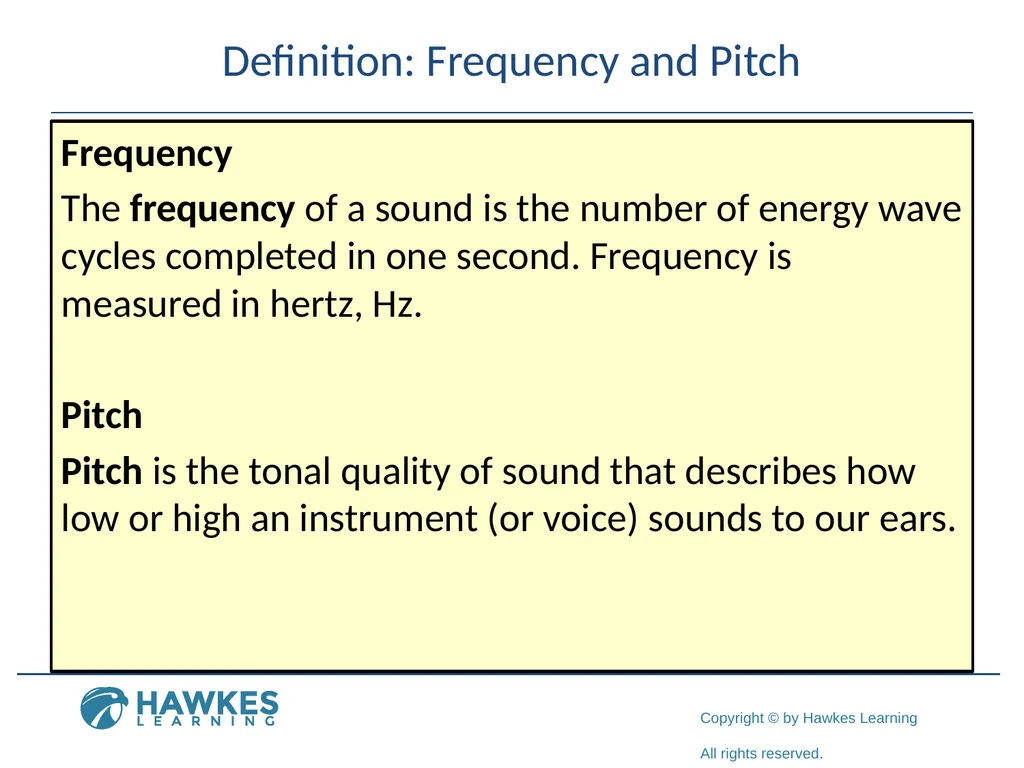
Definition: Frequency and Pitch Frequency
The frequency of a sound is the number of energy wave cycles completed in one second. Frequency is measured in hertz, Hz.
Pitch
Pitch is the tonal quality of sound that describes how low or high an instrument (or voice) sounds to our ears.<br>
The frequency of a sound is the number of energy wave cycles completed in one second. Frequency is measured in hertz, Hz.
Pitch
Pitch is the tonal quality of sound that describes how low or high an instrument (or voice) sounds to our ears.<br>
19
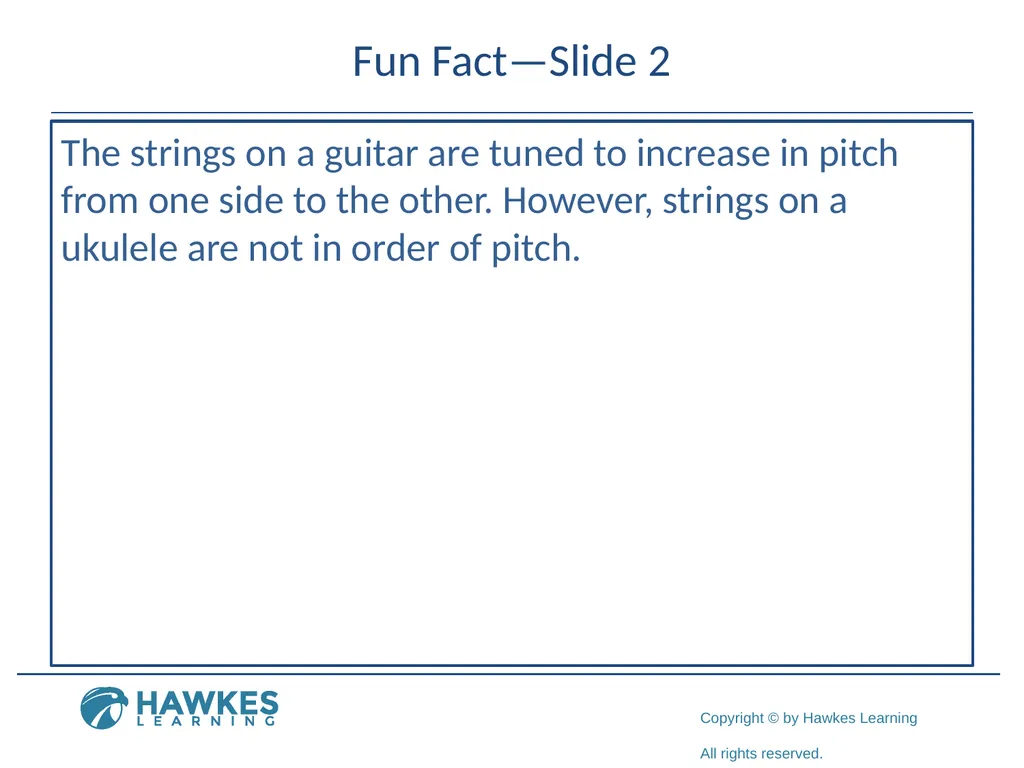
Fun Fact—Slide 2 The strings on a guitar are tuned to increase in pitch from one side to the other. However, strings on a ukulele are not in order of pitch.<br>
20
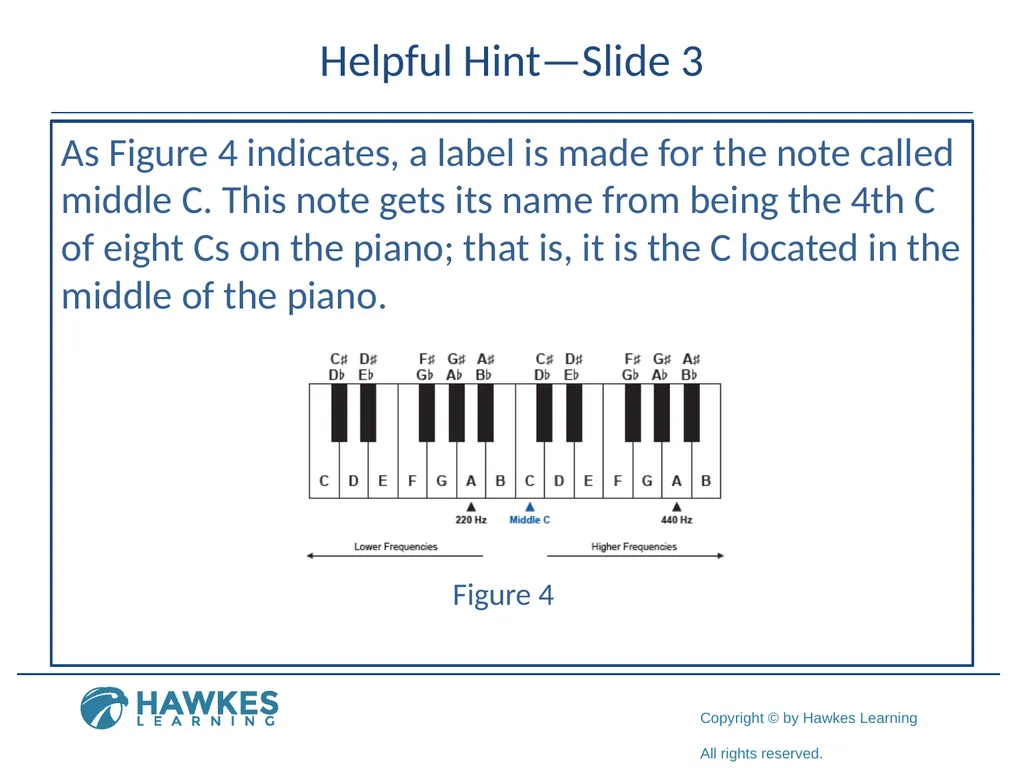
Helpful Hint—Slide 3 As Figure 4 indicates, a label is made for the note called middle C. This note gets its name from being the 4th C of eight Cs on the piano; that is, it is the C located in the middle of the piano. Figure 4<br>
21
Definition: Steps and Octaves Half Step
A half step is the distance between one note and the next nearest note on a piano.
Whole Step
A whole step is defined as the interval between two half steps on a piano.
Octave
An octave is the interval of notes between 12 half steps on a piano.<br>
A half step is the distance between one note and the next nearest note on a piano.
Whole Step
A whole step is defined as the interval between two half steps on a piano.
Octave
An octave is the interval of notes between 12 half steps on a piano.<br>
22
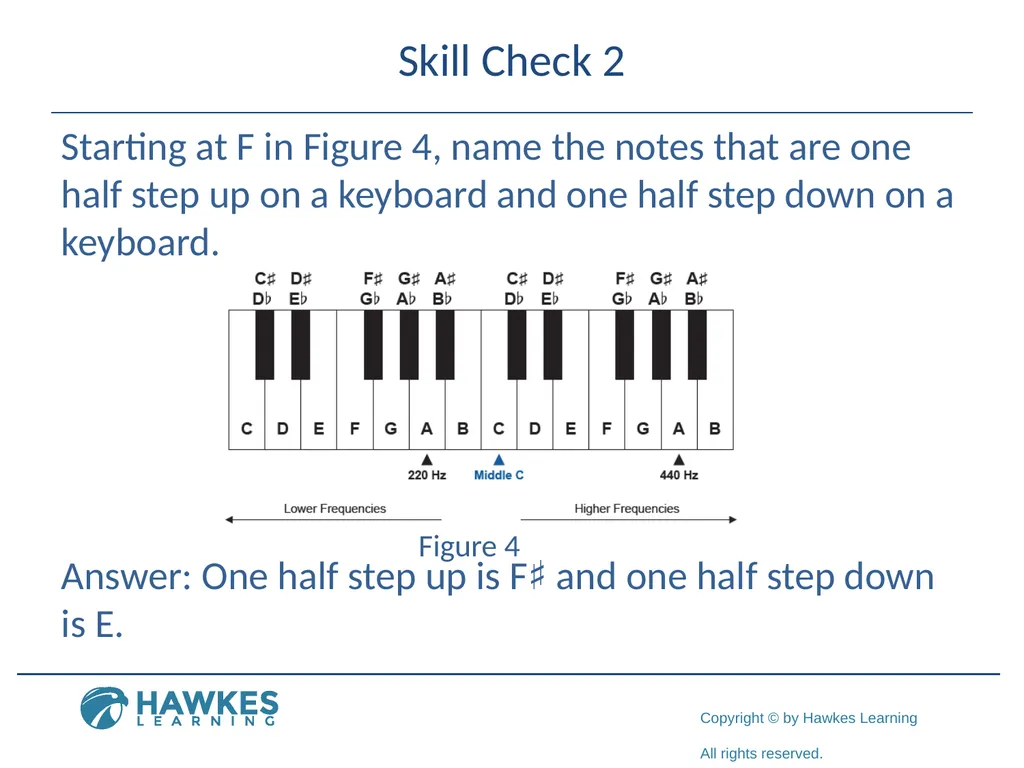
Skill Check 2 Starting at F in Figure 4, name the notes that are one half step up on a keyboard and one half step down on a keyboard.
Answer: One half step up is F♯ and one half step down is E. Figure 4<br>
Answer: One half step up is F♯ and one half step down is E. Figure 4<br>
23
Helpful Hint—Slide 4 If you don't have access to a piano, you can use the virtual piano on the website http://www.virtualpiano.net/.<br>
24
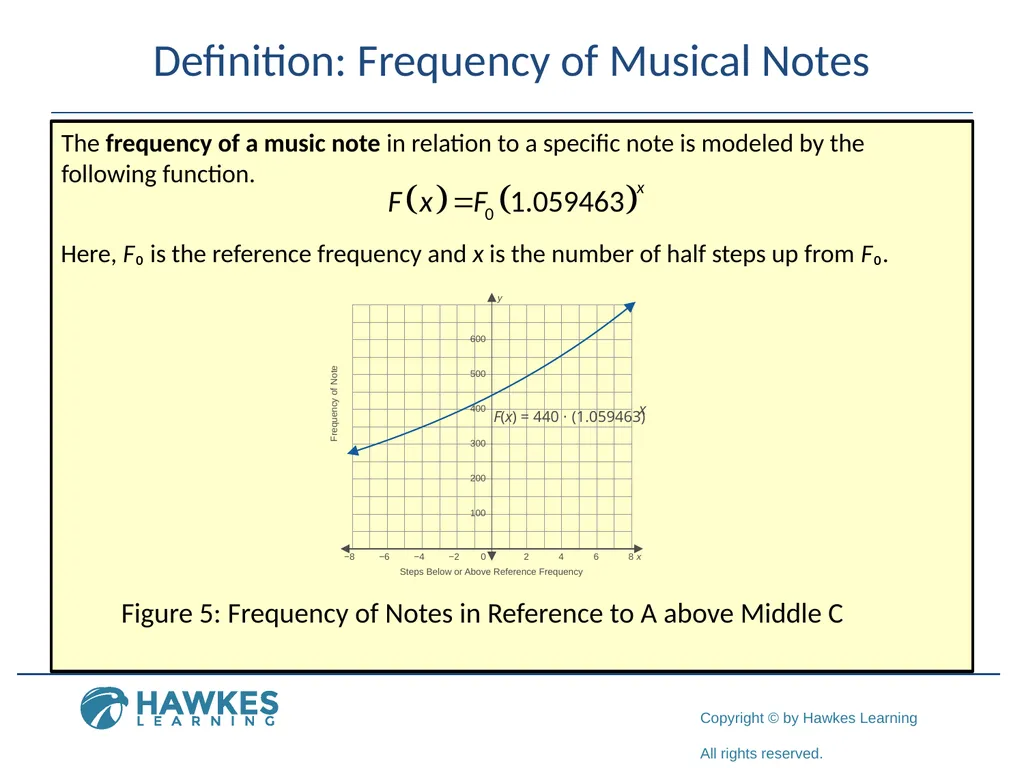
Definition: Frequency of Musical Notes The frequency of a music note in relation to a specific note is modeled by the following function. Here, F₀ is the reference frequency and x is the number of half steps up from F₀. Figure 5: Frequency of Notes in Reference to A above Middle C<br>
25
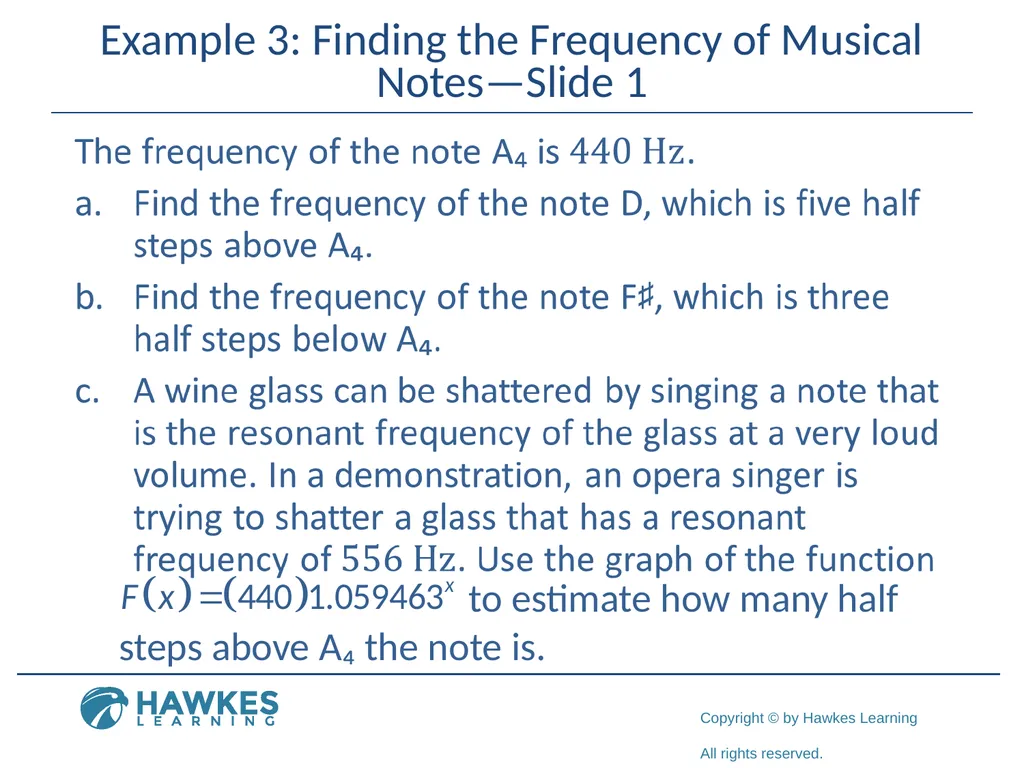
Example 3: Finding the Frequency of Musical Notes—Slide 1 to estimate how many half steps above A₄ the note is.<br>
26
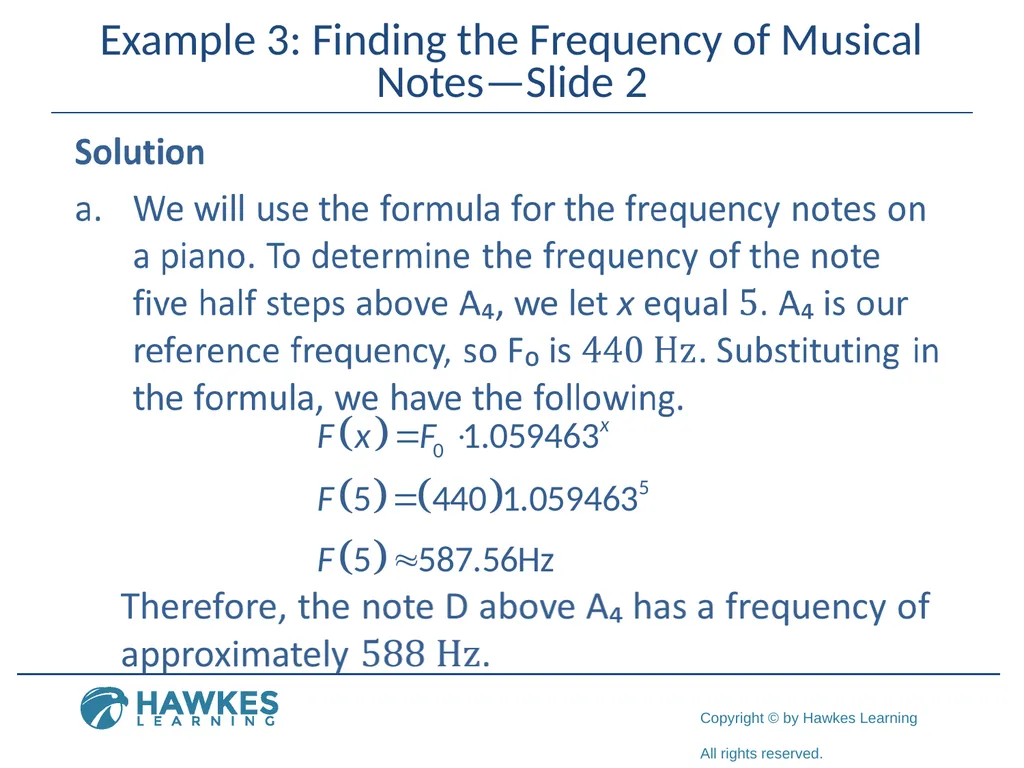
Example 3: Finding the Frequency of Musical Notes—Slide 2<br>
27
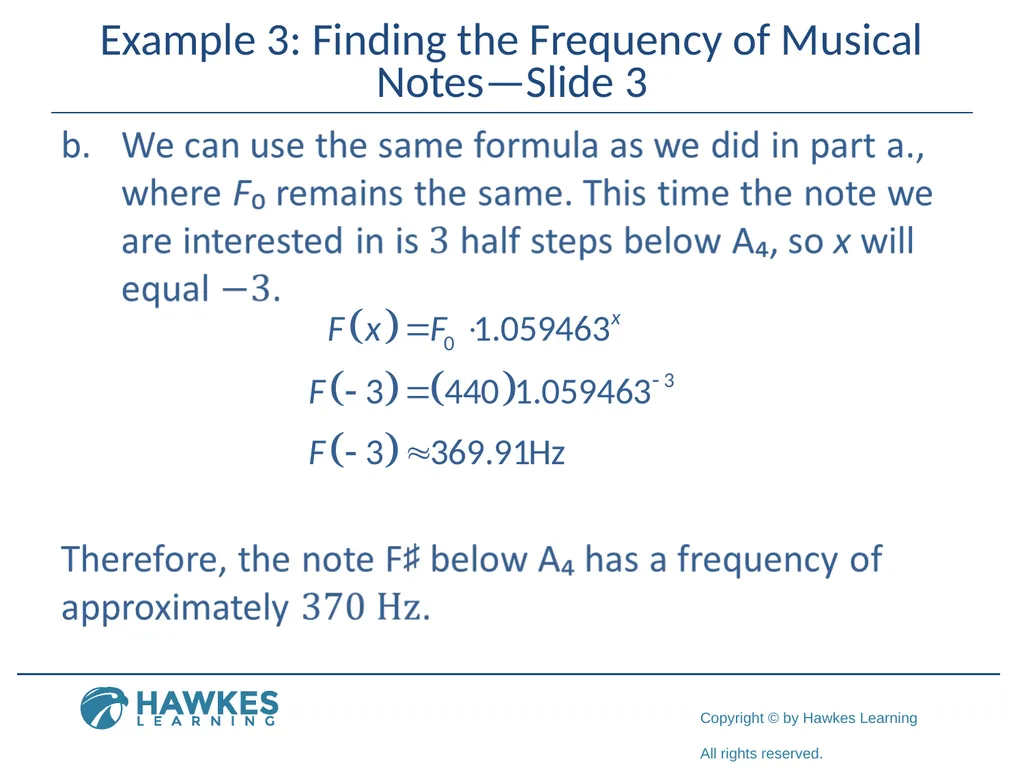
Example 3: Finding the Frequency of Musical Notes—Slide 3<br>
28
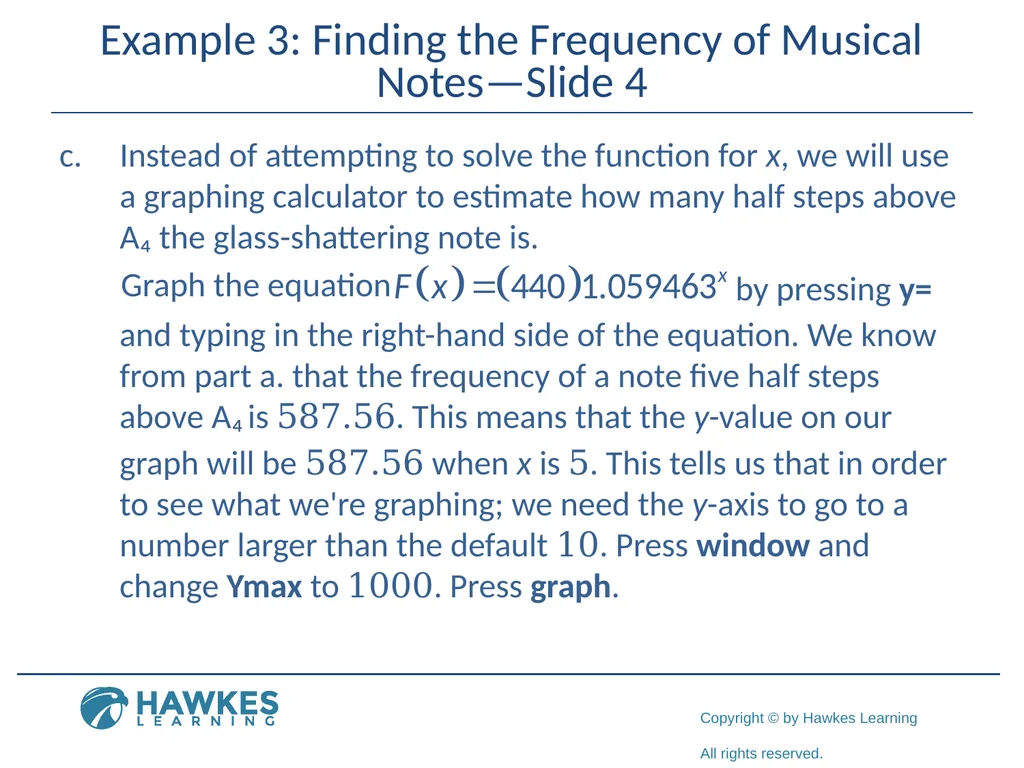
Example 3: Finding the Frequency of Musical Notes—Slide 4 c. Instead of attempting to solve the function for x, we will use a graphing calculator to estimate how many half steps above A₄ the glass-shattering note is.
Graph the equation by pressing y= and typing in the right-hand side of the equation. We know
from part a. that the frequency of a note five half steps
above A₄ is 587.56. This means that the y-value on our graph will be 587.56 when x is 5. This tells us that in order to see what we're graphing; we need the y-axis to go to a number larger than the default 10. Press window and change Ymax to 1000. Press graph.<br>
Graph the equation by pressing y= and typing in the right-hand side of the equation. We know
from part a. that the frequency of a note five half steps
above A₄ is 587.56. This means that the y-value on our graph will be 587.56 when x is 5. This tells us that in order to see what we're graphing; we need the y-axis to go to a number larger than the default 10. Press window and change Ymax to 1000. Press graph.<br>
29
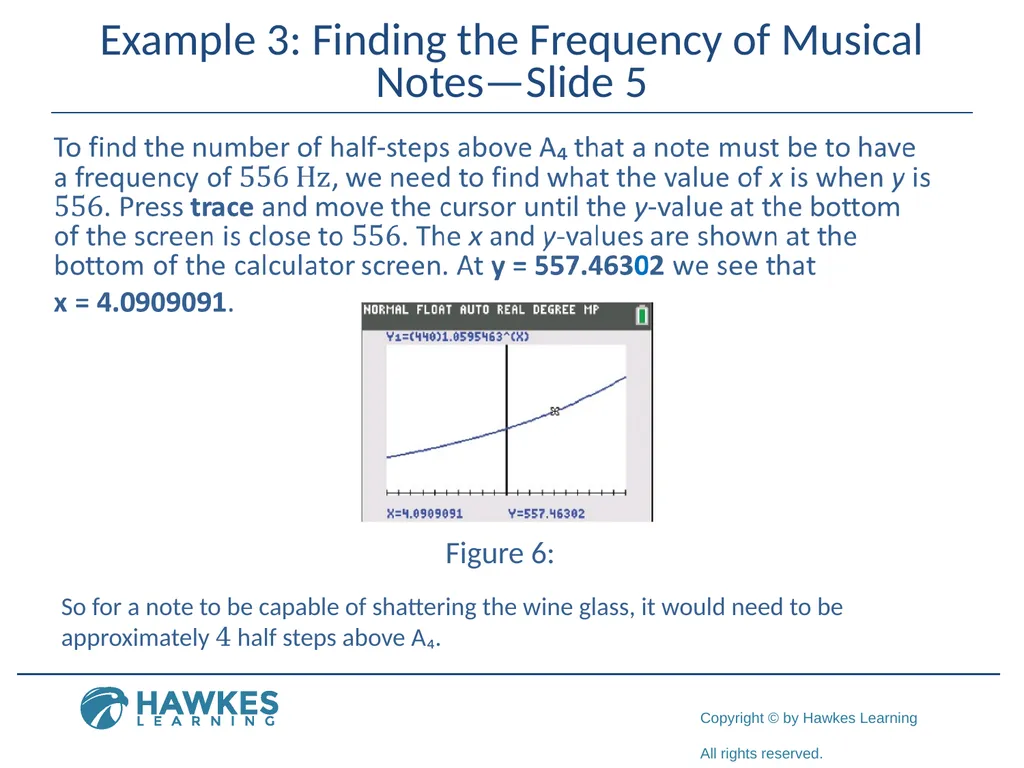
Example 3: Finding the Frequency of Musical Notes—Slide 5 Figure 6: So for a note to be capable of shattering the wine glass, it would need to be approximately 4 half steps above A₄.<br>
30
Helpful Hint—Slide 5 Net income is the amount of revenue a business has left after subtracting all expenses, taxes, and costs.<br>
31
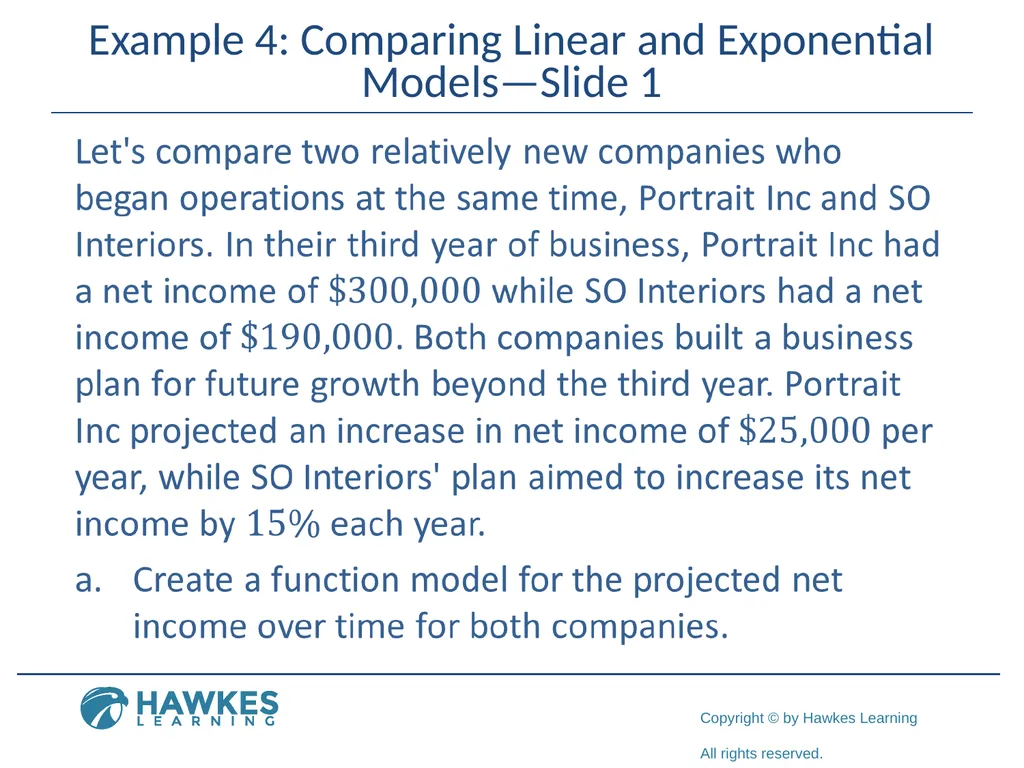
Example 4: Comparing Linear and Exponential Models—Slide 1<br>
32
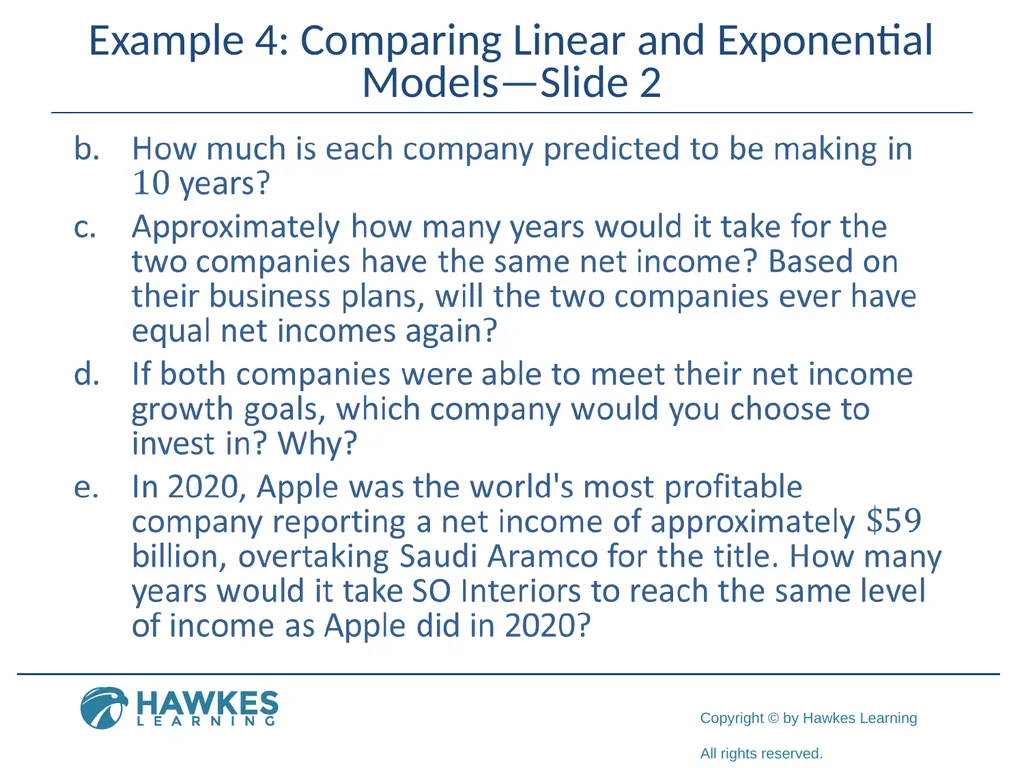
Example 4: Comparing Linear and Exponential Models—Slide 2<br>
33
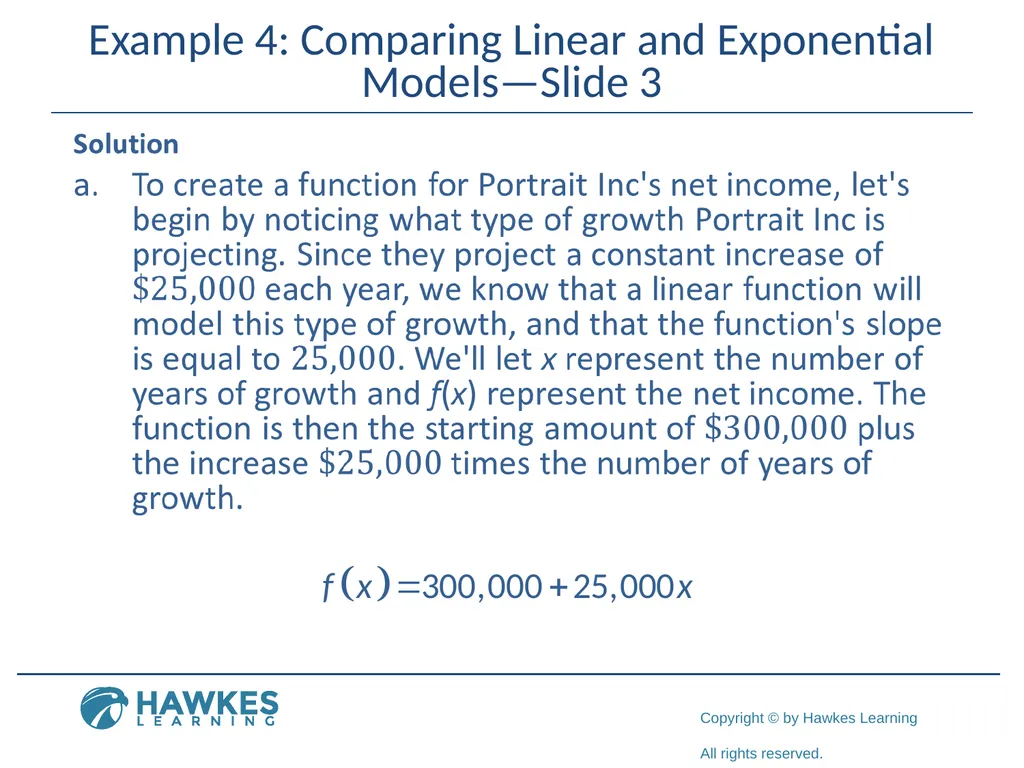
Example 4: Comparing Linear and Exponential Models—Slide 3<br>
34
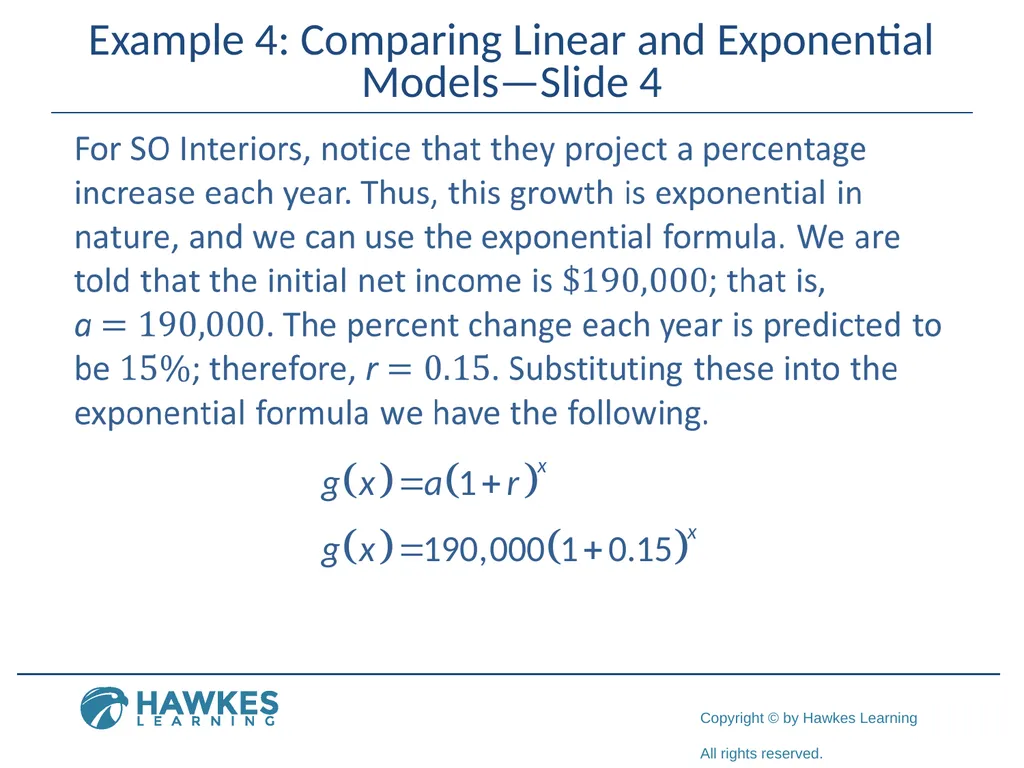
Example 4: Comparing Linear and Exponential Models—Slide 4<br>
35
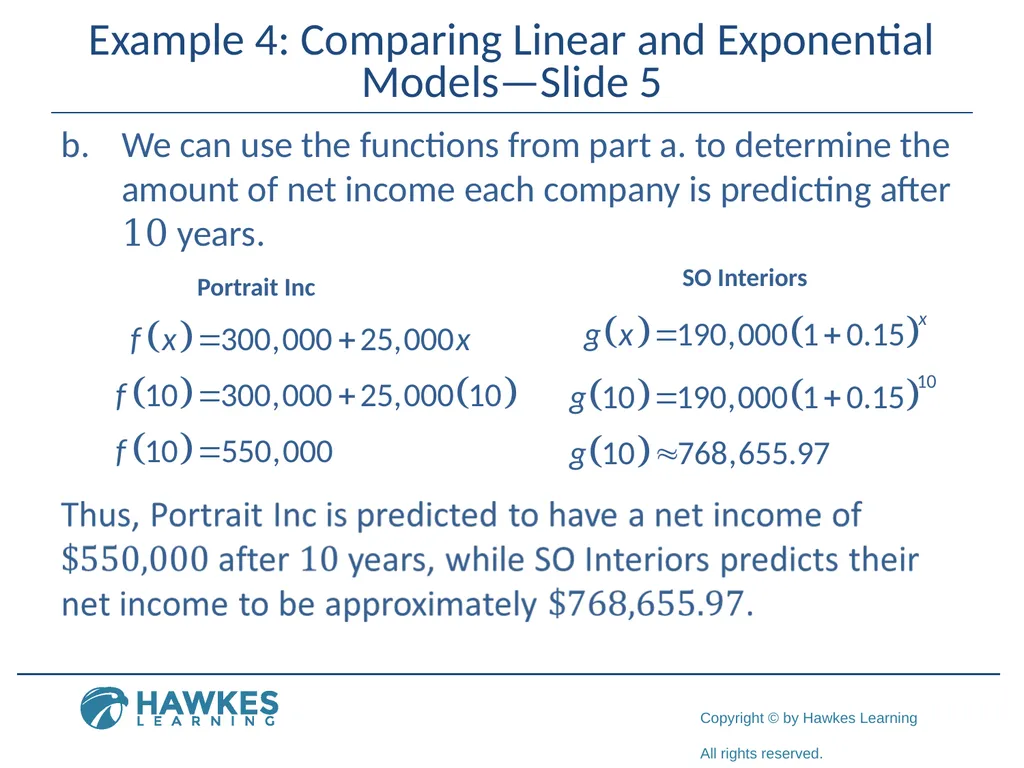
Example 4: Comparing Linear and Exponential Models—Slide 5 b. We can use the functions from part a. to determine the amount of net income each company is predicting after 10 years.
Portrait Inc SO Interiors<br>
Portrait Inc SO Interiors<br>
36
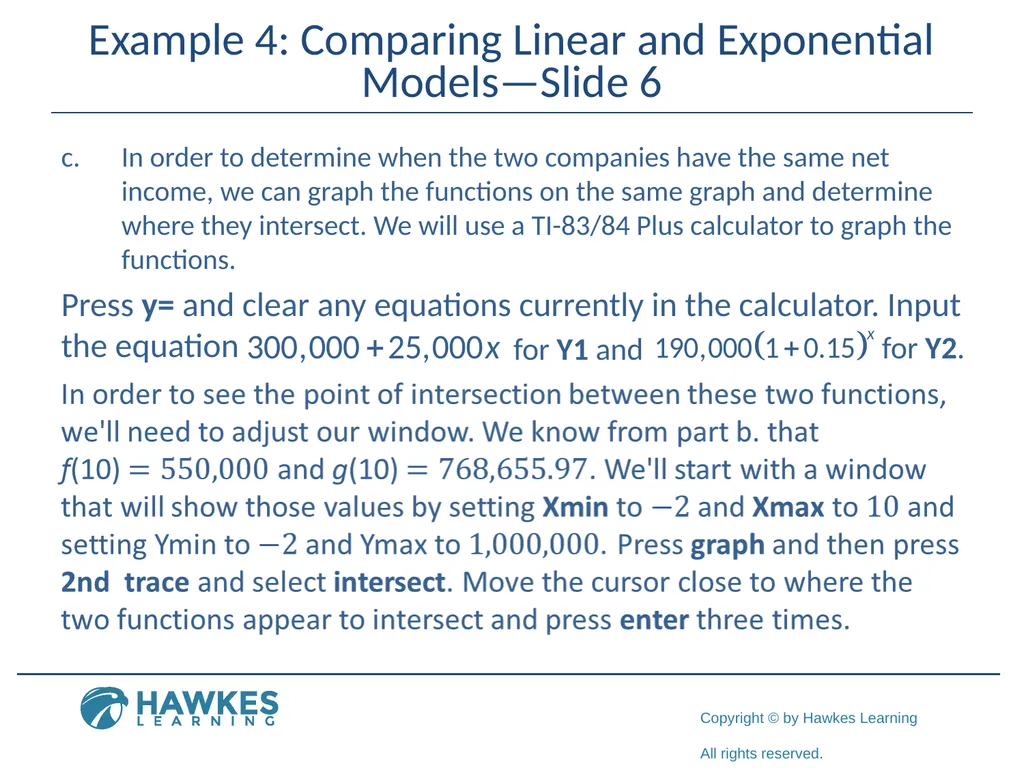
Example 4: Comparing Linear and Exponential Models—Slide 6 c. In order to determine when the two companies have the same net income, we can graph the functions on the same graph and determine where they intersect. We will use a TI-83/84 Plus calculator to graph the functions.
Press y= and clear any equations currently in the calculator. Input the equation for Y1 and for Y2.<br>
Press y= and clear any equations currently in the calculator. Input the equation for Y1 and for Y2.<br>
37
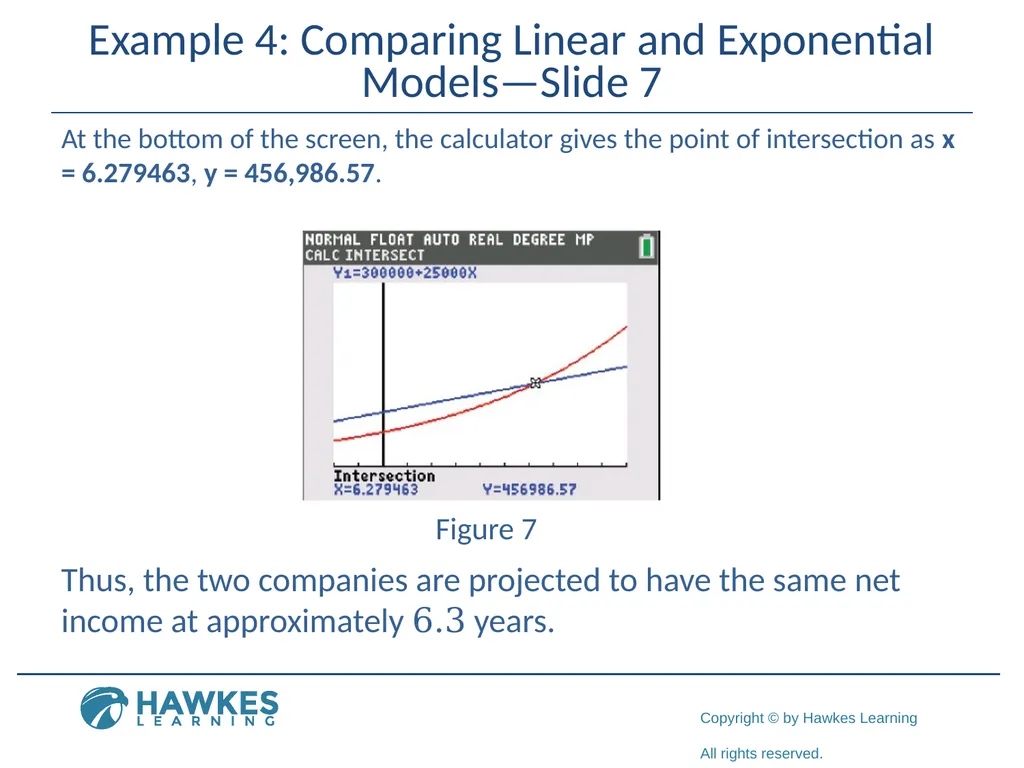
Example 4: Comparing Linear and Exponential Models—Slide 7 At the bottom of the screen, the calculator gives the point of intersection as x = 6.279463, y = 456,986.57.
Figure 7 Thus, the two companies are projected to have the same net income at approximately 6.3 years.<br>
Figure 7 Thus, the two companies are projected to have the same net income at approximately 6.3 years.<br>
38
Example 4: Comparing Linear and Exponential Models—Slide 8 Since Portrait Inc's projected net income is increasing linearly, and SO Interiors project net income is increasing exponentially, the net incomes will never be equal again. SO Interiors will continue to grow at a faster rate and Portrait Inc will not catch up if it only has linear growth.
d. If you are able to invest money for more than 6.3 years, then SO Interiors is the better long-term investment because their income will continue to grow at a faster rate. However, you might choose Portrait Inc if you prefer a quick return of your investment.<br>
d. If you are able to invest money for more than 6.3 years, then SO Interiors is the better long-term investment because their income will continue to grow at a faster rate. However, you might choose Portrait Inc if you prefer a quick return of your investment.<br>
39
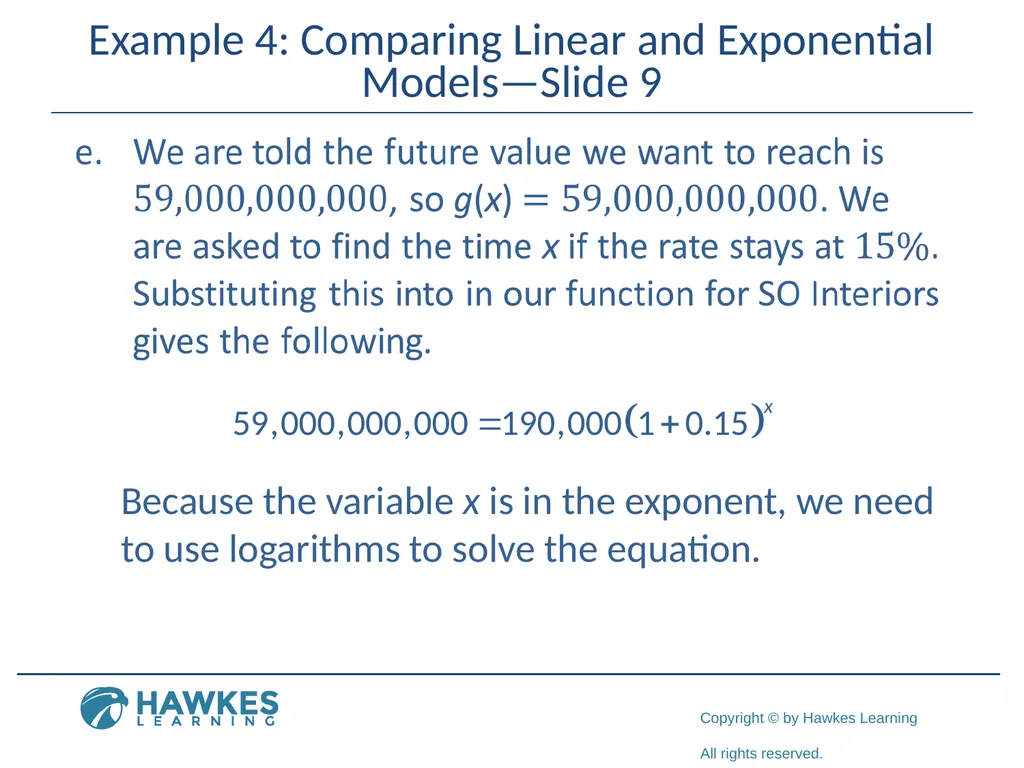
Example 4: Comparing Linear and Exponential Models—Slide 9 Because the variable x is in the exponent, we need
to use logarithms to solve the equation.<br>
to use logarithms to solve the equation.<br>
40
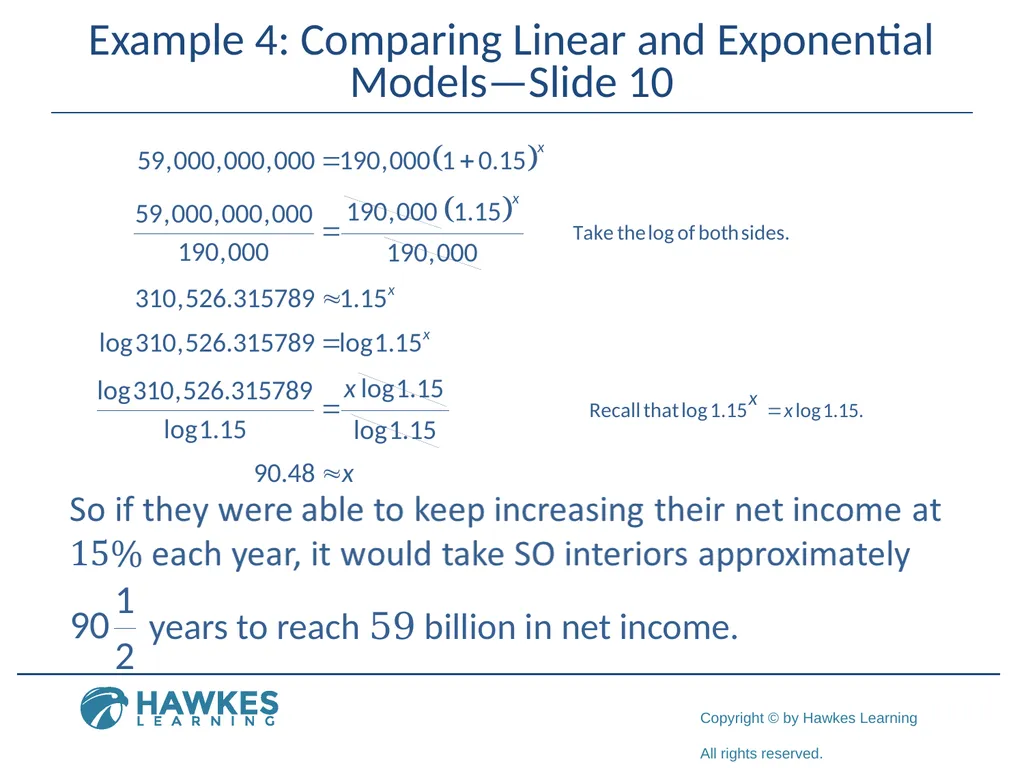
Example 4: Comparing Linear and Exponential Models—Slide 10 years to reach 59 billion in net income.<br>
41
Helpful Hint—Slide 6 When a variable is in the exponent of an equation, we can use common logs to solve.<br>
42
Fun Fact—Slide 3 The word logarithm implies exponent or power. It originates from the Greek words logos (reckoning) and arithmos (number).<br>
43
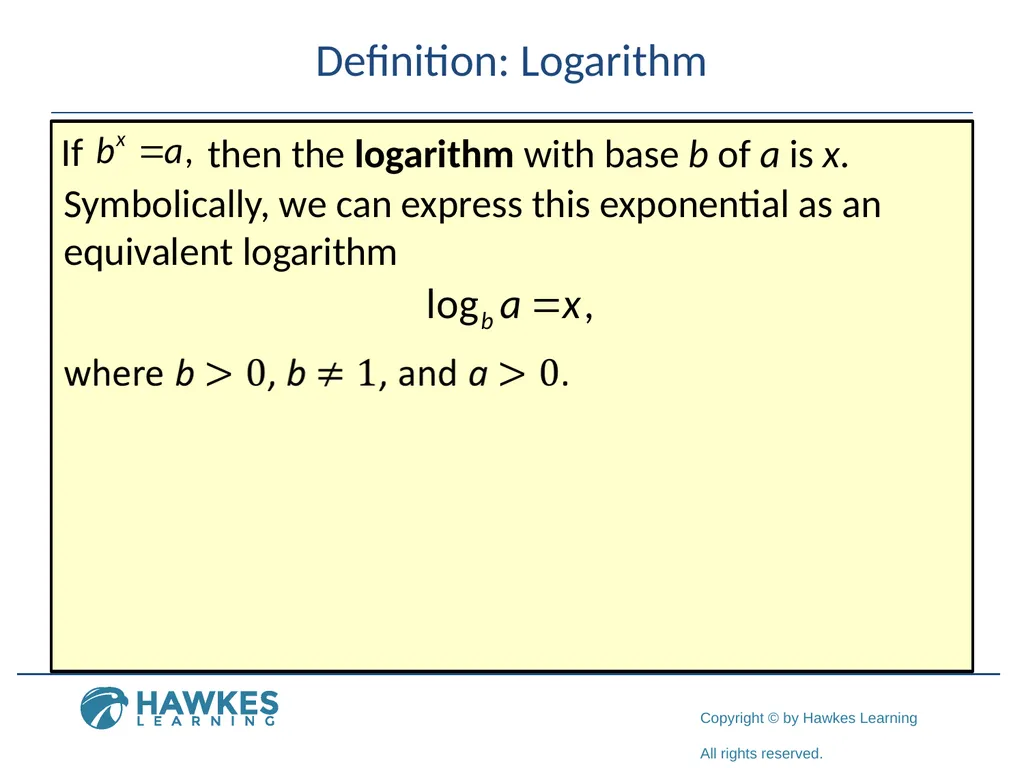
Definition: Logarithm If then the logarithm with base b of a is x. Symbolically, we can express this exponential as an equivalent logarithm<br>
44
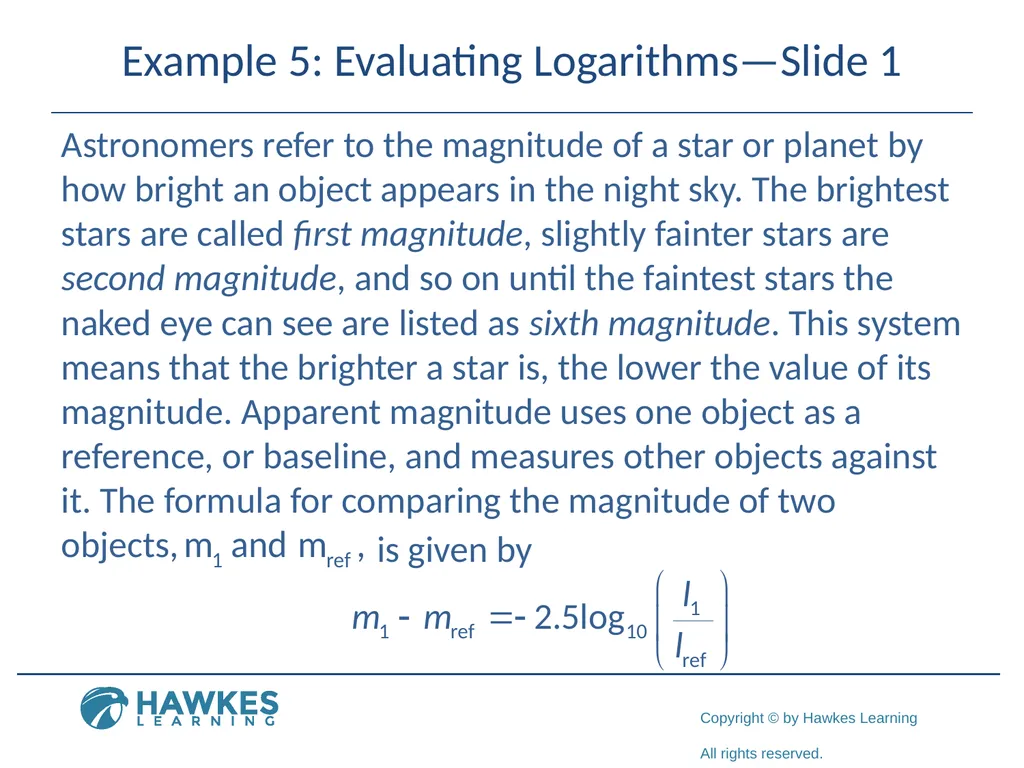
Example 5: Evaluating Logarithms—Slide 1 Astronomers refer to the magnitude of a star or planet by how bright an object appears in the night sky. The brightest stars are called first magnitude, slightly fainter stars are second magnitude, and so on until the faintest stars the naked eye can see are listed as sixth magnitude. This system means that the brighter a star is, the lower the value of its magnitude. Apparent magnitude uses one object as a reference, or baseline, and measures other objects against it. The formula for comparing the magnitude of two objects, is given by<br>
45
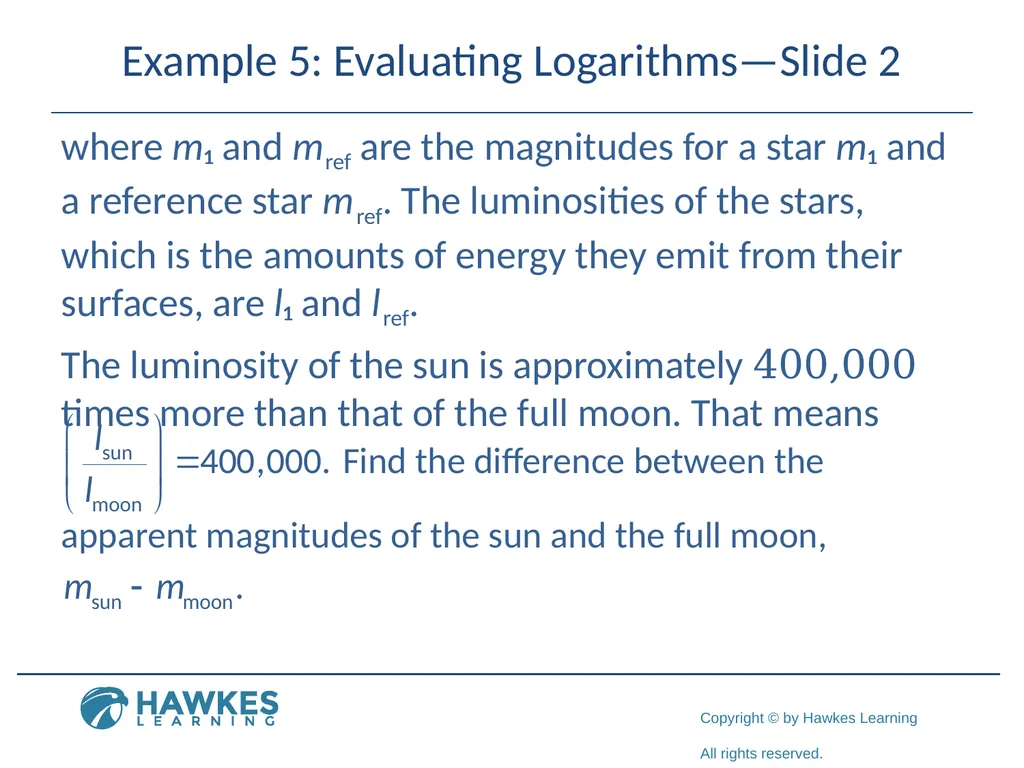
Example 5: Evaluating Logarithms—Slide 2 where m₁ and m ref are the magnitudes for a star m₁ and a reference star m ref. The luminosities of the stars, which is the amounts of energy they emit from their surfaces, are l₁ and l ref.
The luminosity of the sun is approximately 400,000 times more than that of the full moon. That means Find the difference between the apparent magnitudes of the sun and the full moon,<br>
The luminosity of the sun is approximately 400,000 times more than that of the full moon. That means Find the difference between the apparent magnitudes of the sun and the full moon,<br>
46
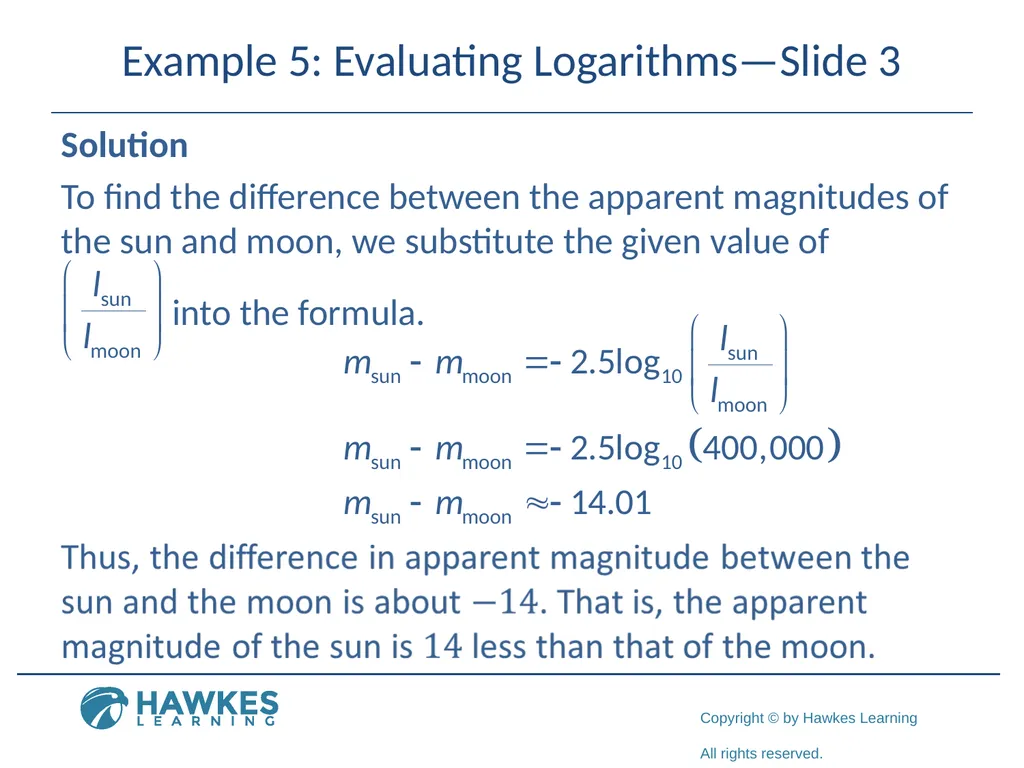
Example 5: Evaluating Logarithms—Slide 3 Solution
To find the difference between the apparent magnitudes of the sun and moon, we substitute the given value of into the formula.<br>
To find the difference between the apparent magnitudes of the sun and moon, we substitute the given value of into the formula.<br>
47
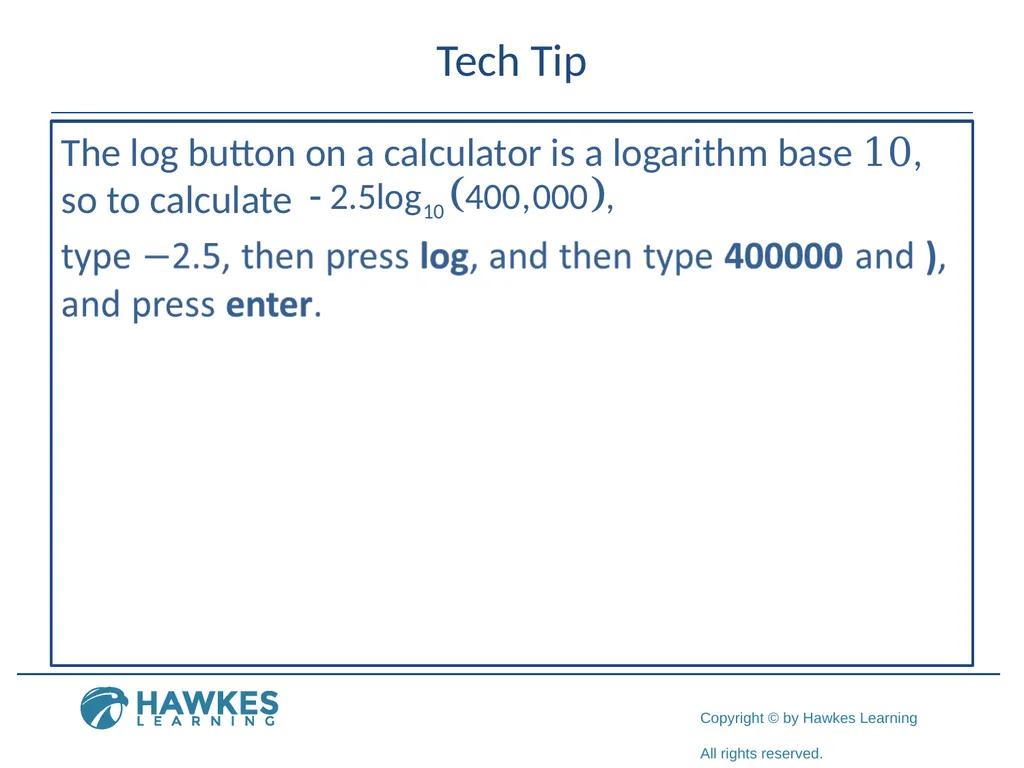
Tech Tip The log button on a calculator is a logarithm base 10, so to calculate<br>
48
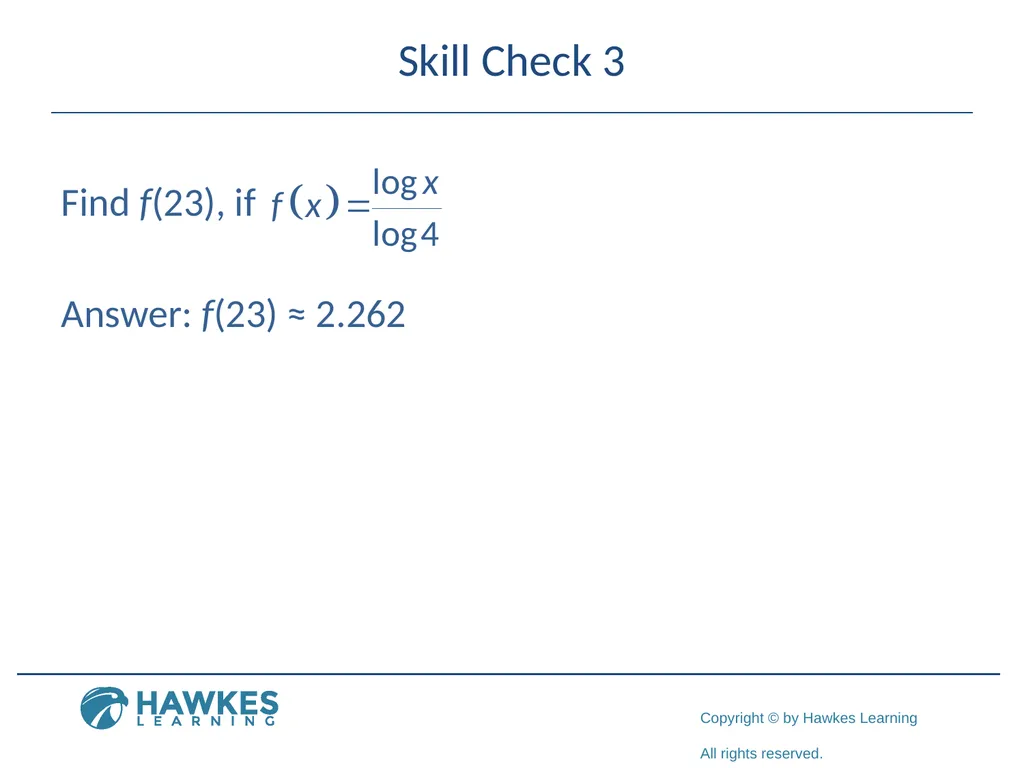
Skill Check 3 Find f(23), if
Answer: f(23) ≈ 2.262<br>
Answer: f(23) ≈ 2.262<br>
49
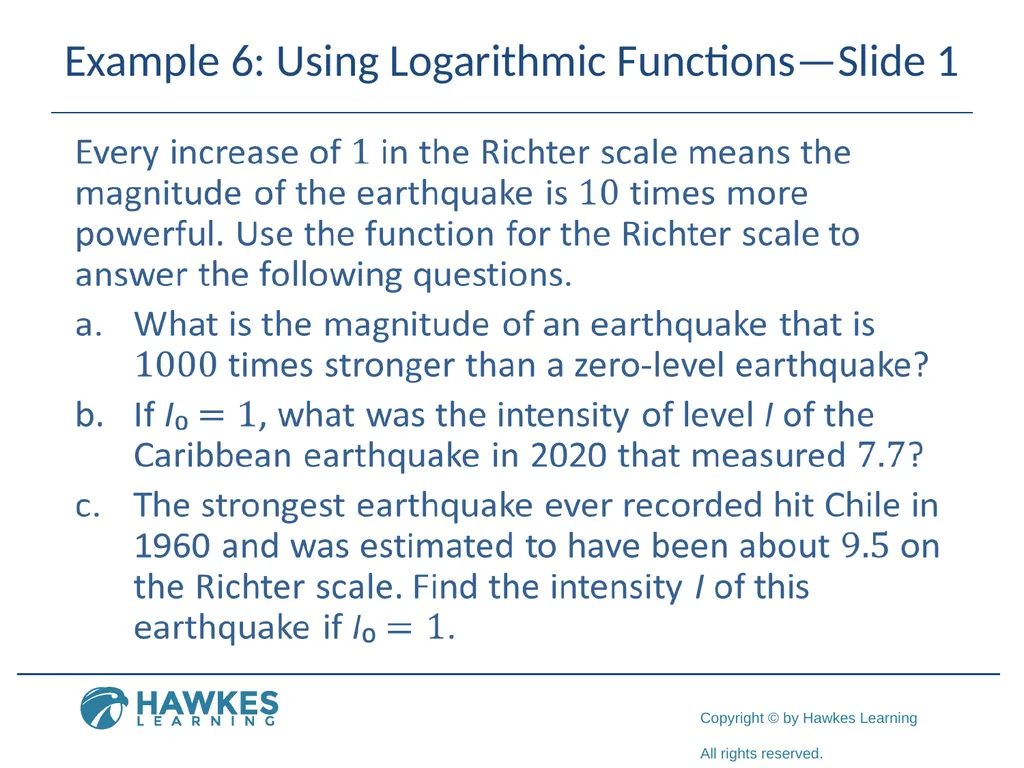
Example 6: Using Logarithmic Functions—Slide 1<br>
50
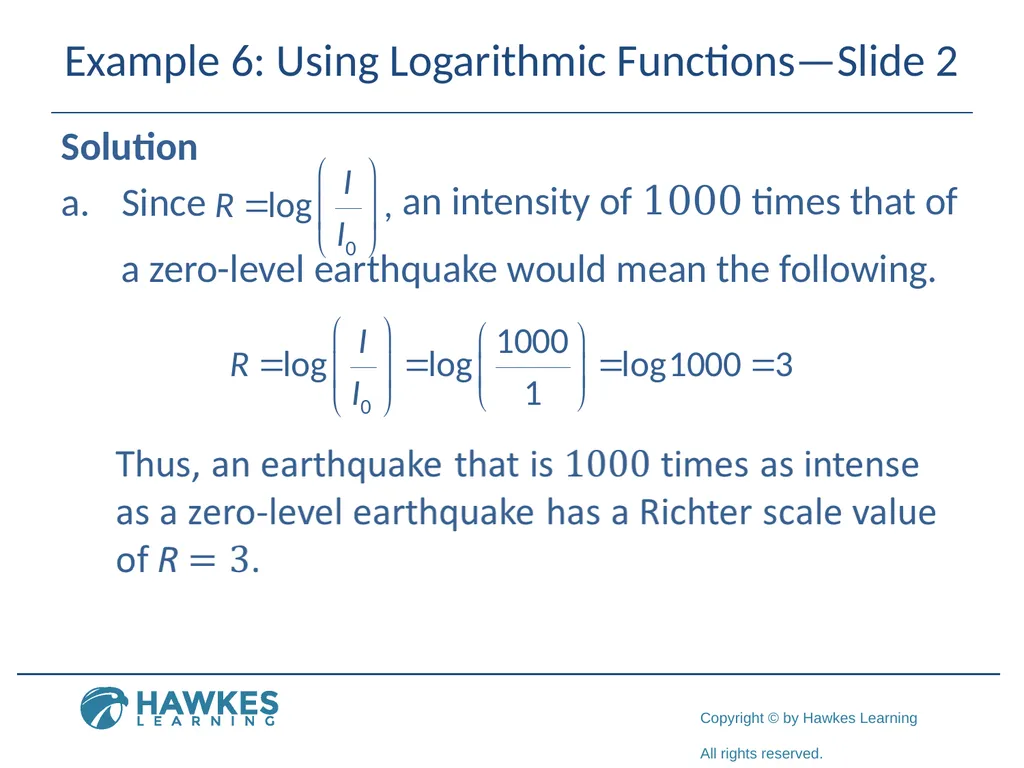
Example 6: Using Logarithmic Functions—Slide 2 Solution
a. Since
an intensity of 1000 times that of a zero-level earthquake would mean the following.<br>
a. Since
an intensity of 1000 times that of a zero-level earthquake would mean the following.<br>
51
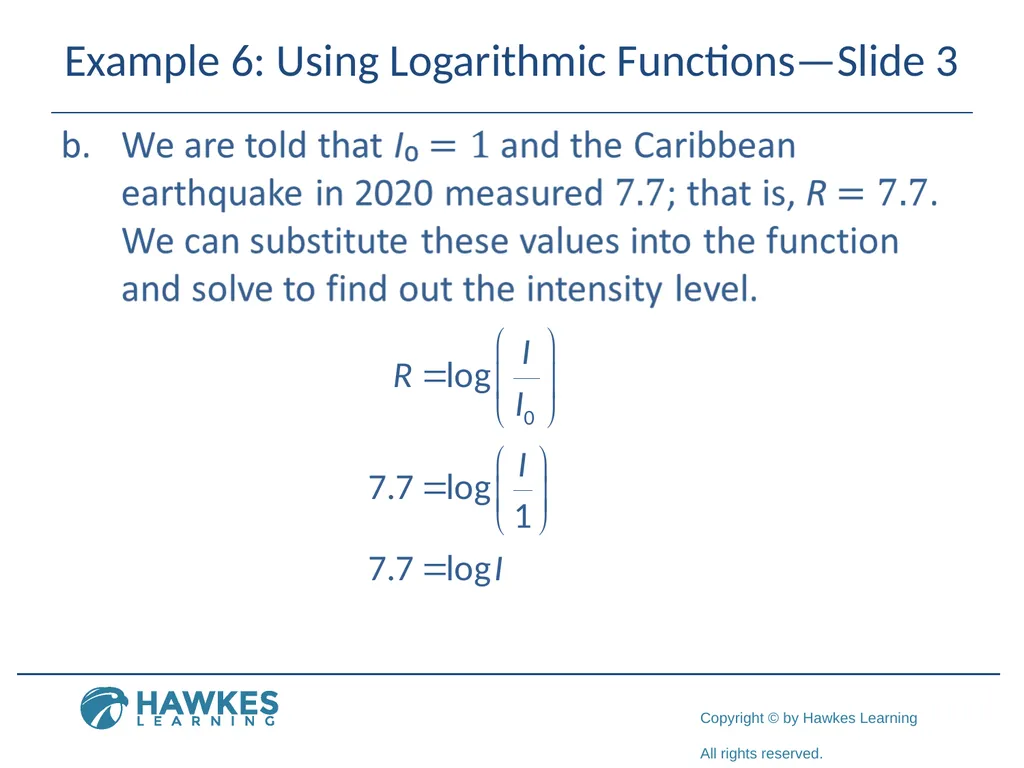
Example 6: Using Logarithmic Functions—Slide 3<br>
52
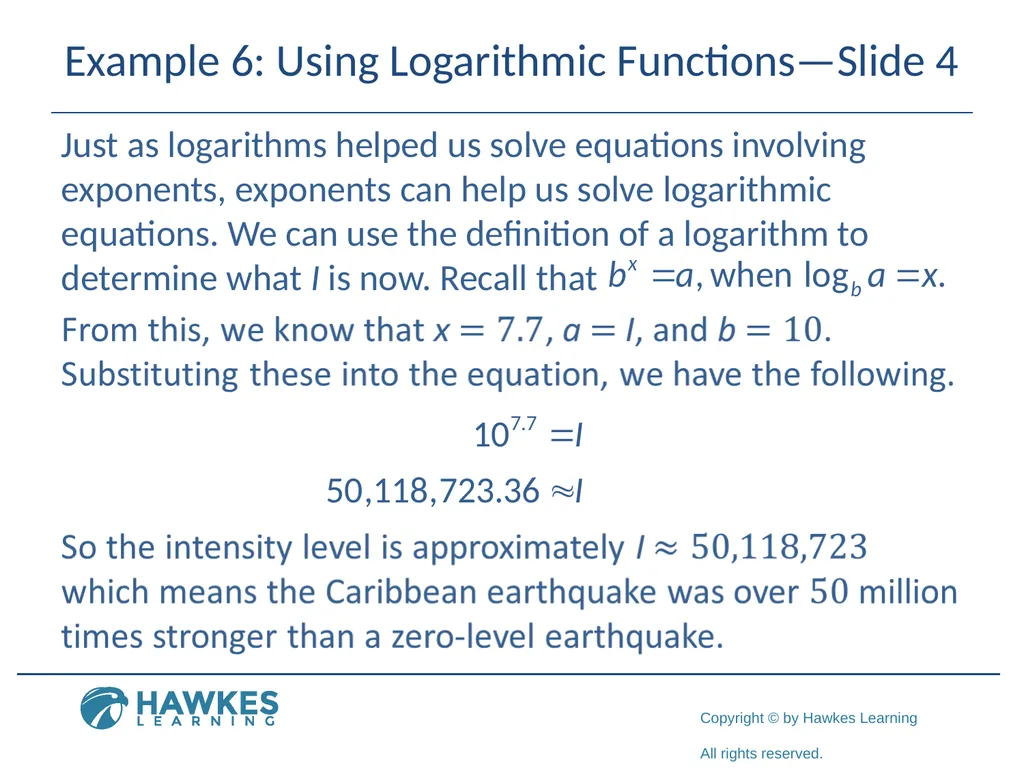
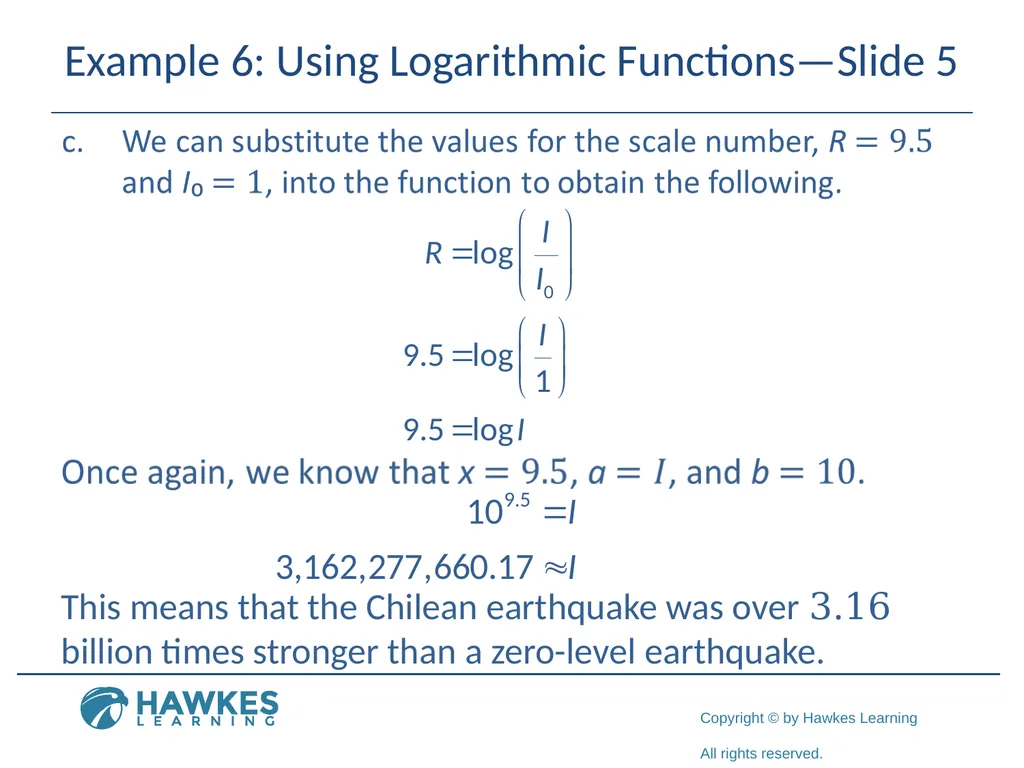
Example 6: Using Logarithmic Functions—Slide 4 Just as logarithms helped us solve equations involving exponents, exponents can help us solve logarithmic equations. We can use the definition of a logarithm to determine what I is now. Recall that
<br>
<br>
53
Example 6: Using Logarithmic Functions—Slide 5 This means that the Chilean earthquake was over 3.16 billion times stronger than a zero-level earthquake.<br>
54
Skill Check 4 Determine how much stronger the Chilean earthquake was than the Caribbean earthquake.
Answer: About 63 times stronger<br>
Answer: About 63 times stronger<br>
55
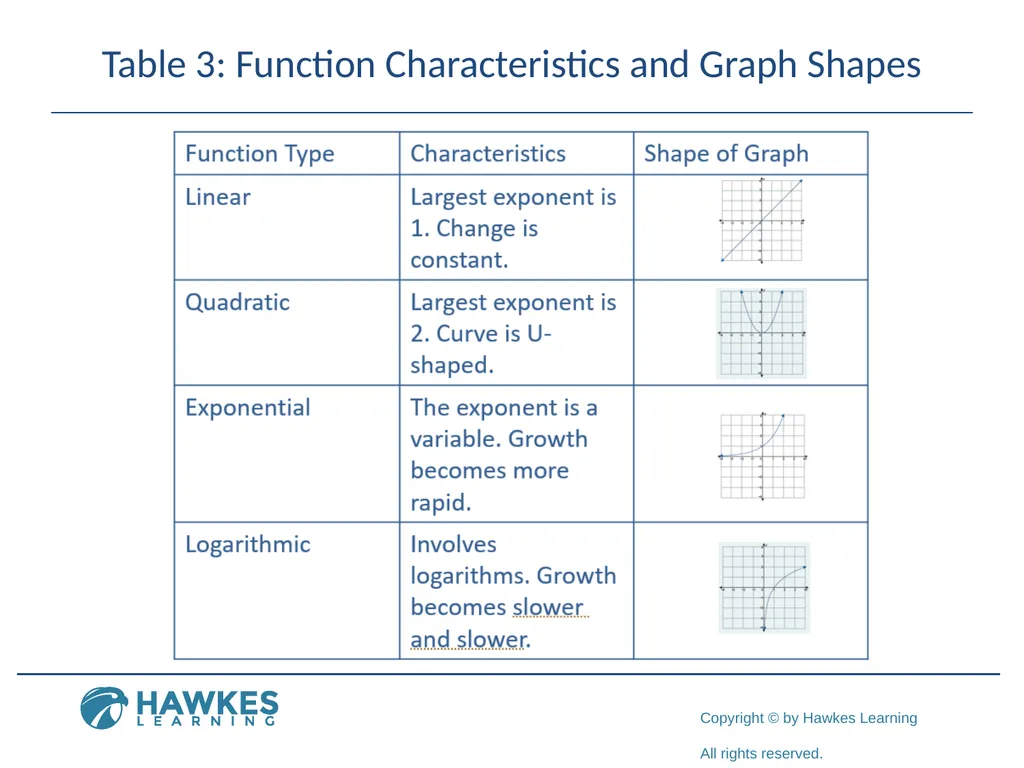
Table 3: Function Characteristics and Graph Shapes<br>