Sections 11.8 11.9 The Ideal Gas Relationships The Combined Gas Law Kinetic Molecular Theory (KMT) of Gases Set of statements (assumptions) that describes the interactions of gas molecules. The molecules in a gas occupy no volume. There
"Sections 11.8 & 11.9 The Ideal Gas Relationships &" is the property of its rightful owner. Permission is granted to
download and print the materials on this website for personal, non-commercial use only, and to display it
on your personal computer provided you do not modify the materials and that you retain all copyright
notices contained in the materials. By downloading content from our website, you accept the terms of this
agreement.
Presentation Transcript
01
Sections 11.8 & 11.9 The Ideal Gas Relationships & The Combined Gas Law<br>
02
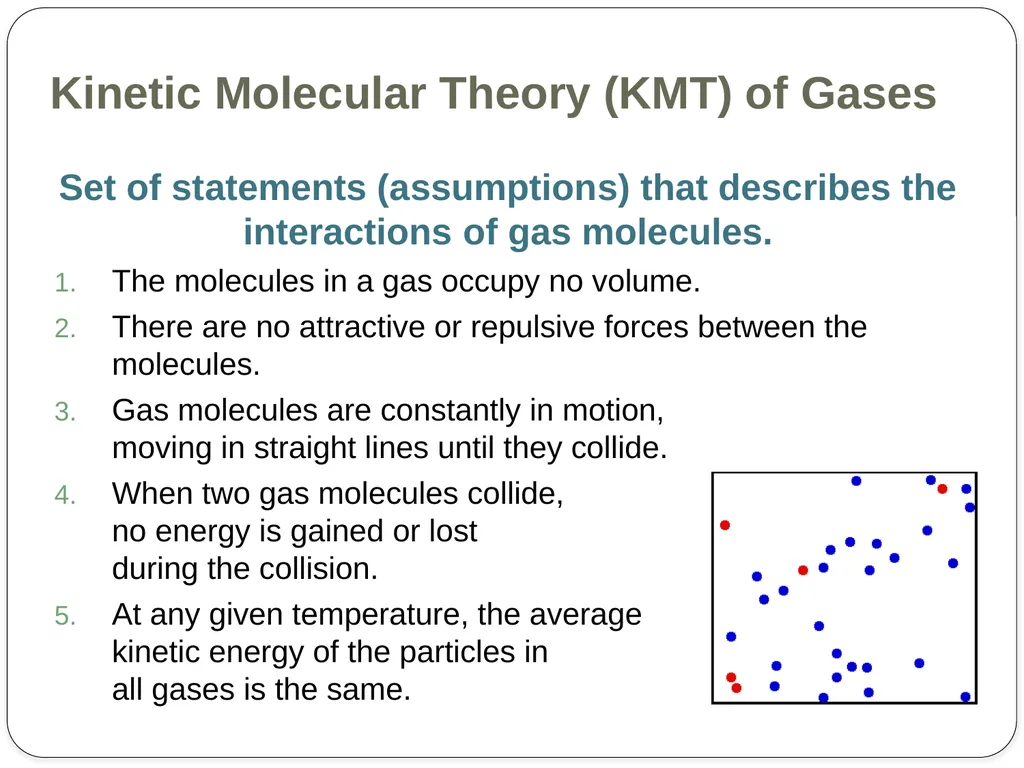
Kinetic Molecular Theory (KMT) of Gases Set of statements (assumptions) that describes the interactions of gas molecules.
The molecules in a gas occupy no volume.
There are no attractive or repulsive forces between the molecules.
Gas molecules are constantly in motion, moving in straight lines until they collide.
When two gas molecules collide, no energy is gained or lost during the collision.
At any given temperature, the average kinetic energy of the particles in all gases is the same.<br>
03
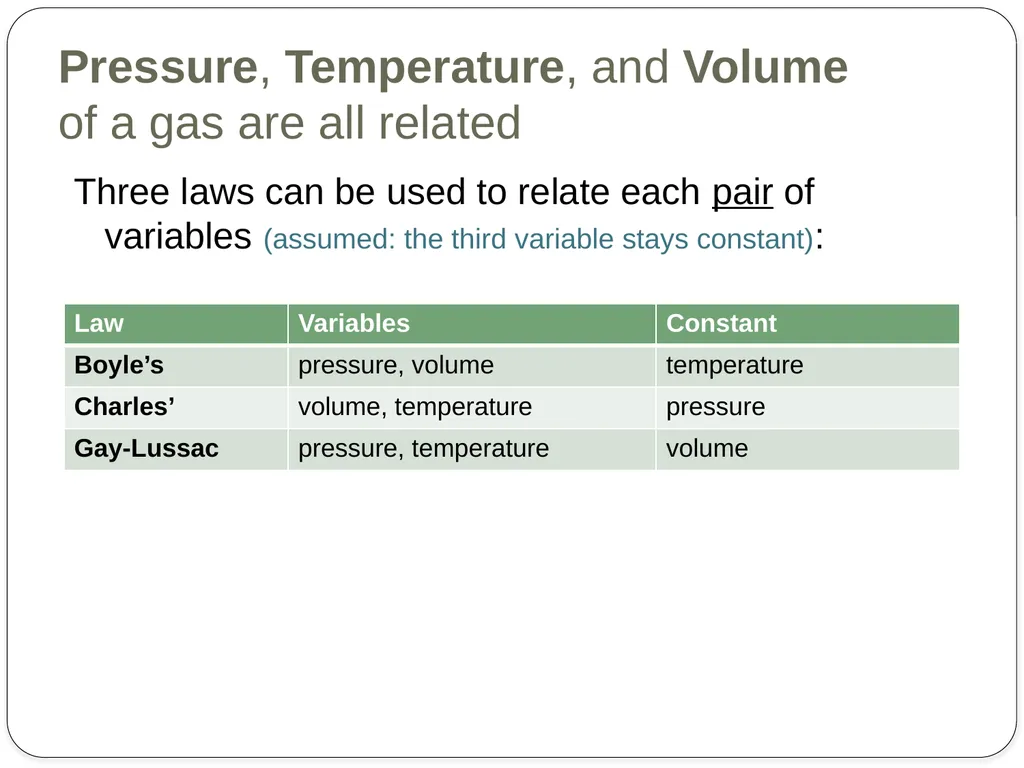
Pressure, Temperature, and Volume of a gas are all related Three laws can be used to relate each pair of variables (assumed: the third variable stays constant):<br>
04
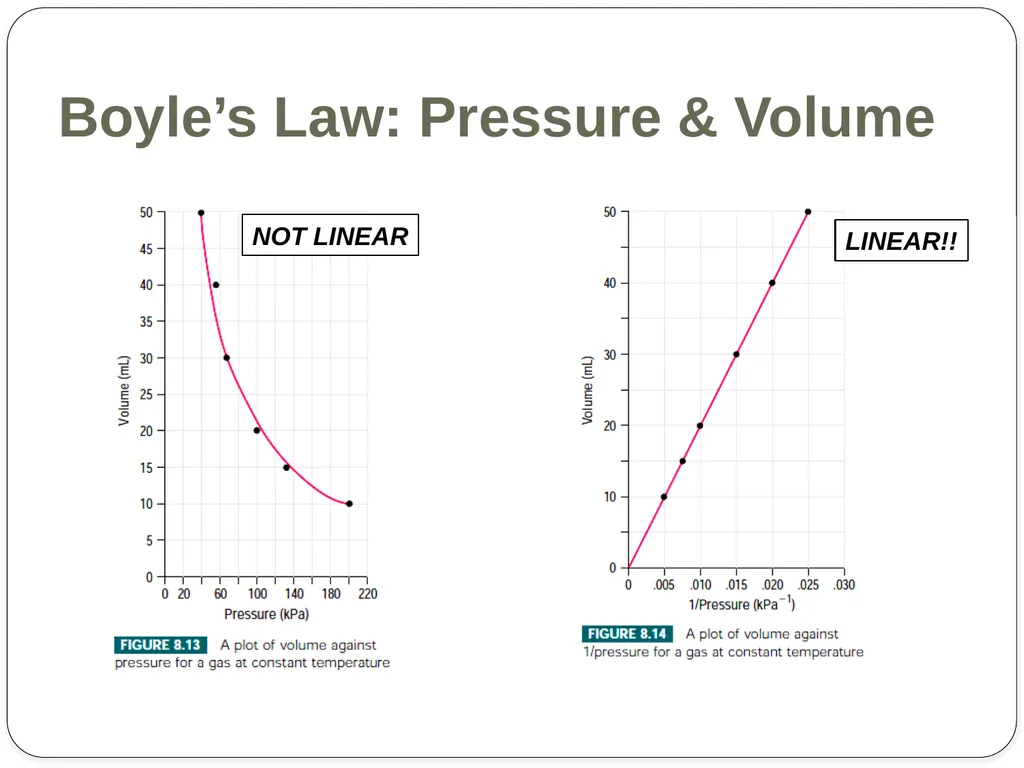
Boyle’s Law: Pressure & Volume NOT LINEAR LINEAR!!<br>
05
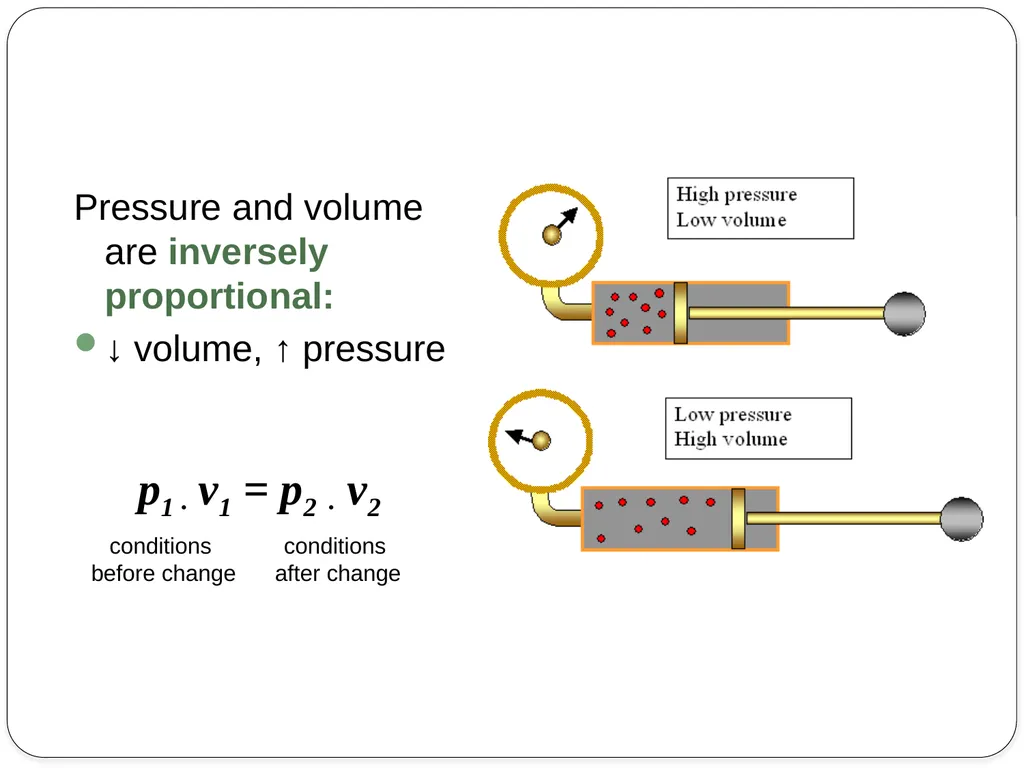
Pressure and volume are inversely proportional:
↓ volume, ↑ pressure p1 · v1 = p2 · v2 conditions before change conditions after change<br>
06
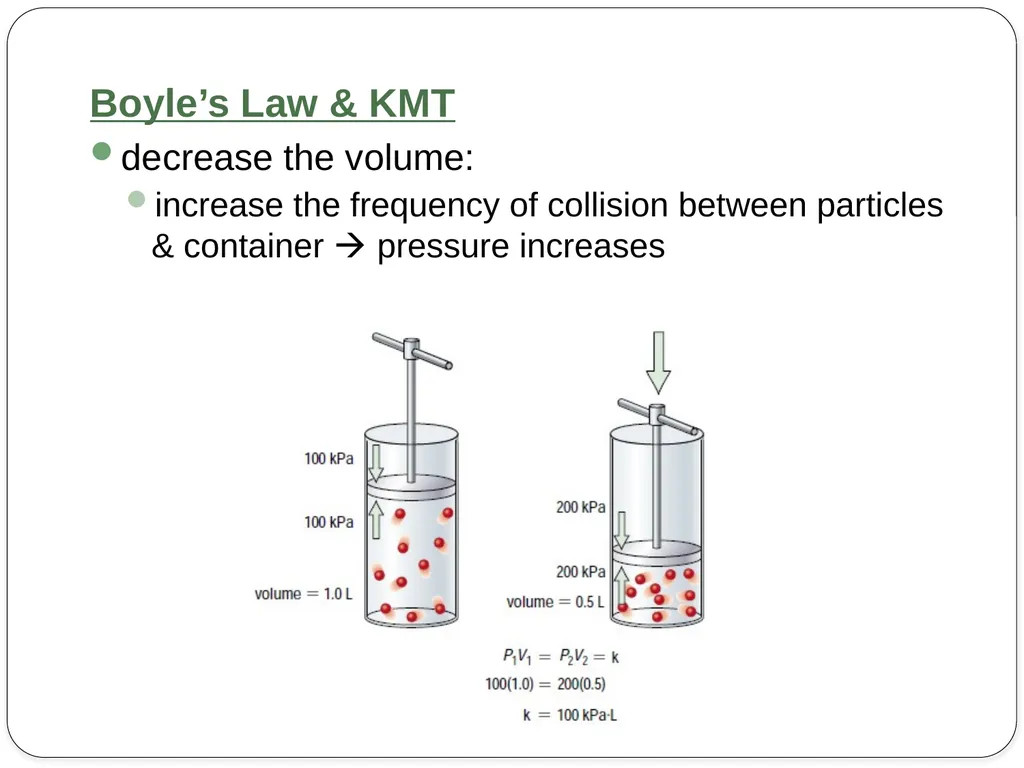
Boyle’s Law & KMT
decrease the volume:
increase the frequency of collision between particles & container pressure increases<br>
07
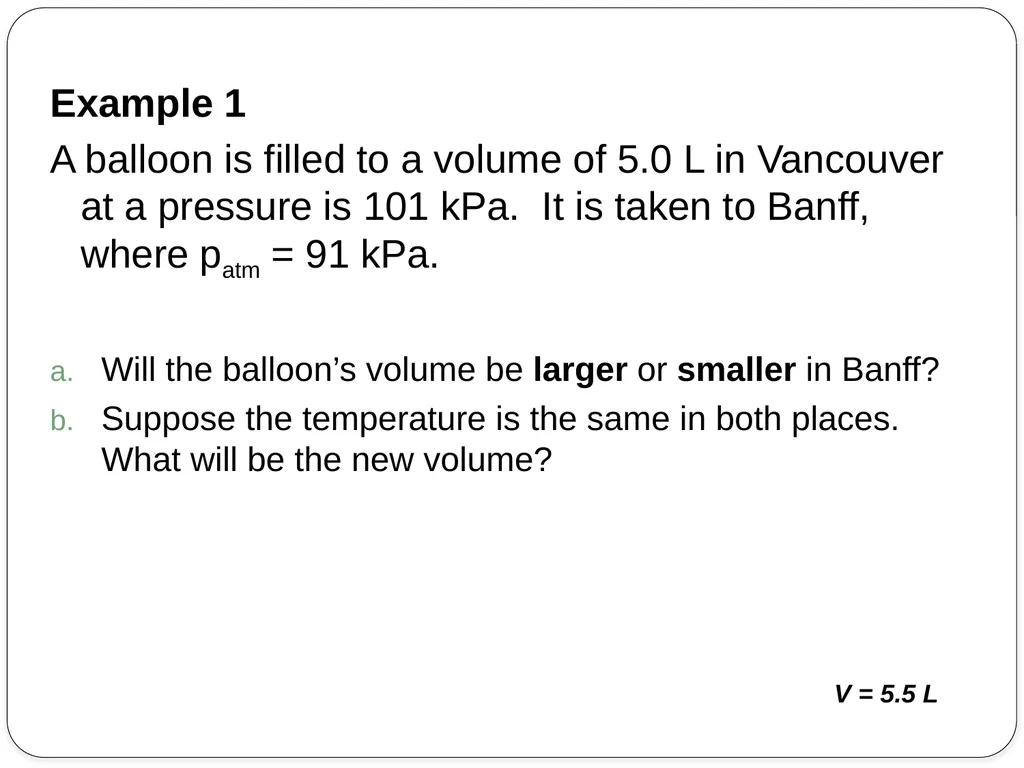
Example 1
A balloon is filled to a volume of 5.0 L in Vancouver at a pressure is 101 kPa. It is taken to Banff, where patm = 91 kPa.
Will the balloon’s volume be larger or smaller in Banff?
Suppose the temperature is the same in both places. What will be the new volume? V = 5.5 L<br>
08
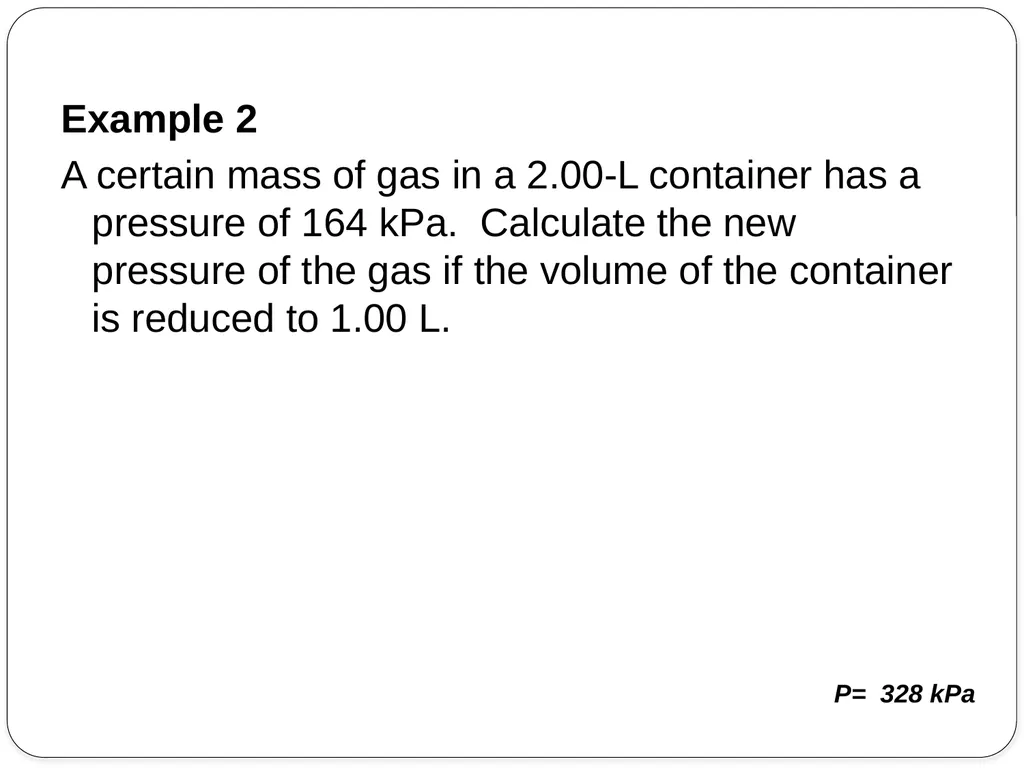
Example 2
A certain mass of gas in a 2.00-L container has a pressure of 164 kPa. Calculate the new pressure of the gas if the volume of the container is reduced to 1.00 L. P= 328 kPa<br>
09
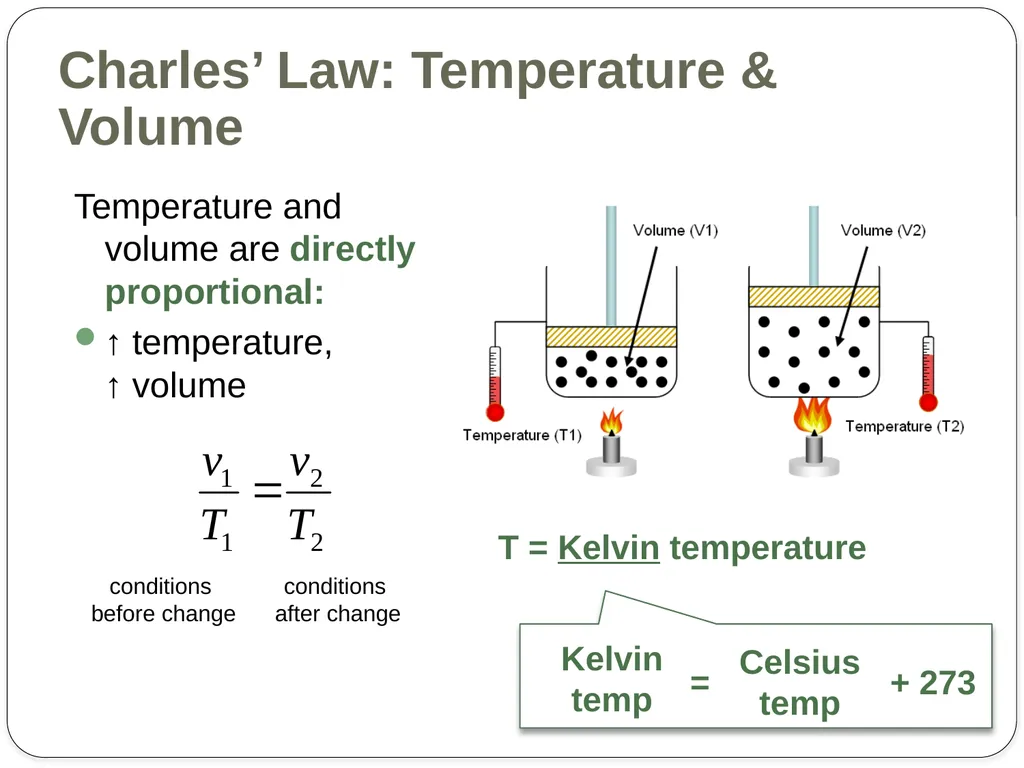
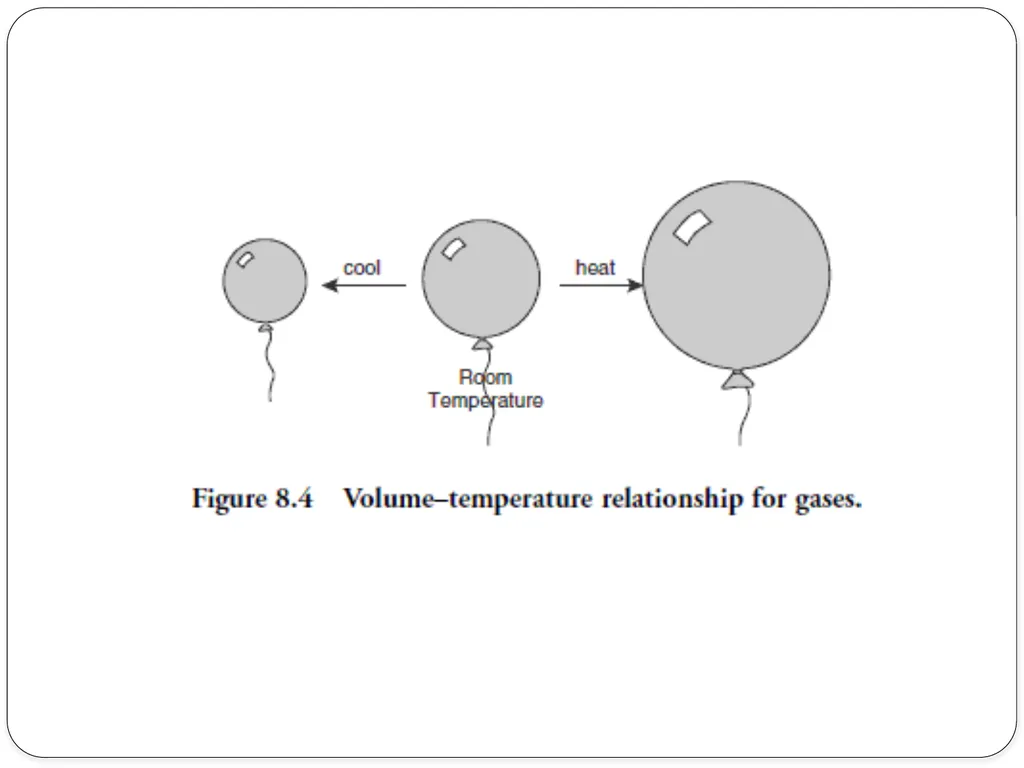
Charles’ Law: Temperature & Volume Temperature and volume are directly proportional:
↑ temperature, ↑ volume conditions before change conditions after change T = Kelvin temperature<br>
10
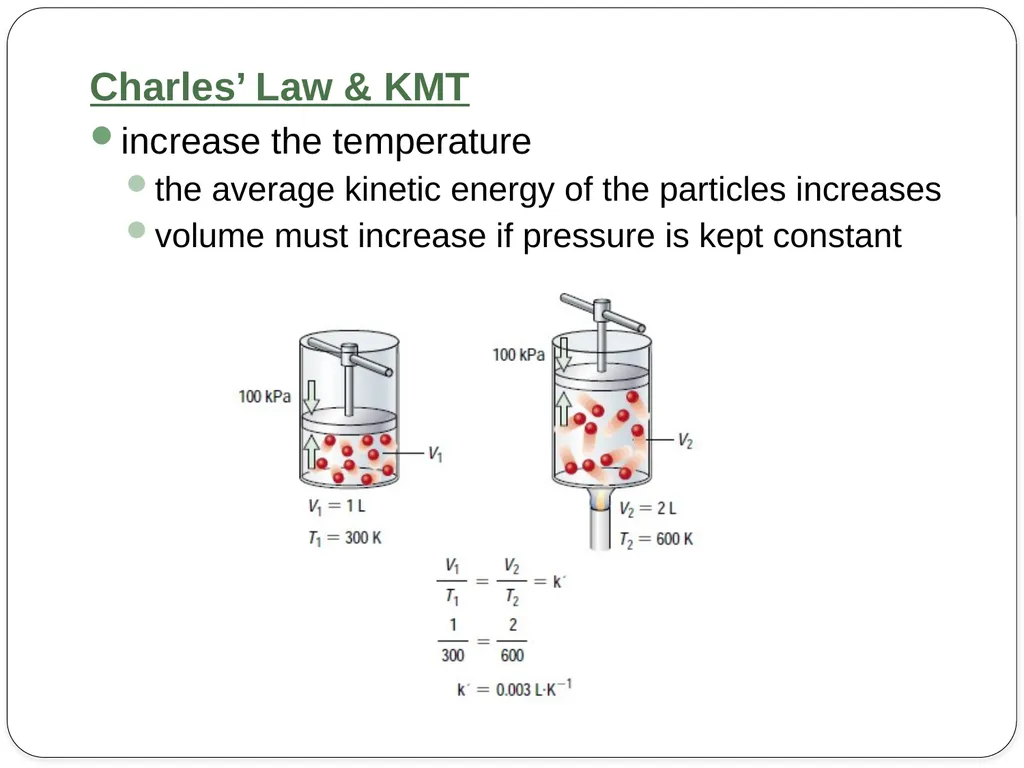
Charles’ Law & KMT
increase the temperature
the average kinetic energy of the particles increases
volume must increase if pressure is kept constant<br>
11
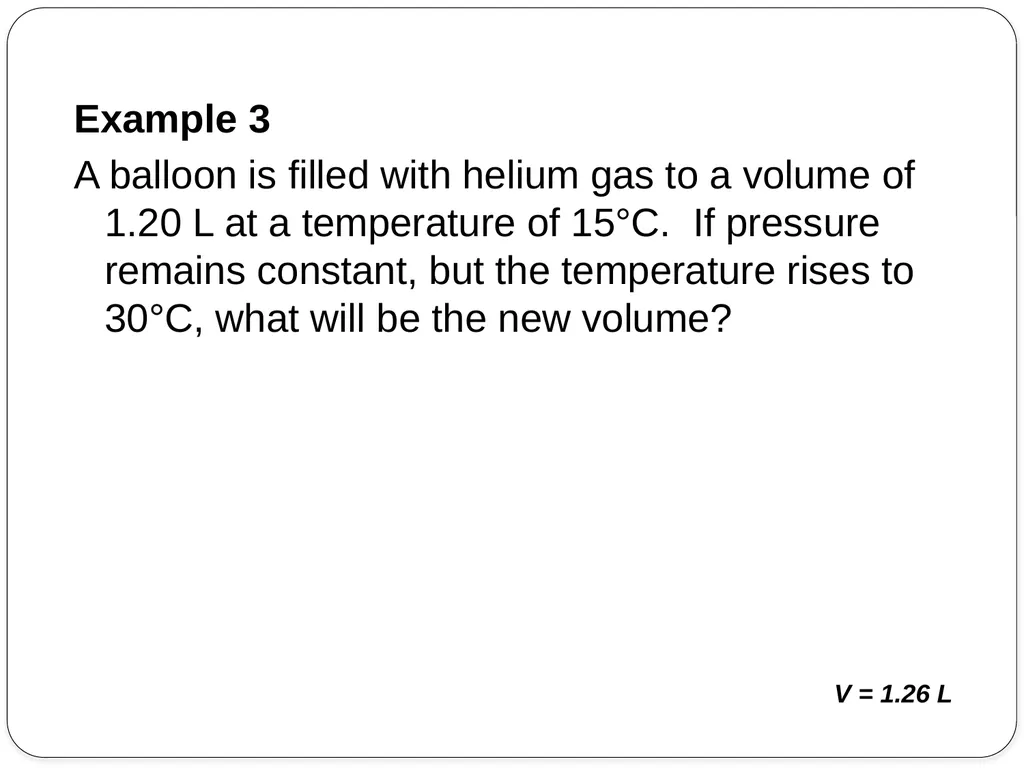
Example 3
A balloon is filled with helium gas to a volume of 1.20 L at a temperature of 15°C. If pressure remains constant, but the temperature rises to 30°C, what will be the new volume? V = 1.26 L<br>
12
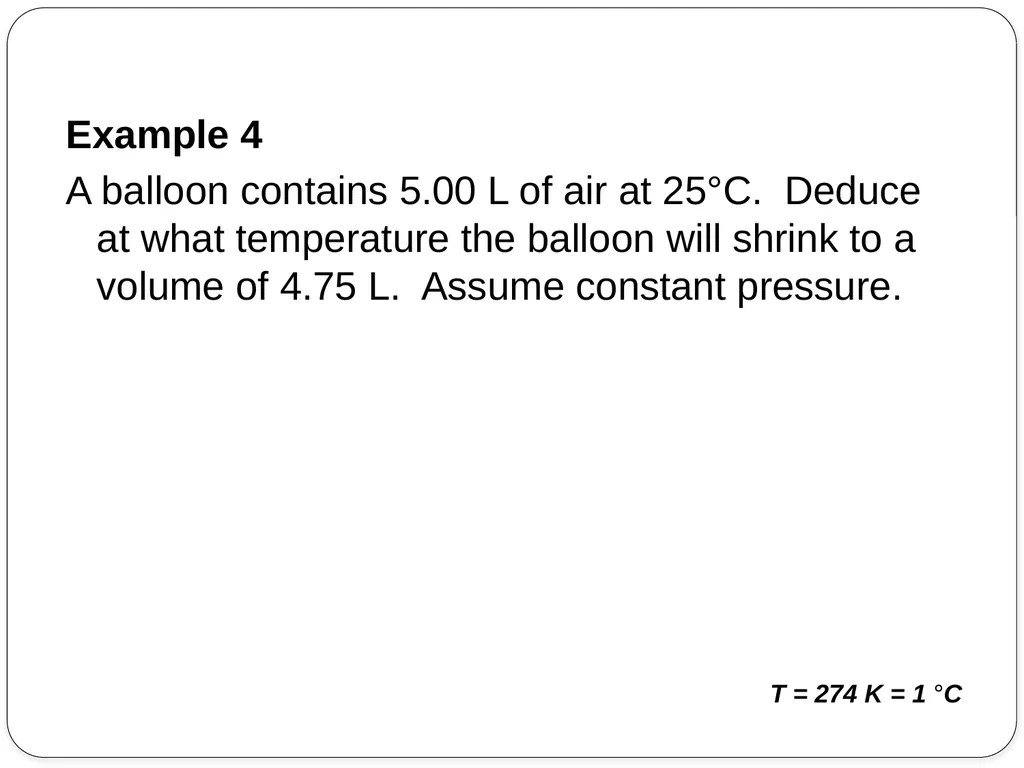
Example 4
A balloon contains 5.00 L of air at 25°C. Deduce at what temperature the balloon will shrink to a volume of 4.75 L. Assume constant pressure. T = 274 K = 1 °C<br>
13
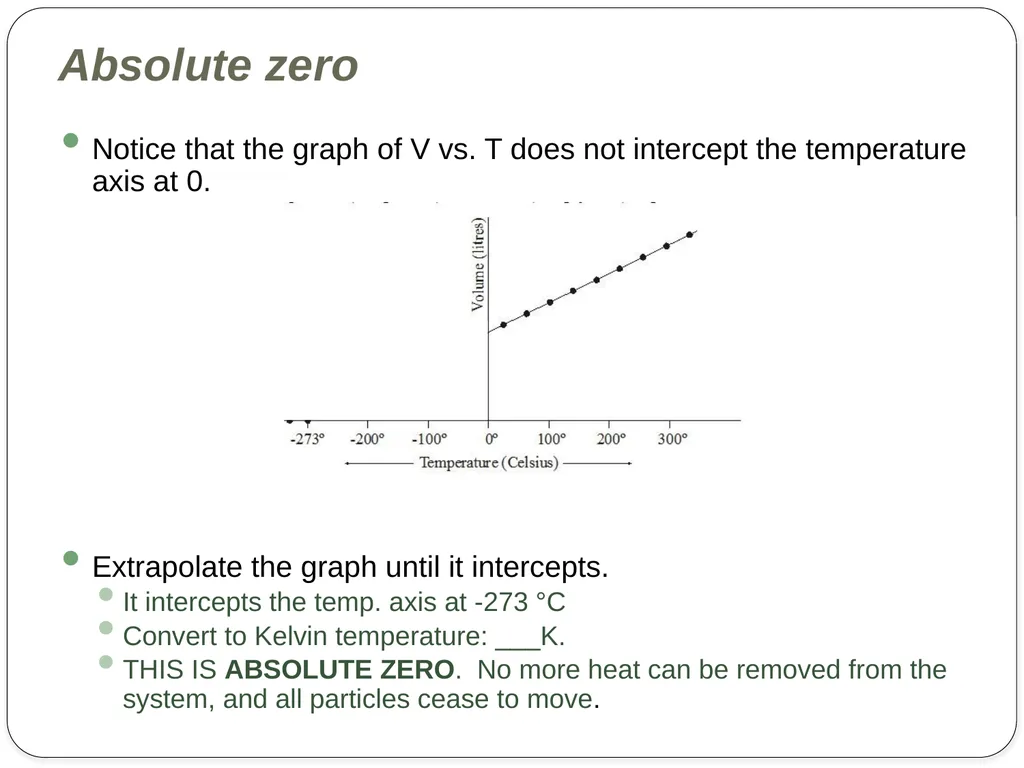
Absolute zero Notice that the graph of V vs. T does not intercept the temperature axis at 0.
Extrapolate the graph until it intercepts.
It intercepts the temp. axis at -273 °C
Convert to Kelvin temperature: ___K.
THIS IS ABSOLUTE ZERO. No more heat can be removed from the system, and all particles cease to move.<br>
14
Homework Boyle’s Law and Charles’ Law
Pg. 549 #1, 2
Pg. 553 #1-6
Worksheet<br>
15
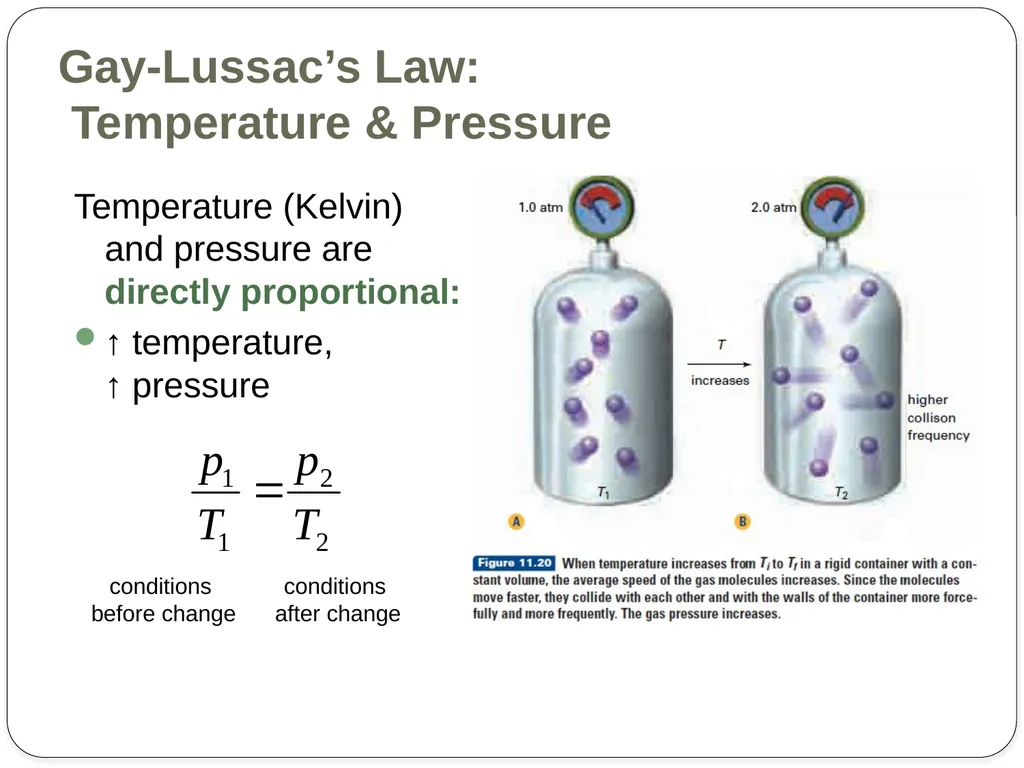
Gay-Lussac’s Law: Temperature & Pressure Temperature (Kelvin) and pressure are directly proportional:
↑ temperature, ↑ pressure conditions before change conditions after change<br>
16
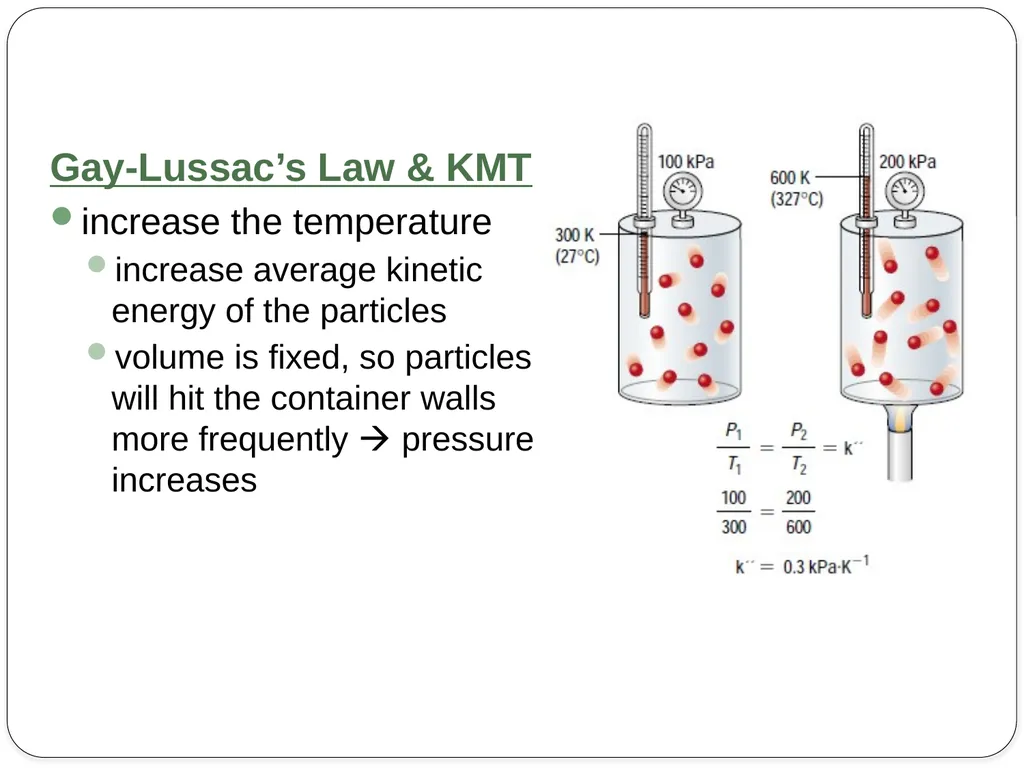
Gay-Lussac’s Law & KMT
increase the temperature
increase average kinetic energy of the particles
volume is fixed, so particles will hit the container walls more frequently pressure increases<br>
17
Example 5
At a temperature of 10°C, a container is filled with gas at a pressure of 225 kPa. What will the pressure be if the container is placed in the hot sun to reach a temperature of 42°C? P = 250 kPa<br>
18
Example 6
A glass vessel that can only withstand a maximum internal pressure of 225 kPa is filled with gas at 21°C and 100.0 kPa, and then heated. At what temperature will the vessel burst? T = 662 K = 389 °C<br>
19
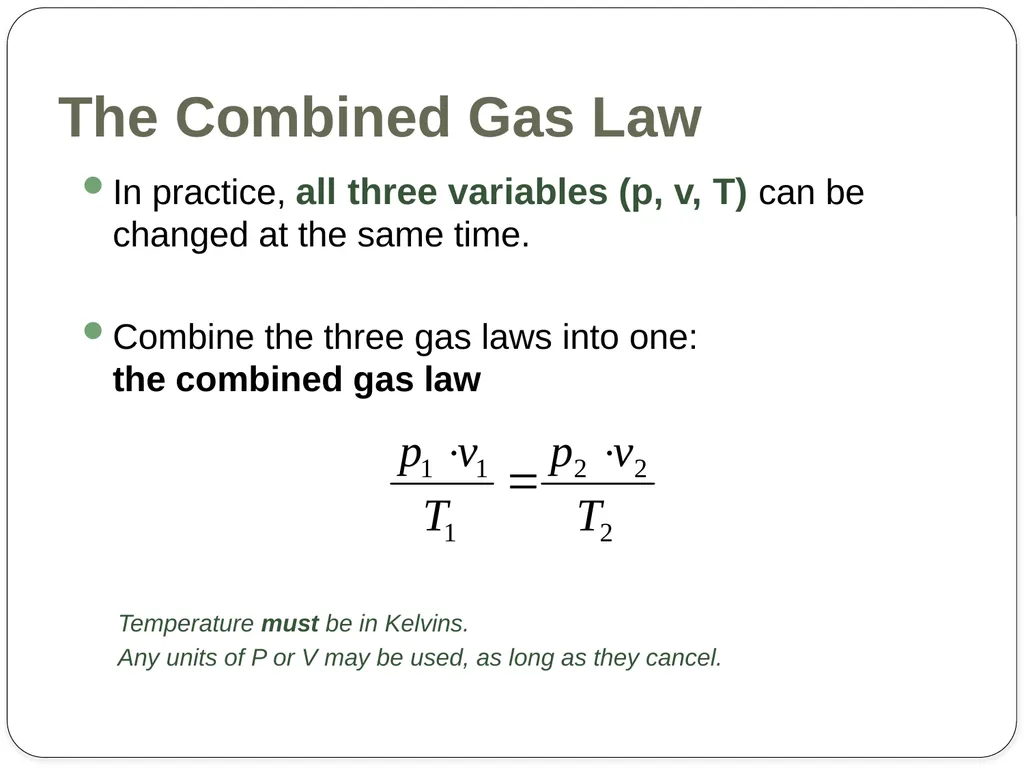
The Combined Gas Law In practice, all three variables (p, v, T) can be changed at the same time.
Combine the three gas laws into one: the combined gas law
Temperature must be in Kelvins.
Any units of P or V may be used, as long as they cancel.<br>
20
Example 7
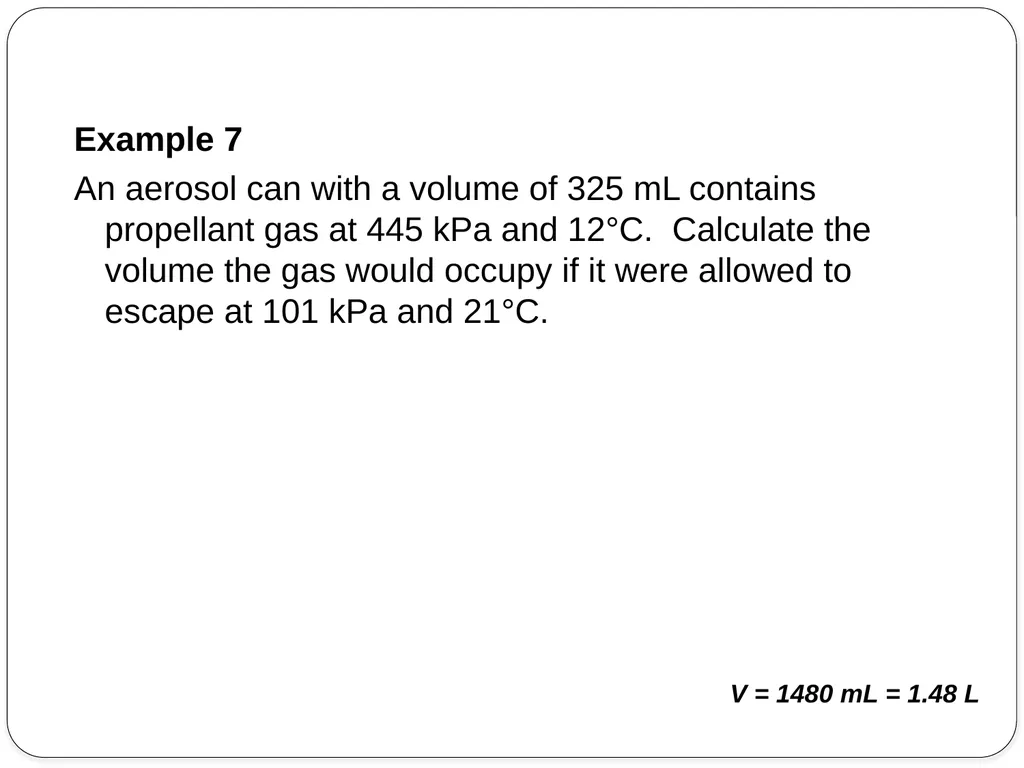
An aerosol can with a volume of 325 mL contains propellant gas at 445 kPa and 12°C. Calculate the volume the gas would occupy if it were allowed to escape at 101 kPa and 21°C. V = 1480 mL = 1.48 L<br>
21
Example 8
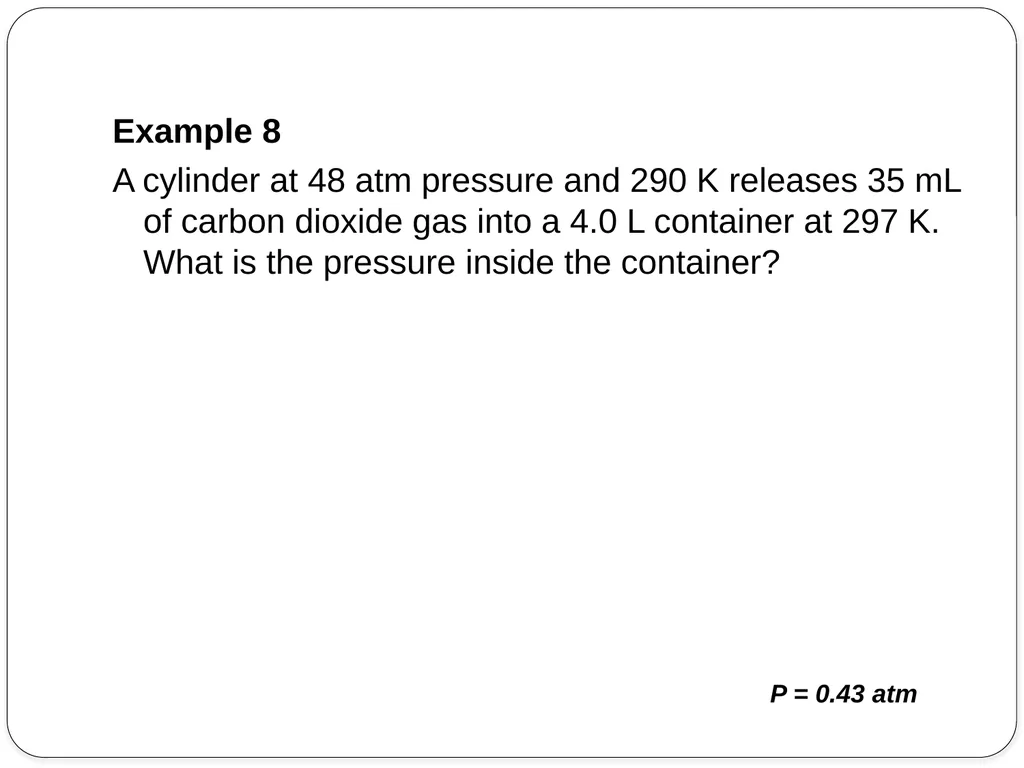
A cylinder at 48 atm pressure and 290 K releases 35 mL of carbon dioxide gas into a 4.0 L container at 297 K. What is the pressure inside the container? P = 0.43 atm<br>
22
Homework Worksheets:
Gay-Lussac’s law
Combined gas law<br>