
SECURITIES ENFORCEMENT: What Has Happened? Why Are
A
Published · 19 slides · 0 views

1 / 1
Description
SECURITIES ENFORCEMENT: What Has Happened? Why Are Folks Upset? What Can Be Done? By John C. Coffee, Jr. Adolf A. Berle Professor of Law Columbia University Law School First Annual Securities Regulation and Enforcement Institute December
Related Topics
Share
Embed code
Download this presentation From Below
"SECURITIES ENFORCEMENT: What Has Happened? Why Are" is the property of its rightful owner. Permission is granted to download and print the materials on this website for personal, non-commercial use only, and to display it on your personal computer provided you do not modify the materials and that you retain all copyright notices contained in the materials. By downloading content from our website, you accept the terms of this agreement.
Presentation Transcript
01
SECURITIES ENFORCEMENT:
What Has Happened?
Why Are Folks Upset?
What Can Be Done?
By John C. Coffee, Jr.
Adolf A. Berle Professor of Law
Columbia University Law School First Annual Securities Regulation and Enforcement Institute
December 11, 2012
New York City Bar COPYRIGHT © 2012 John C. Coffee, Jr. All rights reserved. No part of this publication may be reproduced without the prior written permission of the author.<br>
What Can Be Done?
By John C. Coffee, Jr.
Adolf A. Berle Professor of Law
Columbia University Law School First Annual Securities Regulation and Enforcement Institute
December 11, 2012
New York City Bar COPYRIGHT © 2012 John C. Coffee, Jr. All rights reserved. No part of this publication may be reproduced without the prior written permission of the author.<br>
02
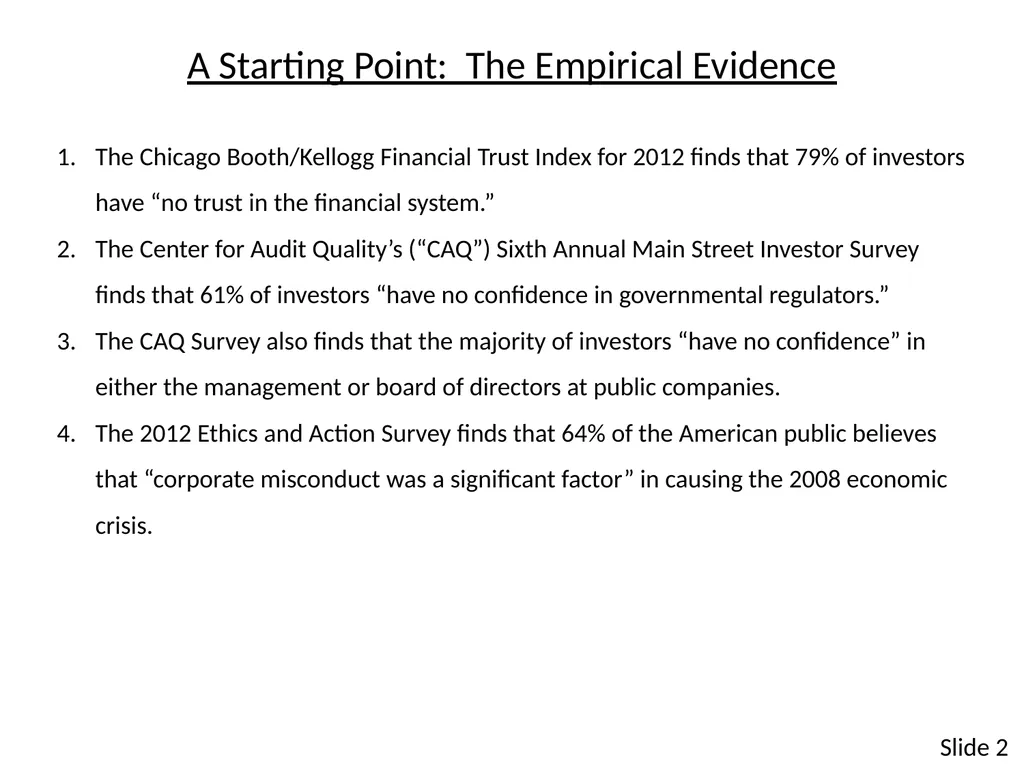
The Chicago Booth/Kellogg Financial Trust Index for 2012 finds that 79% of investors have “no trust in the financial system.”
The Center for Audit Quality’s (“CAQ”) Sixth Annual Main Street Investor Survey finds that 61% of investors “have no confidence in governmental regulators.”
The CAQ Survey also finds that the majority of investors “have no confidence” in either the management or board of directors at public companies.
The 2012 Ethics and Action Survey finds that 64% of the American public believes that “corporate misconduct was a significant factor” in causing the 2008 economic crisis. A Starting Point: The Empirical Evidence Slide 2<br>
The Center for Audit Quality’s (“CAQ”) Sixth Annual Main Street Investor Survey finds that 61% of investors “have no confidence in governmental regulators.”
The CAQ Survey also finds that the majority of investors “have no confidence” in either the management or board of directors at public companies.
The 2012 Ethics and Action Survey finds that 64% of the American public believes that “corporate misconduct was a significant factor” in causing the 2008 economic crisis. A Starting Point: The Empirical Evidence Slide 2<br>
03
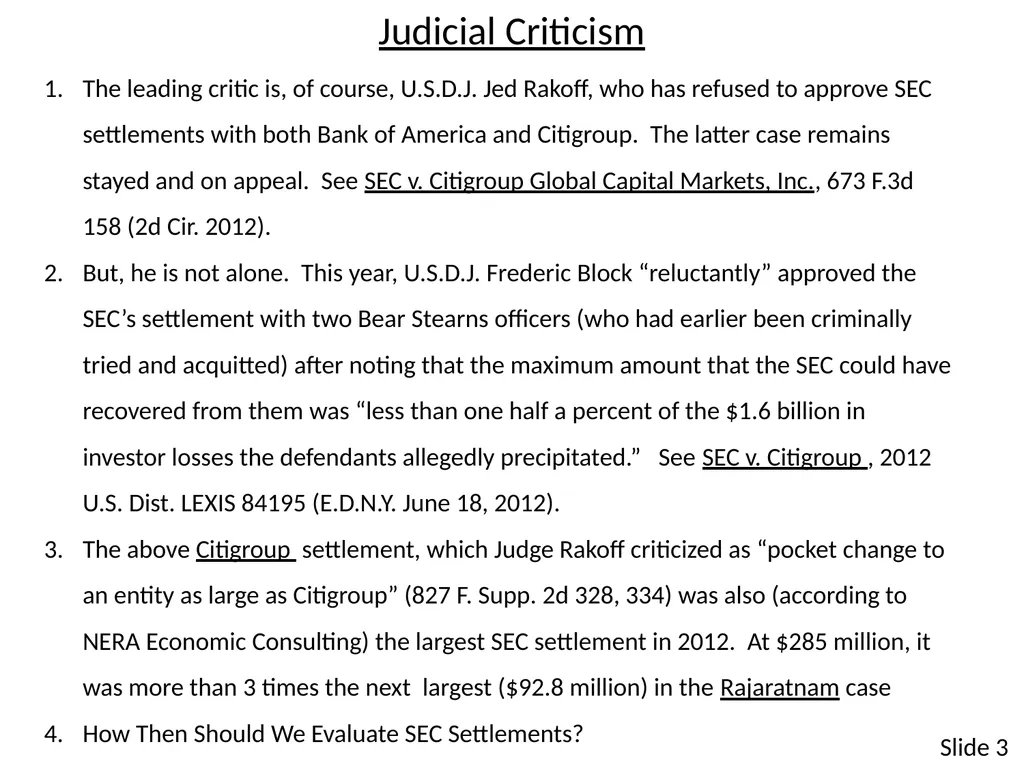
Judicial Criticism The leading critic is, of course, U.S.D.J. Jed Rakoff, who has refused to approve SEC settlements with both Bank of America and Citigroup. The latter case remains stayed and on appeal. See SEC v. Citigroup Global Capital Markets, Inc., 673 F.3d 158 (2d Cir. 2012).
But, he is not alone. This year, U.S.D.J. Frederic Block “reluctantly” approved the SEC’s settlement with two Bear Stearns officers (who had earlier been criminally tried and acquitted) after noting that the maximum amount that the SEC could have recovered from them was “less than one half a percent of the $1.6 billion in investor losses the defendants allegedly precipitated.” See SEC v. Citigroup , 2012 U.S. Dist. LEXIS 84195 (E.D.N.Y. June 18, 2012).
The above Citigroup settlement, which Judge Rakoff criticized as “pocket change to an entity as large as Citigroup” (827 F. Supp. 2d 328, 334) was also (according to NERA Economic Consulting) the largest SEC settlement in 2012. At $285 million, it was more than 3 times the next largest ($92.8 million) in the Rajaratnam case
How Then Should We Evaluate SEC Settlements? Slide 3<br>
But, he is not alone. This year, U.S.D.J. Frederic Block “reluctantly” approved the SEC’s settlement with two Bear Stearns officers (who had earlier been criminally tried and acquitted) after noting that the maximum amount that the SEC could have recovered from them was “less than one half a percent of the $1.6 billion in investor losses the defendants allegedly precipitated.” See SEC v. Citigroup , 2012 U.S. Dist. LEXIS 84195 (E.D.N.Y. June 18, 2012).
The above Citigroup settlement, which Judge Rakoff criticized as “pocket change to an entity as large as Citigroup” (827 F. Supp. 2d 328, 334) was also (according to NERA Economic Consulting) the largest SEC settlement in 2012. At $285 million, it was more than 3 times the next largest ($92.8 million) in the Rajaratnam case
How Then Should We Evaluate SEC Settlements? Slide 3<br>
04
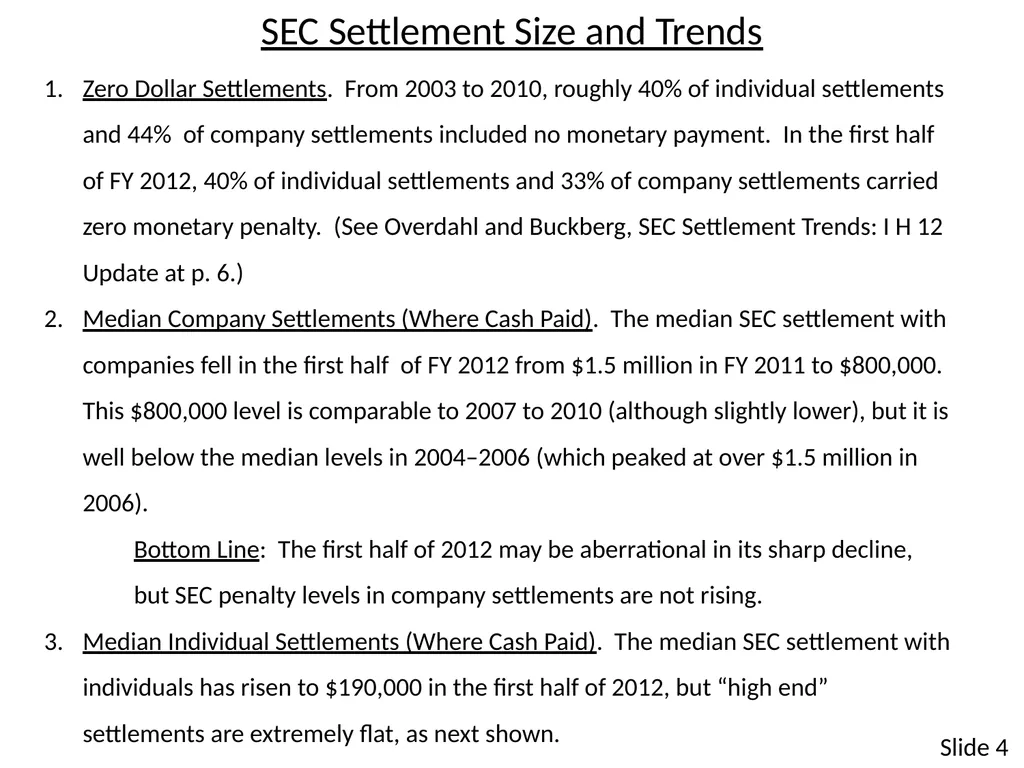
Slide 4 Zero Dollar Settlements. From 2003 to 2010, roughly 40% of individual settlements and 44% of company settlements included no monetary payment. In the first half of FY 2012, 40% of individual settlements and 33% of company settlements carried zero monetary penalty. (See Overdahl and Buckberg, SEC Settlement Trends: I H 12 Update at p. 6.)
Median Company Settlements (Where Cash Paid). The median SEC settlement with companies fell in the first half of FY 2012 from $1.5 million in FY 2011 to $800,000. This $800,000 level is comparable to 2007 to 2010 (although slightly lower), but it is well below the median levels in 2004–2006 (which peaked at over $1.5 million in 2006).
Bottom Line: The first half of 2012 may be aberrational in its sharp decline, but SEC penalty levels in company settlements are not rising.
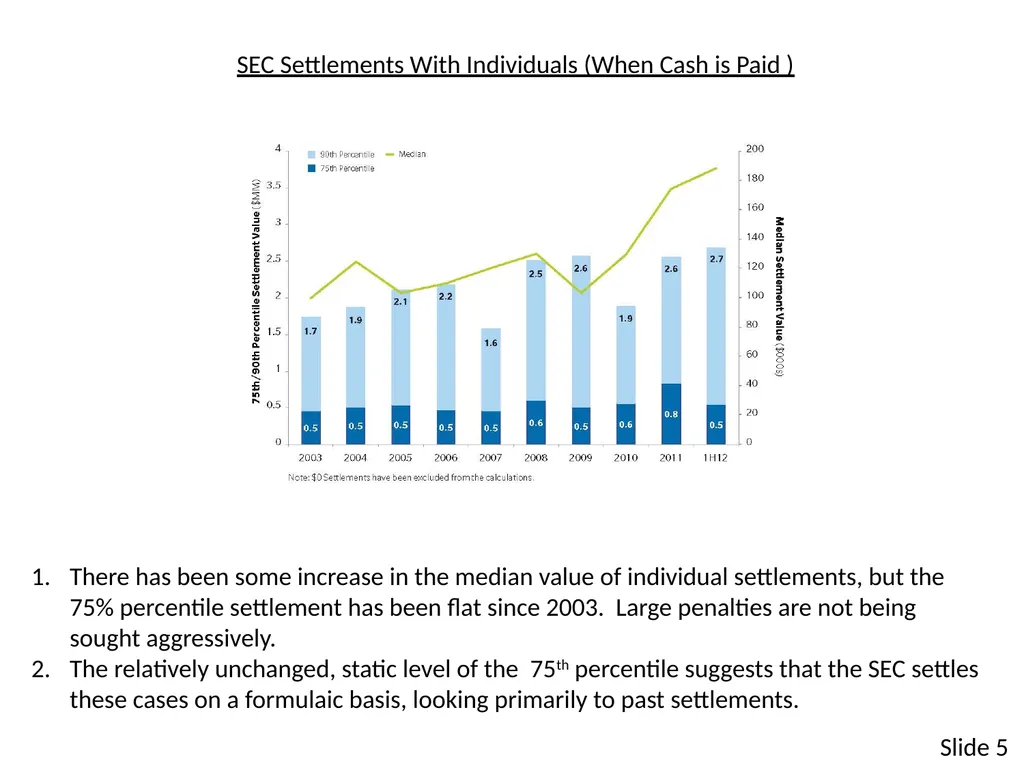
Median Individual Settlements (Where Cash Paid). The median SEC settlement with individuals has risen to $190,000 in the first half of 2012, but “high end” settlements are extremely flat, as next shown. SEC Settlement Size and Trends<br>
Median Company Settlements (Where Cash Paid). The median SEC settlement with companies fell in the first half of FY 2012 from $1.5 million in FY 2011 to $800,000. This $800,000 level is comparable to 2007 to 2010 (although slightly lower), but it is well below the median levels in 2004–2006 (which peaked at over $1.5 million in 2006).
Bottom Line: The first half of 2012 may be aberrational in its sharp decline, but SEC penalty levels in company settlements are not rising.
Median Individual Settlements (Where Cash Paid). The median SEC settlement with individuals has risen to $190,000 in the first half of 2012, but “high end” settlements are extremely flat, as next shown. SEC Settlement Size and Trends<br>
05
Slide 5 SEC Settlements With Individuals (When Cash is Paid ) There has been some increase in the median value of individual settlements, but the 75% percentile settlement has been flat since 2003. Large penalties are not being sought aggressively.
The relatively unchanged, static level of the 75th percentile suggests that the SEC settles these cases on a formulaic basis, looking primarily to past settlements.<br>
The relatively unchanged, static level of the 75th percentile suggests that the SEC settles these cases on a formulaic basis, looking primarily to past settlements.<br>
06
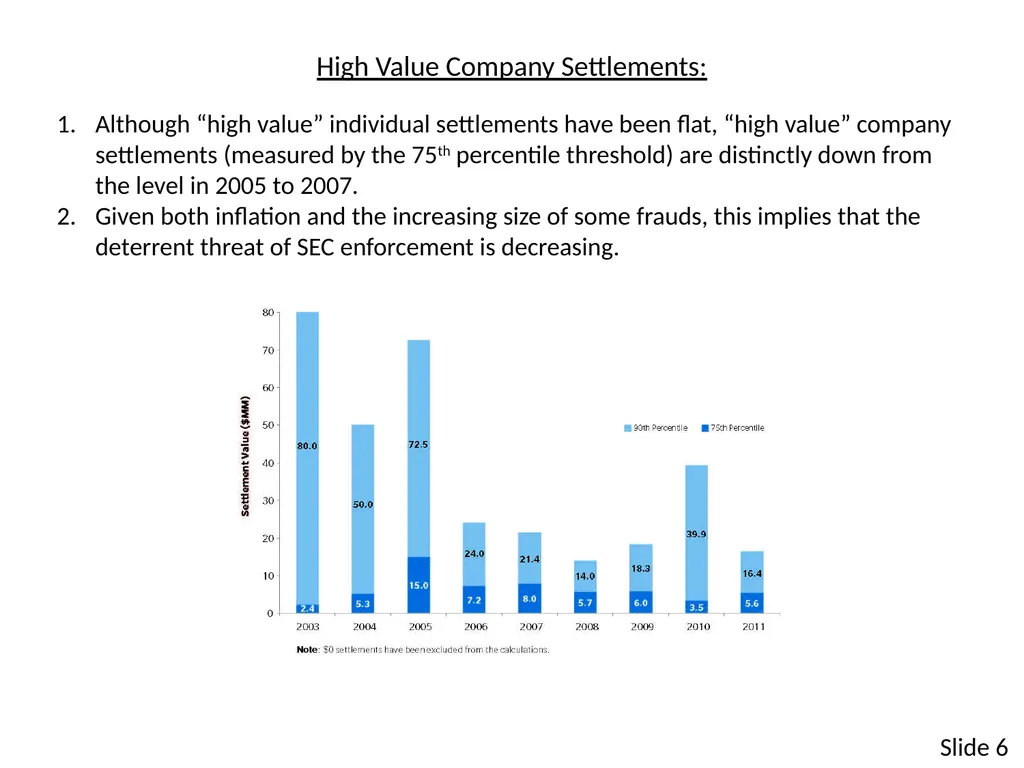
Slide 6 Although “high value” individual settlements have been flat, “high value” company settlements (measured by the 75th percentile threshold) are distinctly down from the level in 2005 to 2007.
Given both inflation and the increasing size of some frauds, this implies that the deterrent threat of SEC enforcement is decreasing. High Value Company Settlements:<br>
Given both inflation and the increasing size of some frauds, this implies that the deterrent threat of SEC enforcement is decreasing. High Value Company Settlements:<br>
07
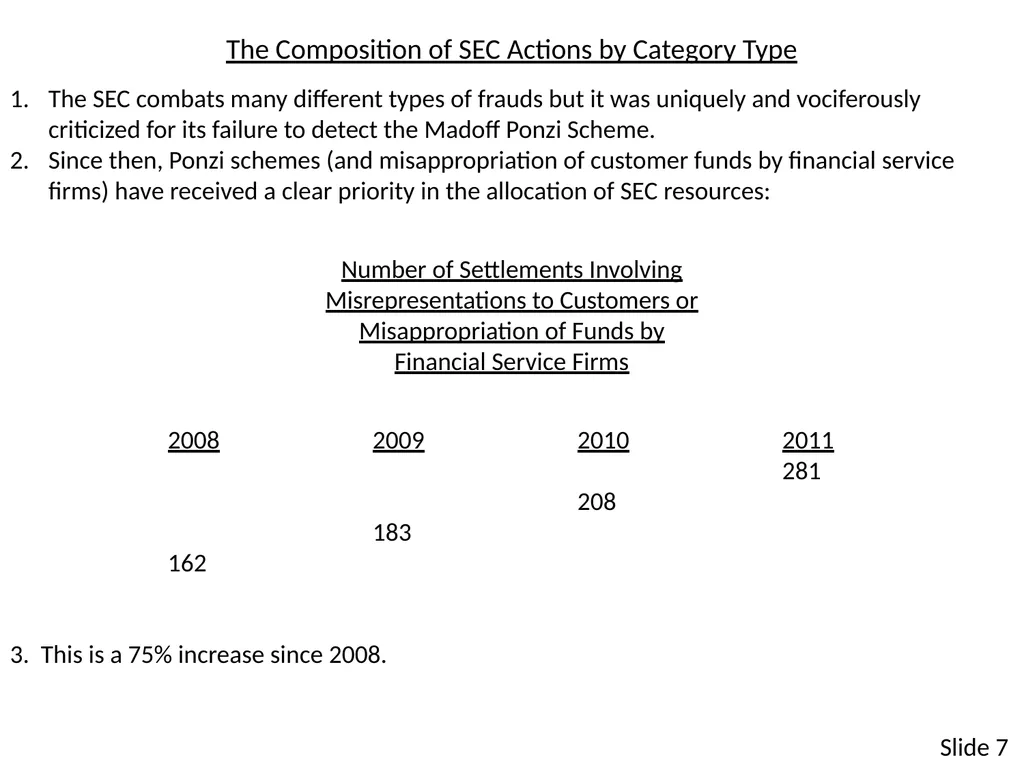
Slide 7 The Composition of SEC Actions by Category Type The SEC combats many different types of frauds but it was uniquely and vociferously criticized for its failure to detect the Madoff Ponzi Scheme.
Since then, Ponzi schemes (and misappropriation of customer funds by financial service firms) have received a clear priority in the allocation of SEC resources: Number of Settlements Involving Misrepresentations to Customers or Misappropriation of Funds by Financial Service Firms 3. This is a 75% increase since 2008. 2008 2009 2010 2011
281
208
183
162<br>
Since then, Ponzi schemes (and misappropriation of customer funds by financial service firms) have received a clear priority in the allocation of SEC resources: Number of Settlements Involving Misrepresentations to Customers or Misappropriation of Funds by Financial Service Firms 3. This is a 75% increase since 2008. 2008 2009 2010 2011
281
208
183
162<br>
08
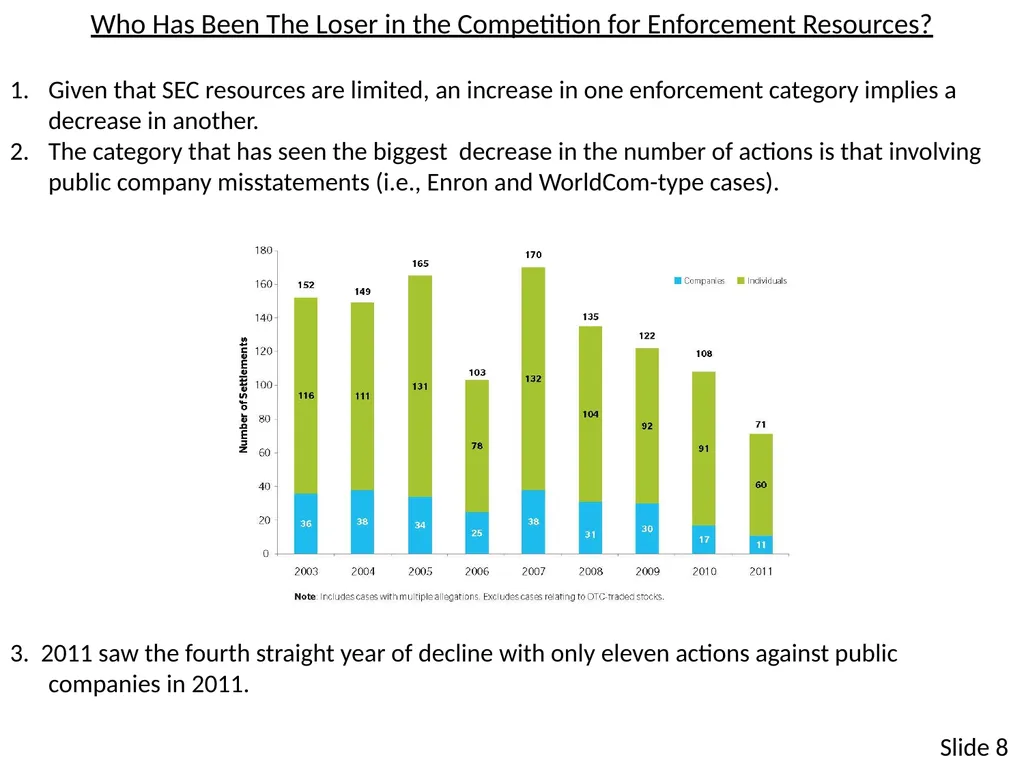
Slide 8 Who Has Been The Loser in the Competition for Enforcement Resources? Given that SEC resources are limited, an increase in one enforcement category implies a decrease in another.
The category that has seen the biggest decrease in the number of actions is that involving public company misstatements (i.e., Enron and WorldCom-type cases). 3. 2011 saw the fourth straight year of decline with only eleven actions against public companies in 2011.<br>
The category that has seen the biggest decrease in the number of actions is that involving public company misstatements (i.e., Enron and WorldCom-type cases). 3. 2011 saw the fourth straight year of decline with only eleven actions against public companies in 2011.<br>
09
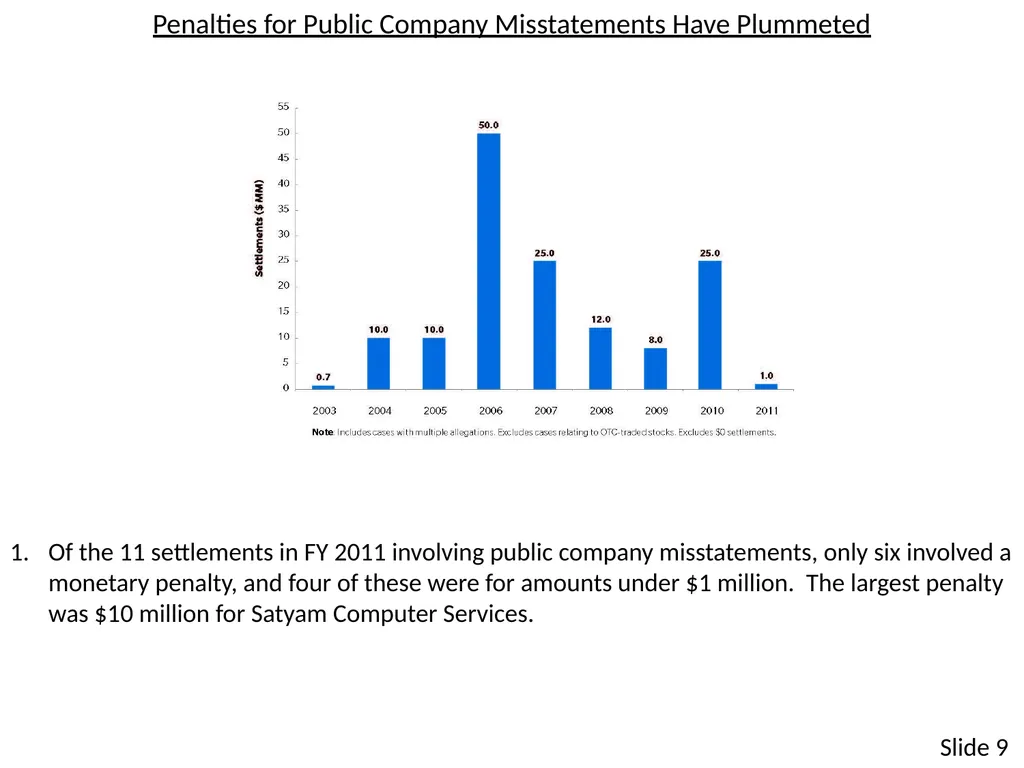
Slide 9 Penalties for Public Company Misstatements Have Plummeted Of the 11 settlements in FY 2011 involving public company misstatements, only six involved a monetary penalty, and four of these were for amounts under $1 million. The largest penalty was $10 million for Satyam Computer Services.<br>
10
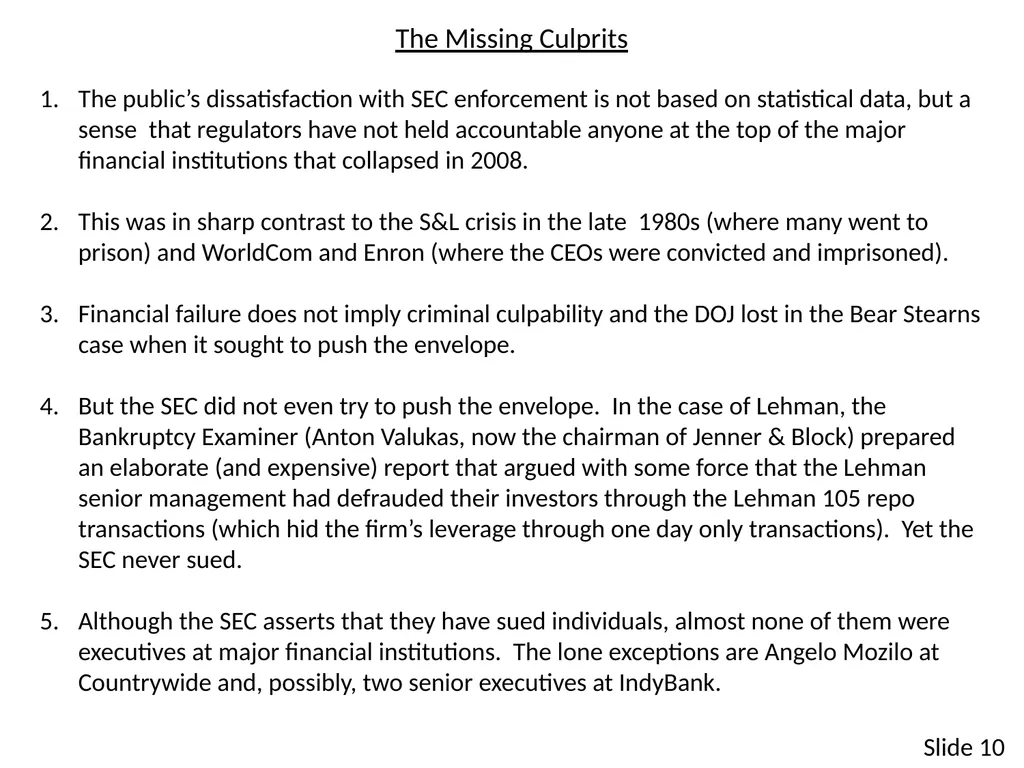
Slide 10 The Missing Culprits The public’s dissatisfaction with SEC enforcement is not based on statistical data, but a sense that regulators have not held accountable anyone at the top of the major financial institutions that collapsed in 2008.
This was in sharp contrast to the S&L crisis in the late 1980s (where many went to prison) and WorldCom and Enron (where the CEOs were convicted and imprisoned).
Financial failure does not imply criminal culpability and the DOJ lost in the Bear Stearns case when it sought to push the envelope.
But the SEC did not even try to push the envelope. In the case of Lehman, the Bankruptcy Examiner (Anton Valukas, now the chairman of Jenner & Block) prepared an elaborate (and expensive) report that argued with some force that the Lehman senior management had defrauded their investors through the Lehman 105 repo transactions (which hid the firm’s leverage through one day only transactions). Yet the SEC never sued.
Although the SEC asserts that they have sued individuals, almost none of them were executives at major financial institutions. The lone exceptions are Angelo Mozilo at Countrywide and, possibly, two senior executives at IndyBank.<br>
This was in sharp contrast to the S&L crisis in the late 1980s (where many went to prison) and WorldCom and Enron (where the CEOs were convicted and imprisoned).
Financial failure does not imply criminal culpability and the DOJ lost in the Bear Stearns case when it sought to push the envelope.
But the SEC did not even try to push the envelope. In the case of Lehman, the Bankruptcy Examiner (Anton Valukas, now the chairman of Jenner & Block) prepared an elaborate (and expensive) report that argued with some force that the Lehman senior management had defrauded their investors through the Lehman 105 repo transactions (which hid the firm’s leverage through one day only transactions). Yet the SEC never sued.
Although the SEC asserts that they have sued individuals, almost none of them were executives at major financial institutions. The lone exceptions are Angelo Mozilo at Countrywide and, possibly, two senior executives at IndyBank.<br>
11
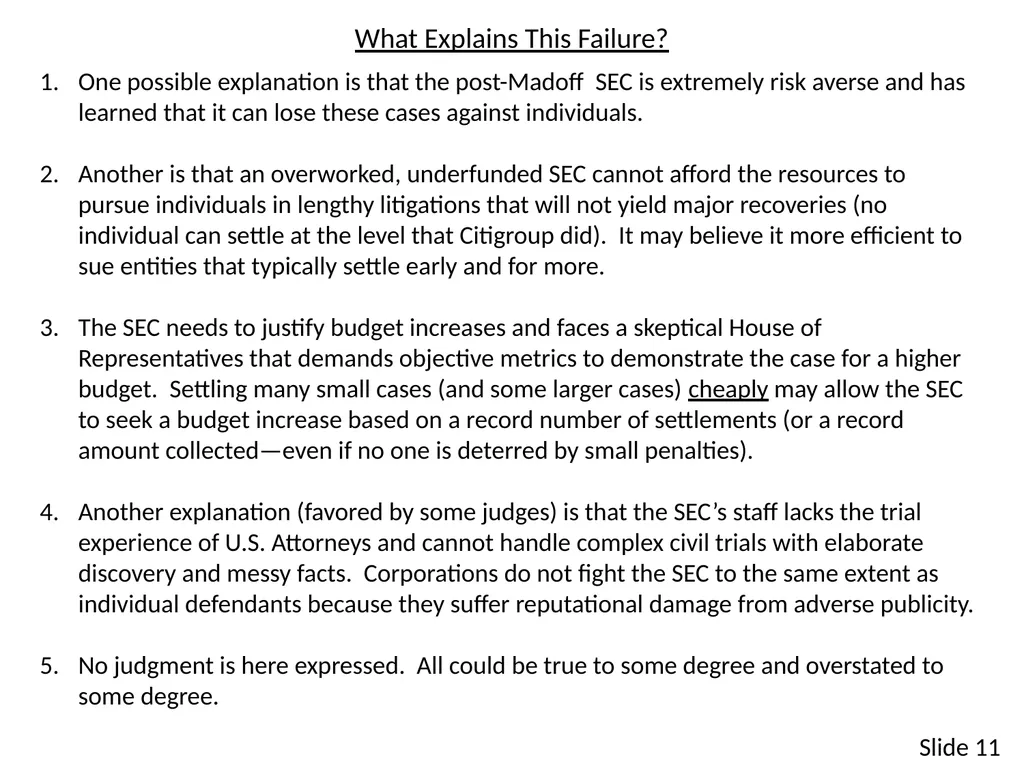
Slide 11 What Explains This Failure? One possible explanation is that the post-Madoff SEC is extremely risk averse and has learned that it can lose these cases against individuals.
Another is that an overworked, underfunded SEC cannot afford the resources to pursue individuals in lengthy litigations that will not yield major recoveries (no individual can settle at the level that Citigroup did). It may believe it more efficient to sue entities that typically settle early and for more.
The SEC needs to justify budget increases and faces a skeptical House of Representatives that demands objective metrics to demonstrate the case for a higher budget. Settling many small cases (and some larger cases) cheaply may allow the SEC to seek a budget increase based on a record number of settlements (or a record amount collected—even if no one is deterred by small penalties).
Another explanation (favored by some judges) is that the SEC’s staff lacks the trial experience of U.S. Attorneys and cannot handle complex civil trials with elaborate discovery and messy facts. Corporations do not fight the SEC to the same extent as individual defendants because they suffer reputational damage from adverse publicity.
No judgment is here expressed. All could be true to some degree and overstated to some degree.<br>
Another is that an overworked, underfunded SEC cannot afford the resources to pursue individuals in lengthy litigations that will not yield major recoveries (no individual can settle at the level that Citigroup did). It may believe it more efficient to sue entities that typically settle early and for more.
The SEC needs to justify budget increases and faces a skeptical House of Representatives that demands objective metrics to demonstrate the case for a higher budget. Settling many small cases (and some larger cases) cheaply may allow the SEC to seek a budget increase based on a record number of settlements (or a record amount collected—even if no one is deterred by small penalties).
Another explanation (favored by some judges) is that the SEC’s staff lacks the trial experience of U.S. Attorneys and cannot handle complex civil trials with elaborate discovery and messy facts. Corporations do not fight the SEC to the same extent as individual defendants because they suffer reputational damage from adverse publicity.
No judgment is here expressed. All could be true to some degree and overstated to some degree.<br>
12
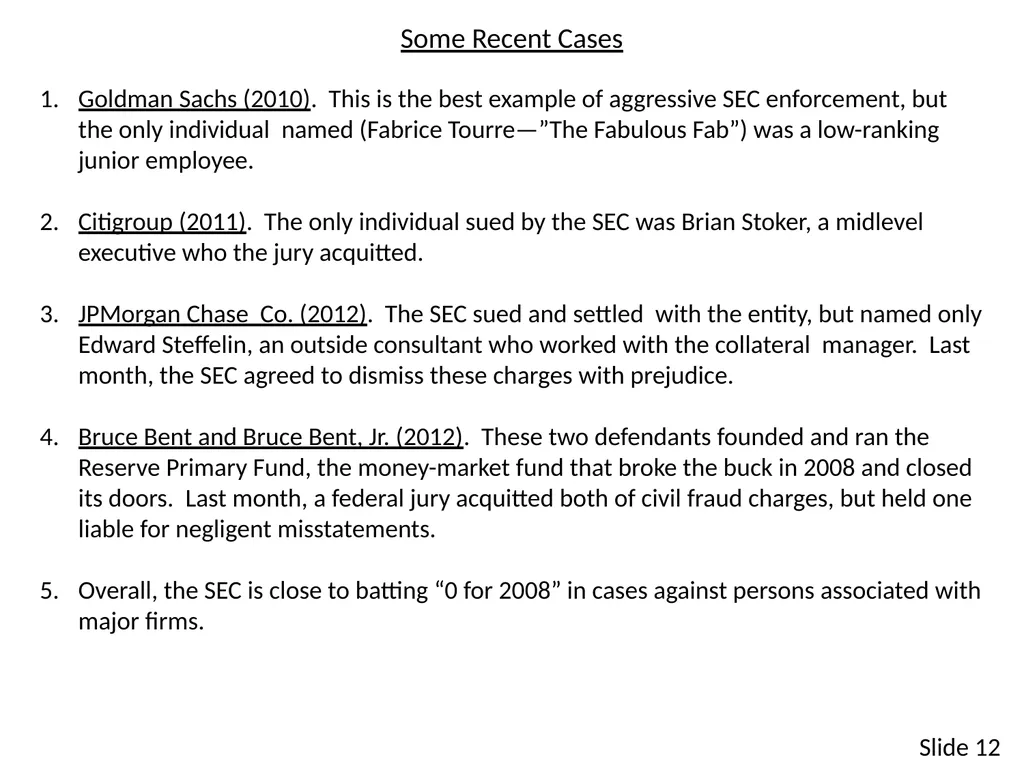
Some Recent Cases Goldman Sachs (2010). This is the best example of aggressive SEC enforcement, but the only individual named (Fabrice Tourre—”The Fabulous Fab”) was a low-ranking junior employee.
Citigroup (2011). The only individual sued by the SEC was Brian Stoker, a midlevel executive who the jury acquitted.
JPMorgan Chase Co. (2012). The SEC sued and settled with the entity, but named only Edward Steffelin, an outside consultant who worked with the collateral manager. Last month, the SEC agreed to dismiss these charges with prejudice.
Bruce Bent and Bruce Bent, Jr. (2012). These two defendants founded and ran the Reserve Primary Fund, the money-market fund that broke the buck in 2008 and closed its doors. Last month, a federal jury acquitted both of civil fraud charges, but held one liable for negligent misstatements.
Overall, the SEC is close to batting “0 for 2008” in cases against persons associated with major firms. Slide 12<br>
Citigroup (2011). The only individual sued by the SEC was Brian Stoker, a midlevel executive who the jury acquitted.
JPMorgan Chase Co. (2012). The SEC sued and settled with the entity, but named only Edward Steffelin, an outside consultant who worked with the collateral manager. Last month, the SEC agreed to dismiss these charges with prejudice.
Bruce Bent and Bruce Bent, Jr. (2012). These two defendants founded and ran the Reserve Primary Fund, the money-market fund that broke the buck in 2008 and closed its doors. Last month, a federal jury acquitted both of civil fraud charges, but held one liable for negligent misstatements.
Overall, the SEC is close to batting “0 for 2008” in cases against persons associated with major firms. Slide 12<br>
13
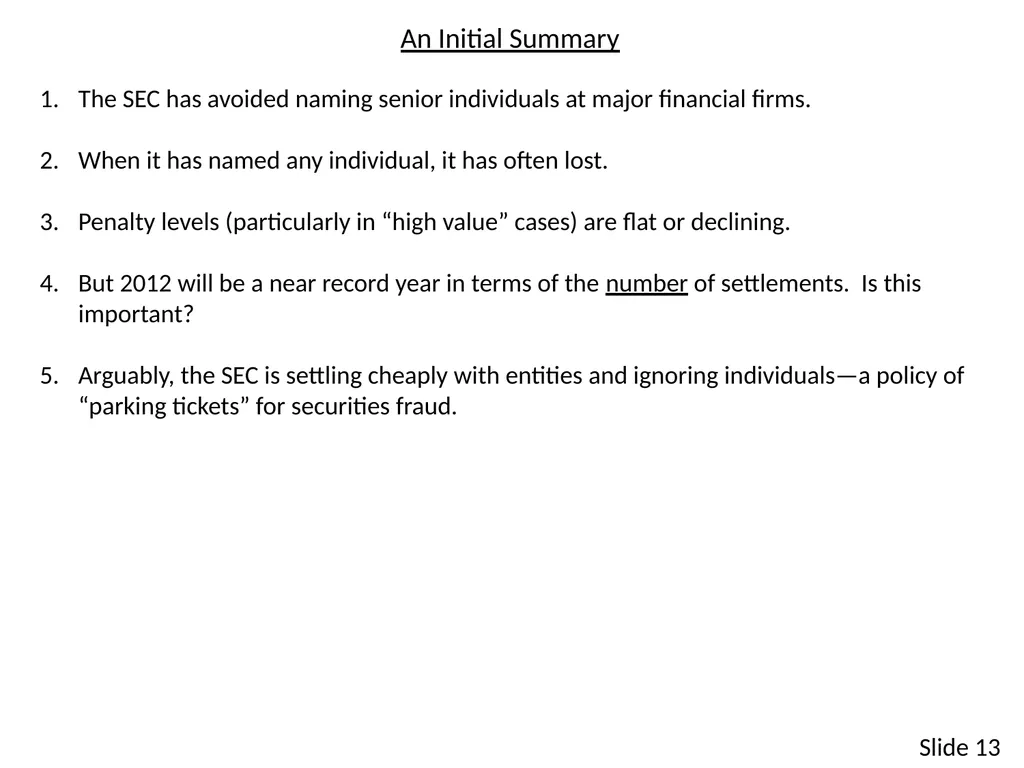
Slide 13 An Initial Summary The SEC has avoided naming senior individuals at major financial firms.
When it has named any individual, it has often lost.
Penalty levels (particularly in “high value” cases) are flat or declining.
But 2012 will be a near record year in terms of the number of settlements. Is this important?
Arguably, the SEC is settling cheaply with entities and ignoring individuals—a policy of “parking tickets” for securities fraud.<br>
When it has named any individual, it has often lost.
Penalty levels (particularly in “high value” cases) are flat or declining.
But 2012 will be a near record year in terms of the number of settlements. Is this important?
Arguably, the SEC is settling cheaply with entities and ignoring individuals—a policy of “parking tickets” for securities fraud.<br>
14
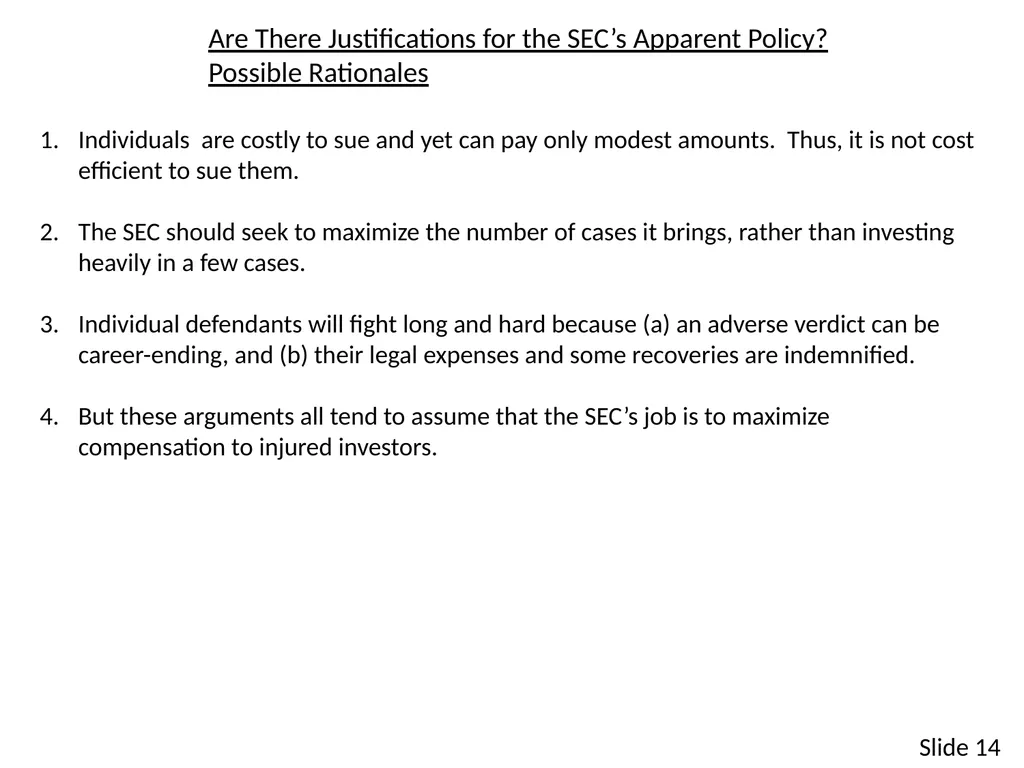
Slide 14 Are There Justifications for the SEC’s Apparent Policy?
Possible Rationales Individuals are costly to sue and yet can pay only modest amounts. Thus, it is not cost efficient to sue them.
The SEC should seek to maximize the number of cases it brings, rather than investing heavily in a few cases.
Individual defendants will fight long and hard because (a) an adverse verdict can be career-ending, and (b) their legal expenses and some recoveries are indemnified.
But these arguments all tend to assume that the SEC’s job is to maximize compensation to injured investors.<br>
Possible Rationales Individuals are costly to sue and yet can pay only modest amounts. Thus, it is not cost efficient to sue them.
The SEC should seek to maximize the number of cases it brings, rather than investing heavily in a few cases.
Individual defendants will fight long and hard because (a) an adverse verdict can be career-ending, and (b) their legal expenses and some recoveries are indemnified.
But these arguments all tend to assume that the SEC’s job is to maximize compensation to injured investors.<br>
15
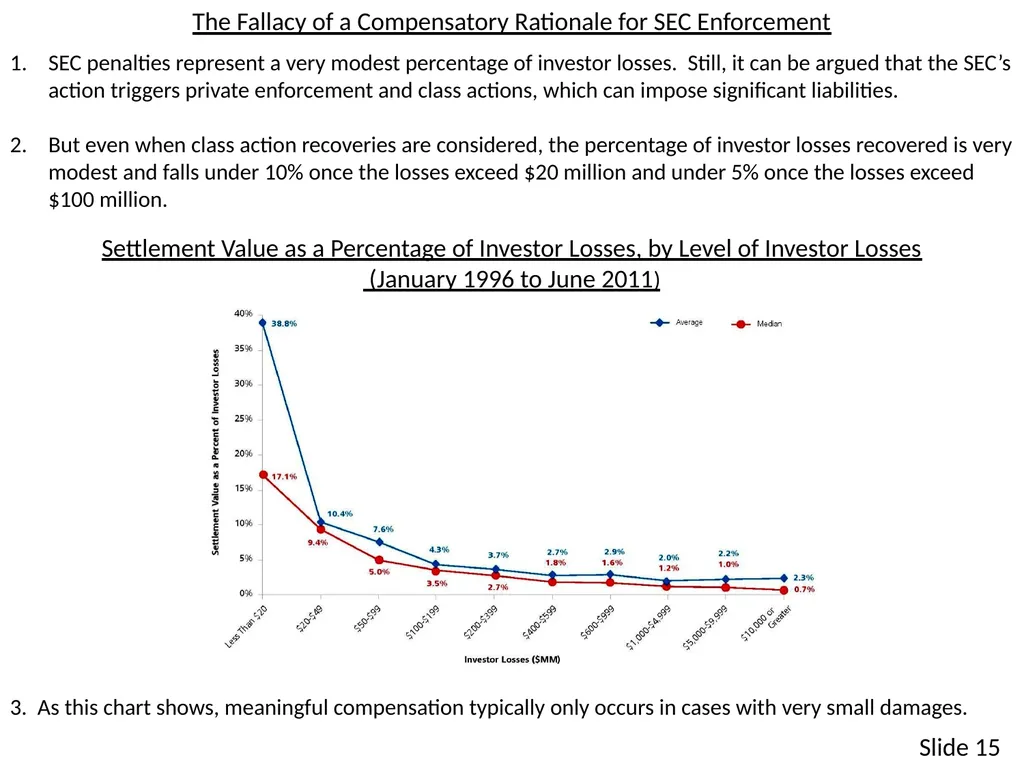
Slide 15 The Fallacy of a Compensatory Rationale for SEC Enforcement SEC penalties represent a very modest percentage of investor losses. Still, it can be argued that the SEC’s action triggers private enforcement and class actions, which can impose significant liabilities.
But even when class action recoveries are considered, the percentage of investor losses recovered is very modest and falls under 10% once the losses exceed $20 million and under 5% once the losses exceed $100 million. Settlement Value as a Percentage of Investor Losses, by Level of Investor Losses (January 1996 to June 2011) 3. As this chart shows, meaningful compensation typically only occurs in cases with very small damages.<br>
But even when class action recoveries are considered, the percentage of investor losses recovered is very modest and falls under 10% once the losses exceed $20 million and under 5% once the losses exceed $100 million. Settlement Value as a Percentage of Investor Losses, by Level of Investor Losses (January 1996 to June 2011) 3. As this chart shows, meaningful compensation typically only occurs in cases with very small damages.<br>
16
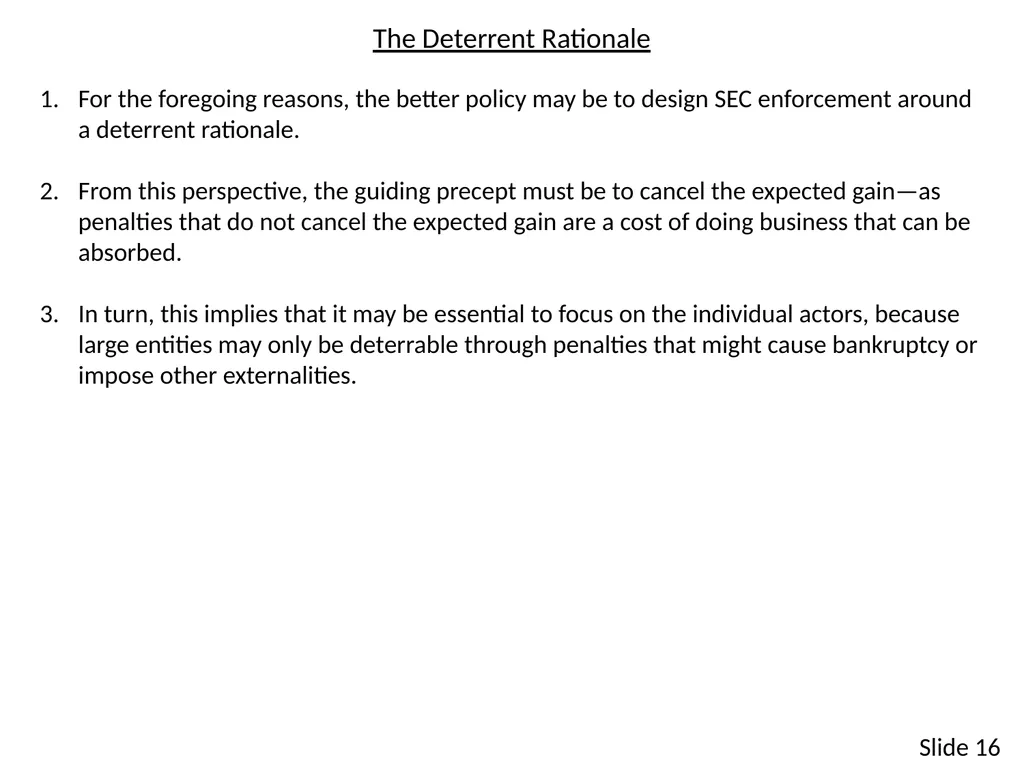
Slide 16 The Deterrent Rationale For the foregoing reasons, the better policy may be to design SEC enforcement around a deterrent rationale.
From this perspective, the guiding precept must be to cancel the expected gain—as penalties that do not cancel the expected gain are a cost of doing business that can be absorbed.
In turn, this implies that it may be essential to focus on the individual actors, because large entities may only be deterrable through penalties that might cause bankruptcy or impose other externalities.<br>
From this perspective, the guiding precept must be to cancel the expected gain—as penalties that do not cancel the expected gain are a cost of doing business that can be absorbed.
In turn, this implies that it may be essential to focus on the individual actors, because large entities may only be deterrable through penalties that might cause bankruptcy or impose other externalities.<br>
17
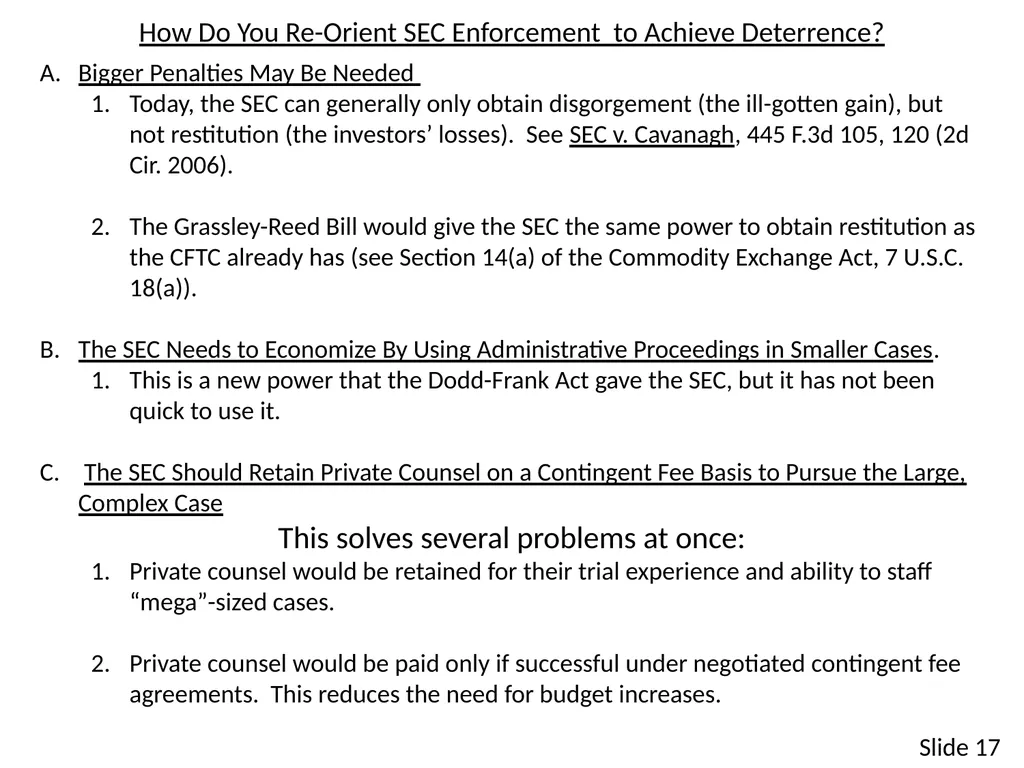
Slide 17 How Do You Re-Orient SEC Enforcement to Achieve Deterrence? Bigger Penalties May Be Needed
Today, the SEC can generally only obtain disgorgement (the ill-gotten gain), but not restitution (the investors’ losses). See SEC v. Cavanagh, 445 F.3d 105, 120 (2d Cir. 2006).
The Grassley-Reed Bill would give the SEC the same power to obtain restitution as the CFTC already has (see Section 14(a) of the Commodity Exchange Act, 7 U.S.C. 18(a)).
The SEC Needs to Economize By Using Administrative Proceedings in Smaller Cases.
This is a new power that the Dodd-Frank Act gave the SEC, but it has not been quick to use it.
The SEC Should Retain Private Counsel on a Contingent Fee Basis to Pursue the Large, Complex Case
This solves several problems at once:
Private counsel would be retained for their trial experience and ability to staff “mega”-sized cases.
Private counsel would be paid only if successful under negotiated contingent fee agreements. This reduces the need for budget increases.<br>
Today, the SEC can generally only obtain disgorgement (the ill-gotten gain), but not restitution (the investors’ losses). See SEC v. Cavanagh, 445 F.3d 105, 120 (2d Cir. 2006).
The Grassley-Reed Bill would give the SEC the same power to obtain restitution as the CFTC already has (see Section 14(a) of the Commodity Exchange Act, 7 U.S.C. 18(a)).
The SEC Needs to Economize By Using Administrative Proceedings in Smaller Cases.
This is a new power that the Dodd-Frank Act gave the SEC, but it has not been quick to use it.
The SEC Should Retain Private Counsel on a Contingent Fee Basis to Pursue the Large, Complex Case
This solves several problems at once:
Private counsel would be retained for their trial experience and ability to staff “mega”-sized cases.
Private counsel would be paid only if successful under negotiated contingent fee agreements. This reduces the need for budget increases.<br>
18
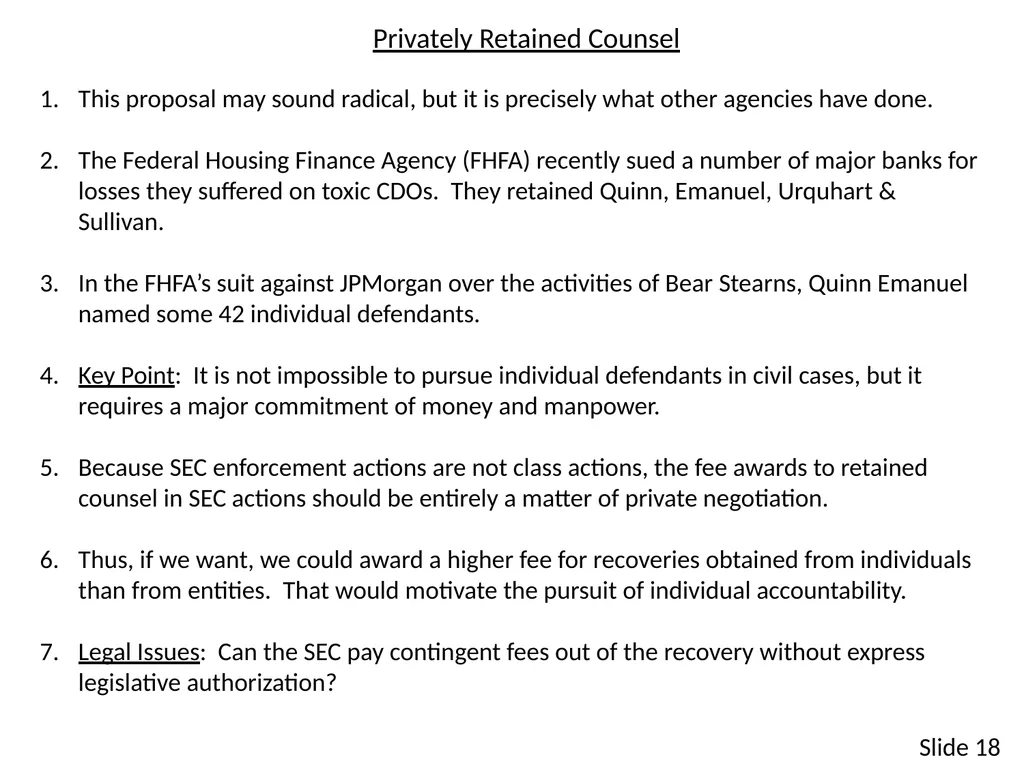
Slide 18 Privately Retained Counsel This proposal may sound radical, but it is precisely what other agencies have done.
The Federal Housing Finance Agency (FHFA) recently sued a number of major banks for losses they suffered on toxic CDOs. They retained Quinn, Emanuel, Urquhart & Sullivan.
In the FHFA’s suit against JPMorgan over the activities of Bear Stearns, Quinn Emanuel named some 42 individual defendants.
Key Point: It is not impossible to pursue individual defendants in civil cases, but it requires a major commitment of money and manpower.
Because SEC enforcement actions are not class actions, the fee awards to retained counsel in SEC actions should be entirely a matter of private negotiation.
Thus, if we want, we could award a higher fee for recoveries obtained from individuals than from entities. That would motivate the pursuit of individual accountability.
Legal Issues: Can the SEC pay contingent fees out of the recovery without express legislative authorization?<br>
The Federal Housing Finance Agency (FHFA) recently sued a number of major banks for losses they suffered on toxic CDOs. They retained Quinn, Emanuel, Urquhart & Sullivan.
In the FHFA’s suit against JPMorgan over the activities of Bear Stearns, Quinn Emanuel named some 42 individual defendants.
Key Point: It is not impossible to pursue individual defendants in civil cases, but it requires a major commitment of money and manpower.
Because SEC enforcement actions are not class actions, the fee awards to retained counsel in SEC actions should be entirely a matter of private negotiation.
Thus, if we want, we could award a higher fee for recoveries obtained from individuals than from entities. That would motivate the pursuit of individual accountability.
Legal Issues: Can the SEC pay contingent fees out of the recovery without express legislative authorization?<br>
19
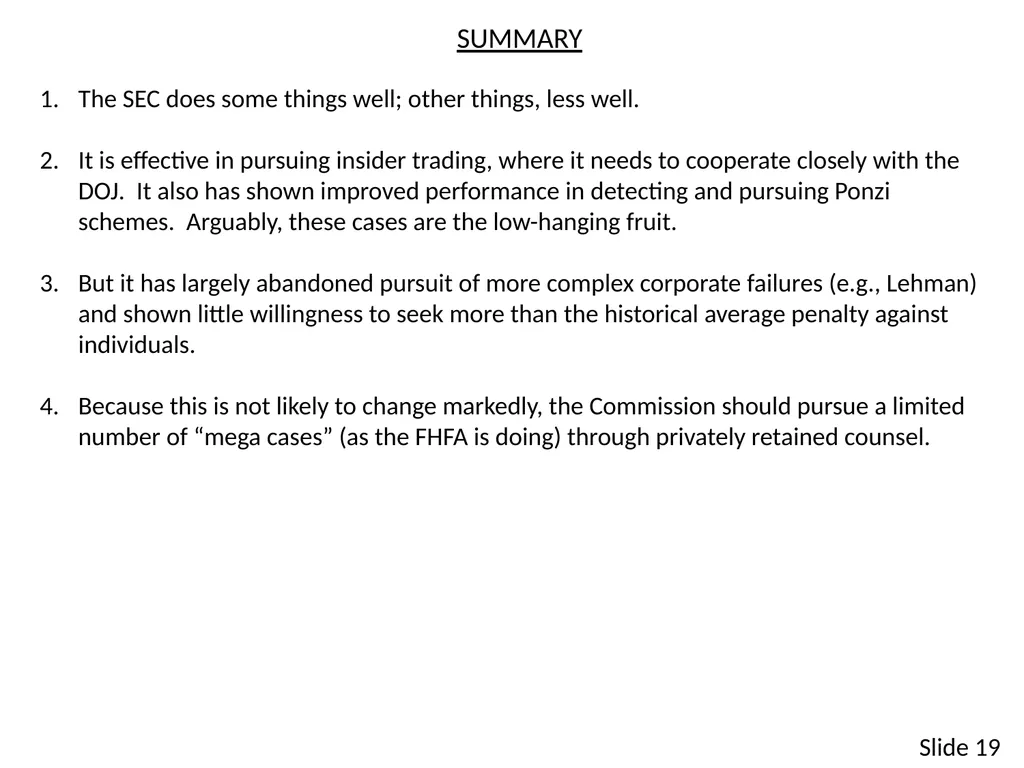
SUMMARY The SEC does some things well; other things, less well.
It is effective in pursuing insider trading, where it needs to cooperate closely with the DOJ. It also has shown improved performance in detecting and pursuing Ponzi schemes. Arguably, these cases are the low-hanging fruit.
But it has largely abandoned pursuit of more complex corporate failures (e.g., Lehman) and shown little willingness to seek more than the historical average penalty against individuals.
Because this is not likely to change markedly, the Commission should pursue a limited number of “mega cases” (as the FHFA is doing) through privately retained counsel. Slide 19<br>
It is effective in pursuing insider trading, where it needs to cooperate closely with the DOJ. It also has shown improved performance in detecting and pursuing Ponzi schemes. Arguably, these cases are the low-hanging fruit.
But it has largely abandoned pursuit of more complex corporate failures (e.g., Lehman) and shown little willingness to seek more than the historical average penalty against individuals.
Because this is not likely to change markedly, the Commission should pursue a limited number of “mega cases” (as the FHFA is doing) through privately retained counsel. Slide 19<br>