
Security and Sovereignty: Protecting Immigrant

Description: Security and Sovereignty: Protecting Immigrant Families through Naturalization Presented by: Sara Morales, Leticia Galicia, Maria Romero Learning Objectives Participants will learn to identify potential red flags in N-400 cases that may
Related Topics
Download Presentation
"Security and Sovereignty: Protecting Immigrant" is the property of its rightful owner. Permission is granted to download and print the materials on this website for personal, non-commercial use only, and to display it on your personal computer provided you do not modify the materials and that you retain all copyright notices contained in the materials. By downloading content from our website, you accept the terms of this agreement.
Presentation Transcript
slide1. Security and Sovereignty:
Protecting Immigrant Families through Naturalization Presented by: Sara Morales, Leticia Galicia, Maria Romero<br>
slide2. Learning Objectives Participants will learn to identify potential “red flags” in N-400 cases that may trigger enforcement actions.
Attendees will gain strategies for documenting eligibility in complex “good moral character” scenarios.
Attendees will understand how to leverage administrative advocacy to address USCIS processing delays.<br>
slide3. Naturalization as a Defensive Strategy<br>
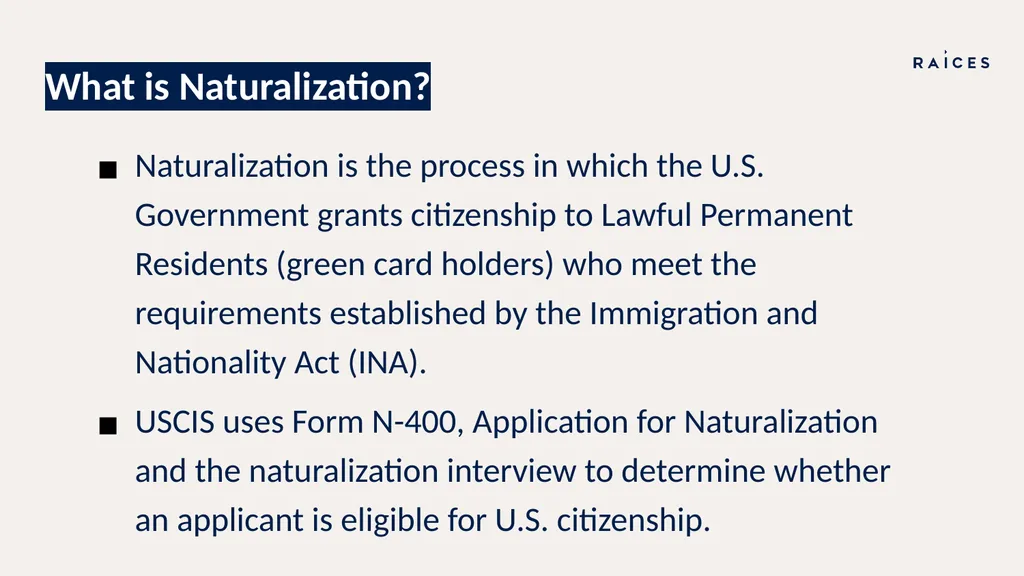
slide4. What is Naturalization? Naturalization is the process in which the U.S. Government grants citizenship to Lawful Permanent Residents (green card holders) who meet the requirements established by the Immigration and Nationality Act (INA).
USCIS uses Form N-400, Application for Naturalization and the naturalization interview to determine whether an applicant is eligible for U.S. citizenship.<br>
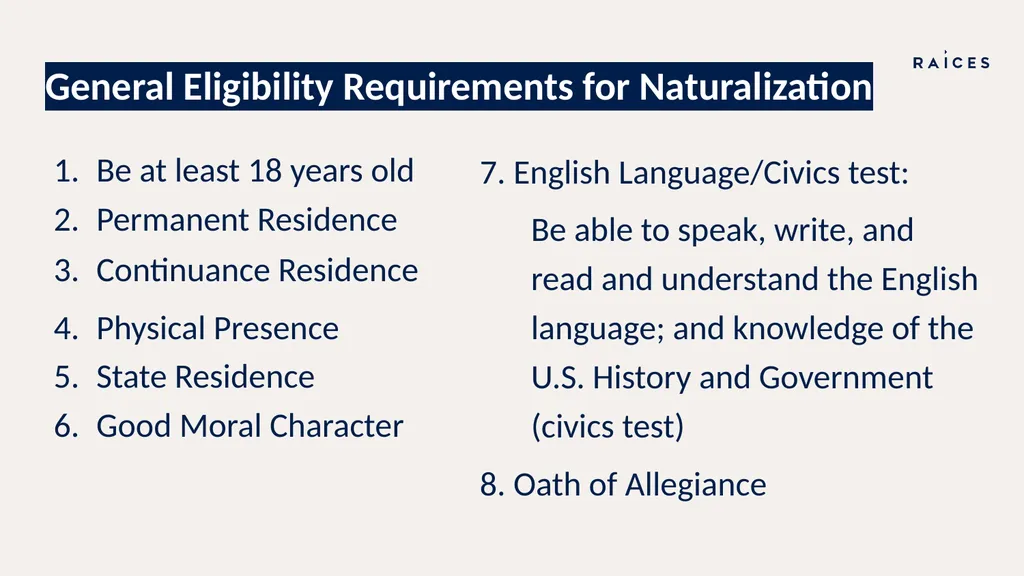
slide5. General Eligibility Requirements for Naturalization Be at least 18 years old
Permanent Residence
Continuance Residence
Physical Presence
State Residence
Good Moral Character 7. English Language/Civics test:
Be able to speak, write, and read and understand the English language; and knowledge of the U.S. History and Government (civics test)
8. Oath of Allegiance<br>
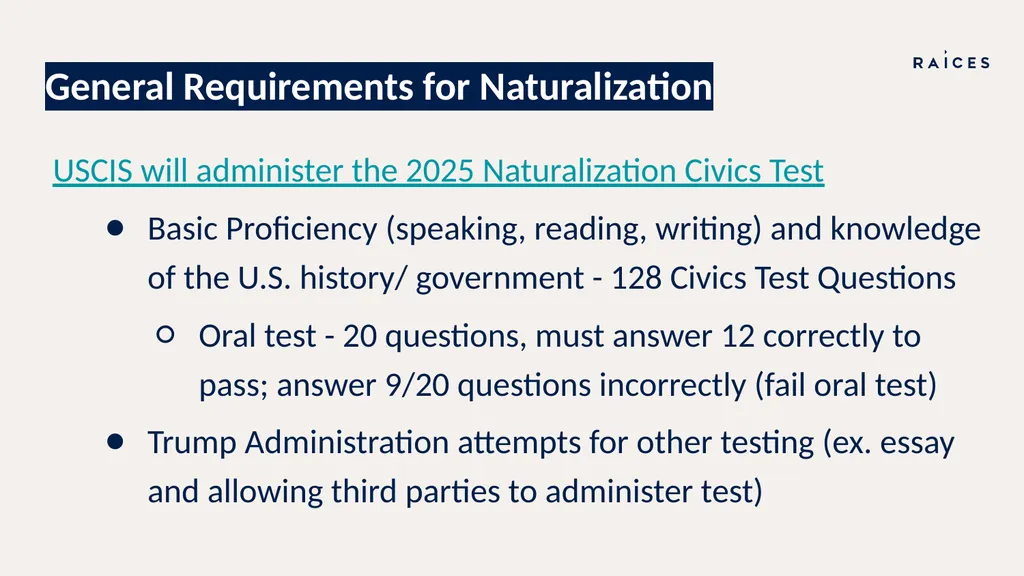
slide6. General Requirements for Naturalization USCIS will administer the 2025 Naturalization Civics Test
Basic Proficiency (speaking, reading, writing) and knowledge of the U.S. history/ government - 128 Civics Test Questions
Oral test - 20 questions, must answer 12 correctly to pass; answer 9/20 questions incorrectly (fail oral test)
Trump Administration attempts for other testing (ex. essay and allowing third parties to administer test)<br>
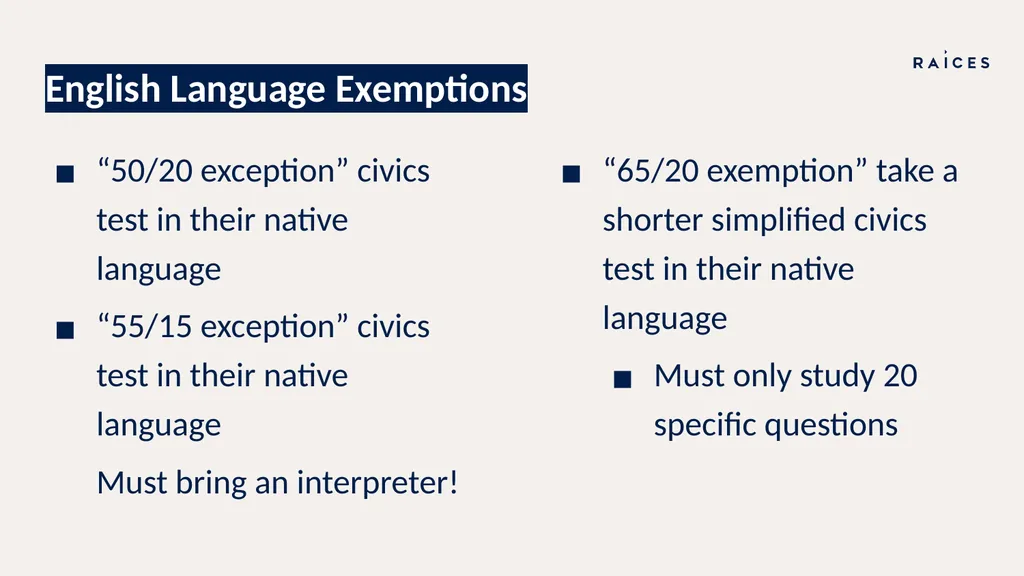
slide7. English Language Exemptions “50/20 exception” civics test in their native language
“55/15 exception” civics test in their native language
Must bring an interpreter! “65/20 exemption” take a shorter simplified civics test in their native language
Must only study 20 specific questions<br>
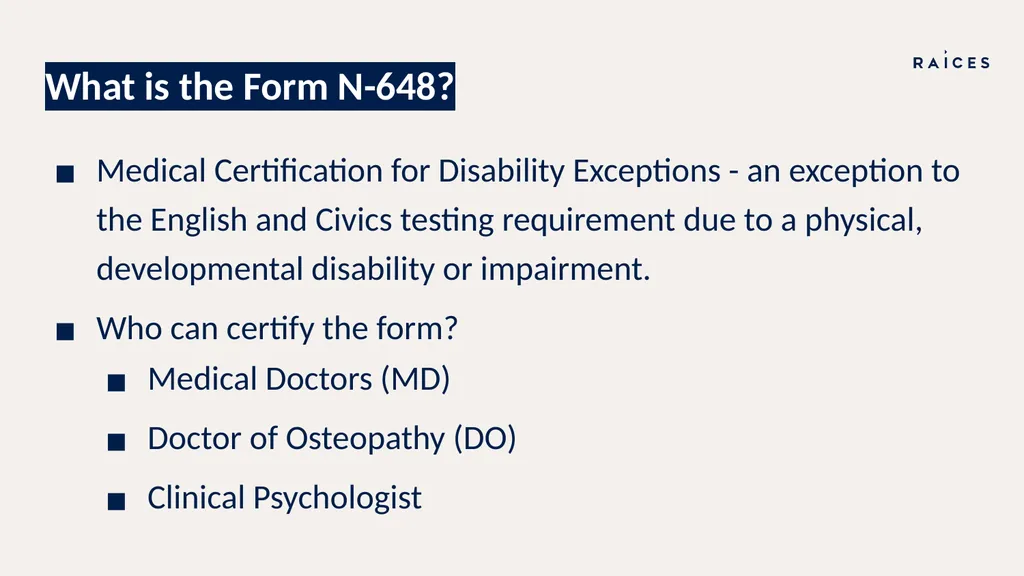
slide8. What is the Form N-648? Medical Certification for Disability Exceptions - an exception to the English and Civics testing requirement due to a physical, developmental disability or impairment.
Who can certify the form?
Medical Doctors (MD)
Doctor of Osteopathy (DO)
Clinical Psychologist<br>
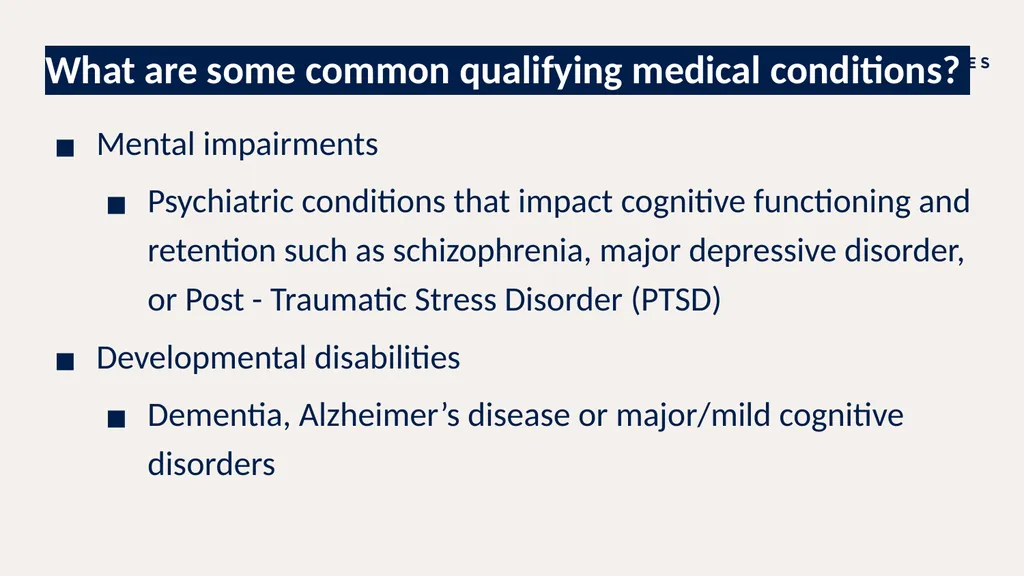
slide9. What are some common qualifying medical conditions? Mental impairments
Psychiatric conditions that impact cognitive functioning and retention such as schizophrenia, major depressive disorder, or Post - Traumatic Stress Disorder (PTSD)
Developmental disabilities
Dementia, Alzheimer’s disease or major/mild cognitive disorders<br>
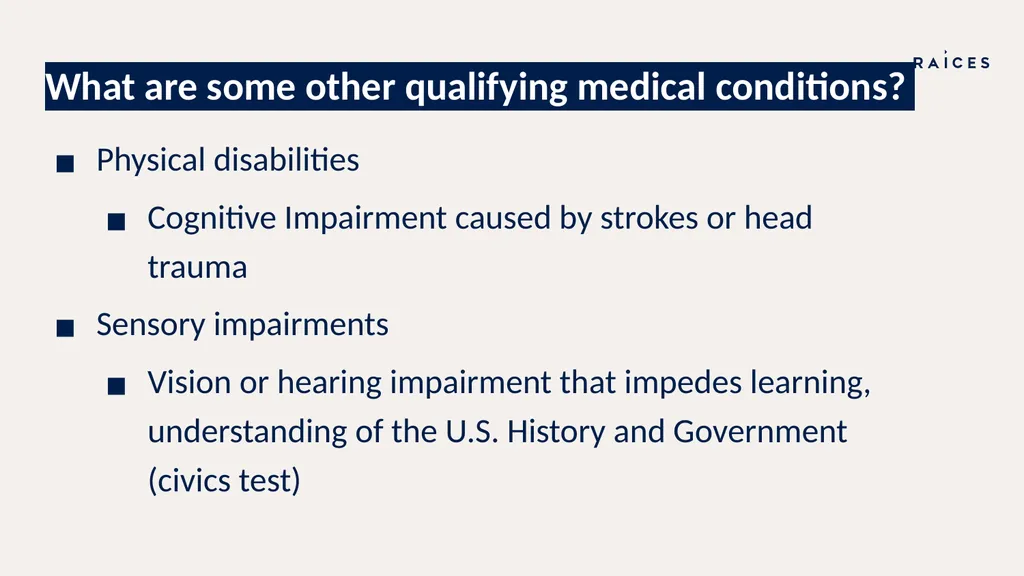
slide10. What are some other qualifying medical conditions? Physical disabilities
Cognitive Impairment caused by strokes or head trauma
Sensory impairments
Vision or hearing impairment that impedes learning, understanding of the U.S. History and Government (civics test)<br>
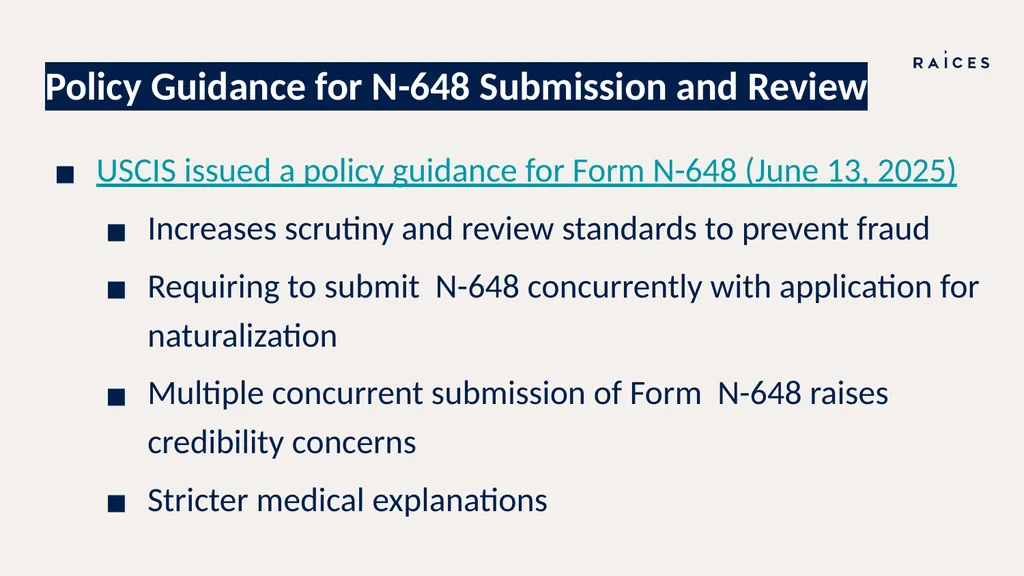
slide11. Policy Guidance for N-648 Submission and Review USCIS issued a policy guidance for Form N-648 (June 13, 2025)
Increases scrutiny and review standards to prevent fraud
Requiring to submit N-648 concurrently with application for naturalization
Multiple concurrent submission of Form N-648 raises credibility concerns
Stricter medical explanations<br>
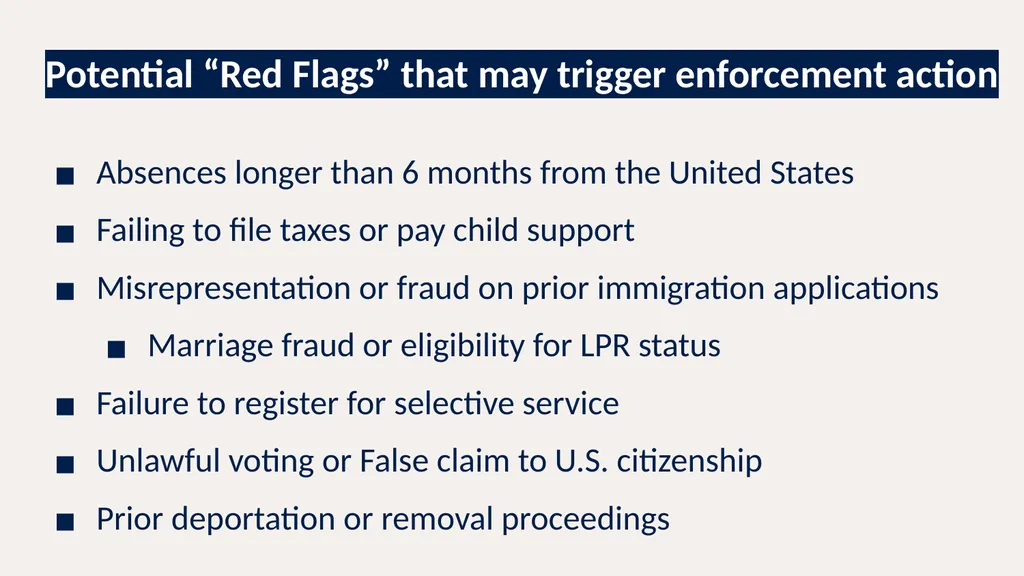
slide12. Potential “Red Flags” that may trigger enforcement action Absences longer than 6 months from the United States
Failing to file taxes or pay child support
Misrepresentation or fraud on prior immigration applications
Marriage fraud or eligibility for LPR status
Failure to register for selective service
Unlawful voting or False claim to U.S. citizenship
Prior deportation or removal proceedings<br>
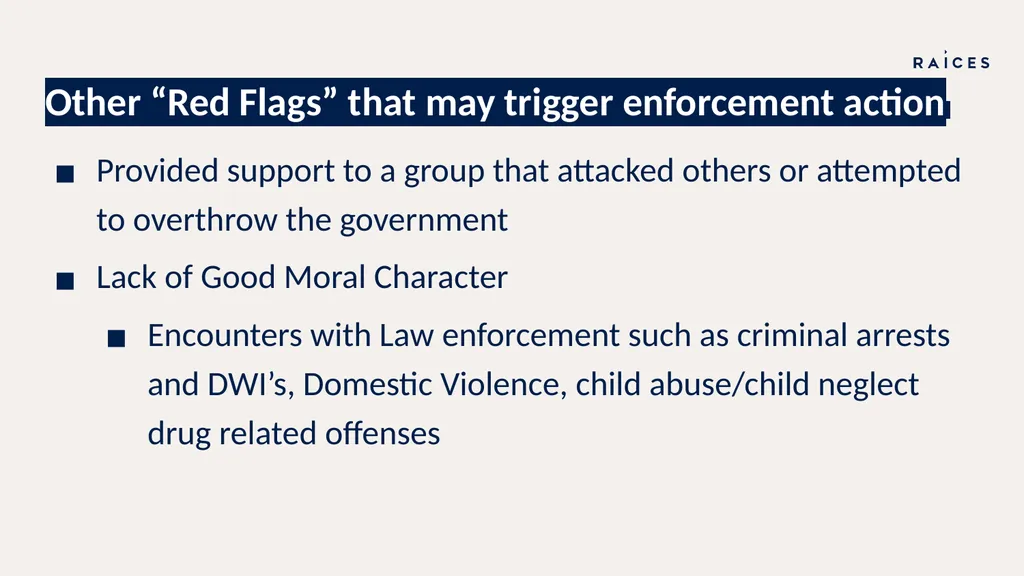
slide13. Other “Red Flags” that may trigger enforcement action Provided support to a group that attacked others or attempted to overthrow the government
Lack of Good Moral Character
Encounters with Law enforcement such as criminal arrests and DWI’s, Domestic Violence, child abuse/child neglect drug related offenses<br>
slide14. Navigating Complex Eligibility A High-Level Overview of Good Moral Character and Statutory Naturalization Requirements<br>
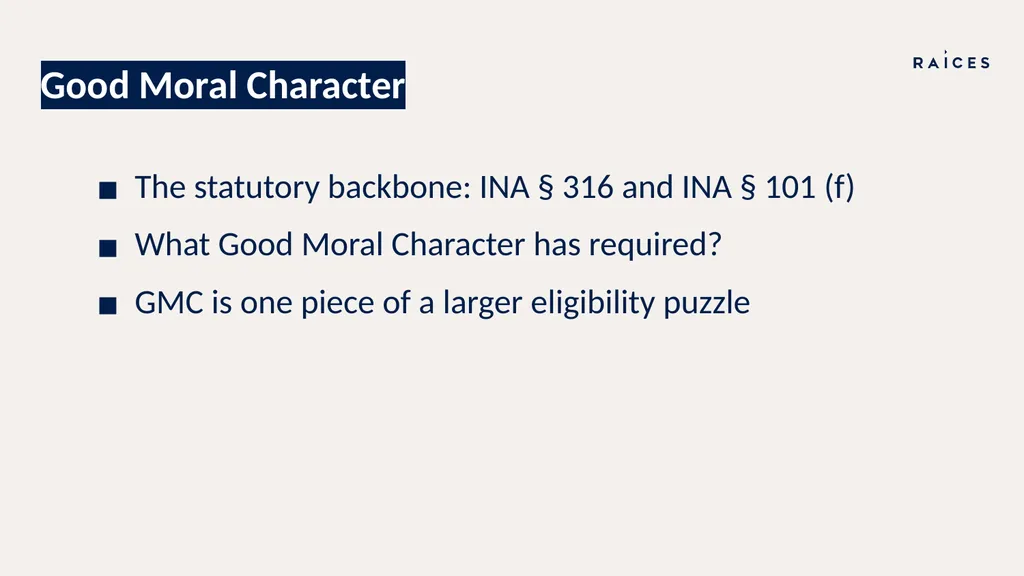
slide15. Good Moral Character The statutory backbone: INA § 316 and INA § 101 (f)
What Good Moral Character has required?
GMC is one piece of a larger eligibility puzzle<br>
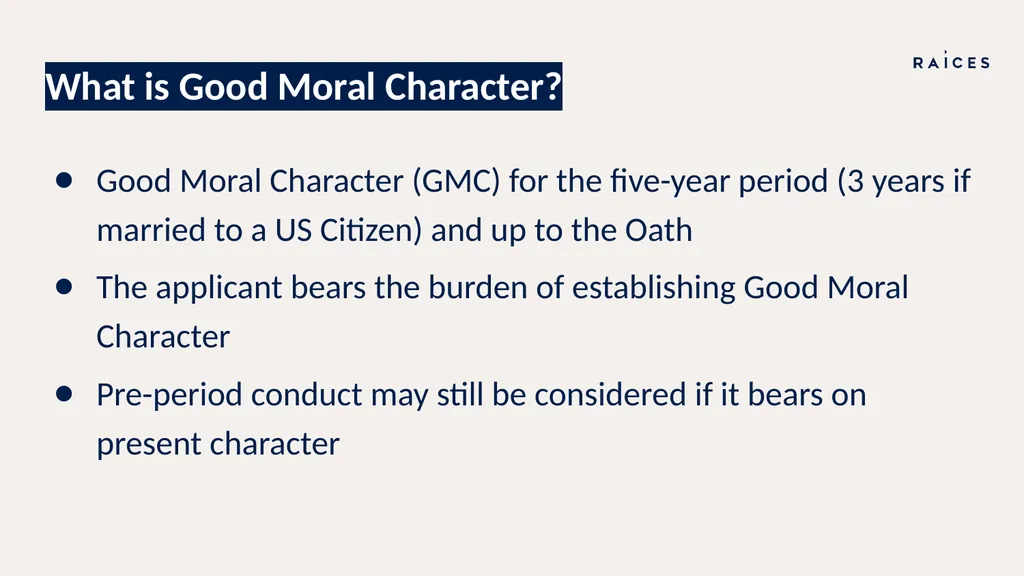
slide16. What is Good Moral Character? Good Moral Character (GMC) for the five-year period (3 years if married to a US Citizen) and up to the Oath
The applicant bears the burden of establishing Good Moral Character
Pre-period conduct may still be considered if it bears on present character<br>
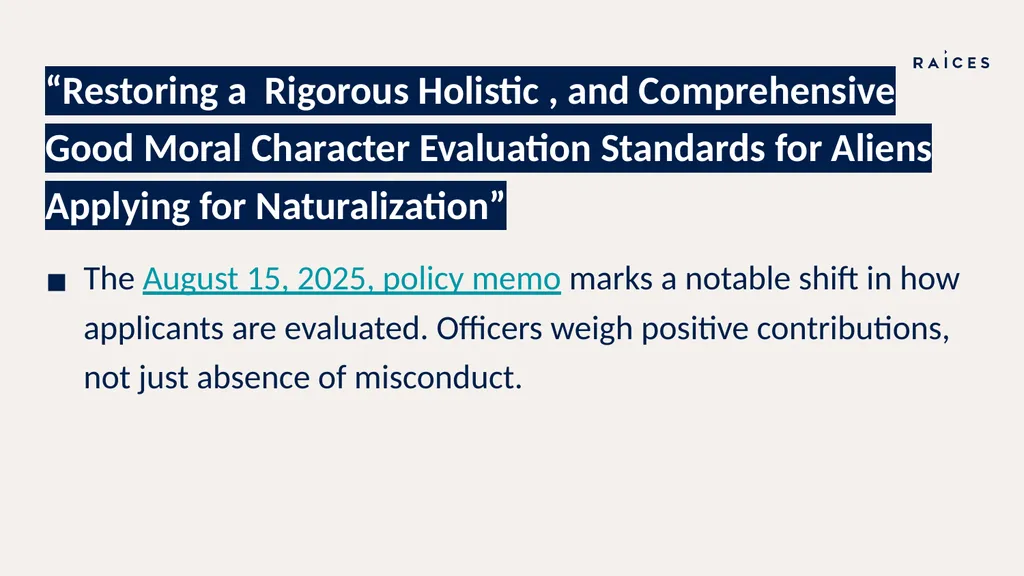
slide17. “Restoring a Rigorous Holistic , and Comprehensive Good Moral Character Evaluation Standards for Aliens Applying for Naturalization” The August 15, 2025, policy memo marks a notable shift in how applicants are evaluated. Officers weigh positive contributions, not just absence of misconduct.<br>
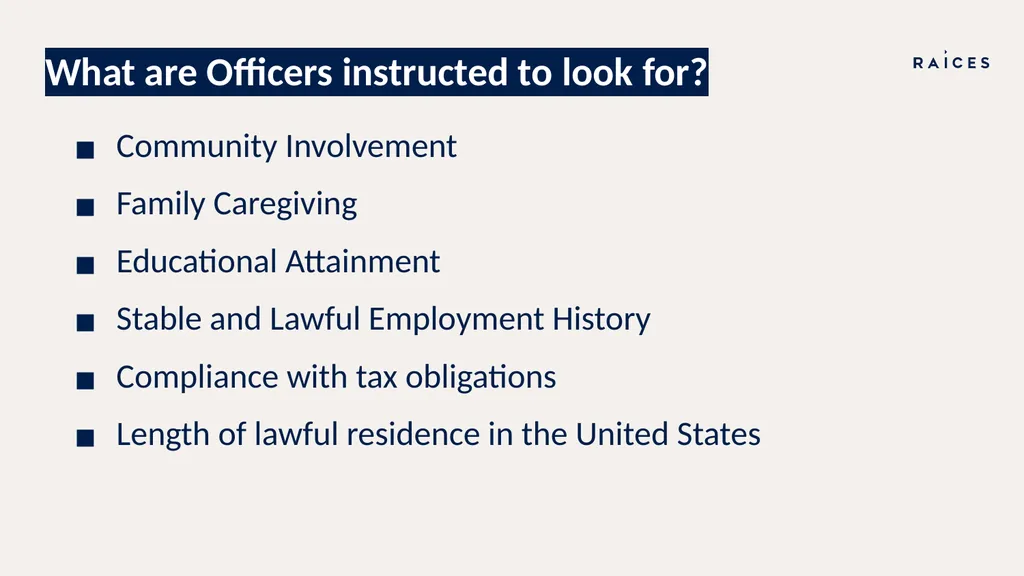
slide18. What are Officers instructed to look for? Community Involvement
Family Caregiving
Educational Attainment
Stable and Lawful Employment History
Compliance with tax obligations
Length of lawful residence in the United States<br>
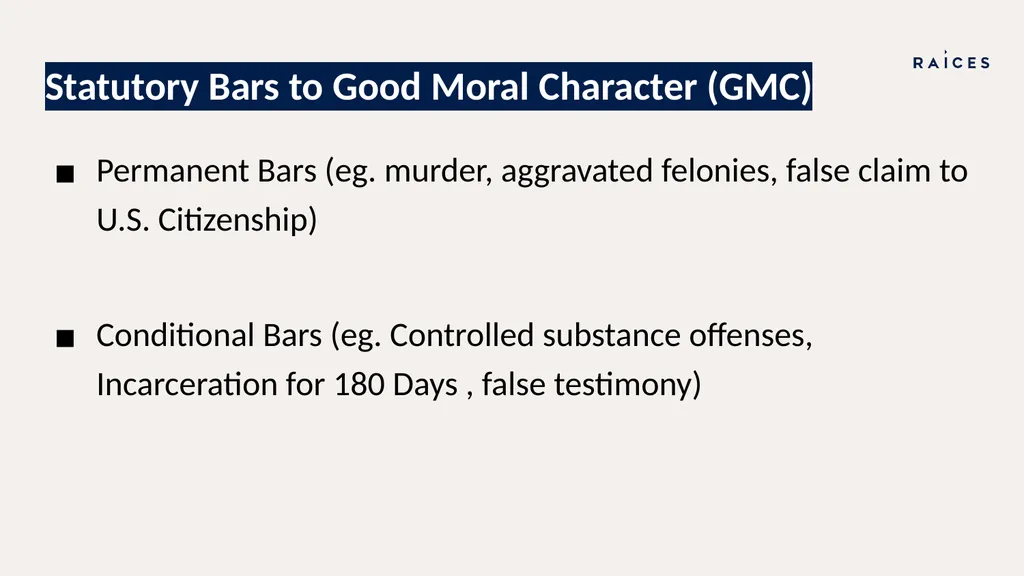
slide19. Statutory Bars to Good Moral Character (GMC) Permanent Bars (eg. murder, aggravated felonies, false claim to U.S. Citizenship)
Conditional Bars (eg. Controlled substance offenses, Incarceration for 180 Days , false testimony)<br>
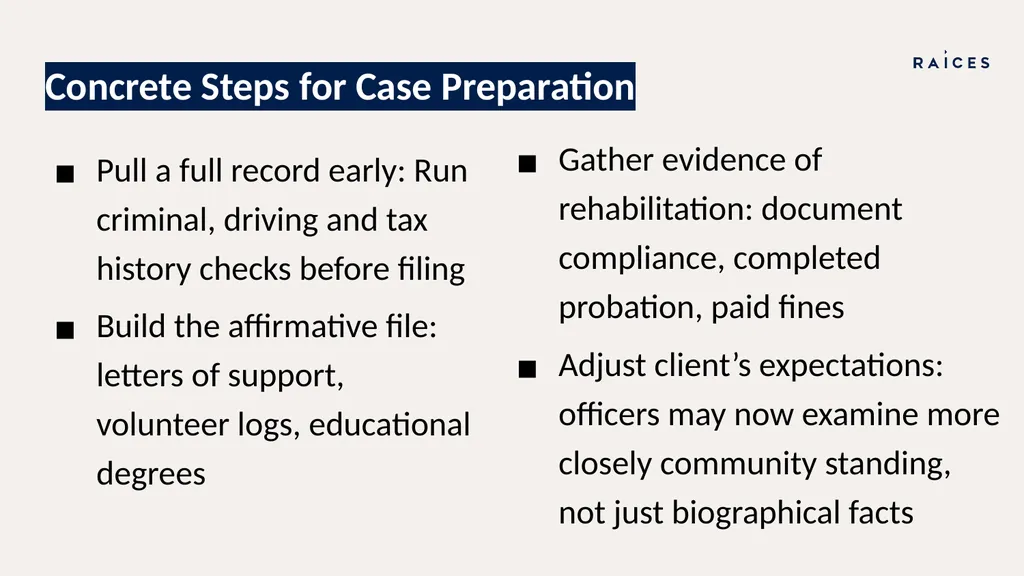
slide20. Concrete Steps for Case Preparation Pull a full record early: Run criminal, driving and tax history checks before filing
Build the affirmative file: letters of support, volunteer logs, educational degrees Gather evidence of rehabilitation: document compliance, completed probation, paid fines
Adjust client’s expectations: officers may now examine more closely community standing, not just biographical facts<br>
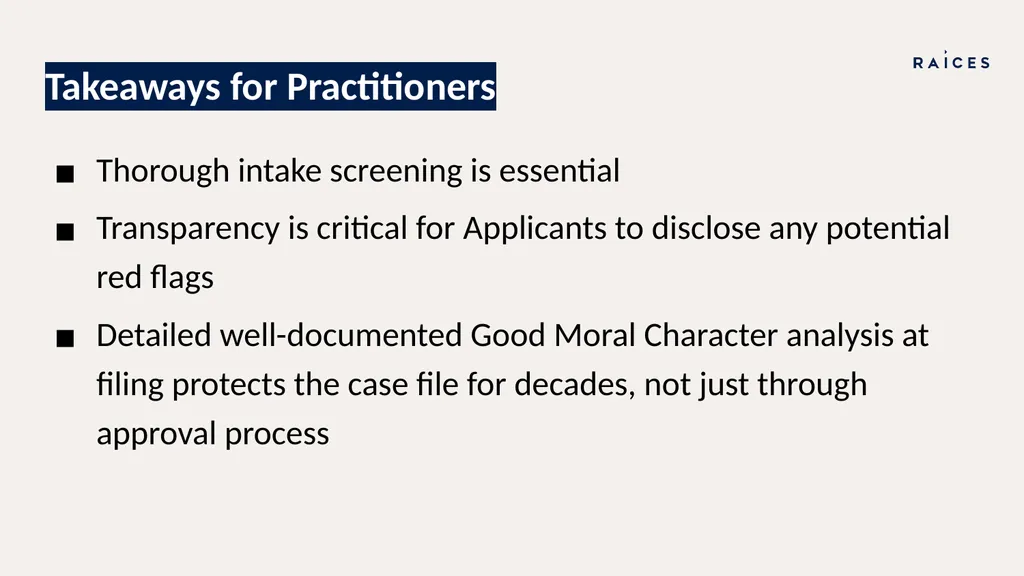
slide21. Takeaways for Practitioners Thorough intake screening is essential
Transparency is critical for Applicants to disclose any potential red flags
Detailed well-documented Good Moral Character analysis at filing protects the case file for decades, not just through approval process<br>
slide22. Administrative Advocacy: Resolving USCIS delays and utilizing internal remedies for case resolution<br>
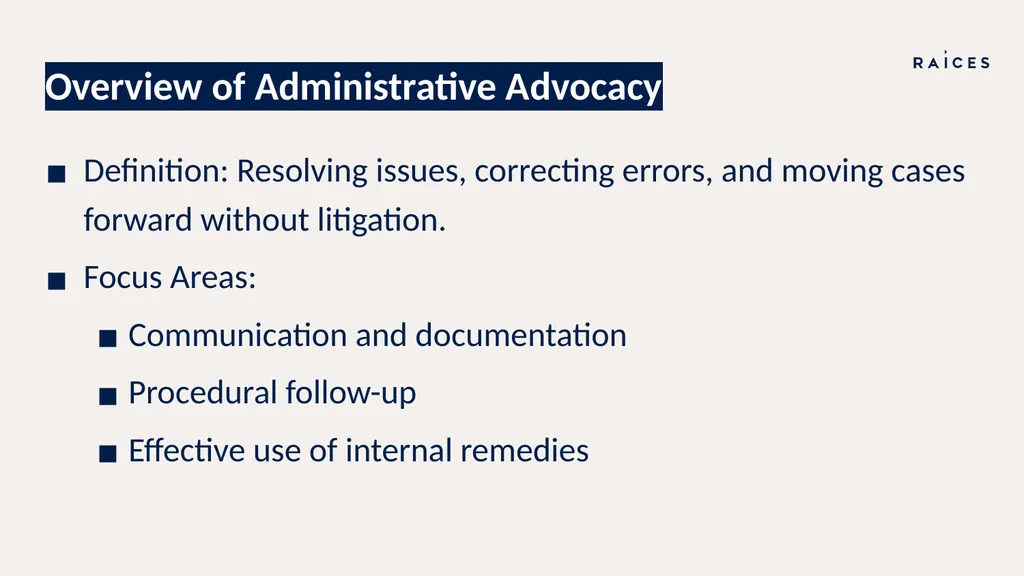
slide23. Overview of Administrative Advocacy Definition: Resolving issues, correcting errors, and moving cases forward without litigation.
Focus Areas:
Communication and documentation
Procedural follow-up
Effective use of internal remedies<br>
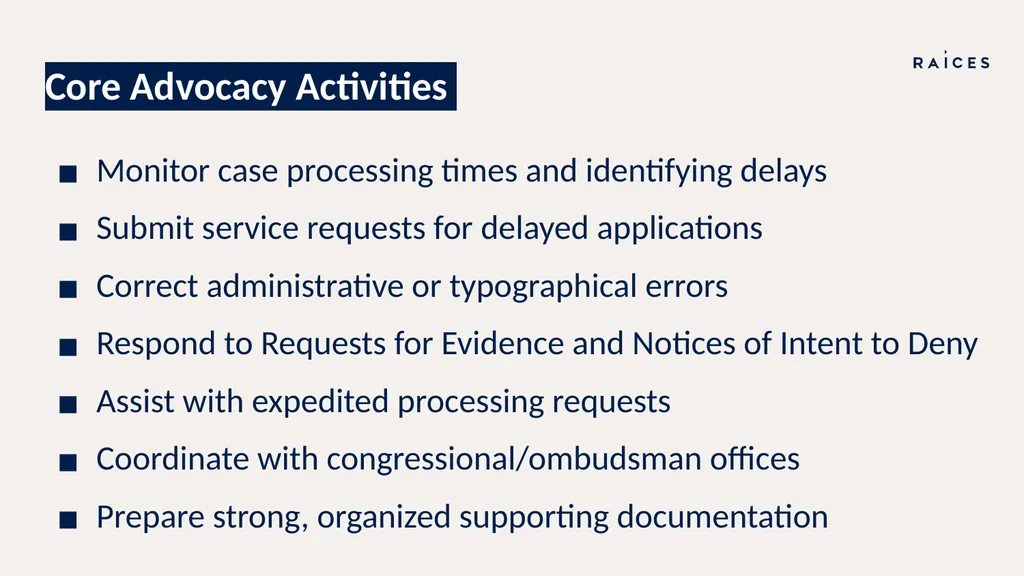
slide24. Core Advocacy Activities Monitor case processing times and identifying delays
Submit service requests for delayed applications
Correct administrative or typographical errors
Respond to Requests for Evidence and Notices of Intent to Deny
Assist with expedited processing requests
Coordinate with congressional/ombudsman offices
Prepare strong, organized supporting documentation<br>
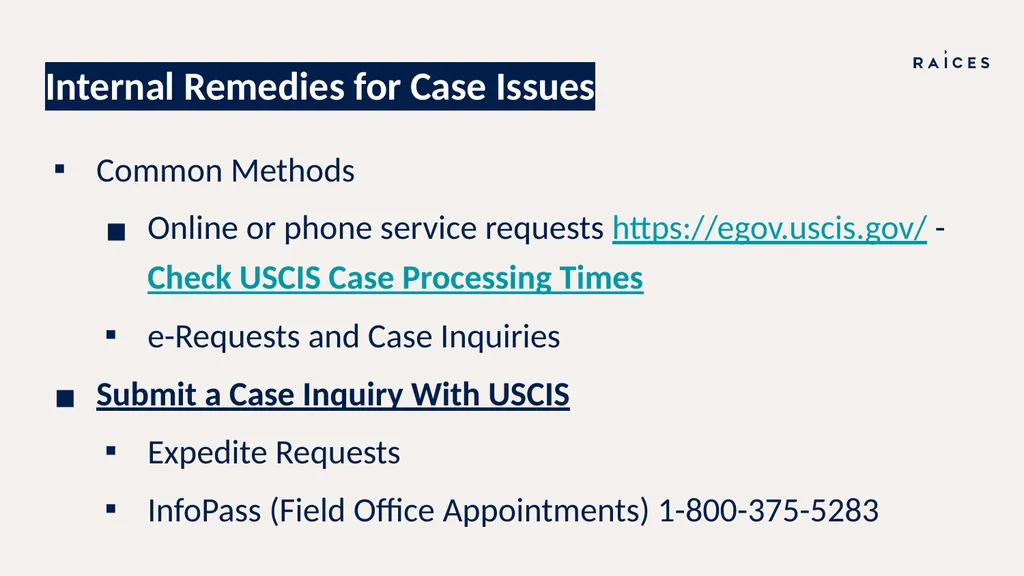
slide25. Internal Remedies for Case Issues Common Methods
Online or phone service requests https://egov.uscis.gov/ - Check USCIS Case Processing Times
e-Requests and Case Inquiries
Submit a Case Inquiry With USCIS
Expedite Requests
InfoPass (Field Office Appointments) 1-800-375-5283<br>
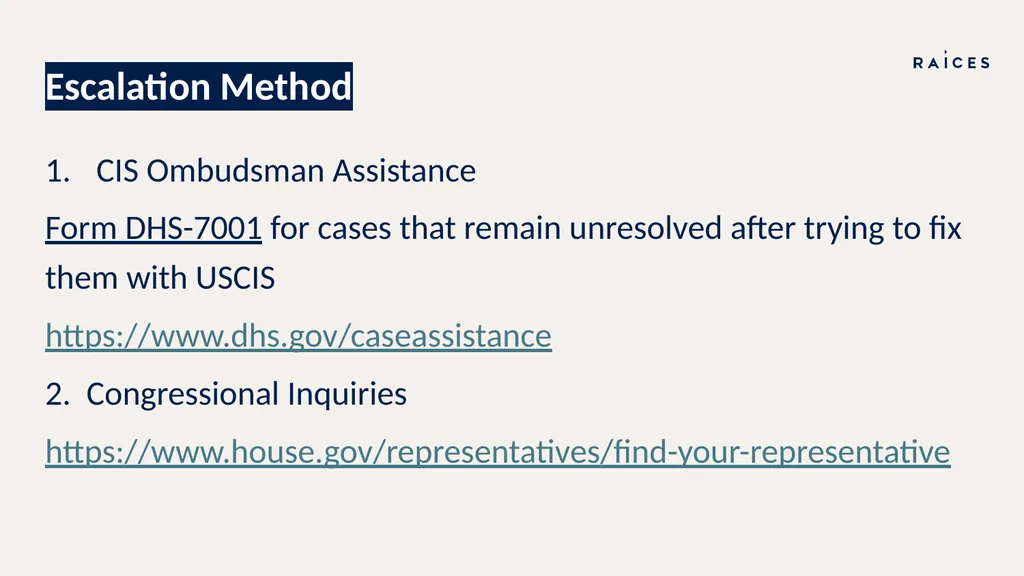
slide26. Escalation Method CIS Ombudsman Assistance
Form DHS-7001 for cases that remain unresolved after trying to fix them with USCIS
https://www.dhs.gov/caseassistance
2. Congressional Inquiries
https://www.house.gov/representatives/find-your-representative<br>
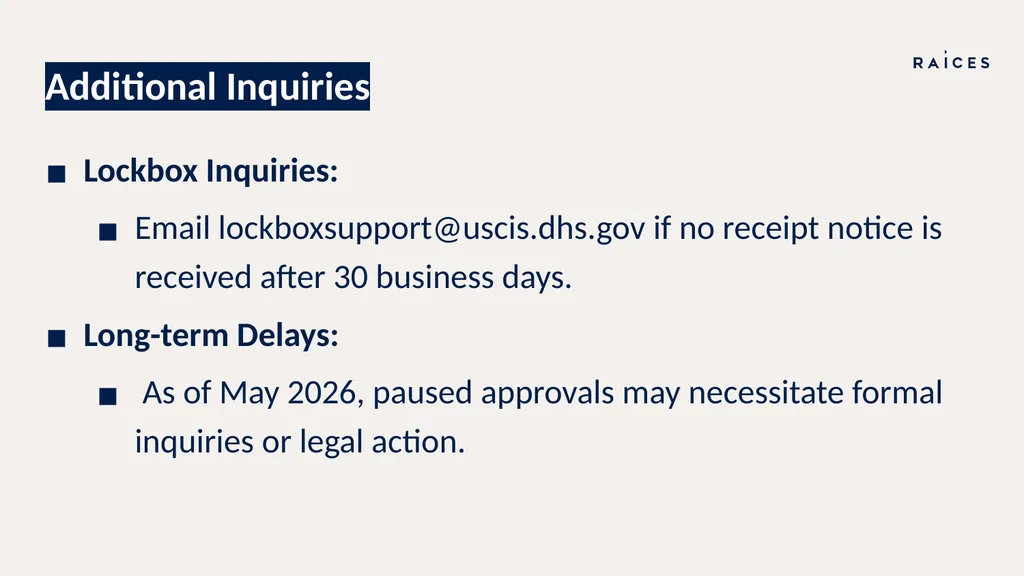
slide27. Additional Inquiries Lockbox Inquiries:
Email lockboxsupport@uscis.dhs.gov if no receipt notice is received after 30 business days.
Long-term Delays:
As of May 2026, paused approvals may necessitate formal inquiries or legal action.<br>
slide28. Best Practices for Advocacy Keep organized records and timelines.
Track all correspondence and receipt numbers.
Provide clear, concise written explanations.
Understand USCIS policy guidance and procedural requirements.
Follow up consistently while maintaining professionalism.<br>
slide29. Motion and Administrative Appeals What Happens After the Interview?
Decision timeline
Reasons for denials
Fighting a Denial
Request a Hearing filing form N-336 within 30 days of denial<br>
slide30. Frequently Asked Questions What should I do if I have already applied for naturalization and my Permanent Resident Card (Green Card) is expiring?
The N-400 receipt notice acts as a 24-month Green Card extension.
There Is no limit to naturalization applications but must pay fee.
Can I legally change my name?<br>
slide31. Summary & Final Thoughts: Be proactive, organized and know your rights.<br>
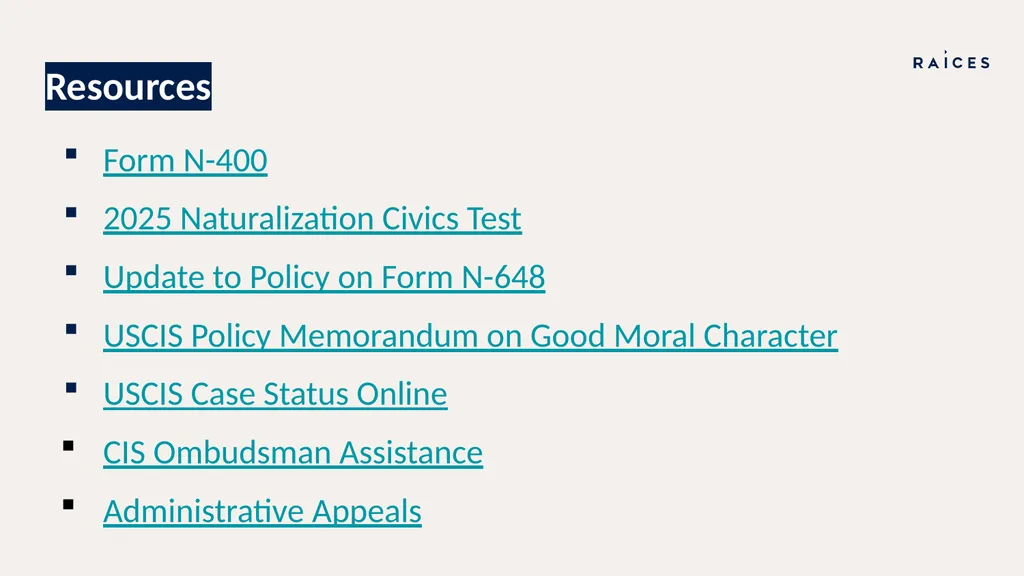
slide32. Resources Form N-400
2025 Naturalization Civics Test
Update to Policy on Form N-648
USCIS Policy Memorandum on Good Moral Character
USCIS Case Status Online
CIS Ombudsman Assistance
Administrative Appeals<br>
Protecting Immigrant Families through Naturalization Presented by: Sara Morales, Leticia Galicia, Maria Romero<br>
slide2. Learning Objectives Participants will learn to identify potential “red flags” in N-400 cases that may trigger enforcement actions.
Attendees will gain strategies for documenting eligibility in complex “good moral character” scenarios.
Attendees will understand how to leverage administrative advocacy to address USCIS processing delays.<br>
slide3. Naturalization as a Defensive Strategy<br>
slide4. What is Naturalization? Naturalization is the process in which the U.S. Government grants citizenship to Lawful Permanent Residents (green card holders) who meet the requirements established by the Immigration and Nationality Act (INA).
USCIS uses Form N-400, Application for Naturalization and the naturalization interview to determine whether an applicant is eligible for U.S. citizenship.<br>
slide5. General Eligibility Requirements for Naturalization Be at least 18 years old
Permanent Residence
Continuance Residence
Physical Presence
State Residence
Good Moral Character 7. English Language/Civics test:
Be able to speak, write, and read and understand the English language; and knowledge of the U.S. History and Government (civics test)
8. Oath of Allegiance<br>
slide6. General Requirements for Naturalization USCIS will administer the 2025 Naturalization Civics Test
Basic Proficiency (speaking, reading, writing) and knowledge of the U.S. history/ government - 128 Civics Test Questions
Oral test - 20 questions, must answer 12 correctly to pass; answer 9/20 questions incorrectly (fail oral test)
Trump Administration attempts for other testing (ex. essay and allowing third parties to administer test)<br>
slide7. English Language Exemptions “50/20 exception” civics test in their native language
“55/15 exception” civics test in their native language
Must bring an interpreter! “65/20 exemption” take a shorter simplified civics test in their native language
Must only study 20 specific questions<br>
slide8. What is the Form N-648? Medical Certification for Disability Exceptions - an exception to the English and Civics testing requirement due to a physical, developmental disability or impairment.
Who can certify the form?
Medical Doctors (MD)
Doctor of Osteopathy (DO)
Clinical Psychologist<br>
slide9. What are some common qualifying medical conditions? Mental impairments
Psychiatric conditions that impact cognitive functioning and retention such as schizophrenia, major depressive disorder, or Post - Traumatic Stress Disorder (PTSD)
Developmental disabilities
Dementia, Alzheimer’s disease or major/mild cognitive disorders<br>
slide10. What are some other qualifying medical conditions? Physical disabilities
Cognitive Impairment caused by strokes or head trauma
Sensory impairments
Vision or hearing impairment that impedes learning, understanding of the U.S. History and Government (civics test)<br>
slide11. Policy Guidance for N-648 Submission and Review USCIS issued a policy guidance for Form N-648 (June 13, 2025)
Increases scrutiny and review standards to prevent fraud
Requiring to submit N-648 concurrently with application for naturalization
Multiple concurrent submission of Form N-648 raises credibility concerns
Stricter medical explanations<br>
slide12. Potential “Red Flags” that may trigger enforcement action Absences longer than 6 months from the United States
Failing to file taxes or pay child support
Misrepresentation or fraud on prior immigration applications
Marriage fraud or eligibility for LPR status
Failure to register for selective service
Unlawful voting or False claim to U.S. citizenship
Prior deportation or removal proceedings<br>
slide13. Other “Red Flags” that may trigger enforcement action Provided support to a group that attacked others or attempted to overthrow the government
Lack of Good Moral Character
Encounters with Law enforcement such as criminal arrests and DWI’s, Domestic Violence, child abuse/child neglect drug related offenses<br>
slide14. Navigating Complex Eligibility A High-Level Overview of Good Moral Character and Statutory Naturalization Requirements<br>
slide15. Good Moral Character The statutory backbone: INA § 316 and INA § 101 (f)
What Good Moral Character has required?
GMC is one piece of a larger eligibility puzzle<br>
slide16. What is Good Moral Character? Good Moral Character (GMC) for the five-year period (3 years if married to a US Citizen) and up to the Oath
The applicant bears the burden of establishing Good Moral Character
Pre-period conduct may still be considered if it bears on present character<br>
slide17. “Restoring a Rigorous Holistic , and Comprehensive Good Moral Character Evaluation Standards for Aliens Applying for Naturalization” The August 15, 2025, policy memo marks a notable shift in how applicants are evaluated. Officers weigh positive contributions, not just absence of misconduct.<br>
slide18. What are Officers instructed to look for? Community Involvement
Family Caregiving
Educational Attainment
Stable and Lawful Employment History
Compliance with tax obligations
Length of lawful residence in the United States<br>
slide19. Statutory Bars to Good Moral Character (GMC) Permanent Bars (eg. murder, aggravated felonies, false claim to U.S. Citizenship)
Conditional Bars (eg. Controlled substance offenses, Incarceration for 180 Days , false testimony)<br>
slide20. Concrete Steps for Case Preparation Pull a full record early: Run criminal, driving and tax history checks before filing
Build the affirmative file: letters of support, volunteer logs, educational degrees Gather evidence of rehabilitation: document compliance, completed probation, paid fines
Adjust client’s expectations: officers may now examine more closely community standing, not just biographical facts<br>
slide21. Takeaways for Practitioners Thorough intake screening is essential
Transparency is critical for Applicants to disclose any potential red flags
Detailed well-documented Good Moral Character analysis at filing protects the case file for decades, not just through approval process<br>
slide22. Administrative Advocacy: Resolving USCIS delays and utilizing internal remedies for case resolution<br>
slide23. Overview of Administrative Advocacy Definition: Resolving issues, correcting errors, and moving cases forward without litigation.
Focus Areas:
Communication and documentation
Procedural follow-up
Effective use of internal remedies<br>
slide24. Core Advocacy Activities Monitor case processing times and identifying delays
Submit service requests for delayed applications
Correct administrative or typographical errors
Respond to Requests for Evidence and Notices of Intent to Deny
Assist with expedited processing requests
Coordinate with congressional/ombudsman offices
Prepare strong, organized supporting documentation<br>
slide25. Internal Remedies for Case Issues Common Methods
Online or phone service requests https://egov.uscis.gov/ - Check USCIS Case Processing Times
e-Requests and Case Inquiries
Submit a Case Inquiry With USCIS
Expedite Requests
InfoPass (Field Office Appointments) 1-800-375-5283<br>
slide26. Escalation Method CIS Ombudsman Assistance
Form DHS-7001 for cases that remain unresolved after trying to fix them with USCIS
https://www.dhs.gov/caseassistance
2. Congressional Inquiries
https://www.house.gov/representatives/find-your-representative<br>
slide27. Additional Inquiries Lockbox Inquiries:
Email lockboxsupport@uscis.dhs.gov if no receipt notice is received after 30 business days.
Long-term Delays:
As of May 2026, paused approvals may necessitate formal inquiries or legal action.<br>
slide28. Best Practices for Advocacy Keep organized records and timelines.
Track all correspondence and receipt numbers.
Provide clear, concise written explanations.
Understand USCIS policy guidance and procedural requirements.
Follow up consistently while maintaining professionalism.<br>
slide29. Motion and Administrative Appeals What Happens After the Interview?
Decision timeline
Reasons for denials
Fighting a Denial
Request a Hearing filing form N-336 within 30 days of denial<br>
slide30. Frequently Asked Questions What should I do if I have already applied for naturalization and my Permanent Resident Card (Green Card) is expiring?
The N-400 receipt notice acts as a 24-month Green Card extension.
There Is no limit to naturalization applications but must pay fee.
Can I legally change my name?<br>
slide31. Summary & Final Thoughts: Be proactive, organized and know your rights.<br>
slide32. Resources Form N-400
2025 Naturalization Civics Test
Update to Policy on Form N-648
USCIS Policy Memorandum on Good Moral Character
USCIS Case Status Online
CIS Ombudsman Assistance
Administrative Appeals<br>