
Security Notions for Fully Encrypted Protocols
Description: Security Notions for Fully Encrypted Protocols Ellis Fenske (U.S. Naval Academy) Aaron Johnson (U.S. Naval Research Lab) February 15th, 2023 Free and Open Communications on the Internet (FOCI 23) Fully Encrypted Protocols (FEPs)
Related Topics
Download Presentation
"Security Notions for Fully Encrypted Protocols" is the property of its rightful owner. Permission is granted to download and print the materials on this website for personal, non-commercial use only, and to display it on your personal computer provided you do not modify the materials and that you retain all copyright notices contained in the materials. By downloading content from our website, you accept the terms of this agreement.
Presentation Transcript
slide1. Security Notions for Fully Encrypted Protocols
Ellis Fenske (U.S. Naval Academy)
Aaron Johnson (U.S. Naval Research Lab) February 15th, 2023
Free and Open Communications on the Internet (FOCI ’23)<br>
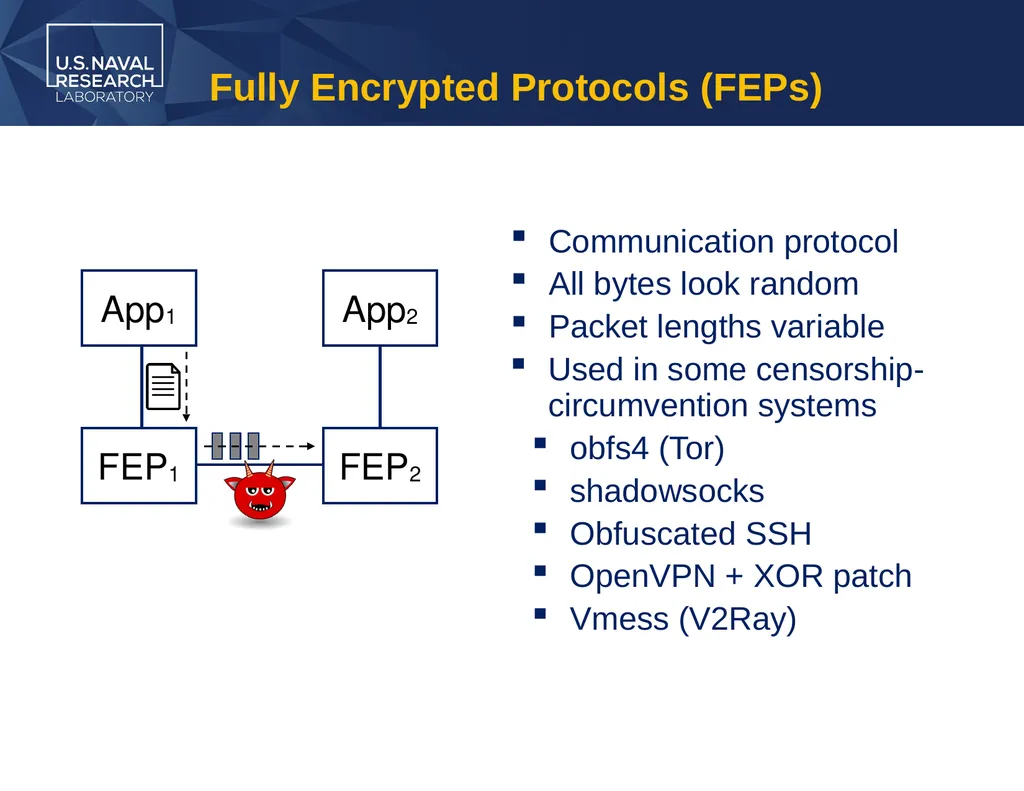
slide2. Fully Encrypted Protocols (FEPs) Communication protocol
All bytes look random
Packet lengths variable
Used in some censorship-circumvention systems
obfs4 (Tor)
shadowsocks
Obfuscated SSH
OpenVPN + XOR patch
Vmess (V2Ray) App1 App2 FEP1 FEP2<br>
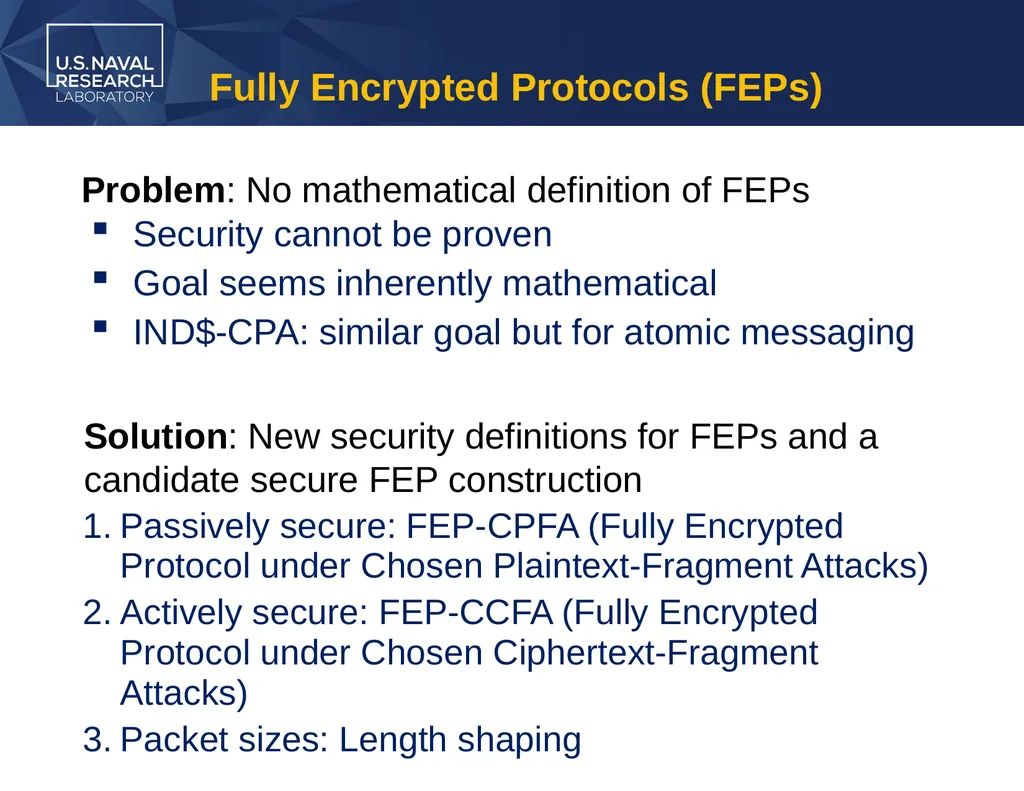
slide3. Fully Encrypted Protocols (FEPs) Security cannot be proven
Goal seems inherently mathematical
IND$-CPA: similar goal but for atomic messaging Problem: No mathematical definition of FEPs Solution: New security definitions for FEPs and a candidate secure FEP construction Passively secure: FEP-CPFA (Fully Encrypted Protocol under Chosen Plaintext-Fragment Attacks)
Actively secure: FEP-CCFA (Fully Encrypted Protocol under Chosen Ciphertext-Fragment Attacks)
Packet sizes: Length shaping<br>
slide4. Terminology Other terms used
“Obfuscated” protocol
“Look-like-nothing”/“look-like-random” protocol
“Randomized”/“randomizer” protocol
Why “fully encrypted” protocols?
Unused for other concepts
Positive connotation
Abbreviates (FEPs)
“Exposing the Great Firewall's Dynamic Blocking of Fully Encrypted Traffic” by Anonymous, Kevin Bock, Jackson Sippe, Shelikhoo, David Fifield, Eric Wustrow, Dave Levin, Amir Houmansadr. June 2022.<br>
slide5. Value of FEPs Censorship circumvention
Not easily detected as carrying proxied traffic
Very limited metadata for selective blocking (e.g. targeting applications)
China is blocking FEPs (“Exposing the Great Firewall's Dynamic Blocking of Fully Encrypted Traffic” by Anonymous et al.)
Natural endpoint of secure communication protocols
Maximally protects metadata
Modern protocols protect more metadata: QUIC, TLS 1.3 Encrypted Client Hello, Noise protocol framework
IETF Internet-Draft: Pseudorandom Extension for cTLS
“a cTLS extension that allows each party to emit a purely pseudorandom bitstream”
“TODO: More precise security properties and security proof. The goal we're after hasn't been widely considered in the literature so far, at least as far as we can tell.”<br>
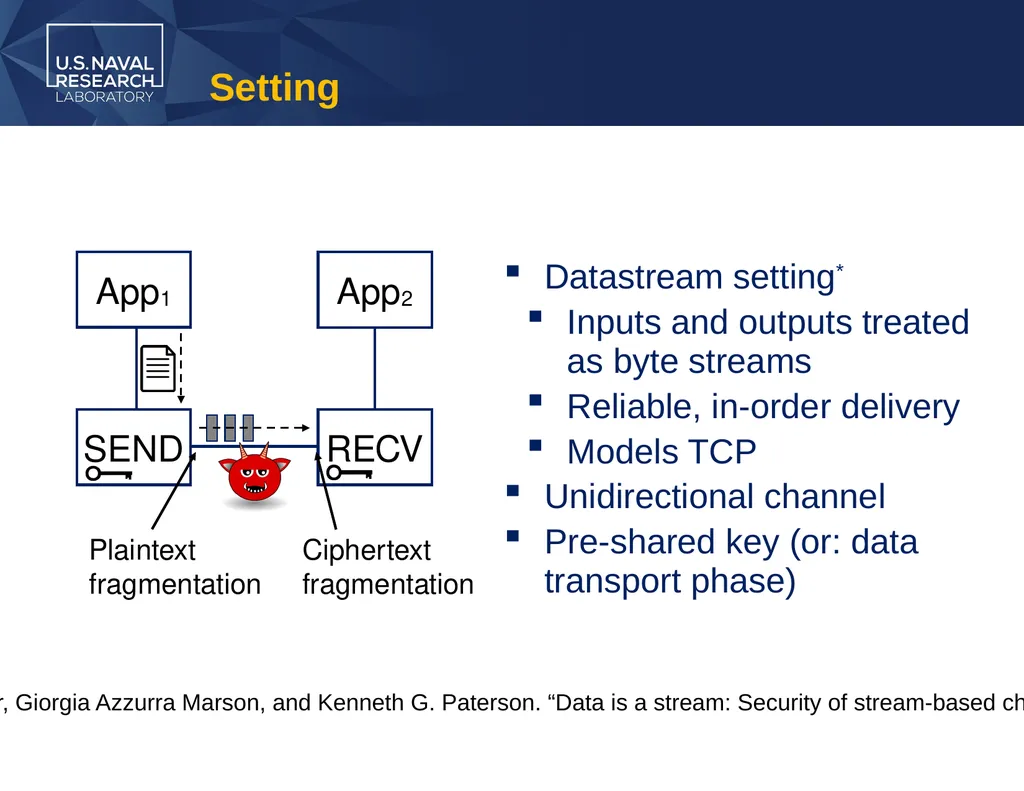
slide6. Setting Datastream setting*
Inputs and outputs treated as byte streams
Reliable, in-order delivery
Models TCP
Unidirectional channel
Pre-shared key (or: data transport phase) App1 App2 SEND RECV Plaintext fragmentation Ciphertext fragmentation *Marc Fischlin, Felix Günther, Giorgia Azzurra Marson, and Kenneth G. Paterson. “Data is a stream: Security of stream-based channels”. CRYPTO 2015.<br>
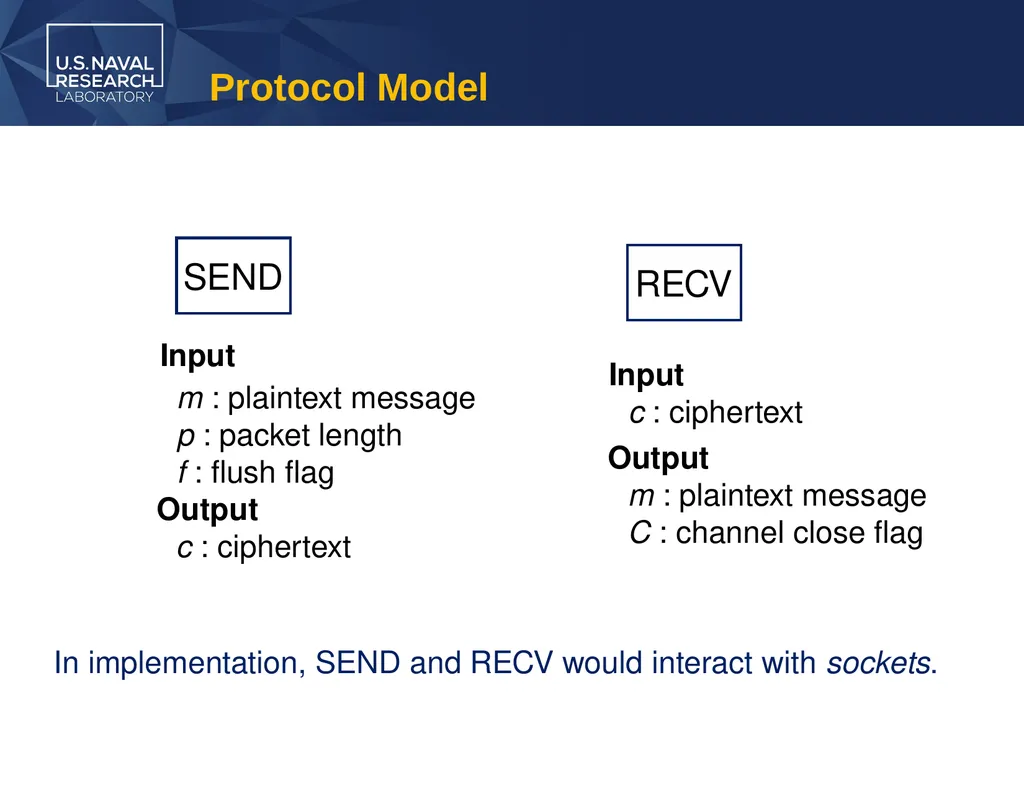
slide7. Protocol Model SEND RECV Input m : plaintext message
p : packet length
f : flush flag Output c : ciphertext Input c : ciphertext Output m : plaintext message
C : channel close flag In implementation, SEND and RECV would interact with sockets.<br>
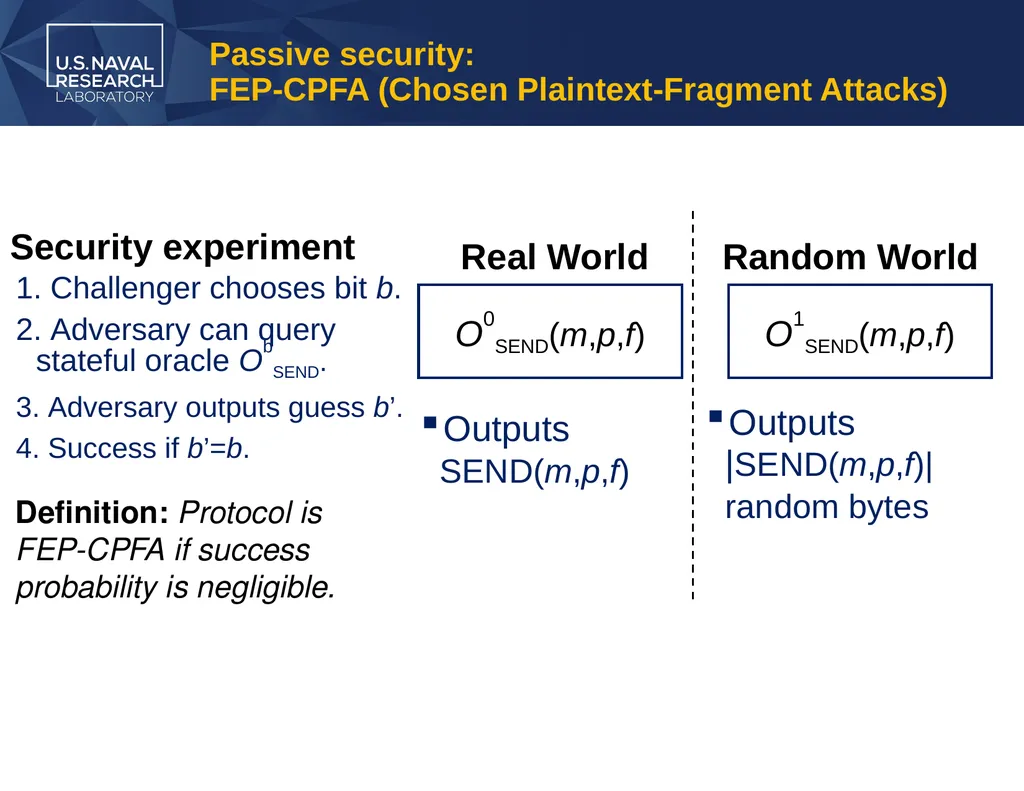
slide8. Passive security:
FEP-CPFA (Chosen Plaintext-Fragment Attacks) O0SEND(m,p,f) Challenger chooses bit b.
Adversary can query stateful oracle ObSEND.
Adversary outputs guess b’.
Success if b’=b. Security experiment Real World Random World Definition: Protocol is FEP-CPFA if success probability is negligible. Outputs SEND(m,p,f) Outputs |SEND(m,p,f)| random bytes O1SEND(m,p,f)<br>
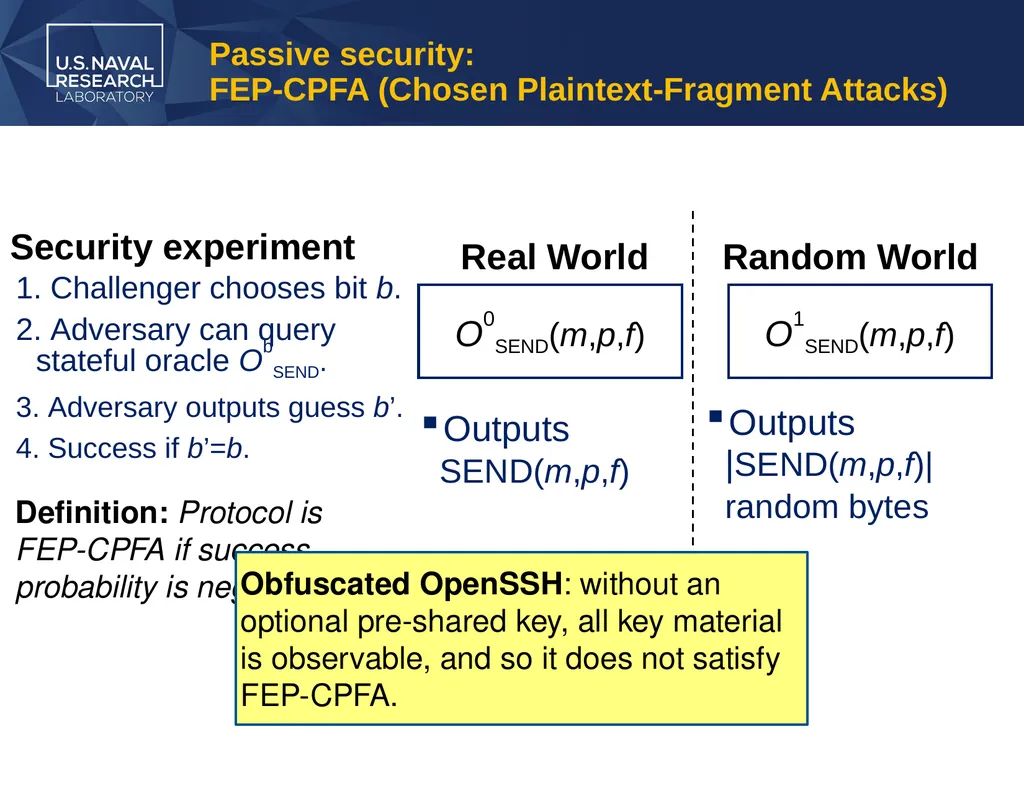
slide9. Passive security:
FEP-CPFA (Chosen Plaintext-Fragment Attacks) O0SEND(m,p,f) Challenger chooses bit b.
Adversary can query stateful oracle ObSEND.
Adversary outputs guess b’.
Success if b’=b. Security experiment Real World Random World Definition: Protocol is FEP-CPFA if success probability is negligible. Outputs SEND(m,p,f) Outputs |SEND(m,p,f)| random bytes O1SEND(m,p,f) Obfuscated OpenSSH: without an optional pre-shared key, all key material is observable, and so it does not satisfy FEP-CPFA.<br>
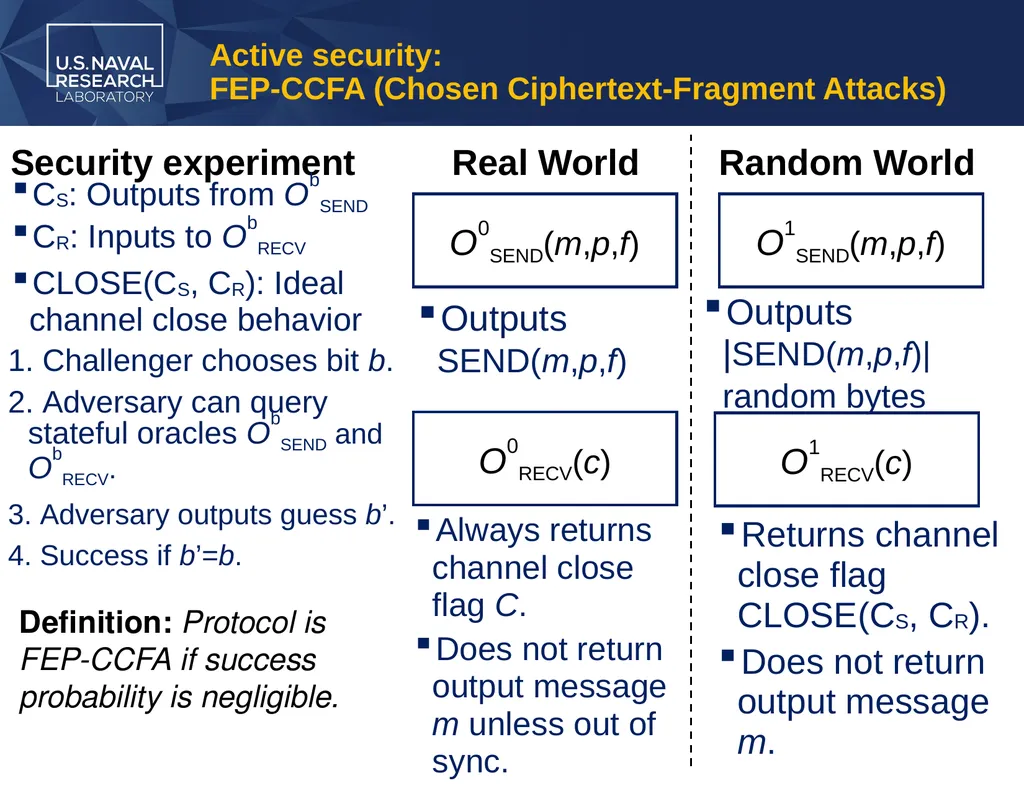
slide10. Active security:
FEP-CCFA (Chosen Ciphertext-Fragment Attacks) O0SEND(m,p,f) Challenger chooses bit b.
Adversary can query stateful oracles ObSEND and ObRECV.
Adversary outputs guess b’.
Success if b’=b. Security experiment Real World Random World Definition: Protocol is FEP-CCFA if success probability is negligible. Always returns channel close flag C.
Does not return output message m unless out of sync. Returns channel close flag CLOSE(CS, CR).
Does not return output message m. O1SEND(m,p,f) O0RECV(c) O1RECV(c) Outputs SEND(m,p,f) Outputs |SEND(m,p,f)| random bytes CS: Outputs from ObSEND
CR: Inputs to ObRECV
CLOSE(CS, CR): Ideal channel close behavior<br>
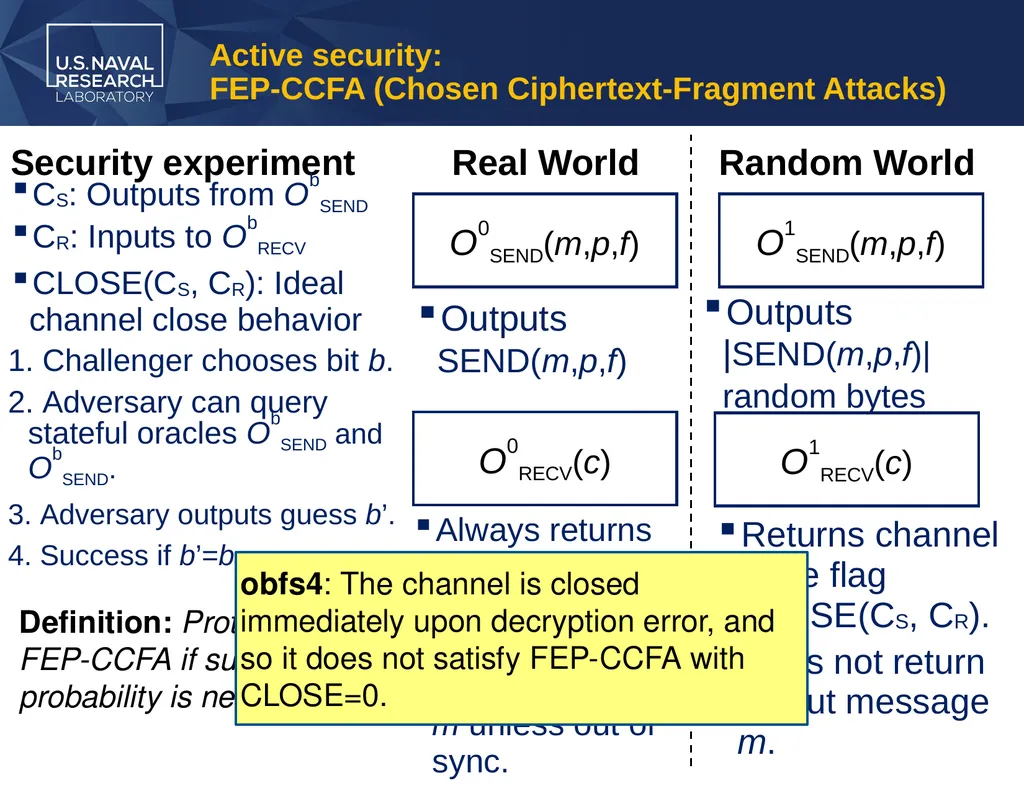
slide11. Active security:
FEP-CCFA (Chosen Ciphertext-Fragment Attacks) O0SEND(m,p,f) Challenger chooses bit b.
Adversary can query stateful oracles ObSEND and ObSEND.
Adversary outputs guess b’.
Success if b’=b. Security experiment Real World Random World Definition: Protocol is FEP-CCFA if success probability is negligible. Always returns channel close flag C.
Does not return output message m unless out of sync. Returns channel close flag CLOSE(CS, CR).
Does not return output message m. O1SEND(m,p,f) O0RECV(c) O1RECV(c) Outputs SEND(m,p,f) Outputs |SEND(m,p,f)| random bytes CS: Outputs from ObSEND
CR: Inputs to ObRECV
CLOSE(CS, CR): Ideal channel close behavior obfs4: The channel is closed immediately upon decryption error, and so it does not satisfy FEP-CCFA with CLOSE=0.<br>
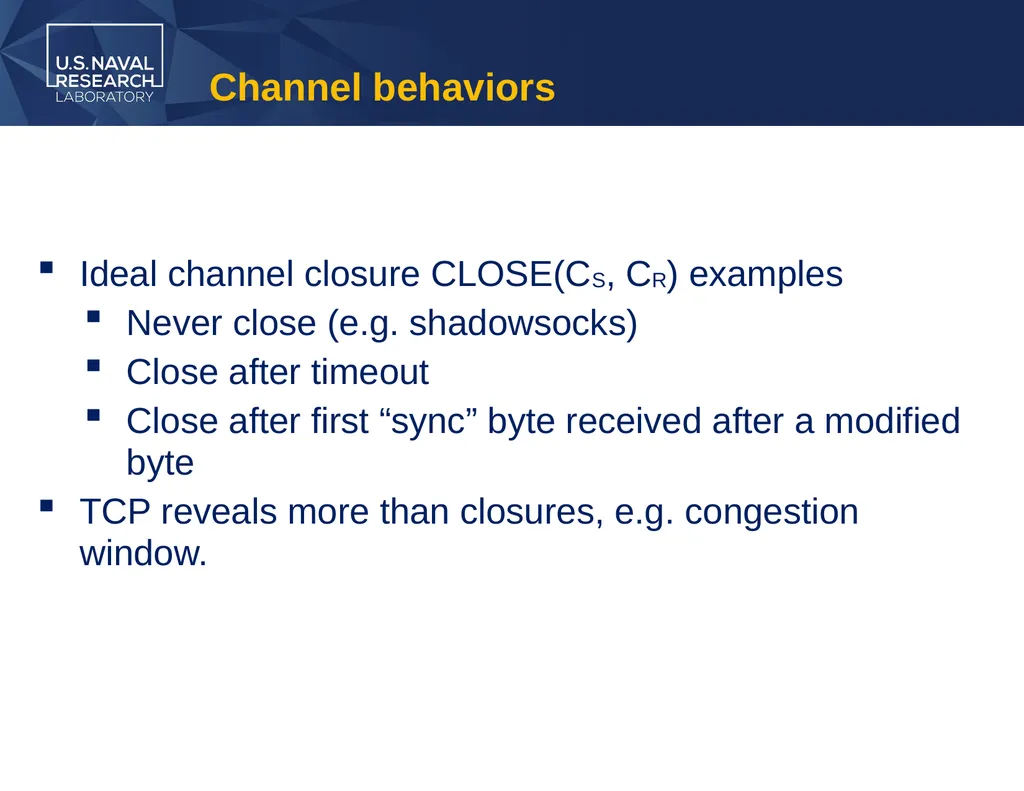
slide12. Channel behaviors Ideal channel closure CLOSE(CS, CR) examples
Never close (e.g. shadowsocks)
Close after timeout
Close after first “sync” byte received after a modified byte
TCP reveals more than closures, e.g. congestion window.<br>
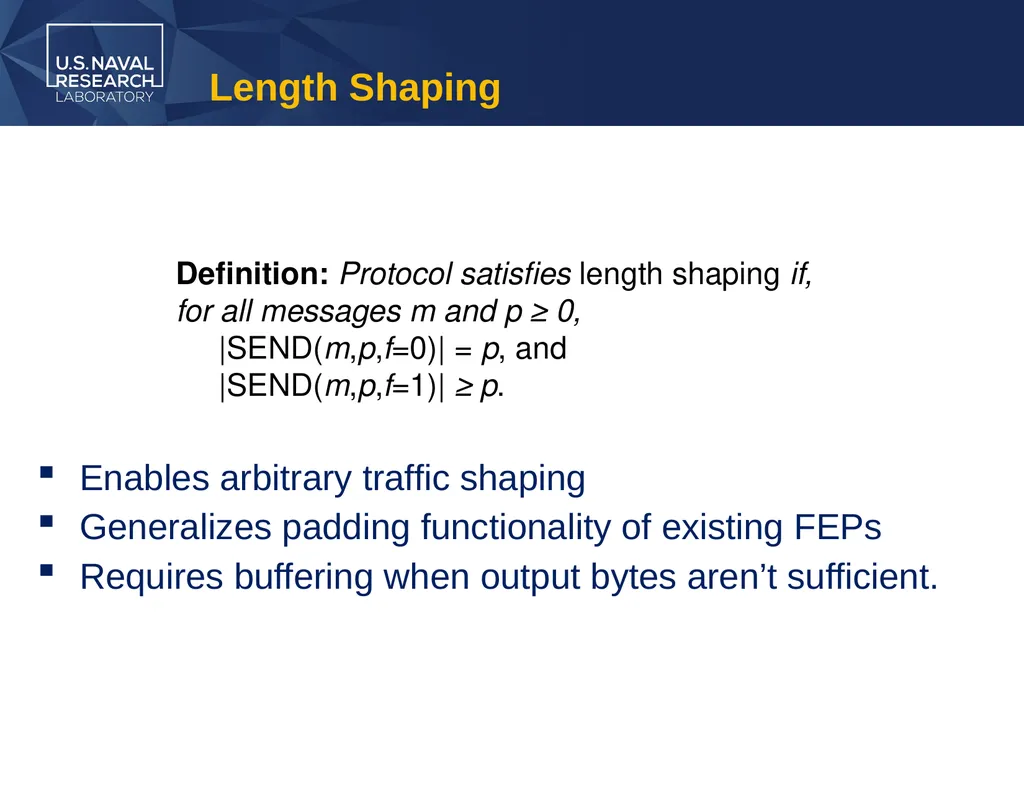
slide13. Length Shaping Enables arbitrary traffic shaping
Generalizes padding functionality of existing FEPs
Requires buffering when output bytes aren’t sufficient. Definition: Protocol satisfies length shaping if, for all messages m and p ≥ 0, |SEND(m,p,f=0)| = p, and
|SEND(m,p,f=1)| ≥ p.<br>
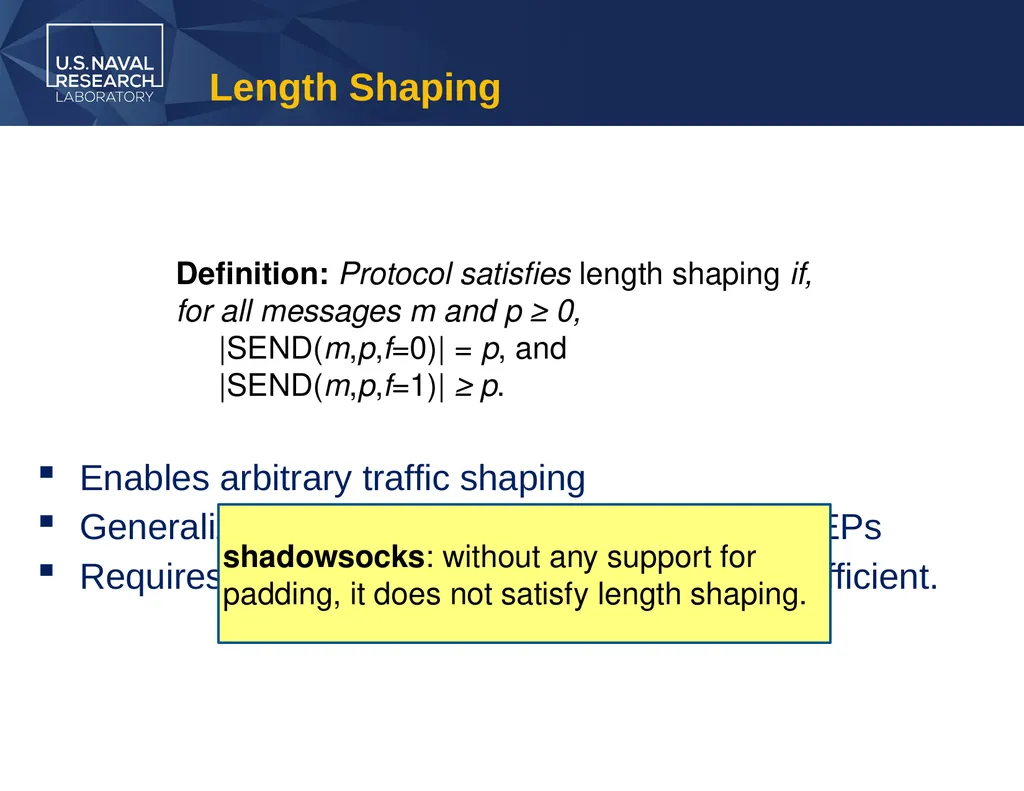
slide14. Length Shaping Enables arbitrary traffic shaping
Generalizes padding functionality of existing FEPs
Requires buffering when output bytes aren’t sufficient. Definition: Protocol satisfies length shaping if, for all messages m and p ≥ 0, |SEND(m,p,f=0)| = p, and
|SEND(m,p,f=1)| ≥ p. shadowsocks: without any support for padding, it does not satisfy length shaping.<br>
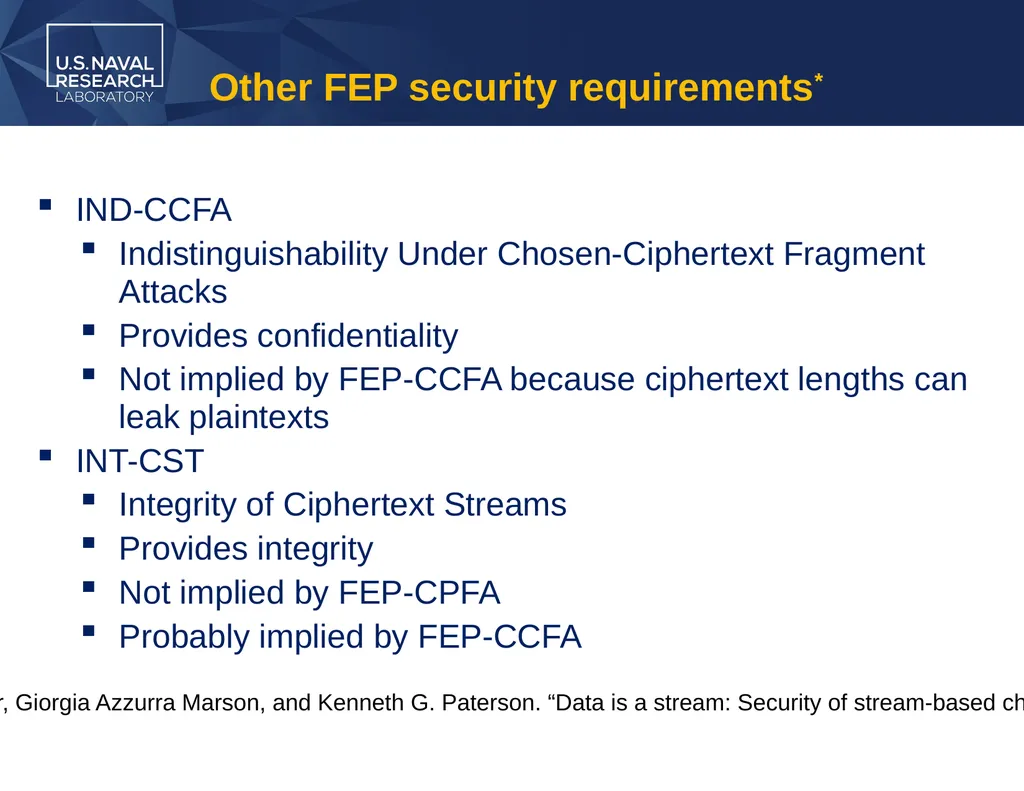
slide15. Other FEP security requirements* IND-CCFA
Indistinguishability Under Chosen-Ciphertext Fragment Attacks
Provides confidentiality
Not implied by FEP-CCFA because ciphertext lengths can leak plaintexts
INT-CST
Integrity of Ciphertext Streams
Provides integrity
Not implied by FEP-CPFA
Probably implied by FEP-CCFA *Marc Fischlin, Felix Günther, Giorgia Azzurra Marson, and Kenneth G. Paterson. “Data is a stream: Security of stream-based channels”. CRYPTO 2015.<br>
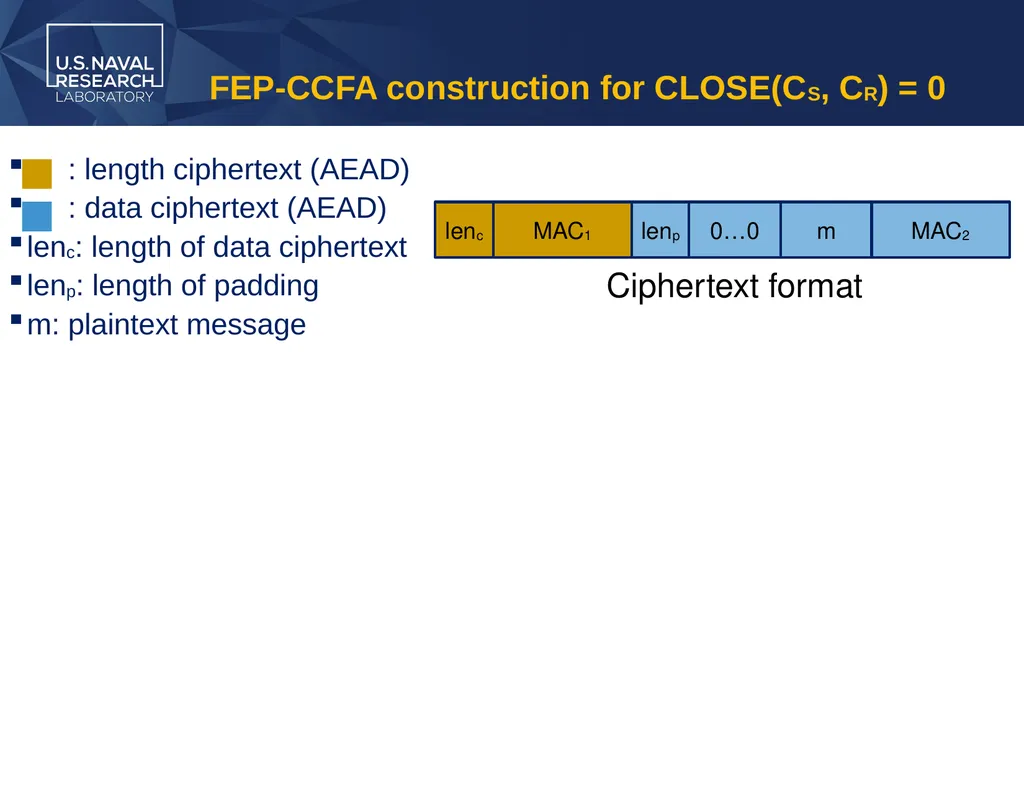
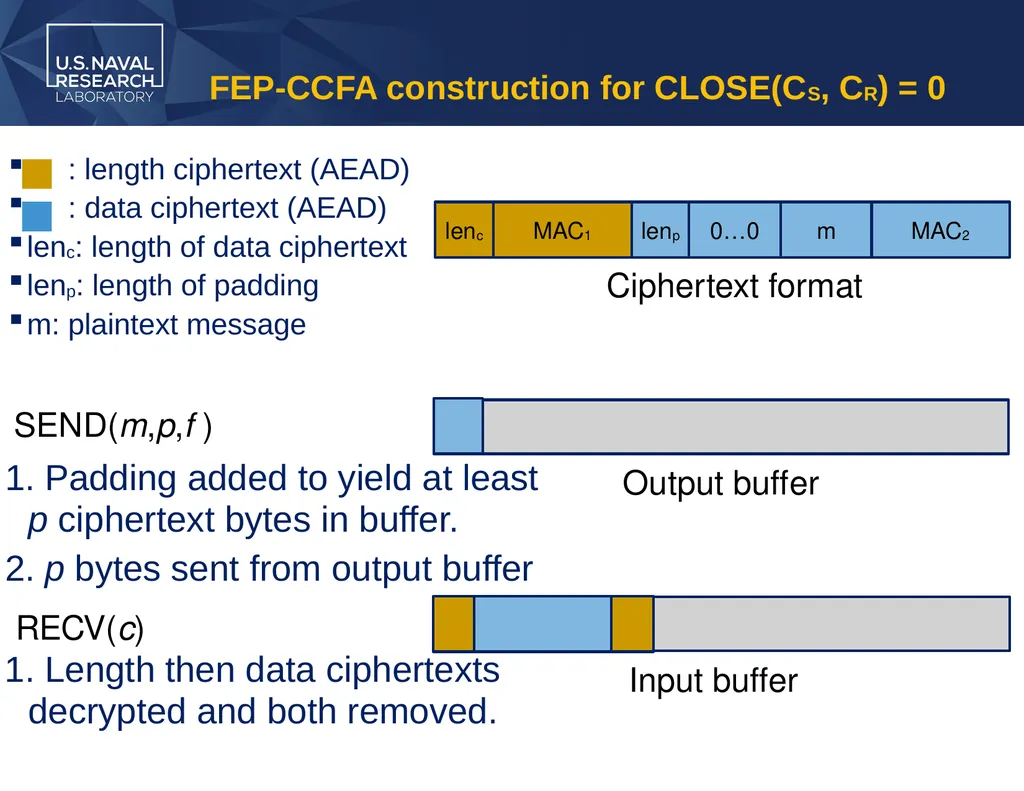
slide16. FEP-CCFA construction for CLOSE(CS, CR) = 0 lenc MAC1 lenp 0…0 m MAC2 : length ciphertext (AEAD)
: data ciphertext (AEAD)
lenc: length of data ciphertext
lenp: length of padding
m: plaintext message Ciphertext format<br>
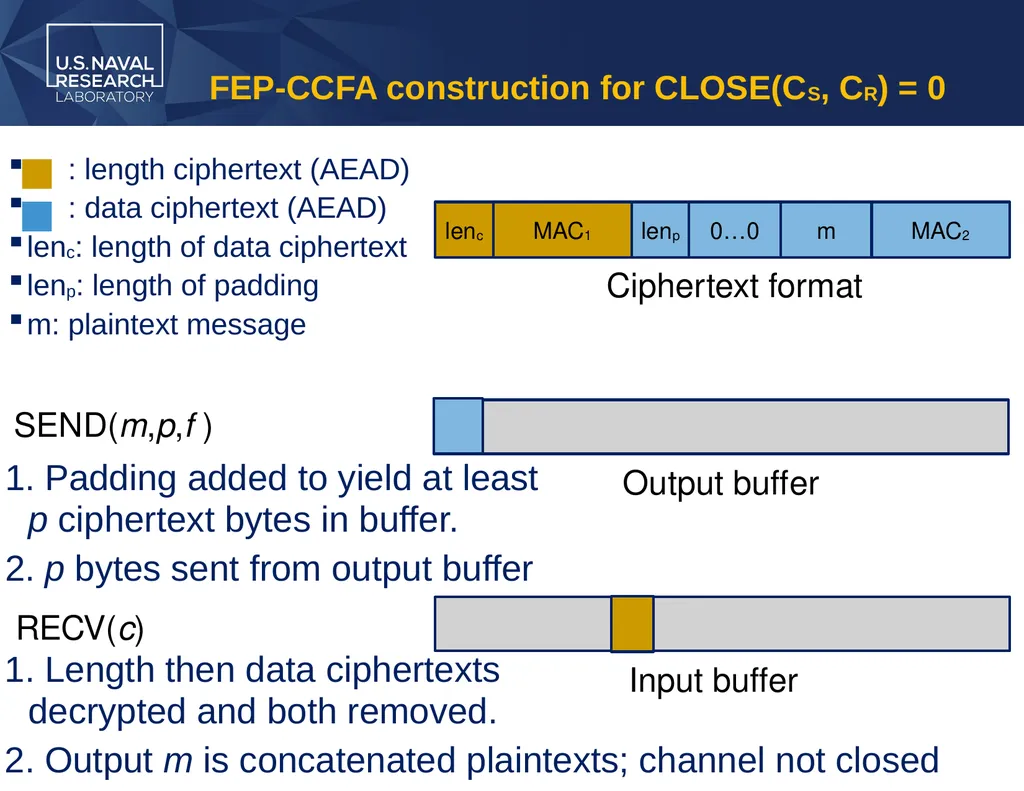
slide17. FEP-CCFA construction for CLOSE(CS, CR) = 0 lenc MAC1 lenp 0…0 m MAC2 : length ciphertext (AEAD)
: data ciphertext (AEAD)
lenc: length of data ciphertext
lenp: length of padding
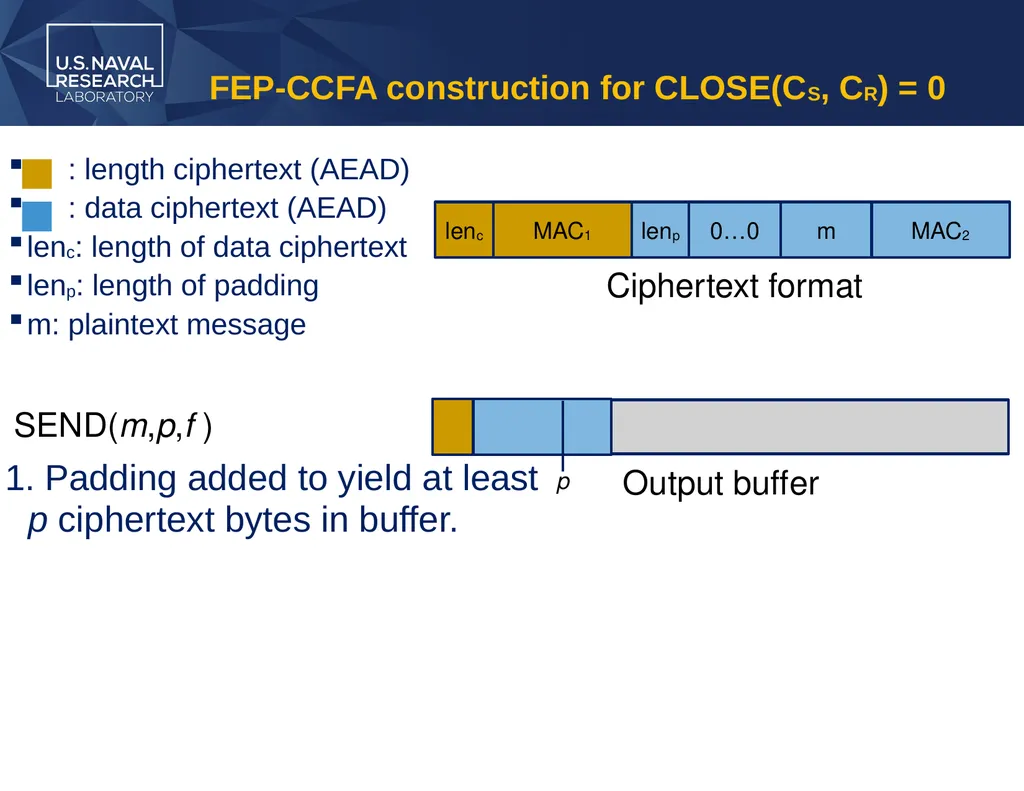
m: plaintext message SEND(m,p,f ) p Padding added to yield at least p ciphertext bytes in buffer. Ciphertext format Output buffer<br>
slide18. FEP-CCFA construction for CLOSE(CS, CR) = 0 lenc MAC1 lenp 0…0 m MAC2 : length ciphertext (AEAD)
: data ciphertext (AEAD)
lenc: length of data ciphertext
lenp: length of padding
m: plaintext message SEND(m,p,f ) p Padding added to yield at least p ciphertext bytes in buffer.
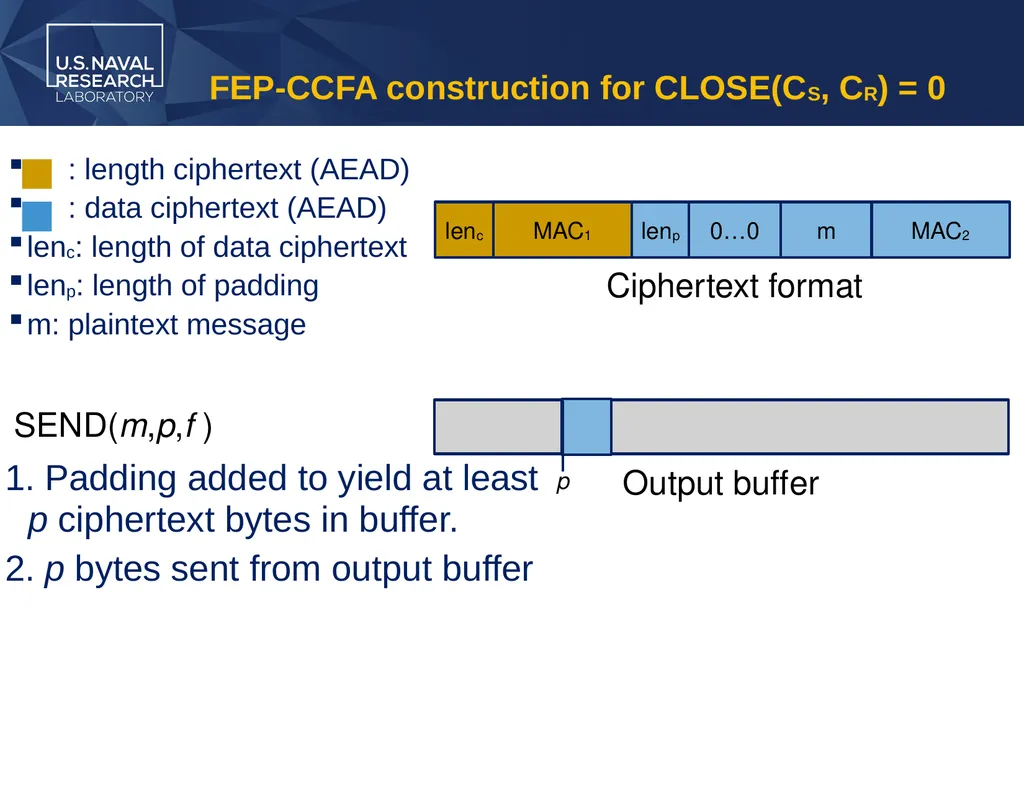
p bytes sent from output buffer Ciphertext format Output buffer<br>
slide19. FEP-CCFA construction for CLOSE(CS, CR) = 0 lenc MAC1 lenp 0…0 m MAC2 : length ciphertext (AEAD)
: data ciphertext (AEAD)
lenc: length of data ciphertext
lenp: length of padding
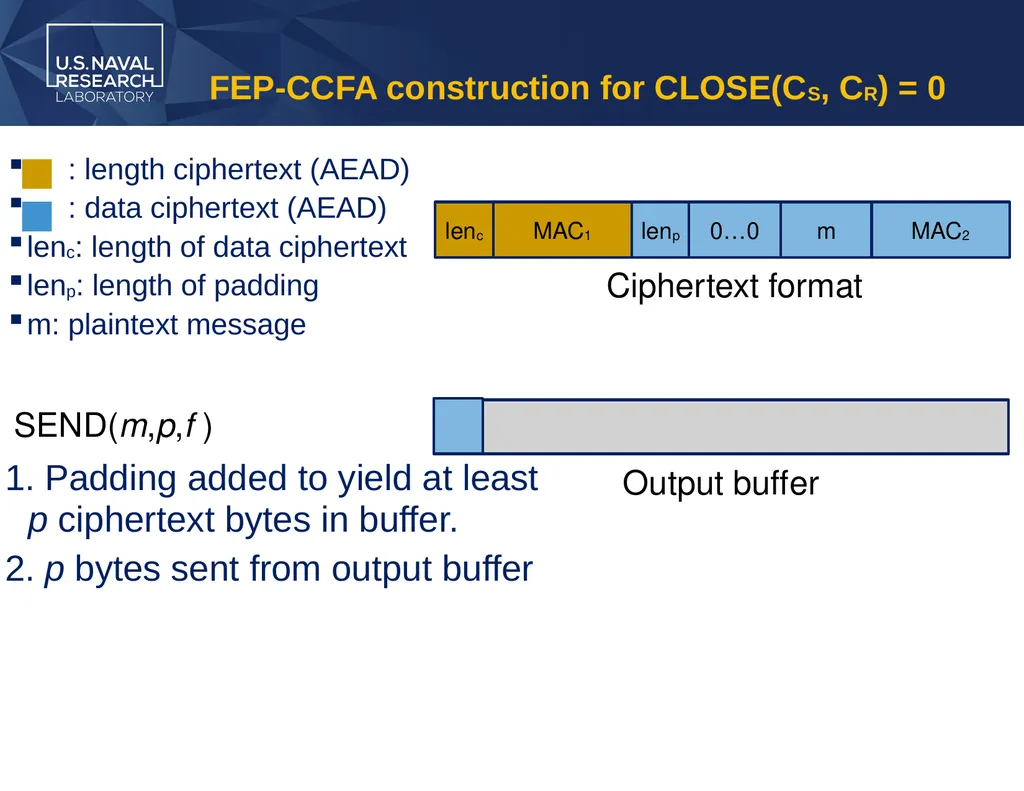
m: plaintext message SEND(m,p,f ) Padding added to yield at least p ciphertext bytes in buffer.
p bytes sent from output buffer Ciphertext format Output buffer<br>
slide20. FEP-CCFA construction for CLOSE(CS, CR) = 0 lenc Ciphertext format MAC1 lenp 0…0 m MAC2 : length ciphertext (AEAD)
: data ciphertext (AEAD)
lenc: length of data ciphertext
lenp: length of padding
m: plaintext message SEND(m,p,f ) Padding added to yield at least p ciphertext bytes in buffer.
p bytes sent from output buffer Output buffer RECV(c) Length then data ciphertexts decrypted and both removed. Input buffer<br>
slide21. FEP-CCFA construction for CLOSE(CS, CR) = 0 lenc Ciphertext format MAC1 lenp 0…0 m MAC2 : length ciphertext (AEAD)
: data ciphertext (AEAD)
lenc: length of data ciphertext
lenp: length of padding
m: plaintext message SEND(m,p,f ) Padding added to yield at least p ciphertext bytes in buffer.
p bytes sent from output buffer Output buffer RECV(c) Length then data ciphertexts decrypted and both removed.
Output m is concatenated plaintexts; channel not closed Input buffer<br>
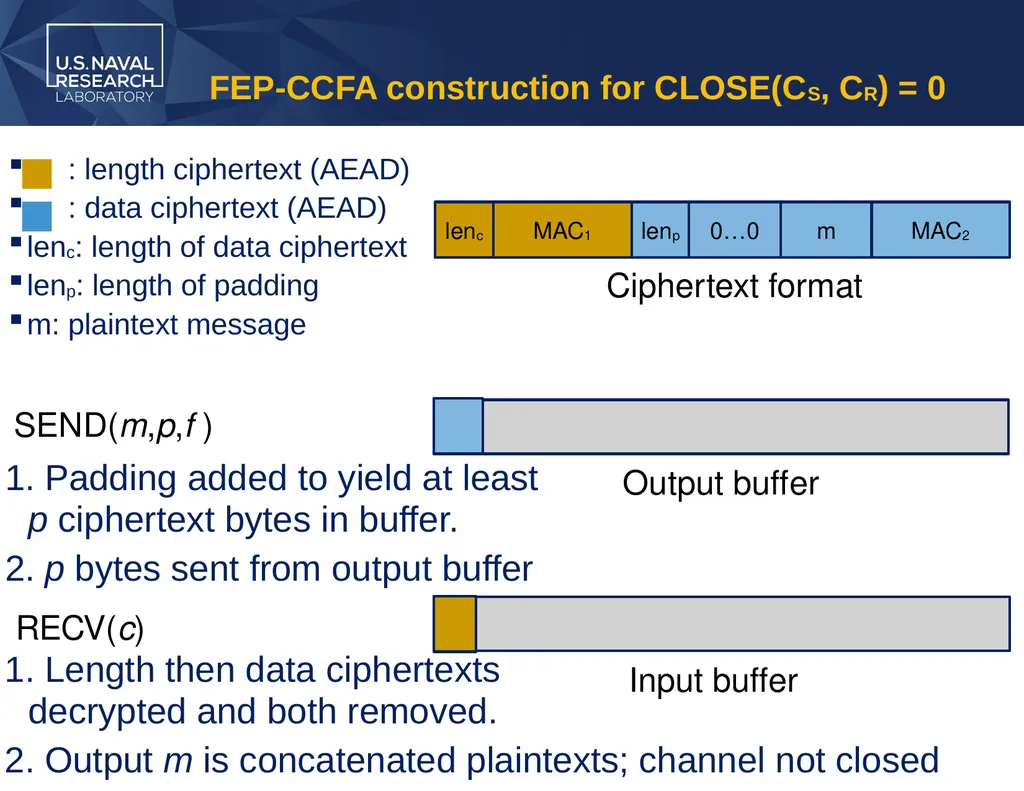
slide22. FEP-CCFA construction for CLOSE(CS, CR) = 0 lenc Ciphertext format MAC1 lenp 0…0 m MAC2 : length ciphertext (AEAD)
: data ciphertext (AEAD)
lenc: length of data ciphertext
lenp: length of padding
m: plaintext message SEND(m,p,f ) Padding added to yield at least p ciphertext bytes in buffer.
p bytes sent from output buffer Output buffer RECV(c) Length then data ciphertexts decrypted and both removed.
Output m is concatenated plaintexts; channel not closed Input buffer<br>
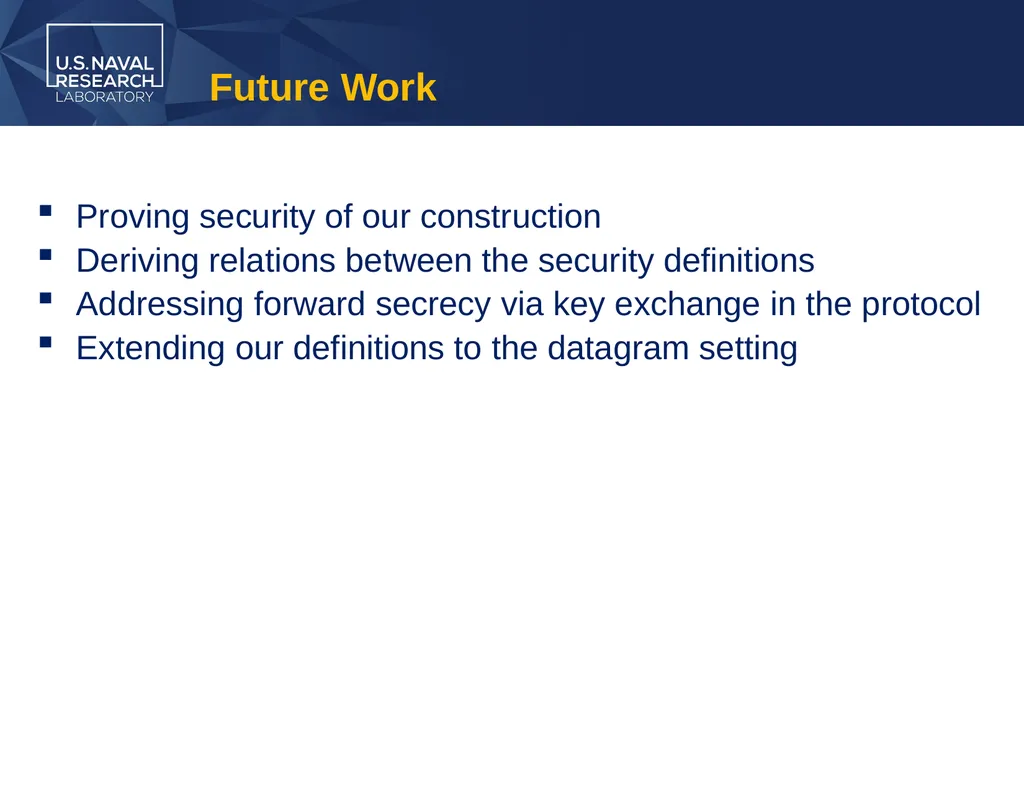
slide23. Future Work Proving security of our construction
Deriving relations between the security definitions
Addressing forward secrecy via key exchange in the protocol
Extending our definitions to the datagram setting<br>
Free and Open Communications on the Internet (FOCI ’23)<br>
slide2. Fully Encrypted Protocols (FEPs) Communication protocol
All bytes look random
Packet lengths variable
Used in some censorship-circumvention systems
obfs4 (Tor)
shadowsocks
Obfuscated SSH
OpenVPN + XOR patch
Vmess (V2Ray) App1 App2 FEP1 FEP2<br>
slide3. Fully Encrypted Protocols (FEPs) Security cannot be proven
Goal seems inherently mathematical
IND$-CPA: similar goal but for atomic messaging Problem: No mathematical definition of FEPs Solution: New security definitions for FEPs and a candidate secure FEP construction Passively secure: FEP-CPFA (Fully Encrypted Protocol under Chosen Plaintext-Fragment Attacks)
Actively secure: FEP-CCFA (Fully Encrypted Protocol under Chosen Ciphertext-Fragment Attacks)
Packet sizes: Length shaping<br>
slide4. Terminology Other terms used
“Obfuscated” protocol
“Look-like-nothing”/“look-like-random” protocol
“Randomized”/“randomizer” protocol
Why “fully encrypted” protocols?
Unused for other concepts
Positive connotation
Abbreviates (FEPs)
“Exposing the Great Firewall's Dynamic Blocking of Fully Encrypted Traffic” by Anonymous, Kevin Bock, Jackson Sippe, Shelikhoo, David Fifield, Eric Wustrow, Dave Levin, Amir Houmansadr. June 2022.<br>
slide5. Value of FEPs Censorship circumvention
Not easily detected as carrying proxied traffic
Very limited metadata for selective blocking (e.g. targeting applications)
China is blocking FEPs (“Exposing the Great Firewall's Dynamic Blocking of Fully Encrypted Traffic” by Anonymous et al.)
Natural endpoint of secure communication protocols
Maximally protects metadata
Modern protocols protect more metadata: QUIC, TLS 1.3 Encrypted Client Hello, Noise protocol framework
IETF Internet-Draft: Pseudorandom Extension for cTLS
“a cTLS extension that allows each party to emit a purely pseudorandom bitstream”
“TODO: More precise security properties and security proof. The goal we're after hasn't been widely considered in the literature so far, at least as far as we can tell.”<br>
slide6. Setting Datastream setting*
Inputs and outputs treated as byte streams
Reliable, in-order delivery
Models TCP
Unidirectional channel
Pre-shared key (or: data transport phase) App1 App2 SEND RECV Plaintext fragmentation Ciphertext fragmentation *Marc Fischlin, Felix Günther, Giorgia Azzurra Marson, and Kenneth G. Paterson. “Data is a stream: Security of stream-based channels”. CRYPTO 2015.<br>
slide7. Protocol Model SEND RECV Input m : plaintext message
p : packet length
f : flush flag Output c : ciphertext Input c : ciphertext Output m : plaintext message
C : channel close flag In implementation, SEND and RECV would interact with sockets.<br>
slide8. Passive security:
FEP-CPFA (Chosen Plaintext-Fragment Attacks) O0SEND(m,p,f) Challenger chooses bit b.
Adversary can query stateful oracle ObSEND.
Adversary outputs guess b’.
Success if b’=b. Security experiment Real World Random World Definition: Protocol is FEP-CPFA if success probability is negligible. Outputs SEND(m,p,f) Outputs |SEND(m,p,f)| random bytes O1SEND(m,p,f)<br>
slide9. Passive security:
FEP-CPFA (Chosen Plaintext-Fragment Attacks) O0SEND(m,p,f) Challenger chooses bit b.
Adversary can query stateful oracle ObSEND.
Adversary outputs guess b’.
Success if b’=b. Security experiment Real World Random World Definition: Protocol is FEP-CPFA if success probability is negligible. Outputs SEND(m,p,f) Outputs |SEND(m,p,f)| random bytes O1SEND(m,p,f) Obfuscated OpenSSH: without an optional pre-shared key, all key material is observable, and so it does not satisfy FEP-CPFA.<br>
slide10. Active security:
FEP-CCFA (Chosen Ciphertext-Fragment Attacks) O0SEND(m,p,f) Challenger chooses bit b.
Adversary can query stateful oracles ObSEND and ObRECV.
Adversary outputs guess b’.
Success if b’=b. Security experiment Real World Random World Definition: Protocol is FEP-CCFA if success probability is negligible. Always returns channel close flag C.
Does not return output message m unless out of sync. Returns channel close flag CLOSE(CS, CR).
Does not return output message m. O1SEND(m,p,f) O0RECV(c) O1RECV(c) Outputs SEND(m,p,f) Outputs |SEND(m,p,f)| random bytes CS: Outputs from ObSEND
CR: Inputs to ObRECV
CLOSE(CS, CR): Ideal channel close behavior<br>
slide11. Active security:
FEP-CCFA (Chosen Ciphertext-Fragment Attacks) O0SEND(m,p,f) Challenger chooses bit b.
Adversary can query stateful oracles ObSEND and ObSEND.
Adversary outputs guess b’.
Success if b’=b. Security experiment Real World Random World Definition: Protocol is FEP-CCFA if success probability is negligible. Always returns channel close flag C.
Does not return output message m unless out of sync. Returns channel close flag CLOSE(CS, CR).
Does not return output message m. O1SEND(m,p,f) O0RECV(c) O1RECV(c) Outputs SEND(m,p,f) Outputs |SEND(m,p,f)| random bytes CS: Outputs from ObSEND
CR: Inputs to ObRECV
CLOSE(CS, CR): Ideal channel close behavior obfs4: The channel is closed immediately upon decryption error, and so it does not satisfy FEP-CCFA with CLOSE=0.<br>
slide12. Channel behaviors Ideal channel closure CLOSE(CS, CR) examples
Never close (e.g. shadowsocks)
Close after timeout
Close after first “sync” byte received after a modified byte
TCP reveals more than closures, e.g. congestion window.<br>
slide13. Length Shaping Enables arbitrary traffic shaping
Generalizes padding functionality of existing FEPs
Requires buffering when output bytes aren’t sufficient. Definition: Protocol satisfies length shaping if, for all messages m and p ≥ 0, |SEND(m,p,f=0)| = p, and
|SEND(m,p,f=1)| ≥ p.<br>
slide14. Length Shaping Enables arbitrary traffic shaping
Generalizes padding functionality of existing FEPs
Requires buffering when output bytes aren’t sufficient. Definition: Protocol satisfies length shaping if, for all messages m and p ≥ 0, |SEND(m,p,f=0)| = p, and
|SEND(m,p,f=1)| ≥ p. shadowsocks: without any support for padding, it does not satisfy length shaping.<br>
slide15. Other FEP security requirements* IND-CCFA
Indistinguishability Under Chosen-Ciphertext Fragment Attacks
Provides confidentiality
Not implied by FEP-CCFA because ciphertext lengths can leak plaintexts
INT-CST
Integrity of Ciphertext Streams
Provides integrity
Not implied by FEP-CPFA
Probably implied by FEP-CCFA *Marc Fischlin, Felix Günther, Giorgia Azzurra Marson, and Kenneth G. Paterson. “Data is a stream: Security of stream-based channels”. CRYPTO 2015.<br>
slide16. FEP-CCFA construction for CLOSE(CS, CR) = 0 lenc MAC1 lenp 0…0 m MAC2 : length ciphertext (AEAD)
: data ciphertext (AEAD)
lenc: length of data ciphertext
lenp: length of padding
m: plaintext message Ciphertext format<br>
slide17. FEP-CCFA construction for CLOSE(CS, CR) = 0 lenc MAC1 lenp 0…0 m MAC2 : length ciphertext (AEAD)
: data ciphertext (AEAD)
lenc: length of data ciphertext
lenp: length of padding
m: plaintext message SEND(m,p,f ) p Padding added to yield at least p ciphertext bytes in buffer. Ciphertext format Output buffer<br>
slide18. FEP-CCFA construction for CLOSE(CS, CR) = 0 lenc MAC1 lenp 0…0 m MAC2 : length ciphertext (AEAD)
: data ciphertext (AEAD)
lenc: length of data ciphertext
lenp: length of padding
m: plaintext message SEND(m,p,f ) p Padding added to yield at least p ciphertext bytes in buffer.
p bytes sent from output buffer Ciphertext format Output buffer<br>
slide19. FEP-CCFA construction for CLOSE(CS, CR) = 0 lenc MAC1 lenp 0…0 m MAC2 : length ciphertext (AEAD)
: data ciphertext (AEAD)
lenc: length of data ciphertext
lenp: length of padding
m: plaintext message SEND(m,p,f ) Padding added to yield at least p ciphertext bytes in buffer.
p bytes sent from output buffer Ciphertext format Output buffer<br>
slide20. FEP-CCFA construction for CLOSE(CS, CR) = 0 lenc Ciphertext format MAC1 lenp 0…0 m MAC2 : length ciphertext (AEAD)
: data ciphertext (AEAD)
lenc: length of data ciphertext
lenp: length of padding
m: plaintext message SEND(m,p,f ) Padding added to yield at least p ciphertext bytes in buffer.
p bytes sent from output buffer Output buffer RECV(c) Length then data ciphertexts decrypted and both removed. Input buffer<br>
slide21. FEP-CCFA construction for CLOSE(CS, CR) = 0 lenc Ciphertext format MAC1 lenp 0…0 m MAC2 : length ciphertext (AEAD)
: data ciphertext (AEAD)
lenc: length of data ciphertext
lenp: length of padding
m: plaintext message SEND(m,p,f ) Padding added to yield at least p ciphertext bytes in buffer.
p bytes sent from output buffer Output buffer RECV(c) Length then data ciphertexts decrypted and both removed.
Output m is concatenated plaintexts; channel not closed Input buffer<br>
slide22. FEP-CCFA construction for CLOSE(CS, CR) = 0 lenc Ciphertext format MAC1 lenp 0…0 m MAC2 : length ciphertext (AEAD)
: data ciphertext (AEAD)
lenc: length of data ciphertext
lenp: length of padding
m: plaintext message SEND(m,p,f ) Padding added to yield at least p ciphertext bytes in buffer.
p bytes sent from output buffer Output buffer RECV(c) Length then data ciphertexts decrypted and both removed.
Output m is concatenated plaintexts; channel not closed Input buffer<br>
slide23. Future Work Proving security of our construction
Deriving relations between the security definitions
Addressing forward secrecy via key exchange in the protocol
Extending our definitions to the datagram setting<br>