
SEED Fund Collaborative Solar Procurement for
DP
Published · 30 slides · 0 views
1 / 1
Description
SEED Fund Collaborative Solar Procurement for Public Agencies Solar Project Installation and Technical Considerations June 2019 Agenda Introduction to SEED Fund Team SEED Fund Project Overview and Status Update Solar Value Proposition
Related Topics
Share
Embed code
Download this presentation From Below
"SEED Fund Collaborative Solar Procurement for" is the property of its rightful owner. Permission is granted to download and print the materials on this website for personal, non-commercial use only, and to display it on your personal computer provided you do not modify the materials and that you retain all copyright notices contained in the materials. By downloading content from our website, you accept the terms of this agreement.
Presentation Transcript
01
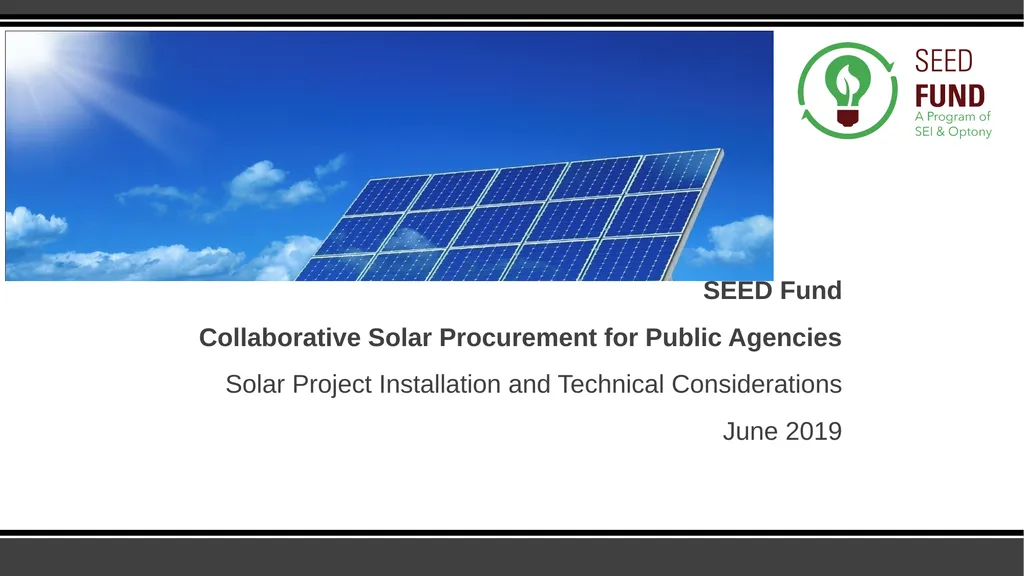
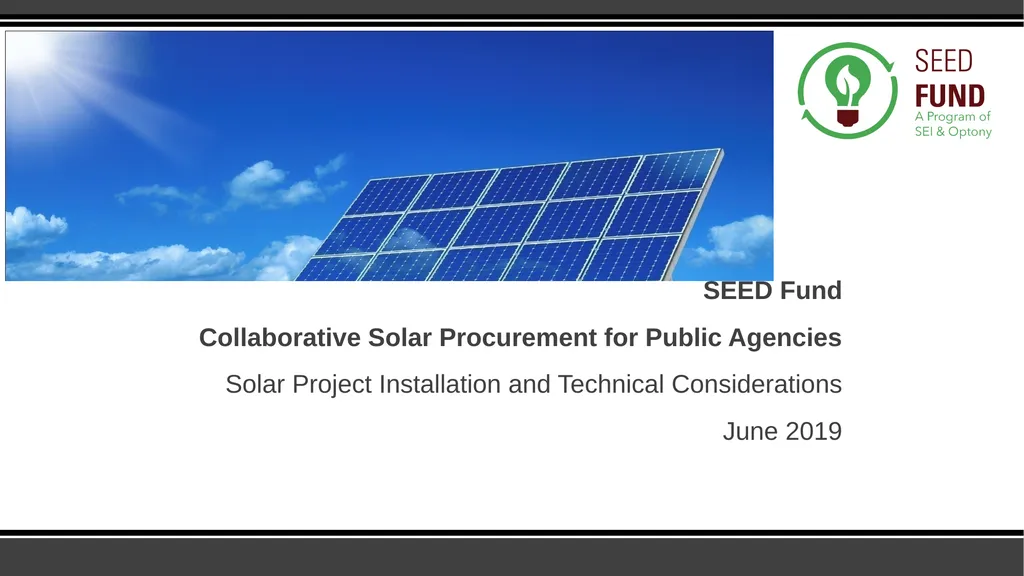
SEED Fund
Collaborative Solar Procurement for Public Agencies
Solar Project Installation and Technical Considerations
June 2019<br>
Collaborative Solar Procurement for Public Agencies
Solar Project Installation and Technical Considerations
June 2019<br>
02
Agenda Introduction to SEED Fund Team
SEED Fund Project Overview and Status Update
Solar Value Proposition
Long-Life Asset
Offset of Electrical Costs
Financial Incentives and Programs
Alternative Energy Valuations
Financing Options & Evaluation Process
Direct Purchase
Power Purchase Agreement
Equipment Lease
Next Steps<br>
SEED Fund Project Overview and Status Update
Solar Value Proposition
Long-Life Asset
Offset of Electrical Costs
Financial Incentives and Programs
Alternative Energy Valuations
Financing Options & Evaluation Process
Direct Purchase
Power Purchase Agreement
Equipment Lease
Next Steps<br>
03
About Strategic Energy Innovations (SEI) 3 Strategic Energy Innovations inspires & empowers to advance solutions for a healthy, thriving planet.
Committed to empowering under-served markets
Schools, colleges, and universities
Local governments
Small and rural communities
Affordable housing providers and residents
Small businesses
…to embrace a climate-friendly future through green building, clean energy, resource efficiency and support of a local and qualified green workforce.<br>
Committed to empowering under-served markets
Schools, colleges, and universities
Local governments
Small and rural communities
Affordable housing providers and residents
Small businesses
…to embrace a climate-friendly future through green building, clean energy, resource efficiency and support of a local and qualified green workforce.<br>
04
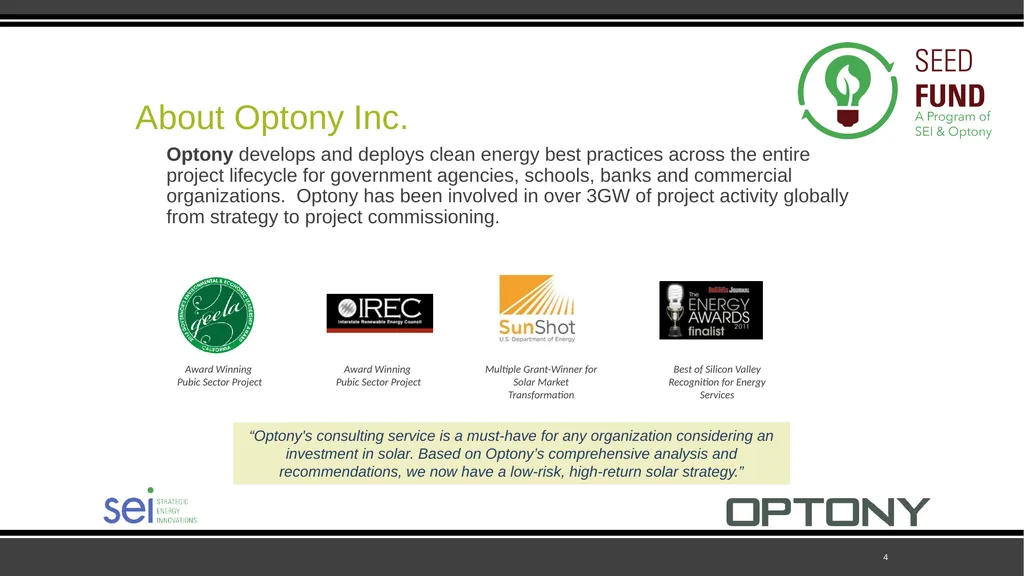
About Optony Inc. 4 Optony develops and deploys clean energy best practices across the entire project lifecycle for government agencies, schools, banks and commercial organizations. Optony has been involved in over 3GW of project activity globally from strategy to project commissioning. “Optony's consulting service is a must-have for any organization considering an investment in solar. Based on Optony’s comprehensive analysis and recommendations, we now have a low-risk, high-return solar strategy.” Award Winning
Pubic Sector Project Award Winning
Pubic Sector Project Multiple Grant-Winner for Solar Market Transformation Best of Silicon Valley Recognition for Energy Services<br>
Pubic Sector Project Award Winning
Pubic Sector Project Multiple Grant-Winner for Solar Market Transformation Best of Silicon Valley Recognition for Energy Services<br>
05
About Sierra Business Council (SBC) 5 Sierra Business Council is an organization focusing on the environment, communities, and economies of the Sierra region. We’re a certified non-profit in both California and Nevada and have a 20-year history in the region.
Implements projects in several areas of expertise
Community planning
Natural area conservation and open space planning
Rural economic development
Collaborative process facilitation
Sustainable business practices
… to increase community vitality, economic prosperity, environmental quality, and social fairness in the Sierra Nevada.<br>
Implements projects in several areas of expertise
Community planning
Natural area conservation and open space planning
Rural economic development
Collaborative process facilitation
Sustainable business practices
… to increase community vitality, economic prosperity, environmental quality, and social fairness in the Sierra Nevada.<br>
06
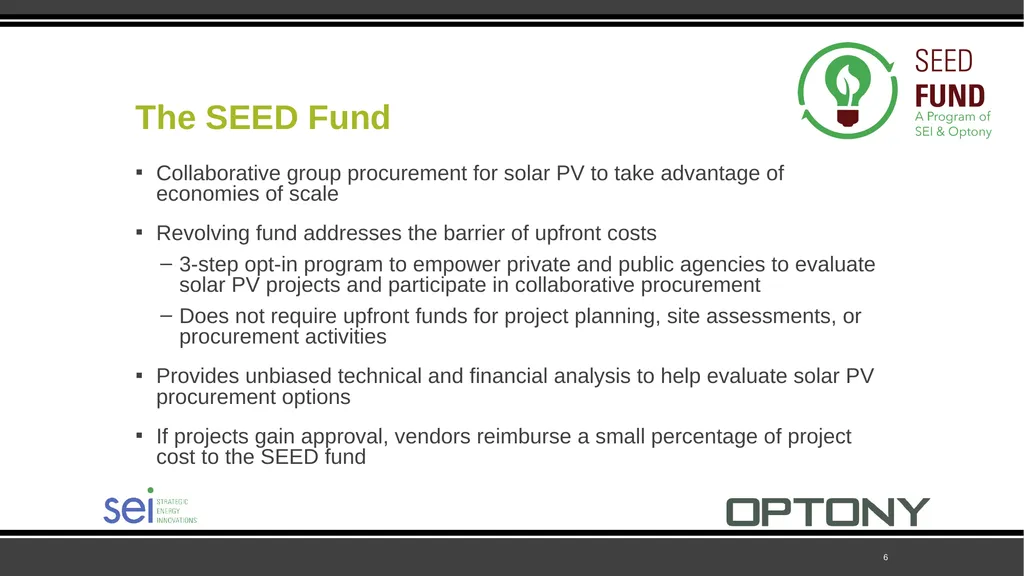
The SEED Fund Collaborative group procurement for solar PV to take advantage of economies of scale
Revolving fund addresses the barrier of upfront costs
3-step opt-in program to empower private and public agencies to evaluate solar PV projects and participate in collaborative procurement
Does not require upfront funds for project planning, site assessments, or procurement activities
Provides unbiased technical and financial analysis to help evaluate solar PV procurement options
If projects gain approval, vendors reimburse a small percentage of project cost to the SEED fund 6<br>
Revolving fund addresses the barrier of upfront costs
3-step opt-in program to empower private and public agencies to evaluate solar PV projects and participate in collaborative procurement
Does not require upfront funds for project planning, site assessments, or procurement activities
Provides unbiased technical and financial analysis to help evaluate solar PV procurement options
If projects gain approval, vendors reimburse a small percentage of project cost to the SEED fund 6<br>
07
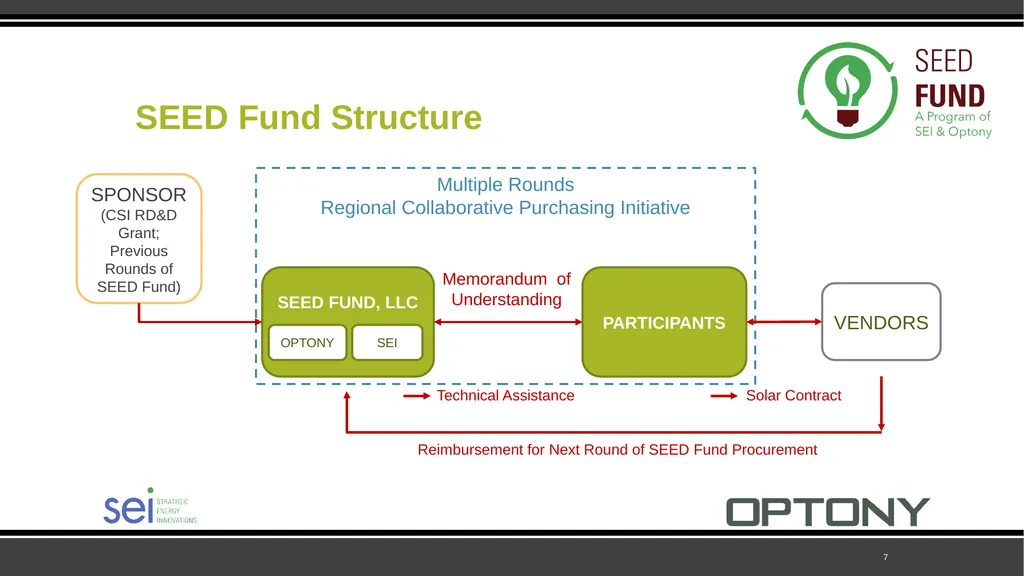
SEED Fund Structure 7 Reimbursement for Next Round of SEED Fund Procurement<br>
08
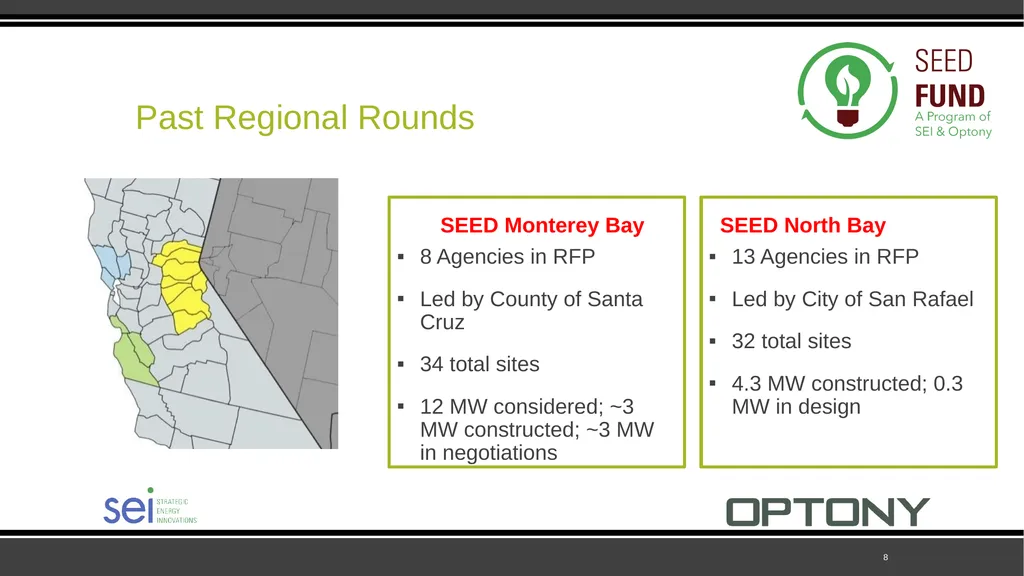
Past Regional Rounds SEED North Bay 13 Agencies in RFP
Led by City of San Rafael
32 total sites
4.3 MW constructed; 0.3 MW in design SEED Monterey Bay 8 Agencies in RFP
Led by County of Santa Cruz
34 total sites
12 MW considered; ~3 MW constructed; ~3 MW in negotiations 8<br>
Led by City of San Rafael
32 total sites
4.3 MW constructed; 0.3 MW in design SEED Monterey Bay 8 Agencies in RFP
Led by County of Santa Cruz
34 total sites
12 MW considered; ~3 MW constructed; ~3 MW in negotiations 8<br>
09
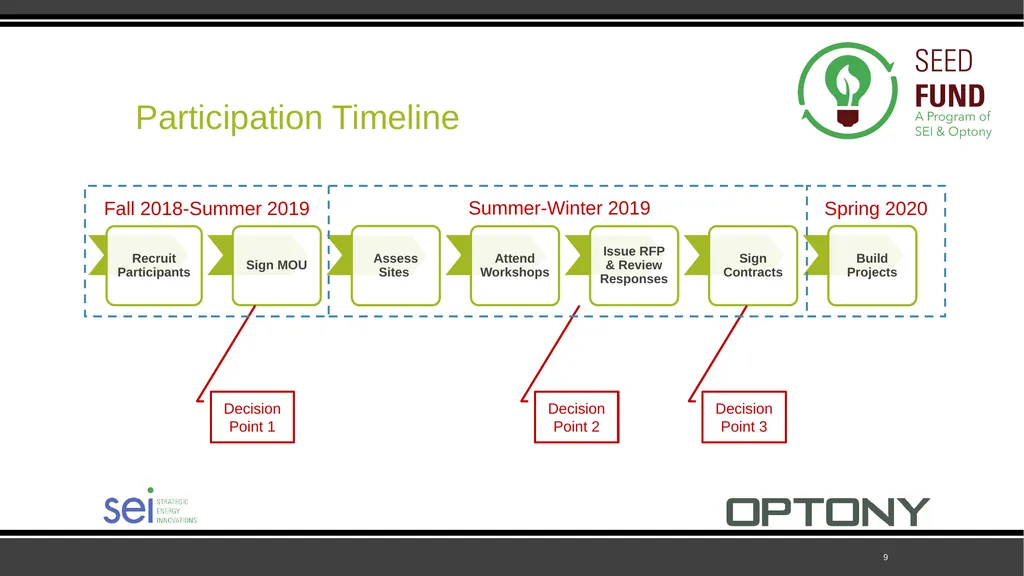
Participation Timeline 9<br>
10
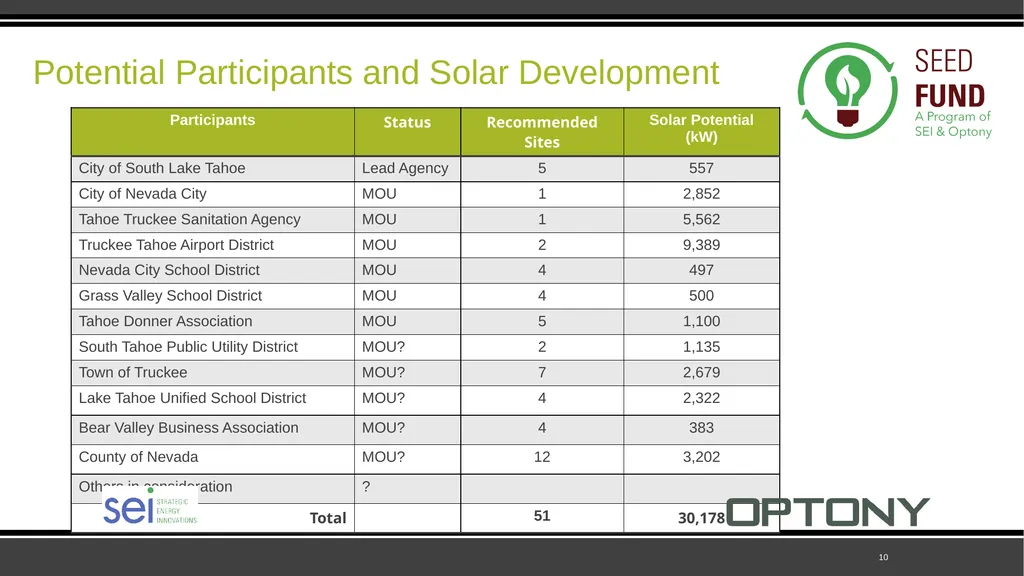
Potential Participants and Solar Development 10<br>
11
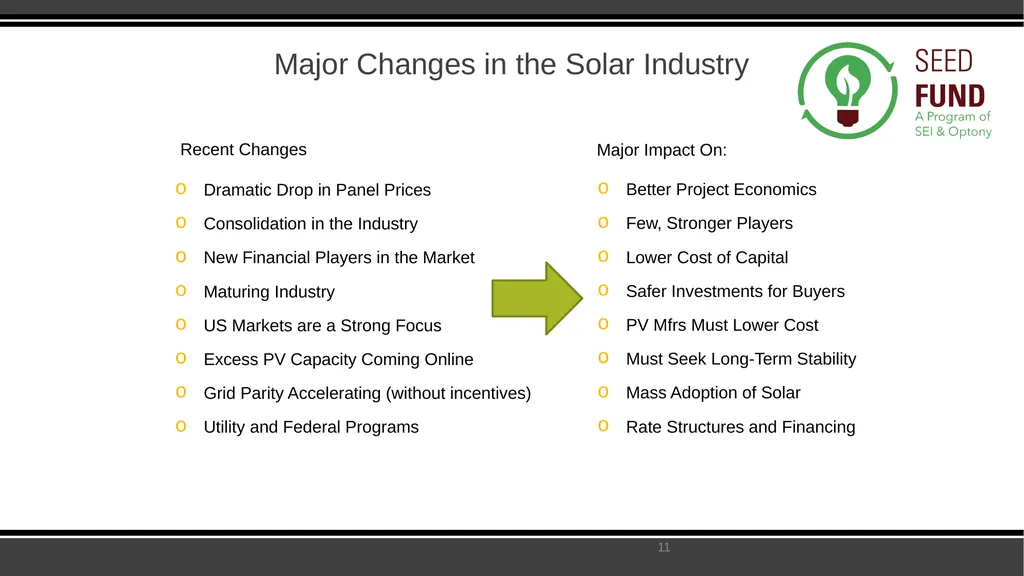
Recent Changes Major Changes in the Solar Industry Dramatic Drop in Panel Prices
Consolidation in the Industry
New Financial Players in the Market
Maturing Industry
US Markets are a Strong Focus
Excess PV Capacity Coming Online
Grid Parity Accelerating (without incentives)
Utility and Federal Programs Better Project Economics
Few, Stronger Players
Lower Cost of Capital
Safer Investments for Buyers
PV Mfrs Must Lower Cost
Must Seek Long-Term Stability
Mass Adoption of Solar
Rate Structures and Financing Major Impact On: 11<br>
Consolidation in the Industry
New Financial Players in the Market
Maturing Industry
US Markets are a Strong Focus
Excess PV Capacity Coming Online
Grid Parity Accelerating (without incentives)
Utility and Federal Programs Better Project Economics
Few, Stronger Players
Lower Cost of Capital
Safer Investments for Buyers
PV Mfrs Must Lower Cost
Must Seek Long-Term Stability
Mass Adoption of Solar
Rate Structures and Financing Major Impact On: 11<br>
12
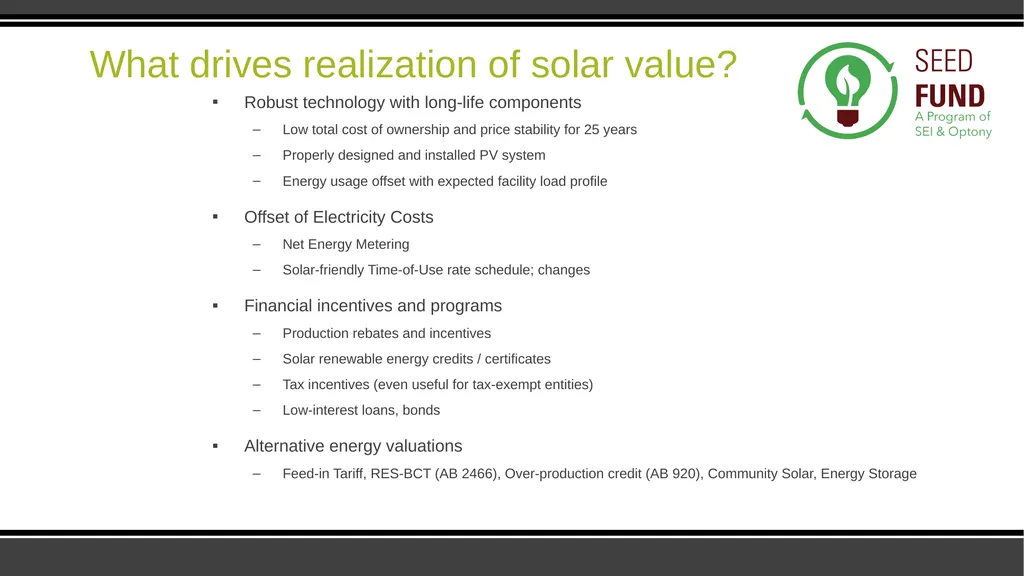
What drives realization of solar value? Robust technology with long-life components
Low total cost of ownership and price stability for 25 years
Properly designed and installed PV system
Energy usage offset with expected facility load profile
Offset of Electricity Costs
Net Energy Metering
Solar-friendly Time-of-Use rate schedule; changes
Financial incentives and programs
Production rebates and incentives
Solar renewable energy credits / certificates
Tax incentives (even useful for tax-exempt entities)
Low-interest loans, bonds
Alternative energy valuations
Feed-in Tariff, RES-BCT (AB 2466), Over-production credit (AB 920), Community Solar, Energy Storage<br>
Low total cost of ownership and price stability for 25 years
Properly designed and installed PV system
Energy usage offset with expected facility load profile
Offset of Electricity Costs
Net Energy Metering
Solar-friendly Time-of-Use rate schedule; changes
Financial incentives and programs
Production rebates and incentives
Solar renewable energy credits / certificates
Tax incentives (even useful for tax-exempt entities)
Low-interest loans, bonds
Alternative energy valuations
Feed-in Tariff, RES-BCT (AB 2466), Over-production credit (AB 920), Community Solar, Energy Storage<br>
13
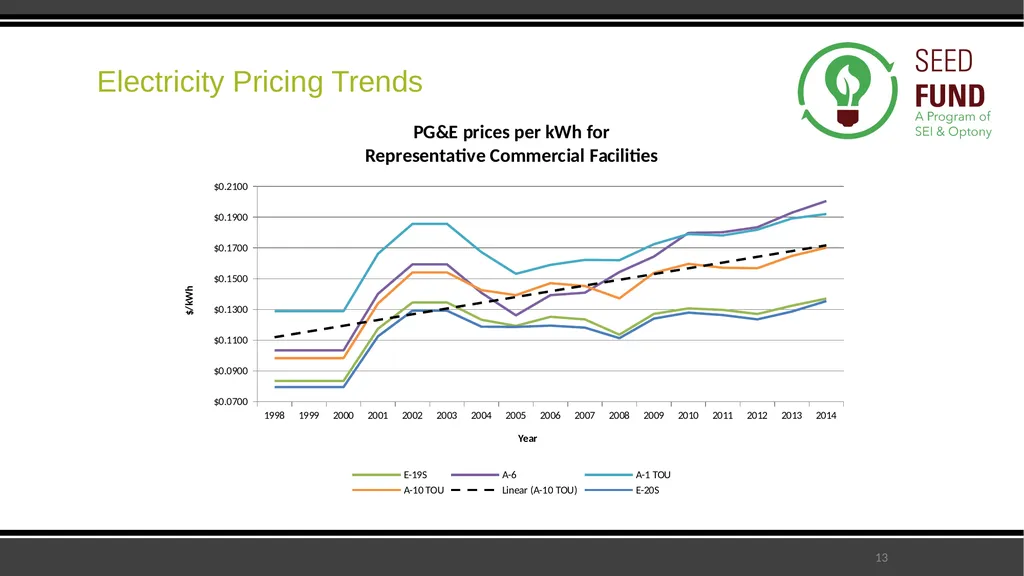
Electricity Pricing Trends 13<br>
14
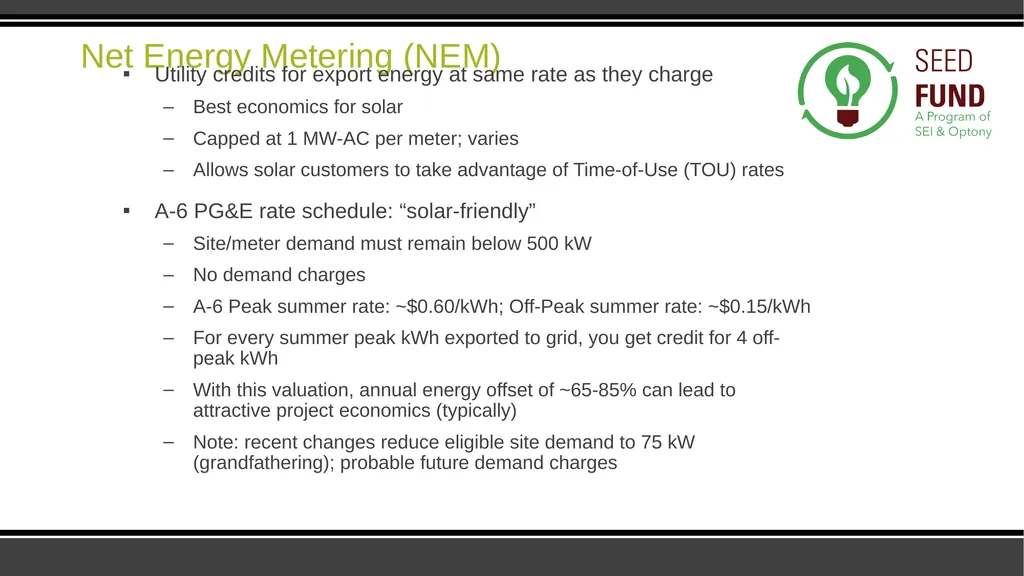
Net Energy Metering (NEM) Utility credits for export energy at same rate as they charge
Best economics for solar
Capped at 1 MW-AC per meter; varies
Allows solar customers to take advantage of Time-of-Use (TOU) rates
A-6 PG&E rate schedule: “solar-friendly”
Site/meter demand must remain below 500 kW
No demand charges
A-6 Peak summer rate: ~$0.60/kWh; Off-Peak summer rate: ~$0.15/kWh
For every summer peak kWh exported to grid, you get credit for 4 off-peak kWh
With this valuation, annual energy offset of ~65-85% can lead to attractive project economics (typically)
Note: recent changes reduce eligible site demand to 75 kW (grandfathering); probable future demand charges<br>
Best economics for solar
Capped at 1 MW-AC per meter; varies
Allows solar customers to take advantage of Time-of-Use (TOU) rates
A-6 PG&E rate schedule: “solar-friendly”
Site/meter demand must remain below 500 kW
No demand charges
A-6 Peak summer rate: ~$0.60/kWh; Off-Peak summer rate: ~$0.15/kWh
For every summer peak kWh exported to grid, you get credit for 4 off-peak kWh
With this valuation, annual energy offset of ~65-85% can lead to attractive project economics (typically)
Note: recent changes reduce eligible site demand to 75 kW (grandfathering); probable future demand charges<br>
15
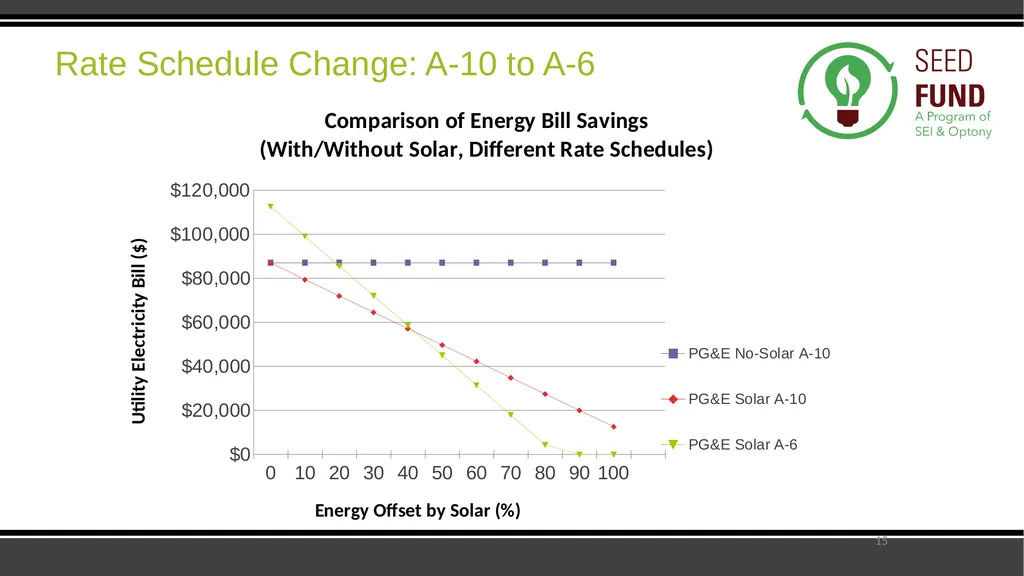
Rate Schedule Change: A-10 to A-6 15<br>
16
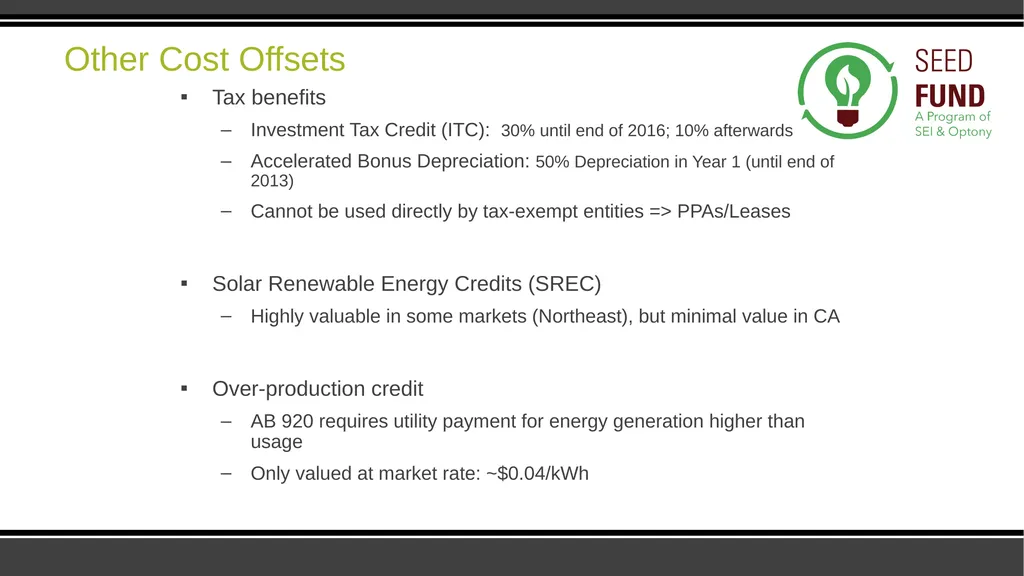
Other Cost Offsets Tax benefits
Investment Tax Credit (ITC): 30% until end of 2016; 10% afterwards
Accelerated Bonus Depreciation: 50% Depreciation in Year 1 (until end of 2013)
Cannot be used directly by tax-exempt entities => PPAs/Leases
Solar Renewable Energy Credits (SREC)
Highly valuable in some markets (Northeast), but minimal value in CA
Over-production credit
AB 920 requires utility payment for energy generation higher than usage
Only valued at market rate: ~$0.04/kWh<br>
Investment Tax Credit (ITC): 30% until end of 2016; 10% afterwards
Accelerated Bonus Depreciation: 50% Depreciation in Year 1 (until end of 2013)
Cannot be used directly by tax-exempt entities => PPAs/Leases
Solar Renewable Energy Credits (SREC)
Highly valuable in some markets (Northeast), but minimal value in CA
Over-production credit
AB 920 requires utility payment for energy generation higher than usage
Only valued at market rate: ~$0.04/kWh<br>
17
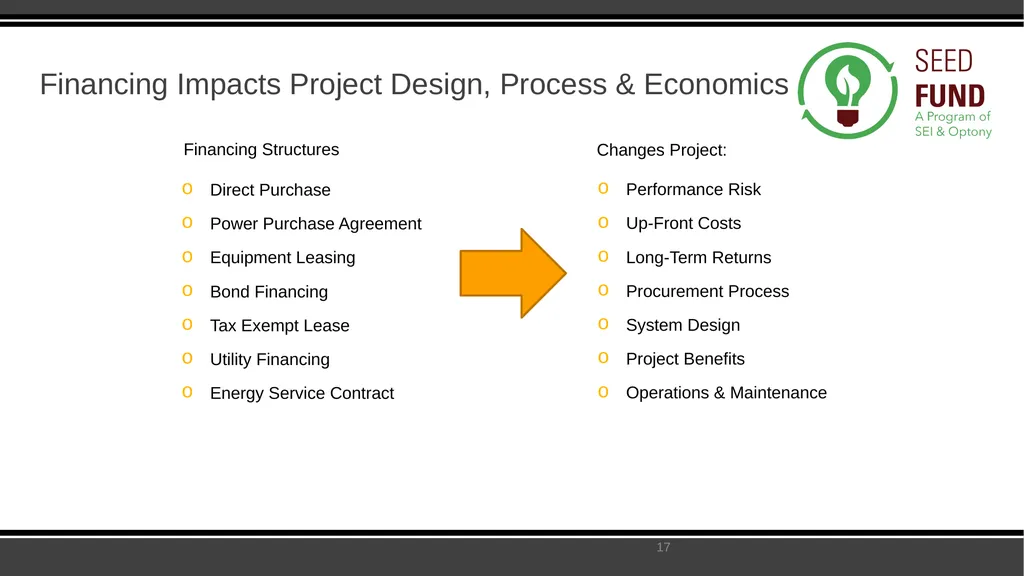
Financing Structures Financing Impacts Project Design, Process & Economics Direct Purchase
Power Purchase Agreement
Equipment Leasing
Bond Financing
Tax Exempt Lease
Utility Financing
Energy Service Contract Performance Risk
Up-Front Costs
Long-Term Returns
Procurement Process
System Design
Project Benefits
Operations & Maintenance Changes Project: 17<br>
Power Purchase Agreement
Equipment Leasing
Bond Financing
Tax Exempt Lease
Utility Financing
Energy Service Contract Performance Risk
Up-Front Costs
Long-Term Returns
Procurement Process
System Design
Project Benefits
Operations & Maintenance Changes Project: 17<br>
18
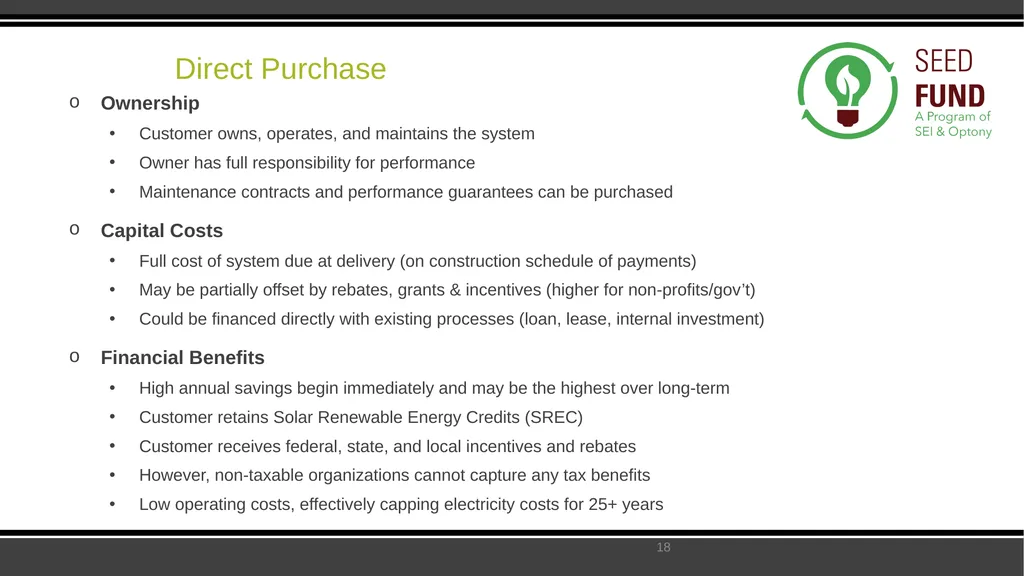
Direct Purchase Ownership
Customer owns, operates, and maintains the system
Owner has full responsibility for performance
Maintenance contracts and performance guarantees can be purchased
Capital Costs
Full cost of system due at delivery (on construction schedule of payments)
May be partially offset by rebates, grants & incentives (higher for non-profits/gov’t)
Could be financed directly with existing processes (loan, lease, internal investment)
Financial Benefits
High annual savings begin immediately and may be the highest over long-term
Customer retains Solar Renewable Energy Credits (SREC)
Customer receives federal, state, and local incentives and rebates
However, non-taxable organizations cannot capture any tax benefits
Low operating costs, effectively capping electricity costs for 25+ years 18<br>
Customer owns, operates, and maintains the system
Owner has full responsibility for performance
Maintenance contracts and performance guarantees can be purchased
Capital Costs
Full cost of system due at delivery (on construction schedule of payments)
May be partially offset by rebates, grants & incentives (higher for non-profits/gov’t)
Could be financed directly with existing processes (loan, lease, internal investment)
Financial Benefits
High annual savings begin immediately and may be the highest over long-term
Customer retains Solar Renewable Energy Credits (SREC)
Customer receives federal, state, and local incentives and rebates
However, non-taxable organizations cannot capture any tax benefits
Low operating costs, effectively capping electricity costs for 25+ years 18<br>
19
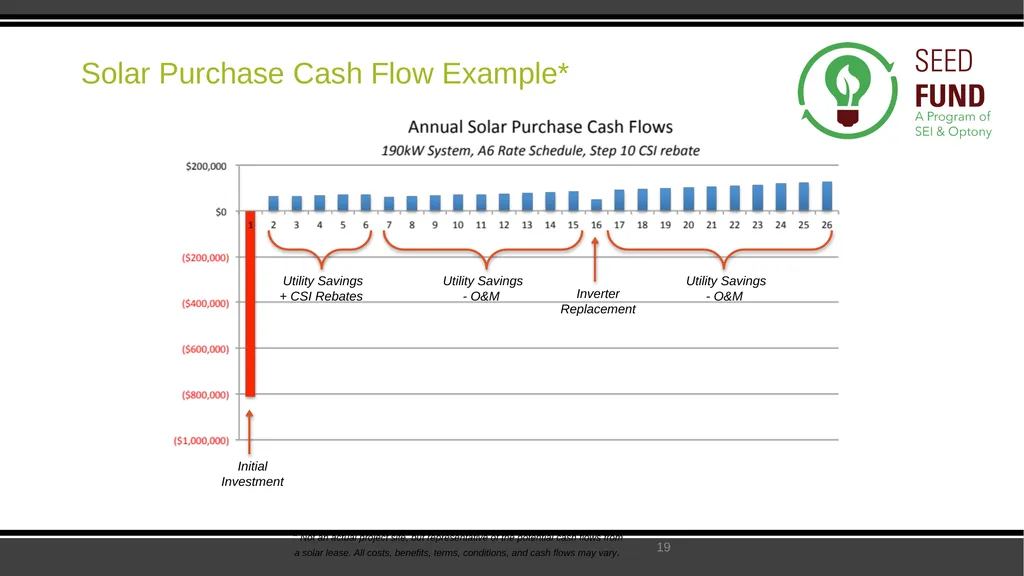
Solar Purchase Cash Flow Example* * Not an actual project site, but representative of the potential cash flows from a solar lease. All costs, benefits, terms, conditions, and cash flows may vary. 19 Inverter
Replacement Utility Savings
+ CSI Rebates Initial
Investment Utility Savings
- O&M Utility Savings
- O&M<br>
Replacement Utility Savings
+ CSI Rebates Initial
Investment Utility Savings
- O&M Utility Savings
- O&M<br>
20
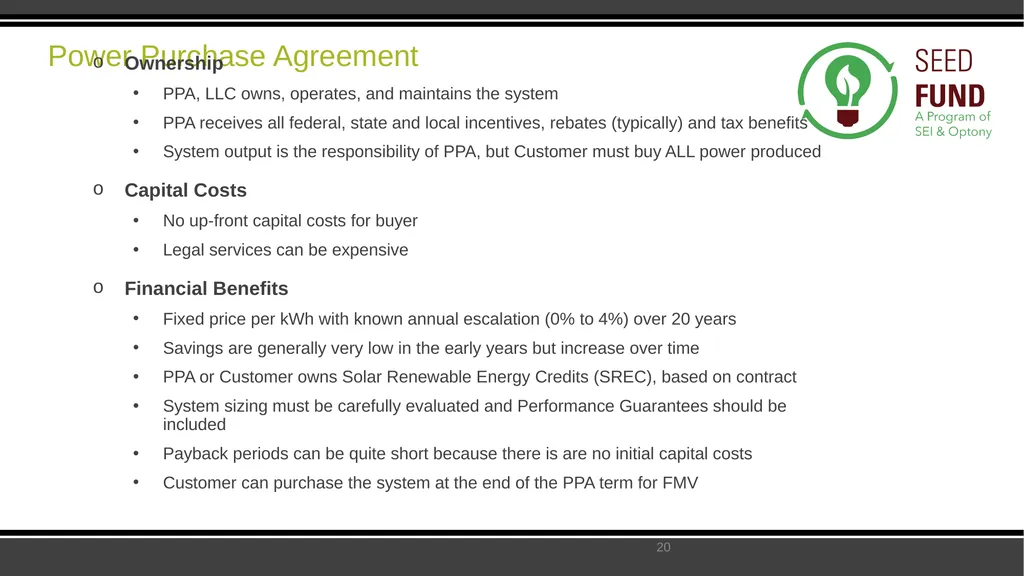
Power Purchase Agreement Ownership
PPA, LLC owns, operates, and maintains the system
PPA receives all federal, state and local incentives, rebates (typically) and tax benefits
System output is the responsibility of PPA, but Customer must buy ALL power produced
Capital Costs
No up-front capital costs for buyer
Legal services can be expensive
Financial Benefits
Fixed price per kWh with known annual escalation (0% to 4%) over 20 years
Savings are generally very low in the early years but increase over time
PPA or Customer owns Solar Renewable Energy Credits (SREC), based on contract
System sizing must be carefully evaluated and Performance Guarantees should be included
Payback periods can be quite short because there is are no initial capital costs
Customer can purchase the system at the end of the PPA term for FMV 20<br>
PPA, LLC owns, operates, and maintains the system
PPA receives all federal, state and local incentives, rebates (typically) and tax benefits
System output is the responsibility of PPA, but Customer must buy ALL power produced
Capital Costs
No up-front capital costs for buyer
Legal services can be expensive
Financial Benefits
Fixed price per kWh with known annual escalation (0% to 4%) over 20 years
Savings are generally very low in the early years but increase over time
PPA or Customer owns Solar Renewable Energy Credits (SREC), based on contract
System sizing must be carefully evaluated and Performance Guarantees should be included
Payback periods can be quite short because there is are no initial capital costs
Customer can purchase the system at the end of the PPA term for FMV 20<br>
21
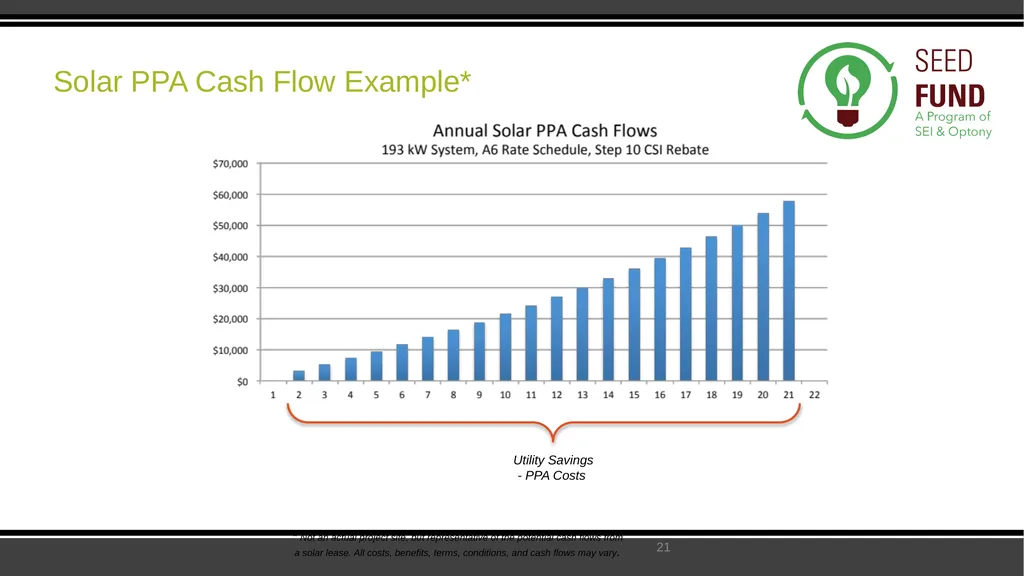
Solar PPA Cash Flow Example* 21 Utility Savings
- PPA Costs * Not an actual project site, but representative of the potential cash flows from a solar lease. All costs, benefits, terms, conditions, and cash flows may vary.<br>
- PPA Costs * Not an actual project site, but representative of the potential cash flows from a solar lease. All costs, benefits, terms, conditions, and cash flows may vary.<br>
22
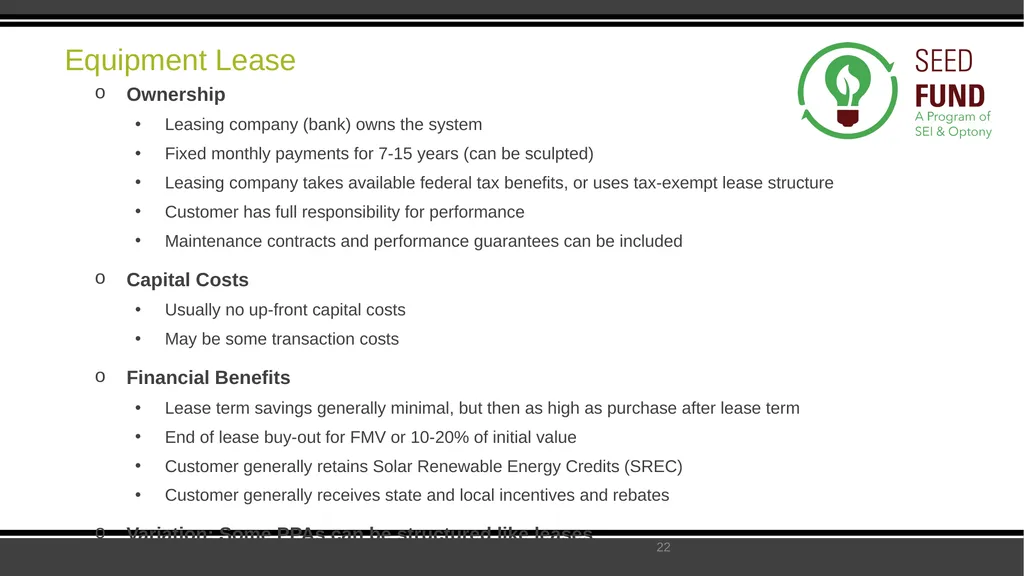
Equipment Lease Ownership
Leasing company (bank) owns the system
Fixed monthly payments for 7-15 years (can be sculpted)
Leasing company takes available federal tax benefits, or uses tax-exempt lease structure
Customer has full responsibility for performance
Maintenance contracts and performance guarantees can be included
Capital Costs
Usually no up-front capital costs
May be some transaction costs
Financial Benefits
Lease term savings generally minimal, but then as high as purchase after lease term
End of lease buy-out for FMV or 10-20% of initial value
Customer generally retains Solar Renewable Energy Credits (SREC)
Customer generally receives state and local incentives and rebates
Variation: Some PPAs can be structured like leases 22<br>
Leasing company (bank) owns the system
Fixed monthly payments for 7-15 years (can be sculpted)
Leasing company takes available federal tax benefits, or uses tax-exempt lease structure
Customer has full responsibility for performance
Maintenance contracts and performance guarantees can be included
Capital Costs
Usually no up-front capital costs
May be some transaction costs
Financial Benefits
Lease term savings generally minimal, but then as high as purchase after lease term
End of lease buy-out for FMV or 10-20% of initial value
Customer generally retains Solar Renewable Energy Credits (SREC)
Customer generally receives state and local incentives and rebates
Variation: Some PPAs can be structured like leases 22<br>
23
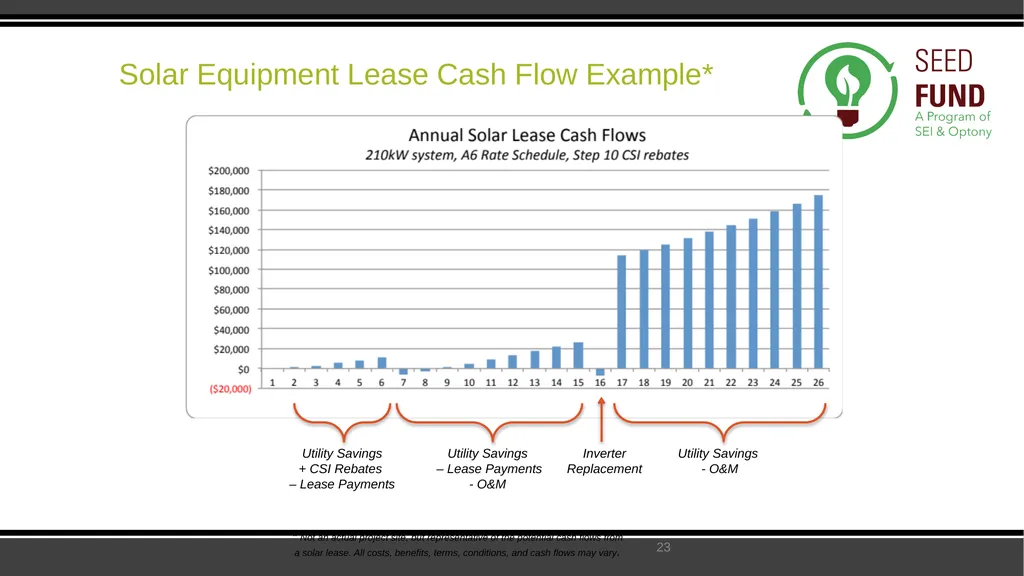
Solar Equipment Lease Cash Flow Example* Utility Savings
+ CSI Rebates
– Lease Payments Utility Savings
– Lease Payments
- O&M Utility Savings
- O&M Inverter
Replacement 23 * Not an actual project site, but representative of the potential cash flows from a solar lease. All costs, benefits, terms, conditions, and cash flows may vary.<br>
+ CSI Rebates
– Lease Payments Utility Savings
– Lease Payments
- O&M Utility Savings
- O&M Inverter
Replacement 23 * Not an actual project site, but representative of the potential cash flows from a solar lease. All costs, benefits, terms, conditions, and cash flows may vary.<br>
24
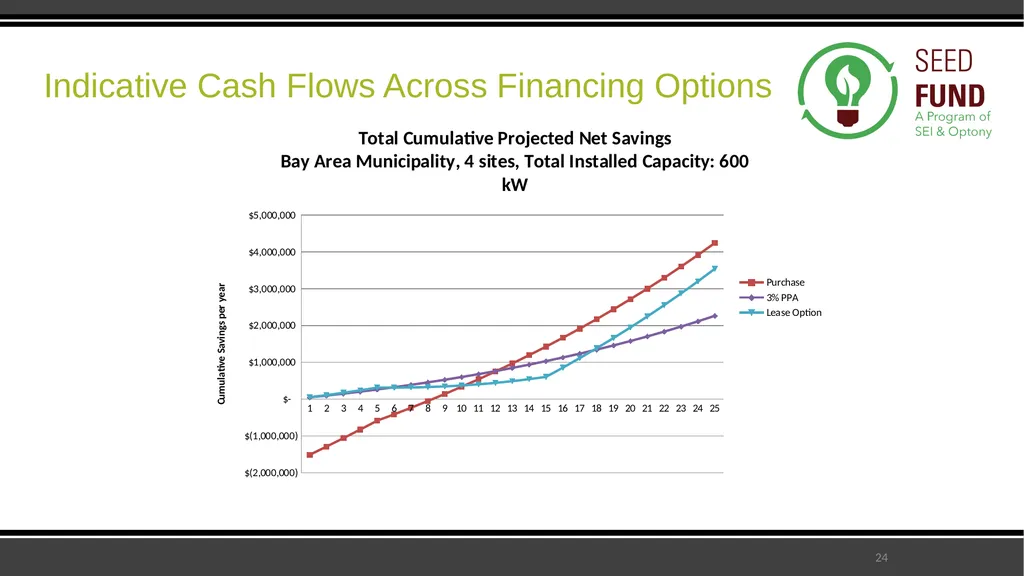
Indicative Cash Flows Across Financing Options 24<br>
25
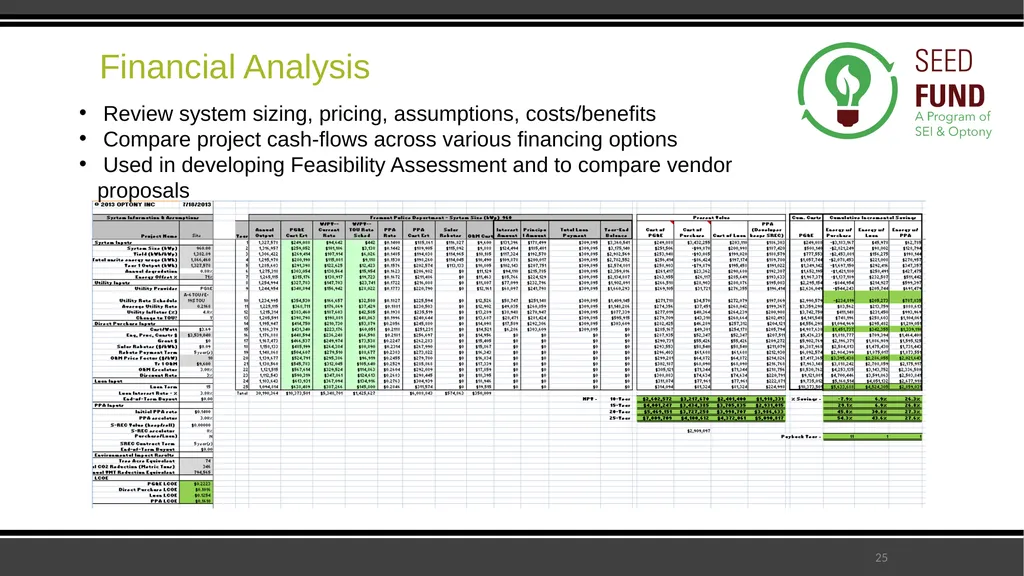
Financial Analysis 25 Review system sizing, pricing, assumptions, costs/benefits
Compare project cash-flows across various financing options
Used in developing Feasibility Assessment and to compare vendor proposals<br>
Compare project cash-flows across various financing options
Used in developing Feasibility Assessment and to compare vendor proposals<br>
26
Making the Case Feasibility studies demonstrate technical & economic potential
Compare realistic financing options and assumptions
Look for available incentives and programs to reduce costs
Anticipate questions and provide concrete examples
Involve key decision-makers early in the process
Show long-term cost savings can more than pay for the effort
Connect projects to local and regional sustainability plans
Link to state requirements for GHG reductions
Involve community members to help support clean energy
Include economic impact and job creation benefits 26<br>
Compare realistic financing options and assumptions
Look for available incentives and programs to reduce costs
Anticipate questions and provide concrete examples
Involve key decision-makers early in the process
Show long-term cost savings can more than pay for the effort
Connect projects to local and regional sustainability plans
Link to state requirements for GHG reductions
Involve community members to help support clean energy
Include economic impact and job creation benefits 26<br>
27
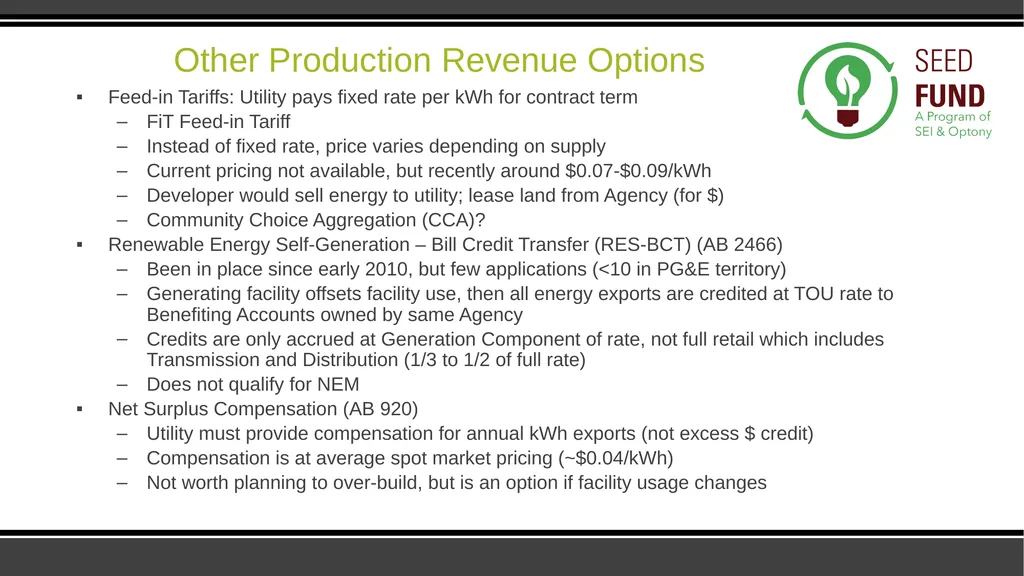
Other Production Revenue Options Feed-in Tariffs: Utility pays fixed rate per kWh for contract term
FiT Feed-in Tariff
Instead of fixed rate, price varies depending on supply
Current pricing not available, but recently around $0.07-$0.09/kWh
Developer would sell energy to utility; lease land from Agency (for $)
Community Choice Aggregation (CCA)?
Renewable Energy Self-Generation – Bill Credit Transfer (RES-BCT) (AB 2466)
Been in place since early 2010, but few applications (<10 in PG&E territory)
Generating facility offsets facility use, then all energy exports are credited at TOU rate to Benefiting Accounts owned by same Agency
Credits are only accrued at Generation Component of rate, not full retail which includes Transmission and Distribution (1/3 to 1/2 of full rate)
Does not qualify for NEM
Net Surplus Compensation (AB 920)
Utility must provide compensation for annual kWh exports (not excess $ credit)
Compensation is at average spot market pricing (~$0.04/kWh)
Not worth planning to over-build, but is an option if facility usage changes<br>
FiT Feed-in Tariff
Instead of fixed rate, price varies depending on supply
Current pricing not available, but recently around $0.07-$0.09/kWh
Developer would sell energy to utility; lease land from Agency (for $)
Community Choice Aggregation (CCA)?
Renewable Energy Self-Generation – Bill Credit Transfer (RES-BCT) (AB 2466)
Been in place since early 2010, but few applications (<10 in PG&E territory)
Generating facility offsets facility use, then all energy exports are credited at TOU rate to Benefiting Accounts owned by same Agency
Credits are only accrued at Generation Component of rate, not full retail which includes Transmission and Distribution (1/3 to 1/2 of full rate)
Does not qualify for NEM
Net Surplus Compensation (AB 920)
Utility must provide compensation for annual kWh exports (not excess $ credit)
Compensation is at average spot market pricing (~$0.04/kWh)
Not worth planning to over-build, but is an option if facility usage changes<br>
28
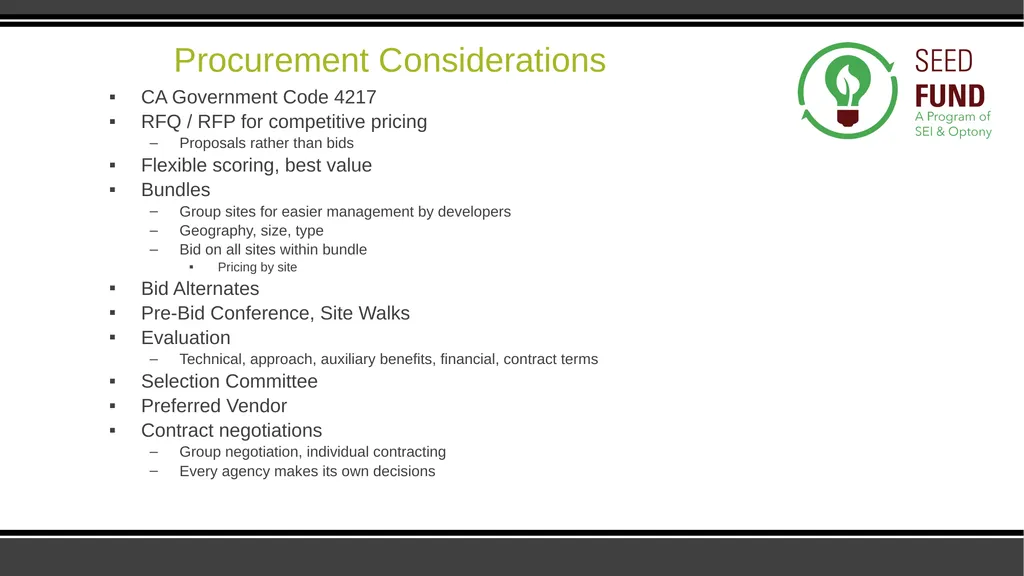
Procurement Considerations CA Government Code 4217
RFQ / RFP for competitive pricing
Proposals rather than bids
Flexible scoring, best value
Bundles
Group sites for easier management by developers
Geography, size, type
Bid on all sites within bundle
Pricing by site
Bid Alternates
Pre-Bid Conference, Site Walks
Evaluation
Technical, approach, auxiliary benefits, financial, contract terms
Selection Committee
Preferred Vendor
Contract negotiations
Group negotiation, individual contracting
Every agency makes its own decisions<br>
RFQ / RFP for competitive pricing
Proposals rather than bids
Flexible scoring, best value
Bundles
Group sites for easier management by developers
Geography, size, type
Bid on all sites within bundle
Pricing by site
Bid Alternates
Pre-Bid Conference, Site Walks
Evaluation
Technical, approach, auxiliary benefits, financial, contract terms
Selection Committee
Preferred Vendor
Contract negotiations
Group negotiation, individual contracting
Every agency makes its own decisions<br>
29
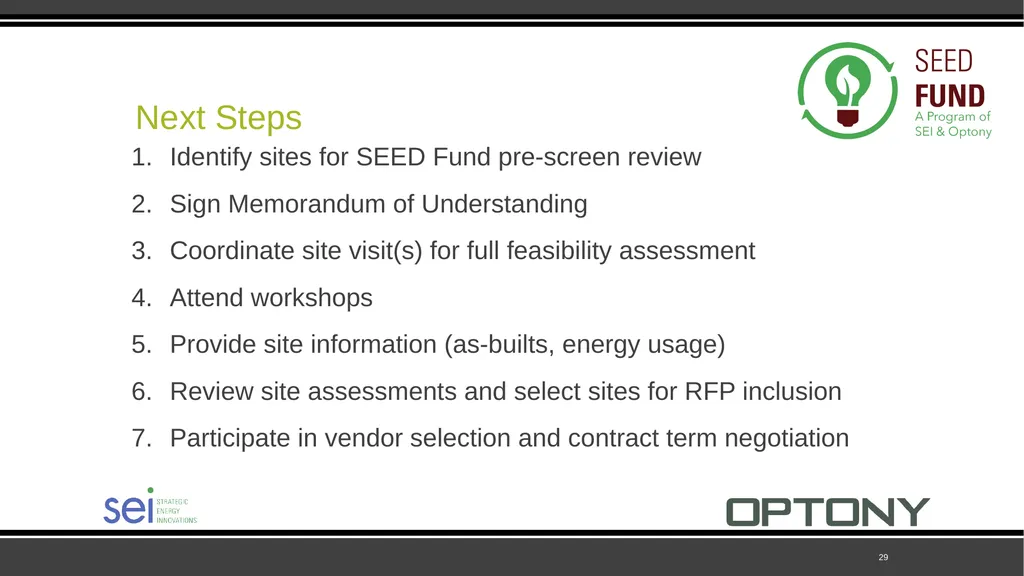
Next Steps Identify sites for SEED Fund pre-screen review
Sign Memorandum of Understanding
Coordinate site visit(s) for full feasibility assessment
Attend workshops
Provide site information (as-builts, energy usage)
Review site assessments and select sites for RFP inclusion
Participate in vendor selection and contract term negotiation 29<br>
Sign Memorandum of Understanding
Coordinate site visit(s) for full feasibility assessment
Attend workshops
Provide site information (as-builts, energy usage)
Review site assessments and select sites for RFP inclusion
Participate in vendor selection and contract term negotiation 29<br>
30
Contact Information 30 SEED Team
Meredith Anderson meredith@sierranevadaalliance.org
Sam Ruderman samruderman@sierranevadaalliance.org
Ray Jarvis rjarvis@cityofslt.us
Nathan McKenzie nathan@seiinc.org
Jonathan Whelan jonathan.whelan@optonyusa.com
Sam Hill-Cristol sam.hill-cristol@optonyusa.com
Sierra Business Council
Paul Ahrns pahrns@sierrabusiness.org
Simone Cordery-Cotter scordery-cotter@sbcouncil.org<br>
Meredith Anderson meredith@sierranevadaalliance.org
Sam Ruderman samruderman@sierranevadaalliance.org
Ray Jarvis rjarvis@cityofslt.us
Nathan McKenzie nathan@seiinc.org
Jonathan Whelan jonathan.whelan@optonyusa.com
Sam Hill-Cristol sam.hill-cristol@optonyusa.com
Sierra Business Council
Paul Ahrns pahrns@sierrabusiness.org
Simone Cordery-Cotter scordery-cotter@sbcouncil.org<br>