
Seeding Green Innovation: Lessons for SME Finance
CM
Published · 21 slides · 0 views

1 / 1

Description
Seeding Green Innovation: Lessons for SME Finance Policy and Practice from the UK Experience Presentation to University of Angers, 8th September, 2022 Robyn Owen Centre for Enterprise and Economic Development Research (CEEDR) Greenfin
Related Topics
Share
Embed code
Download this presentation From Below
"Seeding Green Innovation: Lessons for SME Finance" is the property of its rightful owner. Permission is granted to download and print the materials on this website for personal, non-commercial use only, and to display it on your personal computer provided you do not modify the materials and that you retain all copyright notices contained in the materials. By downloading content from our website, you accept the terms of this agreement.
Presentation Transcript
01
Seeding Green Innovation: Lessons for SME Finance Policy and Practice from the UK Experience Presentation to University of Angers, 8th September, 2022
Robyn Owen
Centre for Enterprise and Economic
Development Research (CEEDR) & Greenfin Research,
Middlesex University
r.owen@mdx.ac.uk
All views expressed in this presentation are those of the author CEEDR<br>
Robyn Owen
Centre for Enterprise and Economic
Development Research (CEEDR) & Greenfin Research,
Middlesex University
r.owen@mdx.ac.uk
All views expressed in this presentation are those of the author CEEDR<br>
02
Content:
About Greenfin research hub, Middlesex University
Projects and outputs
Seeding UK Green Innovation Finance
Q&A<br>
About Greenfin research hub, Middlesex University
Projects and outputs
Seeding UK Green Innovation Finance
Q&A<br>
03
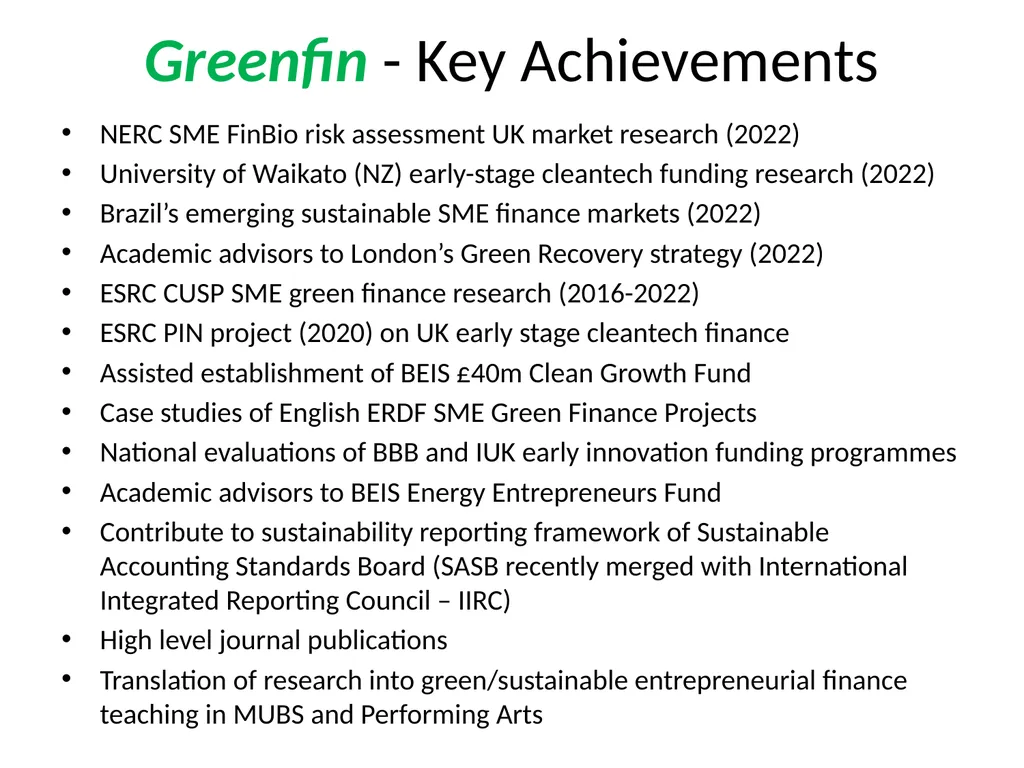
Greenfin - Key Achievements NERC SME FinBio risk assessment UK market research (2022)
University of Waikato (NZ) early-stage cleantech funding research (2022)
Brazil’s emerging sustainable SME finance markets (2022)
Academic advisors to London’s Green Recovery strategy (2022)
ESRC CUSP SME green finance research (2016-2022)
ESRC PIN project (2020) on UK early stage cleantech finance
Assisted establishment of BEIS £40m Clean Growth Fund
Case studies of English ERDF SME Green Finance Projects
National evaluations of BBB and IUK early innovation funding programmes
Academic advisors to BEIS Energy Entrepreneurs Fund
Contribute to sustainability reporting framework of Sustainable Accounting Standards Board (SASB recently merged with International Integrated Reporting Council – IIRC)
High level journal publications
Translation of research into green/sustainable entrepreneurial finance teaching in MUBS and Performing Arts<br>
University of Waikato (NZ) early-stage cleantech funding research (2022)
Brazil’s emerging sustainable SME finance markets (2022)
Academic advisors to London’s Green Recovery strategy (2022)
ESRC CUSP SME green finance research (2016-2022)
ESRC PIN project (2020) on UK early stage cleantech finance
Assisted establishment of BEIS £40m Clean Growth Fund
Case studies of English ERDF SME Green Finance Projects
National evaluations of BBB and IUK early innovation funding programmes
Academic advisors to BEIS Energy Entrepreneurs Fund
Contribute to sustainability reporting framework of Sustainable Accounting Standards Board (SASB recently merged with International Integrated Reporting Council – IIRC)
High level journal publications
Translation of research into green/sustainable entrepreneurial finance teaching in MUBS and Performing Arts<br>
04
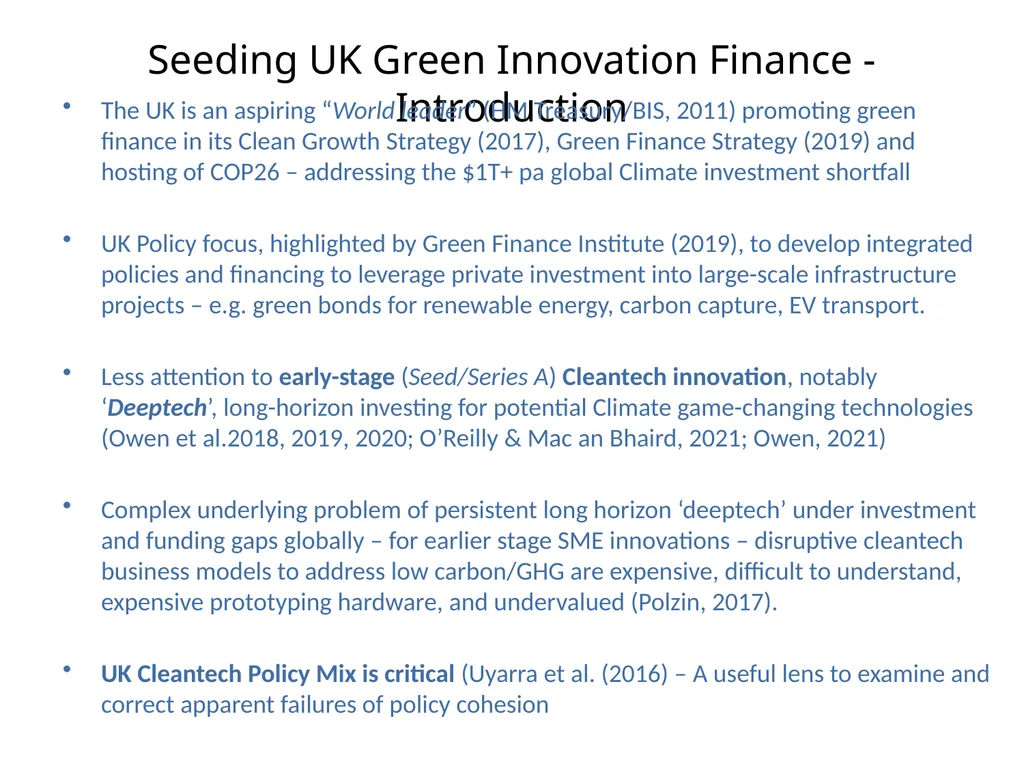
Seeding UK Green Innovation Finance - Introduction The UK is an aspiring “World leader” (HM Treasury/BIS, 2011) promoting green finance in its Clean Growth Strategy (2017), Green Finance Strategy (2019) and hosting of COP26 – addressing the $1T+ pa global Climate investment shortfall
UK Policy focus, highlighted by Green Finance Institute (2019), to develop integrated policies and financing to leverage private investment into large-scale infrastructure projects – e.g. green bonds for renewable energy, carbon capture, EV transport.
Less attention to early-stage (Seed/Series A) Cleantech innovation, notably ‘Deeptech’, long-horizon investing for potential Climate game-changing technologies (Owen et al.2018, 2019, 2020; O’Reilly & Mac an Bhaird, 2021; Owen, 2021)
Complex underlying problem of persistent long horizon ‘deeptech’ under investment and funding gaps globally – for earlier stage SME innovations – disruptive cleantech business models to address low carbon/GHG are expensive, difficult to understand, expensive prototyping hardware, and undervalued (Polzin, 2017).
UK Cleantech Policy Mix is critical (Uyarra et al. (2016) – A useful lens to examine and correct apparent failures of policy cohesion<br>
UK Policy focus, highlighted by Green Finance Institute (2019), to develop integrated policies and financing to leverage private investment into large-scale infrastructure projects – e.g. green bonds for renewable energy, carbon capture, EV transport.
Less attention to early-stage (Seed/Series A) Cleantech innovation, notably ‘Deeptech’, long-horizon investing for potential Climate game-changing technologies (Owen et al.2018, 2019, 2020; O’Reilly & Mac an Bhaird, 2021; Owen, 2021)
Complex underlying problem of persistent long horizon ‘deeptech’ under investment and funding gaps globally – for earlier stage SME innovations – disruptive cleantech business models to address low carbon/GHG are expensive, difficult to understand, expensive prototyping hardware, and undervalued (Polzin, 2017).
UK Cleantech Policy Mix is critical (Uyarra et al. (2016) – A useful lens to examine and correct apparent failures of policy cohesion<br>
05
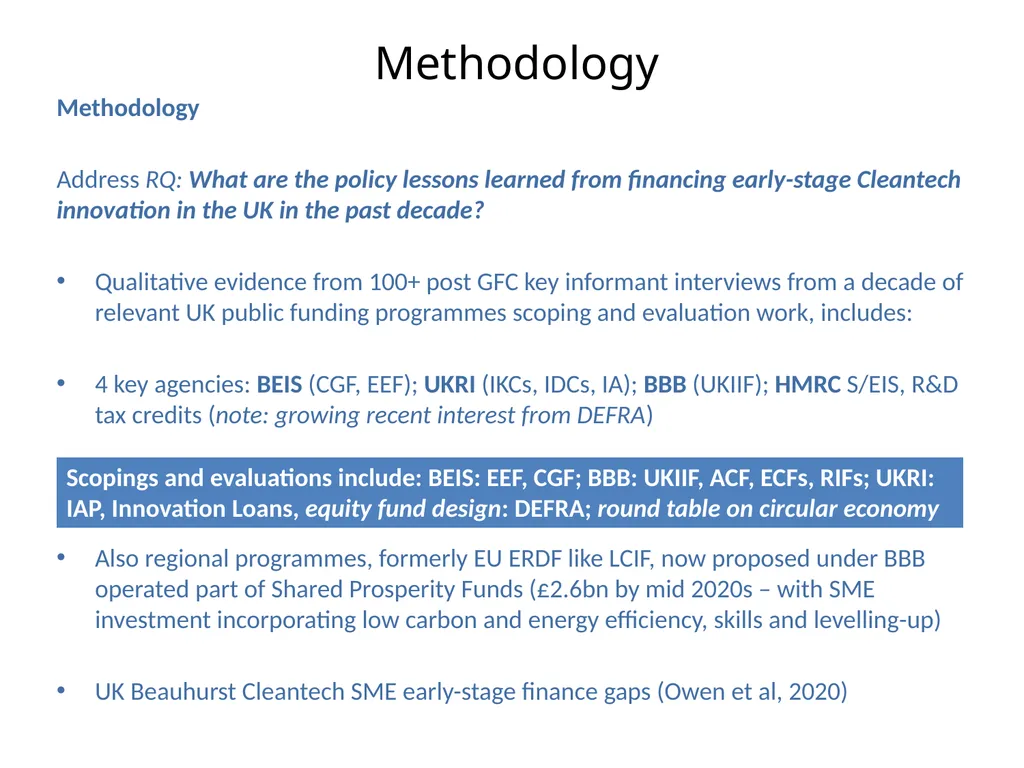
Methodology Methodology
Address RQ: What are the policy lessons learned from financing early-stage Cleantech innovation in the UK in the past decade?
Qualitative evidence from 100+ post GFC key informant interviews from a decade of relevant UK public funding programmes scoping and evaluation work, includes:
4 key agencies: BEIS (CGF, EEF); UKRI (IKCs, IDCs, IA); BBB (UKIIF); HMRC S/EIS, R&D tax credits (note: growing recent interest from DEFRA)
Also regional programmes, formerly EU ERDF like LCIF, now proposed under BBB operated part of Shared Prosperity Funds (£2.6bn by mid 2020s – with SME investment incorporating low carbon and energy efficiency, skills and levelling-up)
UK Beauhurst Cleantech SME early-stage finance gaps (Owen et al, 2020)<br>
Address RQ: What are the policy lessons learned from financing early-stage Cleantech innovation in the UK in the past decade?
Qualitative evidence from 100+ post GFC key informant interviews from a decade of relevant UK public funding programmes scoping and evaluation work, includes:
4 key agencies: BEIS (CGF, EEF); UKRI (IKCs, IDCs, IA); BBB (UKIIF); HMRC S/EIS, R&D tax credits (note: growing recent interest from DEFRA)
Also regional programmes, formerly EU ERDF like LCIF, now proposed under BBB operated part of Shared Prosperity Funds (£2.6bn by mid 2020s – with SME investment incorporating low carbon and energy efficiency, skills and levelling-up)
UK Beauhurst Cleantech SME early-stage finance gaps (Owen et al, 2020)<br>
06
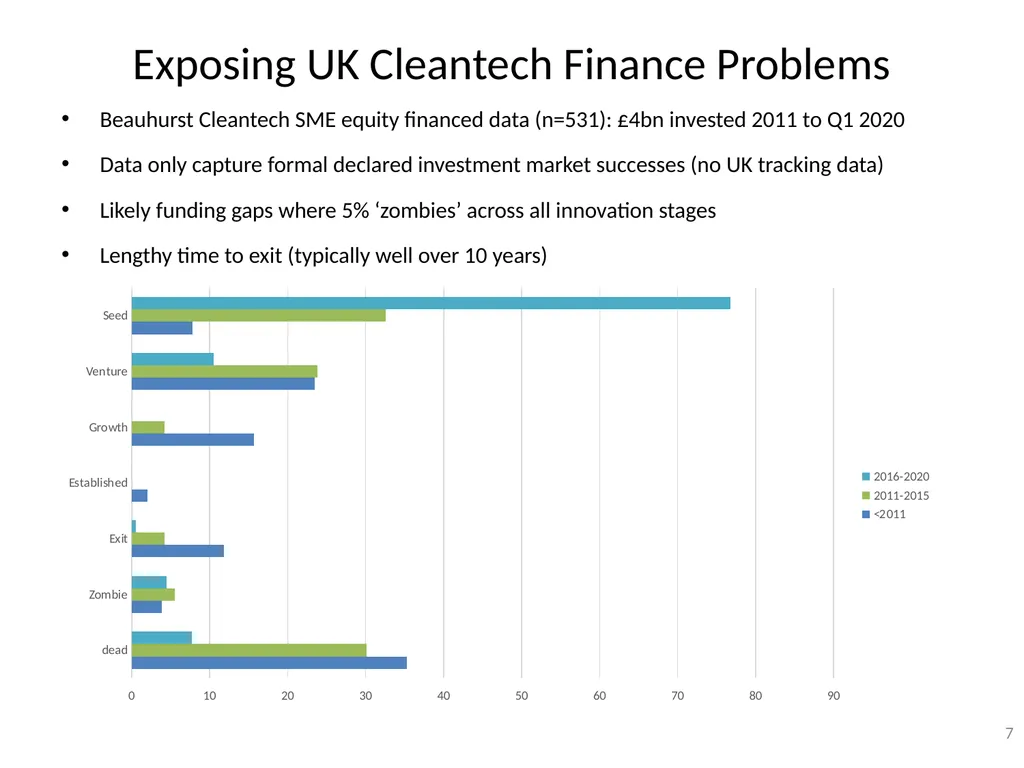
Exposing UK Cleantech Finance Problems Beauhurst Cleantech SME equity financed data (n=531): £4bn invested 2011 to Q1 2020
Data only capture formal declared investment market successes (no UK tracking data)
Likely funding gaps where 5% ‘zombies’ across all innovation stages
Lengthy time to exit (typically well over 10 years) 7<br>
Data only capture formal declared investment market successes (no UK tracking data)
Likely funding gaps where 5% ‘zombies’ across all innovation stages
Lengthy time to exit (typically well over 10 years) 7<br>
07
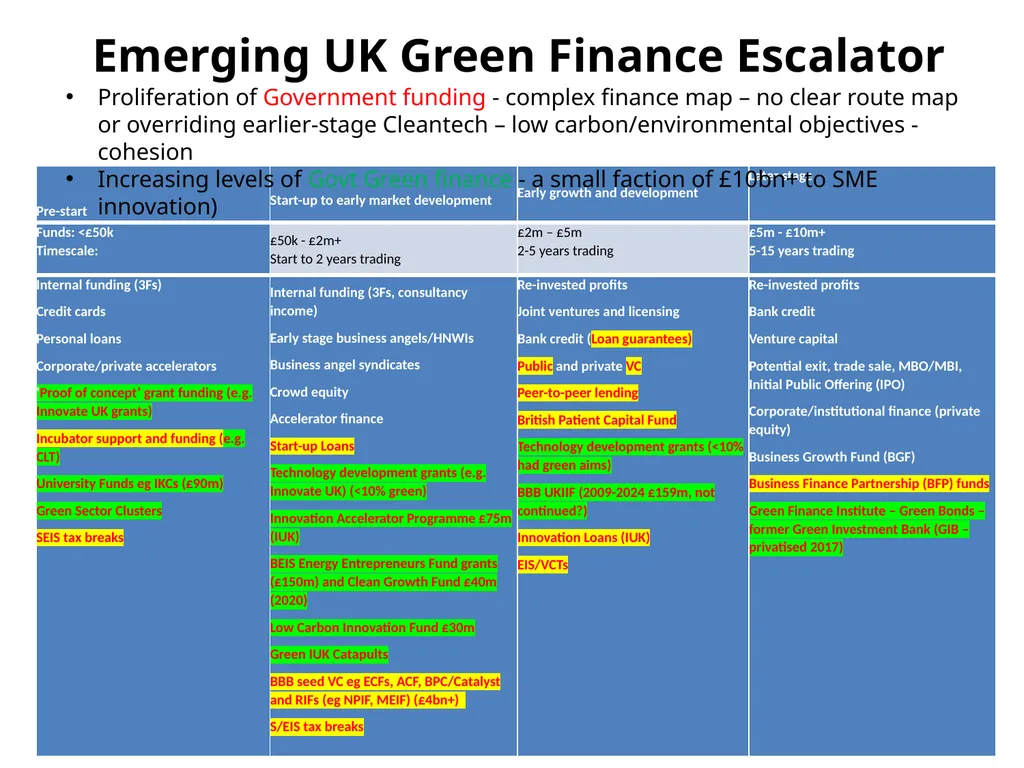
Emerging UK Green Finance Escalator Proliferation of Government funding - complex finance map – no clear route map or overriding earlier-stage Cleantech – low carbon/environmental objectives - cohesion
Increasing levels of Govt Green finance - a small faction of £10bn+ to SME innovation)<br>
Increasing levels of Govt Green finance - a small faction of £10bn+ to SME innovation)<br>
08
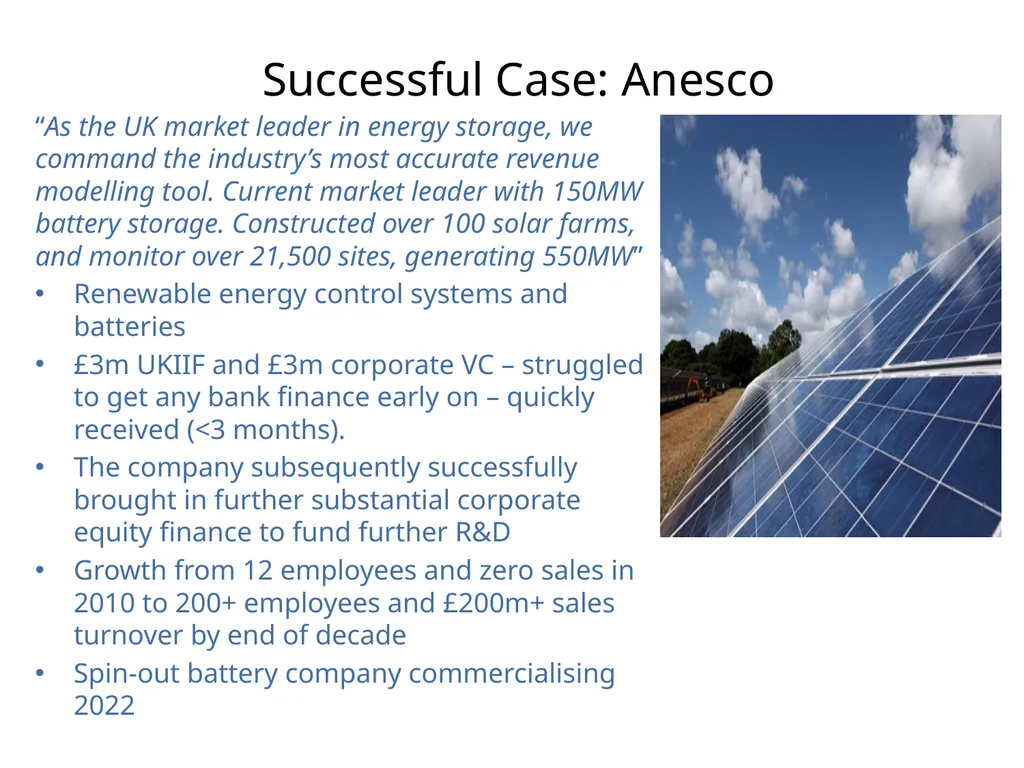
Successful Case: Anesco “As the UK market leader in energy storage, we command the industry’s most accurate revenue modelling tool. Current market leader with 150MW battery storage. Constructed over 100 solar farms, and monitor over 21,500 sites, generating 550MW”
Renewable energy control systems and batteries
£3m UKIIF and £3m corporate VC – struggled to get any bank finance early on – quickly received (<3 months).
The company subsequently successfully brought in further substantial corporate equity finance to fund further R&D
Growth from 12 employees and zero sales in 2010 to 200+ employees and £200m+ sales turnover by end of decade
Spin-out battery company commercialising 2022<br>
Renewable energy control systems and batteries
£3m UKIIF and £3m corporate VC – struggled to get any bank finance early on – quickly received (<3 months).
The company subsequently successfully brought in further substantial corporate equity finance to fund further R&D
Growth from 12 employees and zero sales in 2010 to 200+ employees and £200m+ sales turnover by end of decade
Spin-out battery company commercialising 2022<br>
09
Less Successful Case: Keld Energy Cleantech biomass later-stage R&D and early commercialisation of patented biomass energy technology
Received initial grant of £190k from Carbon Trust for PoC and £500k angel finance for early R&D (2005-2009)
bootstrapped whilst unsuccessful in seeking equity finance
Shift to licencing models with client paying for the capital build cost. Grown from 2 staff and no income to 4 staff and £1.5m in 2015 and further £3m in orders for 2016
No subsequent growth or development – 4 staff surviving on consultancy in green energy construction work – A lost opportunity?<br>
Received initial grant of £190k from Carbon Trust for PoC and £500k angel finance for early R&D (2005-2009)
bootstrapped whilst unsuccessful in seeking equity finance
Shift to licencing models with client paying for the capital build cost. Grown from 2 staff and no income to 4 staff and £1.5m in 2015 and further £3m in orders for 2016
No subsequent growth or development – 4 staff surviving on consultancy in green energy construction work – A lost opportunity?<br>
10
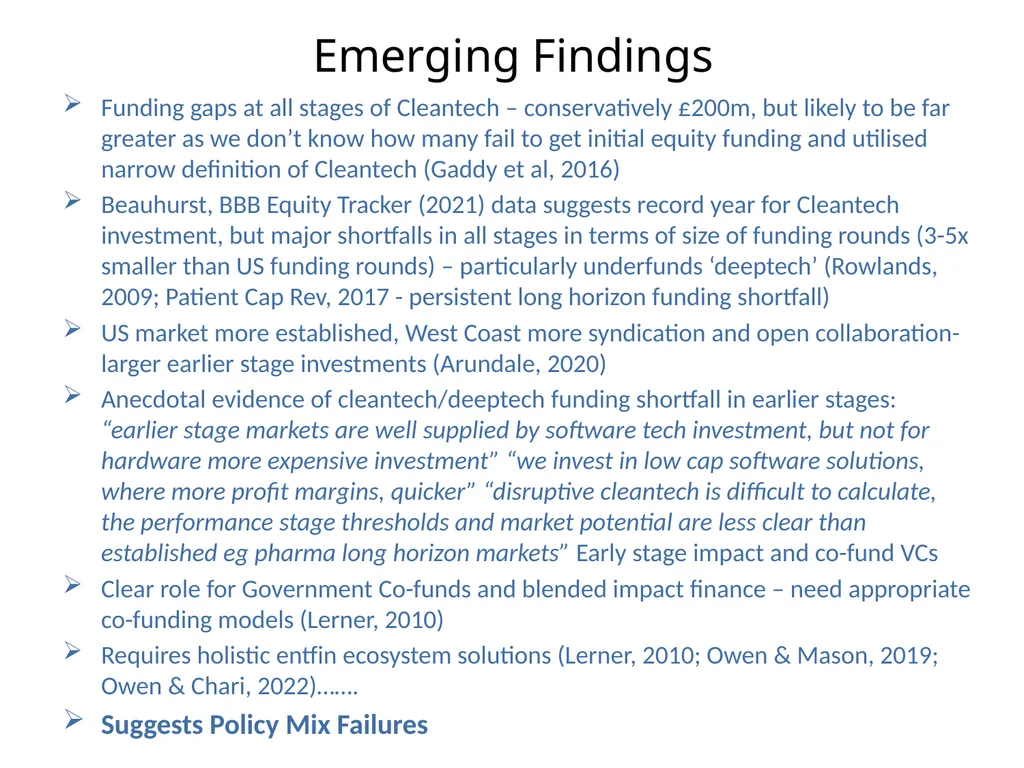
Emerging Findings Funding gaps at all stages of Cleantech – conservatively £200m, but likely to be far greater as we don’t know how many fail to get initial equity funding and utilised narrow definition of Cleantech (Gaddy et al, 2016)
Beauhurst, BBB Equity Tracker (2021) data suggests record year for Cleantech investment, but major shortfalls in all stages in terms of size of funding rounds (3-5x smaller than US funding rounds) – particularly underfunds ‘deeptech’ (Rowlands, 2009; Patient Cap Rev, 2017 - persistent long horizon funding shortfall)
US market more established, West Coast more syndication and open collaboration- larger earlier stage investments (Arundale, 2020)
Anecdotal evidence of cleantech/deeptech funding shortfall in earlier stages: “earlier stage markets are well supplied by software tech investment, but not for hardware more expensive investment” “we invest in low cap software solutions, where more profit margins, quicker” “disruptive cleantech is difficult to calculate, the performance stage thresholds and market potential are less clear than established eg pharma long horizon markets” Early stage impact and co-fund VCs
Clear role for Government Co-funds and blended impact finance – need appropriate co-funding models (Lerner, 2010)
Requires holistic entfin ecosystem solutions (Lerner, 2010; Owen & Mason, 2019; Owen & Chari, 2022)…….
Suggests Policy Mix Failures<br>
Beauhurst, BBB Equity Tracker (2021) data suggests record year for Cleantech investment, but major shortfalls in all stages in terms of size of funding rounds (3-5x smaller than US funding rounds) – particularly underfunds ‘deeptech’ (Rowlands, 2009; Patient Cap Rev, 2017 - persistent long horizon funding shortfall)
US market more established, West Coast more syndication and open collaboration- larger earlier stage investments (Arundale, 2020)
Anecdotal evidence of cleantech/deeptech funding shortfall in earlier stages: “earlier stage markets are well supplied by software tech investment, but not for hardware more expensive investment” “we invest in low cap software solutions, where more profit margins, quicker” “disruptive cleantech is difficult to calculate, the performance stage thresholds and market potential are less clear than established eg pharma long horizon markets” Early stage impact and co-fund VCs
Clear role for Government Co-funds and blended impact finance – need appropriate co-funding models (Lerner, 2010)
Requires holistic entfin ecosystem solutions (Lerner, 2010; Owen & Mason, 2019; Owen & Chari, 2022)…….
Suggests Policy Mix Failures<br>
11
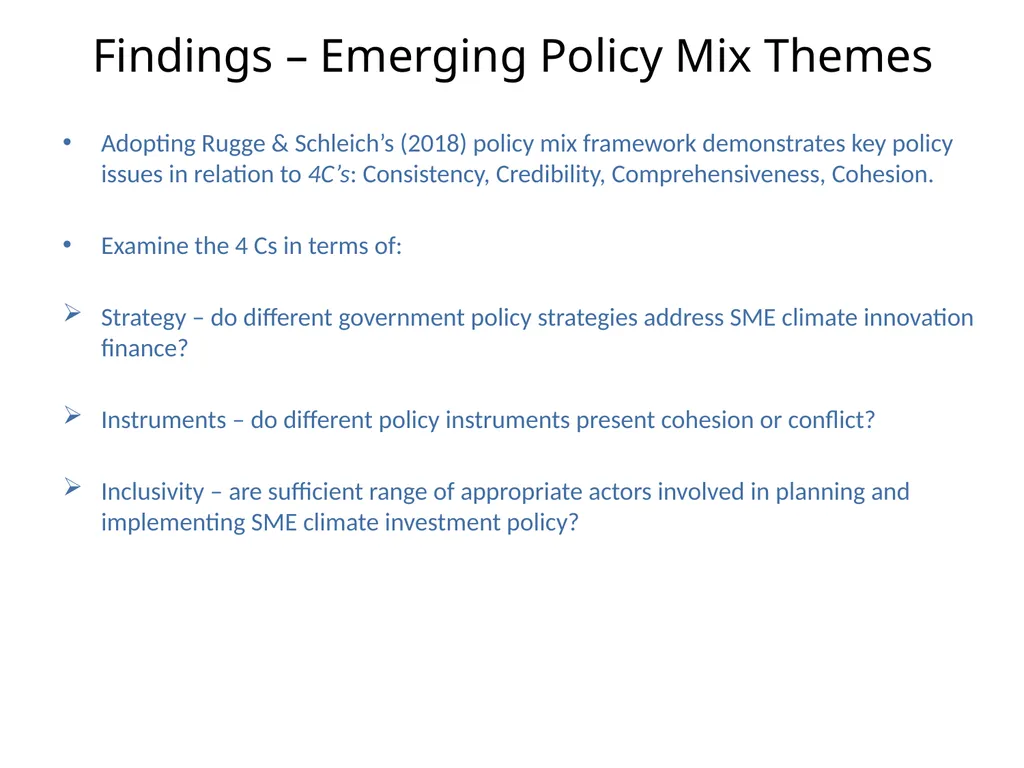
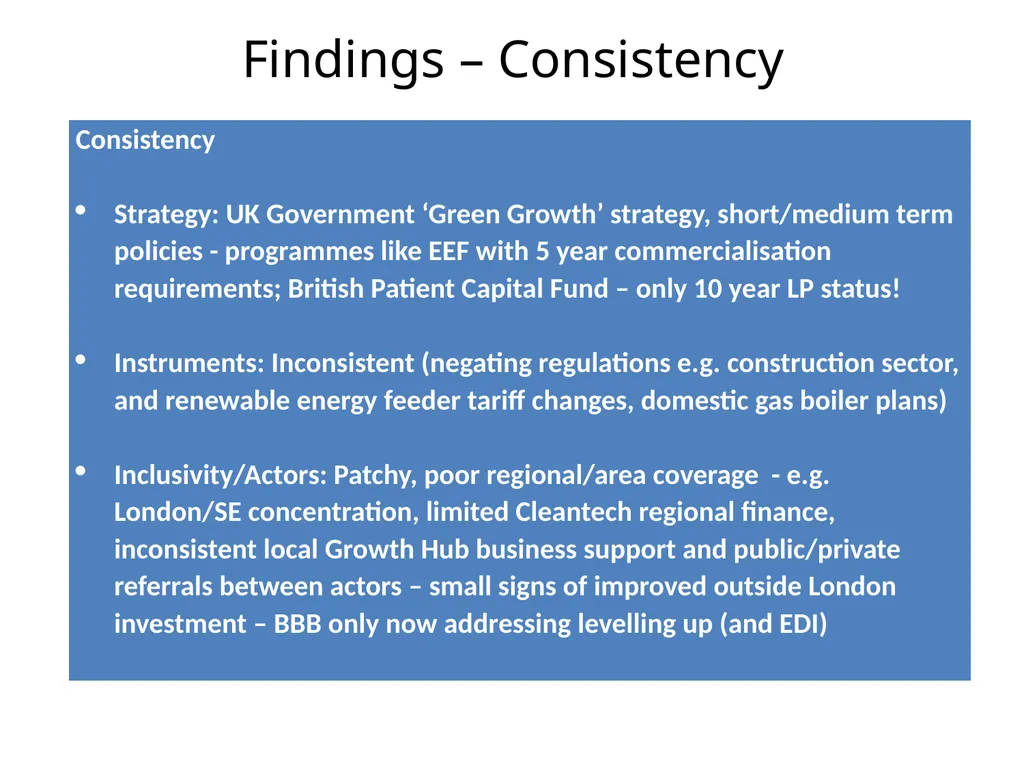
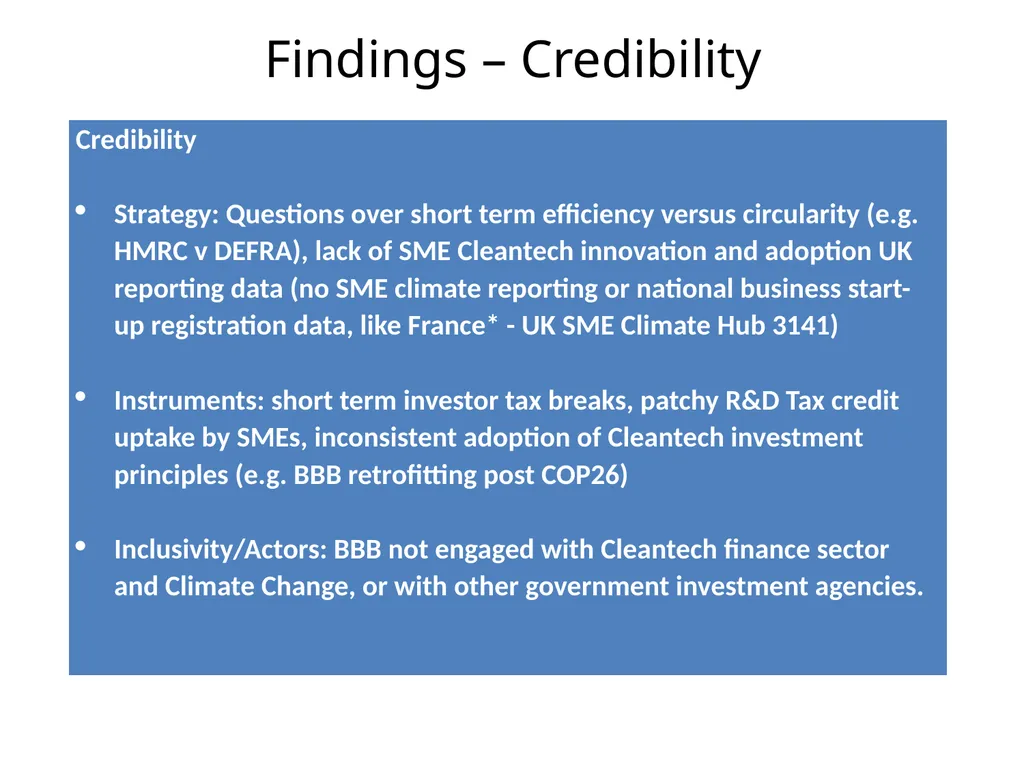
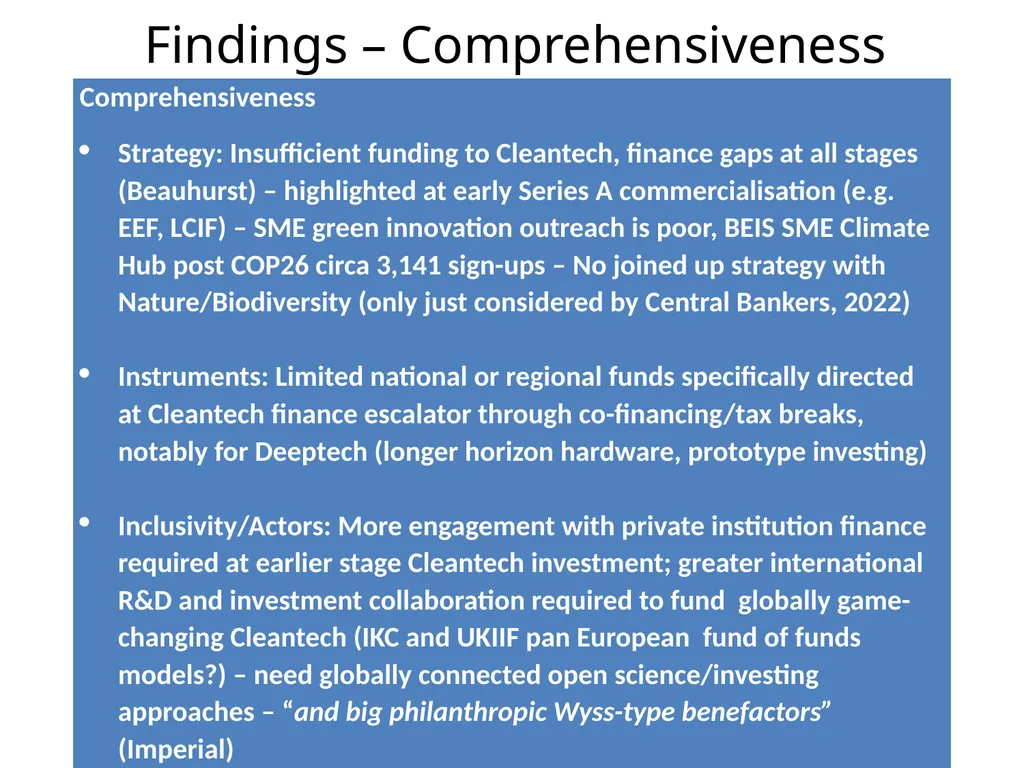
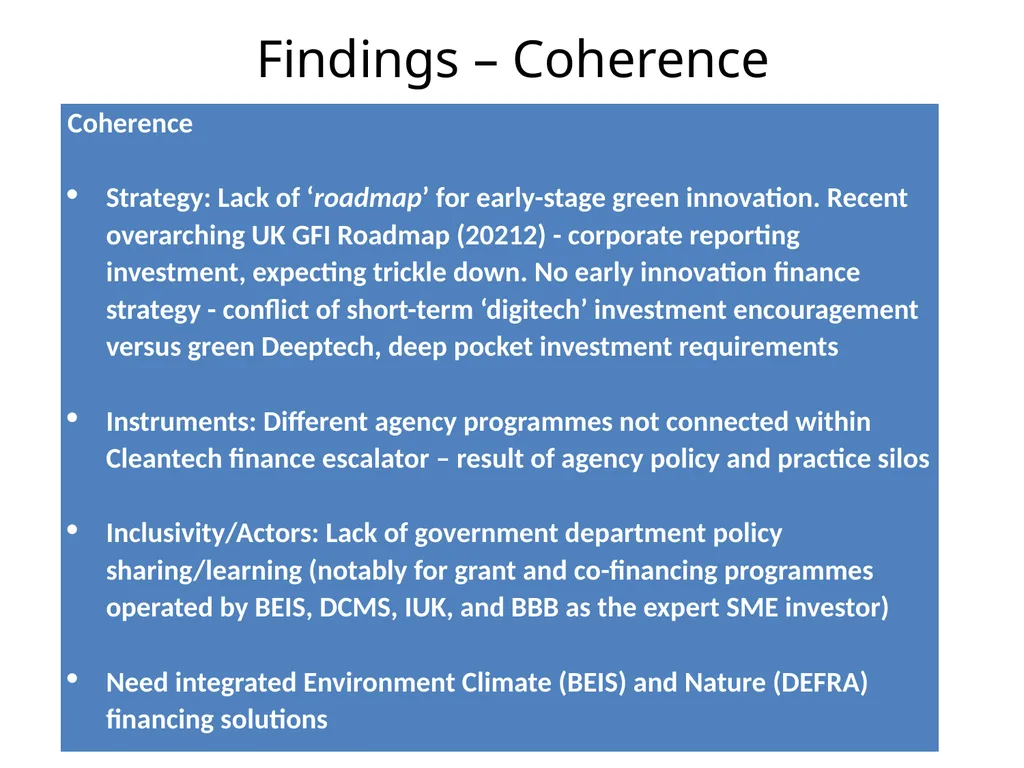
Findings – Emerging Policy Mix Themes Adopting Rugge & Schleich’s (2018) policy mix framework demonstrates key policy issues in relation to 4C’s: Consistency, Credibility, Comprehensiveness, Cohesion.
Examine the 4 Cs in terms of:
Strategy – do different government policy strategies address SME climate innovation finance?
Instruments – do different policy instruments present cohesion or conflict?
Inclusivity – are sufficient range of appropriate actors involved in planning and implementing SME climate investment policy?<br>
Examine the 4 Cs in terms of:
Strategy – do different government policy strategies address SME climate innovation finance?
Instruments – do different policy instruments present cohesion or conflict?
Inclusivity – are sufficient range of appropriate actors involved in planning and implementing SME climate investment policy?<br>
12
Findings – Consistency<br>
13
Findings – Credibility<br>
14
Findings – Comprehensiveness<br>
15
Findings – Coherence<br>
16
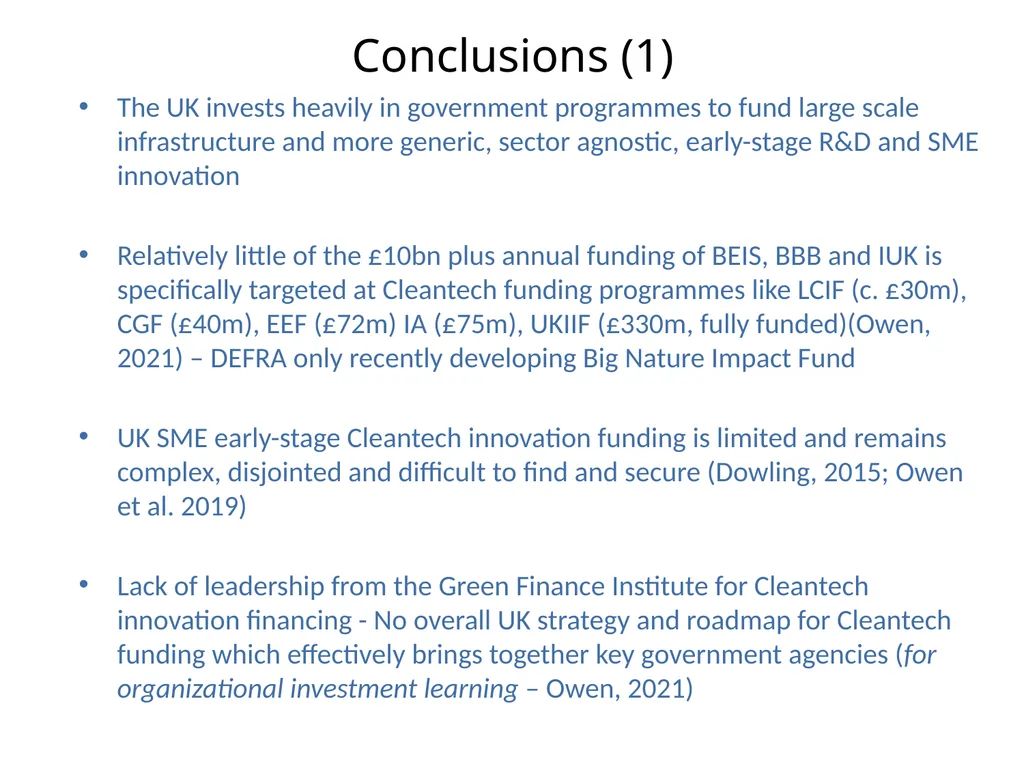
Conclusions (1) The UK invests heavily in government programmes to fund large scale infrastructure and more generic, sector agnostic, early-stage R&D and SME innovation
Relatively little of the £10bn plus annual funding of BEIS, BBB and IUK is specifically targeted at Cleantech funding programmes like LCIF (c. £30m), CGF (£40m), EEF (£72m) IA (£75m), UKIIF (£330m, fully funded)(Owen, 2021) – DEFRA only recently developing Big Nature Impact Fund
UK SME early-stage Cleantech innovation funding is limited and remains complex, disjointed and difficult to find and secure (Dowling, 2015; Owen et al. 2019)
Lack of leadership from the Green Finance Institute for Cleantech innovation financing - No overall UK strategy and roadmap for Cleantech funding which effectively brings together key government agencies (for organizational investment learning – Owen, 2021)<br>
Relatively little of the £10bn plus annual funding of BEIS, BBB and IUK is specifically targeted at Cleantech funding programmes like LCIF (c. £30m), CGF (£40m), EEF (£72m) IA (£75m), UKIIF (£330m, fully funded)(Owen, 2021) – DEFRA only recently developing Big Nature Impact Fund
UK SME early-stage Cleantech innovation funding is limited and remains complex, disjointed and difficult to find and secure (Dowling, 2015; Owen et al. 2019)
Lack of leadership from the Green Finance Institute for Cleantech innovation financing - No overall UK strategy and roadmap for Cleantech funding which effectively brings together key government agencies (for organizational investment learning – Owen, 2021)<br>
17
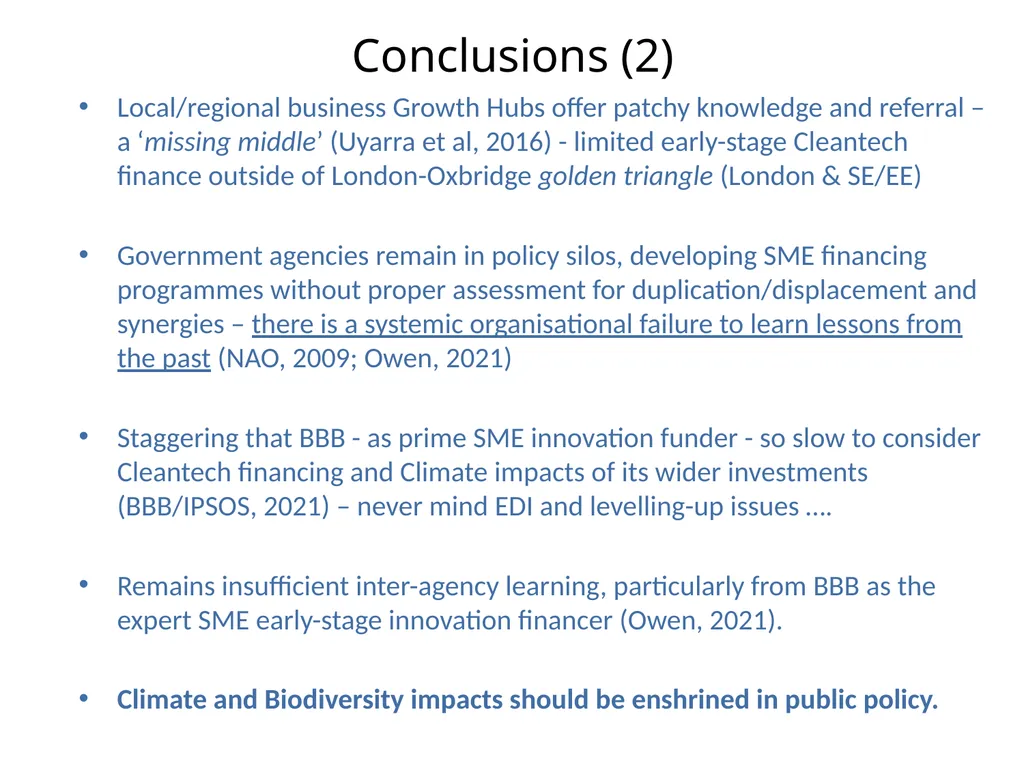
Conclusions (2) Local/regional business Growth Hubs offer patchy knowledge and referral – a ‘missing middle’ (Uyarra et al, 2016) - limited early-stage Cleantech finance outside of London-Oxbridge golden triangle (London & SE/EE)
Government agencies remain in policy silos, developing SME financing programmes without proper assessment for duplication/displacement and synergies – there is a systemic organisational failure to learn lessons from the past (NAO, 2009; Owen, 2021)
Staggering that BBB - as prime SME innovation funder - so slow to consider Cleantech financing and Climate impacts of its wider investments (BBB/IPSOS, 2021) – never mind EDI and levelling-up issues ….
Remains insufficient inter-agency learning, particularly from BBB as the expert SME early-stage innovation financer (Owen, 2021).
Climate and Biodiversity impacts should be enshrined in public policy.<br>
Government agencies remain in policy silos, developing SME financing programmes without proper assessment for duplication/displacement and synergies – there is a systemic organisational failure to learn lessons from the past (NAO, 2009; Owen, 2021)
Staggering that BBB - as prime SME innovation funder - so slow to consider Cleantech financing and Climate impacts of its wider investments (BBB/IPSOS, 2021) – never mind EDI and levelling-up issues ….
Remains insufficient inter-agency learning, particularly from BBB as the expert SME early-stage innovation financer (Owen, 2021).
Climate and Biodiversity impacts should be enshrined in public policy.<br>
18
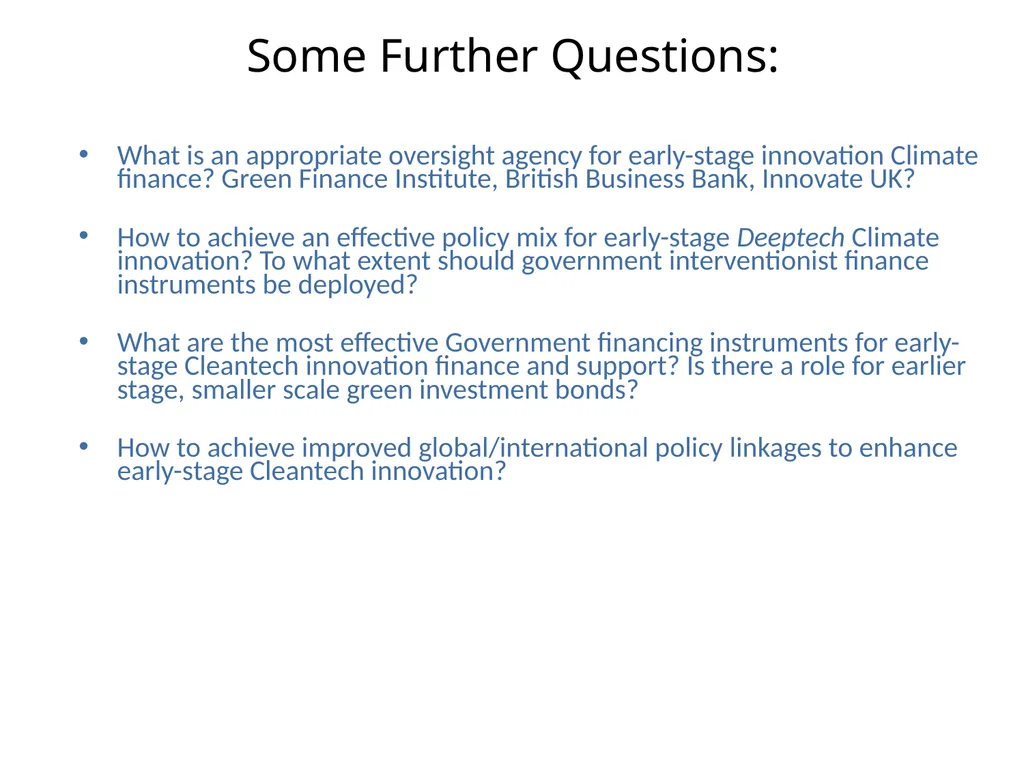
Some Further Questions: What is an appropriate oversight agency for early-stage innovation Climate finance? Green Finance Institute, British Business Bank, Innovate UK?
How to achieve an effective policy mix for early-stage Deeptech Climate innovation? To what extent should government interventionist finance instruments be deployed?
What are the most effective Government financing instruments for early-stage Cleantech innovation finance and support? Is there a role for earlier stage, smaller scale green investment bonds?
How to achieve improved global/international policy linkages to enhance early-stage Cleantech innovation?<br>
How to achieve an effective policy mix for early-stage Deeptech Climate innovation? To what extent should government interventionist finance instruments be deployed?
What are the most effective Government financing instruments for early-stage Cleantech innovation finance and support? Is there a role for earlier stage, smaller scale green investment bonds?
How to achieve improved global/international policy linkages to enhance early-stage Cleantech innovation?<br>
19
References:
Harrer T and Owen R (2022) Reducing early-stage Cleantech funding gaps: an exploration of the role of Environmental Performance Indicators. International Journal of Entrepreneurial Behaviour and Research 28(9): 268-288
Owen, Robyn and Vedanthachari, Lakshmi Narasimhan (2022) Exploring the Role of UK Government Policy in Developing the University Entrepreneurial Finance Ecosystem for Cleantech. IEEE Transactions on Engineering Management
Pierrakis Y and R Owen 2022. Startup ventures and equity finance: How do Business Accelerators and Business Angels assess the human capital of socio-environmental mission led entrepreneurs? In: Innovation. DOI: 10.1080/14479338.2022.2029706
Hussain, Javed; Karimu, Amin; Salia, Samuel; Owen, Robyn (2022) “Does the cost of energy matter for innovation? The effects of energy prices on SME innovation in Sub-Saharan Africa” International Journal of Entrepreneurial Behavior & Research
Owen R (2021) Lessons from Government Venture Capital to Enable Transition to a Low Carbon Economy: The UK Case (forthcoming) IEEE Transaction on Engineering Management
Owen R, Harrer T, Lodh S, Mair S, Pates R, Pikkat K (2020) Redefining SME Productivity Measurement and Assessment for a Low Carbon Economy. Productivity Insights Network Report. PIN-DRAFT-FINAL-Report-30-09-2020-RO-TH-1.pdf (productivityinsightsnetwork.co.uk)
Owen R, Lehner O, Lyon F and Brennan G (2020a) Early Stage Investing in Green SMEs: The Case of the UK. ACRN Oxford Journal of Finance and Risk Perspectives 8, 163-182
Owen R, Lyon F, and Brennan G (2018) Enabling investment for the transition to a low carbon economy: Government policy to finance early stage green innovation. Current Opinion in Environmental Sustainability Special Issue for the Intergovernmental Panel on Climate Change (IPCC) Vol31: 137-145
Rogge K & Schleich J (2018) Do Policy Mix Characteristics Matter for Low Carbon Innovations? Research Policy 47: 1639-1654
Uyarra E., Shapira P & Harding A (2016) Low Carbon Innovations and enterprise Growth in the UK: Challenges of a Place-Blind Policy Mix. Technology Strategy and Social Forecasting 103: 264-272<br>
Harrer T and Owen R (2022) Reducing early-stage Cleantech funding gaps: an exploration of the role of Environmental Performance Indicators. International Journal of Entrepreneurial Behaviour and Research 28(9): 268-288
Owen, Robyn and Vedanthachari, Lakshmi Narasimhan (2022) Exploring the Role of UK Government Policy in Developing the University Entrepreneurial Finance Ecosystem for Cleantech. IEEE Transactions on Engineering Management
Pierrakis Y and R Owen 2022. Startup ventures and equity finance: How do Business Accelerators and Business Angels assess the human capital of socio-environmental mission led entrepreneurs? In: Innovation. DOI: 10.1080/14479338.2022.2029706
Hussain, Javed; Karimu, Amin; Salia, Samuel; Owen, Robyn (2022) “Does the cost of energy matter for innovation? The effects of energy prices on SME innovation in Sub-Saharan Africa” International Journal of Entrepreneurial Behavior & Research
Owen R (2021) Lessons from Government Venture Capital to Enable Transition to a Low Carbon Economy: The UK Case (forthcoming) IEEE Transaction on Engineering Management
Owen R, Harrer T, Lodh S, Mair S, Pates R, Pikkat K (2020) Redefining SME Productivity Measurement and Assessment for a Low Carbon Economy. Productivity Insights Network Report. PIN-DRAFT-FINAL-Report-30-09-2020-RO-TH-1.pdf (productivityinsightsnetwork.co.uk)
Owen R, Lehner O, Lyon F and Brennan G (2020a) Early Stage Investing in Green SMEs: The Case of the UK. ACRN Oxford Journal of Finance and Risk Perspectives 8, 163-182
Owen R, Lyon F, and Brennan G (2018) Enabling investment for the transition to a low carbon economy: Government policy to finance early stage green innovation. Current Opinion in Environmental Sustainability Special Issue for the Intergovernmental Panel on Climate Change (IPCC) Vol31: 137-145
Rogge K & Schleich J (2018) Do Policy Mix Characteristics Matter for Low Carbon Innovations? Research Policy 47: 1639-1654
Uyarra E., Shapira P & Harding A (2016) Low Carbon Innovations and enterprise Growth in the UK: Challenges of a Place-Blind Policy Mix. Technology Strategy and Social Forecasting 103: 264-272<br>
20
Thank you for attending. For further information and updates on current research of Middlesex University GreenFin - green and sustainable finance research cluster
GreenFin Research | Middlesex University London (mdx.ac.uk)
Current project: SME Financing for Biodiversity: Building Nature Measurement and Impacts into SME Financing (‘SME FinBio’) | Middlesex University London (mdx.ac.uk)
Please contact Robyn Owen: r.owen@mdx.ac.uk<br>
GreenFin Research | Middlesex University London (mdx.ac.uk)
Current project: SME Financing for Biodiversity: Building Nature Measurement and Impacts into SME Financing (‘SME FinBio’) | Middlesex University London (mdx.ac.uk)
Please contact Robyn Owen: r.owen@mdx.ac.uk<br>