
Self-Harm Suicidal Ideation Shanna Pochatko, CPC,




Description: Self-Harm Suicidal Ideation Shanna Pochatko, CPC, CDEO, CPMA,CPMA-I Jennifer Johnson, CPC, CPB, CPMA October 2025 Suicide The Devastating Aftermath Charting the Crisis This presentation incorporates information from the International
Related Topics
Download Presentation
"Self-Harm Suicidal Ideation Shanna Pochatko, CPC," is the property of its rightful owner. Permission is granted to download and print the materials on this website for personal, non-commercial use only, and to display it on your personal computer provided you do not modify the materials and that you retain all copyright notices contained in the materials. By downloading content from our website, you accept the terms of this agreement.
Presentation Transcript
slide1. Self-Harm
Suicidal Ideation Shanna Pochatko, CPC, CDEO, CPMA,CPMA-I
Jennifer Johnson, CPC, CPB, CPMA
October 2025 Suicide
The Devastating Aftermath Charting the Crisis<br>
slide2. This presentation incorporates information from the International Classification of Diseases, Tenth Revision (ICD-10) and the 2025 fiscal year CPT coding guidelines, including CPT / CPT Assistant—both registered trademarks of the American Medical Association.
The views expressed are those of the presenter(s) and do not constitute formal endorsements by any other entities. Participants are advised that the content provided is not a substitute for informed professional judgment. The presenter disclaims any responsibility for participants' use of or reliance on the information shared in this presentation.<br>
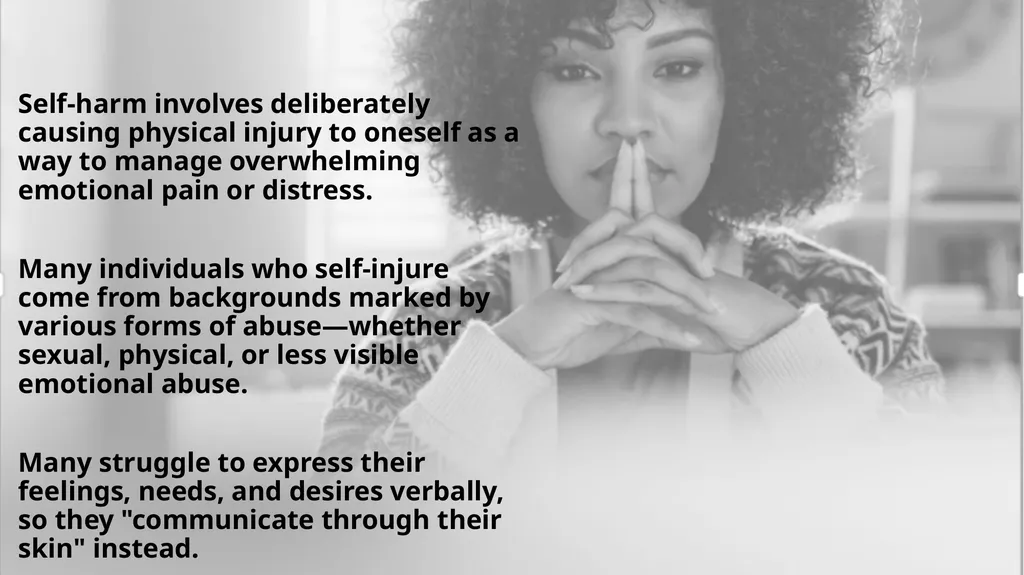
slide4. Self-harm involves deliberately causing physical injury to oneself as a way to manage overwhelming emotional pain or distress.
Many individuals who self-injure come from backgrounds marked by various forms of abuse—whether sexual, physical, or less visible emotional abuse.
Many struggle to express their feelings, needs, and desires verbally, so they "communicate through their skin" instead.<br>
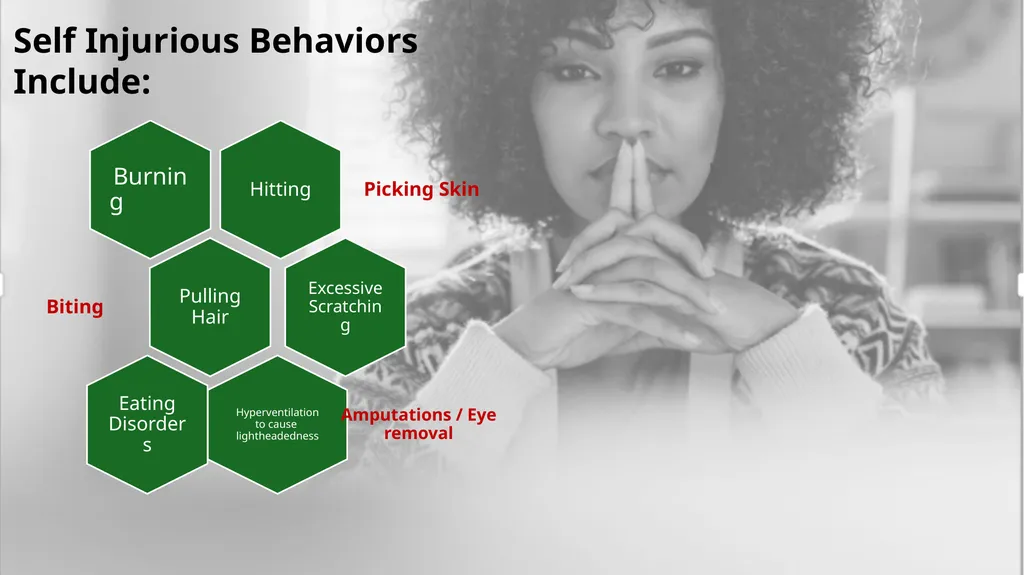
slide5. Self Injurious Behaviors Include:<br>
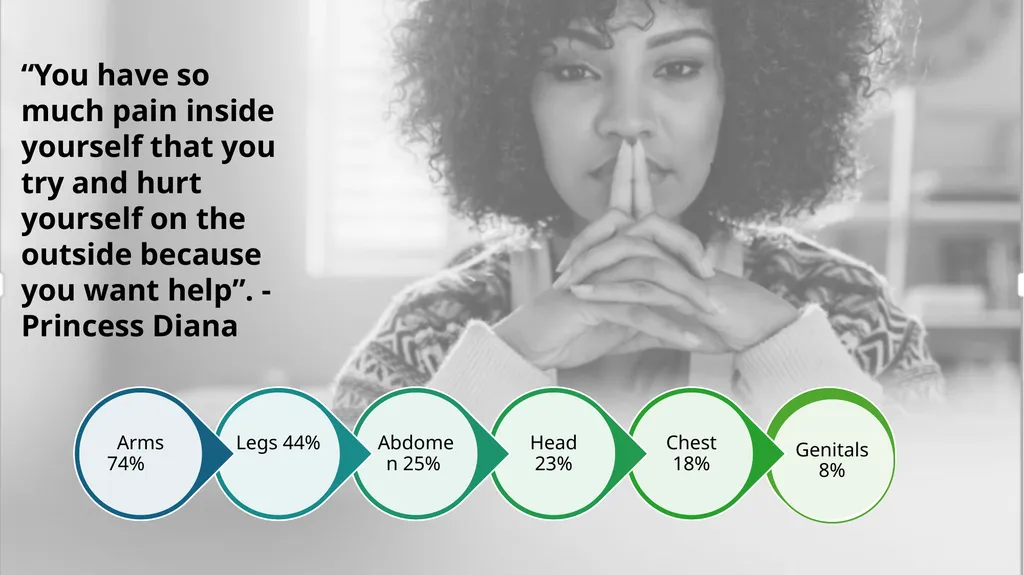
slide6. “You have so much pain inside yourself that you try and hurt yourself on the outside because you want help”. -Princess Diana<br>
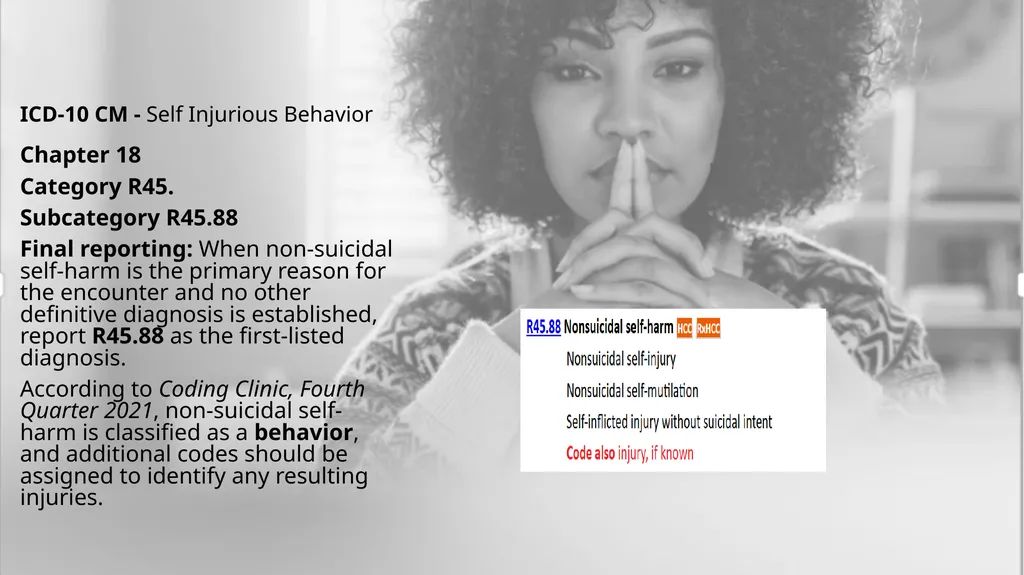
slide7. ICD-10 CM - Self Injurious Behavior Chapter 18
Category R45.
Subcategory R45.88
Final reporting: When non-suicidal self-harm is the primary reason for the encounter and no other definitive diagnosis is established, report R45.88 as the first-listed diagnosis.
According to Coding Clinic, Fourth Quarter 2021, non-suicidal self-harm is classified as a behavior, and additional codes should be assigned to identify any resulting injuries.<br>
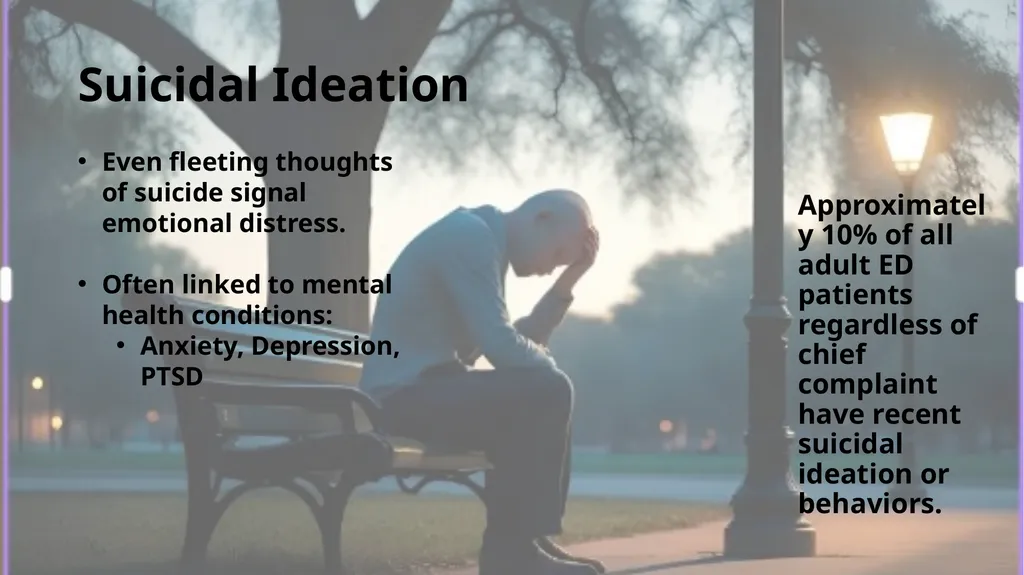
slide8. Suicidal Ideation Approximately 10% of all adult ED patients regardless of chief complaint have recent suicidal ideation or behaviors. Even fleeting thoughts of suicide signal emotional distress.
Often linked to mental health conditions:
Anxiety, Depression, PTSD<br>
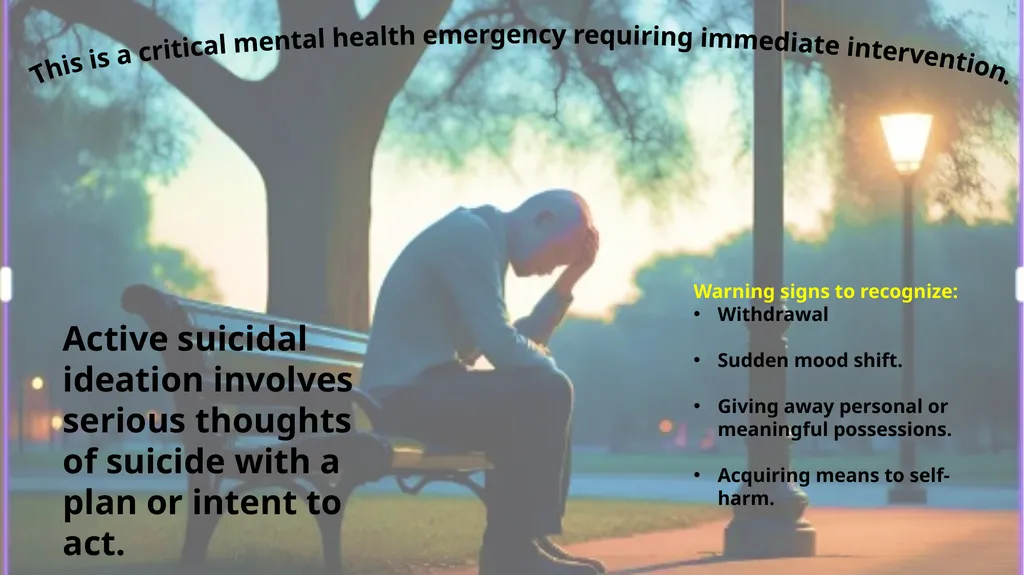
slide9. This is a critical mental health emergency requiring immediate intervention. Warning signs to recognize:
Withdrawal
Sudden mood shift.
Giving away personal or meaningful possessions.
Acquiring means to self-harm. Active suicidal ideation involves serious thoughts of suicide with a plan or intent to act.<br>
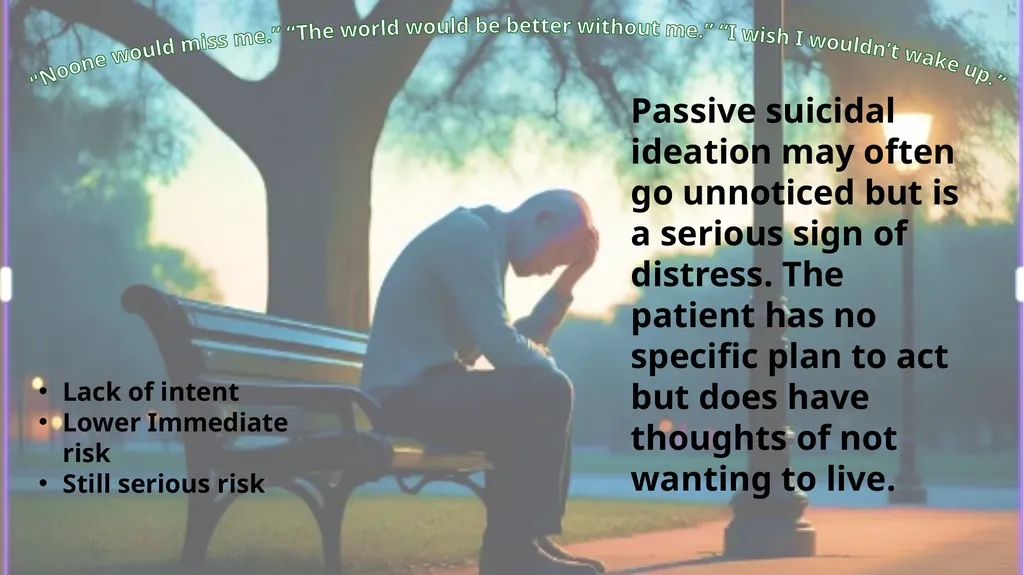
slide10. “Noone would miss me.” “The world would be better without me.” “I wish I wouldn’t wake up.” Passive suicidal ideation may often go unnoticed but is a serious sign of distress. The patient has no specific plan to act but does have thoughts of not wanting to live. Lack of intent
Lower Immediate risk
Still serious risk<br>
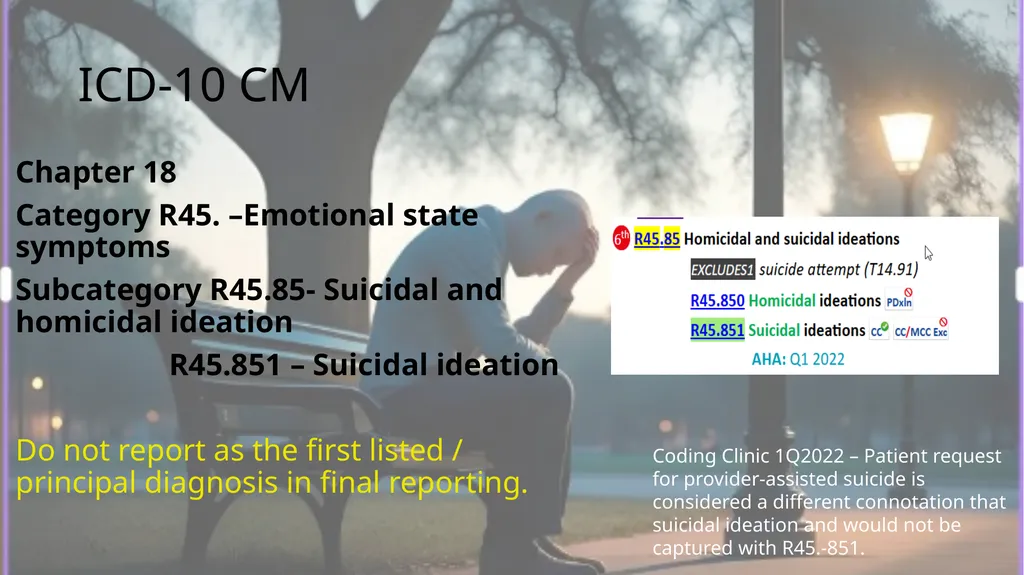
slide11. ICD-10 CM Chapter 18
Category R45. –Emotional state symptoms
Subcategory R45.85- Suicidal and homicidal ideation
R45.851 – Suicidal ideation
Do not report as the first listed / principal diagnosis in final reporting. Coding Clinic 1Q2022 – Patient request for provider-assisted suicide is considered a different connotation that suicidal ideation and would not be captured with R45.-851.<br>
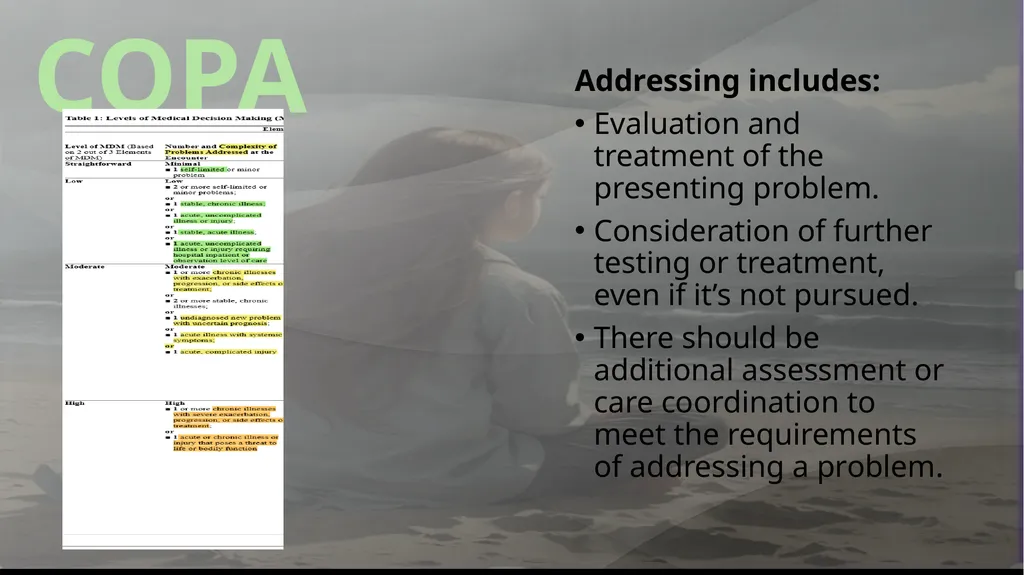
slide12. Addressing includes:
Evaluation and treatment of the presenting problem.
Consideration of further testing or treatment, even if it’s not pursued.
There should be additional assessment or care coordination to meet the requirements of addressing a problem. COPA<br>
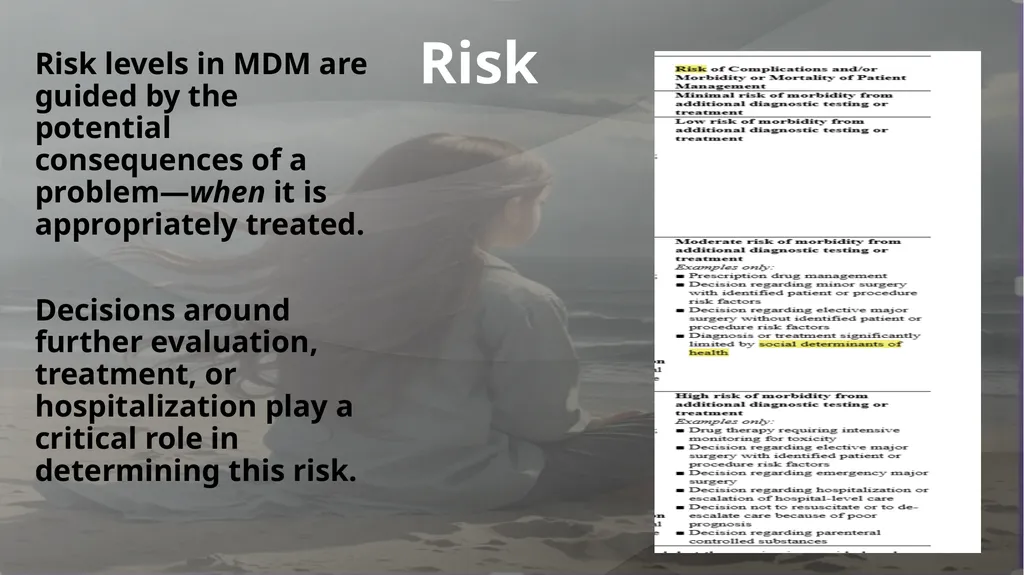
slide13. Risk levels in MDM are guided by the potential consequences of a problem—when it is appropriately treated.
Decisions around further evaluation, treatment, or hospitalization play a critical role in determining this risk. Risk<br>
slide14. Compassionate Care Individuals who have attempted self-harm or are grieving a suicide loss are emotionally vulnerable. Impact of Compassionate Language
Compassionate language fosters trust and emotional healing for vulnerable patients and survivors during recovery.
Avoiding Harmful Remarks
Judgmental or dismissive comments can alienate and harm patients, hindering their emotional recovery process.
Nonverbal Compassionate Actions
Nonverbal cues like eye contact and thoughtful responses enhance trust and convey genuine presence.
Connecting to Support Resources
Helping patients access resources shows commitment to their well-being and supports their healing journey. Get help | AFSP<br>
slide15. Supporting Someone At Risk Compassionate Support Importance
Healing begins with empathy and acceptance, not judgment or condemnation, for individuals at risk of self-harm.
Perceived Judgment Effects
Fear of judgment intensifies feelings of shame, anxiety, and isolation, hindering recovery after self-harm attempts.
Effective Response Techniques
Taking threats seriously and fostering open communication builds trust and encourages seeking professional help.
Long-term Emotional Resilience
Compassionate responses aid immediate crisis management and contribute to lasting emotional stability and recovery. A Second Chance or a Second Risk?
For some, a failed attempt may be a wake-up call, revealing their value to loved ones and society. Get help | AFSP<br>
slide16. Suicide Suicide is the act of intentionally taking one’s own life.
Can occur in context of major depressive episode.
May occur because of a substance use disorder.
Can manifest independently without any psychiatric disorder.
Without warning signs
Result of stressful circumstances
Prolonged bereavement
Bullying
Financial difficulties
Declining health<br>
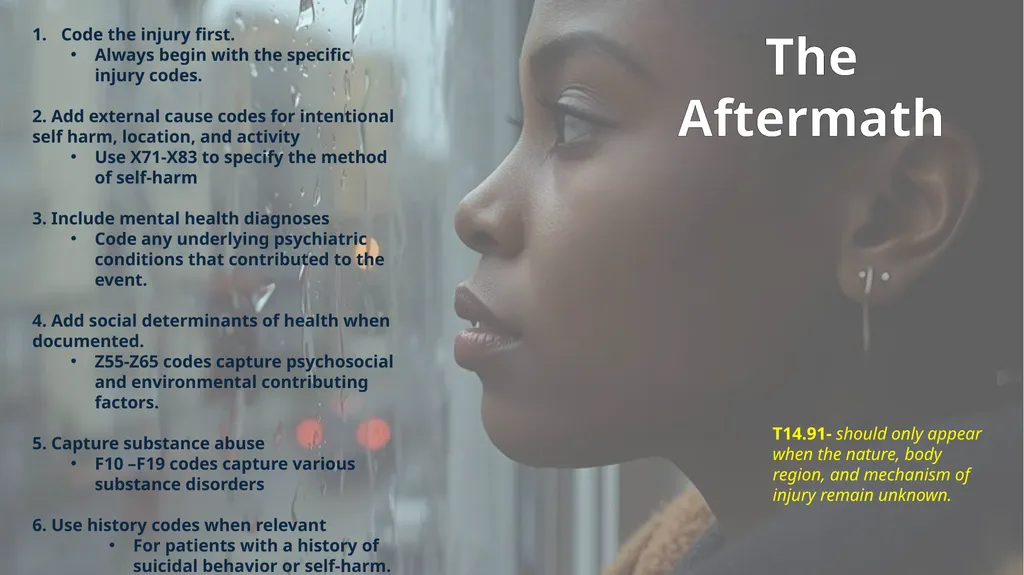
slide17. Code the injury first.
Always begin with the specific injury codes.
2. Add external cause codes for intentional self harm, location, and activity
Use X71-X83 to specify the method of self-harm
3. Include mental health diagnoses
Code any underlying psychiatric conditions that contributed to the event.
4. Add social determinants of health when documented.
Z55-Z65 codes capture psychosocial and environmental contributing factors.
5. Capture substance abuse
F10 –F19 codes capture various substance disorders
6. Use history codes when relevant
For patients with a history of suicidal behavior or self-harm. The Aftermath T14.91- should only appear when the nature, body region, and mechanism of injury remain unknown.<br>
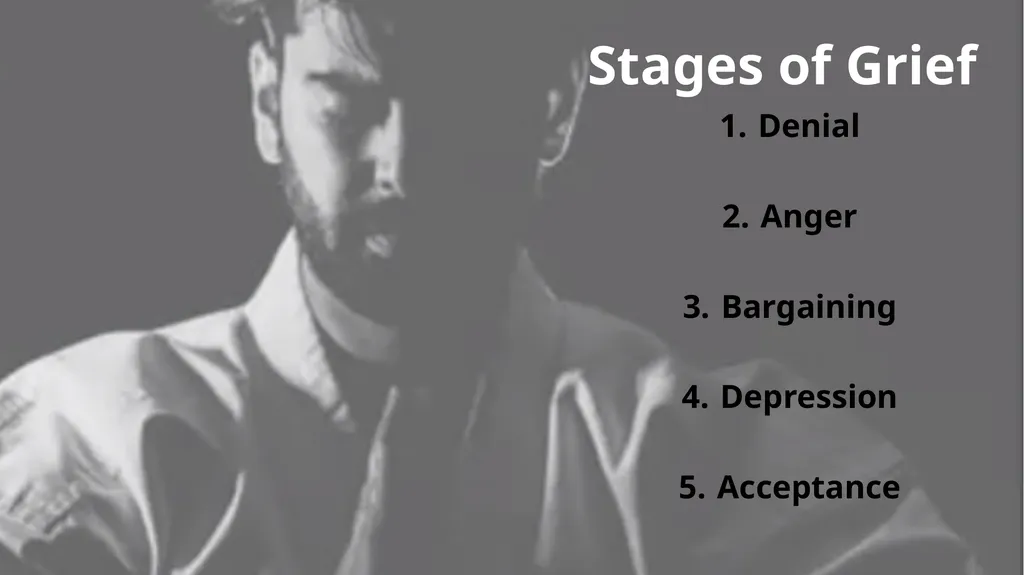
slide18. Stages of Grief Denial
Anger
Bargaining
Depression
Acceptance<br>
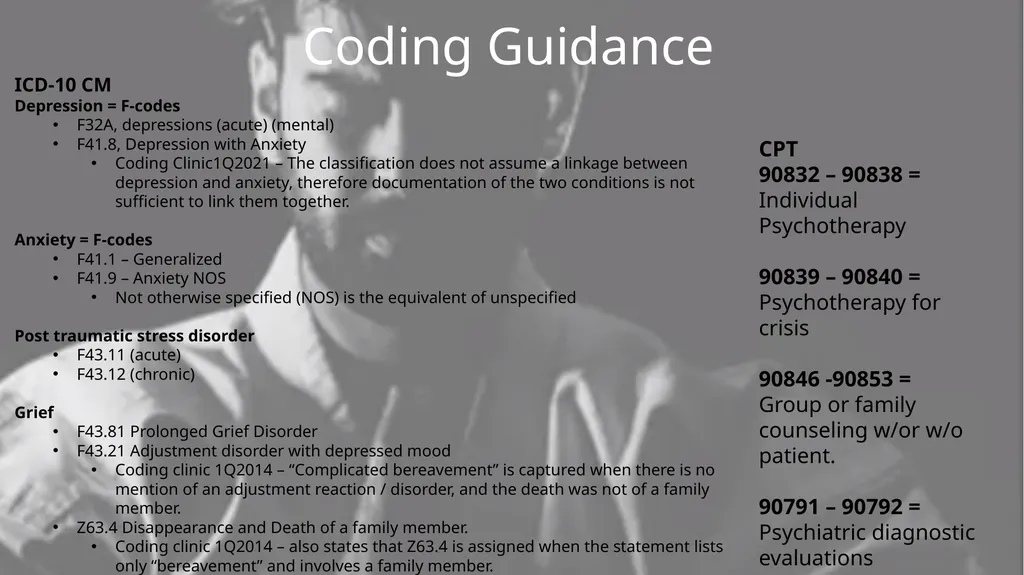
slide19. Coding Guidance ICD-10 CM
Depression = F-codes
F32A, depressions (acute) (mental)
F41.8, Depression with Anxiety
Coding Clinic1Q2021 – The classification does not assume a linkage between depression and anxiety, therefore documentation of the two conditions is not sufficient to link them together.
Anxiety = F-codes
F41.1 – Generalized
F41.9 – Anxiety NOS
Not otherwise specified (NOS) is the equivalent of unspecified
Post traumatic stress disorder
F43.11 (acute)
F43.12 (chronic)
Grief
F43.81 Prolonged Grief Disorder
F43.21 Adjustment disorder with depressed mood
Coding clinic 1Q2014 – “Complicated bereavement” is captured when there is no mention of an adjustment reaction / disorder, and the death was not of a family member.
Z63.4 Disappearance and Death of a family member.
Coding clinic 1Q2014 – also states that Z63.4 is assigned when the statement lists only “bereavement” and involves a family member. CPT
90832 – 90838 =
Individual Psychotherapy
90839 – 90840 = Psychotherapy for crisis
90846 -90853 =
Group or family counseling w/or w/o patient.
90791 – 90792 =
Psychiatric diagnostic evaluations<br>
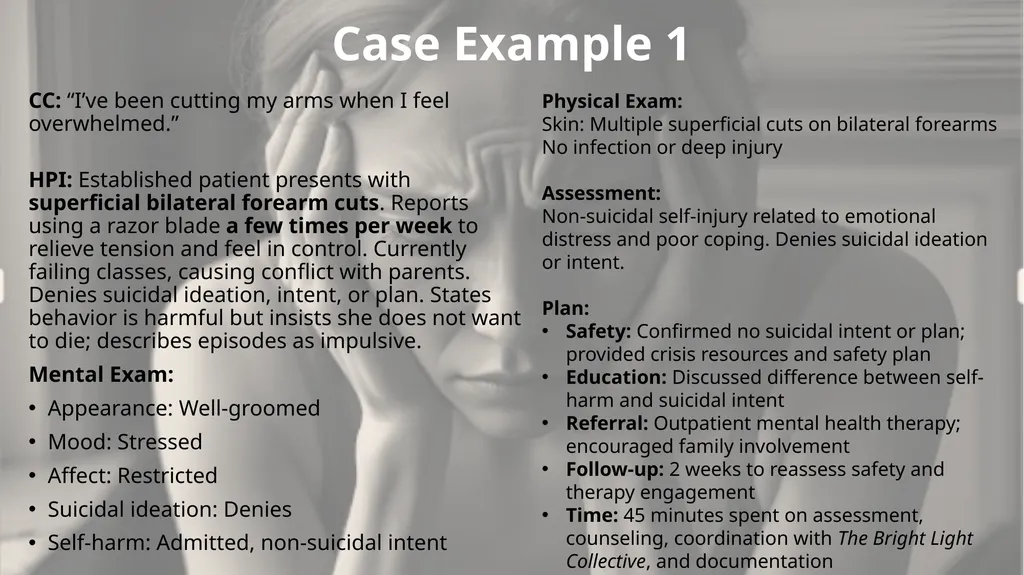
slide20. CC: “I’ve been cutting my arms when I feel overwhelmed.”
HPI: Established patient presents with superficial bilateral forearm cuts. Reports using a razor blade a few times per week to relieve tension and feel in control. Currently failing classes, causing conflict with parents. Denies suicidal ideation, intent, or plan. States behavior is harmful but insists she does not want to die; describes episodes as impulsive.
Mental Exam:
Appearance: Well-groomed
Mood: Stressed
Affect: Restricted
Suicidal ideation: Denies
Self-harm: Admitted, non-suicidal intent Physical Exam:
Skin: Multiple superficial cuts on bilateral forearms
No infection or deep injury
Assessment:
Non-suicidal self-injury related to emotional distress and poor coping. Denies suicidal ideation or intent.
Plan:
Safety: Confirmed no suicidal intent or plan; provided crisis resources and safety plan
Education: Discussed difference between self-harm and suicidal intent
Referral: Outpatient mental health therapy; encouraged family involvement
Follow-up: 2 weeks to reassess safety and therapy engagement
Time: 45 minutes spent on assessment, counseling, coordination with The Bright Light Collective, and documentation Case Example 1<br>
slide21. ICD-10 CM:
S50.811XA – Abrasion or right forearm, initial encounter
S50.812XA – Abrasion of left forearm, initial encounter
R45.88 –Non-suicidal self harm
Z73.3 – Stress, not elsewhere classified
Z55.2 – Failed school examinations
Z63.8 – Other specified problems related to primary support group
X78.8XXA – Intentional self harm by other sharp object E/M: 99215
Risk of self harm
Mental health referral
Safety planning
45 minutes<br>
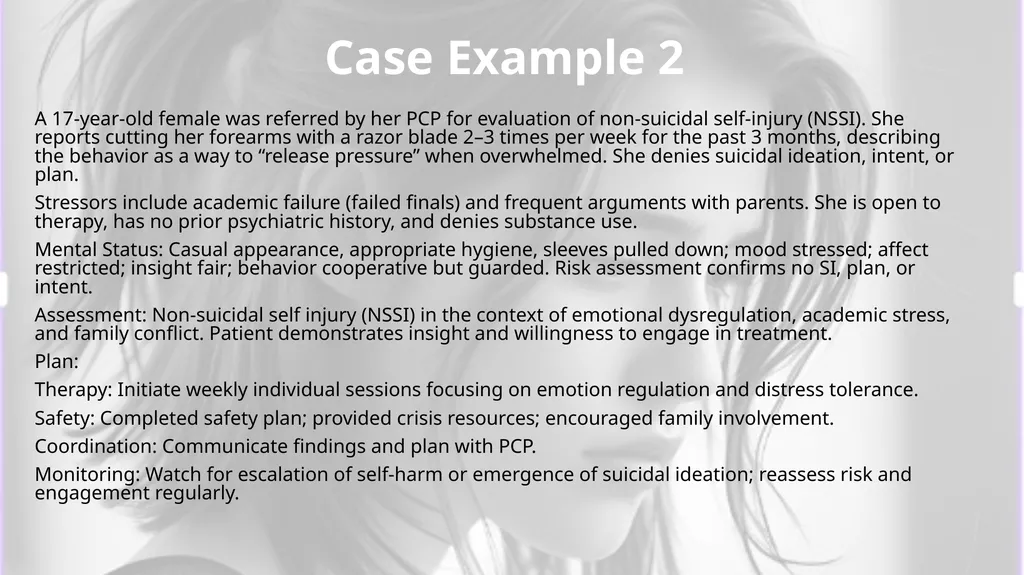
slide22. Case Example 2 A 17-year-old female was referred by her PCP for evaluation of non-suicidal self-injury (NSSI). She reports cutting her forearms with a razor blade 2–3 times per week for the past 3 months, describing the behavior as a way to “release pressure” when overwhelmed. She denies suicidal ideation, intent, or plan.
Stressors include academic failure (failed finals) and frequent arguments with parents. She is open to therapy, has no prior psychiatric history, and denies substance use.
Mental Status: Casual appearance, appropriate hygiene, sleeves pulled down; mood stressed; affect restricted; insight fair; behavior cooperative but guarded. Risk assessment confirms no SI, plan, or intent.
Assessment: Non-suicidal self injury (NSSI) in the context of emotional dysregulation, academic stress, and family conflict. Patient demonstrates insight and willingness to engage in treatment.
Plan:
Therapy: Initiate weekly individual sessions focusing on emotion regulation and distress tolerance.
Safety: Completed safety plan; provided crisis resources; encouraged family involvement.
Coordination: Communicate findings and plan with PCP.
Monitoring: Watch for escalation of self-harm or emergence of suicidal ideation; reassess risk and engagement regularly.<br>
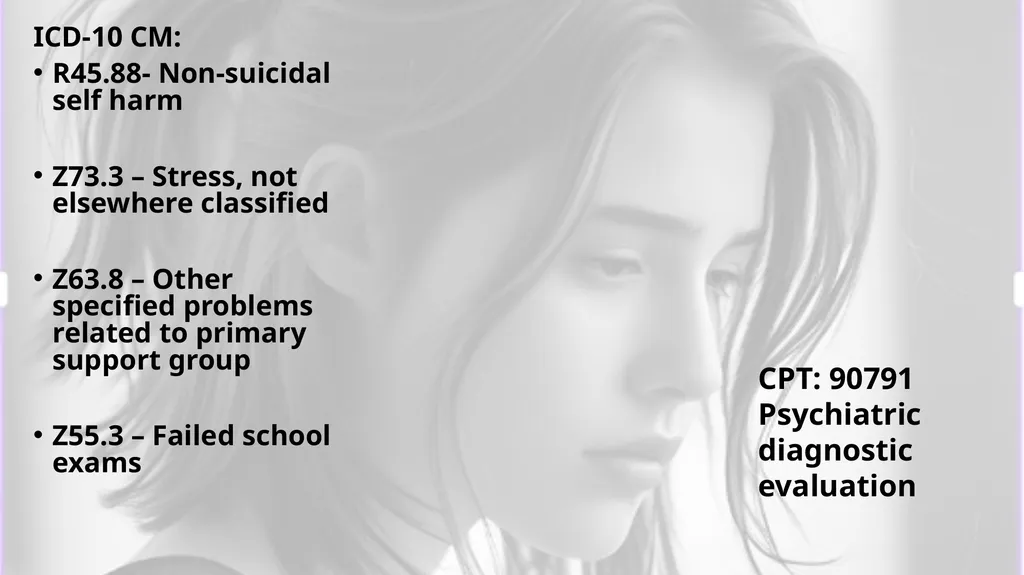
slide23. ICD-10 CM:
R45.88- Non-suicidal self harm
Z73.3 – Stress, not elsewhere classified
Z63.8 – Other specified problems related to primary support group
Z55.3 – Failed school exams CPT: 90791 Psychiatric diagnostic evaluation<br>
slide24. A 17-year-old was brought in by EMS after expressing active suicidal intent to parents, stating: “I can’t take this anymore.” The patient reports ongoing depression, recent academic stress, and family discord. Admits to a specific plan to overdose on prescription medication and has access to means at home. No prior psychiatric hospitalizations.
Mental Status:
Appearance: Disheveled, tearful
Behavior: Anxious, guarded
Mood: “Done”
Thought Content: Active suicidal ideation with plan and intent
Insight: Limited Case Example 3 Orders:
1:1 monitoring
Consult with social worker; safety plan completed with family
Tdap administered
UA with reflex culture considered but not performed
IV placement with administration of Amitriptyline
Amitriptyline serum level with 50 ng/ml – level within therapeutic range as applicable.
Referrals: Local mental health provider
Disposition: Discharged home in stable condition with safety plan in place.
Prescriptions: Amitriptyline 50 mg at bedtime<br>
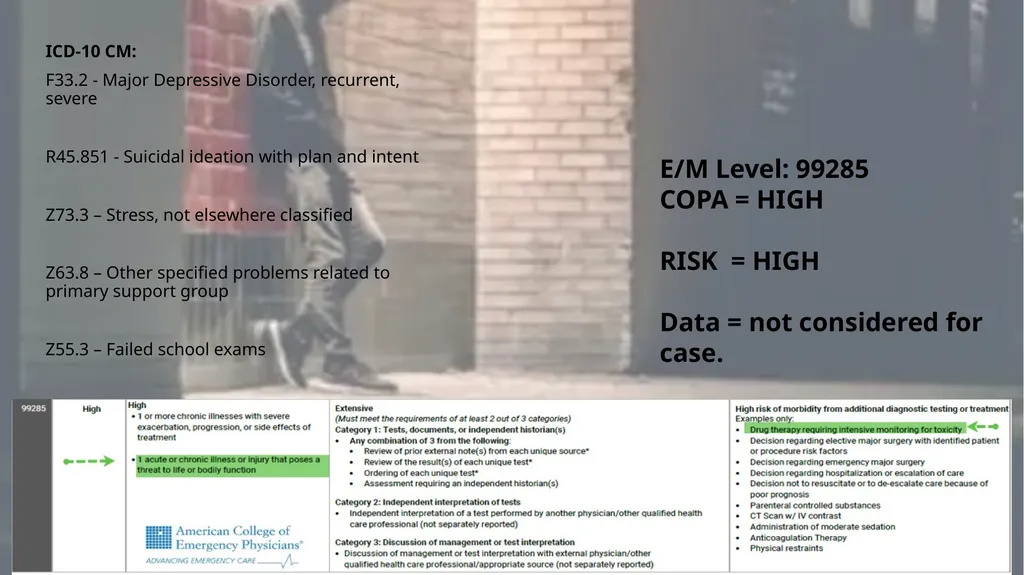
slide25. ICD-10 CM:
F33.2 - Major Depressive Disorder, recurrent, severe
R45.851 - Suicidal ideation with plan and intent
Z73.3 – Stress, not elsewhere classified
Z63.8 – Other specified problems related to primary support group
Z55.3 – Failed school exams
Z23 – Encounter for immunization E/M Level: 99285
COPA = HIGH
RISK = HIGH
Data = not considered for case.<br>
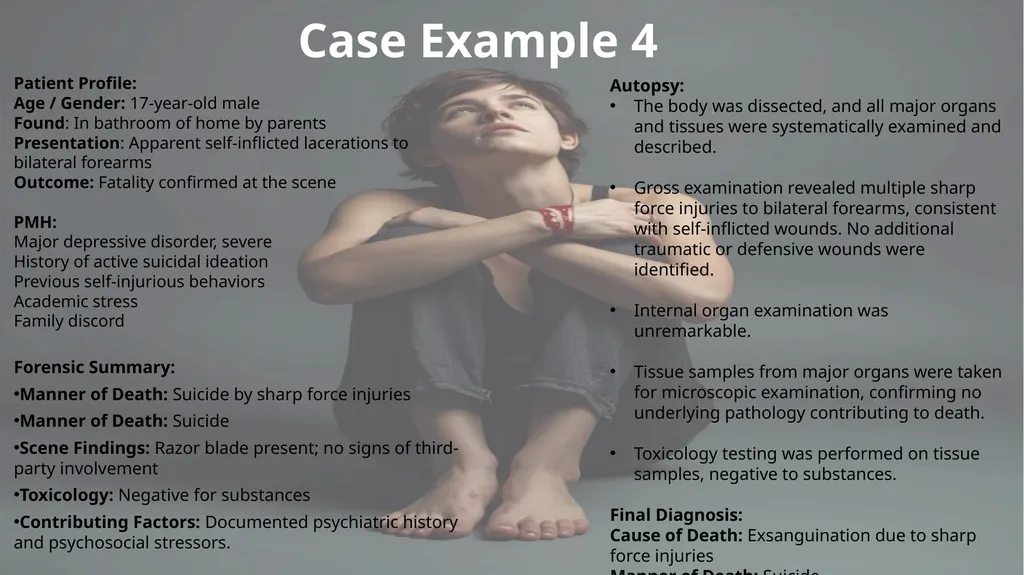
slide26. Case Example 4 Patient Profile:
Age / Gender: 17-year-old male
Found: In bathroom of home by parents
Presentation: Apparent self-inflicted lacerations to bilateral forearms
Outcome: Fatality confirmed at the scene
PMH:
Major depressive disorder, severe
History of active suicidal ideation
Previous self-injurious behaviors
Academic stress
Family discord
Forensic Summary:
Manner of Death: Suicide by sharp force injuries
Manner of Death: Suicide
Scene Findings: Razor blade present; no signs of third-party involvement
Toxicology: Negative for substances
Contributing Factors: Documented psychiatric history and psychosocial stressors. Autopsy:
The body was dissected, and all major organs and tissues were systematically examined and described.
Gross examination revealed multiple sharp force injuries to bilateral forearms, consistent with self-inflicted wounds. No additional traumatic or defensive wounds were identified.
Internal organ examination was unremarkable.
Tissue samples from major organs were taken for microscopic examination, confirming no underlying pathology contributing to death.
Toxicology testing was performed on tissue samples, negative to substances.
Final Diagnosis:
Cause of Death: Exsanguination due to sharp force injuries
Manner of Death: Suicide<br>
slide27. Primary Diagnosis:
S51.811A – Laceration without foreign body of right forearm, initial encounter
S51.812A – Laceration without foreign body of left forearm, initial encounter
Secondary Diagnoses:
F32.2 – Major depressive disorder, single episode, severe
Z63.0 – Problems in relationship with spouse or partner (family discord)
Z55.9 – Academic underachievement or underperformance, unspecified
Z91.52 – Personal history of non-suicidal self harm
External Cause of Injury:
X78.8XXA – Intentional self-harm by sharp object, initial encounter
External Cause Status & Location:
Y92.010 – Bathroom in single-family (private) house CPT Code: 88040 – Necropsy, forensic examination<br>
slide28. Year One:
Often described as being emotionally “lost,” filled with first holidays and milestones without the person. Life continues in motion, but the weight of the absence is felt deeply.
It’s not uncommon to clock out many things, especially within this first year.
Year Two and beyond:
Pain doesn’t simply fade. Instead, assumptions from others that things must have “improved” can intensify the isolation. Support systems may dwindle, even while inner turmoil persists.
Unseen Pain: Survivors frequently experience ongoing self-blame and “what if” thoughts, believing they could have prevented the tragedy. These emotions can remain hidden behind a brave exterior.
You will find your social group changes: Loss of friends with new friendships to develop during this time.
Healthcare professionals suggest no major life decisions after the death of a loved one: At least three years. Understanding the Devastating Aftermath of Suicide<br>
slide29. You don’t know what someone is going through until you’ve walked in their shoes.
Even then, grief follows no script—each person navigates its terrain in their own pace and order.
Be mindful of those who are struggling or grieving. Your sensitivity can be their lifeline.
Your documentation isn’t just routine. You are capturing the gravity of a crisis. Closing Reflections<br>
slide30. References AMA CPT
AMA CPT Assistants
ICD-10 CM
AHA Coding Clinic for ICD-9 CM and ICD-10 CM/PCS
CDC
Psychiatry.org – Home
2023 Emergency Department Evaluation and Management Guidelines | ACEP
2025 Gainesville Out of the Darkness Community Walk at Albert "Ray" Massey Westside Park, Gainesville on 8th November, 2025
Suicide statistics | AFSP
https://www.aapc.com/resources/evaluation-management-coding-changes-2021?srsltid=AfmBOopV4A-GW0RKnxr9jFX_KSeeJFU5YXPWJo3Cex7ZWVbsXNUflOe_
https://pmc.ncbi.nlm.nih.gov/articles/PMC4724471/
SUICIDAL IDEATION Definition & Meaning - Merriam-Webster
https://www.aapc.com/resources/evaluation-management-coding-changes-2021?srsltid=AfmBOopV4A-GW0RKnxr9jFX_KSeeJFU5YXPWJo3Cex7ZWVbsXNUflOe_<br>
Suicidal Ideation Shanna Pochatko, CPC, CDEO, CPMA,CPMA-I
Jennifer Johnson, CPC, CPB, CPMA
October 2025 Suicide
The Devastating Aftermath Charting the Crisis<br>
slide2. This presentation incorporates information from the International Classification of Diseases, Tenth Revision (ICD-10) and the 2025 fiscal year CPT coding guidelines, including CPT / CPT Assistant—both registered trademarks of the American Medical Association.
The views expressed are those of the presenter(s) and do not constitute formal endorsements by any other entities. Participants are advised that the content provided is not a substitute for informed professional judgment. The presenter disclaims any responsibility for participants' use of or reliance on the information shared in this presentation.<br>
slide4. Self-harm involves deliberately causing physical injury to oneself as a way to manage overwhelming emotional pain or distress.
Many individuals who self-injure come from backgrounds marked by various forms of abuse—whether sexual, physical, or less visible emotional abuse.
Many struggle to express their feelings, needs, and desires verbally, so they "communicate through their skin" instead.<br>
slide5. Self Injurious Behaviors Include:<br>
slide6. “You have so much pain inside yourself that you try and hurt yourself on the outside because you want help”. -Princess Diana<br>
slide7. ICD-10 CM - Self Injurious Behavior Chapter 18
Category R45.
Subcategory R45.88
Final reporting: When non-suicidal self-harm is the primary reason for the encounter and no other definitive diagnosis is established, report R45.88 as the first-listed diagnosis.
According to Coding Clinic, Fourth Quarter 2021, non-suicidal self-harm is classified as a behavior, and additional codes should be assigned to identify any resulting injuries.<br>
slide8. Suicidal Ideation Approximately 10% of all adult ED patients regardless of chief complaint have recent suicidal ideation or behaviors. Even fleeting thoughts of suicide signal emotional distress.
Often linked to mental health conditions:
Anxiety, Depression, PTSD<br>
slide9. This is a critical mental health emergency requiring immediate intervention. Warning signs to recognize:
Withdrawal
Sudden mood shift.
Giving away personal or meaningful possessions.
Acquiring means to self-harm. Active suicidal ideation involves serious thoughts of suicide with a plan or intent to act.<br>
slide10. “Noone would miss me.” “The world would be better without me.” “I wish I wouldn’t wake up.” Passive suicidal ideation may often go unnoticed but is a serious sign of distress. The patient has no specific plan to act but does have thoughts of not wanting to live. Lack of intent
Lower Immediate risk
Still serious risk<br>
slide11. ICD-10 CM Chapter 18
Category R45. –Emotional state symptoms
Subcategory R45.85- Suicidal and homicidal ideation
R45.851 – Suicidal ideation
Do not report as the first listed / principal diagnosis in final reporting. Coding Clinic 1Q2022 – Patient request for provider-assisted suicide is considered a different connotation that suicidal ideation and would not be captured with R45.-851.<br>
slide12. Addressing includes:
Evaluation and treatment of the presenting problem.
Consideration of further testing or treatment, even if it’s not pursued.
There should be additional assessment or care coordination to meet the requirements of addressing a problem. COPA<br>
slide13. Risk levels in MDM are guided by the potential consequences of a problem—when it is appropriately treated.
Decisions around further evaluation, treatment, or hospitalization play a critical role in determining this risk. Risk<br>
slide14. Compassionate Care Individuals who have attempted self-harm or are grieving a suicide loss are emotionally vulnerable. Impact of Compassionate Language
Compassionate language fosters trust and emotional healing for vulnerable patients and survivors during recovery.
Avoiding Harmful Remarks
Judgmental or dismissive comments can alienate and harm patients, hindering their emotional recovery process.
Nonverbal Compassionate Actions
Nonverbal cues like eye contact and thoughtful responses enhance trust and convey genuine presence.
Connecting to Support Resources
Helping patients access resources shows commitment to their well-being and supports their healing journey. Get help | AFSP<br>
slide15. Supporting Someone At Risk Compassionate Support Importance
Healing begins with empathy and acceptance, not judgment or condemnation, for individuals at risk of self-harm.
Perceived Judgment Effects
Fear of judgment intensifies feelings of shame, anxiety, and isolation, hindering recovery after self-harm attempts.
Effective Response Techniques
Taking threats seriously and fostering open communication builds trust and encourages seeking professional help.
Long-term Emotional Resilience
Compassionate responses aid immediate crisis management and contribute to lasting emotional stability and recovery. A Second Chance or a Second Risk?
For some, a failed attempt may be a wake-up call, revealing their value to loved ones and society. Get help | AFSP<br>
slide16. Suicide Suicide is the act of intentionally taking one’s own life.
Can occur in context of major depressive episode.
May occur because of a substance use disorder.
Can manifest independently without any psychiatric disorder.
Without warning signs
Result of stressful circumstances
Prolonged bereavement
Bullying
Financial difficulties
Declining health<br>
slide17. Code the injury first.
Always begin with the specific injury codes.
2. Add external cause codes for intentional self harm, location, and activity
Use X71-X83 to specify the method of self-harm
3. Include mental health diagnoses
Code any underlying psychiatric conditions that contributed to the event.
4. Add social determinants of health when documented.
Z55-Z65 codes capture psychosocial and environmental contributing factors.
5. Capture substance abuse
F10 –F19 codes capture various substance disorders
6. Use history codes when relevant
For patients with a history of suicidal behavior or self-harm. The Aftermath T14.91- should only appear when the nature, body region, and mechanism of injury remain unknown.<br>
slide18. Stages of Grief Denial
Anger
Bargaining
Depression
Acceptance<br>
slide19. Coding Guidance ICD-10 CM
Depression = F-codes
F32A, depressions (acute) (mental)
F41.8, Depression with Anxiety
Coding Clinic1Q2021 – The classification does not assume a linkage between depression and anxiety, therefore documentation of the two conditions is not sufficient to link them together.
Anxiety = F-codes
F41.1 – Generalized
F41.9 – Anxiety NOS
Not otherwise specified (NOS) is the equivalent of unspecified
Post traumatic stress disorder
F43.11 (acute)
F43.12 (chronic)
Grief
F43.81 Prolonged Grief Disorder
F43.21 Adjustment disorder with depressed mood
Coding clinic 1Q2014 – “Complicated bereavement” is captured when there is no mention of an adjustment reaction / disorder, and the death was not of a family member.
Z63.4 Disappearance and Death of a family member.
Coding clinic 1Q2014 – also states that Z63.4 is assigned when the statement lists only “bereavement” and involves a family member. CPT
90832 – 90838 =
Individual Psychotherapy
90839 – 90840 = Psychotherapy for crisis
90846 -90853 =
Group or family counseling w/or w/o patient.
90791 – 90792 =
Psychiatric diagnostic evaluations<br>
slide20. CC: “I’ve been cutting my arms when I feel overwhelmed.”
HPI: Established patient presents with superficial bilateral forearm cuts. Reports using a razor blade a few times per week to relieve tension and feel in control. Currently failing classes, causing conflict with parents. Denies suicidal ideation, intent, or plan. States behavior is harmful but insists she does not want to die; describes episodes as impulsive.
Mental Exam:
Appearance: Well-groomed
Mood: Stressed
Affect: Restricted
Suicidal ideation: Denies
Self-harm: Admitted, non-suicidal intent Physical Exam:
Skin: Multiple superficial cuts on bilateral forearms
No infection or deep injury
Assessment:
Non-suicidal self-injury related to emotional distress and poor coping. Denies suicidal ideation or intent.
Plan:
Safety: Confirmed no suicidal intent or plan; provided crisis resources and safety plan
Education: Discussed difference between self-harm and suicidal intent
Referral: Outpatient mental health therapy; encouraged family involvement
Follow-up: 2 weeks to reassess safety and therapy engagement
Time: 45 minutes spent on assessment, counseling, coordination with The Bright Light Collective, and documentation Case Example 1<br>
slide21. ICD-10 CM:
S50.811XA – Abrasion or right forearm, initial encounter
S50.812XA – Abrasion of left forearm, initial encounter
R45.88 –Non-suicidal self harm
Z73.3 – Stress, not elsewhere classified
Z55.2 – Failed school examinations
Z63.8 – Other specified problems related to primary support group
X78.8XXA – Intentional self harm by other sharp object E/M: 99215
Risk of self harm
Mental health referral
Safety planning
45 minutes<br>
slide22. Case Example 2 A 17-year-old female was referred by her PCP for evaluation of non-suicidal self-injury (NSSI). She reports cutting her forearms with a razor blade 2–3 times per week for the past 3 months, describing the behavior as a way to “release pressure” when overwhelmed. She denies suicidal ideation, intent, or plan.
Stressors include academic failure (failed finals) and frequent arguments with parents. She is open to therapy, has no prior psychiatric history, and denies substance use.
Mental Status: Casual appearance, appropriate hygiene, sleeves pulled down; mood stressed; affect restricted; insight fair; behavior cooperative but guarded. Risk assessment confirms no SI, plan, or intent.
Assessment: Non-suicidal self injury (NSSI) in the context of emotional dysregulation, academic stress, and family conflict. Patient demonstrates insight and willingness to engage in treatment.
Plan:
Therapy: Initiate weekly individual sessions focusing on emotion regulation and distress tolerance.
Safety: Completed safety plan; provided crisis resources; encouraged family involvement.
Coordination: Communicate findings and plan with PCP.
Monitoring: Watch for escalation of self-harm or emergence of suicidal ideation; reassess risk and engagement regularly.<br>
slide23. ICD-10 CM:
R45.88- Non-suicidal self harm
Z73.3 – Stress, not elsewhere classified
Z63.8 – Other specified problems related to primary support group
Z55.3 – Failed school exams CPT: 90791 Psychiatric diagnostic evaluation<br>
slide24. A 17-year-old was brought in by EMS after expressing active suicidal intent to parents, stating: “I can’t take this anymore.” The patient reports ongoing depression, recent academic stress, and family discord. Admits to a specific plan to overdose on prescription medication and has access to means at home. No prior psychiatric hospitalizations.
Mental Status:
Appearance: Disheveled, tearful
Behavior: Anxious, guarded
Mood: “Done”
Thought Content: Active suicidal ideation with plan and intent
Insight: Limited Case Example 3 Orders:
1:1 monitoring
Consult with social worker; safety plan completed with family
Tdap administered
UA with reflex culture considered but not performed
IV placement with administration of Amitriptyline
Amitriptyline serum level with 50 ng/ml – level within therapeutic range as applicable.
Referrals: Local mental health provider
Disposition: Discharged home in stable condition with safety plan in place.
Prescriptions: Amitriptyline 50 mg at bedtime<br>
slide25. ICD-10 CM:
F33.2 - Major Depressive Disorder, recurrent, severe
R45.851 - Suicidal ideation with plan and intent
Z73.3 – Stress, not elsewhere classified
Z63.8 – Other specified problems related to primary support group
Z55.3 – Failed school exams
Z23 – Encounter for immunization E/M Level: 99285
COPA = HIGH
RISK = HIGH
Data = not considered for case.<br>
slide26. Case Example 4 Patient Profile:
Age / Gender: 17-year-old male
Found: In bathroom of home by parents
Presentation: Apparent self-inflicted lacerations to bilateral forearms
Outcome: Fatality confirmed at the scene
PMH:
Major depressive disorder, severe
History of active suicidal ideation
Previous self-injurious behaviors
Academic stress
Family discord
Forensic Summary:
Manner of Death: Suicide by sharp force injuries
Manner of Death: Suicide
Scene Findings: Razor blade present; no signs of third-party involvement
Toxicology: Negative for substances
Contributing Factors: Documented psychiatric history and psychosocial stressors. Autopsy:
The body was dissected, and all major organs and tissues were systematically examined and described.
Gross examination revealed multiple sharp force injuries to bilateral forearms, consistent with self-inflicted wounds. No additional traumatic or defensive wounds were identified.
Internal organ examination was unremarkable.
Tissue samples from major organs were taken for microscopic examination, confirming no underlying pathology contributing to death.
Toxicology testing was performed on tissue samples, negative to substances.
Final Diagnosis:
Cause of Death: Exsanguination due to sharp force injuries
Manner of Death: Suicide<br>
slide27. Primary Diagnosis:
S51.811A – Laceration without foreign body of right forearm, initial encounter
S51.812A – Laceration without foreign body of left forearm, initial encounter
Secondary Diagnoses:
F32.2 – Major depressive disorder, single episode, severe
Z63.0 – Problems in relationship with spouse or partner (family discord)
Z55.9 – Academic underachievement or underperformance, unspecified
Z91.52 – Personal history of non-suicidal self harm
External Cause of Injury:
X78.8XXA – Intentional self-harm by sharp object, initial encounter
External Cause Status & Location:
Y92.010 – Bathroom in single-family (private) house CPT Code: 88040 – Necropsy, forensic examination<br>
slide28. Year One:
Often described as being emotionally “lost,” filled with first holidays and milestones without the person. Life continues in motion, but the weight of the absence is felt deeply.
It’s not uncommon to clock out many things, especially within this first year.
Year Two and beyond:
Pain doesn’t simply fade. Instead, assumptions from others that things must have “improved” can intensify the isolation. Support systems may dwindle, even while inner turmoil persists.
Unseen Pain: Survivors frequently experience ongoing self-blame and “what if” thoughts, believing they could have prevented the tragedy. These emotions can remain hidden behind a brave exterior.
You will find your social group changes: Loss of friends with new friendships to develop during this time.
Healthcare professionals suggest no major life decisions after the death of a loved one: At least three years. Understanding the Devastating Aftermath of Suicide<br>
slide29. You don’t know what someone is going through until you’ve walked in their shoes.
Even then, grief follows no script—each person navigates its terrain in their own pace and order.
Be mindful of those who are struggling or grieving. Your sensitivity can be their lifeline.
Your documentation isn’t just routine. You are capturing the gravity of a crisis. Closing Reflections<br>
slide30. References AMA CPT
AMA CPT Assistants
ICD-10 CM
AHA Coding Clinic for ICD-9 CM and ICD-10 CM/PCS
CDC
Psychiatry.org – Home
2023 Emergency Department Evaluation and Management Guidelines | ACEP
2025 Gainesville Out of the Darkness Community Walk at Albert "Ray" Massey Westside Park, Gainesville on 8th November, 2025
Suicide statistics | AFSP
https://www.aapc.com/resources/evaluation-management-coding-changes-2021?srsltid=AfmBOopV4A-GW0RKnxr9jFX_KSeeJFU5YXPWJo3Cex7ZWVbsXNUflOe_
https://pmc.ncbi.nlm.nih.gov/articles/PMC4724471/
SUICIDAL IDEATION Definition & Meaning - Merriam-Webster
https://www.aapc.com/resources/evaluation-management-coding-changes-2021?srsltid=AfmBOopV4A-GW0RKnxr9jFX_KSeeJFU5YXPWJo3Cex7ZWVbsXNUflOe_<br>