
Semantic Principles Course tutor Prof. AHMED Q.
A
Published · 16 slides · 0 views
1 / 1



Description
Semantic Principles Course tutor Prof. AHMED Q. ABED, PhD Prepared by Hind Ibrahim Ismail Table of contents 1- Semantic principles 2- The open choice principle 3- The idiom principle 1 - Semantic principles In order to produce or understand
Related Topics
Share
Embed code
Download this presentation From Below
"Semantic Principles Course tutor Prof. AHMED Q." is the property of its rightful owner. Permission is granted to download and print the materials on this website for personal, non-commercial use only, and to display it on your personal computer provided you do not modify the materials and that you retain all copyright notices contained in the materials. By downloading content from our website, you accept the terms of this agreement.
Presentation Transcript
01
Semantic Principles Course tutor
Prof. AHMED Q. ABED, PhD
Prepared by
Hind Ibrahim Ismail<br>
Prof. AHMED Q. ABED, PhD
Prepared by
Hind Ibrahim Ismail<br>
02
Table of contents 1- Semantic principles
2- The open choice principle
3- The idiom principle<br>
03
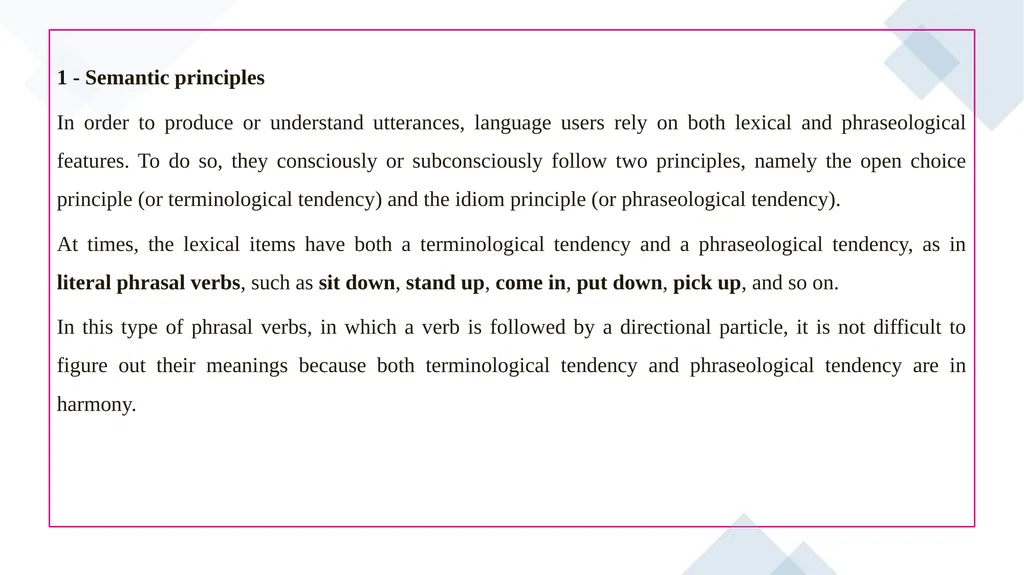
1 - Semantic principles
In order to produce or understand utterances, language users rely on both lexical and phraseological features. To do so, they consciously or subconsciously follow two principles, namely the open choice principle (or terminological tendency) and the idiom principle (or phraseological tendency).
At times, the lexical items have both a terminological tendency and a phraseological tendency, as in literal phrasal verbs, such as sit down, stand up, come in, put down, pick up, and so on.
In this type of phrasal verbs, in which a verb is followed by a directional particle, it is not difficult to figure out their meanings because both terminological tendency and phraseological tendency are in harmony.<br>
In order to produce or understand utterances, language users rely on both lexical and phraseological features. To do so, they consciously or subconsciously follow two principles, namely the open choice principle (or terminological tendency) and the idiom principle (or phraseological tendency).
At times, the lexical items have both a terminological tendency and a phraseological tendency, as in literal phrasal verbs, such as sit down, stand up, come in, put down, pick up, and so on.
In this type of phrasal verbs, in which a verb is followed by a directional particle, it is not difficult to figure out their meanings because both terminological tendency and phraseological tendency are in harmony.<br>
04
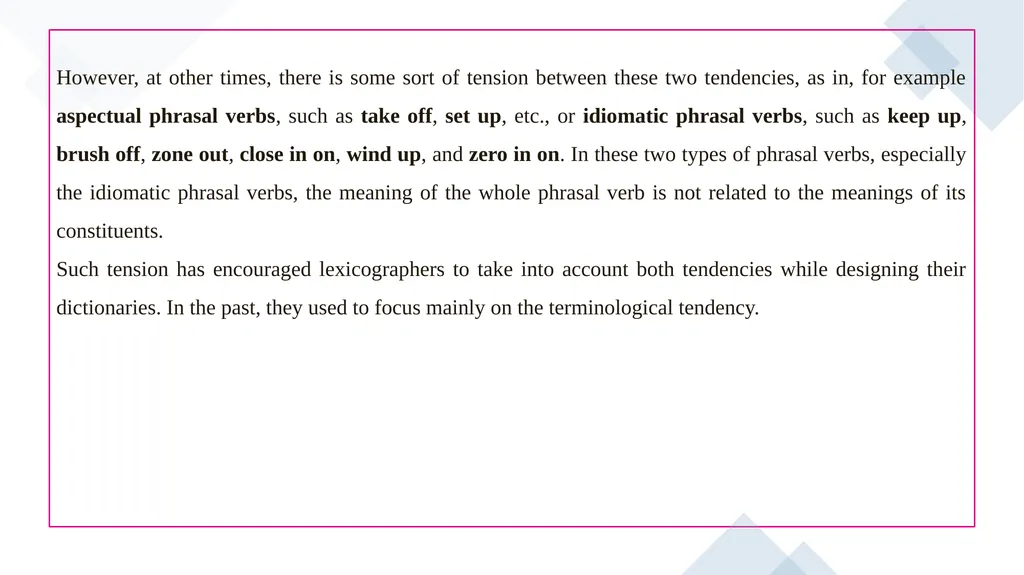
However, at other times, there is some sort of tension between these two tendencies, as in, for example aspectual phrasal verbs, such as take off, set up, etc., or idiomatic phrasal verbs, such as keep up, brush off, zone out, close in on, wind up, and zero in on. In these two types of phrasal verbs, especially the idiomatic phrasal verbs, the meaning of the whole phrasal verb is not related to the meanings of its constituents.
Such tension has encouraged lexicographers to take into account both tendencies while designing their dictionaries. In the past, they used to focus mainly on the terminological tendency.<br>
Such tension has encouraged lexicographers to take into account both tendencies while designing their dictionaries. In the past, they used to focus mainly on the terminological tendency.<br>
05
2 - The open choice principle
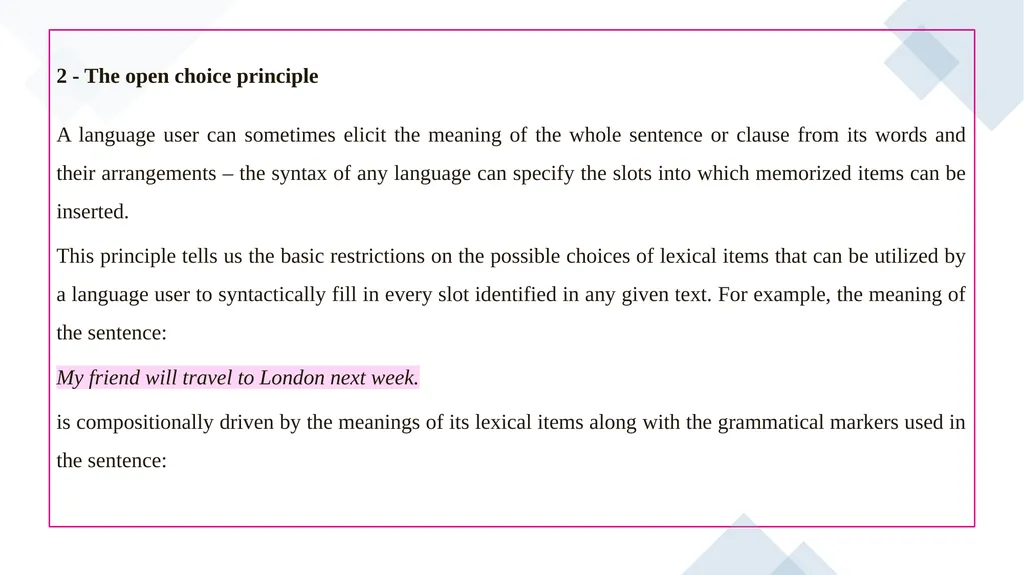
A language user can sometimes elicit the meaning of the whole sentence or clause from its words and their arrangements – the syntax of any language can specify the slots into which memorized items can be inserted.
This principle tells us the basic restrictions on the possible choices of lexical items that can be utilized by a language user to syntactically fill in every slot identified in any given text. For example, the meaning of the sentence:
My friend will travel to London next week.
is compositionally driven by the meanings of its lexical items along with the grammatical markers used in the sentence:<br>
A language user can sometimes elicit the meaning of the whole sentence or clause from its words and their arrangements – the syntax of any language can specify the slots into which memorized items can be inserted.
This principle tells us the basic restrictions on the possible choices of lexical items that can be utilized by a language user to syntactically fill in every slot identified in any given text. For example, the meaning of the sentence:
My friend will travel to London next week.
is compositionally driven by the meanings of its lexical items along with the grammatical markers used in the sentence:<br>
06
My friend will travel to London next week preceded by the possessive pronoun my that functions as a deictic expression referring to the speaker in the future tense indicated by the modal verb will preceded by the word next, thus functioning together as a deictic expression indicating when the actor of the action will travel. preceded by the preposition to, thus indicating the final destination of the actor<br>
07
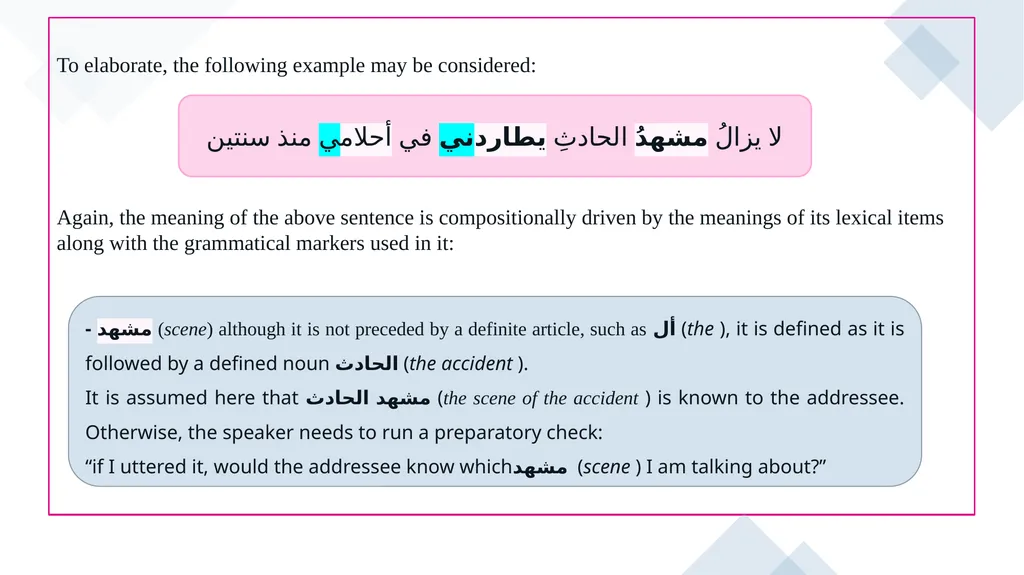
To elaborate, the following example may be considered:
Again, the meaning of the above sentence is compositionally driven by the meanings of its lexical items along with the grammatical markers used in it: لا يزالُ مشهدُ الحادثِ يطاردني في أحلامي منذ سنتين - مشهد (scene) although it is not preceded by a definite article, such as أل (the ), it is defined as it is followed by a defined noun الحادث (the accident ).
It is assumed here that مشهد الحادث (the scene of the accident ) is known to the addressee. Otherwise, the speaker needs to run a preparatory check:
“if I uttered it, would the addressee know whichمشهد (scene ) I am talking about?”<br>
Again, the meaning of the above sentence is compositionally driven by the meanings of its lexical items along with the grammatical markers used in it: لا يزالُ مشهدُ الحادثِ يطاردني في أحلامي منذ سنتين - مشهد (scene) although it is not preceded by a definite article, such as أل (the ), it is defined as it is followed by a defined noun الحادث (the accident ).
It is assumed here that مشهد الحادث (the scene of the accident ) is known to the addressee. Otherwise, the speaker needs to run a preparatory check:
“if I uttered it, would the addressee know whichمشهد (scene ) I am talking about?”<br>
08
- the pronoun ني (me ) is in the objective case referring to the speaker. - the noun أحلام (dreams ) is the plural form of حلم (dream ); it is followed by the possessive pronoun ي (my ) referring to the speaker. - the verb يطارد (lit. to chase ) is in the present tense. The emphasis is placed on both the continuity of the described action at the moment of speaking indicated by لا يزال (still ) and the duration of the action that
began in the past (two years ago) and is seen relevant to the present indicated byمنذ (for/since ).<br>
began in the past (two years ago) and is seen relevant to the present indicated byمنذ (for/since ).<br>
09
Paying undivided attention to the meanings of the lexical items or expressions along with the grammatical markers used in it on the one hand, and taking into account the linguistic and stylistic norms of the target language on the other, a professional translator may well suggest a rendering like this:
The scene of the accident has been haunting my dreams for two years.
For Sinclair (1991) , the open choice principle is:
a way of seeing language as the result of a very large number of complex choices. At each point where a unit is complete (a word or a phrase or a clause), a large range of choices opens up and the only restraint is grammaticalness.<br>
The scene of the accident has been haunting my dreams for two years.
For Sinclair (1991) , the open choice principle is:
a way of seeing language as the result of a very large number of complex choices. At each point where a unit is complete (a word or a phrase or a clause), a large range of choices opens up and the only restraint is grammaticalness.<br>
10
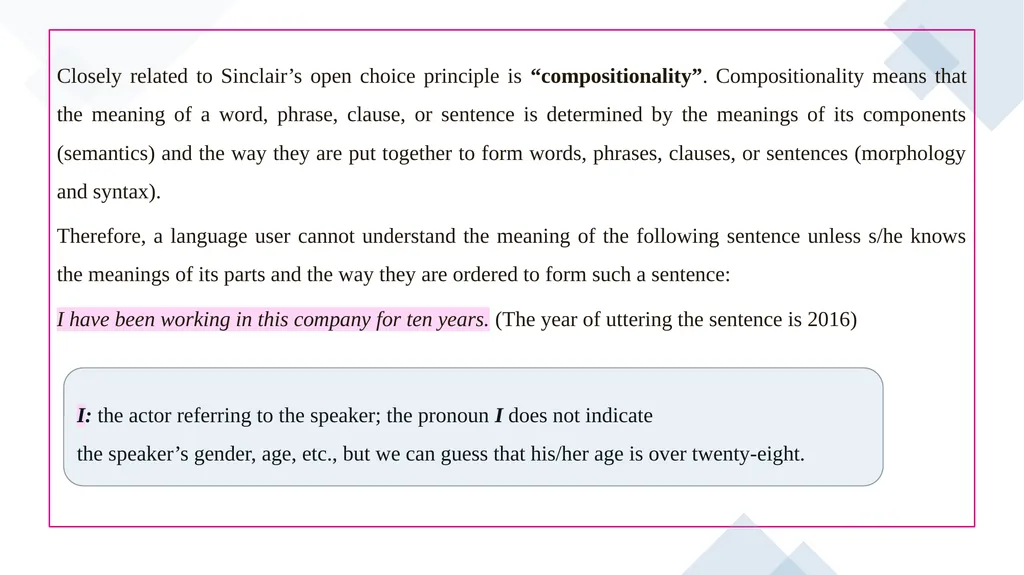
Closely related to Sinclair’s open choice principle is “compositionality”. Compositionality means that the meaning of a word, phrase, clause, or sentence is determined by the meanings of its components (semantics) and the way they are put together to form words, phrases, clauses, or sentences (morphology and syntax).
Therefore, a language user cannot understand the meaning of the following sentence unless s/he knows the meanings of its parts and the way they are ordered to form such a sentence:
I have been working in this company for ten years. (The year of uttering the sentence is 2016) I: the actor referring to the speaker; the pronoun I does not indicate
the speaker’s gender, age, etc., but we can guess that his/her age is over twenty-eight.<br>
Therefore, a language user cannot understand the meaning of the following sentence unless s/he knows the meanings of its parts and the way they are ordered to form such a sentence:
I have been working in this company for ten years. (The year of uttering the sentence is 2016) I: the actor referring to the speaker; the pronoun I does not indicate
the speaker’s gender, age, etc., but we can guess that his/her age is over twenty-eight.<br>
11
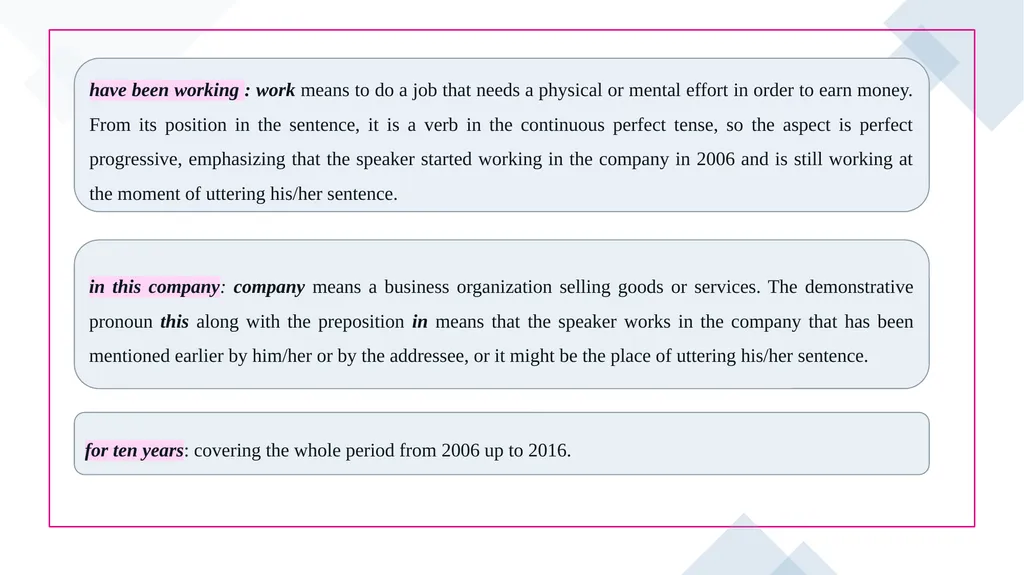
have been working : work means to do a job that needs a physical or mental effort in order to earn money. From its position in the sentence, it is a verb in the continuous perfect tense, so the aspect is perfect progressive, emphasizing that the speaker started working in the company in 2006 and is still working at the moment of uttering his/her sentence. in this company: company means a business organization selling goods or services. The demonstrative pronoun this along with the preposition in means that the speaker works in the company that has been mentioned earlier by him/her or by the addressee, or it might be the place of uttering his/her sentence. for ten years: covering the whole period from 2006 up to 2016.<br>
12
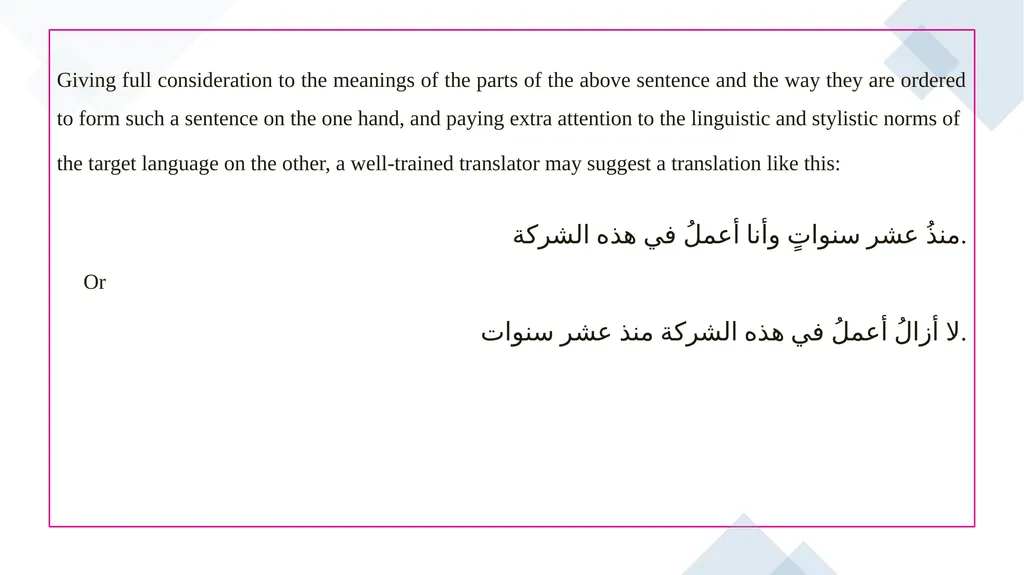
Giving full consideration to the meanings of the parts of the above sentence and the way they are ordered to form such a sentence on the one hand, and paying extra attention to the linguistic and stylistic norms of
the target language on the other, a well-trained translator may suggest a translation like this:
منذُ عشر سنواتٍ وأنا أعملُ في هذه الشركة.
Or
لا أزالُ أعملُ في هذه الشركة منذ عشر سنوات.<br>
the target language on the other, a well-trained translator may suggest a translation like this:
منذُ عشر سنواتٍ وأنا أعملُ في هذه الشركة.
Or
لا أزالُ أعملُ في هذه الشركة منذ عشر سنوات.<br>
13
3 - The idiom principle
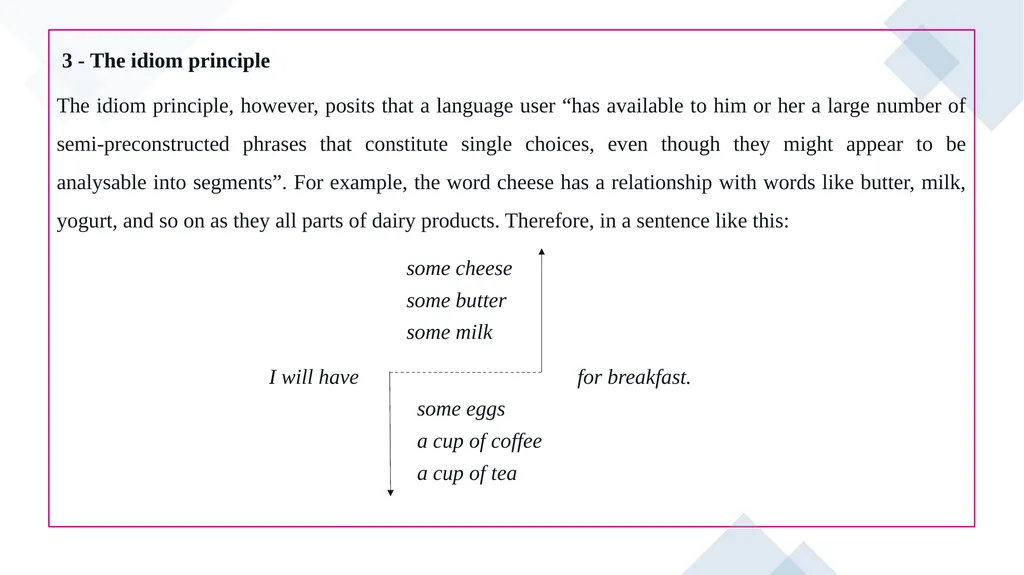
The idiom principle, however, posits that a language user “has available to him or her a large number of semi-preconstructed phrases that constitute single choices, even though they might appear to be analysable into segments”. For example, the word cheese has a relationship with words like butter, milk, yogurt, and so on as they all parts of dairy products. Therefore, in a sentence like this:
some cheese
some butter
some milk
I will have for breakfast.
some eggs
a cup of coffee
a cup of tea<br>
The idiom principle, however, posits that a language user “has available to him or her a large number of semi-preconstructed phrases that constitute single choices, even though they might appear to be analysable into segments”. For example, the word cheese has a relationship with words like butter, milk, yogurt, and so on as they all parts of dairy products. Therefore, in a sentence like this:
some cheese
some butter
some milk
I will have for breakfast.
some eggs
a cup of coffee
a cup of tea<br>
14
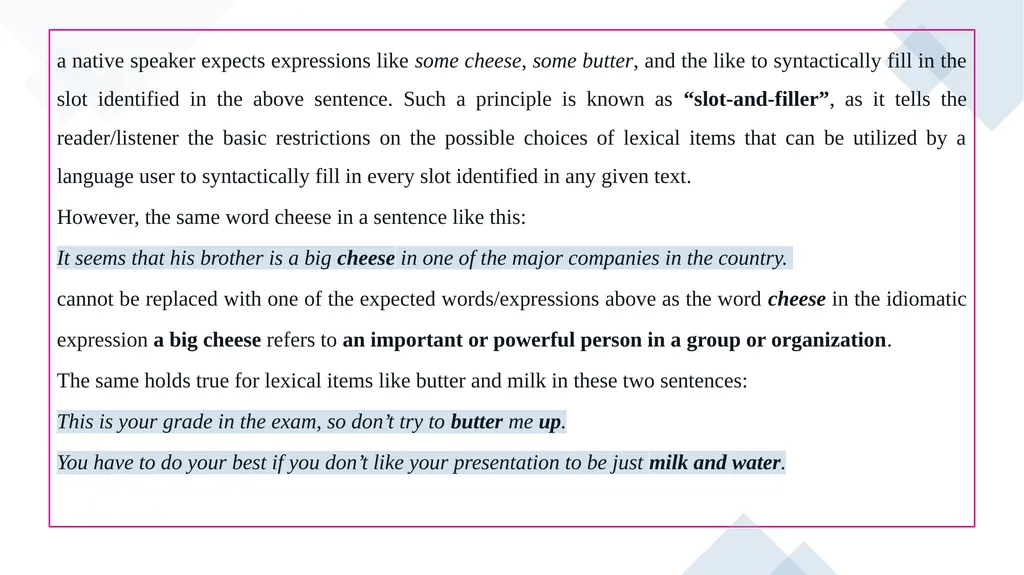
a native speaker expects expressions like some cheese, some butter, and the like to syntactically fill in the slot identified in the above sentence. Such a principle is known as “slot-and-filler”, as it tells the reader/listener the basic restrictions on the possible choices of lexical items that can be utilized by a language user to syntactically fill in every slot identified in any given text.
However, the same word cheese in a sentence like this:
It seems that his brother is a big cheese in one of the major companies in the country.
cannot be replaced with one of the expected words/expressions above as the word cheese in the idiomatic expression a big cheese refers to an important or powerful person in a group or organization.
The same holds true for lexical items like butter and milk in these two sentences:
This is your grade in the exam, so don’t try to butter me up.
You have to do your best if you don’t like your presentation to be just milk and water.<br>
However, the same word cheese in a sentence like this:
It seems that his brother is a big cheese in one of the major companies in the country.
cannot be replaced with one of the expected words/expressions above as the word cheese in the idiomatic expression a big cheese refers to an important or powerful person in a group or organization.
The same holds true for lexical items like butter and milk in these two sentences:
This is your grade in the exam, so don’t try to butter me up.
You have to do your best if you don’t like your presentation to be just milk and water.<br>
15
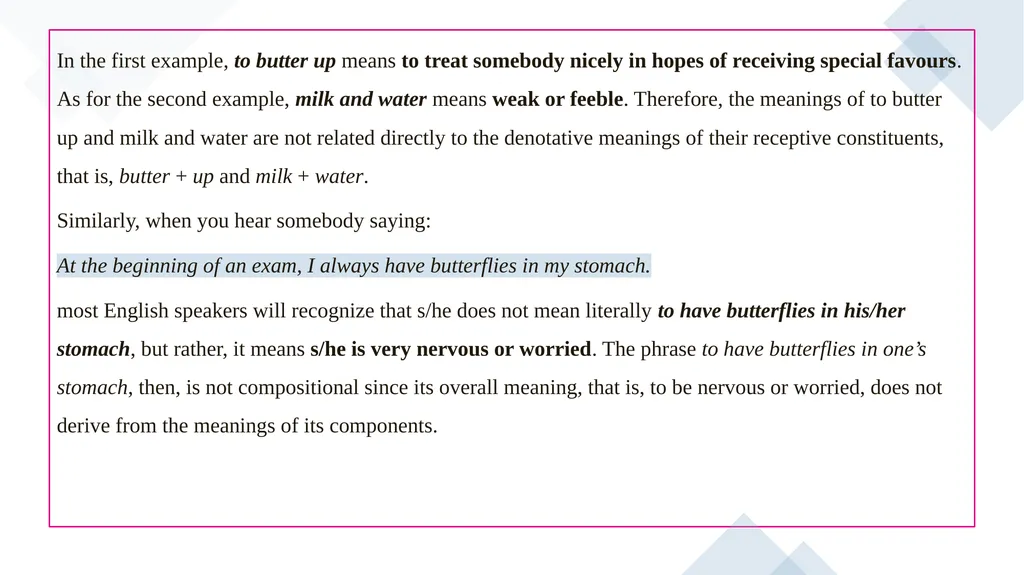
In the first example, to butter up means to treat somebody nicely in hopes of receiving special favours. As for the second example, milk and water means weak or feeble. Therefore, the meanings of to butter up and milk and water are not related directly to the denotative meanings of their receptive constituents, that is, butter + up and milk + water.
Similarly, when you hear somebody saying:
At the beginning of an exam, I always have butterflies in my stomach.
most English speakers will recognize that s/he does not mean literally to have butterflies in his/her stomach, but rather, it means s/he is very nervous or worried. The phrase to have butterflies in one’s stomach, then, is not compositional since its overall meaning, that is, to be nervous or worried, does not derive from the meanings of its components.<br>
Similarly, when you hear somebody saying:
At the beginning of an exam, I always have butterflies in my stomach.
most English speakers will recognize that s/he does not mean literally to have butterflies in his/her stomach, but rather, it means s/he is very nervous or worried. The phrase to have butterflies in one’s stomach, then, is not compositional since its overall meaning, that is, to be nervous or worried, does not derive from the meanings of its components.<br>
16
References
1 – Almanna, Ali (2016). Semantics for Translation Students : Arabic–English–Arabic.
United Kingdom: Peter Lang Ltd, International Academic Publishers<br>
1 – Almanna, Ali (2016). Semantics for Translation Students : Arabic–English–Arabic.
United Kingdom: Peter Lang Ltd, International Academic Publishers<br>