
Semantic Web 09005004 Darshan Kapashi 09005009
SB
Published · 44 slides · 0 views

1 / 1
Description
Semantic Web 09005004 Darshan Kapashi 09005009 Pararth Shah 09005015 Hemant Gangolia Outline Introduction: What is Semantic Web really? Motivation: Why is it so important today? Architecture: What are its components? Strategy: How to
Related Topics
Share
Embed code
Download this presentation From Below
"Semantic Web 09005004 Darshan Kapashi 09005009" is the property of its rightful owner. Permission is granted to download and print the materials on this website for personal, non-commercial use only, and to display it on your personal computer provided you do not modify the materials and that you retain all copyright notices contained in the materials. By downloading content from our website, you accept the terms of this agreement.
Presentation Transcript
01
Semantic Web 09005004 Darshan Kapashi
09005009 Pararth Shah
09005015 Hemant Gangolia<br>
09005009 Pararth Shah
09005015 Hemant Gangolia<br>
02
Outline Introduction: What is Semantic Web really?
Motivation: Why is it so important today?
Architecture: What are its components?
Strategy: How to transition to Web 3.0?
Progress: What are the most promising applications?
Roadblocks: What are the major issues?
Conclusion: Where will we be 10 years from now? 2<br>
Motivation: Why is it so important today?
Architecture: What are its components?
Strategy: How to transition to Web 3.0?
Progress: What are the most promising applications?
Roadblocks: What are the major issues?
Conclusion: Where will we be 10 years from now? 2<br>
03
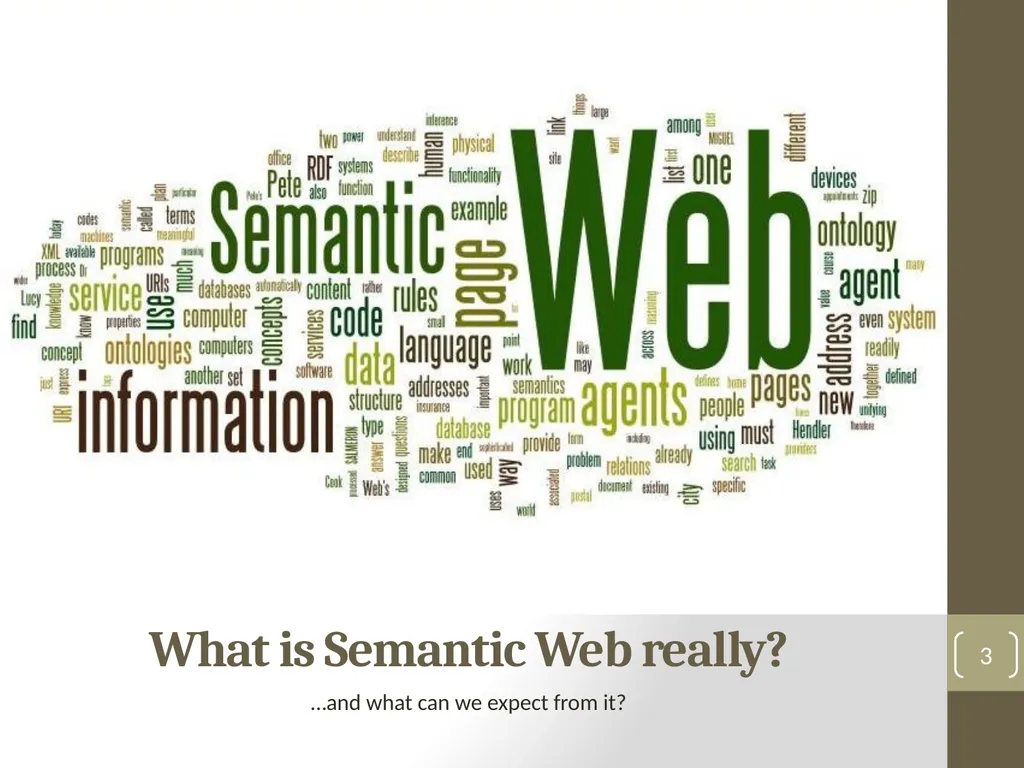
What is Semantic Web really? …and what can we expect from it? 3<br>
04
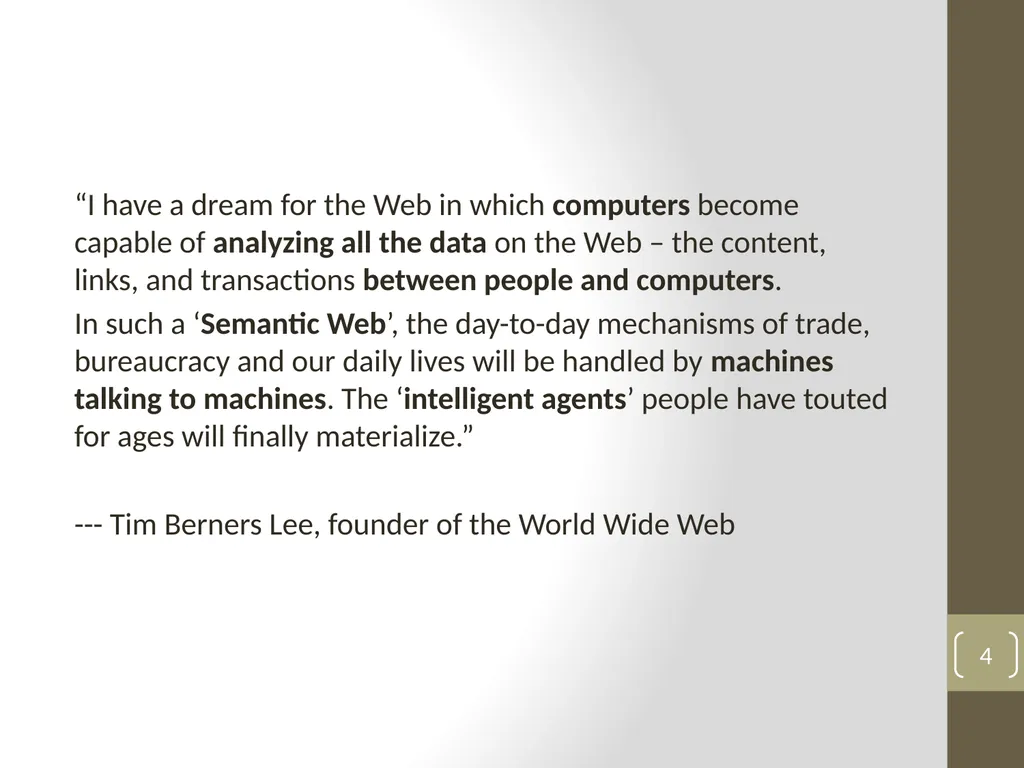
“I have a dream for the Web in which computers become capable of analyzing all the data on the Web – the content, links, and transactions between people and computers.
In such a ‘Semantic Web’, the day-to-day mechanisms of trade, bureaucracy and our daily lives will be handled by machines talking to machines. The ‘intelligent agents’ people have touted for ages will finally materialize.”
--- Tim Berners Lee, founder of the World Wide Web 4<br>
In such a ‘Semantic Web’, the day-to-day mechanisms of trade, bureaucracy and our daily lives will be handled by machines talking to machines. The ‘intelligent agents’ people have touted for ages will finally materialize.”
--- Tim Berners Lee, founder of the World Wide Web 4<br>
05
“I have a dream for the Web in which computers become capable of analyzing all the data on the Web – the content, links, and transactions between people and computers.
In such a ‘Semantic Web’, the day-to-day mechanisms of trade, bureaucracy and our daily lives will be handled by machines talking to machines. The ‘intelligent agents’ people have touted for ages will finally materialize.”
--- Tim Berners Lee, founder of the World Wide Web 5<br>
In such a ‘Semantic Web’, the day-to-day mechanisms of trade, bureaucracy and our daily lives will be handled by machines talking to machines. The ‘intelligent agents’ people have touted for ages will finally materialize.”
--- Tim Berners Lee, founder of the World Wide Web 5<br>
06
A Machine-Friendly Web The Web was designed for humans to access resources over the Internet
There is no way for machines to process the semantics of the delivered content
In contrast to “machine-readable”, Semantic Web envisions a Web designed around machine-understandable content
It hopes to empower computers to analyze, reason about, and make confident predictions about the data
It will enable computers to communicate meaningful content to humans, as well as to each other
This will give rise to a new generation of services which are capable of much more complex tasks 6<br>
There is no way for machines to process the semantics of the delivered content
In contrast to “machine-readable”, Semantic Web envisions a Web designed around machine-understandable content
It hopes to empower computers to analyze, reason about, and make confident predictions about the data
It will enable computers to communicate meaningful content to humans, as well as to each other
This will give rise to a new generation of services which are capable of much more complex tasks 6<br>
07
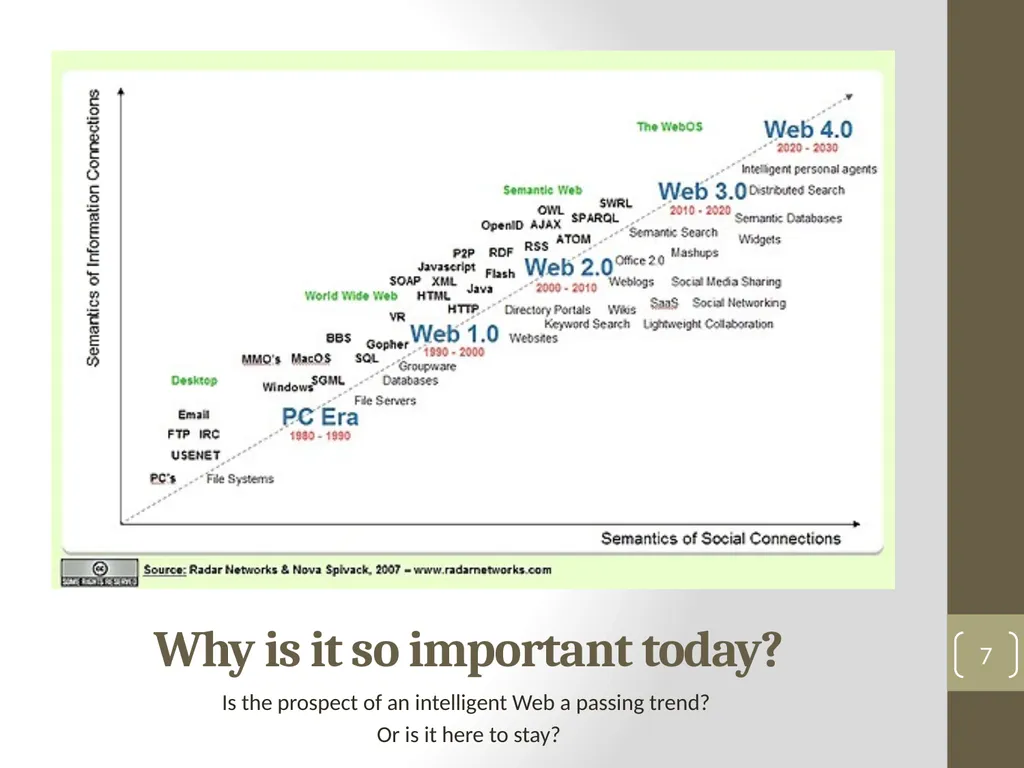
Why is it so important today? Is the prospect of an intelligent Web a passing trend?
Or is it here to stay? 7<br>
Or is it here to stay? 7<br>
08
The Web 2.0 Data Explosion Web 2.0 introduced crowdsourcing, blogging, sharing on social networks:
Web enabled services log user activity on their websites
Enormous amount of data generated everyday: user-click histories, user-generated content, financial/weather/scientific data
Raised interesting questions that were never asked before:
How to efficiently store, retrieve and search this large amount of distributed data?
Is it possible for machines to make sense of this data?
Can we derive enough knowledge out of this data to make useful inferences about the world? 8<br>
Web enabled services log user activity on their websites
Enormous amount of data generated everyday: user-click histories, user-generated content, financial/weather/scientific data
Raised interesting questions that were never asked before:
How to efficiently store, retrieve and search this large amount of distributed data?
Is it possible for machines to make sense of this data?
Can we derive enough knowledge out of this data to make useful inferences about the world? 8<br>
09
AI and the Era of Big Data Building expert systems that demonstrate intelligent behaviour comparable to humans has been a long term goal of AI research
Learning from experience is an important component of any intelligent system
Machine Learning is a sub-topic of AI which borrows from Statistics, Information Retrieval and Data Mining to build systems that infer knowledge from data
The growth of the Web has brought about a data revolution
A new hope has arisen that systems that employ learning from the Web of Big Data will be able to overcome the issues faced by traditional AI
The Semantic Web is the logical next frontier in this regard 9<br>
Learning from experience is an important component of any intelligent system
Machine Learning is a sub-topic of AI which borrows from Statistics, Information Retrieval and Data Mining to build systems that infer knowledge from data
The growth of the Web has brought about a data revolution
A new hope has arisen that systems that employ learning from the Web of Big Data will be able to overcome the issues faced by traditional AI
The Semantic Web is the logical next frontier in this regard 9<br>
10
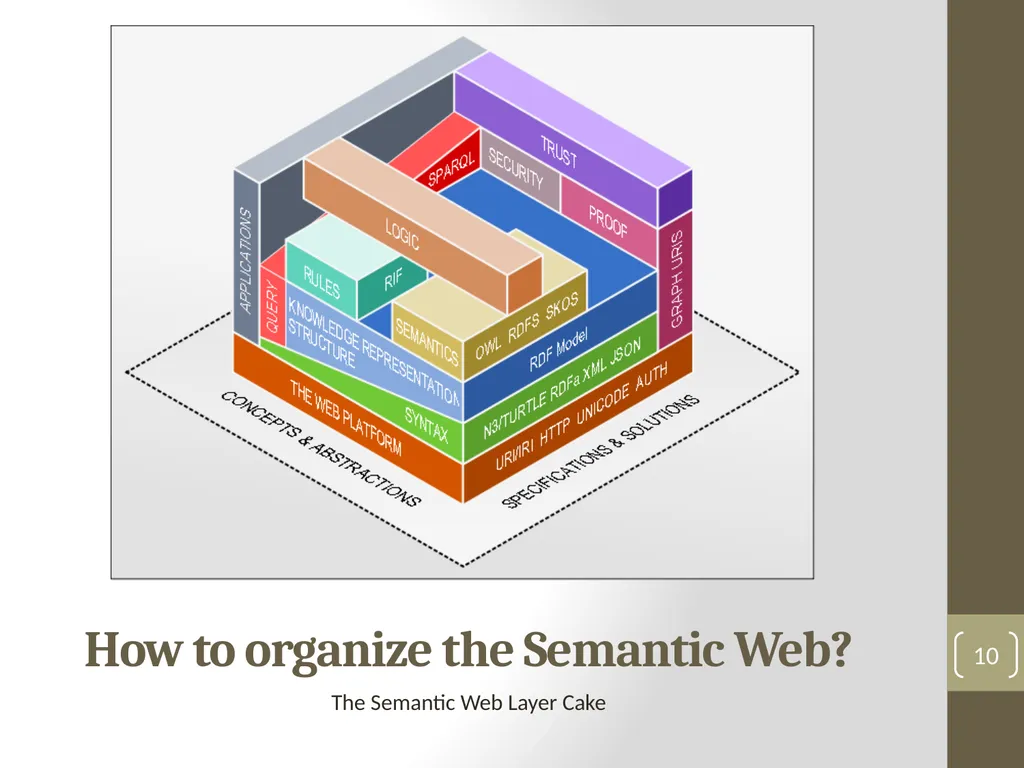
How to organize the Semantic Web? The Semantic Web Layer Cake 10<br>
11
Knowledge Representation A prerequisite for Semantic Web is to enable automated software to store, exchange, and use machine-readable information distributed throughout the Web
But data distributed throughout the Web is highly heterogeneous and unstructured
To make use of heterogeneous data: Required to decide upon standardized data format for representing information
The RDF format is a lightweight format which can be easily embedded in HTML
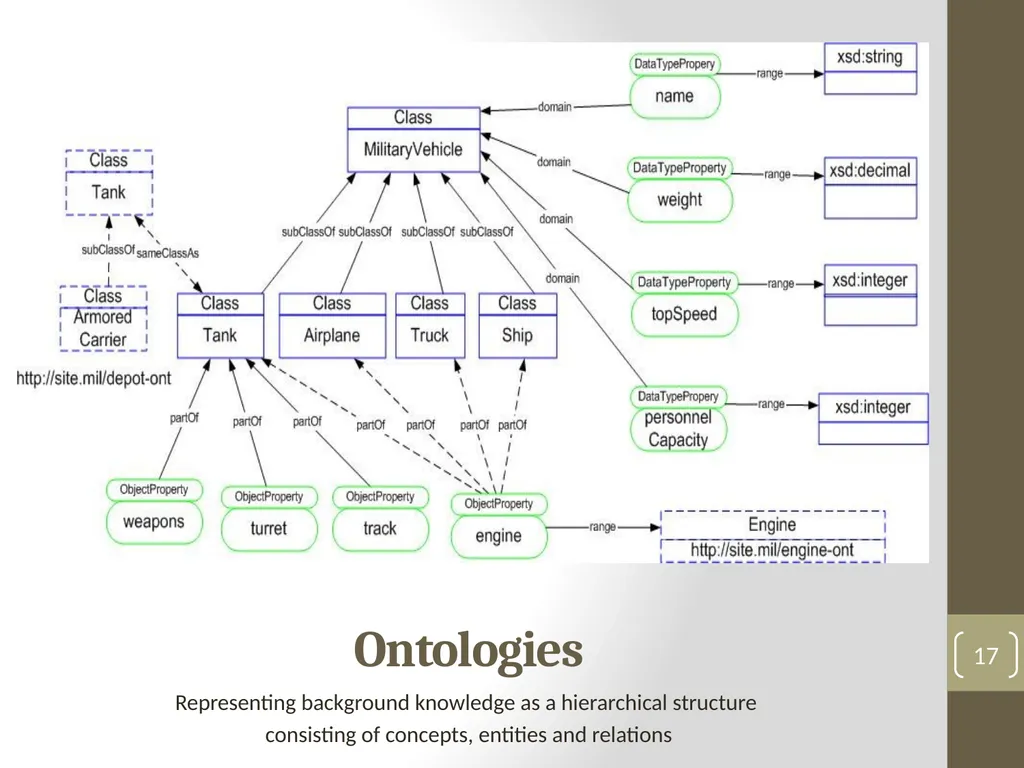
To make use of unstructured data: Required to build “ontologies” which encode the semantic relationships between data items and provide a structure from which knowledge can be inferred 11<br>
But data distributed throughout the Web is highly heterogeneous and unstructured
To make use of heterogeneous data: Required to decide upon standardized data format for representing information
The RDF format is a lightweight format which can be easily embedded in HTML
To make use of unstructured data: Required to build “ontologies” which encode the semantic relationships between data items and provide a structure from which knowledge can be inferred 11<br>
12
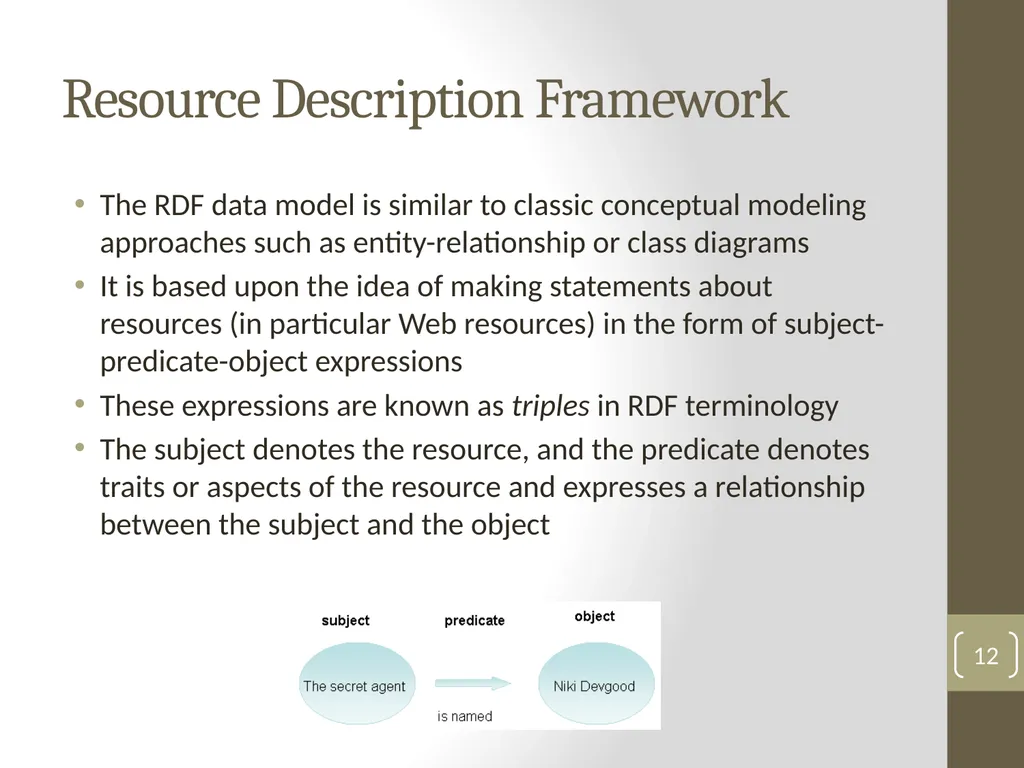
Resource Description Framework The RDF data model is similar to classic conceptual modeling approaches such as entity-relationship or class diagrams
It is based upon the idea of making statements about resources (in particular Web resources) in the form of subject-predicate-object expressions
These expressions are known as triples in RDF terminology
The subject denotes the resource, and the predicate denotes traits or aspects of the resource and expresses a relationship between the subject and the object 12<br>
It is based upon the idea of making statements about resources (in particular Web resources) in the form of subject-predicate-object expressions
These expressions are known as triples in RDF terminology
The subject denotes the resource, and the predicate denotes traits or aspects of the resource and expresses a relationship between the subject and the object 12<br>
13
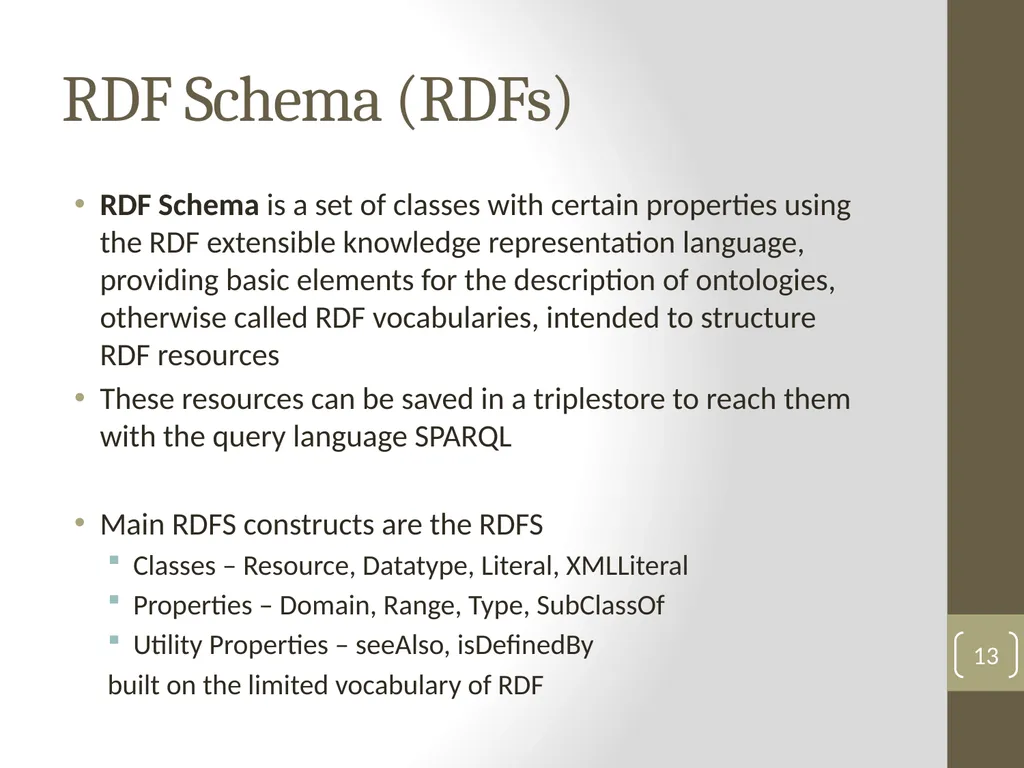
RDF Schema (RDFs) RDF Schema is a set of classes with certain properties using the RDF extensible knowledge representation language, providing basic elements for the description of ontologies, otherwise called RDF vocabularies, intended to structure RDF resources
These resources can be saved in a triplestore to reach them with the query language SPARQL
Main RDFS constructs are the RDFS
Classes – Resource, Datatype, Literal, XMLLiteral
Properties – Domain, Range, Type, SubClassOf
Utility Properties – seeAlso, isDefinedBy
built on the limited vocabulary of RDF 13<br>
These resources can be saved in a triplestore to reach them with the query language SPARQL
Main RDFS constructs are the RDFS
Classes – Resource, Datatype, Literal, XMLLiteral
Properties – Domain, Range, Type, SubClassOf
Utility Properties – seeAlso, isDefinedBy
built on the limited vocabulary of RDF 13<br>
14
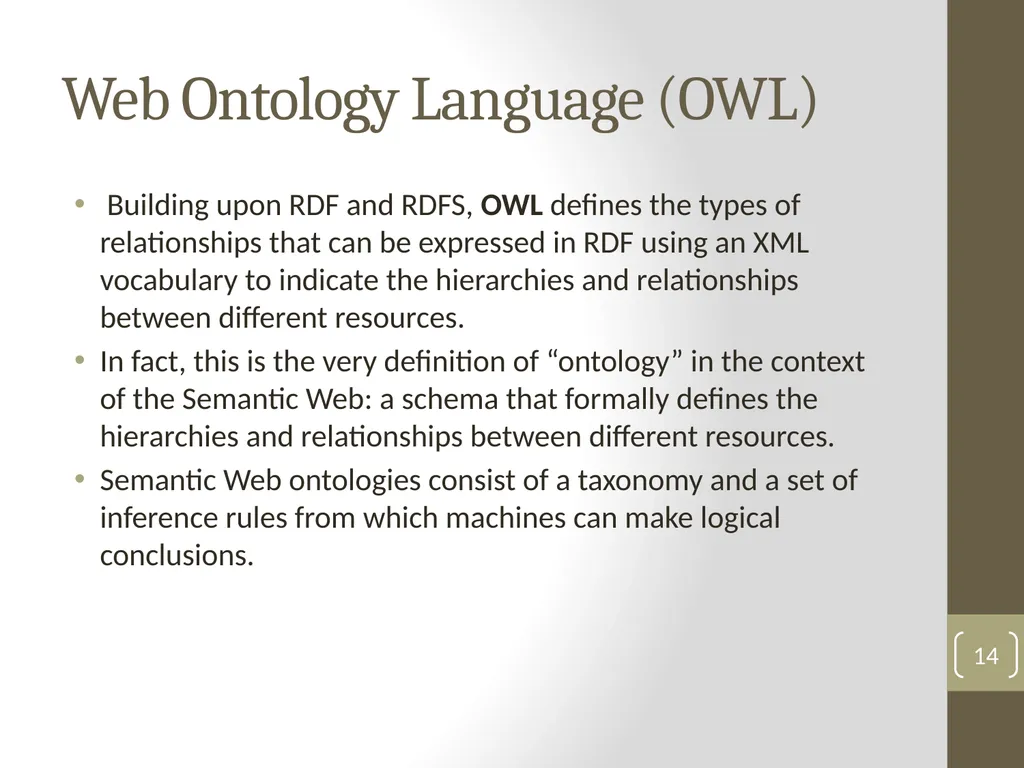
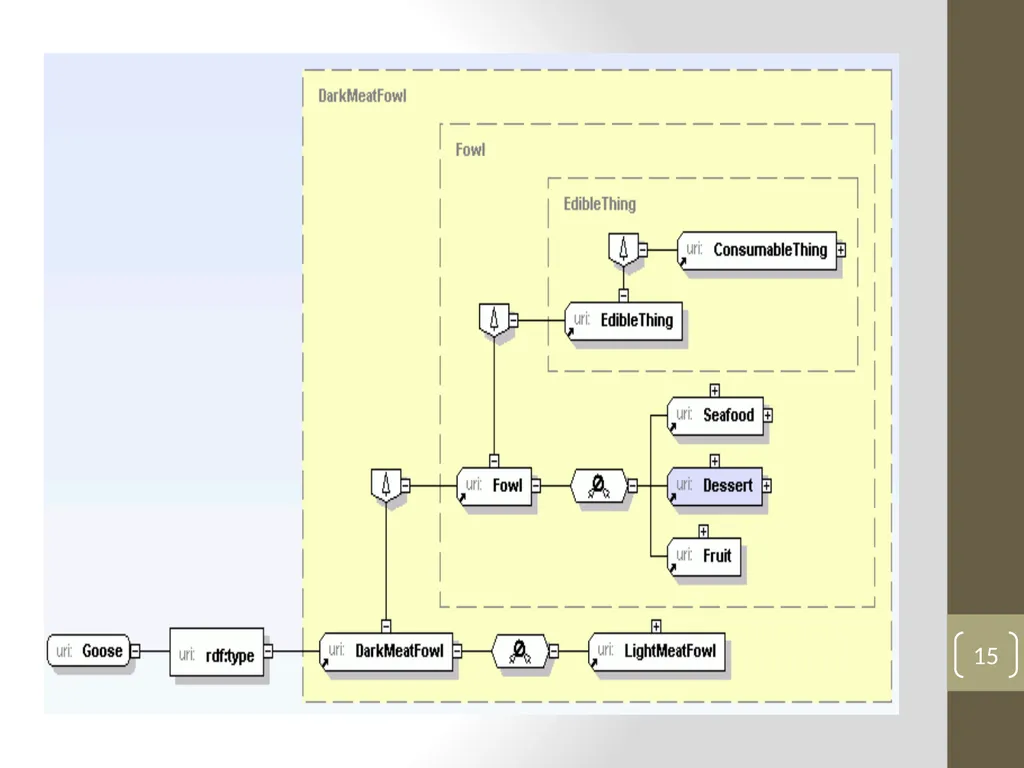
Web Ontology Language (OWL) Building upon RDF and RDFS, OWL defines the types of relationships that can be expressed in RDF using an XML vocabulary to indicate the hierarchies and relationships between different resources.
In fact, this is the very definition of “ontology” in the context of the Semantic Web: a schema that formally defines the hierarchies and relationships between different resources.
Semantic Web ontologies consist of a taxonomy and a set of inference rules from which machines can make logical conclusions. 14<br>
In fact, this is the very definition of “ontology” in the context of the Semantic Web: a schema that formally defines the hierarchies and relationships between different resources.
Semantic Web ontologies consist of a taxonomy and a set of inference rules from which machines can make logical conclusions. 14<br>
15
15<br>
16
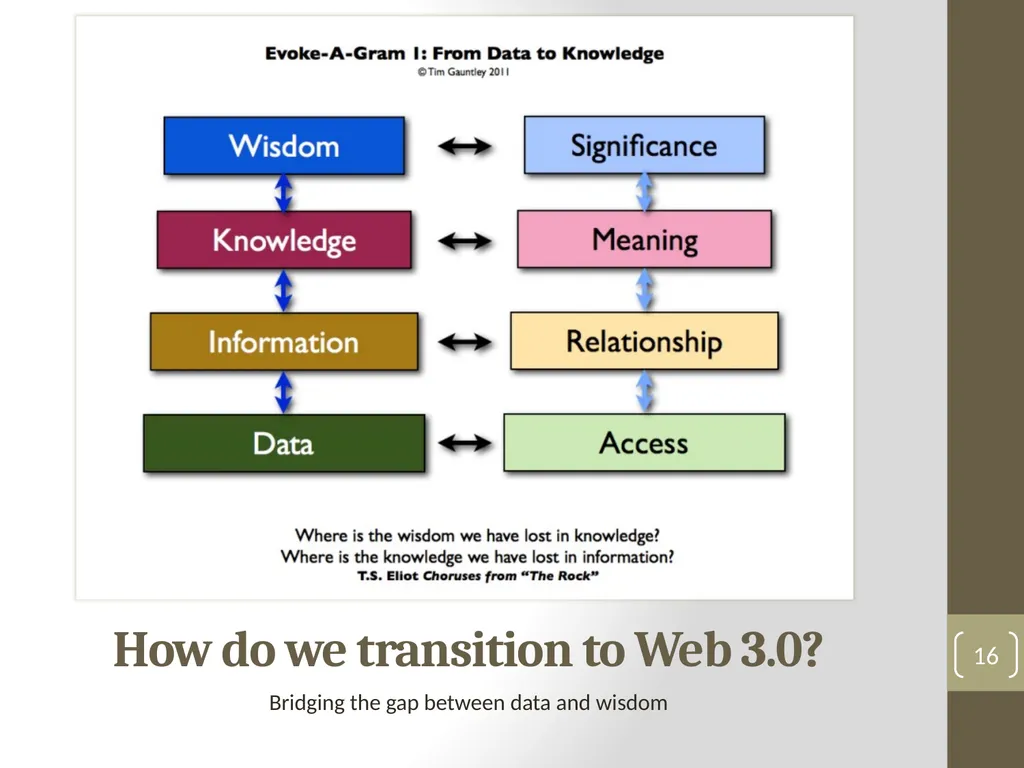
How do we transition to Web 3.0? Bridging the gap between data and wisdom 16<br>
17
Ontologies Representing background knowledge as a hierarchical structure
consisting of concepts, entities and relations 17<br>
consisting of concepts, entities and relations 17<br>
18
Ontologies An ontology is an explicit specification of a conceptualization
Practically, an ontological commitment is an agreement to use a vocabulary (i.e., ask queries and make assertions) in a way that is consistent (but not complete) with respect to the theory specified by an ontology.
We build agents that commit to ontologies.
We design ontologies so we can share knowledge with and among these agents 18<br>
Practically, an ontological commitment is an agreement to use a vocabulary (i.e., ask queries and make assertions) in a way that is consistent (but not complete) with respect to the theory specified by an ontology.
We build agents that commit to ontologies.
We design ontologies so we can share knowledge with and among these agents 18<br>
19
Example of Ontology - WordNet WordNet is a lexical database for the English language.
It groups English words into sets of synonyms called synsets, provides short, general definitions, records the various semantic relations between these synonym sets.
Purpose:
to produce a combination of dictionary and thesaurus that is more intuitively usable
to support automatic text analysis and artificial intelligence applications 19<br>
It groups English words into sets of synonyms called synsets, provides short, general definitions, records the various semantic relations between these synonym sets.
Purpose:
to produce a combination of dictionary and thesaurus that is more intuitively usable
to support automatic text analysis and artificial intelligence applications 19<br>
20
Parts of a WordNet Noun
Hypernyms – (Y,X) if every X is a (kind of) Y – (canine, dog)
Hyponyms - (Y,X) if every Y is a (kind of) X
Coordinate terms – (Y,X) if X and Y share a hypernym
Holonyms - (Y,X) if X is a part of Y – (building, window)
Meronym - (Y,X) if Y is a part of X
Verbs
Hypernyms - (Y,X) if the activity X is a (kind of) Y – (to perceive, to listen)
Troponyms - (Y,X) if the activity Y is doing X in some manner – (to lisp, to talk)
Entailment - (Y,X) if by doing X you must be doing Y - (to sleep, to snore)
Coordinate terms - verbs sharing a common hypernym (to lisp, to yell)
Adjectives
Adverbs 20<br>
Hypernyms – (Y,X) if every X is a (kind of) Y – (canine, dog)
Hyponyms - (Y,X) if every Y is a (kind of) X
Coordinate terms – (Y,X) if X and Y share a hypernym
Holonyms - (Y,X) if X is a part of Y – (building, window)
Meronym - (Y,X) if Y is a part of X
Verbs
Hypernyms - (Y,X) if the activity X is a (kind of) Y – (to perceive, to listen)
Troponyms - (Y,X) if the activity Y is doing X in some manner – (to lisp, to talk)
Entailment - (Y,X) if by doing X you must be doing Y - (to sleep, to snore)
Coordinate terms - verbs sharing a common hypernym (to lisp, to yell)
Adjectives
Adverbs 20<br>
21
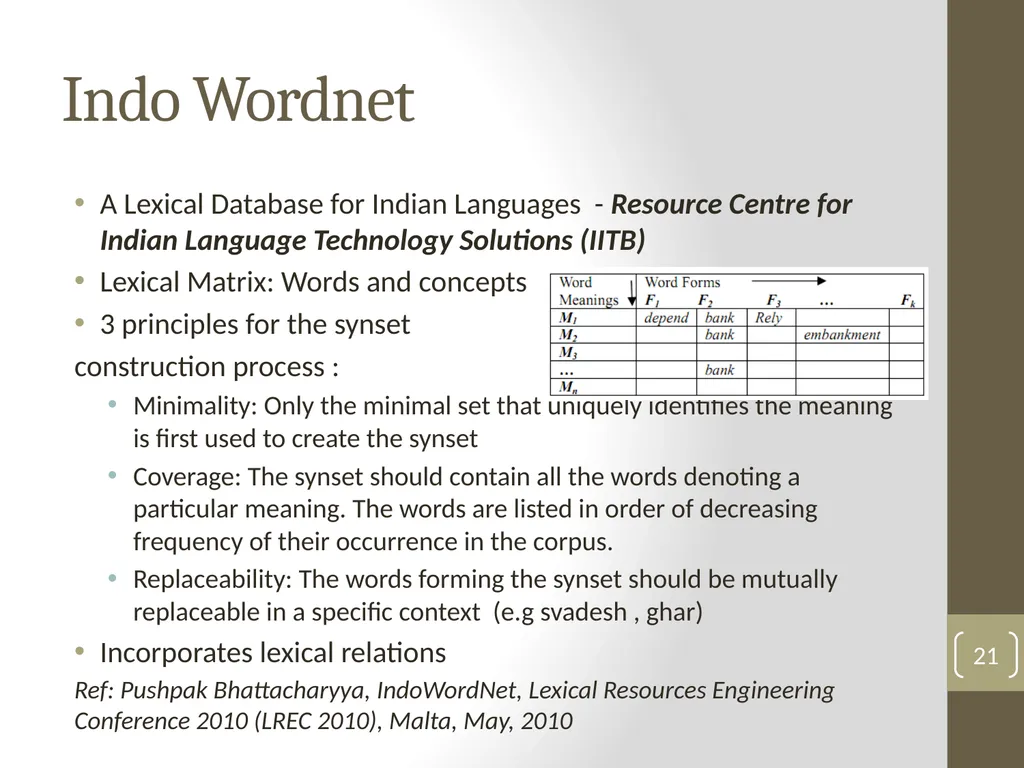
A Lexical Database for Indian Languages - Resource Centre for Indian Language Technology Solutions (IITB)
Lexical Matrix: Words and concepts
3 principles for the synset
construction process :
Minimality: Only the minimal set that uniquely identifies the meaning is first used to create the synset
Coverage: The synset should contain all the words denoting a particular meaning. The words are listed in order of decreasing frequency of their occurrence in the corpus.
Replaceability: The words forming the synset should be mutually replaceable in a specific context (e.g svadesh , ghar)
Incorporates lexical relations
Ref: Pushpak Bhattacharyya, IndoWordNet, Lexical Resources Engineering Conference 2010 (LREC 2010), Malta, May, 2010 Indo Wordnet 21<br>
Lexical Matrix: Words and concepts
3 principles for the synset
construction process :
Minimality: Only the minimal set that uniquely identifies the meaning is first used to create the synset
Coverage: The synset should contain all the words denoting a particular meaning. The words are listed in order of decreasing frequency of their occurrence in the corpus.
Replaceability: The words forming the synset should be mutually replaceable in a specific context (e.g svadesh , ghar)
Incorporates lexical relations
Ref: Pushpak Bhattacharyya, IndoWordNet, Lexical Resources Engineering Conference 2010 (LREC 2010), Malta, May, 2010 Indo Wordnet 21<br>
22
Semantic Web @ IIT-B Curating and Searching the Annotated Web (CSAW):
A project in the CSE department
Aims to annotate mentions of named entities on billions of Web pages with IDs, thus linking them to entity nodes in Wikipedia
This will enable searching with entities and relationships at an unprecedented scale
The project has two parts:
Annotating token segments on Web pages with Wikipedia entity IDs
A new aggregated search mechanism for quantities
Ref: Annotating and Searching Web Tables Using Entities, Types and Relationships. By Girija Limaye, Sunita Sarawagi and Soumen Chakrabarti. In VLDB 2010
Ref: Collective Annotation of Wikipedia Entities in Web Text, by Sayali Kulkarni, Amit Singh, Ganesh Ramakrishnan, and Soumen Chakrabarti, in SIGKDD 2009. 22<br>
A project in the CSE department
Aims to annotate mentions of named entities on billions of Web pages with IDs, thus linking them to entity nodes in Wikipedia
This will enable searching with entities and relationships at an unprecedented scale
The project has two parts:
Annotating token segments on Web pages with Wikipedia entity IDs
A new aggregated search mechanism for quantities
Ref: Annotating and Searching Web Tables Using Entities, Types and Relationships. By Girija Limaye, Sunita Sarawagi and Soumen Chakrabarti. In VLDB 2010
Ref: Collective Annotation of Wikipedia Entities in Web Text, by Sayali Kulkarni, Amit Singh, Ganesh Ramakrishnan, and Soumen Chakrabarti, in SIGKDD 2009. 22<br>
23
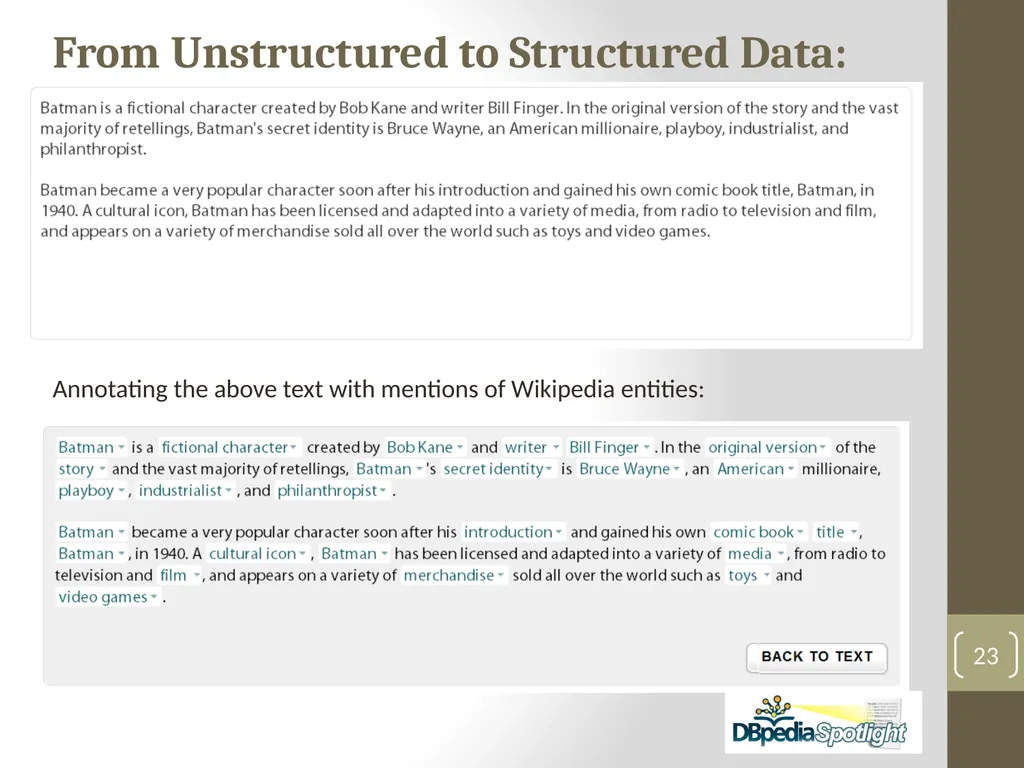
23 From Unstructured to Structured Data: Annotating the above text with mentions of Wikipedia entities:<br>
24
CSAW – Contributions Posing entity disambiguation as an optimization problem:
Clues from local context help in disambiguation
Disambiguation based on compatibility between spot and label
Single optimization objective:
Using integer linear programs (NP Hard)
Heuristics for approximate solutions (eg. Hill Climbing)
Rich node features with systematic learning:
Node score + Clique score
Use relatedness measure as described by Milne et. al.
Back off strategy for controlled annotations:
Not all spots may be tagged. Allow backoff from tagging
Assign a special label “na” to mark a “no attachment”
Reward a spot for attaching to na – RNA 24<br>
Clues from local context help in disambiguation
Disambiguation based on compatibility between spot and label
Single optimization objective:
Using integer linear programs (NP Hard)
Heuristics for approximate solutions (eg. Hill Climbing)
Rich node features with systematic learning:
Node score + Clique score
Use relatedness measure as described by Milne et. al.
Back off strategy for controlled annotations:
Not all spots may be tagged. Allow backoff from tagging
Assign a special label “na” to mark a “no attachment”
Reward a spot for attaching to na – RNA 24<br>
25
What are the promising applications? Semantic Web enabled services 25<br>
26
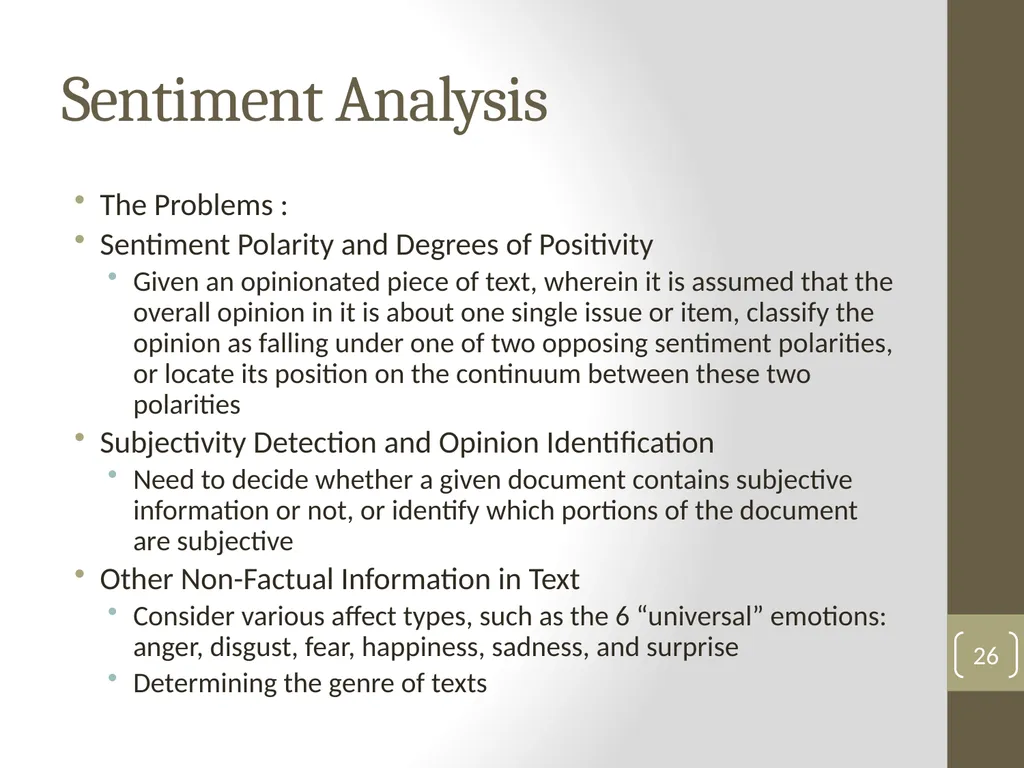
Sentiment Analysis The Problems :
Sentiment Polarity and Degrees of Positivity
Given an opinionated piece of text, wherein it is assumed that the overall opinion in it is about one single issue or item, classify the opinion as falling under one of two opposing sentiment polarities, or locate its position on the continuum between these two polarities
Subjectivity Detection and Opinion Identification
Need to decide whether a given document contains subjective information or not, or identify which portions of the document are subjective
Other Non-Factual Information in Text
Consider various affect types, such as the 6 “universal” emotions: anger, disgust, fear, happiness, sadness, and surprise
Determining the genre of texts 26<br>
Sentiment Polarity and Degrees of Positivity
Given an opinionated piece of text, wherein it is assumed that the overall opinion in it is about one single issue or item, classify the opinion as falling under one of two opposing sentiment polarities, or locate its position on the continuum between these two polarities
Subjectivity Detection and Opinion Identification
Need to decide whether a given document contains subjective information or not, or identify which portions of the document are subjective
Other Non-Factual Information in Text
Consider various affect types, such as the 6 “universal” emotions: anger, disgust, fear, happiness, sadness, and surprise
Determining the genre of texts 26<br>
27
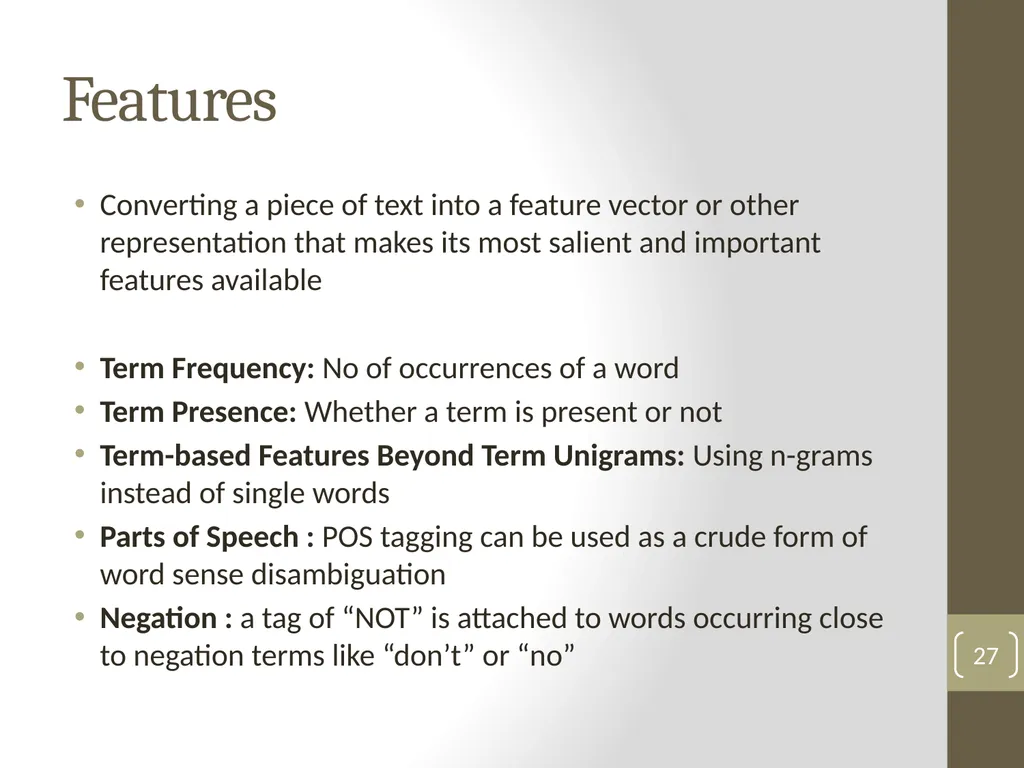
Features Converting a piece of text into a feature vector or other representation that makes its most salient and important features available
Term Frequency: No of occurrences of a word
Term Presence: Whether a term is present or not
Term-based Features Beyond Term Unigrams: Using n-grams instead of single words
Parts of Speech : POS tagging can be used as a crude form of word sense disambiguation
Negation : a tag of “NOT” is attached to words occurring close to negation terms like “don’t” or “no” 27<br>
Term Frequency: No of occurrences of a word
Term Presence: Whether a term is present or not
Term-based Features Beyond Term Unigrams: Using n-grams instead of single words
Parts of Speech : POS tagging can be used as a crude form of word sense disambiguation
Negation : a tag of “NOT” is attached to words occurring close to negation terms like “don’t” or “no” 27<br>
28
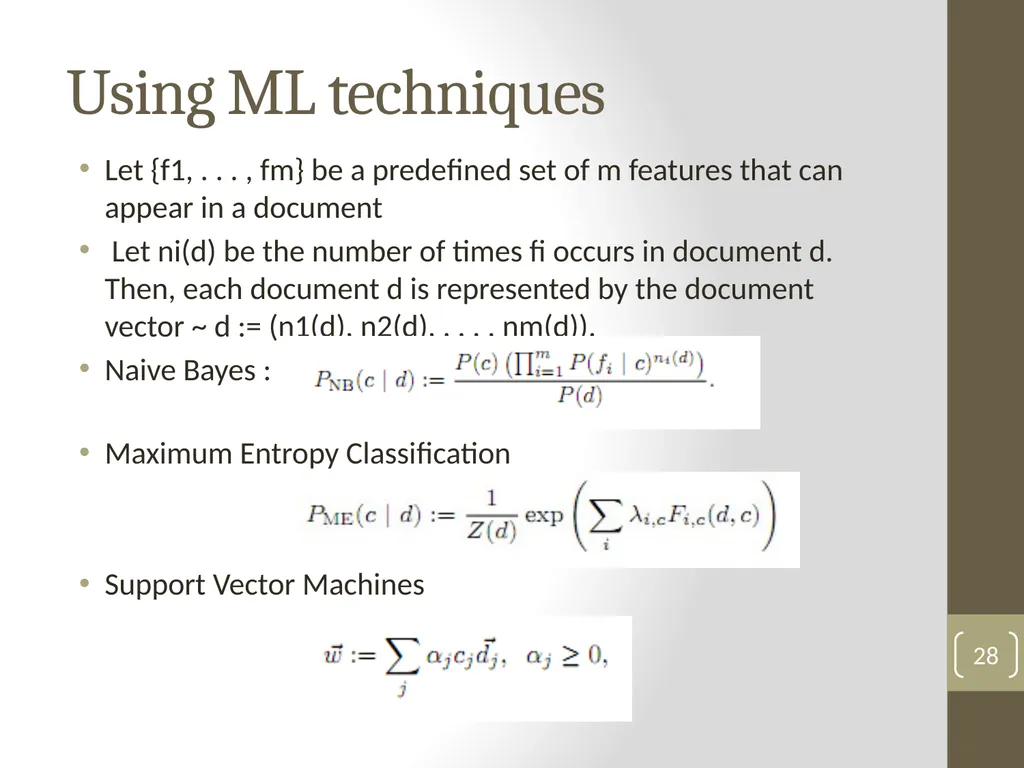
Let {f1, . . . , fm} be a predefined set of m features that can appear in a document
Let ni(d) be the number of times fi occurs in document d. Then, each document d is represented by the document vector ~ d := (n1(d), n2(d), . . . , nm(d)).
Naive Bayes :
Maximum Entropy Classification
Support Vector Machines Using ML techniques 28<br>
Let ni(d) be the number of times fi occurs in document d. Then, each document d is represented by the document vector ~ d := (n1(d), n2(d), . . . , nm(d)).
Naive Bayes :
Maximum Entropy Classification
Support Vector Machines Using ML techniques 28<br>
29
Sentiment Analyzer : C-Feel-It NLP Research @ IITB
Input : Keyword(s)
Fetches tweets using the twitter API
Preprocessing : Handling extensions, chat lingo
Emoticon-based Sentiment Predictor
Lexicon-based Sentiment Predictor
The words ‘no’, ‘never’, ‘not’ are considered negating words and a context window of three words after a negative words is considered for inversion.
For each word in the tweet, it gets the prediction from a lexical resource.
We use the intuition that a positive tweet has positive words outnumbering other words, a negative tweet has negative words outnumbering other words and an objective tweet has objective words outnumbering other words.
Tweet Sentiment Collaborator
Ref: Aditya Joshi, Balamurali A.R, Pushpak Bhattacharyya and Rajat Mohanty, C-Feel-It: A Sentiment Analyzer for Micro-blogs (demo paper), Annual Meeting of the Association of Computational Linguistics (ACL 2011), Oregon, USA, June 2011. 29<br>
Input : Keyword(s)
Fetches tweets using the twitter API
Preprocessing : Handling extensions, chat lingo
Emoticon-based Sentiment Predictor
Lexicon-based Sentiment Predictor
The words ‘no’, ‘never’, ‘not’ are considered negating words and a context window of three words after a negative words is considered for inversion.
For each word in the tweet, it gets the prediction from a lexical resource.
We use the intuition that a positive tweet has positive words outnumbering other words, a negative tweet has negative words outnumbering other words and an objective tweet has objective words outnumbering other words.
Tweet Sentiment Collaborator
Ref: Aditya Joshi, Balamurali A.R, Pushpak Bhattacharyya and Rajat Mohanty, C-Feel-It: A Sentiment Analyzer for Micro-blogs (demo paper), Annual Meeting of the Association of Computational Linguistics (ACL 2011), Oregon, USA, June 2011. 29<br>
30
Semantic Web Agents Automated personal assistants have been a popular topic of AI research for a long time
With the advent of the Semantic Web, a Web-enabled agent can access the semantic knowledge distributed across websites and make real-time decisions to solve complex problems
These agents are intelligent, autonomous and reactive
They may interact with each other to complete a task 30<br>
With the advent of the Semantic Web, a Web-enabled agent can access the semantic knowledge distributed across websites and make real-time decisions to solve complex problems
These agents are intelligent, autonomous and reactive
They may interact with each other to complete a task 30<br>
31
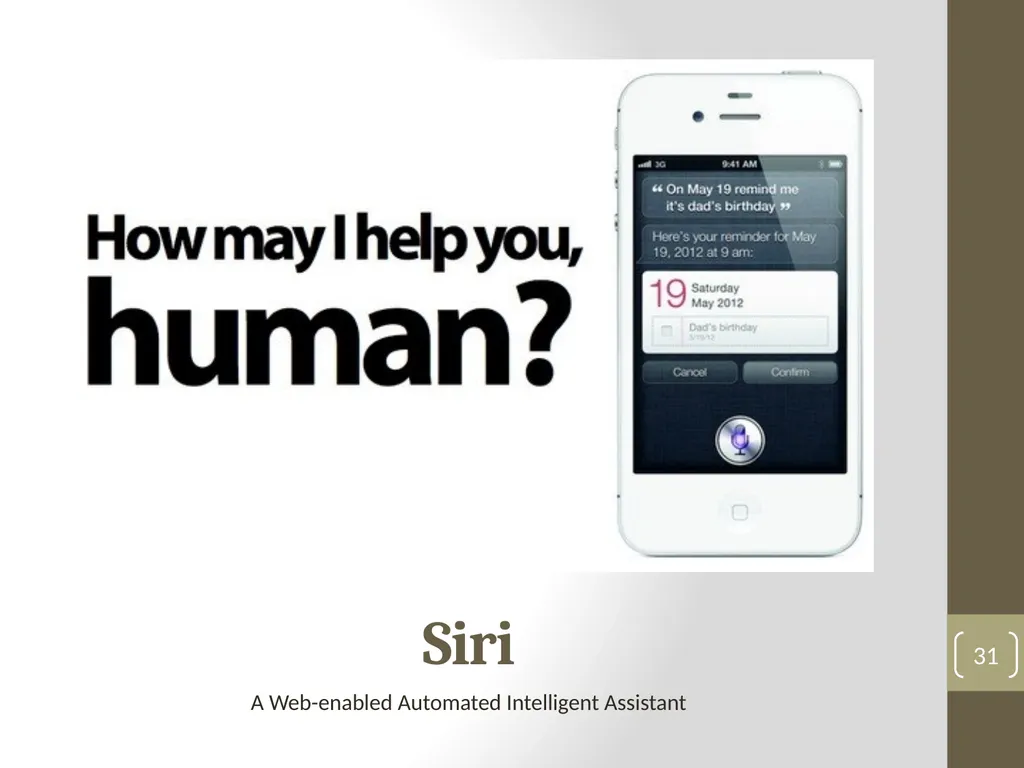
Siri A Web-enabled Automated Intelligent Assistant 31<br>
32
Siri: A Major Step Forward Siri is an intelligent software assistant and knowledge navigator functioning as a personal assistant application for iOS
The application uses a natural language user interface to answer questions, make recommendations, and perform actions by delegating requests to a set of web services
Siri understands what you say, knows what you mean, and even talks back
In a mobile environment, you just don’t have time to wade through pages of links and disjointed interfaces and apps to get at simple answers. Just one question can replace 20 tasks by the user. This is the power of Siri 32<br>
The application uses a natural language user interface to answer questions, make recommendations, and perform actions by delegating requests to a set of web services
Siri understands what you say, knows what you mean, and even talks back
In a mobile environment, you just don’t have time to wade through pages of links and disjointed interfaces and apps to get at simple answers. Just one question can replace 20 tasks by the user. This is the power of Siri 32<br>
33
How Siri works? Does Things For You- Task completion:
- Multiple Criteria Vertical and Horizontal searches
- On the fly combining of multiple information sources
- Real time editing of information based on dynamic criteria
- Integrated endpoints, like ticket purchases, etc.
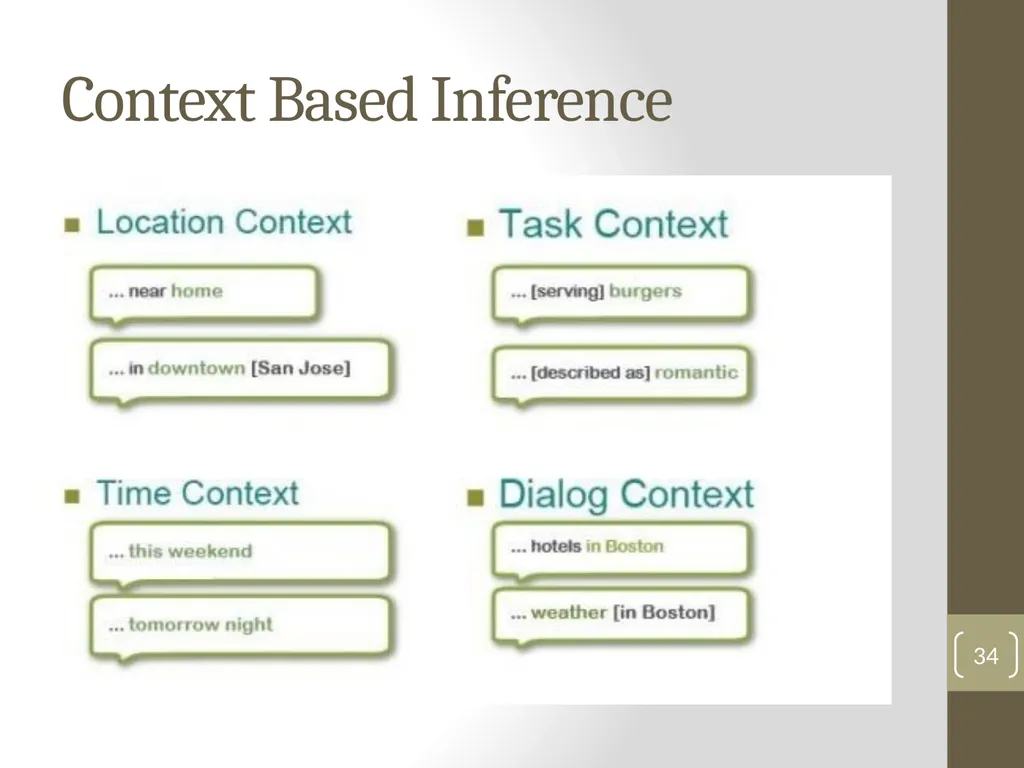
Gets What You Say- Conversational intent: - Location context - Time context - Task context - Dialog context
Gets To Know You- Learns and acts on personal information: - Who are your friends - Where do you live - What is your age - What do you like 33<br>
Gets What You Say- Conversational intent: - Location context - Time context - Task context - Dialog context
Gets To Know You- Learns and acts on personal information: - Who are your friends - Where do you live - What is your age - What do you like 33<br>
34
Context Based Inference 34<br>
35
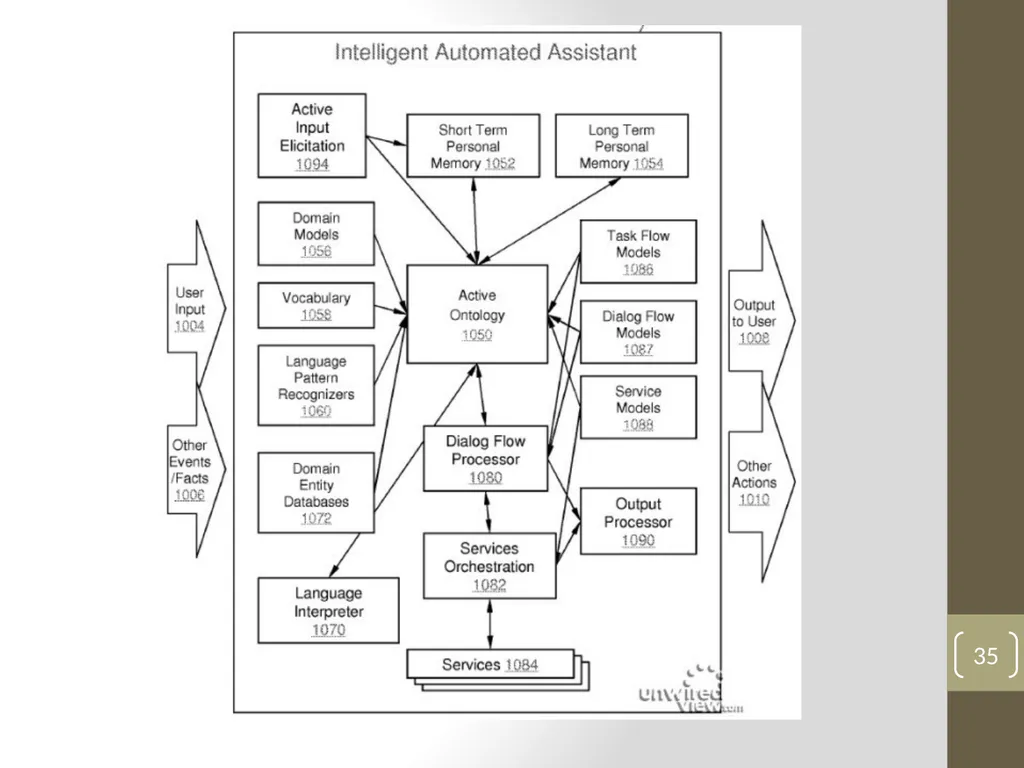
35<br>
36
What are the major issues? …and how to overcome them 36<br>
37
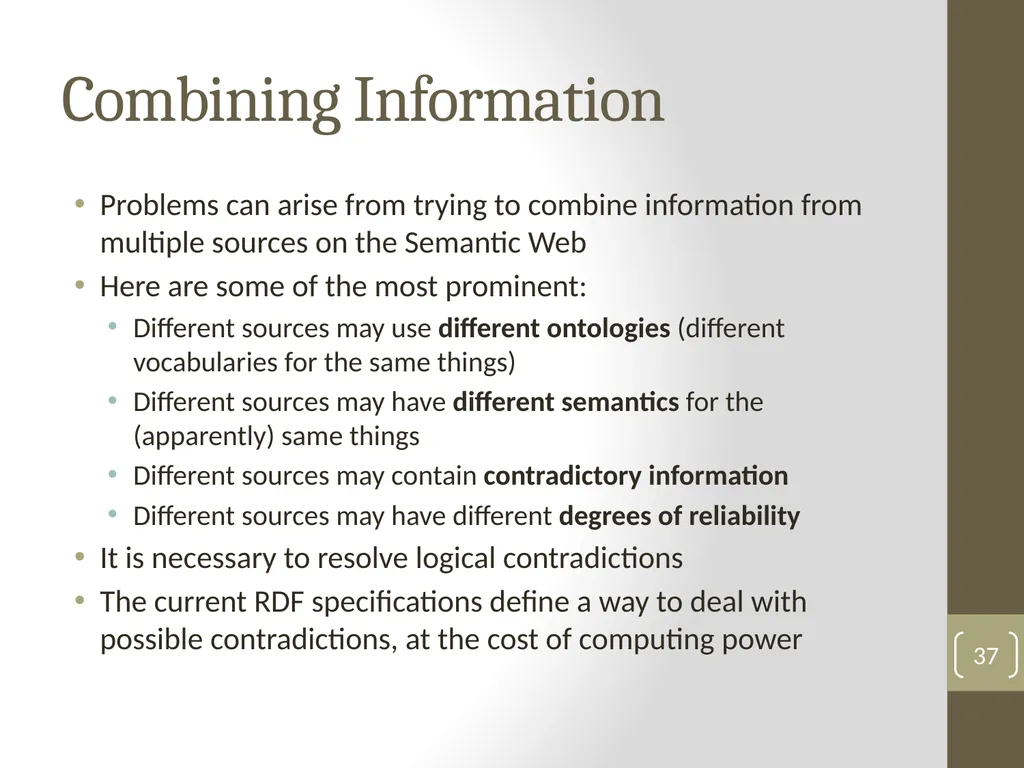
Combining Information Problems can arise from trying to combine information from multiple sources on the Semantic Web
Here are some of the most prominent:
Different sources may use different ontologies (different vocabularies for the same things)
Different sources may have different semantics for the (apparently) same things
Different sources may contain contradictory information
Different sources may have different degrees of reliability
It is necessary to resolve logical contradictions
The current RDF specifications define a way to deal with possible contradictions, at the cost of computing power 37<br>
Here are some of the most prominent:
Different sources may use different ontologies (different vocabularies for the same things)
Different sources may have different semantics for the (apparently) same things
Different sources may contain contradictory information
Different sources may have different degrees of reliability
It is necessary to resolve logical contradictions
The current RDF specifications define a way to deal with possible contradictions, at the cost of computing power 37<br>
38
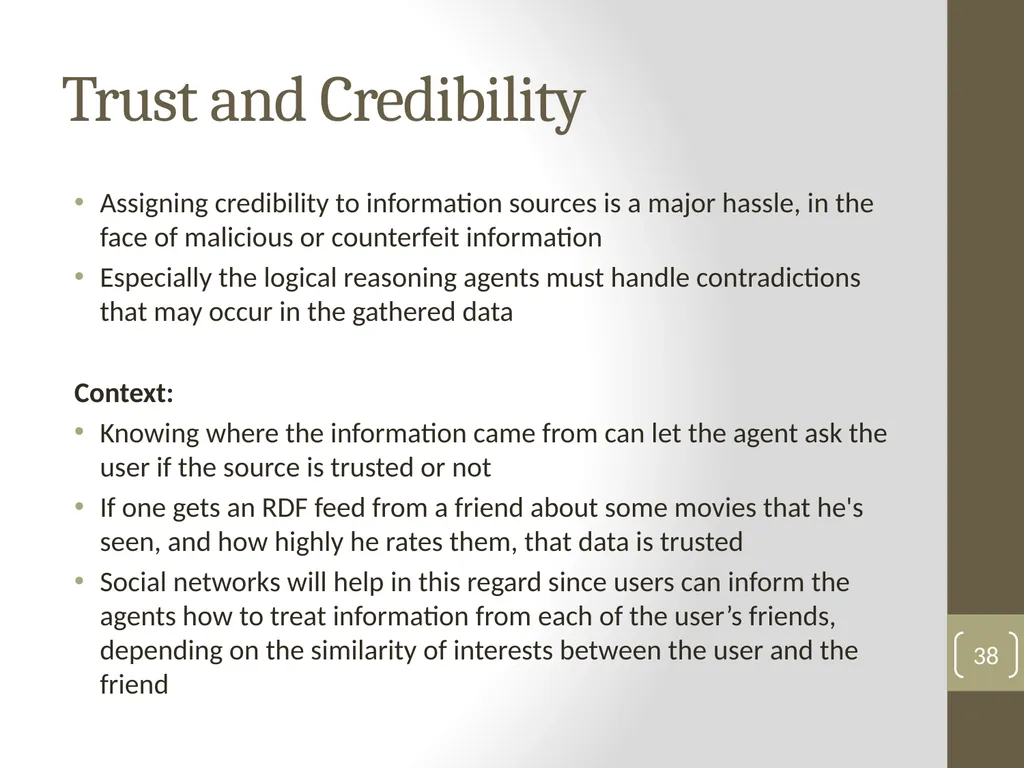
Trust and Credibility Assigning credibility to information sources is a major hassle, in the face of malicious or counterfeit information
Especially the logical reasoning agents must handle contradictions that may occur in the gathered data
Context:
Knowing where the information came from can let the agent ask the user if the source is trusted or not
If one gets an RDF feed from a friend about some movies that he's seen, and how highly he rates them, that data is trusted
Social networks will help in this regard since users can inform the agents how to treat information from each of the user’s friends, depending on the similarity of interests between the user and the friend 38<br>
Especially the logical reasoning agents must handle contradictions that may occur in the gathered data
Context:
Knowing where the information came from can let the agent ask the user if the source is trusted or not
If one gets an RDF feed from a friend about some movies that he's seen, and how highly he rates them, that data is trusted
Social networks will help in this regard since users can inform the agents how to treat information from each of the user’s friends, depending on the similarity of interests between the user and the friend 38<br>
39
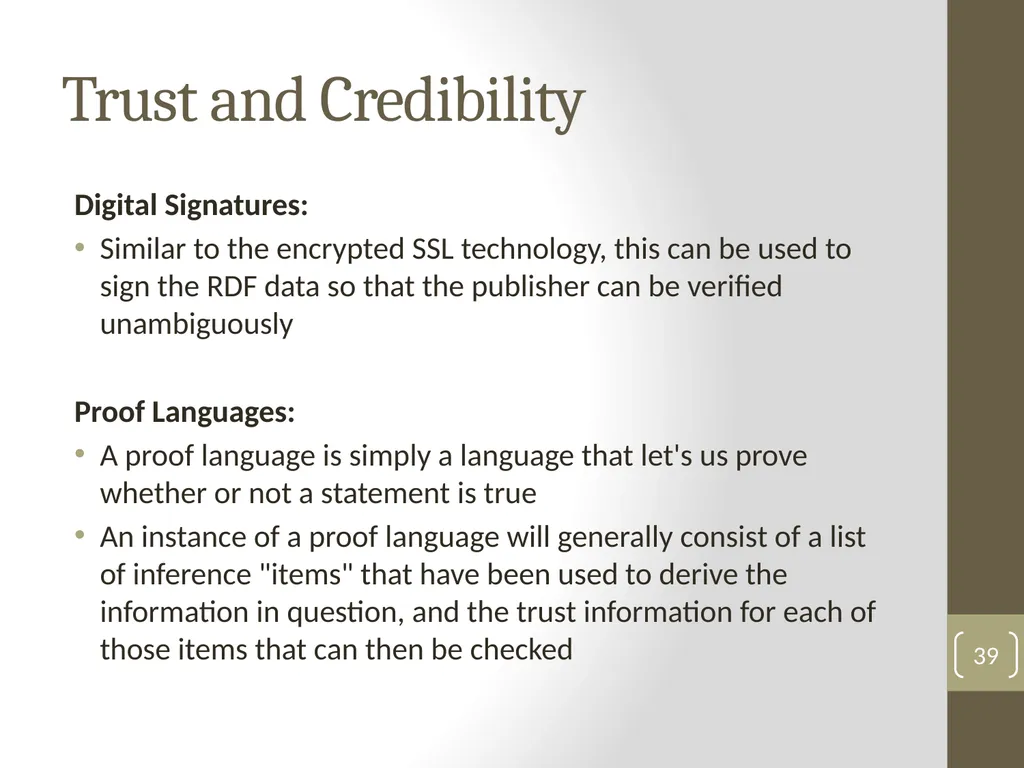
Trust and Credibility Digital Signatures:
Similar to the encrypted SSL technology, this can be used to sign the RDF data so that the publisher can be verified unambiguously
Proof Languages:
A proof language is simply a language that let's us prove whether or not a statement is true
An instance of a proof language will generally consist of a list of inference "items" that have been used to derive the information in question, and the trust information for each of those items that can then be checked 39<br>
Similar to the encrypted SSL technology, this can be used to sign the RDF data so that the publisher can be verified unambiguously
Proof Languages:
A proof language is simply a language that let's us prove whether or not a statement is true
An instance of a proof language will generally consist of a list of inference "items" that have been used to derive the information in question, and the trust information for each of those items that can then be checked 39<br>
40
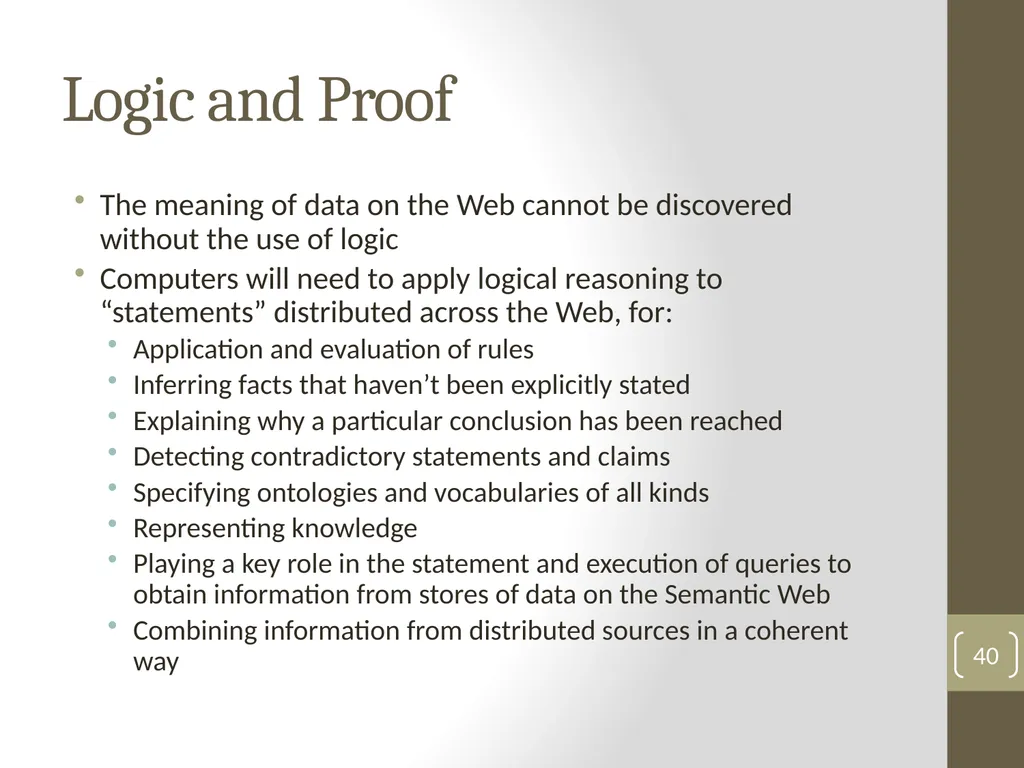
Logic and Proof The meaning of data on the Web cannot be discovered without the use of logic
Computers will need to apply logical reasoning to “statements” distributed across the Web, for:
Application and evaluation of rules
Inferring facts that haven’t been explicitly stated
Explaining why a particular conclusion has been reached
Detecting contradictory statements and claims
Specifying ontologies and vocabularies of all kinds
Representing knowledge
Playing a key role in the statement and execution of queries to obtain information from stores of data on the Semantic Web
Combining information from distributed sources in a coherent way 40<br>
Computers will need to apply logical reasoning to “statements” distributed across the Web, for:
Application and evaluation of rules
Inferring facts that haven’t been explicitly stated
Explaining why a particular conclusion has been reached
Detecting contradictory statements and claims
Specifying ontologies and vocabularies of all kinds
Representing knowledge
Playing a key role in the statement and execution of queries to obtain information from stores of data on the Semantic Web
Combining information from distributed sources in a coherent way 40<br>
41
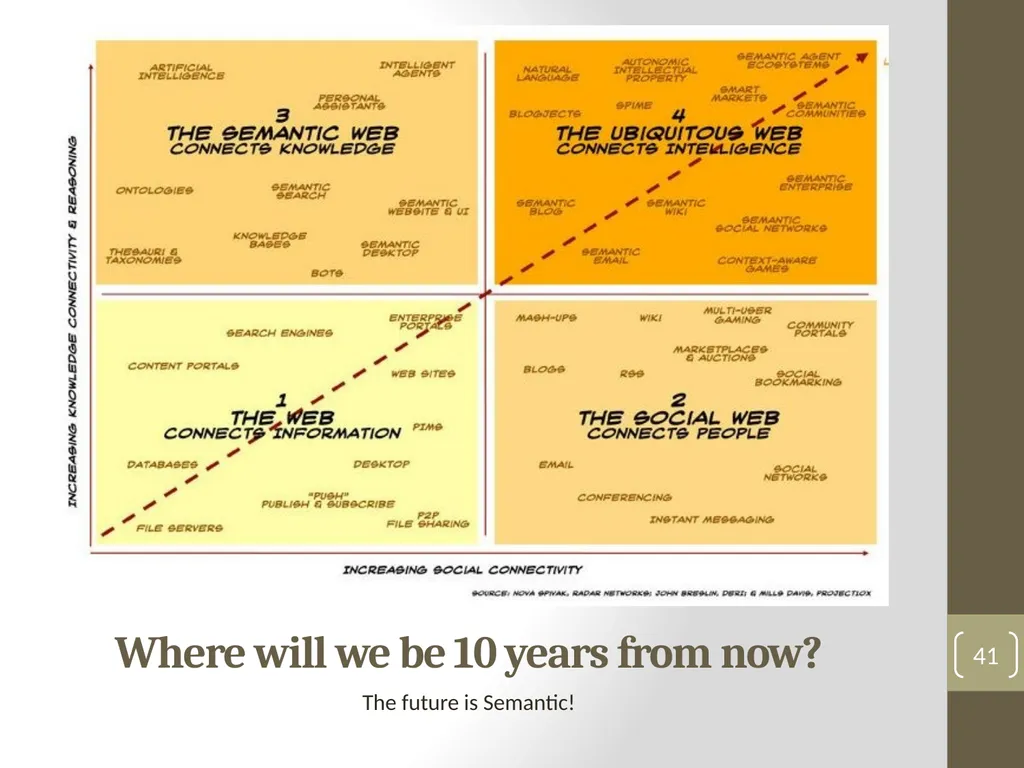
Where will we be 10 years from now? The future is Semantic! 41<br>
42
Conclusion “The level of advancement of a civilization is measured by the complexity of the tasks that it automates and frees from the day-to-day attention of its members”
The Semantic Web will free humans from the most time consuming task facing us today
Autonomous systems that work on our behalf and perform the task of organizing, retrieving, and making sense of the information present on the Web, will enable us to delve into the next level of cognitive reasoning
This will be a major step forward in the path of human understanding 42<br>
The Semantic Web will free humans from the most time consuming task facing us today
Autonomous systems that work on our behalf and perform the task of organizing, retrieving, and making sense of the information present on the Web, will enable us to delve into the next level of cognitive reasoning
This will be a major step forward in the path of human understanding 42<br>
43
References Introduction to The Semantic Web (http://infomesh.net/2001/swintro/)
http://www.altova.com/semantic_web.html
Wikipedia as an Ontology for Describing Documents – (http://ebiquity.umbc.edu/paper/html/id/383)
http://www.youtube.com/watch?v=OGg8A2zfWKg
A Survey of the Web Ontology Landscape, Taowei David Wang, Bijan Parsia, James Hendler
(http://www.mindswap.org/papers/2006/survey.pdf)
Annotating and Searching Web Tables Using Entities, Types and Relationships. By Girija Limaye, Sunita Sarawagi and Soumen Chakrabarti. In VLDB 2010
Collective Annotation of Wikipedia Entities in Web Text, by Sayali Kulkarni, Amit Singh, Ganesh Ramakrishnan, and Soumen Chakrabarti, in SIGKDD 2009. 43<br>
http://www.altova.com/semantic_web.html
Wikipedia as an Ontology for Describing Documents – (http://ebiquity.umbc.edu/paper/html/id/383)
http://www.youtube.com/watch?v=OGg8A2zfWKg
A Survey of the Web Ontology Landscape, Taowei David Wang, Bijan Parsia, James Hendler
(http://www.mindswap.org/papers/2006/survey.pdf)
Annotating and Searching Web Tables Using Entities, Types and Relationships. By Girija Limaye, Sunita Sarawagi and Soumen Chakrabarti. In VLDB 2010
Collective Annotation of Wikipedia Entities in Web Text, by Sayali Kulkarni, Amit Singh, Ganesh Ramakrishnan, and Soumen Chakrabarti, in SIGKDD 2009. 43<br>
44
References The Semantic Web, By Tim Berners-Lee, James Hendler and Ora Lassila, Scientific American, May 17, 2001
Aditya Joshi, Balamurali A.R, Pushpak Bhattacharyya and Rajat Mohanty, C-Feel-It: A Sentiment Analyzer for Micro-blogs (demo paper), Annual Meeting of the Association of Computational Linguistics (ACL 2011), Oregon, USA, June 2011.
Pushpak Bhattacharyya, IndoWordNet, Lexical Resources Engineering Conference 2010 (LREC 2010), Malta, May, 2010
G. A. Miller, R. Beckwith, C. D. Fellbaum, D. Gross, K. Miller. 1990. WordNet: An online lexical database. Int. J. Lexicograph. 3, 4, pp. 235–244.
http://www.quora.com/Siri-software/Why-is-Siri-important
Wikipedia – The Online Encyclopedia, http://en.wikipedia.org/wiki/Semantic_Web
Google Image Search 44<br>
Aditya Joshi, Balamurali A.R, Pushpak Bhattacharyya and Rajat Mohanty, C-Feel-It: A Sentiment Analyzer for Micro-blogs (demo paper), Annual Meeting of the Association of Computational Linguistics (ACL 2011), Oregon, USA, June 2011.
Pushpak Bhattacharyya, IndoWordNet, Lexical Resources Engineering Conference 2010 (LREC 2010), Malta, May, 2010
G. A. Miller, R. Beckwith, C. D. Fellbaum, D. Gross, K. Miller. 1990. WordNet: An online lexical database. Int. J. Lexicograph. 3, 4, pp. 235–244.
http://www.quora.com/Siri-software/Why-is-Siri-important
Wikipedia – The Online Encyclopedia, http://en.wikipedia.org/wiki/Semantic_Web
Google Image Search 44<br>