SEMINAR DAY Name Jyotsna Kisan Renjar Topic Name Breeding of Mulberry and Management Mulberry is a deciduous tree and is an economically important food crop for domesticated silkworm, Bombyx mori. The practice of producing valuable silk
"SEMINAR DAY Name – Jyotsna Kisan Renjar Topic Name" is the property of its rightful owner. Permission is granted to
download and print the materials on this website for personal, non-commercial use only, and to display it
on your personal computer provided you do not modify the materials and that you retain all copyright
notices contained in the materials. By downloading content from our website, you accept the terms of this
agreement.
Presentation Transcript
01
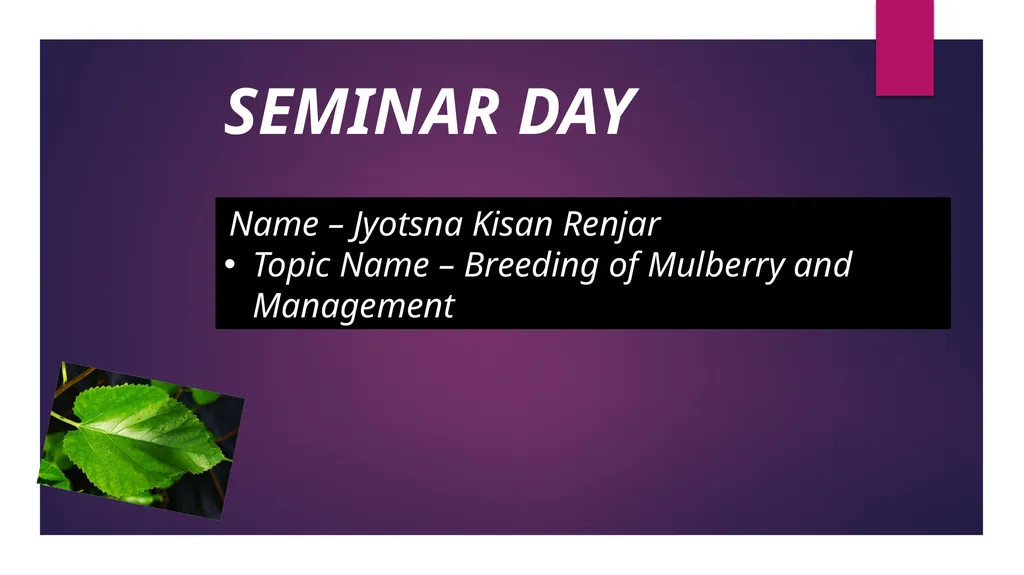
SEMINAR DAY Name – Jyotsna Kisan Renjar
Topic Name – Breeding of Mulberry and Management<br>
02
Mulberry is a deciduous tree and is an economically important food crop for domesticated silkworm, Bombyx mori.
The practice of producing valuable silk from silkworms nourished by mulberry leaves started at least 5,000 years ago and helped to shape world history through the silkroad.
Mulberry species grown in temperate, tropical and subtropical regions of the world.
Taxonomy of Morus is complex. Fossils of Morus appear in the pliocene record of Netherland. INTRODUCTION<br>
03
Species and varieties under cultivation in India There are about 68 species of the Morus.
In India there are many species of Morus, of which Morus alba, M. indica, M. serrata and M. laevigata grow wild in the Hmalayas.
Several varieties have been introduced belong to M. multicaulis, M. nigra, M. sinensis.
Most of the varieties of mulberry belongs to Morus indica.
Suitable varieties – S-1, S-7999, S-1635, S-146, Tr-10 & BC- 259 varieties are recommended for the hilly regions of North and northeastern India.<br>
04
Genetic Description of Mulberry plant Mulberry is fast growing, deciduous, woody, perennial plant.
It has deep root system
The leaves are simple, stipulate, Petiolate, entire or lobed.
Plants are generally dioceous.
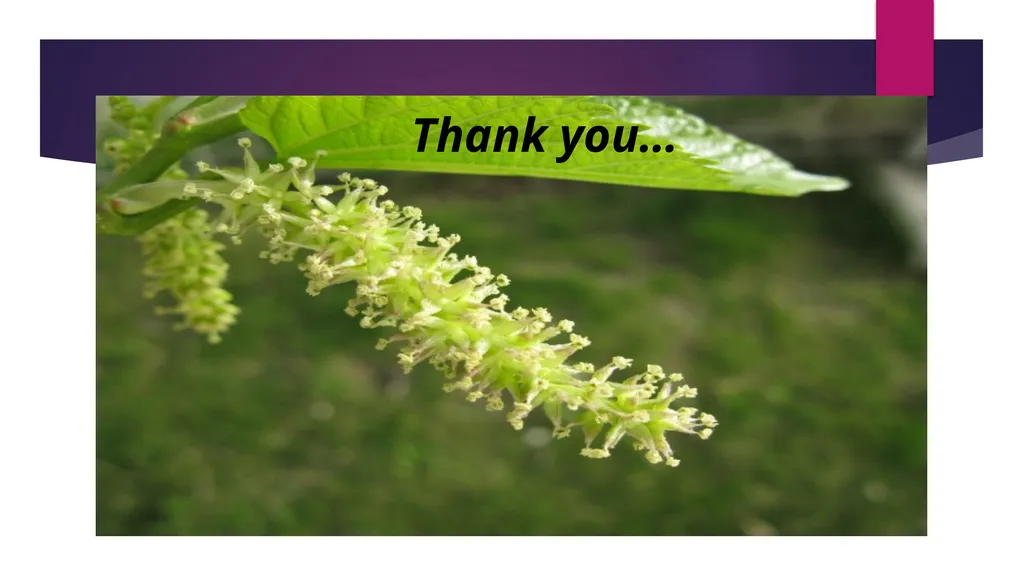
Inflorescence is catkin with pendent or drooping peduncle bearing unisexual flowers.
Inflorescence is always auxiliary.
The chief pollinating agent in mulberry is wind.<br>
05
Mulberry fruit is sorosis, mainly violet, black in colour.
Most of the species of the genus Morus and cultivated varieties are diploid with 28 chromosomes.
Natural polyploidy are comman in mulberry, though diploid with 28 chromosomes or triploid with 42 chromosomes are more frequent.<br>
06
Breeding Objectives Development of high yielding mulberry varieties with quality leaves suitable to different agro-climatic zones of India Specially for southern states.
Developing mulberry varieties for productive areas.
Developing mulberry varieties for tolerance to water stress under semi-arid condition.
Breeding mulberry varieties for suitable under fertilizer & irrigation constraints.
Developing mulberry varieties for disease resistance with special reference to root-rot and root-knot disease.<br>
07
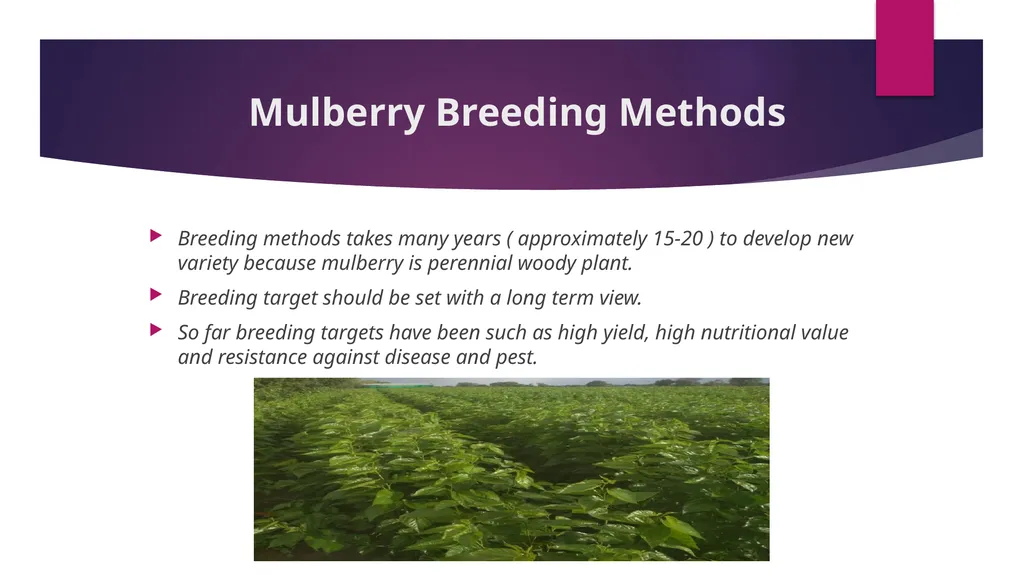
Mulberry Breeding Methods Breeding methods takes many years ( approximately 15-20 ) to develop new variety because mulberry is perennial woody plant.
Breeding target should be set with a long term view.
So far breeding targets have been such as high yield, high nutritional value and resistance against disease and pest.<br>
08
CROSSING METHOD
- It is the major breeding method adopted for the development of new mulberry varieties.
- In this method, the choice of parent selection plays a vital role in achieving the ObjectiVe.<br>
09
STEPS Parental selection the characterization of germplasm asscessions is carried out using morphological, biochemical, & physiological characters, rooting ability of stem cutting, leaf yeild, protein & sugar content, photosynthetic efficiency, etc.
Since almost all mulberry accessions are highly heterozygous and have a long gestation period, traditional breeding methodologies mostly rely on production of F1 hybrid.
The best hybrid is selected & mass multiplied vegetatively for further testing at different regions used for regional multi location studies.<br>
10
All India Coordinate Experiments on Mulberry (AICEM ) along with hybrid selected in same way from other regions to evaluate their performance in different agro-climatic conditions in India for a minimum of 4 years.
The best performance of the AICEM are released for commercial exploration.
By this way a number of high-yielding mulberry varieties have been developed & released for commercial cultivation in India.<br>
11
GENETIC ENGINEERING
Genetic engineering is another potential tool that can be used for mulberry genetic improvement.
Thus, concerted efforts are to be mode to integrate conventional breeding with advanced technological development to accelerate varietal development in mulberry for better sustainability & profitability of the silk industry in India.<br>
12
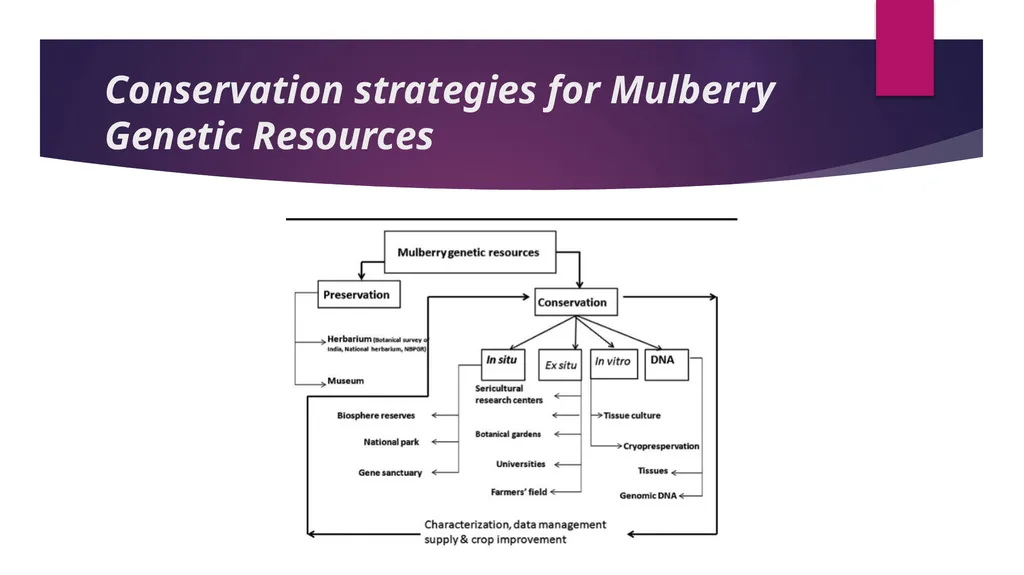
Conservation strategies for Mulberry Genetic Resources<br>