Sentence types Students typical confusions and some teaching implications Defining sentence types Then they all became friends and had a party together is a simple sentence...its like simple; its really easy to read; its really easy
"Sentence types Students’ typical confusions and" is the property of its rightful owner. Permission is granted to
download and print the materials on this website for personal, non-commercial use only, and to display it
on your personal computer provided you do not modify the materials and that you retain all copyright
notices contained in the materials. By downloading content from our website, you accept the terms of this
agreement.
Presentation Transcript
01
Sentence types Students’ typical confusions and some teaching implications<br>
02
Defining sentence types ‘Then they all became friends and had a party together ‘ is a simple sentence...it’s like simple; it’s really easy to read; it’s really easy to like describe it.
A simple sentence is like a short and straight away sentence, a complex sentence is like with more detail but still a bit short with little detail, and compound is where you have long sentences and a lot of description.
That’s a complex because it’s got more than one thing happening.
Many students are confused by the terms ‘simple’, ‘compound’ and ‘complex’ and give semantic definitions rather than grammatical definitions, such as understanding that a simple sentence has one clause containing a finite verb.<br>
03
Simple sentences ‘You have your answer’ is a simple sentence. It’s got four words and it’s like just simple for some particular reason that I just can’t explain it.
A simple sentence is something like ‘I had a picnic’ – it’s simple to write and it’s not that long.
Many students equate simple (i.e. single-clause) sentences with short sentences, when in fact they can be any length e.g:
Devon is beautiful.
The large and scenically varied county of Devon, with its rolling green hills and stunning coastline, is, without a doubt, exceptionally beautiful.<br>
04
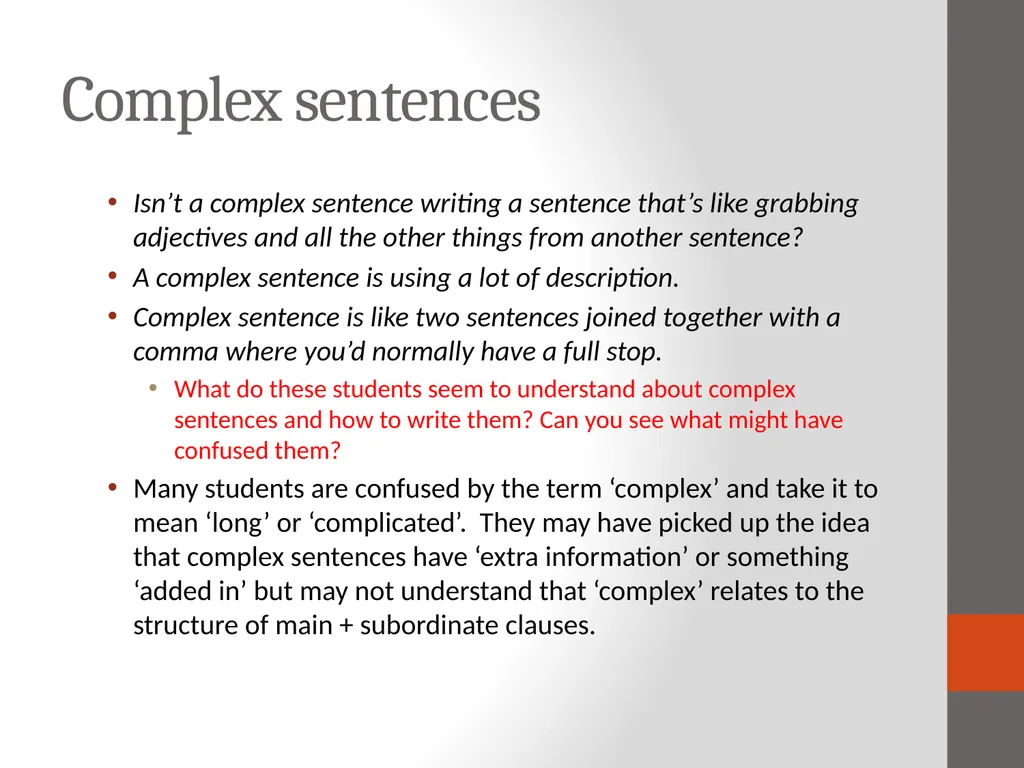
Complex sentences Isn’t a complex sentence writing a sentence that’s like grabbing adjectives and all the other things from another sentence?
A complex sentence is using a lot of description.
Complex sentence is like two sentences joined together with a comma where you’d normally have a full stop.
What do these students seem to understand about complex sentences and how to write them? Can you see what might have confused them?
Many students are confused by the term ‘complex’ and take it to mean ‘long’ or ‘complicated’. They may have picked up the idea that complex sentences have ‘extra information’ or something ‘added in’ but may not understand that ‘complex’ relates to the structure of main + subordinate clauses.<br>
05
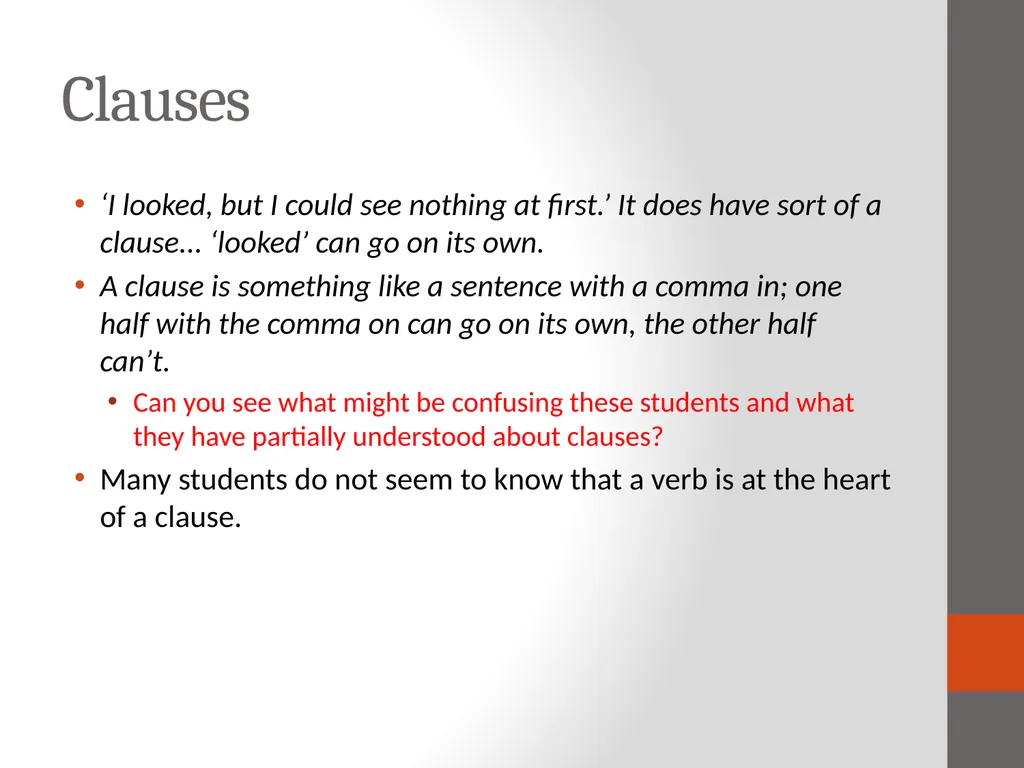
Clauses ‘I looked, but I could see nothing at first.’ It does have sort of a clause... ‘looked’ can go on its own.
A clause is something like a sentence with a comma in; one half with the comma on can go on its own, the other half can’t.
Can you see what might be confusing these students and what they have partially understood about clauses?
Many students do not seem to know that a verb is at the heart of a clause.<br>
06
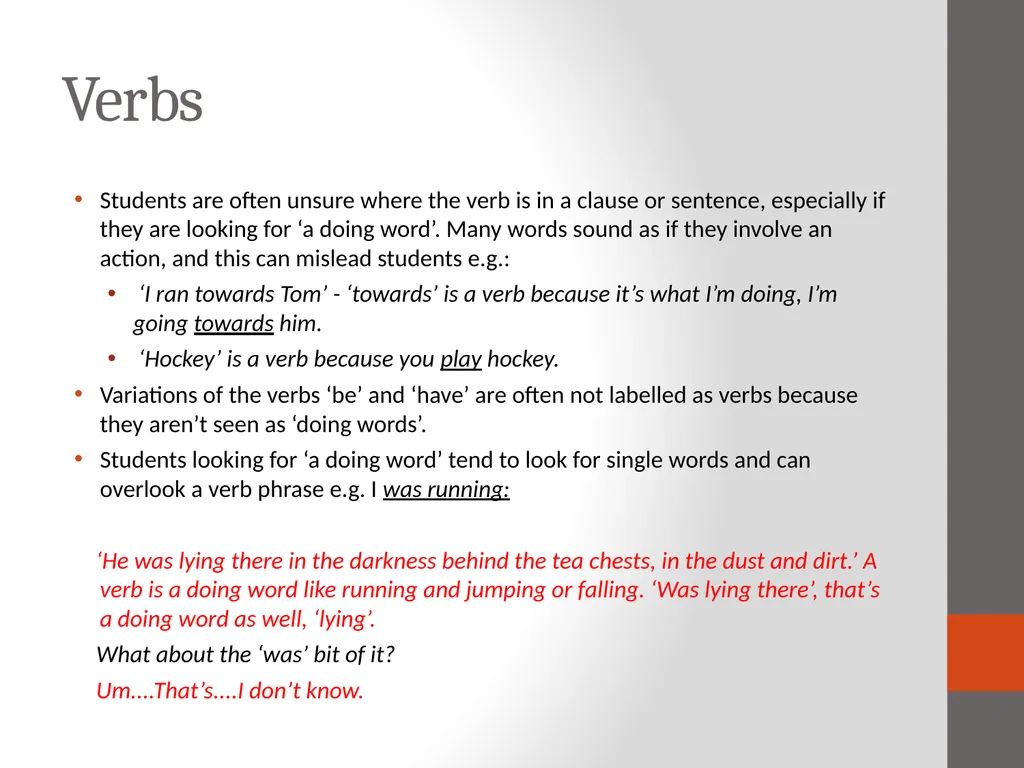
Verbs Students are often unsure where the verb is in a clause or sentence, especially if they are looking for ‘a doing word’. Many words sound as if they involve an action, and this can mislead students e.g.:
‘I ran towards Tom’ - ‘towards’ is a verb because it’s what I’m doing, I’m going towards him.
‘Hockey’ is a verb because you play hockey.
Variations of the verbs ‘be’ and ‘have’ are often not labelled as verbs because they aren’t seen as ‘doing words’.
Students looking for ‘a doing word’ tend to look for single words and can overlook a verb phrase e.g. I was running:
‘He was lying there in the darkness behind the tea chests, in the dust and dirt.’ A verb is a doing word like running and jumping or falling. ‘Was lying there’, that’s a doing word as well, ‘lying’.
What about the ‘was’ bit of it?
Um....That’s....I don’t know.<br>
07
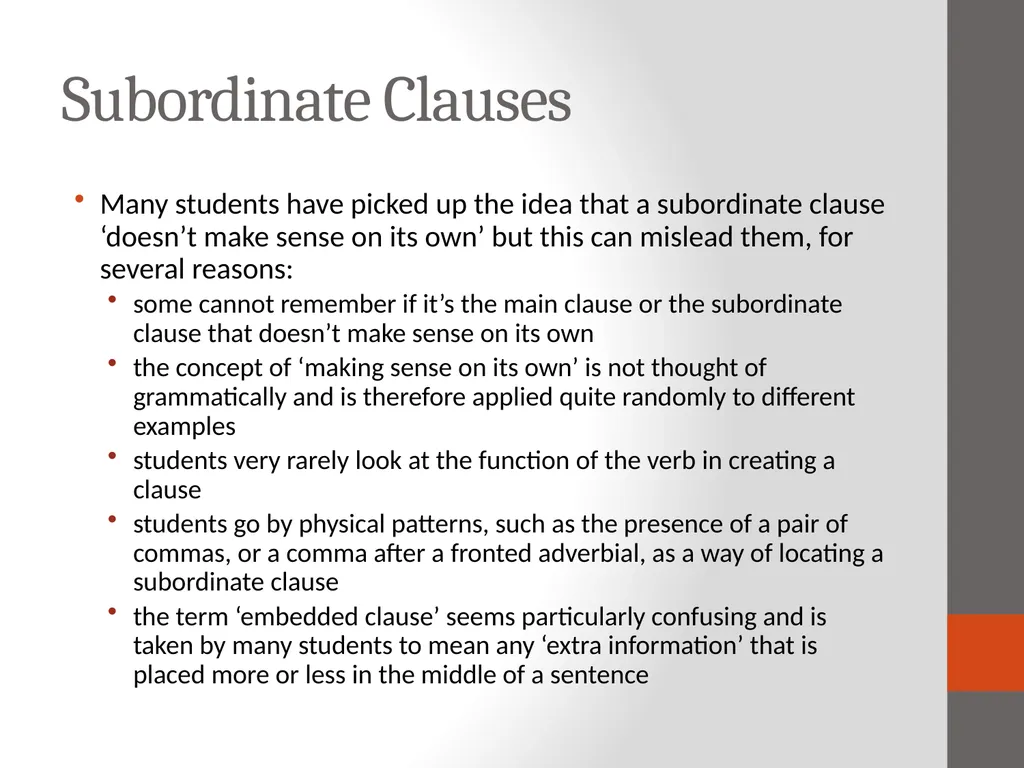
Subordinate Clauses Many students have picked up the idea that a subordinate clause ‘doesn’t make sense on its own’ but this can mislead them, for several reasons:
some cannot remember if it’s the main clause or the subordinate clause that doesn’t make sense on its own
the concept of ‘making sense on its own’ is not thought of grammatically and is therefore applied quite randomly to different examples
students very rarely look at the function of the verb in creating a clause
students go by physical patterns, such as the presence of a pair of commas, or a comma after a fronted adverbial, as a way of locating a subordinate clause
the term ‘embedded clause’ seems particularly confusing and is taken by many students to mean any ‘extra information’ that is placed more or less in the middle of a sentence<br>
08
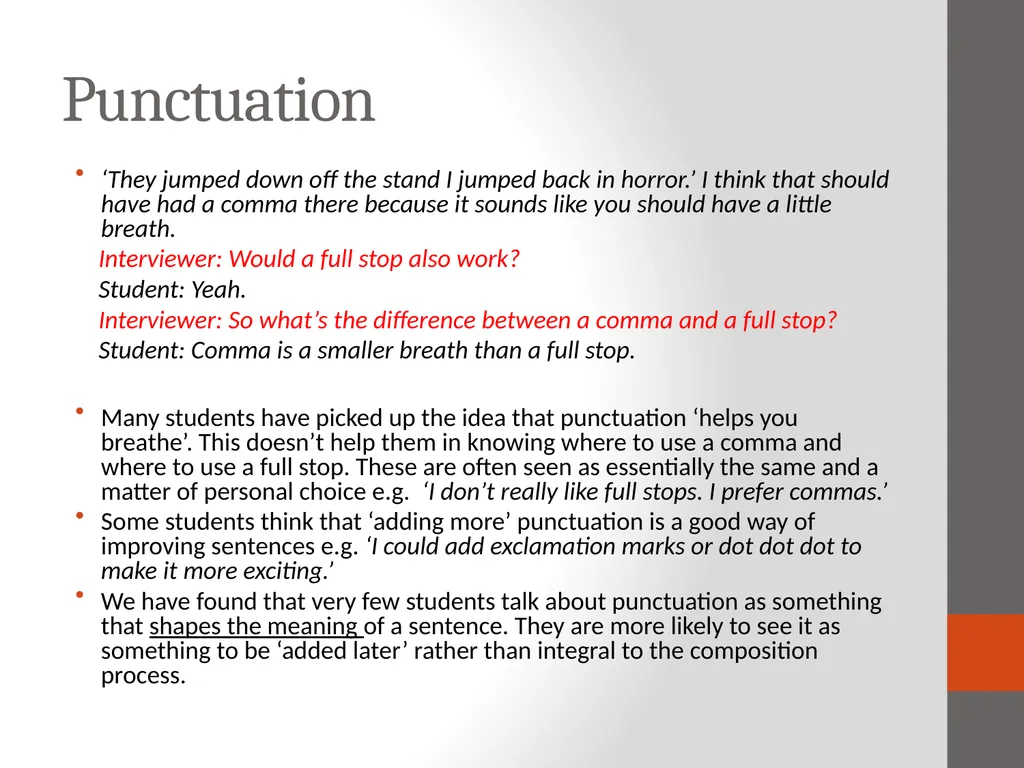
Punctuation ‘They jumped down off the stand I jumped back in horror.’ I think that should have had a comma there because it sounds like you should have a little breath.
Interviewer: Would a full stop also work?
Student: Yeah.
Interviewer: So what’s the difference between a comma and a full stop?
Student: Comma is a smaller breath than a full stop.
Many students have picked up the idea that punctuation ‘helps you breathe’. This doesn’t help them in knowing where to use a comma and where to use a full stop. These are often seen as essentially the same and a matter of personal choice e.g. ‘I don’t really like full stops. I prefer commas.’
Some students think that ‘adding more’ punctuation is a good way of improving sentences e.g. ‘I could add exclamation marks or dot dot dot to make it more exciting.’
We have found that very few students talk about punctuation as something that shapes the meaning of a sentence. They are more likely to see it as something to be ‘added later’ rather than integral to the composition process.<br>
09
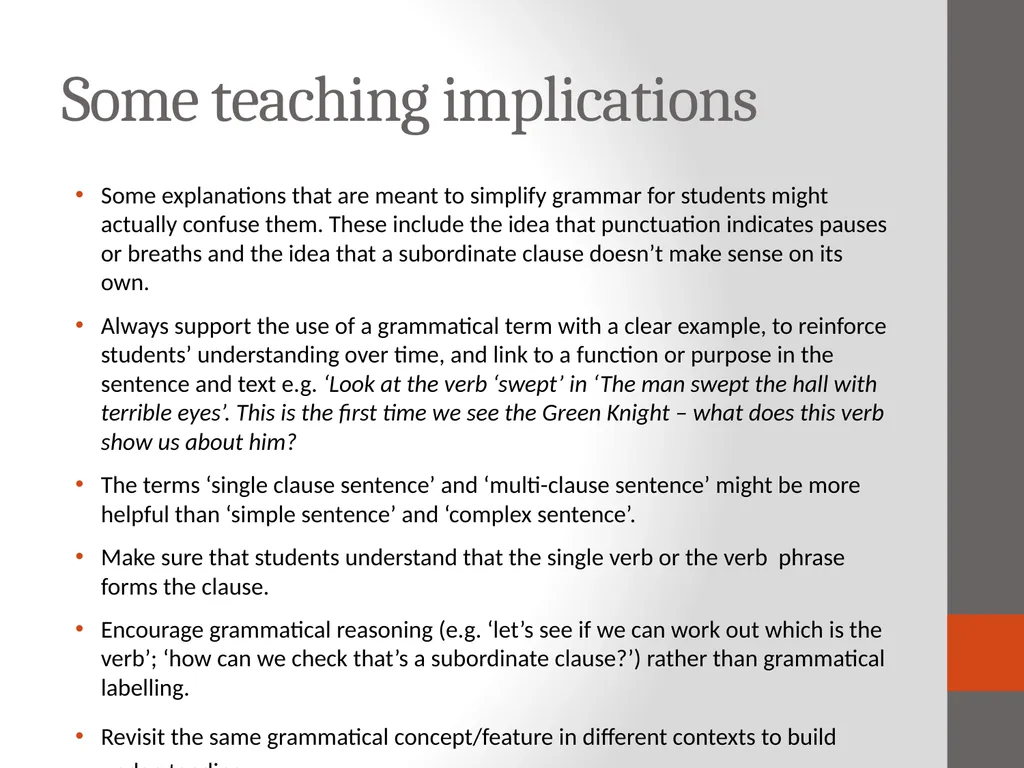
Some teaching implications Some explanations that are meant to simplify grammar for students might actually confuse them. These include the idea that punctuation indicates pauses or breaths and the idea that a subordinate clause doesn’t make sense on its own.
Always support the use of a grammatical term with a clear example, to reinforce students’ understanding over time, and link to a function or purpose in the sentence and text e.g. ‘Look at the verb ‘swept’ in ‘The man swept the hall with terrible eyes’. This is the first time we see the Green Knight – what does this verb show us about him?
The terms ‘single clause sentence’ and ‘multi-clause sentence’ might be more helpful than ‘simple sentence’ and ‘complex sentence’.
Make sure that students understand that the single verb or the verb phrase forms the clause.
Encourage grammatical reasoning (e.g. ‘let’s see if we can work out which is the verb’; ‘how can we check that’s a subordinate clause?’) rather than grammatical labelling.
Revisit the same grammatical concept/feature in different contexts to build understanding.<br>