
Sericulture Sericulture, or silk farming, is the
FD
Published · 21 slides · 0 views

1 / 1



Description
Sericulture Sericulture, or silk farming, is the rearing of silkworms for the production of silk. Although there are several commercial species of silkworms, Bombyx mori is the most widely used and intensively studied Silk is a natural
Related Topics
Share
Embed code
Download this presentation From Below
"Sericulture Sericulture, or silk farming, is the" is the property of its rightful owner. Permission is granted to download and print the materials on this website for personal, non-commercial use only, and to display it on your personal computer provided you do not modify the materials and that you retain all copyright notices contained in the materials. By downloading content from our website, you accept the terms of this agreement.
Presentation Transcript
01
Sericulture
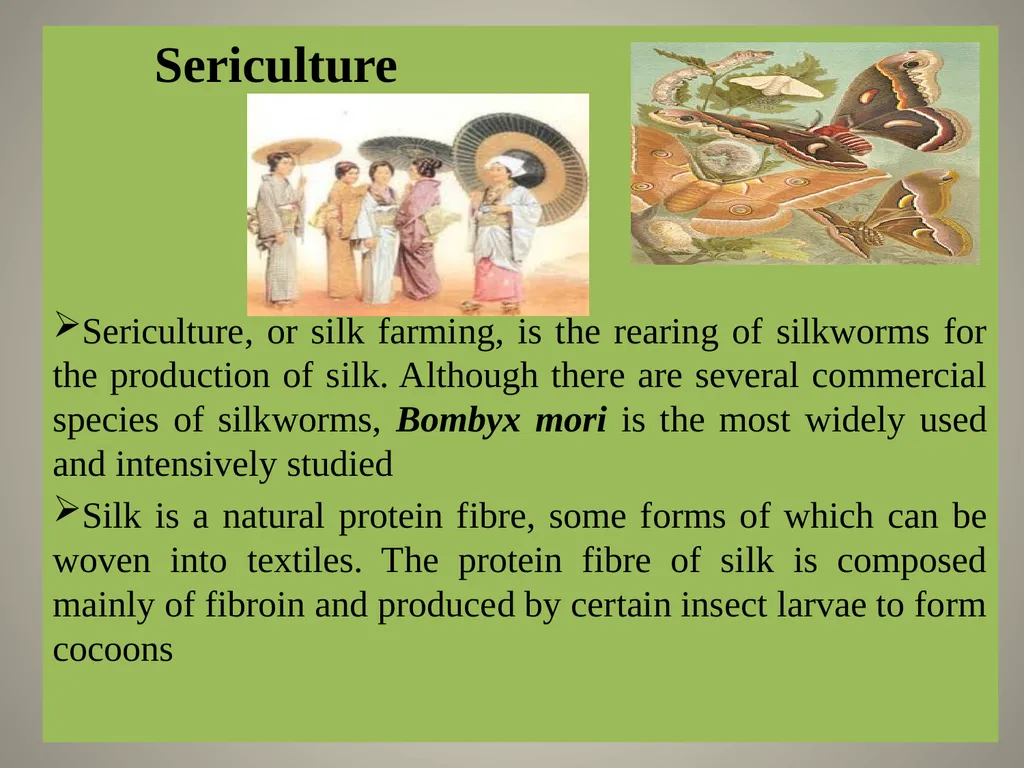
Sericulture, or silk farming, is the rearing of silkworms for the production of silk. Although there are several commercial species of silkworms, Bombyx mori is the most widely used and intensively studied
Silk is a natural protein fibre, some forms of which can be woven into textiles. The protein fibre of silk is composed mainly of fibroin and produced by certain insect larvae to form cocoons<br>
Sericulture, or silk farming, is the rearing of silkworms for the production of silk. Although there are several commercial species of silkworms, Bombyx mori is the most widely used and intensively studied
Silk is a natural protein fibre, some forms of which can be woven into textiles. The protein fibre of silk is composed mainly of fibroin and produced by certain insect larvae to form cocoons<br>
02
SILK WORM – TYPES There are five major types of silk of commercial importance, obtained from different species of silkworms which in turn feed on a number of food plants
Except mulberry, other varieties of silks are generally termed as non-mulberry silks. India has the unique distinction of producing all these commercial varieties of silk
Mulberry
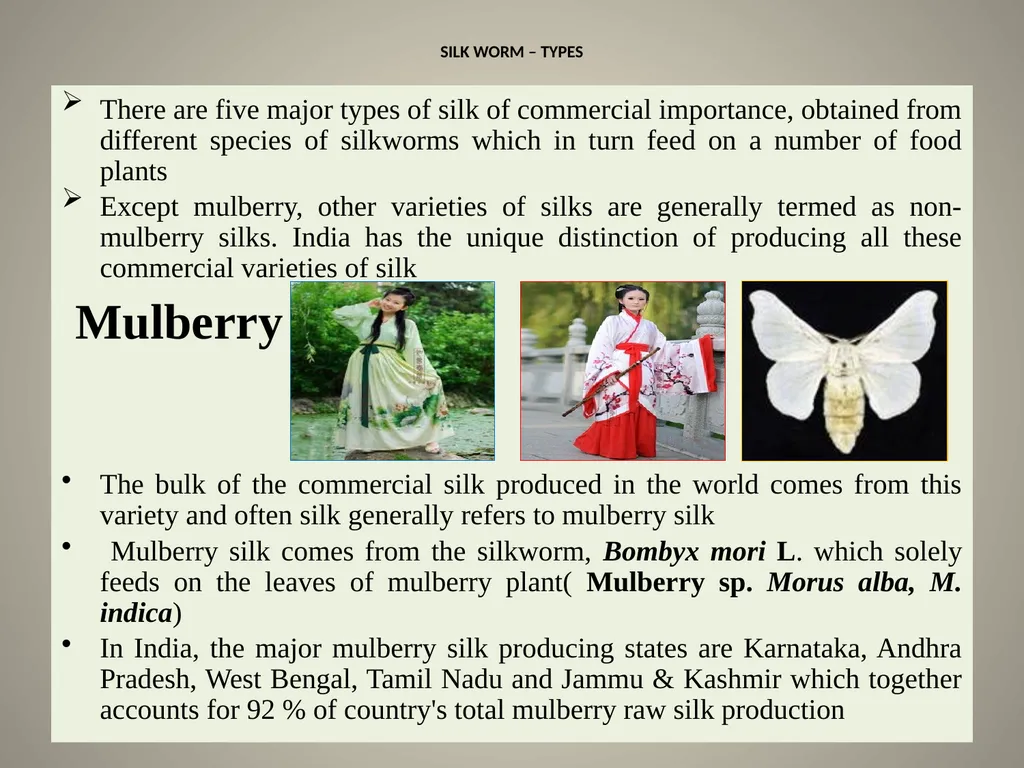
The bulk of the commercial silk produced in the world comes from this variety and often silk generally refers to mulberry silk
Mulberry silk comes from the silkworm, Bombyx mori L. which solely feeds on the leaves of mulberry plant( Mulberry sp. Morus alba, M. indica)
In India, the major mulberry silk producing states are Karnataka, Andhra Pradesh, West Bengal, Tamil Nadu and Jammu & Kashmir which together accounts for 92 % of country's total mulberry raw silk production<br>
Except mulberry, other varieties of silks are generally termed as non-mulberry silks. India has the unique distinction of producing all these commercial varieties of silk
Mulberry
The bulk of the commercial silk produced in the world comes from this variety and often silk generally refers to mulberry silk
Mulberry silk comes from the silkworm, Bombyx mori L. which solely feeds on the leaves of mulberry plant( Mulberry sp. Morus alba, M. indica)
In India, the major mulberry silk producing states are Karnataka, Andhra Pradesh, West Bengal, Tamil Nadu and Jammu & Kashmir which together accounts for 92 % of country's total mulberry raw silk production<br>
03
Tasar
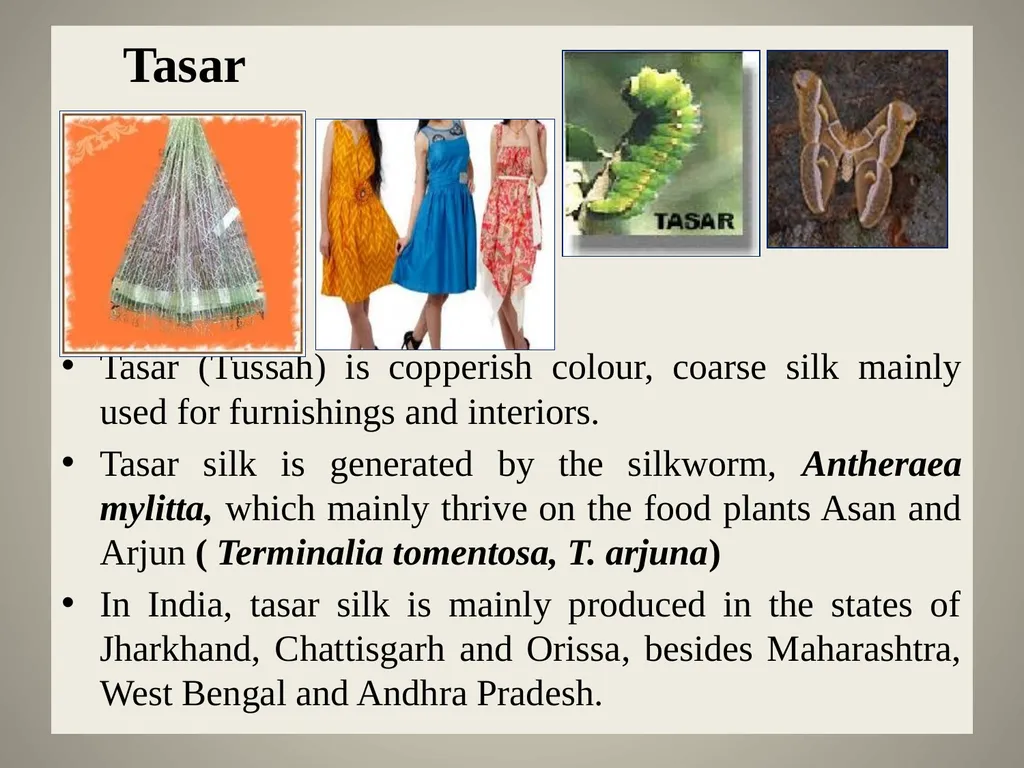
Tasar (Tussah) is copperish colour, coarse silk mainly used for furnishings and interiors.
Tasar silk is generated by the silkworm, Antheraea mylitta, which mainly thrive on the food plants Asan and Arjun ( Terminalia tomentosa, T. arjuna)
In India, tasar silk is mainly produced in the states of Jharkhand, Chattisgarh and Orissa, besides Maharashtra, West Bengal and Andhra Pradesh.<br>
Tasar (Tussah) is copperish colour, coarse silk mainly used for furnishings and interiors.
Tasar silk is generated by the silkworm, Antheraea mylitta, which mainly thrive on the food plants Asan and Arjun ( Terminalia tomentosa, T. arjuna)
In India, tasar silk is mainly produced in the states of Jharkhand, Chattisgarh and Orissa, besides Maharashtra, West Bengal and Andhra Pradesh.<br>
04
Oak Tasar
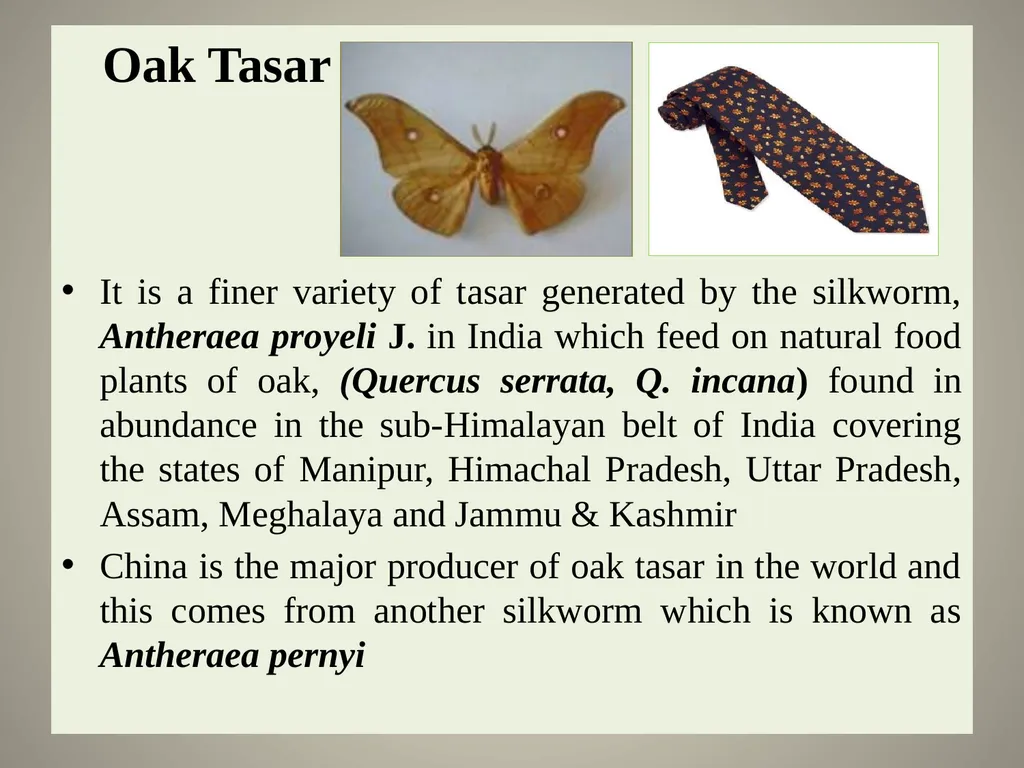
It is a finer variety of tasar generated by the silkworm, Antheraea proyeli J. in India which feed on natural food plants of oak, (Quercus serrata, Q. incana) found in abundance in the sub-Himalayan belt of India covering the states of Manipur, Himachal Pradesh, Uttar Pradesh, Assam, Meghalaya and Jammu & Kashmir
China is the major producer of oak tasar in the world and this comes from another silkworm which is known as Antheraea pernyi<br>
It is a finer variety of tasar generated by the silkworm, Antheraea proyeli J. in India which feed on natural food plants of oak, (Quercus serrata, Q. incana) found in abundance in the sub-Himalayan belt of India covering the states of Manipur, Himachal Pradesh, Uttar Pradesh, Assam, Meghalaya and Jammu & Kashmir
China is the major producer of oak tasar in the world and this comes from another silkworm which is known as Antheraea pernyi<br>
05
Eri
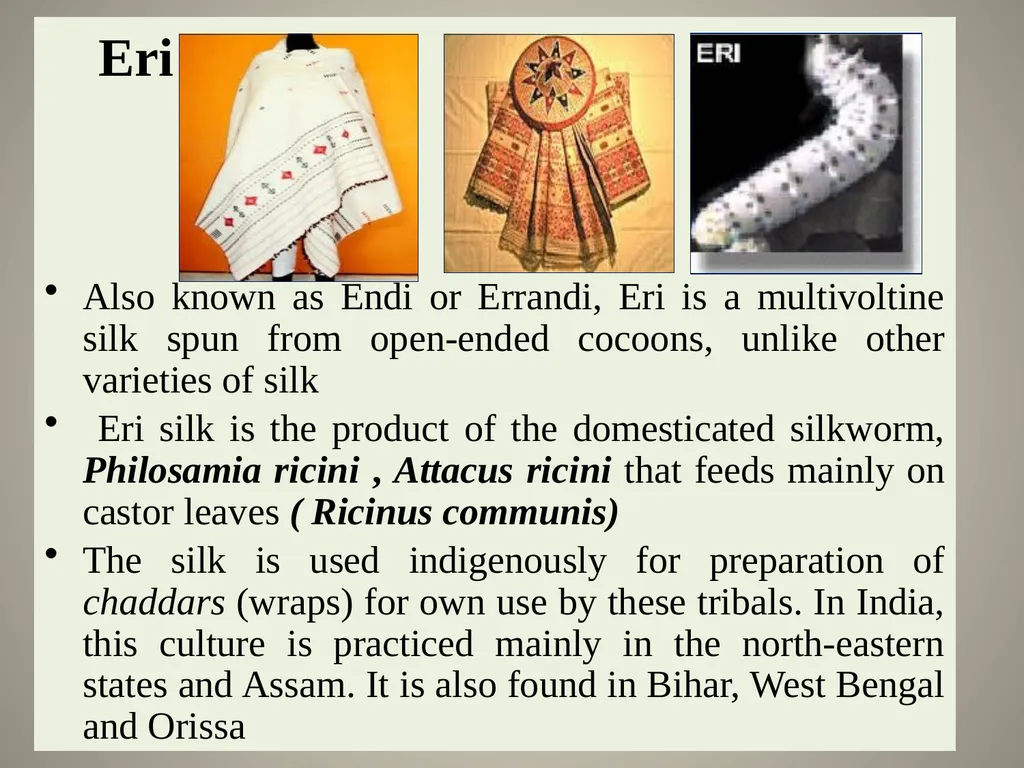
Also known as Endi or Errandi, Eri is a multivoltine silk spun from open-ended cocoons, unlike other varieties of silk
Eri silk is the product of the domesticated silkworm, Philosamia ricini , Attacus ricini that feeds mainly on castor leaves ( Ricinus communis)
The silk is used indigenously for preparation of chaddars (wraps) for own use by these tribals. In India, this culture is practiced mainly in the north-eastern states and Assam. It is also found in Bihar, West Bengal and Orissa<br>
Also known as Endi or Errandi, Eri is a multivoltine silk spun from open-ended cocoons, unlike other varieties of silk
Eri silk is the product of the domesticated silkworm, Philosamia ricini , Attacus ricini that feeds mainly on castor leaves ( Ricinus communis)
The silk is used indigenously for preparation of chaddars (wraps) for own use by these tribals. In India, this culture is practiced mainly in the north-eastern states and Assam. It is also found in Bihar, West Bengal and Orissa<br>
06
Muga
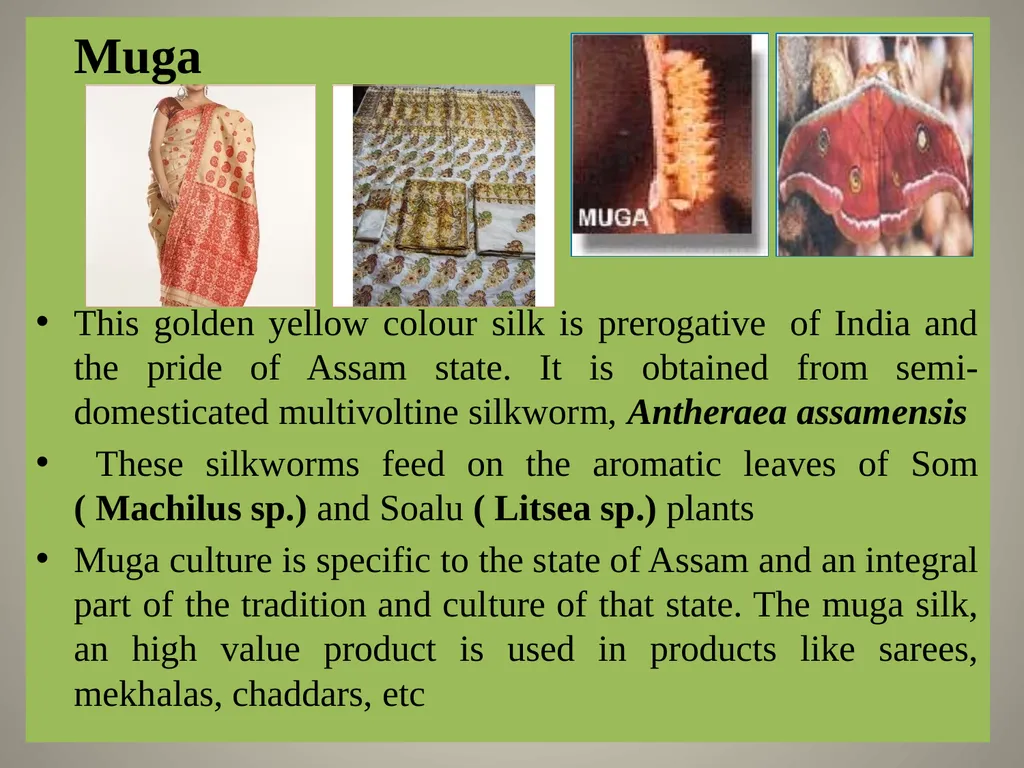
This golden yellow colour silk is prerogative of India and the pride of Assam state. It is obtained from semi-domesticated multivoltine silkworm, Antheraea assamensis
These silkworms feed on the aromatic leaves of Som ( Machilus sp.) and Soalu ( Litsea sp.) plants
Muga culture is specific to the state of Assam and an integral part of the tradition and culture of that state. The muga silk, an high value product is used in products like sarees, mekhalas, chaddars, etc<br>
This golden yellow colour silk is prerogative of India and the pride of Assam state. It is obtained from semi-domesticated multivoltine silkworm, Antheraea assamensis
These silkworms feed on the aromatic leaves of Som ( Machilus sp.) and Soalu ( Litsea sp.) plants
Muga culture is specific to the state of Assam and an integral part of the tradition and culture of that state. The muga silk, an high value product is used in products like sarees, mekhalas, chaddars, etc<br>
07
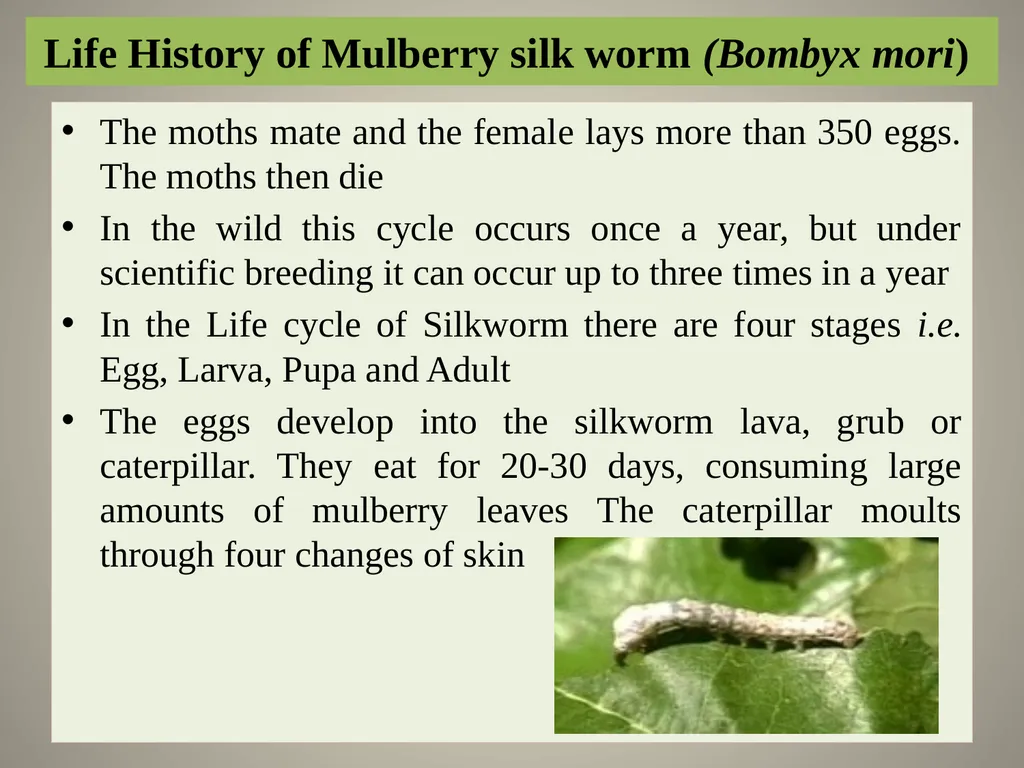
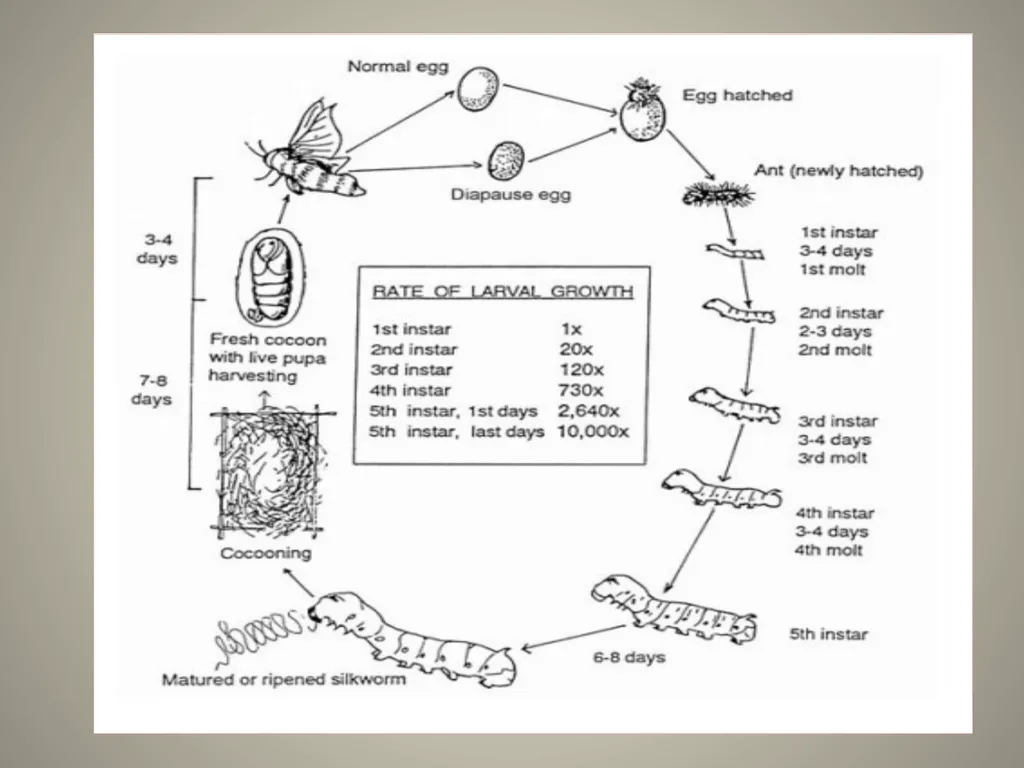
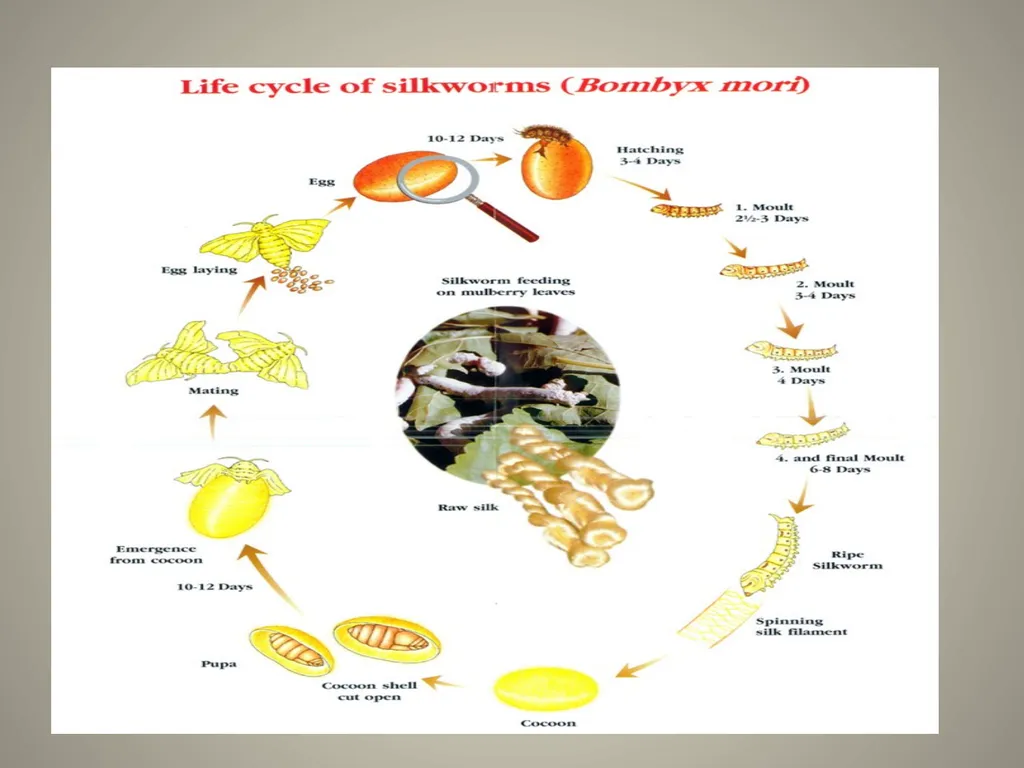
Life History of Mulberry silk worm (Bombyx mori) The moths mate and the female lays more than 350 eggs. The moths then die
In the wild this cycle occurs once a year, but under scientific breeding it can occur up to three times in a year
In the Life cycle of Silkworm there are four stages i.e. Egg, Larva, Pupa and Adult
The eggs develop into the silkworm lava, grub or caterpillar. They eat for 20-30 days, consuming large amounts of mulberry leaves The caterpillar moults through four changes of skin<br>
In the wild this cycle occurs once a year, but under scientific breeding it can occur up to three times in a year
In the Life cycle of Silkworm there are four stages i.e. Egg, Larva, Pupa and Adult
The eggs develop into the silkworm lava, grub or caterpillar. They eat for 20-30 days, consuming large amounts of mulberry leaves The caterpillar moults through four changes of skin<br>
08
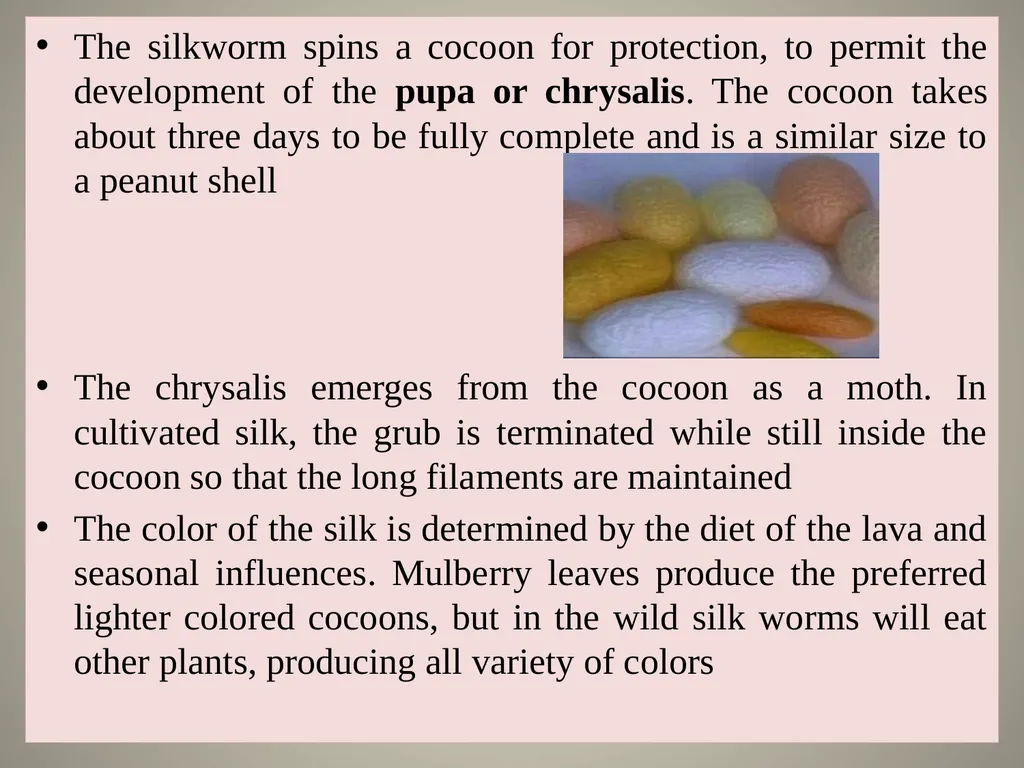
The silkworm spins a cocoon for protection, to permit the development of the pupa or chrysalis. The cocoon takes about three days to be fully complete and is a similar size to a peanut shell
The chrysalis emerges from the cocoon as a moth. In cultivated silk, the grub is terminated while still inside the cocoon so that the long filaments are maintained
The color of the silk is determined by the diet of the lava and seasonal influences. Mulberry leaves produce the preferred lighter colored cocoons, but in the wild silk worms will eat other plants, producing all variety of colors<br>
The chrysalis emerges from the cocoon as a moth. In cultivated silk, the grub is terminated while still inside the cocoon so that the long filaments are maintained
The color of the silk is determined by the diet of the lava and seasonal influences. Mulberry leaves produce the preferred lighter colored cocoons, but in the wild silk worms will eat other plants, producing all variety of colors<br>
09
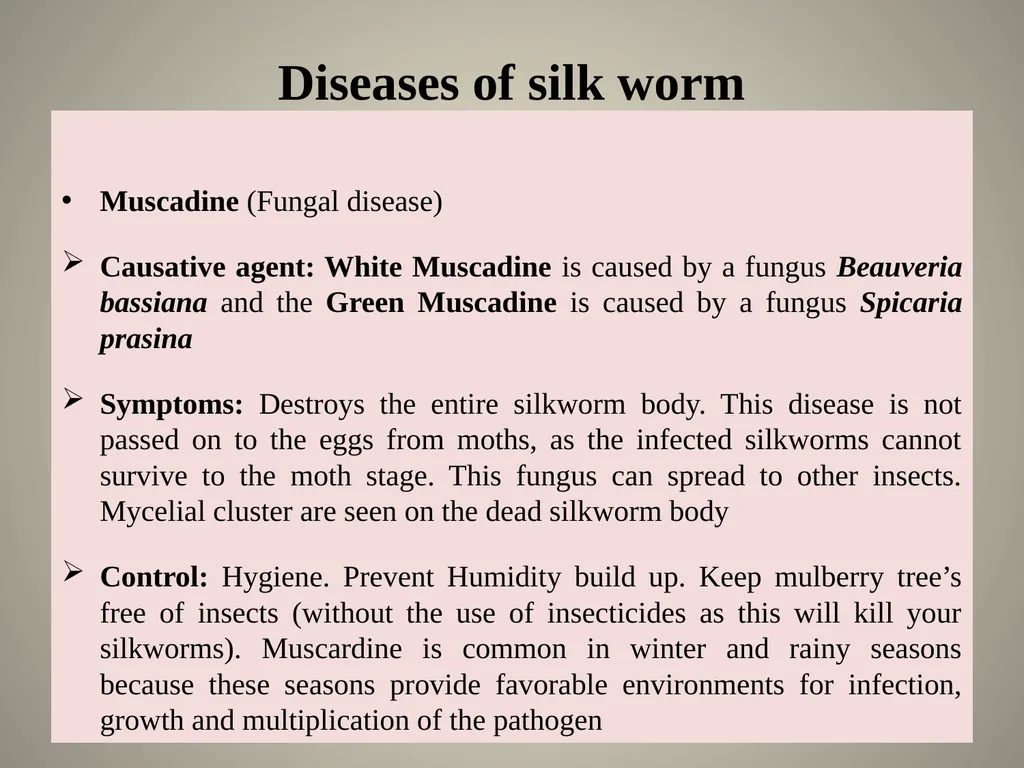
Diseases of silk worm Muscadine (Fungal disease)
Causative agent: White Muscadine is caused by a fungus Beauveria bassiana and the Green Muscadine is caused by a fungus Spicaria prasina
Symptoms: Destroys the entire silkworm body. This disease is not passed on to the eggs from moths, as the infected silkworms cannot survive to the moth stage. This fungus can spread to other insects. Mycelial cluster are seen on the dead silkworm body
Control: Hygiene. Prevent Humidity build up. Keep mulberry tree’s free of insects (without the use of insecticides as this will kill your silkworms). Muscardine is common in winter and rainy seasons because these seasons provide favorable environments for infection, growth and multiplication of the pathogen<br>
Causative agent: White Muscadine is caused by a fungus Beauveria bassiana and the Green Muscadine is caused by a fungus Spicaria prasina
Symptoms: Destroys the entire silkworm body. This disease is not passed on to the eggs from moths, as the infected silkworms cannot survive to the moth stage. This fungus can spread to other insects. Mycelial cluster are seen on the dead silkworm body
Control: Hygiene. Prevent Humidity build up. Keep mulberry tree’s free of insects (without the use of insecticides as this will kill your silkworms). Muscardine is common in winter and rainy seasons because these seasons provide favorable environments for infection, growth and multiplication of the pathogen<br>
10
Polyhedrosis (Grasserie disease)
Causative agent: Virus Nuclear polyhedrosis
Nuclear polyhedrosis: nuclei of cells of fatty tissue, dermal tissue, muscles, epithelial cells of mid-gut, blood cells
Symptoms: Larva becomes inactive, loses appetite, body swells up, pus leak out, death of larva
Control: Disinfection of room, treatment with formalin, hygienic conditions
2. MG Cytoplasmic polyhedrosis: Cytoplasm of MG cells, Goblet cells
Symptoms: Translucent cephalothorax, shrinkage of body size, excretion of white colored loose feaces
3. MG Nuclear Polyhedrosis: MG column on cells
Symptoms and control as above<br>
Causative agent: Virus Nuclear polyhedrosis
Nuclear polyhedrosis: nuclei of cells of fatty tissue, dermal tissue, muscles, epithelial cells of mid-gut, blood cells
Symptoms: Larva becomes inactive, loses appetite, body swells up, pus leak out, death of larva
Control: Disinfection of room, treatment with formalin, hygienic conditions
2. MG Cytoplasmic polyhedrosis: Cytoplasm of MG cells, Goblet cells
Symptoms: Translucent cephalothorax, shrinkage of body size, excretion of white colored loose feaces
3. MG Nuclear Polyhedrosis: MG column on cells
Symptoms and control as above<br>
11
Pebrine disease
Causative agent: A parasitic microsporidian, Nosema bombycis
Symptoms: The affected part (fat body and cells of AC) become black due to formation of melanin, white spots appear on the surface of silk glands and AC
Control: Only eggs of healthy mother moth should be used; spores can be destroyed by treatment with 2% formalin for 30min. or 5% chlorinated lime for 30min<br>
Causative agent: A parasitic microsporidian, Nosema bombycis
Symptoms: The affected part (fat body and cells of AC) become black due to formation of melanin, white spots appear on the surface of silk glands and AC
Control: Only eggs of healthy mother moth should be used; spores can be destroyed by treatment with 2% formalin for 30min. or 5% chlorinated lime for 30min<br>
12
Flacherie: (Bacteria and viral disease )individually or in combination
Symptoms: Flacherie is most often caused by high humidity and fluctuating temperatures. Worms appear lethargic and flaccid, growth is stunted. The cephalothoracic region may be translucent. Dead worms putrefy quickly often with a foul odo
Control: As Flacherie is most often contracted in the early Instars and does not present until the later Instars it is usually impossible to eradicate without destroying the entire colony. You may remove the sick or dead silkworms and any silkworms that have contacted fluid.<br>
Symptoms: Flacherie is most often caused by high humidity and fluctuating temperatures. Worms appear lethargic and flaccid, growth is stunted. The cephalothoracic region may be translucent. Dead worms putrefy quickly often with a foul odo
Control: As Flacherie is most often contracted in the early Instars and does not present until the later Instars it is usually impossible to eradicate without destroying the entire colony. You may remove the sick or dead silkworms and any silkworms that have contacted fluid.<br>
13
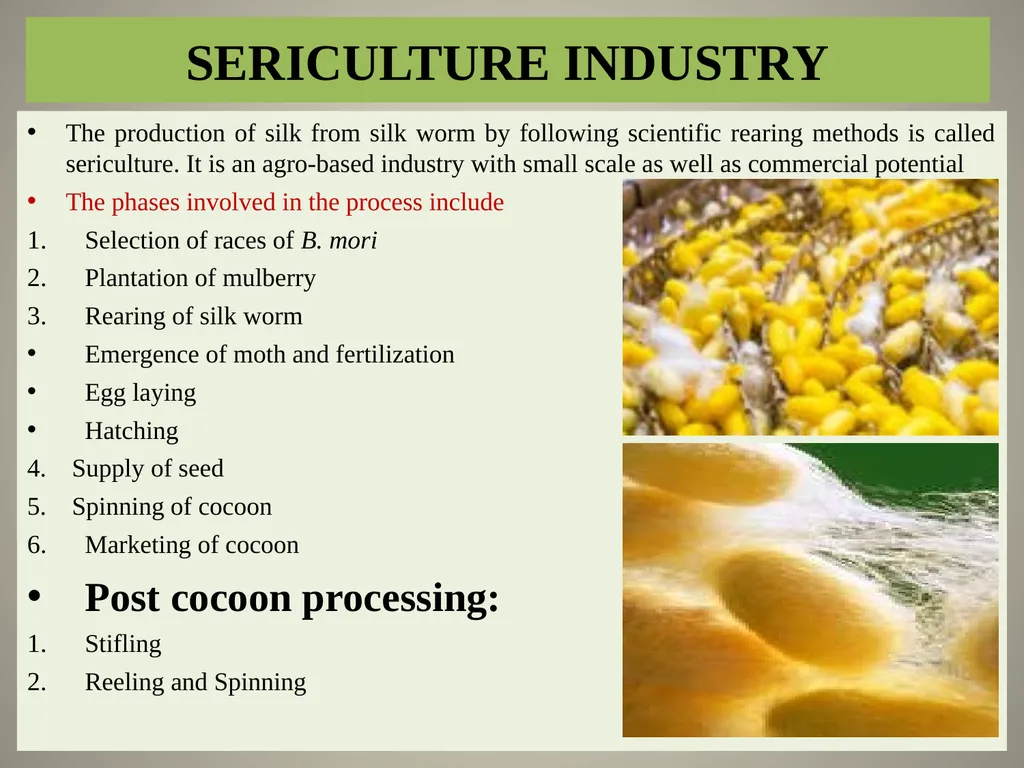
SERICULTURE INDUSTRY The production of silk from silk worm by following scientific rearing methods is called sericulture. It is an agro-based industry with small scale as well as commercial potential
The phases involved in the process include
Selection of races of B. mori
Plantation of mulberry
Rearing of silk worm
Emergence of moth and fertilization
Egg laying
Hatching
4. Supply of seed
5. Spinning of cocoon
Marketing of cocoon
Post cocoon processing:
Stifling
Reeling and Spinning<br>
The phases involved in the process include
Selection of races of B. mori
Plantation of mulberry
Rearing of silk worm
Emergence of moth and fertilization
Egg laying
Hatching
4. Supply of seed
5. Spinning of cocoon
Marketing of cocoon
Post cocoon processing:
Stifling
Reeling and Spinning<br>
14
Selection of races of B. mori
Worms are introduced through DFLs (Disease Free Layings, i.e. eggs) procured from a quality centre (called grainage)
Plantation of mulberry
Rearing of silkworms involves cultivation of mulberry trees, which provide a regular supply of leaves
Generally, the mulberry plants are raised from semi-hardwood cuttings.
Cuttings are selected from well established garden of 8-12 months old.
Only full grown thick main stems, free from insect and disease damages having a diameter of 10-12mm are chosen for preparation of cuttings.
Plant the cuttings/saplings at a spacing of 75 / 105 cm x 90 cm in rainy season.
Raise intercrops in the wider inter row space (amenable for mechanization also)<br>
Worms are introduced through DFLs (Disease Free Layings, i.e. eggs) procured from a quality centre (called grainage)
Plantation of mulberry
Rearing of silkworms involves cultivation of mulberry trees, which provide a regular supply of leaves
Generally, the mulberry plants are raised from semi-hardwood cuttings.
Cuttings are selected from well established garden of 8-12 months old.
Only full grown thick main stems, free from insect and disease damages having a diameter of 10-12mm are chosen for preparation of cuttings.
Plant the cuttings/saplings at a spacing of 75 / 105 cm x 90 cm in rainy season.
Raise intercrops in the wider inter row space (amenable for mechanization also)<br>
15
Rearing of silkworm
The silkworms are actually larvae of the silkmoth. They are reared in specially made trays in rooms with controlled temperature and humidity and regularly fed mulberry leaves.
At a certain stage they convert themselves into cocoons. These cocoons are made from a single filament of material secreted by the pupa and wrapped around itself for protection
Spinning of coccon
The larva before transferring into pupa, stops feeding at the end of Vth stage and starts spinning coccon. When larva grows fully stop feeding and passes out the stomach content and the mature larva becomes translucent and yellowish in appearance
It is a symbol of ripening and at this stage larva should be picked up and mounted on mountages or cocconing frames where they spin coccon<br>
The silkworms are actually larvae of the silkmoth. They are reared in specially made trays in rooms with controlled temperature and humidity and regularly fed mulberry leaves.
At a certain stage they convert themselves into cocoons. These cocoons are made from a single filament of material secreted by the pupa and wrapped around itself for protection
Spinning of coccon
The larva before transferring into pupa, stops feeding at the end of Vth stage and starts spinning coccon. When larva grows fully stop feeding and passes out the stomach content and the mature larva becomes translucent and yellowish in appearance
It is a symbol of ripening and at this stage larva should be picked up and mounted on mountages or cocconing frames where they spin coccon<br>
16
STIFLING
The process of killing the cocoon is termed as stifling and is done by dropping in hot water or subjecting to steam or dry heat or sun exposure or fumigation.
REELING
The process of removing threads from the killed cocoon is called as reeling. The silk is unbound from the cocoon by softening the sericin and then delicately and carefully unwinding, or 'reeling' the filaments.
Usually 8-10 cocoons are reeled together. There are three methods for reeling: the charkha, the slightly more advanced cottage basin and the costly automatic machines.
The threads of the cocoons are passed through eyelets and guides to twist into one thread which is wound round a large wheel and then to spool.
This is called RAW SILK or REELED SILK. Raw silk is further processed to bring out the final silk thread<br>
The process of killing the cocoon is termed as stifling and is done by dropping in hot water or subjecting to steam or dry heat or sun exposure or fumigation.
REELING
The process of removing threads from the killed cocoon is called as reeling. The silk is unbound from the cocoon by softening the sericin and then delicately and carefully unwinding, or 'reeling' the filaments.
Usually 8-10 cocoons are reeled together. There are three methods for reeling: the charkha, the slightly more advanced cottage basin and the costly automatic machines.
The threads of the cocoons are passed through eyelets and guides to twist into one thread which is wound round a large wheel and then to spool.
This is called RAW SILK or REELED SILK. Raw silk is further processed to bring out the final silk thread<br>
17
Spinning the Coccon
Silkworms possess a pair of specially modified salivary glands called sericteries, which are used for the production of fibroin – a clear, viscous, proteinaceous fluid that is forced through openings called spinnerets on the mouthpart of the larva
The secretions harden on exposure to the air and form twin filaments composed of fibroin, a protein material. A second pair of glands secretes a gummy binding fluid called sericin which bonds the two filaments together
Steadily over the next four days, the silkworm rotates its body in a figure-8 movement some 300,000 times, constructing a cocoon and producing about a kilometer of silk filament<br>
Silkworms possess a pair of specially modified salivary glands called sericteries, which are used for the production of fibroin – a clear, viscous, proteinaceous fluid that is forced through openings called spinnerets on the mouthpart of the larva
The secretions harden on exposure to the air and form twin filaments composed of fibroin, a protein material. A second pair of glands secretes a gummy binding fluid called sericin which bonds the two filaments together
Steadily over the next four days, the silkworm rotates its body in a figure-8 movement some 300,000 times, constructing a cocoon and producing about a kilometer of silk filament<br>
18
Thank you<br>