
Serological tests Assis .Lec. Dhuha khudaier
MS
Published · 24 slides · 0 views

1 / 1



Description
Serological tests Assis .Lec. Dhuha khudaier kariem Serology is the branch of laboratory medicine that studies blood serum for evidence of infection and other parameters by evaluating antigen-antibody reactions in vitro. Serological tests
Related Topics
Share
Embed code
Download this presentation From Below
"Serological tests Assis .Lec. Dhuha khudaier" is the property of its rightful owner. Permission is granted to download and print the materials on this website for personal, non-commercial use only, and to display it on your personal computer provided you do not modify the materials and that you retain all copyright notices contained in the materials. By downloading content from our website, you accept the terms of this agreement.
Presentation Transcript
01
Serological tests
Assis .Lec. Dhuha khudaier kariem<br>
02
Serology is the branch of laboratory medicine that studies blood serum for evidence of infection and other parameters by evaluating antigen-antibody reactions in vitro.
Serological tests are blood tests that look for antibodies in the blood(Antigen –Antibody reaction).They can involve a number of laboratory techniques. Different types of serologic tests are used to diagnose various disease conditions.<br>
Serological tests are blood tests that look for antibodies in the blood(Antigen –Antibody reaction).They can involve a number of laboratory techniques. Different types of serologic tests are used to diagnose various disease conditions.<br>
03
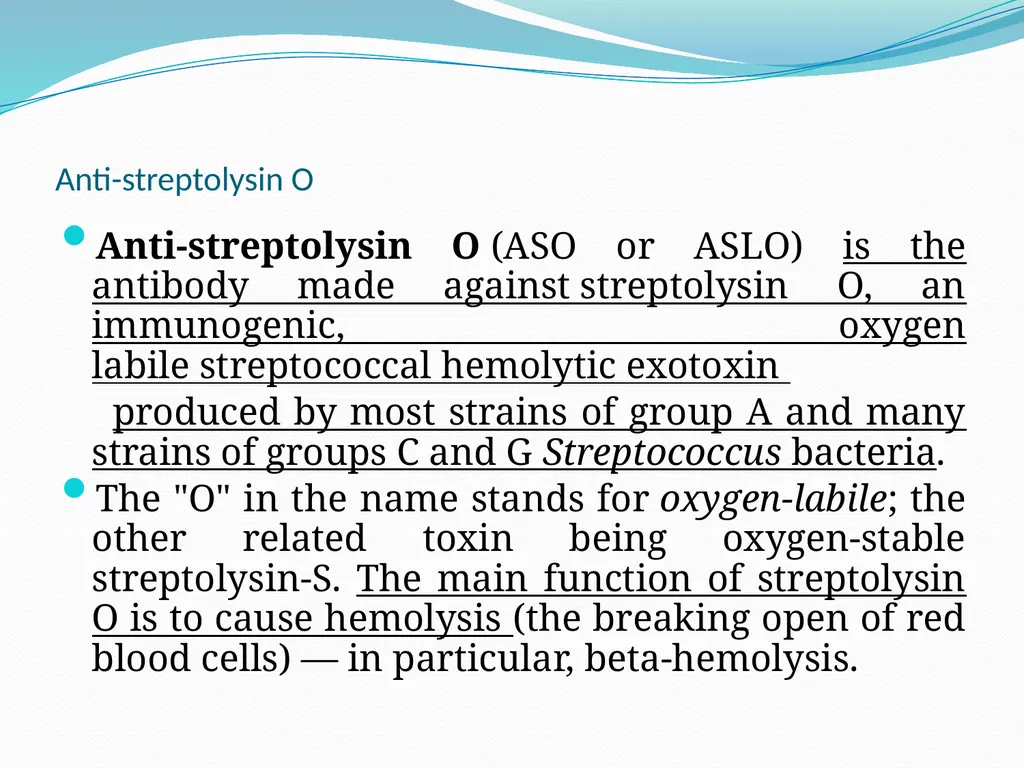
Anti-streptolysin O Anti-streptolysin O (ASO or ASLO) is the antibody made against streptolysin O, an immunogenic, oxygen labile streptococcal hemolytic exotoxin
produced by most strains of group A and many strains of groups C and G Streptococcus bacteria.
The "O" in the name stands for oxygen-labile; the other related toxin being oxygen-stable streptolysin-S. The main function of streptolysin O is to cause hemolysis (the breaking open of red blood cells) — in particular, beta-hemolysis.<br>
produced by most strains of group A and many strains of groups C and G Streptococcus bacteria.
The "O" in the name stands for oxygen-labile; the other related toxin being oxygen-stable streptolysin-S. The main function of streptolysin O is to cause hemolysis (the breaking open of red blood cells) — in particular, beta-hemolysis.<br>
04
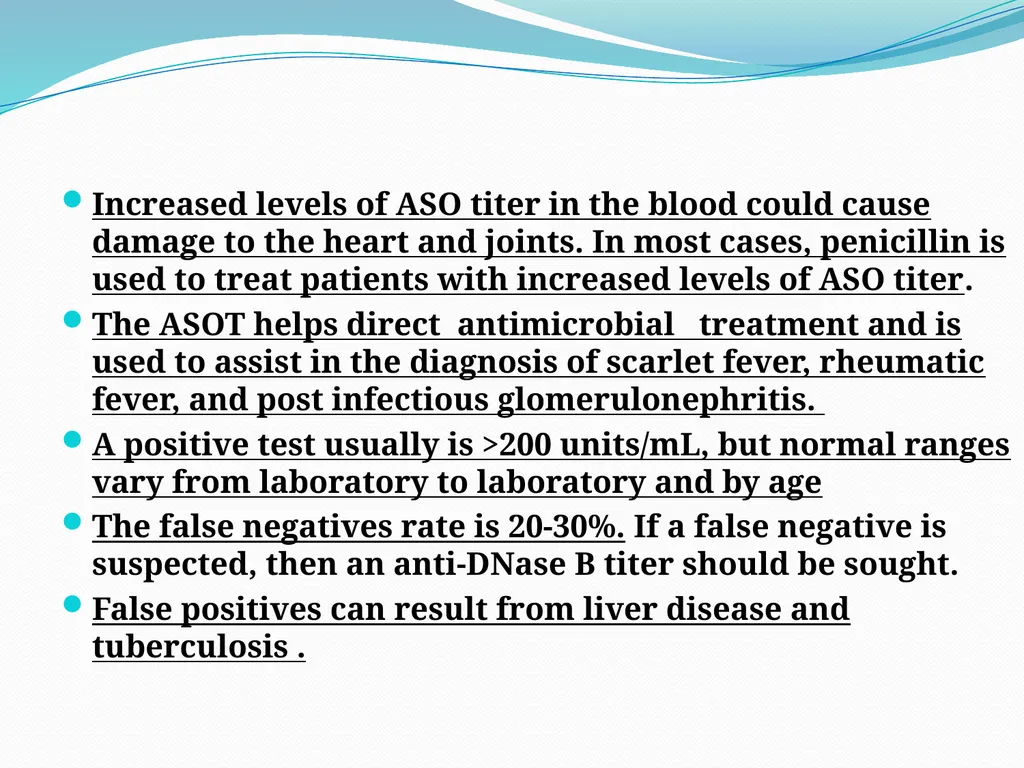
Increased levels of ASO titer in the blood could cause damage to the heart and joints. In most cases, penicillin is used to treat patients with increased levels of ASO titer.
The ASOT helps direct antimicrobial treatment and is used to assist in the diagnosis of scarlet fever, rheumatic fever, and post infectious glomerulonephritis.
A positive test usually is >200 units/mL, but normal ranges vary from laboratory to laboratory and by age
The false negatives rate is 20-30%. If a false negative is suspected, then an anti-DNase B titer should be sought.
False positives can result from liver disease and tuberculosis .<br>
The ASOT helps direct antimicrobial treatment and is used to assist in the diagnosis of scarlet fever, rheumatic fever, and post infectious glomerulonephritis.
A positive test usually is >200 units/mL, but normal ranges vary from laboratory to laboratory and by age
The false negatives rate is 20-30%. If a false negative is suspected, then an anti-DNase B titer should be sought.
False positives can result from liver disease and tuberculosis .<br>
05
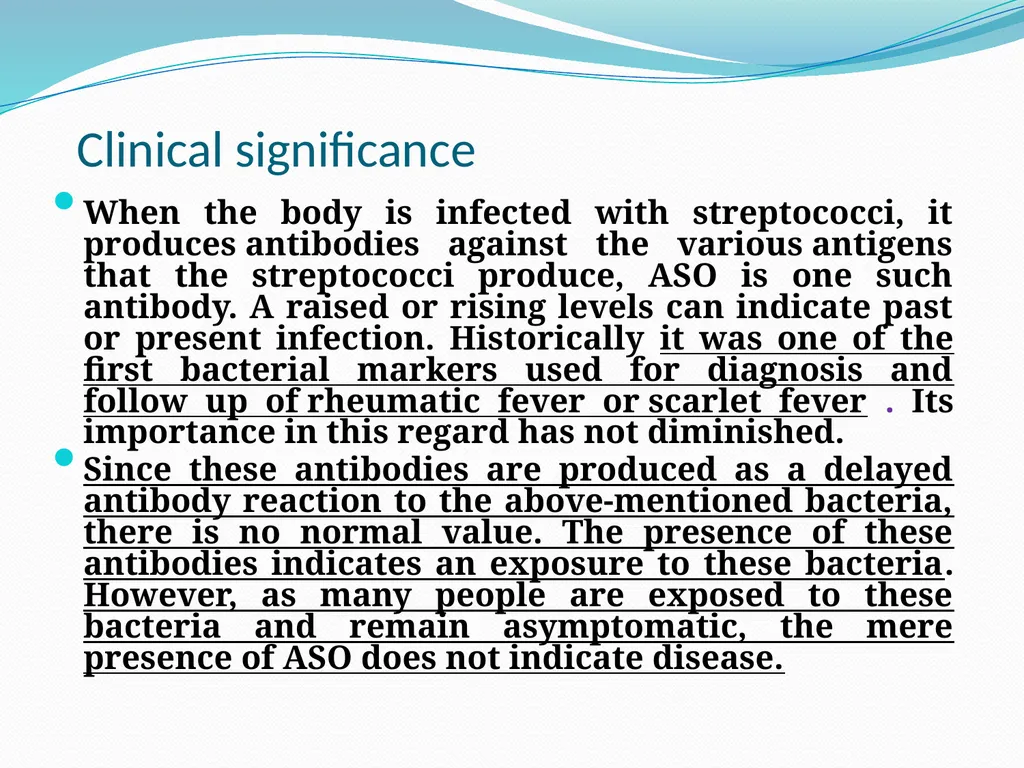
Clinical significance When the body is infected with streptococci, it produces antibodies against the various antigens that the streptococci produce, ASO is one such antibody. A raised or rising levels can indicate past or present infection. Historically it was one of the first bacterial markers used for diagnosis and follow up of rheumatic fever or scarlet fever . Its importance in this regard has not diminished.
Since these antibodies are produced as a delayed antibody reaction to the above-mentioned bacteria, there is no normal value. The presence of these antibodies indicates an exposure to these bacteria. However, as many people are exposed to these bacteria and remain asymptomatic, the mere presence of ASO does not indicate disease.<br>
Since these antibodies are produced as a delayed antibody reaction to the above-mentioned bacteria, there is no normal value. The presence of these antibodies indicates an exposure to these bacteria. However, as many people are exposed to these bacteria and remain asymptomatic, the mere presence of ASO does not indicate disease.<br>
06
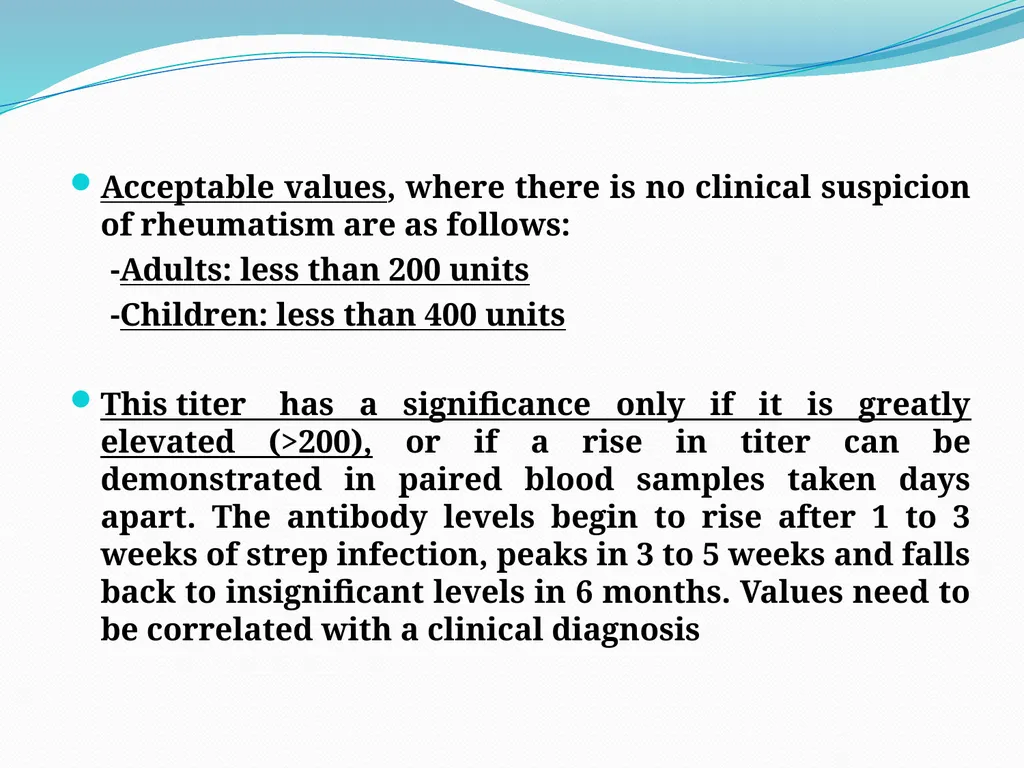
Acceptable values, where there is no clinical suspicion of rheumatism are as follows:
-Adults: less than 200 units
-Children: less than 400 units
This titer has a significance only if it is greatly elevated (>200), or if a rise in titer can be demonstrated in paired blood samples taken days apart. The antibody levels begin to rise after 1 to 3 weeks of strep infection, peaks in 3 to 5 weeks and falls back to insignificant levels in 6 months. Values need to be correlated with a clinical diagnosis<br>
-Adults: less than 200 units
-Children: less than 400 units
This titer has a significance only if it is greatly elevated (>200), or if a rise in titer can be demonstrated in paired blood samples taken days apart. The antibody levels begin to rise after 1 to 3 weeks of strep infection, peaks in 3 to 5 weeks and falls back to insignificant levels in 6 months. Values need to be correlated with a clinical diagnosis<br>
07
Estimation It is done by serological methods like latex agglutination or slide agglutination. ELISA may be performed to detect the exact titer value.
To detect the titer value, by a non-ELISA method, one has to perform the above agglutination using a serial dilution technique.
Mechanism of action
The antibodies produced against the bacteria cross-react with human antigens (mainly collagen) and hence attack the cellular matrix of various organs, mainly the heart, joints, skin, brain, etc.<br>
To detect the titer value, by a non-ELISA method, one has to perform the above agglutination using a serial dilution technique.
Mechanism of action
The antibodies produced against the bacteria cross-react with human antigens (mainly collagen) and hence attack the cellular matrix of various organs, mainly the heart, joints, skin, brain, etc.<br>
08
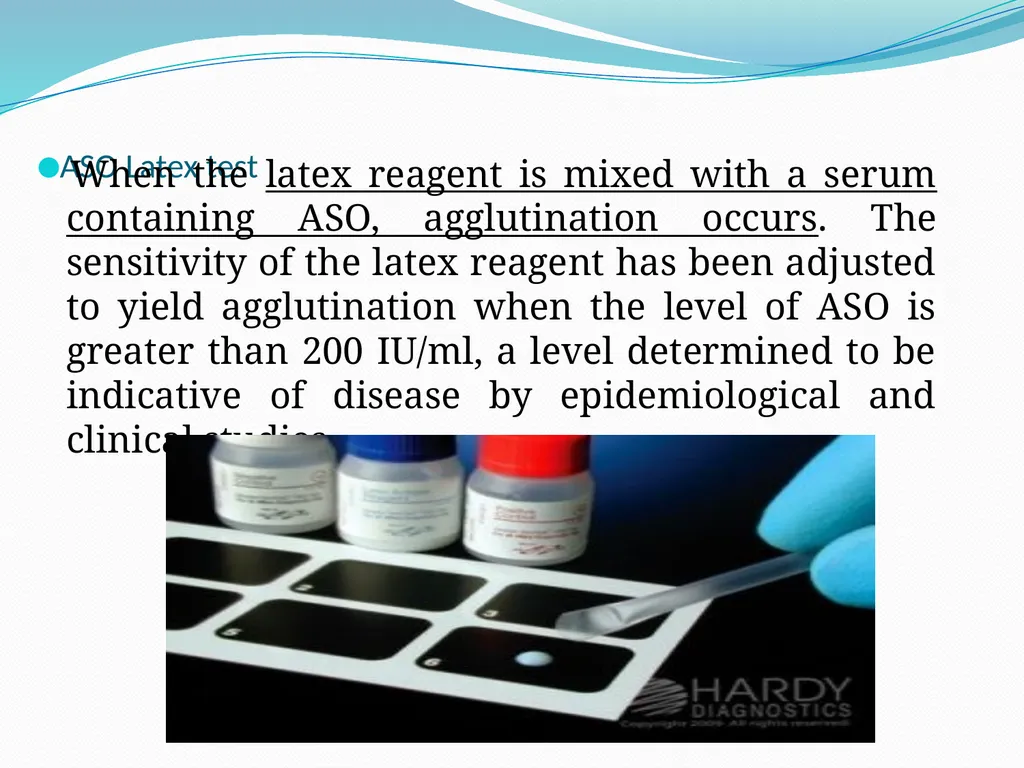
ASO Latex test When the latex reagent is mixed with a serum containing ASO, agglutination occurs. The sensitivity of the latex reagent has been adjusted to yield agglutination when the level of ASO is greater than 200 IU/ml, a level determined to be indicative of disease by epidemiological and clinical studies<br>
09
Sample Collection and Handling: Only fresh serum specimens should be used. Plasma must not be used since fibrinogen may cause non-specific agglutination of the latex. It is preferable to test samples on the same day as collected. Serum samples may be stored at 2-8o C for up to 48 hours prior to testing. If longer storage is necessary, sera should be stored frozen at -20ºC.
Materials used in the ASO Test
1-ASO Antigen: A stabilized buffered suspension of polystyrene latex particles coated with Streptolysin O and 0.1% sodium azide as preservative. Shake well prior to use.
2-ASO Positive Control: Human serum containing more than 200 IU/ml ASO and 0.1% sodium azide as preservative.
3-ASO Negative Control: Human serum containing 0.1% sodium azide as preservative.
4-Sufficient disposable pipettes.
5-Glass test slide.<br>
Materials used in the ASO Test
1-ASO Antigen: A stabilized buffered suspension of polystyrene latex particles coated with Streptolysin O and 0.1% sodium azide as preservative. Shake well prior to use.
2-ASO Positive Control: Human serum containing more than 200 IU/ml ASO and 0.1% sodium azide as preservative.
3-ASO Negative Control: Human serum containing 0.1% sodium azide as preservative.
4-Sufficient disposable pipettes.
5-Glass test slide.<br>
10
Procedure for Antistreptolysin O Test: 1-Bring all test reagents and samples to room temperature.
2-Use a disposable pipette to draw up and place one free-falling drop of each undiluted sample into its identified circle of the slide. Retain each pipette for mixing in step 5.
3-Deliver one free-falling drop of positive and negative control into its identified circle.
4-Mix the ASO latex reagent by gently shaking. Add one free-falling drop of reagent to each control and sample.
5-Using the flattened end of the appropriate plastic pipette as a stirrer (step 2), thoroughly mix each sample with reagent within the full area of the circle.
6-Discard the disposable pipette.
7-Slowly rock the slide for exactly two (2) minutes and observe for agglutination under a high intensity light.
8-Record results.
9-Re-wash glass slide for future use
Test Result: A test sample is considered to contain ASO antibodies in excess of 200 IU/ml when agglutination (clumping) is observed when compared to the result of the negative control.<br>
2-Use a disposable pipette to draw up and place one free-falling drop of each undiluted sample into its identified circle of the slide. Retain each pipette for mixing in step 5.
3-Deliver one free-falling drop of positive and negative control into its identified circle.
4-Mix the ASO latex reagent by gently shaking. Add one free-falling drop of reagent to each control and sample.
5-Using the flattened end of the appropriate plastic pipette as a stirrer (step 2), thoroughly mix each sample with reagent within the full area of the circle.
6-Discard the disposable pipette.
7-Slowly rock the slide for exactly two (2) minutes and observe for agglutination under a high intensity light.
8-Record results.
9-Re-wash glass slide for future use
Test Result: A test sample is considered to contain ASO antibodies in excess of 200 IU/ml when agglutination (clumping) is observed when compared to the result of the negative control.<br>
11
VDRL Test: Principle, procedure, results and interpretation Venereal disease research laboratory (VDRL) test is a nonspecific flocculation test which is used for the screening of Syphilis. VDRL test is easy to perform and inexpensive, so it is commonly used in the screening of population for Syphilis.
Sample:
1-Serum (plasma can not be used)
2-Cerebrospinal fluid (CSF)<br>
Sample:
1-Serum (plasma can not be used)
2-Cerebrospinal fluid (CSF)<br>
12
Principle of VDRL Test: Non-treponemal antigen (Cardiolipin-Cholesterol-Lecithin) is used to detect the presence of “reagin antibodies” ( IgM and IgG antibodies to lipoidal material released from damaged host cells as well as to lipoprotein-like material, and possibly cardiolipin released from the treponemes) in patient’s serum.
When the heat inactivated (to destroy complement) serum of patient is reacted with freshly prepared non-treponemal antigen, flocculation reaction (antigen and antibody complex are suspended) occurs. The flocculation can be observed by using Microscope with 10x objective and 10x eye piece.
Reactive VDRL test serum can be quantitated to obtain the titre of “reagin antibodies” by using serial double dilution method.
Result and Interpretation of VDRL test
VDRL test is positive in most cases of primary syphilis and are almost always positive in secondary syphilis. The titer of reagin antibodies decreases with effective treatment, so VDRL test can be used to determine the treatment response of syphilis.<br>
When the heat inactivated (to destroy complement) serum of patient is reacted with freshly prepared non-treponemal antigen, flocculation reaction (antigen and antibody complex are suspended) occurs. The flocculation can be observed by using Microscope with 10x objective and 10x eye piece.
Reactive VDRL test serum can be quantitated to obtain the titre of “reagin antibodies” by using serial double dilution method.
Result and Interpretation of VDRL test
VDRL test is positive in most cases of primary syphilis and are almost always positive in secondary syphilis. The titer of reagin antibodies decreases with effective treatment, so VDRL test can be used to determine the treatment response of syphilis.<br>
13
Limiation of the Test A. False positive VDRL test result
Reagin antibodies may be produced in response to nontreponemal diseases of an acute and chronic nature in which tissue damage occurs such as:
Leprosy
Hepatitis B
Infectious Mononucleosis
Various autoimmune Diseases
B. False negative VDRL test
It can be seen because of prozone phenomenon (no flocculation due to antibody excess). In that case test serum has to be diluted further to obtain zone of equivalence (where maximum flocculation of Ag-Ab occurs<br>
Reagin antibodies may be produced in response to nontreponemal diseases of an acute and chronic nature in which tissue damage occurs such as:
Leprosy
Hepatitis B
Infectious Mononucleosis
Various autoimmune Diseases
B. False negative VDRL test
It can be seen because of prozone phenomenon (no flocculation due to antibody excess). In that case test serum has to be diluted further to obtain zone of equivalence (where maximum flocculation of Ag-Ab occurs<br>
14
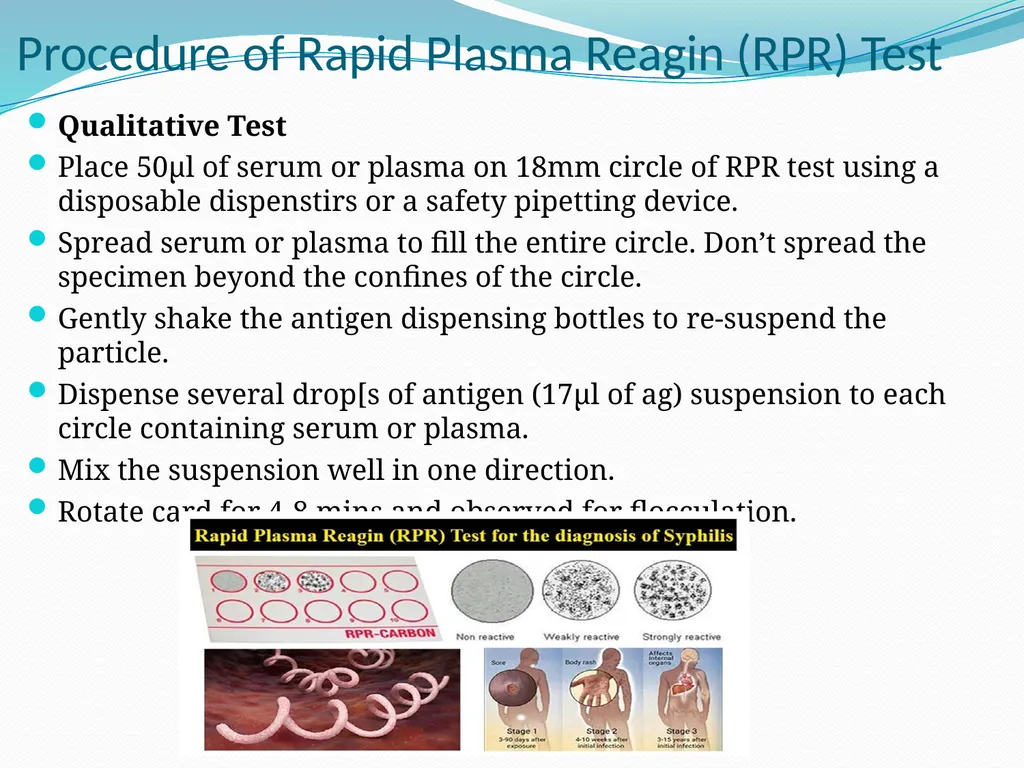
Rapid Plasma Reagin (RPR) Test for the diagnosis of Syphilis The rapid plasma reagin (RPR) test is a macroscopic, nontreponemal flocculation card test used to screen for syphilis.
Let’s first analyze the test name:
Rapid: Its rapid test that can be done within few minutes.
Plasma: The sample is plasma (or serum)
Reagin: The term “reagin” means that this test does not look for antibodies against the actual bacterium, but rather for antibodies against substances released by cells when they are damaged by Treponema pallidum.
In some text books you can find reagin means an antibody to cardiolipin.
RPR test is one of the nonspecific tests (another non-specific test is VDRL Test) commonly used to screen the population for syphilis. The RPR test measures IgM and IgG antibodies to lipoidal material released from damaged host cells as well as to lipoprotein-like material, and possibly cardiolipin released from the treponemes.<br>
Let’s first analyze the test name:
Rapid: Its rapid test that can be done within few minutes.
Plasma: The sample is plasma (or serum)
Reagin: The term “reagin” means that this test does not look for antibodies against the actual bacterium, but rather for antibodies against substances released by cells when they are damaged by Treponema pallidum.
In some text books you can find reagin means an antibody to cardiolipin.
RPR test is one of the nonspecific tests (another non-specific test is VDRL Test) commonly used to screen the population for syphilis. The RPR test measures IgM and IgG antibodies to lipoidal material released from damaged host cells as well as to lipoprotein-like material, and possibly cardiolipin released from the treponemes.<br>
15
Principle of Rapid Plasma Reagin (RPR) Test RPR is 18 mm circle card test is a macroscopic flocculation test for syphilis. The antigen is prepared from modified VDRL (Venereal Disease Research Laboratory), antigen suspension containing choline chloride and EDTA (ethylenediamine tetraacetic acid) to enhance stability of suspension, finely divided charcoal particles as visualizing agents. In this test antigen is mixed with unheated serum on plastic –coated card. This test measures IgM & IgG antibodies to lipodial material released from damaged host cells as well as possibly cardiolipin released from treponems. If antibodies are present, they combines with lipid particles of the antigen, causing them to agglutinate .The charcoal particles co-agglutinate with antibodies and shows black clumps on white cards. If antibodies are not present, the test mixture is uniformly gray.<br>
16
Procedure of Rapid Plasma Reagin (RPR) Test Qualitative Test
Place 50µl of serum or plasma on 18mm circle of RPR test using a disposable dispenstirs or a safety pipetting device.
Spread serum or plasma to fill the entire circle. Don’t spread the specimen beyond the confines of the circle.
Gently shake the antigen dispensing bottles to re-suspend the particle.
Dispense several drop[s of antigen (17µl of ag) suspension to each circle containing serum or plasma.
Mix the suspension well in one direction.
Rotate card for 4-8 mins and observed for flocculation.<br>
Place 50µl of serum or plasma on 18mm circle of RPR test using a disposable dispenstirs or a safety pipetting device.
Spread serum or plasma to fill the entire circle. Don’t spread the specimen beyond the confines of the circle.
Gently shake the antigen dispensing bottles to re-suspend the particle.
Dispense several drop[s of antigen (17µl of ag) suspension to each circle containing serum or plasma.
Mix the suspension well in one direction.
Rotate card for 4-8 mins and observed for flocculation.<br>
17
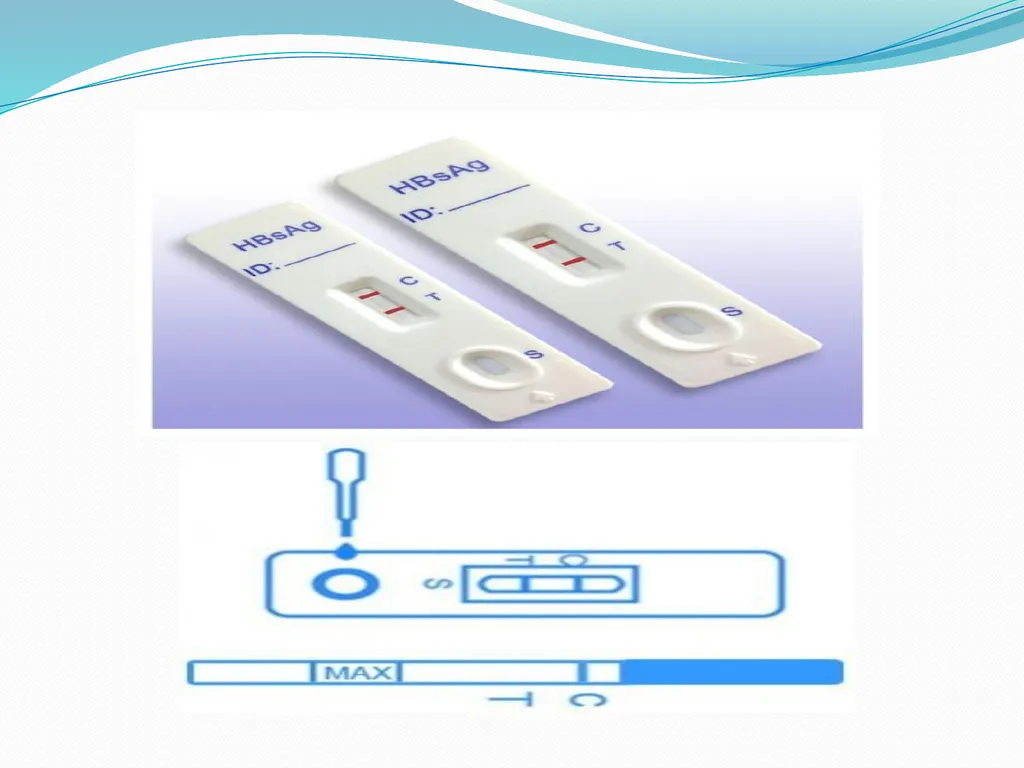
Hepatitis Test
Hepatitis is a general term that describes inflammation of the liver. Hepatitis can damage the liver, affect liver function, and over time lead to complications such as cirrhosis,
which is severe scarring of the liver, and liver cancer. The Role of Hepatitis Tests
The purpose of hepatitis tests is to screen for and diagnose hepatitis, evaluate the liver, and to determine the underlying cause of hepatitis:
Screening for viral hepatitis infection: Screening involves testing to look for diseases before a person develops symptoms. Hepatitis tests are commonly used to screen for two types of viral hepatitis, hepatitis B and hepatitis C, in certain populations.
Diagnose the underlying cause of hepatitis: Hepatitis testing is often used to determine the underlying cause of inflammation in the liver or liver damage. Testing can identify whether a person has a viral hepatitis infection, if hepatitis is acute or chronic, and whether they are contagious and can spread viral hepatitis to others.<br>
Hepatitis is a general term that describes inflammation of the liver. Hepatitis can damage the liver, affect liver function, and over time lead to complications such as cirrhosis,
which is severe scarring of the liver, and liver cancer. The Role of Hepatitis Tests
The purpose of hepatitis tests is to screen for and diagnose hepatitis, evaluate the liver, and to determine the underlying cause of hepatitis:
Screening for viral hepatitis infection: Screening involves testing to look for diseases before a person develops symptoms. Hepatitis tests are commonly used to screen for two types of viral hepatitis, hepatitis B and hepatitis C, in certain populations.
Diagnose the underlying cause of hepatitis: Hepatitis testing is often used to determine the underlying cause of inflammation in the liver or liver damage. Testing can identify whether a person has a viral hepatitis infection, if hepatitis is acute or chronic, and whether they are contagious and can spread viral hepatitis to others.<br>
18
Assessing immunity to viral hepatitis: After a patient recovers from certain types of viral hepatitis, including hepatitis A and hepatitis B, their body develops protective antibodies, and they become immune to future infections. Hepatitis testing can help doctors understand if a patient has developed immunity based on a past infection or successful vaccination.
Guiding treatment for hepatitis: Hepatitis testing may be ordered to help determine the most appropriate treatment for hepatitis. Testing can also help detect complications of hepatitis and assess a patient’s response to treatment.<br>
Guiding treatment for hepatitis: Hepatitis testing may be ordered to help determine the most appropriate treatment for hepatitis. Testing can also help detect complications of hepatitis and assess a patient’s response to treatment.<br>
19
Types of Hepatitis Tests
Hepatitis testing often begins with preliminary tests to evaluate the liver and detect evidence of hepatitis. Depending on the patient’s symptoms, medical history, and the results of a physical exam, a patient’s doctor may order individual tests or broad test panels such as a comprehensive metabolic panel and a liver panel. These tests may be used to evaluate the liver, detect evidence of hepatitis, and begin to narrow down the underlying cause of a patient’s condition.
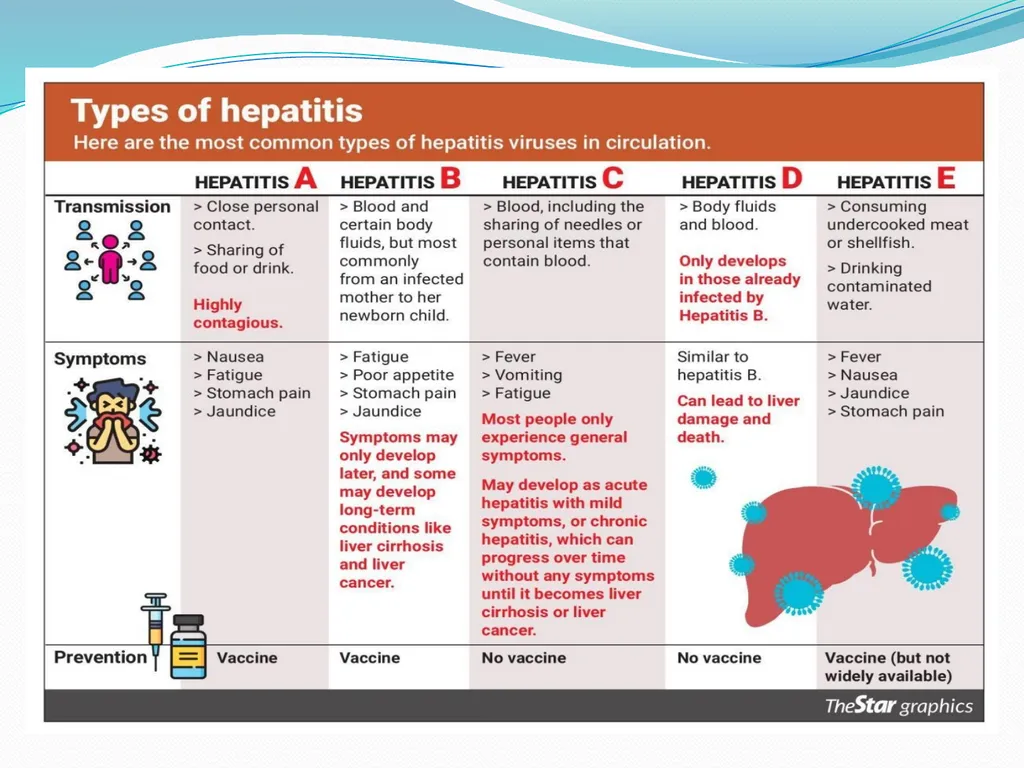
Tests used to diagnose, evaluate, and guide treatment for viral hepatitis may be performed individually when a person has a known or suspected exposure to a specific type of viral hepatitis. In patients without a known or expected exposure, tests may be performed together as part of an acute viral hepatitis panel. An acute viral hepatitis panel detects evidence of the three most common types of hepatitis in the United States: hepatitis A, B, and C.<br>
Hepatitis testing often begins with preliminary tests to evaluate the liver and detect evidence of hepatitis. Depending on the patient’s symptoms, medical history, and the results of a physical exam, a patient’s doctor may order individual tests or broad test panels such as a comprehensive metabolic panel and a liver panel. These tests may be used to evaluate the liver, detect evidence of hepatitis, and begin to narrow down the underlying cause of a patient’s condition.
Tests used to diagnose, evaluate, and guide treatment for viral hepatitis may be performed individually when a person has a known or suspected exposure to a specific type of viral hepatitis. In patients without a known or expected exposure, tests may be performed together as part of an acute viral hepatitis panel. An acute viral hepatitis panel detects evidence of the three most common types of hepatitis in the United States: hepatitis A, B, and C.<br>
20
Viral hepatitis testing detects antibodies, antigens, or hepatithe genetic material of a hepatitis virus. Antigens are substances from the virus that produce an immune response, while antibodies are produced by the immune system after an infection. Tests related to viral tis include:<br>
21
THANK YOU<br>