Server-Aided Anonymous Credentials Rutchathon Chairattana-Apirom1, Franklin Harding2, Anna Lysyanskaya2, and Stefano Tessaro1 1: University of Washington, Seattle, WA, USA 2: Brown University, Providence, RI, USA 1 European Digital Identity
"Server-Aided Anonymous Credentials Rutchathon" is the property of its rightful owner. Permission is granted to
download and print the materials on this website for personal, non-commercial use only, and to display it
on your personal computer provided you do not modify the materials and that you retain all copyright
notices contained in the materials. By downloading content from our website, you accept the terms of this
agreement.
Presentation Transcript
01
Server-Aided Anonymous Credentials Rutchathon Chairattana-Apirom1, Franklin Harding2,
Anna Lysyanskaya2, and Stefano Tessaro1
1: University of Washington, Seattle, WA, USA
2: Brown University, Providence, RI, USA 1<br>
02
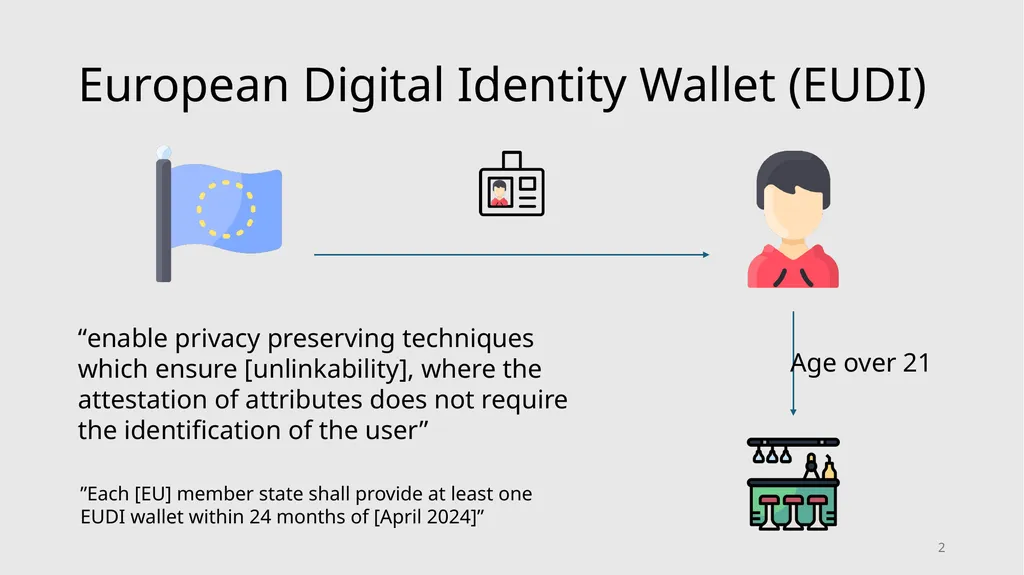
European Digital Identity Wallet (EUDI) Age over 21 2 ”Each [EU] member state shall provide at least one EUDI wallet within 24 months of [April 2024]” “enable privacy preserving techniques which ensure [unlinkability], where the attestation of attributes does not require the identification of the user”<br>
03
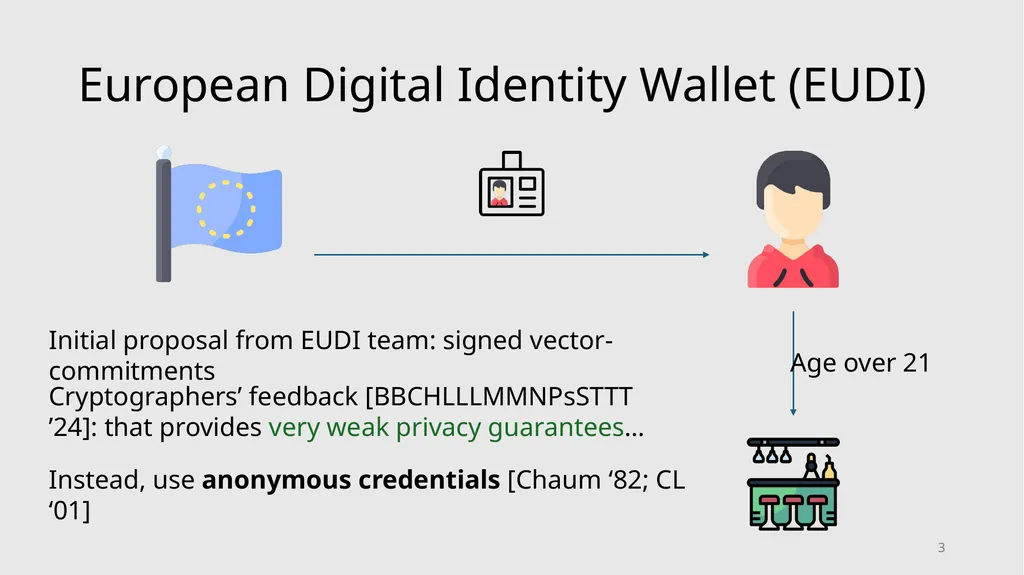
European Digital Identity Wallet (EUDI) 3 Initial proposal from EUDI team: signed vector-commitments Cryptographers’ feedback [BBCHLLLMMNPsSTTT ’24]: that provides very weak privacy guarantees… Instead, use anonymous credentials [Chaum ‘82; CL ‘01] Age over 21<br>
04
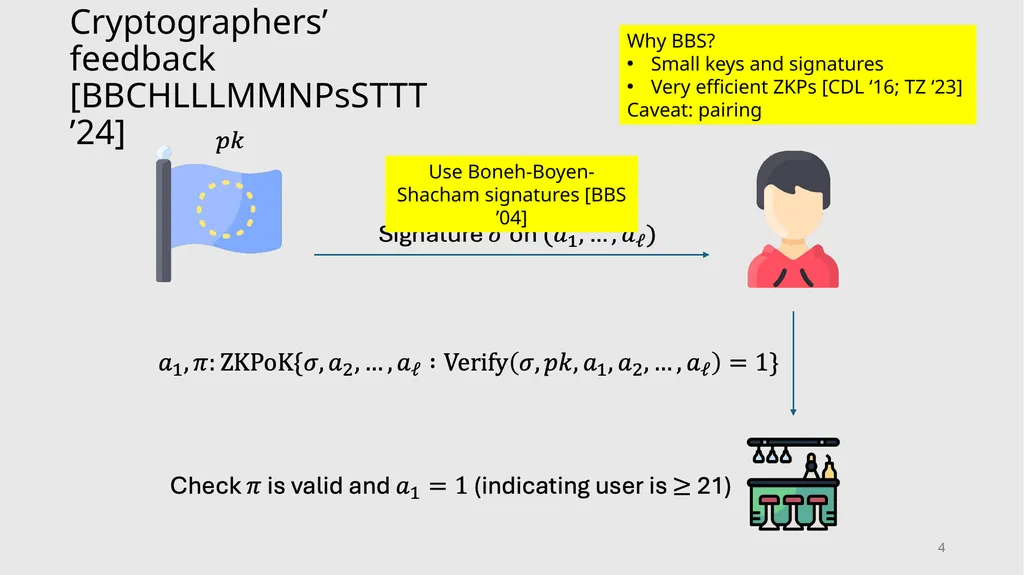
4 Cryptographers’ feedback [BBCHLLLMMNPsSTTT ’24] Use Boneh-Boyen-Shacham signatures [BBS ’04] Why BBS?
Small keys and signatures
Very efficient ZKPs [CDL ‘16; TZ ‘23]
Caveat: pairing<br>
05
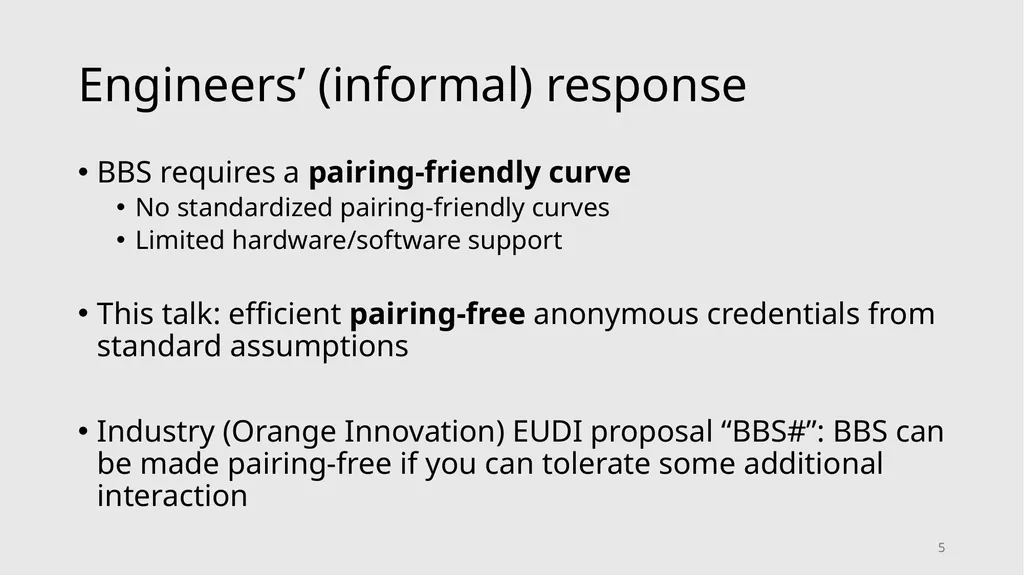
Engineers’ (informal) response BBS requires a pairing-friendly curve
No standardized pairing-friendly curves
Limited hardware/software support
This talk: efficient pairing-free anonymous credentials from standard assumptions
Industry (Orange Innovation) EUDI proposal “BBS#”: BBS can be made pairing-free if you can tolerate some additional interaction 5<br>
06
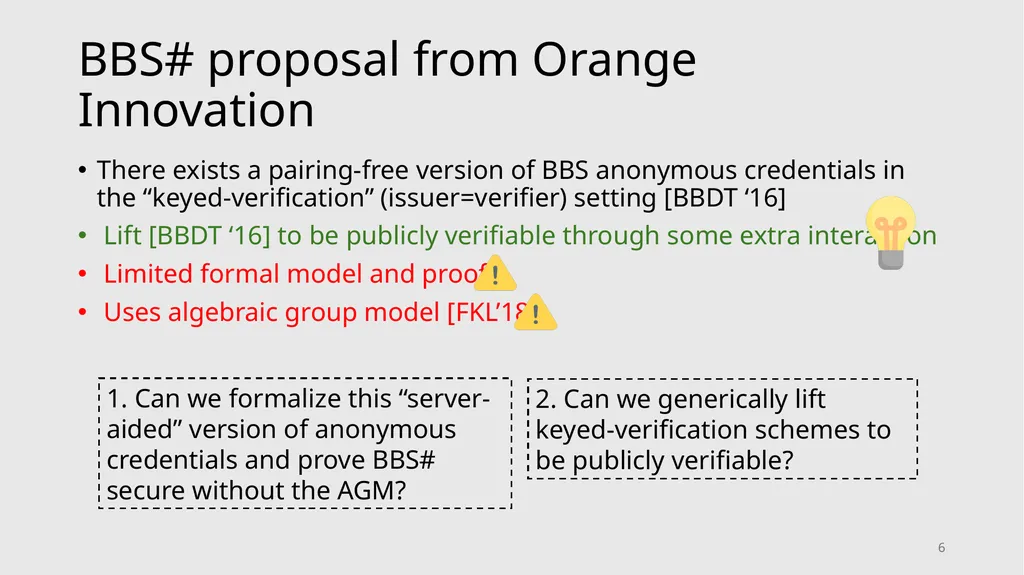
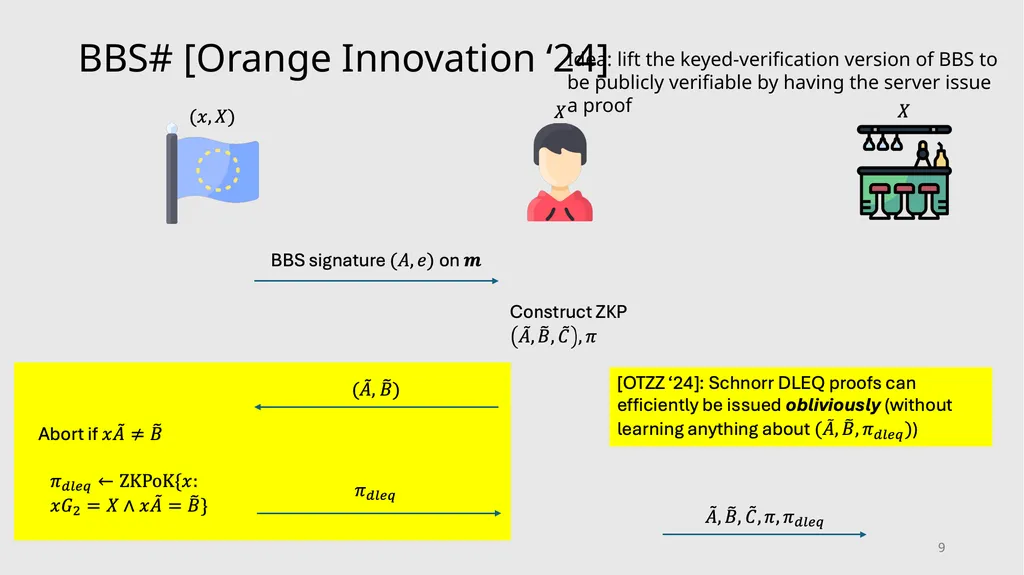
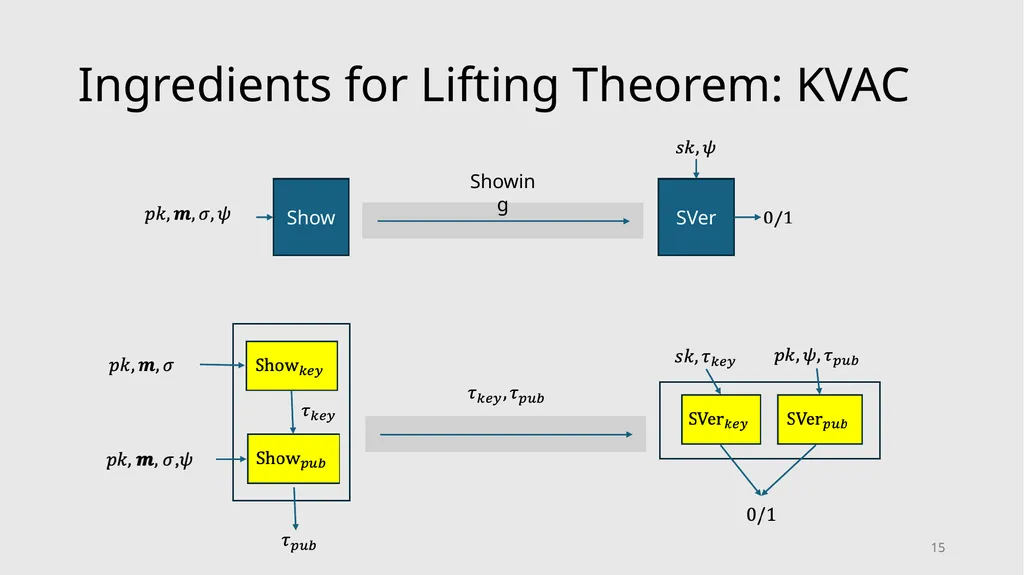
BBS# proposal from Orange Innovation There exists a pairing-free version of BBS anonymous credentials in the “keyed-verification” (issuer=verifier) setting [BBDT ‘16]
Lift [BBDT ‘16] to be publicly verifiable through some extra interaction
Limited formal model and proofs
Uses algebraic group model [FKL’18] 6 1. Can we formalize this “server-aided” version of anonymous credentials and prove BBS# secure without the AGM? 2. Can we generically lift keyed-verification schemes to be publicly verifiable?<br>
07
Summary so far EU needs pairing-free anonymous credentials
BBS is the most promising option, but requires a pairing
BBS#: proposal to make BBS pairing-free through extra interaction
Up next
Background: BBS signatures and BBS#
Our results 7<br>
08
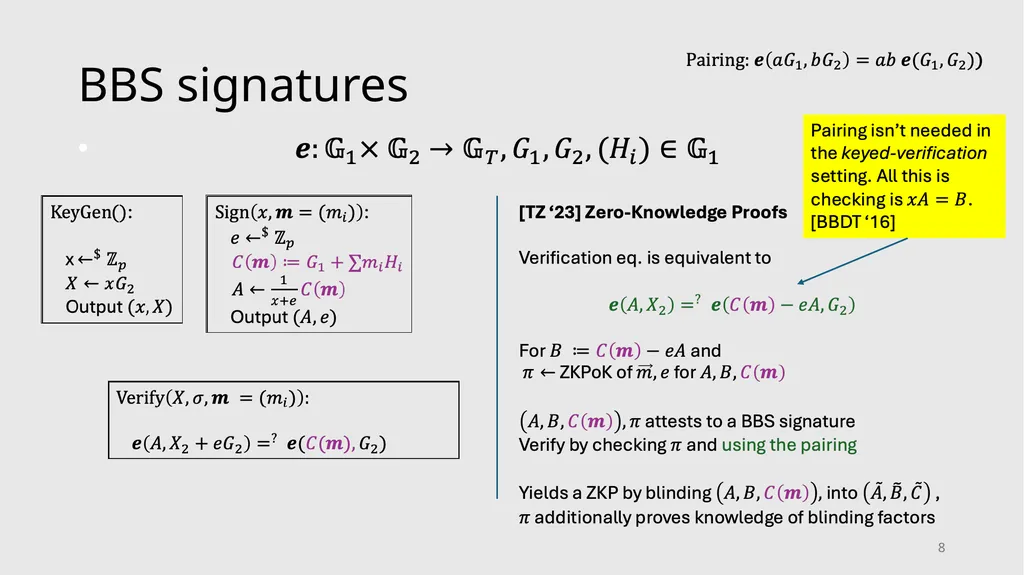
BBS signatures 8<br>
09
BBS# [Orange Innovation ‘24] 9 Idea: lift the keyed-verification version of BBS to be publicly verifiable by having the server issue a proof<br>
10
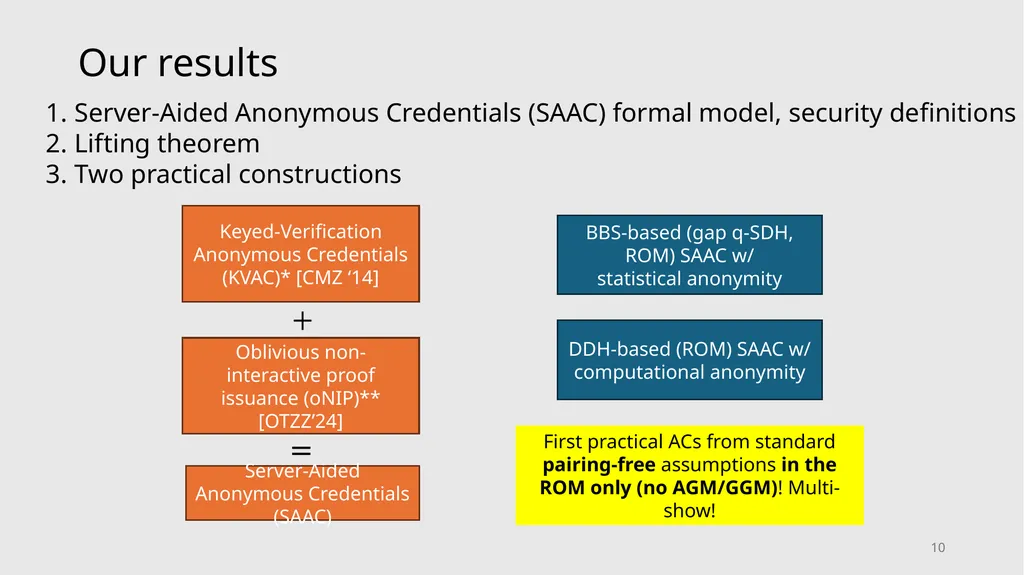
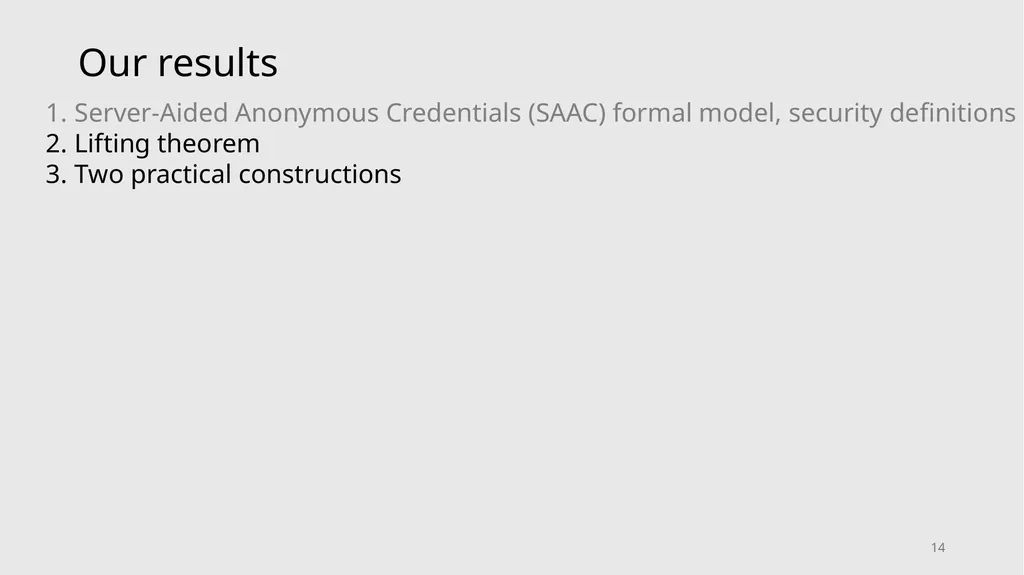
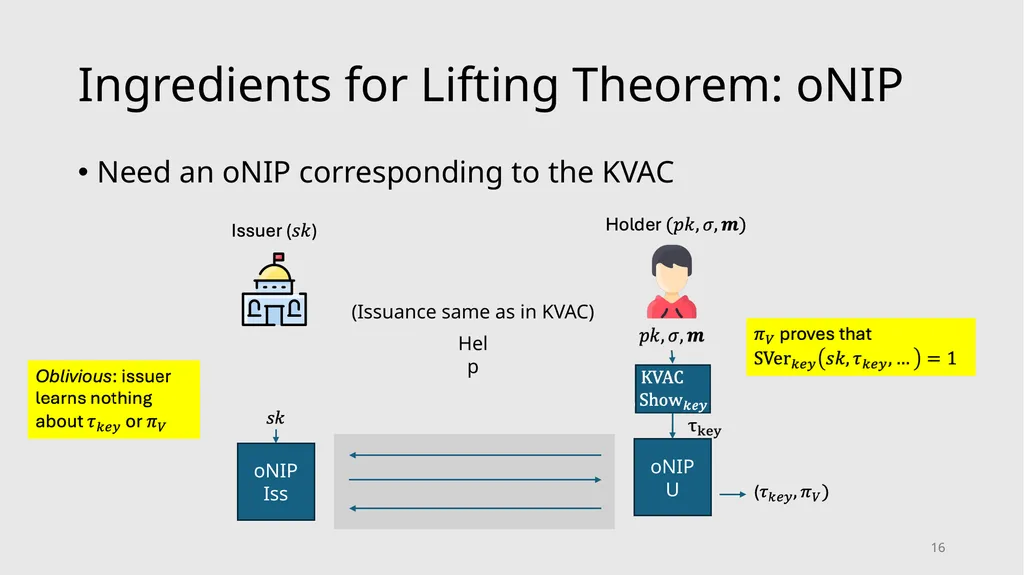
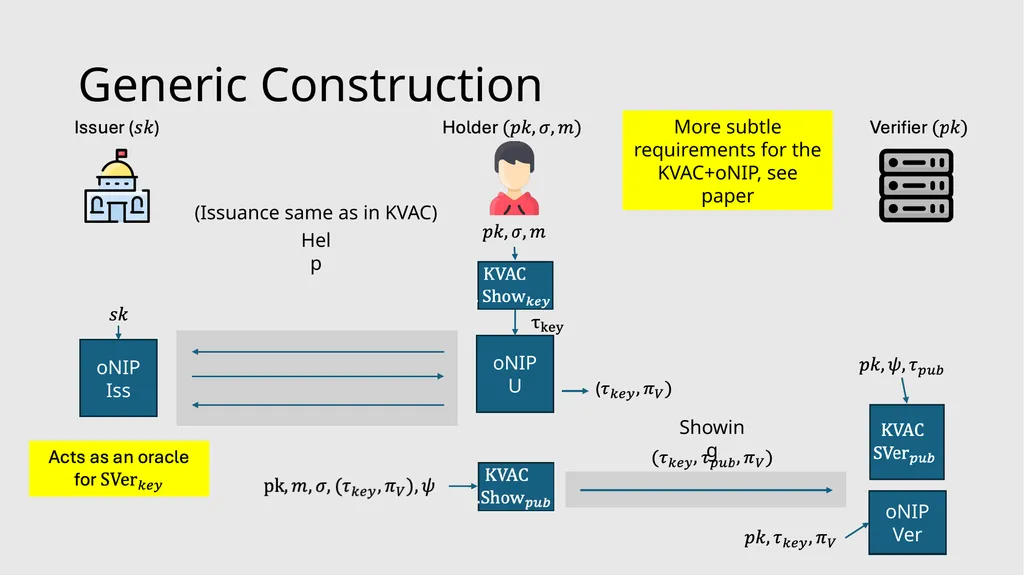
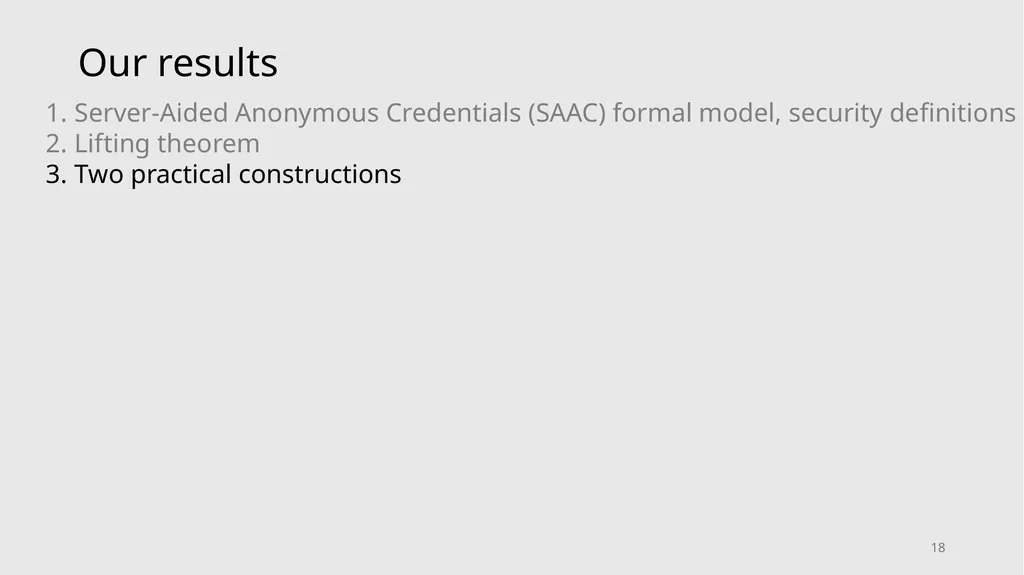
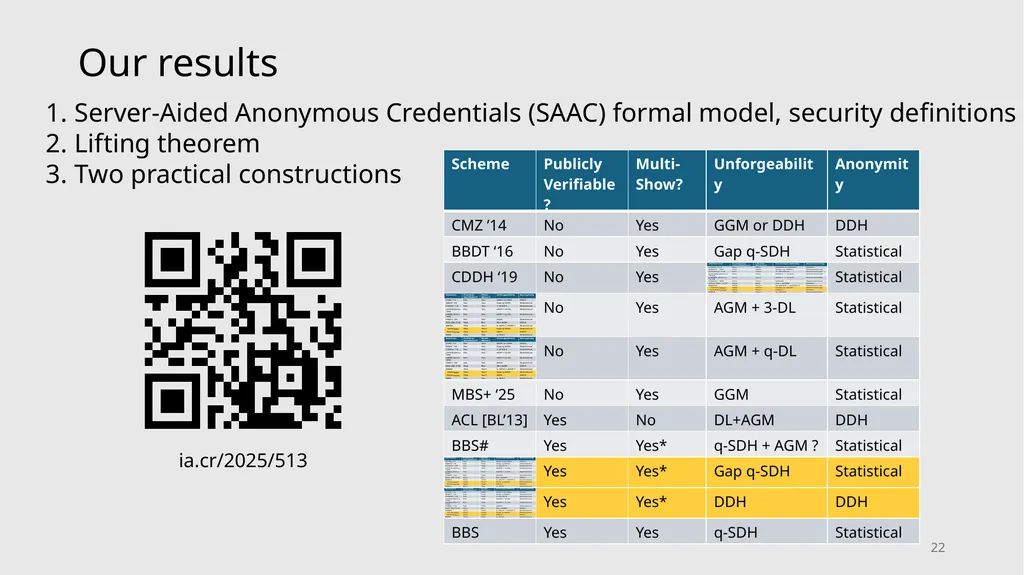
Our results Keyed-Verification Anonymous Credentials (KVAC)* [CMZ ‘14] Oblivious non-interactive proof issuance (oNIP)** [OTZZ’24] Server-Aided Anonymous Credentials (SAAC) First practical ACs from standard pairing-free assumptions in the ROM only (no AGM/GGM)! Multi-show! 10 BBS-based (gap q-SDH, ROM) SAAC w/
statistical anonymity DDH-based (ROM) SAAC w/
computational anonymity Server-Aided Anonymous Credentials (SAAC) formal model, security definitions
Lifting theorem
Two practical constructions<br>
11
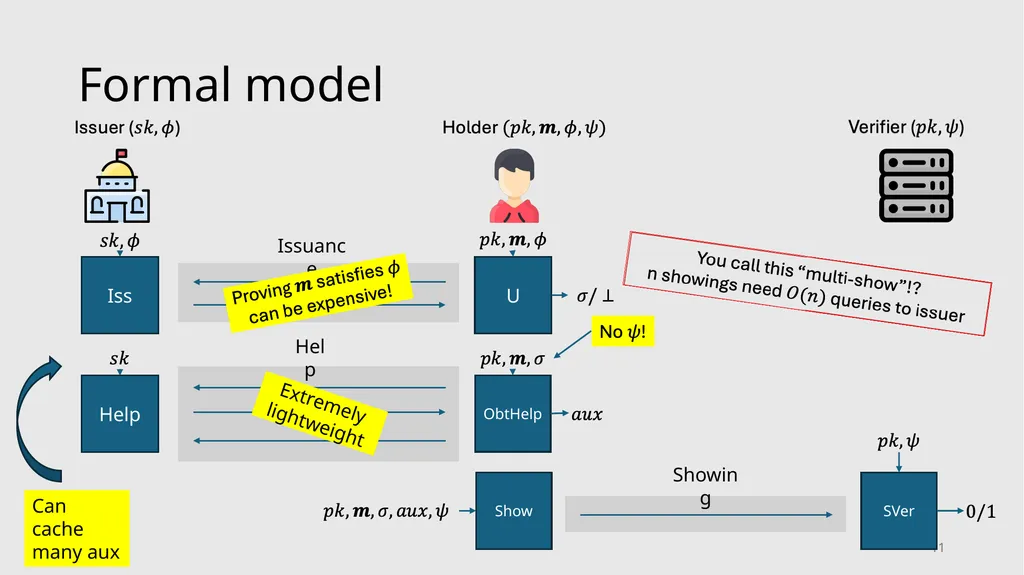
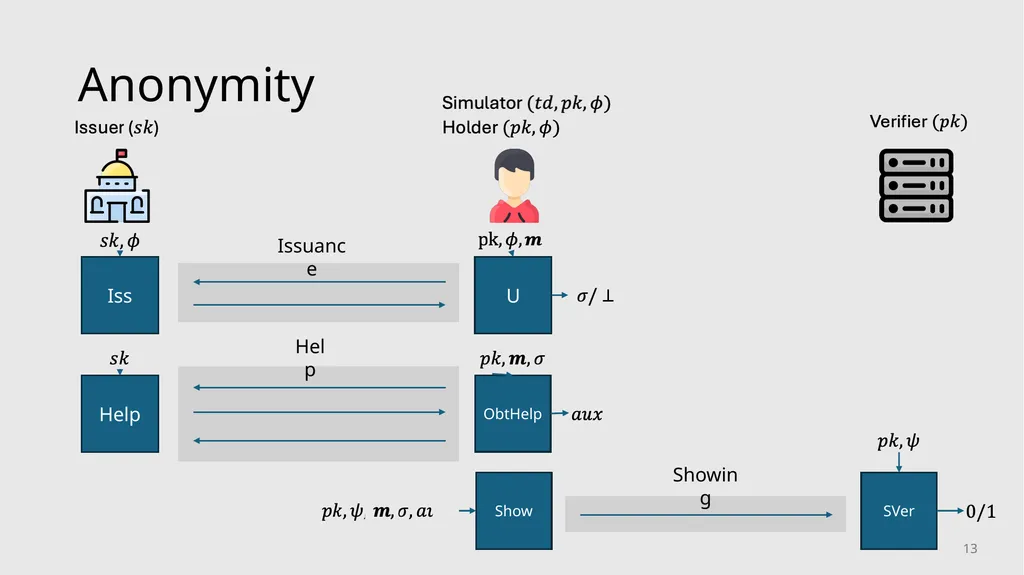
Formal model Issuance Help Showing Can cache many aux Iss U Help ObtHelp Show SVer Extremely lightweight 11<br>
12
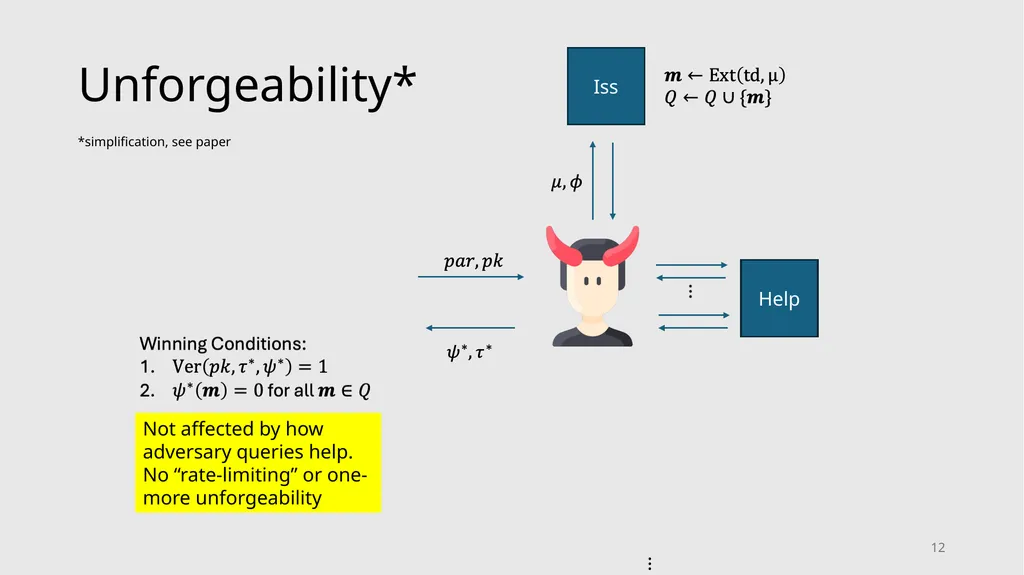
Unforgeability* Not affected by how adversary queries help.
No “rate-limiting” or one-more unforgeability Iss Help *simplification, see paper 12<br>
13
Anonymity Issuance Help Showing Iss U Help ObtHelp Show SVer 13<br>
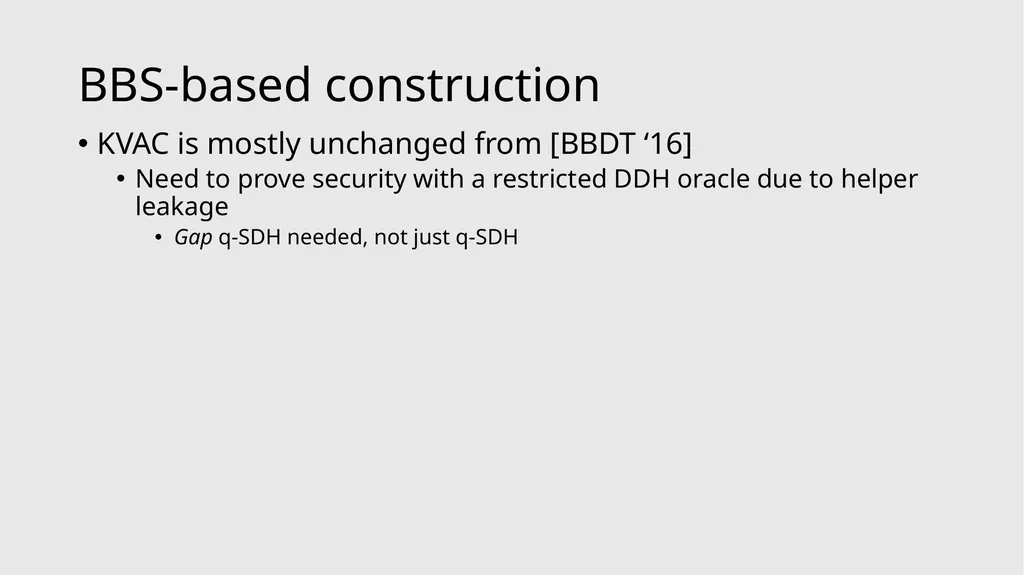
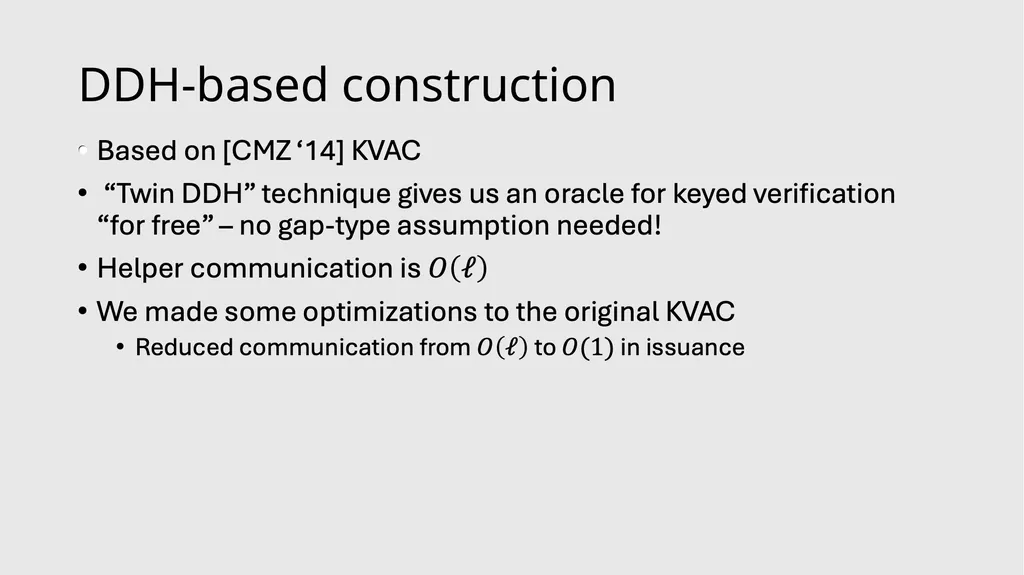
BBS-based construction KVAC is mostly unchanged from [BBDT ‘16]
Need to prove security with a restricted DDH oracle due to helper leakage
Gap q-SDH needed, not just q-SDH<br>
20
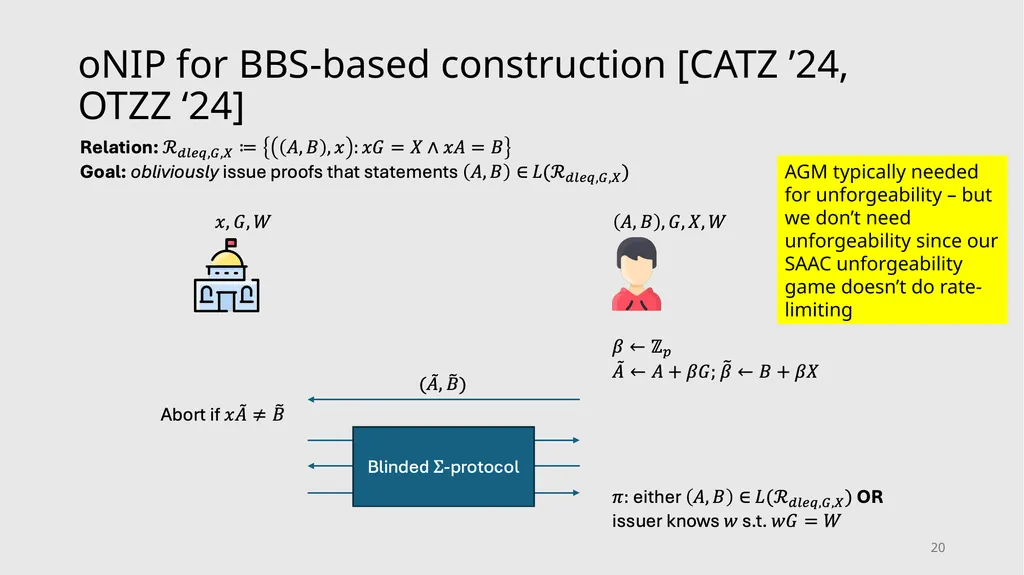
oNIP for BBS-based construction [CATZ ’24, OTZZ ‘24] 20 AGM typically needed for unforgeability – but we don’t need unforgeability since our SAAC unforgeability game doesn’t do rate-limiting<br>