Service Description Devon Tier 2 Weight Management Service Lucy OLoughlin Public Health Specialist Commissioning Lead for Healthy Weight Overview Healthy Weight Care Pathway and gaps Developing a new model for Devon-needs and assets
Related Topics
Share
Embed code
Download this presentation From Below
"Service Description Devon Tier 2 Weight Management" is the property of its rightful owner. Permission is granted to
download and print the materials on this website for personal, non-commercial use only, and to display it
on your personal computer provided you do not modify the materials and that you retain all copyright
notices contained in the materials. By downloading content from our website, you accept the terms of this
agreement.
Presentation Transcript
01
Service Description Devon Tier 2 Weight Management Service Lucy O’Loughlin
Public Health Specialist/ Commissioning Lead for Healthy Weight<br>
02
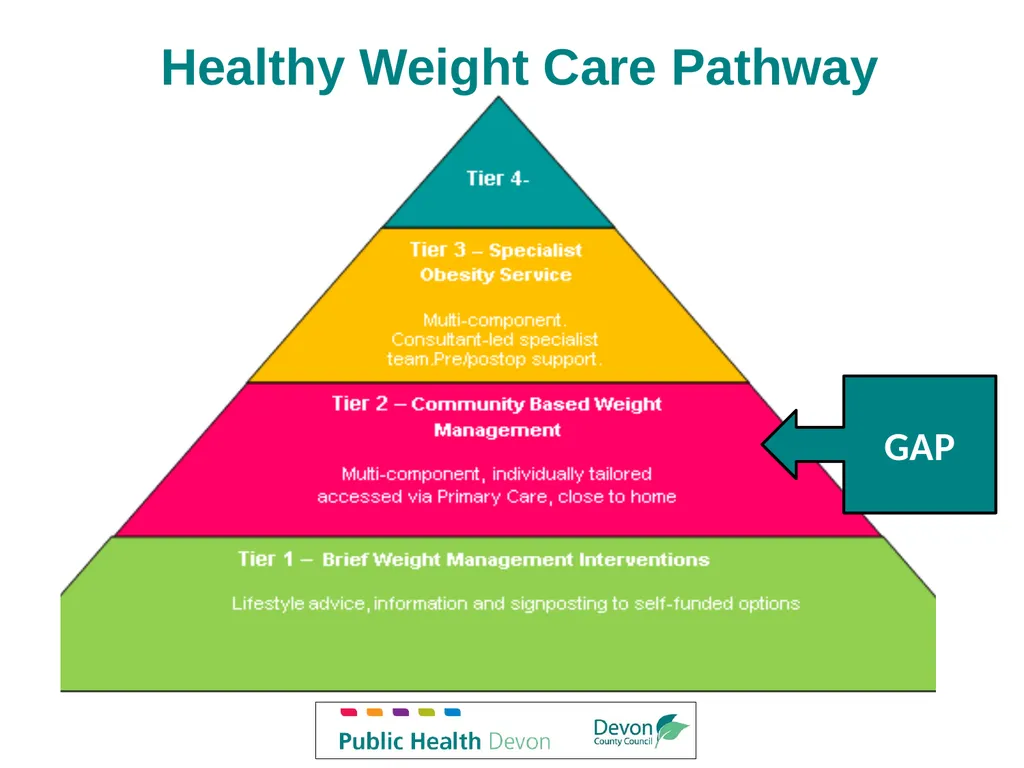
Overview Healthy Weight Care Pathway and gaps
Developing a new model for Devon-needs and assets
Service descriptions- Lots1-4
Healthy Lifestyle Hub
Where are we now and next steps
Questions<br>
03
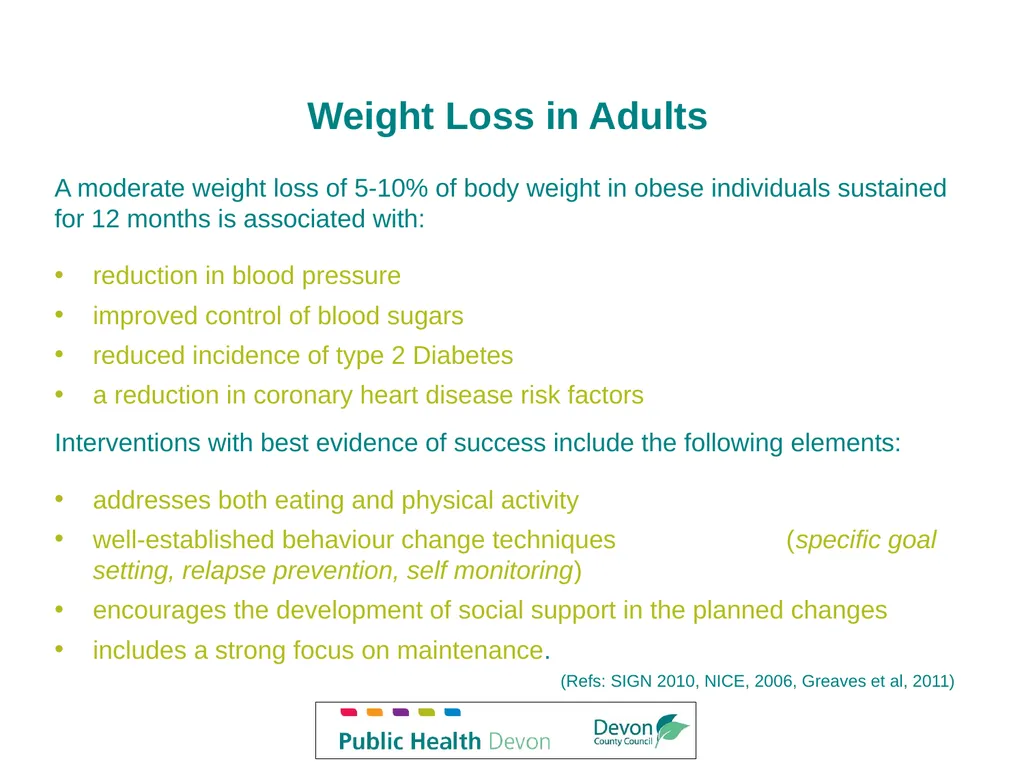
Weight Loss in Adults A moderate weight loss of 5-10% of body weight in obese individuals sustained for 12 months is associated with:
reduction in blood pressure
improved control of blood sugars
reduced incidence of type 2 Diabetes
a reduction in coronary heart disease risk factors
Interventions with best evidence of success include the following elements:
addresses both eating and physical activity
well-established behaviour change techniques (specific goal setting, relapse prevention, self monitoring)
encourages the development of social support in the planned changes
includes a strong focus on maintenance.
(Refs: SIGN 2010, NICE, 2006, Greaves et al, 2011)<br>
04
Healthy Weight Care Pathway GAP<br>
05
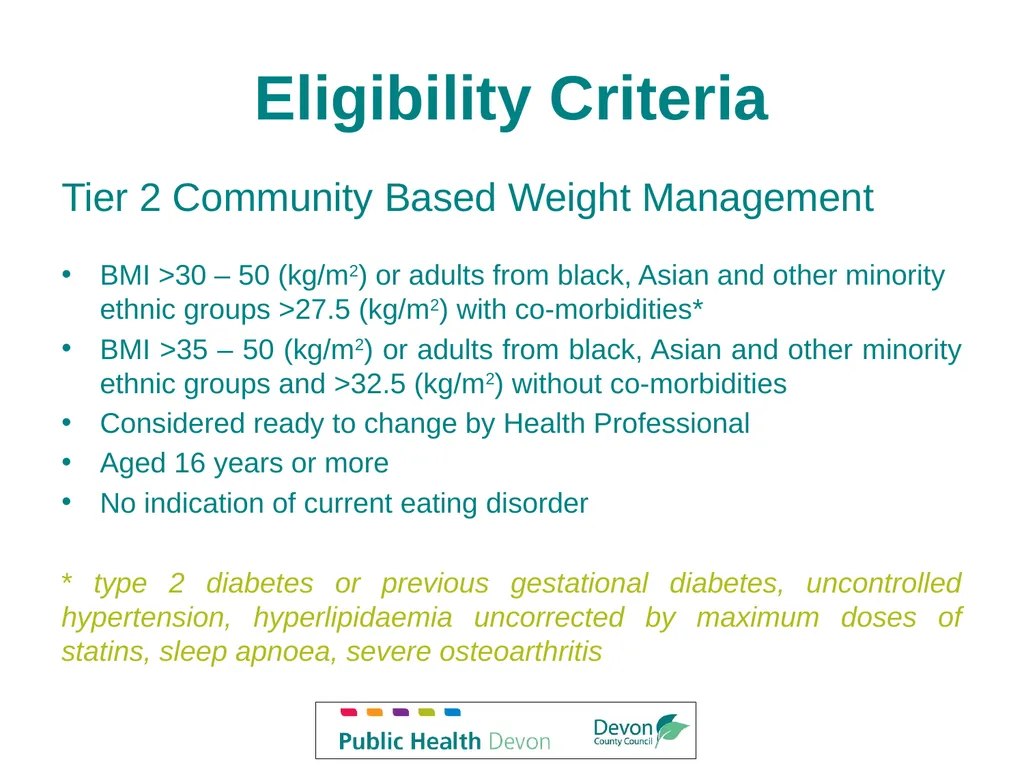
Eligibility Criteria Tier 2 Community Based Weight Management
BMI >30 – 50 (kg/m2) or adults from black, Asian and other minority ethnic groups >27.5 (kg/m2) with co-morbidities*
BMI >35 – 50 (kg/m2) or adults from black, Asian and other minority ethnic groups and >32.5 (kg/m2) without co-morbidities
Considered ready to change by Health Professional
Aged 16 years or more
No indication of current eating disorder
* type 2 diabetes or previous gestational diabetes, uncontrolled hypertension, hyperlipidaemia uncorrected by maximum doses of statins, sleep apnoea, severe osteoarthritis<br>
06
What Do We Know About The Health Needs? 158,053 people BMI 30 kg/m2 or above
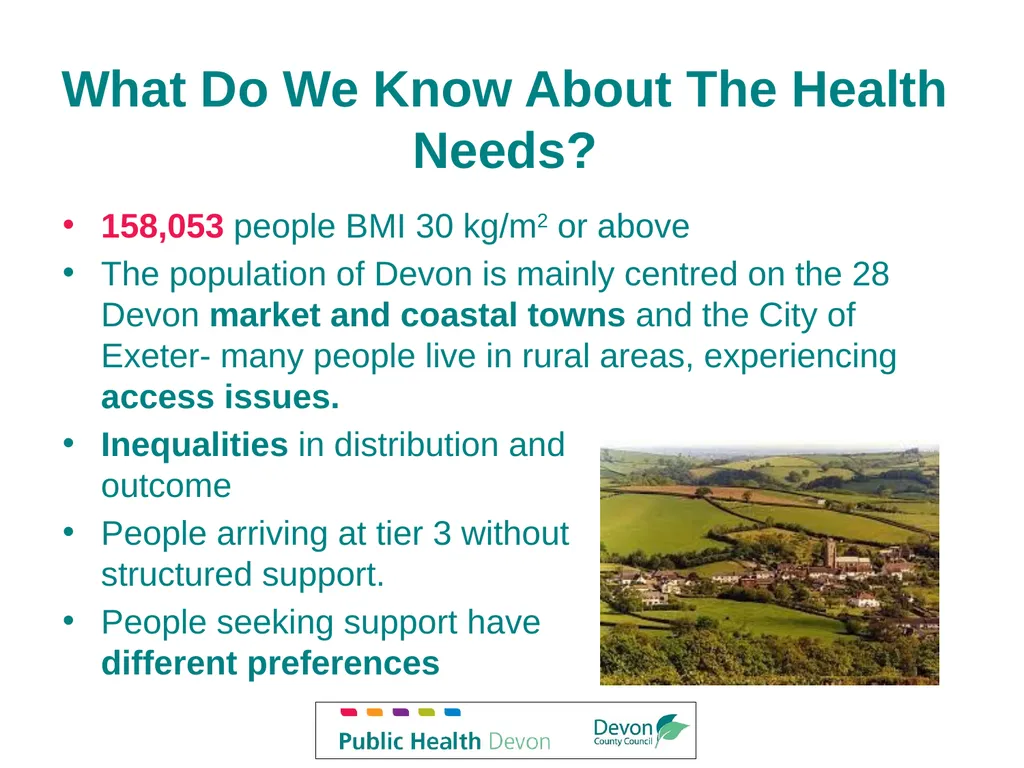
The population of Devon is mainly centred on the 28 Devon market and coastal towns and the City of Exeter- many people live in rural areas, experiencing access issues.
Inequalities in distribution and outcome
People arriving at tier 3 without structured support.
People seeking support have different preferences<br>
07
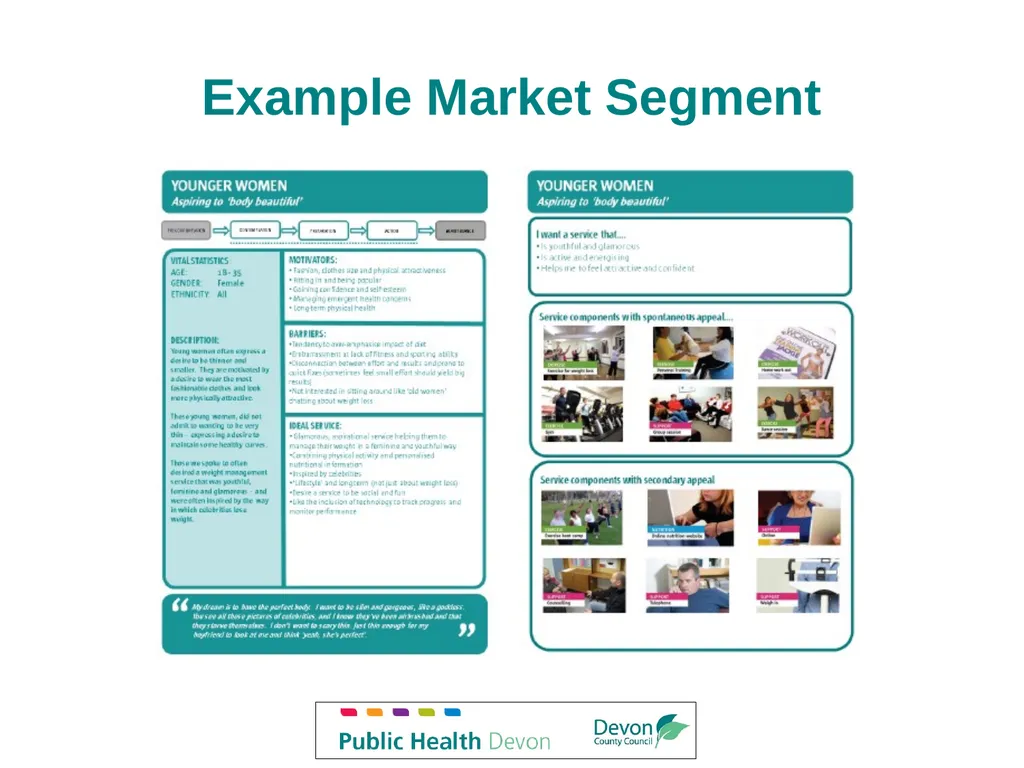
Understanding Different Needs Work commissioned by Dept Health , published March 2010. “Maximising the Appeal of Weight Management Services”
Evident that ‘one size does not fit all’
Need to take into account the motivators and barriers experienced by different user groups
Frustration at the current services on offer… “unreflective of their needs”
Broad differences of appeal emerged across different socio-demographic groups:
Male and female
Older and younger
More and less affluent
Size (e.g. overweight – very big)
9 population segments developed<br>
08
Example Market Segment<br>
09
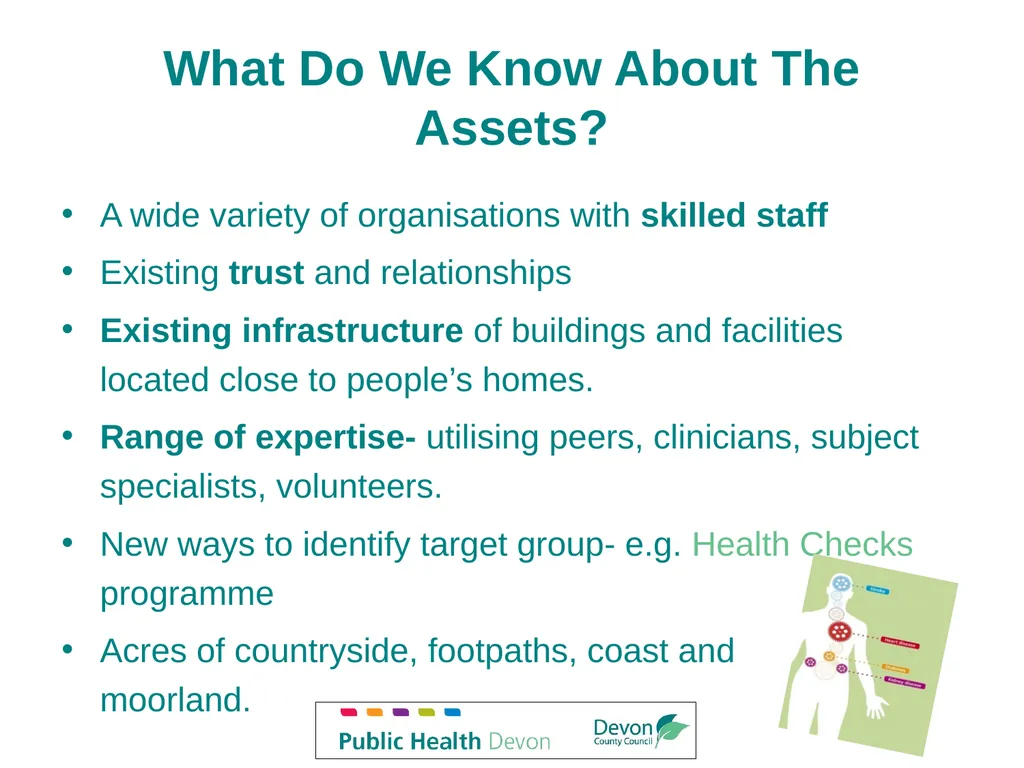
What Do We Know About The Assets? A wide variety of organisations with skilled staff
Existing trust and relationships
Existing infrastructure of buildings and facilities located close to people’s homes.
Range of expertise- utilising peers, clinicians, subject specialists, volunteers.
New ways to identify target group- e.g. Health Checks programme
Acres of countryside, footpaths, coast and moorland.<br>
10
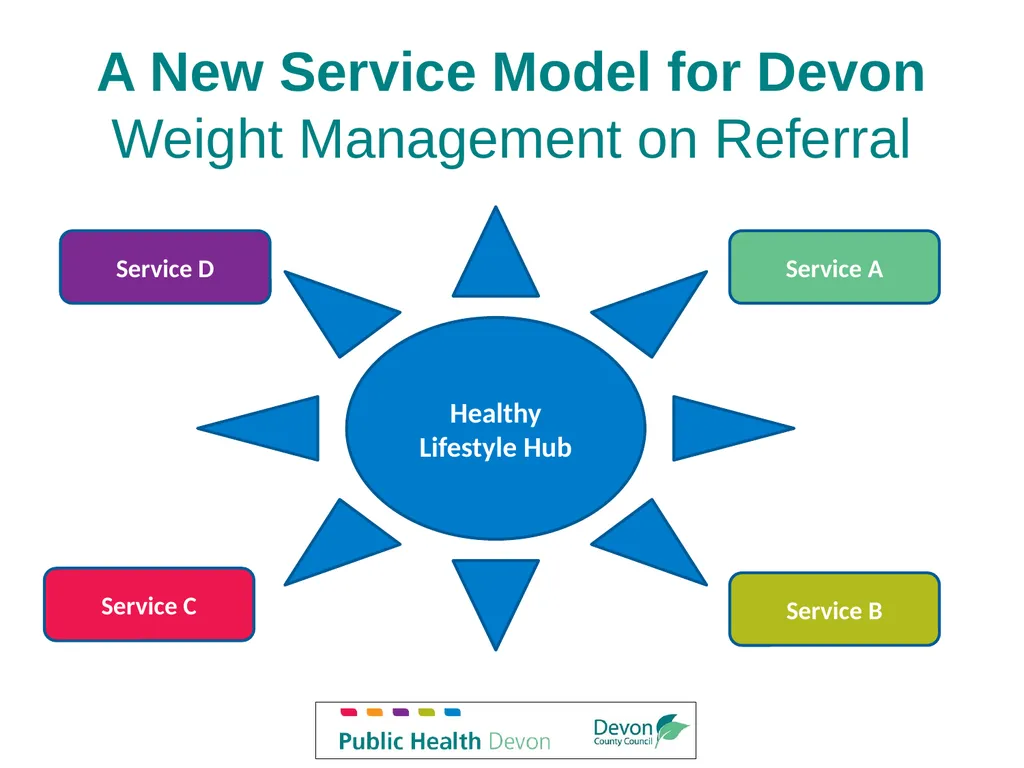
A New Service Model for Devon Weight Management on Referral Healthy Lifestyle Hub Service A Service D Service B Service C<br>
11
Weight Management Services 3 month, individually tailored package of support
Free introductory session to ensure that client is satisfied with their choice
Meet NICE (2006) guidance
Offer practical, safe advice about physical activity and healthy eating
Use evidence-based behavioural change techniques
Provide on-going motivational support and follow up
Aim for target weight loss of 5-10% body weight
Aim for realistic pace 0.5-1.0 kg per week.
Minimum 9 sessions in 12 weeks<br>
12
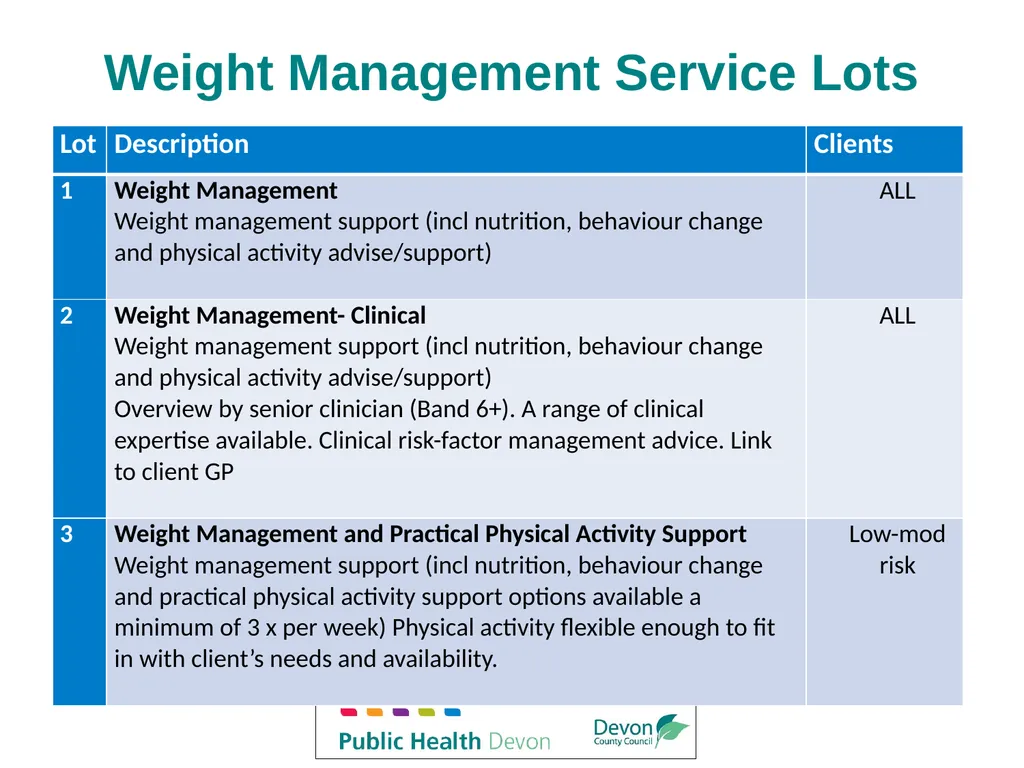
Weight Management Service Lots<br>
13
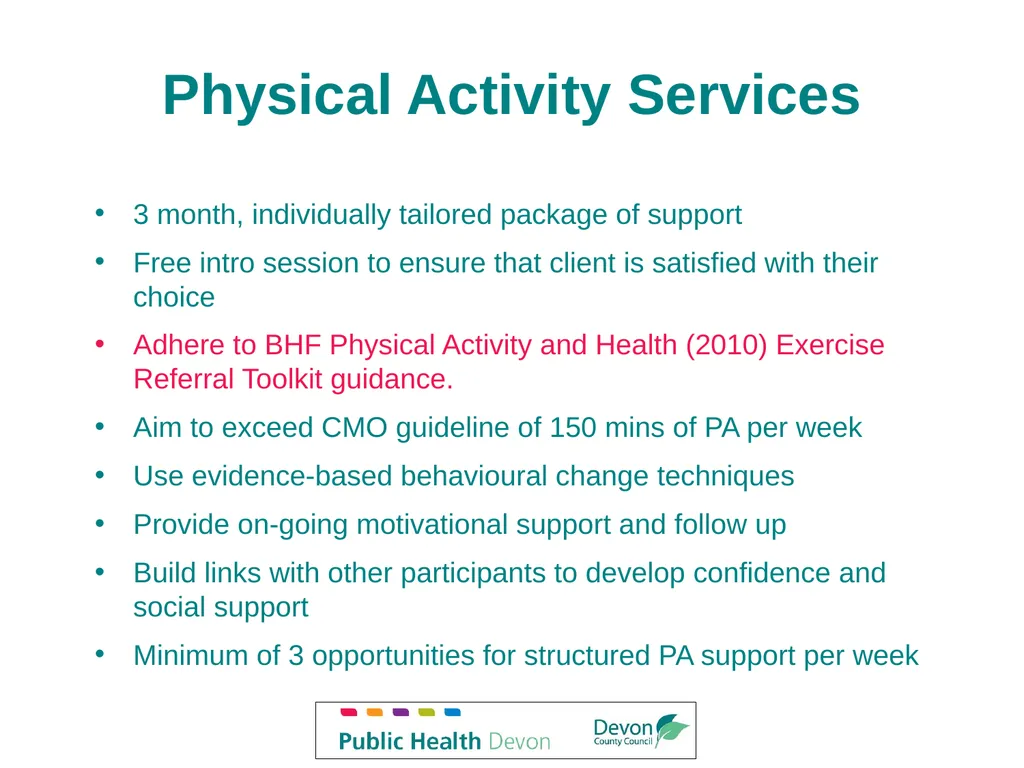
Physical Activity Services 3 month, individually tailored package of support
Free intro session to ensure that client is satisfied with their choice
Adhere to BHF Physical Activity and Health (2010) Exercise Referral Toolkit guidance.
Aim to exceed CMO guideline of 150 mins of PA per week
Use evidence-based behavioural change techniques
Provide on-going motivational support and follow up
Build links with other participants to develop confidence and social support
Minimum of 3 opportunities for structured PA support per week<br>
14
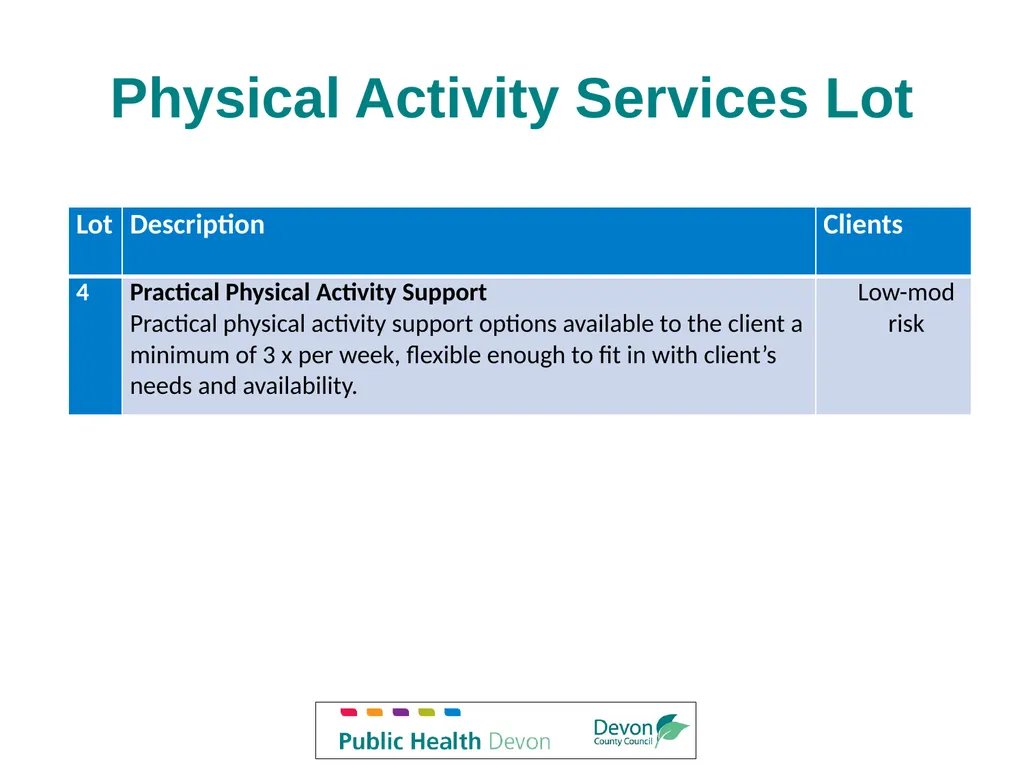
Physical Activity Services Lot<br>
15
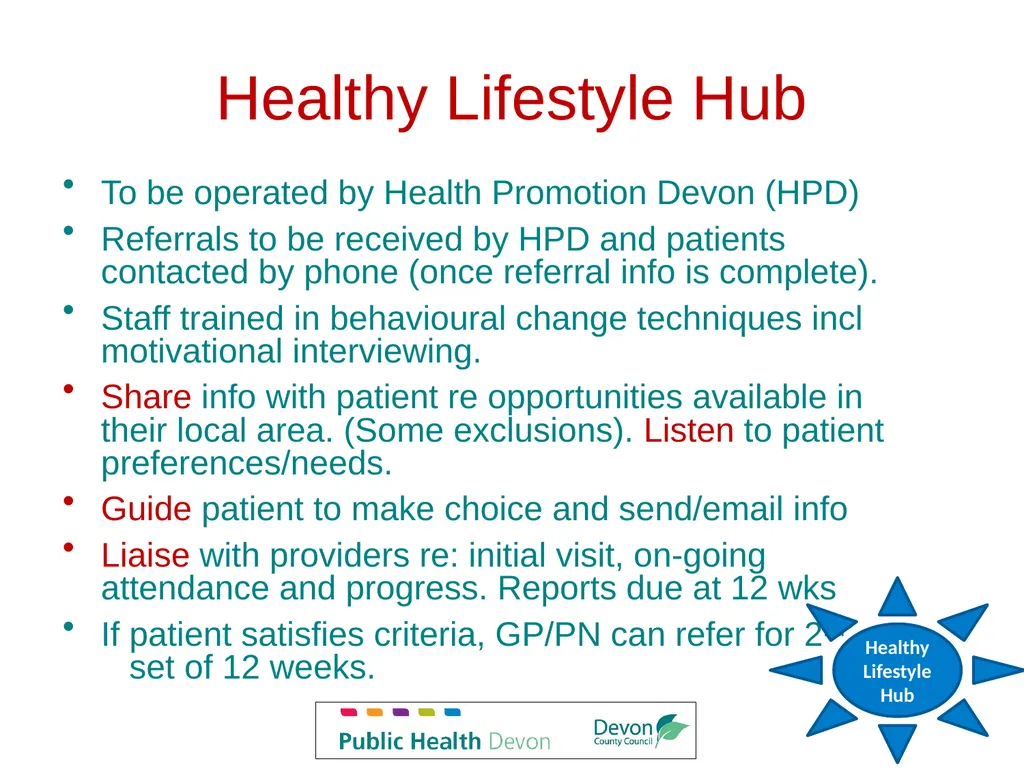
Healthy Lifestyle Hub To be operated by Health Promotion Devon (HPD)
Referrals to be received by HPD and patients contacted by phone (once referral info is complete).
Staff trained in behavioural change techniques incl motivational interviewing.
Share info with patient re opportunities available in their local area. (Some exclusions). Listen to patient preferences/needs.
Guide patient to make choice and send/email info
Liaise with providers re: initial visit, on-going attendance and progress. Reports due at 12 wks
If patient satisfies criteria, GP/PN can refer for 2nd set of 12 weeks. Healthy Lifestyle Hub<br>
16
Where Are We Now and What Next? Almost through procurement process - clarifications
Expect differences in the “offer” across Devon
Working closely with Hub to smooth transition, finalise communication pathways, ensure support for tier 1 ready.
Planned start: Jan 2014
Still some areas to resolve- eg. referrals outside primary care
Need to communicate to all potential referring clinicians- Use range of channels/media (suggestions gratefully received)
Your help in this will be key- to spread the word! ALSO to Ensure patient is “ready”
Need to try to help clinicians to manage patient expectations-tiers 1, 2 and 3
Enlist support of DART re- tier 3 “re-directions”<br>
17
Next Steps Manage scheme, keep communicating with referrers, providers, hub and patients- learn what works and adjust.
Commission independent evaluation- some merit in letting scheme bed down first.
Researching maintenance programme utilising volunteers/champions.
Scoping maternity. Market warming around children and young peoples services.<br>