
Session 1 Objectives – Workshop Welcome By the end
LD
Published · 48 slides · 0 views
1 / 1
Description
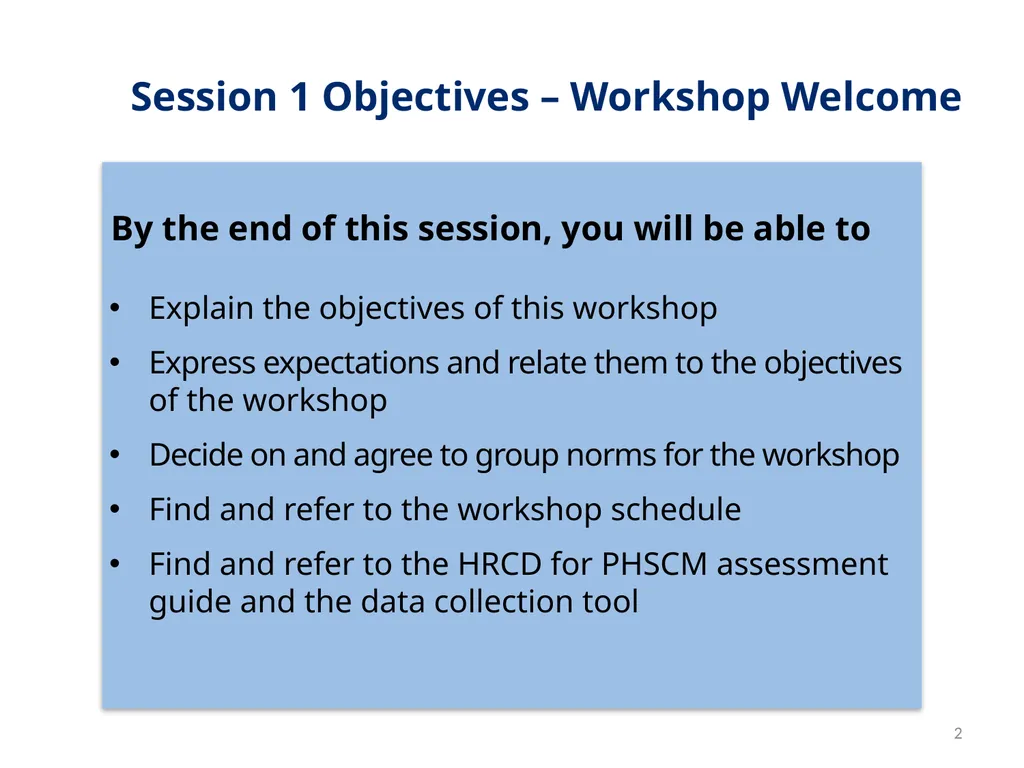
Session 1 Objectives Workshop Welcome By the end of this session, you will be able to Explain the objectives of this workshop Express expectations and relate them to the objectives of the workshop Decide on and agree to group norms for
Related Topics
Share
Embed code
Download this presentation From Below
"Session 1 Objectives – Workshop Welcome By the end" is the property of its rightful owner. Permission is granted to download and print the materials on this website for personal, non-commercial use only, and to display it on your personal computer provided you do not modify the materials and that you retain all copyright notices contained in the materials. By downloading content from our website, you accept the terms of this agreement.
Presentation Transcript
01
Session 1 Objectives – Workshop Welcome By the end of this session, you will be able to
Explain the objectives of this workshop
Express expectations and relate them to the objectives of the workshop
Decide on and agree to group norms for the workshop
Find and refer to the workshop schedule
Find and refer to the HRCD for PHSCM assessment guide and the data collection tool 2<br>
Explain the objectives of this workshop
Express expectations and relate them to the objectives of the workshop
Decide on and agree to group norms for the workshop
Find and refer to the workshop schedule
Find and refer to the HRCD for PHSCM assessment guide and the data collection tool 2<br>
02
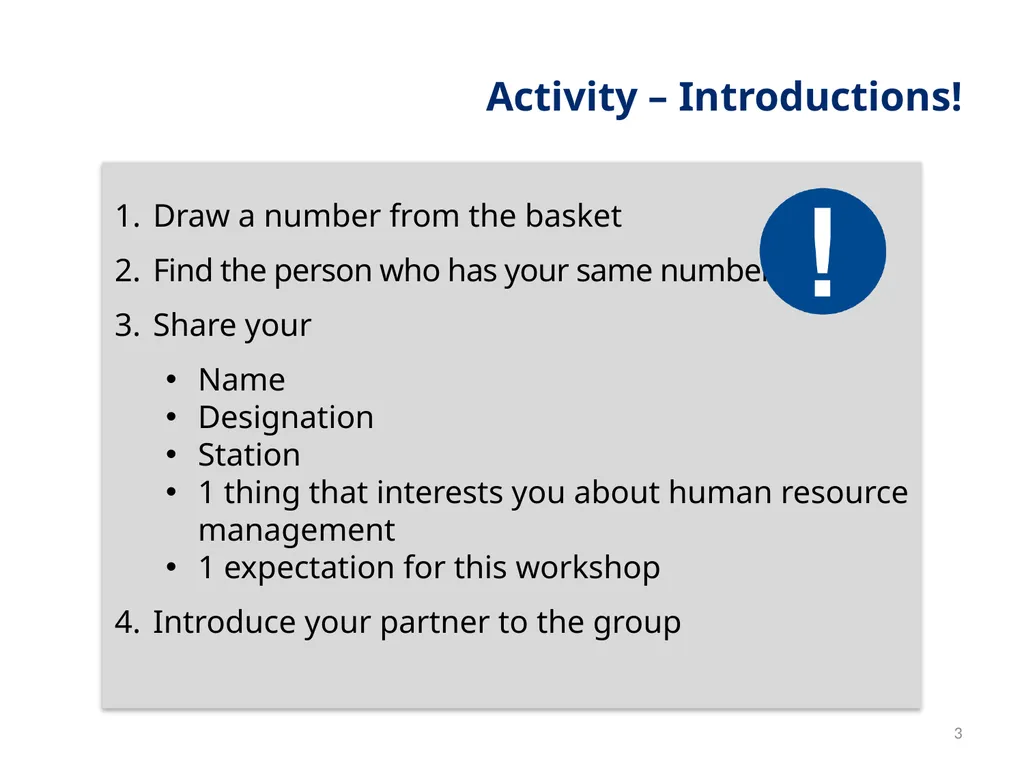
Activity – Introductions! Draw a number from the basket
Find the person who has your same number
Share your
Name
Designation
Station
1 thing that interests you about human resource management
1 expectation for this workshop
Introduce your partner to the group 3<br>
Find the person who has your same number
Share your
Name
Designation
Station
1 thing that interests you about human resource management
1 expectation for this workshop
Introduce your partner to the group 3<br>
03
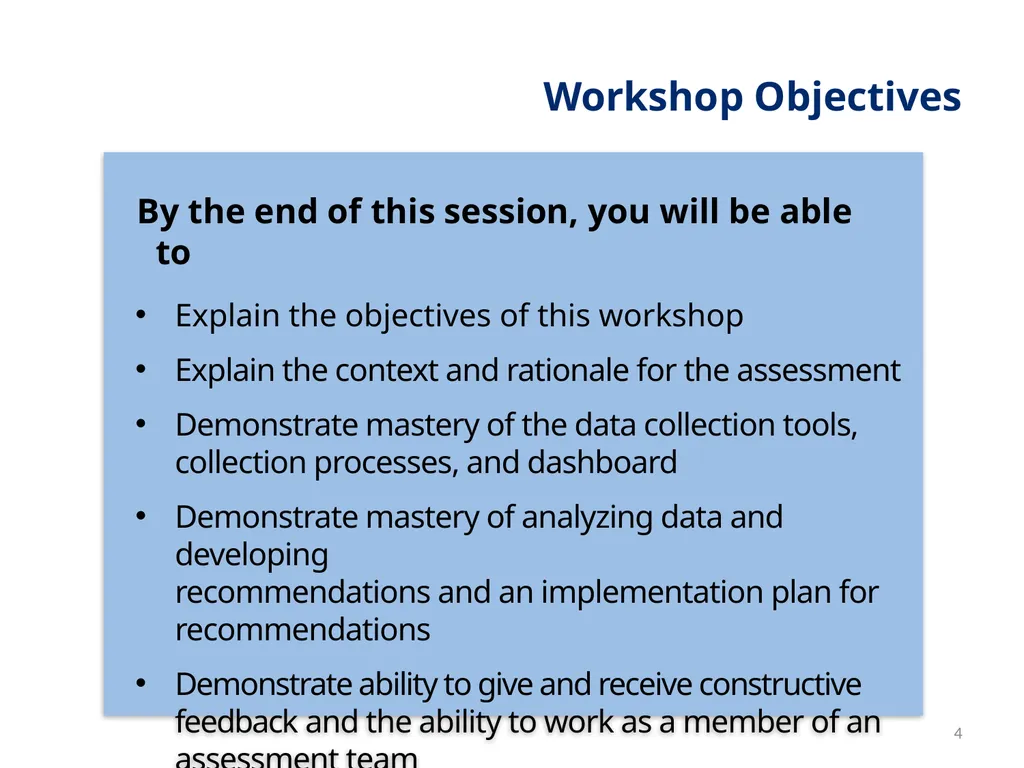
Workshop Objectives By the end of this session, you will be able to
Explain the objectives of this workshop
Explain the context and rationale for the assessment
Demonstrate mastery of the data collection tools, collection processes, and dashboard
Demonstrate mastery of analyzing data and developing recommendations and an implementation plan for recommendations
Demonstrate ability to give and receive constructive feedback and the ability to work as a member of an assessment team 4<br>
Explain the objectives of this workshop
Explain the context and rationale for the assessment
Demonstrate mastery of the data collection tools, collection processes, and dashboard
Demonstrate mastery of analyzing data and developing recommendations and an implementation plan for recommendations
Demonstrate ability to give and receive constructive feedback and the ability to work as a member of an assessment team 4<br>
04
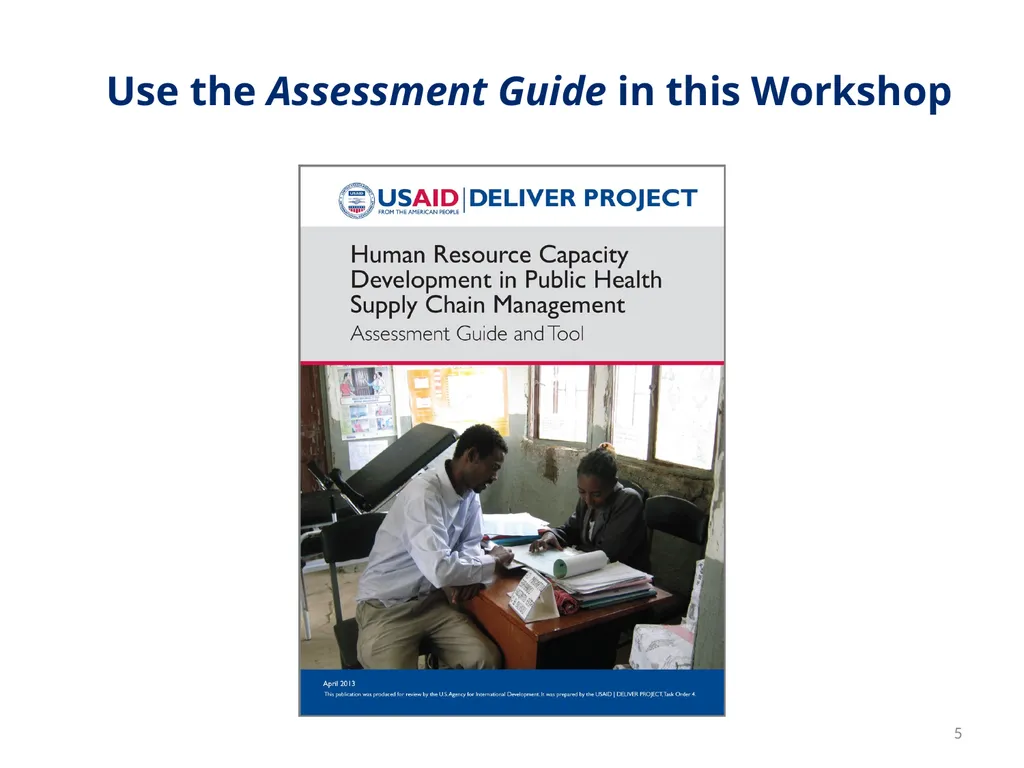
Use the Assessment Guide in this Workshop 5<br>
05
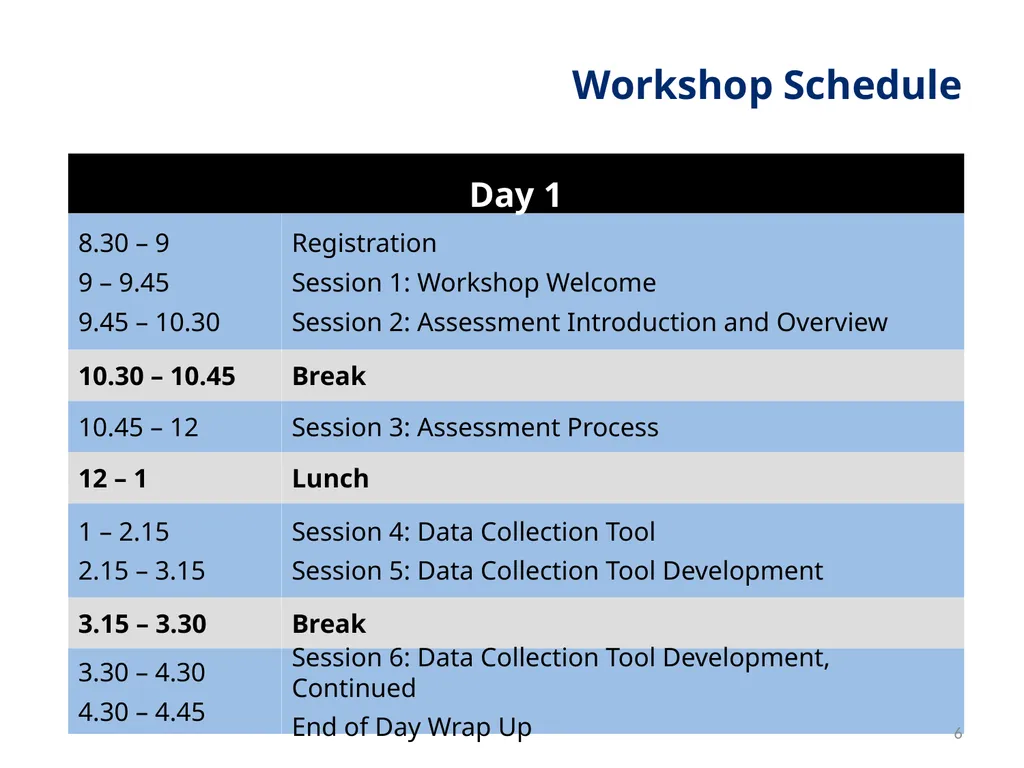
Workshop Schedule 8.30 – 9
9 – 9.45
9.45 – 10.30 Registration
Session 1: Workshop Welcome
Session 2: Assessment Introduction and Overview 10.30 – 10.45 Break 10.45 – 12 Session 3: Assessment Process 12 – 1 Lunch 1 – 2.15
2.15 – 3.15 Session 4: Data Collection Tool
Session 5: Data Collection Tool Development 3.15 – 3.30 Break 3.30 – 4.30
4.30 – 4.45 Session 6: Data Collection Tool Development, Continued
End of Day Wrap Up Day 1 6<br>
9 – 9.45
9.45 – 10.30 Registration
Session 1: Workshop Welcome
Session 2: Assessment Introduction and Overview 10.30 – 10.45 Break 10.45 – 12 Session 3: Assessment Process 12 – 1 Lunch 1 – 2.15
2.15 – 3.15 Session 4: Data Collection Tool
Session 5: Data Collection Tool Development 3.15 – 3.30 Break 3.30 – 4.30
4.30 – 4.45 Session 6: Data Collection Tool Development, Continued
End of Day Wrap Up Day 1 6<br>
06
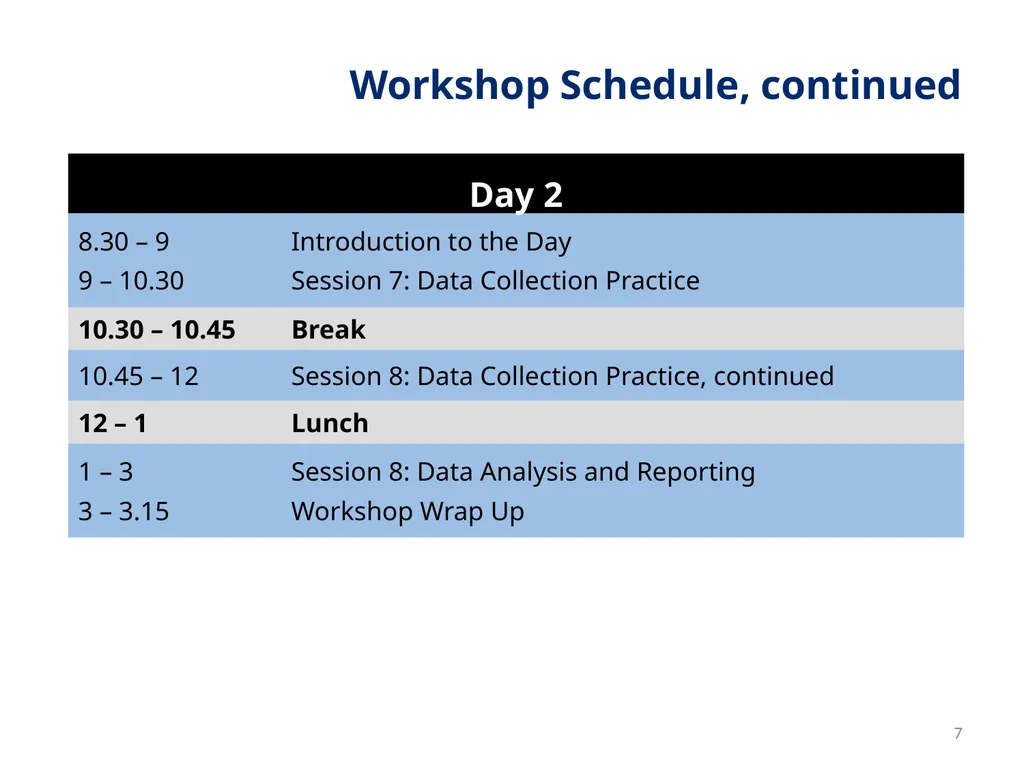
Workshop Schedule, continued 8.30 – 9
9 – 10.30 Introduction to the Day
Session 7: Data Collection Practice 10.30 – 10.45 Break 10.45 – 12 Session 8: Data Collection Practice, continued 12 – 1 Lunch 1 – 3
3 – 3.15 Session 8: Data Analysis and Reporting
Workshop Wrap Up Day 2 7<br>
9 – 10.30 Introduction to the Day
Session 7: Data Collection Practice 10.30 – 10.45 Break 10.45 – 12 Session 8: Data Collection Practice, continued 12 – 1 Lunch 1 – 3
3 – 3.15 Session 8: Data Analysis and Reporting
Workshop Wrap Up Day 2 7<br>
07
By the end of this session, you will be able to
Understand and explain the relationship between human resources and supply chain management
Name the five building blocks of human resource capacity and how they relate to building a productive workforce for supply chain management
Understand the purpose of the assessment guide and tool Session 2 Objectives – Assessment Overview 8<br>
Understand and explain the relationship between human resources and supply chain management
Name the five building blocks of human resource capacity and how they relate to building a productive workforce for supply chain management
Understand the purpose of the assessment guide and tool Session 2 Objectives – Assessment Overview 8<br>
08
Six Rights of Supply Chain
Human Resources 9 An effective supply chain involves
engaging the right people…
in the right quantities…
with the right skills…
in the right place…
paid the right salary…
at the right time
…to implement the procedures that direct supply chain operations and ensure the supply of
health commodities<br>
engaging the right people…
in the right quantities…
with the right skills…
in the right place…
paid the right salary…
at the right time
…to implement the procedures that direct supply chain operations and ensure the supply of
health commodities<br>
09
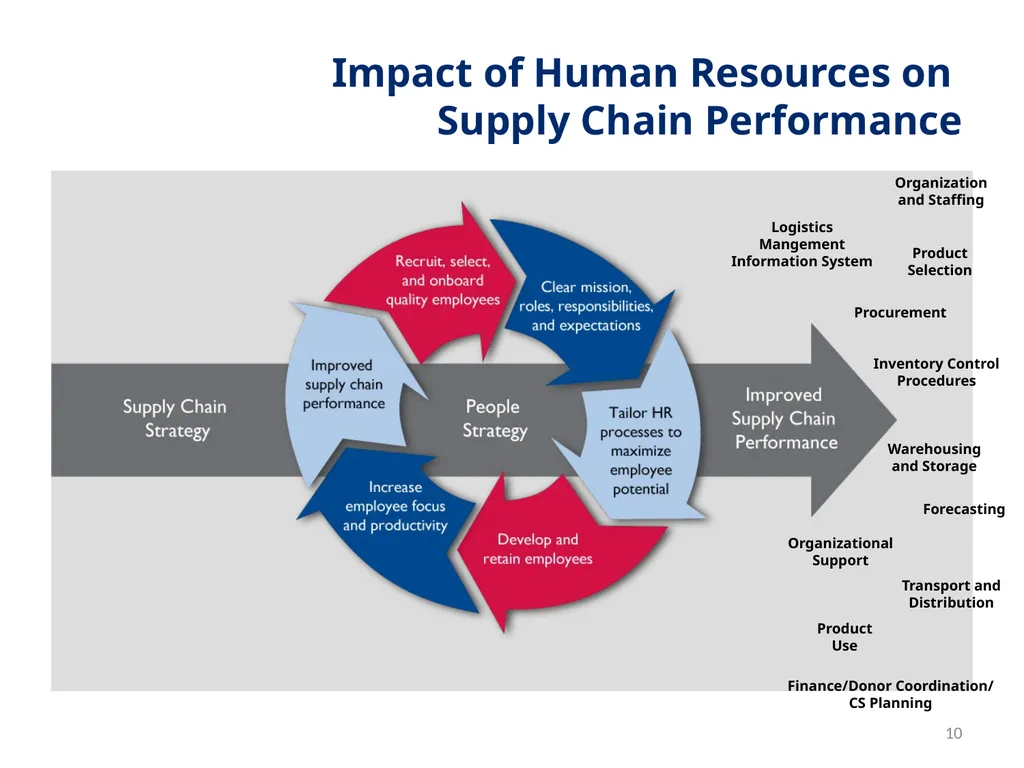
Impact of Human Resources on
Supply Chain Performance Logistics Mangement Information System Product Selection Procurement Inventory Control Procedures Warehousing and Storage Transport and Distribution Organizational Support Product Use Organization and Staffing Forecasting Finance/Donor Coordination/
CS Planning 10<br>
CS Planning 10<br>
10
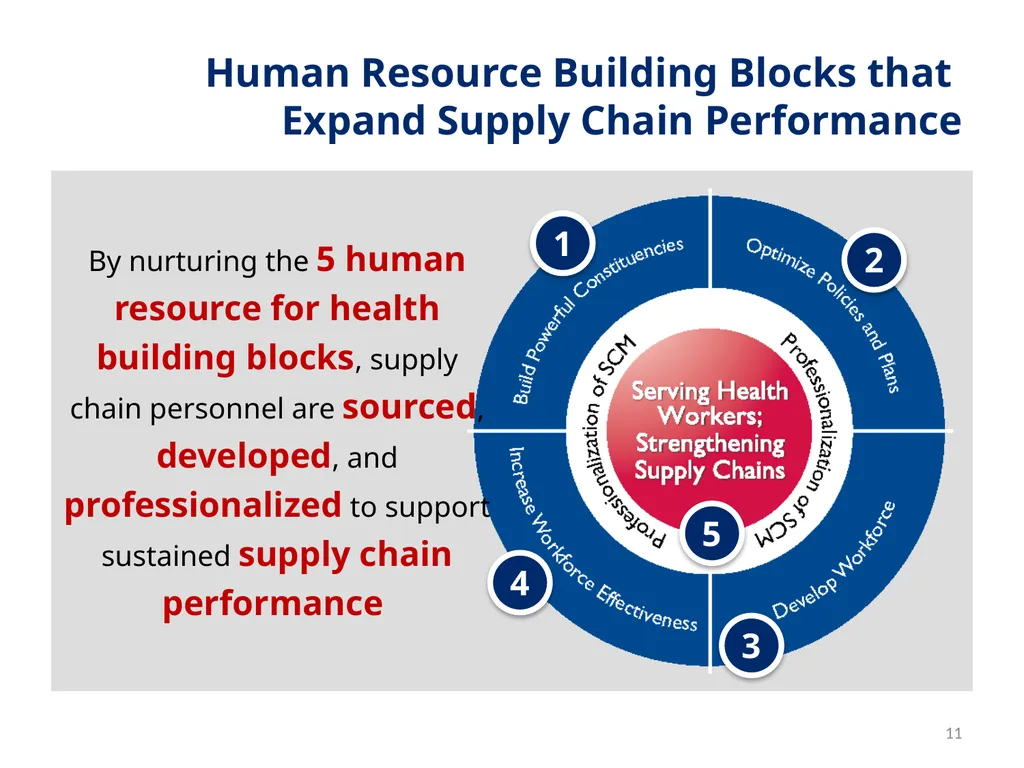
Human Resource Building Blocks that
Expand Supply Chain Performance By nurturing the 5 human resource for health building blocks, supply chain personnel are sourced, developed, and professionalized to support sustained supply chain performance 1 2 3 4 5 11<br>
11
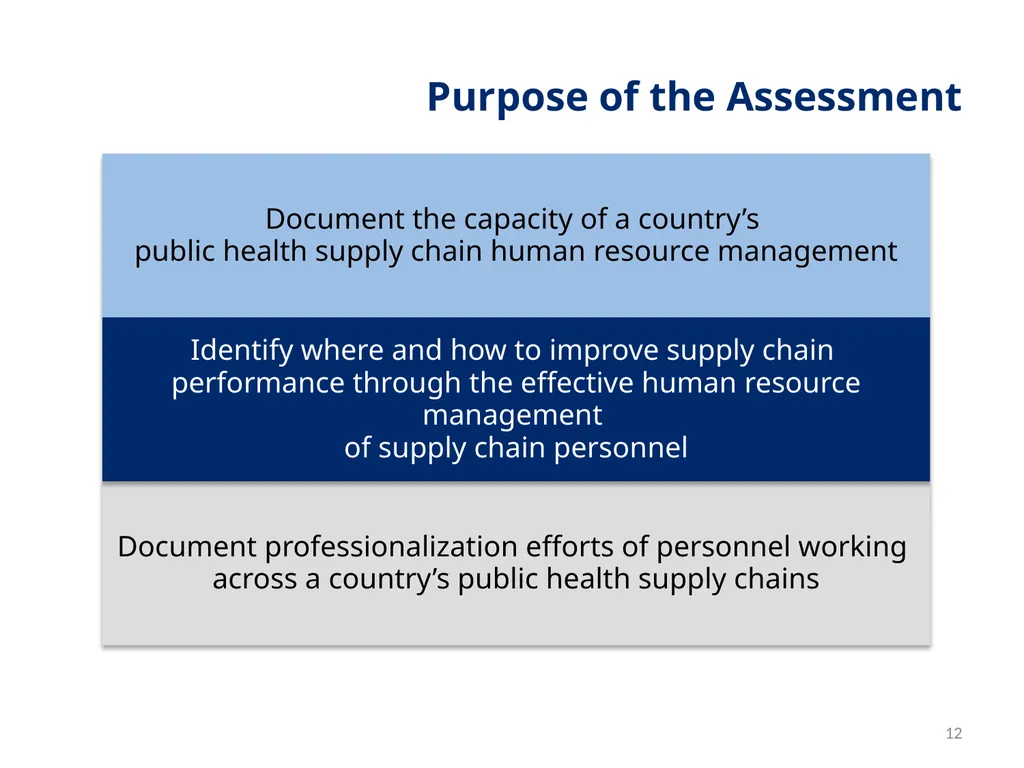
Purpose of the Assessment Document the capacity of a country’s
public health supply chain human resource management Document professionalization efforts of personnel working
across a country’s public health supply chains Identify where and how to improve supply chain
performance through the effective human resource management
of supply chain personnel 12<br>
public health supply chain human resource management Document professionalization efforts of personnel working
across a country’s public health supply chains Identify where and how to improve supply chain
performance through the effective human resource management
of supply chain personnel 12<br>
12
Session 3 Objectives – Assessment Process By the end of this session, you will be able to
Describe the process and timelines for the assessment 13<br>
Describe the process and timelines for the assessment 13<br>
13
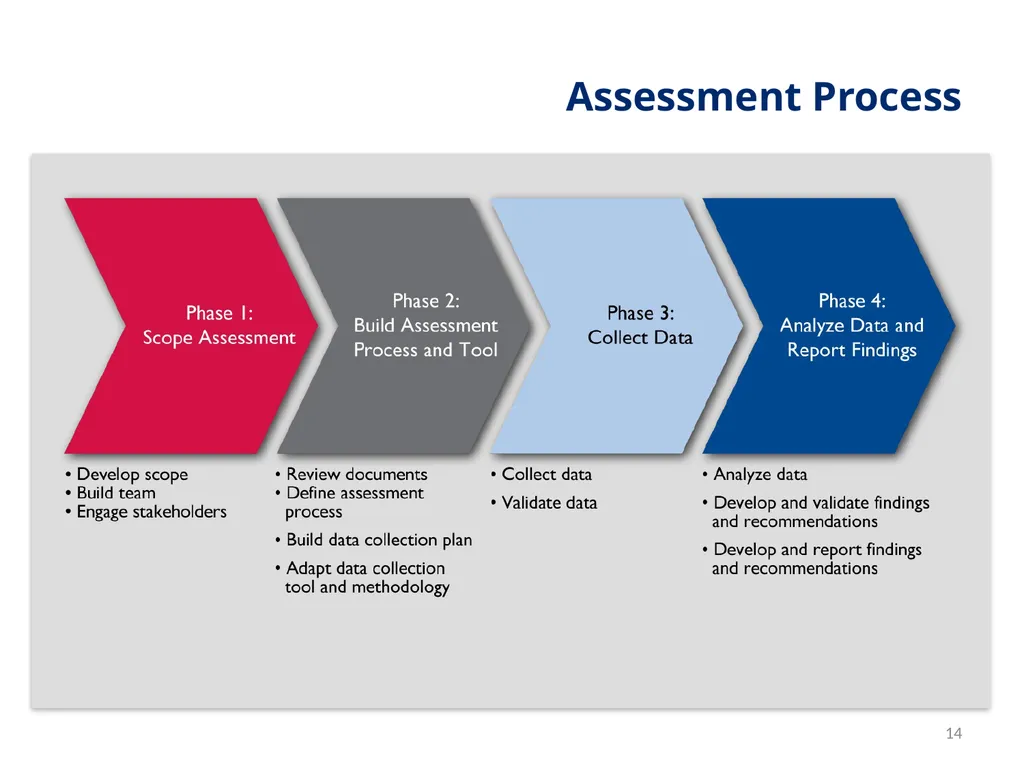
Assessment Process 14<br>
14
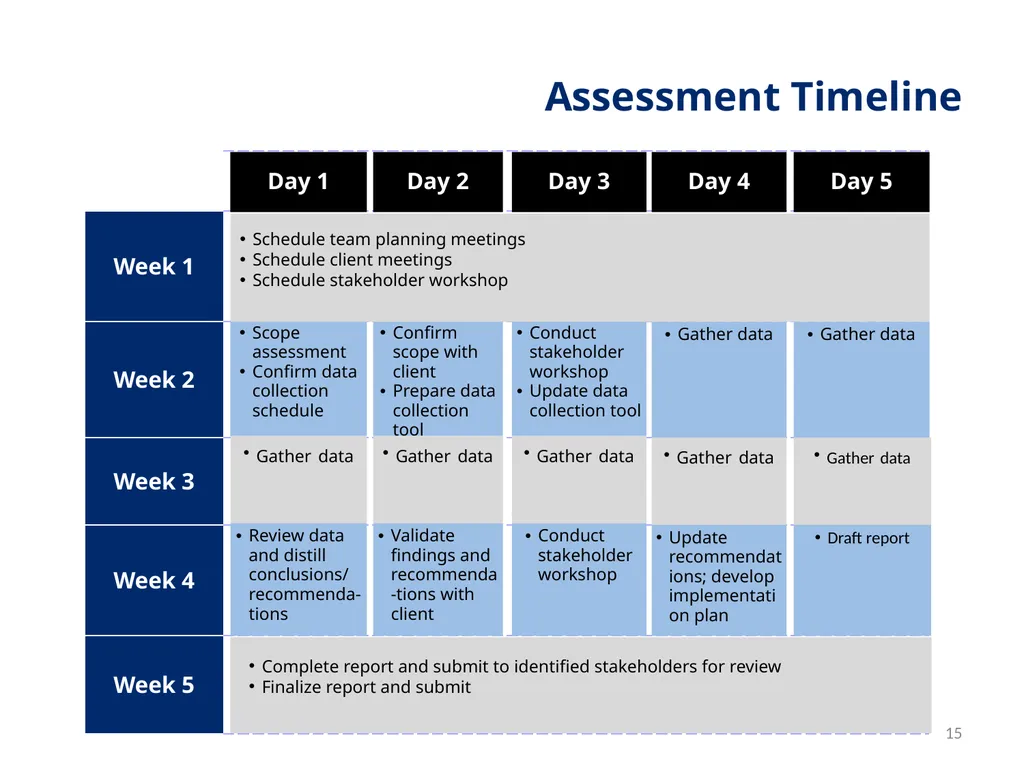
Assessment Timeline Scope assessment
Confirm data collection schedule Gather data Conduct stakeholder workshop
Update data collection tool Confirm scope with client
Prepare data collection tool Gather data Day 1 Day 4 Day 3 Day 2 Day 5 Gather data Gather data Gather data Gather data Gather data Review data and distill conclusions/ recommenda-tions Update recommendations; develop implementation plan Conduct stakeholder workshop Validate findings and recommenda-tions with client Draft report Schedule team planning meetings
Schedule client meetings
Schedule stakeholder workshop Complete report and submit to identified stakeholders for review
Finalize report and submit 15<br>
Confirm data collection schedule Gather data Conduct stakeholder workshop
Update data collection tool Confirm scope with client
Prepare data collection tool Gather data Day 1 Day 4 Day 3 Day 2 Day 5 Gather data Gather data Gather data Gather data Gather data Review data and distill conclusions/ recommenda-tions Update recommendations; develop implementation plan Conduct stakeholder workshop Validate findings and recommenda-tions with client Draft report Schedule team planning meetings
Schedule client meetings
Schedule stakeholder workshop Complete report and submit to identified stakeholders for review
Finalize report and submit 15<br>
15
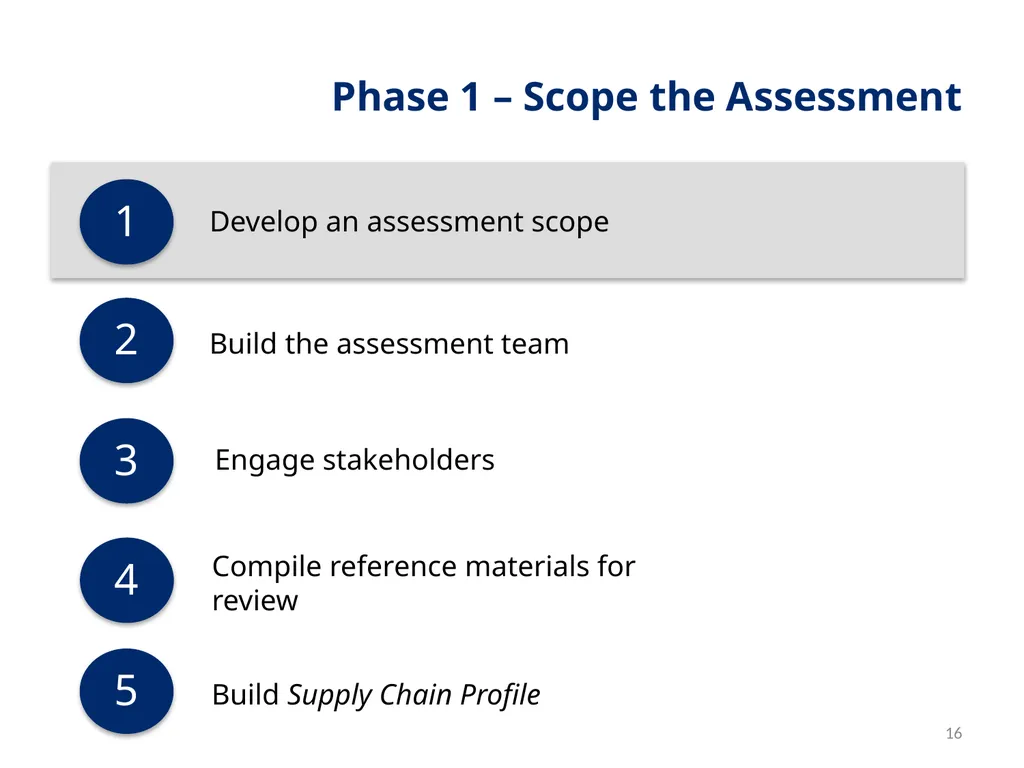
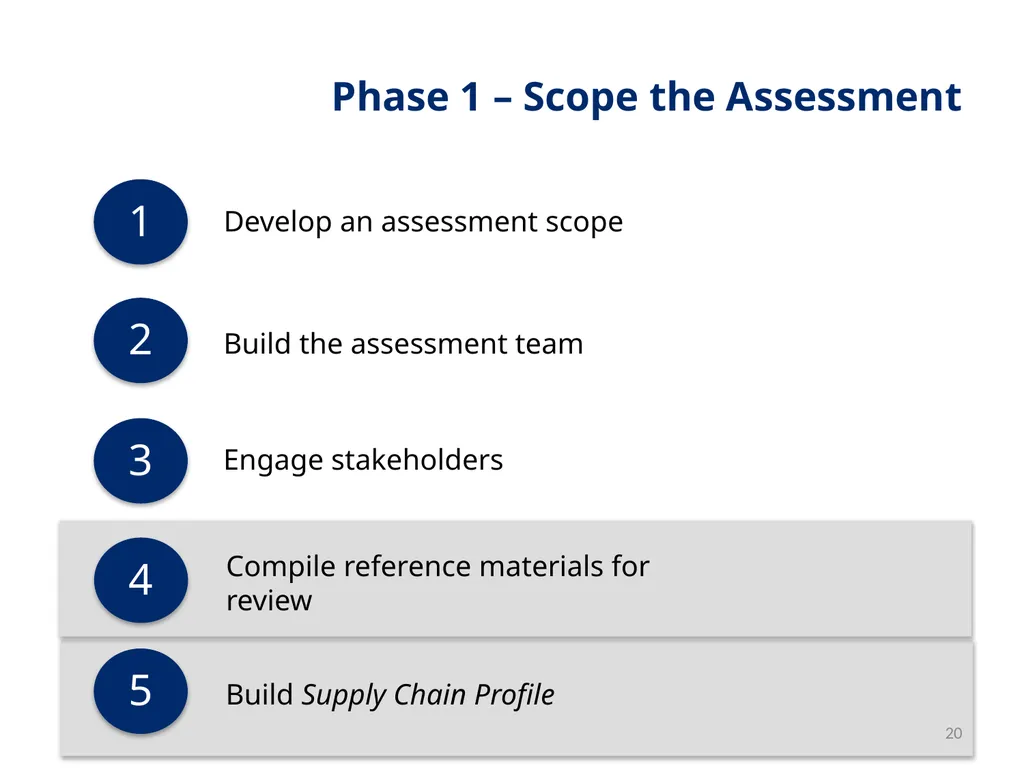
Phase 1 – Scope the Assessment Develop an assessment scope 2 3 1 Build the assessment team Engage stakeholders 4 Compile reference materials for review 5 Build Supply Chain Profile 16<br>
16
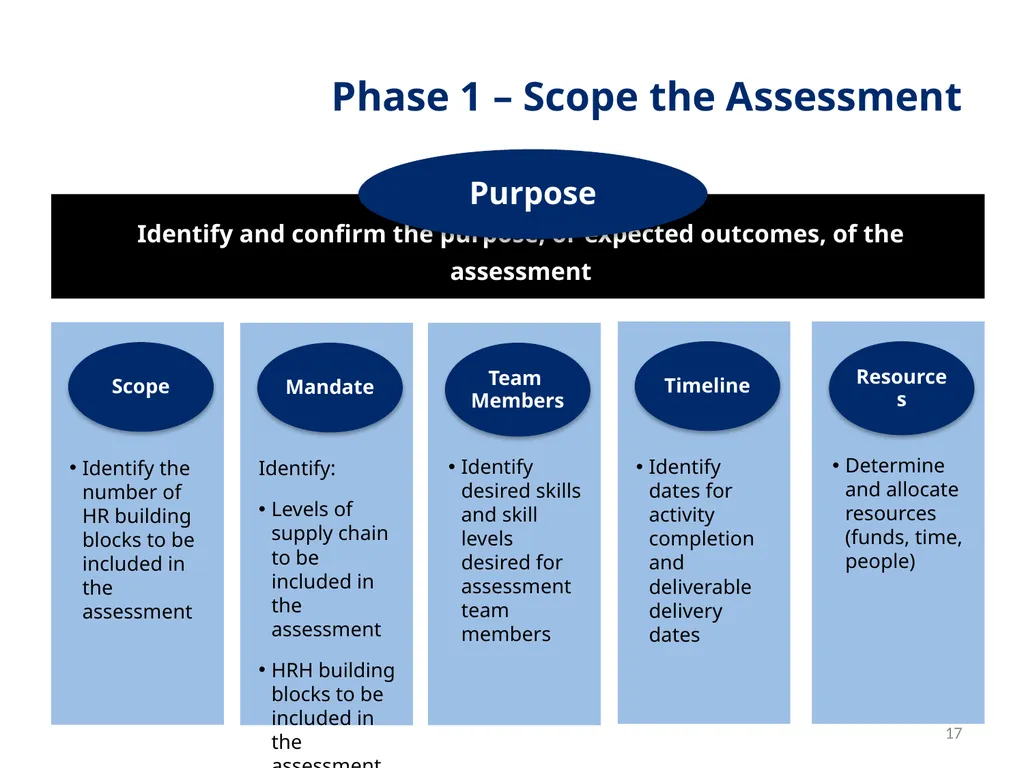
Phase 1 – Scope the Assessment Identify and confirm the purpose, or expected outcomes, of the assessment Identify desired skills and skill levels desired for assessment team members Identify:
Levels of supply chain to be included in the assessment
HRH building blocks to be included in the assessment Purpose Team
Members Mandate Determine and allocate resources (funds, time, people) Identify dates for activity completion and deliverable delivery dates Resources Timeline Identify the number of HR building blocks to be included in the assessment Scope 17<br>
Levels of supply chain to be included in the assessment
HRH building blocks to be included in the assessment Purpose Team
Members Mandate Determine and allocate resources (funds, time, people) Identify dates for activity completion and deliverable delivery dates Resources Timeline Identify the number of HR building blocks to be included in the assessment Scope 17<br>
17
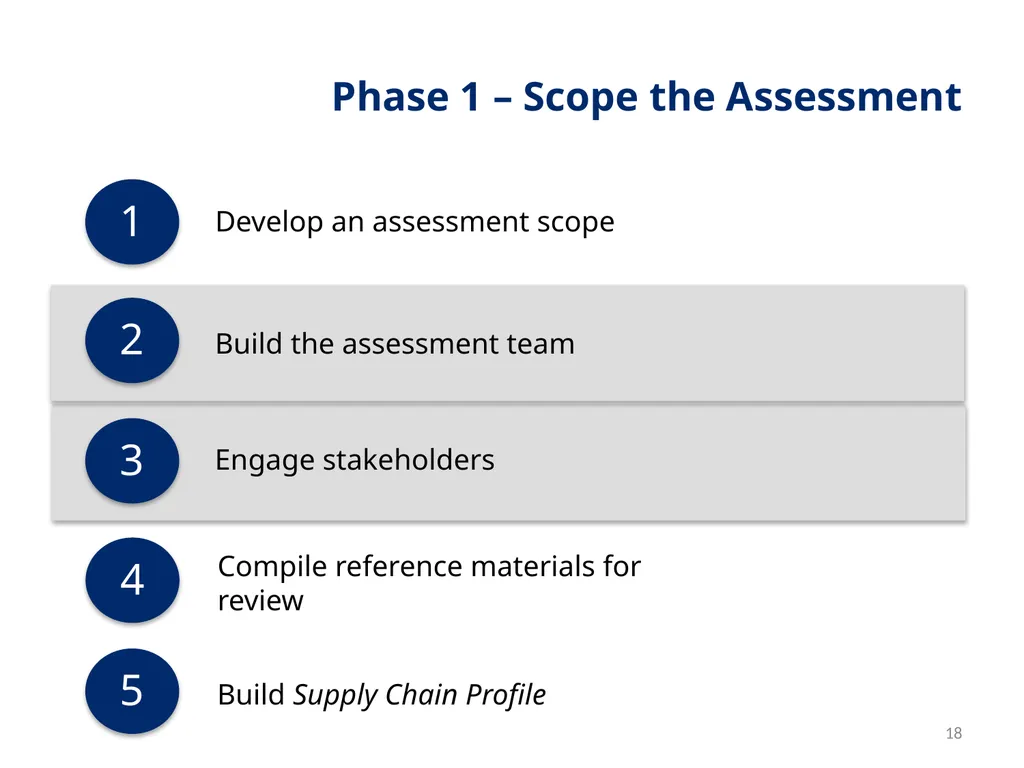
Phase 1 – Scope the Assessment Develop an assessment scope 2 3 1 Build the assessment team Engage stakeholders 4 Compile reference materials for review 5 Build Supply Chain Profile 18<br>
18
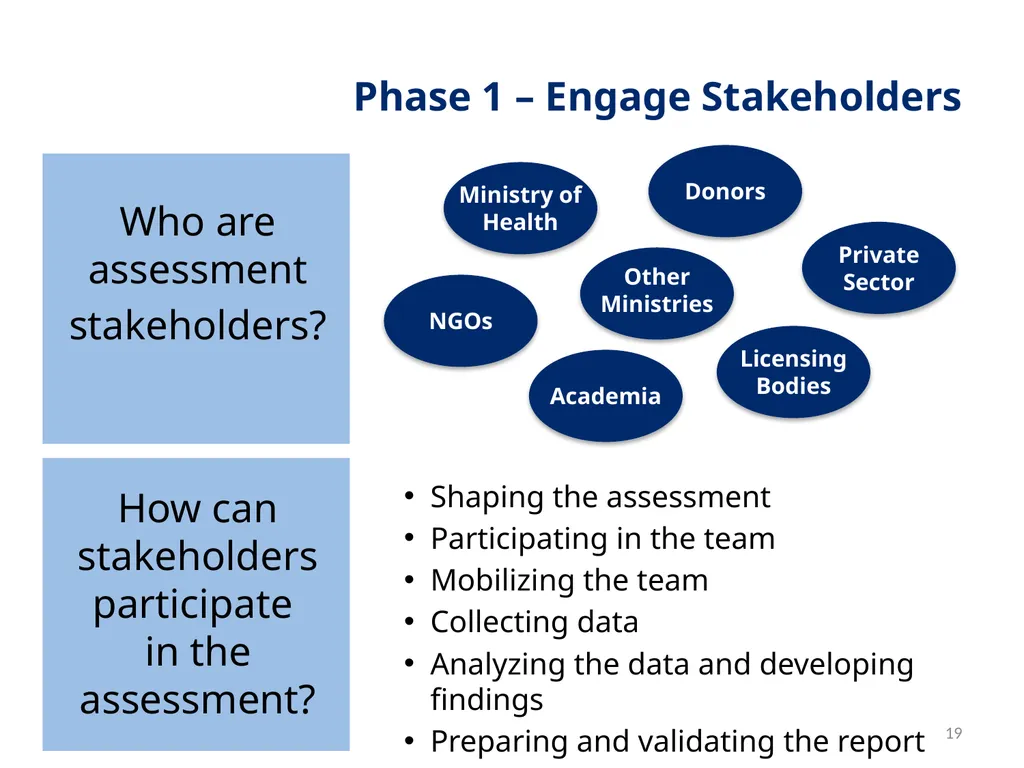
Phase 1 – Engage Stakeholders Shaping the assessment
Participating in the team
Mobilizing the team
Collecting data
Analyzing the data and developing findings
Preparing and validating the report Who are assessment
stakeholders? How can stakeholders participate in the assessment? 19<br>
Participating in the team
Mobilizing the team
Collecting data
Analyzing the data and developing findings
Preparing and validating the report Who are assessment
stakeholders? How can stakeholders participate in the assessment? 19<br>
19
Phase 1 – Scope the Assessment Develop an assessment scope 2 3 1 Build the assessment team Engage stakeholders 4 Compile reference materials for review 5 Build Supply Chain Profile 20<br>
20
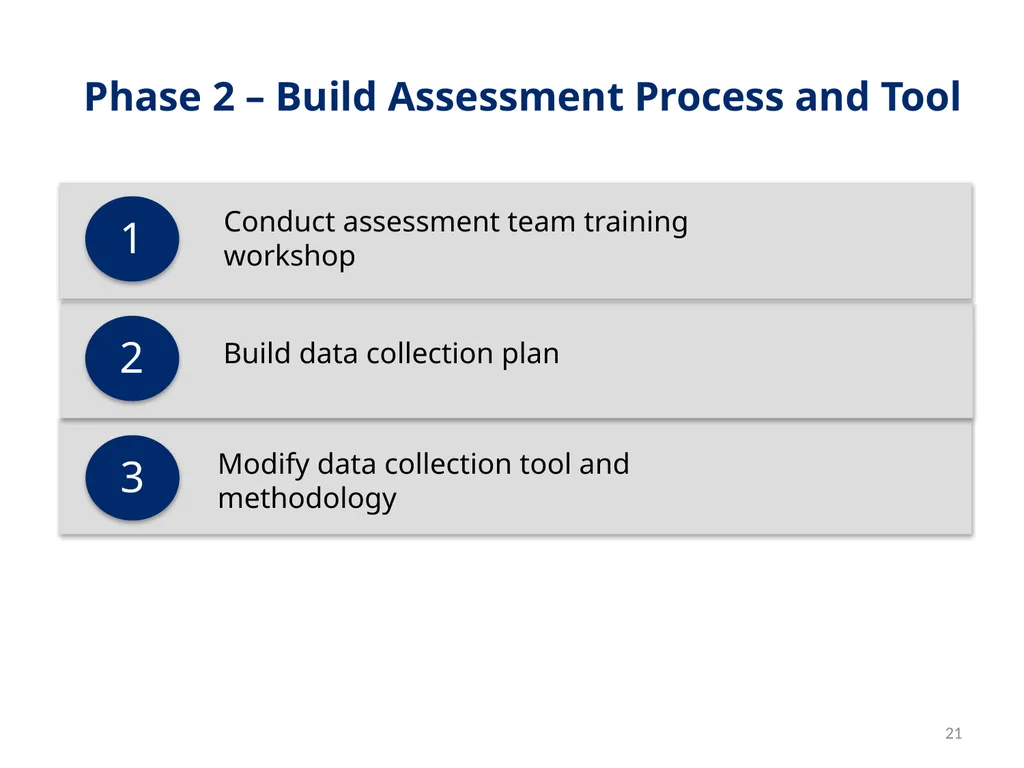
Phase 2 – Build Assessment Process and Tool Conduct assessment team training workshop 2 1 Build data collection plan 3 Modify data collection tool and methodology 21<br>
21
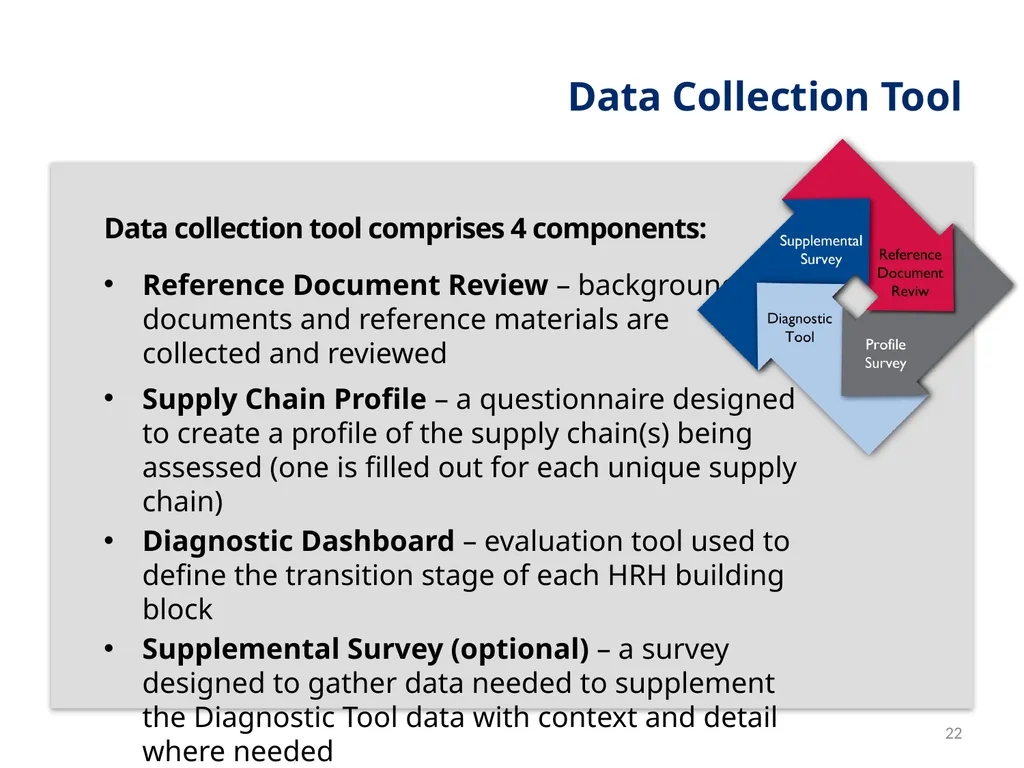
Data Collection Tool Data collection tool comprises 4 components:
Reference Document Review – background documents and reference materials are collected and reviewed Supply Chain Profile – a questionnaire designed to create a profile of the supply chain(s) being assessed (one is filled out for each unique supply chain)
Diagnostic Dashboard – evaluation tool used to define the transition stage of each HRH building block
Supplemental Survey (optional) – a survey designed to gather data needed to supplement the Diagnostic Tool data with context and detail where needed 22<br>
Reference Document Review – background documents and reference materials are collected and reviewed Supply Chain Profile – a questionnaire designed to create a profile of the supply chain(s) being assessed (one is filled out for each unique supply chain)
Diagnostic Dashboard – evaluation tool used to define the transition stage of each HRH building block
Supplemental Survey (optional) – a survey designed to gather data needed to supplement the Diagnostic Tool data with context and detail where needed 22<br>
22
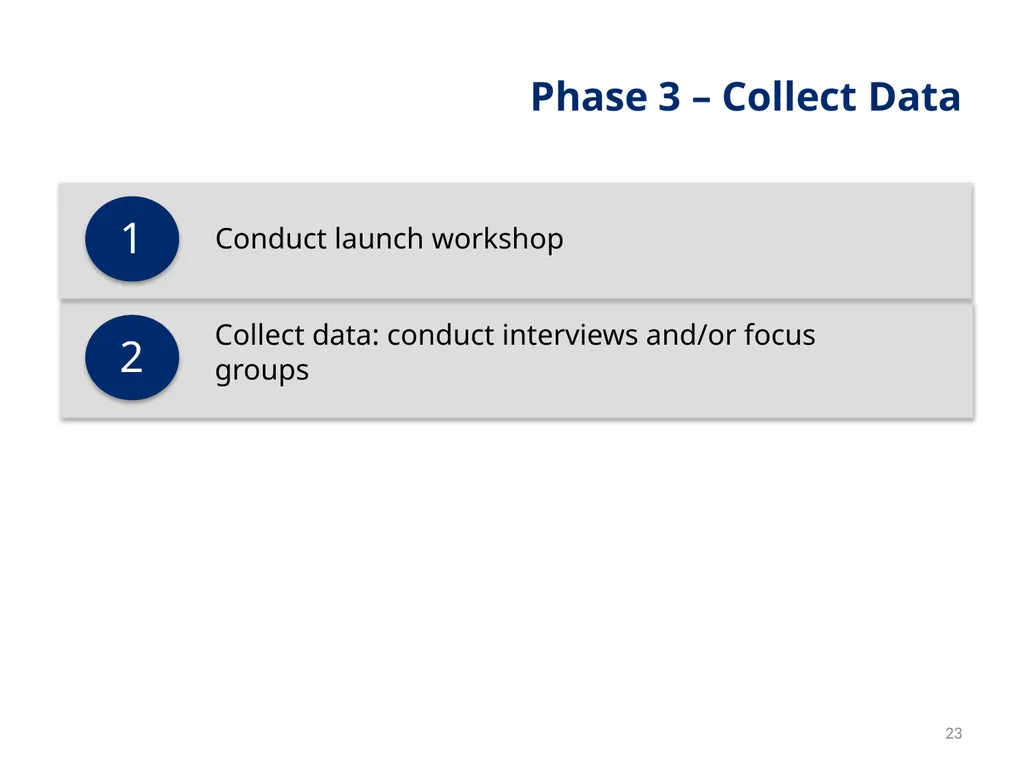
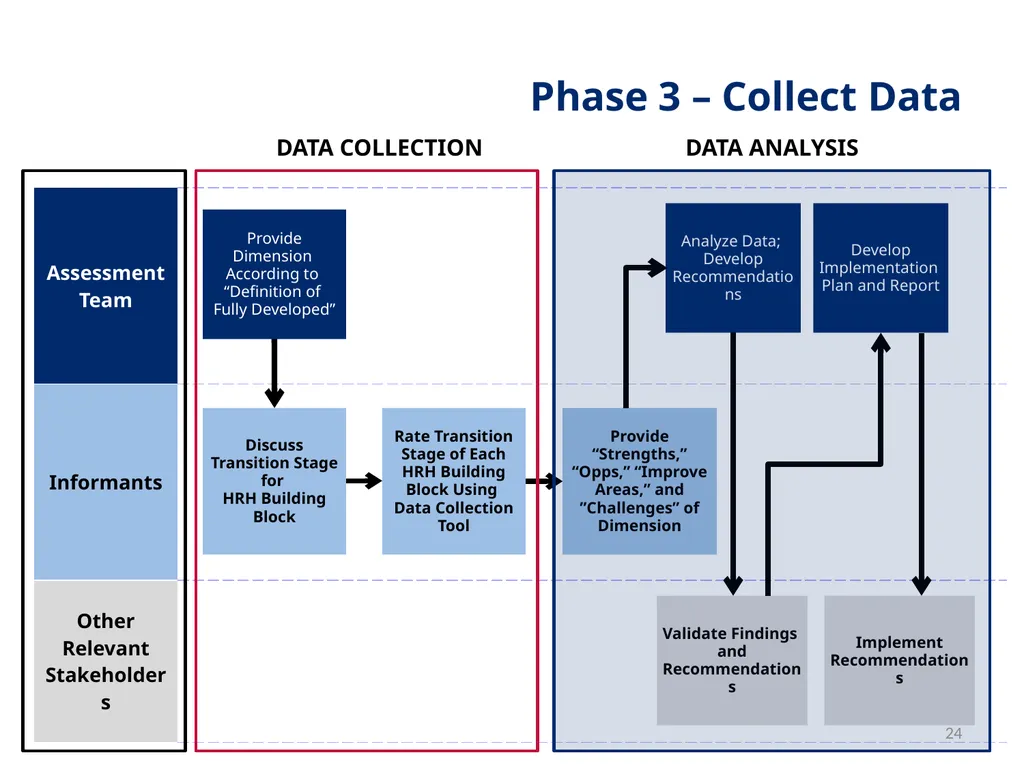
Phase 3 – Collect Data Conduct launch workshop Collect data: conduct interviews and/or focus groups 23<br>
23
Phase 3 – Collect Data Data Collection Data Analysis Provide Dimension According to “Definition of
Fully Developed” Discuss Transition Stage for
HRH Building Block Validate Findings
and Recommendations Analyze Data;
Develop Recommendations Provide “Strengths,” “Opps,” “Improve Areas,” and ”Challenges” of Dimension Rate Transition Stage of Each HRH Building Block Using
Data Collection Tool Develop Implementation
Plan and Report Implement Recommendations 24<br>
24
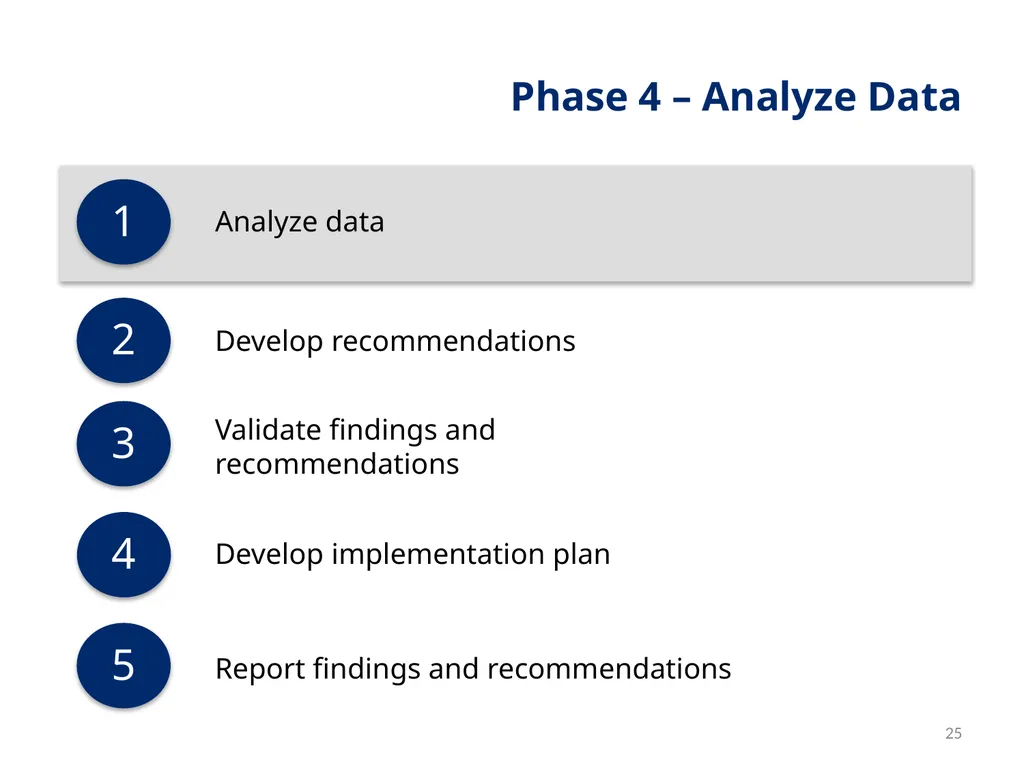
Phase 4 – Analyze Data Analyze data 2 1 Develop recommendations 3 Validate findings and recommendations 4 Develop implementation plan 5 Report findings and recommendations 25<br>
25
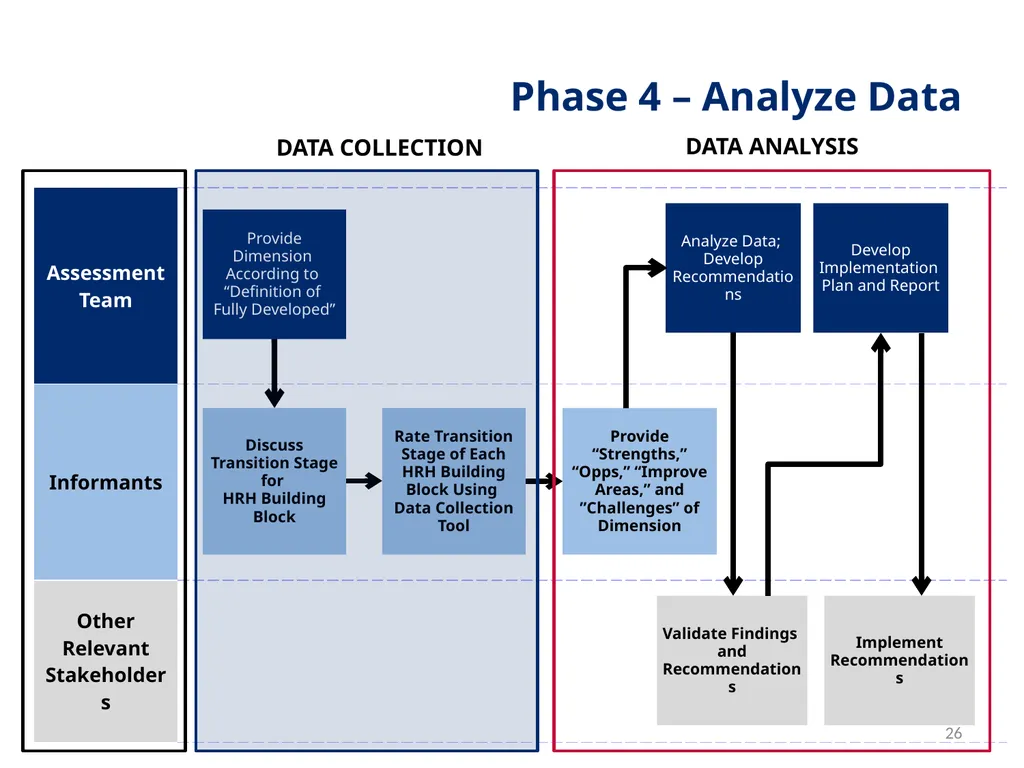
Phase 4 – Analyze Data Data Collection Data Analysis Provide Dimension According to “Definition of
Fully Developed” Discuss Transition Stage for
HRH Building Block Validate Findings
and Recommendations Analyze Data;
Develop Recommendations Provide “Strengths,” “Opps,” “Improve Areas,” and ”Challenges” of Dimension Rate Transition Stage of Each HRH Building Block Using
Data Collection Tool Develop Implementation
Plan and Report Implement Recommendations 26<br>
26
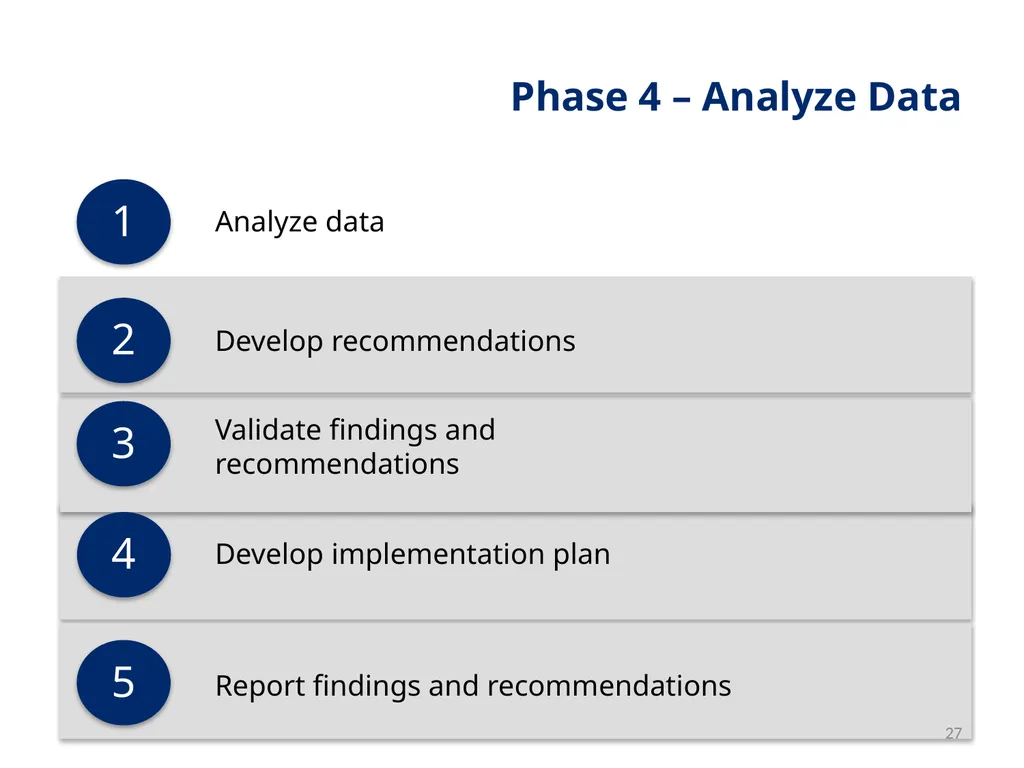
Phase 4 – Analyze Data Analyze data 2 1 Develop recommendations 3 Validate findings and recommendations 4 Develop implementation plan 5 Report findings and recommendations 27<br>
27
Session 4 Objectives – Data Collection Tool Introduction By the end of this session, you will be able to
Confidently use the data collection tool
Define the data collection tool components and purposes 28<br>
Confidently use the data collection tool
Define the data collection tool components and purposes 28<br>
28
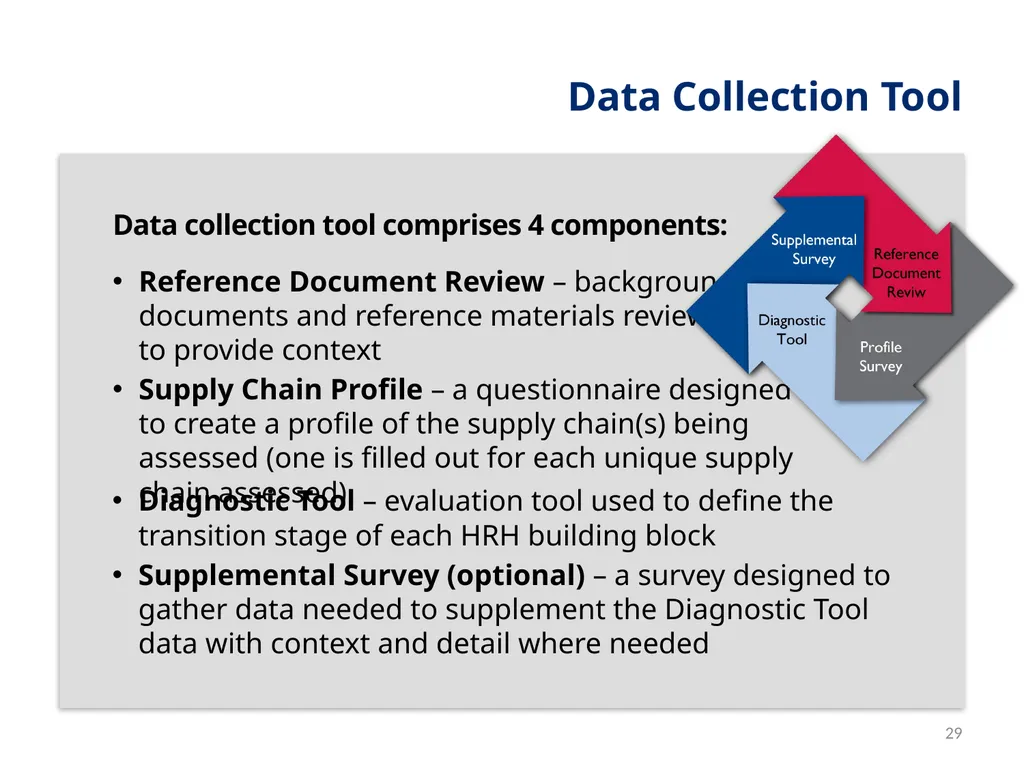
Data Collection Tool Data collection tool comprises 4 components:
Reference Document Review – background documents and reference materials reviewed to provide context
Supply Chain Profile – a questionnaire designed to create a profile of the supply chain(s) being assessed (one is filled out for each unique supply chain assessed) Diagnostic Tool – evaluation tool used to define the transition stage of each HRH building block
Supplemental Survey (optional) – a survey designed to gather data needed to supplement the Diagnostic Tool data with context and detail where needed 29<br>
Reference Document Review – background documents and reference materials reviewed to provide context
Supply Chain Profile – a questionnaire designed to create a profile of the supply chain(s) being assessed (one is filled out for each unique supply chain assessed) Diagnostic Tool – evaluation tool used to define the transition stage of each HRH building block
Supplemental Survey (optional) – a survey designed to gather data needed to supplement the Diagnostic Tool data with context and detail where needed 29<br>
29
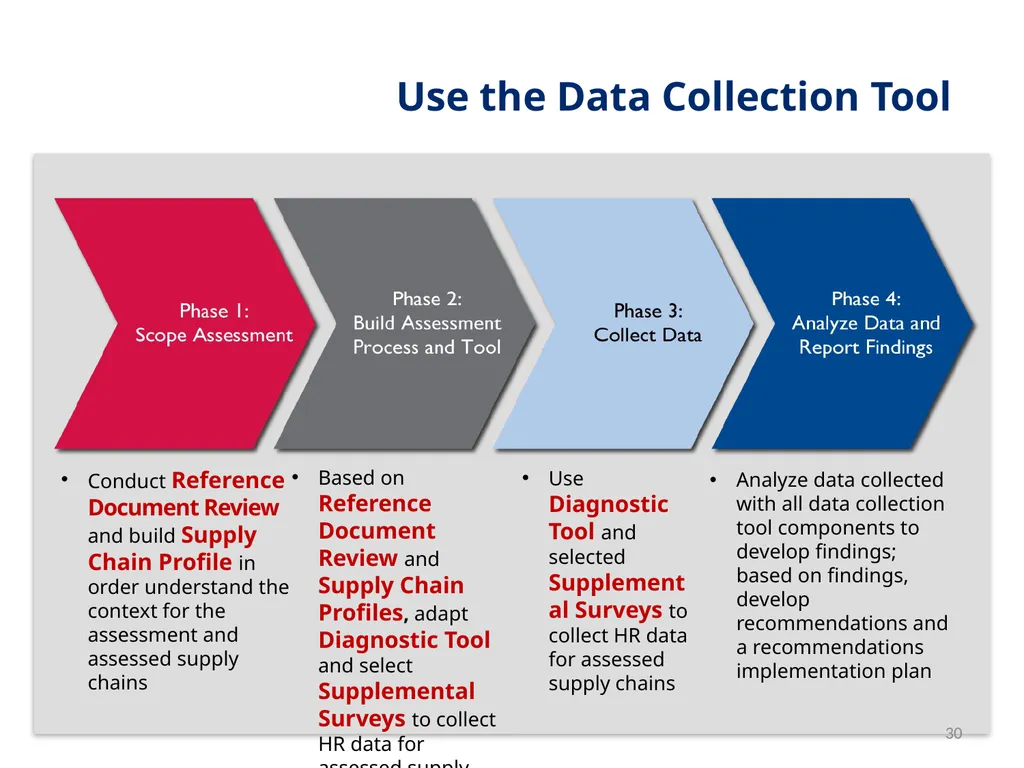
Use the Data Collection Tool Conduct Reference Document Review and build Supply Chain Profile in order understand the context for the assessment and assessed supply chains Based on Reference Document Review and Supply Chain Profiles, adapt Diagnostic Tool and select Supplemental Surveys to collect HR data for assessed supply chains Use Diagnostic Tool and selected Supplemental Surveys to collect HR data for assessed supply chains Analyze data collected with all data collection tool components to develop findings; based on findings, develop recommendations and a recommendations implementation plan 30<br>
30
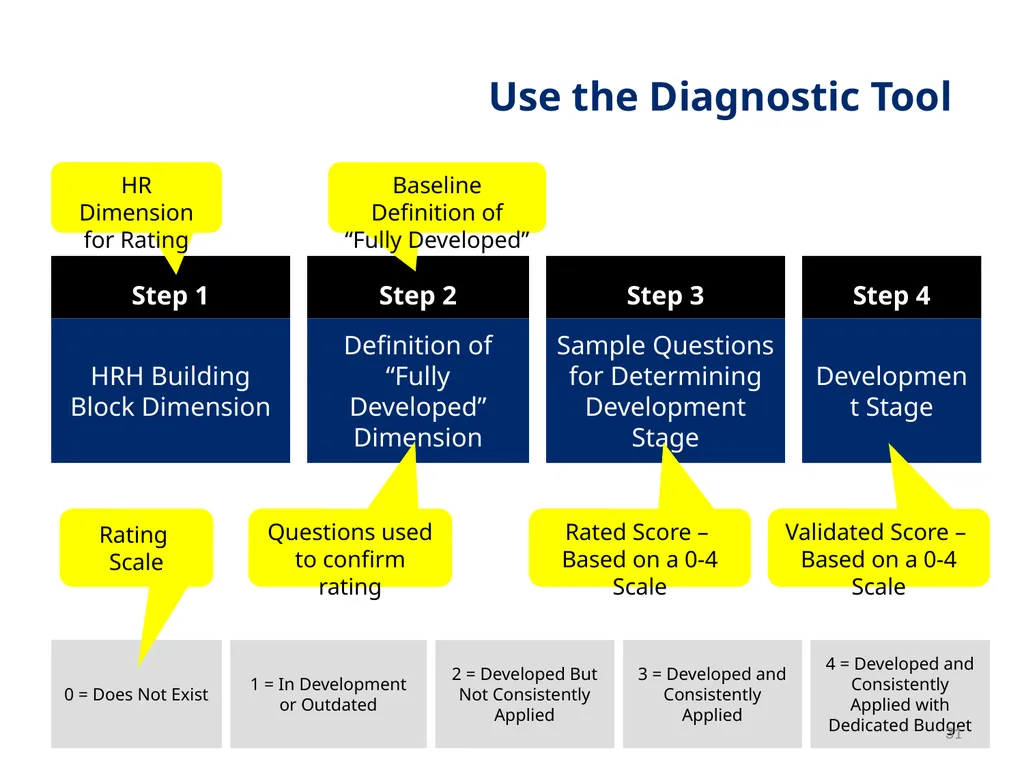
Use the Diagnostic Tool Step 1 Step 2 HRH Building Block Dimension Definition of “Fully Developed” Dimension Step 3 Step 4 Sample Questions for Determining Development Stage Development Stage Baseline Definition of “Fully Developed” HR Dimension for Rating Questions used to confirm rating 0 = Does Not Exist 1 = In Development or Outdated 2 = Developed But Not Consistently Applied 3 = Developed and Consistently Applied 4 = Developed and Consistently Applied with Dedicated Budget Rating
Scale Rated Score –
Based on a 0-4 Scale Validated Score –
Based on a 0-4 Scale 31<br>
Scale Rated Score –
Based on a 0-4 Scale Validated Score –
Based on a 0-4 Scale 31<br>
31
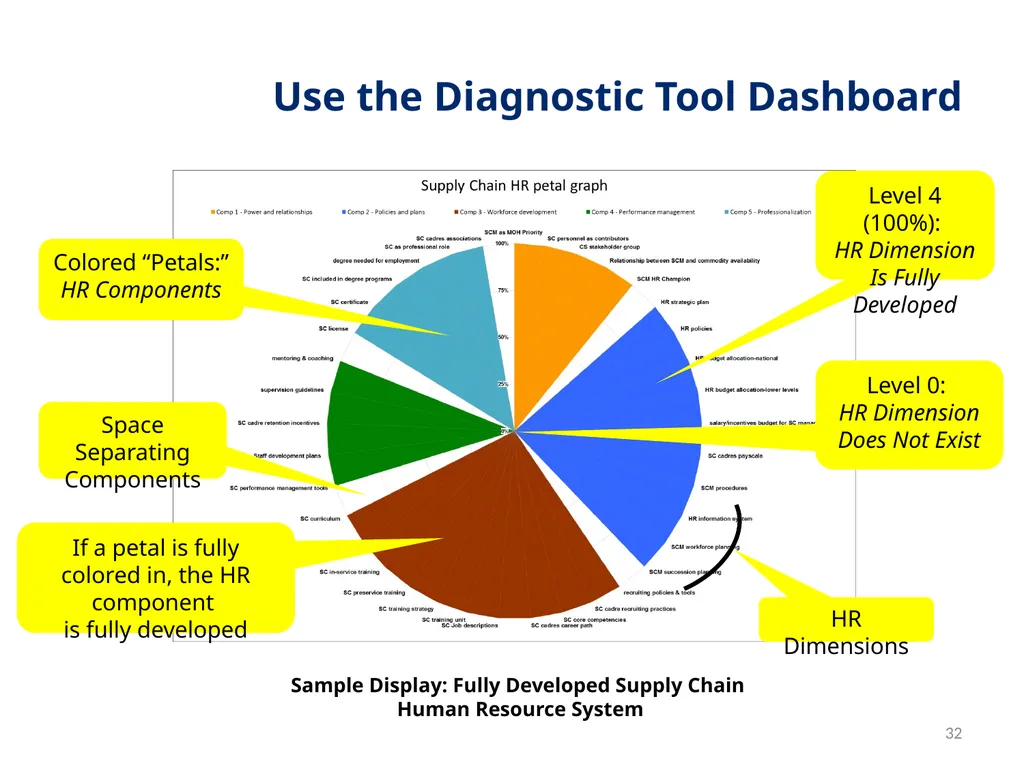
Use the Diagnostic Tool Dashboard Sample Display: Fully Developed Supply Chain
Human Resource System HR Dimensions Colored “Petals:”
HR Components Space Separating Components Level 4 (100%):
HR Dimension Is Fully Developed Level 0:
HR Dimension Does Not Exist If a petal is fully colored in, the HR component is fully developed 32<br>
Human Resource System HR Dimensions Colored “Petals:”
HR Components Space Separating Components Level 4 (100%):
HR Dimension Is Fully Developed Level 0:
HR Dimension Does Not Exist If a petal is fully colored in, the HR component is fully developed 32<br>
32
Session 5 Objectives – Data Collection
Tool Development By the end of this session, you will be able to
Develop data collection plan
Modify data collection tool 33<br>
Develop data collection plan
Modify data collection tool 33<br>
33
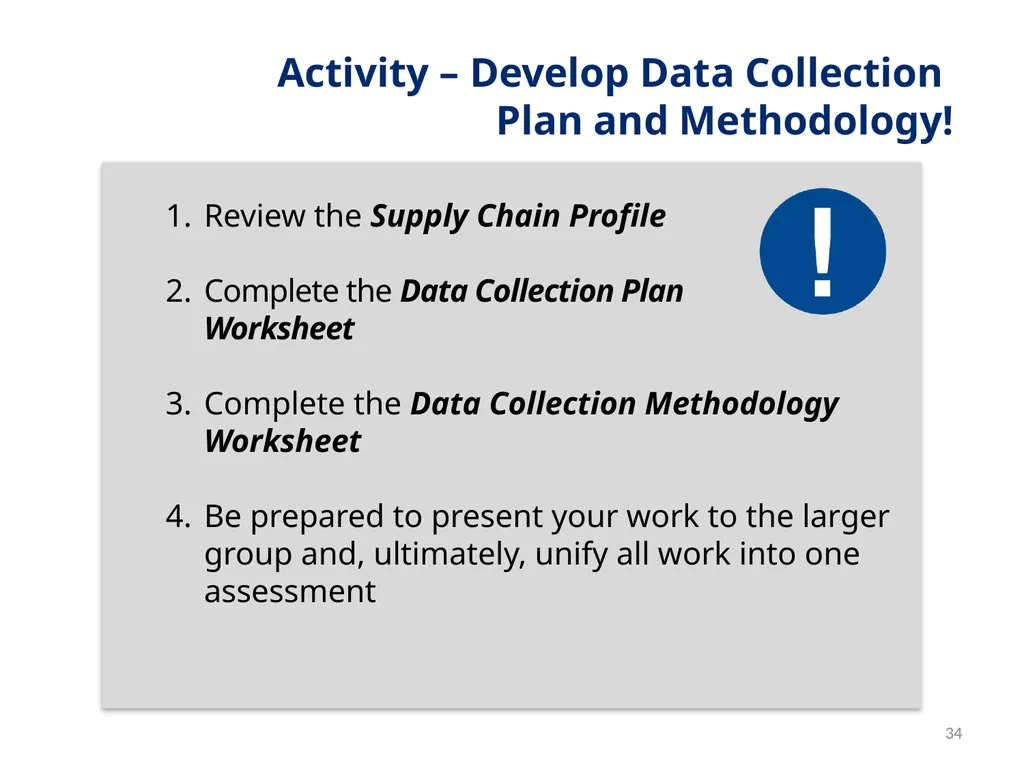
Review the Supply Chain Profile
Complete the Data Collection Plan Worksheet
Complete the Data Collection Methodology Worksheet
Be prepared to present your work to the larger group and, ultimately, unify all work into one assessment Activity – Develop Data Collection Plan and Methodology! 34<br>
Complete the Data Collection Plan Worksheet
Complete the Data Collection Methodology Worksheet
Be prepared to present your work to the larger group and, ultimately, unify all work into one assessment Activity – Develop Data Collection Plan and Methodology! 34<br>
34
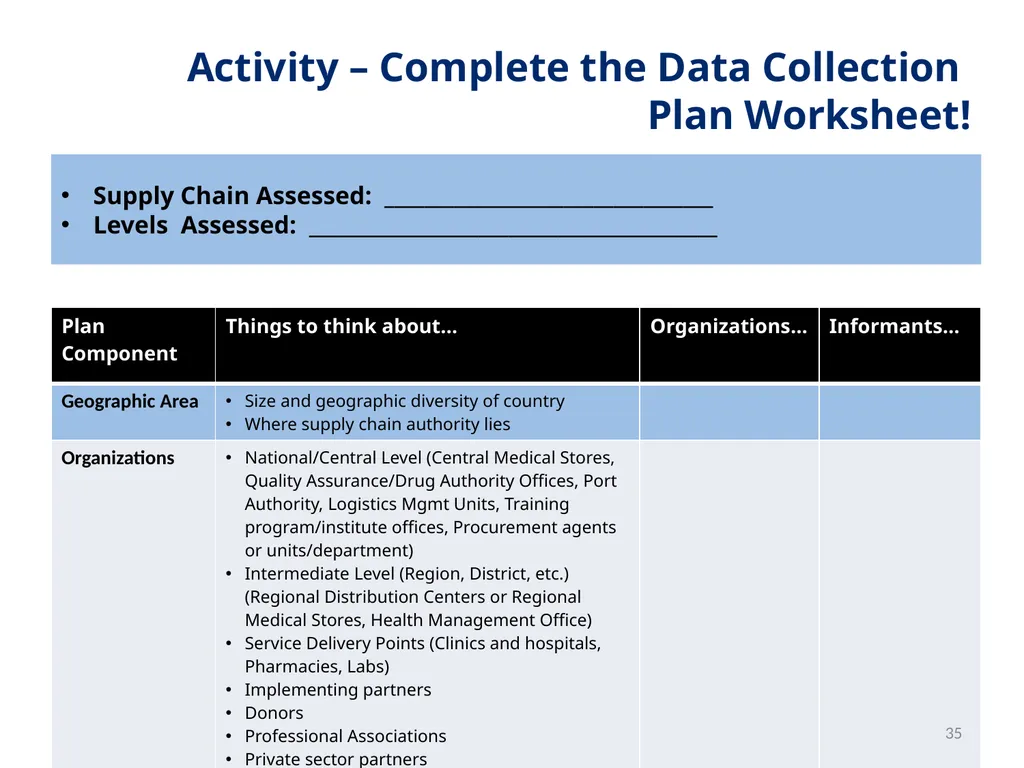
Activity – Complete the Data Collection
Plan Worksheet! Supply Chain Assessed: _________________________________
Levels Assessed: _________________________________________ 35<br>
Levels Assessed: _________________________________________ 35<br>
35
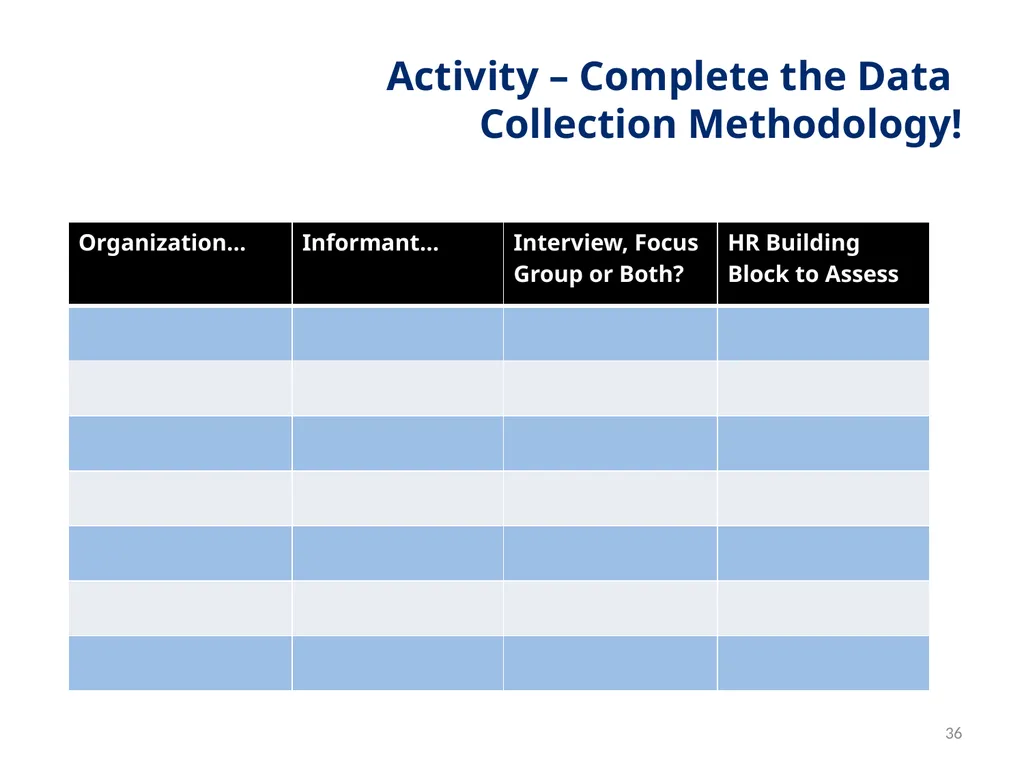
Activity – Complete the Data
Collection Methodology! 36<br>
36
Session 6 – Practice Collecting Data By the end of this session, you will be able to
Practice skills required to take thorough and accurate notes
Gather HRH building block data using interviewing skills
Gather HRH building block data using focus group facilitation skills 37<br>
Practice skills required to take thorough and accurate notes
Gather HRH building block data using interviewing skills
Gather HRH building block data using focus group facilitation skills 37<br>
37
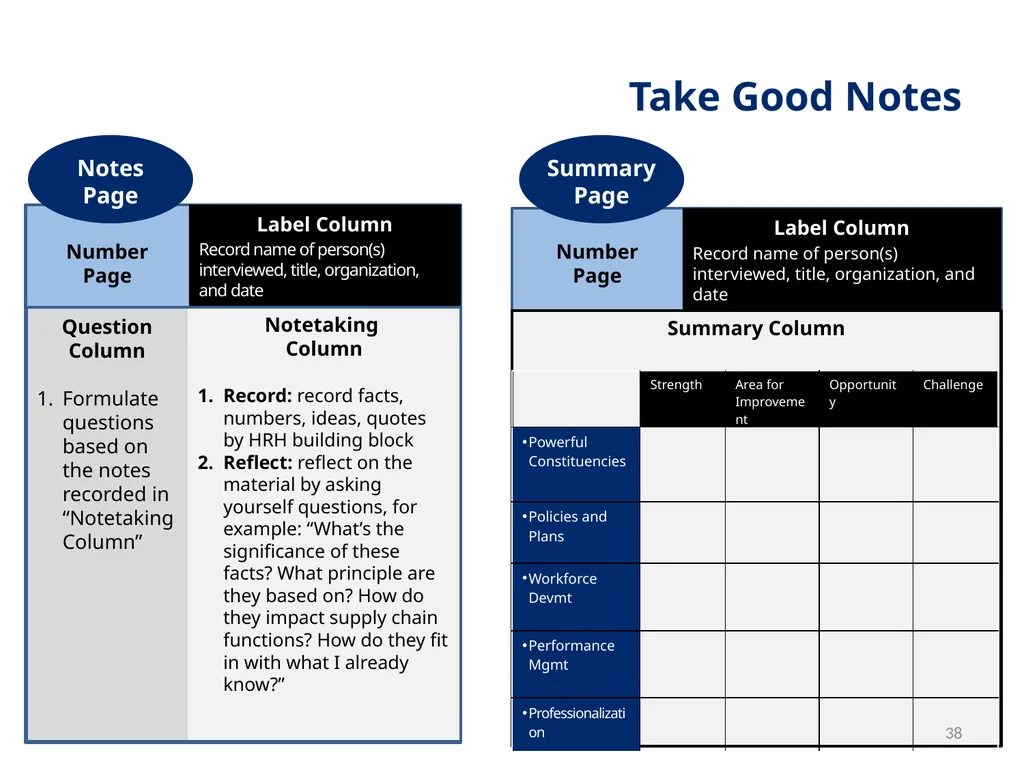
Label Column
Record name of person(s) interviewed, title, organization, and date Take Good Notes Notetaking
Column
Record: record facts, numbers, ideas, quotes by HRH building block
Reflect: reflect on the material by asking yourself questions, for example: “What’s the significance of these facts? What principle are they based on? How do they impact supply chain functions? How do they fit in with what I already know?” Question
Column
Formulate questions based on the notes recorded in “Notetaking Column” Label Column
Record name of person(s) interviewed, title, organization, and date Number Page Number Page Summary Column Summary Page Notes
Page 38<br>
Record name of person(s) interviewed, title, organization, and date Take Good Notes Notetaking
Column
Record: record facts, numbers, ideas, quotes by HRH building block
Reflect: reflect on the material by asking yourself questions, for example: “What’s the significance of these facts? What principle are they based on? How do they impact supply chain functions? How do they fit in with what I already know?” Question
Column
Formulate questions based on the notes recorded in “Notetaking Column” Label Column
Record name of person(s) interviewed, title, organization, and date Number Page Number Page Summary Column Summary Page Notes
Page 38<br>
38
Activity – Practice Your Notetaking Skills! Organize your notetaking paper according to the format you just learned
As you listen to the demonstration interview/- focus group, take notes according to this strategy 39<br>
As you listen to the demonstration interview/- focus group, take notes according to this strategy 39<br>
39
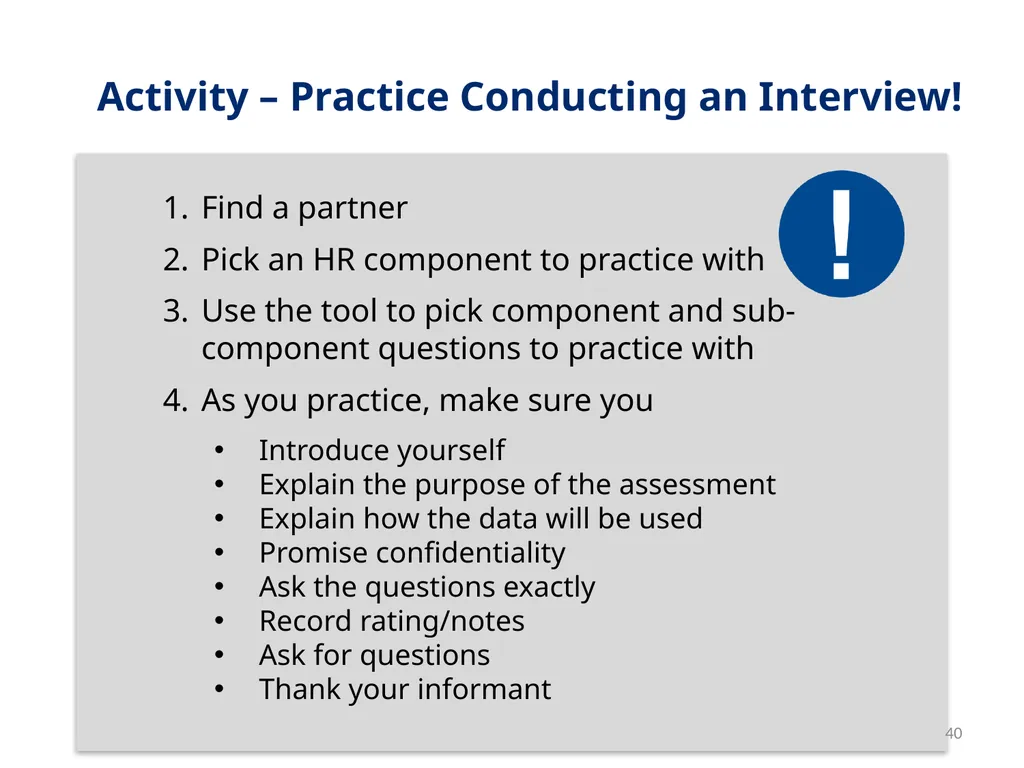
Activity – Practice Conducting an Interview! Find a partner
Pick an HR component to practice with
Use the tool to pick component and sub-component questions to practice with
As you practice, make sure you
Introduce yourself
Explain the purpose of the assessment
Explain how the data will be used
Promise confidentiality
Ask the questions exactly
Record rating/notes
Ask for questions
Thank your informant 40<br>
Pick an HR component to practice with
Use the tool to pick component and sub-component questions to practice with
As you practice, make sure you
Introduce yourself
Explain the purpose of the assessment
Explain how the data will be used
Promise confidentiality
Ask the questions exactly
Record rating/notes
Ask for questions
Thank your informant 40<br>
40
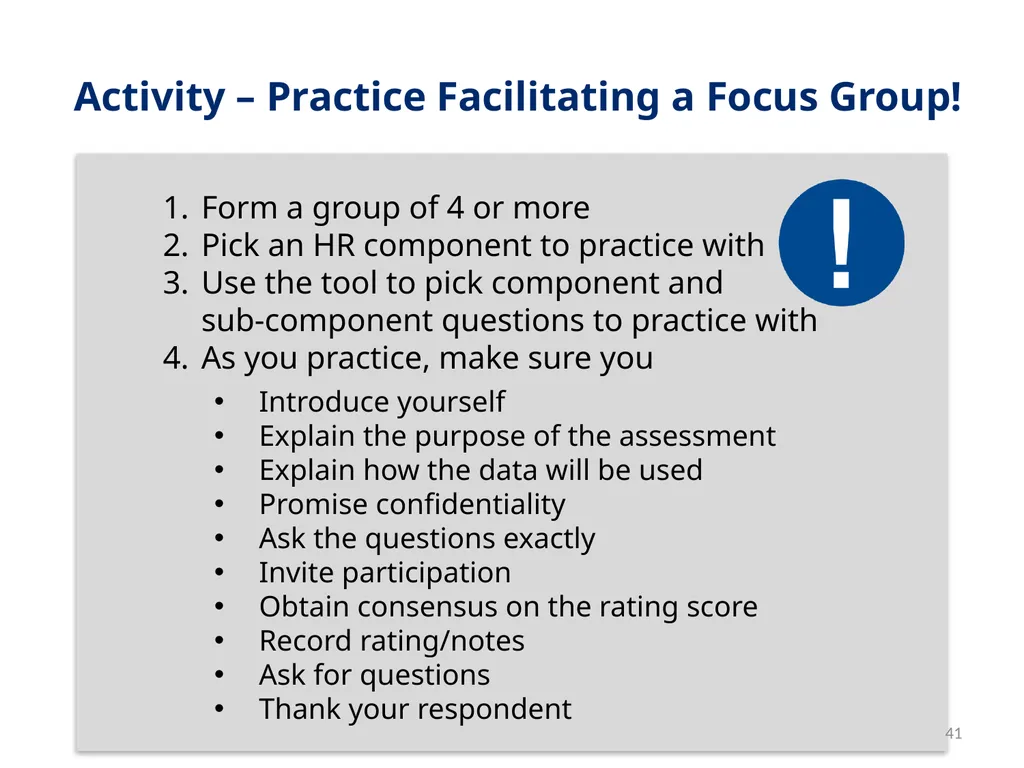
Activity – Practice Facilitating a Focus Group! Form a group of 4 or more
Pick an HR component to practice with
Use the tool to pick component and sub-component questions to practice with
As you practice, make sure you
Introduce yourself
Explain the purpose of the assessment
Explain how the data will be used
Promise confidentiality
Ask the questions exactly
Invite participation
Obtain consensus on the rating score
Record rating/notes
Ask for questions
Thank your respondent 41<br>
Pick an HR component to practice with
Use the tool to pick component and sub-component questions to practice with
As you practice, make sure you
Introduce yourself
Explain the purpose of the assessment
Explain how the data will be used
Promise confidentiality
Ask the questions exactly
Invite participation
Obtain consensus on the rating score
Record rating/notes
Ask for questions
Thank your respondent 41<br>
41
Session 7 – Data Analysis and Reporting By the end of this session, you will be able to
Analyze HRH building block data and develop recommendations
Develop recommendations implementation plan 42<br>
Analyze HRH building block data and develop recommendations
Develop recommendations implementation plan 42<br>
42
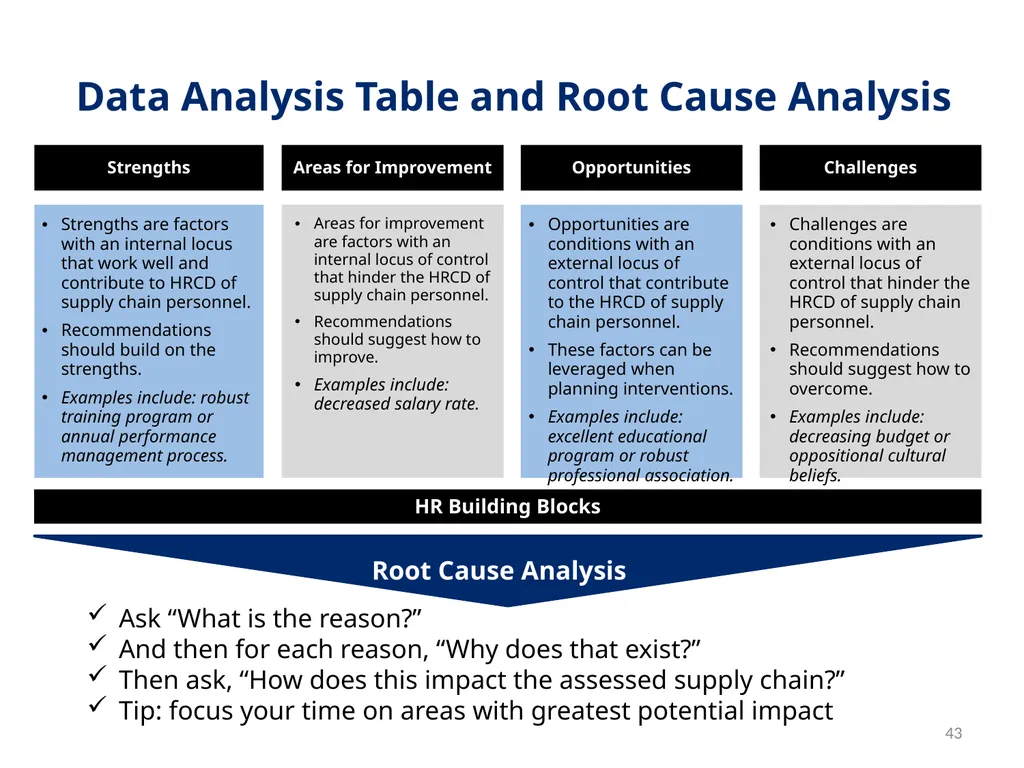
Data Analysis Table and Root Cause Analysis Ask “What is the reason?”
And then for each reason, “Why does that exist?”
Then ask, “How does this impact the assessed supply chain?”
Tip: focus your time on areas with greatest potential impact Strengths are factors with an internal locus that work well and contribute to HRCD of supply chain personnel.
Recommendations should build on the strengths.
Examples include: robust training program or annual performance management process. Areas for improvement are factors with an internal locus of control that hinder the HRCD of supply chain personnel.
Recommendations should suggest how to improve.
Examples include: decreased salary rate. Challenges are conditions with an external locus of control that hinder the HRCD of supply chain personnel.
Recommendations should suggest how to overcome.
Examples include: decreasing budget or oppositional cultural beliefs. Opportunities are conditions with an external locus of control that contribute to the HRCD of supply chain personnel.
These factors can be leveraged when planning interventions.
Examples include: excellent educational program or robust professional association. Strengths Areas for Improvement Opportunities Challenges HR Building Blocks Root Cause Analysis 43<br>
And then for each reason, “Why does that exist?”
Then ask, “How does this impact the assessed supply chain?”
Tip: focus your time on areas with greatest potential impact Strengths are factors with an internal locus that work well and contribute to HRCD of supply chain personnel.
Recommendations should build on the strengths.
Examples include: robust training program or annual performance management process. Areas for improvement are factors with an internal locus of control that hinder the HRCD of supply chain personnel.
Recommendations should suggest how to improve.
Examples include: decreased salary rate. Challenges are conditions with an external locus of control that hinder the HRCD of supply chain personnel.
Recommendations should suggest how to overcome.
Examples include: decreasing budget or oppositional cultural beliefs. Opportunities are conditions with an external locus of control that contribute to the HRCD of supply chain personnel.
These factors can be leveraged when planning interventions.
Examples include: excellent educational program or robust professional association. Strengths Areas for Improvement Opportunities Challenges HR Building Blocks Root Cause Analysis 43<br>
43
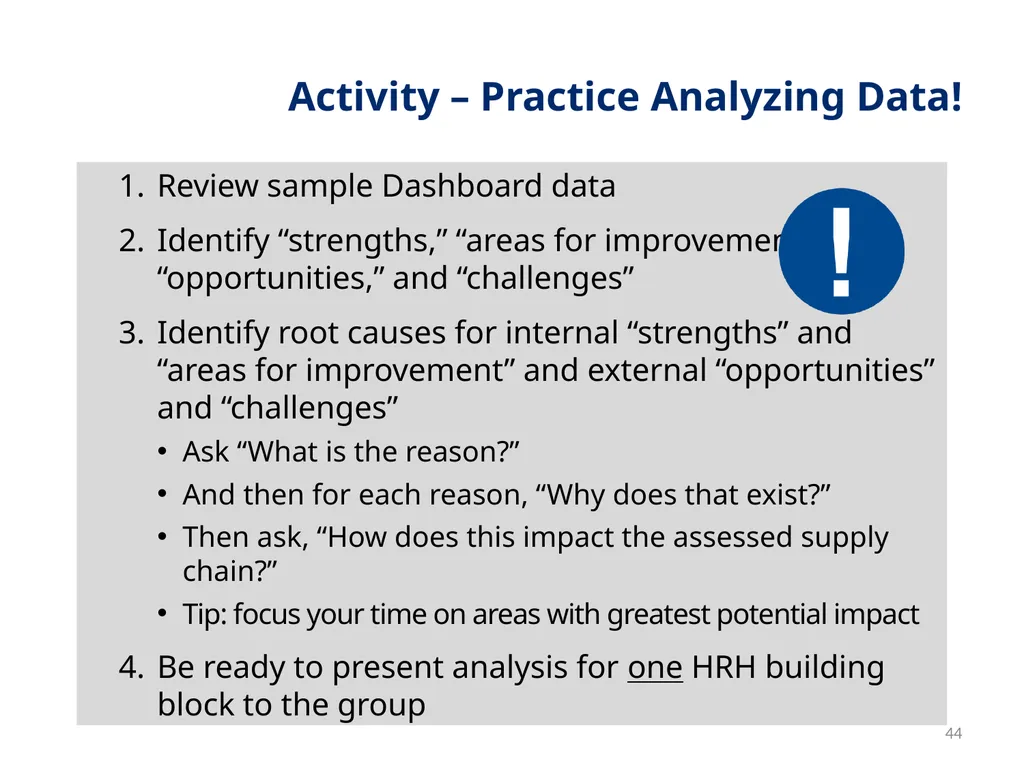
Activity – Practice Analyzing Data! Review sample Dashboard data
Identify “strengths,” “areas for improvements,” “opportunities,” and “challenges”
Identify root causes for internal “strengths” and “areas for improvement” and external “opportunities” and “challenges”
Ask “What is the reason?”
And then for each reason, “Why does that exist?”
Then ask, “How does this impact the assessed supply chain?”
Tip: focus your time on areas with greatest potential impact
Be ready to present analysis for one HRH building block to the group 44<br>
Identify “strengths,” “areas for improvements,” “opportunities,” and “challenges”
Identify root causes for internal “strengths” and “areas for improvement” and external “opportunities” and “challenges”
Ask “What is the reason?”
And then for each reason, “Why does that exist?”
Then ask, “How does this impact the assessed supply chain?”
Tip: focus your time on areas with greatest potential impact
Be ready to present analysis for one HRH building block to the group 44<br>
44
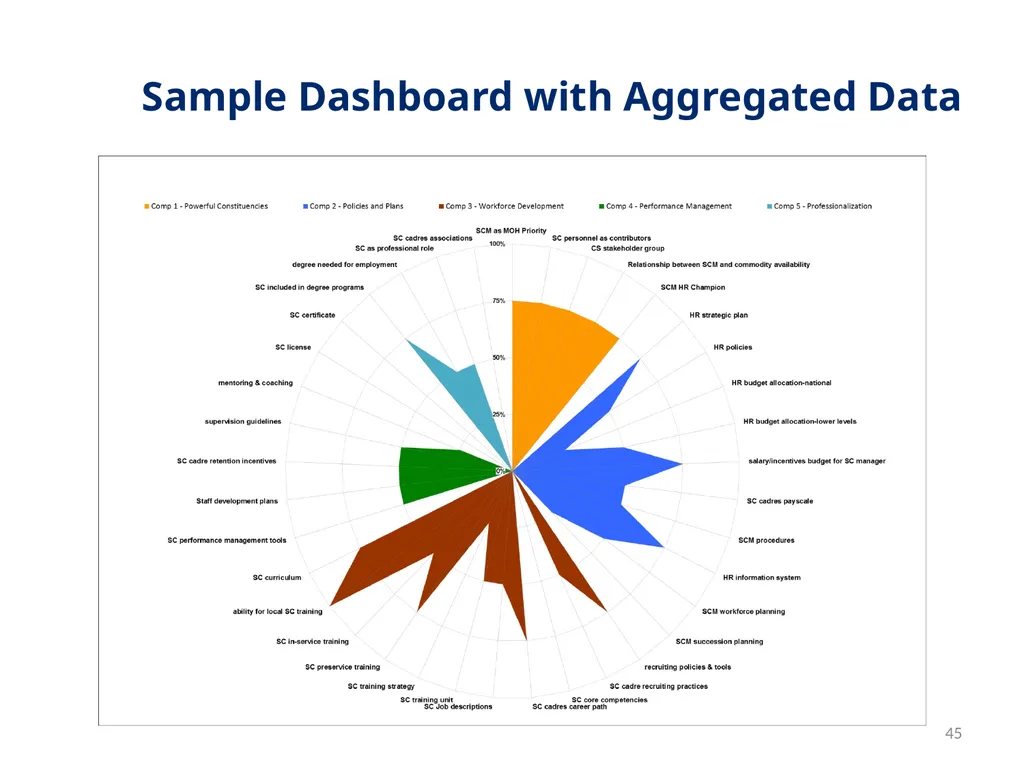
Sample Dashboard with Aggregated Data 45<br>
45
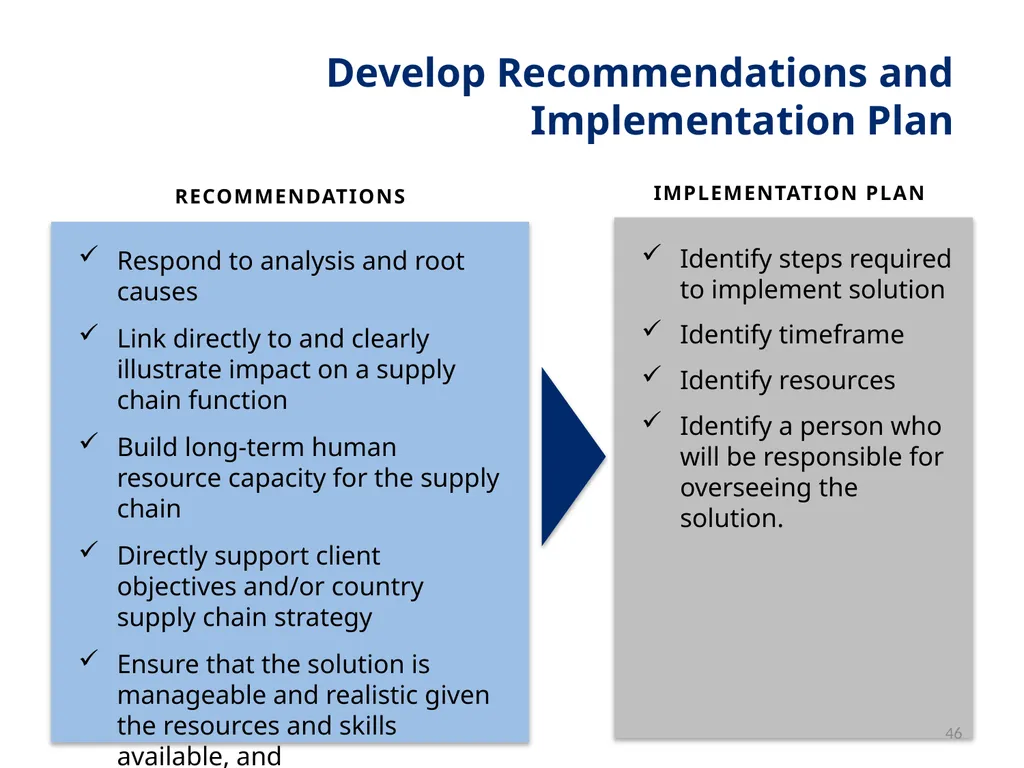
Develop Recommendations and Implementation Plan Respond to analysis and root causes
Link directly to and clearly illustrate impact on a supply chain function
Build long-term human resource capacity for the supply chain
Directly support client objectives and/or country supply chain strategy
Ensure that the solution is manageable and realistic given the resources and skills available, and
Can be achieved within a specified time scale. Identify steps required to implement solution
Identify timeframe
Identify resources
Identify a person who will be responsible for overseeing the solution. RECOMMENDATIONS IMPLEMENTATION PLAN 46<br>
Link directly to and clearly illustrate impact on a supply chain function
Build long-term human resource capacity for the supply chain
Directly support client objectives and/or country supply chain strategy
Ensure that the solution is manageable and realistic given the resources and skills available, and
Can be achieved within a specified time scale. Identify steps required to implement solution
Identify timeframe
Identify resources
Identify a person who will be responsible for overseeing the solution. RECOMMENDATIONS IMPLEMENTATION PLAN 46<br>
46
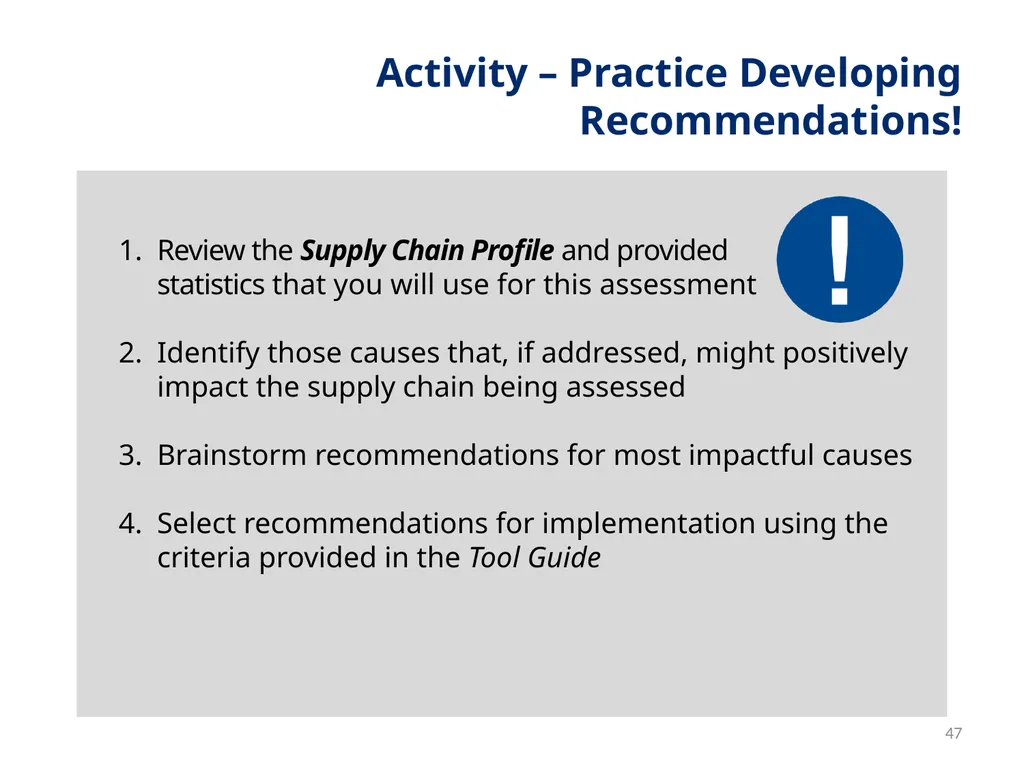
Activity – Practice Developing Recommendations! Review the Supply Chain Profile and provided statistics that you will use for this assessment
Identify those causes that, if addressed, might positively impact the supply chain being assessed
Brainstorm recommendations for most impactful causes
Select recommendations for implementation using the criteria provided in the Tool Guide 47<br>
Identify those causes that, if addressed, might positively impact the supply chain being assessed
Brainstorm recommendations for most impactful causes
Select recommendations for implementation using the criteria provided in the Tool Guide 47<br>
47
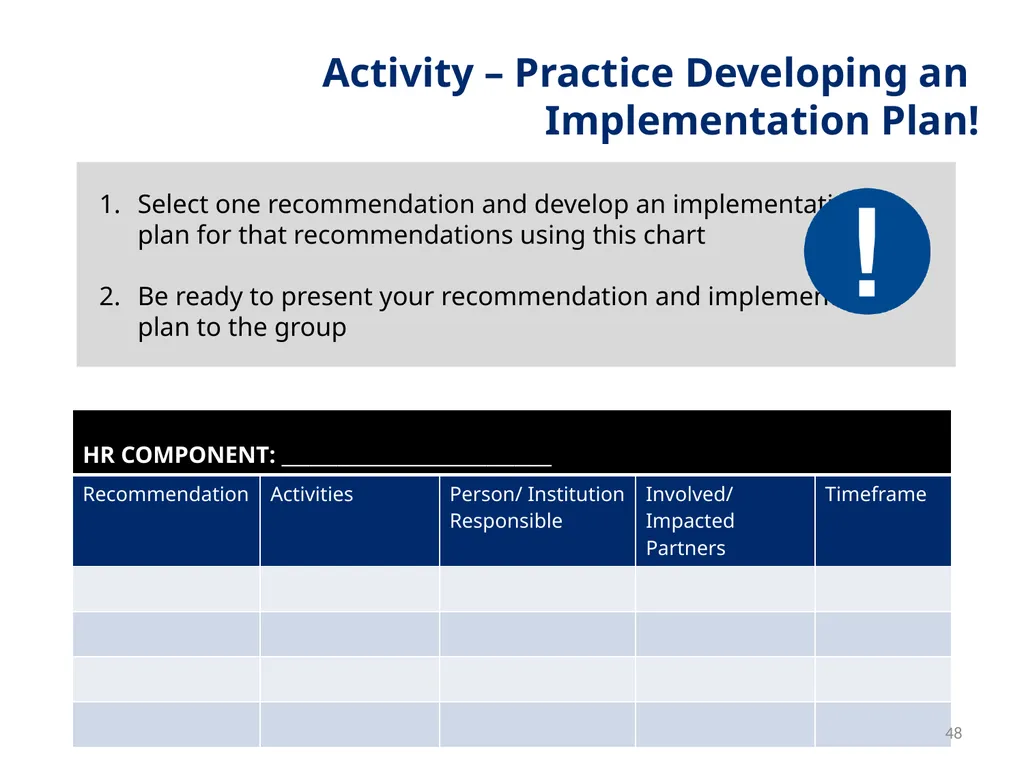
Activity – Practice Developing an
Implementation Plan! Select one recommendation and develop an implementation
plan for that recommendations using this chart
Be ready to present your recommendation and implementation plan to the group 48<br>
Be ready to present your recommendation and implementation plan to the group 48<br>