Session 4 Class Diagrams, Composition and Aggregation Object-oriented programming Course Outline Session 4 Outline To be able to read and draw class diagrams To understand the difference between private, public and protected attributes To
"Session 4 Class Diagrams, Composition and" is the property of its rightful owner. Permission is granted to
download and print the materials on this website for personal, non-commercial use only, and to display it
on your personal computer provided you do not modify the materials and that you retain all copyright
notices contained in the materials. By downloading content from our website, you accept the terms of this
agreement.
Presentation Transcript
01
Session 4
Class Diagrams, Composition and Aggregation Object-oriented programming<br>
02
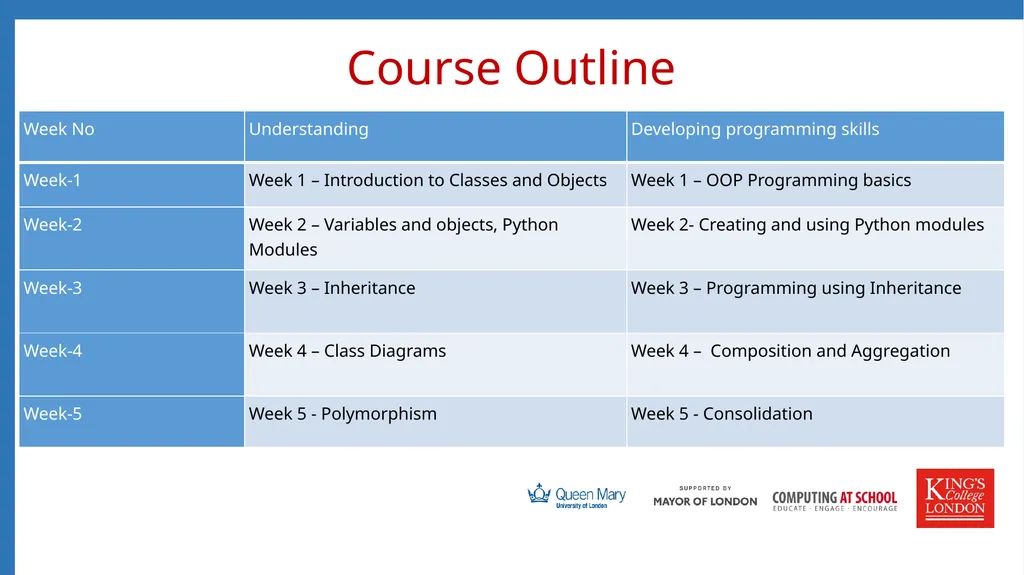
Course Outline<br>
03
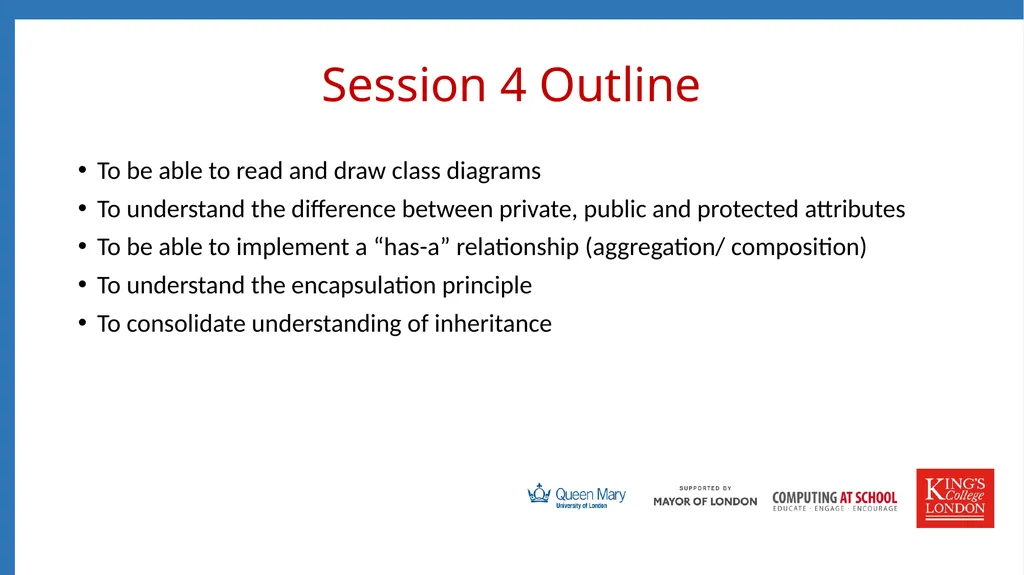
Session 4 Outline To be able to read and draw class diagrams
To understand the difference between private, public and protected attributes
To be able to implement a “has-a” relationship (aggregation/ composition)
To understand the encapsulation principle
To consolidate understanding of inheritance<br>
04
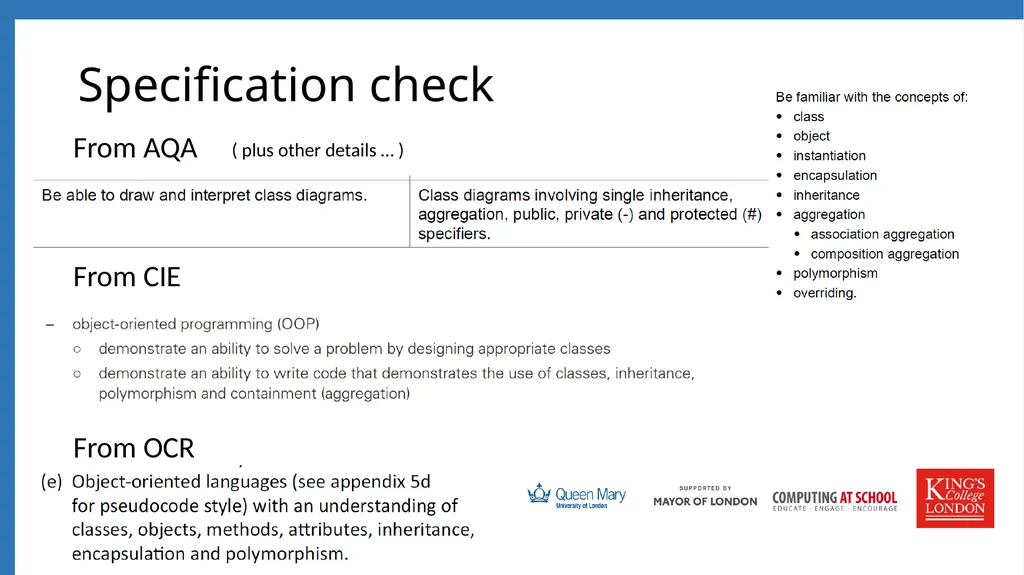
Specification check From AQA
From CIE
From OCR ( plus other details … )<br>
05
Recap: Inheritance One class can inherit methods and variables from another class
This is called inheritance
For example, in a system for a school, there may be a Student class and a Staff class (enabling you to create Student and Staff objects)
There also may be TeachingStaff, SupportStaff, ManagementStaff classes.
These could inherit methods and variables from the Staff object.
In this case Staff is the super class and TeachingStaff is the sub class (or child class)<br>
06
Private, public & protected Theoretically, the parts of a class declaration are declared to be
private OR
public
a private section for the state (member data – ie attributes)
a public section for the behaviour(operations, member functions)
The keywords “private” and “public” control the accessibility of the member data and functions
Private or protected attributes cannot be accessed outside of the class
Public methods can be accessed outside the class
Private and public are not implemented in Python but are needed for examination answers<br>
07
Encapsulation This is an important principle of OOP, associated with abstraction or information hiding
Encapsulation means that the internal representation of an object cannot be seen from outside of the object’s definition
It is achieved by making attributes private (or protected).
The attributes are only accessed through methods (public)
Get and set methods are written to access the data
This protects the object from being changed in an irregular way and allows groups of developers to all access the same class, via the methods.<br>
08
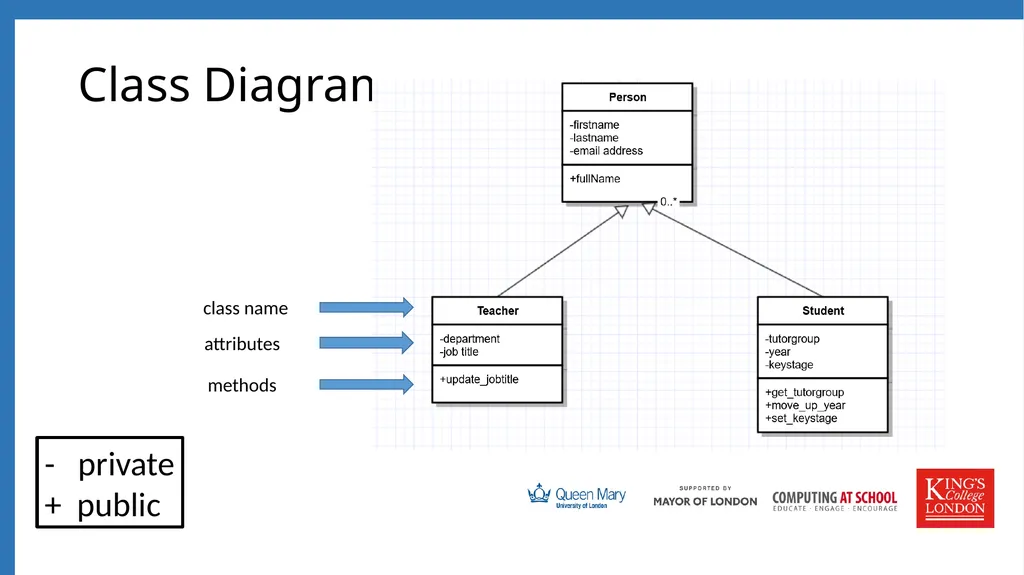
Class Diagrams - private
+ public attributes methods class name<br>
09
Composition and aggregation contd Composition is where one object is composed (or made up of) two or more existing objects and is entirely dependent on those objects for its own existence (from Hodder AQA materials)
Association aggregation is where an object is made up of one or more objects but is not entirely dependent on those objects for its own existence (from Hodder’s AQA materials)
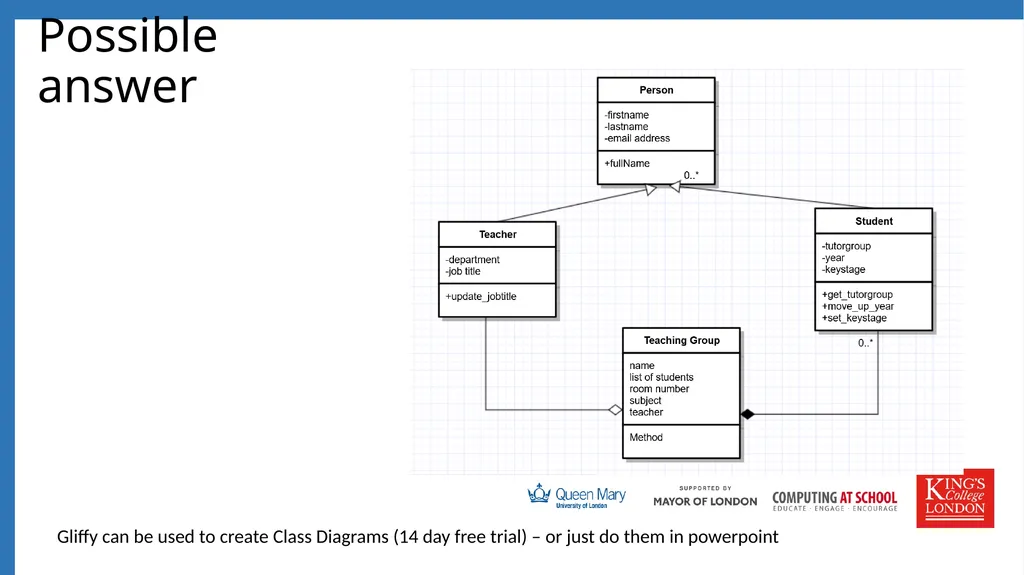
For example, a teaching group is made up of students: this is aggregation as the students will belong to other teaching groups too.
A teaching group also has to have a teacher. This can be argued to be the stronger case of composition.<br>
10
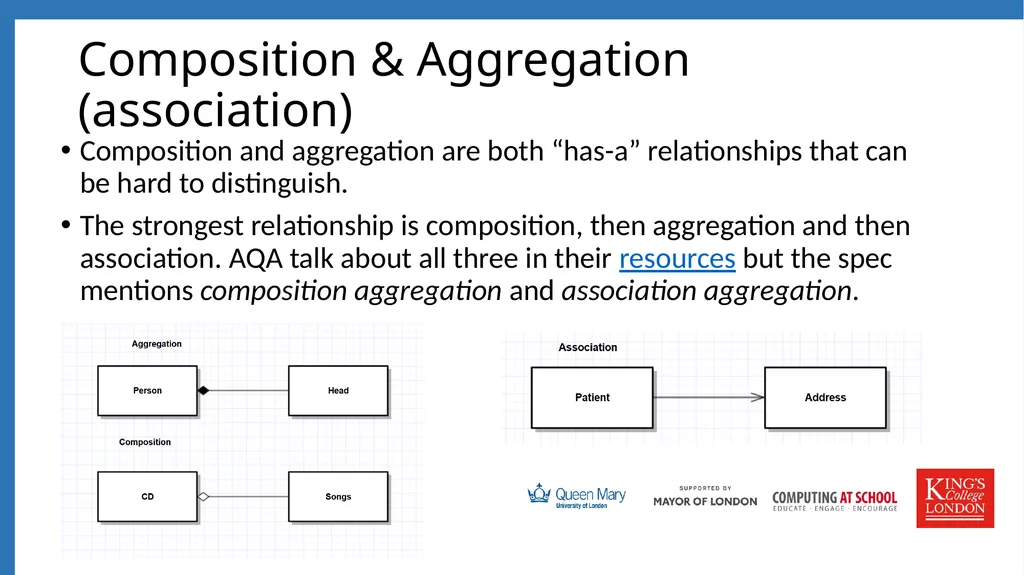
Composition & Aggregation (association) Composition and aggregation are both “has-a” relationships that can be hard to distinguish.
The strongest relationship is composition, then aggregation and then association. AQA talk about all three in their resources but the spec mentions composition aggregation and association aggregation.<br>
11
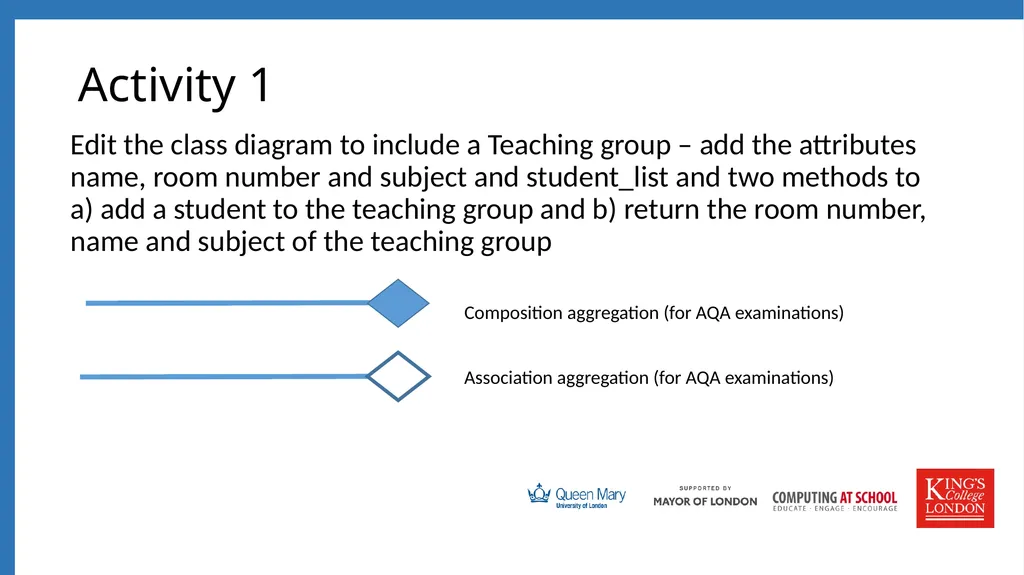
Activity 1 Edit the class diagram to include a Teaching group – add the attributes name, room number and subject and student_list and two methods to a) add a student to the teaching group and b) return the room number, name and subject of the teaching group Composition aggregation (for AQA examinations) Association aggregation (for AQA examinations)<br>
12
Possible answer Gliffy can be used to create Class Diagrams (14 day free trial) – or just do them in powerpoint<br>
13
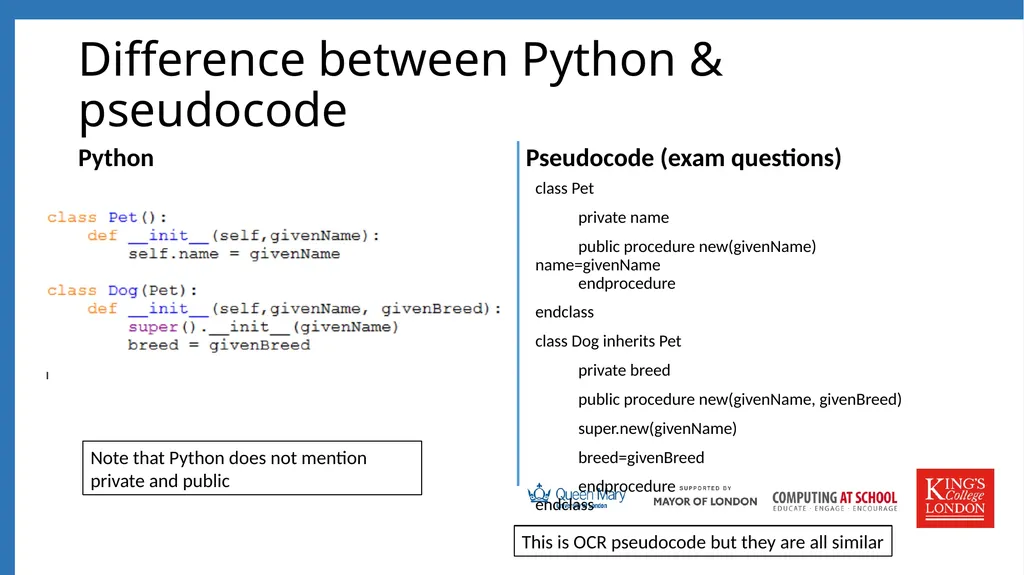
Difference between Python & pseudocode Python Pseudocode (exam questions) class Pet
private name
public procedure new(givenName) name=givenName endprocedure
endclass
class Dog inherits Pet
private breed
public procedure new(givenName, givenBreed)
super.new(givenName)
breed=givenBreed
endprocedure endclass This is OCR pseudocode but they are all similar Note that Python does not mention private and public<br>
14
Activity: Past paper question Answer examination question
June 2015 AQA Comp 3
See handout
Draw an inheritance diagram
Write a class definition in pseudocode<br>