Session A: Education Common Complaints From New Moms Baby Blues Postpartum Depression Where to get Help Resources 1 2 Session A Goals Establish a working relationship Setting realistic expectations about the postpartum period motherhood
"Session A: Education Common Complaints From New" is the property of its rightful owner. Permission is granted to
download and print the materials on this website for personal, non-commercial use only, and to display it
on your personal computer provided you do not modify the materials and that you retain all copyright
notices contained in the materials. By downloading content from our website, you accept the terms of this
agreement.
Presentation Transcript
01
Session A: Education Common Complaints From New Moms
Baby Blues
Postpartum Depression
Where to get Help
Resources 1<br>
02
2 Session A Goals
Establish a working relationship
Setting realistic expectations about the postpartum period + motherhood
Introduce the concept of role transition
Introduce the concept of utilizing social support
Provide woman with an overview of the course<br>
03
Ground rules
Confidentiality (limits of confidentiality), being supportive to one another, encouraging participation, time management, management of cell phones
Description of group
Classes (not treatment), skill based, focused on postpartum stress management, session times, cancellations, children at groups
Introductions
Interventionist, group members (name, number weeks pregnant, delivered before, etc) Session A Setting Expectations 3<br>
04
Setting Expectations If you provide care to patient, it will be important to provide a context for why you are now talking about ways to cope once the patient has had her baby.
“Here at (name of clinic) we are committed to helping mothers get a good start for their babies. Happy moms , happy babies.
“When we meet I will (also) be talking with you about the changes and stresses that can occur once you have had your baby and ways you can manage these changes. “
or
“Becoming a mother brings about many changes and in our ROSE classes we will provide you with tools (a toolkit) to successfully survive motherhood.” 4<br>
05
Current expectations
Society’s expectations from media (e.g., Facebook) etc., stories heard from woman’s own mom, sisters, friends, own story/expectations, different experiences among women
Reality of having a baby
Hardest job, little training, sleep deprivation etc. Session A Views on Motherhood 5<br>
06
Psychoeducation
Create realistic expectations around the postpartum period
Adapt information based on woman’s experiences (emphasize individual differences)
Normalize experiences
Review resources and how to access them (informal sources of support) 6 Session A<br>
07
Session A Psychoeducation on Baby Blues Range of responses among women after delivery
Most mothers get baby blues –up to 80%
Description of baby blues (mood swings, crying for no reason)
Refer to handouts on Common Complaints and on Baby Blues 7<br>
08
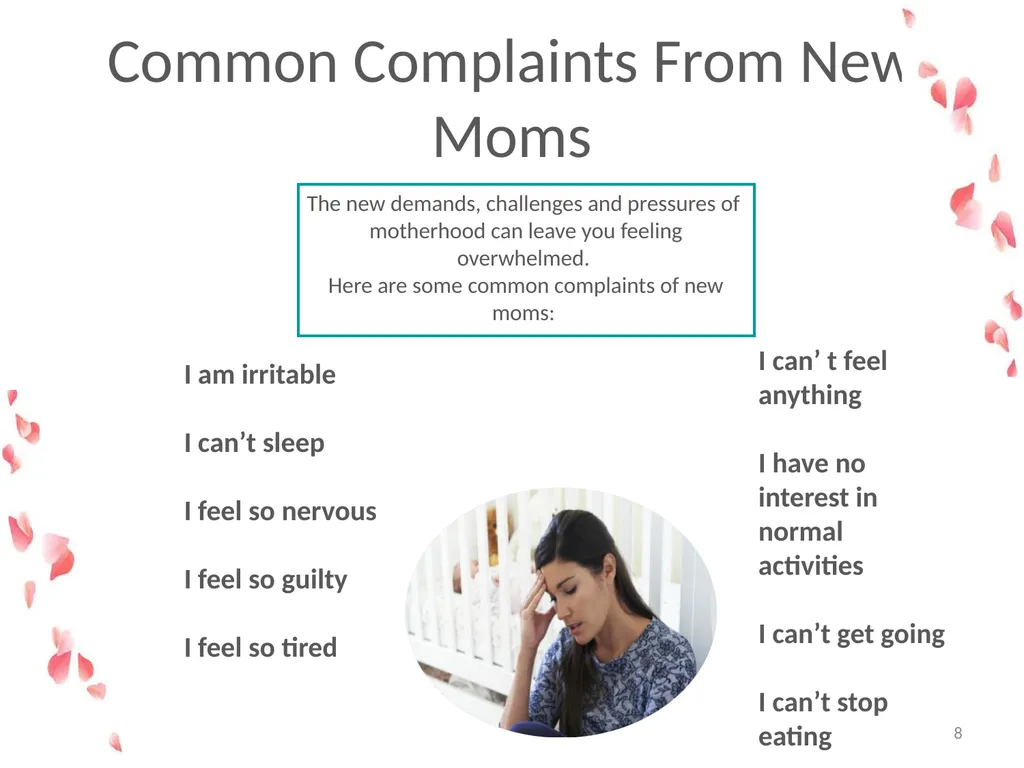
Common Complaints From New Moms The new demands, challenges and pressures of motherhood can leave you feeling overwhelmed. Here are some common complaints of new moms: I am irritable
I can’t sleep
I feel so nervous
I feel so guilty
I feel so tired I can’ t feel anything
I have no interest in normal activities
I can’t get going
I can’t stop eating 8<br>
09
Baby Blues 30-80% of women experience Baby Blues
It usually occurs 2-5 days after delivery and usually goes away after about two weeks Crying
Mood swings
Exhaustion
Tension
Anxiety
Restlessness 9<br>
10
Ask women if they know the symptoms of postpartum depression or depression, % of women who get it
For women who have financial difficulties about one in four to five women will experience postpartum depression
Refer to handout on postpartum depression
Women who have had previous episode/s of depression are more likely to experience depression after childbirth. Those women who have had postpartum depression are more likely to experience it again Session A Psychoeducation on Postpartum Depression 10<br>
11
Postpartum Depression Sleep problems (example: you cannot return to sleep after feeding the baby)
Eating problems-eating too much or too little
Anxiety and worry
Avoiding people, avoiding contact with the baby, wanting to be on your own
No energy
Death wish, suicidal thoughts
Difficulty having positive feelings towards the baby
Difficulty making decisions
Mania-feeling speedy, being excitable and irritable, talking fast, and having less need for sleep
Panic attacks
Fears for the baby, fantasies about harming or killing the baby
If you ever feel that you might hurt yourself, your baby or anyone else, please talk to your healthcare provider or call 911 11<br>
12
Session A Importance of Seeking Support Can feel better talking to support people
Support can help prevent postpartum depression
New moms deserve support
Treatment can help
Review where to get help handout
Review local resources
Normalize negative postpartum feelings. Refer to handout you are not alone, you are not to blame, and you can feel better 12<br>
13
You are not alone
You are not to blame
And
You CAN feel better 13<br>
14
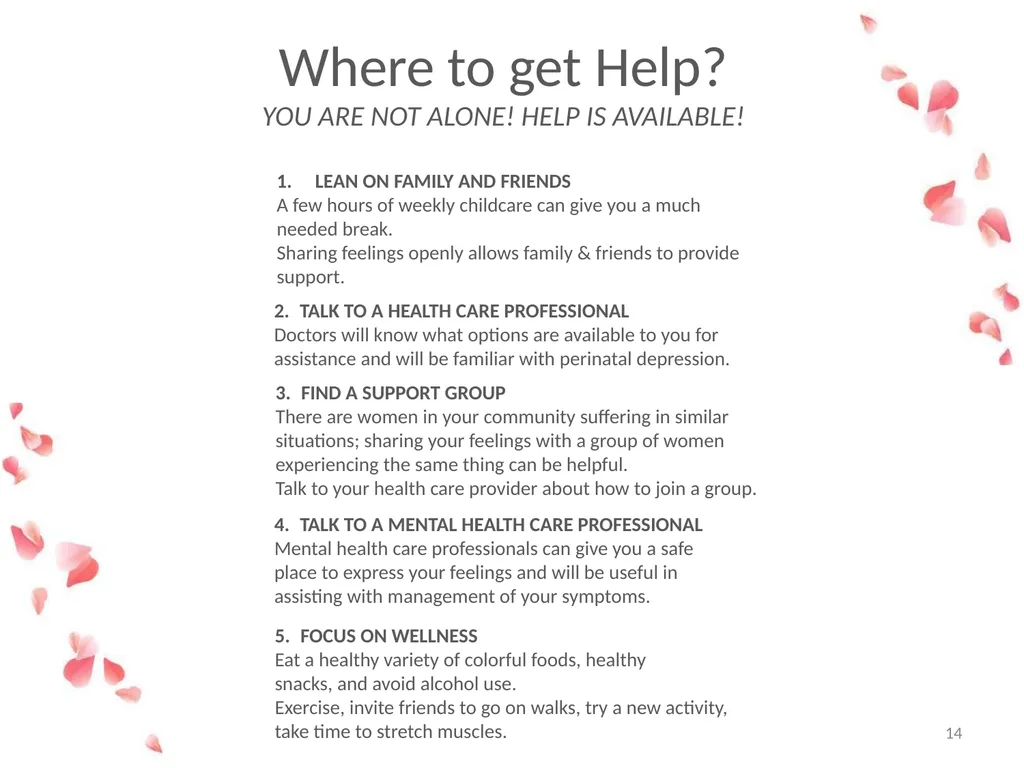
Where to get Help? YOU ARE NOT ALONE! HELP IS AVAILABLE! LEAN ON FAMILY AND FRIENDS
A few hours of weekly childcare can give you a much needed break.
Sharing feelings openly allows family & friends to provide support. TALK TO A HEALTH CARE PROFESSIONAL
Doctors will know what options are available to you for assistance and will be familiar with perinatal depression. FIND A SUPPORT GROUP
There are women in your community suffering in similar situations; sharing your feelings with a group of women experiencing the same thing can be helpful.
Talk to your health care provider about how to join a group. TALK TO A MENTAL HEALTH CARE PROFESSIONAL
Mental health care professionals can give you a safe place to express your feelings and will be useful in assisting with management of your symptoms. FOCUS ON WELLNESS
Eat a healthy variety of colorful foods, healthy snacks, and avoid alcohol use.
Exercise, invite friends to go on walks, try a new activity, take time to stretch muscles. 14<br>
15
My Resources Domestic Violence
_________________
______________________________________________________________________________________________________ Mental Health
_______________________________________________________________________________________________________________________ Parenting
_______________________________________________________________________________________________________________________ Legal Services
______________________________________________________________________________________________________________________________ Suicide Prevention
______________________________________________________________________________________________________________________________ 15<br>
16
Wrap–up Having a baby is a major life event
New demands and new skills will be needed
Postpartum women deserve positive support
Reemphasize the importance of support (a buffer for PPD)
Date and time of next session
Preview of next session (Ways to decrease stress, how to survive motherhood, and talk about support people in your life) 16<br>
17
17 Potential Difficulties Session A Woman strays off the topic/talks too much
Acknowledge feeling/thought/concern
Redirect (politely and carefully-validate her)
I know these concerns are really important to you, but I am going to have to move on because we have still so much material to talk about and I want to make sure I share with you some important information
Use close-ended questions
Offer to speak to her after the session<br>
18
18 Potential Difficulties Session A Women engage in side conversations with one another
Emphasize importance of social support. Pleased to see them connect
Ask if possible to continue after group, exchange contact information
Remind class and lots to share with them<br>
19
19 Potential Difficulties Session A Woman reticent to participate
Reassurance, normalization, encouragement (reinforce any response), gentle probes on nonthreatening material, open-ended questions (e.g. What did you think of that?)<br>
20
20 Potential Difficulties Session A Women become restless
Take a stretch break;
Take a snack break;
Take a deep breath-in and -out break;
Take a “massage hands with cream” break;
Acknowledge that group is long and let them know more or less how much of session is left.<br>