
SFS: Random Write Considered Harmful in Solid








Description: SFS: Random Write Considered Harmful in Solid State Drives Changwoo Min1, 2, Kangnyeon Kim1, Hyunjin Cho2, Sang-Won Lee1, Young Ik Eom1 1Sungkyunkwan University, Korea 2Samsung Electronics, Korea Outline Background Design Decisions
Related Topics
Download Presentation
"SFS: Random Write Considered Harmful in Solid" is the property of its rightful owner. Permission is granted to download and print the materials on this website for personal, non-commercial use only, and to display it on your personal computer provided you do not modify the materials and that you retain all copyright notices contained in the materials. By downloading content from our website, you accept the terms of this agreement.
Presentation Transcript
slide1. SFS: Random Write Considered Harmful in Solid State Drives Changwoo Min1, 2, Kangnyeon Kim1, Hyunjin Cho2, Sang-Won Lee1, Young Ik Eom1
1Sungkyunkwan University, Korea
2Samsung Electronics, Korea<br>
slide2. Outline Background
Design Decisions
Introduction
Segment Writing
Segment Cleaning
Evaluation
Conclusion 2<br>
slide3. Flash-based Solid State Drives Solid State Drive (SSD)
A purely electronic device built on NAND flash memory
No mechanical parts
Technical merits
Low access latency
Low power consumption
Shock resistance
Potentially uniform random access speed
Remaining two problems limiting wider deployment of SSDs
Limited life span
Random write performance 3<br>
slide4. Limited lifespan of SSDs Limited program/erase (P/E) cycles of NAND flash memory
Single-level Cell (SLC): 100K ~ 1M
Multi-level Cell (MLC): 5K ~ 10K
Triple-level Cell (TLC): 1K
As bit density increases
cost decreases, lifespan decreases
Starting to be used in laptops, desktops and data centers.
Contain write intensive workloads 4<br>
slide5. Random Write Considered Harmful in SSDs Random write is slow.
Even in modern SSDs, the disparity with sequential write bandwidth is more than ten-fold.
Random writes shortens the lifespan of SSDs.
Random write causes internal fragmentation of SSDs.
Internal fragmentation increases garbage collection cost inside SSDs.
Increased garbage collection overhead incurs more block erases per write and degrades performance.
Therefore, the lifespan of SSDs can be drastically reduced by random writes. 5<br>
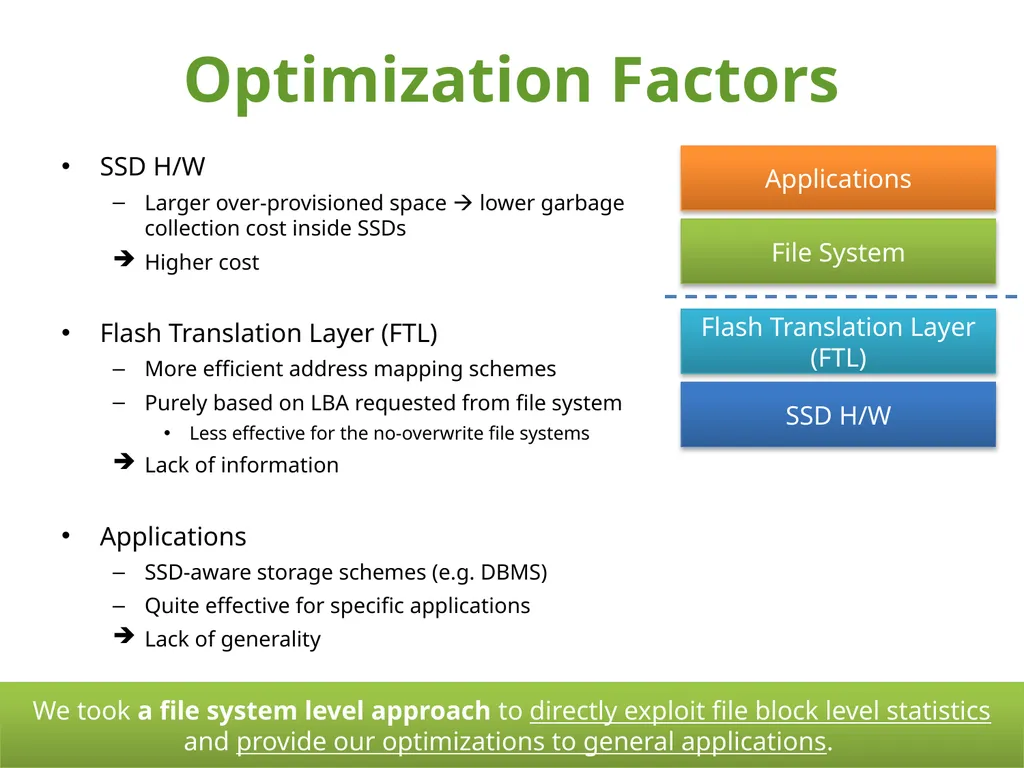
slide6. Optimization Factors SSD H/W
Larger over-provisioned space lower garbage collection cost inside SSDs
Higher cost
Flash Translation Layer (FTL)
More efficient address mapping schemes
Purely based on LBA requested from file system
Less effective for the no-overwrite file systems
Lack of information
Applications
SSD-aware storage schemes (e.g. DBMS)
Quite effective for specific applications
Lack of generality SSD H/W Flash Translation Layer
(FTL) File System Applications We took a file system level approach to directly exploit file block level statistics and provide our optimizations to general applications. 6<br>
slide7. Outline Background
Design Decisions
Log-structured File System
Eager on writing data grouping
Introduction
Segment Writing
Segment Cleaning
Evaluation
Conclusion 7<br>
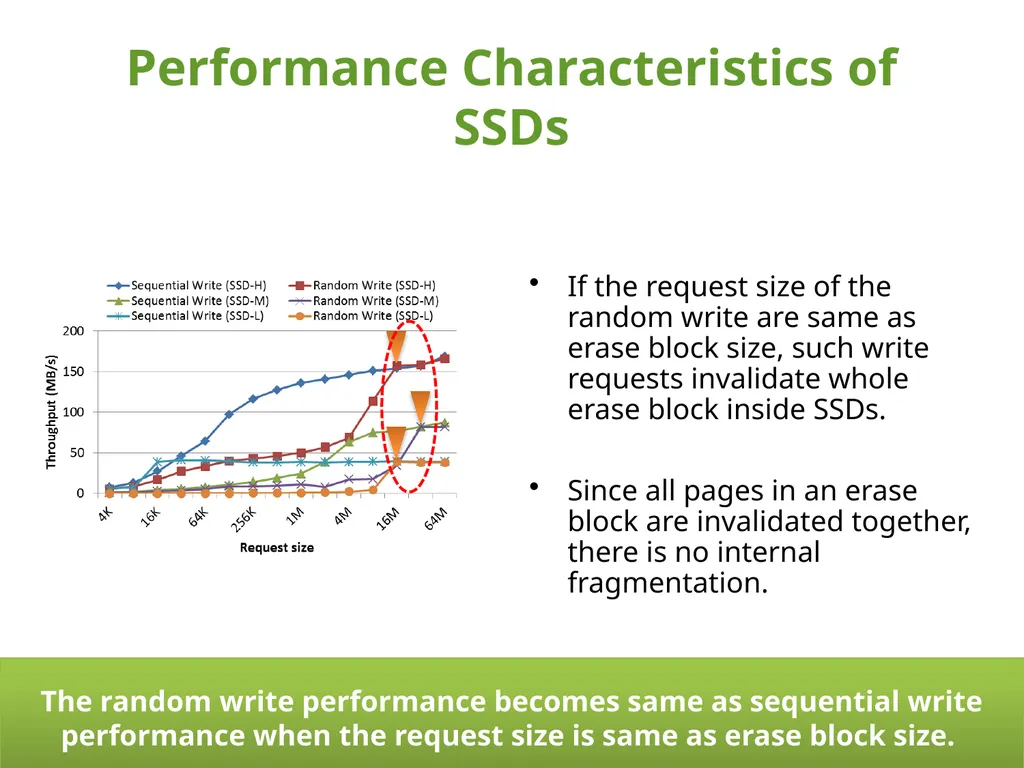
slide8. Performance Characteristics of SSDs If the request size of the random write are same as erase block size, such write requests invalidate whole erase block inside SSDs.
Since all pages in an erase block are invalidated together, there is no internal fragmentation. 8 The random write performance becomes same as sequential write performance when the request size is same as erase block size.<br>
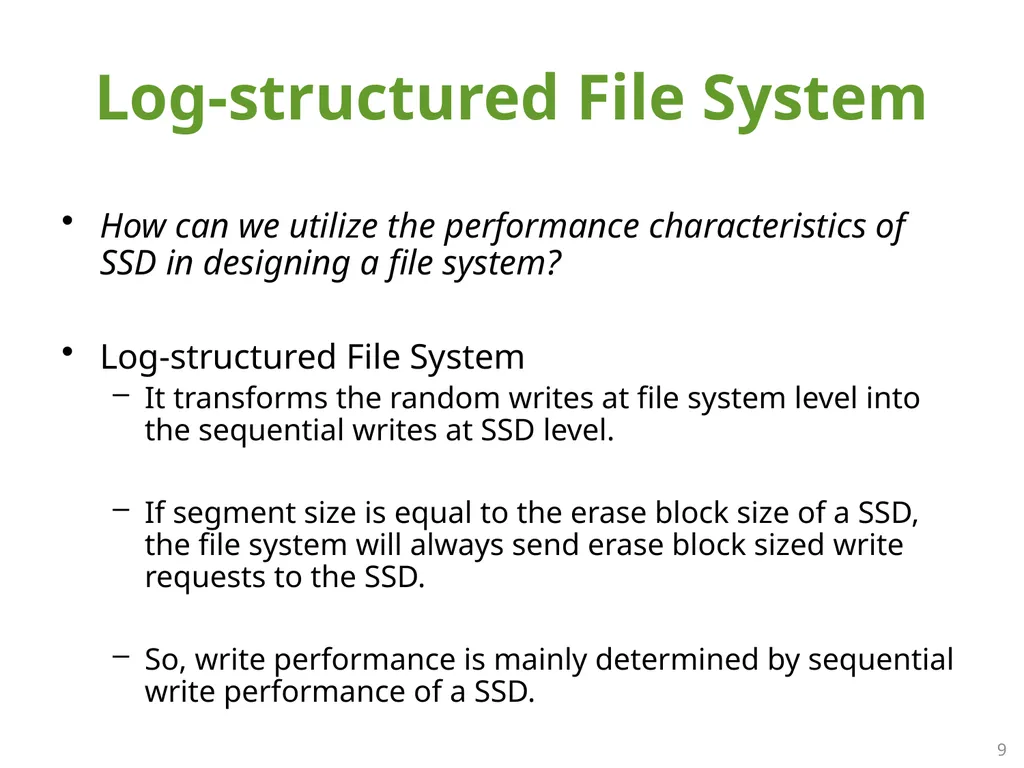
slide9. Log-structured File System How can we utilize the performance characteristics of SSD in designing a file system?
Log-structured File System
It transforms the random writes at file system level into the sequential writes at SSD level.
If segment size is equal to the erase block size of a SSD, the file system will always send erase block sized write requests to the SSD.
So, write performance is mainly determined by sequential write performance of a SSD. 9<br>
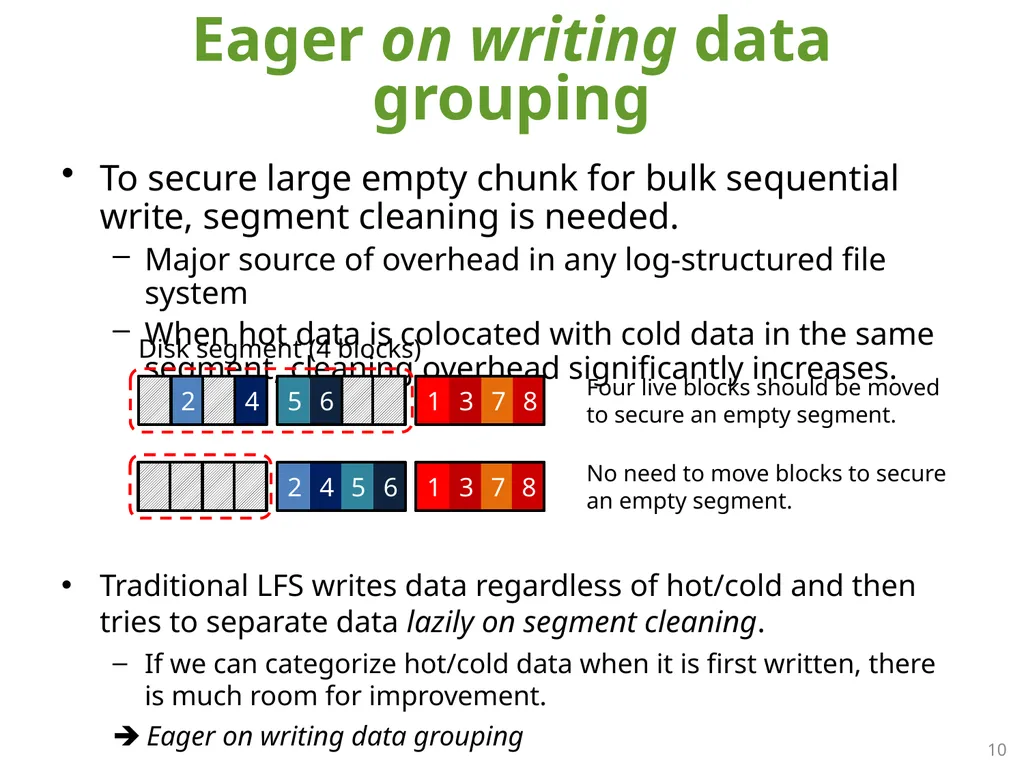
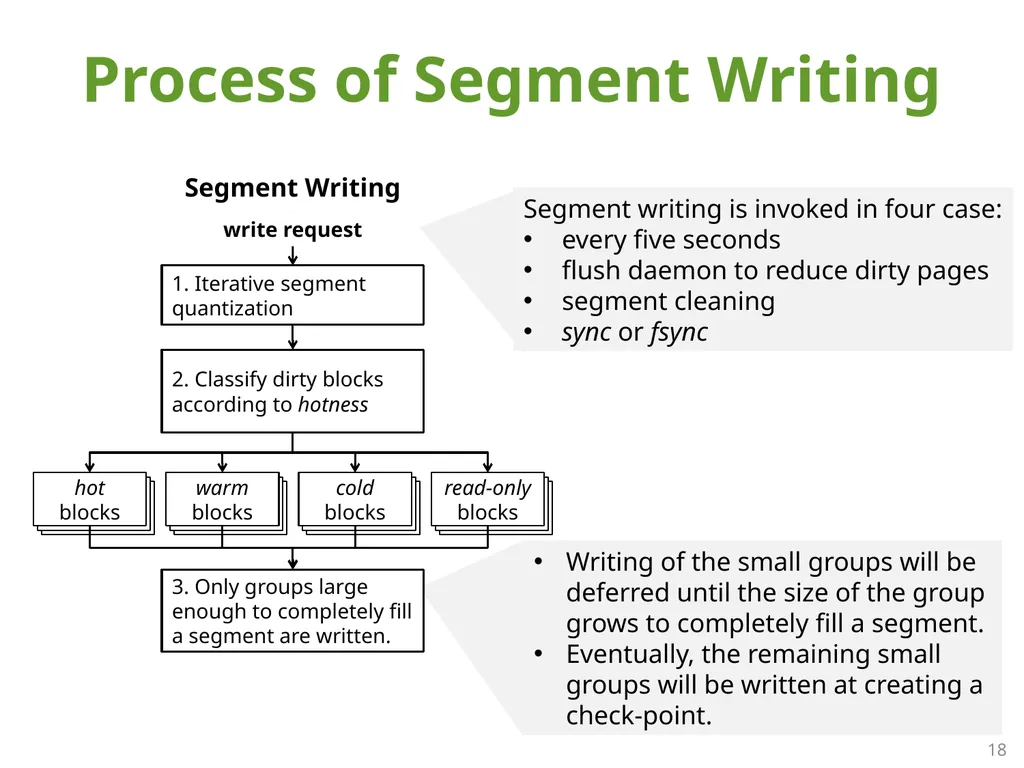
slide10. Eager on writing data grouping To secure large empty chunk for bulk sequential write, segment cleaning is needed.
Major source of overhead in any log-structured file system
When hot data is colocated with cold data in the same segment, cleaning overhead significantly increases. 1 2 3 4 5 6 7 8 1 3 7 8 2 4 5 6 Traditional LFS writes data regardless of hot/cold and then tries to separate data lazily on segment cleaning.
If we can categorize hot/cold data when it is first written, there is much room for improvement.
Eager on writing data grouping Disk segment (4 blocks) 1 3 7 8 Four live blocks should be moved to secure an empty segment. 1 3 7 8 No need to move blocks to secure an empty segment. 10<br>
slide11. Outline Background
Design Decisions
Introduction
Segment Writing
Segment Cleaning
Evaluation
Conclusion 11<br>
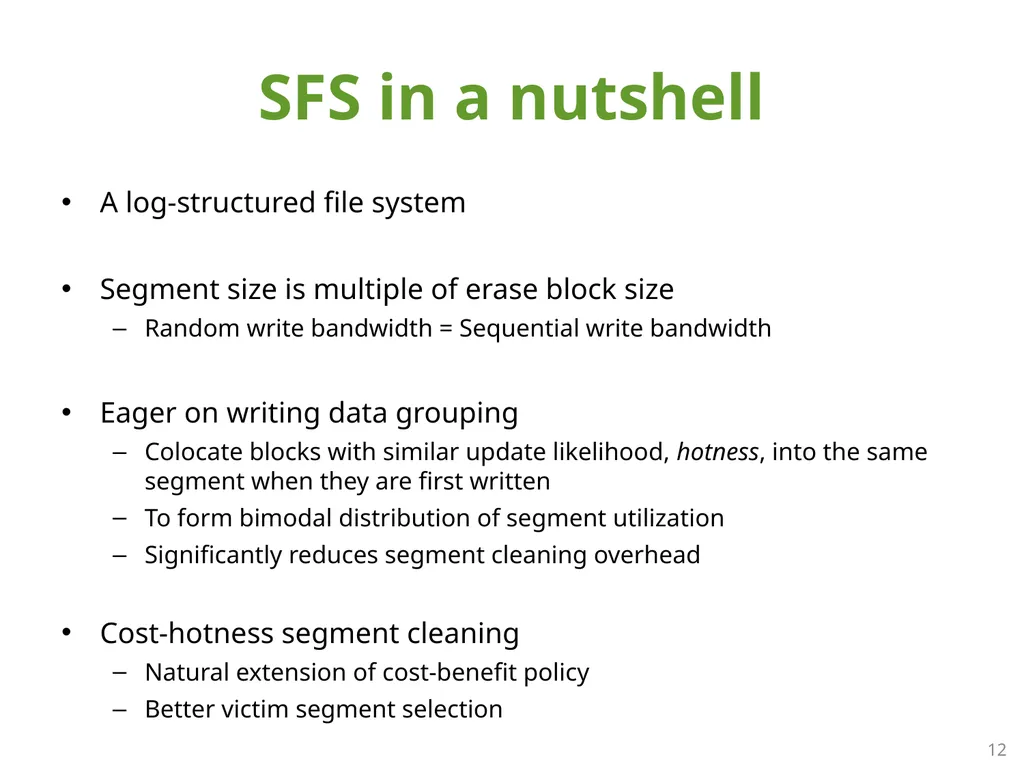
slide12. SFS in a nutshell A log-structured file system
Segment size is multiple of erase block size
Random write bandwidth = Sequential write bandwidth
Eager on writing data grouping
Colocate blocks with similar update likelihood, hotness, into the same segment when they are first written
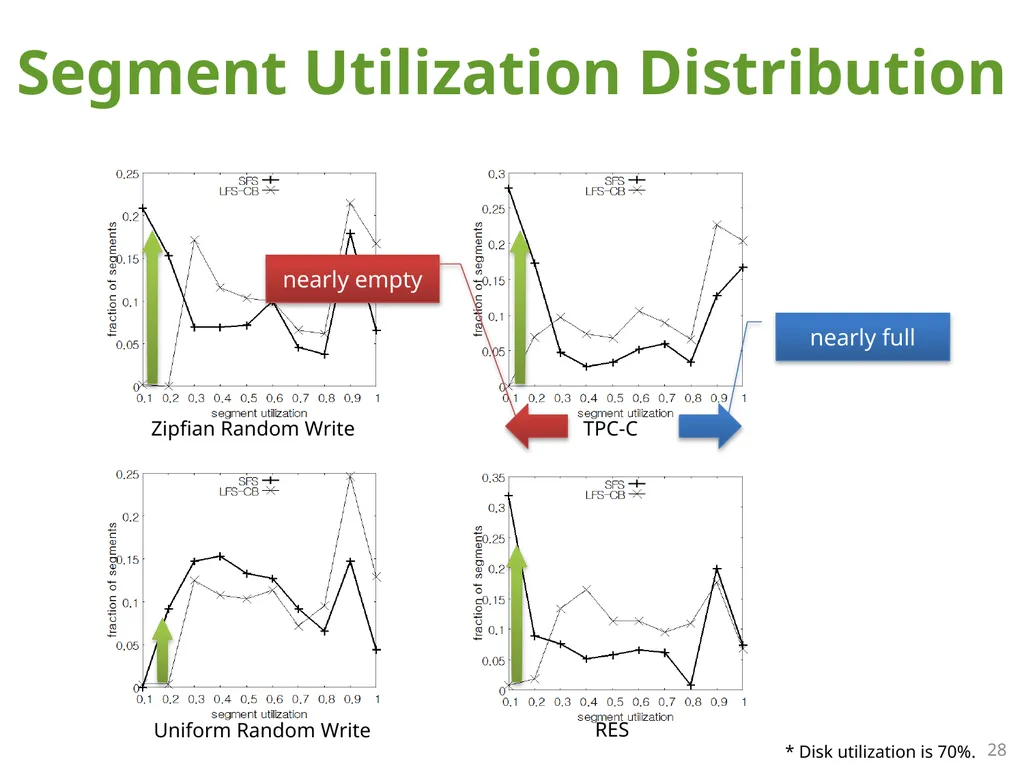
To form bimodal distribution of segment utilization
Significantly reduces segment cleaning overhead
Cost-hotness segment cleaning
Natural extension of cost-benefit policy
Better victim segment selection 12<br>
slide13. Outline Background
Design Decisions
Introduction
Segment Writing
Segment Cleaning
Evaluation
Conclusion 13<br>
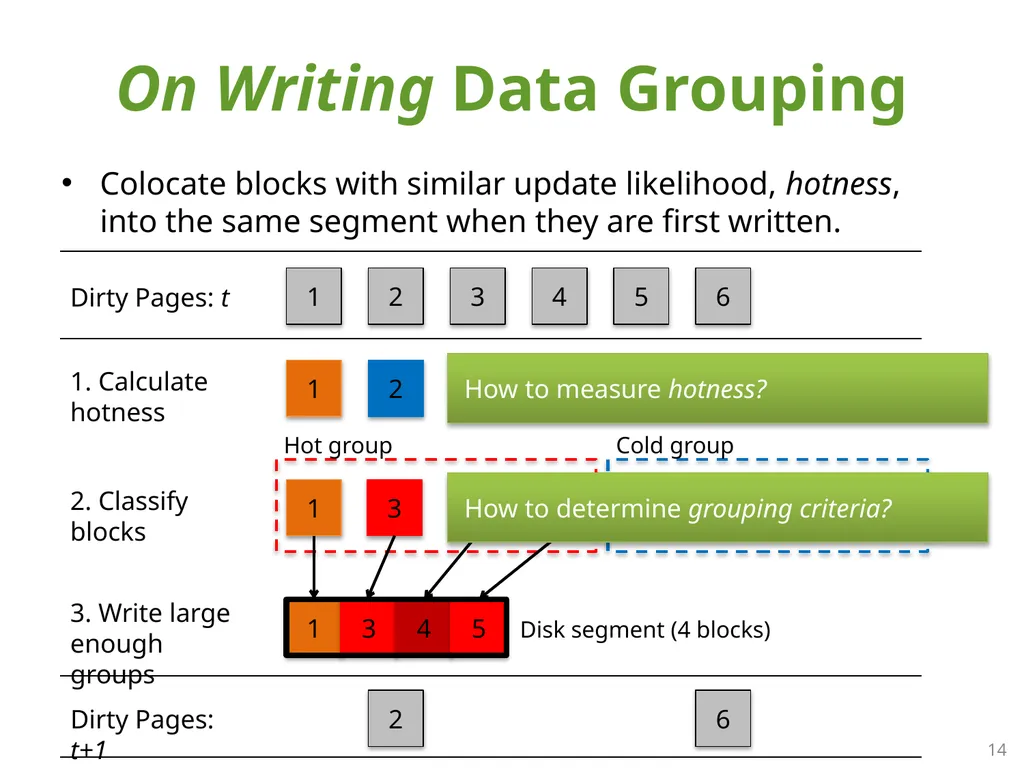
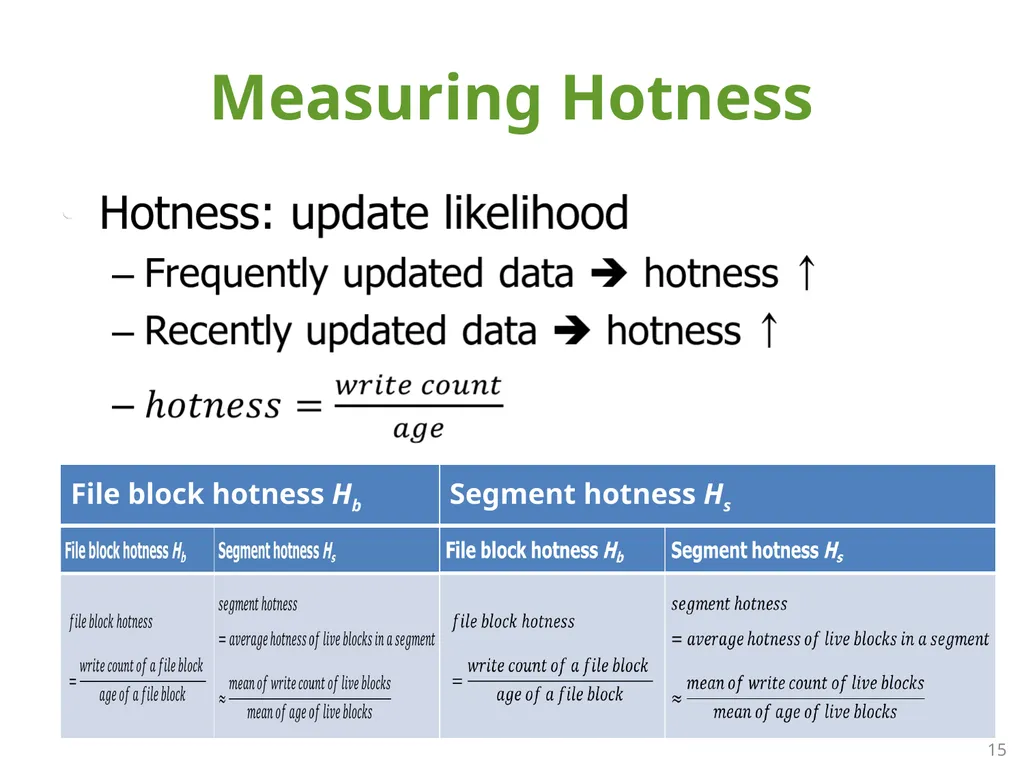
slide14. On Writing Data Grouping Colocate blocks with similar update likelihood, hotness, into the same segment when they are first written. 1 Dirty Pages: t 2 3 4 5 6 1. Calculate hotness 1 2 3 4 5 6 2. Classify blocks 1 3 4 5 2 6 3. Write large enough groups 1 3 4 5 Disk segment (4 blocks) 2 6 Dirty Pages: t+1 How to measure hotness? How to determine grouping criteria? 14<br>
slide15. Measuring Hotness 15<br>
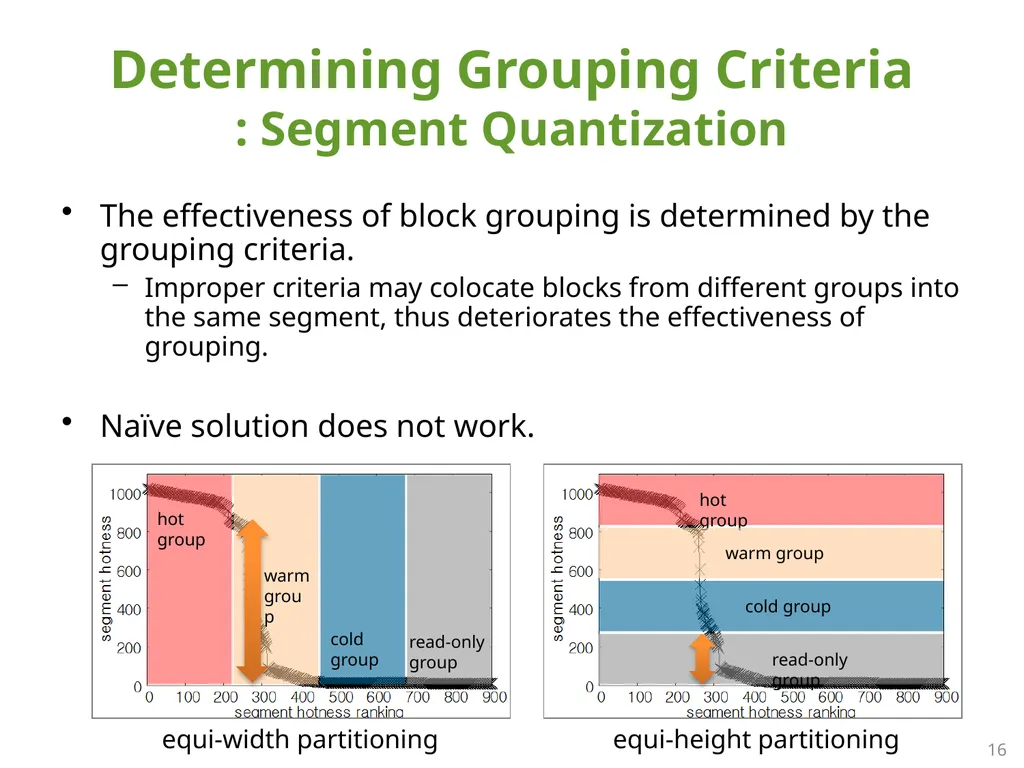
slide16. equi-width partitioning Determining Grouping Criteria : Segment Quantization The effectiveness of block grouping is determined by the grouping criteria.
Improper criteria may colocate blocks from different groups into the same segment, thus deteriorates the effectiveness of grouping.
Naïve solution does not work. 16<br>
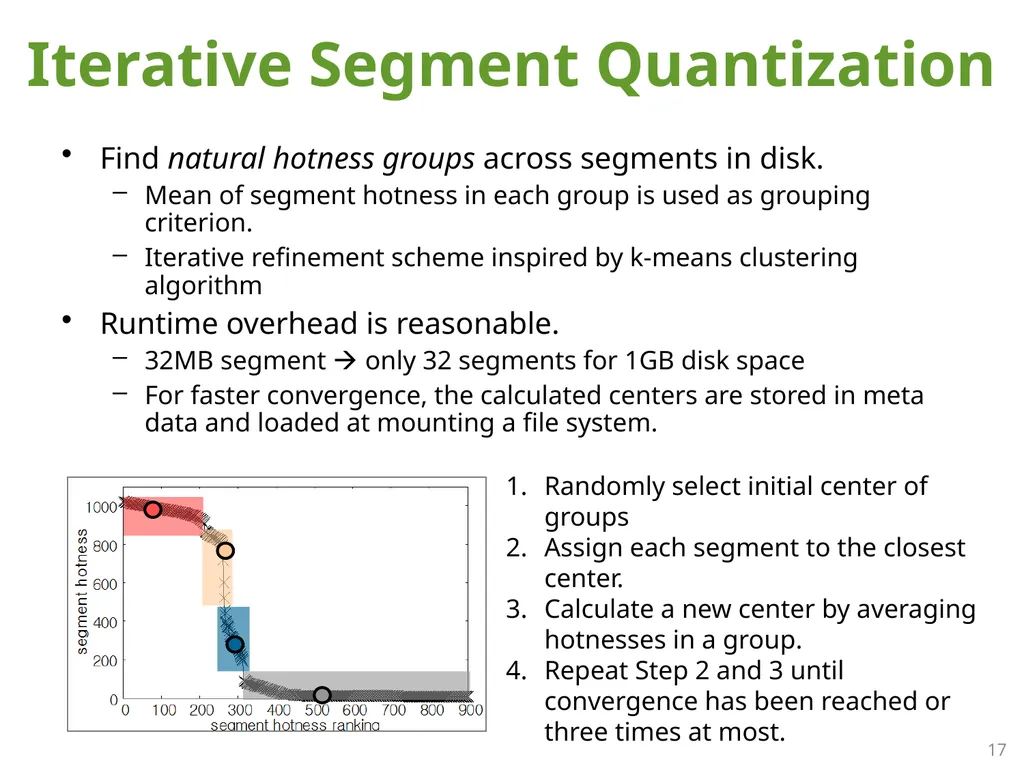
slide17. Iterative Segment Quantization Find natural hotness groups across segments in disk.
Mean of segment hotness in each group is used as grouping criterion.
Iterative refinement scheme inspired by k-means clustering algorithm
Runtime overhead is reasonable.
32MB segment only 32 segments for 1GB disk space
For faster convergence, the calculated centers are stored in meta data and loaded at mounting a file system. Randomly select initial center of groups
Assign each segment to the closest center.
Calculate a new center by averaging hotnesses in a group.
Repeat Step 2 and 3 until convergence has been reached or three times at most. 17<br>
slide18. Process of Segment Writing Segment Writing 2. Classify dirty blocks according to hotness 3. Only groups large enough to completely fill a segment are written. 1. Iterative segment quantization write request 18<br>
slide19. Outline Background
Design Decisions
Introduction
Segment Writing
Segment Cleaning
Evaluation
Conclusion 19<br>
slide20. Cost-hotness Policy 20<br>
slide21. Writing Blocks under Segment Cleaning Live blocks under segment cleaning are handled similarly to typical writing scenario.
Their writing can also be deferred for continuous re-grouping
Continuous re-grouping to form bimodal segment distribution. 21<br>
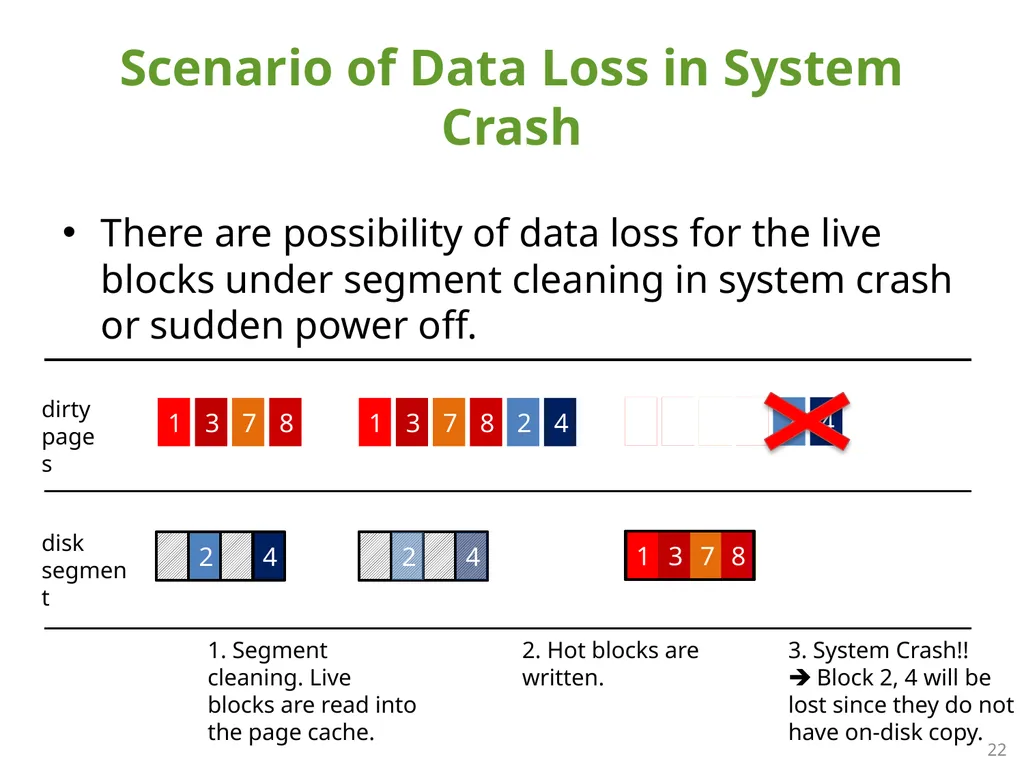
slide22. Scenario of Data Loss in System Crash There are possibility of data loss for the live blocks under segment cleaning in system crash or sudden power off. 1 3 7 8 1 2 3 4 disk segment 1 3 7 8 2 4 dirty pages 1 2 3 4 1. Segment cleaning. Live blocks are read into the page cache. 1 2 3 4 1 3 7 8 2 4 1 3 7 8 2. Hot blocks are written. 3. System Crash!!
Block 2, 4 will be lost since they do not have on-disk copy. 22<br>
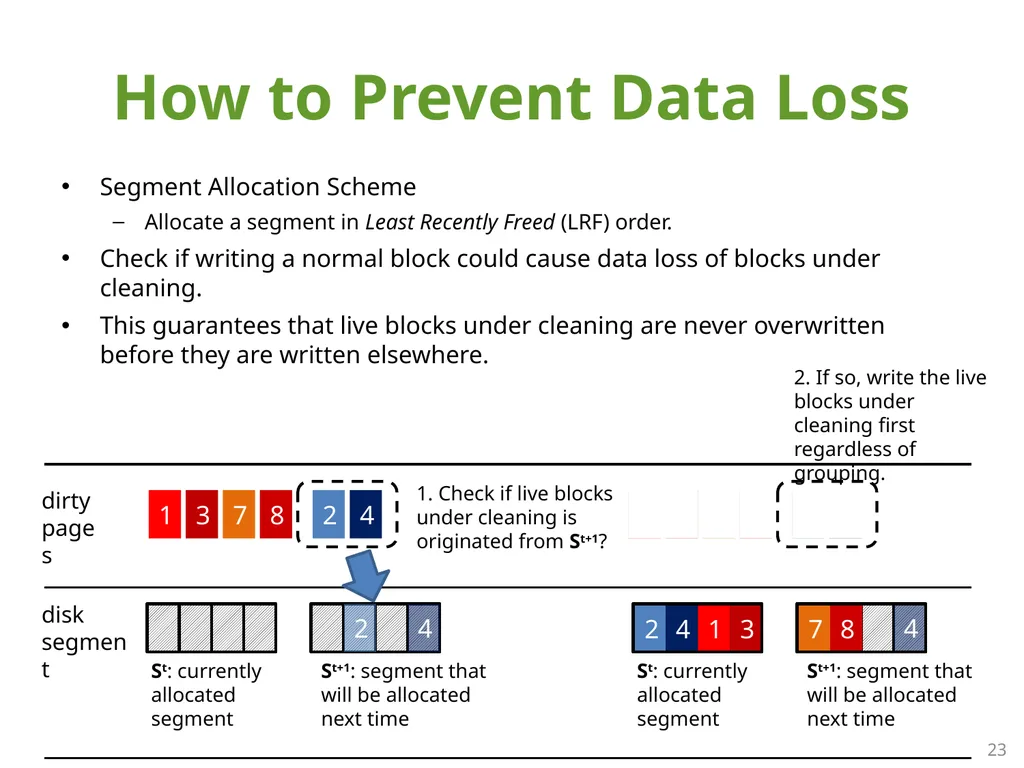
slide23. How to Prevent Data Loss Segment Allocation Scheme
Allocate a segment in Least Recently Freed (LRF) order.
Check if writing a normal block could cause data loss of blocks under cleaning.
This guarantees that live blocks under cleaning are never overwritten before they are written elsewhere. disk segment 1 3 7 8 2 4 dirty pages 1 2 3 4 1 2 3 4 St: currently allocated segment St+1: segment that will be allocated next time 1. Check if live blocks under cleaning is originated from St+1? 1 2 3 4 1 2 3 4 St: currently allocated segment St+1: segment that will be allocated next time 1 3 7 8 2 4 2. If so, write the live blocks under cleaning first regardless of grouping. 2 4 1 3 7 8 ` ` ` ` 23<br>
slide24. Outline Background
Design Decisions
Introduction
Segment Writing
Segment Cleaning
Evaluation
Conclusion 24<br>
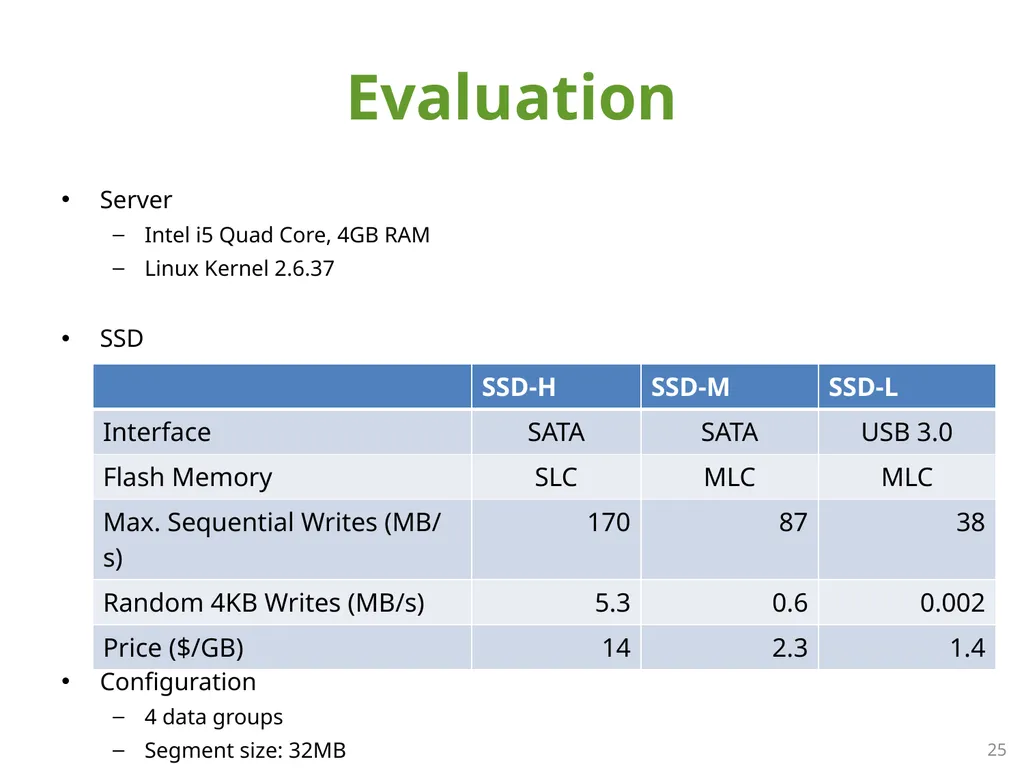
slide25. Evaluation Server
Intel i5 Quad Core, 4GB RAM
Linux Kernel 2.6.37
SSD
Configuration
4 data groups
Segment size: 32MB 25<br>
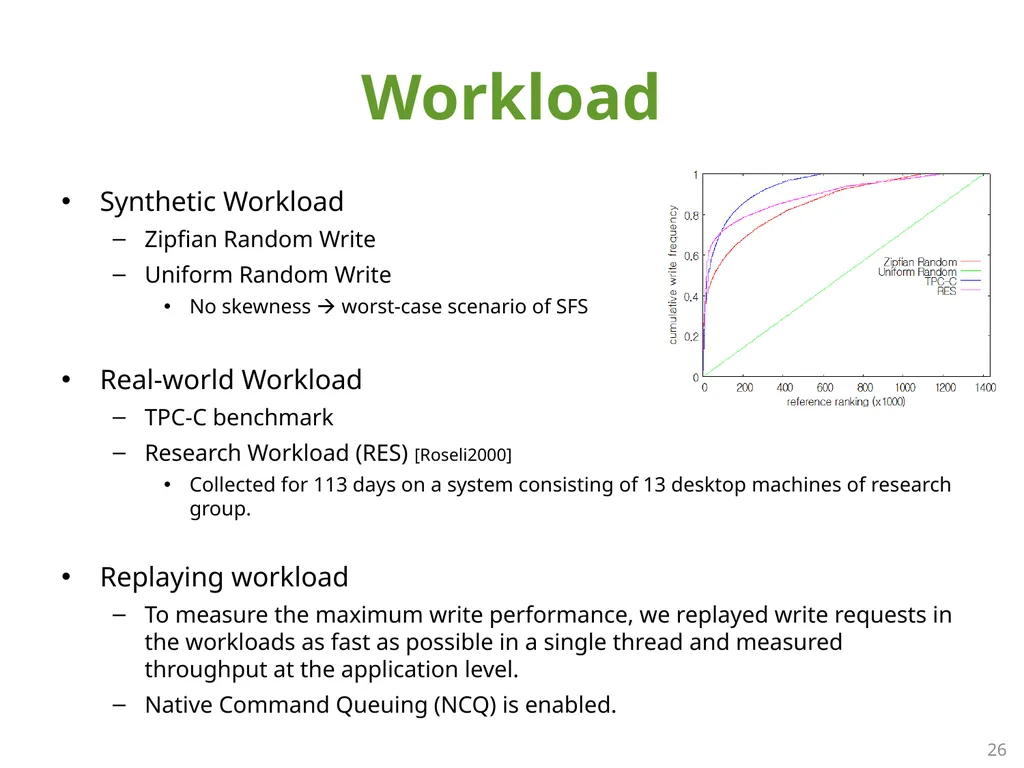
slide26. Workload Synthetic Workload
Zipfian Random Write
Uniform Random Write
No skewness worst-case scenario of SFS
Real-world Workload
TPC-C benchmark
Research Workload (RES) [Roseli2000]
Collected for 113 days on a system consisting of 13 desktop machines of research group.
Replaying workload
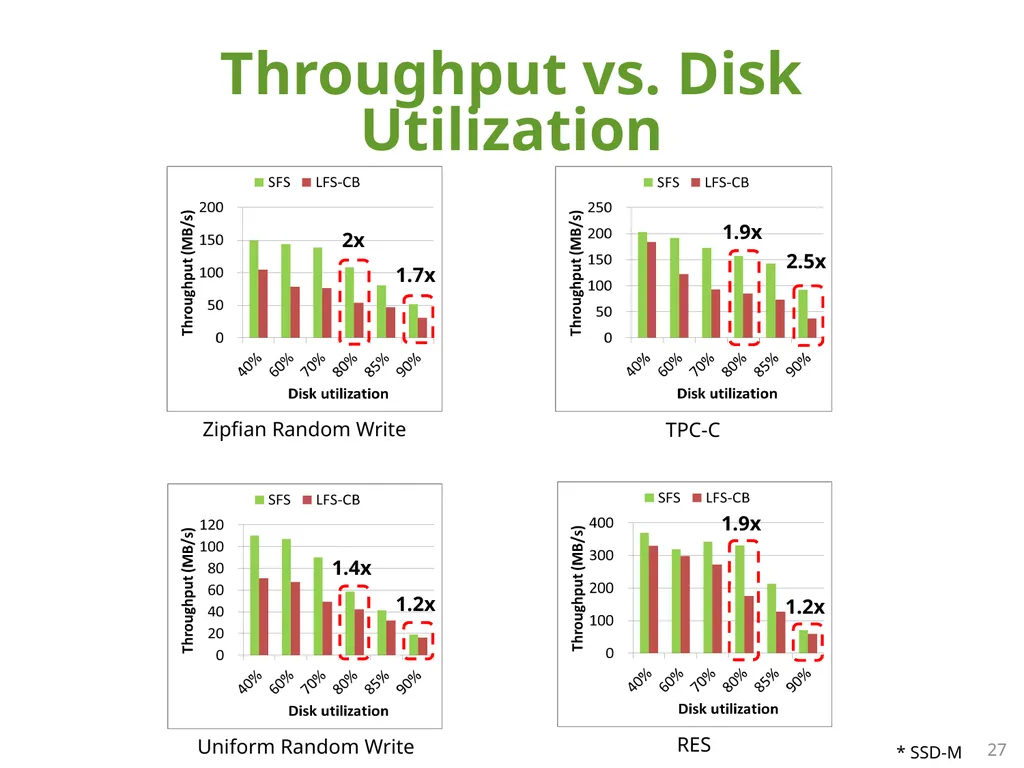
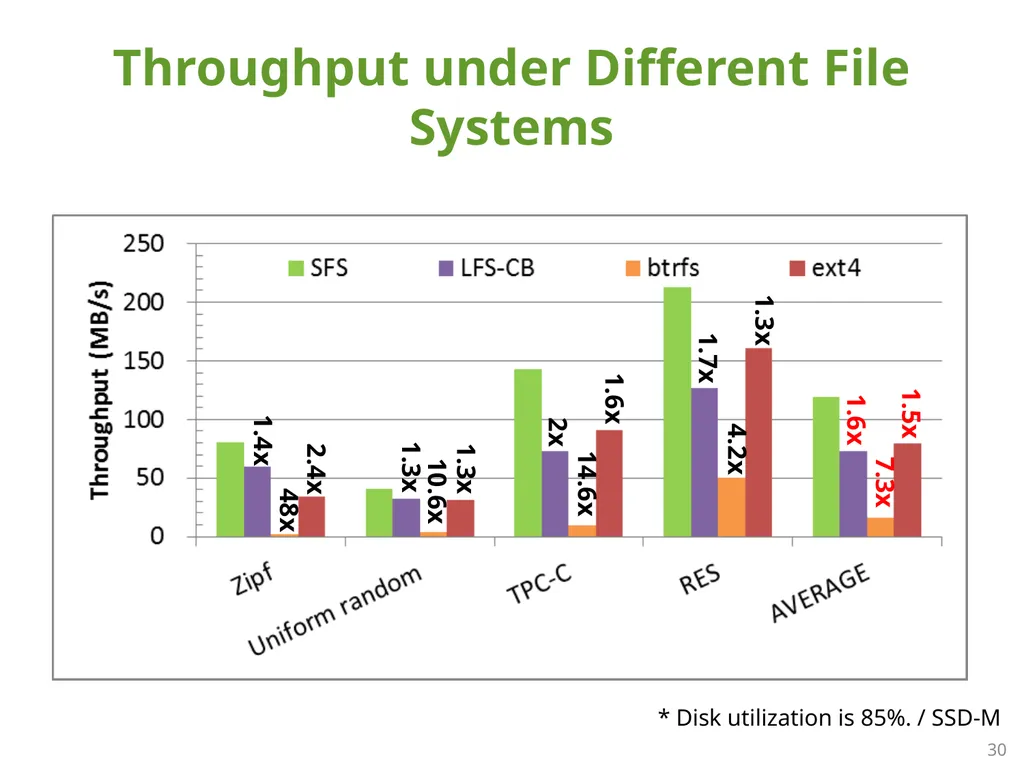
To measure the maximum write performance, we replayed write requests in the workloads as fast as possible in a single thread and measured throughput at the application level.
Native Command Queuing (NCQ) is enabled. 26<br>
slide27. Throughput vs. Disk Utilization 27 * SSD-M Zipfian Random Write TPC-C 2x 1.9x 1.7x Uniform Random Write RES 1.4x 1.2x 1.9x 1.2x<br>
slide28. Segment Utilization Distribution * Disk utilization is 70%. 28<br>
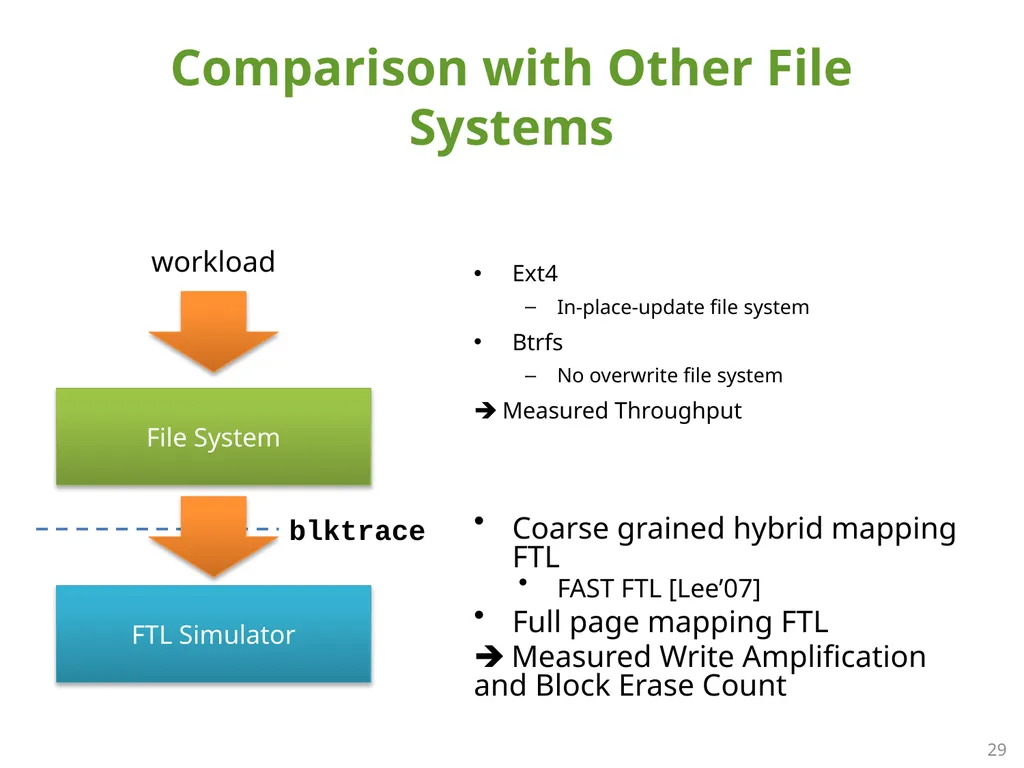
slide29. Comparison with Other File Systems File System FTL Simulator workload Ext4
In-place-update file system
Btrfs
No overwrite file system
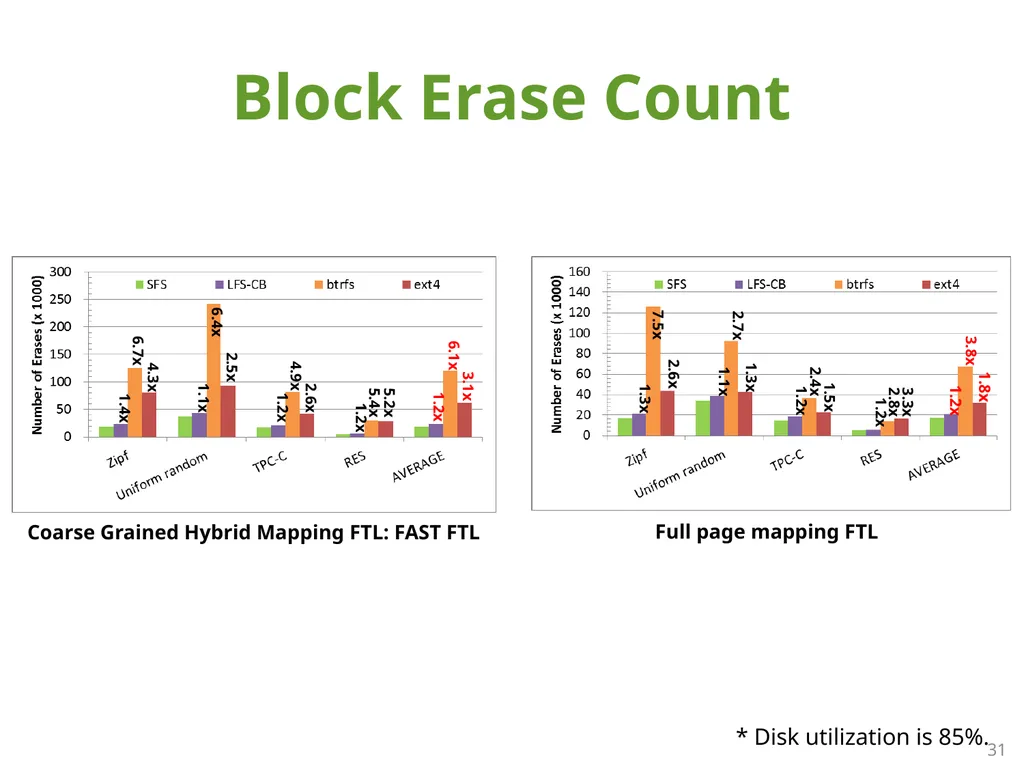
Measured Throughput blktrace Coarse grained hybrid mapping FTL
FAST FTL [Lee’07]
Full page mapping FTL
Measured Write Amplification and Block Erase Count 29<br>
slide30. Throughput under Different File Systems * Disk utilization is 85%. / SSD-M 1.6x 7.3x 1.5x 1.3x 10.6x 1.3x 2x 14.6x 1.6x 30 1.4x 48x 2.4x 1.7x 4.2x 1.3x<br>
slide31. Block Erase Count * Disk utilization is 85%. 31 5.2x<br>
slide32. Outline Background
Design Decisions
Introduction
Segment Writing
Segment Cleaning
Evaluation
Conclusion 32<br>
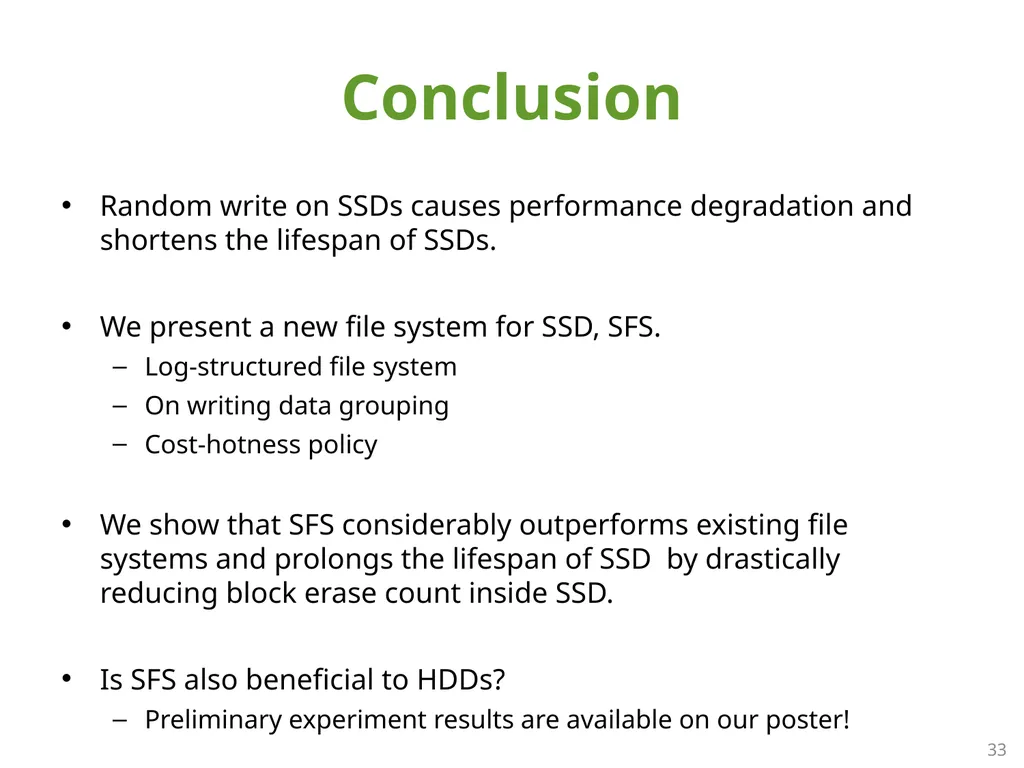
slide33. Conclusion Random write on SSDs causes performance degradation and shortens the lifespan of SSDs.
We present a new file system for SSD, SFS.
Log-structured file system
On writing data grouping
Cost-hotness policy
We show that SFS considerably outperforms existing file systems and prolongs the lifespan of SSD by drastically reducing block erase count inside SSD.
Is SFS also beneficial to HDDs?
Preliminary experiment results are available on our poster! 33<br>
slide34. Thank you! Questions? 34<br>
1Sungkyunkwan University, Korea
2Samsung Electronics, Korea<br>
slide2. Outline Background
Design Decisions
Introduction
Segment Writing
Segment Cleaning
Evaluation
Conclusion 2<br>
slide3. Flash-based Solid State Drives Solid State Drive (SSD)
A purely electronic device built on NAND flash memory
No mechanical parts
Technical merits
Low access latency
Low power consumption
Shock resistance
Potentially uniform random access speed
Remaining two problems limiting wider deployment of SSDs
Limited life span
Random write performance 3<br>
slide4. Limited lifespan of SSDs Limited program/erase (P/E) cycles of NAND flash memory
Single-level Cell (SLC): 100K ~ 1M
Multi-level Cell (MLC): 5K ~ 10K
Triple-level Cell (TLC): 1K
As bit density increases
cost decreases, lifespan decreases
Starting to be used in laptops, desktops and data centers.
Contain write intensive workloads 4<br>
slide5. Random Write Considered Harmful in SSDs Random write is slow.
Even in modern SSDs, the disparity with sequential write bandwidth is more than ten-fold.
Random writes shortens the lifespan of SSDs.
Random write causes internal fragmentation of SSDs.
Internal fragmentation increases garbage collection cost inside SSDs.
Increased garbage collection overhead incurs more block erases per write and degrades performance.
Therefore, the lifespan of SSDs can be drastically reduced by random writes. 5<br>
slide6. Optimization Factors SSD H/W
Larger over-provisioned space lower garbage collection cost inside SSDs
Higher cost
Flash Translation Layer (FTL)
More efficient address mapping schemes
Purely based on LBA requested from file system
Less effective for the no-overwrite file systems
Lack of information
Applications
SSD-aware storage schemes (e.g. DBMS)
Quite effective for specific applications
Lack of generality SSD H/W Flash Translation Layer
(FTL) File System Applications We took a file system level approach to directly exploit file block level statistics and provide our optimizations to general applications. 6<br>
slide7. Outline Background
Design Decisions
Log-structured File System
Eager on writing data grouping
Introduction
Segment Writing
Segment Cleaning
Evaluation
Conclusion 7<br>
slide8. Performance Characteristics of SSDs If the request size of the random write are same as erase block size, such write requests invalidate whole erase block inside SSDs.
Since all pages in an erase block are invalidated together, there is no internal fragmentation. 8 The random write performance becomes same as sequential write performance when the request size is same as erase block size.<br>
slide9. Log-structured File System How can we utilize the performance characteristics of SSD in designing a file system?
Log-structured File System
It transforms the random writes at file system level into the sequential writes at SSD level.
If segment size is equal to the erase block size of a SSD, the file system will always send erase block sized write requests to the SSD.
So, write performance is mainly determined by sequential write performance of a SSD. 9<br>
slide10. Eager on writing data grouping To secure large empty chunk for bulk sequential write, segment cleaning is needed.
Major source of overhead in any log-structured file system
When hot data is colocated with cold data in the same segment, cleaning overhead significantly increases. 1 2 3 4 5 6 7 8 1 3 7 8 2 4 5 6 Traditional LFS writes data regardless of hot/cold and then tries to separate data lazily on segment cleaning.
If we can categorize hot/cold data when it is first written, there is much room for improvement.
Eager on writing data grouping Disk segment (4 blocks) 1 3 7 8 Four live blocks should be moved to secure an empty segment. 1 3 7 8 No need to move blocks to secure an empty segment. 10<br>
slide11. Outline Background
Design Decisions
Introduction
Segment Writing
Segment Cleaning
Evaluation
Conclusion 11<br>
slide12. SFS in a nutshell A log-structured file system
Segment size is multiple of erase block size
Random write bandwidth = Sequential write bandwidth
Eager on writing data grouping
Colocate blocks with similar update likelihood, hotness, into the same segment when they are first written
To form bimodal distribution of segment utilization
Significantly reduces segment cleaning overhead
Cost-hotness segment cleaning
Natural extension of cost-benefit policy
Better victim segment selection 12<br>
slide13. Outline Background
Design Decisions
Introduction
Segment Writing
Segment Cleaning
Evaluation
Conclusion 13<br>
slide14. On Writing Data Grouping Colocate blocks with similar update likelihood, hotness, into the same segment when they are first written. 1 Dirty Pages: t 2 3 4 5 6 1. Calculate hotness 1 2 3 4 5 6 2. Classify blocks 1 3 4 5 2 6 3. Write large enough groups 1 3 4 5 Disk segment (4 blocks) 2 6 Dirty Pages: t+1 How to measure hotness? How to determine grouping criteria? 14<br>
slide15. Measuring Hotness 15<br>
slide16. equi-width partitioning Determining Grouping Criteria : Segment Quantization The effectiveness of block grouping is determined by the grouping criteria.
Improper criteria may colocate blocks from different groups into the same segment, thus deteriorates the effectiveness of grouping.
Naïve solution does not work. 16<br>
slide17. Iterative Segment Quantization Find natural hotness groups across segments in disk.
Mean of segment hotness in each group is used as grouping criterion.
Iterative refinement scheme inspired by k-means clustering algorithm
Runtime overhead is reasonable.
32MB segment only 32 segments for 1GB disk space
For faster convergence, the calculated centers are stored in meta data and loaded at mounting a file system. Randomly select initial center of groups
Assign each segment to the closest center.
Calculate a new center by averaging hotnesses in a group.
Repeat Step 2 and 3 until convergence has been reached or three times at most. 17<br>
slide18. Process of Segment Writing Segment Writing 2. Classify dirty blocks according to hotness 3. Only groups large enough to completely fill a segment are written. 1. Iterative segment quantization write request 18<br>
slide19. Outline Background
Design Decisions
Introduction
Segment Writing
Segment Cleaning
Evaluation
Conclusion 19<br>
slide20. Cost-hotness Policy 20<br>
slide21. Writing Blocks under Segment Cleaning Live blocks under segment cleaning are handled similarly to typical writing scenario.
Their writing can also be deferred for continuous re-grouping
Continuous re-grouping to form bimodal segment distribution. 21<br>
slide22. Scenario of Data Loss in System Crash There are possibility of data loss for the live blocks under segment cleaning in system crash or sudden power off. 1 3 7 8 1 2 3 4 disk segment 1 3 7 8 2 4 dirty pages 1 2 3 4 1. Segment cleaning. Live blocks are read into the page cache. 1 2 3 4 1 3 7 8 2 4 1 3 7 8 2. Hot blocks are written. 3. System Crash!!
Block 2, 4 will be lost since they do not have on-disk copy. 22<br>
slide23. How to Prevent Data Loss Segment Allocation Scheme
Allocate a segment in Least Recently Freed (LRF) order.
Check if writing a normal block could cause data loss of blocks under cleaning.
This guarantees that live blocks under cleaning are never overwritten before they are written elsewhere. disk segment 1 3 7 8 2 4 dirty pages 1 2 3 4 1 2 3 4 St: currently allocated segment St+1: segment that will be allocated next time 1. Check if live blocks under cleaning is originated from St+1? 1 2 3 4 1 2 3 4 St: currently allocated segment St+1: segment that will be allocated next time 1 3 7 8 2 4 2. If so, write the live blocks under cleaning first regardless of grouping. 2 4 1 3 7 8 ` ` ` ` 23<br>
slide24. Outline Background
Design Decisions
Introduction
Segment Writing
Segment Cleaning
Evaluation
Conclusion 24<br>
slide25. Evaluation Server
Intel i5 Quad Core, 4GB RAM
Linux Kernel 2.6.37
SSD
Configuration
4 data groups
Segment size: 32MB 25<br>
slide26. Workload Synthetic Workload
Zipfian Random Write
Uniform Random Write
No skewness worst-case scenario of SFS
Real-world Workload
TPC-C benchmark
Research Workload (RES) [Roseli2000]
Collected for 113 days on a system consisting of 13 desktop machines of research group.
Replaying workload
To measure the maximum write performance, we replayed write requests in the workloads as fast as possible in a single thread and measured throughput at the application level.
Native Command Queuing (NCQ) is enabled. 26<br>
slide27. Throughput vs. Disk Utilization 27 * SSD-M Zipfian Random Write TPC-C 2x 1.9x 1.7x Uniform Random Write RES 1.4x 1.2x 1.9x 1.2x<br>
slide28. Segment Utilization Distribution * Disk utilization is 70%. 28<br>
slide29. Comparison with Other File Systems File System FTL Simulator workload Ext4
In-place-update file system
Btrfs
No overwrite file system
Measured Throughput blktrace Coarse grained hybrid mapping FTL
FAST FTL [Lee’07]
Full page mapping FTL
Measured Write Amplification and Block Erase Count 29<br>
slide30. Throughput under Different File Systems * Disk utilization is 85%. / SSD-M 1.6x 7.3x 1.5x 1.3x 10.6x 1.3x 2x 14.6x 1.6x 30 1.4x 48x 2.4x 1.7x 4.2x 1.3x<br>
slide31. Block Erase Count * Disk utilization is 85%. 31 5.2x<br>
slide32. Outline Background
Design Decisions
Introduction
Segment Writing
Segment Cleaning
Evaluation
Conclusion 32<br>
slide33. Conclusion Random write on SSDs causes performance degradation and shortens the lifespan of SSDs.
We present a new file system for SSD, SFS.
Log-structured file system
On writing data grouping
Cost-hotness policy
We show that SFS considerably outperforms existing file systems and prolongs the lifespan of SSD by drastically reducing block erase count inside SSD.
Is SFS also beneficial to HDDs?
Preliminary experiment results are available on our poster! 33<br>
slide34. Thank you! Questions? 34<br>