
Sharing Planetary Science De-Jargoning Your Talks
Description: Sharing Planetary Science De-Jargoning Your Talks LPI Education and Public Engagement Sept. 17, 2020 Having trouble hearing? Call in to join by phone: 1(346) 980-4201 Meeting ID: 148 423 9532 This seminar is being recorded and will be
Related Topics
Download Presentation
"Sharing Planetary Science De-Jargoning Your Talks" is the property of its rightful owner. Permission is granted to download and print the materials on this website for personal, non-commercial use only, and to display it on your personal computer provided you do not modify the materials and that you retain all copyright notices contained in the materials. By downloading content from our website, you accept the terms of this agreement.
Presentation Transcript
slide1. Sharing Planetary Science De-Jargoning Your Talks
LPI Education and Public Engagement
Sept. 17, 2020 Having trouble hearing? Call in to join by phone: +1(346) 980-4201
Meeting ID: 148 423 9532# This seminar is being recorded and will be posted.<br>
slide2. Sharing Planetary Science De-Jargoning Your Talk
Presenters:
Dr. Sanlyn Buxner, PSI
Christine Shupla, LPI This seminar is being recorded and will be posted. Having trouble hearing? Call in to join by phone: +1(346) 980-4201
Meeting ID: 148 423 9532#<br>
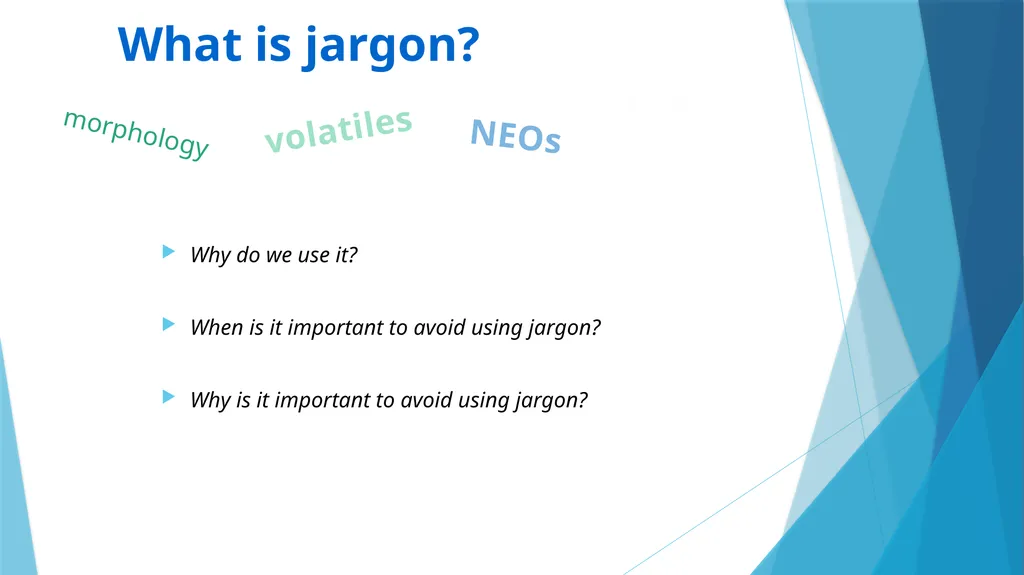
slide3. What is jargon? Why do we use it?
When is it important to avoid using jargon?
Why is it important to avoid using jargon? GA morphology volatiles NEOs<br>
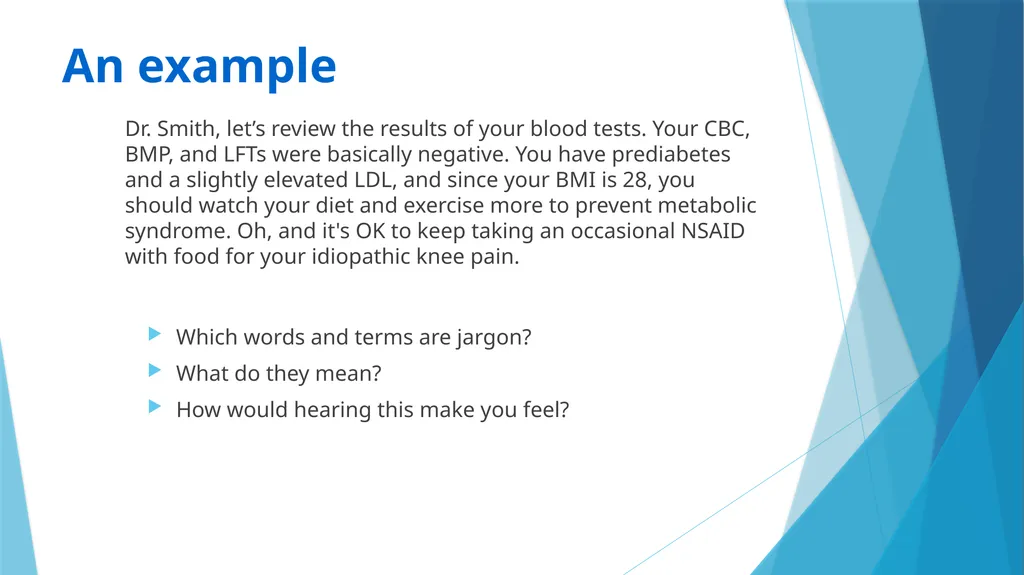
slide4. An example Dr. Smith, let’s review the results of your blood tests. Your CBC, BMP, and LFTs were basically negative. You have prediabetes and a slightly elevated LDL, and since your BMI is 28, you should watch your diet and exercise more to prevent metabolic syndrome. Oh, and it's OK to keep taking an occasional NSAID with food for your idiopathic knee pain. Which words and terms are jargon?
What do they mean?
How would hearing this make you feel?<br>
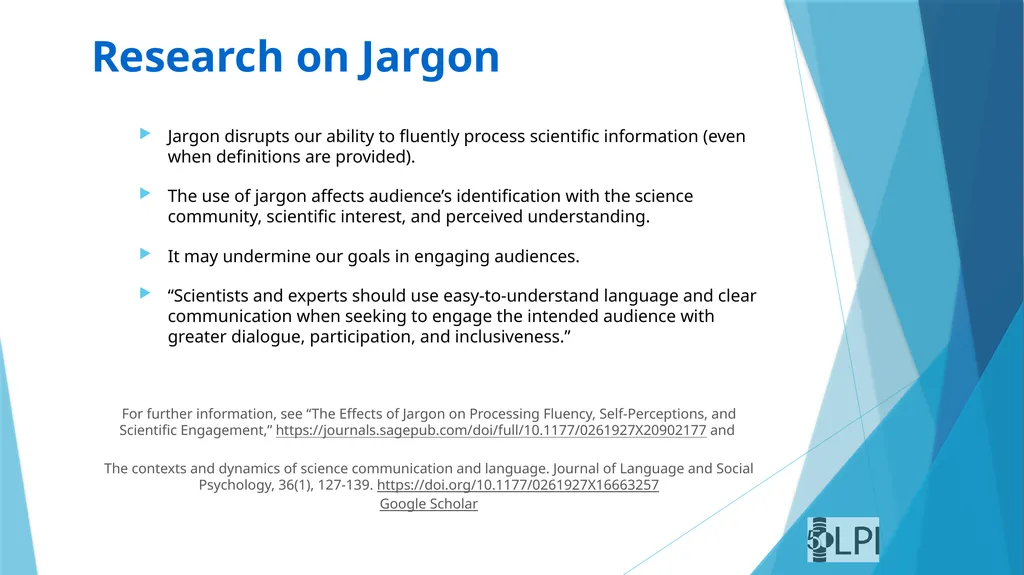
slide5. Research on Jargon Jargon disrupts our ability to fluently process scientific information (even when definitions are provided).
The use of jargon affects audience’s identification with the science community, scientific interest, and perceived understanding.
It may undermine our goals in engaging audiences.
“Scientists and experts should use easy-to-understand language and clear communication when seeking to engage the intended audience with greater dialogue, participation, and inclusiveness.”
For further information, see “The Effects of Jargon on Processing Fluency, Self-Perceptions, and Scientific Engagement,” https://journals.sagepub.com/doi/full/10.1177/0261927X20902177 and
The contexts and dynamics of science communication and language. Journal of Language and Social Psychology, 36(1), 127-139. https://doi.org/10.1177/0261927X16663257 Google Scholar<br>
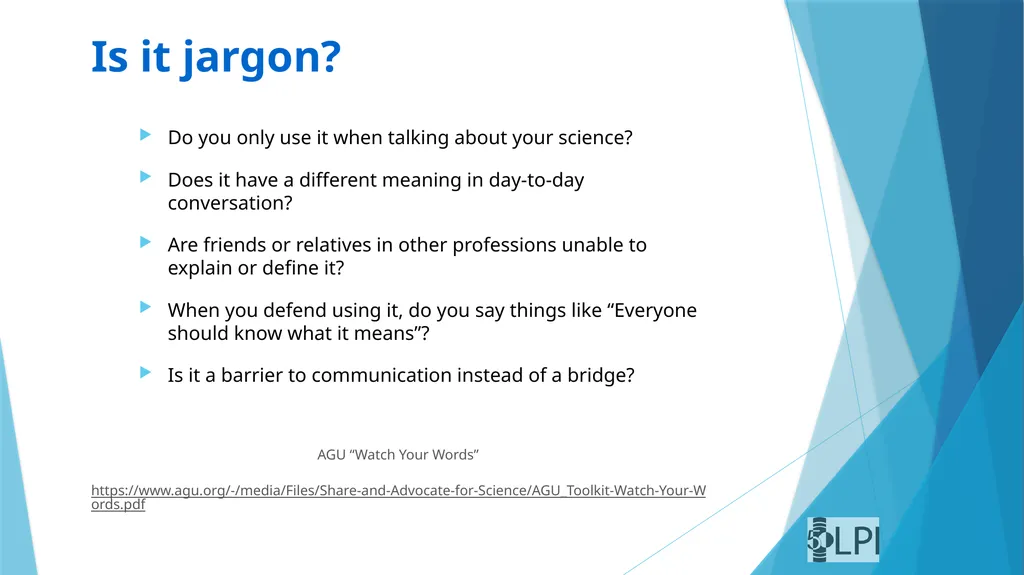
slide6. Is it jargon? Do you only use it when talking about your science?
Does it have a different meaning in day-to-day conversation?
Are friends or relatives in other professions unable to explain or define it?
When you defend using it, do you say things like “Everyone should know what it means”?
Is it a barrier to communication instead of a bridge?
AGU “Watch Your Words”
https://www.agu.org/-/media/Files/Share-and-Advocate-for-Science/AGU_Toolkit-Watch-Your-Words.pdf<br>
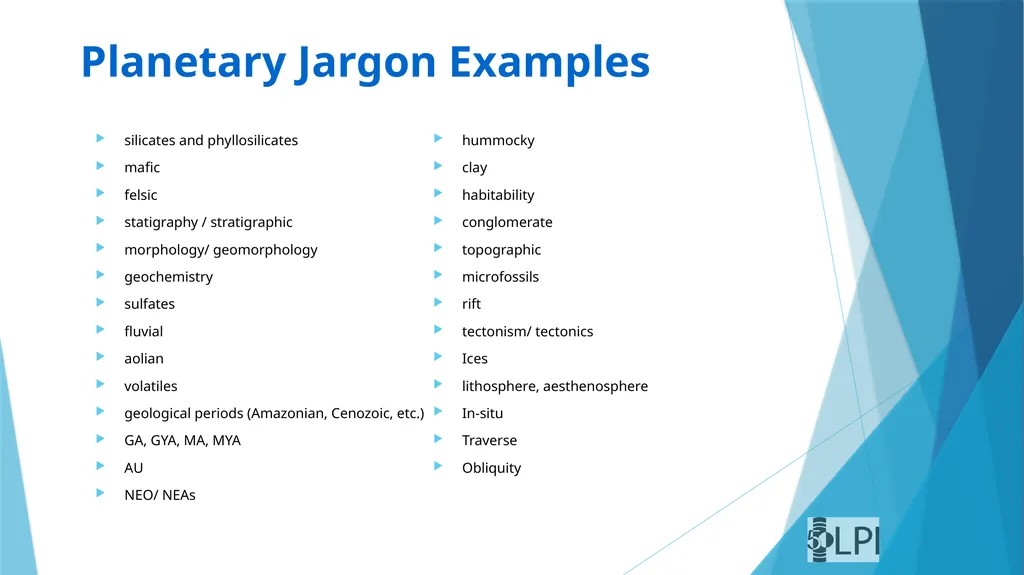
slide7. Planetary Jargon Examples silicates and phyllosilicates
mafic
felsic
statigraphy / stratigraphic
morphology/ geomorphology
geochemistry
sulfates
fluvial
aolian
volatiles
geological periods (Amazonian, Cenozoic, etc.)
GA, GYA, MA, MYA
AU
NEO/ NEAs
hummocky
clay
habitability
conglomerate
topographic
microfossils
rift
tectonism/ tectonics
Ices
lithosphere, aesthenosphere
In-situ
Traverse
Obliquity<br>
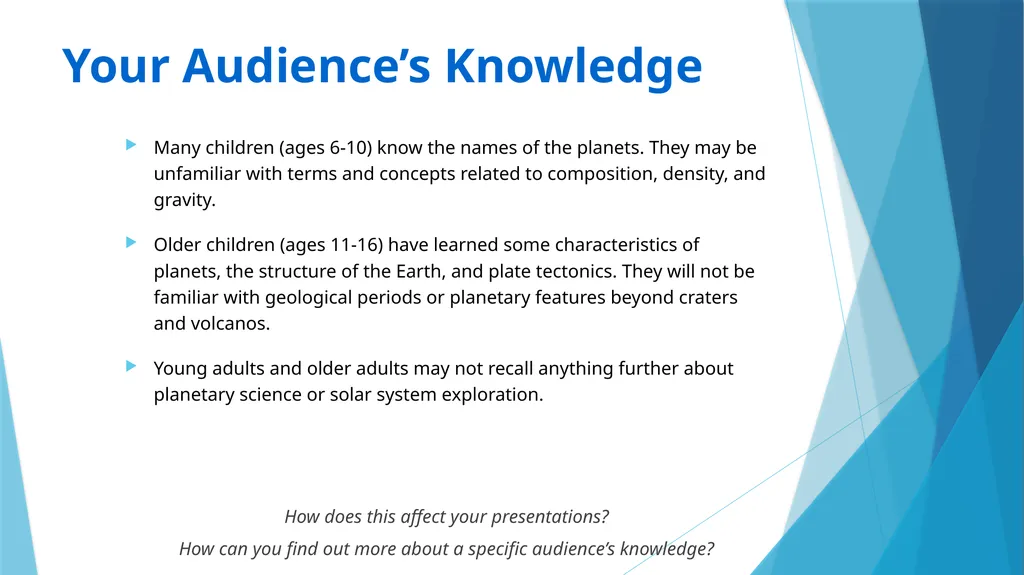
slide8. Your Audience’s Knowledge Many children (ages 6-10) know the names of the planets. They may be unfamiliar with terms and concepts related to composition, density, and gravity.
Older children (ages 11-16) have learned some characteristics of planets, the structure of the Earth, and plate tectonics. They will not be familiar with geological periods or planetary features beyond craters and volcanos.
Young adults and older adults may not recall anything further about planetary science or solar system exploration.
How does this affect your presentations?
How can you find out more about a specific audience’s knowledge?<br>
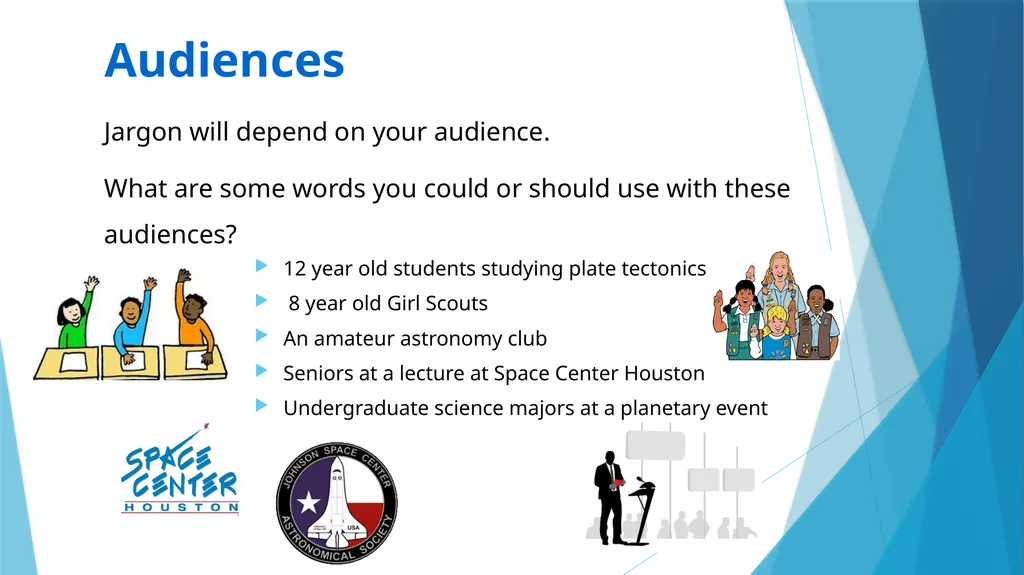
slide9. Audiences Jargon will depend on your audience.
What are some words you could or should use with these audiences? 12 year old students studying plate tectonics
8 year old Girl Scouts
An amateur astronomy club
Seniors at a lecture at Space Center Houston
Undergraduate science majors at a planetary event<br>
slide10. Describing Your Research How can you describe your work simply, without using jargon?
Can you do it in 30 seconds?
Please enter your own short description of your research in the chat. Any volunteers?<br>
slide11. Resources AGU’s Watch Your Words:
https://www.agu.org/-/media/Files/Share-and-Advocate-for-Science/AGU_Toolkit-Watch-Your-Words.pdf
De-Jargonizer:
http://scienceandpublic.com/Home/About?whatIsIt
LPI: General Understanding of Planetary Science<br>
slide12. Thanks! We have a very short evaluation form; we appreciate your feedback!
https://www.surveymonkey.com/r/SharingPlanetaryScience.
Past seminar recordings and presentations are available at www.lpi.usra.edu/education/scientist-engagement.
Feel free to contact us with your thoughts and suggestions!<br>
LPI Education and Public Engagement
Sept. 17, 2020 Having trouble hearing? Call in to join by phone: +1(346) 980-4201
Meeting ID: 148 423 9532# This seminar is being recorded and will be posted.<br>
slide2. Sharing Planetary Science De-Jargoning Your Talk
Presenters:
Dr. Sanlyn Buxner, PSI
Christine Shupla, LPI This seminar is being recorded and will be posted. Having trouble hearing? Call in to join by phone: +1(346) 980-4201
Meeting ID: 148 423 9532#<br>
slide3. What is jargon? Why do we use it?
When is it important to avoid using jargon?
Why is it important to avoid using jargon? GA morphology volatiles NEOs<br>
slide4. An example Dr. Smith, let’s review the results of your blood tests. Your CBC, BMP, and LFTs were basically negative. You have prediabetes and a slightly elevated LDL, and since your BMI is 28, you should watch your diet and exercise more to prevent metabolic syndrome. Oh, and it's OK to keep taking an occasional NSAID with food for your idiopathic knee pain. Which words and terms are jargon?
What do they mean?
How would hearing this make you feel?<br>
slide5. Research on Jargon Jargon disrupts our ability to fluently process scientific information (even when definitions are provided).
The use of jargon affects audience’s identification with the science community, scientific interest, and perceived understanding.
It may undermine our goals in engaging audiences.
“Scientists and experts should use easy-to-understand language and clear communication when seeking to engage the intended audience with greater dialogue, participation, and inclusiveness.”
For further information, see “The Effects of Jargon on Processing Fluency, Self-Perceptions, and Scientific Engagement,” https://journals.sagepub.com/doi/full/10.1177/0261927X20902177 and
The contexts and dynamics of science communication and language. Journal of Language and Social Psychology, 36(1), 127-139. https://doi.org/10.1177/0261927X16663257 Google Scholar<br>
slide6. Is it jargon? Do you only use it when talking about your science?
Does it have a different meaning in day-to-day conversation?
Are friends or relatives in other professions unable to explain or define it?
When you defend using it, do you say things like “Everyone should know what it means”?
Is it a barrier to communication instead of a bridge?
AGU “Watch Your Words”
https://www.agu.org/-/media/Files/Share-and-Advocate-for-Science/AGU_Toolkit-Watch-Your-Words.pdf<br>
slide7. Planetary Jargon Examples silicates and phyllosilicates
mafic
felsic
statigraphy / stratigraphic
morphology/ geomorphology
geochemistry
sulfates
fluvial
aolian
volatiles
geological periods (Amazonian, Cenozoic, etc.)
GA, GYA, MA, MYA
AU
NEO/ NEAs
hummocky
clay
habitability
conglomerate
topographic
microfossils
rift
tectonism/ tectonics
Ices
lithosphere, aesthenosphere
In-situ
Traverse
Obliquity<br>
slide8. Your Audience’s Knowledge Many children (ages 6-10) know the names of the planets. They may be unfamiliar with terms and concepts related to composition, density, and gravity.
Older children (ages 11-16) have learned some characteristics of planets, the structure of the Earth, and plate tectonics. They will not be familiar with geological periods or planetary features beyond craters and volcanos.
Young adults and older adults may not recall anything further about planetary science or solar system exploration.
How does this affect your presentations?
How can you find out more about a specific audience’s knowledge?<br>
slide9. Audiences Jargon will depend on your audience.
What are some words you could or should use with these audiences? 12 year old students studying plate tectonics
8 year old Girl Scouts
An amateur astronomy club
Seniors at a lecture at Space Center Houston
Undergraduate science majors at a planetary event<br>
slide10. Describing Your Research How can you describe your work simply, without using jargon?
Can you do it in 30 seconds?
Please enter your own short description of your research in the chat. Any volunteers?<br>
slide11. Resources AGU’s Watch Your Words:
https://www.agu.org/-/media/Files/Share-and-Advocate-for-Science/AGU_Toolkit-Watch-Your-Words.pdf
De-Jargonizer:
http://scienceandpublic.com/Home/About?whatIsIt
LPI: General Understanding of Planetary Science<br>
slide12. Thanks! We have a very short evaluation form; we appreciate your feedback!
https://www.surveymonkey.com/r/SharingPlanetaryScience.
Past seminar recordings and presentations are available at www.lpi.usra.edu/education/scientist-engagement.
Feel free to contact us with your thoughts and suggestions!<br>