
Shoftim: “Do not destroy”— When is it Allowed? Why
TF
Published · 39 slides · 0 views
1 / 1


Description
Shoftim: Do not destroy When is it Allowed? Why is it forbidden to cut down a fruit tree, but permitted to burn clothing? BH A. The Prohibition of wast Simchat Torah SOURCE 1 Deuteronomy 20:19-20 When you besiege a city for many days to
Related Topics
Share
Embed code
Download this presentation From Below
"Shoftim: “Do not destroy”— When is it Allowed? Why" is the property of its rightful owner. Permission is granted to download and print the materials on this website for personal, non-commercial use only, and to display it on your personal computer provided you do not modify the materials and that you retain all copyright notices contained in the materials. By downloading content from our website, you accept the terms of this agreement.
Presentation Transcript
01
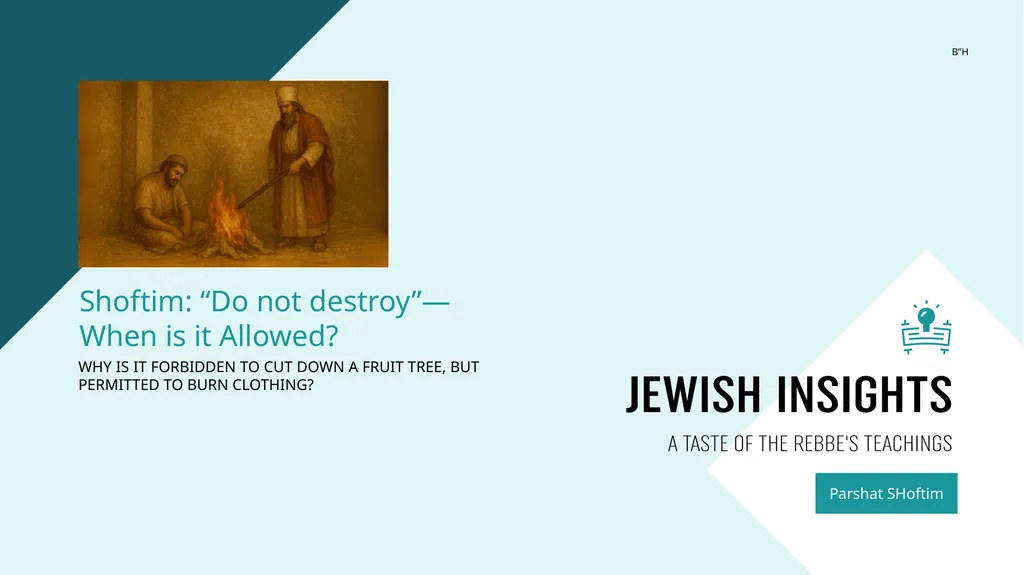
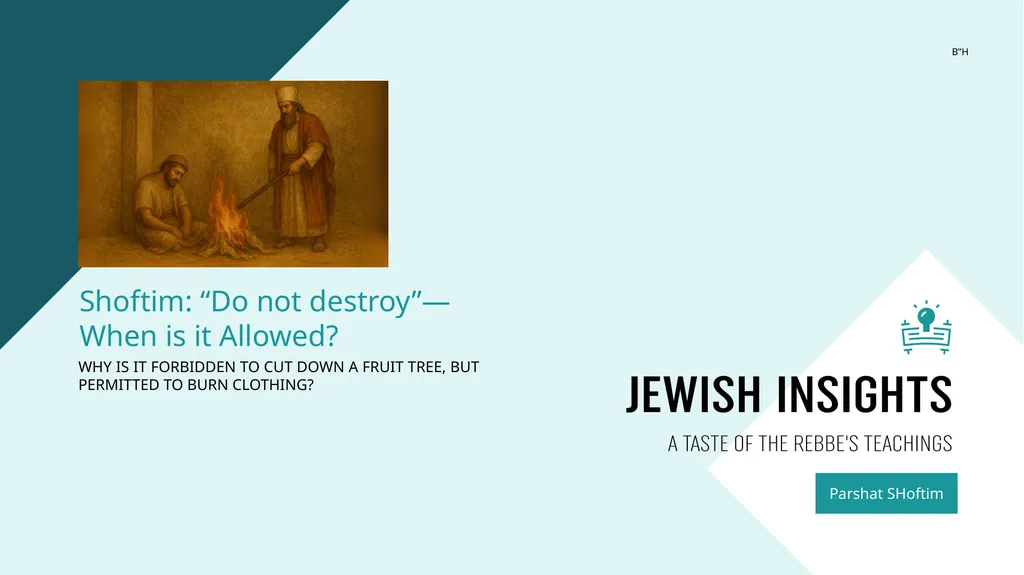
Shoftim: “Do not destroy”— When is it Allowed? Why is it forbidden to cut down a fruit tree, but permitted to burn clothing? B”H<br>
02
A. The Prohibition of wast Simchat Torah<br>
03
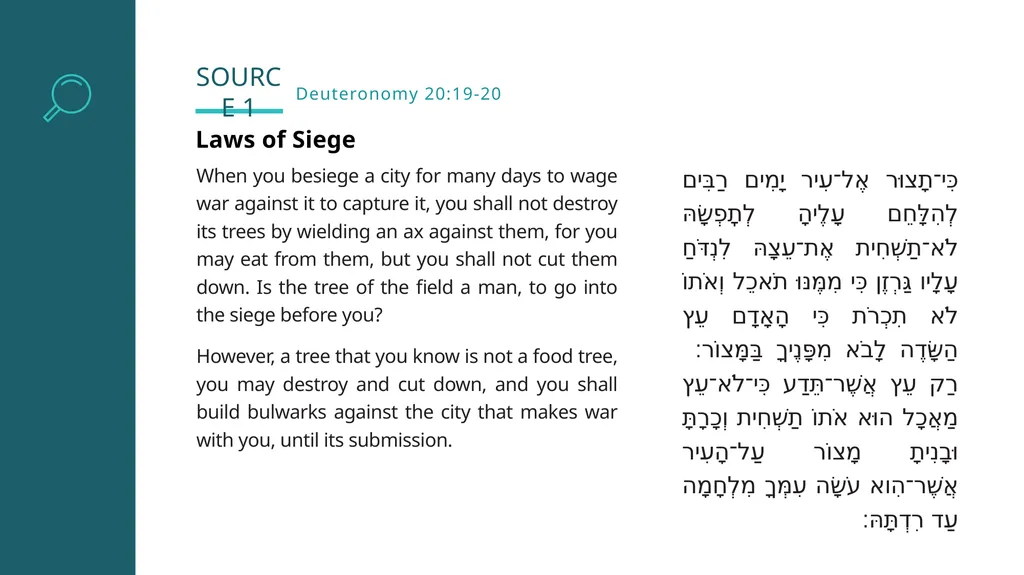
SOURCE 1 Deuteronomy 20:19-20 When you besiege a city for many days to wage war against it to capture it, you shall not destroy its trees by wielding an ax against them, for you may eat from them, but you shall not cut them down. Is the tree of the field a man, to go into the siege before you?
However, a tree that you know is not a food tree, you may destroy and cut down, and you shall build bulwarks against the city that makes war with you, until its submission. כִּי־תָצוּר אֶל־עִיר יָמִים רַבִּים לְהִלָּחֵם עָלֶיהָ לְתׇפְשָׂהּ לֹא־תַשְׁחִית אֶת־עֵצָהּ לִנְדֹּחַ עָלָיו גַּרְזֶן כִּי מִמֶּנּוּ תֹאכֵל וְאֹתוֹ לֹא תִכְרֹת כִּי הָאָדָם עֵץ הַשָּׂדֶה לָבֹא מִפָּנֶיךָ בַּמָּצוֹר׃ רַק עֵץ אֲשֶׁר־תֵּדַע כִּי־לֹא־עֵץ מַאֲכָל הוּא אֹתוֹ תַשְׁחִית וְכָרָתָּ וּבָנִיתָ מָצוֹר עַל־הָעִיר אֲשֶׁר־הִוא עֹשָׂה עִמְּךָ מִלְחָמָה עַד רִדְתָּהּ׃ Laws of Siege<br>
However, a tree that you know is not a food tree, you may destroy and cut down, and you shall build bulwarks against the city that makes war with you, until its submission. כִּי־תָצוּר אֶל־עִיר יָמִים רַבִּים לְהִלָּחֵם עָלֶיהָ לְתׇפְשָׂהּ לֹא־תַשְׁחִית אֶת־עֵצָהּ לִנְדֹּחַ עָלָיו גַּרְזֶן כִּי מִמֶּנּוּ תֹאכֵל וְאֹתוֹ לֹא תִכְרֹת כִּי הָאָדָם עֵץ הַשָּׂדֶה לָבֹא מִפָּנֶיךָ בַּמָּצוֹר׃ רַק עֵץ אֲשֶׁר־תֵּדַע כִּי־לֹא־עֵץ מַאֲכָל הוּא אֹתוֹ תַשְׁחִית וְכָרָתָּ וּבָנִיתָ מָצוֹר עַל־הָעִיר אֲשֶׁר־הִוא עֹשָׂה עִמְּךָ מִלְחָמָה עַד רִדְתָּהּ׃ Laws of Siege<br>
04
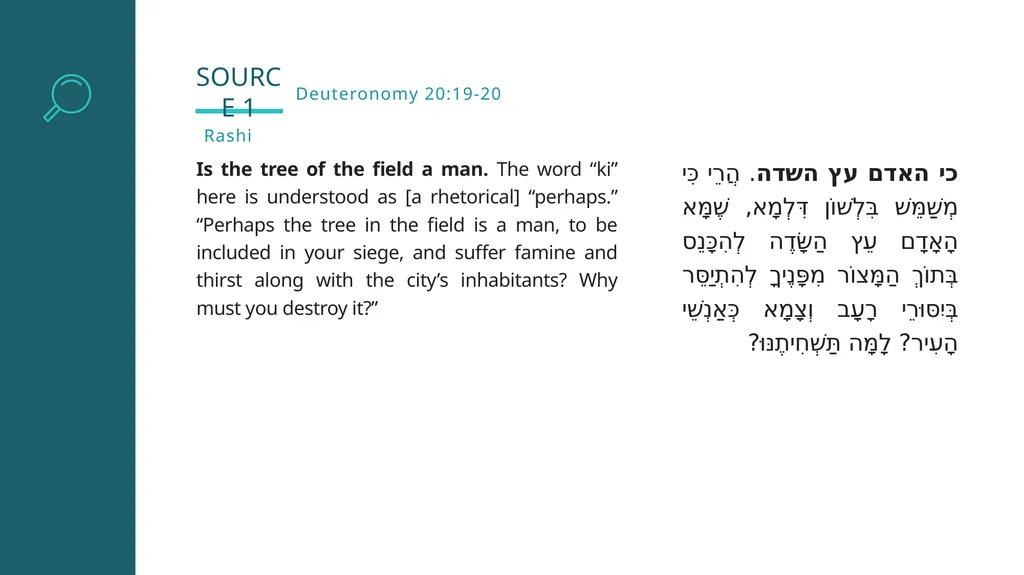
SOURCE 1 Deuteronomy 20:19-20 Is the tree of the field a man. The word “ki” here is understood as [a rhetorical] “perhaps.” “Perhaps the tree in the field is a man, to be included in your siege, and suffer famine and thirst along with the city’s inhabitants? Why must you destroy it?” כי האדם עץ השדה. הֲרֵי כִּי מְשַׁמֵּשׁ בִּלְשׁוֹן דִּלְמָא, שֶׁמָּא הָאָדָם עֵץ הַשָּׂדֶה לְהִכָּנֵס בְּתוֹךְ הַמָּצוֹר מִפָּנֶיךָ לְהִתְיַסֵּר בְּיִסּוּרֵי רָעָב וְצָמָא כְּאַנְשֵׁי הָעִיר? לָמָּה תַּשְׁחִיתֶנּוּ? Rashi<br>
05
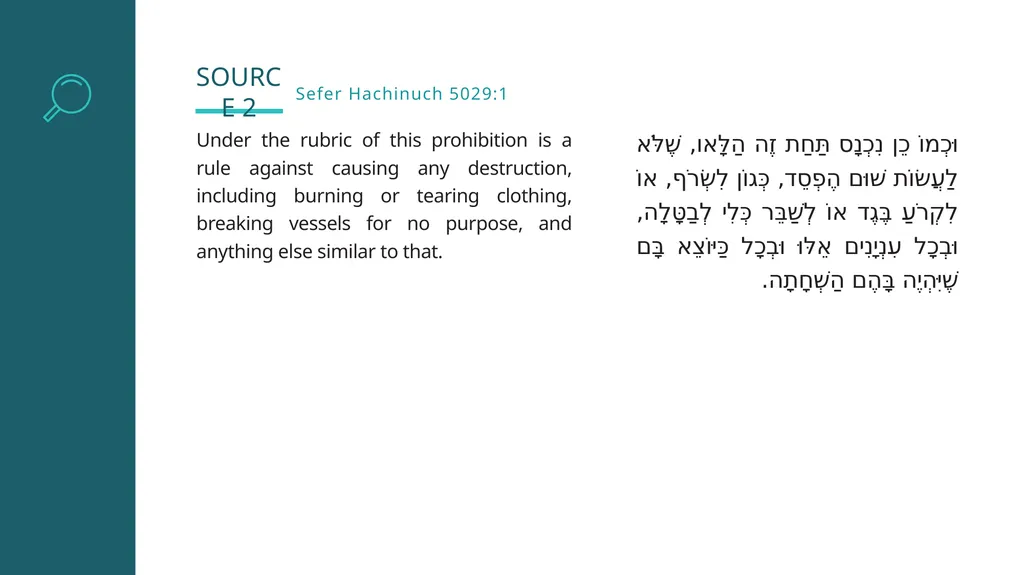
SOURCE 2 Sefer Hachinuch 5029:1 Under the rubric of this prohibition is a rule against causing any destruction, including burning or tearing clothing, breaking vessels for no purpose, and anything else similar to that. וּכְמוֹ כֵן נִכְנָס תַּחַת זֶה הַלָּאו, שֶׁלֹּא לַעֲשׂוֹת שׁוּם הֶפְסֵד, כְּגוֹן לִשְׂרֹף, אוֹ לִקְרֹעַ בֶּגֶד אוֹ לְשַׁבֵּר כְּלִי לְבַטָּלָה, וּבְכָל עִנְיָנִים אֵלּוּ וּבְכָל כַּיּוֹצֵא בָּם שֶׁיִּהְיֶה בָּהֶם הַשְׁחָתָה.<br>
06
SOURCE 3 Mishnah, Middot 1:1-2 The priests guarded three areas … and the Levites guarded 21 areas.
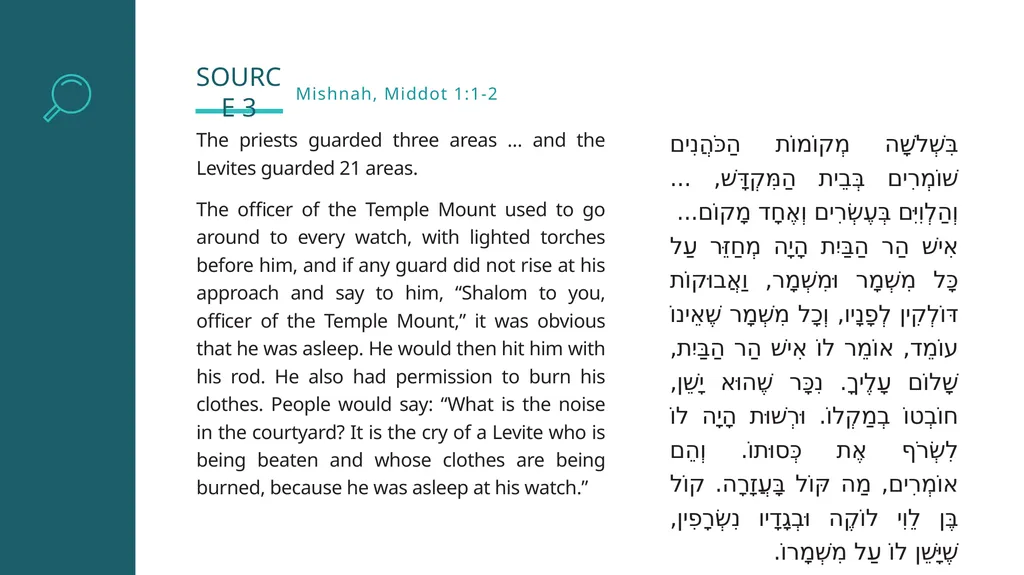
The officer of the Temple Mount used to go around to every watch, with lighted torches before him, and if any guard did not rise at his approach and say to him, “Shalom to you, officer of the Temple Mount,” it was obvious that he was asleep. He would then hit him with his rod. He also had permission to burn his clothes. People would say: “What is the noise in the courtyard? It is the cry of a Levite who is being beaten and whose clothes are being burned, because he was asleep at his watch.” בִּשְׁלשָׁה מְקוֹמוֹת הַכֹּהֲנִים שׁוֹמְרִים בְּבֵית הַמִּקְדָּשׁ, ... וְהַלְוִיִּם בְּעֶשְׂרִים וְאֶחָד מָקוֹם...
אִישׁ הַר הַבַּיִת הָיָה מְחַזֵּר עַל כָּל מִשְׁמָר וּמִשְׁמָר, וַאֲבוּקוֹת דּוֹלְקִין לְפָנָיו, וְכָל מִשְׁמָר שֶׁאֵינוֹ עוֹמֵד, אוֹמֵר לוֹ אִישׁ הַר הַבַּיִת, שָׁלוֹם עָלֶיךָ. נִכָּר שֶׁהוּא יָשֵׁן, חוֹבְטוֹ בְמַקְלוֹ. וּרְשׁוּת הָיָה לוֹ לִשְׂרֹף אֶת כְּסוּתוֹ. וְהֵם אוֹמְרִים, מַה קּוֹל בָּעֲזָרָה. קוֹל בֶּן לֵוִי לוֹקֶה וּבְגָדָיו נִשְׂרָפִין, שֶׁיָּשֵׁן לוֹ עַל מִשְׁמָרוֹ.<br>
The officer of the Temple Mount used to go around to every watch, with lighted torches before him, and if any guard did not rise at his approach and say to him, “Shalom to you, officer of the Temple Mount,” it was obvious that he was asleep. He would then hit him with his rod. He also had permission to burn his clothes. People would say: “What is the noise in the courtyard? It is the cry of a Levite who is being beaten and whose clothes are being burned, because he was asleep at his watch.” בִּשְׁלשָׁה מְקוֹמוֹת הַכֹּהֲנִים שׁוֹמְרִים בְּבֵית הַמִּקְדָּשׁ, ... וְהַלְוִיִּם בְּעֶשְׂרִים וְאֶחָד מָקוֹם...
אִישׁ הַר הַבַּיִת הָיָה מְחַזֵּר עַל כָּל מִשְׁמָר וּמִשְׁמָר, וַאֲבוּקוֹת דּוֹלְקִין לְפָנָיו, וְכָל מִשְׁמָר שֶׁאֵינוֹ עוֹמֵד, אוֹמֵר לוֹ אִישׁ הַר הַבַּיִת, שָׁלוֹם עָלֶיךָ. נִכָּר שֶׁהוּא יָשֵׁן, חוֹבְטוֹ בְמַקְלוֹ. וּרְשׁוּת הָיָה לוֹ לִשְׂרֹף אֶת כְּסוּתוֹ. וְהֵם אוֹמְרִים, מַה קּוֹל בָּעֲזָרָה. קוֹל בֶּן לֵוִי לוֹקֶה וּבְגָדָיו נִשְׂרָפִין, שֶׁיָּשֵׁן לוֹ עַל מִשְׁמָרוֹ.<br>
07
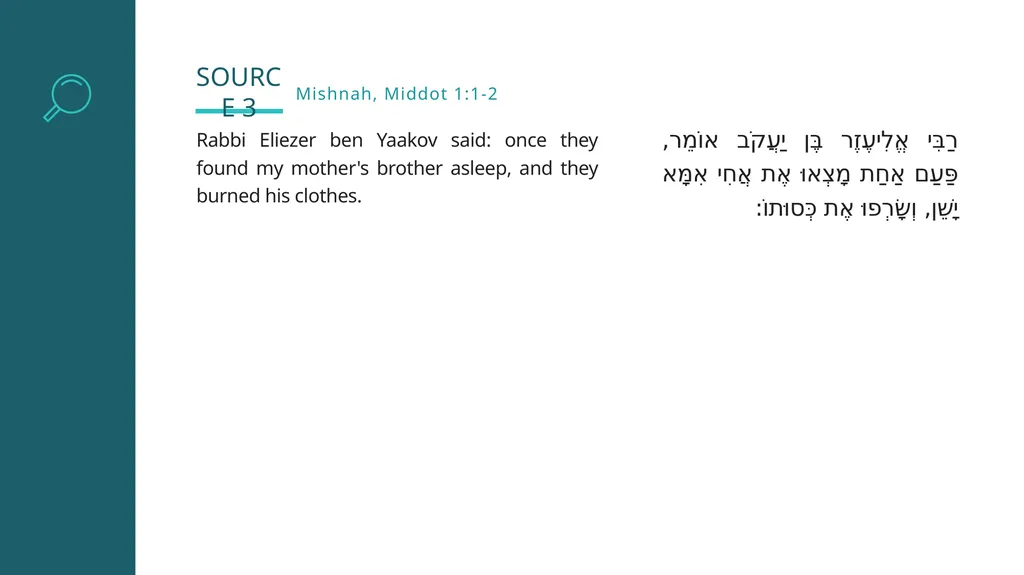
SOURCE 3 Mishnah, Middot 1:1-2 Rabbi Eliezer ben Yaakov said: once they found my mother's brother asleep, and they burned his clothes. רַבִּי אֱלִיעֶזֶר בֶּן יַעֲקֹב אוֹמֵר, פַּעַם אַחַת מָצְאוּ אֶת אֲחִי אִמָּא יָשֵׁן, וְשָׂרְפוּ אֶת כְּסוּתוֹ:<br>
08
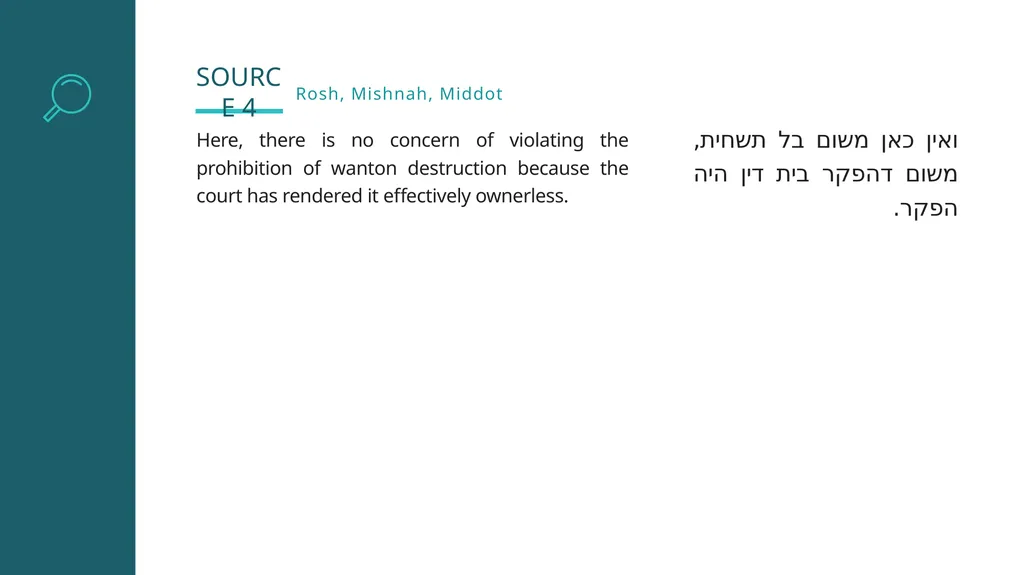
SOURCE 4 Rosh, Mishnah, Middot Here, there is no concern of violating the prohibition of wanton destruction because the court has rendered it effectively ownerless. ואין כאן משום בל תשחית, משום דהפקר בית דין היה הפקר.<br>
09
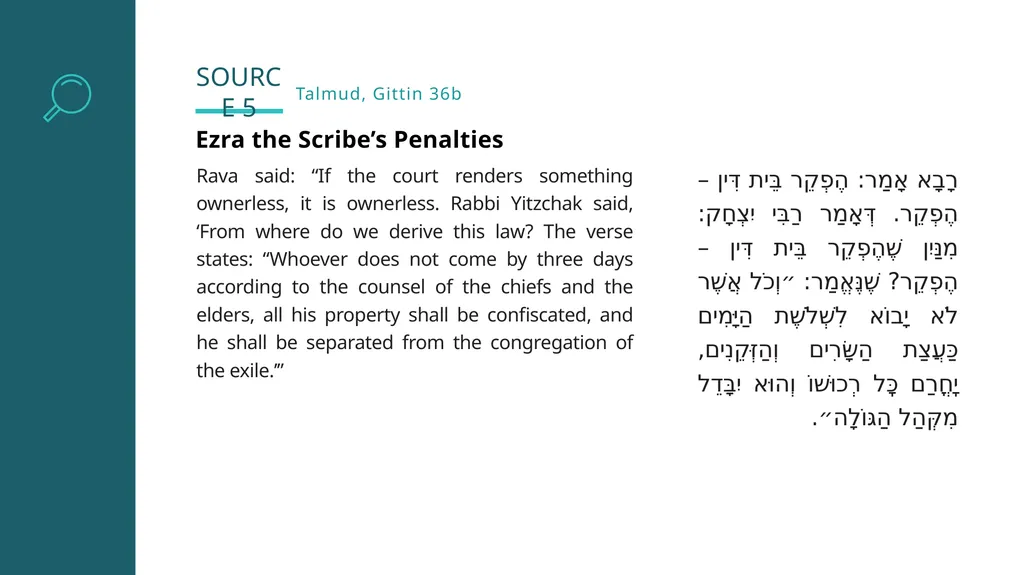
SOURCE 5 Talmud, Gittin 36b Rava said: “If the court renders something ownerless, it is ownerless. Rabbi Yitzchak said, ‘From where do we derive this law? The verse states: “Whoever does not come by three days according to the counsel of the chiefs and the elders, all his property shall be confiscated, and he shall be separated from the congregation of the exile.’” רָבָא אָמַר: הֶפְקֵר בֵּית דִּין – הֶפְקֵר. דְּאָמַר רַבִּי יִצְחָק: מִנַּיִן שֶׁהֶפְקֵר בֵּית דִּין – הֶפְקֵר? שֶׁנֶּאֱמַר: ״וְכֹל אֲשֶׁר לֹא יָבוֹא לִשְׁלֹשֶׁת הַיָּמִים כַּעֲצַת הַשָּׂרִים וְהַזְּקֵנִים, יׇחֳרַם כׇּל רְכוּשׁוֹ וְהוּא יִבָּדֵל מִקְּהַל הַגּוֹלָה״. Ezra the Scribe’s Penalties<br>
10
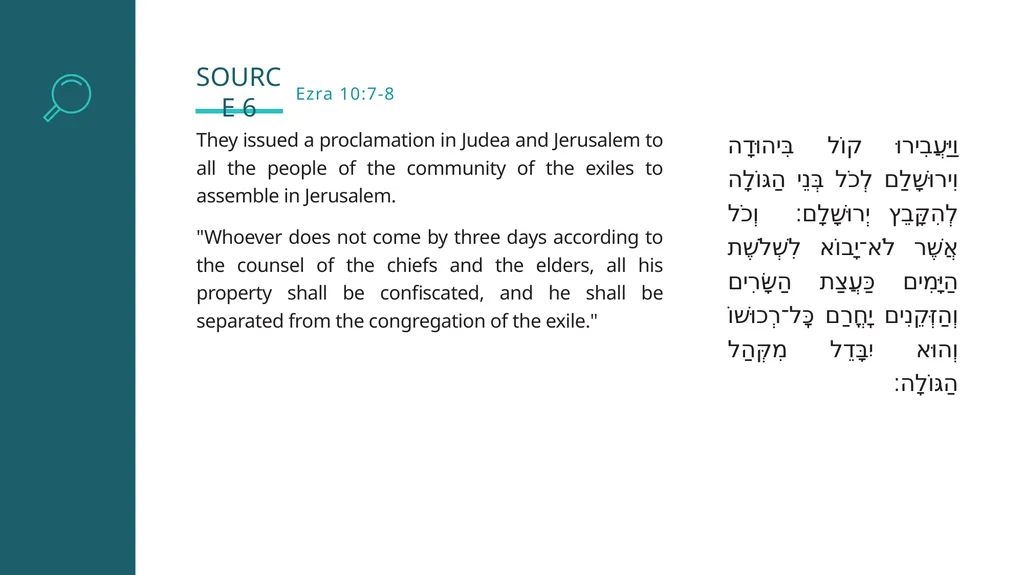
SOURCE 6 Ezra 10:7-8 They issued a proclamation in Judea and Jerusalem to all the people of the community of the exiles to assemble in Jerusalem.
"Whoever does not come by three days according to the counsel of the chiefs and the elders, all his property shall be confiscated, and he shall be separated from the congregation of the exile." וַיַּעֲבִירוּ קוֹל בִּיהוּדָה וִירוּשָׁלַ͏ִם לְכֹל בְּנֵי הַגּוֹלָה לְהִקָּבֵץ יְרוּשָׁלָ͏ִם׃ וְכֹל אֲשֶׁר לֹא־יָבוֹא לִשְׁלֹשֶׁת הַיָּמִים כַּעֲצַת הַשָּׂרִים וְהַזְּקֵנִים יׇחֳרַם כׇּל־רְכוּשׁוֹ וְהוּא יִבָּדֵל מִקְּהַל הַגּוֹלָה׃<br>
"Whoever does not come by three days according to the counsel of the chiefs and the elders, all his property shall be confiscated, and he shall be separated from the congregation of the exile." וַיַּעֲבִירוּ קוֹל בִּיהוּדָה וִירוּשָׁלַ͏ִם לְכֹל בְּנֵי הַגּוֹלָה לְהִקָּבֵץ יְרוּשָׁלָ͏ִם׃ וְכֹל אֲשֶׁר לֹא־יָבוֹא לִשְׁלֹשֶׁת הַיָּמִים כַּעֲצַת הַשָּׂרִים וְהַזְּקֵנִים יׇחֳרַם כׇּל־רְכוּשׁוֹ וְהוּא יִבָּדֵל מִקְּהַל הַגּוֹלָה׃<br>
11
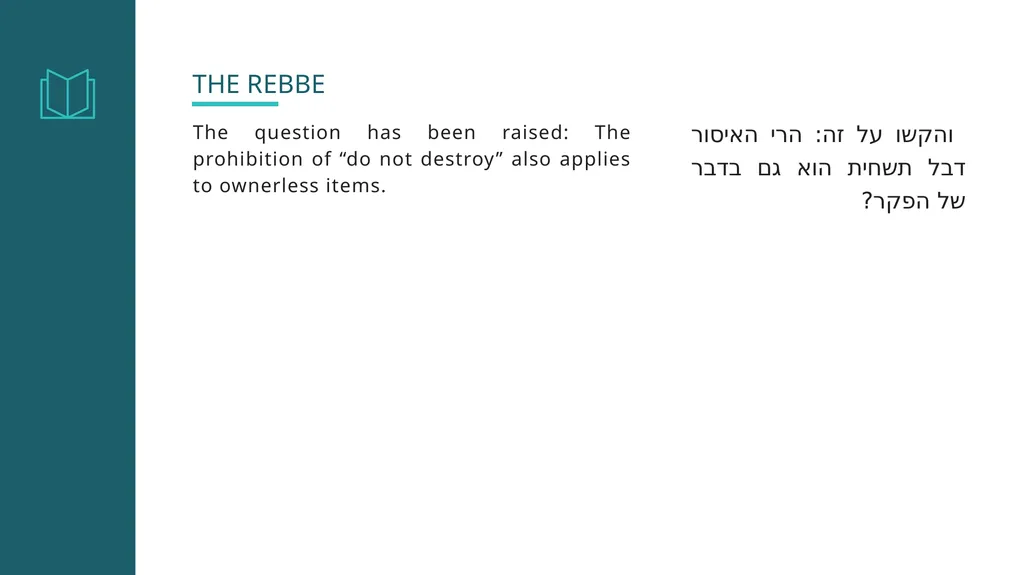
THE REBBE The question has been raised: The prohibition of “do not destroy” also applies to ownerless items. והקשו על זה: הרי האיסור דבל תשחית הוא גם בדבר של הפקר?<br>
12
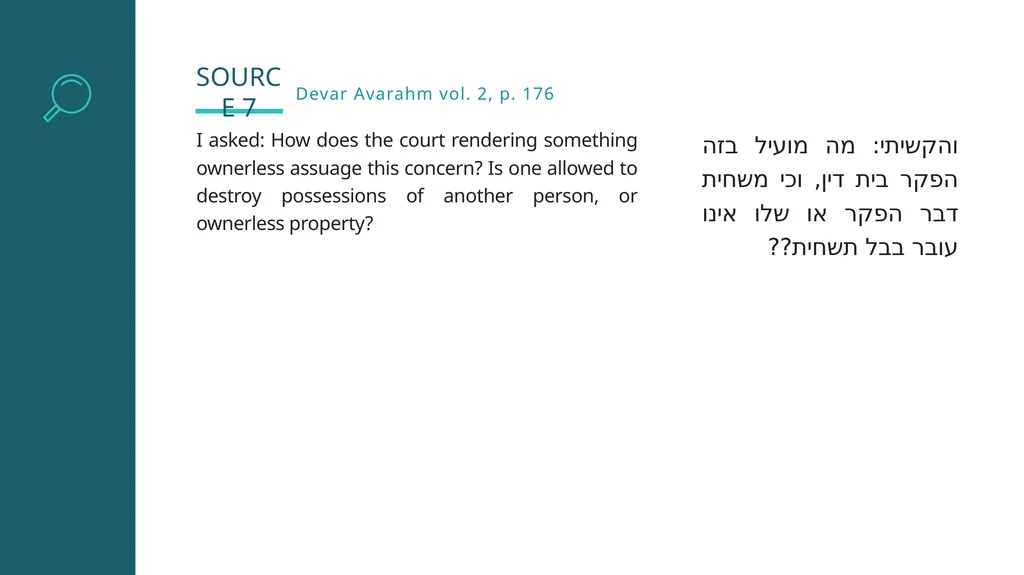
SOURCE 7 Devar Avarahm vol. 2, p. 176 I asked: How does the court rendering something ownerless assuage this concern? Is one allowed to destroy possessions of another person, or ownerless property? והקשיתי: מה מועיל בזה הפקר בית דין, וכי משחית דבר הפקר או שלו אינו עובר בבל תשחית??<br>
13
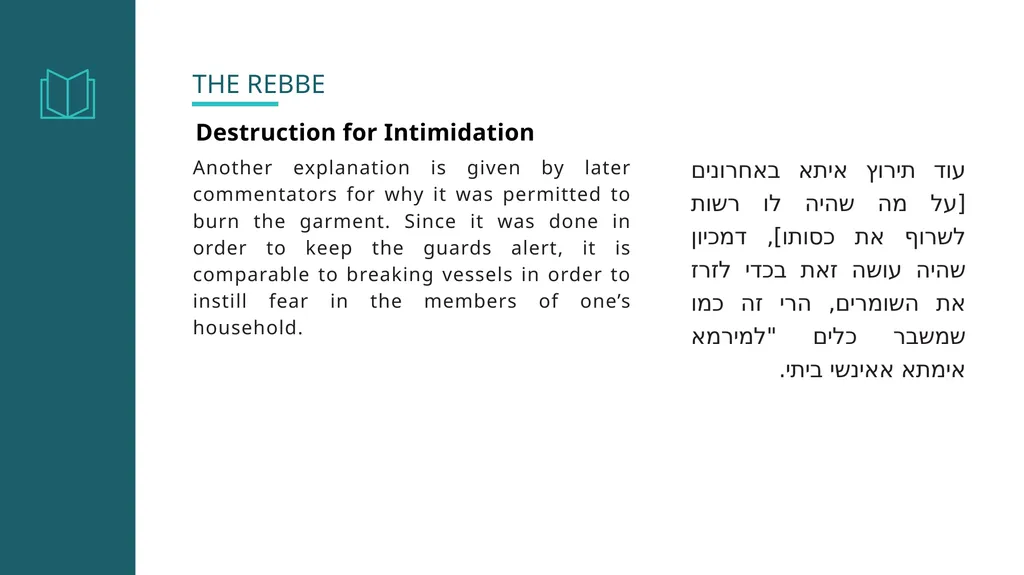
THE REBBE Another explanation is given by later commentators for why it was permitted to burn the garment. Since it was done in order to keep the guards alert, it is comparable to breaking vessels in order to instill fear in the members of one’s household. עוד תירוץ איתא באחרונים [על מה שהיה לו רשות לשרוף את כסותו], דמכיון שהיה עושה זאת בכדי לזרז את השומרים, הרי זה כמו שמשבר כלים "למירמא אימתא אאינשי ביתי. Destruction for Intimidation<br>
14
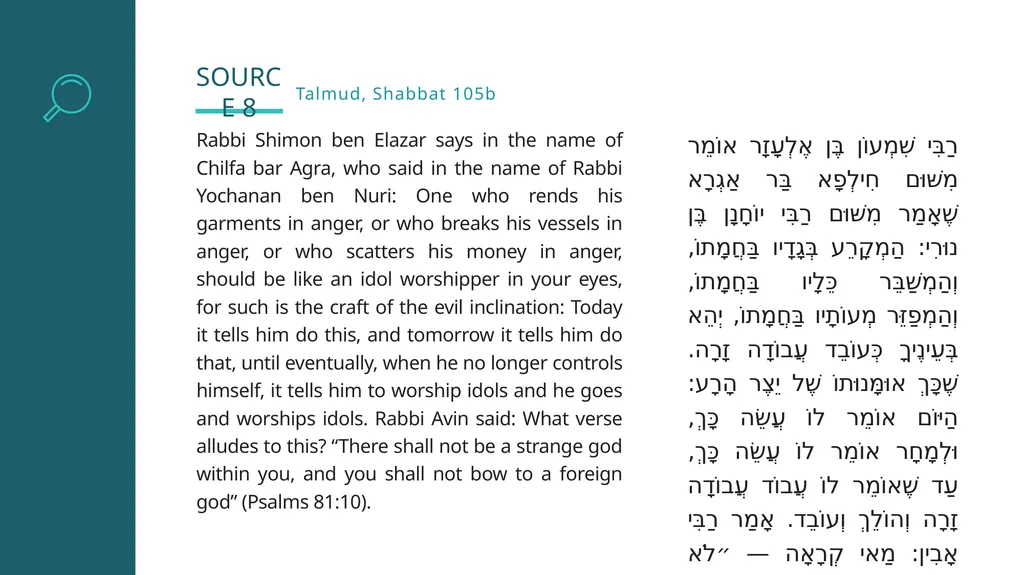
SOURCE 8 Talmud, Shabbat 105b Rabbi Shimon ben Elazar says in the name of Chilfa bar Agra, who said in the name of Rabbi Yochanan ben Nuri: One who rends his garments in anger, or who breaks his vessels in anger, or who scatters his money in anger, should be like an idol worshipper in your eyes, for such is the craft of the evil inclination: Today it tells him do this, and tomorrow it tells him do that, until eventually, when he no longer controls himself, it tells him to worship idols and he goes and worships idols. Rabbi Avin said: What verse alludes to this? “There shall not be a strange god within you, and you shall not bow to a foreign god” (Psalms 81:10). רַבִּי שִׁמְעוֹן בֶּן אֶלְעָזָר אוֹמֵר מִשּׁוּם חִילְפָא בַּר אַגְרָא שֶׁאָמַר מִשּׁוּם רַבִּי יוֹחָנָן בֶּן נוּרִי: הַמְקָרֵע בְּגָדָיו בַּחֲמָתוֹ, וְהַמְשַׁבֵּר כֵּלָיו בַּחֲמָתוֹ, וְהַמְפַזֵּר מְעוֹתָיו בַּחֲמָתוֹ, יְהֵא בְּעֵינֶיךָ כְּעוֹבֵד עֲבוֹדָה זָרָה. שֶׁכָּךְ אוּמָּנוּתוֹ שֶׁל יֵצֶר הָרָע: הַיּוֹם אוֹמֵר לוֹ עֲשֵׂה כָּךְ, וּלְמָחָר אוֹמֵר לוֹ עֲשֵׂה כָּךְ, עַד שֶׁאוֹמֵר לוֹ עֲבוֹד עֲבוֹדָה זָרָה וְהוֹלֵךְ וְעוֹבֵד. אָמַר רַבִּי אָבִין: מַאי קְרָאָה — ״לֹא יִהְיֶה בְךָ אֵל זָר וְלֹא תִשְׁתַּחֲוֶה לְאֵל נֵכָר״,<br>
15
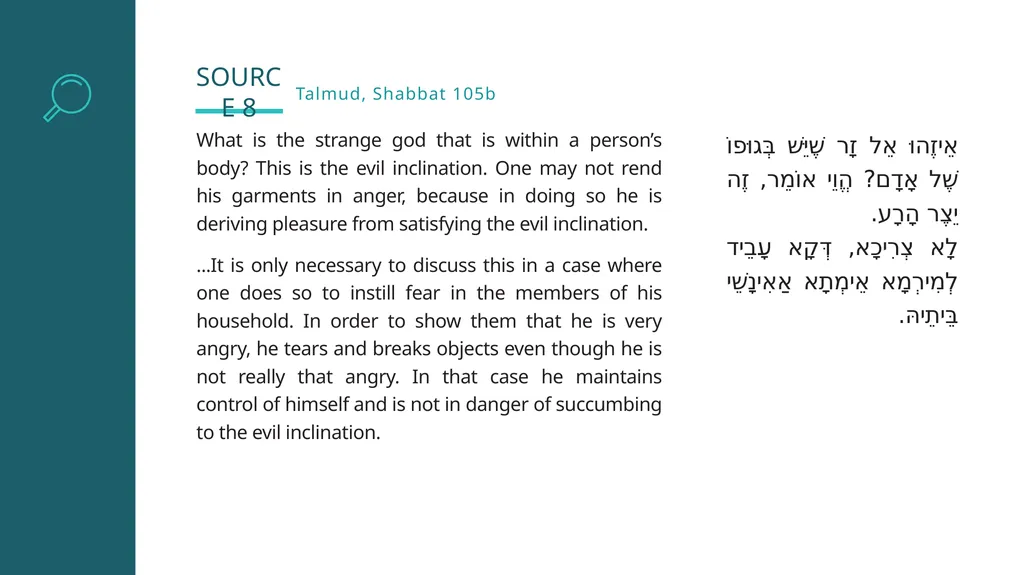
SOURCE 8 Talmud, Shabbat 105b What is the strange god that is within a person’s body? This is the evil inclination. One may not rend his garments in anger, because in doing so he is deriving pleasure from satisfying the evil inclination.
...It is only necessary to discuss this in a case where one does so to instill fear in the members of his household. In order to show them that he is very angry, he tears and breaks objects even though he is not really that angry. In that case he maintains control of himself and is not in danger of succumbing to the evil inclination. אֵיזֶהוּ אֵל זָר שֶׁיֵּשׁ בְּגוּפוֹ שֶׁל אָדָם? הֱוֵי אוֹמֵר, זֶה יֵצֶר הָרָע.
לָא צְרִיכָא, דְּקָא עָבֵיד לְמִירְמָא אֵימְתָא אַאִינָשֵׁי בֵּיתֵיהּ.<br>
...It is only necessary to discuss this in a case where one does so to instill fear in the members of his household. In order to show them that he is very angry, he tears and breaks objects even though he is not really that angry. In that case he maintains control of himself and is not in danger of succumbing to the evil inclination. אֵיזֶהוּ אֵל זָר שֶׁיֵּשׁ בְּגוּפוֹ שֶׁל אָדָם? הֱוֵי אוֹמֵר, זֶה יֵצֶר הָרָע.
לָא צְרִיכָא, דְּקָא עָבֵיד לְמִירְמָא אֵימְתָא אַאִינָשֵׁי בֵּיתֵיהּ.<br>
16
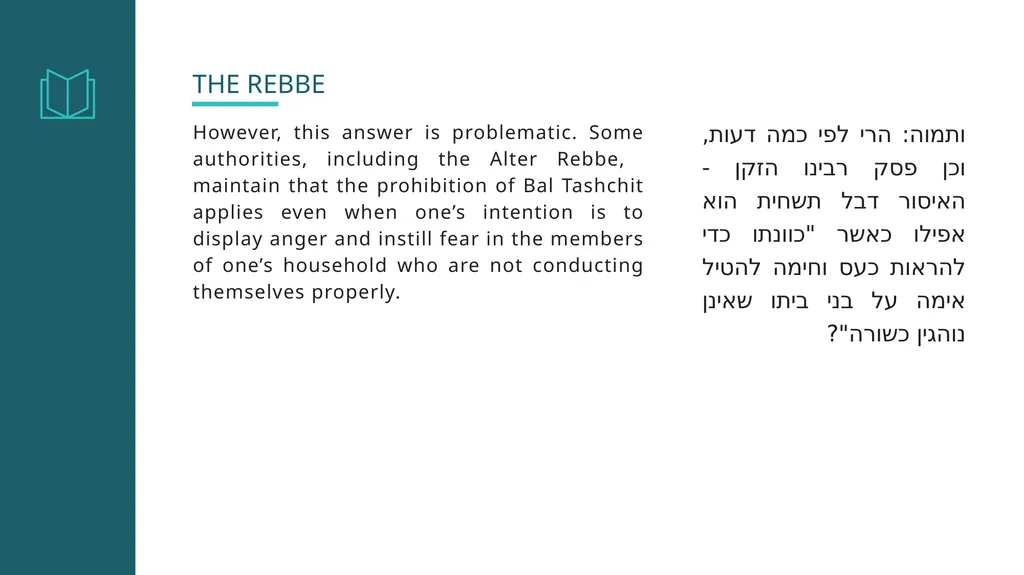
THE REBBE However, this answer is problematic. Some authorities, including the Alter Rebbe, maintain that the prohibition of Bal Tashchit applies even when one’s intention is to display anger and instill fear in the members of one’s household who are not conducting themselves properly. ותמוה: הרי לפי כמה דעות, וכן פסק רבינו הזקן - האיסור דבל תשחית הוא אפילו כאשר "כוונתו כדי להראות כעס וחימה להטיל אימה על בני ביתו שאינן נוהגין כשורה"?<br>
17
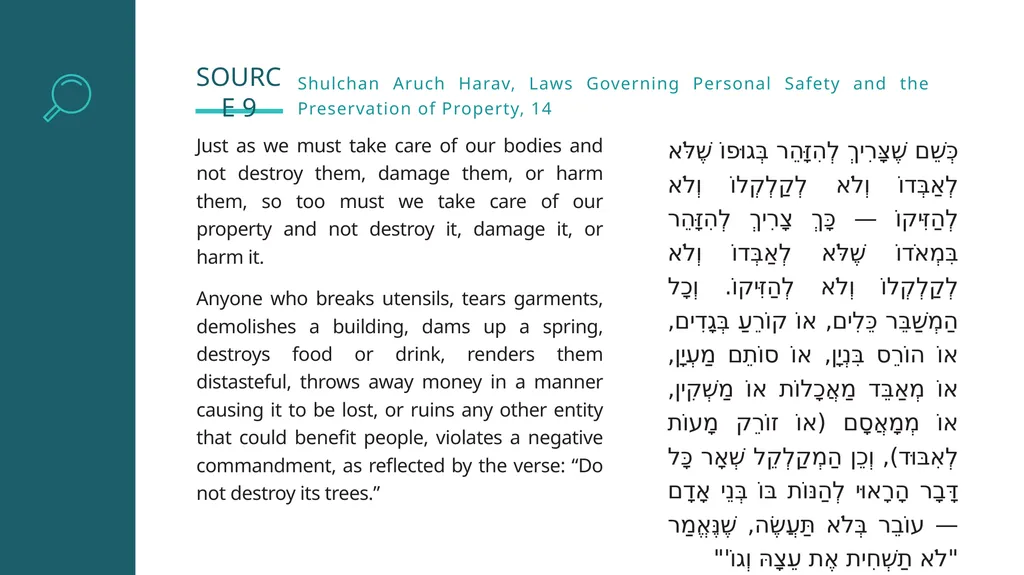
SOURCE 9 Shulchan Aruch Harav, Laws Governing Personal Safety and the Preservation of Property, 14 Just as we must take care of our bodies and not destroy them, damage them, or harm them, so too must we take care of our property and not destroy it, damage it, or harm it.
Anyone who breaks utensils, tears garments, demolishes a building, dams up a spring, destroys food or drink, renders them distasteful, throws away money in a manner causing it to be lost, or ruins any other entity that could benefit people, violates a negative commandment, as reflected by the verse: “Do not destroy its trees.” כְּשֵׁם שֶׁצָּרִיךְ לְהִזָּהֵר בְּגוּפוֹ שֶׁלֹּא לְאַבְּדוֹ וְלֹא לְקַלְקְלוֹ וְלֹא לְהַזִּיקוֹ — כָּךְ צָרִיךְ לְהִזָּהֵר בִּמְאֹדוֹ שֶׁלֹּא לְאַבְּדוֹ וְלֹא לְקַלְקְלוֹ וְלֹא לְהַזִּיקוֹ. וְכָל הַמְשַׁבֵּר כֵּלִים, אוֹ קוֹרֵעַ בְּגָדִים, אוֹ הוֹרֵס בִּנְיָן, אוֹ סוֹתֵם מַעְיָן, אוֹ מְאַבֵּד מַאֲכָלוֹת אוֹ מַשְׁקִין, אוֹ מְמָאֲסָם (אוֹ זוֹרֵק מָעוֹת לְאִבּוּד), וְכֵן הַמְקַלְקֵל שְׁאָר כָּל דָּבָר הָרָאוּי לְהַנּוֹת בּוֹ בְּנֵי אָדָם — עוֹבֵר בְּלֹא תַּעֲשֶׂה, שֶׁנֶּאֱמַר "לֹא תַשְׁחִית אֶת עֵצָהּ וְגוֹ'"<br>
Anyone who breaks utensils, tears garments, demolishes a building, dams up a spring, destroys food or drink, renders them distasteful, throws away money in a manner causing it to be lost, or ruins any other entity that could benefit people, violates a negative commandment, as reflected by the verse: “Do not destroy its trees.” כְּשֵׁם שֶׁצָּרִיךְ לְהִזָּהֵר בְּגוּפוֹ שֶׁלֹּא לְאַבְּדוֹ וְלֹא לְקַלְקְלוֹ וְלֹא לְהַזִּיקוֹ — כָּךְ צָרִיךְ לְהִזָּהֵר בִּמְאֹדוֹ שֶׁלֹּא לְאַבְּדוֹ וְלֹא לְקַלְקְלוֹ וְלֹא לְהַזִּיקוֹ. וְכָל הַמְשַׁבֵּר כֵּלִים, אוֹ קוֹרֵעַ בְּגָדִים, אוֹ הוֹרֵס בִּנְיָן, אוֹ סוֹתֵם מַעְיָן, אוֹ מְאַבֵּד מַאֲכָלוֹת אוֹ מַשְׁקִין, אוֹ מְמָאֲסָם (אוֹ זוֹרֵק מָעוֹת לְאִבּוּד), וְכֵן הַמְקַלְקֵל שְׁאָר כָּל דָּבָר הָרָאוּי לְהַנּוֹת בּוֹ בְּנֵי אָדָם — עוֹבֵר בְּלֹא תַּעֲשֶׂה, שֶׁנֶּאֱמַר "לֹא תַשְׁחִית אֶת עֵצָהּ וְגוֹ'"<br>
18
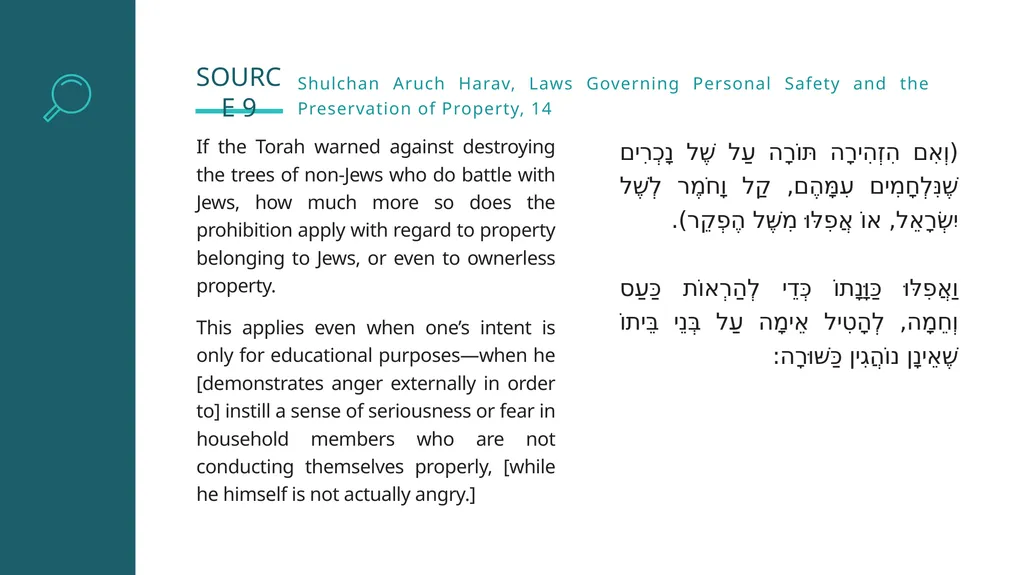
SOURCE 9 Shulchan Aruch Harav, Laws Governing Personal Safety and the Preservation of Property, 14 If the Torah warned against destroying the trees of non-Jews who do battle with Jews, how much more so does the prohibition apply with regard to property belonging to Jews, or even to ownerless property.
This applies even when one’s intent is only for educational purposes—when he [demonstrates anger externally in order to] instill a sense of seriousness or fear in household members who are not conducting themselves properly, [while he himself is not actually angry.] (וְאִם הִזְהִירָה תּוֹרָה עַל שֶׁל נָכְרִים שֶׁנִּלְחָמִים עִמָּהֶם, קַל וָחֹמֶר לְשֶׁל יִשְׂרָאֵל, אוֹ אֲפִלּוּ מִשֶּׁל הֶפְקֵר).
וַאֲפִלּוּ כַּוָּנָתוֹ כְּדֵי לְהַרְאוֹת כַּעַס וְחֵמָה, לְהָטִיל אֵימָה עַל בְּנֵי בֵּיתוֹ שֶׁאֵינָן נוֹהֲגִין כַּשּׁוּרָה:<br>
This applies even when one’s intent is only for educational purposes—when he [demonstrates anger externally in order to] instill a sense of seriousness or fear in household members who are not conducting themselves properly, [while he himself is not actually angry.] (וְאִם הִזְהִירָה תּוֹרָה עַל שֶׁל נָכְרִים שֶׁנִּלְחָמִים עִמָּהֶם, קַל וָחֹמֶר לְשֶׁל יִשְׂרָאֵל, אוֹ אֲפִלּוּ מִשֶּׁל הֶפְקֵר).
וַאֲפִלּוּ כַּוָּנָתוֹ כְּדֵי לְהַרְאוֹת כַּעַס וְחֵמָה, לְהָטִיל אֵימָה עַל בְּנֵי בֵּיתוֹ שֶׁאֵינָן נוֹהֲגִין כַּשּׁוּרָה:<br>
19
B. Why is Fasting Permitted? Simchat Torah<br>
20
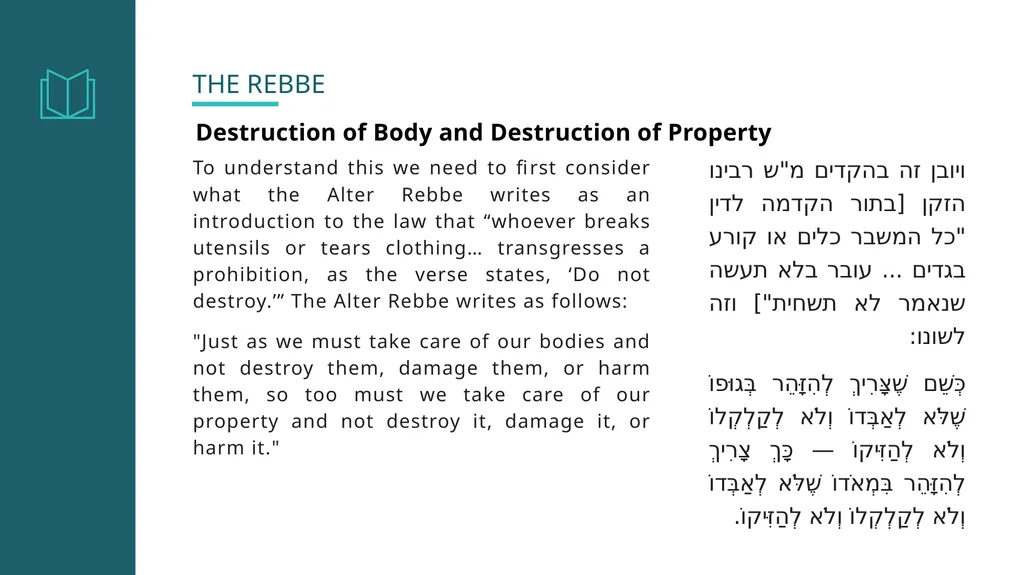
THE REBBE To understand this we need to first consider what the Alter Rebbe writes as an introduction to the law that “whoever breaks utensils or tears clothing… transgresses a prohibition, as the verse states, ‘Do not destroy.’” The Alter Rebbe writes as follows:
"Just as we must take care of our bodies and not destroy them, damage them, or harm them, so too must we take care of our property and not destroy it, damage it, or harm it." ויובן זה בהקדים מ"ש רבינו הזקן [בתור הקדמה לדין "כל המשבר כלים או קורע בגדים ... עובר בלא תעשה שנאמר לא תשחית"] וזה לשונו:
כְּשֵׁם שֶׁצָּרִיךְ לְהִזָּהֵר בְּגוּפוֹ שֶׁלֹּא לְאַבְּדוֹ וְלֹא לְקַלְקְלוֹ וְלֹא לְהַזִּיקוֹ — כָּךְ צָרִיךְ לְהִזָּהֵר בִּמְאֹדוֹ שֶׁלֹּא לְאַבְּדוֹ וְלֹא לְקַלְקְלוֹ וְלֹא לְהַזִּיקוֹ. Destruction of Body and Destruction of Property<br>
"Just as we must take care of our bodies and not destroy them, damage them, or harm them, so too must we take care of our property and not destroy it, damage it, or harm it." ויובן זה בהקדים מ"ש רבינו הזקן [בתור הקדמה לדין "כל המשבר כלים או קורע בגדים ... עובר בלא תעשה שנאמר לא תשחית"] וזה לשונו:
כְּשֵׁם שֶׁצָּרִיךְ לְהִזָּהֵר בְּגוּפוֹ שֶׁלֹּא לְאַבְּדוֹ וְלֹא לְקַלְקְלוֹ וְלֹא לְהַזִּיקוֹ — כָּךְ צָרִיךְ לְהִזָּהֵר בִּמְאֹדוֹ שֶׁלֹּא לְאַבְּדוֹ וְלֹא לְקַלְקְלוֹ וְלֹא לְהַזִּיקוֹ. Destruction of Body and Destruction of Property<br>
21
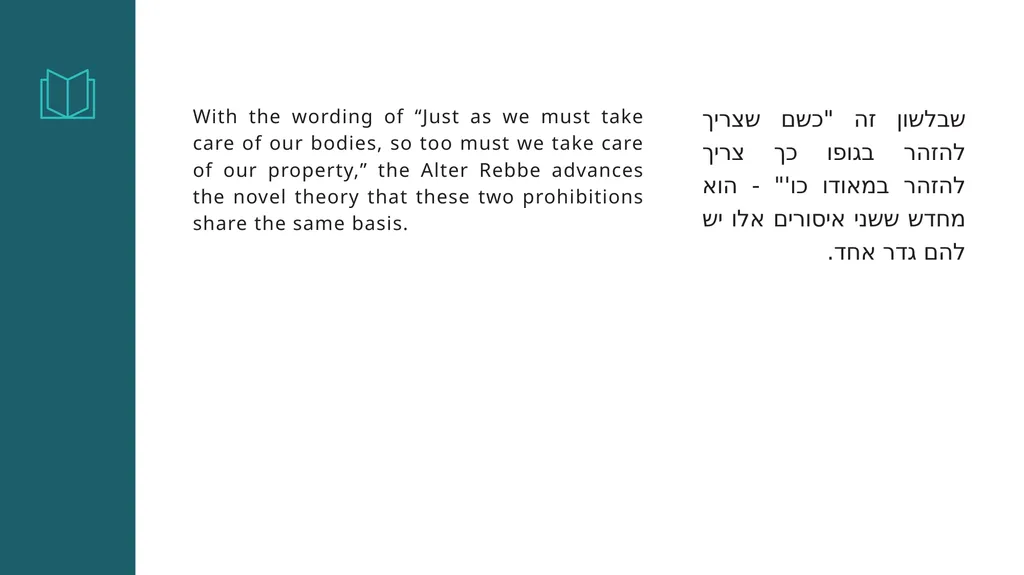
With the wording of “Just as we must take care of our bodies, so too must we take care of our property,” the Alter Rebbe advances the novel theory that these two prohibitions share the same basis. שבלשון זה "כשם שצריך להזהר בגופו כך צריך להזהר במאודו כו'" - הוא מחדש ששני איסורים אלו יש להם גדר אחד.<br>
22
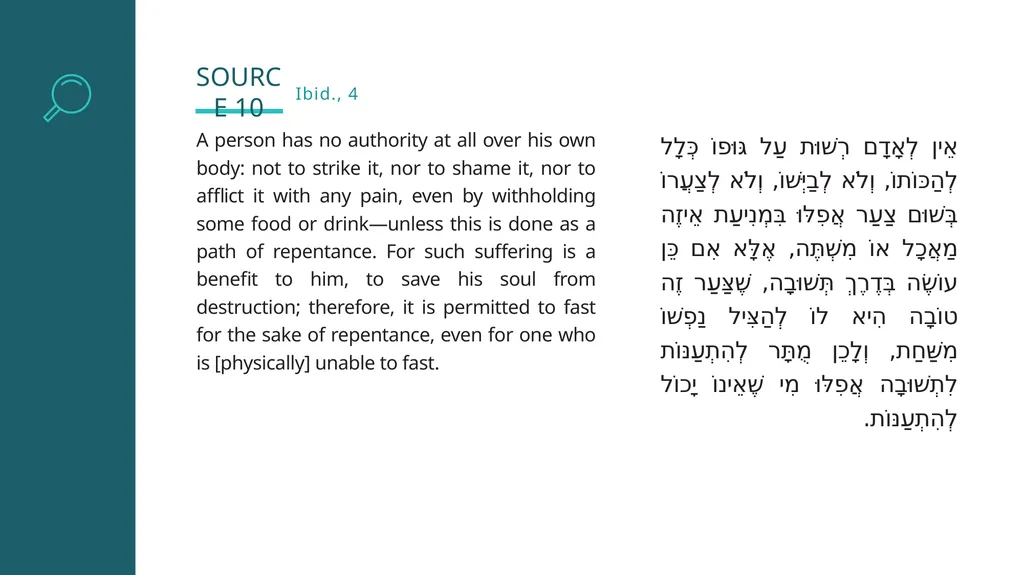
SOURCE 10 Ibid., 4 A person has no authority at all over his own body: not to strike it, nor to shame it, nor to afflict it with any pain, even by withholding some food or drink—unless this is done as a path of repentance. For such suffering is a benefit to him, to save his soul from destruction; therefore, it is permitted to fast for the sake of repentance, even for one who is [physically] unable to fast. אֵין לְאָדָם רְשׁוּת עַל גּוּפוֹ כְּלָל לְהַכּוֹתוֹ, וְלֹא לְבַיְּשׁוֹ, וְלֹא לְצַעֲרוֹ בְּשׁוּם צַעַר אֲפִלּוּ בִּמְנִיעַת אֵיזֶה מַאֲכָל אוֹ מִשְׁתֶּה, אֶלָּא אִם כֵּן עוֹשֶׂה בְּדֶרֶךְ תְּשׁוּבָה, שֶׁצַּעַר זֶה טוֹבָה הִיא לוֹ לְהַצִּיל נַפְשׁוֹ מִשַּׁחַת, וְלָכֵן מֻתָּר לְהִתְעַנּוֹת לִתְשׁוּבָה אֲפִלּוּ מִי שֶׁאֵינוֹ יָכוֹל לְהִתְעַנּוֹת.<br>
23
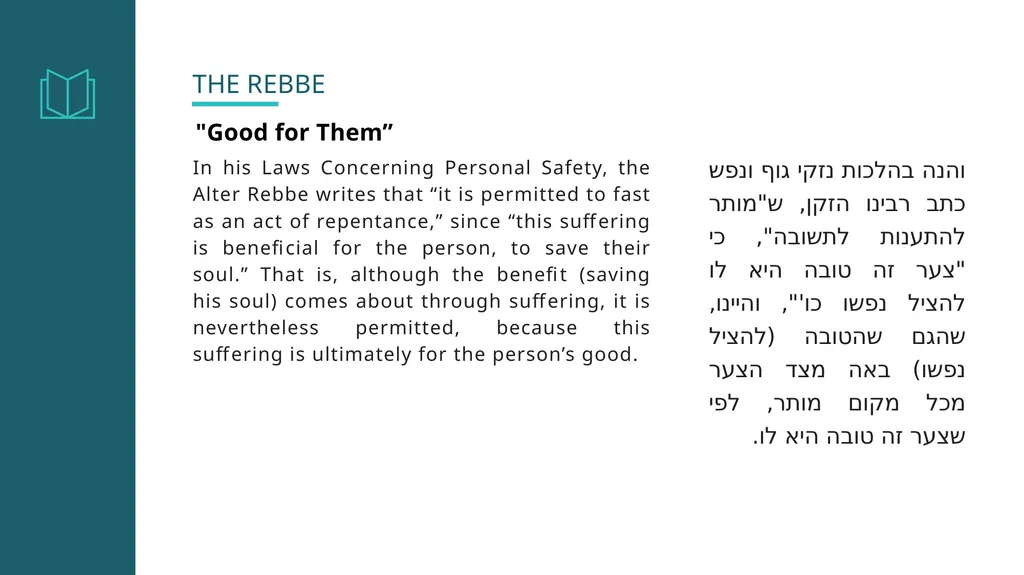
THE REBBE In his Laws Concerning Personal Safety, the Alter Rebbe writes that “it is permitted to fast as an act of repentance,” since “this suffering is beneficial for the person, to save their soul.” That is, although the benefit (saving his soul) comes about through suffering, it is nevertheless permitted, because this suffering is ultimately for the person’s good. והנה בהלכות נזקי גוף ונפש כתב רבינו הזקן, ש"מותר להתענות לתשובה", כי "צער זה טובה היא לו להציל נפשו כו'", והיינו, שהגם שהטובה (להציל נפשו) באה מצד הצער מכל מקום מותר, לפי שצער זה טובה היא לו. "Good for Them”<br>
24
As noted, the prohibition of Bal Tashchit shares the same basis as the prohibition against causing harm to one’s body. It therefore follows that when a person destroys something for the benefit of someone under their authority, as in our case, where the benefit to the guard not falling asleep again comes through the destruction of their garment this does not fall under the prohibition of wanton destruction, because it is for the person’s benefit. ומכיון שהאיסור דבל תשחית הוא אותו הגדר דנזק הגוף - מובן מזה, שכאשר הוא מאבד איזה דבר בשביל טובתו של מי שהוא [שברשותו], גם כאשר הטובה באה מצד איבודו של הדבר - וכבנדון דידן, שטובתו של השומר (שלא יישן עוד פעם) באה מצד איבוד כסותו - אין בזה האיסור דבל תשחית "הואיל והיא לטובתו".<br>
25
We have established that the prohibition of Bal Tashchit regarding possessions is akin to the prohibition regarding a person’s own body. It follows, that just as in the laws of harming the body there is a principle that if one afflicts himself “as an act of repentance,” it is considered beneficial for his soul and outweighs the suffering of the body—so that it is not called destruction but, on the contrary, an act of good—the same reasoning applies to wanton destruction of possessions. מכיוון שאומרים שהאיסור של בל תשחית בקשר לנכסים, הוא ״כשם״ האיסור של בל תשחית בקשר לגוף האדם, אם כן, בדיוק כפי שבדיני היזק גוף האדם ישנו הכלל, שבאם האדם מתענה ״בדרך תשובה״, שזוהי טובה לנפשו, יש לזה משקל גבוה יותר מהצער של הגוף, ולכן זה לא נקרא השחתה, אלא אדרבה, זה נקרא ענין של טובה. באותו אופן נלמד זאת גם על בל תשחית בקשר לנכסים: The Soul’s Benefit Takes Precedence Over the Body’s Pain<br>
26
When the Temple officer burned the garment of a Levite in order to bring him to repentance—so that he would truly regret his past actions and, most importantly, make a genuine resolution for the future—then the benefit to the Levite’s soul outweighs the damage to his property. If the benefit of the soul of the person who fasts for repentance outweighs the physical harm caused to the body, it is certainly true in our case. ומזה מובן, שכאשר איש הר הבית שורף את כסותו של אותו ״בן לוי״, כדי לוודא שהוא יחזור בתשובה, ושעל ידי זה הוא יתחרט חרטה גמורה על העבר, ועל אחת כמה וכמה, שבפשטות הוא גם יקבל על עצמו, קבלה טובה על להבא, אז טובת הנפש של הבן לוי, מקבלת משקל גבוה יותר מההיזק של נכסיו, במכל שכן מכך, שטובת הנפש של המתענה, חשובה יותר מהיזק גופו!<br>
27
c. How Could G-d Destroy the Temple? Simchat Torah<br>
28
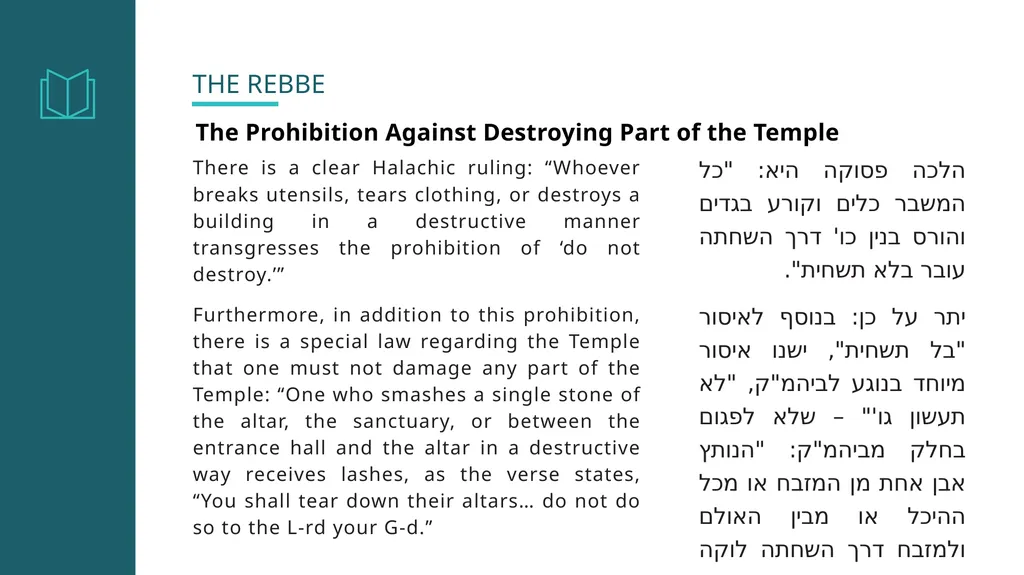
THE REBBE There is a clear Halachic ruling: “Whoever breaks utensils, tears clothing, or destroys a building in a destructive manner transgresses the prohibition of ‘do not destroy.’”
Furthermore, in addition to this prohibition, there is a special law regarding the Temple that one must not damage any part of the Temple: “One who smashes a single stone of the altar, the sanctuary, or between the entrance hall and the altar in a destructive way receives lashes, as the verse states, “You shall tear down their altars… do not do so to the L-rd your G-d.” הלכה פסוקה היא: "כל המשבר כלים וקורע בגדים והורס בנין כו' דרך השחתה עובר בלא תשחית".
יתר על כן: בנוסף לאיסור "בל תשחית", ישנו איסור מיוחד בנוגע לביהמ"ק, "לא תעשון גו'" – שלא לפגום בחלק מביהמ"ק: "הנותץ אבן אחת מן המזבח או מכל ההיכל או מבין האולם ולמזבח דרך השחתה לוקה שנאמר ונתצתם את מזבחותם וגו' לא תעשון כן לה' אלקיכם", The Prohibition Against Destroying Part of the Temple<br>
Furthermore, in addition to this prohibition, there is a special law regarding the Temple that one must not damage any part of the Temple: “One who smashes a single stone of the altar, the sanctuary, or between the entrance hall and the altar in a destructive way receives lashes, as the verse states, “You shall tear down their altars… do not do so to the L-rd your G-d.” הלכה פסוקה היא: "כל המשבר כלים וקורע בגדים והורס בנין כו' דרך השחתה עובר בלא תשחית".
יתר על כן: בנוסף לאיסור "בל תשחית", ישנו איסור מיוחד בנוגע לביהמ"ק, "לא תעשון גו'" – שלא לפגום בחלק מביהמ"ק: "הנותץ אבן אחת מן המזבח או מכל ההיכל או מבין האולם ולמזבח דרך השחתה לוקה שנאמר ונתצתם את מזבחותם וגו' לא תעשון כן לה' אלקיכם", The Prohibition Against Destroying Part of the Temple<br>
29
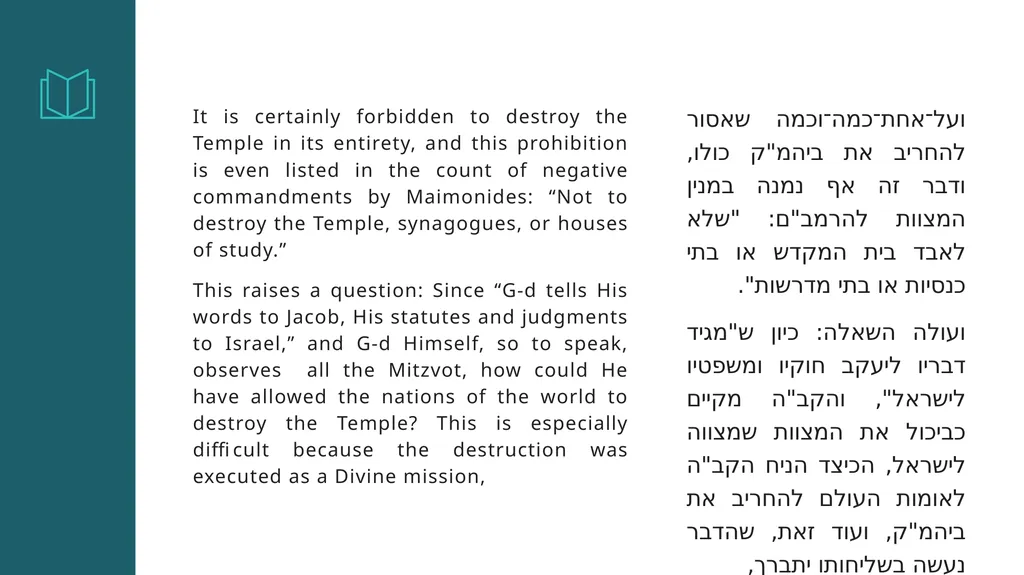
It is certainly forbidden to destroy the Temple in its entirety, and this prohibition is even listed in the count of negative commandments by Maimonides: “Not to destroy the Temple, synagogues, or houses of study.”
This raises a question: Since “G-d tells His words to Jacob, His statutes and judgments to Israel,” and G-d Himself, so to speak, observes all the Mitzvot, how could He have allowed the nations of the world to destroy the Temple? This is especially difficult because the destruction was executed as a Divine mission, ועל־אחת־כמה־וכמה שאסור להחריב את ביהמ"ק כולו, ודבר זה אף נמנה במנין המצוות להרמב"ם: "שלא לאבד בית המקדש או בתי כנסיות או בתי מדרשות".
ועולה השאלה: כיון ש"מגיד דבריו ליעקב חוקיו ומשפטיו לישראל", והקב"ה מקיים כביכול את המצוות שמצווה לישראל, הכיצד הניח הקב"ה לאומות העולם להחריב את ביהמ"ק, ועוד זאת, שהדבר נעשה בשליחותו יתברך,<br>
This raises a question: Since “G-d tells His words to Jacob, His statutes and judgments to Israel,” and G-d Himself, so to speak, observes all the Mitzvot, how could He have allowed the nations of the world to destroy the Temple? This is especially difficult because the destruction was executed as a Divine mission, ועל־אחת־כמה־וכמה שאסור להחריב את ביהמ"ק כולו, ודבר זה אף נמנה במנין המצוות להרמב"ם: "שלא לאבד בית המקדש או בתי כנסיות או בתי מדרשות".
ועולה השאלה: כיון ש"מגיד דבריו ליעקב חוקיו ומשפטיו לישראל", והקב"ה מקיים כביכול את המצוות שמצווה לישראל, הכיצד הניח הקב"ה לאומות העולם להחריב את ביהמ"ק, ועוד זאת, שהדבר נעשה בשליחותו יתברך,<br>
30
As the prophecy states: “Behold, I will send and take… Nebuchadnezzar king of Babylon, My servant.”
If the Jewish people were unworthy of the Temple, G-d could have simply buried it, just as we find regarding the Tabernacle, that “the Tent of Meeting was hidden.” Even regarding the Temple itself we are told “Her gates sank into the earth,” and several of the sacred Temple vessels were also buried. כדכתיב בנבואה "הנני שולח ולקחתי גו' ואל נבוכדראצר מלך בבל עבדי גו'"?!
ואם מפני שלא היו ישראל ראויים לביהמ"ק – הרי היה ביכולת הקב"ה לגנוז את המקדש, וכמו שמצינו בנוגע למשכן ש"נגנז אוהל מועד כו'", ובפרט שגם במקדש עצמו מצינו ש"טבעו בארץ שעריה", ועל־דרך־זה נגנזו כמה מהכלים.<br>
If the Jewish people were unworthy of the Temple, G-d could have simply buried it, just as we find regarding the Tabernacle, that “the Tent of Meeting was hidden.” Even regarding the Temple itself we are told “Her gates sank into the earth,” and several of the sacred Temple vessels were also buried. כדכתיב בנבואה "הנני שולח ולקחתי גו' ואל נבוכדראצר מלך בבל עבדי גו'"?!
ואם מפני שלא היו ישראל ראויים לביהמ"ק – הרי היה ביכולת הקב"ה לגנוז את המקדש, וכמו שמצינו בנוגע למשכן ש"נגנז אוהל מועד כו'", ובפרט שגם במקדש עצמו מצינו ש"טבעו בארץ שעריה", ועל־דרך־זה נגנזו כמה מהכלים.<br>
31
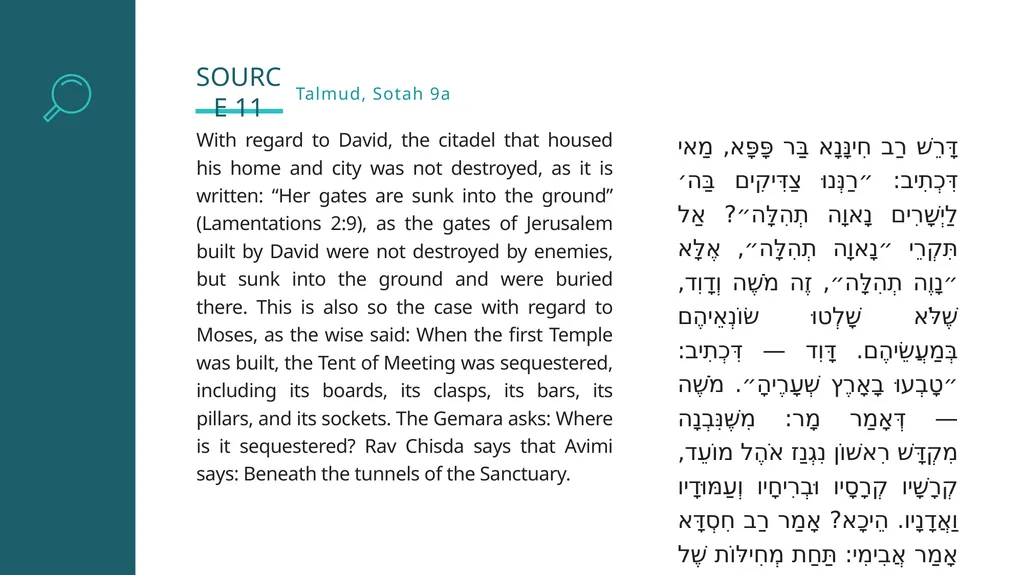
SOURCE 11 Talmud, Sotah 9a With regard to David, the citadel that housed his home and city was not destroyed, as it is written: “Her gates are sunk into the ground” (Lamentations 2:9), as the gates of Jerusalem built by David were not destroyed by enemies, but sunk into the ground and were buried there. This is also so the case with regard to Moses, as the wise said: When the first Temple was built, the Tent of Meeting was sequestered, including its boards, its clasps, its bars, its pillars, and its sockets. The Gemara asks: Where is it sequestered? Rav Chisda says that Avimi says: Beneath the tunnels of the Sanctuary. דָּרֵשׁ רַב חִינָּנָא בַּר פָּפָּא, מַאי דִּכְתִיב: ״רַנְּנוּ צַדִּיקִים בַּה׳ לַיְשָׁרִים נָאוָה תְהִלָּה״? אַל תִּקְרֵי ״נָאוָה תְהִלָּה״, אֶלָּא ״נָוֶה תְהִלָּה״, זֶה מֹשֶׁה וְדָוִד, שֶׁלֹּא שָׁלְטוּ שׂוֹנְאֵיהֶם בְּמַעֲשֵׂיהֶם. דָּוִד — דִּכְתִיב: ״טָבְעוּ בָאָרֶץ שְׁעָרֶיהָ״. מֹשֶׁה — דְּאָמַר מָר: מִשֶּׁנִּבְנָה מִקְדָּשׁ רִאשׁוֹן נִגְנַז אֹהֶל מוֹעֵד, קְרָשָׁיו קְרָסָיו וּבְרִיחָיו וְעַמּוּדָיו וַאֲדָנָיו. הֵיכָא? אָמַר רַב חִסְדָּא אָמַר אֲבִימִי: תַּחַת מְחִילּוֹת שֶׁל הֵיכָל.<br>
32
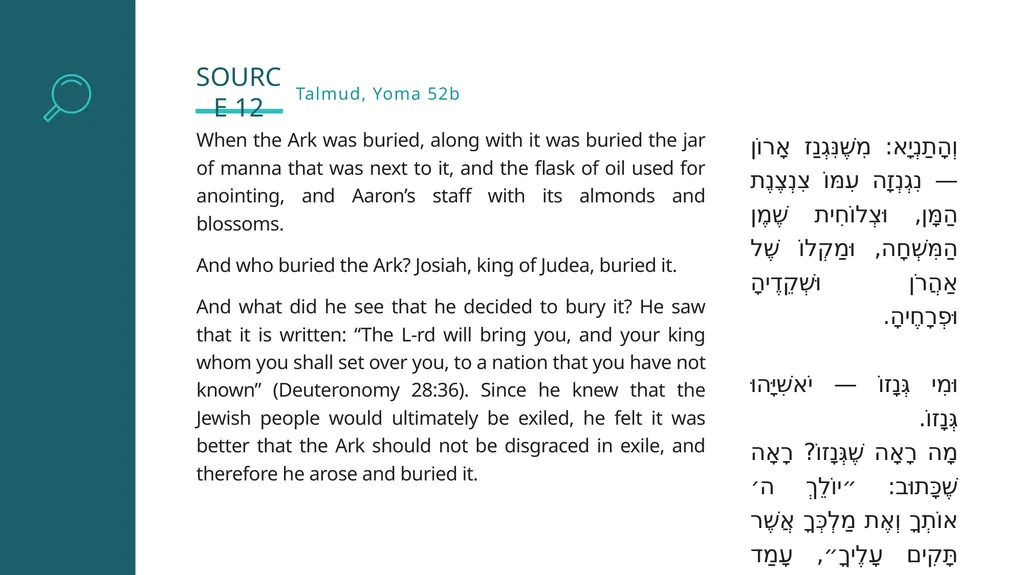
SOURCE 12 Talmud, Yoma 52b When the Ark was buried, along with it was buried the jar of manna that was next to it, and the flask of oil used for anointing, and Aaron’s staff with its almonds and blossoms.
And who buried the Ark? Josiah, king of Judea, buried it.
And what did he see that he decided to bury it? He saw that it is written: “The L-rd will bring you, and your king whom you shall set over you, to a nation that you have not known” (Deuteronomy 28:36). Since he knew that the Jewish people would ultimately be exiled, he felt it was better that the Ark should not be disgraced in exile, and therefore he arose and buried it. וְהָתַנְיָא: מִשֶּׁנִּגְנַז אָרוֹן — נִגְנְזָה עִמּוֹ צִנְצֶנֶת הַמָּן, וּצְלוֹחִית שֶׁמֶן הַמִּשְׁחָה, וּמַקְלוֹ שֶׁל אַהֲרֹן וּשְׁקֵדֶיהָ וּפְרָחֶיהָ.
וּמִי גְּנָזוֹ — יֹאשִׁיָּהוּ גְּנָזוֹ.
מָה רָאָה שֶׁגְּנָזוֹ? רָאָה שֶׁכָּתוּב: ״יוֹלֵךְ ה׳ אוֹתְךָ וְאֶת מַלְכְּךָ אֲשֶׁר תָּקִים עָלֶיךָ״, עָמַד וּגְנָזוֹ.<br>
And who buried the Ark? Josiah, king of Judea, buried it.
And what did he see that he decided to bury it? He saw that it is written: “The L-rd will bring you, and your king whom you shall set over you, to a nation that you have not known” (Deuteronomy 28:36). Since he knew that the Jewish people would ultimately be exiled, he felt it was better that the Ark should not be disgraced in exile, and therefore he arose and buried it. וְהָתַנְיָא: מִשֶּׁנִּגְנַז אָרוֹן — נִגְנְזָה עִמּוֹ צִנְצֶנֶת הַמָּן, וּצְלוֹחִית שֶׁמֶן הַמִּשְׁחָה, וּמַקְלוֹ שֶׁל אַהֲרֹן וּשְׁקֵדֶיהָ וּפְרָחֶיהָ.
וּמִי גְּנָזוֹ — יֹאשִׁיָּהוּ גְּנָזוֹ.
מָה רָאָה שֶׁגְּנָזוֹ? רָאָה שֶׁכָּתוּב: ״יוֹלֵךְ ה׳ אוֹתְךָ וְאֶת מַלְכְּךָ אֲשֶׁר תָּקִים עָלֶיךָ״, עָמַד וּגְנָזוֹ.<br>
33
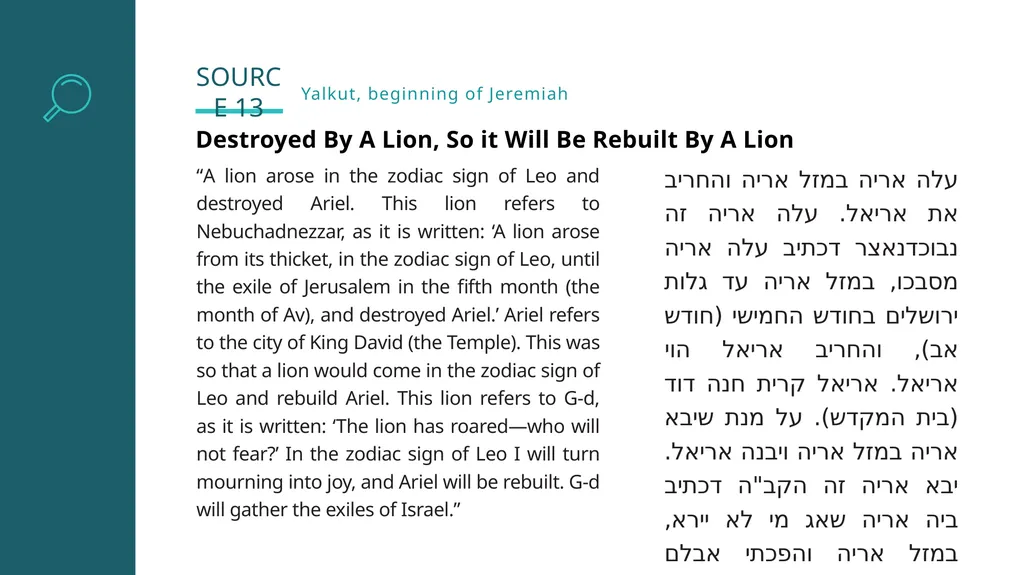
SOURCE 13 Yalkut, beginning of Jeremiah “A lion arose in the zodiac sign of Leo and destroyed Ariel. This lion refers to Nebuchadnezzar, as it is written: ‘A lion arose from its thicket, in the zodiac sign of Leo, until the exile of Jerusalem in the fifth month (the month of Av), and destroyed Ariel.’ Ariel refers to the city of King David (the Temple). This was so that a lion would come in the zodiac sign of Leo and rebuild Ariel. This lion refers to G-d, as it is written: ‘The lion has roared—who will not fear?’ In the zodiac sign of Leo I will turn mourning into joy, and Ariel will be rebuilt. G-d will gather the exiles of Israel.” עלה אריה במזל אריה והחריב את אריאל. עלה אריה זה נבוכדנאצר דכתיב עלה אריה מסבכו, במזל אריה עד גלות ירושלים בחודש החמישי (חודש אב), והחריב אריאל הוי אריאל. אריאל קרית חנה דוד (בית המקדש). על מנת שיבא אריה במזל אריה ויבנה אריאל. יבא אריה זה הקב"ה דכתיב ביה אריה שאג מי לא יירא, במזל אריה והפכתי אבלם לששון, ויבנה אריאל בונה ירושלים ה' נדחי ישראל יכנס". Destroyed By A Lion, So it Will Be Rebuilt By A Lion<br>
34
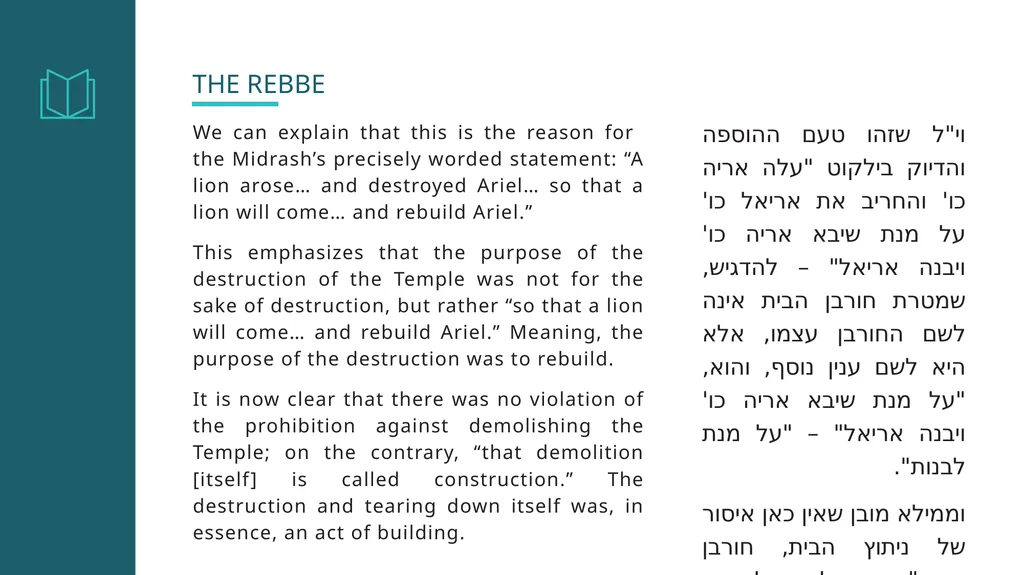
THE REBBE We can explain that this is the reason for the Midrash’s precisely worded statement: “A lion arose… and destroyed Ariel… so that a lion will come… and rebuild Ariel.”
This emphasizes that the purpose of the destruction of the Temple was not for the sake of destruction, but rather “so that a lion will come… and rebuild Ariel.” Meaning, the purpose of the destruction was to rebuild.
It is now clear that there was no violation of the prohibition against demolishing the Temple; on the contrary, “that demolition [itself] is called construction.” The destruction and tearing down itself was, in essence, an act of building. וי"ל שזהו טעם ההוספה והדיוק בילקוט "עלה אריה כו' והחריב את אריאל כו' על מנת שיבא אריה כו' ויבנה אריאל" – להדגיש, שמטרת חורבן הבית אינה לשם החורבן עצמו, אלא היא לשם ענין נוסף, והוא, "על מנת שיבא אריה כו' ויבנה אריאל" – "על מנת לבנות".
וממילא מובן שאין כאן איסור של ניתוץ הבית, חורבן ביהמ"ק, אלא להיפך: "ההיא נתיצה בנין מקרי"– החורבן והניתוץ עצמו ענינו (ושמו) הוא – בנין.<br>
This emphasizes that the purpose of the destruction of the Temple was not for the sake of destruction, but rather “so that a lion will come… and rebuild Ariel.” Meaning, the purpose of the destruction was to rebuild.
It is now clear that there was no violation of the prohibition against demolishing the Temple; on the contrary, “that demolition [itself] is called construction.” The destruction and tearing down itself was, in essence, an act of building. וי"ל שזהו טעם ההוספה והדיוק בילקוט "עלה אריה כו' והחריב את אריאל כו' על מנת שיבא אריה כו' ויבנה אריאל" – להדגיש, שמטרת חורבן הבית אינה לשם החורבן עצמו, אלא היא לשם ענין נוסף, והוא, "על מנת שיבא אריה כו' ויבנה אריאל" – "על מנת לבנות".
וממילא מובן שאין כאן איסור של ניתוץ הבית, חורבן ביהמ"ק, אלא להיפך: "ההיא נתיצה בנין מקרי"– החורבן והניתוץ עצמו ענינו (ושמו) הוא – בנין.<br>
35
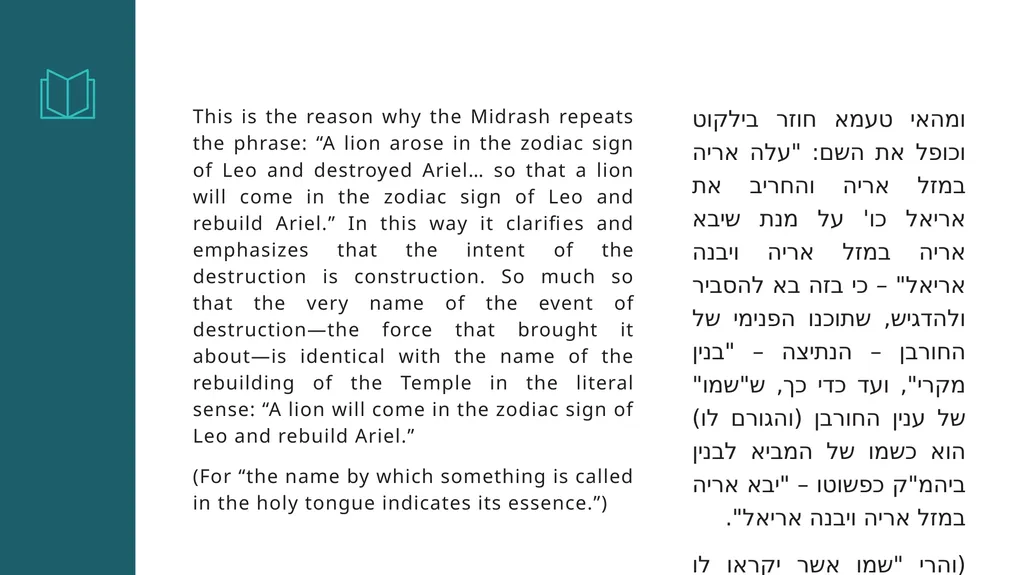
This is the reason why the Midrash repeats the phrase: “A lion arose in the zodiac sign of Leo and destroyed Ariel… so that a lion will come in the zodiac sign of Leo and rebuild Ariel.” In this way it clarifies and emphasizes that the intent of the destruction is construction. So much so that the very name of the event of destruction—the force that brought it about—is identical with the name of the rebuilding of the Temple in the literal sense: “A lion will come in the zodiac sign of Leo and rebuild Ariel.”
(For “the name by which something is called in the holy tongue indicates its essence.”) ומהאי טעמא חוזר בילקוט וכופל את השם: "עלה אריה במזל אריה והחריב את אריאל כו' על מנת שיבא אריה במזל אריה ויבנה אריאל" – כי בזה בא להסביר ולהדגיש, שתוכנו הפנימי של החורבן – הנתיצה – "בנין מקרי", ועד כדי כך, ש"שמו" של ענין החורבן (והגורם לו) הוא כשמו של המביא לבנין ביהמ"ק כפשוטו – "יבא אריה במזל אריה ויבנה אריאל".
(והרי "שמו אשר יקראו לו בלשון הקודש" מורה על תוכן הדבר).<br>
(For “the name by which something is called in the holy tongue indicates its essence.”) ומהאי טעמא חוזר בילקוט וכופל את השם: "עלה אריה במזל אריה והחריב את אריאל כו' על מנת שיבא אריה במזל אריה ויבנה אריאל" – כי בזה בא להסביר ולהדגיש, שתוכנו הפנימי של החורבן – הנתיצה – "בנין מקרי", ועד כדי כך, ש"שמו" של ענין החורבן (והגורם לו) הוא כשמו של המביא לבנין ביהמ"ק כפשוטו – "יבא אריה במזל אריה ויבנה אריאל".
(והרי "שמו אשר יקראו לו בלשון הקודש" מורה על תוכן הדבר).<br>
36
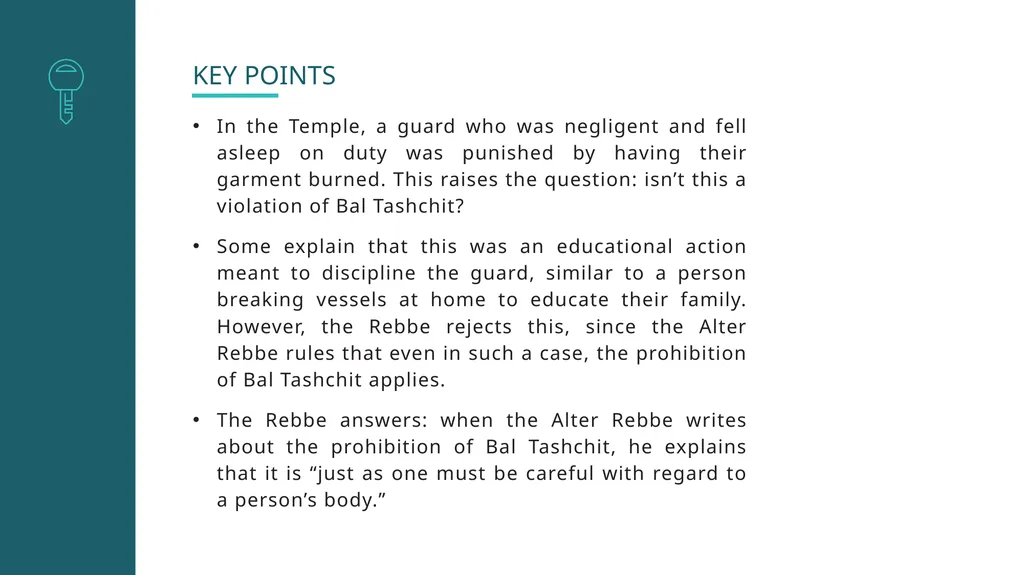
In the Temple, a guard who was negligent and fell asleep on duty was punished by having their garment burned. This raises the question: isn’t this a violation of Bal Tashchit?
Some explain that this was an educational action meant to discipline the guard, similar to a person breaking vessels at home to educate their family. However, the Rebbe rejects this, since the Alter Rebbe rules that even in such a case, the prohibition of Bal Tashchit applies.
The Rebbe answers: when the Alter Rebbe writes about the prohibition of Bal Tashchit, he explains that it is “just as one must be careful with regard to a person’s body.” KEY POINTS<br>
Some explain that this was an educational action meant to discipline the guard, similar to a person breaking vessels at home to educate their family. However, the Rebbe rejects this, since the Alter Rebbe rules that even in such a case, the prohibition of Bal Tashchit applies.
The Rebbe answers: when the Alter Rebbe writes about the prohibition of Bal Tashchit, he explains that it is “just as one must be careful with regard to a person’s body.” KEY POINTS<br>
37
The Alter Rebbe teaches thereby that the two prohibitions—causing bodily suffering and destroying property—share the same underlying principle.
Accordingly, just as the Alter Rebbe rules that it is permitted to fast for repentance, even though it causes bodily suffering, because it benefits the soul and is therefore “good for the person,” so too in matters of property it is permitted for the Temple official to destroy the guard’s garment in order to prompt him to repent. Since this benefits his soul, it is considered for his good. KEY POINTS<br>
Accordingly, just as the Alter Rebbe rules that it is permitted to fast for repentance, even though it causes bodily suffering, because it benefits the soul and is therefore “good for the person,” so too in matters of property it is permitted for the Temple official to destroy the guard’s garment in order to prompt him to repent. Since this benefits his soul, it is considered for his good. KEY POINTS<br>
38
In a similar case, the Rebbe asks: since G-d fulfills the commandments given to Israel, how could He allow the nations of the world to destroy the Temple through His agency, despite the prohibition of Bal Tashchit?
The answer: the purpose of the destruction was not mere ruin, but preparation for a future, higher, and eternal rebuilding. Therefore, the destruction itself is part of the building process. KEY POINTS<br>
The answer: the purpose of the destruction was not mere ruin, but preparation for a future, higher, and eternal rebuilding. Therefore, the destruction itself is part of the building process. KEY POINTS<br>
39
Thursday, 7pm<br>