
SHS Sector Webinar Thursday 13 August 2020
TF
Published · 14 slides · 0 views

1 / 1
Description
SHS Sector Webinar Thursday 13 August 2020 Presenter: Joe Parsons Director Design Stewardship, Housing Homelessness Strategy, Policy and Commissioning Department of Communities and Justice Update COVID-19 planning for public housing
Related Topics
Share
Embed code
Download this presentation From Below
"SHS Sector Webinar Thursday 13 August 2020" is the property of its rightful owner. Permission is granted to download and print the materials on this website for personal, non-commercial use only, and to display it on your personal computer provided you do not modify the materials and that you retain all copyright notices contained in the materials. By downloading content from our website, you accept the terms of this agreement.
Presentation Transcript
01
SHS Sector Webinar Thursday 13 August 2020
Presenter: Joe Parsons
Director Design & Stewardship, Housing & Homelessness
Strategy, Policy and Commissioning
Department of Communities and Justice<br>
Presenter: Joe Parsons
Director Design & Stewardship, Housing & Homelessness
Strategy, Policy and Commissioning
Department of Communities and Justice<br>
02
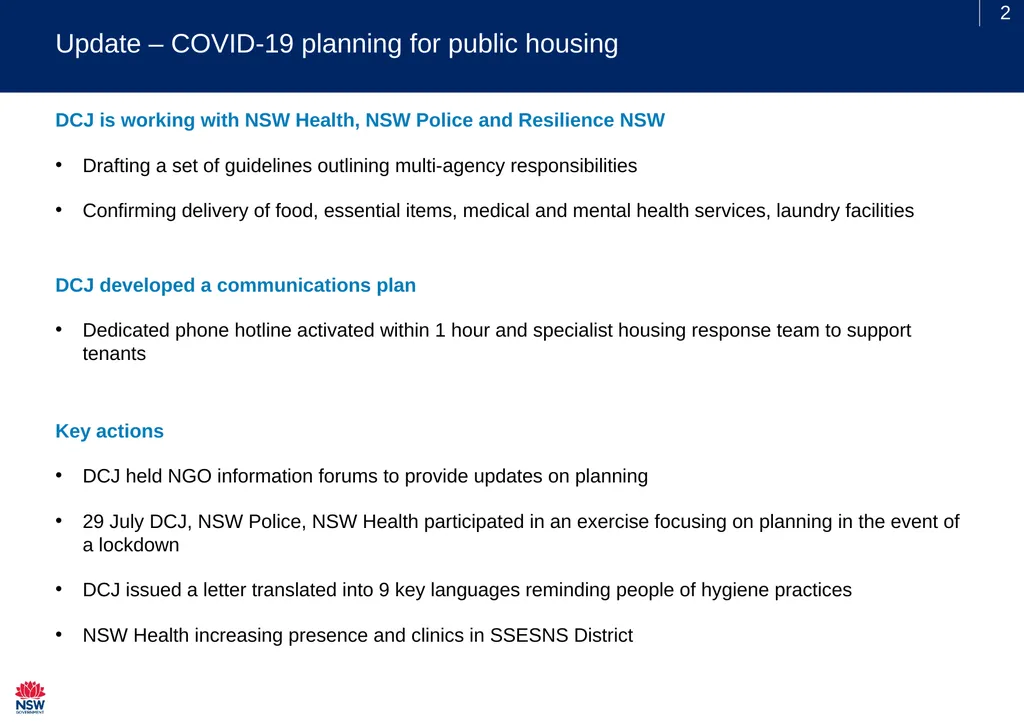
Update – COVID-19 planning for public housing DCJ is working with NSW Health, NSW Police and Resilience NSW
Drafting a set of guidelines outlining multi-agency responsibilities
Confirming delivery of food, essential items, medical and mental health services, laundry facilities
DCJ developed a communications plan
Dedicated phone hotline activated within 1 hour and specialist housing response team to support tenants
Key actions
DCJ held NGO information forums to provide updates on planning
29 July DCJ, NSW Police, NSW Health participated in an exercise focusing on planning in the event of a lockdown
DCJ issued a letter translated into 9 key languages reminding people of hygiene practices
NSW Health increasing presence and clinics in SSESNS District<br>
Drafting a set of guidelines outlining multi-agency responsibilities
Confirming delivery of food, essential items, medical and mental health services, laundry facilities
DCJ developed a communications plan
Dedicated phone hotline activated within 1 hour and specialist housing response team to support tenants
Key actions
DCJ held NGO information forums to provide updates on planning
29 July DCJ, NSW Police, NSW Health participated in an exercise focusing on planning in the event of a lockdown
DCJ issued a letter translated into 9 key languages reminding people of hygiene practices
NSW Health increasing presence and clinics in SSESNS District<br>
03
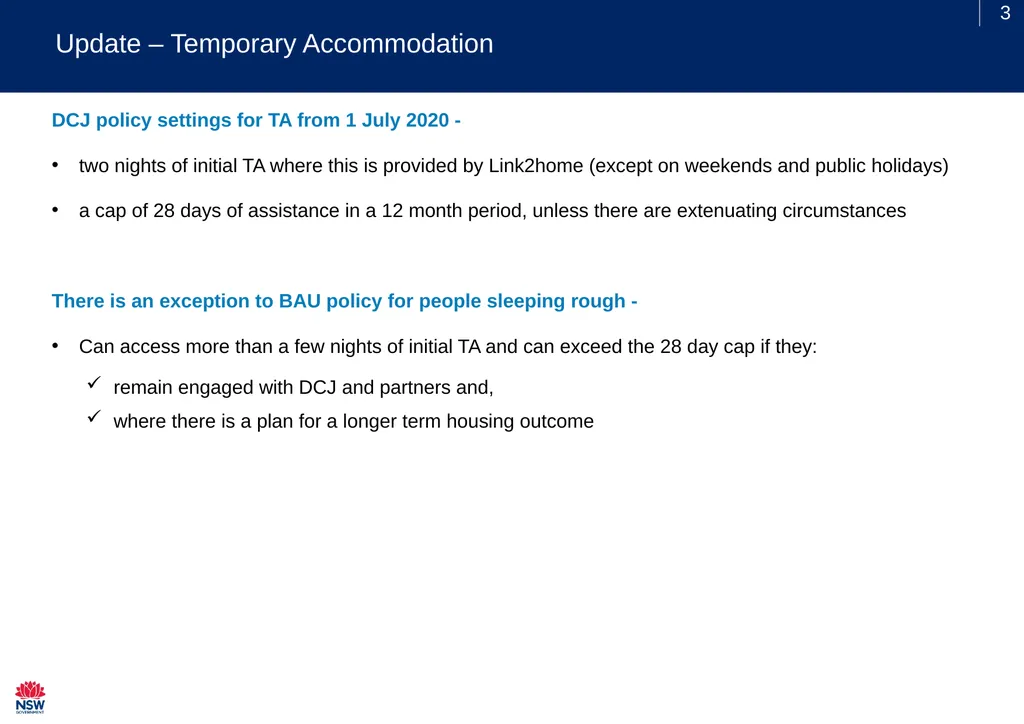
Update – Temporary Accommodation DCJ policy settings for TA from 1 July 2020 -
two nights of initial TA where this is provided by Link2home (except on weekends and public holidays)
a cap of 28 days of assistance in a 12 month period, unless there are extenuating circumstances
There is an exception to BAU policy for people sleeping rough -
Can access more than a few nights of initial TA and can exceed the 28 day cap if they:
remain engaged with DCJ and partners and,
where there is a plan for a longer term housing outcome<br>
two nights of initial TA where this is provided by Link2home (except on weekends and public holidays)
a cap of 28 days of assistance in a 12 month period, unless there are extenuating circumstances
There is an exception to BAU policy for people sleeping rough -
Can access more than a few nights of initial TA and can exceed the 28 day cap if they:
remain engaged with DCJ and partners and,
where there is a plan for a longer term housing outcome<br>
04
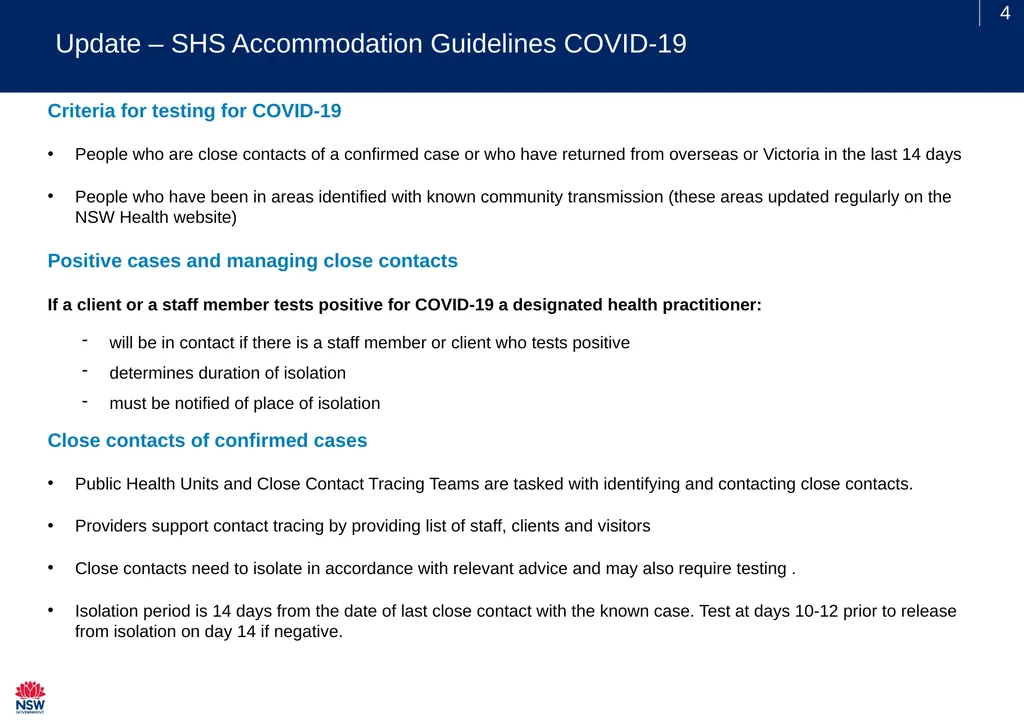
Update – SHS Accommodation Guidelines COVID-19 Criteria for testing for COVID-19
People who are close contacts of a confirmed case or who have returned from overseas or Victoria in the last 14 days
People who have been in areas identified with known community transmission (these areas updated regularly on the NSW Health website)
Positive cases and managing close contacts
If a client or a staff member tests positive for COVID-19 a designated health practitioner:
will be in contact if there is a staff member or client who tests positive
determines duration of isolation
must be notified of place of isolation
Close contacts of confirmed cases
Public Health Units and Close Contact Tracing Teams are tasked with identifying and contacting close contacts.
Providers support contact tracing by providing list of staff, clients and visitors
Close contacts need to isolate in accordance with relevant advice and may also require testing .
Isolation period is 14 days from the date of last close contact with the known case. Test at days 10-12 prior to release from isolation on day 14 if negative.<br>
People who are close contacts of a confirmed case or who have returned from overseas or Victoria in the last 14 days
People who have been in areas identified with known community transmission (these areas updated regularly on the NSW Health website)
Positive cases and managing close contacts
If a client or a staff member tests positive for COVID-19 a designated health practitioner:
will be in contact if there is a staff member or client who tests positive
determines duration of isolation
must be notified of place of isolation
Close contacts of confirmed cases
Public Health Units and Close Contact Tracing Teams are tasked with identifying and contacting close contacts.
Providers support contact tracing by providing list of staff, clients and visitors
Close contacts need to isolate in accordance with relevant advice and may also require testing .
Isolation period is 14 days from the date of last close contact with the known case. Test at days 10-12 prior to release from isolation on day 14 if negative.<br>
05
Update – SHS Accommodation Guidelines COVID-19 Screening for those at increased risk
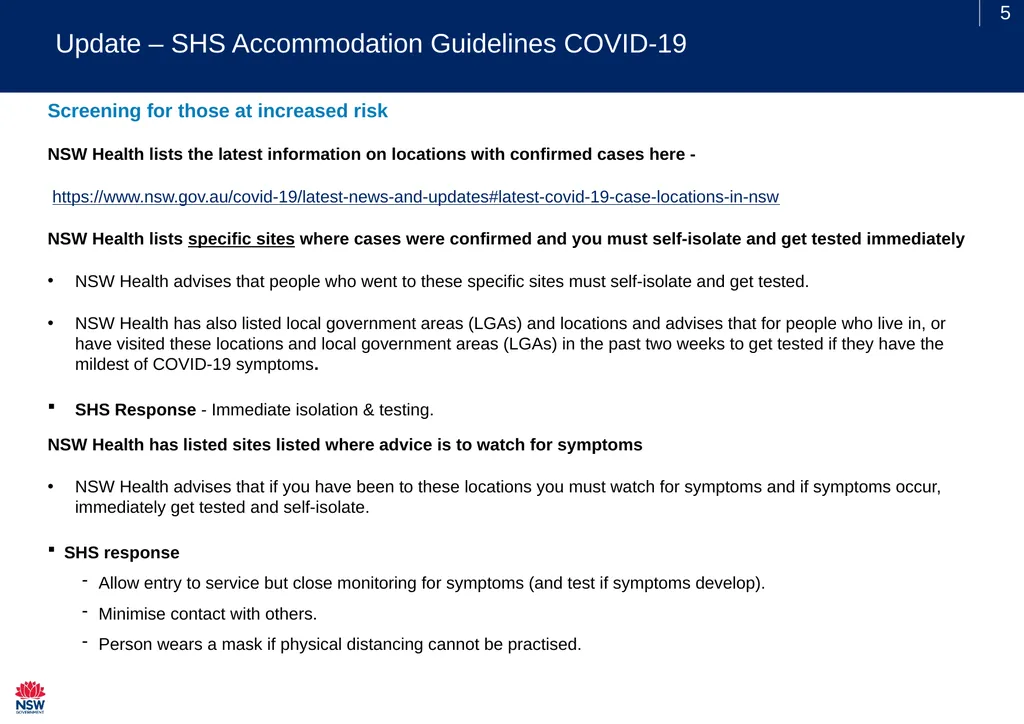
NSW Health lists the latest information on locations with confirmed cases here -
https://www.nsw.gov.au/covid-19/latest-news-and-updates#latest-covid-19-case-locations-in-nsw
NSW Health lists specific sites where cases were confirmed and you must self-isolate and get tested immediately
NSW Health advises that people who went to these specific sites must self-isolate and get tested.
NSW Health has also listed local government areas (LGAs) and locations and advises that for people who live in, or have visited these locations and local government areas (LGAs) in the past two weeks to get tested if they have the mildest of COVID-19 symptoms.
SHS Response - Immediate isolation & testing.
NSW Health has listed sites listed where advice is to watch for symptoms
NSW Health advises that if you have been to these locations you must watch for symptoms and if symptoms occur, immediately get tested and self-isolate.
SHS response
Allow entry to service but close monitoring for symptoms (and test if symptoms develop).
Minimise contact with others.
Person wears a mask if physical distancing cannot be practised.<br>
NSW Health lists the latest information on locations with confirmed cases here -
https://www.nsw.gov.au/covid-19/latest-news-and-updates#latest-covid-19-case-locations-in-nsw
NSW Health lists specific sites where cases were confirmed and you must self-isolate and get tested immediately
NSW Health advises that people who went to these specific sites must self-isolate and get tested.
NSW Health has also listed local government areas (LGAs) and locations and advises that for people who live in, or have visited these locations and local government areas (LGAs) in the past two weeks to get tested if they have the mildest of COVID-19 symptoms.
SHS Response - Immediate isolation & testing.
NSW Health has listed sites listed where advice is to watch for symptoms
NSW Health advises that if you have been to these locations you must watch for symptoms and if symptoms occur, immediately get tested and self-isolate.
SHS response
Allow entry to service but close monitoring for symptoms (and test if symptoms develop).
Minimise contact with others.
Person wears a mask if physical distancing cannot be practised.<br>
06
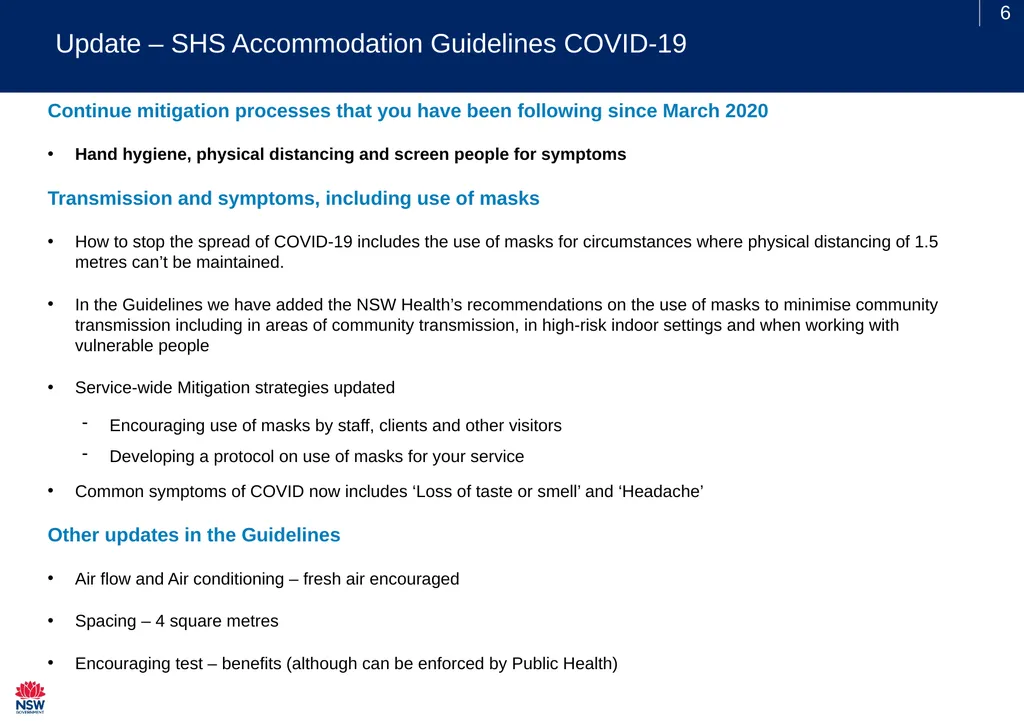
Update – SHS Accommodation Guidelines COVID-19 Continue mitigation processes that you have been following since March 2020
Hand hygiene, physical distancing and screen people for symptoms
Transmission and symptoms, including use of masks
How to stop the spread of COVID-19 includes the use of masks for circumstances where physical distancing of 1.5 metres can’t be maintained.
In the Guidelines we have added the NSW Health’s recommendations on the use of masks to minimise community transmission including in areas of community transmission, in high-risk indoor settings and when working with vulnerable people
Service-wide Mitigation strategies updated
Encouraging use of masks by staff, clients and other visitors
Developing a protocol on use of masks for your service
Common symptoms of COVID now includes ‘Loss of taste or smell’ and ‘Headache’
Other updates in the Guidelines
Air flow and Air conditioning – fresh air encouraged
Spacing – 4 square metres
Encouraging test – benefits (although can be enforced by Public Health)<br>
Hand hygiene, physical distancing and screen people for symptoms
Transmission and symptoms, including use of masks
How to stop the spread of COVID-19 includes the use of masks for circumstances where physical distancing of 1.5 metres can’t be maintained.
In the Guidelines we have added the NSW Health’s recommendations on the use of masks to minimise community transmission including in areas of community transmission, in high-risk indoor settings and when working with vulnerable people
Service-wide Mitigation strategies updated
Encouraging use of masks by staff, clients and other visitors
Developing a protocol on use of masks for your service
Common symptoms of COVID now includes ‘Loss of taste or smell’ and ‘Headache’
Other updates in the Guidelines
Air flow and Air conditioning – fresh air encouraged
Spacing – 4 square metres
Encouraging test – benefits (although can be enforced by Public Health)<br>
07
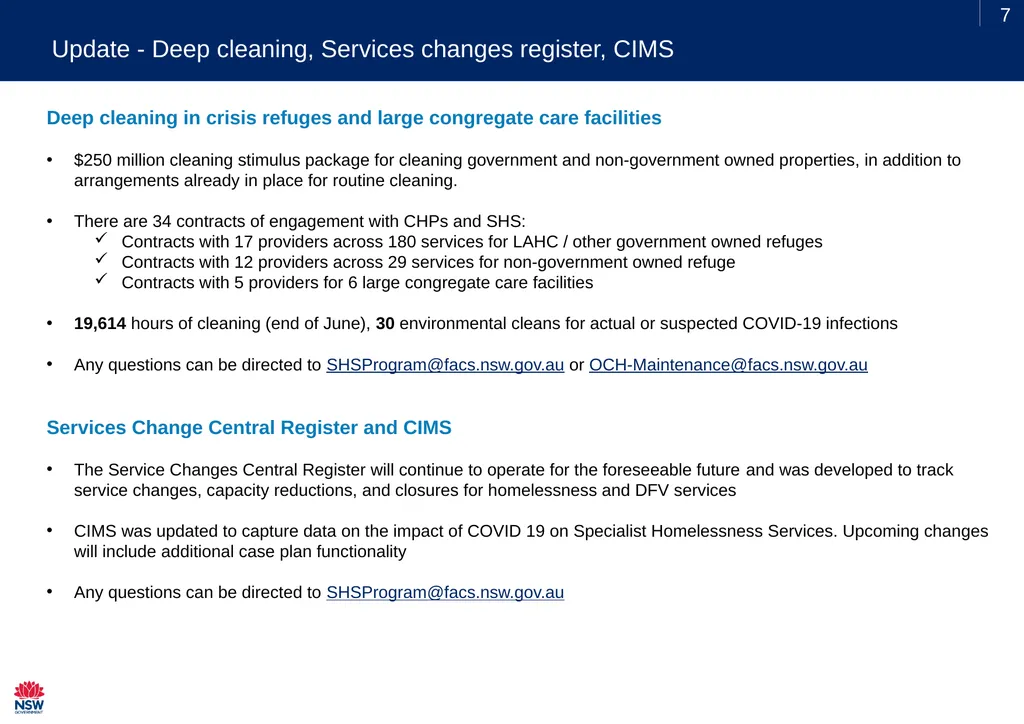
Update - Deep cleaning, Services changes register, CIMS Deep cleaning in crisis refuges and large congregate care facilities
$250 million cleaning stimulus package for cleaning government and non-government owned properties, in addition to arrangements already in place for routine cleaning.
There are 34 contracts of engagement with CHPs and SHS:
Contracts with 17 providers across 180 services for LAHC / other government owned refuges
Contracts with 12 providers across 29 services for non-government owned refuge
Contracts with 5 providers for 6 large congregate care facilities
19,614 hours of cleaning (end of June), 30 environmental cleans for actual or suspected COVID-19 infections
Any questions can be directed to SHSProgram@facs.nsw.gov.au or OCH-Maintenance@facs.nsw.gov.au
Services Change Central Register and CIMS
The Service Changes Central Register will continue to operate for the foreseeable future and was developed to track service changes, capacity reductions, and closures for homelessness and DFV services
CIMS was updated to capture data on the impact of COVID 19 on Specialist Homelessness Services. Upcoming changes will include additional case plan functionality
Any questions can be directed to SHSProgram@facs.nsw.gov.au<br>
$250 million cleaning stimulus package for cleaning government and non-government owned properties, in addition to arrangements already in place for routine cleaning.
There are 34 contracts of engagement with CHPs and SHS:
Contracts with 17 providers across 180 services for LAHC / other government owned refuges
Contracts with 12 providers across 29 services for non-government owned refuge
Contracts with 5 providers for 6 large congregate care facilities
19,614 hours of cleaning (end of June), 30 environmental cleans for actual or suspected COVID-19 infections
Any questions can be directed to SHSProgram@facs.nsw.gov.au or OCH-Maintenance@facs.nsw.gov.au
Services Change Central Register and CIMS
The Service Changes Central Register will continue to operate for the foreseeable future and was developed to track service changes, capacity reductions, and closures for homelessness and DFV services
CIMS was updated to capture data on the impact of COVID 19 on Specialist Homelessness Services. Upcoming changes will include additional case plan functionality
Any questions can be directed to SHSProgram@facs.nsw.gov.au<br>
08
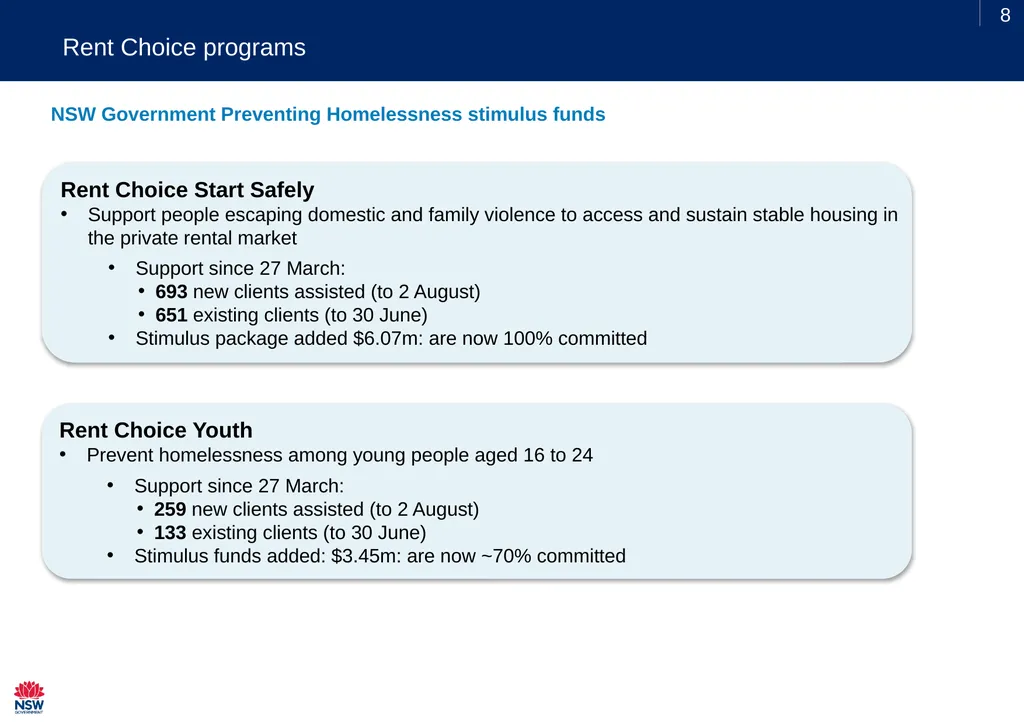
Rent Choice programs NSW Government Preventing Homelessness stimulus funds Rent Choice Youth
Prevent homelessness among young people aged 16 to 24
Support since 27 March:
259 new clients assisted (to 2 August)
133 existing clients (to 30 June)
Stimulus funds added: $3.45m: are now ~70% committed Rent Choice Start Safely
Support people escaping domestic and family violence to access and sustain stable housing in the private rental market
Support since 27 March:
693 new clients assisted (to 2 August)
651 existing clients (to 30 June)
Stimulus package added $6.07m: are now 100% committed<br>
Prevent homelessness among young people aged 16 to 24
Support since 27 March:
259 new clients assisted (to 2 August)
133 existing clients (to 30 June)
Stimulus funds added: $3.45m: are now ~70% committed Rent Choice Start Safely
Support people escaping domestic and family violence to access and sustain stable housing in the private rental market
Support since 27 March:
693 new clients assisted (to 2 August)
651 existing clients (to 30 June)
Stimulus package added $6.07m: are now 100% committed<br>
09
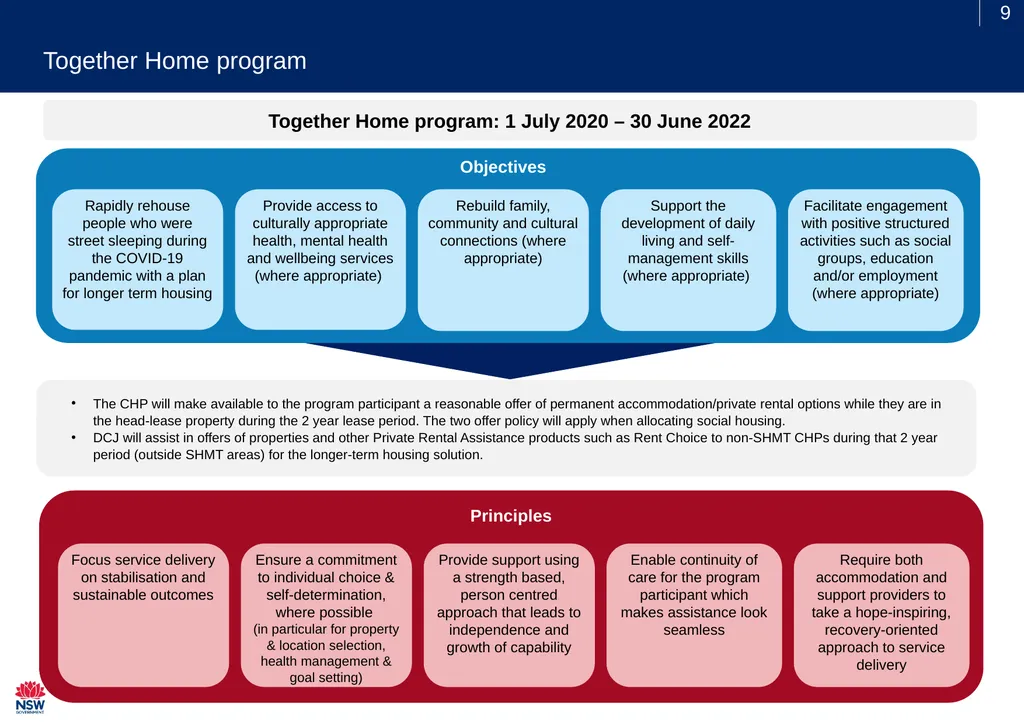
Together Home program Together Home program: 1 July 2020 – 30 June 2022<br>
10
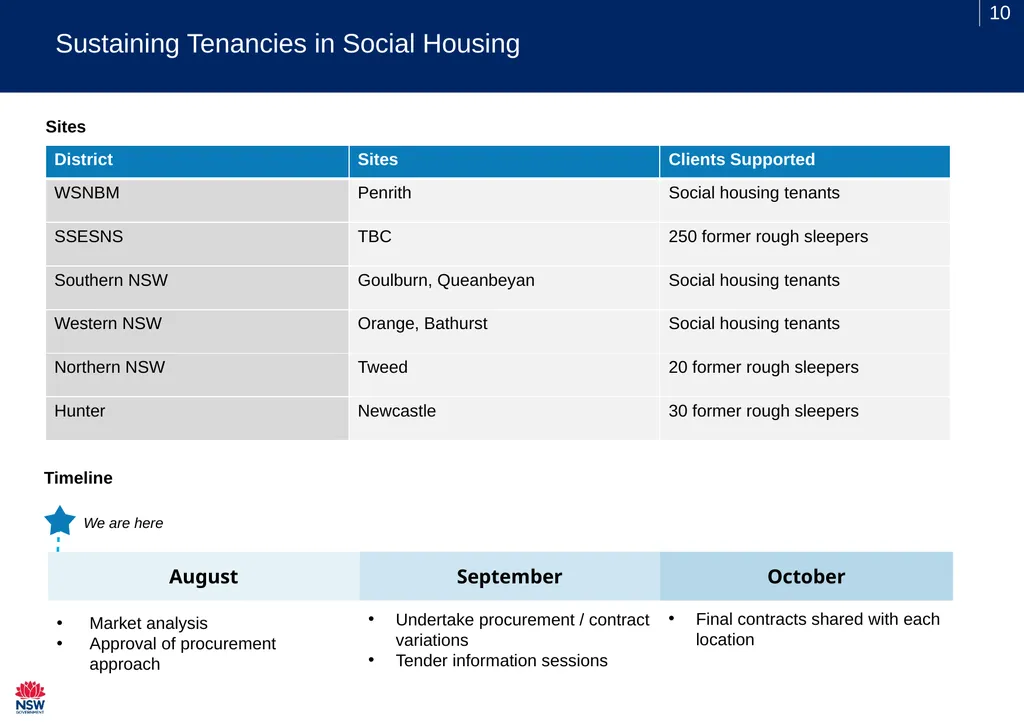
Sustaining Tenancies in Social Housing Timeline Sites<br>
11
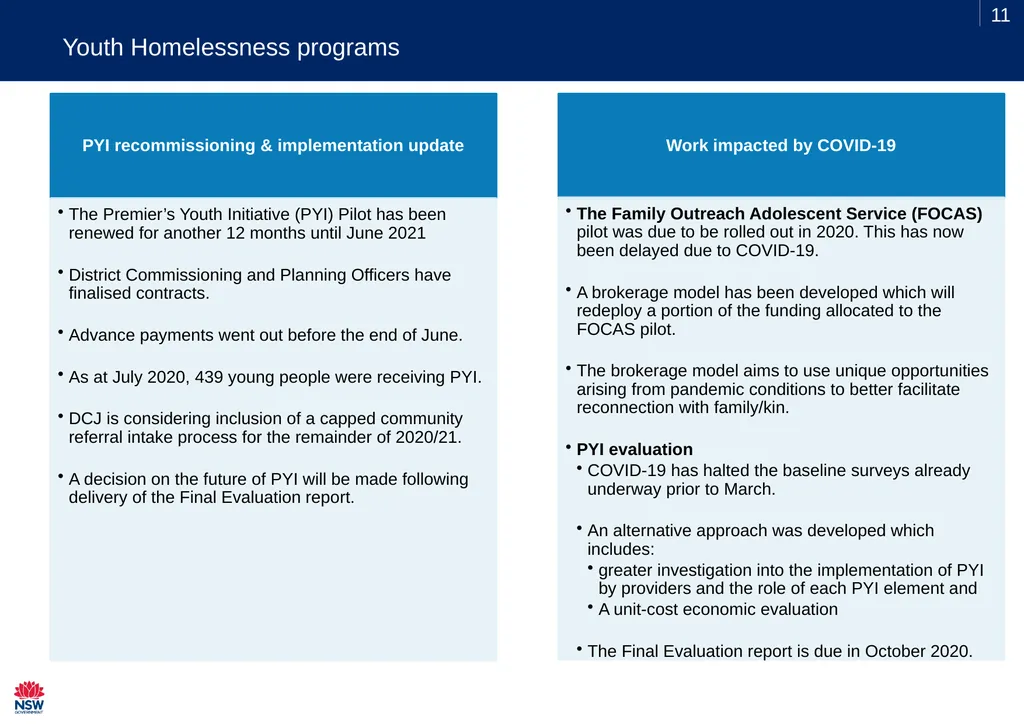
Youth Homelessness programs<br>
12
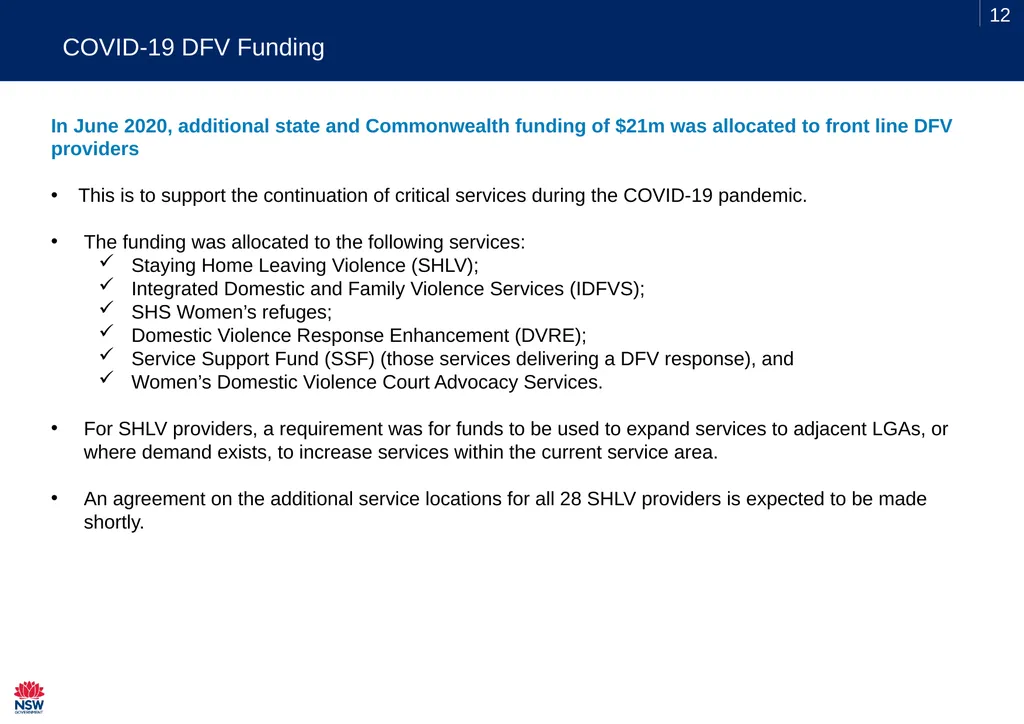
COVID-19 DFV Funding In June 2020, additional state and Commonwealth funding of $21m was allocated to front line DFV providers
This is to support the continuation of critical services during the COVID-19 pandemic.
The funding was allocated to the following services:
Staying Home Leaving Violence (SHLV);
Integrated Domestic and Family Violence Services (IDFVS);
SHS Women’s refuges;
Domestic Violence Response Enhancement (DVRE);
Service Support Fund (SSF) (those services delivering a DFV response), and
Women’s Domestic Violence Court Advocacy Services.
For SHLV providers, a requirement was for funds to be used to expand services to adjacent LGAs, or where demand exists, to increase services within the current service area.
An agreement on the additional service locations for all 28 SHLV providers is expected to be made shortly.<br>
This is to support the continuation of critical services during the COVID-19 pandemic.
The funding was allocated to the following services:
Staying Home Leaving Violence (SHLV);
Integrated Domestic and Family Violence Services (IDFVS);
SHS Women’s refuges;
Domestic Violence Response Enhancement (DVRE);
Service Support Fund (SSF) (those services delivering a DFV response), and
Women’s Domestic Violence Court Advocacy Services.
For SHLV providers, a requirement was for funds to be used to expand services to adjacent LGAs, or where demand exists, to increase services within the current service area.
An agreement on the additional service locations for all 28 SHLV providers is expected to be made shortly.<br>
13
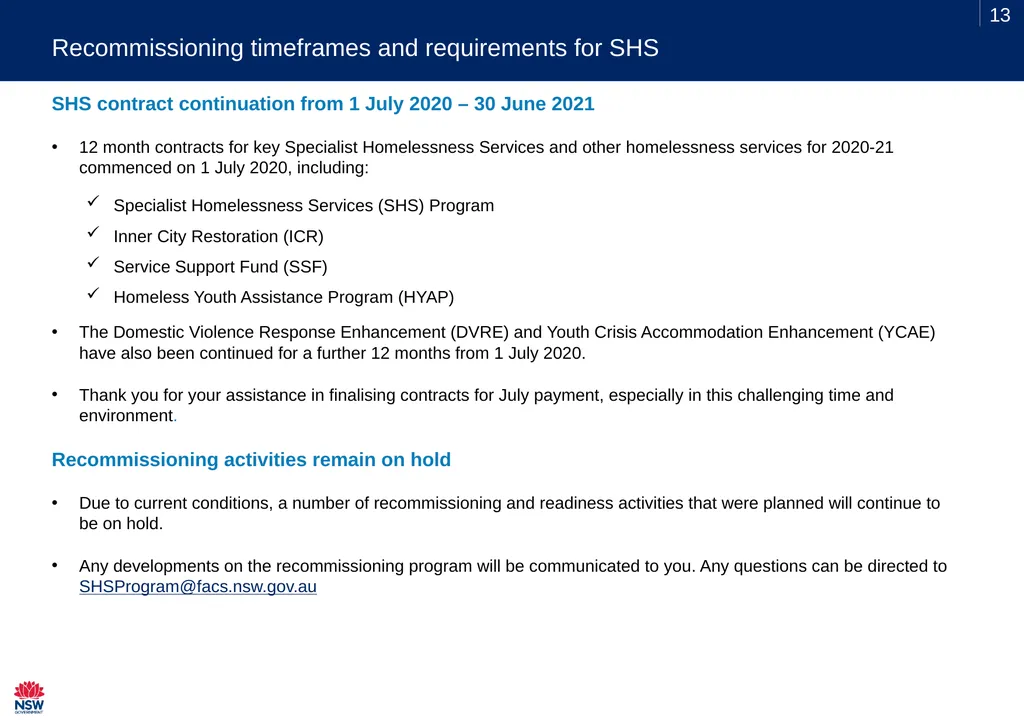
Recommissioning timeframes and requirements for SHS SHS contract continuation from 1 July 2020 – 30 June 2021
12 month contracts for key Specialist Homelessness Services and other homelessness services for 2020-21 commenced on 1 July 2020, including:
Specialist Homelessness Services (SHS) Program
Inner City Restoration (ICR)
Service Support Fund (SSF)
Homeless Youth Assistance Program (HYAP)
The Domestic Violence Response Enhancement (DVRE) and Youth Crisis Accommodation Enhancement (YCAE) have also been continued for a further 12 months from 1 July 2020.
Thank you for your assistance in finalising contracts for July payment, especially in this challenging time and environment.
Recommissioning activities remain on hold
Due to current conditions, a number of recommissioning and readiness activities that were planned will continue to be on hold.
Any developments on the recommissioning program will be communicated to you. Any questions can be directed to SHSProgram@facs.nsw.gov.au<br>
12 month contracts for key Specialist Homelessness Services and other homelessness services for 2020-21 commenced on 1 July 2020, including:
Specialist Homelessness Services (SHS) Program
Inner City Restoration (ICR)
Service Support Fund (SSF)
Homeless Youth Assistance Program (HYAP)
The Domestic Violence Response Enhancement (DVRE) and Youth Crisis Accommodation Enhancement (YCAE) have also been continued for a further 12 months from 1 July 2020.
Thank you for your assistance in finalising contracts for July payment, especially in this challenging time and environment.
Recommissioning activities remain on hold
Due to current conditions, a number of recommissioning and readiness activities that were planned will continue to be on hold.
Any developments on the recommissioning program will be communicated to you. Any questions can be directed to SHSProgram@facs.nsw.gov.au<br>
14
More information Any updates for the sector on COVID-19 can be accessed on the following DCJ website pages:
Service providers and Specialist Homelessness Services.<br>
Service providers and Specialist Homelessness Services.<br>